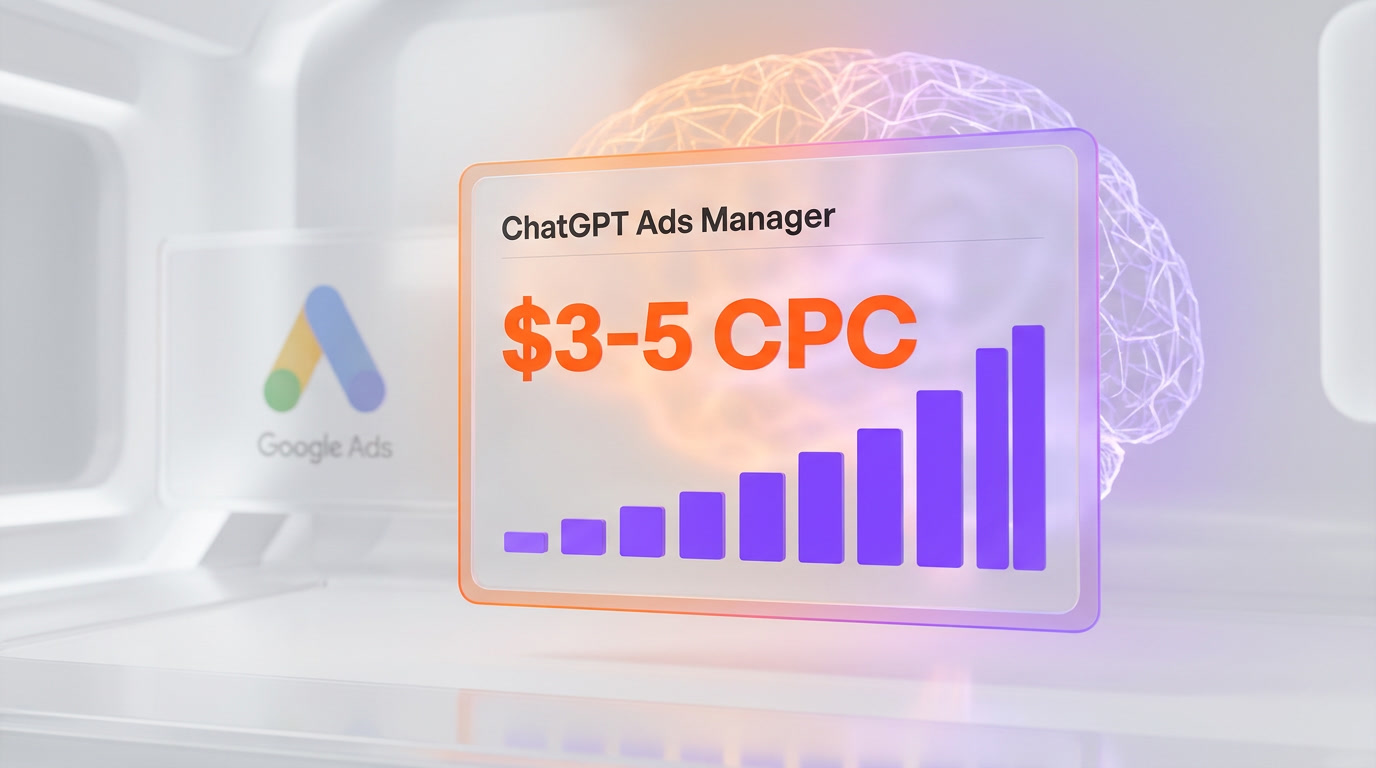
OpenAI launched a self-serve ChatGPT Ads Manager in beta for all US businesses on May 5, 2026. The platform supports cost-per-click (CPC) bidding with a recommended starting maximum bid of $3 to $5 per click, ships a Conversions API and pixel-based measurement for purchases, leads, and sign-ups, and removes the prior $200,000-$250,000 minimum (per ppc.land) spend that gated the original February 2026 pilot. Ads currently appear below responses for ChatGPT Free and Go users in the US, Canada, Australia, and New Zealand. Plus, Pro, and Business subscribers see no ads. With this launch, ChatGPT becomes a real ad platform competing for the same budgets that today flow into Google Ads (over $200 billion annual run rate) and Meta Ads (over $130 billion). It also confirms the OpenAI super-app monetization pivot we tracked in our Anthropic 10-gigawatt empire editorial, which framed the AI market as a three-track race where OpenAI owns the consumer/super-app lane.
What OpenAI Actually Shipped on May 5, 2026
The announcement on the OpenAI blog (titled New ways to buy ChatGPT ads) ships four concrete things at once: a self-serve Ads Manager portal, CPC bidding, conversion measurement (Conversions API plus a pixel), and the removal of the spend gate that kept the original pilot inside a small group of brand advertisers.
Until May 5, buying ChatGPT ads required a managed-service relationship with OpenAI's sales team and a $200,000-$250,000 minimum commitment (per ppc.land coverage) (the figure the original February 2026 pilot opened with). That number was cut to roughly $50,000 in April 2026 as the program expanded, and is now eliminated for self-serve advertisers. Any US business with a payment method and a website can register, set a daily budget, upload creatives, and launch a campaign the same day.
The bidding model also flipped. The February pilot was CPM-only (cost per thousand impressions), which is how brand campaigns typically buy display. The May 5 release adds CPC bidding as the headline performance lever, with OpenAI publicly recommending a $3 to $5 starting maximum bid per click for the US auction. Cost-per-action (CPA) bidding is "in motion" per Asad Awan, OpenAI's head of ads and monetization, but no launch date is committed yet.
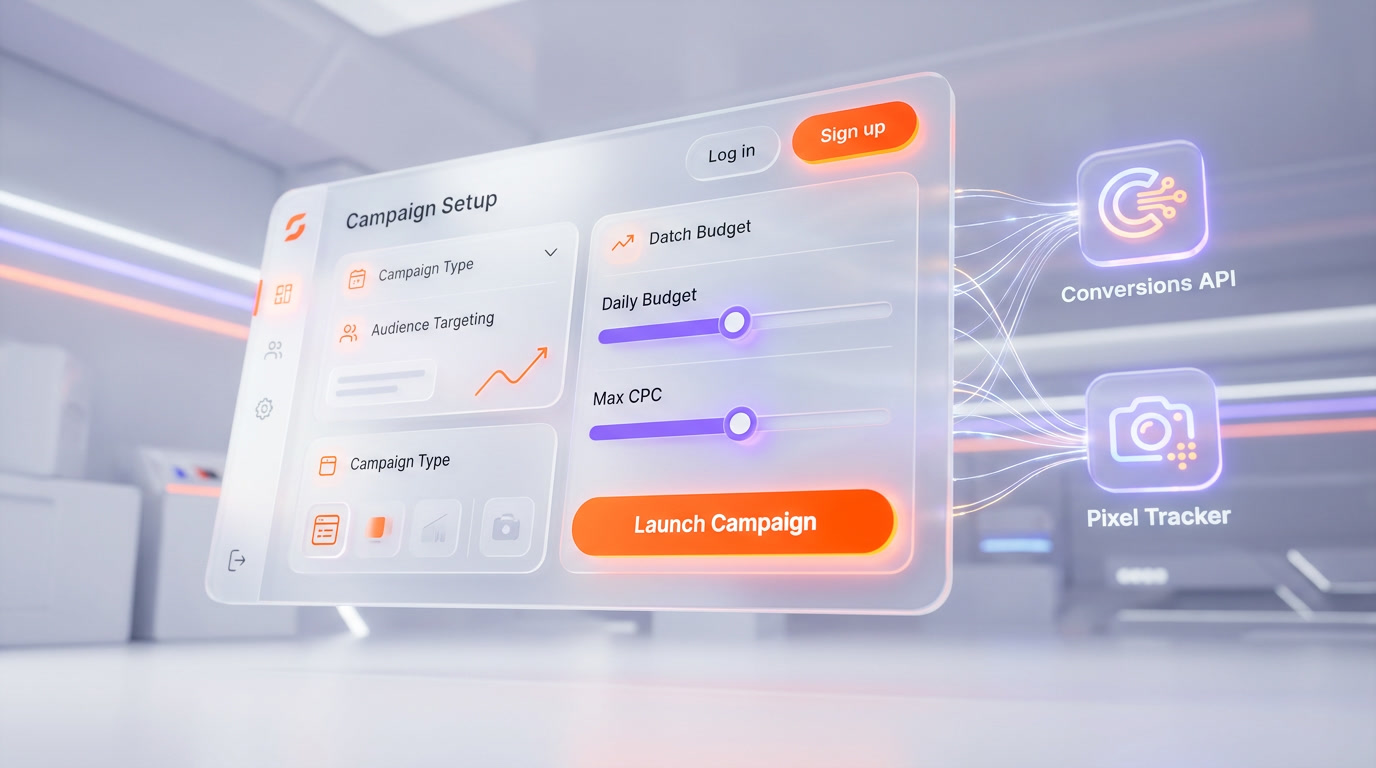
On the measurement side, OpenAI shipped its own Conversions API (a server-side event endpoint, similar in spirit to Meta's CAPI) and a browser pixel. Advertisers can attribute purchases, leads, sign-ups, and custom events back to ChatGPT clicks, with reporting delivered in aggregate inside the Ads Manager portal. UTM parameters can be appended to landing URLs so existing analytics stacks (GA4, Adobe, Amplitude) capture the click as a normal source.
Finally, two guardrails matter. First, third-party measurement partners are not live. Awan confirmed no integrations with the standard MMM/MTA vendors are signed and no timeline has been published. Second, OpenAI is explicit that ads are kept separate from model answers: ad creatives render below the assistant response, never inside it, and user conversations are not shared with advertisers.
Why This Matters: ChatGPT Just Became a Real Ad Platform
Self-serve is the inflection point. As long as the only way to spend was a $250,000 sales call, ChatGPT ads were a brand-budget experiment. With self-serve, CPC bidding, and a pixel, the buying motion looks identical to Google Ads or Meta Ads: log in, attach a payment method, set a daily budget, define audience or keywords (here keyword-style intent inferred from the conversation), upload assets, push live, watch CPCs and conversions roll in.
The total addressable market is huge. Google's advertising business runs above $200 billion annually (per Alphabet's most recent 10-K disclosures), and Meta's ad business runs above $130 billion annually. Both numbers are still growing, but both depend on a behavior — clicking blue links or scrolling a feed — that ChatGPT explicitly disrupts. Every query that resolves inside ChatGPT instead of Google is a query Google did not monetize.
OpenAI does not need to take ten percent of those budgets to matter. One percent is two billion dollars in ad revenue per year. Five percent is sixteen billion. That is the scale of pull self-serve unlocks, because performance marketers will test any channel that ships a CPC bid, a pixel, and a Conversions API — those are the three boxes a media buyer needs ticked to sign a P.O.
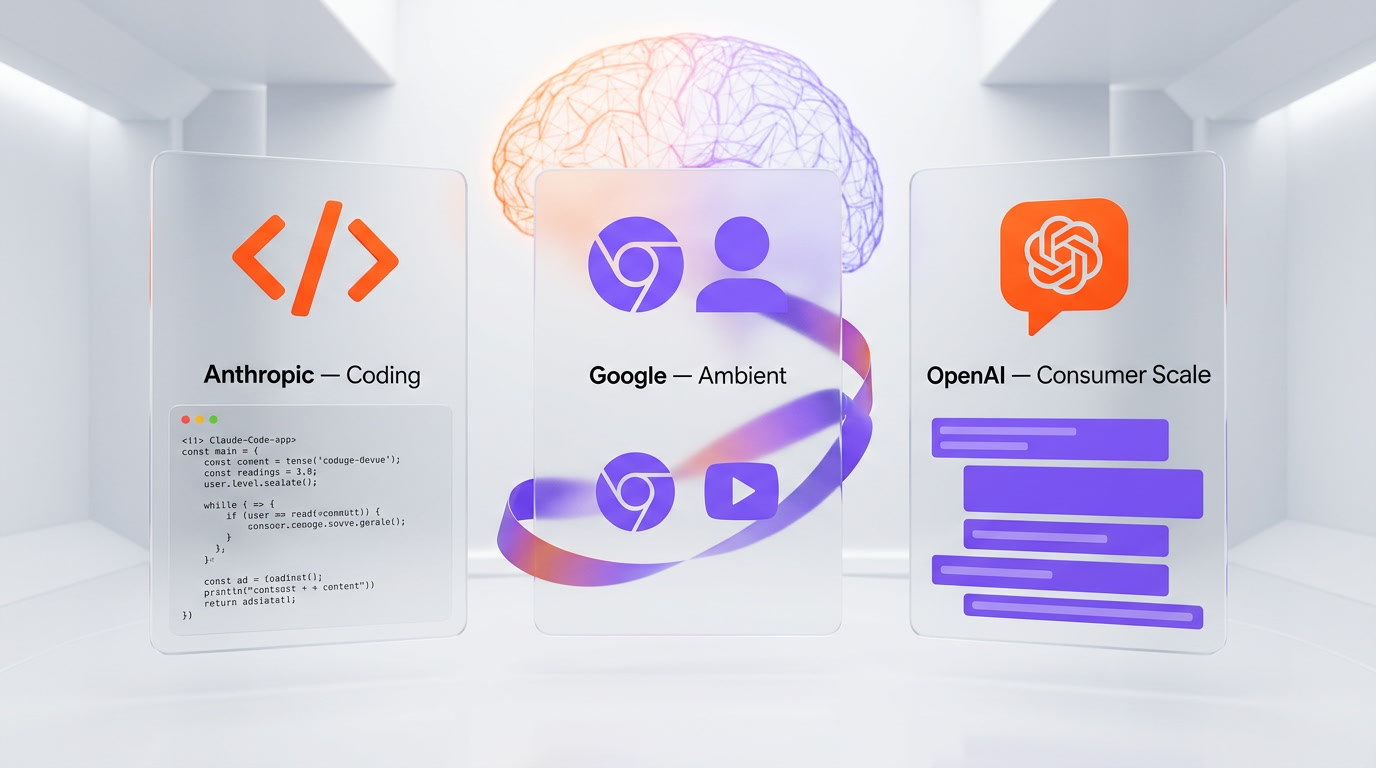
This also slots cleanly into the three-track AI market thesis we laid out in our Anthropic 10-gigawatt empire editorial. We argued the market is splitting into three distinct lanes: Anthropic owns coding and the agentic developer stack, Google owns multimedia and the ambient assistant layer via Gemini in Chrome and Workspace, and OpenAI owns consumer scale and the super-app surface. A super-app needs an ad business. May 5 is the day that ad business stopped being a slide deck and became infrastructure.
How the ChatGPT Ads Manager Actually Works
The advertiser flow is deliberately familiar. After registering as an advertiser inside the portal, a marketer:
- Adds a payment method (credit card or invoiced billing).
- Sets daily and lifetime budgets with bid caps and pacing.
- Defines a maximum CPC (the $3 to $5 starting band OpenAI recommends, although the auction will clear lower in many verticals).
- Uploads ad creative: a headline of roughly 16 characters, a description of roughly 32 characters, a small image asset, advertiser name, favicon, and the destination URL.
- Installs the ChatGPT pixel on the destination site or wires the Conversions API server-side for purchase, lead, sign-up, and custom events.
- Launches and watches a performance dashboard with impressions, clicks, CPC, CTR, and conversions in aggregate.
Two product details deserve sharper focus. First, logos cannot be the primary visual. OpenAI is keeping ad units visually subordinate to the conversation, which limits the temptation to make assistant turns feel like a sponsored carousel. Second, ads only render to Free and Go users in the US, Canada, Australia, and New Zealand, and never to users who appear to be under 18. Plus, Pro, and Business subscribers see no advertising, period — that is the deal OpenAI is making with its paying base.
The placement logic itself is contextual. Ads render below relevant assistant responses, never woven into the answer text. OpenAI has not published its full targeting taxonomy, but the practical signal seems to be conversational intent (what the user just asked) plus high-level demographic and geographic filters. There is no audience uploader, no lookalike modeling, and no third-party data overlay yet — by design, the input is what the user is doing in ChatGPT right now.
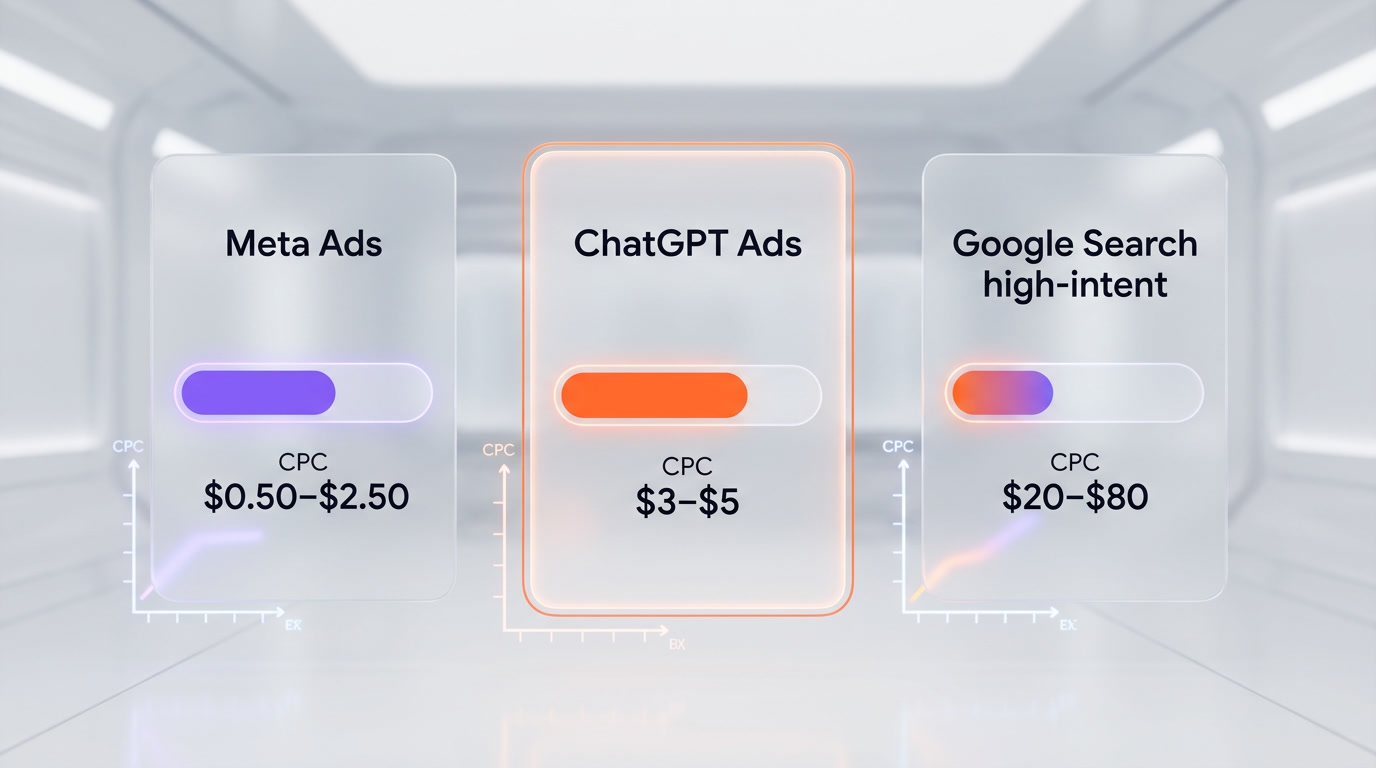
Bidding and Pricing: What $3 to $5 Per Click Actually Means
OpenAI's public guidance — start at a $3 to $5 maximum CPC — sits noticeably above the open-web display average and roughly matches mid-funnel Google Search CPCs in commercial verticals. For reference, average Google Search CPCs across all advertisers cluster between $2 and $4 in the US, with high-intent verticals (legal, insurance, B2B SaaS) routinely clearing $20 to $80 per click. Meta CPCs typically run $0.50 to $2.50.
What that means in practice: ChatGPT is positioning itself as a premium intent channel, not a cheap impression farm. The conversational context (the user just asked a substantive question) carries higher implied intent than a feed scroll, and OpenAI is pricing accordingly. We expect actual clearing CPCs to land below the $3 to $5 ceiling in most categories during the beta as inventory ramps and competition is thin, then drift up as advertisers identify the verticals where the channel converts well.
The removal of the minimum spend is the bigger story for the long tail. The original February pilot priced out every SMB, every agency below the holding-company tier, and every direct-to-consumer brand under roughly $30 million in revenue. Cutting the floor to $50,000 in April invited the agency mid-market. Cutting it to zero in May invites everyone — every Shopify merchant, every local service business, every B2B startup running paid acquisition. That is the exact arc Google and Meta walked in their early years, and it is the arc that builds an enduring auction.
Measurement: Conversions API, Pixel, and What's Still Missing
The measurement stack ships in two pieces. The ChatGPT pixel is a JavaScript snippet installed on the advertiser's site that fires on standard events (page view, add to cart, purchase) and sends them back to the Ads Manager for attribution. The Conversions API is the server-side equivalent — events posted from the advertiser's backend, immune to ad blockers and ITP-style browser restrictions, the same architectural pattern Meta's CAPI popularized.
Both can run in parallel for redundancy. Both feed an aggregated reporting view inside the Ads Manager — OpenAI does not expose conversation-level data to advertisers, and individual user identifiers are not passed through. UTM parameters on the destination URL allow the click to be reconciled inside GA4, Adobe Analytics, Amplitude, or Mixpanel, so multi-touch attribution models still see ChatGPT as a real channel.
What is missing matters too. No MMP partners for app install attribution (Adjust, AppsFlyer, Branch, Singular). No third-party measurement vendors signed (Nielsen, Comscore, DoubleVerify, IAS). No CPA bidding yet, only CPC. No lookalike audiences, no first-party CRM uploads, no retargeting — the audience layer is essentially nonexistent, which is normal for a v1 ad platform but is the gap performance marketers will press OpenAI to close fastest.
Competitive Frame: Where ChatGPT Ads Sit Versus Google and Meta
The honest comparison is not "ChatGPT replaces Google Search ads." It is "ChatGPT carves a new bucket inside the same media plan." Most performance budgets already split across three or four channels: Google Search and Performance Max, Meta Advantage+, TikTok Ads, sometimes a programmatic DSP. ChatGPT becomes the fifth box on that media plan.
The defensible angles for ChatGPT versus the incumbents:
- Higher implied intent per click. A user finishing a substantive ChatGPT conversation has self-qualified more than a feed scroller. Early CPCs may price high, but downstream conversion rates can plausibly clear above Meta and approach Google Search.
- Net-new audience. A meaningful slice of ChatGPT queries are queries the user would not have run on Google — research synthesis, multi-step reasoning, code generation, drafting work. That is incremental reach, not just channel substitution.
- Cleaner ad load. Google's SERP and Meta's feed are saturated. ChatGPT is shipping with a single ad unit below the response, no carousels, no shopping rails, no auto-play. CTR per impression should run above feed display for at least the first two years of the platform.
The vulnerabilities are equally clear:
- No audience layer yet. Without lookalikes, retargeting, or first-party uploads, optimization is shallow. Google and Meta will keep most of the budget that depends on those features.
- No third-party measurement. Holding companies and large brands will not commit material spend without DV/IAS/Nielsen. Until those partnerships sign, this is an SMB and mid-market channel.
- Inventory is tied to ChatGPT user growth. Google has the open web as inventory. Meta has the feed plus Reels plus Stories plus WhatsApp. ChatGPT has ChatGPT — a single surface, even if a popular one.
- Plus and Pro users are excluded. The most valuable user cohort (paying subscribers) will never see ads. That is good for retention but caps the premium audience an advertiser can reach inside ChatGPT.
Where this stops Google specifically: it does not, in the short term. Google's aggressive push of AI directly into Chrome is reshaping search-driven website traffic on its own terms, and Google still owns the world's most valuable identifier graph through Chrome, Android, and Workspace. ChatGPT is taking a slice of new spend, not draining the existing trunk.
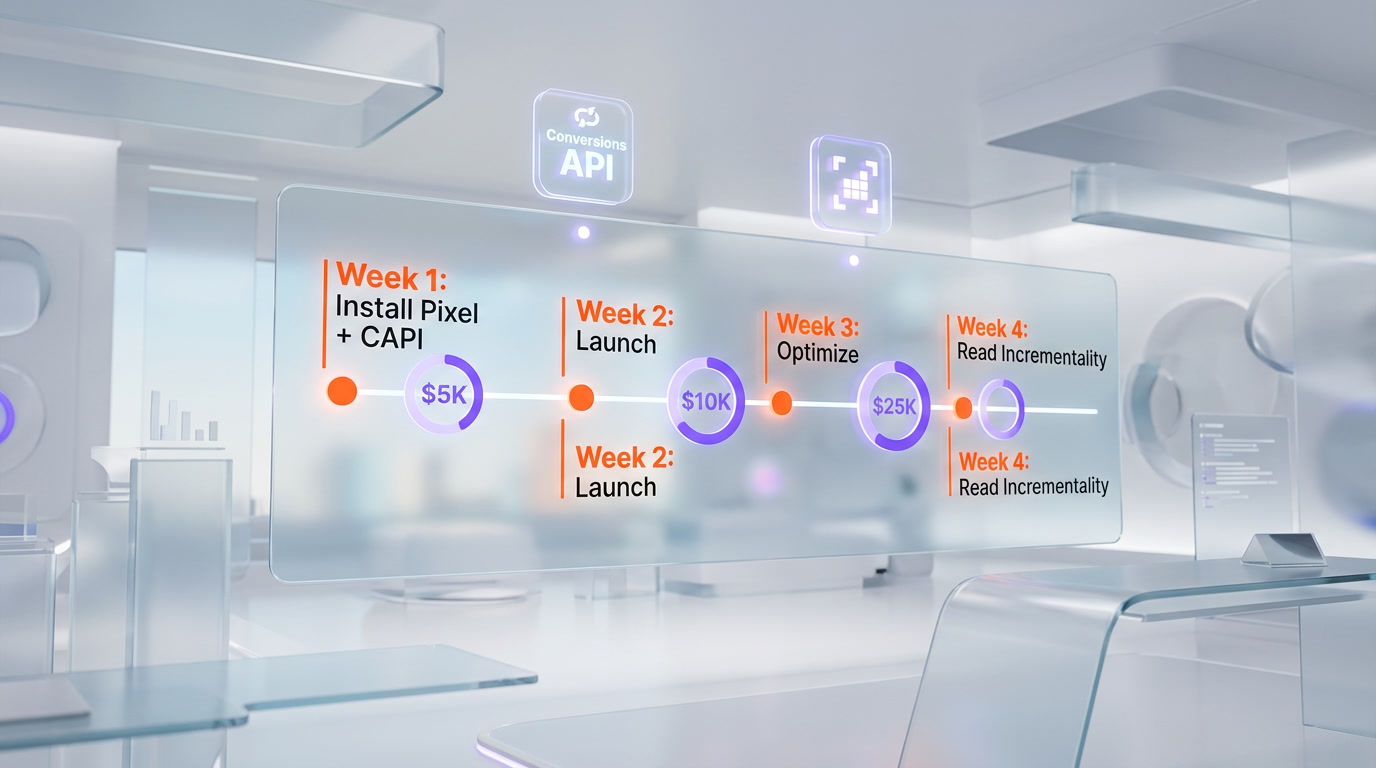
The Advertiser Playbook: What Marketers Should Actually Do This Week
For most performance teams, the right move on May 5 is a small, structured test, not a bet-the-quarter campaign.
- Register as an advertiser and install the ChatGPT pixel and Conversions API in week one. The friction is low and the data starts compounding immediately.
- Allocate $5,000 to $25,000 over four weeks as an exploratory budget. That is a meaningful enough sample to read CPC, CTR, and conversion rate in any vertical with reasonable volume.
- Bid below the recommendation. Start at $1.50 to $2.50 maximum CPC for non-luxury categories. The auction is thin during the beta and most advertisers will discover their actual clearing CPC sits well under the public guidance.
- Tag every URL with UTMs. Use
utm_source=chatgpt,utm_medium=ads, and a campaign tag so GA4 and Adobe register the channel as distinct from organic ChatGPT referrals. - Test creative formats inside the favicon-plus-text constraint. Headline (~16 characters) and description (~32 characters) are tight. Treat each ad like a search ad, not a display banner: clear value prop, single CTA verb, no fluff.
- Compare incrementality, not absolute volume. The right benchmark for ChatGPT ads is "did our total bottom-line conversions go up," not "did we get cheap CPCs." Hold-out tests beat raw click reporting in a thin-data channel.
- Reread the policy page weekly. OpenAI is iterating fast. Expect targeting, formats, and measurement to change inside the first ninety days.
Verticals that are likely to read well early: SaaS, e-commerce DTC, B2B lead gen, fintech, education, and travel. Verticals that will struggle in v1: anything that depends on heavy retargeting (subscription churn rescue, abandoned cart, app re-engagement) and anything regulated enough to need third-party measurement (pharma, alcohol, political).
The Three-Track Market Thesis: This Confirms It
We have been writing for the last three months that the AI market is settling into three distinct lanes that will not converge. Each player picks the surface where its model strength compounds, builds the ecosystem around that surface, and monetizes it accordingly.
Anthropic owns the coding and agentic developer lane. Claude is already the default for serious code work, the Anthropic 10-gigawatt compute build is engineered around long-horizon coding agents, and the developer ecosystem (Claude Code, Claude API, Anthropic Skills) keeps gaining mind-share among engineering teams. The monetization model is API and seat-based subscription, and it is durable because it sells into operating budgets, not media budgets.
Google owns the ambient and multimedia lane. Gemini is being pushed deeper into Chrome, Android, Workspace, Photos, and YouTube. Veo, Imagen, and Lyria own the multimedia generation surface. Google's distribution moat is unique — billions of users already inside its products — and its monetization stays inside the existing ad business plus Workspace seats. Even as Google's AI features cannibalize traditional website visits, the company captures the value through its own surface.
OpenAI owns the consumer scale and super-app lane. ChatGPT is the front door for general-purpose AI for most consumers, GPT-5.5 Instant just became the default model, and the super-app strategy is shipping in public. The monetization model has always been the missing piece — Plus and Pro subscriptions are real but cap out, API revenue is a different game. Self-serve advertising is the third leg, and May 5 is the day it became real infrastructure rather than a roadmap line.
Each lane is engineered around a different financial primitive. Anthropic monetizes compute and developer seats. Google monetizes queries and workspace seats. OpenAI monetizes consumer attention and ads on top of paid subscriptions. None of the three is trying to be the other two, and the longer the divergence persists the harder it gets to undo.
Risks: What Could Derail This in 2026
Three credible scenarios could slow or stall the ChatGPT ads business between now and end of year.
User backlash. ChatGPT users have spent two years in an ad-free product. Even with ads only on Free and Go tiers, public sentiment is the variable OpenAI cannot fully model in advance. If the perception becomes "ChatGPT got worse," organic growth slows and the ad inventory shrinks. The Plus/Pro/Business carve-out is OpenAI's hedge, and the "below the response, never inside it" placement rule is the second hedge.
Regulatory friction. Disclosure rules for AI-mediated advertising are still being written in the EU, UK, and several US states. Early signs suggest "ad" labels will be mandatory and potentially more prominent than the current treatment. The FTC has been signaling for two years that AI-generated or AI-recommended product placements will be policed under the same disclosure regime as influencer endorsements. Expect compliance work, not bans.
Trust events. A single high-profile case of an ad appearing to be confused with a model recommendation — even if the technical separation held — could force OpenAI to redesign the placement. The current architecture (ads below the assistant turn, conversations not shared with advertisers) is well-designed against this risk, but it is a category of risk that does not exist in Google Search or Meta Feed.
The macro tailwind, however, is strong. ChatGPT user growth has not slowed, the GPT-5.5 model upgrade is the most capable consumer AI shipped to date, and the super-app surface (apps, agents, payments, image and video generation) keeps adding reasons to stay inside the product. Inventory is growing faster than advertiser onboarding, which is the right shape for an ad auction in year one.
What to Watch in the Next Ninety Days
- CPA bidding launch. Asad Awan said it is "in motion." A date inside Q3 2026 turns ChatGPT into a true performance channel for direct-response advertisers.
- Third-party measurement deals. First signing (Nielsen, DoubleVerify, IAS, or Comscore) unlocks holding-company budgets. Until then, this stays a self-serve channel.
- Audience features. Lookalikes, first-party CRM uploads, and retargeting are the three features performance marketers will demand. Whichever ships first signals the priority.
- International rollout. Beta is US-advertiser only at launch. UK, EU, and APAC opening dates indicate how fast OpenAI thinks the auction can scale.
- Format expansion. Today the unit is favicon-plus-text-plus-small-image. Watch for product carousels, video, and shopping integrations — each one materially increases revenue per impression.
- Plus-tier policy stability. If OpenAI ever introduces ads to Plus subscribers (even sponsored content), the trust contract changes overnight. We will be watching that line carefully.
Bottom Line
OpenAI did not just open a new ad channel on May 5. It declared that ChatGPT is a real ad platform, with the buying motion, measurement stack, and pricing structure performance marketers expect. The product is v1 and the gaps are real — no CPA bidding, no third-party measurement, no audience layer — but the trajectory is unambiguous. Self-serve, CPC, and a pixel are the three primitives every durable ad platform of the last twenty years has shipped first.
For OpenAI, this is the monetization leg of the super-app strategy. For Google and Meta, it is a new line item competing for the same advertiser attention. For media buyers, it is a fifth box on the media plan that warrants a structured test this month, not next quarter. And for the broader AI market thesis, it is the move that confirms the three lanes are real: Anthropic builds the developer stack, Google owns the ambient layer, OpenAI monetizes consumer scale. Each of the three is now playing a different game, and each is winning the game it picked.
If you build software, you keep using Claude Code. If you ship products to consumers, you test ChatGPT Ads in May. If you depend on Google traffic, you read our Chrome AI piece twice. The three-track market is no longer a thesis — it is the operating environment.
Frequently Asked Questions
When did OpenAI launch the self-serve ChatGPT Ads Manager?
OpenAI launched the self-serve ChatGPT Ads Manager in beta on May 5, 2026, opening the platform to all US businesses. The original managed-service pilot started in February 2026 with a $200,000-$250,000 minimum (per ppc.land) spend, which was reduced to $50,000 in April and removed entirely on May 5 for the self-serve release.
How much does it cost to advertise on ChatGPT?
OpenAI publicly recommends a starting maximum bid of $3 to $5 USD per click for CPC campaigns, although actual clearing CPCs typically land lower during the beta because auction competition is thin. There is no minimum daily budget or monthly spend floor for self-serve advertisers as of May 5, 2026.
What bidding models does ChatGPT Ads support?
As of the May 5, 2026 launch, ChatGPT Ads supports CPC (cost-per-click) and CPM (cost-per-thousand-impressions) bidding. CPA (cost-per-action) bidding is "in motion" per OpenAI ads lead Asad Awan but does not have a public launch date yet. The original February pilot was CPM-only.
Can I track conversions from ChatGPT ads?
Yes. OpenAI shipped a Conversions API for server-side event tracking and a JavaScript pixel for browser-side tracking on May 5, 2026. Both support purchases, leads, sign-ups, and custom events, and feed an aggregated reporting view inside the Ads Manager. UTM parameters on landing URLs are also supported, so GA4, Adobe Analytics, Amplitude, and Mixpanel see ChatGPT ads as a distinct channel.
Will ChatGPT ads compete with Google Ads and Meta Ads?
Yes, ChatGPT Ads competes for the same performance marketing budgets currently flowing into Google Ads (over $200 billion annually) and Meta Ads (over $130 billion annually). However, ChatGPT does not have lookalike audiences, retargeting, first-party CRM uploads, or third-party measurement partners yet, so most large advertisers will treat it as a fifth channel on the media plan rather than a replacement for the incumbents in 2026.
Where do ChatGPT ads appear and who sees them?
Ads appear below relevant assistant responses, never inside the answer text itself. Only ChatGPT Free and Go users in the United States, Canada, Australia, and New Zealand see ads. Plus, Pro, and Business subscribers see no advertising. Users who appear to be under 18 are also excluded from advertising.
Is OpenAI sharing my ChatGPT conversations with advertisers?
No. OpenAI is explicit that user conversations are not shared with advertisers. Reporting is delivered in aggregate inside the Ads Manager portal, and ad creatives are kept separate from model answers — the assistant turn and the ad unit are rendered independently, with placement determined by conversational intent without exposing individual user identifiers or message text.
Does this confirm the OpenAI super-app strategy?
Yes. Self-serve advertising is the third monetization leg of the OpenAI super-app strategy alongside paid subscriptions (Plus, Pro, Business) and API revenue. It also fits the three-track AI market thesis we laid out in our Anthropic 10-gigawatt empire editorial — where Anthropic owns coding and the developer stack, Google owns the ambient and multimedia layer, and OpenAI owns consumer scale and the super-app surface.
What format do ChatGPT ads use?
Each ad unit includes the advertiser name, a favicon, a headline of approximately 16 characters, a description of approximately 32 characters, an image asset, and a destination URL. Logos cannot serve as the primary visual element. Ad units render below the assistant response and do not include carousels, video, or shopping rails as of the May 5, 2026 launch.
Should I run a ChatGPT ads test this month?
Yes — a small structured test makes sense for most performance teams. Allocate $5,000 to $25,000 across four weeks, install the pixel and Conversions API in week one, bid $1.50 to $2.50 maximum CPC for non-luxury categories rather than the full $3 to $5 ceiling, tag URLs with UTMs, and measure incrementality (did total conversions rise) rather than absolute click volume. The auction is thin during beta, which favors early advertisers willing to experiment.
What is missing from ChatGPT Ads in May 2026?
Three gaps matter most: no CPA bidding (only CPC and CPM), no third-party measurement partners (no Nielsen, DoubleVerify, IAS, or Comscore deals signed), and no audience layer (no lookalikes, no first-party CRM uploads, no retargeting). Until those features ship, ChatGPT Ads will primarily attract SMBs, mid-market advertisers, and performance teams testing the channel rather than holding-company-scale brand budgets.
Where can I read the official OpenAI announcement?
The official OpenAI announcement is published at openai.com/index/new-ways-to-buy-chatgpt-ads/ and was titled "New ways to buy ChatGPT ads," dated May 5, 2026. Coverage is also available from Search Engine Journal, MediaPost, Digiday, and PPC.land — all four publications confirmed the CPC bidding, Conversions API, pixel measurement, and removal of the prior minimum-spend requirement.