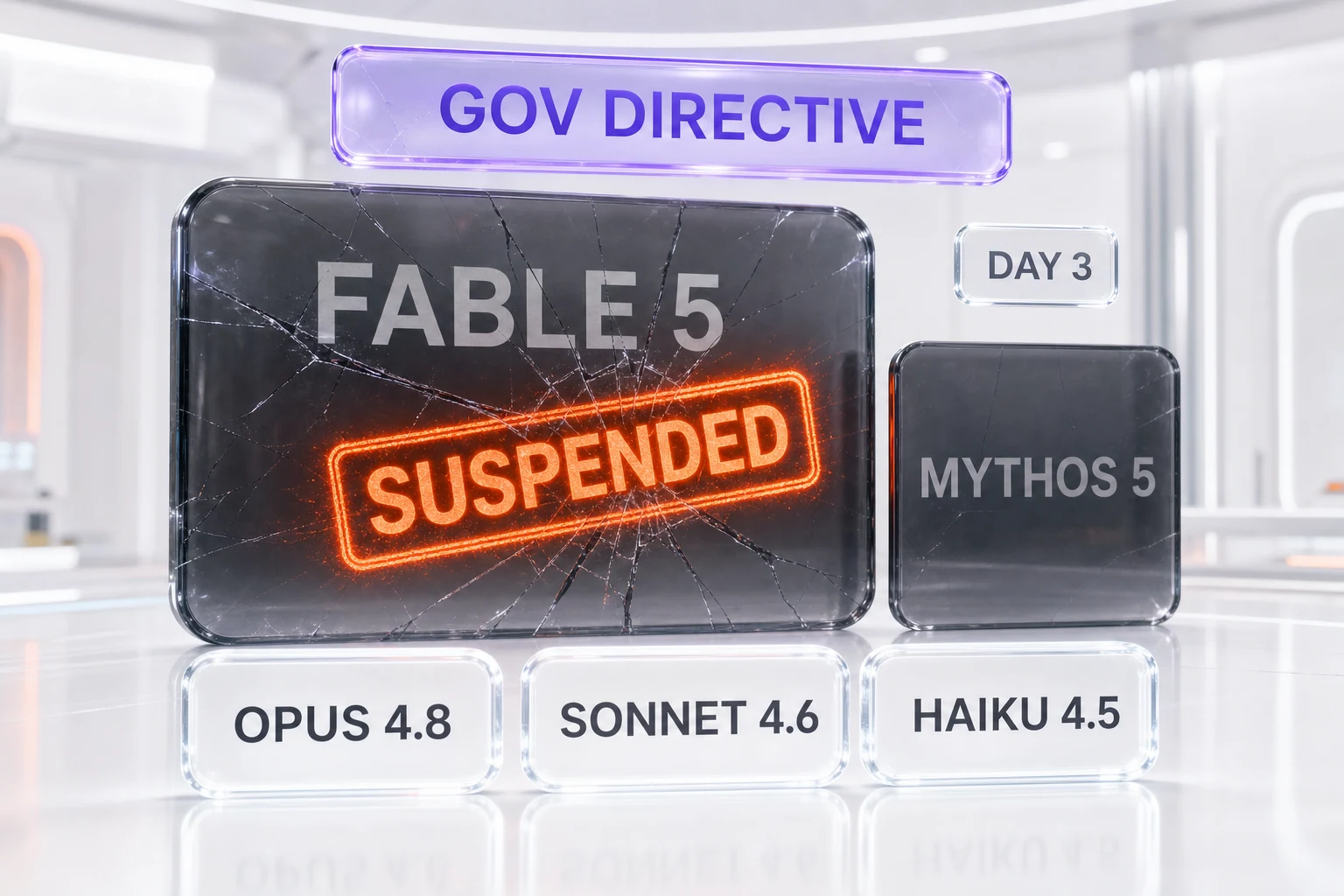
On June 12, 2026, the US government suspended access to Claude Fable 5 and Mythos 5 for every foreign national worldwide through an export-control directive, and Anthropic disabled both models for all customers across its API and apps to comply. Opus 4.8, Sonnet 4.6, and Haiku 4.5 are not affected. The directive landed three days after Fable 5 launched, citing a narrow potential jailbreak, and Anthropic says it is complying while it disputes the finding. No restoration date has been given.
Update — June 15, 2026: This is a developing story. Since the suspension, the standoff has escalated — a reported 90-minute ultimatum from the Commerce Department, a warning from Amazon's Andy Jassy, and Anthropic sending senior staff to Washington to negotiate. Read the full follow-up: How the US–Anthropic standoff over Claude Fable 5 escalated.
What Happened
At 5:21pm Eastern Time on June 12, 2026, Anthropic received a legal directive from US national security authorities ordering it to suspend access to its two most capable models, Claude Fable 5 and Mythos 5. The order applies to "any foreign national, whether inside or outside the United States, including foreign national Anthropic employees." Because Anthropic cannot reliably segment a global user base down to citizenship in real time, the company said the practical effect was blunt: it had to "abruptly disable Fable 5 and Mythos 5 for all our customers." That means the API, the Claude apps, and every integration that routed to Fable 5 went dark at once.
This is the part worth slowing down on. A government did not fine a model, request a patch, or open a review while the product stayed live. It ordered an already-deployed frontier model — one shipping to a user base Anthropic describes as "hundreds of millions of people" — pulled from the market. As far as we can tell from the public record, this is the first time a government has forced the recall of a commercially deployed frontier AI model. Whatever you think of the reasoning, that is a regulatory first, and it is the reason this story matters beyond the three days Fable 5 was on sale.
Anthropic published its account on its newsroom on June 12 and committed to "share more details over the next 24 hours." We are anchoring this article on that primary statement rather than on secondary coverage, and we will note clearly where the company has not yet said something — because on a story like this, the gaps matter as much as the disclosures.

Who Is Cut Off — and Who Is Not
The directive is unusually broad in one direction and narrow in another. It is broad on geography and access: it reaches any foreign national anywhere on earth, and it does not stop at non-US companies. It explicitly includes Anthropic's own foreign-national employees, and it sweeps in the API and the consumer apps, not just enterprise contracts. For a global product, "no foreign nationals" is functionally indistinguishable from "no one," which is why Anthropic shut the two models off for everybody rather than attempt a citizenship gate.
It is narrow on which models are involved. Anthropic was explicit: "Access to all other Anthropic models will not be affected." In plain terms, three production models keep running:
- Claude Opus 4.8 — Anthropic's flagship general-purpose model before Fable 5, still available across the API and apps. For most non-US developers and teams, this is the direct fallback.
- Claude Sonnet 4.6 — the balanced workhorse tier, unaffected and well suited to high-volume, cost-sensitive workloads.
- Claude Haiku 4.5 — the fast, low-cost tier, unaffected, for latency-sensitive and high-throughput tasks.
So the loss is real but bounded. If you were building on Fable 5 specifically — for its larger context window or its top-end reasoning — you are blocked. If you were using any other Claude model, nothing changed for you. We walk through the practical fallback path further down, because for most teams outside the US the disruption is a model swap, not an outage of Claude as a whole.
Why the Government Acted: The "Narrow Jailbreak"
The stated reason is a security concern. According to Anthropic's account, the government believes a method exists for "bypassing, or 'jailbreaking'" Fable 5. Anthropic says it reviewed a demonstration of the technique and characterizes it as "a narrow potential jailbreak." The specific behavior described is asking the model to read a particular codebase and fix the software flaws it finds in that code.
On its face, that capability — read a codebase, identify weaknesses, propose fixes — is exactly what a frontier coding model is built to do, and what makes Fable 5 valuable to engineers. The security worry is the mirror image of the feature: a model good enough to find and patch vulnerabilities at scale is, by the same token, good enough to find and characterize them in code it was not meant to harden. The government's view, as relayed by Anthropic, is that awareness of this method is itself the risk, severe enough to warrant pulling the model rather than waiting for a mitigation. The directive came from national security authorities; Anthropic's public statement does not name the specific agency, and we are not naming one we cannot verify.
Two things are notably absent from the public record so far. First, there is no published technical detail on what makes this jailbreak materially different from the broad class of "get the model to do something it normally refuses" techniques that labs patch continually. Second, there is no stated threshold — no explanation of what would have to be true for the model to come back. We flag both as open questions rather than filling them with speculation.

Three Days From Launch to Recall
The timing is the sharpest detail in the whole episode. Anthropic launched Fable 5 on June 9, 2026, positioning it as its most powerful model — a tier above Opus, with a one-million-token context window and pricing of $10 per million input tokens and $50 per million output tokens. We covered that launch in our Claude Fable 5 launch breakdown. Seventy-two hours later, it was suspended. A model can go from headline release to government-ordered recall inside a single week, and that compression is itself a signal about how fast the regulatory posture around frontier AI is moving in 2026.
Mythos 5 sits in the same directive but in a different place in Anthropic's lineup. It is, in effect, the same underlying model as Fable 5 but without the safety classifiers — the version run inside Project Glasswing, Anthropic's restricted cybersecurity program. Mythos has never been a broad consumer product; access has been tightly held from the start. So the headline disruption for the general public is Fable 5. The inclusion of Mythos in the same order suggests the government is treating the capability, not the packaging, as the thing to restrict — the same model, classifiers or not, is covered.
For readers tracking the longer arc, this lands on top of a year of escalating scrutiny: Anthropic has been steadily widening Mythos's controlled footprint, including an offer of Mythos access to the EU's ENISA, and the US executive branch has openly floated FDA-style pre-release reviews for powerful models. The Fable 5 suspension is the first time that climate has produced a concrete, market-removing action against a shipping product.
Anthropic's Position: Comply, But Disagree
Anthropic's framing is careful and, notably, two-sided. The company is unambiguous that it is following the order: "We are complying with the government's legal directive." At the same time, it states a clear objection: "We disagree that the finding of a narrow potential jailbreak should be cause for recalling a commercial model deployed to hundreds of millions of people." It adds that it believes the situation is "a misunderstanding" and is "working to restore access as soon as possible."
What is missing from that statement is as telling as what is in it. Anthropic gives no restoration date, no description of an appeal or review process, and no criteria for what resolving the "misunderstanding" would require. "As soon as possible" is a commitment of intent, not a timeline. For a company that has built its brand on safety-forward positioning, the posture here is striking: it is the lab arguing that the government's caution went too far, not the other way around. That role reversal — a frontier developer pushing back on a regulator for over-restricting — is part of why this case is likely to be cited in AI-policy debates well after access is restored.
We are not taking a side on whether the government or Anthropic has the better of the technical argument; we do not have the underlying demonstration, and on a national-security matter neither do most observers. What we can say plainly is that both positions are now on the public record, and that the absence of a defined off-ramp is the single biggest source of uncertainty for anyone who depended on these models.
What It Means for Non-US Users Right Now
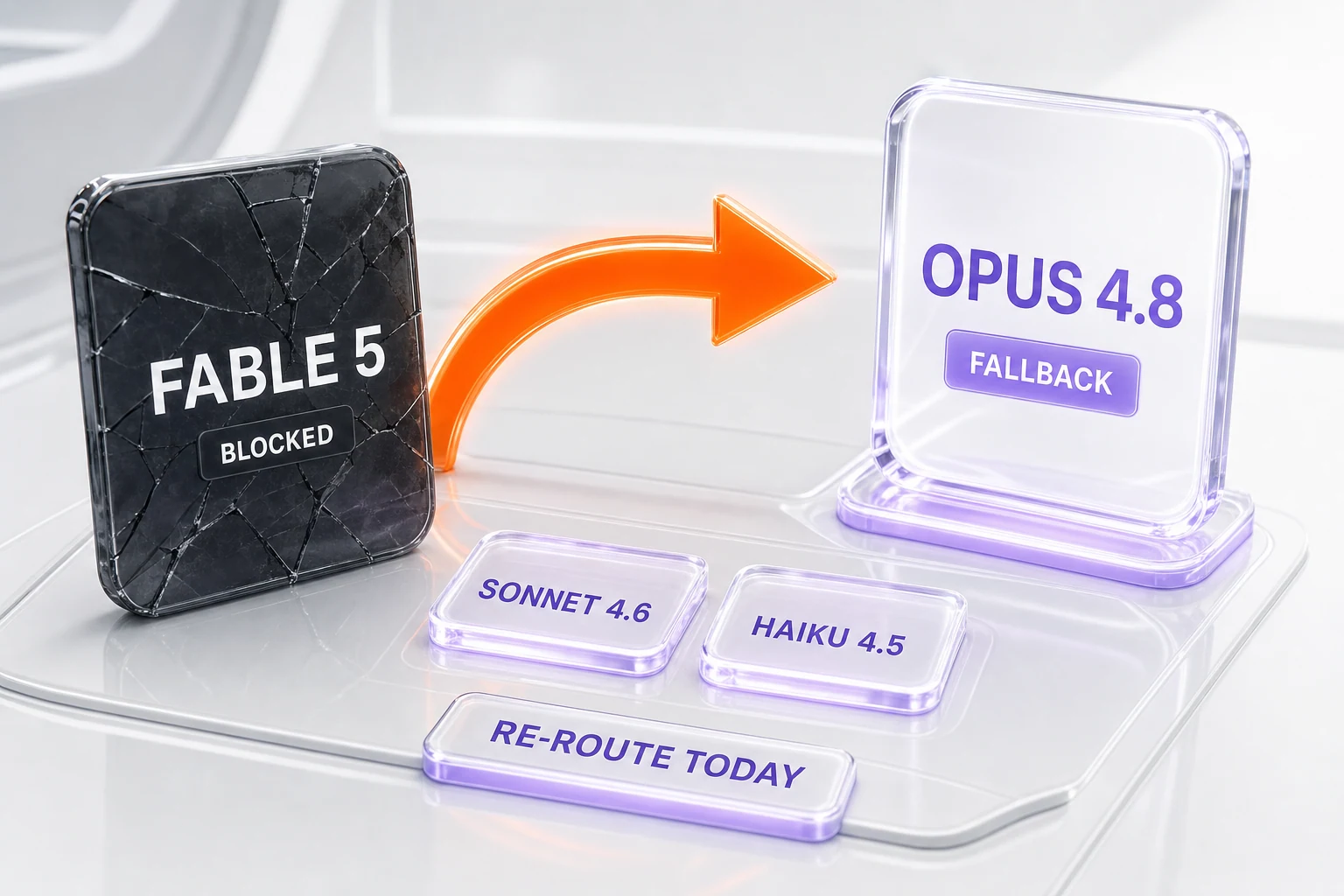
If you are a developer, a startup, or a team outside the United States that was building on Fable 5, here is the concrete situation. Your Fable 5 calls will fail; the model is disabled regardless of where you are. The fix is not to wait — it is to re-route. Claude Opus 4.8 is the closest unaffected substitute for top-end reasoning and coding work, and it remains fully available through the API and apps. For higher-volume or more cost-sensitive pipelines, Claude Sonnet 4.6 and Claude Haiku 4.5 are both untouched.
The practical gaps to plan around are Fable 5's specific advantages: its one-million-token context window and its top-tier performance ceiling. Opus 4.8 is a strong model, but if your workflow genuinely required Fable 5's larger context or its highest reasoning tier, you will feel the downgrade and should test your prompts against Opus before assuming parity. Watch your model identifiers in production — code that hardcoded a Fable 5 model string needs updating, not just a quota change.
The disruption has reached beyond Anthropic's own surfaces. According to GitHub's changelog, GitHub Copilot suspended Claude Fable 5 across all of its experiences on June 12, while keeping Opus 4.8, Sonnet 4.6, and Haiku 4.5 available to Copilot users. If you reach Claude through a third-party platform rather than directly, expect the same pattern: Fable 5 removed, the other Claude tiers still selectable. Check your provider's status page, because the timing of these downstream removals can vary by hours.

The Bigger Picture: Export Control Meets Frontier AI
Strip away the specifics and this is a story about a new enforcement tool being used for the first time. Export controls have historically governed hardware — advanced chips, manufacturing equipment, the physical substrate of AI. Here the control is being applied to access to a deployed software model, conditioned on the nationality of the user rather than the location of a data center. That is a meaningfully different lever, and June 12 is the first time we have seen it pulled against a live frontier model.
The mechanism reveals how leaky "model-level" export control is in practice. Because a global API cannot cleanly verify citizenship in real time, a directive aimed at foreign nationals collapses into a near-total shutdown — Anthropic could not surgically exclude one group without taking the whole product offline. That bluntness cuts both ways: it makes the control easy to impose and hard to comply with proportionately, and it means the cost falls on the developer and on every legitimate user, not just on whatever the order was trying to prevent.
It also sharpens a strategic question for non-US teams that has been building all year. If access to the most capable US models can be revoked by directive within days, with no published timeline for return, then concentration risk on a single jurisdiction's frontier lab is now a board-level concern rather than a hypothetical. We have already covered European moves toward sovereign capability in response to exactly this dynamic; the Fable 5 suspension is the clearest evidence yet that those bets are about resilience, not just politics. Expect more enterprises to keep a tested fallback across providers and jurisdictions, and to treat "which model can I lose overnight" as a real line item in their architecture.
What to Watch Next
Anthropic promised more detail within 24 hours of its June 12 statement, so the first thing to track is whether that follow-up defines any process — an appeal, a review, a remediation path — or simply repeats "as soon as possible." A defined off-ramp would calm the market; its continued absence would not. The second thing to watch is whether the restriction stays scoped to Fable 5 and Mythos 5 or expands, and whether any precedent here gets applied to other labs' frontier models. The third is downstream: how quickly third-party platforms restore Fable 5 once (if) Anthropic does, and whether any of them move workloads to non-Claude models in the interim.
For now, the actionable summary is simple. Fable 5 and Mythos 5 are off, worldwide, for everyone, with no return date. Opus 4.8, Sonnet 4.6, and Haiku 4.5 are on and unaffected. If you depended on Fable 5, your move today is to re-route to Opus 4.8 and validate, not to wait for a restoration that has no date attached. We will update this article as Anthropic and the authorities say more.
Frequently Asked Questions
Why did the US government suspend Claude Fable 5?
On June 12, 2026, US national security authorities issued an export-control directive suspending access to Claude Fable 5 and Mythos 5 for foreign nationals worldwide. The stated reason is a security concern over what the government calls a method of jailbreaking Fable 5. Anthropic reviewed a demonstration and describes it as a narrow potential jailbreak: asking the model to read a specific codebase and fix the software flaws it finds.
Is Claude Fable 5 still available anywhere?
No. Anthropic disabled Fable 5 for all customers across its API and apps to comply with the directive. Because the order covers any foreign national worldwide and a global API cannot verify citizenship in real time, the practical effect was a full shutdown rather than a partial block. Third-party platforms followed: according to GitHub’s changelog, GitHub Copilot suspended Fable 5 across all of its experiences on June 12.
Which Claude models are not affected by the suspension?
Anthropic stated that access to all of its other models is unaffected. Claude Opus 4.8, Claude Sonnet 4.6, and Claude Haiku 4.5 all remain fully available through the API and apps. Only Fable 5 and Mythos 5 are covered by the directive.
What should I use instead of Claude Fable 5?
Claude Opus 4.8 is the closest unaffected substitute for top-end reasoning and coding and remains fully available. Claude Sonnet 4.6 fits high-volume, cost-sensitive workloads, and Claude Haiku 4.5 suits fast, low-cost tasks. The gaps to plan around are Fable 5’s one-million-token context window and its top performance tier, so test your prompts against Opus 4.8 before assuming parity.
When will Claude Fable 5 access be restored?
No date has been given. Anthropic said it is working to restore access as soon as possible and committed to share more details within 24 hours of its June 12 statement, but it has not published a restoration timeline or a defined appeal process. The lack of a stated off-ramp is the main source of uncertainty for affected users.
What is the difference between Fable 5 and Mythos 5 in this directive?
Mythos 5 is, in effect, the same underlying model as Fable 5 but without the safety classifiers, run inside Anthropic’s restricted Project Glasswing cybersecurity program. Both are named in the same directive, which suggests the government is restricting the capability itself rather than a specific product packaging. Mythos was never a broad consumer product, so the headline disruption for the public is Fable 5.
Does this affect users outside the United States?
Yes, directly. The directive covers any foreign national whether inside or outside the United States, including Anthropic’s own foreign-national employees, and it includes the API and apps. In practice that means non-US developers and teams lose Fable 5 and Mythos 5 entirely, while keeping access to Opus 4.8, Sonnet 4.6, and Haiku 4.5.
Is this the first time a government has recalled a deployed AI model?
Based on the public record, this is the first time a government has forced the recall of a commercially deployed frontier AI model rather than fining it, requesting a patch, or reviewing it while it stayed live. Fable 5 launched on June 9, 2026 and was suspended on June 12, three days later, which makes the case a notable regulatory precedent regardless of how the dispute is ultimately resolved.
Editorial note: This is a news explainer. ThePlanetTools.ai has no affiliate or commercial relationship with Anthropic, GitHub, or any government body referenced here, and this article contains no affiliate links. We anchored every factual claim on Anthropic's own June 12, 2026 statement and other primary sources, linked below, and we flag where information has not yet been disclosed rather than fill the gaps with speculation. We will update this piece as the situation develops.
Primary sources: Anthropic — Access to Fable 5 and Mythos 5 · GitHub Changelog.