Claude Fable 5 vs Qwen 3.6: Peak Intelligence vs 30x Cheaper Open Weights


Fable 5 tops the independent Artificial Analysis index 60 to 40 — but Qwen 3.6 Plus costs ~30x less and ships Apache 2.0 open weights. Split verdict.
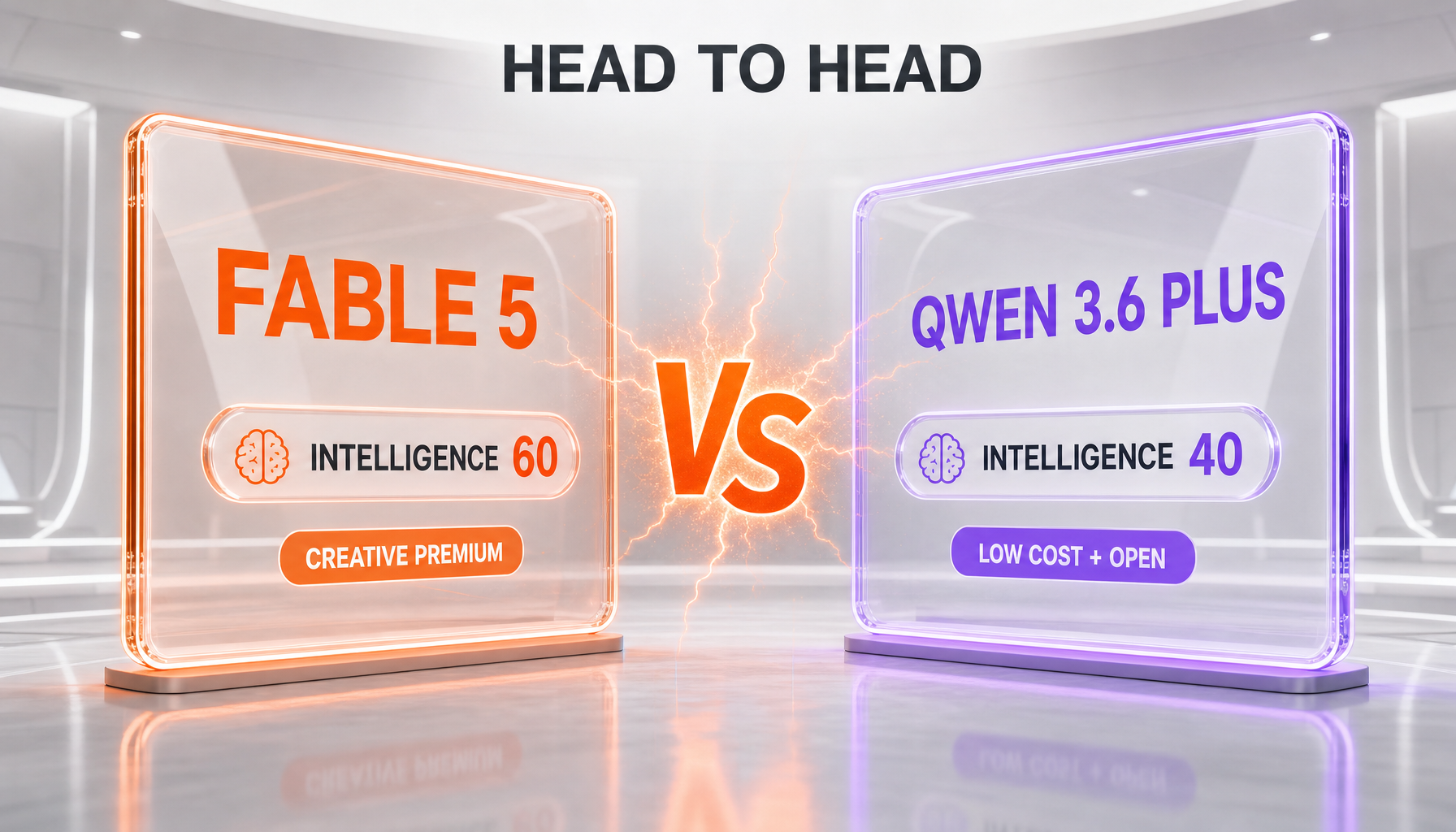
Feature Comparison
| Feature | Claude Fable 5 | Qwen 3.6 |
|---|---|---|
| AA Intelligence Index v4.1 (Artificial Analysis, same evaluator) | 60 — ranked number one overall | 40 (Qwen 3.6 Plus) |
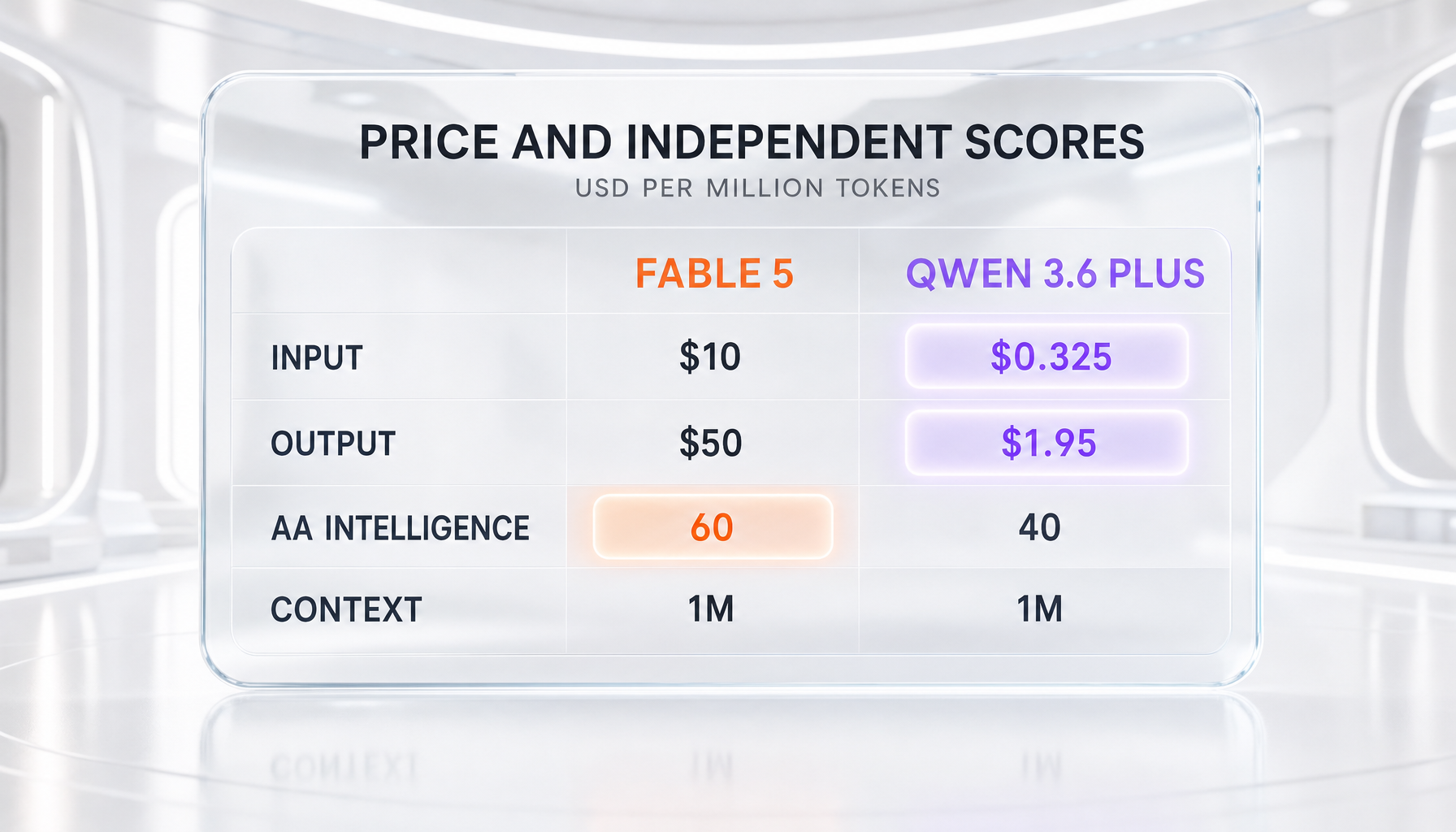
| Input price (per million tokens) | $10.00 (verified) | $0.325 (Qwen 3.6 Plus, Alibaba direct) |
| Output price (per million tokens) | $50.00 (verified) | $1.95 (Qwen 3.6 Plus, Alibaba direct) |
| Context window | 1,000,000 tokens | 1,000,000 tokens |
| Independent third-party benchmarks | SWE-bench Verified 95% (vals.ai); LMArena 1509 | No independent benchmark for the Plus tier |
| Open weights and self-hosting | None — closed, API-only | Apache 2.0 open-weight variants (Qwen3.6-27B, Qwen3.6-35B-A3B) |
| Premium creative and reasoning | Purpose-built creative flagship, #1 on the independent index | General-purpose multimodal model |
Pricing Comparison
Claude Fable 5
Qwen 3.6
Detailed Comparison
Claude Fable 5 and Qwen 3.6 sit at opposite ends of the 2026 model market. Claude Fable 5 is Anthropic's premium creative flagship: closed and API-only, priced at 10 dollars per million input tokens and 50 dollars per million output tokens, with a 1,000,000-token context window. It ranks number one overall on the independent Artificial Analysis Intelligence Index at 60, scores 95 percent on SWE-bench Verified as measured independently by vals.ai, and holds an LMArena rating of 1509. Qwen 3.6 is Alibaba's model family, released April 2, 2026; its flagship API tier, Qwen 3.6 Plus, is a closed multimodal model priced at 0.325 dollars input and 1.95 dollars output per million tokens on Alibaba's direct endpoint — roughly 31 times cheaper on input and 26 times cheaper on output — with the same 1,000,000-token context and an independent Artificial Analysis score of 40. The family also ships Apache 2.0 open-weight variants you can download and self-host, something Fable 5 has no equivalent to. Best for peak intelligence, independently verified coding, and premium creative work: Claude Fable 5. Best for cost at scale and open-weight self-hosting: Qwen 3.6.
Quick Verdict
This is a split verdict by use case, and the intelligence gap here is the widest we have measured in this batch of matchups. We lined both models up against the same public evaluations, pulled every price directly from each vendor's own console in July 2026, and kept a hard rule throughout: the one benchmark that scores both models with the same battery is the Artificial Analysis Intelligence Index, so that is the only head-to-head number we treat as settled. Everything else is attributed to its source and its exact model variant. These two are not competing for the same budget line. One is the highest-scoring model on the independent index; the other is roughly 30 times cheaper and ships open weights you can run yourself. Here is the short version.
- Best for raw intelligence: Claude Fable 5. It ranks number one overall on the Artificial Analysis Intelligence Index at 60, a full 20 points ahead of Qwen 3.6 Plus at 40 on the same version-4.1 index.
- Best for independently verified coding: Claude Fable 5. It posts 95 percent on SWE-bench Verified as measured by the independent evaluator vals.ai. Qwen 3.6 Plus, the flagship API tier, has no independent SWE result of its own.
- Best for cost: Qwen 3.6 Plus, overwhelmingly. At 0.325 dollars input and 1.95 dollars output per million tokens on Alibaba's direct endpoint, it is roughly 31 times cheaper than Fable 5 on input and about 26 times cheaper on output.
- Best for open weights and self-hosting: Qwen 3.6. The family includes Apache 2.0 open-weight models — Qwen3.6-27B and Qwen3.6-35B-A3B — that you can download, fine-tune, and run on your own hardware. Fable 5 is closed and cannot be self-hosted.
- Best for equal-context long work: a genuine tie. Both models carry a 1,000,000-token context window, so neither wins on how much you can put in front of it.
Bottom line: if your workload needs the strongest model on the independent index — and each call is valuable enough to absorb 50 dollars per million output tokens — Claude Fable 5 is the pick, and nothing here is close on capability. If token cost is the binding constraint, or you need open weights you can host inside your own network, Qwen 3.6 delivers a usable share of frontier behavior at a price that changes what is buildable. We did not crown a single overall winner, because a 20-point intelligence lead and a 30-times price advantage pull in opposite directions, and the use case decides which one wins.
At a Glance
Before the detail, here is the side-by-side that frames everything below. All pricing was fetched directly from each vendor's own pages in July 2026. Every benchmark figure is attributed to its source and to the exact model variant it describes — which matters more than usual here, because Qwen 3.6 is a family, not a single model.
| Dimension | Claude Fable 5 | Qwen 3.6 (Plus tier) |
|---|---|---|
| Vendor / origin | Anthropic (US) | Alibaba (China) |
| Released | 2026 (current Anthropic flagship) | April 2, 2026 |
| Positioning | Premium creative and reasoning flagship | Low-cost multimodal family, closed Plus tier plus open-weight variants |
| License (flagship tier) | Closed, API and cloud only | Qwen 3.6 Plus closed; open-weight variants under Apache 2.0 |
| Input price (per million tokens) | $10.00 (verified) | $0.325, Plus tier, Alibaba direct (verified) |
| Output price (per million tokens) | $50.00 (verified) | $1.95, Plus tier, Alibaba direct (verified) |
| Cached input (per million tokens) | $1.00 (verified) | Not broken out at this tier |
| Context window | 1,000,000 tokens (verified) | 1,000,000 tokens (verified) |
| Max output | Long-form, per Anthropic docs | 65,536 tokens (Plus) |
| AA Intelligence Index v4.1 | 60, ranked number one overall (Artificial Analysis) | 40, Plus tier (Artificial Analysis) |
| Independent coding benchmark | 95% SWE-bench Verified (vals.ai) | None for the Plus tier |
| LMArena rating | 1509 | Not listed comparably |
| Multimodality | Text and creative focus | Multimodal: text, image, video |
| Self-hostable | No | Yes, via Apache 2.0 open-weight variants |
Overview of Each Model
Claude Fable 5
Claude Fable 5 is Anthropic's premium flagship, built around creative generation and hard reasoning, and it is the top-ranked model on the one evaluator that scores both contenders here. On the Artificial Analysis Intelligence Index, version 4.1, it holds the number-one position overall with a composite score of 60 — the highest of any model on that index at the time of writing. Its coding credentials are unusually well established for a launch-window model: on SWE-bench Verified, the independent evaluator vals.ai measures it at 95 percent, one of the strongest independently confirmed coding results on record. On LMArena, the community head-to-head arena, it carries a rating of 1509. The spec sheet backs the positioning: a 1,000,000-token context window for long-horizon work, and pricing set at a genuine premium — 10 dollars per million input tokens, 1 dollar per million cached input tokens, and 50 dollars per million output tokens. It is a closed model, delivered through Anthropic's API and cloud partners, and it cannot be self-hosted. In practice, Fable 5 is the model you reach for when the quality of a single answer is worth paying for: premium prose, deep multi-step reasoning, and coding where being right the first time saves more than the tokens cost. For the full breakdown, see our Claude Fable 5 review.
Qwen 3.6
Qwen 3.6 is not a single model — it is Alibaba's April 2, 2026 model family, and getting the comparison right means being precise about which member you mean. The flagship API tier, and the one this comparison targets, is Qwen 3.6 Plus: a closed, proprietary, multimodal model that handles text, image, and video, carries a 1,000,000-token context window with a maximum output of 65,536 tokens, and is the only member of the family with an independent intelligence score. On the Artificial Analysis Intelligence Index v4.1, Qwen 3.6 Plus scores 40. Its headline is price: on Alibaba's direct Model Studio and DashScope endpoints it costs 0.325 dollars per million input tokens and 1.95 dollars per million output tokens — a fraction of any frontier flagship. Alongside Plus, the family ships something Fable 5 has no answer to: Apache 2.0 open-weight models. Qwen3.6-27B is a dense model, and Qwen3.6-35B-A3B is a sparse mixture-of-experts model with roughly 3 billion parameters active per token. Both are released under the Apache 2.0 license — the most permissive terms in wide use, with free commercial use and no monthly-active-user threshold — which means you can download the weights, fine-tune them, and run them entirely on your own infrastructure. That open-weight tier is a strategic asset the closed Plus tier and Fable 5 simply do not offer. Our full Qwen 3.6 review covers the family and its licensing in depth.
Pricing Compared: A Roughly 30-Times Gap
The two models are separated by one of the widest price gaps in this comparison series. Every number below was fetched directly from each vendor's own pricing surface in July 2026 — Anthropic's model documentation for Fable 5, Alibaba's Model Studio and DashScope pricing for Qwen 3.6 Plus.
| Model / tier | Input (per million tokens) | Output (per million tokens) | Cached input (per million tokens) |
|---|---|---|---|
| Claude Fable 5 | $10.00 | $50.00 | $1.00 |
| Qwen 3.6 Plus (Alibaba direct) | $0.325 | $1.95 | Not broken out |
Run the arithmetic and the gap is stark. On input tokens, Fable 5 at 10 dollars per million is roughly 31 times the cost of Qwen 3.6 Plus at 0.325 dollars. On output — the line that dominates real agentic spend — Fable 5 at 50 dollars is about 26 times the cost of Qwen 3.6 Plus at 1.95 dollars. Context is identical at 1,000,000 tokens on both sides, so this is a near-pure price-versus-capability trade with no context penalty on the cheaper option.
One honest nuance on the Qwen side. The 0.325-dollar and 1.95-dollar figures are the direct rates on Alibaba's own Model Studio and DashScope international endpoints, and they match the pricing on our published Qwen 3.6 tool page. Some third-party aggregators and rate cards list Qwen 3.6 Plus higher, around 0.50 dollars input and 3.00 dollars output per million tokens, depending on the access path and region. Even at the higher aggregator rate, Qwen 3.6 Plus remains roughly an order of magnitude cheaper than Fable 5, so the conclusion does not change — but if you are budgeting precisely, price your exact endpoint rather than assuming a single global rate.
On the Fable 5 side, the premium is deliberate and the billing design is transparent: 10 dollars input, 50 dollars output, and a relatively low 1 dollar per million for cached input, which rewards stable system prompts in a tool loop. There is no cheaper tier of Fable 5 to fall back to — you pay the flagship rate because the flagship capability is the product.
Intelligence and Benchmarks Compared
Cross-lab benchmark comparisons are a minefield, and this matchup carries a specific trap that we want to defuse before it misleads anyone. We handle it the way we always do: lean on the single independent evaluator that scores both models with the same battery, attribute everything else to its exact source and model variant, and refuse to place numbers side by side that were never measured the same way.
| Benchmark | Claude Fable 5 | Qwen 3.6 Plus | Like-for-like? |
|---|---|---|---|
| AA Intelligence Index v4.1 (Artificial Analysis) | 60, number one overall | 40 | Yes — same evaluator, same index version |
| SWE-bench Verified (independent, vals.ai) | 95% | Not independently benchmarked at this tier | No counterpart for Plus |
| LMArena (community Elo) | 1509 | Not listed comparably | No clean counterpart |
| Multimodality | Text and creative focus | Text, image, and video | Qwen advantage |
The cleanest and only truly settled signal is the Artificial Analysis Intelligence Index, because it is one evaluator running one battery on both models at the same v4.1 version. On that index, Claude Fable 5 holds the number-one rank overall with a composite of 60, and Qwen 3.6 Plus scores 40. A 20-point spread on this index is large — it is the widest intelligence gap in this batch of comparisons — and it reflects a real difference in reasoning depth, not a rounding artifact. When you need the model to be as capable as possible, this is the number that matters, and it favors Fable 5 decisively.
Fable 5's independent coding result reinforces the same story from a different angle. On SWE-bench Verified, the independent evaluator vals.ai measures Claude Fable 5 at 95 percent — an elite, third-party-confirmed result on a real software-engineering benchmark. Qwen 3.6 Plus, the proprietary flagship tier, does not carry an equivalent independent SWE score, so we leave that cell explicitly empty rather than borrow a number from a different model. That discipline sets up the trap we flagged at the top, which we handle in the next section.
The Open-Weight Question, and a Benchmark Trap
Here is where Qwen 3.6 earns a genuine strategic edge that has nothing to do with the intelligence index — and where a common benchmark mistake needs heading off.
The Qwen 3.6 family includes open-weight models released under the Apache 2.0 license, and that is a differentiator Fable 5 cannot match at any price. Qwen3.6-27B is a dense model; Qwen3.6-35B-A3B is a sparse mixture-of-experts model that activates roughly 3 billion parameters per token for efficient inference. Both ship their weights openly under Apache 2.0 — free commercial use, redistribution, and modification, with no monthly-active-user cap — which means you can download them, fine-tune on proprietary data, and run them entirely inside your own network. For teams where data sovereignty, cost predictability, or freedom from vendor lock-in is the binding constraint, that option is worth more than a few points on an intelligence index. Claude Fable 5, by contrast, is closed and API-only: there are no weights to download and no self-hosting path.
Now the trap. Alibaba publishes coding numbers for those open-weight models: the dense Qwen3.6-27B is self-reported at 77.2 percent on SWE-bench Verified, and the sparse Qwen3.6-35B-A3B at 73.4 percent. Those are legitimate figures, but two things about them must stay front of mind. First, they are vendor self-reported by Alibaba, not independently confirmed. Second — and this is the part lazy comparisons get wrong — they describe the open-weight models, not Qwen 3.6 Plus, the closed flagship tier that carries the intelligence score in this comparison. It would be a category error to line either of those vendor open-weight coding numbers up against Claude Fable 5's independently measured coding result: different benchmark provenance, different evaluation regime, and different models entirely. So we do not. When we talk about Qwen 3.6 Plus, its settled independent number is the Artificial Analysis score of 40; when we talk about the open weights, we talk about their Alibaba-reported coding figures and their Apache 2.0 license — and we keep those two conversations separate on purpose.
Design Philosophy: Premium Sealed Flagship vs Tiered Open Family
Strip away the numbers and you find two different theories of how to ship AI in 2026.
Claude Fable 5 is a single, sealed, premium product. Anthropic offers one flagship at one capability tier and one price, tuned to be the best answer per call rather than the cheapest. Because it is closed, you rent behavior, not internals — and the behavior on offer is top-of-index reasoning, independently verified coding, and premium creative generation, delivered through a managed US-hosted API with mature enterprise paperwork. There is no cheaper Fable to drop down to and no weights to take with you; the trade you accept is cost and lock-in in exchange for peak capability and a clean, single-vendor integration.
Qwen 3.6 is the opposite: a tiered family that lets you choose your point on the cost, control, and capability curve. At the top sits Qwen 3.6 Plus — closed, multimodal, cheap, and independently scored at 40. Underneath it sit the Apache 2.0 open-weight models you can host yourself. The same brand spans a rented low-cost API and a downloadable, ownable engine, and you pick per workload: Plus when you want multimodal capability at a hosted-API price, the open weights when you want sovereignty and freedom from a pricing sheet. Where Fable 5 hands you one carefully tuned product, Qwen 3.6 hands you a menu.
Neither theory is wrong. Fable 5 prices for the tasks where the answer is expensive to get wrong; Qwen 3.6 prices for the tasks where volume, control, or cost decide the architecture. They are optimizing for different customers.
Total Cost of Ownership
Per-token prices stay abstract until you multiply them by a real workload, so here is the arithmetic that decides architectures. A pipeline producing one billion output tokens a month costs about 50,000 dollars on Claude Fable 5 at list price. The same volume on Qwen 3.6 Plus, at 1.95 dollars per million output tokens, costs roughly 1,950 dollars. That is not a line-item difference; it is the difference between a workload that needs executive sign-off and one that fits on a team budget. On input tokens the ratio is similar — about 31 to one in Qwen's favor — and the 1,000,000-token context is identical on both, so the cheaper option carries no context handicap.
The open-weight path changes the units rather than the conclusion. The Apache 2.0 Qwen 3.6 weights are free to license, but running the larger dense model at full precision wants serious GPU hardware, and even the sparse 35B-A3B model benefits from quantization to fit comfortably. Self-hosting trades the API meter for capital expenditure, MLOps headcount, and your own safety and moderation stack. It pays off for steady, high-volume workloads and for organizations where data sovereignty is non-negotiable; it does not pay off for spiky or modest usage, where the hosted Plus API — still an order of magnitude under Fable 5 — is the rational baseline.
The pattern we expect most sophisticated teams to land on is not either-or. It is routing: Claude Fable 5 for the small fraction of tasks where topping the intelligence index is worth 50 dollars per million tokens — deep reasoning, premium creative drafts, high-stakes coding — and Qwen 3.6 for the bulk tier underneath, where 1.95 dollars per million output tokens makes near-unlimited iteration affordable. At a roughly 26-times output spread, routing even a modest majority of traffic to Qwen keeps a blended bill far below an all-Fable one, while preserving Fable's ceiling for the calls that need it.
How We Compared
Honesty about methodology matters most in exactly this kind of cross-lab, cross-country comparison, so here is precisely what is verified, what is independent, and what is vendor-reported, as of July 2026.
All pricing in this piece was fetched directly from each vendor's own surfaces — Anthropic's model documentation for Claude Fable 5, Alibaba's Model Studio and DashScope pricing for Qwen 3.6 Plus — never from secondhand summaries. The one head-to-head capability number we treat as settled is the Artificial Analysis Intelligence Index v4.1, because it is a single independent evaluator scoring both models with the same battery at the same version: 60 for Fable 5, 40 for Qwen 3.6 Plus. Claude Fable 5's 95 percent SWE-bench Verified figure is measured independently by vals.ai, and its 1509 LMArena rating is community-sourced. Qwen 3.6 Plus does not carry an independent SWE benchmark, so we report no coding number for it. The coding figures that exist in the Qwen family — 77.2 percent and 73.4 percent — are Alibaba self-reported for the open-weight Qwen3.6-27B and Qwen3.6-35B-A3B respectively, and we treat them as exactly that: vendor numbers for the open weights, not for the Plus tier, and never as a like-for-like counterpart to Fable 5's independent result. We have not run weeks of controlled, identical-task benchmarking of these two models against each other; where a like-for-like number does not exist, the cell says so.
Winner by Category
A single overall winner would be dishonest when a 20-point intelligence lead and a 30-times price advantage point in opposite directions. Here is who wins what.
- Best for raw intelligence: Claude Fable 5. Number one overall on the Artificial Analysis Intelligence Index at 60, versus 40 for Qwen 3.6 Plus — the widest gap in this batch.
- Best for independently verified coding: Claude Fable 5. 95 percent on SWE-bench Verified as measured by vals.ai; Qwen 3.6 Plus has no independent SWE result.
- Best for premium creative and reasoning work: Claude Fable 5. It is a purpose-built creative and reasoning flagship and tops the independent index.
- Best for cost: Qwen 3.6 Plus, overwhelmingly. Roughly 31 times cheaper on input and 26 times cheaper on output than Fable 5, at identical context.
- Best for open weights and self-hosting: Qwen 3.6. Apache 2.0 open-weight variants — Qwen3.6-27B and Qwen3.6-35B-A3B — that Fable 5 has no equivalent to.
- Best for multimodal input: Qwen 3.6 Plus. Native text, image, and video handling; Fable 5 is focused on text and creative generation.
- Best for equal-context long work: a tie. Both carry a 1,000,000-token context window.
Pros and Cons
Claude Fable 5 — Pros
- Number one overall on the independent Artificial Analysis Intelligence Index at 60 — the highest-scoring model in this comparison series by 20 points.
- Independently verified coding: 95 percent on SWE-bench Verified as measured by vals.ai, one of the strongest third-party-confirmed coding results on record.
- Strong community standing with an LMArena rating of 1509.
- 1,000,000-token context window for long-horizon reasoning and creative work.
- Purpose-built as a premium creative and reasoning flagship, with a relatively low 1 dollar per million cached-input rate that rewards stable prompts.
- Delivered through Anthropic's managed US-hosted API and cloud partners, with mature enterprise procurement paths.
Claude Fable 5 — Cons
- Expensive: 10 dollars input and 50 dollars output per million tokens — roughly 31 times and 26 times Qwen 3.6 Plus respectively.
- Closed and API-only: no weights, no self-hosting, and no data-sovereignty path.
- Single premium tier: there is no cheaper Fable variant to drop down to for bulk or low-stakes work.
- Text and creative focus rather than a native multimodal pipeline for image and video input.
- The premium is only justified when answer quality outweighs token cost; for high-volume, low-stakes work it is hard to defend.
Qwen 3.6 — Pros
- Dramatically cheaper: Qwen 3.6 Plus at 0.325 dollars input and 1.95 dollars output per million tokens on Alibaba's direct endpoint.
- Ships Apache 2.0 open-weight variants — Qwen3.6-27B and Qwen3.6-35B-A3B — that you can download, fine-tune, and self-host with no monthly-active-user cap.
- Native multimodality on the Plus tier: text, image, and video in one model.
- Identical 1,000,000-token context window, so the price advantage comes with no context penalty.
- A tiered family that lets you pick your point on the cost, control, and capability curve per workload.
Qwen 3.6 — Cons
- Trails Claude Fable 5 by 20 points on the independent Artificial Analysis Intelligence Index — 40 versus 60.
- Qwen 3.6 Plus carries no independent coding benchmark, so its coding ceiling at the flagship tier is unproven by third parties.
- The open-weight coding figures are Alibaba self-reported and describe the open models, not the Plus tier, so they cannot be read as flagship-versus-flagship results.
- Hosted API runs in China, which is a hard stop for some US federal and regulated-industry buyers unless you self-host the open weights.
- Self-hosting the open weights demands real GPU hardware and your own safety and moderation stack.
When to Pick Each
When to pick Claude Fable 5
Pick Fable 5 when the marginal quality of the answer is worth more than the tokens it costs. That means premium creative generation, hard multi-step reasoning, and coding where being right the first time — reflected in its 95 percent independent SWE-bench Verified result — saves more than the price of the run. Pick it when you need the single strongest model on the independent index and your error cost is high enough that a 20-point intelligence lead changes outcomes. And pick it if your volume profile is modest but your stakes are not: at low volumes the absolute dollar difference shrinks while the capability gap does not, so paying the premium on a small number of high-value calls is easy to justify. If you are a Western enterprise that wants a managed, US-hosted, single-vendor integration with no self-hosting to operate, Fable 5 fits that shape cleanly.
When to pick Qwen 3.6
Pick Qwen 3.6 when cost, volume, control, or multimodality is the binding constraint — which, at these prices, covers a very large share of production AI workloads. Batch processing, retrieval pipelines, classification, summarization at scale, and multimodal tasks over text, image, and video: Qwen 3.6 Plus makes all of it affordable at a fraction of any frontier flagship. Pick the Apache 2.0 open-weight variants when self-hosting, fine-tuning on proprietary data, or freedom from vendor lock-in matters more than topping an intelligence index — weights running inside your own network give you a data-control posture no closed API, Fable 5 included, can match. The trade you accept is a 20-point gap on the independent index and, at the flagship tier, no independently confirmed coding number of its own. For a large class of high-volume and sovereignty-driven workloads, that trade is not a compromise; it is the correct call.
Final Verdict
Split verdict, and a clean illustration that 2026's model market has forked into two different products. Claude Fable 5 is the strongest model in this comparison on the one benchmark that scores both: number one overall on the Artificial Analysis Intelligence Index at 60, twenty points clear of Qwen 3.6 Plus at 40, with an independently verified 95 percent on SWE-bench Verified from vals.ai and a 1509 LMArena rating on top. Qwen 3.6 is the aggressive cost-and-openness play: Qwen 3.6 Plus at 0.325 dollars input and 1.95 dollars output per million tokens is roughly 31 and 26 times cheaper than Fable 5, the family ships Apache 2.0 open weights you can self-host, and the context window matches Fable's at 1,000,000 tokens. One model maximizes capability per call; the other maximizes capability per dollar and hands you weights you can own.
We did not crown an overall winner because the use case decides everything here. If you need the best model on the independent index and the economics of your problem absorb 50 dollars per million output tokens, buy Claude Fable 5 — nothing in this matchup is close on capability. If you need volume, price, multimodality, or open-weight sovereignty, Qwen 3.6 is not a compromise; for many workloads it is the economically correct tool, and the only one that lets you run the weights yourself. The most rational architecture we see is both: route the hardest, highest-value calls to Fable 5 and the bulk of traffic to Qwen 3.6, and let the roughly 26-times output spread fund the premium calls. All benchmark figures here are attributed — the Artificial Analysis Intelligence Index for the head-to-head, vals.ai for Fable 5's coding, and Alibaba's own reporting for the Qwen open-weight coding numbers — and only the pricing is fetch-verified directly from each vendor.
If you are weighing the rest of the field, we also ran Anthropic's creative flagship against its own Opus tier in Claude Fable 5 vs Claude Opus 4.8, against OpenAI's flagship in Claude Fable 5 vs GPT-5.5, and against the cheapest open-weight flagship we track in Claude Fable 5 vs DeepSeek V4. For the broader shortlist, see our roundup of the best AI coding tools of 2026.
Frequently Asked Questions
Is Claude Fable 5 better than Qwen 3.6?
On raw capability, yes. Claude Fable 5 ranks number one overall on the independent Artificial Analysis Intelligence Index at 60, twenty points ahead of Qwen 3.6 Plus at 40 on the same version-4.1 index, and it posts 95 percent on SWE-bench Verified as measured independently by vals.ai. But Qwen 3.6 Plus costs roughly 31 times less on input and 26 times less on output, and the Qwen family ships Apache 2.0 open weights you can self-host, so the better choice depends entirely on whether you are optimizing for capability or for cost and control.
How much cheaper is Qwen 3.6 than Claude Fable 5?
Substantially. Qwen 3.6 Plus costs 0.325 dollars per million input tokens and 1.95 dollars per million output tokens on Alibaba's direct Model Studio and DashScope endpoints, versus 10 dollars input and 50 dollars output for Claude Fable 5. That is roughly 31 times cheaper on input and about 26 times cheaper on output. Both models carry an identical 1,000,000-token context window, so the price advantage comes with no context penalty. All prices were fetched directly from each vendor's pricing pages in July 2026.
What is the difference between Qwen 3.6 Plus and the open-weight Qwen 3.6 models?
Qwen 3.6 Plus is the closed, proprietary flagship API tier: multimodal, priced at 0.325 dollars input and 1.95 dollars output per million tokens, and the only member of the family with an independent Artificial Analysis intelligence score, which is 40. The open-weight members — Qwen3.6-27B, a dense model, and Qwen3.6-35B-A3B, a sparse mixture-of-experts model with about 3 billion parameters active per token — are released under the Apache 2.0 license, meaning you can download, fine-tune, and self-host them freely. The open weights do not carry the Plus tier's intelligence score, and their published coding figures are Alibaba self-reported for those specific models, not for Plus.
What is the independent intelligence score for each model?
On the Artificial Analysis Intelligence Index, version 4.1 — the one independent evaluator that scores both with the same battery — Claude Fable 5 scores 60 and ranks number one overall, while Qwen 3.6 Plus scores 40. The 20-point gap is the widest in this batch of comparisons and reflects a real difference in reasoning depth. This is the only head-to-head capability number we treat as settled; everything else is attributed to its specific source and model variant.
Can I self-host either model?
Only Qwen 3.6, and only its open-weight variants. Qwen3.6-27B and Qwen3.6-35B-A3B ship under the Apache 2.0 license, so you can download the weights and run them on your own hardware, though the larger dense model wants serious GPU capacity and the sparse model benefits from quantization. Qwen 3.6 Plus, the closed flagship tier, is API-only, and Claude Fable 5 is closed and API-only as well — neither the Plus tier nor Fable 5 can be self-hosted at any price.
What are the context windows for Claude Fable 5 and Qwen 3.6?
Both carry a 1,000,000-token context window, so on how much you can put in front of the model they are a genuine tie. The maximum output differs: Qwen 3.6 Plus supports up to 65,536 output tokens per request, while Claude Fable 5 supports long-form output per Anthropic's documentation. For most work the shared 1,000,000-token input context is the figure that matters, and neither model wins on it.
Are the Qwen 3.6 coding benchmarks comparable to Claude Fable 5's?
No, and treating them as comparable is a common mistake. Claude Fable 5's coding result — 95 percent on SWE-bench Verified — is measured independently by vals.ai. Qwen's published coding figures come from a different regime entirely: they are Alibaba self-reported numbers for the open-weight models, specifically Qwen3.6-27B at 77.2 percent and Qwen3.6-35B-A3B at 73.4 percent, and they describe those open weights rather than Qwen 3.6 Plus, the flagship tier this comparison targets. Different benchmark provenance, different models — so we never place them side by side as if they settled a head-to-head.
Is Qwen 3.6 open source?
Partly. The Qwen 3.6 family includes open-weight models — Qwen3.6-27B and Qwen3.6-35B-A3B — released under the Apache 2.0 license, one of the most permissive terms available, with free commercial use, redistribution, and modification and no monthly-active-user threshold. However, Qwen 3.6 Plus, the flagship API tier, is closed and proprietary. So the family spans both worlds: a downloadable open-weight tier you can own, and a closed hosted flagship you rent. Claude Fable 5, by contrast, is fully closed with no open-weight option.
Which model is better for creative writing?
Claude Fable 5. It is Anthropic's purpose-built creative and reasoning flagship and ranks number one overall on the independent Artificial Analysis Intelligence Index at 60, which correlates strongly with the reasoning depth that premium prose and long-form creative work depend on. Qwen 3.6 Plus is a capable, far cheaper multimodal model, so for high-volume or budget-sensitive creative tasks it is very attractive — but for the highest-quality single drafts where the result justifies the cost, Fable 5 leads.
Which model is better for high-volume production workloads?
For pure volume, Qwen 3.6 — and it is rarely close. One billion output tokens a month costs about 50,000 dollars on Claude Fable 5 versus roughly 1,950 dollars on Qwen 3.6 Plus, a difference of more than 25 times. For very high volume with sovereignty needs, the Apache 2.0 open-weight variants remove the API meter entirely. The pattern we recommend is routing: send the small fraction of genuinely hard, high-value tasks to Claude Fable 5 and everything bulk to Qwen 3.6, so the roughly 26-times output spread funds the premium calls.
Does Qwen 3.6 Plus pricing vary by provider?
Yes. The rates we cite — 0.325 dollars input and 1.95 dollars output per million tokens — are the direct prices on Alibaba's own Model Studio and DashScope international endpoints, and they match our published Qwen 3.6 tool page. Some third-party aggregators list Qwen 3.6 Plus higher, around 0.50 dollars input and 3.00 dollars output per million tokens, depending on the access path and region. Even at the higher rate, Qwen 3.6 Plus remains roughly an order of magnitude cheaper than Claude Fable 5, so budget against your exact endpoint rather than a single global rate.
When were these models released and is this comparison current?
Qwen 3.6 was released by Alibaba on April 2, 2026, and Claude Fable 5 is Anthropic's current flagship at the time of writing. This comparison was last updated in July 2026, with all pricing fetched directly from Anthropic's model documentation and Alibaba's Model Studio and DashScope pricing at that time. Every benchmark figure is attributed to its source — the Artificial Analysis Intelligence Index for the head-to-head score, vals.ai for Claude Fable 5's coding result, and Alibaba's own reporting for the Qwen open-weight coding figures.
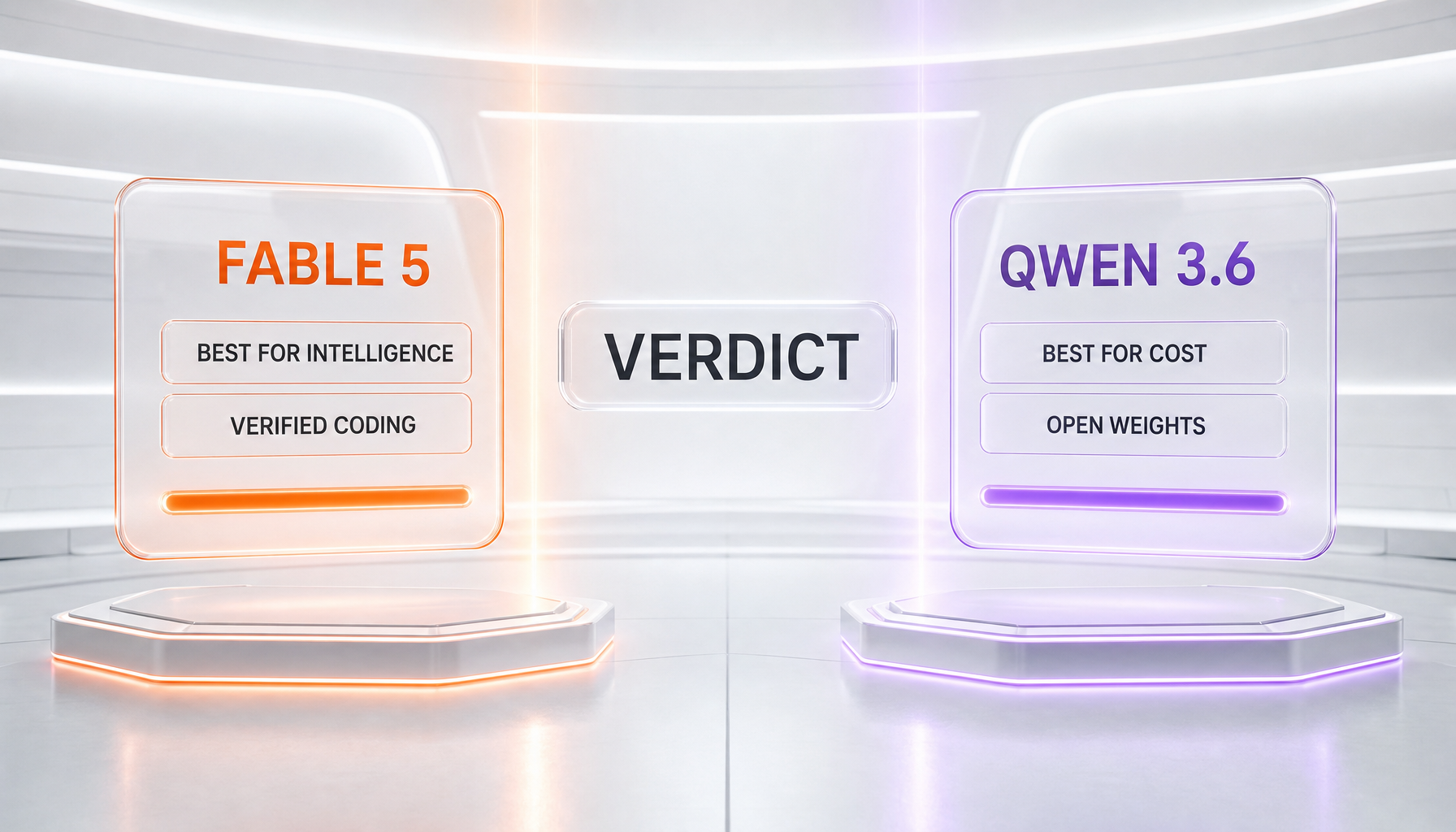
Our Verdict
Split verdict by use case — the widest intelligence gap in this batch of matchups set against a roughly 30-times price advantage. Claude Fable 5 is the strongest model on the one benchmark that scores both: number one overall on the Artificial Analysis Intelligence Index v4.1 at 60 versus 40 for Qwen 3.6 Plus, with an independently verified 95% on SWE-bench Verified (vals.ai) and a 1509 LMArena rating. Qwen 3.6 wins everything about cost and openness: Qwen 3.6 Plus at $0.325 input and $1.95 output per million tokens is roughly 31x and 26x cheaper than Fable 5, the family ships Apache 2.0 open weights (Qwen3.6-27B, Qwen3.6-35B-A3B) you can self-host, and both models share a 1,000,000-token context. No single overall winner: best for peak intelligence, verified coding, and premium creative work is Claude Fable 5; best for cost, multimodality, and open-weight self-hosting is Qwen 3.6. Only the pricing is fetch-verified; the head-to-head score is the independent Artificial Analysis index, and the Qwen open-weight coding figures are vendor self-reported for the open models, not the Plus tier.
Choose Claude Fable 5
Anthropic's most capable widely released model — the public, safety-classified Mythos-class frontier tier.
Try Claude Fable 5 →Choose Qwen 3.6
Alibaba's flagship LLM family — Plus and Max Preview proprietary plus Apache 2.0 open-weight 27B and 35B-A3B.
Try Qwen 3.6 →Frequently Asked Questions
Is Claude Fable 5 better than Qwen 3.6?
Split verdict by use case — the widest intelligence gap in this batch of matchups set against a roughly 30-times price advantage. Claude Fable 5 is the strongest model on the one benchmark that scores both: number one overall on the Artificial Analysis Intelligence Index v4.1 at 60 versus 40 for Qwen 3.6 Plus, with an independently verified 95% on SWE-bench Verified (vals.ai) and a 1509 LMArena rating. Qwen 3.6 wins everything about cost and openness: Qwen 3.6 Plus at $0.325 input and $1.95 output per million tokens is roughly 31x and 26x cheaper than Fable 5, the family ships Apache 2.0 open weights (Qwen3.6-27B, Qwen3.6-35B-A3B) you can self-host, and both models share a 1,000,000-token context. No single overall winner: best for peak intelligence, verified coding, and premium creative work is Claude Fable 5; best for cost, multimodality, and open-weight self-hosting is Qwen 3.6. Only the pricing is fetch-verified; the head-to-head score is the independent Artificial Analysis index, and the Qwen open-weight coding figures are vendor self-reported for the open models, not the Plus tier.
Which is cheaper, Claude Fable 5 or Qwen 3.6?
Claude Fable 5 is priced at $10 in / $50 out per M tokens. Qwen 3.6 offers a free plan (free plan available). Check the pricing comparison section above for a full breakdown.
What are the main differences between Claude Fable 5 and Qwen 3.6?
The key differences span across 7 features we compared. For AA Intelligence Index v4.1 (Artificial Analysis, same evaluator), Claude Fable 5 offers 60 — ranked number one overall while Qwen 3.6 offers 40 (Qwen 3.6 Plus). For Input price (per million tokens), Claude Fable 5 offers $10.00 (verified) while Qwen 3.6 offers $0.325 (Qwen 3.6 Plus, Alibaba direct). For Output price (per million tokens), Claude Fable 5 offers $50.00 (verified) while Qwen 3.6 offers $1.95 (Qwen 3.6 Plus, Alibaba direct). See the full feature comparison table above for all details.