Claude Opus 5 vs Claude Fable 5: Half the Price, One Point Apart (2026)


Opus 5 costs $5 and $25 per million tokens against Fable 5's $10 and $50, and scores 61 to 60 at max effort. Why price, not points, decides it.
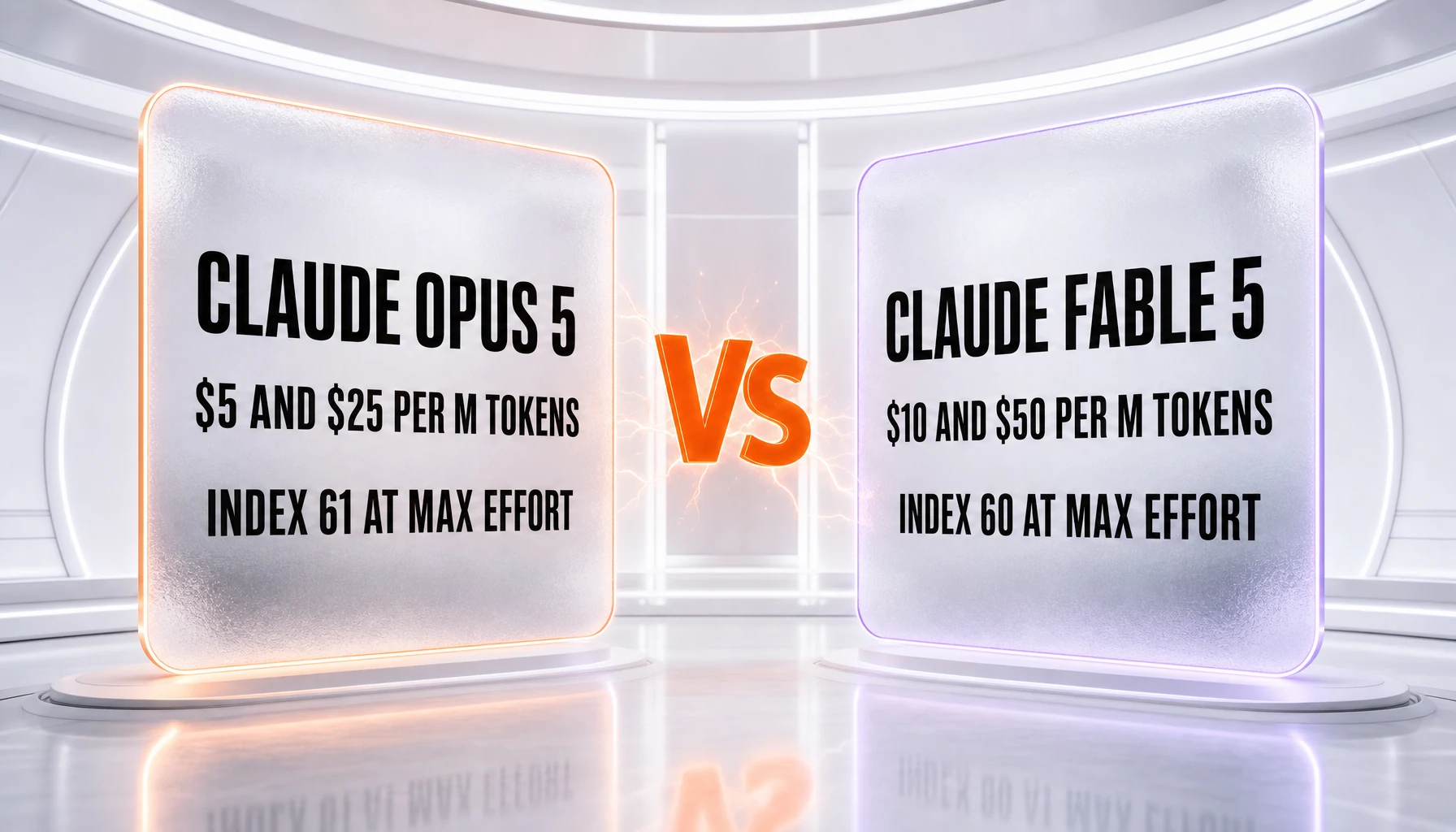
Feature Comparison
| Feature | Claude Opus 5 | Claude Fable 5 |
|---|---|---|
| Input price per million tokens | USD 5.00 | USD 10.00 |
| Output price per million tokens | USD 25.00 | USD 50.00 |
| Artificial Analysis Intelligence Index v4.1, max effort | 61 (narrowly ahead) | 60 |
| Same index at the API default setting | 59 at high | Not published below max |
| Cost per index task, max effort | USD 2.03 | USD 2.75 |
| Context window | 1,000,000 tokens | 1,000,000 tokens |
| Knowledge cutoff | May 2026 | January 2026 |
| Zero data retention | Available | Not available, 30-day retention required |
| Start tier input tokens per minute | 2,000,000 | 500,000 |
| Output tokens per second, max effort | 52.8 | 69.7 |
| Time to first token, max effort | 69.71 seconds | 133.80 seconds |
| FrontierCode, scored by Cognition (vendor system card) | 53.4 | 53.5 |
| Classifier refusal rate on FrontierBench (vendor system card) | 5 percent of calls | 42 percent of calls |
| Effort levels | Five, low to max, high by default | Five, low to max, high by default |
Pricing Comparison
Claude Opus 5
Claude Fable 5
Detailed Comparison
Claude Opus 5 vs Claude Fable 5: Opus 5 launched on July 24, 2026 at $5 per million input tokens and $25 per million output tokens, exactly half of Fable 5's $10 and $50. On version 4.1 of the independent Artificial Analysis Intelligence Index, Opus 5 scores 61 at max effort against Fable 5's 60, also at max effort — narrowly ahead, and only in that configuration, since Opus 5 scores 59 at the high setting the API gives you by default. Both models carry a 1M-token context window. Opus 5 adds a May 2026 knowledge cutoff, four times the rate-limit allowance on the same tier, and zero-data-retention eligibility that Fable 5 cannot offer. Our verdict: Opus 5 is the better default for most teams because it costs half as much, not because one index point makes it the better model. Fable 5 still earns its premium on long-horizon work, and it edges Opus 5 on the FrontierCode coding set reported in Anthropic's own system card.
The short answer
Opus 5 wins on price, not on points. That distinction is the whole comparison, and collapsing it produces a wrong answer in both directions. The measured gap between these two models is one point on a composite index published without a confidence interval, which is not a gap you should plan a stack around. The price gap is exactly two-to-one, verifiable to the cent on Anthropic's own pricing page, and it applies to every token you will ever send. When a difference you can bank on is that much larger than a difference you can measure, the cheaper model becomes the default — and that reasoning holds whether Opus 5 had scored 61, 60, or 59.
What makes this comparison unusual is that both models come from the same vendor, and the cheaper one is the newer one. Anthropic's tiering has said for two years that more capability costs more money. Claude Opus 5 is priced identically to Opus 4.8, 4.7, 4.6, and 4.5 before it, while Claude Fable 5 sits at double that. For the first time, the model at the top of the independent leaderboard is not the model at the top of the price list.
- Claude Opus 5 wins for: cost per unit of capability, high-volume bounded work, compliance postures that forbid data retention, throughput-heavy pipelines that need the larger rate-limit bucket, and anything that benefits from a knowledge cutoff four months fresher.
- Claude Fable 5 wins for: tasks measured in duration rather than in discrete outcomes, frontier coding work where it holds a razor-thin lead on the FrontierCode set, and teams already standardized on it who have no compliance reason to move.
- Identical on both: a 1M-token context window at standard pricing, availability across the Claude API and the major cloud platforms, and a 90 percent discount on prompt-cache reads relative to base input price.
- The honest caveat: both index scores are contaminated by the same mechanism. When a safety classifier refuses a request, the harness falls back to Opus 4.8, so some completions inside both the 61 and the 60 were not produced by the model on the label.
What each model is
Claude Opus 5
Claude Opus 5 shipped on July 24, 2026 as Anthropic's newest frontier model, and the headline is what did not change: $5 per million input tokens and $25 per million output tokens, the same figures the Opus tier has carried since Opus 4.5. Cache reads bill at $0.50 per million tokens, five-minute cache writes at $6.25, one-hour writes at $10, and the Batch API halves everything to $2.50 and $12.50. A research-preview fast mode is offered at $10 and $50 on the first-party API only, and it is worth understanding precisely what that buys: it raises output tokens per second and does nothing for time to first token.
Three things separate it from the rest of the Claude family. Its knowledge cutoff is May 2026, both for reliable knowledge and for training data, making it the freshest model Anthropic ships. Its context window is one million tokens by default, with no beta header and no long-context surcharge. And it exposes five effort levels rather than a binary, with high as the default in both the API and Claude Code — a genuine dial on cost and latency rather than a marketing label. Output runs to 128k tokens synchronously and 300k in batch behind a dedicated header. Rate limits on the Start tier are 1,000 requests per minute, 2,000,000 input tokens per minute, and 400,000 output tokens per minute, allocated in a bucket separate from other models. There is no Priority Tier. For the full specification sheet, see our launch coverage of Opus 5.
Claude Fable 5
Claude Fable 5 reached general availability on June 9, 2026 and remains, by Anthropic's own designation, its most capable model in general availability. It bills at $10 per million input tokens and $50 per million output tokens, with cache reads at $1, five-minute cache writes at $12.50, one-hour writes at $20, and batch pricing at $5 and $25. It carries the same 1M-token context window as Opus 5 and a January 2026 knowledge cutoff, four months behind.
Its defining operational constraint has nothing to do with capability. Fable 5 is a Covered Model, which means a mandatory 30-day data retention period with no zero-data-retention option available. For a large number of regulated buyers, that single line ends the evaluation before any benchmark is read, and it is the one structural advantage Opus 5 holds that no future index revision can erode. Its rate limits are also materially tighter: 500,000 input tokens per minute and 100,000 output tokens per minute on the Start tier, one quarter of what Opus 5 allows on both axes. We covered its arrival in detail in our Claude Fable 5 launch analysis, and measured it against the previous Opus flagship in Claude Fable 5 vs Claude Opus 4.8.
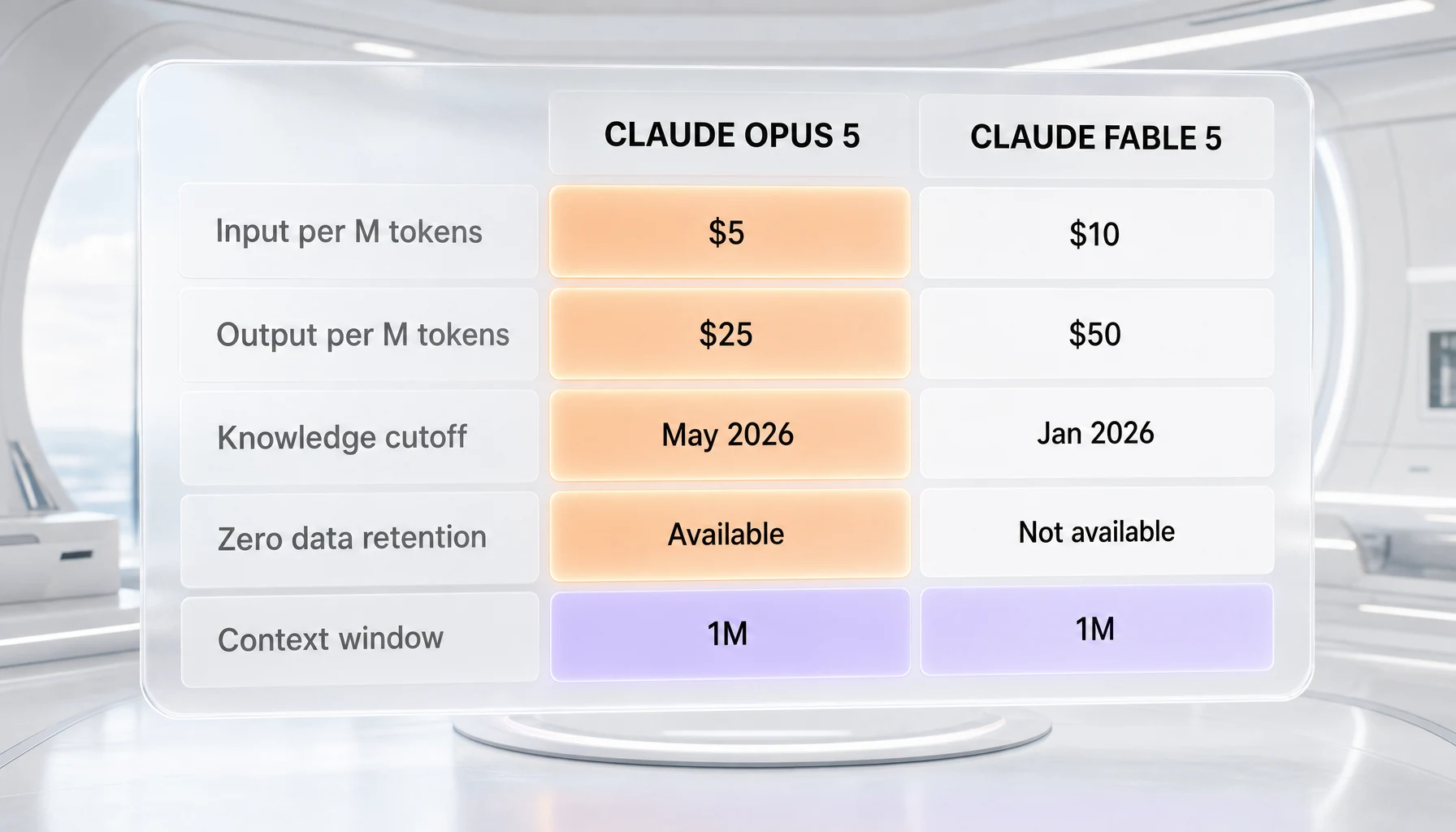
Head-to-head specifications
Every figure in this table is drawn from Anthropic's published platform documentation or from the independent Artificial Analysis index. No vendor benchmark results appear here; those are handled separately, and deliberately so.
| Specification | Claude Opus 5 | Claude Fable 5 | Edge |
|---|---|---|---|
| Input price per million tokens | USD 5.00 | USD 10.00 | Opus 5 |
| Output price per million tokens | USD 25.00 | USD 50.00 | Opus 5 |
| Cache read per million tokens | USD 0.50 | USD 1.00 | Opus 5 |
| Cache write, five minutes, per million tokens | USD 6.25 | USD 12.50 | Opus 5 |
| Batch input and output per million tokens | USD 2.50 and USD 12.50 | USD 5.00 and USD 25.00 | Opus 5 |
| Artificial Analysis Intelligence Index v4.1, max effort | 61 | 60 | Opus 5, narrowly |
| Same index, Opus 5 at the API default setting | 59 at high | Not published below max | No comparison available |
| Cost per index task, max effort (measured July 27, 2026) | USD 2.03 | USD 2.75 | Opus 5 |
| Context window | 1,000,000 tokens | 1,000,000 tokens | Tie |
| Knowledge cutoff | May 2026 | January 2026 | Opus 5 |
| Zero data retention | Available | Not available, 30-day retention required | Opus 5 |
| Start tier input tokens per minute | 2,000,000 | 500,000 | Opus 5 |
| Start tier output tokens per minute | 400,000 | 100,000 | Opus 5 |
| Output tokens per second, max effort (measured July 27, 2026) | 52.8 | 69.7 | Fable 5 |
| Time to first token, max effort (measured July 27, 2026) | 69.71 seconds | 133.80 seconds | Opus 5 |
Read that table with one correction in mind. The row count is lopsided, but rows are not weighted equally, and two of them cut against the headline. The 61 requires max effort: at the high setting the API gives you by default, Opus 5 scores 59, and you have to opt into max — and pay for the extra tokens it consumes — to reach the headline figure. What that means against Fable 5 is unknown, because Artificial Analysis publishes no Fable 5 score below max effort. And Fable 5 produces output roughly 32 percent faster once it starts producing. Neither fact overturns the price argument, but both belong in front of anyone who reads the first row and stops.
Pricing: the same work at half the invoice
Anthropic prices these two models at an exact two-to-one ratio on every axis that matters. Input, output, cache reads, cache writes at both durations, and batch rates all sit at precisely double for Fable 5. There is no tier, no volume band, and no commitment level at which the ratio narrows.
On a workload of 20 million input tokens and 4 million output tokens per month — a realistic mid-sized production pipeline — Opus 5 bills $100 for input and $100 for output, totaling $200. Fable 5 bills $200 and $200, totaling $400. Run the same workload through the Batch API and Opus 5 costs $100 against Fable 5's $200. The absolute numbers scale, the ratio does not move, and at the volumes where this decision actually matters the annual difference runs to five figures.
Artificial Analysis re-measures cost, speed and latency continuously, so each of those figures is a reading taken on July 27, 2026 rather than a fixed property of either model. The Artificial Analysis cost-per-task figures tell the same story from a different angle, and they are more honest than raw token prices because they account for how many tokens each model actually spends to finish the work. Completing the index cost $2.03 per task on Opus 5 at max effort against $2.75 on Fable 5 — a 26 percent saving rather than the 50 percent the price list implies. The gap narrows because Opus 5 is verbose: it generated roughly 100 million tokens across the index run against a median of 63 million for models in its price band, about 59 percent more. Half-price tokens partly offset by generating more of them still lands ahead, but not by the factor the pricing page suggests.
Artificial Analysis published a full cost-per-effort ladder for Opus 5, which lets you price that trade-off directly. Both models expose the same five effort levels — Anthropic's documentation gives Fable 5 the same low-to-max range with high as the default — but no equivalent per-effort cost breakdown has been published for Fable 5, so only Opus 5 can be priced this way today. Cost per index task runs $0.36 at low, $0.62 at medium, $1.06 at high, $1.56 at xhigh, and $2.03 at max. A team that finds its work is well served at high — the default — is comparing $1.06 against $2.75, which is a materially different conversation from the one the headline numbers frame.
The independent index, and what one point does not mean
The Artificial Analysis Intelligence Index is the only third-party measurement that scores both models under one harness, which makes it the only place a direct comparison is even defensible. On version 4.1, relevant as of July 24, 2026, Opus 5 scores 61 at max effort and Fable 5 scores 60. Opus 5 ranks first; Fable 5's official entry, listed as "Claude Fable 5 (Adaptive Reasoning, Max Effort, Opus 4.8 Fallback)", ranks third.
Four qualifications have to travel with those numbers, and dropping any of them turns a measurement into a marketing claim.
A score exists only with its index version. Version 4.1 is not version 4.0, and models have moved by double digits across index revisions in the past. A 61 from v4.1 cannot be set against a score you read on a different version, and neither can a 60.
A score exists only with its configuration. Opus 5's 61 is a max-effort figure. The same model scores 60 at xhigh, 59 at high, 56 at medium, and 51 at low. High is the default in the API and in Claude Code, which means the number most teams will actually experience is 59. Quoting 61 without the effort setting attached is quoting a number that most users will never see. Note what this does not license: Fable 5's 60 is itself a max-effort measurement, and Artificial Analysis publishes no Fable 5 figure at any lower setting, so setting 59 against 60 would compare two different configurations — the same faulty move this page objects to elsewhere. The default-setting comparison simply has not been measured.
The rank is not the score. Fable 5 sits third rather than second because Opus 5 at xhigh also rounds to 60 and edges it on the raw figure. Two positions on a leaderboard here encode a difference far smaller than one point. Ranks compress; they are a presentation artifact, not a performance fact, and treating third place as meaningfully worse than first would be reading precision that the underlying data does not contain.
Both numbers are contaminated by the same mechanism. This is the qualification that matters most and gets quoted least. Anthropic's safety classifiers can refuse an API call mid-evaluation, and in both models' harnesses a refused call falls back to Opus 4.8. Some share of the completions inside the 61 and inside the 60 were therefore produced by a third model. Anthropic disclosed those proportions for its FrontierBench run — 5 percent of calls on 4 percent of attempts for Opus 5, against 42 percent of calls on 26 percent of attempts for Fable 5 — but no equivalent disclosure exists for the Intelligence Index. We do not know how much of either score is Opus 4.8 wearing another model's name.
Put those together and the defensible statement is that Opus 5 is narrowly ahead of Fable 5 on one independent composite index, with both models measured at max effort and both carrying an undisclosed and probably unequal amount of fallback contamination — and that no independent measurement exists for either model at the default setting. That is a materially weaker claim than "Opus 5 is the better model", and it is the only one the evidence supports. The price difference, by contrast, needs no qualification at all.
The refusal asymmetry deserves a second look on its own terms, because it is a product fact and not only a measurement problem. A model that refuses 42 percent of calls on a security-adjacent evaluation will refuse a meaningful share of calls in a security-adjacent product. If your workload touches offensive security, biology, or chemistry, Opus 5's 5 percent refusal rate is not a benchmark footnote — it is the difference between a pipeline that runs and one that spends its budget on fallbacks.
The vendor's own numbers, kept separate
Everything in this section comes from Anthropic's 194-page system card for Opus 5. These are the vendor's evaluations of the vendor's model against the vendor's other model, and we are keeping them in their own section rather than mixing them into the table above, because a self-reported figure and an independently measured one do not belong in the same row. Read them as the vendor's account, not as settled fact.
- FrontierBench v0.1 — 74 tasks, run internally by Anthropic on a mini-SWE-agent harness. Opus 5 scores 44.4 percent at xhigh against Fable 5's 33.7 percent. The widest margin Anthropic reports, and also the one run entirely in-house.
- FrontierCode — 150 tasks, built and scored by Cognition rather than by Anthropic. Fable 5 wins, 53.5 against 53.4 on the main set. This is the one place Opus 5 does not come first, the margin is a tenth of a point, and it lands on the one coding evaluation in the set that Anthropic did not score itself. We are not going to bury it.
- OSWorld 2.0 — computer-use tasks, both models run by Anthropic. Opus 5 scores 70.57 percent against Fable 5's 66.1 percent.
- AutomationBench — a held-out private set from Zapier. Opus 5 scores 26.0 percent at max effort against Fable 5's 17.4 percent. Held-out sets resist contamination, which makes this a stronger data point than its low absolute numbers suggest.
- ARC-AGI — verified by the ARC Prize Foundation, making it the least conflicted figure in the entire document. Opus 5 reaches 97.50 percent on ARC-AGI-1 and 90.42 percent on ARC-AGI-2.
One more item from the system card belongs here because it cuts against Opus 5. Anthropic reports that Opus 5 improved accuracy by 11 percent over Opus 4.8 while its hallucination rate rose by 6 percent, though the card does not state whether these are relative changes or absolute point differences. The document is unusually direct about the failure mode, noting on page 3 "a surprising number of cases in which Opus 5 confidently stated an answer about which it was in fact unsure". A model that is more often right and also more often confidently wrong is a specific engineering problem, and it argues for verification layers on any Opus 5 output that feeds an automated decision.
Speed: two different questions
Latency comparisons between these models get reported wrongly more often than any other figure, because the two models each win one half of the question and the halves point in opposite directions.
Artificial Analysis re-measures speed and latency continuously, so these are readings, not constants; the figures below were taken on July 27, 2026. Fable 5 generates output faster: 69.7 output tokens per second at max effort against Opus 5's 52.8, roughly 32 percent quicker once generation begins. Opus 5 starts faster: 69.71 seconds to first token against Fable 5's 133.80, roughly 48 percent sooner. Whichever model you prefer, the sentence "it is faster" is incomplete, and the claim that either model is faster on both axes is simply false.
Which half matters depends entirely on your surface. A batch pipeline chewing through long documents cares about sustained throughput and will prefer Fable 5's token rate. Anything with a human waiting on it cares about time to first token — and both figures are severe enough at max effort that neither model belongs in an interactive product at that setting. For context, the median time to first token across models in this price band is 2.87 seconds. Both of these models are an order of magnitude slower than their peers at maximum effort, which is the cost of the reasoning that produces the scores.
Opus 5's fast mode is worth one precise note, because its name invites the wrong assumption. At $10 and $50 per million tokens it improves output tokens per second only. It does not reduce time to first token. If your latency complaint is that the model takes a minute to say anything, fast mode does not address it, and you would be paying Fable 5 prices for an Opus 5 model that still makes the user wait.
How we researched this
We researched both models rather than running our own hands-on evaluation of them. No benchmark figure on this page was produced by us, and we think saying so plainly is worth more than an implied authority we have not earned.
Pricing, context windows, output limits, cutoffs, rate limits, retention status, cache rates, and tool-use overhead were read directly from Anthropic's published platform documentation on July 27, 2026, not from summaries or secondhand reporting. Index scores, cost per task, output speed, time to first token, and token-verbosity figures come from version 4.1 of the Artificial Analysis Intelligence Index as of July 24, 2026. Benchmark results attributed to Anthropic come from the Opus 5 system card and are labeled as vendor-reported wherever they appear. The ARC-AGI figures are flagged separately because the ARC Prize Foundation verified them independently.
Where the two evidence classes disagree or cannot be reconciled, we have said so rather than averaging them into a single score. Where a number depends on a configuration — and on these models most of them do — we have carried the configuration alongside the number. Comparisons that quietly drop the effort setting, the index version, or the fallback disclosure are not being more concise; they are reporting something that is not true.
Winner by category
| Category | Winner | Why |
|---|---|---|
| Cost per unit of capability | Claude Opus 5 | Half the token price and USD 2.03 against USD 2.75 per index task |
| Peak measured intelligence | Claude Opus 5, narrowly | 61 against 60, both at max effort; Opus 5 scores 59 at the default setting, where Fable 5 is unmeasured |
| Frontier coding | Claude Fable 5 | 53.5 against 53.4 on the Cognition-scored FrontierCode set |
| Long-horizon and duration-heavy tasks | Claude Fable 5 | Anthropic itself concedes the evaluations Opus 5 wins do not measure duration |
| Regulated and zero-retention environments | Claude Opus 5 | Fable 5's Covered Model status forces 30-day retention with no opt-out |
| Throughput at scale | Claude Opus 5 | Four times the input and output rate-limit allowance in a separate bucket |
| Knowledge freshness | Claude Opus 5 | May 2026 against January 2026 |
| Sustained generation speed | Claude Fable 5 | 69.7 against 52.8 output tokens per second |
| Responsiveness | Claude Opus 5 | 69.71 seconds to first token against 133.80 |
| Security-adjacent workloads | Claude Opus 5 | 5 percent of calls refused against 42 percent on the same evaluation |
| Factual reliability | Not measured between these two | Anthropic reports Opus 5's hallucination rate against Opus 4.8, never against Fable 5 |
| Conciseness | Claude Fable 5 | Opus 5 generated roughly 59 percent more tokens than its price-band median |
Strengths and limitations
Claude Opus 5 — where it is strong
- Half the token price of Fable 5 on every axis, with no volume band at which the ratio narrows.
- Narrowly first on the independent Artificial Analysis Intelligence Index v4.1 at max effort.
- A May 2026 knowledge cutoff for both reliable knowledge and training data, four months fresher than Fable 5.
- Five effort levels that turn cost and latency into a dial, from $0.36 to $2.03 per index task.
- Zero-data-retention eligibility, which Fable 5 structurally cannot offer.
- Four times the input and output rate-limit allowance on the same tier, in a separate bucket.
- A 5 percent classifier refusal rate against Fable 5's 42 percent on the same evaluation.
Claude Opus 5 — where it is weak
- 69.71 seconds to first token at max effort, against a peer median of 2.87 seconds.
- A hallucination rate 6 percent higher than Opus 4.8, alongside 11 percent better accuracy.
- Verbose, generating roughly 100 million tokens on the index run against a 63 million peer median.
- Scores 59 at the default high setting; reaching the headline 61 requires explicitly opting into max effort, and the extra tokens it spends.
- Second on FrontierCode, by a tenth of a point, on the most independently scored coding set available.
- No Priority Tier support.
Claude Fable 5 — where it is strong
- Anthropic's most capable model in general availability by the vendor's own designation.
- Scores 60 on the independent index at max effort, one point behind Opus 5 in the same configuration.
- Wins FrontierCode 53.5 to 53.4, scored by Cognition rather than by Anthropic.
- Generates output roughly 32 percent faster once generation begins.
- Stronger on long-horizon work, a gap Anthropic acknowledges its own evaluations do not capture.
- The same 1M-token context window as Opus 5, at standard pricing.
Claude Fable 5 — where it is weak
- Double the price on input, output, cache reads, cache writes, and batch.
- Covered Model status forces 30-day retention with no zero-data-retention option.
- A January 2026 knowledge cutoff, four months behind Opus 5.
- One quarter of Opus 5's rate-limit allowance on both input and output.
- 133.80 seconds to first token, the slower of the two to start responding.
- 42 percent of calls refused by safety classifiers on Anthropic's FrontierBench run.
- Costs $2.75 per index task against $2.03, a 35 percent premium for what the same index measures as one point.
When to pick which
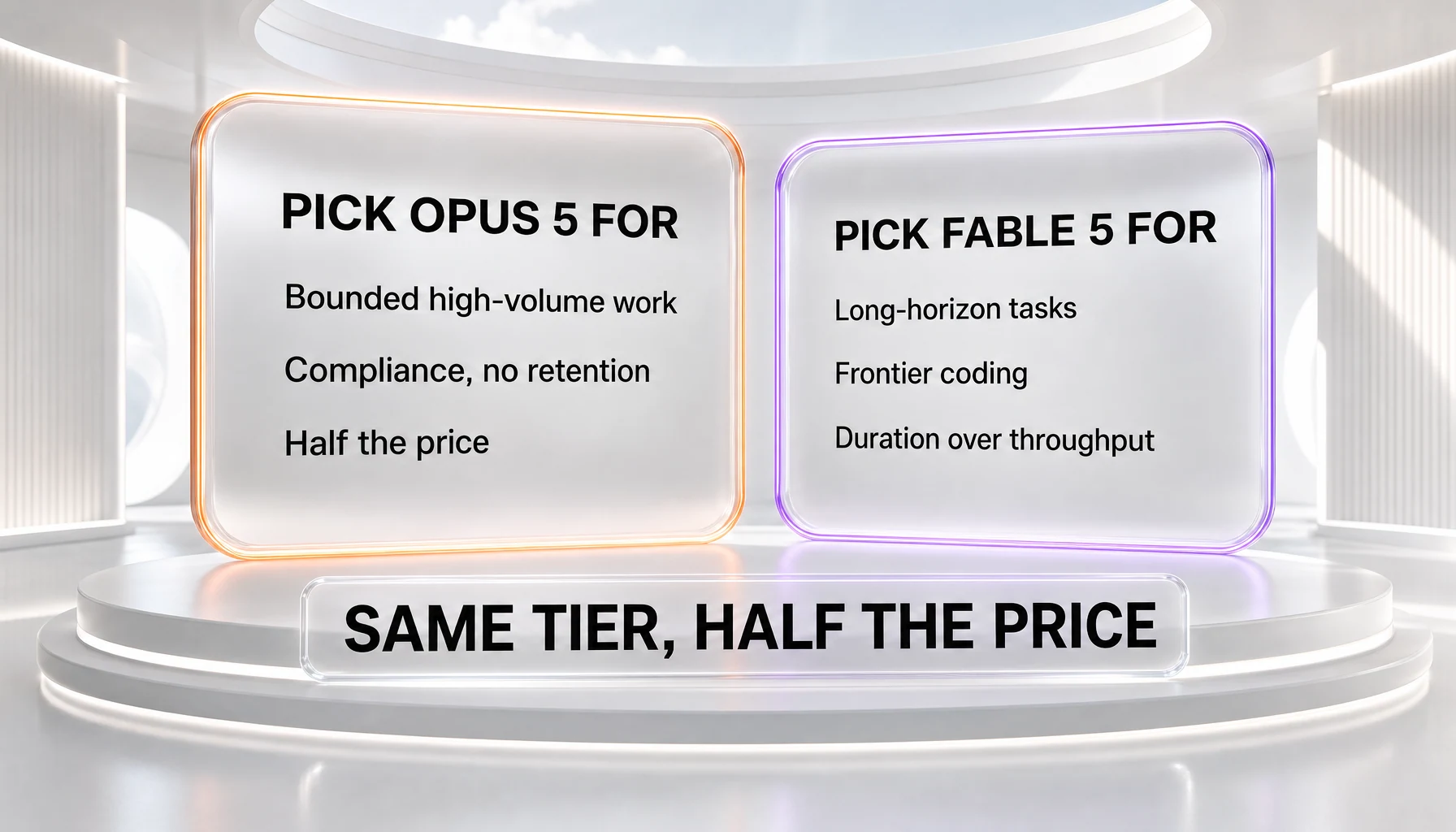
Pick Claude Opus 5 if
Your workload is high volume and bounded — discrete tasks with a defined correct outcome, run many times. This is precisely the shape Anthropic's own spokesperson identified as Opus 5's strength, and it is where halving the token price compounds fastest. Pick it if your compliance posture forbids data retention, which makes the decision for you regardless of any benchmark. Pick it if you are rate-limit constrained, because four times the allowance in a separate bucket is a throughput change no amount of capability substitutes for. Pick it if your work depends on events after January 2026, where Fable 5 is simply blind. And pick it if you want the effort dial: the ability to run most traffic at low or medium and reserve max for the hard tail is a cost lever Fable 5 does not offer.
Pick Claude Fable 5 if
Your work is measured in duration rather than in discrete outcomes. An Anthropic spokesperson put the limitation of their own evaluations to VentureBeat plainly: "The evals where Opus 5 wins are bounded tasks with a specific outcome, which is where it's strongest. What those evals don't measure is duration." That is a vendor conceding the boundary of its own benchmark suite, which makes it more credible than a vendor claiming a win, and it is the strongest argument for paying double. Pick Fable 5 for frontier coding, where it holds FrontierCode by a tenth of a point on the set Anthropic did not score itself. Pick it if sustained generation speed matters more to you than time to first token. And pick it if you are already running it in production without a compliance reason to move — a 26 percent cost-per-task saving rarely justifies a migration on its own.
Consider neither if
Both models are expensive and slow to start. If your tasks do not genuinely require frontier reasoning, Claude Sonnet 5 covers a large share of production work at a fraction of the price, and Claude Opus 4.8 remains available at Opus 5 pricing with a lower hallucination rate. Outside Anthropic, GPT-5.6 Sol and Kimi K3 are both worth pricing before committing, and Kimi K3 in particular changes the arithmetic for teams whose hardest task sits below the frontier line.
Final verdict
Claude Opus 5 is the better default, and the reason is the price rather than the point. A model that matches its stablemate's measured capability within the noise floor of a composite index, while costing exactly half as much, carrying a fresher cutoff, allowing four times the throughput, and remaining usable under zero-data-retention constraints, is the model most teams should reach for first. Every element of that sentence except the first is a hard fact with no measurement dispute attached.
What we will not do is convert one index point into a capability claim. Opus 5 is narrowly ahead of Fable 5 on version 4.1 of the Artificial Analysis Intelligence Index, at max effort, and behind it at the setting the API gives you by default. Both scores include completions produced by Opus 4.8 after classifier refusals, in proportions that were disclosed for a different evaluation and never for this one. A one-point gap on a composite index published without a confidence interval, measured on two configurations that fall back to a third model at unequal rates, is not a result you should build a procurement decision on. The two-to-one price ratio is.
Fable 5 keeps a genuine claim on two things. It wins FrontierCode, narrowly, on the coding set Anthropic did not score itself. And it is stronger on work measured in duration, a gap Anthropic's own spokesperson conceded its evaluation suite does not capture — an unusually candid admission that we weight more heavily than any figure in the system card. If your hardest work is long-horizon agentic work, Fable 5 is still worth its premium, and no amount of price advantage changes that.
The broader signal is the one worth carrying away. For the first time, Anthropic's price hierarchy and its performance hierarchy point in different directions. The cheaper, newer model sits at the top of the independent leaderboard while the expensive one holds the "most capable" label. Treat the label as a description of tiering rather than of measured performance, price both models against your actual workload, and let the two-to-one ratio do the work that one index point cannot.
Frequently Asked Questions
Which is better overall, Claude Opus 5 or Claude Fable 5?
Opus 5 is the better default for most teams, but on price rather than on measured capability. On version 4.1 of the independent Artificial Analysis Intelligence Index it scores 61 at max effort against Fable 5's 60 in the same configuration — narrowly ahead. At the high setting the API uses by default Opus 5 scores 59, and no Fable 5 score is published below max effort, so the default-setting comparison does not exist. One point on a composite index published without a confidence interval is not a decisive gap. The exact two-to-one price difference is decisive, and it applies to every token you send. Fable 5 remains the better choice for long-horizon work and frontier coding.
How much cheaper is Claude Opus 5 than Claude Fable 5?
Exactly half, on every axis. Opus 5 costs $5 per million input tokens and $25 per million output tokens; Fable 5 costs $10 and $50. Cache reads are $0.50 against $1, five-minute cache writes $6.25 against $12.50, and batch rates $2.50 and $12.50 against $5 and $25. There is no volume band where the ratio narrows. On a workload of 20 million input and 4 million output tokens per month, Opus 5 bills $200 against Fable 5's $400.
Is Claude Opus 5 really the number one model?
It ranks first on version 4.1 of the Artificial Analysis Intelligence Index, but that ranking carries conditions. The 61 that earns it applies only at max effort; at the default high setting the model scores 59, and Artificial Analysis publishes no Fable 5 figure below max effort to compare that against. Ranks also compress real differences — Fable 5 sits third rather than second because Opus 5 at xhigh also rounds to 60. A leaderboard position is a presentation artifact, not a performance fact, and the honest description is that Opus 5 is narrowly ahead under one specific configuration.
What does the Opus 4.8 fallback mean for these scores?
It means both scores are contaminated by the same mechanism. When an Anthropic safety classifier refuses an API call during an evaluation, the harness completes it on Opus 4.8 instead. Some portion of both the 61 and the 60 was therefore produced by a third model. Anthropic disclosed these rates for its FrontierBench run — 5 percent of calls for Opus 5 against 42 percent for Fable 5 — but published no equivalent figure for the Intelligence Index. Nobody outside Anthropic knows how much of either index score is actually Opus 4.8.
Which model is faster, Claude Opus 5 or Claude Fable 5?
Each wins one half of the question, so the answer depends on what you mean. Fable 5 generates output faster at 69.7 output tokens per second against Opus 5's 52.8, roughly 32 percent quicker. Opus 5 starts faster, at 69.71 seconds to first token against Fable 5's 133.80. Neither model is faster on both axes, and any source claiming otherwise has dropped one measurement. At max effort both are an order of magnitude slower to start than their price-band median of 2.87 seconds.
Can I use Claude Fable 5 with zero data retention?
No. Fable 5 is designated a Covered Model, which imposes a mandatory 30-day data retention period with no zero-data-retention option available. Opus 5 carries no such requirement. For organizations whose compliance posture forbids retention, this single constraint decides the comparison before any benchmark is considered, and it is the one advantage Opus 5 holds that no future index revision can erode.
Does Claude Fable 5 beat Opus 5 at anything measurable?
Yes, on two counts. It wins the FrontierCode evaluation 53.5 to 53.4 on the main set, notable because Cognition built and scored that set rather than Anthropic. And it generates output roughly 32 percent faster once generation begins. Anthropic also concedes its evaluation suite does not measure task duration, which is where Fable 5 is reported to be stronger.
Why does Anthropic charge more for the model that scores lower?
Because tier pricing reflects positioning rather than measured performance. Fable 5 remains Anthropic's designated most capable model in general availability, and it was priced at that tier when it launched in June 2026. Opus 5 arrived in July at the same $5 and $25 the Opus tier has carried since Opus 4.5. The result is that the price hierarchy and the independent performance hierarchy now point in different directions — a first for Anthropic, and the most useful signal in this comparison.
Does Claude Opus 5 hallucinate more than previous models?
Anthropic reports that it does. The Opus 5 system card documents an accuracy improvement of 11 percent over Opus 4.8 alongside a hallucination rate increase of 6 percent, though the card does not state whether these are relative changes or absolute point differences. The document describes "a surprising number of cases in which Opus 5 confidently stated an answer about which it was in fact unsure". A model that is more often right and also more often confidently wrong argues for verification layers on any output feeding an automated decision.
What is Opus 5 fast mode, and is it worth paying for?
Fast mode is a research preview available on the first-party Claude API only, priced at $10 and $50 per million tokens — the same as standard Fable 5. It improves output tokens per second and nothing else. Critically, it does not reduce time to first token. If your complaint is that the model takes a minute before it says anything, fast mode will not fix it, and you would be paying Fable 5 rates without solving the problem you bought it for.
How much does the effort setting change the cost?
By a factor of more than five. Artificial Analysis measured cost per index task on Opus 5 at $0.36 at low effort, $0.62 at medium, $1.06 at high, $1.56 at xhigh, and $2.03 at max. Fable 5 exposes the same five effort levels, but Artificial Analysis published only one measurement for it, at $2.75 per task, so there is no per-effort curve to compare against. A team running most traffic at high and reserving max for the hard tail is comparing $1.06 against $2.75 — a very different calculation from the headline figures.
Should I migrate an existing Fable 5 deployment to Opus 5?
Only with a reason beyond the benchmark. A 26 percent saving in cost per index task rarely justifies migration work on its own, and the measured capability difference is within noise. Three reasons do justify it: a compliance requirement Fable 5 cannot meet because of its mandatory retention, rate-limit pressure that four times the allowance would relieve, or a workload dependent on knowledge after January 2026. Absent one of those, staying put is defensible.
Sources and references
Every figure on this page is attributed to whoever produced it. Independent measurement, vendor-reported results and third-party-verified scores are listed separately and never merged.
- Anthropic — Introducing Claude Opus 5 (launch announcement, July 24, 2026)
- Anthropic — Claude Opus 5 System Card (194 pages; source for every vendor benchmark figure quoted here)
- Anthropic — Models overview (model IDs, context windows, knowledge cutoffs, availability)
- Anthropic — Pricing (per-token rates, cache pricing, Batch API)
- Anthropic — Effort parameter (the five effort levels and per-model defaults)
- Anthropic — Rate limits (the separate Opus 5 bucket and per-tier allowances)
- Artificial Analysis — Model leaderboard (Intelligence Index v4.1 scores and cost per task, consulted July 27, 2026)
- Artificial Analysis — Claude Opus 5 (index score, speed, latency and verbosity)
- Artificial Analysis — Claude Fable 5 (index score, speed and latency)
Our Verdict
Claude Opus 5 is the better default, and the reason is the price rather than the point. It is narrowly ahead of Fable 5 on version 4.1 of the independent Artificial Analysis Intelligence Index — 61 against 60, with both models measured at max effort; Opus 5 scores 59 at the high setting the API uses by default, a level at which Artificial Analysis publishes no Fable 5 figure to compare against. Both figures are contaminated by the same Opus 4.8 fallback on classifier refusals, in proportions Anthropic disclosed for a different evaluation and never for this index, so a one-point gap published without a confidence interval cannot carry a procurement decision. The exact two-to-one price ratio can, and it comes with a fresher May 2026 cutoff, four times the rate-limit allowance, and zero-data-retention eligibility Fable 5 structurally cannot offer. Fable 5 keeps a genuine claim on two things: it wins the Cognition-scored FrontierCode set 53.5 to 53.4, and it is stronger on long-horizon work — a gap Anthropic's own spokesperson conceded its evaluation suite does not measure.
Choose Claude Opus 5
Anthropic's frontier reasoning model — top of the independent index at half the price of Fable 5.
Try Claude Opus 5 →Choose Claude Fable 5
Anthropic's most capable widely released model — the public, safety-classified Mythos-class frontier tier.
Try Claude Fable 5 →Frequently Asked Questions
Is Claude Opus 5 better than Claude Fable 5?
Claude Opus 5 is the better default, and the reason is the price rather than the point. It is narrowly ahead of Fable 5 on version 4.1 of the independent Artificial Analysis Intelligence Index — 61 against 60, with both models measured at max effort; Opus 5 scores 59 at the high setting the API uses by default, a level at which Artificial Analysis publishes no Fable 5 figure to compare against. Both figures are contaminated by the same Opus 4.8 fallback on classifier refusals, in proportions Anthropic disclosed for a different evaluation and never for this index, so a one-point gap published without a confidence interval cannot carry a procurement decision. The exact two-to-one price ratio can, and it comes with a fresher May 2026 cutoff, four times the rate-limit allowance, and zero-data-retention eligibility Fable 5 structurally cannot offer. Fable 5 keeps a genuine claim on two things: it wins the Cognition-scored FrontierCode set 53.5 to 53.4, and it is stronger on long-horizon work — a gap Anthropic's own spokesperson conceded its evaluation suite does not measure.
Which is cheaper, Claude Opus 5 or Claude Fable 5?
Claude Opus 5 starts at $5 in / $25 out per M tokens. Claude Fable 5 starts at $10 in / $50 out per M tokens. Check the pricing comparison section above for a full breakdown.
What are the main differences between Claude Opus 5 and Claude Fable 5?
The key differences span across 14 features we compared. For Input price per million tokens, Claude Opus 5 offers USD 5.00 while Claude Fable 5 offers USD 10.00. For Output price per million tokens, Claude Opus 5 offers USD 25.00 while Claude Fable 5 offers USD 50.00. For Artificial Analysis Intelligence Index v4.1, max effort, Claude Opus 5 offers 61 (narrowly ahead) while Claude Fable 5 offers 60. See the full feature comparison table above for all details.