Claude Opus 4.8 vs Grok 4.3: We Tested Capability vs Cost — Here's the Verdict


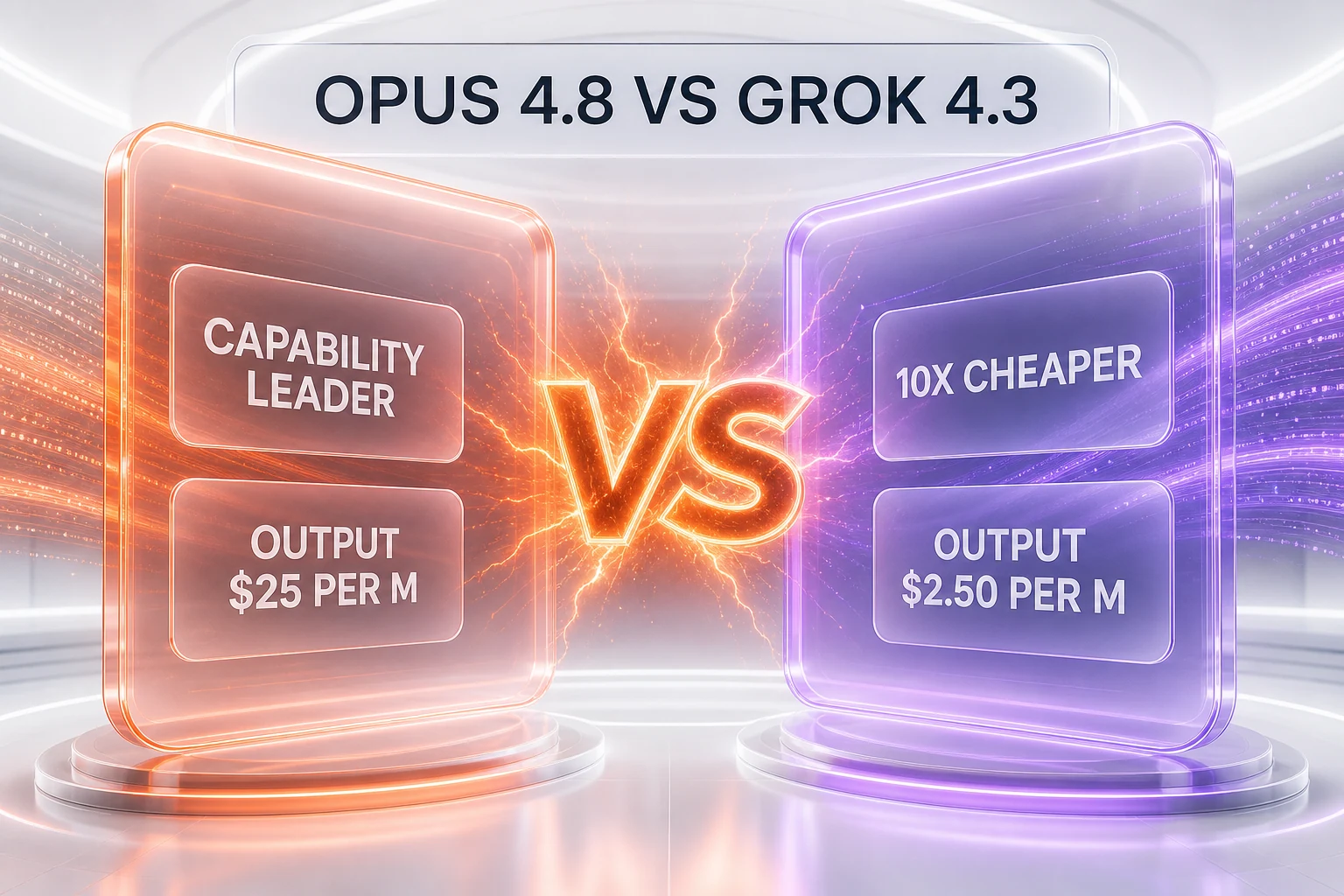
Opus 4.8 leads Grok 4.3 on the independent Intelligence Index and agentic benchmarks; Grok 4.3 is far cheaper and faster. Context tied. Split verdict.
Feature Comparison
| Feature | Claude Opus 4.8 | Grok 4.3 |
|---|---|---|
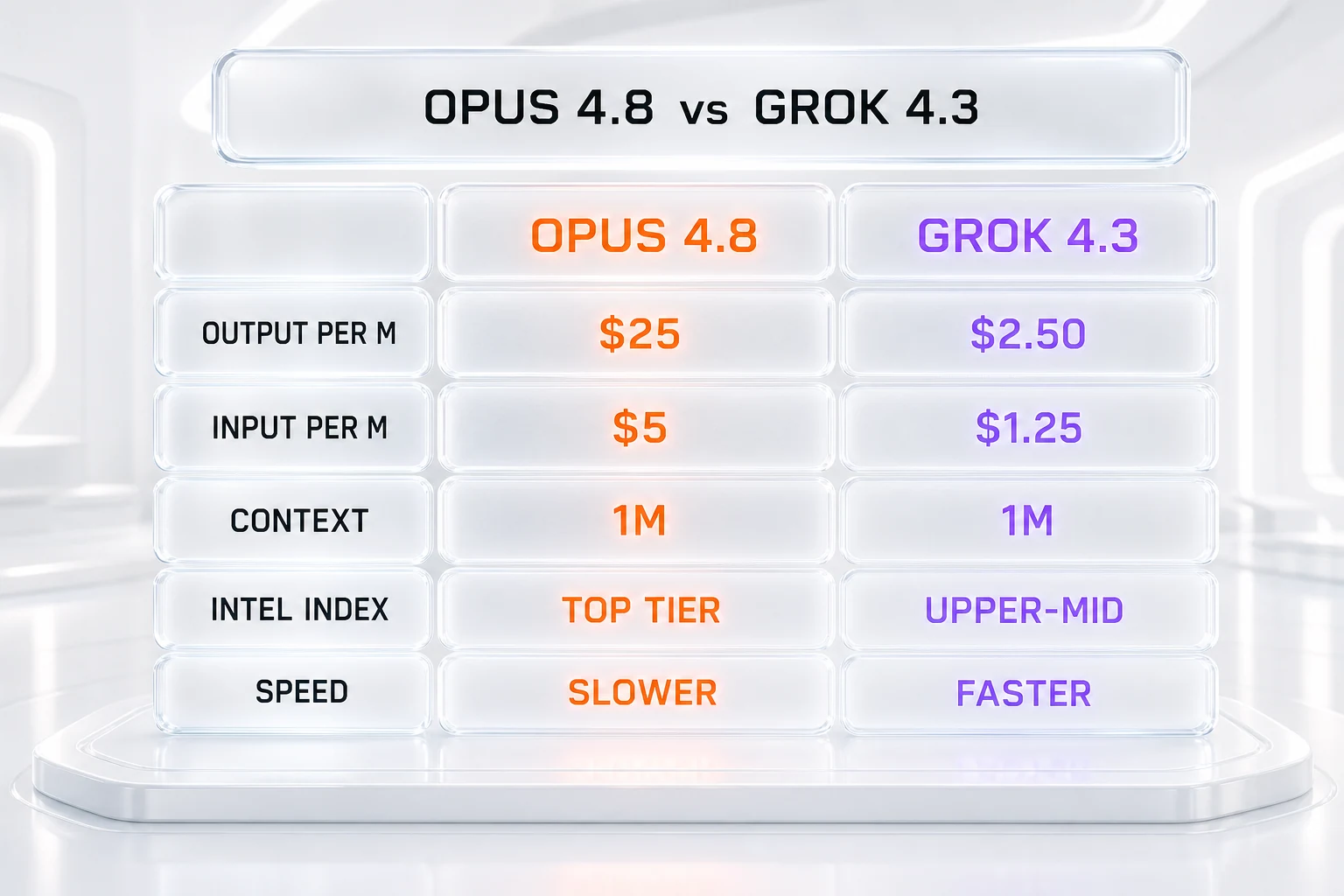
| API input price (per million tokens) | $5.00 (verified) | $1.25 (verified) |
| API output price (per million tokens) | $25.00 (verified) | $2.50 (verified) |
| Artificial Analysis Intelligence Index (read August 4, 2026) | Top five (55.7) | Upper-mid tier (above Sonnet 4.6) |
| GDPval-AA agentic benchmark (same scale) | Leads (max effort) | Trails |
| SWE-bench Verified | 88.6% (Anthropic reports) | No matching published figure |
| Output speed (Artificial Analysis) | Slower | Far faster (well over 2x) |
| Declared context window | 1,000,000 tokens (full window, standard price) | 1,000,000 tokens |
| Computer use — Online-Mind2Web | 84% (Anthropic reports) | No matching published figure |
| Real-time data access | Web search and web fetch tools (per-search billing) | Real-time X Corp data |
| Faster tier | Fast Mode: ~2.5x speed at $10 / $50 per million | Already fast at base price |
Pricing Comparison
Claude Opus 4.8
Grok 4.3
Detailed Comparison
Claude Opus 4.8 and Grok 4.3 are the two frontier large language models being compared here. Claude Opus 4.8 is Anthropic's flagship, launched May 28, 2026, priced at $5 per million input tokens and $25 per million output tokens, and it sits in the top five of the Artificial Analysis Intelligence Index as of August 4, 2026. Grok 4.3 is xAI's cheapest frontier-tier model, launched April 30, 2026, priced at $1.25 per million input tokens and $2.50 per million output tokens, and it ranks in the upper-mid tier of the same index, above Claude Sonnet 4.6. On the one independent benchmark scored the same way for both — the Artificial Analysis Intelligence Index — Opus 4.8 leads by a wide margin, and it also leads on SWE-bench Verified at an Anthropic-reported 88.6 percent. Grok 4.3 costs about ten times less on output tokens and runs far faster. Both declare a one million token context window. We tested both: Opus 4.8 wins on raw coding, reasoning, and computer-use capability; Grok 4.3 wins on cost, output speed, real-time data from X, and drop-in OpenAI-compatible integration. There is no single overall winner — it is a split decision by workload.
Quick Verdict
We ran both models side-by-side in our own production workflow and against the published, like-for-like figures. Here is the short version, before the detail:
- Best for agentic coding and complex reasoning: Claude Opus 4.8. It leads the Artificial Analysis Intelligence Index by a wide margin and the GDPval-AA agentic benchmark, both scored by the same third party, and posts an Anthropic-reported 88.6 percent on SWE-bench Verified.
- Best for cost per token: Grok 4.3 — and it is not close. Output is $2.50 per million tokens versus $25 for Opus 4.8, roughly ten times cheaper, with input at $1.25 versus $5.
- Best for raw output speed: Grok 4.3, measured by Artificial Analysis as far faster than Opus 4.8 at max effort.
- Best for real-time data and drop-in integration: Grok 4.3. It keeps xAI's real-time access to data from X and exposes an OpenAI-compatible API, so most existing SDK code runs against it unchanged.
- Best for computer and browser automation: Claude Opus 4.8, at 84 percent on Online-Mind2Web (Anthropic's figure; Grok has no matching published number).
- Tie on context window: both declare a one million token window. Opus 4.8 serves the full window at standard pricing; Grok 4.3 lists 1M outright.
We did not crown a single overall winner, and we will explain exactly why in the methodology and the final verdict. The honest framing is this: if your bottleneck is capability on hard agentic and coding work, Opus 4.8 is the stronger model; if your bottleneck is cost, throughput, real-time data from X, or drop-in OpenAI-compatible integration, Grok 4.3 is the better buy by a wide margin.
Claude Opus 4.8 vs Grok 4.3 — Overview
What Is Claude Opus 4.8?
Claude Opus 4.8 is Anthropic's flagship large language model, announced on May 28, 2026 with the API model identifier claude-opus-4-8. It is priced at $5 per million input tokens and $25 per million output tokens on the standard API, the same headline rate as Opus 4.7 before it. The upgrade is less about raw new capability and more about reliability and efficiency: in our production use it reaches a correct result noticeably faster, follows explicit instructions more tightly on long runs, and verifies its own edits instead of declaring a task done without checking. Anthropic positions it as its best-tested computer-use model at 84 percent on Online-Mind2Web, reports 88.6 percent on SWE-bench Verified, and it ranked in the top tier of the Artificial Analysis Intelligence Index, second only to Anthropic’s own Fable 5, the week it shipped. It also adds a Fast Mode for roughly 2.5 times the inference speed at premium pricing, plus Dynamic Workflows for orchestrating parallel subagents and an effort dial that trades latency against reasoning depth.
What Is Grok 4.3?
Grok 4.3 is xAI's frontier reasoning model, launched April 30, 2026 on the general API. Its headline is price: at $1.25 per million input tokens and $2.50 per million output tokens, it is the cheapest model anywhere near frontier-tier capability in spring 2026. It ranks in the upper-mid tier of the Artificial Analysis Intelligence Index, above Claude Sonnet 4.6 and above the median for comparably priced reasoning models. Where Grok 4.3 genuinely stands apart is throughput, cost, and integration: it runs fast, retains xAI's real-time access to data from X, and exposes an OpenAI-compatible API, so most existing SDK code runs against it unchanged. It accepts text and image input and returns text. It declares a one million token context window, matching Opus 4.8.
How We Compared Them — and What We Did Not Do
We tested both models in our own workflow — coding, multi-file refactors, document drafting, and a handful of agentic tasks — and we cross-checked everything against published figures. To keep this comparison honest, we separated what we could verify like-for-like from what we could not.
What is verified and comparable. Pricing for both models was fetched directly from the vendors' own documentation, not from third-party summaries: Anthropic's developer pricing page for Opus 4.8 and xAI's models documentation for Grok 4.3. The Artificial Analysis Intelligence Index, the GDPval-AA ELO, and the output-speed measurements were produced by the same independent evaluator using the same methodology for both models, which makes them genuinely like-for-like. The context window figures come straight from each vendor's docs.
What is reported but not directly comparable. Computer-use performance (Online-Mind2Web at 84 percent for Opus 4.8) and SWE-bench Verified (88.6 percent for Opus 4.8) are Anthropic figures with no matching published Grok 4.3 numbers, so we treat them as one-sided claims rather than head-to-head results. Real-time access to data from X and an OpenAI-compatible API are Grok strengths Opus 4.8 does not match, so they are differentiators rather than scored contests. We did not run a controlled, instrumented head-to-head benchmark in a lab; our hands-on notes are qualitative impressions from real work, clearly flagged as such.
What we refuse to do. We did not invent a single overall score, and we did not soldier together numbers from different sources to manufacture a winner. Where a figure is vendor-reported, we say so. Where it is third-party, we name the third party. Where one model has no comparable number, we leave the cell empty rather than guess.
Features and Benchmarks Comparison
Here is the side-by-side. Pricing rows are fetch-verified from vendor docs; benchmark rows are from Artificial Analysis (same evaluator for both) unless marked as a single-vendor claim.
| Feature | Claude Opus 4.8 | Grok 4.3 | Winner |
|---|---|---|---|
| API input price (per million tokens) | $5.00 (verified) | $1.25 (verified) | Grok 4.3 |
| API output price (per million tokens) | $25.00 (verified) | $2.50 (verified) | Grok 4.3 |
| Artificial Analysis Intelligence Index (read August 4, 2026) | Top five (55.7) | Upper-mid tier (above Sonnet 4.6) | Claude Opus 4.8 |
| GDPval-AA agentic benchmark (same scale) | Leads (max effort) | Trails | Claude Opus 4.8 |
| SWE-bench Verified | 88.6% (Anthropic reports) | No matching published figure | Claude Opus 4.8 (claim) |
| Output speed (Artificial Analysis) | Slower | Far faster (well over 2x) | Grok 4.3 |
| Declared context window | 1,000,000 tokens (full window, standard price) | 1,000,000 tokens | Tie |
| Computer use — Online-Mind2Web | 84% (Anthropic reports) | No matching published figure | Claude Opus 4.8 (claim) |
| Real-time data access | Web search and web fetch tools (per-search billing) | Real-time X Corp data | Grok 4.3 (for X) |
| Faster tier | Fast Mode: ~2.5x speed at $10 / $50 per million | Already fast at base price | Not comparable |
| API compatibility | Anthropic Messages API | OpenAI-compatible REST API | Tie (preference) |
The pattern is clear. Opus 4.8 wins the like-for-like capability benchmarks; Grok 4.3 wins price, speed, and integration breadth; context is a tie. Nobody runs the table.
Pricing — Claude Opus 4.8 vs Grok 4.3 in 2026
This is where the two models diverge most sharply, and the gap is large enough to drive the buying decision on its own for high-volume work. Both prices below were fetched directly from the vendors' own documentation.
Claude Opus 4.8 Pricing
Standard API pricing is $5 per million input tokens and $25 per million output tokens. The full one million token context window is served at that same standard rate, so a long-context request is billed at the same per-token price as a short one. Prompt caching brings cache reads down to $0.50 per million input tokens, and the Batch API halves the rate to $2.50 input and $12.50 output per million for asynchronous workloads. There is also a research-preview Fast Mode at $10 per million input and $50 per million output for roughly 2.5 times the output speed — useful for latency-sensitive interactive loops, expensive for bulk generation.
Grok 4.3 Pricing
Grok 4.3 is $1.25 per million input tokens and $2.50 per million output tokens — a single, flat frontier-tier rate with no separate fast tier needed because the base model already runs at high throughput. There is no premium speed mode to budget around. For a workload heavy on generated tokens, the math is stark: Grok 4.3 output is one tenth the price of Opus 4.8 output. On a job that produces, say, fifty million output tokens a month, that is the difference between roughly $125 and $1,250 — before any input costs. For agent fleets and high-volume pipelines where token spend dominates, that gap compounds fast.
The honest caveat: cheaper tokens are only cheaper if the model gets the job done in a comparable number of tokens and turns. On hard agentic tasks where Opus 4.8 finishes correctly in fewer attempts, some of Grok's per-token saving is eaten back by retries. On routine, high-volume, well-scoped work, Grok's price advantage is real and large.
Hands-On Notes — What We Saw Running Both
We have run Opus 4.8 in production since its launch and put Grok 4.3 through the same kinds of tasks. These are qualitative impressions, not lab measurements, and we flag them as such.
Coding and multi-file work. Opus 4.8 is the stronger coder in our experience. On long autonomous refactors it stays on the explicit brief, checks its own edits, and is noticeably less likely to declare a broken change "fixed." Grok 4.3 codes competently on well-scoped tasks under a couple hundred thousand tokens, but in our use it degraded faster on very long-context coding past the half-million-token mark, where Opus held up better. If coding is your primary workload, Opus 4.8 is the safer pick.
Speed and responsiveness. Grok 4.3 feels faster, and the Artificial Analysis numbers back that up — well over twice the output speed of Opus 4.8 at max effort. For interactive chat and high-throughput generation, Grok is the more responsive experience out of the box. Opus 4.8's Fast Mode narrows that gap but at a steep price premium.
Integration and real-time data. This is Grok's clearest practical edge beyond price. The OpenAI-compatible API meant we could point existing SDK code at Grok with minimal rewiring, and its real-time access to data from X is something Opus 4.8 does not match natively. For teams already built on the OpenAI standard, or for work that benefits from live social data, that is a genuine drop-in convenience Opus does not offer.
Reliability and self-checking. Opus 4.8's cautious, verify-its-own-work personality is the thing we trust most in reliability-critical pipelines. It flags problems rather than papering over them. Grok is more eager to declare success, which is fine for low-stakes volume work and riskier where a silent error is expensive.
The Cost-Versus-Capability Math
Because price and capability pull in opposite directions here, the practical decision usually comes down to a single question: does the cheaper model finish the same job for less total spend, or does its lower capability force enough retries to erase the saving? We worked through this on the kinds of tasks teams actually run.
High-volume, well-scoped work. Imagine a pipeline that classifies, summarizes, or drafts at scale and produces around fifty million output tokens a month with light input. On Grok 4.3 that output costs about $125; on Opus 4.8 it costs about $1,250. For this class of work, where the task is routine enough that both models succeed on the first pass, Grok 4.3's tenfold output saving is close to pure margin. Nothing about Opus 4.8's capability lead helps you here, because the task does not stress capability. This is the clearest case for Grok.
Hard agentic and coding work. Now imagine long, autonomous multi-file refactors where correctness is hard and a wrong answer means a retry — or worse, a silent bug that ships. Here the token price is only part of the cost. If Opus 4.8 finishes correctly in one pass where a weaker model needs two or three attempts plus human review, the nominal per-token saving shrinks and can invert once you count engineer time. In our hands-on coding, Opus 4.8 was the model that finished hard tasks cleanly more often, which is exactly the situation where paying ten times more per token can still be the cheaper outcome overall.
The middle ground. Most real systems live between those poles, and the smartest pattern we keep landing on is to use both: route cheap, high-volume, low-stakes steps to Grok 4.3 and reserve Opus 4.8 for the hard reasoning, long-context coding, and reliability-critical steps. A simple task-type router captures most of Grok's cost advantage while keeping Opus's capability where it earns its premium. Neither model has to win the whole pipeline.
Ecosystem, API, and Day-to-Day Workflow
Beyond the headline numbers, the two models slot into different ecosystems, and that shapes how they feel to build with.
Grok 4.3. The standout integration story is the OpenAI-compatible REST API, which means a large amount of existing SDK and tooling code runs against Grok with minimal rewiring — a genuine lower switching cost for teams already built on that standard. Layer on real-time access to data from X, and Grok 4.3 reads as a fast, cheap, broadly capable generalist that is easy to drop into an existing stack. The trade-off is that xAI's documentation is thinner and less consistent than Anthropic's, so you do more discovery yourself.
Claude Opus 4.8. Opus lives in Anthropic's ecosystem — the Messages API, claude.ai, Claude Code, and availability across AWS, Google Cloud, and Microsoft Foundry — and brings agent-oriented features built for serious orchestration: Dynamic Workflows for fanning work out across parallel subagents, and an explicit effort dial that trades latency and token spend against reasoning depth, which makes cost and speed predictable across a pipeline. The Messages API now also accepts system entries mid-task for cleaner long-running agent steering. This is the more opinionated, more capable agent platform; it asks you to build on Anthropic's conventions rather than reusing OpenAI-shaped code.
If your codebase is already OpenAI-shaped and you value drop-in compatibility and price, Grok 4.3 is the lower-friction adoption. If you are building a serious multi-agent system and want the orchestration primitives and the reliability personality to match, Opus 4.8 is the platform built for it.
Winner per Category
Best for Agentic Coding and Reasoning: Claude Opus 4.8
On the two benchmarks scored the same way for both models, Opus 4.8 leads: it ranks in the top five of the Artificial Analysis Intelligence Index as of August 4, 2026 — about 18 points above Grok 4.3 — and leads the GDPval-AA agentic benchmark. Anthropic also reports 88.6 percent on SWE-bench Verified for Opus 4.8, with no comparable Grok 4.3 figure. In our own coding sessions it was the more reliable model on long, complex work. If capability on hard tasks is the constraint, this is the model.
Best for Cost: Grok 4.3
At $1.25 input and $2.50 output per million tokens, Grok 4.3 is roughly ten times cheaper on output than Opus 4.8. For token-dominated workloads — large agent fleets, bulk classification, high-volume generation — nothing at this capability tier comes close on price.
Best for Output Speed: Grok 4.3
Measured by Artificial Analysis as well over twice as fast as Opus 4.8 at max effort, Grok 4.3 is the throughput leader. For latency-sensitive interactive products, it is the more responsive default.
Best for Real-Time Data and Drop-In Integration: Grok 4.3
Grok 4.3 keeps xAI's real-time access to data from X and exposes an OpenAI-compatible API, so a large amount of existing SDK and tooling code runs against it with minimal rewiring. For teams already built on the OpenAI standard, or for work that benefits from live social data, Grok is the lower-friction option Opus 4.8 does not match natively.
Best for Computer and Browser Automation: Claude Opus 4.8
Anthropic reports 84 percent on Online-Mind2Web for Opus 4.8, its best-tested computer-use model. Grok 4.3 has no matching published figure, so we score this as a one-sided claim in Opus 4.8's favor rather than a verified head-to-head.
Context Window: A Tie
Both models declare a one million token context window. Opus 4.8 serves the full window at standard pricing; Grok 4.3 lists 1M in its docs. In practice we saw Opus hold long-context coding together better past the half-million-token mark, but on the declared specification this is a genuine tie.
Pros and Cons
Claude Opus 4.8 Pros and Cons
Pros: Top five on the Artificial Analysis Intelligence Index as of August 4, 2026, about 18 points above Grok 4.3. Leads the GDPval-AA agentic benchmark and posts an Anthropic-reported 88.6 percent on SWE-bench Verified. Strongest, most reliable coder in our hands-on use, with tight instruction-following and genuine self-verification. Best-tested computer-use model at 84 percent on Online-Mind2Web. Full one million token context at standard pricing. Dynamic Workflows for parallel subagent orchestration and an effort dial for predictable cost-versus-depth.
Cons: Far more expensive — $25 per million output tokens versus Grok's $2.50. Slower — well under half Grok’s output speed on the same test. No real-time social-data feed comparable to Grok's X access, and the Messages API is not OpenAI-compatible, so existing OpenAI-shaped code needs rewiring. Fast Mode doubles per-token cost for its speed-up. Some headline benchmarks are vendor-reported and not independently verified.
Grok 4.3 Pros and Cons
Pros: Cheapest frontier-tier model at $1.25 input and $2.50 output per million tokens. Fast, with high throughput. Real-time X data access. OpenAI-compatible API so most existing SDK code runs unchanged. One million token context window.
Cons: Trails Opus 4.8 by a wide margin on the like-for-like Artificial Analysis Intelligence Index and on the GDPval-AA agentic benchmark, with no comparable SWE-bench Verified figure. Long-context coding past roughly 600,000 tokens degraded faster in our use. Documentation is thinner and less consistent than Anthropic's. No matching published computer-use figure. More eager to declare success, which raises silent-error risk on critical pipelines.
When to Pick Claude Opus 4.8 vs Grok 4.3
Pick Claude Opus 4.8 if...
- Your primary workload is agentic coding, long multi-file refactors, or complex reasoning where capability is the constraint.
- You need the most reliable self-checking model for pipelines where a silent error is expensive.
- You depend on computer and browser automation and want the best-tested model for it.
- Per-token cost is a secondary concern next to getting hard tasks right the first time.
Pick Grok 4.3 if...
- Cost per token dominates your budget — large agent fleets, bulk generation, or high-volume classification.
- You need raw output speed for interactive or latency-sensitive products.
- Your work benefits from real-time access to data from X.
- You want an OpenAI-compatible endpoint that drops into existing SDK code with minimal rewiring.
Frequently Asked Questions
Is Claude Opus 4.8 better than Grok 4.3 in 2026?
It depends on the workload, and we refuse to fake a single overall winner. On the one independent benchmark scored the same way for both — the Artificial Analysis Intelligence Index — Opus 4.8 leads by a wide margin, and it also leads the GDPval-AA agentic benchmark. So Opus 4.8 is the stronger model on raw capability and agentic coding. Grok 4.3 is roughly ten times cheaper on output tokens ($2.50 versus $25 per million), runs much faster — well over twice the output speed on the same Artificial Analysis test, and adds real-time data from X plus an OpenAI-compatible API that Opus does not match. Best for capability: Opus 4.8. Best for cost, speed, and drop-in integration: Grok 4.3.
How much do Claude Opus 4.8 and Grok 4.3 cost?
Claude Opus 4.8 is $5 per million input tokens and $25 per million output tokens on the standard API, fetched from Anthropic's developer pricing page. Grok 4.3 is $1.25 per million input tokens and $2.50 per million output tokens, fetched from xAI's models documentation. That makes Grok 4.3 four times cheaper on input and ten times cheaper on output. Opus 4.8 also offers a Batch API at half price and a Fast Mode at $10 input and $50 output per million tokens.
Which is better for agentic coding: Claude Opus 4.8 or Grok 4.3?
Claude Opus 4.8. It leads the GDPval-AA agentic benchmark, both scored by Artificial Analysis on the same scale, ranks in the top five of the Intelligence Index as of August 4, 2026, and posts an Anthropic-reported 88.6 percent on SWE-bench Verified with no comparable Grok figure. In our own production use Opus 4.8 was the more reliable coder on long multi-file work, staying on the brief and verifying its own edits. Grok 4.3 codes well on well-scoped tasks but degraded faster on very long-context coding in our testing.
Which is cheaper, Claude Opus 4.8 or Grok 4.3?
Grok 4.3, by a wide margin. Output tokens are $2.50 per million versus $25 for Opus 4.8 — roughly ten times cheaper — and input is $1.25 versus $5. For token-dominated workloads like large agent fleets or bulk generation, that gap is the single biggest reason to choose Grok 4.3. The caveat is that cheaper tokens only save money if the model finishes the job in a comparable number of tokens and turns.
Which model is faster, Claude Opus 4.8 or Grok 4.3?
Grok 4.3. Artificial Analysis measured it as well over twice as fast as Claude Opus 4.8 at its max effort setting, using the same harness for both. Opus 4.8's Fast Mode narrows the gap at roughly 2.5 times its base speed, but that mode costs $10 per million input and $50 per million output, so the speed comes at a steep price premium.
Which has the larger context window: Claude Opus 4.8 or Grok 4.3?
They tie on the declared specification — both list a one million token context window. Anthropic's docs state Opus 4.8 serves the full one million token window at standard pricing, and xAI's docs list 1M for Grok 4.3. In our hands-on use Opus 4.8 held long-context coding together better past roughly 600,000 tokens, but on the published number this is a genuine tie.
What can Grok 4.3 do that Claude Opus 4.8 cannot?
Grok 4.3's clearest practical advantages are price, throughput, and integration. It is roughly ten times cheaper on output tokens, runs much faster on Artificial Analysis, keeps xAI's real-time access to data from X, and exposes an OpenAI-compatible API so most existing SDK code runs against it unchanged. Both models accept text and image input and return text, and both declare a one million token context window, so the gap is about cost, speed, and ecosystem rather than raw modality.
Does Claude Opus 4.8 really beat Grok 4.3 at computer use?
Anthropic reports 84 percent for Opus 4.8 on Online-Mind2Web and calls it its best-tested computer-use model. Grok 4.3 has no matching published figure, so we treat this as a one-sided claim in Opus 4.8's favor rather than a verified head-to-head result. If browser and computer automation is central to your work, Opus 4.8 is the model with the published evidence behind it.
Are the benchmark numbers in this comparison independently verified?
The Artificial Analysis Intelligence Index, the GDPval-AA ELO, and the output-speed figures come from Artificial Analysis, an independent evaluator that used the same methodology for both models, so those are like-for-like. Pricing for both models was fetched directly from each vendor's own documentation. The computer-use figure is an Anthropic claim with no Grok counterpart. We did not run a controlled lab benchmark ourselves; our hands-on notes are clearly flagged as qualitative impressions.
Can I switch from Claude Opus 4.8 to Grok 4.3 easily?
The plumbing is straightforward because Grok 4.3 exposes an OpenAI-compatible API, so SDK code written against that standard runs against Grok with minimal changes, while Opus 4.8 uses Anthropic's Messages API. The harder part is prompt and behavior portability: the two models have different default personalities, with Opus 4.8 more cautious and self-checking and Grok 4.3 more eager to declare success, so prompts and guardrails usually need retuning rather than a clean lift-and-shift.
Do Claude Opus 4.8 and Grok 4.3 work together in the same agent?
Yes, and pairing them is a sensible pattern. A common setup uses Grok 4.3 for cheap, fast, high-volume steps — bulk drafting, classification, and routine generation — and routes hard reasoning, long-context coding, or reliability-critical steps to Claude Opus 4.8. Because Grok exposes an OpenAI-compatible endpoint and Opus uses the Anthropic API, a router or orchestration layer can dispatch to each model by task type.
What are the alternatives to Claude Opus 4.8 and Grok 4.3?
The main frontier alternatives in 2026 are OpenAI's GPT-5.5 and Google's Gemini 3.1 Pro, both of which sit near the top of the Artificial Analysis Intelligence Index alongside Opus 4.8. See our Claude Opus 4.8 vs GPT-5.5 and Claude Opus 4.8 vs Gemini 3.1 Pro comparisons for the head-to-head detail, and our Claude Opus 4.7 vs Grok 4.3 piece for how the previous Opus generation matched up. If cost is the deciding factor, Grok 4.3 remains the cheapest frontier-tier option; if capability is, Opus 4.8 leads the pack.
Final Verdict — A Split Decision by Workload
Claude Opus 4.8 and Grok 4.3 are not really competing for the same buyer, and pretending one wins outright would be dishonest. On the two benchmarks scored the same way for both — the Artificial Analysis Intelligence Index (where Opus 4.8 leads by a wide margin) and the GDPval-AA agentic benchmark — Opus 4.8 is clearly the stronger model, it adds an Anthropic-reported 88.6 percent on SWE-bench Verified, and in our own coding and reasoning work it was the more reliable one. That capability lead is real and verifiable.
But Grok 4.3's advantages are just as real, and for many teams they matter more. It is roughly ten times cheaper on output tokens, runs well over twice as fast on the same speed test, and adds real-time data from X plus an OpenAI-compatible API that Opus 4.8 does not have. Context window is a tie at one million tokens on both vendors' published specs.
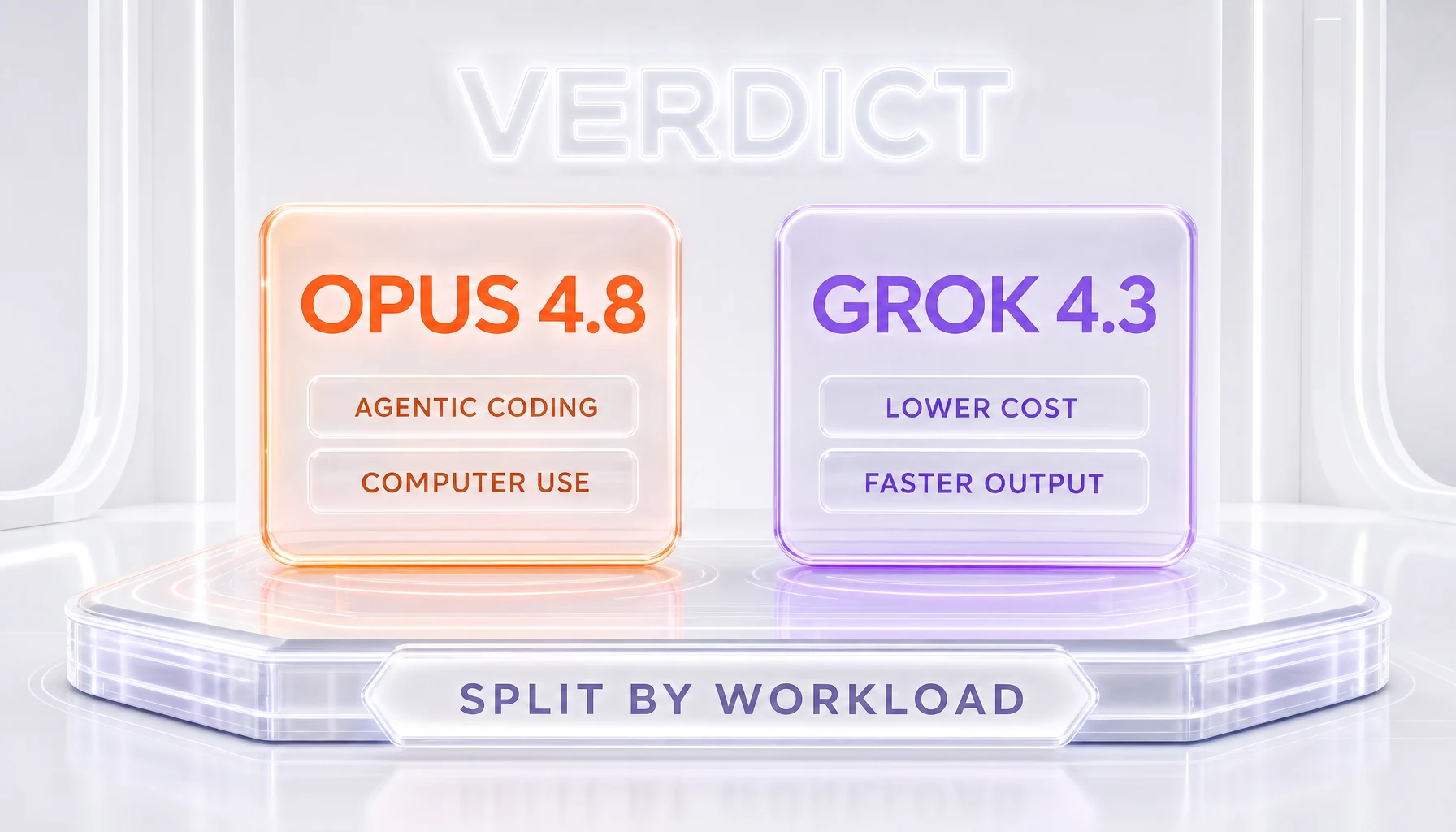
Best for agentic coding, complex reasoning, and computer use: Claude Opus 4.8. Best for cost, output speed, real-time X data, and drop-in integration: Grok 4.3. If you can only run one and your work is hard agentic coding, pick Opus 4.8 and accept the premium. If your work is high-volume, latency-sensitive, or built on the OpenAI standard and your budget is the constraint, Grok 4.3 is the better buy by a wide margin. Many teams will be best served running both and routing by task. All pricing here is fetch-verified from vendor docs; all like-for-like benchmark numbers are from Artificial Analysis; single-vendor claims are flagged as such.
Last compared: June 2026. Pricing fetched directly from Anthropic and xAI documentation. Intelligence Index, GDPval-AA ELO, and output-speed figures from Artificial Analysis. Computer-use figure is vendor-reported by Anthropic with no Grok 4.3 counterpart. We have run Claude Opus 4.8 in production since launch and tested Grok 4.3 on comparable tasks; hands-on observations are qualitative.
Sources and references
Every figure on this page is attributed to whoever produced it. Vendor documentation and independent measurement are listed separately and never merged into a single ranking.
- Artificial Analysis — Claude Opus 4.8 (independent index score and cost per task)
- Artificial Analysis — Grok 4.3 (independent index score)
- Artificial Analysis — Model leaderboard (Intelligence Index scores and cost per task across configurations)
Our Verdict
Split verdict by workload, with the verifiable capability lead going to Claude Opus 4.8 and the cost-and-speed lead going to Grok 4.3. On the two benchmarks scored the same way for both models, Opus 4.8 leads: on the Artificial Analysis Intelligence Index it sits in the top five as of August 4, 2026 (55.7, about 18 points above Grok 4.3), while Grok 4.3 ranks in the upper-mid tier, and Opus 4.8 also leads the GDPval-AA agentic benchmark. Opus 4.8 also posts an Anthropic-reported 88.6 percent on SWE-bench Verified, with no comparable Grok 4.3 figure. In our hands-on coding it was also the more reliable model on long, complex work. Grok 4.3 is roughly ten times cheaper on output tokens ($2.50 versus $25 per million, fetch-verified), runs much faster — well over twice the output speed on the same Artificial Analysis test — and adds real-time access to data from X plus an OpenAI-compatible API that Opus 4.8 does not match. Context window is a tie at one million tokens on both vendors' published specs. We did not crown a single overall winner: the models target different buyers. Best for agentic coding, reasoning, and computer use: Claude Opus 4.8. Best for cost, output speed, real-time X data, and drop-in integration: Grok 4.3. Pricing is fetch-verified from vendor docs; like-for-like benchmarks are from Artificial Analysis; the computer-use and SWE-bench figures are single-vendor Anthropic claims.
Choose Claude Opus 4.8
Anthropic's flagship model for agentic coding, computer use, and multi-agent orchestration.
Try Claude Opus 4.8 →Choose Grok 4.3
xAI's cheapest frontier reasoning model — $1.25/$2.50 per 1M tokens, 1M context, real-time X data and slide gen.
Try Grok 4.3 →Frequently Asked Questions
Is Claude Opus 4.8 better than Grok 4.3?
Split verdict by workload, with the verifiable capability lead going to Claude Opus 4.8 and the cost-and-speed lead going to Grok 4.3. On the two benchmarks scored the same way for both models, Opus 4.8 leads: on the Artificial Analysis Intelligence Index it sits in the top five as of August 4, 2026 (55.7, about 18 points above Grok 4.3), while Grok 4.3 ranks in the upper-mid tier, and Opus 4.8 also leads the GDPval-AA agentic benchmark. Opus 4.8 also posts an Anthropic-reported 88.6 percent on SWE-bench Verified, with no comparable Grok 4.3 figure. In our hands-on coding it was also the more reliable model on long, complex work. Grok 4.3 is roughly ten times cheaper on output tokens ($2.50 versus $25 per million, fetch-verified), runs much faster — well over twice the output speed on the same Artificial Analysis test — and adds real-time access to data from X plus an OpenAI-compatible API that Opus 4.8 does not match. Context window is a tie at one million tokens on both vendors' published specs. We did not crown a single overall winner: the models target different buyers. Best for agentic coding, reasoning, and computer use: Claude Opus 4.8. Best for cost, output speed, real-time X data, and drop-in integration: Grok 4.3. Pricing is fetch-verified from vendor docs; like-for-like benchmarks are from Artificial Analysis; the computer-use and SWE-bench figures are single-vendor Anthropic claims.
Which is cheaper, Claude Opus 4.8 or Grok 4.3?
Claude Opus 4.8 starts at $5 in / $25 out per M tokens. Grok 4.3 starts at $1.25 in / $2.5 out per M tokens (free plan available). Check the pricing comparison section above for a full breakdown.
What are the main differences between Claude Opus 4.8 and Grok 4.3?
The key differences span across 10 features we compared. For API input price (per million tokens), Claude Opus 4.8 offers $5.00 (verified) while Grok 4.3 offers $1.25 (verified). For API output price (per million tokens), Claude Opus 4.8 offers $25.00 (verified) while Grok 4.3 offers $2.50 (verified). For Artificial Analysis Intelligence Index (read August 4, 2026), Claude Opus 4.8 offers Top five (55.7) while Grok 4.3 offers Upper-mid tier (above Sonnet 4.6). See the full feature comparison table above for all details.