Claude Opus 4.8 vs Mistral Large 3: Frontier vs Open Weights (2026)


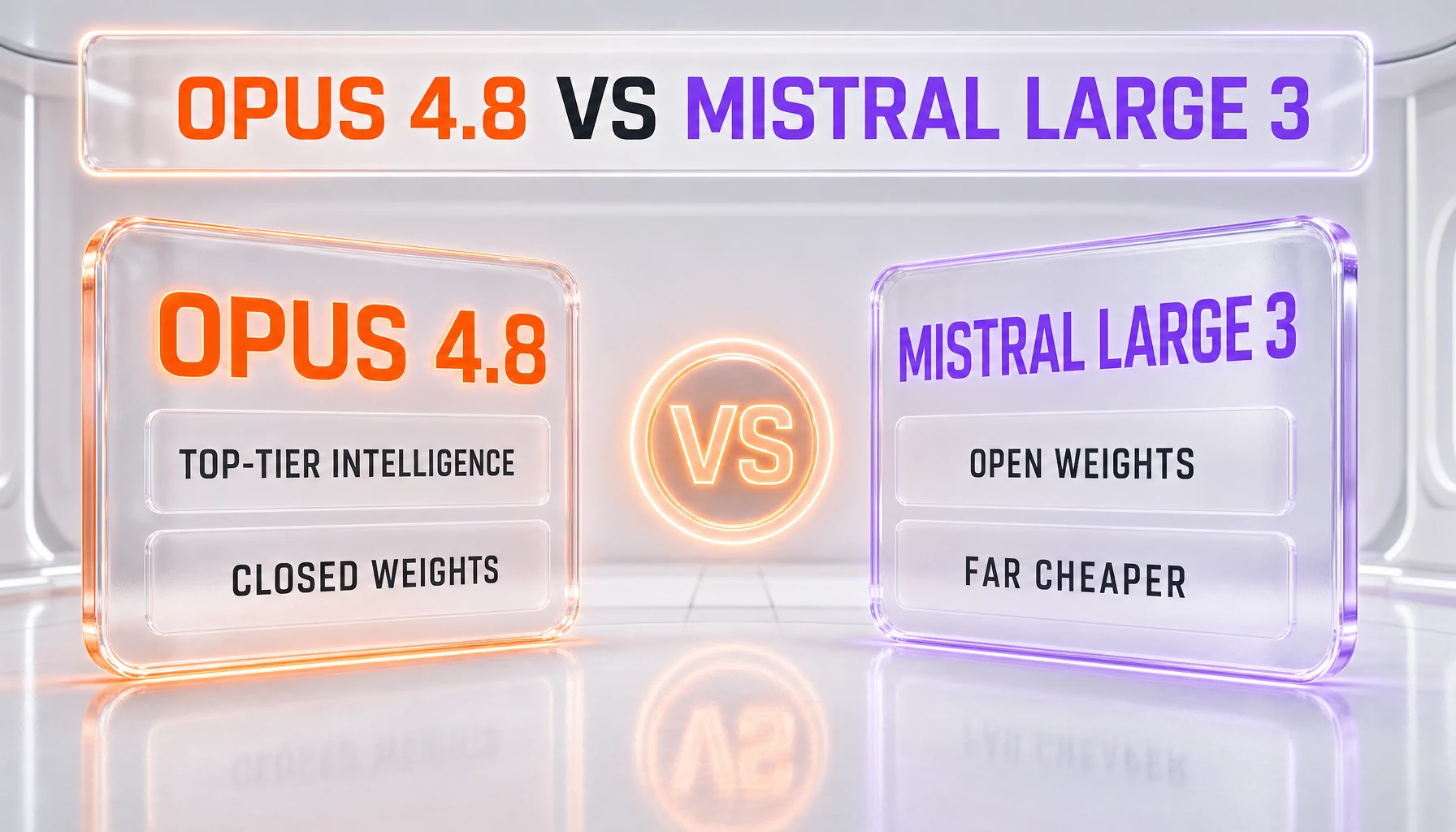
Mistral Large 3 is far cheaper with Apache 2.0 open weights; Opus 4.8 leads it by a wide margin on the Intelligence Index. A split, attributed verdict.
Feature Comparison
| Feature | Claude Opus 4.8 | Mistral Large 3 |
|---|---|---|
| API input price (per million tokens) | $5.00 (verified) | $0.50 (verified) |
| API output price (per million tokens) | $25.00 (verified) | $1.50 (verified) |
| Declared context window | 1,000,000 tokens (verified) | 262,144 tokens / 256K (verified) |
| Open weights / self-hosting | No — closed, API only | Yes — Apache 2.0, Hugging Face (verified) |
| License | Proprietary, API terms | Apache 2.0 — gold-standard permissive (verified) |
| Artificial Analysis Intelligence Index (same evaluator) | 61 (max-effort reasoning mode) | 23 (standard profile) |
| GPQA Diamond (different harnesses) | 93.6 (Anthropic reports) | 67.17 (Mistral model-card eval) |
| SWE-bench Verified (agentic coding) | 88.6% (Anthropic reports) | Not reported the same way |
| MMLU broad knowledge | Not reported the same way | ~85.5% on 8-language variant (Mistral reports) |
| Output speed (Artificial Analysis) | 66.8 tokens per second | 52.3 tokens per second |
| Time to first token (Artificial Analysis) | 25.91 seconds (max-effort reasoning) | 1.09 seconds |
| Total / active parameters | Not disclosed (closed) | 675B total / 41B active (MoE, verified) |
| Data sovereignty | US vendor, closed API | EU vendor, self-hostable Apache weights |
| Multi-agent orchestration | Dynamic Workflows (Claude Code preview) | Native function calling, agentic post-training |
Pricing Comparison
Claude Opus 4.8
Mistral Large 3
Detailed Comparison
Claude Opus 4.8 and Mistral Large 3 are the two frontier large language models compared here. Claude Opus 4.8 is Anthropic's closed-weight US flagship, priced at 5 dollars per million input tokens and 25 dollars per million output tokens, with a 1,000,000-token context window at standard pricing. Mistral Large 3 is Mistral AI's open-weight European flagship, a 675-billion-parameter mixture-of-experts with 41 billion active parameters, released December 2, 2025 under the Apache 2.0 license, priced at 0.50 dollars per million input tokens and 1.50 dollars per million output tokens, with a 256K-token context window. The headline trade is capability against cost and openness: on the Artificial Analysis Intelligence Index — the one composite both models are scored on by the same evaluator — Claude Opus 4.8 ranks far ahead while Mistral Large 3 places well behind, a wide gap. Mistral Large 3 is roughly eight to ten times cheaper, ships fully open weights under Apache 2.0, and is EU-sovereign. Best for top-end agentic coding, reasoning, and the largest context: Claude Opus 4.8. Best for cost, open weights, and European data sovereignty: Mistral Large 3.
Quick Verdict
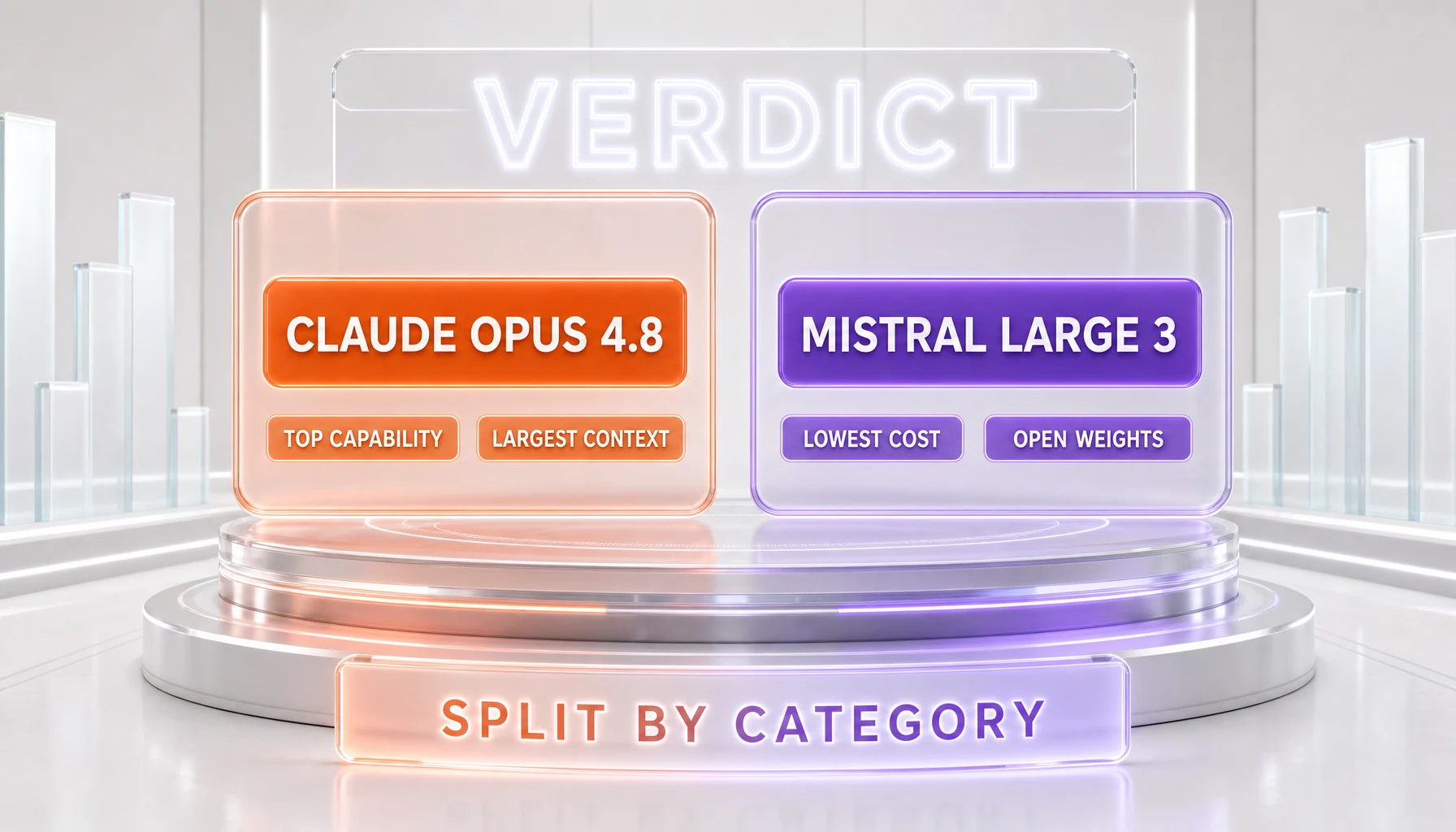
This is a split verdict by category, not a single overall winner. We pulled both models' pricing directly from their vendor pages, compared the published benchmarks side-by-side, and added our scoped hands-on notes — we use Claude Opus 4.8 daily as our default agent model, but we have not run Mistral Large 3 in production, so its side is research-based and attributed throughout. Where a benchmark comes from the same evaluator on both models, we say so; where the vendors measure different things, we refuse to fabricate a head-to-head. Here is the short version.
- Best for top-end capability and reasoning: Claude Opus 4.8. On the Artificial Analysis Intelligence Index — the one composite both models are scored on by the same evaluator — Opus 4.8 ranks far ahead while Mistral Large 3 sits well behind. That is a wide, like-for-like gap, though Opus is measured in adaptive max-effort reasoning mode.
- Best for cost: Mistral Large 3, by a wide and verified margin. Input is 0.50 dollars per million tokens versus 5 dollars for Opus 4.8, and output is 1.50 dollars per million versus 25 dollars. That is roughly eight to ten times cheaper on a typical mix — both prices fetched directly from the vendors.
- Best for open weights and self-hosting: Mistral Large 3. It ships under the Apache 2.0 license — the gold standard of permissive open-source — with open weights on Hugging Face, so you can self-host, fine-tune, redistribute, and use it commercially with no monthly-active-user ceiling. Claude Opus 4.8 is closed-weight and API-only.
- Best for the largest declared context window: Claude Opus 4.8. Anthropic publishes a 1,000,000-token context window at standard pricing; Mistral publishes 256K (262,144 tokens) for Mistral Large 3. Opus 4.8 declares roughly four times the window.
- Best for European data sovereignty: Mistral Large 3. Mistral AI is a French company, and the open Apache 2.0 weights let EU teams self-host inside their own jurisdiction with no US-vendor dependency. Opus 4.8 is a US closed API.
The honest caveat up front: the two models are profiled differently. The Artificial Analysis Intelligence Index places Opus 4.8 far ahead of Mistral Large 3, and because both scores come from the same evaluator that row is the cleanest comparison on the page — but Opus 4.8's score is in adaptive max-effort reasoning mode, while Mistral Large 3 is a standard general-purpose profile, so the gap partly reflects reasoning configuration as well as raw capability. The fully verified data here is the pricing for both models, the context windows, and Mistral Large 3's Apache 2.0 open-weight license — all fetched directly from the vendors. We flag every benchmark inline.
Claude Opus 4.8 vs Mistral Large 3 — Overview
What Is Claude Opus 4.8?
Claude Opus 4.8 is Anthropic's flagship large language model, positioned for agentic coding, computer use, and multi-agent orchestration. We cover it in depth in our Claude Opus 4.8 review. The headline improvements over Opus 4.7 are concentrated in long-horizon agentic reliability and self-verification rather than a leap in raw capability: Anthropic reports it is around four times less likely than its predecessor to let flaws in code it has written pass unremarked. API pricing is 5 dollars per million input tokens and 25 dollars per million output tokens, identical to Opus 4.7. There is also a Fast Mode that runs at roughly 2.5 times the speed for 10 dollars per million input and 50 dollars per million output tokens, and a 1,000,000-token context window at standard pricing. Anthropic adds Dynamic Workflows, which orchestrates hundreds of parallel subagents in a Claude Code research preview, and Effort controls that trade response latency against reasoning depth. We pulled the pricing and context window directly from Anthropic's official platform pricing page on June 8, 2026; both are verified. The benchmark figures come from Anthropic's announcement and the press coverage relaying its table, plus the Artificial Analysis evaluation, so we attribute each one to its source and flag whether it is independently measured. We have used Opus 4.8 daily as our default agent model since launch — the reliability behavior we describe later is anecdotal production color, not a controlled benchmark.
What Is Mistral Large 3?
Mistral Large 3 is Mistral AI's open-weight flagship, released December 2, 2025 as version 25.12. See our full Mistral Large 3 review for the detail. It is a 675-billion-parameter granular mixture-of-experts model with 41 billion active parameters per token, paired with a 2.5-billion-parameter MoonViT-style vision encoder for native multimodal input. The weights ship under the Apache 2.0 license on Hugging Face — the gold standard of permissive open-source licensing, allowing unrestricted commercial use, modification, and redistribution with no copyleft and no monthly-active-user threshold — so you can self-host, fine-tune, and run it offline. API pricing is 0.50 dollars per million input tokens and 1.50 dollars per million output tokens, with a 256K (262,144) token context window. Mistral AI is a French company, which makes Mistral Large 3 the EU-sovereign option in this matchup: a European team can run the open weights inside its own jurisdiction with no dependency on a US vendor. We pulled Mistral Large 3's pricing directly from Mistral's official pricing page and confirmed the Apache 2.0 license, the 675-billion / 41-billion mixture-of-experts architecture, and the 256K context on its Hugging Face model card on June 8, 2026; those are verified. Hands-on disclosure: we have not run Mistral Large 3 in production. Our daily content pipeline runs on Claude Opus 4.8, so everything we say about Mistral Large 3's behavior is research-based, drawn from Mistral's reporting and the Artificial Analysis evaluation, and attributed as such — not a hands-on result.
How We Compared Them — and What We Did Not Do
Transparency on method matters more than usual here, because one model is closed and US-built while the other is open-weight and Europe-built, and the two are profiled differently on the benchmarks. Here is exactly what we did and did not do.
- Pricing: fetched directly from each vendor on June 8, 2026. Opus 4.8 pricing is verified against Anthropic's official platform pricing page; Mistral Large 3 pricing is verified against Mistral's official pricing page. Both are fetch-verified, which is rare for this kind of comparison.
- Open weights and architecture: Mistral Large 3's Apache 2.0 license, 675-billion / 41-billion-active mixture-of-experts design, and 256K context are verified against its Hugging Face model card. Opus 4.8's closed-weight, API-only nature is a matter of record.
- Benchmarks: the Artificial Analysis Intelligence Index is the one composite both models are scored on by the same evaluator, so it is our anchor for like-for-like capability — Opus 4.8 ranks far ahead of Mistral Large 3 on it. We flag that Opus 4.8's figure is in adaptive max-effort reasoning mode while Mistral Large 3 is a standard general-purpose profile. Every vendor-reported figure beyond the Index is attributed to its source.
- Hands-on: our qualitative notes are scoped to Claude Opus 4.8, which we use daily. We have not run Mistral Large 3 in production, so we do not present hands-on "winners" for it — only research-based, attributed observations.
- Disclosure: we have no affiliate relationship with Anthropic or Mistral AI. There are no sponsored links on this page. Both vendor links are plain reference links.
Features and Benchmarks Comparison
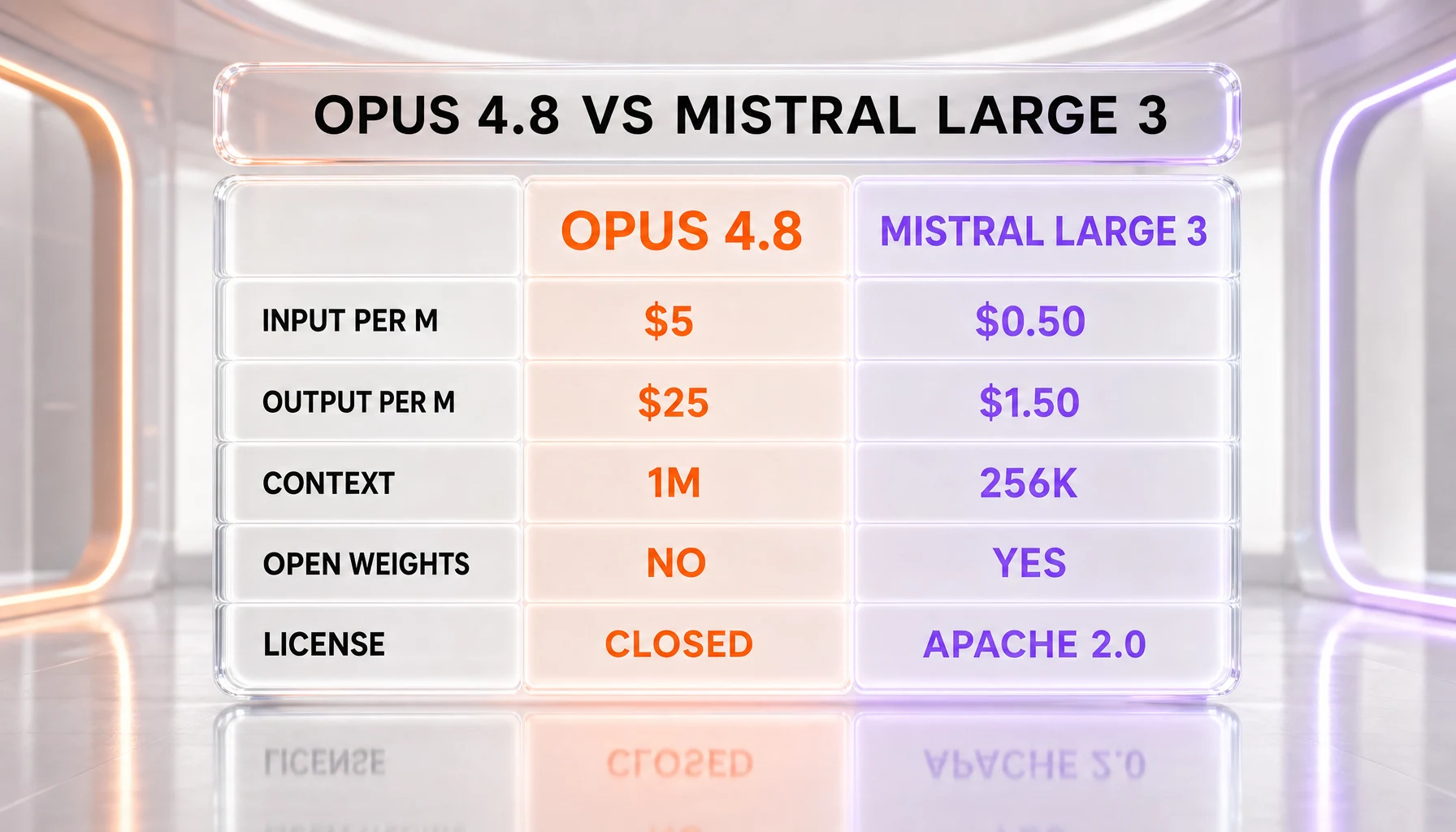
The table below lists every dimension we could verify or attribute. Read the "Winner" column carefully: it says "Not comparable" wherever the two vendors measured different things, and it flags the reasoning-mode caveat on the Intelligence Index row. Those are not cop-outs — they are the honest read. Pricing, context window, and open-weight status are fetch-verified; the Artificial Analysis Intelligence Index is from the same evaluator; every other benchmark figure is vendor-reported unless stated otherwise.
| Feature | Claude Opus 4.8 | Mistral Large 3 | Winner |
|---|---|---|---|
| API input price (per million tokens) | $5.00 (verified) | $0.50 (verified) | Mistral Large 3 |
| API output price (per million tokens) | $25.00 (verified) | $1.50 (verified) | Mistral Large 3 |
| Cache-hit input price (per million tokens) | $0.50 (verified) | Not published separately | Where measured (Opus only) |
| Declared context window | 1,000,000 tokens (verified) | 262,144 tokens / 256K (verified) | Claude Opus 4.8 |
| Open weights / self-hosting | No — closed, API only | Yes — Apache 2.0, Hugging Face (verified) | Mistral Large 3 |
| License | Proprietary, API terms | Apache 2.0 — gold-standard permissive (verified) | Mistral Large 3 |
| Artificial Analysis Intelligence Index (same evaluator) | Leads by a wide margin | Well behind | Claude Opus 4.8 (Opus in max-effort reasoning mode) |
| GPQA Diamond (scientific reasoning) | 93.6 (Anthropic reports) | 67.17 (Mistral model-card eval) | Claude Opus 4.8 (different harnesses) |
| SWE-bench Verified (agentic coding) | 88.6% (Anthropic reports) | Not reported the same way | Where measured (Opus only) |
| SWE-bench Pro (agentic coding) | 69.2% (Anthropic reports) | Not reported | Where measured (Opus only) |
| MMLU (broad knowledge) | Not reported the same way | ~85.5% on 8-language variant (Mistral reports) | Where measured (Mistral only) |
| Output speed (Artificial Analysis) | 66.8 tokens per second | 52.3 tokens per second | Claude Opus 4.8 |
| Time to first token (Artificial Analysis) | 25.91 seconds (max-effort reasoning) | 1.09 seconds | Mistral Large 3 (far lower latency) |
| Total / active parameters | Not disclosed (closed) | 675B total / 41B active (MoE, verified) | Where disclosed (Mistral only) |
| Native multimodal vision | Yes | Yes — 2.5B vision encoder (verified) | Tie |
| Data sovereignty | US vendor, closed API | EU vendor, self-hostable Apache weights | Mistral Large 3 (for EU teams) |
| Multi-agent orchestration | Dynamic Workflows (Claude Code preview) | Native function calling, agentic post-training | Tie / different designs |
Synthesis: the verified columns tell a clean story. Mistral Large 3 wins pricing outright — ten times cheaper on input (0.50 dollars versus 5 dollars per million) and more than sixteen times cheaper on output (1.50 dollars versus 25 dollars per million) — and it wins on open weights and license, shipping under Apache 2.0, which Opus 4.8 simply does not offer. Claude Opus 4.8 wins the declared context window (1,000,000 versus 262,144 tokens) and, decisively, the same-evaluator Artificial Analysis Intelligence Index, where it ranks far ahead of Mistral Large 3. That Index is the one row measured on both models by a single evaluator, so it is our cleanest capability signal — with the caveat that Opus 4.8 runs it in adaptive max-effort reasoning mode while Mistral Large 3 is a standard profile. Latency flips the other way: Mistral Large 3's time to first token is 1.09 seconds against Opus 4.8's 25.91 seconds in reasoning mode, so for snappy interactive use Mistral feels far more responsive. Everywhere the two vendors measured different benchmarks, we mark "where measured" rather than inventing a head-to-head.
Pricing — Claude Opus 4.8 vs Mistral Large 3 in 2026
Pricing is the cleanest part of this comparison because we pulled both models' rates directly from their vendor pages on June 8, 2026. The gap is large and unambiguous: Mistral Large 3 is roughly eight to ten times cheaper than Claude Opus 4.8 on standard token rates. That is the single biggest reason a cost-sensitive team would reach for Mistral Large 3 — and, combined with open weights, the single biggest reason this comparison is not a slam dunk for the more capable model.
Claude Opus 4.8 Pricing
| Tier | Input (per million tokens) | Output (per million tokens) | Notes |
|---|---|---|---|
| Standard API | $5.00 | $25.00 | Verified on Anthropic's platform pricing page |
| Cache hit | $0.50 | — | 10 percent of standard input on a cache read |
| Batch API | $2.50 | $12.50 | 50 percent discount, asynchronous |
| Fast Mode | $10.00 | $50.00 | About 2.5x the speed, double the unit price |
Mistral Large 3 Pricing
| Tier | Input (per million tokens) | Output (per million tokens) | Notes |
|---|---|---|---|
| Standard API (la Plateforme) | $0.50 | $1.50 | Verified on Mistral's official pricing page |
| Self-hosted (open weights) | Infrastructure cost only | Infrastructure cost only | Apache 2.0; runs on your own GPUs, no per-token fee |
| Free tier | Available | Available | Mistral offers a free experimentation tier on la Plateforme |
Pricing verdict: Mistral Large 3 is dramatically cheaper. On a representative agentic call of 50,000 input tokens and 5,000 output tokens, Claude Opus 4.8 standard costs about 0.375 dollars (5 dollars times 0.05 input plus 25 dollars times 0.005 output), while Mistral Large 3 costs about 0.0325 dollars (0.50 dollars times 0.05 plus 1.50 dollars times 0.005) — Mistral Large 3 is roughly ten to twelve times cheaper on that mix, and the gap widens as output share grows because the output rate gap (1.50 dollars versus 25 dollars per million) is the steepest. There is also a path with no per-token fee at all — because Mistral Large 3 ships open weights under Apache 2.0, you can self-host on your own GPU cluster and pay only infrastructure. That is not free in practice; a 675-billion-parameter mixture-of-experts model needs serious hardware even with 41 billion active parameters, so self-hosting is for teams with real GPU capacity. One nuance worth flagging: Opus 4.8 uses a newer tokenizer that Anthropic notes can consume up to 35 percent more tokens for the same text, so the real-bill gap on identical content may be a touch wider than the rate cards alone suggest. We did not run a controlled token-accounting test across both models, so we will not claim an exact per-task winner beyond the rate-card math above — tokenizer differences and response verbosity move the real bill. The honest framing: if unit cost dominates your decision, Mistral Large 3 wins this section outright.
Hands-On Notes — Scoped to Opus 4.8
We owe you honesty about the limits of this section. We use Claude Opus 4.8 daily as our default agent model on a Next.js and Supabase content pipeline. We have not run Mistral Large 3 in production — our pipeline is locked on Claude models, and everything we know about Mistral Large 3's behavior comes from Mistral's reporting and the Artificial Analysis evaluation. So this is not a "we tested both" section. It is "here is what we observed using Opus 4.8 in production, plus what the research says about Mistral Large 3." Take the Opus 4.8 part as qualitative color on one model and the Mistral Large 3 part as attributed research, not a head-to-head result.
What stands out on Opus 4.8 in daily use: it pushes back on weak plans before executing, and it catches its own mistakes mid-task more often than the 4.x models we used before — which lines up with Anthropic's claim that it is around four times less likely to let code flaws pass unremarked. On long agentic runs — 30 or more tool calls in our content pipeline — it finishes more often without a "done" claim that turns out to be a broken build. That reliability-on-long-runs property is the single reason it is our default. The trade-off we feel daily is latency: in max-effort reasoning mode, time to first token can run into the tens of seconds, which is exactly what Artificial Analysis measured at 25.91 seconds. For interactive, type-and-wait use that is noticeable.
What the research says about Mistral Large 3: the Artificial Analysis evaluation places its Intelligence Index far below Opus 4.8's, so on that same-evaluator composite it sits well below the frontier — but its time to first token of 1.09 seconds is in a different league for responsiveness, and its broad-knowledge MMLU figure (~85.5 percent on an eight-language variant, Mistral reports) is genuinely strong for a model at one-tenth the price. The open Apache 2.0 weights are the structural advantage: a model you self-host under a fully permissive license cannot be silently changed under you, cannot be deprecated out from under your stack, and can run inside an EU jurisdiction with no US-vendor dependency. We could not validate any of Mistral Large 3's runtime behavior ourselves, so we present it as research, not experience. What we cannot tell you from our own use is whether Mistral Large 3 would match Opus 4.8 on our specific pipeline tasks — we have not run that test, and the Intelligence Index gap, with its reasoning-mode caveat, only takes us so far.
Winner per Category
Best for Top-End Capability and Reasoning: Claude Opus 4.8
On the Artificial Analysis Intelligence Index — the one composite both models are scored on by the same evaluator — Opus 4.8 ranks far ahead of Mistral Large 3. That is the cleanest capability signal we have, and it points the same way as Anthropic's reported GPQA Diamond (93.6), SWE-bench Verified (88.6 percent), and our own daily experience of Opus 4.8's completion reliability on long autonomous runs. The honest caveat: Opus 4.8 runs the Index in adaptive max-effort reasoning mode while Mistral Large 3 is a standard general-purpose profile, so part of that gap is configuration, not just raw ceiling. Even discounting for that, if your primary workload is multi-step agentic coding, hard reasoning, or scientific analysis and capability ceiling matters more than cost, Opus 4.8 is the pick on the evidence we can stand behind.
Best for Cost: Mistral Large 3
This one is not close, and it is fully verified. Mistral Large 3 charges 0.50 dollars per million input tokens versus Opus 4.8's 5 dollars, and 1.50 dollars per million output versus 25 dollars — roughly eight to ten times cheaper on a typical mix, and more than sixteen times cheaper on output alone. For high-volume backend coding routines, content generation, classification, and any output-heavy workload, that gap compounds into a different order of magnitude on the monthly bill. If your decision is dominated by unit cost, Mistral Large 3 wins this category outright.
Best for Open Weights and Self-Hosting: Mistral Large 3
Mistral Large 3 ships under the Apache 2.0 license with open weights on Hugging Face, so you can self-host on your own GPU cluster, fine-tune for your domain, run it air-gapped, redistribute it, and avoid per-token vendor lock-in entirely — with no monthly-active-user ceiling and no copyleft obligation. Apache 2.0 is the most permissive mainstream open-source license, more open than the "modified" or "community" licenses some rival open-weight models use. Claude Opus 4.8 is closed-weight and API-only. For teams with data-sovereignty requirements, offline deployment needs, or a desire to control the model's lifecycle, this is a hard differentiator that no amount of Opus 4.8 capability can replace.
Best for the Largest Declared Context Window: Claude Opus 4.8
Anthropic publishes a 1,000,000-token context window for Opus 4.8 at standard pricing, verified on its pricing page. Mistral publishes 256K (262,144 tokens) for Mistral Large 3, also verified. That is roughly a fourfold difference in declared window. For workloads that must hold an entire large codebase or a long document corpus in a single prompt, Opus 4.8 has the bigger published number — and it is one of the few specification dimensions where both models declare a clean figure, so the comparison is direct.
Best for European Data Sovereignty: Mistral Large 3
Mistral AI is a French company, and Mistral Large 3's open Apache 2.0 weights let a European team run the model entirely inside its own jurisdiction — on its own infrastructure, with no data leaving for a US-controlled API. For organizations bound by EU data-residency rules, public-sector procurement preferences, or a strategic choice to reduce dependency on US AI vendors, that combination of European provenance plus self-hostable open weights is unique in this matchup. Claude Opus 4.8 is a US closed API; Anthropic offers data-residency options, but you are still sending data to a US vendor's service rather than running the weights yourself.
Lowest Latency: Mistral Large 3
Artificial Analysis measured Mistral Large 3's time to first token at 1.09 seconds against Claude Opus 4.8's 25.91 seconds in adaptive max-effort reasoning mode. For interactive, type-and-wait applications — chat assistants, autocomplete, anything where a human is staring at the screen — that responsiveness gap is large and felt. Opus 4.8's Fast Mode narrows the speed gap at double the unit price, and lower Effort settings reduce its latency, but at its most capable setting it is a deliberate-and-slow reasoner, while Mistral Large 3 is built to respond fast. If snappy interactivity is your priority, Mistral Large 3 has the edge.
Multi-Agent Orchestration: A Tie of Different Designs
Both vendors support agentic, tool-using workflows, but with different shapes. Anthropic's Dynamic Workflows orchestrates hundreds of parallel subagents in a Claude Code research preview, and Opus 4.8 is post-trained heavily for long-horizon agentic reliability. Mistral Large 3 ships native function calling and JSON output with agentic post-training, and its open weights mean you can build any orchestration layer you want around it without vendor constraints. We have used Dynamic Workflows on large multi-file tasks and found it a genuine time saver; we have not built an agentic stack on Mistral Large 3, so we cannot compare them head-to-head. We call this a tie of different designs rather than naming a winner.
Pros and Cons
Claude Opus 4.8 Pros and Cons
What we like about Claude Opus 4.8
- Leads the same-evaluator capability index. Ranks far ahead of Mistral Large 3 on the Artificial Analysis Intelligence Index — a wide like-for-like gap, with Opus in max-effort reasoning mode.
- Largest declared context window. 1,000,000 tokens at standard pricing (verified) versus Mistral Large 3's 262,144 tokens.
- Completion reliability on long agentic runs. In our daily use it finishes 30-plus-tool-call tasks without false "done" claims more consistently than prior models — the reason it is our default agent.
- Self-verification and judgment. Anthropic reports a roughly fourfold reduction in overlooked code flaws, and in practice it pushes back on weak plans.
- Top-end coding and reasoning benchmarks. Anthropic reports SWE-bench Verified 88.6 percent, SWE-bench Pro 69.2 percent, and GPQA Diamond 93.6 — frontier numbers, vendor-relayed.
Where Claude Opus 4.8 falls short
- Far more expensive. 5 dollars input and 25 dollars output per million tokens versus Mistral Large 3's 0.50 dollars and 1.50 dollars — roughly eight to ten times the unit cost, and more than sixteen times on output.
- Closed weights, no self-hosting. API-only; you cannot run it offline, fine-tune the weights, or escape per-token vendor lock-in.
- High latency at full capability. Time to first token of 25.91 seconds in max-effort reasoning mode (Artificial Analysis) makes it a poor fit for snappy interactive use.
- US vendor, not EU-sovereign. For teams that need to keep data inside European jurisdiction on their own infrastructure, a closed US API is a structural mismatch.
- Newer tokenizer inflates token counts. Anthropic notes it can use up to 35 percent more tokens for the same text, widening the real-bill cost gap further.
Mistral Large 3 Pros and Cons
What we like about Mistral Large 3
- Radically cheaper. 0.50 dollars input and 1.50 dollars output per million tokens (verified) — roughly eight to ten times below Opus 4.8 on a typical mix.
- Fully open weights under Apache 2.0. The gold-standard permissive license on Hugging Face; self-host, fine-tune, redistribute, and ship commercially with no monthly-active-user ceiling and no copyleft.
- European data sovereignty. A French vendor with self-hostable open weights — the EU-sovereign choice for teams that cannot send data to a US API.
- Very low latency. Time to first token of 1.09 seconds (Artificial Analysis) makes it well suited to interactive, responsive applications.
- Native multimodal in one architecture. A 2.5-billion-parameter vision encoder handles image input, with strong multilingual coverage and broad-knowledge MMLU around 85.5 percent on an eight-language variant.
Where Mistral Large 3 falls short
- Well behind on the same-evaluator capability index. Places far below Opus 4.8 on the Artificial Analysis Intelligence Index — though Opus runs that test in max-effort reasoning mode.
- Smaller declared context window. 262,144 tokens versus Opus 4.8's declared 1,000,000.
- Fewer top-end agentic-coding benchmarks reported. Mistral does not publish SWE-bench Pro figures comparable to Anthropic's, so the agentic-coding ceiling is harder to verify.
- Self-hosting is heavy. A 675-billion-parameter mixture-of-experts model needs serious GPU infrastructure, so the "free to self-host" line carries real hardware cost.
- We have not run it in production. Everything we say about its behavior is research-based and attributed, not hands-on.
When to Pick Claude Opus 4.8 vs Mistral Large 3
Pick Claude Opus 4.8 if...
- Your primary workload is top-end agentic coding, hard reasoning, or scientific analysis and you want the capability ceiling — Opus 4.8 leads the same-evaluator Intelligence Index by a wide margin.
- You need the largest declared context window — Anthropic publishes 1,000,000 tokens at standard pricing.
- You run long unattended agentic pipelines where completion reliability and self-verification matter more than unit cost or latency.
- You are comfortable with a closed, API-only US model and the higher per-token rate and higher latency that come with it.
- Your bottleneck is the quality of the hardest 10 percent of tasks, not the cost of the easy 90 percent.
Pick Mistral Large 3 if...
- Unit cost dominates your decision — Mistral Large 3 is roughly eight to ten times cheaper on input and output, verified.
- You need open weights — self-hosting, fine-tuning, air-gapped deployment, redistribution, or freedom from per-token vendor lock-in under a fully permissive Apache 2.0 license.
- You have European data-sovereignty requirements that rule out sending data to a closed US API.
- Latency matters — Mistral Large 3's 1.09-second time to first token suits interactive, responsive applications.
- Your workload is high-volume backend coding, content generation, or classification where the output-token rate gap compounds into real savings, and the absolute capability ceiling is not your bottleneck.
Frequently Asked Questions
Is Claude Opus 4.8 better than Mistral Large 3 in 2026?
It depends on the workload, and we refuse to fake a single overall winner. On the Artificial Analysis Intelligence Index — the one composite both models are scored on by the same evaluator — Opus 4.8 ranks far ahead of Mistral Large 3, so Opus 4.8 leads top-end capability by a wide margin, though it runs that test in adaptive max-effort reasoning mode. Opus 4.8 also has the larger declared context window (1,000,000 versus 262,144 tokens). Mistral Large 3 is roughly eight to ten times cheaper, ships fully open weights under Apache 2.0, is EU-sovereign, and has far lower latency (1.09 versus 25.91 seconds to first token). Best for top-end capability, reasoning, and the largest context: Opus 4.8. Best for cost, open weights, latency, and European sovereignty: Mistral Large 3.
How much do Claude Opus 4.8 and Mistral Large 3 cost?
Claude Opus 4.8 is 5 dollars per million input tokens and 25 dollars per million output tokens, with a 0.50 dollars cache-hit input rate and a Fast Mode at 10 dollars input and 50 dollars output. Mistral Large 3 is 0.50 dollars per million input tokens and 1.50 dollars per million output tokens. That makes Mistral Large 3 roughly eight to ten times cheaper on a typical mix, and more than sixteen times cheaper on output alone. Both prices are verified — we fetched them directly from Anthropic's and Mistral's pricing pages on June 8, 2026. Mistral Large 3 also ships open weights under Apache 2.0, so you can self-host and pay only infrastructure cost.
Which is better for agentic coding: Claude Opus 4.8 or Mistral Large 3?
Claude Opus 4.8, on the evidence we can verify, if capability ceiling is what you optimize for. Anthropic reports SWE-bench Verified at 88.6 percent and SWE-bench Pro at 69.2 percent for Opus 4.8, and it leads the same-evaluator Artificial Analysis Intelligence Index by a wide margin. Mistral Large 3 does not publish directly comparable agentic-coding figures, so its coding ceiling is harder to verify. In our daily use, Opus 4.8's reliability on long agentic runs is the property that makes it our default. That said, Mistral Large 3 is roughly eight to ten times cheaper, so for high-volume coding where cost matters more than the last few points of capability, it is a serious contender — we just have not run it ourselves.
Is Mistral Large 3 really open source and self-hostable?
Yes, and more cleanly than most. Mistral Large 3 ships open weights on Hugging Face under the Apache 2.0 license, verified on its model card — the gold standard of permissive open-source licensing. You can self-host, fine-tune, redistribute, and use it commercially with no monthly-active-user ceiling and no copyleft obligation. That is a genuinely unrestricted release, more permissive than the "modified" or "community" licenses some rival open-weight models use. The practical cost is infrastructure: it is a 675-billion-parameter mixture-of-experts model (41 billion active per token), so you need serious GPU capacity to self-host. Claude Opus 4.8, by contrast, is closed and API-only.
Which has the larger context window: Claude Opus 4.8 or Mistral Large 3?
Claude Opus 4.8, by declared figures. Anthropic publishes a 1,000,000-token context window for Opus 4.8 at standard pricing, verified on its pricing page. Mistral publishes 256K (262,144 tokens) for Mistral Large 3, also verified on its model card and docs. That is roughly a fourfold difference. If your workload must hold an entire large codebase or a long document corpus in a single prompt, Opus 4.8 has the bigger published window — and because both vendors declare a clean figure here, the comparison is direct rather than estimated.
Are the benchmark numbers in this comparison independently verified?
Partly, and we want to be precise about which parts. The Artificial Analysis Intelligence Index (Opus 4.8 far ahead of Mistral Large 3), output speed, and time to first token come from one third-party evaluator measuring both models, which makes them the closest to like-for-like — but Opus 4.8 is scored in adaptive max-effort reasoning mode while Mistral Large 3 is a standard profile. The other figures are vendor-reported: Anthropic's for Opus 4.8 (SWE-bench Verified 88.6 percent, SWE-bench Pro 69.2 percent, GPQA Diamond 93.6, Online-Mind2Web 84 percent) and Mistral's for Mistral Large 3 (MMLU ~85.5 percent on an eight-language variant, GPQA Diamond 67.17 from the model-card eval). The fully verified data here is the pricing for both models, the context windows, and Mistral Large 3's Apache 2.0 open-weight license — all fetched directly from the vendors.
Is Mistral Large 3 a good choice for European data sovereignty?
Yes — it is the standout reason a European team would choose it here. Mistral AI is a French company, and Mistral Large 3's open Apache 2.0 weights let you run the model entirely inside your own EU jurisdiction, on your own infrastructure, with no data leaving for a US-controlled API. For organizations bound by EU data-residency rules, public-sector procurement preferences, or a strategic choice to reduce dependency on US AI vendors, that combination of European provenance plus self-hostable open weights is unique in this matchup. Claude Opus 4.8 is a US closed API; Anthropic offers data-residency options, but you are still sending data to a US vendor's service rather than running the weights yourself.
Which model has lower latency, Claude Opus 4.8 or Mistral Large 3?
Mistral Large 3, by a wide margin in the measured profile. Artificial Analysis recorded its time to first token at 1.09 seconds against Claude Opus 4.8's 25.91 seconds in adaptive max-effort reasoning mode. For interactive, type-and-wait applications — chat assistants, autocomplete, anything with a human watching the screen — that gap is large and felt. Opus 4.8's Fast Mode and lower Effort settings reduce its latency, but at its most capable setting it is a deliberate reasoner, while Mistral Large 3 is built to respond fast. On raw output speed once generation starts, Opus 4.8 is slightly quicker (66.8 versus 52.3 tokens per second), but the first-token wait dominates the felt experience.
Can I switch from Claude Opus 4.8 to Mistral Large 3 (or vice versa) easily?
API-level switching is straightforward — both expose chat-style endpoints with similar message structures, and Mistral offers an OpenAI-compatible API surface on la Plateforme. Production migration takes more work: Claude Opus 4.8 uses Anthropic's Messages API and Claude Code tooling, while Mistral Large 3 uses Mistral's API or self-hosted inference, and the two have different function-calling shapes and prompt conventions. If your stack sits behind an abstraction layer like the Vercel AI SDK, LangChain, or LiteLLM, switching is largely a config change. If you call vendor APIs directly, budget one to three days of integration rework per service. The bigger migration cost is re-validating prompt behavior, since the models reason differently — and Mistral Large 3's open weights also open a self-hosting path that has no Opus equivalent.
Do Claude Opus 4.8 and Mistral Large 3 work together in the same agent?
Yes — multi-model routing is a common production pattern, and the cost gap here makes it especially compelling. A typical split: route the hardest agentic-coding and long-horizon reasoning steps through Claude Opus 4.8 (it leads the same-evaluator capability index and has the larger declared context), and route high-volume, latency-sensitive, or cost-sensitive steps through Mistral Large 3 (roughly eight to ten times cheaper, open weights for self-hosting, far lower time to first token). Frameworks like the Vercel AI SDK, LangChain, and LiteLLM make cost-aware routing by workload type practical. For many teams, this hybrid beats single-vendor purity — use the expensive frontier model only where its capability ceiling actually pays off, and the cheap open-weight model everywhere else.
Why does this comparison flag the Intelligence Index gap as not fully like-for-like?
Because the two models are profiled differently on that test. The Artificial Analysis Intelligence Index is run on both by the same evaluator, which is why we use it as our anchor — but Claude Opus 4.8 is scored in adaptive max-effort reasoning mode (which is also why its time to first token is 25.91 seconds), while Mistral Large 3 is measured in a standard general-purpose profile. So the wide gap — Opus 4.8 far ahead, Mistral Large 3 well behind — reflects both raw capability and reasoning configuration. We still treat it as the cleanest available signal because no other benchmark covers both models on a single harness, but we flag the caveat rather than presenting the gap as a pure capability delta. It is the honest read, even though it makes the headline less clean.
What are the alternatives to Claude Opus 4.8 and Mistral Large 3?
If neither the frontier premium of Opus 4.8 nor the open-weight European provenance of Mistral Large 3 fits, three alternatives are worth a look in 2026: OpenAI's GPT-5.5 for the widest ecosystem and a large declared context, covered in our Claude Opus 4.8 vs GPT-5.5 comparison; Google's Gemini 3.1 Pro for high-volume retrieval at strong value, covered in our Claude Opus 4.8 vs Gemini 3.1 Pro comparison; and the prior Anthropic generation in our Claude Opus 4.8 vs Opus 4.7 comparison. For most teams the real choice in this particular niche — closed US frontier model versus open-weight European flagship — is between Claude Opus 4.8 and Mistral Large 3, the two models this comparison covers.
Final Verdict — A Split Decision by Category
After comparing the verified pricing, context windows, and license status of Claude Opus 4.8 and Mistral Large 3 side-by-side — anchored on the same-evaluator Artificial Analysis Intelligence Index, and with our scoped hands-on experience of Opus 4.8 plus attributed research on Mistral Large 3 — our verdict is split by category, with no single overall winner because the evidence does not support one honestly. Claude Opus 4.8 is the pick for top-end capability, reasoning, and the largest declared context window: it leads the one same-evaluator composite (the Intelligence Index, by a wide margin, with Opus in max-effort reasoning mode) and declares a 1,000,000-token context window. Mistral Large 3 is the pick for cost, open weights, latency, and European sovereignty: it is roughly eight to ten times cheaper on verified pricing, ships fully open weights under the gold-standard Apache 2.0 license you can self-host inside an EU jurisdiction, and answers far faster on time to first token.
We deliberately did not crown a single overall winner. The Intelligence Index gap is partly a reasoning-mode artifact, the agentic-coding benchmarks are vendor-reported and not run on a shared harness, and we have not run Mistral Large 3 in production ourselves. What we can stand behind: on verified pricing, Mistral Large 3 is dramatically cheaper and is the only model here with open weights and EU sovereignty; on the same-evaluator capability index and declared context, Opus 4.8 is well ahead; and on latency, Mistral Large 3 is far more responsive. If you need the capability ceiling, the largest context, or top-end reasoning, choose Claude Opus 4.8. If unit cost, open weights, low latency, or European data sovereignty dominate your decision, choose Mistral Large 3. For many teams the smart move is cost-aware routing — Opus 4.8 for the hardest coding and reasoning steps, Mistral Large 3 for high-volume, latency-sensitive, cost-sensitive work. For more detail, see our full reviews of Claude Opus 4.8 and Mistral Large 3, and the related matchups in our Claude Opus 4.8 vs GPT-5.5 and Claude Opus 4.8 vs Gemini 3.1 Pro comparisons.
Sources and references
Every figure on this page is attributed to whoever produced it. Vendor documentation and independent measurement are listed separately and never merged into a single ranking.
- Artificial Analysis — Claude Opus 4.8 (independent index score and cost per task)
- Artificial Analysis — Mistral Large 3 (independent index score)
- Artificial Analysis — Model leaderboard (Intelligence Index scores and cost per task across configurations)
Our Verdict
Split verdict by category, no single overall winner. On verified pricing, Mistral Large 3 wins outright — $0.50 input and $1.50 output per million tokens versus Claude Opus 4.8's $5 and $25, roughly eight to ten times cheaper — and it is the only model here with fully open weights (Apache 2.0, self-hostable) and EU data sovereignty. On the one composite both models are scored on by the same evaluator, the Artificial Analysis Intelligence Index, Opus 4.8 ranks far ahead of Mistral Large 3, though Opus runs that test in adaptive max-effort reasoning mode. Claude Opus 4.8 also wins the larger declared context window (1,000,000 versus 262,144 tokens, both verified). Latency flips the other way: Mistral Large 3's time to first token is 1.09 seconds against Opus 4.8's 25.91 seconds in reasoning mode. Best for top-end capability, reasoning, and the largest context: Claude Opus 4.8. Best for cost, open weights, low latency, and European sovereignty: Mistral Large 3. Pricing and context windows are fetch-verified; the Intelligence Index is same-evaluator; other benchmarks are vendor-reported.
Choose Claude Opus 4.8
Anthropic's flagship model for agentic coding, computer use, and multi-agent orchestration.
Try Claude Opus 4.8 →Choose Mistral Large 3
Mistral AI's open-weight 675B-MoE multimodal flagship — 256K context, Apache 2.0, EU-sovereign at $0.50 per 1M input tokens.
Try Mistral Large 3 →Frequently Asked Questions
Is Claude Opus 4.8 better than Mistral Large 3?
Split verdict by category, no single overall winner. On verified pricing, Mistral Large 3 wins outright — $0.50 input and $1.50 output per million tokens versus Claude Opus 4.8's $5 and $25, roughly eight to ten times cheaper — and it is the only model here with fully open weights (Apache 2.0, self-hostable) and EU data sovereignty. On the one composite both models are scored on by the same evaluator, the Artificial Analysis Intelligence Index, Opus 4.8 ranks far ahead of Mistral Large 3, though Opus runs that test in adaptive max-effort reasoning mode. Claude Opus 4.8 also wins the larger declared context window (1,000,000 versus 262,144 tokens, both verified). Latency flips the other way: Mistral Large 3's time to first token is 1.09 seconds against Opus 4.8's 25.91 seconds in reasoning mode. Best for top-end capability, reasoning, and the largest context: Claude Opus 4.8. Best for cost, open weights, low latency, and European sovereignty: Mistral Large 3. Pricing and context windows are fetch-verified; the Intelligence Index is same-evaluator; other benchmarks are vendor-reported.
Which is cheaper, Claude Opus 4.8 or Mistral Large 3?
Claude Opus 4.8 starts at $5 in / $25 out per M tokens. Mistral Large 3 starts at $0.5 in / $1.5 out per M tokens (free plan available). Check the pricing comparison section above for a full breakdown.
What are the main differences between Claude Opus 4.8 and Mistral Large 3?
The key differences span across 14 features we compared. For API input price (per million tokens), Claude Opus 4.8 offers $5.00 (verified) while Mistral Large 3 offers $0.50 (verified). For API output price (per million tokens), Claude Opus 4.8 offers $25.00 (verified) while Mistral Large 3 offers $1.50 (verified). For Declared context window, Claude Opus 4.8 offers 1,000,000 tokens (verified) while Mistral Large 3 offers 262,144 tokens / 256K (verified). See the full feature comparison table above for all details.