Claude Opus 5 vs Claude Opus 4.8: Same Price — Should You Migrate?


Identical pricing at $5 and $25 per million tokens. Opus 5 scores 61 against 56 on Artificial Analysis. Four migration changes to audit before you switch.
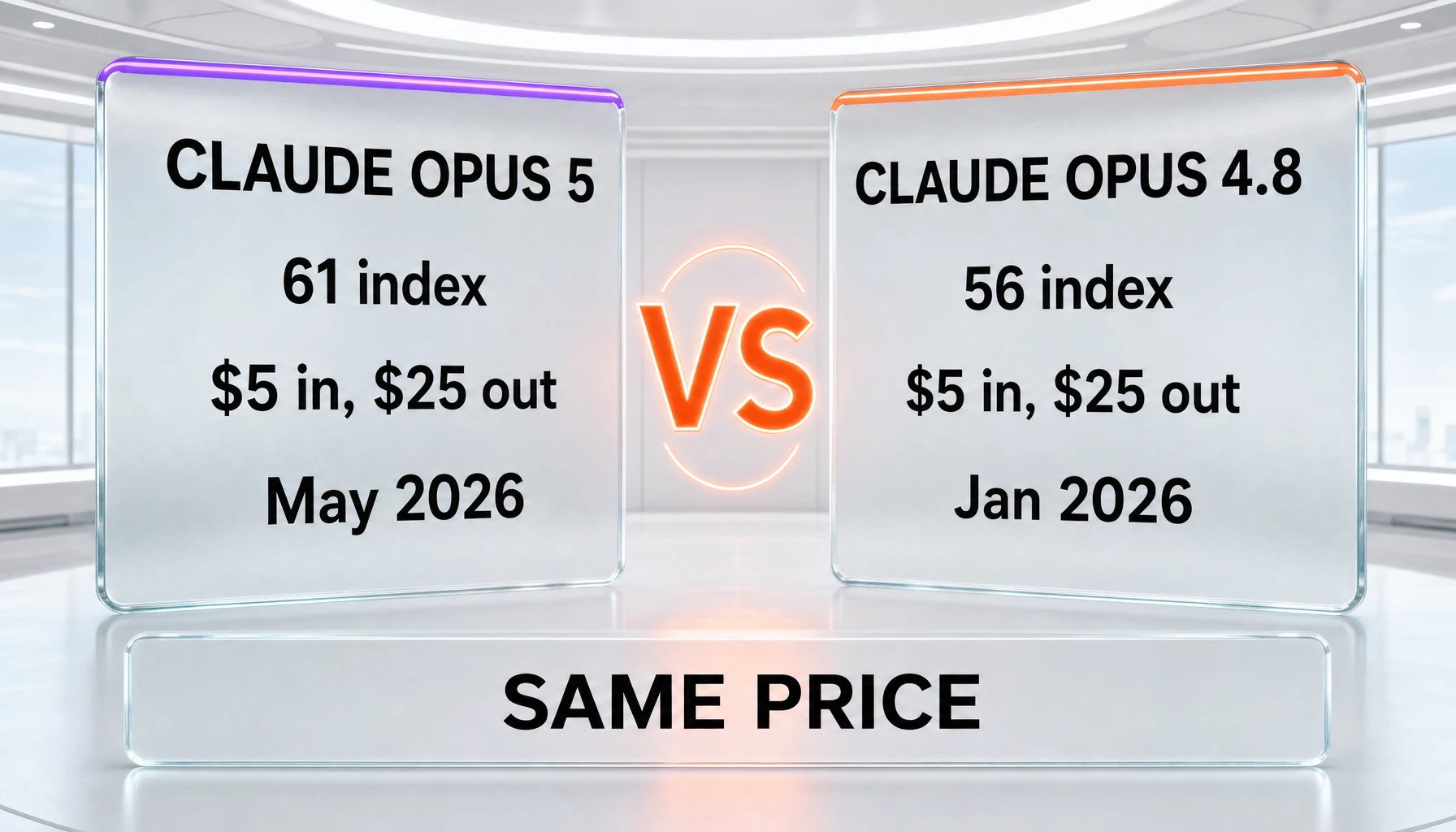
Feature Comparison
| Feature | Claude Opus 5 | Claude Opus 4.8 |
|---|---|---|
| Price per million tokens | $5 input, $25 output | $5 input, $25 output |
| Intelligence Index v4.1, max effort (July 27, 2026) | 61 | 56 |
| Training data cutoff | May 2026 | January 2026 |
| Context window and max output | 1M tokens, 128k output | 1M tokens, 128k output |
| Time to first token, max effort (July 27, 2026) | 69.71 seconds | 29.50 seconds |
| Output speed, max effort (July 27, 2026) | 52.8 tokens per second | 55.4 tokens per second |
| Cost per task, max effort (July 27, 2026) | $2.03 | $1.80 |
| Hallucination rate (Anthropic system card) | Higher — 6 percent above Opus 4.8 | Lower |
| Thinking when the field is omitted | Adaptive thinking on | No thinking |
| Disabling thinking at xhigh or max effort | Returns a 400 error | Accepted |
| Effort levels | low, medium, high, xhigh, max — default high | low, medium, high, xhigh, max — default high |
| Minimum cacheable prompt | 512 tokens | 1,024 tokens |
| Rate-limit bucket | Its own | Shared with Opus 4.7, 4.6, 4.5 |
| Priority Tier eligibility | Excluded | Supported |
| Indirect prompt injection, attacker success in 15 attempts | 2.0 percent | 5.5 percent |
| Documentation status | Current | Legacy models table |
Pricing Comparison
Claude Opus 5
Claude Opus 4.8
Detailed Comparison
Claude Opus 5 and Claude Opus 4.8 cost exactly the same: $5 per million input tokens and $25 per million output tokens, with identical cache and batch rates. On the Artificial Analysis Intelligence Index v4.1, Opus 5 scores 61 at max effort against Opus 4.8's 56 at max effort (both measured July 27, 2026). Opus 5 carries a May 2026 training cutoff against January 2026, a 512-token prompt-caching minimum against 1,024, and its own rate-limit bucket. Because the price is identical, the question is not which to buy but whether to migrate — and migration is not a one-line model-ID swap. Two changes Anthropic labels as breaking, a recalibrated effort ladder, and prompt scaffolding that can now backfire all need auditing first. Verdict: migrate, unless your pipeline depends on custom sampling parameters or your workload punishes hallucination more than it rewards capability.
Quick verdict: should you migrate?
Winner: Claude Opus 5 — with two named reservations. When two models carry the same price tag, the usual comparison collapses. There is no budget trade-off to weigh, no cheaper-but-adequate option to defend. Anthropic prices Claude Opus 5 at $5 per million input tokens and $25 per million output tokens, the exact figures it charges for Claude Opus 4.8, and has moved Opus 4.8 into the Legacy models table in its own documentation. At identical cost, a five-point gap on an independent index makes the direction obvious. What is not obvious is the cost of getting there, and that cost is real: the API surface changed in ways that will throw 400 errors and in ways that will silently alter your token bill.
- Claude Opus 5 wins on: independent index score (61 against 56 at max effort, Artificial Analysis v4.1, measured July 27, 2026), a four-month newer knowledge cutoff (May 2026 against January 2026), prompt caching from 512 tokens instead of 1,024, a dedicated rate-limit bucket, marginally lower tool-use overhead, and every head-to-head benchmark Anthropic published in its own system card.
- Claude Opus 4.8 wins on: latency at max effort (29.50 seconds to first token against 69.71, measured July 27, 2026), throughput (55.4 against 52.8 tokens per second), a lower measured hallucination rate, and stability — it is a known quantity your prompts are already tuned against.
- The result that should actually drive your decision: Opus 5 at medium effort scores 56 on the same index, matching Opus 4.8 at max effort, at $0.62 cost per task against $1.80. Same measured intelligence, roughly a third of the cost per task, and a fraction of the latency.
What each model is
Claude Opus 5 shipped July 24, 2026 as claude-opus-5, positioned by Anthropic for complex agentic coding and enterprise work. Claude Opus 4.8 is claude-opus-4-8, now listed under Legacy models in Anthropic's own model overview. Both expose a 1M-token context window, 128k max output tokens, adaptive thinking, and all five effort levels. Neither accepts manual extended thinking.
The lineage matters here. Opus 4.8 was the model that made Opus-tier capability affordable, and it remains available on the Claude API, Amazon Bedrock, Google Cloud, and Microsoft Foundry — Anthropic states explicitly that "Claude Opus 4.8 remains available on all of these platforms." Legacy status in Anthropic's documentation is not deprecation. Claude Opus 4.1 was retired on August 5, 2026 and no longer answers on the Claude API; Opus 4.8 carries no such warning. You are not being forced off it.
Opus 5 is described by Anthropic as "a step-change improvement over Claude Opus 4.8, with the largest gains in deep reasoning, agentic and long-horizon tasks, and test-time compute scaling." That is vendor language and we treat it as such. The independent index gap is five points; the vendor's own agentic benchmarks show much wider gaps. Both sets of numbers appear below, in separate sections, because they carry different evidential weight.
Claude Opus 5 vs Claude Opus 4.8: head-to-head
The specification table below separates three kinds of fact: contract terms that do not move (price, context, cutoff), configuration facts verified in Anthropic's documentation, and Artificial Analysis measurements that are re-measured continuously and are therefore dated. Treat the third group as a reading taken on a specific day, not a property of the model.
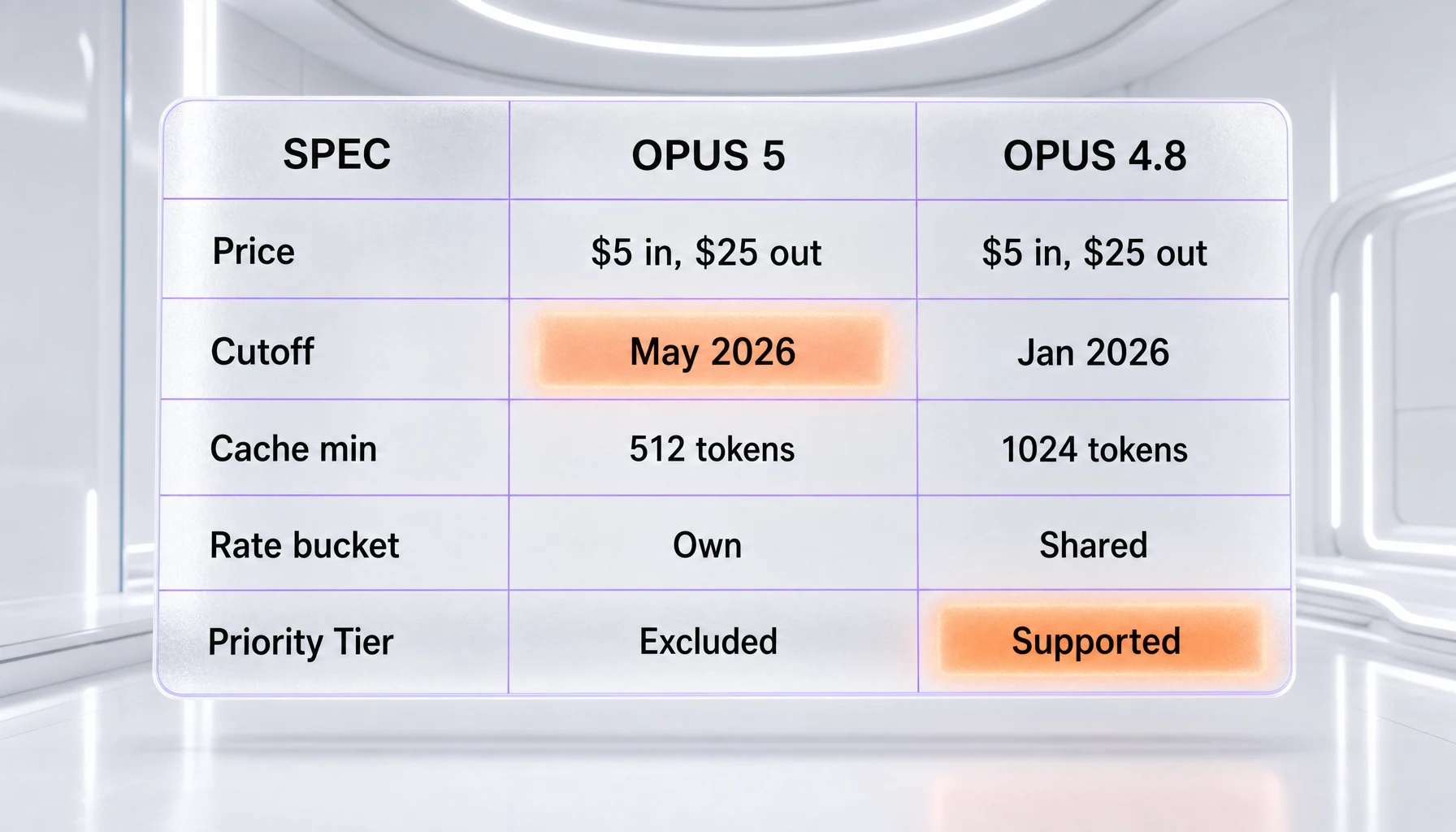
| Specification | Claude Opus 5 | Claude Opus 4.8 |
|---|---|---|
| API model ID | claude-opus-5 | claude-opus-4-8 |
| Input price per million tokens | $5 | $5 |
| Output price per million tokens | $25 | $25 |
| Cache write, 5 minutes, per million tokens | $6.25 | $6.25 |
| Cache read per million tokens | $0.50 | $0.50 |
| Batch input and output per million tokens | $2.50 and $12.50 | $2.50 and $12.50 |
| Fast mode price per million tokens | $10 input, $50 output | $10 input, $50 output |
| Context window | 1M tokens | 1M tokens |
| Max output, synchronous | 128k tokens | 128k tokens |
| Max output, batch beta | 300k tokens | 300k tokens |
| Training data cutoff | May 2026 | January 2026 |
| Reliable knowledge cutoff | May 2026 | January 2026 |
| Thinking when the field is omitted | Adaptive thinking on | No thinking |
| Effort levels | low, medium, high, xhigh, max | low, medium, high, xhigh, max |
| Default effort | high | high |
| Thinking disabled at xhigh or max | 400 error | Accepted |
| Minimum cacheable prompt | 512 tokens | 1,024 tokens |
| Tool-use system prompt overhead | 286 tokens, or 406 forced | 290 tokens, or 410 forced |
| Rate-limit bucket | Its own | Shared with Opus 4.7, 4.6, 4.5 |
| Priority Tier eligibility | Excluded | Supported |
| Start tier limits | 1,000 requests, 2,000,000 input, 400,000 output per minute | 1,000 requests, 2,000,000 input, 400,000 output per minute |
| Documentation status | Current | Legacy models table |
| Intelligence Index v4.1 at max effort (measured July 27, 2026) | 61 | 56 |
| Intelligence Index v4.1 at default effort (measured July 27, 2026) | 59 | No published figure |
| Cost per task at max effort (measured July 27, 2026) | $2.03 | $1.80 |
| Output speed at max effort (measured July 27, 2026) | 52.8 tokens per second | 55.4 tokens per second |
| Time to first token at max effort (measured July 27, 2026) | 69.71 seconds | 29.50 seconds |
One row deserves flagging rather than skipping. Artificial Analysis publishes exactly one Claude Opus 4.8 entry, and it is the max-effort configuration. There is no published Opus 4.8 measurement at default effort. We could have quietly compared Opus 5 at its default of 59 against Opus 4.8's max-effort 56 and produced a tidier story. That comparison would be invalid, so the cell says "no published figure" instead.
What actually breaks when you migrate?
Four things need auditing before you change the model ID. Anthropic's migration guide labels the first two as breaking changes, though only one of them actually returns an error — the other three are silent, and one of those can truncate your output while another quietly invalidates settings you spent time tuning. None of them are difficult to fix. All of them are easy to miss.
1. Thinking is on by default, and max_tokens now has to share
Anthropic's migration guide states it plainly: "On Claude Opus 4.8, requests without a thinking field run without thinking; on Claude Opus 5, the same requests run with adaptive thinking." The wire format did not change. The same JSON body produces a materially different response.
The consequence is budgetary, and it is the one most likely to bite in production. max_tokens is a hard ceiling on total output — thinking tokens plus response text together. A budget calibrated on Opus 4.8, where every one of those tokens went to the visible answer, now has to accommodate reasoning as well. Anthropic's own instruction is to "revisit it for workloads that ran without thinking on Claude Opus 4.8." A generous-looking 4,096-token budget that never came close to truncating on 4.8 can now clip the answer, and nothing in the response will announce that the reasoning consumed the difference.
2. Disabling thinking at xhigh or max effort returns a 400
This is the one unambiguous breaking change, and Anthropic labels it as such: setting thinking: {"type": "disabled"} with effort xhigh or max "returns a 400 error," and this "is a breaking change from Claude Opus 4.8, where disabling thinking was independent of the effort level." On Opus 4.8 that combination was accepted. On Opus 5 it is rejected.
The validation is per-request, not per-conversation. Anthropic notes that "every request's effort and thinking configuration is validated independently, so a request that raises effort to xhigh or max while thinking is disabled is rejected even if earlier requests in the conversation were accepted." A system that escalates effort dynamically on hard turns will fail on exactly those turns, and only those turns — an intermittent failure mode that is unpleasant to diagnose from logs.
There is a secondary consideration if you keep thinking off. Anthropic documents that with thinking disabled, Opus 5 "can occasionally write a tool call into its text output instead of emitting a tool_use block, or include internal XML tags in its visible response," and recommends keeping thinking enabled while controlling cost through lower effort instead.
3. The effort ladder was recalibrated
Both models expose the same five levels and both default to high. What changed is what each level buys. Anthropic states that "the token allocation behind each effort level changes on Claude Opus 5 compared to Claude Opus 4.8," and recommends you "run a fresh effort sweep on your own evals rather than carrying over a setting tuned for Claude Opus 4.8."
The independent measurements make the case for actually doing the sweep rather than nodding at the advice. Opus 5 at medium effort scores 56 on the Intelligence Index v4.1 — the same score Opus 4.8 posts at max effort — at $0.62 cost per task against $1.80, and 5.98 seconds to first token against 29.50 (all measured July 27, 2026). An organization that migrates and leaves effort at max is buying five index points for a wait more than twice as long. An organization that migrates and steps down to medium keeps its previous capability and cuts both cost per task and latency substantially. The sweep is where the value of this migration actually sits.
4. Prompt instructions carried over from Opus 4.8 can now backfire
Not an API change, but a behavior change that affects output quality without touching a status code. Anthropic documents that Opus 5 "verifies its own work without being told to," and advises removing verification instructions inherited from earlier models — phrasings like "include a final verification step" or "use a subagent to verify" — because "they cause over-verification on Claude Opus 5." It also notes that default responses run longer, that the model narrates progress more often in agentic sessions, and that it delegates to subagents more readily. Prompt scaffolding built to compensate for Opus 4.8's habits is now compensating for habits the model no longer has.
What does not break, despite what you may have read
One widely repeated claim about this migration is wrong, and it is worth correcting because acting on it wastes an audit cycle. Custom sampling parameters are not a new restriction on Opus 5. They were already rejected on Opus 4.8.
Anthropic's migration guide files this under behavioral differences that are not breaking, and the wording leaves no room: "Setting temperature, top_p, or top_k to a non-default value returns a 400 error on Claude Opus 5, the same as on Claude Opus 4.8." If your wrapper sets a house temperature, it is already failing every request on Opus 4.8 today — the migration does not cause that, and fixing the migration will not fix it. The check is still worth running if you are arriving from an older model such as Opus 4.6 or Sonnet 4.5, where those parameters were accepted. It is not an Opus 4.8-to-Opus 5 issue.
Several other things also stay put, and their stability is the reason this migration is worth doing at all: price, context window, synchronous max output, batch max output, the batch discount, cache pricing multipliers, fast mode availability and pricing, and the Start tier rate-limit numbers are identical across both models.
What do the independent measurements say?
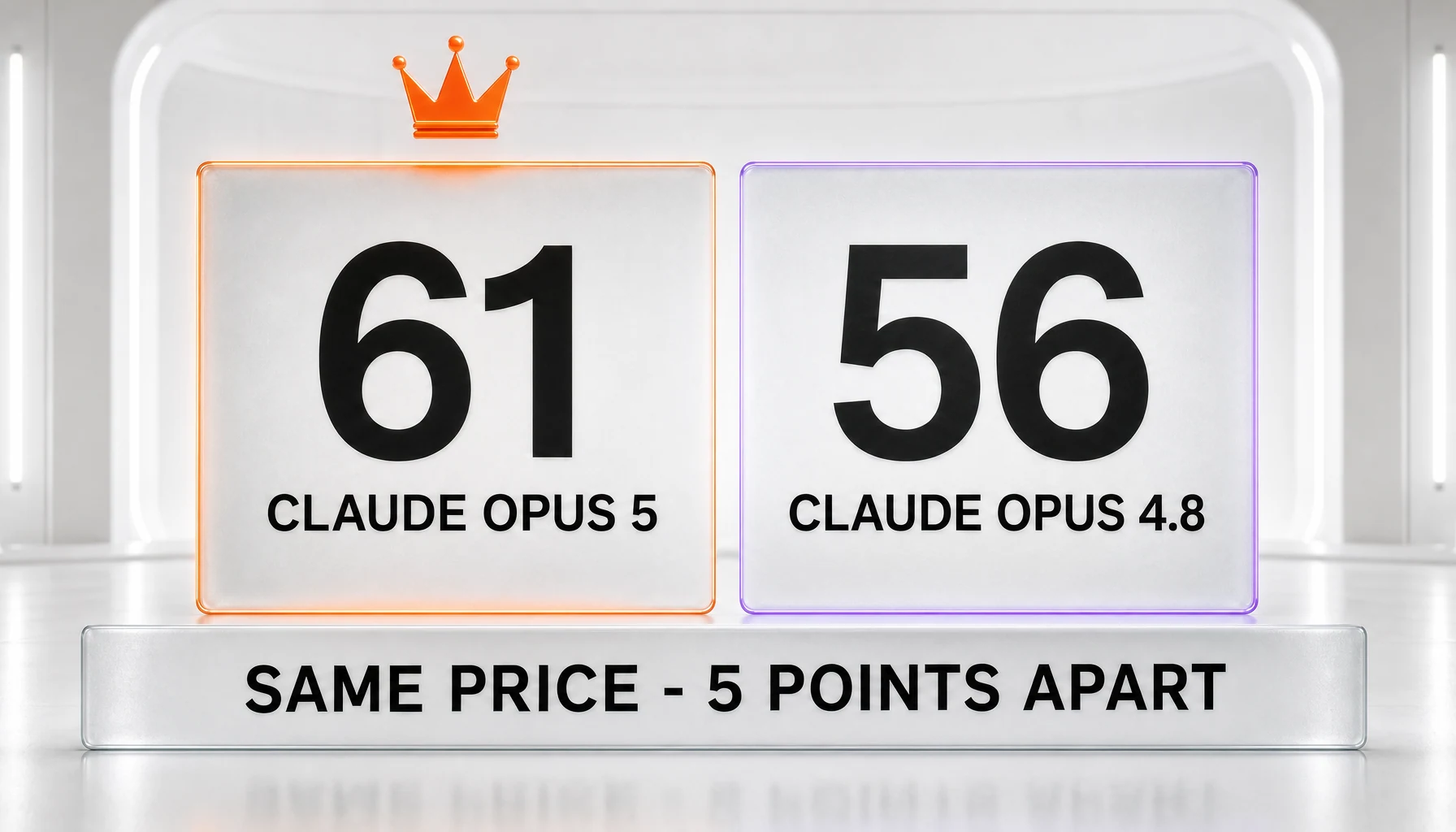
Artificial Analysis is the only independent evaluator publishing directly comparable index scores for both models. On the Intelligence Index v4.1, Claude Opus 5 scores 61 at max effort against Claude Opus 4.8's 56 at max effort. That is a legitimate configuration-matched comparison, and it is the headline result of this matchup.
Everything in the table below was read on July 27, 2026. Artificial Analysis re-measures latency, throughput, and cost continuously against live endpoints, so those three columns are observations of a service on a given day, not fixed specifications. Index scores are stable within an index version; the version here is v4.1 throughout, and a score quoted without its index version is meaningless.
| Configuration | Intelligence Index v4.1 | Cost per task, USD | Time to first token, seconds |
|---|---|---|---|
| Claude Opus 5, max effort | 61 | $2.03 | 69.71 |
| Claude Opus 5, xhigh effort | 60 | $1.56 | 37.38 |
| Claude Opus 5, high effort (default) | 59 | $1.06 | 21.67 |
| Claude Opus 5, medium effort | 56 | $0.62 | 5.98 |
| Claude Opus 5, low effort | 51 | $0.36 | 3.66 |
| Claude Opus 4.8, max effort | 56 | $1.80 | 29.50 |
| Claude Opus 4.8, any other effort | Not published | Not published | Not published |
Two readings deserve attention. First, the five-point gap at max effort is bought with latency: 69.71 seconds to first token against 29.50, a wait roughly 2.4 times longer, at a cost per task 13 percent higher. For interactive work that trade is poor. Second, the medium-effort row is the practical headline — 56 points, matching Opus 4.8's best published score, at roughly a third of the cost per task and a fifth of the wait. The upgrade's real payoff is not the ceiling. It is that the old ceiling is now available cheaply and quickly.
Total evaluation cost across the whole index is nearly flat: $3,835.51 for Opus 5 at max effort against $3,752.55 for Opus 4.8, a 2.2 percent difference. Throughput slightly favors the older model at 55.4 tokens per second against 52.8.
Anthropic's own numbers, kept separate
This is the only pairing in the current Claude lineup where Anthropic's system card compares the two models directly and at length. That makes the figures unusually relevant — and they remain vendor self-reported, produced by the party with an interest in the outcome. They are quarantined in this section for that reason, and they should not be blended with the independent index numbers above.
Anthropic's summary is that "Claude Opus 5 is substantially stronger than Claude Opus 4.8 across the board, with the largest gains in agentic coding, computer use, and long-horizon knowledge work." The published head-to-head figures:
| Evaluation | Claude Opus 5 | Claude Opus 4.8 | Configuration note |
|---|---|---|---|
| FrontierBench v0.1, mean reward | 44.4 percent | 18.7 percent | Opus 5 at xhigh, its best result; Opus 4.8 effort not stated |
| FrontierCode v1.1 main set | 53.4 percent | 46.5 percent | Each model at its best effort; run and scored by Cognition |
| FrontierCode v1.1 extended set | 63.6 percent | 59.6 percent | Each model at its best effort; run and scored by Cognition |
| OSWorld 2.0, first-attempt success | 70.57 percent | 55.7 percent | Averaged over five runs |
| AutomationBench, private held-out set | 26.0 percent | 17.0 percent | Both at max effort; benchmark from Zapier |
| ExploitBench, full arbitrary code execution exploits | 99 | 2 | Combined across both evaluation arms |
| Indirect prompt injection, attacker success within 15 attempts | 2.0 percent | 5.5 percent | Gray Swan IPI benchmark; lower is better |
Three cautions on reading that table. The ExploitBench row is stated in absolute counts deliberately: 99 against 2 is a real and large difference in offensive cybersecurity capability, but any ratio built on a denominator of 2 is arithmetically true and analytically empty, so we do not express it as a multiple. The FrontierBench row compares Opus 5 at its best effort against an Opus 4.8 figure whose effort setting the system card does not state — the gap is wide enough that this is unlikely to reverse it, but the comparison is not configuration-matched and we will not present it as though it were. And the FrontierCode rows are best-effort against best-effort, which is a defensible framing but not the same thing as max against max; Anthropic notes that Opus 5 actually peaks on that benchmark at medium effort, because at higher effort it makes more changes than the task requires and the grader penalizes out-of-scope edits.
One methodological detail is quietly amusing and genuinely informative: for OSWorld 2.0 tasks requiring a model grader, Anthropic "used Opus 4.8." The older model helped score the benchmark the newer model won.
The result that goes against Opus 5
Anthropic's system card documents one clear regression, and because it is the only direct comparison between these two specific models on this dimension, it carries real weight. Claude Opus 5 hallucinates more than Claude Opus 4.8. Not as an inference from a third model, not as a community impression — as a measured finding in the vendor's own document, stated against its own interest.
On the public split of AA-Omniscience, a 41-topic closed-book benchmark run with no web search or knowledge-base access, the system card reports that "Claude Opus 5's accuracy is 11 percent higher than Opus 4.8, but its rate of hallucinations is also 6 percent higher." Opus 5 posted a net score of 0.49, which the card places "in between Opus 4.8 and the two Mythos models." The card does not specify whether those percentages are relative changes or absolute point differences, so we do not assert one reading over the other.
The qualitative finding is the sharper one. Reviewing more than a million training transcripts by recursive summarization, Anthropic writes on page 3 of the system card: "We found a surprising number of cases in which Opus 5 confidently stated an answer about which it was in fact unsure. The model hallucinates factual claims slightly more than Opus 4.8, despite being more accurate overall."
Read those two properties together, because they compound rather than cancel. Opus 5 is right more often and confidently wrong more often. For workloads where a wrong answer is caught downstream — code that fails a test, a patch that breaks a build, an agent step that errors out — this barely matters, and the capability gain dominates. For workloads where a confident wrong answer propagates unchecked into a document, a customer response, a compliance filing, or a research summary, this is the single strongest argument in this comparison for staying on Opus 4.8. Higher accuracy does not help if your failure mode is misplaced confidence rather than error rate, and Opus 5's calibration moved the wrong way.
For balance, the same system card reports Opus 5 as "our most aligned model to date on our automated behavioral audit, surpassing the scores of Sonnet 5, Opus 4.8, and Mythos 5," with prompt injection robustness improved on every surface tested. The hallucination finding is a specific regression inside a broadly favorable safety picture, not a general one.
Pricing is identical, so what actually changes your bill?
Both models bill at $5 per million input tokens and $25 per million output tokens, with matching cache rates, a matching 50 percent batch discount, and matching fast mode pricing at $10 and $50. The full 1M context window is included at standard rates on both. Nothing in the rate card moves. Three things below the rate card do.
Thinking tokens are billed as output. This is the big one, and it follows directly from the first migration change. A request that produced 800 billable output tokens on Opus 4.8 may produce 800 tokens of answer plus a few thousand tokens of reasoning on Opus 5, all charged at the $25 output rate. Identical per-token pricing does not mean identical invoices when the token count itself changes. Effort is the lever: the independent cost-per-task figures run from $0.36 at low effort to $2.03 at max, a spread of roughly 5.6 times on the same model at the same posted price.
The caching floor dropped by half. The minimum cacheable prompt on Opus 5 is 512 tokens, against 1,024 on Opus 4.8. Anthropic notes that "prompts that were too short to cache on Claude Opus 4.8 can now create cache entries with no code changes." Short system prompts, compact tool definitions, and brief instruction headers that silently failed to cache — no error is returned when a prompt is below the floor, both cache fields simply come back at zero — may now cache and bill at $0.50 per million rather than $5. This is the one line item that moves in your favor automatically.
Tool-use overhead is marginally lower. Opus 5 adds 286 tokens for the tool-use system prompt, or 406 with a forced tool choice, against 290 and 410 on Opus 4.8. Four tokens per request. It is a rounding error at any normal volume and we mention it only for completeness.
One eligibility difference runs the other way, and it is the clearest thing Opus 4.8 has that Opus 5 does not. Anthropic's service tiers page states that "Priority Tier is supported on all available Claude models except Claude Mythos 5, Claude Mythos Preview, Claude Opus 5, and Claude Sonnet 5." Opus 4.8 is supported; Opus 5 is named in the exclusion list. The practical scope of this is narrow, because the same page notes that "Priority Tier capacity commitments are no longer available for purchase" and that existing holders may use them through their contract end date. If you hold such a commitment, migrating to Opus 5 means giving up the capacity guarantee you paid for. If you do not, this row is moot — you cannot buy one now regardless.
Rate limits are worth a line of their own. The Start tier numbers are identical — 1,000 requests, 2,000,000 input tokens, and 400,000 output tokens per minute for both. But Anthropic's documentation specifies that the Opus limit "is a total limit that applies to combined traffic across Claude Opus 4.8, Opus 4.7, Opus 4.6, and Opus 4.5. Claude Opus 5 has a separate rate limit and is not part of this combined bucket." Same ceiling, separate bucket. An organization running both models concurrently has roughly double the aggregate headroom of one running either alone, which makes a phased migration cheaper in throughput terms than a hard cutover.
Why Opus 4.8 stays in your stack even after you migrate
Here is the detail that makes this pairing genuinely unusual, and it is the reason "replace 4.8 with 5" is the wrong mental model. Claude Opus 4.8 is the designated fallback model for Claude Opus 5. Changing your model ID does not remove Opus 4.8 from your dependency chain.
Claude Opus 5 ships with cybersecurity safety classifiers. When one of them declines a request, the request does not have to fail — it can be served by Opus 4.8 instead. Anthropic's migration guide puts it directly: "Claude Opus 5 ships with cybersecurity safety classifiers whose cyber-category refusals can fall back to Claude Opus 4.8."
How that behaves depends entirely on the surface, and conflating the two is easy:
- Consumer and agentic surfaces: on by default. Anthropic's launch announcement states that "in Claude.ai, Claude Code, and Claude Cowork, any flagged requests will fall back to Opus 4.8 by default." Users can turn this off under Settings, Capabilities.
- The API: opt-in only. The same announcement adds that "fallbacks to Opus 4.8 can also be enabled on the API" — enabled, not automatic. You send the
server-side-fallback-2026-07-01beta header together with thefallbacksparameter, either as an explicit model list or as the"default"mode that lets Anthropic route by refusal category. Without both, a declined request returns to you withstop_reason: "refusal"and no substitution. Anthropic also notes you are not billed for a refusal that arrives before any output, and that only a classifier decline triggers fallback — a rate limit or server error is returned as-is.
Anthropic's own testing puts numbers on how often this fires. Running FrontierBench v0.1, the system card reports that "Opus 5 safety classifiers flagged and refused 5 percent of the API calls, in 4 percent of the total trials, falling back to Opus 4.8," against Claude Fable 5, whose classifiers "flagged 42 percent API calls on 26 percent of trials, also falling back to Opus 4.8." Those figures come from one security-adjacent benchmark and are not a general refusal rate for ordinary work — a coding agent that never touches exploit-shaped tasks should expect to see this essentially never. The launch announcement frames the same point in relative terms, expecting Opus 5's classifiers "to intervene around 85 percent less often than they do for Fable 5."
There is a counterintuitive wrinkle in the system card worth surfacing, because it is the opposite of what most readers would assume. Falling back to Opus 4.8 makes the deployed system score worse on several alignment dimensions — not because the fallback is unsafe, but because "Claude Opus 5 is one of our most aligned models ever," so a fallback hands the request to a less aligned model. Anthropic still judges the full system safer overall, on the grounds that Opus 4.8's lower capability limits the uplift an attacker could extract. The practical takeaway for an integrator is simply that Opus 4.8 is not a legacy artifact you are decommissioning. It is load-bearing infrastructure in the system you are migrating to.
How we researched this comparison
We researched both models rather than benchmarking them ourselves. We do not run an independent evaluation harness, and we will not present numbers as though we did.
Every specification in this comparison — pricing, context window, output limits, cutoffs, effort levels and defaults, thinking behavior, caching minimums, tool-use overhead, rate limits, and the beta header names — was read directly from Anthropic's platform documentation on July 27, 2026, page by page, rather than taken from search summaries or secondary write-ups. Every independent performance figure comes from Artificial Analysis, read the same day, with the index version recorded alongside each score and the effort configuration recorded alongside each measurement. Every vendor benchmark figure comes from the Claude Opus 5 system card, read directly from the published document, and is confined to its own clearly labeled section.
Where a figure did not exist, we say so rather than substituting a nearby one — which is why the Opus 4.8 default-effort row reads "no published figure" instead of quietly borrowing the max-effort score. Where a configuration was not stated in the source, as with Opus 4.8's effort level on FrontierBench, we flag the gap rather than assume max. We did not use a third model as a proxy to rank these two against each other; the only cross-model figures here are ones where Anthropic compares Opus 5 to Opus 4.8 directly.
Winner by category
| Category | Winner | Why |
|---|---|---|
| Raw capability | Claude Opus 5 | 61 against 56 on Intelligence Index v4.1 at matched max effort, and every head-to-head benchmark in Anthropic's system card |
| Price | Tie | $5 and $25 per million tokens, identical cache, batch, and fast mode rates |
| Cost efficiency in practice | Claude Opus 5 | Matches Opus 4.8's best index score at medium effort for $0.62 per task against $1.80 |
| Latency | Claude Opus 4.8 | 29.50 seconds to first token at max effort against 69.71, and 55.4 tokens per second against 52.8 |
| Knowledge freshness | Claude Opus 5 | May 2026 cutoff against January 2026 |
| Factual reliability | Claude Opus 4.8 | Lower measured hallucination rate on AA-Omniscience per Anthropic's own system card |
| Agentic and long-horizon work | Claude Opus 5 | Widest vendor-reported gaps on FrontierBench, OSWorld 2.0, and AutomationBench |
| Prompt injection robustness | Claude Opus 5 | 2.0 percent attacker success within 15 attempts against 5.5 percent |
| Integration stability | Claude Opus 4.8 | No migration audit required; your prompts and budgets are already tuned to it |
| Priority Tier eligibility | Claude Opus 4.8 | Opus 5 is named in the exclusion list, though new commitments can no longer be purchased |
| Caching economics | Claude Opus 5 | 512-token minimum against 1,024, with no code changes required |
| Long-term support | Claude Opus 5 | Opus 4.8 now sits in Anthropic's Legacy models table |
Pros and cons of each model
Claude Opus 5
Pros: Highest independent index score of the pair at 61 on v4.1 at max effort. Identical price to the model it replaces. Four months of extra world knowledge with a May 2026 cutoff. Matches Opus 4.8's best index score at medium effort for roughly a third of the cost per task. Caches prompts from 512 tokens. Its own rate-limit bucket, doubling aggregate headroom during a phased migration. Wins every head-to-head benchmark Anthropic published. Materially more robust to indirect prompt injection. Current rather than legacy in Anthropic's documentation.
Cons: Hallucinates more than Opus 4.8 and is confidently wrong more often, per Anthropic's own system card. Time to first token at max effort is roughly 2.4 times longer at 69.71 seconds. Slightly slower throughput at 52.8 tokens per second. Thinking on by default can silently truncate output against a max_tokens budget tuned for Opus 4.8. Disabling thinking at xhigh or max effort returns a 400. Effort settings carried over from Opus 4.8 are no longer calibrated. Inherited verification instructions cause over-verification. Excluded from Priority Tier.
Claude Opus 4.8
Pros: Same price as Opus 5 — migrating saves nothing, so staying costs nothing. Lower measured hallucination rate, the better choice where confident errors are expensive. Less than half the time to first token at max effort. Slightly faster throughput. No migration audit: your prompts, effort levels, and token budgets are already tuned. Thinking off by default, and disabling it works at any effort level. Remains available on the Claude API, Bedrock, Google Cloud, and Microsoft Foundry. Eligible for Priority Tier, which excludes Opus 5. Still the designated fallback model, so it stays supported by design.
Cons: Five index points behind at matched max effort, and behind on every benchmark in Anthropic's system card. Four-month older knowledge cutoff at January 2026. Needs 1,024 tokens before a prompt can cache, twice Opus 5's floor. Shares one rate-limit bucket with Opus 4.7, 4.6, and 4.5. More vulnerable to indirect prompt injection at 5.5 percent attacker success. Costs $1.80 per task at max effort to reach a score Opus 5 reaches for $0.62. Now sits in the Legacy models table.
When to migrate, and when to stay
Because the price is identical, this decision turns on workload shape and integration risk rather than budget. Most teams should migrate. Two categories genuinely should not, and a third should wait rather than refuse.
Migrate to Claude Opus 5 if: you run agentic coding, long-horizon tool loops, or multi-agent orchestration, where the vendor-reported gaps are widest and the independent gap is real. Your work benefits from knowledge after January 2026. You are latency-tolerant, or willing to run at medium or low effort — where Opus 5 is both cheaper and faster than Opus 4.8 at equal or better measured intelligence. You process untrusted content in agentic contexts and want the prompt injection improvement. Your prompts are short enough that the 512-token cache floor starts paying. Or you simply want to stay on the current model rather than the legacy one, which at identical pricing is a reasonable default position.
Stay on Claude Opus 4.8 if: your pipeline depends on custom sampling parameters — although verify this first, because that constraint already applies to Opus 4.8 and if you are genuinely setting a non-default temperature today, your requests are already failing. The substantive version of this reason is a pipeline built on thinking: {"type": "disabled"} at xhigh or max effort, which is a real configuration that works on Opus 4.8 and returns a 400 on Opus 5. Or: your workload punishes hallucination more than it rewards capability. If your output is factual prose that ships without a verification layer — research summaries, customer-facing answers, regulatory documents — then a model that is more accurate on average but more confidently wrong at the margin is a poor trade, and Anthropic's own measurement supports staying put.
Wait rather than refuse if: you are latency-bound in an interactive product and have not yet run an effort sweep. The default migration path — swap the ID, leave effort at high — lands you at 59 index points and 21.67 seconds to first token. That is a defensible outcome, but it is not the good one. Run the sweep, find the level where your evals hold, and migrate onto that level rather than onto the default.
Frequently Asked Questions
Is Claude Opus 5 more expensive than Claude Opus 4.8?
No. They cost exactly the same: $5 per million input tokens and $25 per million output tokens. Cache writes, cache reads, the 50 percent batch discount, and fast mode pricing at $10 and $50 are also identical, and both include the full 1M-token context window at standard rates. Your bill can still rise after migrating, because thinking is on by default on Opus 5 and thinking tokens are billed as output tokens — but the posted rate card is unchanged.
How much better is Claude Opus 5 than Claude Opus 4.8?
Five points on the Artificial Analysis Intelligence Index v4.1: 61 against 56, both at max effort, measured July 27, 2026. Anthropic's own system card reports much wider gaps on agentic benchmarks — 44.4 percent against 18.7 percent on FrontierBench v0.1, 70.57 percent against 55.7 percent on OSWorld 2.0, and 26.0 percent against 17.0 percent on AutomationBench — but those are vendor self-reported figures and should be weighted accordingly.
What breaks when migrating from Claude Opus 4.8 to Claude Opus 5?
One hard break and three silent changes. The hard break: thinking: {"type": "disabled"} combined with effort xhigh or max returns a 400 error, where Opus 4.8 accepted it. The silent ones: thinking is on by default so max_tokens now covers reasoning plus answer and can truncate output; effort levels were recalibrated so carried-over settings are no longer tuned; and inherited verification instructions cause over-verification because Opus 5 self-verifies.
Does Claude Opus 5 reject custom temperature settings?
Yes, but so does Claude Opus 4.8 — this is not a migration issue. Anthropic's migration guide states that setting temperature, top_p, or top_k to a non-default value returns a 400 error on Opus 5 "the same as on Claude Opus 4.8." If a wrapper sets a house temperature, it is already failing on Opus 4.8 today. The check matters only when arriving from an older model such as Opus 4.6 or Sonnet 4.5.
Does Claude Opus 4.8 support the same effort levels as Claude Opus 5?
Yes. Both support all five levels — low, medium, high, xhigh, and max — and both default to high on the Claude API. What differs is calibration: Anthropic states that the token allocation behind each level changed on Opus 5, and recommends running a fresh effort sweep rather than carrying a setting over. The levels are the same; what each one buys is not.
Which model hallucinates less, Claude Opus 5 or Claude Opus 4.8?
Claude Opus 4.8. Anthropic's system card reports that on the public split of AA-Omniscience, Opus 5's "accuracy is 11 percent higher than Opus 4.8, but its rate of hallucinations is also 6 percent higher." The card also records "a surprising number of cases in which Opus 5 confidently stated an answer about which it was in fact unsure." Opus 5 is right more often and confidently wrong more often.
Is Claude Opus 4.8 deprecated?
No. It has moved into Anthropic's Legacy models table, which is not the same as deprecation. Claude Opus 4.1 was deprecated and then retired on August 5, 2026; Opus 4.8 has been through neither step. Anthropic states that Opus 4.8 "remains available" on the Claude API, Amazon Bedrock, Google Cloud, and Microsoft Foundry, and it is still the designated fallback model for Opus 5 refusals.
Why is Claude Opus 5 slower than Claude Opus 4.8?
Because it thinks more before answering. At max effort, Opus 5 takes 69.71 seconds to first token against Opus 4.8's 29.50, and produces 52.8 tokens per second against 55.4 — both measured July 27, 2026. Effort is the lever: at medium effort Opus 5 reaches first token in 5.98 seconds while still scoring 56, matching Opus 4.8's max-effort index score. The latency penalty is a configuration choice, not a fixed property.
Does Claude Opus 5 still use Claude Opus 4.8 after I migrate?
It can, and on some surfaces it does by default. Opus 5 ships with cybersecurity safety classifiers whose cyber-category refusals fall back to Opus 4.8. In Claude.ai, Claude Code, and Claude Cowork this happens by default and users can disable it under Settings, Capabilities. On the API it is opt-in: you send the server-side-fallback-2026-07-01 beta header along with the fallbacks parameter. Without both, a refused request simply returns with stop_reason: "refusal".
What is the knowledge cutoff for Claude Opus 5 and Claude Opus 4.8?
Claude Opus 5 has a training data cutoff and a reliable knowledge cutoff of May 2026. Claude Opus 4.8 has both at January 2026. That is a four-month advantage for Opus 5 and the single largest specification difference between the two models that requires no configuration change to benefit from. Both carry a 1M-token context window and 128k max output tokens on the synchronous Messages API.
Do Claude Opus 5 and Claude Opus 4.8 share a rate limit?
No. Anthropic's documentation states that the Opus rate limit "is a total limit that applies to combined traffic across Claude Opus 4.8, Opus 4.7, Opus 4.6, and Opus 4.5. Claude Opus 5 has a separate rate limit and is not part of this combined bucket." The Start tier numbers are identical for both at 1,000 requests, 2,000,000 input tokens, and 400,000 output tokens per minute, so running both concurrently roughly doubles aggregate headroom.
Should I migrate from Claude Opus 4.8 to Claude Opus 5?
For most workloads, yes — the price is identical, the independent index gap is five points, and Opus 4.8 is now the legacy entry. Audit the four migration changes first, particularly the max_tokens interaction with default-on thinking. Two reasons to stay are legitimate: a pipeline that disables thinking at xhigh or max effort, and a workload where a confidently wrong answer costs more than a missing capability.
Related comparisons
Both models compared here have their own full reviews on ThePlanetTools: Claude Opus 5 and Claude Opus 4.8. Our launch analysis covers the release in detail: Anthropic ships Claude Opus 5 at the same price with a newer cutoff.
If you are weighing the wider Anthropic lineup rather than this specific migration, Claude Fable 5 vs Claude Opus 4.8 covers the tier above Opus at double the price, and Claude Sonnet 5 is the cheaper option below it. For cross-vendor context, GPT-5.6 Sol vs Claude Opus 4.8 covers the OpenAI comparison — GPT-5.6 Sol also appears in several of Anthropic's own system card tables — and Kimi K3 is the strongest open-weight challenger in the same capability band. Claude Fable 5 is worth reading alongside this page for one reason in particular: it shares Opus 4.8 as its fallback model.
Final verdict
Claude Opus 5 wins this comparison, and at identical pricing the win is easier to act on than most. Five points of independent index separation at matched max effort, a four-month newer knowledge cutoff, a halved caching floor, its own rate-limit bucket, better prompt injection robustness, and a clean sweep of the vendor's head-to-head benchmarks — none of it costs a cent more than the model it replaces. The strongest practical argument is not the ceiling at all: Opus 5 at medium effort matches Opus 4.8's best published index score at roughly a third of the cost per task and a fifth of the wait, which means the upgrade's real dividend is cheaper access to the capability you already had.
But the audit is not optional, and two reasons to stay are legitimate rather than sentimental. A pipeline that disables thinking at xhigh or max effort will break with a 400 on day one. A max_tokens budget calibrated for a model that did not think will now silently truncate answers. Effort settings carried over are no longer calibrated to anything. And Anthropic's own system card, comparing these two models directly and against its own interest, documents that Opus 5 hallucinates more and states uncertain answers confidently more often — which for factual prose shipped without a verification layer is a genuine reason to stay on Opus 4.8, not a footnote.
Migrate, then. Just do it deliberately: audit the four changes, run the effort sweep before you pick a level, and keep Opus 4.8 wired in — not out of caution, but because Anthropic's own architecture makes it the fallback for the model you are migrating to. You do not leave Opus 4.8 behind by changing your model string. You just stop calling it first.
Sources and references
Every figure in this comparison comes from a primary source — Anthropic's own documentation and system card, or the independent evaluator Artificial Analysis. All pages were read on July 27, 2026.
- Anthropic — Pricing: model pricing, batch rates, cache multipliers, fast mode pricing, tool-use token overhead.
- Anthropic — Models overview: model IDs, context windows, max output, knowledge cutoffs, Legacy models table, effort defaults.
- Anthropic — What's new in Claude Opus 5: thinking on by default, the effort restriction, caching minimum, fast mode, behavior changes.
- Anthropic — Model migration guide: breaking changes from Opus 4.8 to Opus 5, sampling parameter behavior, effort recalibration.
- Anthropic — Effort: the five effort levels and per-model support, defaults, and recommended settings.
- Anthropic — Thinking: adaptive thinking behavior and its interaction with
max_tokens. - Anthropic — Extended thinking: why manual
budget_tokensreturns a 400 on both models. - Anthropic — Prompt caching: minimum cacheable prompt length per model.
- Anthropic — Refusals and fallback: the
fallbacksparameter, beta header names, and refusal categories. - Anthropic — Rate limits: Start tier limits and the Opus bucket-sharing note.
- Anthropic — Service tiers: Priority Tier supported models and commitment availability.
- Anthropic — Fast mode: supported models, pricing, and access terms for both models.
- Anthropic — Introducing Claude Opus 5: launch details and fallback behavior by surface.
- Anthropic — Claude Opus 5 System Card (July 24, 2026): AA-Omniscience hallucination findings, FrontierBench, FrontierCode, OSWorld 2.0, AutomationBench, ExploitBench, indirect prompt injection, and fallback impact.
- Artificial Analysis — Claude Opus 5: Intelligence Index v4.1 scores by effort level, cost per task, throughput, latency.
- Artificial Analysis — Claude Opus 4.8: Intelligence Index v4.1 score at max effort, cost per task, throughput, latency.
Disclosure: ThePlanetTools.ai has no affiliate relationship with Anthropic and earns nothing from your choice between these two models. We researched both rather than benchmarking them ourselves: we run no independent evaluation harness, and no performance number on this page is our own measurement. Specifications come from Anthropic's platform documentation; independent performance figures come from Artificial Analysis, with the index version and effort configuration recorded alongside each; head-to-head benchmark figures come from Anthropic's Claude Opus 5 system card and are vendor self-reported, kept in their own section for that reason. Latency, throughput, and cost per task are continuously re-measured by Artificial Analysis and are dated readings rather than fixed model properties. Last compared: July 27, 2026.
Our Verdict
Claude Opus 5 wins at identical pricing: 61 against 56 on the Artificial Analysis Intelligence Index v4.1 at matched max effort (measured July 27, 2026), a May 2026 knowledge cutoff against January 2026, a 512-token caching floor against 1,024, its own rate-limit bucket, and a clean sweep of Anthropic's own head-to-head benchmarks. Because the price is identical, migration is recommended for most workloads — but it is not a one-line model-ID swap. Audit four things first: thinking is on by default and now shares your max_tokens budget with the answer; disabling thinking at xhigh or max effort returns a 400 error where Opus 4.8 accepted it; the effort ladder was recalibrated so carried-over settings are no longer tuned; and inherited verification instructions cause over-verification. Two reasons to stay are legitimate rather than sentimental: a pipeline that disables thinking at xhigh or max effort, and any workload where a confident wrong answer costs more than a missing capability — Anthropic's own system card documents that Opus 5 hallucinates more than Opus 4.8 and states uncertain answers confidently more often. Note that migrating does not remove Opus 4.8 from your stack: it is the designated fallback model when Opus 5's cybersecurity classifiers decline a request.
Choose Claude Opus 5
Anthropic's frontier reasoning model — top of the independent index at half the price of Fable 5.
Try Claude Opus 5 →Choose Claude Opus 4.8
Anthropic's flagship model for agentic coding, computer use, and multi-agent orchestration.
Try Claude Opus 4.8 →Frequently Asked Questions
Is Claude Opus 5 better than Claude Opus 4.8?
Claude Opus 5 wins at identical pricing: 61 against 56 on the Artificial Analysis Intelligence Index v4.1 at matched max effort (measured July 27, 2026), a May 2026 knowledge cutoff against January 2026, a 512-token caching floor against 1,024, its own rate-limit bucket, and a clean sweep of Anthropic's own head-to-head benchmarks. Because the price is identical, migration is recommended for most workloads — but it is not a one-line model-ID swap. Audit four things first: thinking is on by default and now shares your max_tokens budget with the answer; disabling thinking at xhigh or max effort returns a 400 error where Opus 4.8 accepted it; the effort ladder was recalibrated so carried-over settings are no longer tuned; and inherited verification instructions cause over-verification. Two reasons to stay are legitimate rather than sentimental: a pipeline that disables thinking at xhigh or max effort, and any workload where a confident wrong answer costs more than a missing capability — Anthropic's own system card documents that Opus 5 hallucinates more than Opus 4.8 and states uncertain answers confidently more often. Note that migrating does not remove Opus 4.8 from your stack: it is the designated fallback model when Opus 5's cybersecurity classifiers decline a request.
Which is cheaper, Claude Opus 5 or Claude Opus 4.8?
Claude Opus 5 starts at $5 in / $25 out per M tokens. Claude Opus 4.8 starts at $5 in / $25 out per M tokens. Check the pricing comparison section above for a full breakdown.
What are the main differences between Claude Opus 5 and Claude Opus 4.8?
The key differences span across 16 features we compared. For Price per million tokens, Claude Opus 5 offers $5 input, $25 output while Claude Opus 4.8 offers $5 input, $25 output. For Intelligence Index v4.1, max effort (July 27, 2026), Claude Opus 5 offers 61 while Claude Opus 4.8 offers 56. For Training data cutoff, Claude Opus 5 offers May 2026 while Claude Opus 4.8 offers January 2026. See the full feature comparison table above for all details.