Claude Sonnet 5 vs Claude Sonnet 4.6: The Upgrade (2026)


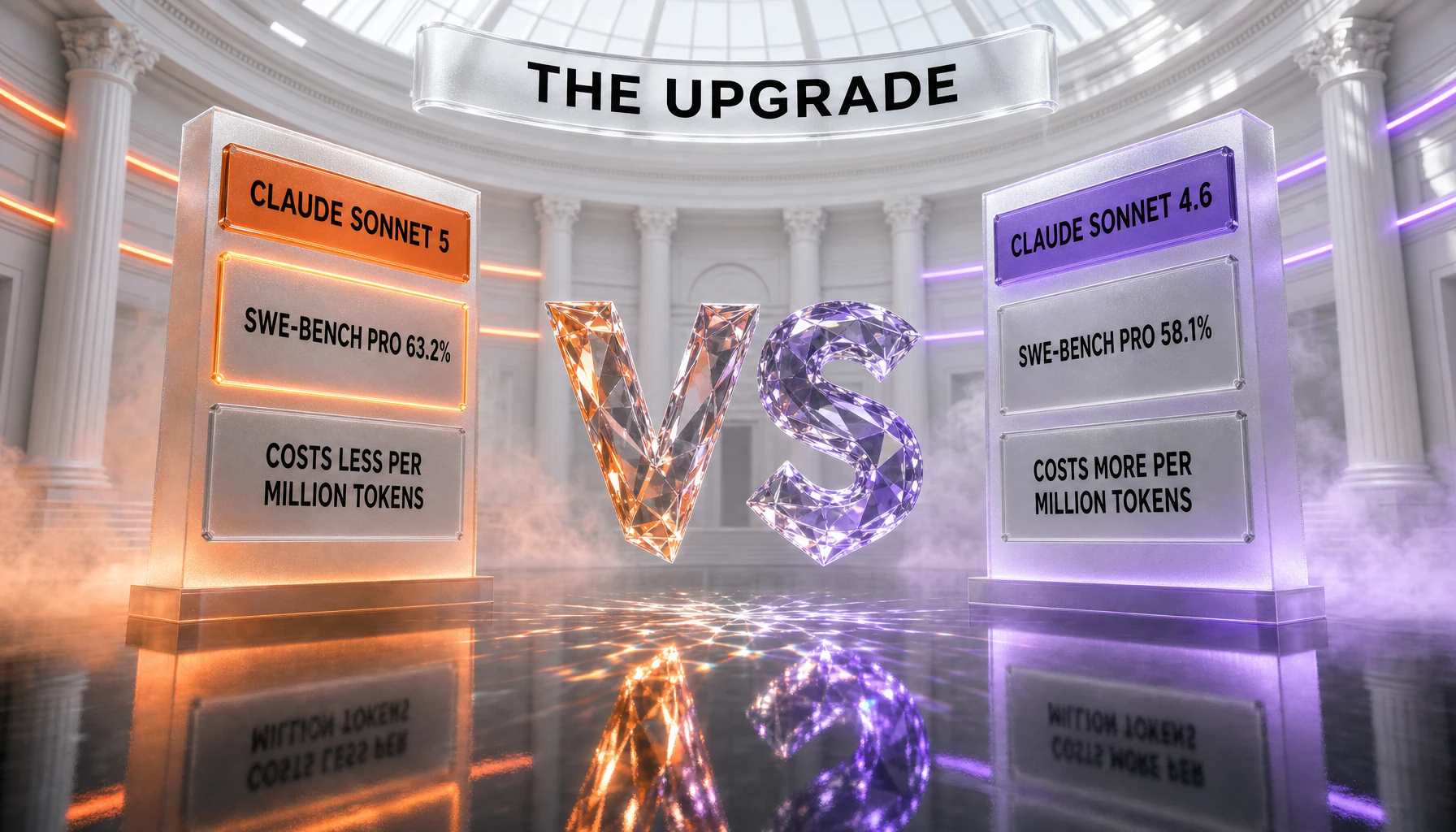
Claude Sonnet 5 beats Sonnet 4.6 on every measured axis — 63.2% vs 58.1% on SWE-bench Pro — and now costs a third less. When to upgrade and when to wait.
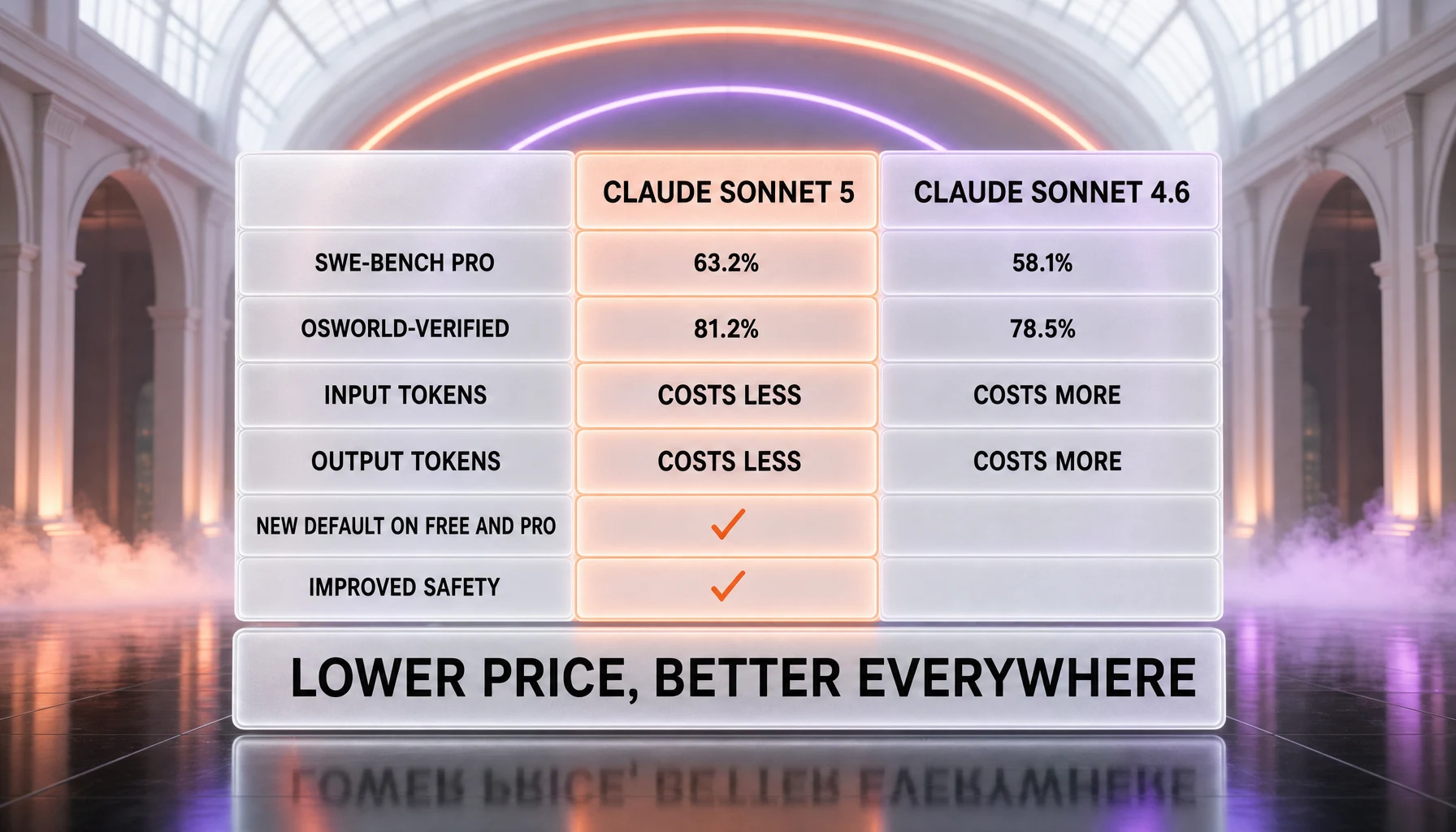
Feature Comparison
| Feature | Claude Sonnet 5 | Claude Sonnet 4.6 |
|---|---|---|
| SWE-bench Pro (agentic coding) | 63.2% | 58.1% |
| OSWorld-Verified (computer use) | 81.2% | 78.5% |
| Input price (per million tokens) | $2 | $3 |
| Output price (per million tokens) | $10 | $15 |
| Safety (hallucination, sycophancy, prompt-injection) | Improved — lower rates, cyber safeguards on by default | Prior-generation baseline |
| Default model on Claude.ai Free and Pro | Yes — the new default | No — superseded |
| Release date | June 30, 2026 | February 17, 2026 |
| Migration effort | One-line model-string change | Already deployed |
| Overall value in 2026 | The new default — better on every measured axis and cheaper on both input and output | Prior-gen midsize — still solid, no longer the default |
Pricing Comparison
Claude Sonnet 5
Claude Sonnet 4.6
Detailed Comparison
Editorial independence: ThePlanetTools.ai has no affiliate relationship with Anthropic and earns nothing whether you run Claude Sonnet 5 or Claude Sonnet 4.6. This verdict is based on hands-on use of both models plus Anthropic's published system card. Benchmark figures (SWE-bench Pro, OSWorld-Verified) are Anthropic-reported and, this early, not yet independently reproduced.
Claude Sonnet 5 vs Claude Sonnet 4.6 in 2026: Claude Sonnet 5, released June 30, 2026, is a straight generational upgrade over Claude Sonnet 4.6. It scores 63.2% on SWE-bench Pro versus 58.1% (a 5.1-point gain) and 81.2% on OSWorld-Verified versus 78.5% (a 2.7-point gain), with lower hallucination and sycophancy and stronger prompt-injection resistance. It also costs less than Sonnet 4.6: $2 per million input tokens and $10 per million output tokens against $3 and $15. Verdict: upgrade to Sonnet 5 unless you have a validated, pinned deployment you are not ready to migrate.
Quick Verdict
This one is not a horse race — it is an upgrade path. Claude Sonnet 5 replaced Claude Sonnet 4.6 as Anthropic's default midsize model, and it beats it on every axis Anthropic measured while costing a third less. There is no capability tradeoff to weigh and no premium to justify: Sonnet 5 is better and cheaper. The only question worth asking is not "which is better" but "is there any reason not to upgrade" — and for most teams the answer is no.
- 🏆 Winner — Claude Sonnet 5: higher SWE-bench Pro and OSWorld-Verified scores, better safety posture, the new default on Claude.ai, and cheaper than Sonnet 4.6 on both input and output
- 🧠 More capable: Claude Sonnet 5 — 63.2% on SWE-bench Pro versus 58.1% for Sonnet 4.6 (a 5.1-point jump) and 81.2% on OSWorld-Verified versus 78.5% (a 2.7-point gain)
- 💰 Cheaper option: Claude Sonnet 5 — $2 per million input tokens and $10 per million output tokens versus Sonnet 4.6 at $3 and $15, a third less on both lines
- 🛡️ Safer: Claude Sonnet 5 shows lower hallucination and sycophancy, stronger refusal of malicious requests, and better prompt-injection resistance than Sonnet 4.6, with cyber safeguards enabled by default
- 📌 Stay on Sonnet 4.6 only if: you run a validated, pinned deployment where re-qualifying the model costs more than the upgrade is worth — a real but narrow case
- 🔁 Migration cost: effectively zero — same Messages API, same SDKs, a one-line model-string change from
claude-sonnet-4-6toclaude-sonnet-5
Both models are live today. You can try Claude Sonnet 5 free as the default model on the Free and Pro plans of Claude.ai, read our full Claude Sonnet 5 review and Claude Sonnet 4.6 review, or see how the flagship compares in our Claude Sonnet 5 vs Claude Opus 4.8 breakdown.
How We Compared Them
We ran both models the way teams actually deploy them. Claude Sonnet 4.6 has been a workhorse in our testing since it launched on February 17, 2026, so the 4.6 notes here reflect months of daily coding, agentic, and tool-use runs. We moved the same batch of tasks onto Claude Sonnet 5 the day it shipped, June 30, 2026, so the Sonnet 5 notes reflect early but genuine hands-on runs alongside Anthropic's published evaluations.
Because Sonnet 5 is new, the head-to-head benchmark numbers below come from Anthropic's June 30, 2026 system card, not from our own re-runs. The important thing for a same-family comparison is that both figures come from the same benchmark: SWE-bench Pro and OSWorld-Verified are reported for both Sonnet 4.6 and Sonnet 5, so the 63.2% versus 58.1% and 81.2% versus 78.5% gaps are apples-to-apples. Where a figure is Anthropic-reported and not yet independently reproduced, we say so. Both models share the same Messages API and SDKs, which is exactly what makes "upgrade to Sonnet 5" a one-line change rather than a project.
Claude Sonnet 5 and Claude Sonnet 4.6 at a Glance
Claude Sonnet 5 is Anthropic's most agentic midsize model, released June 30, 2026, and it is now the default model on the Free and Pro plans of Claude.ai — the model most people and products touch by default. Anthropic tuned it to make plans, drive browsers and terminals, and run multi-step tasks unattended, with improved tool use and error recovery for long agent loops. It scores 63.2% on SWE-bench Pro and 81.2% on OSWorld-Verified. API pricing is $2 per million input tokens and $10 per million output tokens. The Claude API model identifier is claude-sonnet-5.
Claude Sonnet 4.6 is the model Sonnet 5 replaces — the mid-tier hybrid reasoning workhorse Anthropic shipped on February 17, 2026. It brought the 1M token context window (in beta), adaptive thinking, computer use, and prompt caching together at midsize pricing, and it scores 58.1% on SWE-bench Pro and 78.5% on OSWorld-Verified. Its API price is $3 per million input tokens and $15 per million output tokens, half again what Sonnet 5 costs. The Claude API model identifier is claude-sonnet-4-6. It remains a capable model; it is simply no longer the default, and no longer the one we would start a new project on.
The Benchmarks: 63.2% vs 58.1% on SWE-bench Pro
The number that frames this comparison is SWE-bench Pro, the agentic software-engineering benchmark. Claude Sonnet 5 scores 63.2%. Claude Sonnet 4.6 scores 58.1%. That is a 5.1-point gain in a single generation of the midsize tier — a meaningful step, not a rounding error. For reference, Sonnet 5's 63.2% is about 91% of Claude Opus 4.8's flagship 69.2%, so the newest Sonnet has closed most of the distance to the top of the family.
On computer use, Anthropic reports Claude Sonnet 5 at 81.2% on OSWorld-Verified, up from Sonnet 4.6's 78.5% — a 2.7-point gain on one of the hardest agentic skills. Computer use is what turns a chatbot into an agent that can operate real software: clicking through a dashboard, filling forms, extracting data from interfaces that have no API. In early hands-on runs, Sonnet 5 felt steadier than 4.6 on multi-step browser and terminal tasks, recovering from a failed action instead of derailing — which tracks with the benchmark gain.
Both gains point the same direction: Sonnet 5 is better at the two things a midsize agentic model is bought for — writing and fixing code, and driving software. There is no benchmark on Anthropic's shared table where 4.6 comes out ahead. One honesty caveat applies to both: these are Anthropic-reported figures, and independent long-run reproduction is still thin this early. Treat the 5.1-point and 2.7-point gaps as directionally reliable — they match what we feel in daily use — rather than as precision instruments.
Pricing: Sonnet 5 Costs Less — So the Upgrade Pays for Itself
This is the part that makes the decision easy. On capability, Sonnet 5 is ahead. On price, Sonnet 5 is cheaper — which means the upgrade does not cost anything extra, it saves money.
| Model | Input (per million tokens) | Output (per million tokens) | Notes |
|---|---|---|---|
| Claude Sonnet 5 | $2 | $10 | Cheaper than 4.6; the new default on Free and Pro |
| Claude Sonnet 4.6 | $3 | $15 | Higher rate, lower capability |
Claude Sonnet 5 costs $2 per million input tokens and $10 per million output tokens — roughly a third less than Sonnet 4.6's $3 and $15. In other words, the better model is also the cheaper one. Anthropic announced that rate at launch as introductory pricing through August 31, 2026, then cancelled the scheduled increase to $3 and $15 on August 10, 2026, so it is permanent. There is no version of this table where staying on 4.6 saves money.
That is the whole economic case in one line: the newer model is cheaper as well as better, so there is nothing to weigh. If you are sizing a budget for sustained production volume, plan around $2 and $10 on Sonnet 5 against $3 and $15 on Sonnet 4.6.
Safety: Sonnet 5 Moves the Baseline Up
Capability gains are the headline, but the quieter improvement is safety — and it matters more, not less, as these models are handed more autonomy. Anthropic's system card reports that Claude Sonnet 5 has an overall lower rate of undesirable behaviors than Sonnet 4.6: lower hallucination, less sycophancy, stronger refusal of malicious requests, and better resistance to prompt-injection attacks. It also launches with cyber safeguards enabled by default.
For anyone building agents, that combination is exactly the right direction. Prompt-injection resistance and malicious-request refusal are the failure modes that bite hardest when a model is given tool access and left to run; a model that hallucinates less and flatters the user less is a model you can trust with a longer leash. So the safety story reinforces the upgrade rather than complicating it: Sonnet 5 is not just more capable than 4.6, it is more trustworthy on the same tasks.
One nuance, in the interest of honesty. On Anthropic's Firefox 147 security exercise run with Mozilla, neither Sonnet 4.6 nor Sonnet 5 produced a working exploit — both scored 0.0% — but Sonnet 5's partial-success rate rose to 13.2% from 8.8%. Anthropic attributes that to broader general capability rather than any offensive tuning; it is the familiar pattern where "more capable" and "needs guardrails" travel together. It does not change the upgrade calculus between these two models — Sonnet 5's default safeguards and lower misbehavior rates are the reason it is the safer of the pair for day-to-day agentic work.
Feature-by-Feature Comparison
Here is the head-to-head across the dimensions that drive the upgrade decision. We only fill a cell where Anthropic published a comparable figure, and we mark ties honestly.
| Dimension | Claude Sonnet 5 | Claude Sonnet 4.6 | Edge |
|---|---|---|---|
| SWE-bench Pro (agentic coding) | 63.2% | 58.1% | Sonnet 5 |
| OSWorld-Verified (computer use) | 81.2% | 78.5% | Sonnet 5 |
| Input price (per million tokens) | $2 | $3 | Sonnet 5 |
| Output price (per million tokens) | $10 | $15 | Sonnet 5 |
| Safety (hallucination, sycophancy, prompt-injection) | Improved; cyber safeguards on by default | Prior-generation baseline | Sonnet 5 |
| Default model on Claude.ai Free and Pro | Yes — the new default | No — superseded | Sonnet 5 |
| Release date | June 30, 2026 | February 17, 2026 | Sonnet 5 |
| Migration effort | One-line model-string change | Already deployed | Tie |
| Overall value in 2026 | The new default, better on every measured axis and cheaper on both input and output | Still solid, no longer the default | Sonnet 5 |
Pros and Cons
Claude Sonnet 5 — Pros
- Higher on both shared benchmarks: 63.2% versus 58.1% on SWE-bench Pro, 81.2% versus 78.5% on OSWorld-Verified
- Cheaper than 4.6 — $2 input and $10 output per million tokens against $3 and $15
- Improved safety: lower hallucination and sycophancy, stronger prompt-injection resistance, cyber safeguards on by default
- The new default model on the Free and Pro plans of Claude.ai, so you can evaluate the exact model in a browser before paying
- One-line migration from 4.6 — same Messages API, same SDKs, model id claude-sonnet-5
Claude Sonnet 5 — Cons
- Brand new (released June 30, 2026), so independent long-run track record is still thin
- Broader capability shows up on security evals too — the partial-success rate on Anthropic's Firefox 147 exercise rose to 13.2% from 8.8%, though neither model produced a working exploit
- For the hardest and most safety-sensitive autonomous work, Claude Opus 4.8 still leads both Sonnet models
Claude Sonnet 4.6 — Pros
- Mature and battle-tested since February 17, 2026, with a longer public track record than Sonnet 5
- Brought the 1M token context window (beta), adaptive thinking, computer use, and prompt caching to the midsize tier
- A safe choice to keep running if it is already validated and pinned in production
Claude Sonnet 4.6 — Cons
- Lower on both shared benchmarks — 58.1% SWE-bench Pro and 78.5% OSWorld-Verified — than Sonnet 5
- Weaker safety baseline: higher hallucination and sycophancy and less prompt-injection resistance than Sonnet 5
- No longer the default on Claude.ai, so free and Pro users now get Sonnet 5 instead
- No price advantage — it costs half again what Sonnet 5 does for a measurably less capable model
When to Upgrade and When to Wait
Upgrade to Claude Sonnet 5 when
- You are starting anything new — a new agent, a new pipeline, a new feature — where there is no migration cost at all, just a model-string choice
- You run high-volume coding or computer-use workloads and want the 5.1-point SWE-bench Pro and 2.7-point OSWorld-Verified gains for free
- You care about safety on agentic tasks and want lower hallucination, less sycophancy, and stronger prompt-injection resistance with safeguards on by default
- You want to cut your bill — Sonnet 5 costs a third less than 4.6 on both input and output
- Your users touch Claude.ai directly, where Sonnet 5 is already the default they experience
Stay on Claude Sonnet 4.6 (for now) when
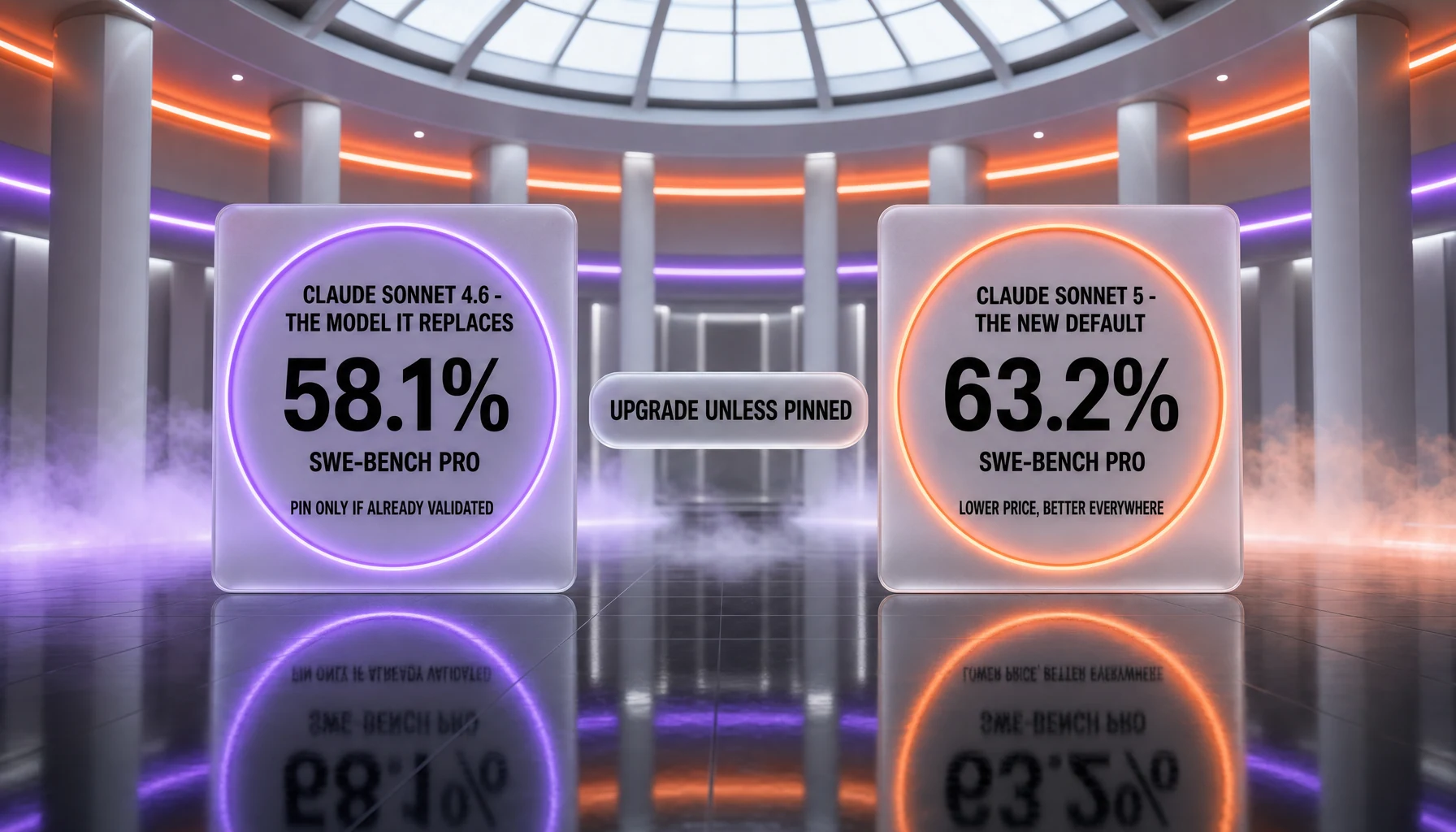
- You have a validated, pinned production deployment — locked to a specific model snapshot with sign-off, evals, and guardrails tuned against 4.6 — where re-qualifying the model costs more than the upgrade is worth today
- You are in a change-freeze window and cannot re-run your acceptance suite before a release
- You depend on behavior you have carefully calibrated to 4.6 and need time to re-validate against Sonnet 5's slightly different responses
Notice that even the "stay" cases are temporary. None of them is "4.6 is the better model" — they are all "we are not ready to re-qualify yet." The right plan is to schedule the migration, re-run your evals against Sonnet 5, and move once it passes, because you gain capability and safety at no extra standard cost. If your workload is genuinely at the hardest or most sensitive end, the real step-up is not staying on 4.6 but reaching for the flagship — see our Claude Sonnet 5 vs Claude Opus 4.8 comparison, or how the flagship behaves inside an agentic terminal in our Claude Code review.
Final Verdict
Upgrade to Claude Sonnet 5. That is the whole comparison in three words. This is not a tie of equals and it is not a hard tradeoff: Sonnet 5 is better than Sonnet 4.6 on every axis Anthropic measured — 63.2% versus 58.1% on SWE-bench Pro, 81.2% versus 78.5% on OSWorld-Verified, and a lower rate of undesirable behavior — and it costs less than 4.6, at $2 per million input tokens and $10 per million output tokens against $3 and $15. When the newer model is better and cheaper, the upgrade is the default and the burden of proof sits on staying put.
The one legitimate reason to hold is a validated, pinned deployment you are not ready to re-qualify — a real but narrow case, and a temporary one. For everyone else, the migration is a one-line model-string change from claude-sonnet-4-6 to claude-sonnet-5 on the same API and SDKs. If you take one action from this comparison, make it this: point your next project at Sonnet 5, and put the existing 4.6 workloads on a migration schedule. Read the full Claude Sonnet 5 review and Claude Sonnet 4.6 review for the per-model deep dives, or see how the new default stacks up against the flagship in Claude Sonnet 5 vs Claude Opus 4.8 and against the top of the family in our Claude Opus 4.8 review.
Frequently Asked Questions
Is Claude Sonnet 5 better than Claude Sonnet 4.6?
Yes, on every axis Anthropic measured. Claude Sonnet 5 scores 63.2% on SWE-bench Pro versus Sonnet 4.6's 58.1% — a 5.1-point gain — and 81.2% on OSWorld-Verified versus 78.5%. The system card also reports lower hallucination, less sycophancy, stronger refusal of malicious requests, and better prompt-injection resistance. It also costs less than Sonnet 4.6, so it is a straightforward upgrade rather than a tradeoff.
Does upgrading from Sonnet 4.6 to Sonnet 5 cost more?
No, it costs less. Claude Sonnet 5 bills $2 per million input tokens and $10 per million output tokens against Claude Sonnet 4.6's $3 and $15 — roughly a third cheaper on both lines. There is no pricing scenario in which staying on 4.6 saves money, which is why we describe the upgrade as free.
What is the SWE-bench Pro difference between Sonnet 5 and Sonnet 4.6?
Claude Sonnet 5 scores 63.2% on SWE-bench Pro and Claude Sonnet 4.6 scores 58.1%, a 5.1-point gain in one generation of the midsize tier. For context, Sonnet 5's 63.2% is about 91% of Claude Opus 4.8's flagship 69.2%, so the newest Sonnet has closed most of the distance to the top of the family. These are Anthropic-reported figures from the June 30, 2026 system card and are not yet widely reproduced independently, so treat the gap as directionally reliable rather than exact.
How much does Claude Sonnet 5 improve computer use over Sonnet 4.6?
On OSWorld-Verified, the computer-use benchmark, Claude Sonnet 5 scores 81.2% versus Sonnet 4.6's 78.5% — a 2.7-point gain. Computer use covers driving browsers and terminals, navigating dashboards, filling forms, and extracting data from interfaces that have no API. In early hands-on runs Sonnet 5 felt steadier than 4.6 on multi-step UI tasks, recovering from a failed action instead of derailing, which matches the benchmark improvement.
Is Claude Sonnet 5 safer than Sonnet 4.6?
Yes. Anthropic's system card reports Claude Sonnet 5 has an overall lower rate of undesirable behaviors than Sonnet 4.6, with lower hallucination and sycophancy, stronger refusal of malicious requests, and better prompt-injection resistance. It also launches with cyber safeguards enabled by default. One nuance: on Anthropic's Firefox 147 exercise with Mozilla, neither model produced a working exploit (both 0.0%), though Sonnet 5's partial-success rate rose to 13.2% from 8.8% as a byproduct of broader capability.
Should I switch from Sonnet 4.6 to Sonnet 5?
For most workloads, yes. Sonnet 5 is better on coding, computer use, and safety, and it costs a third less. The migration is a one-line model-string change on the same API and SDKs, so the practical cost is close to zero. The main reason to schedule rather than switch immediately is if you run a validated, pinned deployment and need to re-run your acceptance suite against Sonnet 5 before promoting it.
Is there any reason to stay on Claude Sonnet 4.6?
One real but narrow reason: a validated, pinned production deployment where you have locked to a specific model snapshot, tuned evals and guardrails around 4.6, and cannot re-qualify the model right now without more cost than the upgrade is worth. That is a scheduling decision, not a capability one — Sonnet 4.6 is not the better model, it is simply the one you have already certified. Plan the migration; do not treat 4.6 as a permanent home.
How hard is it to migrate from Sonnet 4.6 to Sonnet 5?
Technically, it is a one-line change: swap the model identifier from claude-sonnet-4-6 to claude-sonnet-5. Both models use the same Messages API and the same SDKs, and Sonnet 5 honors the system prompts written for the previous Sonnet without rework. The real work is validation, not integration — re-run your evals and acceptance tests against Sonnet 5, confirm behavior on your specific tasks, then promote. For a new project there is no migration at all; you simply start on Sonnet 5.
Is Claude Sonnet 5 free?
You can use Claude Sonnet 5 free because it is now the default model on the Free and Pro plans of Claude.ai — a real advantage, since you can evaluate the exact production model in a browser before spending anything on the API. For programmatic use you pay the API rate: $2 per million input tokens and $10 per million output tokens. Sonnet 4.6 is no longer the free default.
When did Claude Sonnet 5 replace Sonnet 4.6 as the default?
Claude Sonnet 5 launched on June 30, 2026 and became the default model on the Free and Pro plans of Claude.ai from that date, superseding Claude Sonnet 4.6 (which had been the default since its own launch on February 17, 2026). Sonnet 5 is also available to Max, Team, and Enterprise users, inside Claude Code, and through the Claude API as claude-sonnet-5.
Do Sonnet 5 and Sonnet 4.6 use the same API and SDKs?
Yes. Both are exposed through the Claude API using the same Messages API and the same official SDKs, differing only by model identifier — claude-sonnet-5 versus claude-sonnet-4-6. That shared surface is what makes upgrading a one-line change: you can even run both side by side and route a percentage of traffic to Sonnet 5 while you validate it, then flip the rest once you are satisfied.
Is Claude Sonnet 5's price of $2 and $10 permanent?
Yes. Anthropic announced $2 per million input tokens and $10 per million output tokens at launch as introductory pricing through August 31, 2026, then cancelled the scheduled increase to $3 and $15 on August 10, 2026, making the rate standard. Sonnet 5 therefore costs a third less than the model it replaces, while scoring higher and behaving more safely.
Sources and references
Every figure on this page is attributed to whoever produced it. Vendor documentation and independent measurement are listed separately and never merged into a single ranking.
- Artificial Analysis — Claude Sonnet 5 (independent index score and cost per task)
- Artificial Analysis — Claude Sonnet 4.6 (independent index score)
- Artificial Analysis — Model leaderboard (Intelligence Index scores and cost per task across configurations)
Our Verdict
Upgrade to Claude Sonnet 5 unless you have a validated, pinned deployment you are not ready to touch. This is not a close call and it is not a tie — it is a generational upgrade that costs less than the model it replaces. Sonnet 5 scores 63.2% on SWE-bench Pro against Sonnet 4.6's 58.1% (a 5.1-point gain) and 81.2% on OSWorld-Verified against 78.5% (a 2.7-point gain), improves on hallucination, sycophancy, and prompt-injection resistance with cyber safeguards on by default, and is the new default model on the Free and Pro plans of Claude.ai. It costs less than Sonnet 4.6, at $2 per million input tokens and $10 per million output tokens against $3 and $15. Because both models share the same Messages API and SDKs, switching is a one-line model-string change. The only reason to stay on Sonnet 4.6 is a pinned, validated production deployment where the cost of re-qualifying the model outweighs the upgrade — a real but narrow case. For everyone else, Sonnet 5 is the model to run.
Choose Claude Sonnet 5
Anthropic's most agentic midsize model — near-Opus 4.8 coding and computer use at $2 per million input tokens.
Try Claude Sonnet 5 →Choose Claude Sonnet 4.6
Anthropic's mid-tier workhorse — near-Opus coding quality at 1M context for $3 per million input tokens, $15 per million output tokens.
Try Claude Sonnet 4.6 →Frequently Asked Questions
Is Claude Sonnet 5 better than Claude Sonnet 4.6?
Upgrade to Claude Sonnet 5 unless you have a validated, pinned deployment you are not ready to touch. This is not a close call and it is not a tie — it is a generational upgrade that costs less than the model it replaces. Sonnet 5 scores 63.2% on SWE-bench Pro against Sonnet 4.6's 58.1% (a 5.1-point gain) and 81.2% on OSWorld-Verified against 78.5% (a 2.7-point gain), improves on hallucination, sycophancy, and prompt-injection resistance with cyber safeguards on by default, and is the new default model on the Free and Pro plans of Claude.ai. It costs less than Sonnet 4.6, at $2 per million input tokens and $10 per million output tokens against $3 and $15. Because both models share the same Messages API and SDKs, switching is a one-line model-string change. The only reason to stay on Sonnet 4.6 is a pinned, validated production deployment where the cost of re-qualifying the model outweighs the upgrade — a real but narrow case. For everyone else, Sonnet 5 is the model to run.
Which is cheaper, Claude Sonnet 5 or Claude Sonnet 4.6?
Claude Sonnet 5 starts at $2 in / $10 out per M tokens (free plan available). Claude Sonnet 4.6 starts at $3 in / $15 out per M tokens. Check the pricing comparison section above for a full breakdown.
What are the main differences between Claude Sonnet 5 and Claude Sonnet 4.6?
The key differences span across 9 features we compared. For SWE-bench Pro (agentic coding), Claude Sonnet 5 offers 63.2% while Claude Sonnet 4.6 offers 58.1%. For OSWorld-Verified (computer use), Claude Sonnet 5 offers 81.2% while Claude Sonnet 4.6 offers 78.5%. For Input price (per million tokens), Claude Sonnet 5 offers $2 while Claude Sonnet 4.6 offers $3. See the full feature comparison table above for all details.