Claude Sonnet 5 vs Kimi K2.7 Code: Closed Capability vs Open-Weight Price (2026)
Claude Sonnet 5 leads on demonstrated capability and a 1M-token context; Kimi K2.7 Code is open-weight and 2-3x cheaper per token. Our 2026 verdict.
Feature Comparison
| Feature | Claude Sonnet 5 | Kimi K2.7 Code |
|---|---|---|
| Public standardized benchmarks | SWE-bench Pro 63.2%, OSWorld-Verified 81.2% | First-party suites only (Kimi Code Bench v2 62.0, MCP Mark Verified 81.1); independent results pending |
| Input price per 1M tokens | $2 | $0.95 ($0.19 cached) |
| Output price per 1M tokens | $10 | $4.00 |
| Model weights and license | Closed (Anthropic API) | Open-weight, Modified MIT |
| Context window | 1M tokens | 256K tokens |
| Architecture | Managed model, parameters undisclosed | 1T total, 32B active MoE |
| Native multimodal input | Yes (image input) | Yes (MoonViT vision, image and video) |
| Safety and governance docs | Public system card, safeguards on by default | PRC-aligned moderation on hosted API |
| Ecosystem and distribution | Claude Code, default on free and Pro Claude.ai | Kimi Code CLI, open weights on Hugging Face |
Pricing Comparison
Claude Sonnet 5
Kimi K2.7 Code
Detailed Comparison
Claude Sonnet 5 and Kimi K2.7 Code are both mid-2026 coding models built for agentic, tool-heavy work, but they sit on opposite sides of the closed-versus-open divide. Claude Sonnet 5, released June 30, 2026, is Anthropic's managed mid-tier model: it reports 63.2 percent on SWE-bench Pro and 81.2 percent on OSWorld-Verified computer use, ships a public system card, and runs as the default model on the free and Pro plans of Claude.ai. Kimi K2.7 Code, released June 12, 2026 by Moonshot AI, is an open-weight 1-trillion-parameter Mixture-of-Experts model under a Modified MIT license that costs roughly a fifth to half as much per token and can be self-hosted. Our narrow overall pick is Claude Sonnet 5 on demonstrated capability, benchmark transparency, and ecosystem; K2.7 wins decisively on price and openness.
Quick Verdict
If you want the short answer: Claude Sonnet 5 is the narrow overall winner on demonstrated capability and distribution, while Kimi K2.7 Code is the clear winner on price and openness. This is a genuine split decision, not a blowout, and the right pick depends far more on your budget and your stance on self-hosting than on any single number.
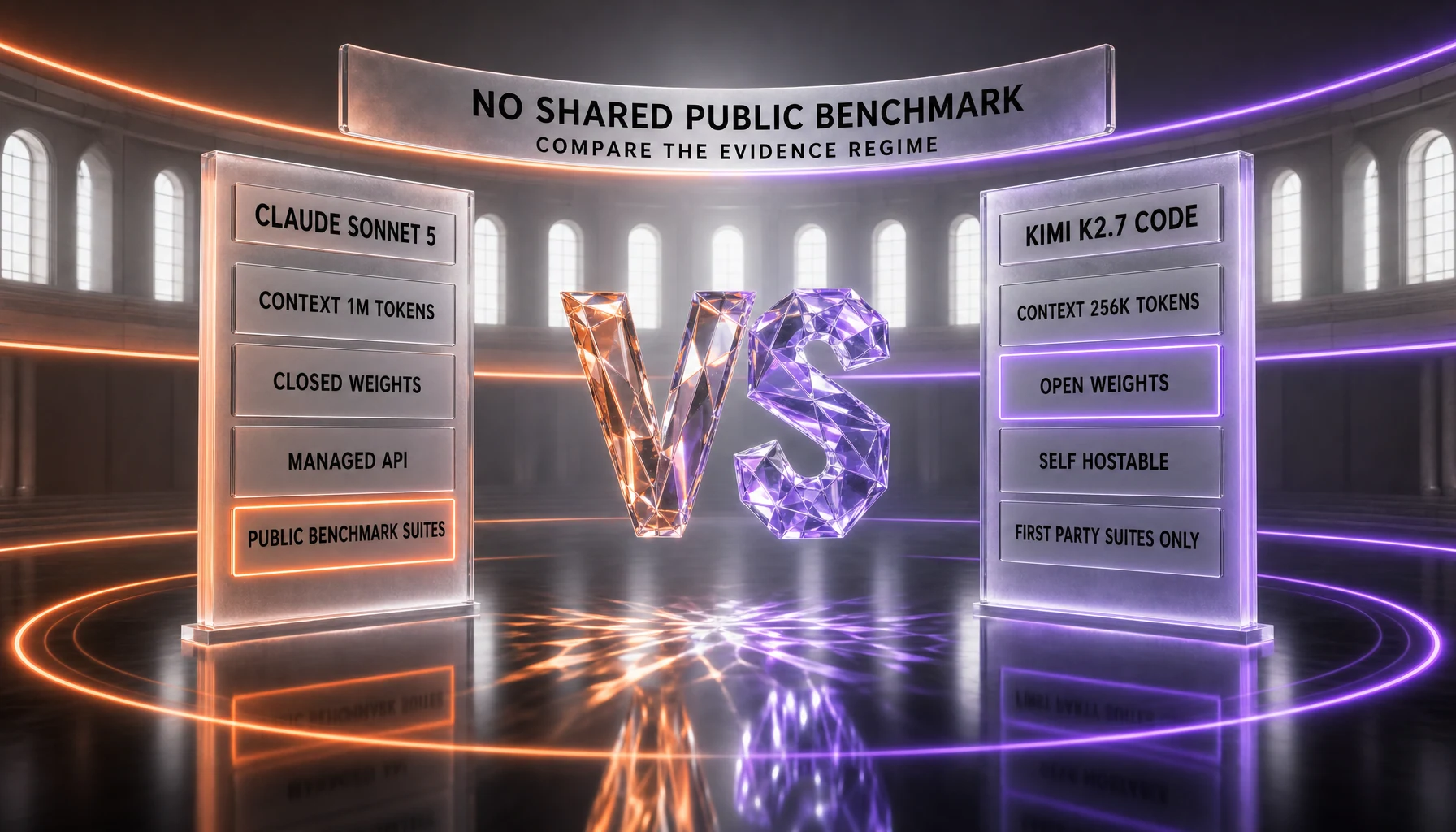
One thing shapes this entire comparison and separates it from most model matchups: the two vendors share no public benchmark on the same scale. Anthropic reports Claude Sonnet 5 on SWE-bench Pro and OSWorld-Verified; Moonshot reports Kimi K2.7 Code only on its own first-party suites. So we never place two capability numbers head to head here — doing that would be inventing a comparison that does not exist.
- Best demonstrated capability: Claude Sonnet 5, which reports 63.2 percent on SWE-bench Pro (about 91 percent of Opus 4.8's 69.2 percent) and 81.2 percent on OSWorld-Verified computer use.
- Best price and cost control: Kimi K2.7 Code, at roughly $0.95 per million input tokens and $4.00 output, versus Sonnet 5's $2 input and $10 output.
- Best openness and self-hosting: Kimi K2.7 Code, with open weights under a Modified MIT license you can download, inspect, and run on your own hardware.
- Best benchmark transparency and safety documentation: Claude Sonnet 5, which reports on public standardized benchmarks and ships a detailed system card.
- Narrow overall winner: Claude Sonnet 5 — but only just, and only if capability and governance outweigh token economics for you.
How We Compared Them
Honesty first, because both models are new. We have limited first-day hands-on time with Claude Sonnet 5, which launched on June 30, 2026, and our assessment of Kimi K2.7 Code is research-led — we have not run K2.7 in production at ThePlanetTools. So this is not a "we ran both side by side for a month" piece. It is a structured comparison built on each vendor's published model card and pricing pages, third-party provider listings, and the limited hands-on signal we have on the Anthropic side.
Two rules shaped the numbers below. First, we only place two figures head to head when both vendors report the same benchmark on the same scale. Unlike some comparisons, that rule has a stark consequence here: Kimi K2.7 Code and Claude Sonnet 5 have zero shared public benchmark. Anthropic reports Sonnet 5 on SWE-bench Pro (63.2 percent) and OSWorld-Verified computer use (81.2 percent). Moonshot reports K2.7 only on its own in-house suites — Kimi Code Bench v2 at 62.0, MCP Mark Verified at 81.1, Program Bench at 53.6, and a handful of others — and states plainly that "all headline numbers are first-party at launch" with "independent results pending." Those are different tests on different scales, so we describe each model's benchmarks in its own block and refuse to invent a matching number for the other side.
Second, we verified pricing directly from each vendor's pricing page rather than from search snippets — Anthropic's API pricing documentation for Sonnet 5, and Moonshot's platform pricing page for the standard kimi-k2.7-code tier — and confirmed both were current at the time of writing. Where you see a "SWE-bench 60.4" or similar number floating around for K2.7 on third-party aggregators, treat it with suspicion: it is not on any official Moonshot source, and at least one aggregator appears to have copied Kimi K2.6's older score onto the K2.7 row. We do not publish it.
Meet Both Models
Claude Sonnet 5 — the closed, ecosystem-backed workhorse
Claude Sonnet 5 is Anthropic's most agentic midsize model, released June 30, 2026 and reachable through the Claude API with the model string claude-sonnet-5. It sits below the Claude Opus 4.8 flagship and replaces Claude Sonnet 4.6 as the default workhorse. Anthropic's headline capability claims are 63.2 percent on SWE-bench Pro — which the system card frames as roughly 91 percent of Opus 4.8's 69.2 percent — and 81.2 percent on OSWorld-Verified, a computer-use benchmark where the model drives a real desktop by reading screenshots and issuing clicks and keystrokes. It carries a 1-million-token context window, accepts image input alongside text, and ships a public system card documenting lower rates of hallucination and sycophancy than its predecessor, stronger prompt-injection resistance, and cyber safeguards enabled by default. Crucially for buyers, Sonnet 5 is the default model on the free and Pro plans of Claude.ai, so you can test the exact model before you ever touch the API.
Kimi K2.7 Code — the open-weight, lower-priced challenger
Kimi K2.7 Code is Moonshot AI's open-weight coding model, announced June 12, 2026. It is a 1-trillion-parameter Mixture-of-Experts model that activates 32 billion parameters per token, ships natively in INT4, and carries a 256K-token context window. The weights are published on Hugging Face under a Modified MIT license, so you can download them, inspect them, fine-tune them, and self-host on your own hardware. It is natively multimodal through a roughly 400-million-parameter MoonViT vision encoder that ingests images and video frames, and it is built for long-horizon agentic coding with a "preserve thinking" mode that retains reasoning across multi-turn tool use. Moonshot benchmarks K2.7 on its own suites — Kimi Code Bench v2, MCP Mark Verified, Program Bench, MLS Bench Lite, MCP Atlas, and Kimi Claw 24/7 Bench — and compares it there against GPT-5.5 and Claude Opus 4.8, not against Sonnet 5.
Head-to-Head at a Glance
| Dimension | Claude Sonnet 5 | Kimi K2.7 Code | Edge |
|---|---|---|---|
| Released | June 30, 2026 | June 12, 2026 | — |
| Public standardized benchmarks | SWE-bench Pro 63.2%, OSWorld-Verified 81.2% | None reported; first-party suites only | Sonnet 5 |
| First-party coding benchmark | Reports on public suites | Kimi Code Bench v2 62.0, MCP Mark Verified 81.1 | Not comparable |
| Input price, per 1M tokens | $2 | $0.95 ($0.19 cached) | Kimi K2.7 Code |
| Output price, per 1M tokens | $10 | $4.00 | Kimi K2.7 Code |
| Context window | 1M tokens | 256K tokens | Sonnet 5 |
| Weights and license | Closed (Anthropic API) | Open-weight, Modified MIT | Kimi K2.7 Code |
| Architecture | Managed model, parameters undisclosed | 1T total, 32B active MoE | — |
| Multimodal input | Image input | Native vision, image and video | Kimi K2.7 Code |
| Safety and governance docs | Public system card, safeguards on by default | PRC-aligned moderation on hosted API | Sonnet 5 |
The table splits almost evenly, which is the honest shape of this matchup. Claude Sonnet 5 owns the capability, transparency, context, and safety rows; Kimi K2.7 Code owns price, openness, and multimodal breadth. Nobody sweeps.
Capability: What the Benchmarks Actually Say
This is the section where most comparisons overreach, so we will be careful. The two models do not report a single benchmark in common, which means there is no honest way to say "Sonnet 5 beats K2.7 by X points." What we can do is describe each vendor's evidence and be clear about what it does and does not prove.
Anthropic's reported benchmarks for Claude Sonnet 5. On SWE-bench Pro, a harder, contamination-resistant variant of the software-engineering benchmark, Anthropic reports 63.2 percent — framed in the system card as about 91 percent of Opus 4.8's 69.2 percent. On OSWorld-Verified, a computer-use benchmark, it reports 81.2 percent. Both are public, standardized suites that other labs also report on, so a reader can at least place Sonnet 5 in the broader field. Both are still vendor-reported and not independently reproduced by us, so read them as "Anthropic's own best numbers," not a referee's scorecard.
Moonshot's reported benchmarks for Kimi K2.7 Code. Moonshot's headline numbers are Kimi Code Bench v2 at 62.0, MCP Mark Verified at 81.1, MCP Atlas at 76.0, Program Bench at 53.6, Kimi Claw 24/7 Bench at 46.9, and MLS Bench Lite at 35.1. Every one of these is a Moonshot in-house benchmark, and the official model card says so directly: all headline numbers are first-party at launch, with independent results pending. Moonshot's own charts compare K2.7 against GPT-5.5 and Claude Opus 4.8 on these suites — not against Sonnet 5. That is useful signal that K2.7 is a serious coding model, but it is not evidence you can line up against Sonnet 5's SWE-bench Pro figure.
What this means in practice. If independently reproducible, public capability numbers matter to you — for a procurement sign-off, say, or for benchmarking against your own evals — Sonnet 5 gives you more to work with today, and that is the single biggest reason it is our narrow overall pick. If you would evaluate a model on your own tasks anyway and treat vendor benchmarks as noise, this gap matters less, and K2.7's first-party scores plus its price may be all the evidence you need to run a pilot.
Pricing: Where Kimi K2.7 Code Pulls Ahead
Pricing is the one place we can compare cleanly, because both vendors quote per-token API rates and we pulled both directly from their pricing pages.
| Cost dimension | Claude Sonnet 5 | Kimi K2.7 Code |
|---|---|---|
| Input, per 1M tokens | $2 | $0.95 |
| Output, per 1M tokens | $10 | $4.00 |
| Cached input, per 1M tokens | $0.20 | $0.19 |
| Free consumer access | Default model on free and Pro Claude.ai | Free tier on kimi.com |
| Self-hosting | Not available (closed) | Yes — open weights on Hugging Face |
On output tokens — which dominate most agentic coding bills, since the model writes far more than it reads — Kimi K2.7 Code costs $4.00 per million versus Sonnet 5's $10, two and a half times cheaper. On input, K2.7 is roughly half the Sonnet 5 rate. If you self-host K2.7, the marginal token cost drops to your own compute, though you take on the hardware and operations burden in exchange.
One honesty note. Anthropic notes that Sonnet 5's newer tokenizer can produce more tokens for the same text than earlier Claude models, so a naive per-token comparison slightly understates its real cost — one more reason the true economic gap favors K2.7 even more than the sticker prices suggest.
Openness and Distribution: The Other Half of the Decision
If capability is Sonnet 5's argument, openness is Kimi K2.7 Code's. Moonshot publishes the full weights on Hugging Face under a Modified MIT license, which means you can download the model, inspect it, fine-tune it on your own data, and run it entirely inside your own infrastructure with no data leaving your network. For teams in regulated industries, or teams that simply refuse to build a product on an API they cannot pin to a version, that is decisive. It also removes vendor lock-in: if Moonshot changes its pricing or terms, your self-hosted copy keeps running.
Claude Sonnet 5 makes the opposite trade. You cannot download it, fine-tune the base weights, or self-host — it lives behind the Anthropic API. In return you get a managed model with a documented safety profile, the mature Claude ecosystem around it, and, notably, the ability to test the exact production model for free: Sonnet 5 is the default on the free and Pro tiers of Claude.ai, and it is built into Claude Code. That "try the real thing before you pay" path is something no self-hosted open-weight model matches, because with K2.7 you are either using Moonshot's hosted API or standing up your own inference stack.
One governance caveat cuts the other way. Moonshot's hosted Kimi API applies content moderation aligned with PRC regulatory requirements, which can matter for some prompts and some jurisdictions; self-hosting the open weights sidesteps that, but then you own moderation entirely. Anthropic's moderation and safety posture is documented in its system card. Neither is strictly "better" — they are different risk models, and which one fits depends on your compliance context.
Multimodal Input and Vision
Both models take images, but they arrive at it differently. Claude Sonnet 5 accepts image input alongside text — screenshots, diagrams, charts, PDF pages — and that vision path feeds its computer-use loop, which is how it reaches 81.2 percent on OSWorld-Verified. Kimi K2.7 Code is natively multimodal through its MoonViT vision encoder and additionally accepts video frames, giving it slightly broader input coverage on paper. In practice, for a coding and agentic workload the difference is small: both can read a screenshot and reason about a UI. If your workflow leans on video understanding, K2.7 has the edge; if it leans on driving a desktop reliably, Sonnet 5's published computer-use score is the stronger evidence.
Architecture and How They Run
The two models are built and served in fundamentally different ways, and that shapes everything downstream from cost to control. Kimi K2.7 Code is a sparse Mixture-of-Experts model: it holds 1 trillion parameters in total but activates only about 32 billion per token, routing each token through a small subset of its 384 experts. That sparsity is what lets an open-weight model this large be economical to serve, and Moonshot ships it natively in INT4 quantization to shrink the memory footprint further. The trade-off is operational: standing up a 1-trillion-parameter model on your own infrastructure is a real engineering project, typically demanding a multi-GPU, high-memory cluster and a mature inference stack, even if the per-token compute is modest once it is running.
Claude Sonnet 5 is the opposite: a fully managed model whose parameter count Anthropic does not disclose, served only from Anthropic's own infrastructure through the Messages API. You never see the weights, you never provision a GPU, and you never tune inference — you send a request and pay per token. For most teams that is a feature, not a limitation: the operational burden is zero and the model is always the latest patched version. For teams that need to own the stack end to end, it is a hard stop. This is the concrete face of the closed-versus-open choice: K2.7 hands you the engine and the maintenance manual, while Sonnet 5 hands you a key and a running car.
Speed, Latency, and Serving Tiers
Latency is easy to overlook until an agent loop makes dozens of sequential model calls, at which point it compounds fast. Here the two vendors give you different levers. Moonshot sells K2.7 in two flavors: the standard kimi-k2.7-code tier at $0.95 input and $4.00 output per million tokens, and a kimi-k2.7-code-highspeed tier at exactly double — $1.90 input and $8.00 output — for teams that will pay more for lower latency. Even the high-speed tier still undercuts Claude Sonnet 5's output price, which is a useful data point: K2.7's "premium" speed option costs less per output token than Sonnet 5's rate. Self-hosting adds a third lever, letting you tune batching, caching, and hardware to your own latency and throughput targets.
Claude Sonnet 5's speed argument is positional rather than a menu. As Anthropic's mid-tier model, it is designed to be materially faster and cheaper than the Opus 4.8 flagship while retaining most of its coding capability — that is the whole point of a "Sonnet" tier. You do not pick a speed variant; you pick Sonnet over Opus when you want throughput and a lower bill, and you accept Anthropic's serving latency as a fixed quantity. For interactive, human-in-the-loop coding both models feel responsive; for massively parallel agent fleets, K2.7's self-hostable, tier-selectable serving gives you more knobs to turn.
Winner by Category
Best demonstrated capability: Claude Sonnet 5
Sonnet 5 is the only one of the two with public, standardized capability numbers — 63.2 percent on SWE-bench Pro and 81.2 percent on OSWorld-Verified. K2.7 may well be excellent, but its evidence is first-party only, so on demonstrated capability Sonnet 5 wins by default of transparency.
Best price and cost control: Kimi K2.7 Code
At $0.95 input and $4.00 output per million tokens — with a cache-hit rate near $0.19 — K2.7 undercuts Sonnet 5 by roughly two to three times, and self-hosting can take the marginal cost lower still. For high-volume pipelines this is not a rounding error; it is the difference between a viable and an unaffordable product.
Best openness and self-hosting: Kimi K2.7 Code
Open weights under Modified MIT, downloadable from Hugging Face, self-hostable, and fine-tunable. If you need to keep data in your network, avoid lock-in, or pin an exact model version forever, K2.7 is the only option here.
Best benchmark transparency and safety documentation: Claude Sonnet 5
Reporting on public suites plus a detailed system card that documents hallucination, sycophancy, prompt-injection, and cyber safeguards gives procurement and risk teams something concrete to sign off on. K2.7's launch numbers are honest about being first-party, but there is simply less external-facing documentation to lean on.
Best high-volume, cost-sensitive throughput: Kimi K2.7 Code
When you are generating millions of output tokens a day, the model that costs $4.00 per million output wins on economics almost regardless of a modest capability gap — especially if you can batch and cache. K2.7 is built for that shape of workload.
Narrow overall winner: Claude Sonnet 5
Add it up and Sonnet 5 takes the narrow overall nod: demonstrated capability, a 1-million-token context, benchmark transparency, safety documentation, and a free path to test the exact model. It is narrow because K2.7 wins more of the countable spec rows on price and openness — so if your priorities are cost and control rather than documented capability, flip the pick without hesitation.
Pros and Cons of Each
Claude Sonnet 5
What stands out:
- Public, standardized benchmarks: 63.2 percent SWE-bench Pro and 81.2 percent OSWorld-Verified computer use.
- A 1-million-token context window, four times K2.7's 256K.
- A detailed public system card and cyber safeguards enabled by default.
- The default model on free and Pro Claude.ai — test the exact production model before paying for the API.
- Mature ecosystem: Claude Code, the Messages API, and a one-line model-string migration from earlier Claude models.
Where it falls short:
- Closed weights: no self-hosting, no fine-tuning, no version pinning outside Anthropic's API.
- Roughly two to two and a half times more expensive per token than K2.7.
- A newer tokenizer can produce more tokens for the same text, nudging real costs up.
- You are dependent on a single vendor's uptime, pricing, and terms.
Kimi K2.7 Code
What stands out:
- Open weights under a Modified MIT license on Hugging Face — self-hostable, inspectable, fine-tunable.
- Roughly two to three times cheaper per token: $0.95 input, $4.00 output, about $0.19 cached.
- A 1-trillion-parameter Mixture-of-Experts design activating 32 billion parameters per token, shipping in INT4.
- Native multimodality via MoonViT, including video-frame input.
- Strong first-party coding scores (Kimi Code Bench v2 62.0, MCP Mark Verified 81.1) and a long-horizon "preserve thinking" agent mode.
Where it falls short:
- No public, standardized benchmarks at launch: all headline numbers are first-party, with independent results pending.
- A 256K context window, one quarter of Sonnet 5's 1M.
- The hosted API applies PRC-aligned content moderation.
- Self-hosting a 1T-parameter model is non-trivial and needs serious hardware and operations effort.
- Less external safety and governance documentation than Anthropic provides.
When to Pick Which
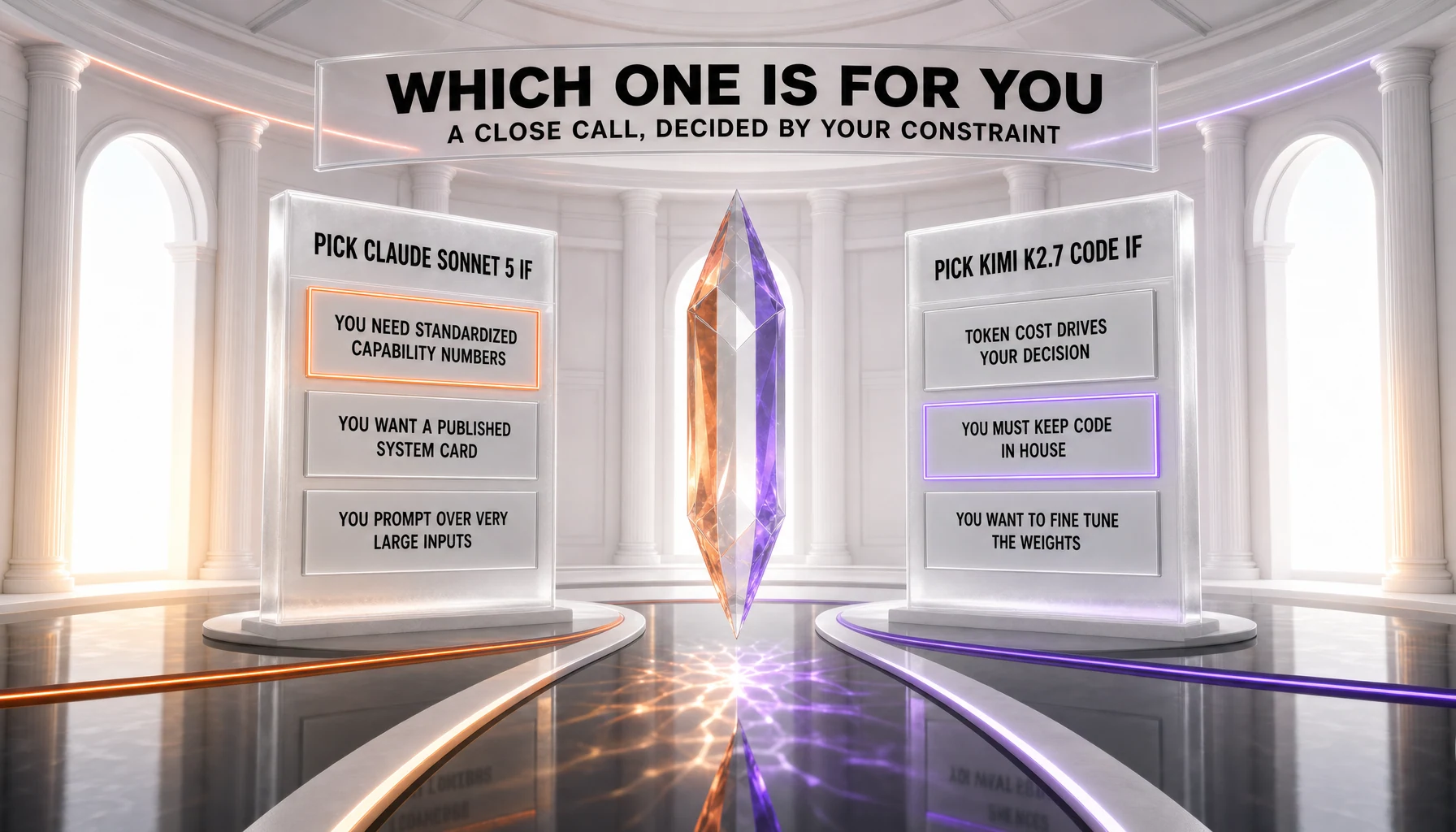
Pick Claude Sonnet 5 if...
You need documented, public capability numbers to justify a decision; you want the longest context window; you value a detailed safety and governance profile; you want to test the exact production model for free before committing; or you would rather pay a premium for a managed, mature ecosystem than run your own inference. Teams shipping to regulated or enterprise buyers who ask "where is the system card?" will find Sonnet 5 the easier sell.
Pick Kimi K2.7 Code if...
Token cost is a first-order constraint; you run high-volume or output-heavy pipelines; you need to self-host to keep data in your network or to pin a model version forever; you want to fine-tune on your own data; or you simply refuse vendor lock-in. A cost-sensitive startup generating millions of output tokens a day will often find K2.7's economics decisive, and its first-party coding scores are strong enough to justify a real pilot.
Or consider a split stack
Many teams will not pick one. A common 2026 pattern is to route cheap, high-volume, or self-hosted work to an open-weight model and reserve a premium managed model for the hardest tasks. If that is you, it is worth reading how K2.7 stacks up against its direct rivals in our Kimi K2.7 Code vs GPT-5.5 and Kimi K2.7 Code vs DeepSeek V4 comparisons, and how the Anthropic flagship handles the same open-weight challenger in Claude Opus 4.8 vs Kimi K2.7 Code. For the wider field, see our roundup of the best AI coding tools of 2026.
Frequently Asked Questions
Is Claude Sonnet 5 better than Kimi K2.7 Code?
On demonstrated, public capability, yes — Claude Sonnet 5 reports 63.2 percent on SWE-bench Pro and 81.2 percent on OSWorld-Verified, while Kimi K2.7 Code reports no public standardized benchmarks at all. But "better" depends on your priorities: K2.7 is two to three times cheaper per token and open-weight, so for cost-sensitive or self-hosting teams it can be the better fit despite the thinner public evidence.
Can you compare Claude Sonnet 5 and Kimi K2.7 Code on SWE-bench?
No, not honestly. Anthropic reports Sonnet 5 on SWE-bench Pro (63.2 percent), but Moonshot does not report Kimi K2.7 Code on SWE-bench Pro or SWE-bench Verified — its published numbers are all on its own suites, such as Kimi Code Bench v2. Any "K2.7 SWE-bench" figure you see on third-party sites is unverified and, in at least one case, appears to be Kimi K2.6's older score copied by mistake.
How much cheaper is Kimi K2.7 Code than Claude Sonnet 5?
Roughly two to two and a half times cheaper per token. Kimi K2.7 Code costs about $0.95 per million input tokens and $4.00 per million output. Claude Sonnet 5 costs $2 input and $10 output. On output tokens, which dominate most coding bills, K2.7 is the clear economic winner.
Is Kimi K2.7 Code open source?
It is open-weight rather than fully open source. Moonshot publishes the model weights on Hugging Face under a Modified MIT license, so you can download, inspect, fine-tune, and self-host it. The training data and full pipeline are not released, which is why "open-weight" is the precise term. Claude Sonnet 5, by contrast, is fully closed and API-only.
What context window does each model have?
Claude Sonnet 5 has a 1-million-token context window. Kimi K2.7 Code has a 256K-token (262,144) context window. Sonnet 5's context is four times larger, which matters for very large codebases or long documents fed in a single request.
Can I self-host either model?
You can self-host Kimi K2.7 Code — its weights are on Hugging Face and it runs on standard open-weight inference stacks, though a 1-trillion-parameter model needs serious hardware. You cannot self-host Claude Sonnet 5; it is available only through Anthropic's API and the Claude.ai and Claude Code products.
Which model is better for agentic, tool-heavy coding?
Both are built for it. Sonnet 5 is Anthropic's most agentic midsize model and posts a published 81.2 percent computer-use score. K2.7 is designed for long-horizon agentic coding with a "preserve thinking" mode and strong first-party agent benchmarks like MCP Mark Verified at 81.1. Without a shared benchmark, the honest answer is that Sonnet 5 has more external evidence, while K2.7 offers comparable ambition at a fraction of the cost.
Do the two models share any benchmark I can compare directly?
No. As of writing, there is no public benchmark that both Anthropic and Moonshot report for these two models on the same scale. That is why this comparison presents each model's benchmarks in a separate block and never lines two capability numbers up against each other.
Can I try Claude Sonnet 5 for free?
Yes. Sonnet 5 is the default model on the free and Pro plans of Claude.ai, so you can use the exact production model before paying for API access. Kimi K2.7 Code also has a free consumer tier on kimi.com, and its open weights let you run it yourself at your own compute cost.
Is Kimi K2.7 Code multimodal?
Yes. Kimi K2.7 Code is natively multimodal through a roughly 400-million-parameter MoonViT vision encoder and can ingest images and video frames. Claude Sonnet 5 also accepts image input, and its vision path feeds its computer-use capability, but Anthropic does not advertise video-frame input the way Moonshot does.
Which should a startup on a tight budget choose?
For a tight budget with high volume, Kimi K2.7 Code is usually the pragmatic pick: it is two to three times cheaper per token and can be self-hosted to push costs lower, and its first-party coding scores are strong enough for a real pilot. Move to Claude Sonnet 5 when you need documented capability, the longest context, or a system card for a governance sign-off.
Final Verdict
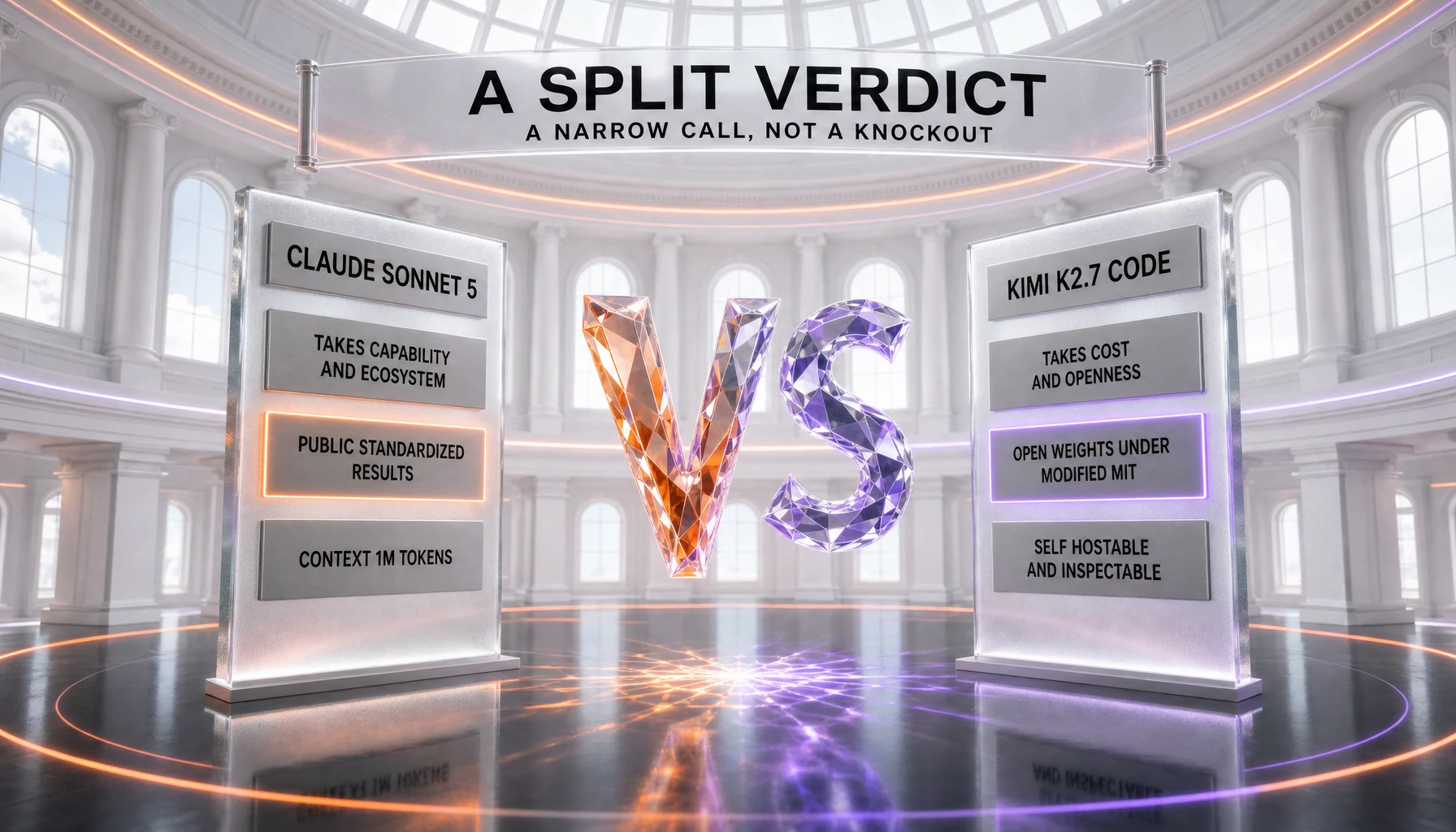
This comparison does not have a knockout winner, and pretending otherwise would be dishonest. Claude Sonnet 5 is our narrow overall pick because it is the only one of the two with public, standardized capability numbers — 63.2 percent SWE-bench Pro and 81.2 percent OSWorld-Verified — plus a 1-million-token context, a detailed system card, and a free path to test the exact model on Claude.ai. Those are concrete, verifiable advantages, and they are what tip a close call.
But Kimi K2.7 Code wins price and openness decisively, and for a large share of teams those will matter more. At roughly $0.95 input and $4.00 output per million tokens, with open weights under a Modified MIT license you can self-host and inspect, it is the obvious choice for cost-sensitive, high-volume, or control-conscious work. The deciding question is simple: do you value demonstrated, documented capability more than token economics and the freedom to self-host? If yes, choose Sonnet 5. If cost and control come first, choose K2.7 — and know that the capability gap, while real on paper, is not proven wide by any shared benchmark.
Last compared: July 2026. Claude Sonnet 5 launched June 30, 2026; Kimi K2.7 Code launched June 12, 2026. Our Sonnet 5 assessment reflects limited first-day hands-on time plus Anthropic's published system card; our K2.7 assessment is research-led, as we have not run K2.7 in production. All benchmark figures are vendor-reported (Anthropic's system card for Sonnet 5; Moonshot's model card for K2.7, whose numbers are first-party with independent results pending) and not independently reproduced by our team. Pricing verified directly from Anthropic's and Moonshot's pricing pages at the time of writing.
Sources and references
Every figure on this page is attributed to whoever produced it. Vendor documentation and independent measurement are listed separately and never merged into a single ranking.
- Artificial Analysis — Claude Sonnet 5 (independent index score and cost per task)
- Moonshot AI — Platform documentation (model family, API reference and limits)
- Artificial Analysis — Model leaderboard (Intelligence Index scores and cost per task across configurations)
Our Verdict
Claude Sonnet 5 is our narrow overall winner on demonstrated capability, transparency, and distribution: it reports 63.2 percent on SWE-bench Pro and 81.2 percent on OSWorld-Verified computer use, publishes those results on public standardized benchmarks, ships a documented system card, offers a 1-million-token context, and runs as the default model on the free and Pro plans of Claude.ai so you can test the exact model before paying for the API. Kimi K2.7 Code wins price and openness decisively — roughly $0.95 per million input tokens and $4.00 output versus Sonnet 5's $2 input and $10 output, with open weights under a Modified MIT license you can self-host and inspect. The catch is that the two models share no public benchmark on the same scale: Sonnet 5 reports SWE-bench Pro and OSWorld while K2.7 reports only Moonshot's own suites, with independent results still pending. So the decision comes down to how much you value demonstrated, third-party-shaped capability and safety documentation versus token economics and the freedom to self-host: cost-sensitive and control-conscious teams should lean K2.7, while teams that need documented capability, computer use, long context, and governance sign-off should lean Claude Sonnet 5.
Choose Claude Sonnet 5
Anthropic's most agentic midsize model — near-Opus 4.8 coding and computer use at $2 per million input tokens.
Try Claude Sonnet 5 →Choose Kimi K2.7 Code
Moonshot AI's open-weight 1T-parameter MoE coding model — 32B active, 256K context, Modified MIT, metered at $0.95 in / $4.00 out per million tokens.
Try Kimi K2.7 Code →Frequently Asked Questions
Is Claude Sonnet 5 better than Kimi K2.7 Code?
Claude Sonnet 5 is our narrow overall winner on demonstrated capability, transparency, and distribution: it reports 63.2 percent on SWE-bench Pro and 81.2 percent on OSWorld-Verified computer use, publishes those results on public standardized benchmarks, ships a documented system card, offers a 1-million-token context, and runs as the default model on the free and Pro plans of Claude.ai so you can test the exact model before paying for the API. Kimi K2.7 Code wins price and openness decisively — roughly $0.95 per million input tokens and $4.00 output versus Sonnet 5's $2 input and $10 output, with open weights under a Modified MIT license you can self-host and inspect. The catch is that the two models share no public benchmark on the same scale: Sonnet 5 reports SWE-bench Pro and OSWorld while K2.7 reports only Moonshot's own suites, with independent results still pending. So the decision comes down to how much you value demonstrated, third-party-shaped capability and safety documentation versus token economics and the freedom to self-host: cost-sensitive and control-conscious teams should lean K2.7, while teams that need documented capability, computer use, long context, and governance sign-off should lean Claude Sonnet 5.
Which is cheaper, Claude Sonnet 5 or Kimi K2.7 Code?
Claude Sonnet 5 starts at $2 in / $10 out per M tokens (free plan available). Kimi K2.7 Code starts at $0.95 in / $4 out per M tokens (free plan available). Check the pricing comparison section above for a full breakdown.
What are the main differences between Claude Sonnet 5 and Kimi K2.7 Code?
The key differences span across 9 features we compared. For Public standardized benchmarks, Claude Sonnet 5 offers SWE-bench Pro 63.2%, OSWorld-Verified 81.2% while Kimi K2.7 Code offers First-party suites only (Kimi Code Bench v2 62.0, MCP Mark Verified 81.1); independent results pending. For Input price per 1M tokens, Claude Sonnet 5 offers $2 while Kimi K2.7 Code offers $0.95 ($0.19 cached). For Output price per 1M tokens, Claude Sonnet 5 offers $10 while Kimi K2.7 Code offers $4.00. See the full feature comparison table above for all details.