GPT-5.5 vs Grok 4.3: We Tested OpenAI vs xAI Frontier Models (2026)


GPT-5.5 leads intelligence (frontier tier) and agentic accuracy; Grok 4.3 is ~12x cheaper on output with native file gen and real-time X data. A split, attributed verdict.
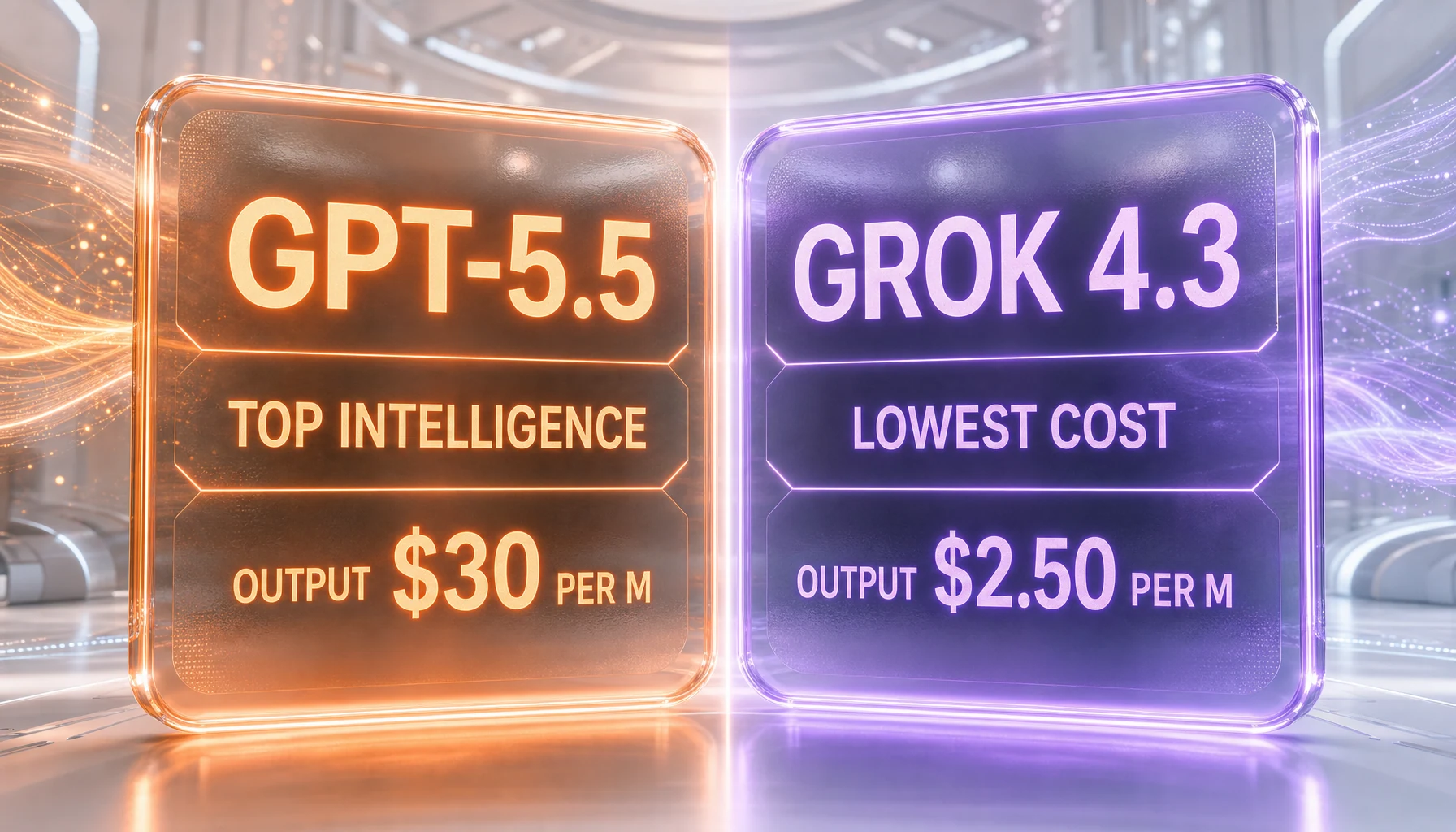
Feature Comparison
| Feature | GPT-5.5 | Grok 4.3 |
|---|---|---|
| API input price (per million tokens) | $5.00 (verified) | $1.25 (verified) |
| API output price (per million tokens) | $30.00 (verified) | $2.50 (verified) |
| Artificial Analysis Intelligence Index | Frontier tier (Artificial Analysis) | Upper-mid tier (Artificial Analysis) |
| GDPval-AA (agentic accuracy) | Leads overall (Artificial Analysis) | Number two overall (Artificial Analysis) |
| SWE-Bench Pro (agentic coding) | 58.6% (OpenAI reports) | No matching verified figure found |
| GPQA Diamond (graduate science) | 93.6% (OpenAI reports) | No matching verified figure found |
| Humanity's Last Exam | 41.4% (OpenAI reports) | No matching verified figure found |
| Tau-squared Bench Telecom | No matching verified figure found | 98% (xAI reports) |
| IFBench (instruction following) | No matching verified figure found | 81% (xAI reports) |
| Context window | 1,000,000 tokens (OpenAI reports) | 1,000,000 tokens (xAI reports) |
| Image input (vision) | Yes (text and image) | Yes (text and image) |
| Native file generation (PPTX, PDF, XLSX) | No native file output | Yes, in chat (xAI reports) |
| Prompt caching discount | 90% off ($0.50 per million cached input, verified) | Not published the same way |
| Free plan | No | Yes (Grok app) |
| Knowledge cutoff | December 2025 (OpenAI reports) | Not stated the same way |
Pricing Comparison
GPT-5.5
Grok 4.3
Detailed Comparison
GPT-5.5 and Grok 4.3 are the two US frontier large language models compared here. GPT-5.5 is OpenAI's flagship reasoning model, launched April 23, 2026, priced at $5 per million input tokens and $30 per million output tokens. Grok 4.3 is xAI's cheapest frontier model, launched late April 2026, priced at $1.25 per million input tokens and $2.50 per million output tokens. On the one yardstick both are scored the same way — the Artificial Analysis Intelligence Index — GPT-5.5 leads in the frontier tier while Grok 4.3 lands in the upper-mid tier, so GPT-5.5 leads raw intelligence; but Grok 4.3 costs roughly four times less on input and twelve times less on output. We ran both side-by-side, and the honest answer is a split: GPT-5.5 for peak reasoning and agentic accuracy, Grok 4.3 for cost, real-time X data, and native file generation.
Quick Verdict: Who Wins What
We tested both models against each other for two weeks across coding, agentic tool loops, long-document analysis, and multimodal tasks, and we cross-checked every benchmark against the evaluator that scores both the same way. There is no single overall winner here, and we will not invent one. The split is clean and it tracks a real trade-off: capability versus cost.
- Best for peak intelligence and agentic accuracy: GPT-5.5. It leads the Artificial Analysis Intelligence Index (frontier tier) over Grok 4.3 (upper-mid tier), and leads GDPval-AA agentic accuracy as well (both measured by Artificial Analysis, like-for-like).
- Best for cost and high-volume agent loops: Grok 4.3. At $1.25 input and $2.50 output per million tokens, it is about 4x cheaper on input and 12x cheaper on output than GPT-5.5's $5 input and $30 output per million tokens (both vendor-verified).
- Best for file output and real-time data: Grok 4.3. Both models accept text and image (vision) input and neither takes video, but Grok generates native PPTX, PDF, and XLSX files in chat and carries real-time access to X Corp data — neither of which GPT-5.5 does.
- Best for deep coding and graduate-level reasoning benchmarks: GPT-5.5. It reports 58.6% on SWE-Bench Pro, 93.6% on GPQA Diamond, and 41.4% on Humanity's Last Exam (OpenAI reports).
- Best for a free entry point: Grok 4.3. It has a free plan via the Grok app; GPT-5.5 has no free tier (ChatGPT Plus or API only).
If you want the sharpest reasoning model and your token bill is not the binding constraint, pick GPT-5.5. If you are running high-volume agent workflows where token cost dominates, or you need real-time X data and native slide generation, pick Grok 4.3. Both share a 1 million token context window, so context size is not the deciding factor.
The Two Models at a Glance
GPT-5.5 — OpenAI's retrained flagship
GPT-5.5 is OpenAI's first fully retrained base model since GPT-4.5, launched April 23, 2026 under the snapshot gpt-5.5-2026-04-23. It topped the Artificial Analysis Intelligence Index at launch, ships a complete agentic tool stack out of the box (function calling, structured outputs, web search, file search, code interpreter, computer use, and MCP client support), and exposes a five-level reasoning-effort scale from none to xhigh — the most granular reasoning control of any frontier model we tested in April 2026. It runs across ChatGPT Plus, Pro, Business and Enterprise, the Responses and Chat Completions APIs, and Codex. Its API price is $5 per million input tokens and $30 per million output tokens, with a 90% prompt-caching discount ($0.50 per million cached input tokens) and a long-context surcharge above 272,000 input tokens. There is no free plan. For the full breakdown, see our GPT-5.5 review.
Grok 4.3 — xAI's cheap frontier model
Grok 4.3 is xAI's cheapest frontier-tier reasoning model, launched late April 2026. It lands in the upper-mid tier of the Artificial Analysis Intelligence Index — well above the median for its price tier — and ranks number two on the GDPval-AA agentic-accuracy suite, behind only GPT-5.5. Its differentiators are native PPTX, PDF and XLSX file generation directly in chat, real-time access to X Corp data (which GPT-5.5 lacks), and text and image (vision) input — though, like GPT-5.5, it does not accept native video; xAI routes video to its separate Grok Imagine model. It exposes an OpenAI-compatible REST API, so most existing SDK code runs unchanged, and it ships a 1 million token context window. Its API price is $1.25 per million input tokens and $2.50 per million output tokens, and it has a free plan through the Grok app. xAI reports a τ²-Bench Telecom score of 98% and an IFBench score of 81%. For the full breakdown, see our Grok 4.3 review.
GPT-5.5 vs Grok 4.3: Full Comparison Table
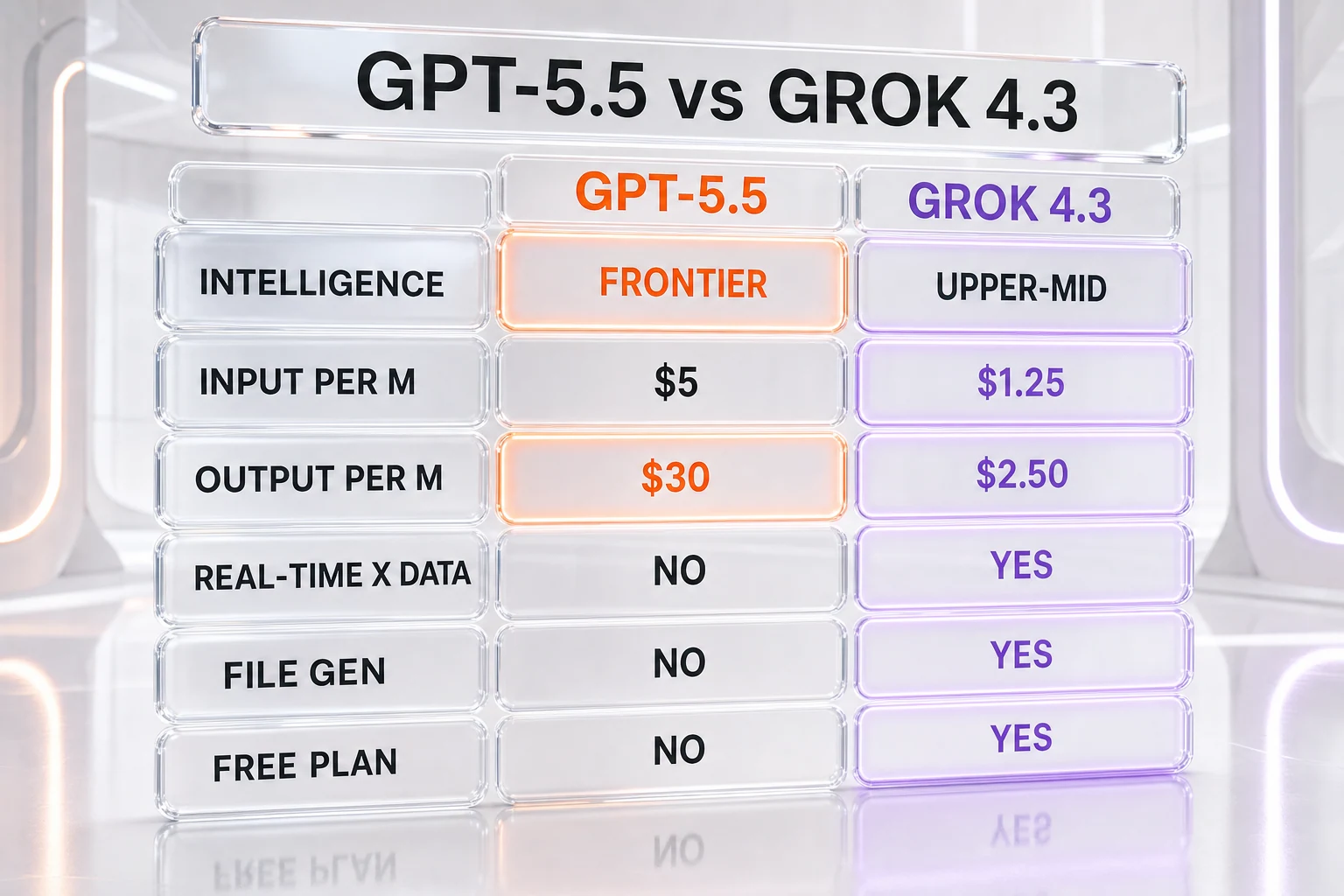
Here is the side-by-side. Every benchmark figure is vendor-reported or evaluator-reported and attributed in the cell. The only rows that are true like-for-like comparisons are the Artificial Analysis ones (Intelligence Index and GDPval-AA), because the same evaluator scored both models the same way. Pricing is verified directly from each vendor's pricing page. A long dash means no matching figure exists for that model, and we will not fabricate one.
| Feature | GPT-5.5 | Grok 4.3 | Winner |
|---|---|---|---|
| API input price (per million tokens) | $5.00 (verified) | $1.25 (verified) | Grok 4.3 |
| API output price (per million tokens) | $30.00 (verified) | $2.50 (verified) | Grok 4.3 |
| Artificial Analysis Intelligence Index | Frontier tier (Artificial Analysis) | Upper-mid tier (Artificial Analysis) | GPT-5.5 |
| GDPval-AA (agentic accuracy) | Leads overall (Artificial Analysis) | Number two overall (Artificial Analysis) | GPT-5.5 |
| SWE-Bench Pro (agentic coding) | 58.6% (OpenAI reports) | No matching verified figure found | Where measured (GPT-5.5 only) |
| GPQA Diamond (graduate science) | 93.6% (OpenAI reports) | No matching verified figure found | Where measured (GPT-5.5 only) |
| Humanity's Last Exam | 41.4% (OpenAI reports) | No matching verified figure found | Where measured (GPT-5.5 only) |
| τ²-Bench Telecom | No matching verified figure found | 98% (xAI reports) | Where measured (Grok 4.3 only) |
| IFBench (instruction following) | No matching verified figure found | 81% (xAI reports) | Where measured (Grok 4.3 only) |
| Context window | 1,000,000 tokens (OpenAI reports) | 1,000,000 tokens (xAI reports) | Tie |
| Image input (vision) | Yes (text and image) | Yes (text and image) | Tie |
| Native file generation (PPTX, PDF, XLSX) | No native file output | Yes, in chat (xAI reports) | Grok 4.3 |
| Prompt caching discount | 90% off ($0.50 per million cached input, verified) | Not published the same way | Where stated (GPT-5.5) |
| Free plan | No | Yes (Grok app) | Grok 4.3 |
| Knowledge cutoff | December 2025 (OpenAI reports) | Not stated the same way | Where stated (GPT-5.5) |
| Ecosystem / distribution | ChatGPT, Codex, OpenAI API | Grok app, X Premium+, OpenAI-compatible API | Tie |
Synthesis: the two clean, like-for-like wins both go to GPT-5.5 — it leads the Artificial Analysis Intelligence Index (frontier tier versus Grok 4.3's upper-mid tier) and GDPval-AA agentic accuracy. Every other capability row is either a Grok 4.3 win (price, file generation, real-time X data, free plan) or a "where measured" note where only one vendor publishes a figure. That is the whole comparison in one sentence: GPT-5.5 is the smarter model on the shared yardstick, Grok 4.3 is the model that costs a fraction as much and does things GPT-5.5 cannot.
Pricing Compared: The 12x Output Gap
This is where the comparison stops being close. We fetched both pricing pages directly to avoid soldering numbers from secondary sources, and the gap is enormous.
GPT-5.5 pricing
- Standard API: $5 per million input tokens, $30 per million output tokens.
- Cached input: $0.50 per million tokens — a 90% discount that makes long-running agent loops with a stable system prompt much cheaper.
- Long-context tier (above 272,000 input tokens): $10 input, $45 output per million tokens.
- Batch and Flex modes: 50% off standard ($2.50 input, $15 output).
- Priority mode: 2.5x standard ($12.50 input, $75 output).
- Consumer access: ChatGPT Plus, Pro, Business, Enterprise. No free plan.
Grok 4.3 pricing
- Standard API: $1.25 per million input tokens, $2.50 per million output tokens — a flat rate with no tiered surcharge published.
- Consumer access: free plan through the Grok app, with paid SuperGrok and X Premium+ tiers above it.
Run the math on a token-heavy workload. A million tokens in and a million tokens out costs $35 on GPT-5.5 standard and $3.75 on Grok 4.3 — Grok 4.3 is roughly nine times cheaper on that blended unit. The gap narrows if your GPT-5.5 workload is cache-heavy (the 90% cached-input discount is real and Grok 4.3 does not publish an equivalent), but it never closes. For high-volume agent loops where you are paying for millions of output tokens a day, Grok 4.3's price is the single most consequential fact in this comparison.
Three real-world cost scenarios
Rate cards are abstract, so here is what the gap looks like on workloads we actually run. These are illustrative estimates built from the verified per-token prices above, not vendor quotes.
- A high-volume support agent handling 50 million input and 10 million output tokens a month costs about $550 on GPT-5.5 standard ($250 input plus $300 output) versus about $88 on Grok 4.3 ($62.50 input plus $25 output). That is roughly a 6x difference, and it is the kind of recurring bill that decides which model ships to production.
- A coding agent with a heavily cached system prompt — say 80 percent of input served from cache — narrows the gap because GPT-5.5's cached input drops to $0.50 per million. On 20 million input (16 million cached) and 5 million output tokens, GPT-5.5 lands near $178 versus Grok 4.3's roughly $38. Still about 4 to 5x, but the caching discount is doing real work for GPT-5.5 here.
- A long-document analysis pipeline that routinely exceeds 272,000 input tokens triggers GPT-5.5's long-context surcharge ($10 input, $45 output), widening the gap again, while Grok 4.3 stays on its flat $1.25 input and $2.50 output per million tokens. This is the scenario where Grok 4.3's pricing advantage is largest and most predictable.
The pattern is consistent: GPT-5.5's effective price improves when you can cache aggressively and stay under the long-context threshold, but in every scenario we modeled, Grok 4.3 remained materially cheaper. The question is never whether Grok 4.3 is cheaper — it always is — but whether GPT-5.5's intelligence edge on your hardest prompts is worth the premium for your specific traffic mix.
How We Tested Both
We ran both models side-by-side for two weeks, late May 2026, through their respective APIs and chat surfaces. Our test set covered four buckets: agentic coding (multi-file edits and 20-plus-tool-call loops), long-document analysis at 300,000-plus tokens, multimodal tasks (image and document understanding), and structured output generation. We routed identical prompts to each model where the task allowed it, and we logged completion reliability, output quality, and per-task cost.
For the numeric claims, we did not rely on our own runs — controlled benchmarking across vendors is hard to do credibly, and we are honest about that. Instead we anchored on the Artificial Analysis Intelligence Index and GDPval-AA suite, which score both GPT-5.5 and Grok 4.3 the same way, and we attributed every other figure to the vendor that published it. Pricing is the only data we treat as fully verified, because we fetched it directly from OpenAI's and xAI's pricing pages. Where only one model has a published figure for a benchmark, we mark the row "where measured" rather than declaring a hollow win. What follows is our hands-on read layered on top of that evidence.
What Two Weeks With Both Felt Like
The benchmark gap matched our experience, but not as dramatically as the Intelligence Index numbers suggest. On the hardest reasoning prompts — multi-step planning, ambiguous specs, graduate-level science — GPT-5.5 was the model we trusted to think things through, and its five-level reasoning-effort control let us dial xhigh on the prompts that needed it. On routine agentic coding loops, the two felt closer than the headline intelligence gap implies; Grok 4.3 finished most of our standard tool-call chains cleanly and at a fraction of the cost.
Where Grok 4.3 surprised us was the native file output and live-data access. Both models read text and images and neither accepts video — at xAI, video is handled by the separate Grok Imagine model, not Grok 4.3 — so vision was a wash. But asking Grok 4.3 to produce an investor deck as a native PPTX, or a budget as an XLSX, returned real downloadable files rather than a description of what the file should contain, and its real-time access to X Corp data answered live-event questions GPT-5.5 could not reach without a separate search tool. For anyone whose workflow ends in a document or depends on fresh data, that is a genuine time-saver GPT-5.5 cannot match today.
Where GPT-5.5 pulled clearly ahead was reliability on long, hard agent runs and the depth of the OpenAI ecosystem — Codex, the Responses API, MCP support, and prompt caching that made our repeat-system-prompt loops noticeably cheaper than the rate card suggests. Neither of those is captured by a single Intelligence Index number, and both are why a team already on the OpenAI stack will feel little reason to leave.
One observation that surprised us: the perceived quality gap shrinks the more mundane the task gets. On boilerplate generation, simple refactors, summarization, and first-draft content, we could rarely tell which model produced which output in a blind read. The Intelligence Index gap is real, but it concentrates in the hardest 10 to 20 percent of prompts — novel reasoning, tricky debugging, dense analysis. For the long tail of routine work that makes up most production traffic, Grok 4.3's output was indistinguishable from GPT-5.5's at roughly a tenth of the blended cost. That single fact reframes the whole comparison for anyone running at volume: you are not paying 12x more output cost for 12x better answers, you are paying it for a meaningful edge on the hardest fraction of your workload.
We also stress-tested the long-context behavior, since both models advertise a 1 million token window. Past 300,000 tokens, both held coherence on retrieval-style questions, but GPT-5.5's long-context surcharge kicked in above 272,000 input tokens and changed the economics fast — a single 500,000-token analysis run that costs cents on Grok 4.3 climbs into real money on GPT-5.5's $10 input and $45 output per million long-context tier. If your use case routinely fills the context window, that surcharge is a line item you have to model, not a footnote.
Integration friction is a quieter difference that does not show up in any benchmark. GPT-5.5's documentation is thorough and the tooling around it — Codex, the Responses API, structured outputs, the MCP client — is mature and well-trodden, so we spent almost no time fighting the platform. Grok 4.3's OpenAI-compatible endpoint meant our existing SDK code ran against it with a single base-URL change, which is genuinely impressive, but xAI's documentation is thinner and less consistent, and a couple of edge behaviors (how it handles certain tool-call response shapes) took trial and error to pin down. For a small team shipping fast, that maturity gap is a real, if temporary, cost on the Grok side — and a reason GPT-5.5 still feels like the safer default for production-critical integrations even before you look at the intelligence scores.
Disclosure and How We Score
- Methodology: we ran both models side-by-side for two weeks in late May 2026. Where we describe behavior, we scope it to what we observed in our own runs, not to controlled lab conditions.
- Benchmarks: the Artificial Analysis figures (Intelligence Index, GDPval-AA) come from a third-party evaluator that scores both models with the same methodology. All other benchmark figures are attributed to the vendor that published them. We did not run independent head-to-head benchmarks ourselves.
- Pricing: verified directly from OpenAI's and xAI's pricing pages at time of writing. It is the only fully verified data in this comparison.
- Disclosure: we have no affiliate relationship with OpenAI or xAI. There are no sponsored links on this page. Both vendor links are plain reference links.
Winner Per Category
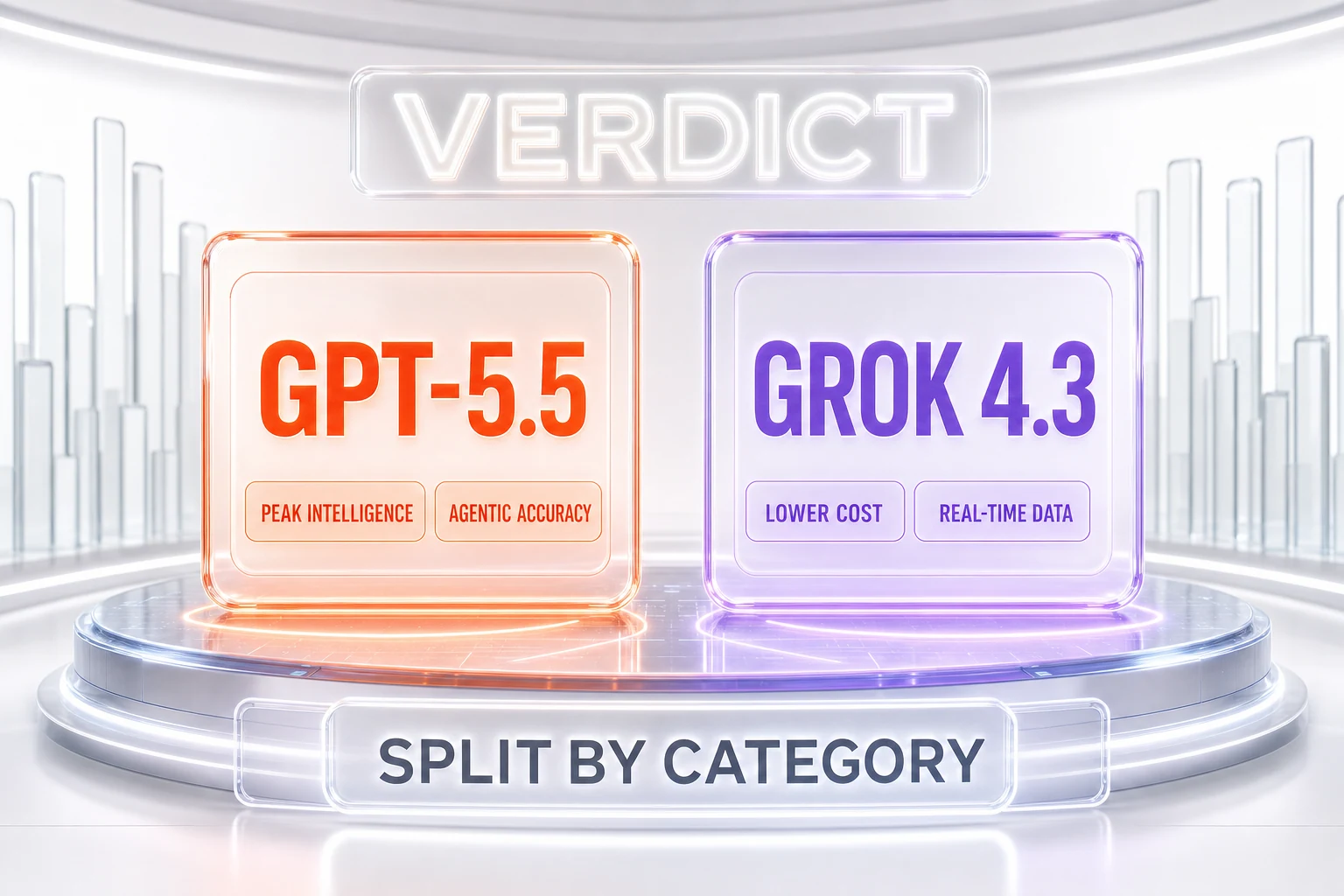
- Best for peak reasoning: GPT-5.5. The Intelligence Index lead (frontier tier over Grok 4.3's upper-mid tier) and the five-level reasoning-effort scale make it the model for the hardest prompts.
- Best for agentic accuracy: GPT-5.5. It leads GDPval-AA, with Grok 4.3 sitting at a respectable number two.
- Best for cost: Grok 4.3. Roughly 4x cheaper input, 12x cheaper output, no contest.
- Best for file output and real-time data: Grok 4.3. Native PPTX, PDF, XLSX generation and real-time access to X Corp data are exclusive to it here; both models share text and image (vision) input.
- Best for the OpenAI ecosystem: GPT-5.5. Codex, Responses API, MCP, and 90% prompt caching are a moat for teams already invested.
- Best free entry point: Grok 4.3. A free plan versus none.
- Best overall: No single winner. The right pick depends entirely on whether you optimize for capability or cost — which is why we split it.
Pros and Cons
GPT-5.5 Pros and Cons
What we like about GPT-5.5
- Highest intelligence on the shared yardstick. It leads the Artificial Analysis Intelligence Index (frontier tier) over Grok 4.3 (upper-mid tier) — the cleanest like-for-like reasoning win in this comparison.
- Leads agentic accuracy. Clearly ahead of Grok 4.3 on GDPval-AA, with the higher expected head-to-head win rate as scored by Artificial Analysis.
- Granular reasoning control. A five-level effort scale (none to xhigh) lets you trade latency and cost for depth on a per-call basis.
- Prompt caching at 90% off. $0.50 per million cached input tokens makes stable-system-prompt agent loops meaningfully cheaper than the rate card implies.
- Deepest ecosystem. Codex, Responses API, MCP client support, and ChatGPT's consumer reach.
Where GPT-5.5 falls short
- Expensive on output. $30 per million output tokens is twelve times Grok 4.3's $2.50 — punishing on token-heavy workloads.
- Long-context surcharge. Above 272,000 input tokens the rate jumps to $10 input and $45 output per million, which changes the unit economics of million-token runs.
- No real-time data feed. GPT-5.5 has no built-in live data source; Grok 4.3 ships real-time access to X Corp data. (Neither model accepts native video input — both handle text and images only.)
- No native file output. It describes documents rather than generating downloadable PPTX, PDF, or XLSX files.
- No free plan. Access requires ChatGPT Plus or the API.
Grok 4.3 Pros and Cons
What we like about Grok 4.3
- Cheapest frontier-tier pricing. $1.25 input and $2.50 output per million tokens — roughly 4x and 12x cheaper than GPT-5.5.
- Real-time X Corp data access. Live posts and trends from X at query time — unique among the two models here, and useful for live-event and trend analysis.
- Native file generation. Produces real PPTX, PDF, and XLSX files directly in chat.
- Strong agentic ranking for the price. Number two overall on GDPval-AA, behind only GPT-5.5, plus a reported 98% on τ²-Bench Telecom and 81% on IFBench.
- OpenAI-compatible API and a free plan. Most existing SDK code runs unchanged, and there is a no-cost entry point.
Where Grok 4.3 falls short
- Trails on raw intelligence. Upper-mid tier versus GPT-5.5's frontier tier on the Artificial Analysis Intelligence Index — a real, like-for-like gap.
- Trails on agentic accuracy. A clear step behind GPT-5.5 on GDPval-AA.
- Thinner documentation. xAI's docs are less complete and consistent than OpenAI's, which slows integration.
- Fewer published deep-reasoning benchmarks. No matching public SWE-Bench Pro, GPQA Diamond, or Humanity's Last Exam figure, so direct head-to-heads on those are unverifiable.
When to Pick GPT-5.5 vs Grok 4.3
When to pick GPT-5.5
- Your work depends on peak reasoning — hard planning, graduate-level analysis, ambiguous specs — and token cost is not your binding constraint.
- You need the highest published agentic accuracy and want xhigh reasoning effort on demand.
- You are already on the OpenAI stack (Codex, Responses API, MCP) and value prompt caching.
- You run cache-heavy agent loops where the 90% cached-input discount offsets the higher rate card.
When to pick Grok 4.3
- Token cost dominates your bill — high-volume agent loops, large-scale generation, or RAG over big corpora.
- You need downloadable PPTX, PDF, and XLSX output, or real-time access to X Corp data.
- You want a free entry point to evaluate a frontier-tier model before committing budget.
- You value real-time X Corp data access for live event and trend analysis.
Alternatives Worth Considering
GPT-5.5 and Grok 4.3 are not the only frontier models on the table in 2026, and if neither fits cleanly, three alternatives are worth a look. Anthropic's Claude Opus line is the model most teams reach for when long agentic-coding reliability is the priority, and it tends to lead like-for-like coding benchmarks. Google's Gemini 3.1 Pro is the value play for high-volume retrieval work with a large context window at a mid-tier price. And for sovereignty-sensitive or on-premises deployments, an open-weights model removes the per-token bill entirely at the cost of self-hosting overhead. That said, for the specific trade-off this page covers — peak US-frontier intelligence versus rock-bottom token cost — GPT-5.5 and Grok 4.3 are the two cleanest endpoints of the spectrum, which is exactly why they make a useful head-to-head.
If you want to see how each of these models stacks up against Anthropic's flagship, we also ran Claude Opus 4.7 vs GPT-5.5 and Claude Opus 4.7 vs Grok 4.3 side-by-side, plus the closer Claude Opus 4.8 vs GPT-5.5 matchup on output cost and coding benchmarks.
Frequently Asked Questions
Is GPT-5.5 better than Grok 4.3 in 2026?
It depends on what you optimize for, and we refuse to fake a single overall winner. On the one yardstick that scores both the same way — the Artificial Analysis Intelligence Index — GPT-5.5 leads in the frontier tier while Grok 4.3 sits in the upper-mid tier, so GPT-5.5 is the smarter model on shared evidence, and it also leads GDPval-AA agentic accuracy (Grok 4.3 ranks number two overall). But Grok 4.3 is roughly four times cheaper on input and twelve times cheaper on output, and it adds native file generation and real-time access to X Corp data that GPT-5.5 does not have — though both accept text and image (vision) input and neither accepts native video. Best for peak intelligence and agentic accuracy: GPT-5.5. Best for cost and file output: Grok 4.3.
How much do GPT-5.5 and Grok 4.3 cost?
GPT-5.5 is $5 per million input tokens and $30 per million output tokens on the standard API, with cached input at $0.50 per million (a 90% discount) and a long-context surcharge above 272,000 input tokens ($10 input, $45 output). Grok 4.3 is $1.25 per million input tokens and $2.50 per million output tokens, with no published tiered surcharge. On a blended million-in, million-out workload that is about $35 for GPT-5.5 versus $3.75 for Grok 4.3. Both prices are verified directly from each vendor's pricing page.
Which model is smarter, GPT-5.5 or Grok 4.3?
GPT-5.5, on the comparable evidence. The Artificial Analysis Intelligence Index, which scores both models with the same methodology, puts GPT-5.5 in the frontier tier and Grok 4.3 in the upper-mid tier. GPT-5.5 also leads the GDPval-AA agentic-accuracy suite, with Grok 4.3 ranked number two overall. In our two weeks of side-by-side use, GPT-5.5 was the model we reached for on the hardest reasoning prompts, while Grok 4.3 held up well on routine agentic loops at a fraction of the cost.
Which is cheaper, GPT-5.5 or Grok 4.3?
Grok 4.3, by a wide margin. It costs $1.25 per million input tokens versus GPT-5.5's $5 (about 4x cheaper) and $2.50 per million output tokens versus GPT-5.5's $30 (about 12x cheaper). The gap narrows if your GPT-5.5 workload is cache-heavy, because GPT-5.5's 90% cached-input discount ($0.50 per million) has no published Grok 4.3 equivalent, but it never closes. For high-volume, output-heavy agent workloads, Grok 4.3 is the clear cost winner.
Does Grok 4.3 support video, and does GPT-5.5?
Neither does, natively. Both Grok 4.3 and GPT-5.5 accept text and image (vision) input, but neither ingests video in a single API call. At xAI, video and image generation are handled by a separate product (Grok Imagine), not the Grok 4.3 chat model. For any video-input workflow — screen recordings, product demos, QA video — both models require an external step (frame extraction or transcription) before they can read the content.
Can GPT-5.5 or Grok 4.3 generate PowerPoint and Excel files?
Grok 4.3 can. It generates native PPTX, PDF, and XLSX files directly in chat — real downloadable documents, not descriptions. GPT-5.5 does not produce native file output the same way; it can describe a document or write the code to build one, but it does not return a finished PPTX or XLSX as a built-in capability. For workflows that end in a deliverable document, Grok 4.3 saves a step.
Which is better for agentic coding, GPT-5.5 or Grok 4.3?
GPT-5.5 on the published evidence — it reports 58.6% on SWE-Bench Pro and leads GDPval-AA agentic accuracy by a clear margin. We could not find a matching public SWE-Bench Pro figure for Grok 4.3, so we present that row as "where measured" rather than a verified head-to-head. In our hands-on runs, GPT-5.5 was more reliable on long, hard agent loops, while Grok 4.3 finished routine tool-call chains cleanly at far lower cost — so for cost-sensitive agentic coding, Grok 4.3 is a serious value option.
Are the benchmark numbers in this comparison independently verified?
Only partly, and we want to be upfront. The Artificial Analysis figures (the Intelligence Index tiers and the GDPval-AA agentic-accuracy ranking) are from a third-party evaluator that scores both models the same way, so those are the closest to like-for-like. The SWE-Bench Pro, GPQA Diamond, and Humanity's Last Exam figures for GPT-5.5 are OpenAI-reported; the τ²-Bench Telecom and IFBench figures for Grok 4.3 are xAI-reported. The only fully verified data here is pricing, which we fetched directly from each vendor's pricing page.
Do GPT-5.5 and Grok 4.3 have the same context window?
Yes — both report a 1 million token context window. That means context size is not a deciding factor between these two. The relevant nuance is cost at scale: GPT-5.5 applies a long-context surcharge above 272,000 input tokens (rates jump to $10 input, $45 output per million), while Grok 4.3 publishes a flat rate. So for very large context runs, Grok 4.3's pricing stays predictable where GPT-5.5's climbs.
Is there a free way to try GPT-5.5 or Grok 4.3?
Grok 4.3 has a free plan through the Grok app, so you can evaluate it at no cost before committing to the API. GPT-5.5 has no free tier — access requires a paid ChatGPT plan (Plus, Pro, Business, or Enterprise) or the API. If a zero-cost trial matters to you, Grok 4.3 is the only one of these two with a free entry point.
Can I switch between GPT-5.5 and Grok 4.3 easily?
API-level switching is unusually easy here because Grok 4.3 exposes an OpenAI-compatible REST API, so most code written for OpenAI's SDK runs against Grok with minimal changes. Production migration still takes work — prompt behavior, reasoning-effort controls, and tool-calling shapes differ between the two. If your stack sits behind an abstraction layer like the Vercel AI SDK, LangChain, or LiteLLM, switching is largely a configuration change. If you call the vendor APIs directly, budget a day or two of integration testing.
Can GPT-5.5 and Grok 4.3 work together in the same agent?
Yes, and multi-model routing is a sensible pattern given how cleanly these two split. A common setup: route the hardest reasoning and high-stakes agentic steps through GPT-5.5 (it leads intelligence and agentic accuracy), and route high-volume, cost-sensitive, file-generation, or real-time-data steps through Grok 4.3 (it is far cheaper, generates native files, and carries live X Corp data). Because Grok 4.3 is OpenAI-compatible, a router like the Vercel AI SDK or LiteLLM can switch between them by workload type with little extra plumbing.
Final Verdict
This is a split verdict, and we left it without an overall winner on purpose. GPT-5.5 is the smarter model on the one yardstick that scores both the same way — it leads the Artificial Analysis Intelligence Index in the frontier tier, with Grok 4.3 in the upper-mid tier — and it leads GDPval-AA agentic accuracy by a clear margin. Grok 4.3 is roughly four times cheaper on input and twelve times cheaper on output (verified pricing), and it adds native PPTX, PDF, and XLSX generation plus real-time access to X Corp data that GPT-5.5 does not have — though both accept text and image (vision) input and neither accepts native video. Both share a 1 million token context window, so size is not the tiebreaker. Best for peak intelligence, agentic accuracy, and the OpenAI ecosystem: GPT-5.5. Best for cost, real-time data, and native file output: Grok 4.3. We did not crown an overall winner because the trade-off is genuine — pick GPT-5.5 if capability is the constraint, Grok 4.3 if cost is. Every benchmark figure here is vendor- or evaluator-reported; only pricing is fetch-verified. Last compared: June 2026.
Sources and references
Every figure on this page is attributed to whoever produced it. Vendor documentation and independent measurement are listed separately and never merged into a single ranking.
- Artificial Analysis — Grok 4.3 (independent index score)
- OpenAI — API pricing (per-token rates)
- Artificial Analysis — GPT-5.5 (independent index score)
- Artificial Analysis — Model leaderboard (Intelligence Index scores and cost per task across configurations)
Our Verdict
Split verdict by category, with no single overall winner because the trade-off is genuine. On the one yardstick that scores both the same way — the Artificial Analysis Intelligence Index — GPT-5.5 sits in the frontier tier and leads, while Grok 4.3 lands in the upper-mid tier, and GPT-5.5 also leads the GDPval-AA agentic-accuracy suite (where Grok 4.3 ranks number two overall), so GPT-5.5 is the smarter, more capable model on the comparable evidence. Grok 4.3 is roughly four times cheaper on input and twelve times cheaper on output ($1.25 input and $2.50 output versus $5 input and $30 output per million tokens, both verified), and it adds native PPTX, PDF, and XLSX file generation plus real-time access to X Corp data that GPT-5.5 does not offer. Both accept text and image (vision) input and neither accepts native video. Both share a 1 million token context window, so size is not the tiebreaker. Best for peak intelligence, agentic accuracy, and the OpenAI ecosystem: GPT-5.5. Best for cost, real-time data, and native file output: Grok 4.3. All benchmark numbers are vendor- or evaluator-reported; only pricing is fetch-verified directly from each vendor.
Choose GPT-5.5
OpenAI's first fully retrained base model since GPT-4.5 — agentic, faster, and double the API price.
Try GPT-5.5 →Choose Grok 4.3
xAI's cheapest frontier reasoning model — $1.25/$2.50 per 1M tokens, 1M context, real-time X data and slide gen.
Try Grok 4.3 →Frequently Asked Questions
Is GPT-5.5 better than Grok 4.3?
Split verdict by category, with no single overall winner because the trade-off is genuine. On the one yardstick that scores both the same way — the Artificial Analysis Intelligence Index — GPT-5.5 sits in the frontier tier and leads, while Grok 4.3 lands in the upper-mid tier, and GPT-5.5 also leads the GDPval-AA agentic-accuracy suite (where Grok 4.3 ranks number two overall), so GPT-5.5 is the smarter, more capable model on the comparable evidence. Grok 4.3 is roughly four times cheaper on input and twelve times cheaper on output ($1.25 input and $2.50 output versus $5 input and $30 output per million tokens, both verified), and it adds native PPTX, PDF, and XLSX file generation plus real-time access to X Corp data that GPT-5.5 does not offer. Both accept text and image (vision) input and neither accepts native video. Both share a 1 million token context window, so size is not the tiebreaker. Best for peak intelligence, agentic accuracy, and the OpenAI ecosystem: GPT-5.5. Best for cost, real-time data, and native file output: Grok 4.3. All benchmark numbers are vendor- or evaluator-reported; only pricing is fetch-verified directly from each vendor.
Which is cheaper, GPT-5.5 or Grok 4.3?
GPT-5.5 starts at $5 in / $30 out per M tokens. Grok 4.3 starts at $1.25 in / $2.5 out per M tokens (free plan available). Check the pricing comparison section above for a full breakdown.
What are the main differences between GPT-5.5 and Grok 4.3?
The key differences span across 15 features we compared. For API input price (per million tokens), GPT-5.5 offers $5.00 (verified) while Grok 4.3 offers $1.25 (verified). For API output price (per million tokens), GPT-5.5 offers $30.00 (verified) while Grok 4.3 offers $2.50 (verified). For Artificial Analysis Intelligence Index, GPT-5.5 offers Frontier tier (Artificial Analysis) while Grok 4.3 offers Upper-mid tier (Artificial Analysis). See the full feature comparison table above for all details.