GPT-5.6 Terra vs Claude Haiku 4.5: Capability vs Latency (2026)


GPT-5.6 Terra vs Claude Haiku 4.5: Terra wins intelligence 55 to 24; Haiku wins speed at 91.7 tokens per second and lower price. Our 2026 split verdict.
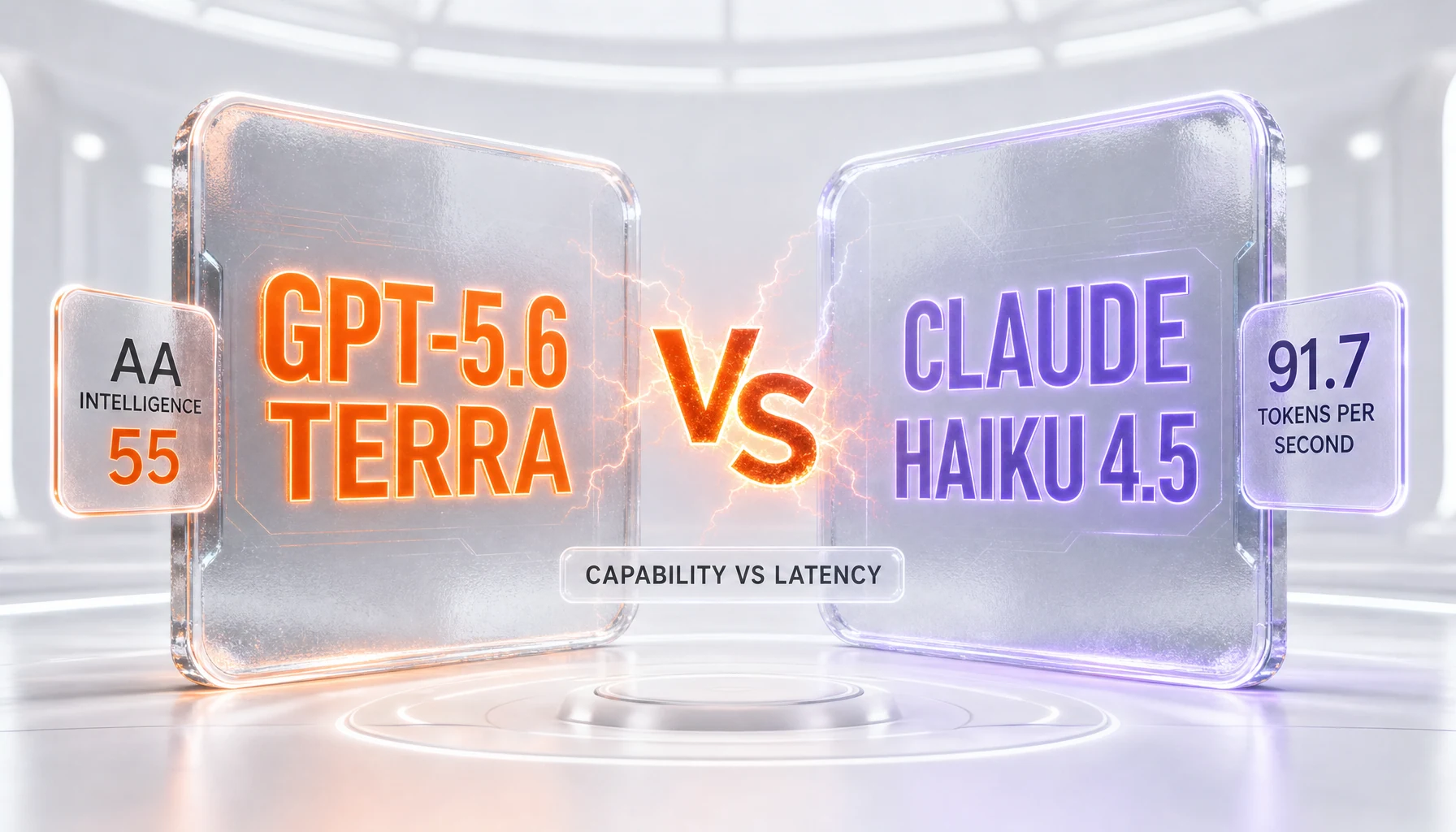
Feature Comparison
| Feature | GPT-5.6 Terra | Claude Haiku 4.5 |
|---|---|---|
| AA Intelligence Index v4.1 (independent) | 55 | 24 |
| Model class | Reasoning-capable balanced tier | Fast non-reasoning tier |
| Output speed | No published tokens-per-second figure | 91.7 tokens per second |
| Time to first token | Not published | 0.82 seconds |
| Input price per 1M tokens | $2.00 | $1.00 |
| Cached input per 1M tokens | $0.20 | $0.10 |
| Output price per 1M tokens | $12.00 | $5.00 |
| Context window | 1.05M tokens | 200K tokens |
Pricing Comparison
GPT-5.6 Terra
Claude Haiku 4.5
Detailed Comparison
GPT-5.6 Terra and Claude Haiku 4.5 are not really competing for the same job. On the version-matched Artificial Analysis Intelligence Index v4.1, Terra scores 55 and Haiku 4.5 scores 24 — a 31-point gap Terra wins decisively. But Haiku 4.5 is built for a different metric: it streams output at 91.7 tokens per second with a 0.82-second time to first token, and it costs $1 per million input tokens and $5 per million output against Terra’s $2.00 and $12. In short: Terra wins raw intelligence, long context, and coding depth; Haiku 4.5 wins speed, latency, and price per token. This is a split verdict — pick by the axis you optimize.
Quick Verdict
If you want the single sentence: pick GPT-5.6 Terra when the work needs reasoning, long context, or coding depth; pick Claude Haiku 4.5 when you are optimizing tokens per second, time to first token, and cost across high volume. This is a split decision by design, not a knockout — the two models are tuned for opposite ends of the same capability-versus-latency trade.
Be honest about the gap first: this is not a duel of intelligence. On the Artificial Analysis Intelligence Index v4.1 — the same version used to score Terra — Terra lands at 55 and Haiku 4.5 lands at 24. That 31-point spread is one of the widest we have written up between two models people actually cross-shop, and Terra wins it without argument. Haiku 4.5 was never designed to close it. Anthropic built Haiku 4.5 as a small, fast, non-reasoning model whose whole reason to exist is latency and cost: 91.7 tokens per second of output, a 0.82-second time to first token, and a lower price on both input and output. So the real question is not which is smarter — Terra is, clearly — but whether your workload rewards intelligence or throughput.
- Best raw intelligence: GPT-5.6 Terra (AA Intelligence Index v4.1 of 55 versus 24 — a 31-point lead)
- Best speed and latency: Claude Haiku 4.5 (91.7 tokens per second, 0.82-second time to first token)
- Best price per token: Claude Haiku 4.5 ($1 input and $5 output per million versus $2.00 and $12)
- Best long-context work: GPT-5.6 Terra (1.05 million tokens versus 200,000)
- Best for real-time and sub-agent fleets: Claude Haiku 4.5 (throughput and low latency at scale)
- Overall: a genuine split — Terra for capability, Haiku 4.5 for latency and cost. There is no single winner, and inventing one would be dishonest.
How We Compared Them
Honesty first. This is a research-led comparison, not a "we ran both in production for a month" piece. We lined the two models up on the numbers that are actually comparable: the independent Artificial Analysis Intelligence Index v4.1, each vendor’s published pricing, and each vendor’s published specifications for context window and throughput. Where a figure is vendor-reported rather than independently measured, we label it as such and refuse to stack it against an independent number as if the two were the same kind of evidence.
One rule shaped everything below: we only score the two models head to head on a benchmark measured the same way for both. The clean shared signal is the AA Intelligence Index v4.1 — an independent third-party score, run on the same index version for Terra and for Haiku 4.5 — where Terra scores 55 and Haiku 4.5 scores 24. That is the one number in this comparison that is both independent and version-matched, and it is why we lead with it.
Pricing we took directly from each vendor rather than from search snippets, because pricing is the figure most often garbled by aggregators. Terra costs $2.00 per million input tokens, $0.20 per million cached input tokens, and $12.00 per million output tokens. Haiku 4.5 costs $1 per million input tokens, $0.10 per million cached input tokens, and $5 per million output tokens. Those are the rates every price comparison below is built on.
A word on a number you will see floating around: some third-party trackers list Haiku 4.5 at 55 on an intelligence index. That is not its score on the version-matched v4.1 index used here — more on why in the FAQ — and we do not use it. On the index both models are scored on, Haiku 4.5 is 24.
Meet Both Models
GPT-5.6 Terra — OpenAI’s balanced reasoning tier
GPT-5.6 Terra is the balanced, mid-priced member of OpenAI’s GPT-5.6 family, sitting between the flagship GPT-5.6 Sol above it and the cheaper GPT-5.6 Luna below. It is a reasoning-capable model: its job is to think through multi-step problems, hold a large working context, and write and debug code. On the independent AA Intelligence Index v4.1 it scores 55 — a third-party measurement rather than a vendor claim; it has no charted entry on the AA Coding Agent Index v1.3. Its context window is enormous at 1.05 million tokens, and it prices at $2.00 per million input, $0.20 per million cached input, and $12 per million output. Terra is the model you reach for when the task rewards getting the answer right over getting it fast.
Claude Haiku 4.5 — Anthropic’s fast, low-cost small model
Claude Haiku 4.5 is Anthropic’s small, fast tier, and it is deliberately not a reasoning model. Its entire design goal is speed and cost: it streams at 91.7 tokens per second with a 0.82-second time to first token, and it prices at $1 per million input tokens and $5 per million output. On the same version-matched AA Intelligence Index v4.1 it scores 24 — ranked around 30th of 79 models in the non-reasoning category by Artificial Analysis — so it is a long way behind Terra on raw intelligence, and Anthropic does not pretend otherwise. Anthropic does report a coding figure of 73.3% on SWE-bench Verified; that is a vendor self-reported number, so we treat it as Anthropic’s own best result rather than an independent measurement and keep it separate from Terra’s independently charted coding score. Haiku 4.5’s context window is 200,000 tokens. Where Terra optimizes for being right, Haiku 4.5 optimizes for being fast and cheap at volume — think real-time interfaces and large fleets of coordinated sub-agents.
Head-to-Head at a Glance
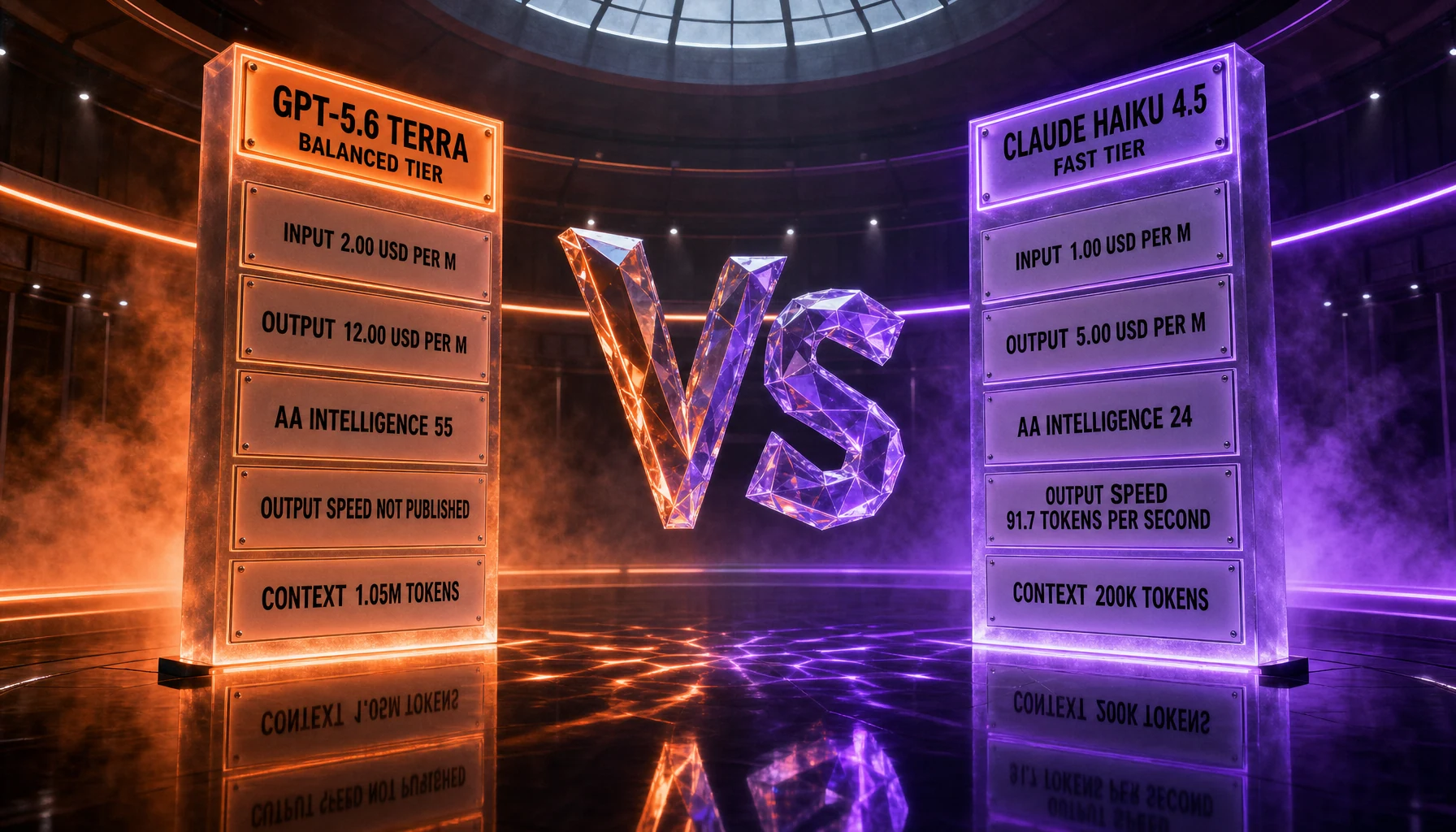
| Dimension | GPT-5.6 Terra | Claude Haiku 4.5 | Edge |
|---|---|---|---|
| AA Intelligence Index v4.1 (independent) | 55 | 24 | Terra (+31) |
| Model class | Reasoning-capable balanced tier | Fast non-reasoning tier | Different jobs |
| Output speed | No published tokens-per-second figure | 91.7 tokens per second | Haiku 4.5 |
| Time to first token | Not published | 0.82 seconds | Haiku 4.5 |
| Input price per 1M tokens | $2.00 | $1.00 | Haiku 4.5 |
| Cached input per 1M tokens | $0.20 | $0.10 | Haiku 4.5 |
| Output price per 1M tokens | $12.00 | $5.00 | Haiku 4.5 |
| Context window | 1.05M tokens | 200K tokens | Terra |
The table splits along a clean line. Terra takes the capability rows — intelligence and context window. Haiku 4.5 takes the economics-and-speed rows — raw output speed, time to first token, and price on input, cached input, and output alike. Neither model wins the other’s column, because they were not built to. Which set of rows matters more is entirely a function of what you are building.
The Intelligence Gap Is Real — and It Is Wide
The single most important number in this comparison is the independent AA Intelligence Index v4.1: 55 for GPT-5.6 Terra, 24 for Claude Haiku 4.5. A 31-point spread on that index is not a rounding difference — it is the gap between a reasoning-capable balanced model and a small non-reasoning one. Terra can hold a complex chain of thought, plan across many steps, and recover from its own mistakes in ways a 24-rated non-reasoning model simply is not built to. If your task involves genuine problem-solving — architecture decisions, multi-file refactors, analysis that has to be correct rather than merely plausible — Terra is the right instrument and the gap will show.
Being fair in the other direction matters just as much. Haiku 4.5’s 24 is not a bug or a disappointment; it is Anthropic building exactly to spec. A large share of production AI work does not need frontier reasoning: routing a request, tagging a ticket, extracting fields from a document, summarizing a chat, drafting a templated reply. For those jobs, a non-reasoning model that answers in a fraction of a second and costs a fraction of the price is not a compromise — it is the correct engineering choice, and paying for Terra-grade intelligence there would be waste. The intelligence gap only becomes a problem when you point Haiku 4.5 at work that actually needs reasoning. Keep it on the work it was designed for and 24 is plenty.
Speed and Latency: Haiku 4.5’s Real Argument
If intelligence is Terra’s headline, speed is Haiku 4.5’s, and it is a genuinely strong one. Anthropic measures Haiku 4.5 at 91.7 tokens per second of output with a 0.82-second time to first token. Those two numbers describe different things that both matter: time to first token is how long a user waits before anything appears, and tokens per second is how fast the answer then streams out. A 0.82-second first token is fast enough that an interface feels responsive rather than laggy, and 91.7 tokens per second means long responses finish quickly instead of crawling.
Latency is not a vanity metric — it changes what you can build. In a real-time, user-facing feature, the difference between a sub-second first token and a multi-second one is the difference between a product that feels alive and one users abandon. The effect compounds hardest in multi-agent systems. When you fan a task out across many parallel sub-agents, every agent’s latency stacks into the wall-clock time of the whole run, and every agent’s per-token cost stacks into the bill. A fast, cheap model like Haiku 4.5 is purpose-built for that shape of workload: spin up a large fleet of sub-agents, each doing a narrow job quickly and cheaply, and let a smarter model handle only the parts that need reasoning. In that architecture Haiku 4.5’s speed and price are not a consolation prize for its lower intelligence — they are the entire point, and Terra cannot match them on the axis Haiku 4.5 was tuned for.
Pricing: Where Haiku 4.5 Pulls Ahead
Price is the second axis Haiku 4.5 owns, and we verified both models’ rates directly from each vendor rather than from search snippets.
| Cost dimension | GPT-5.6 Terra | Claude Haiku 4.5 |
|---|---|---|
| Input per 1M tokens | $2.00 | $1.00 |
| Cached input per 1M tokens | $0.20 | $0.10 |
| Output per 1M tokens | $12.00 | $5.00 |
| Relative input cost | 2 times Haiku 4.5 | Baseline |
| Relative output cost | 2.4 times Haiku 4.5 | Baseline |
At list prices Haiku 4.5 is 2 times cheaper on input and 2.4 times cheaper on output. On a high-volume workload — millions of tokens a day across a fleet of agents or a busy user-facing feature — that ratio is the difference between a model bill you barely notice and one that shows up in a budget review. This is the axis that, for many teams, decides the whole comparison.
Caching does not rescue Terra here, and it is worth being exact because the opposite is often assumed. Both vendors publish a cached-input rate, and both set it at one tenth of their base input price: Terra reads cached tokens at $0.20 per million, Anthropic bills a Haiku 4.5 cache hit at $0.10 per million. Workloads that re-read the same large context on every call — long system prompts, big retrieved documents, iterative agent loops over a fixed corpus — cut their input bill sharply on either model, and the 2-times gap between them survives intact. The one nuance sits on the write side: Anthropic charges $1.25 per million for a 5-minute cache write and $2 per million for the 1-hour window, so a cache only pays for itself once it is actually re-read. As always, measure on your own traffic.
Context Window: 1.05 Million vs 200,000
Terra’s context window is 1.05 million tokens; Haiku 4.5’s is 200,000. That is roughly a five-to-one difference, and it maps directly onto capability. For the fast, bounded tasks Haiku 4.5 targets — a single document, a chat turn, a focused extraction — 200,000 tokens is more than enough and the smaller window costs you nothing. But when the job is whole-repository code understanding, analysis across many long documents at once, or a long-running agent that accumulates a large state as it works, Terra’s 1.05 million tokens is a concrete, practical advantage: it can hold context that would overflow Haiku 4.5 entirely. Context size, like intelligence, is a capability axis, and it lines up on Terra’s side.
A Note on Coding Scores
You will see a coding number attached to each model, and it is tempting to line them up as a score-versus-score. We deliberately do not, because they are not the same kind of evidence. Neither model is charted on an independent coding index, so there is no third-party coding measurement on either side of this matchup. Haiku 4.5’s coding figure is a vendor self-reported result, run under its own conditions and reported by Anthropic itself. Putting an independent number and a vendor number side by side as if they were a fair head-to-head would flatter one side and mislead you. So we report each in its own context: Terra has the reasoning and long-context profile that carries hard coding work, while Haiku 4.5 is a fast, cheap option for high-volume, lighter coding chores. For where each sits among the field, our best AI coding tools roundup has the wider picture.
Winner by Category
Best raw intelligence: GPT-5.6 Terra
At 55 to 24 on the independent, version-matched AA Intelligence Index v4.1, Terra wins reasoning by 31 points. For any task that rewards getting the answer right, this is the model.
Best speed and latency: Claude Haiku 4.5
At 91.7 tokens per second with a 0.82-second time to first token, Haiku 4.5 is built for responsiveness. For real-time features and latency-sensitive pipelines, Terra cannot match it on the axis Haiku 4.5 was tuned for.
Best price per token: Claude Haiku 4.5
At $1 input and $5 output per million tokens — 2 times and 2.4 times cheaper than Terra respectively — Haiku 4.5 is the economical engine for high-volume work. Caching does not change that: Haiku 4.5 reads cached input at $0.10 per million against Terra’s $0.20, so the 2-times gap holds on that row too.
Best long-context work: GPT-5.6 Terra
A 1.05-million-token window against 200,000 makes Terra the choice for whole-repository analysis, long documents, and stateful agents that would overflow Haiku 4.5.
Best for real-time and sub-agent fleets: Claude Haiku 4.5
When you fan work out across many parallel sub-agents, Haiku 4.5’s speed and low cost compound in your favor across the whole fleet. It is the natural worker model in a smart-router architecture.
Overall: a genuine split
There is no single winner. Terra owns capability — intelligence, context, coding depth; Haiku 4.5 owns latency and cost. The right pick is entirely a function of which axis your workload rewards.
Pros and Cons of Each
GPT-5.6 Terra
What stands out:
- Highest intelligence of the two by a wide margin: 55 on the independent AA Intelligence Index v4.1, a 31-point lead over Haiku 4.5
- Reasoning-capable, so it handles multi-step problem-solving, planning, and complex refactors
- Huge 1.05-million-token context window for whole-repository and long-document work
- Independently charted coding score, not a self-reported one
- Cached input at $0.20 per million — one tenth of its base input rate — rewards workloads that re-read a fixed context
Where it falls short:
- 2 times more expensive on input and 2.4 times more on output than Haiku 4.5 at list prices
- No published tokens-per-second or time-to-first-token figure — it is tuned for correctness, not speed
- Overkill (and wasteful) on simple, high-volume tasks that never use its reasoning
Claude Haiku 4.5
What stands out:
- Fast: 91.7 tokens per second of output with a 0.82-second time to first token
- Cheap: $1 input and $5 output per million tokens, 2 and 2.4 times below Terra
- Ideal engine for real-time interfaces and large fleets of coordinated sub-agents
- Anthropic ecosystem and tooling, with a straightforward API
- Honest positioning — a small, fast model that does not pretend to be a reasoner
Where it falls short:
- Far behind on raw intelligence: 24 on the AA Intelligence Index v4.1, 31 points under Terra
- Non-reasoning, so it struggles with genuine multi-step problem-solving
- Smaller 200,000-token context window, roughly five times below Terra
- Cache writes carry a premium — $1.25 per million for the 5-minute window, $2 per million for the 1-hour window — so caching only pays off once the context is actually re-read
- Its coding number is vendor self-reported, not independently verified
When to Pick Which
Pick GPT-5.6 Terra if...
Your work rewards intelligence over speed. Terra is the stronger default when the task involves real reasoning — architecture, complex refactors, analysis that must be correct — when you need to hold a large context such as an entire repository or a stack of long documents, or when coding depth matters more than raw throughput. You accept a higher per-token price and no headline speed number in exchange for a 31-point intelligence lead and a five-times-larger context window. If you are weighing the rest of OpenAI’s lineup, GPT-5.6 Sol sits above Terra for the very hardest work and GPT-5.6 Luna below it for cheaper, lighter tasks.
Pick Claude Haiku 4.5 if...
Latency, throughput, or cost across volume is the thing you are optimizing. Claude Haiku 4.5 is the better choice for real-time, user-facing features where response speed shapes the experience, for high-volume classification, extraction, routing, and summarization, and for multi-agent systems that spin up many parallel sub-agents where speed and price compound across the fleet. You give up frontier reasoning and a large context window, but for the work Haiku 4.5 targets you were never going to use them, and its speed and price are exactly what that work needs.
Or run both in a smart router
The two are not mutually exclusive, and the strongest 2026 pattern often uses both. Route each request to the cheapest model that can handle it: send bulk, latency-sensitive, or simple work to Claude Haiku 4.5 for speed and low cost, and escalate the hard, reasoning-heavy, or long-context requests to GPT-5.6 Terra. Because the two are tuned for opposite ends of the same trade-off, they complement each other cleanly. If you want to see how this capability-versus-cost calculus plays out in other matchups, our Claude Sonnet 5 vs Kimi K2.6 comparison walks through the same kind of decision with a different pair of models.
Frequently Asked Questions
Is GPT-5.6 Terra or Claude Haiku 4.5 smarter?
GPT-5.6 Terra is clearly smarter. On the version-matched Artificial Analysis Intelligence Index v4.1, Terra scores 55 and Claude Haiku 4.5 scores 24 — a 31-point gap and one of the widest we have documented between two commonly cross-shopped models. Both scores are independent third-party measurements on the same index version. Haiku 4.5 is a small, non-reasoning model built for speed and cost, not for topping an intelligence chart, so the gap is by design rather than a failure. If raw reasoning quality is your priority, Terra wins without argument.
Why does Claude Haiku 4.5 score only 24 when some sources say 55?
Because the 55 you may have seen is not Haiku 4.5’s score on the same index. The version-matched Artificial Analysis Intelligence Index v4.1 — the one GPT-5.6 Terra is also scored on — places Claude Haiku 4.5 at 24, ranked around 30th of 79 models in the non-reasoning category. The circulating 55 comes from a different index version or measurement mode and is not comparable. There is an easy way to get confused here: 55 is actually GPT-5.6 Terra’s genuine score on this index, so sloppy comparisons sometimes attach Terra’s number to Haiku 4.5. On the index both models share, Haiku 4.5 is 24.
Which is faster, GPT-5.6 Terra or Claude Haiku 4.5?
Claude Haiku 4.5, decisively — and speed is its whole reason to exist. It streams output at 91.7 tokens per second and returns its first token in about 0.82 seconds. That combination of high throughput and low time to first token is what makes Haiku 4.5 suited to real-time interfaces, chat that has to feel instant, and large fleets of sub-agents where every extra second of latency multiplies across many calls. GPT-5.6 Terra does not publish a tokens-per-second figure and is tuned for getting the answer right rather than returning it fastest.
How much cheaper is Claude Haiku 4.5 than GPT-5.6 Terra?
Claude Haiku 4.5 costs $1 per million input tokens, $0.10 per million cached input tokens, and $5 per million output tokens. GPT-5.6 Terra costs $2.00 per million input, $0.20 per million cached input, and $12.00 per million output. So Haiku 4.5 is 2 times cheaper on input and 2.4 times cheaper on output at list prices, and half the price on cached input as well. Caching cuts the input bill on both models — each vendor prices a cache hit at one tenth of its base input rate — so it narrows nothing between them.
Which has the larger context window?
GPT-5.6 Terra, by a wide margin. Terra supports a 1.05-million-token context window; Claude Haiku 4.5 supports 200,000 tokens — roughly five times smaller. For most fast, high-volume tasks 200,000 tokens is plenty, but for whole-repository code understanding, long document analysis, or agents that accumulate a large running state, Terra’s 1.05 million tokens is a real, practical advantage.
Is Claude Haiku 4.5 a reasoning model?
No. Anthropic positions Claude Haiku 4.5 as a fast, non-reasoning small model. Artificial Analysis classifies it in the non-reasoning category, where it ranks around 30th of 79 models with an Intelligence Index v4.1 score of 24. That is not a criticism — it is the point of the model. Haiku 4.5 trades deliberate multi-step reasoning for speed and low cost, which is exactly what real-time and high-volume workloads want. If you need step-by-step reasoning, GPT-5.6 Terra is the reasoning-capable choice here.
Can Claude Haiku 4.5 replace GPT-5.6 Terra for coding?
For quick, high-volume coding chores — boilerplate, small edits, formatting, and fast autocomplete-style help — Haiku 4.5’s speed and low price make it attractive. But for coding that needs reasoning, planning across a large codebase, or long-context understanding, Terra is the stronger model: it holds a 31-point intelligence lead and an independently charted coding score, and its 1.05-million-token window dwarfs Haiku’s 200,000. Anthropic does report a coding result for Haiku 4.5 — 73.3% on SWE-bench Verified — but that is a vendor self-reported number on a different benchmark, so we do not treat it as a head-to-head win over Terra. For serious coding depth, pick Terra; for fast bulk coding at low cost, Haiku 4.5 earns its place.
When should I pick Claude Haiku 4.5 over GPT-5.6 Terra?
Pick Claude Haiku 4.5 when latency and cost per token dominate your decision. It is the better fit for real-time user-facing features where response speed shapes the experience, for classification, extraction, routing, and summarization at high volume, and for multi-agent systems that spin up many parallel sub-agents — its 91.7 tokens per second and 0.82-second time to first token compound into large savings across a fleet. If your workload is high-throughput and does not demand deep reasoning, Haiku 4.5’s lower price on both input and output makes it the economical engine.
When should I pick GPT-5.6 Terra over Claude Haiku 4.5?
Pick GPT-5.6 Terra when the quality of the answer matters more than how fast or cheap it arrives. Terra’s 31-point intelligence lead on the AA Index, its reasoning capability, and its 1.05-million-token context make it the right choice for complex problem-solving, planning, long-document and whole-repository analysis, and coding that needs depth rather than speed. You pay more per token — $2.00 input and $12 output per million against Haiku 4.5’s $1 and $5 — but for work where a wrong or shallow answer is expensive, that premium is usually worth it.
Are these benchmark numbers independent or vendor-reported?
It is a mix, and the distinction matters. The AA Intelligence Index v4.1 scores — 55 for GPT-5.6 Terra and 24 for Claude Haiku 4.5 — are independent third-party measurements from Artificial Analysis, run on the same index version, which is why we treat them as the cleanest head-to-head signal. Neither model is charted on the independent AA Coding Agent Index v1.3. Haiku 4.5’s 73.3% on SWE-bench Verified, by contrast, is a figure Anthropic reports itself, so we label it vendor self-reported and keep it out of any direct head-to-head, because independent and vendor numbers are not the same kind of evidence.
Is GPT-5.6 Terra worth twice the input price of Claude Haiku 4.5?
It depends entirely on the task. For reasoning-heavy or long-context work, yes: Terra’s 31-point intelligence lead and 1.05-million-token window deliver value that a fast non-reasoning model cannot, and the higher price buys correctness. For high-volume, latency-sensitive, or simple tasks, no: you would be paying 2 times more on input and 2.4 times more on output for intelligence the workload never uses, and Haiku 4.5’s speed is the feature that matters. The right test is to run your actual workload on both and see whether the extra capability changes the output enough to justify the bill.
Can I use both GPT-5.6 Terra and Claude Haiku 4.5 together?
Yes, and for many teams that is the smart move. A common 2026 pattern is to route each request to the cheapest model that can handle it: send bulk, latency-sensitive, or simple calls to Claude Haiku 4.5 for its speed and low cost, and escalate the hard, reasoning-heavy, or long-context requests to GPT-5.6 Terra. Because the two are tuned for opposite ends of the capability-versus-latency trade, they complement each other cleanly rather than compete, so a router that sends easy work to Haiku 4.5 and hard work to Terra often beats committing to either model alone.
Final Verdict
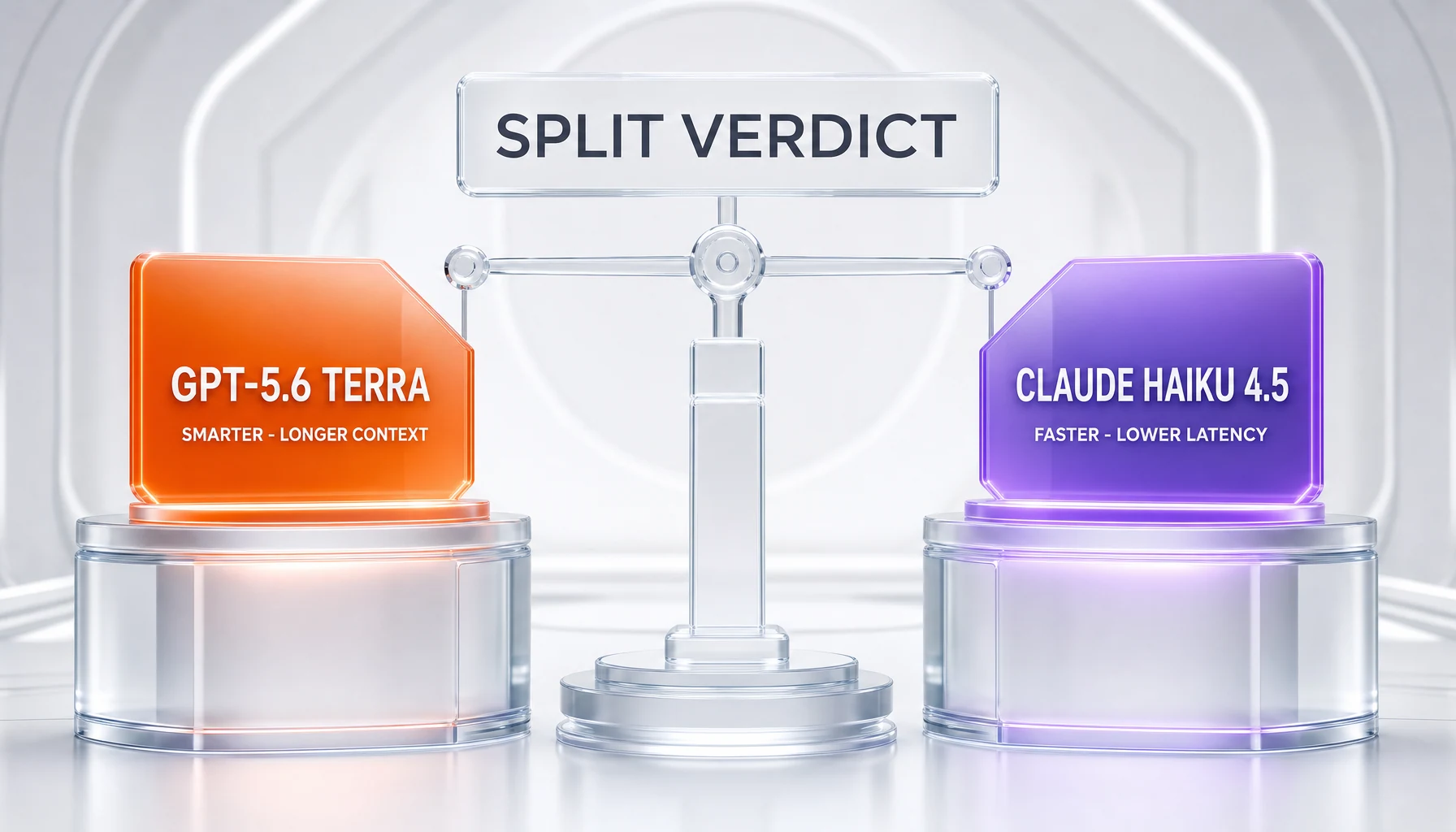
This comparison does not have a knockout winner, and pretending otherwise would be dishonest. GPT-5.6 Terra wins capability outright. It scores 55 to Haiku 4.5’s 24 on the independent, version-matched AA Intelligence Index v4.1 — a 31-point lead — carries an independently charted coding score, and offers a 1.05-million-token context window against Haiku 4.5’s 200,000. If your decision hinges on reasoning quality, depth, or long context, Terra is the answer and the gap is not close.
But Claude Haiku 4.5 wins the axis it was built for — decisively. At 91.7 tokens per second of output, a 0.82-second time to first token, and list prices of $1 input and $5 output per million tokens against Terra’s $2.00 and $12, it is the faster, cheaper engine for real-time features and large sub-agent fleets. Its lower intelligence is not a flaw for that work; it is the deliberate trade that makes the speed and price possible. The question the whole comparison comes down to is simple: are you optimizing for capability or for latency and cost per token? Terra owns the first; Haiku 4.5 owns the second. Many teams will get the best result by using both — Haiku 4.5 as the fast, cheap worker and Terra as the reasoning escalation — and letting the workload, not a single benchmark, make the call.
Last compared: July 2026. Figures: the Artificial Analysis Intelligence Index v4.1 scores (55 for GPT-5.6 Terra, 24 for Claude Haiku 4.5) are independent third-party measurements from Artificial Analysis, version-matched across both models; neither model is charted on the AA Coding Agent Index v1.3. Claude Haiku 4.5’s 73.3% SWE-bench Verified result is vendor self-reported by Anthropic and is not placed head-to-head against Terra’s independent coding score. Speed figures (91.7 tokens per second, 0.82-second time to first token) and pricing are from each vendor’s published specifications, verified at the time of writing. This is a research-led comparison; we have not run both models side by side in production.
Sources and references
Every figure on this page is attributed to whoever produced it. Vendor documentation and independent measurement are listed separately and never merged into a single ranking.
- OpenAI — API pricing (per-token, cached and batch rates)
- Anthropic — Claude model pricing (base input, cache writes, cache hits, output)
- Artificial Analysis — GPT-5.6 Terra (independent index score)
- Artificial Analysis — Model leaderboard (Intelligence Index scores and cost per task across configurations)
Our Verdict
This is a split verdict, and calling a single winner would be dishonest. GPT-5.6 Terra and Claude Haiku 4.5 are tuned for opposite ends of the same trade-off. Terra wins capability outright: it scores 55 to Haiku 4.5’s 24 on the independent, version-matched AA Intelligence Index v4.1 — a 31-point lead — carries an independently charted coding score, and offers a 1.05-million-token context window against Haiku 4.5’s 200,000. Claude Haiku 4.5 wins the axis it was built for: 91.7 tokens per second of output, a 0.82-second time to first token, and lower pricing on every published rate — $1 input, $0.10 cached input, and $5 output per million against Terra’s $2.00, $0.20, and $12. Pick Terra when the work rewards reasoning, depth, and long context; pick Haiku 4.5 when you are optimizing latency, throughput, and cost per token across high volume such as real-time interfaces and large sub-agent fleets. There is no universal winner — only the right tool for the axis you optimize.
Choose GPT-5.6 Terra
OpenAI's balanced GPT-5.6 tier — GPT-5.5-competitive quality at 40 percent of the GPT-5.5 rate, with a 1.05M-token context and the full agentic toolbox.
Try GPT-5.6 Terra →Choose Claude Haiku 4.5
Anthropic's fast small model: Sonnet 4-class coding (73.3% SWE-bench) at $1/$5 per million tokens, ideal for sub-agents and high-volume workflows.
Try Claude Haiku 4.5 →Frequently Asked Questions
Is GPT-5.6 Terra better than Claude Haiku 4.5?
This is a split verdict, and calling a single winner would be dishonest. GPT-5.6 Terra and Claude Haiku 4.5 are tuned for opposite ends of the same trade-off. Terra wins capability outright: it scores 55 to Haiku 4.5’s 24 on the independent, version-matched AA Intelligence Index v4.1 — a 31-point lead — carries an independently charted coding score, and offers a 1.05-million-token context window against Haiku 4.5’s 200,000. Claude Haiku 4.5 wins the axis it was built for: 91.7 tokens per second of output, a 0.82-second time to first token, and lower pricing on every published rate — $1 input, $0.10 cached input, and $5 output per million against Terra’s $2.00, $0.20, and $12. Pick Terra when the work rewards reasoning, depth, and long context; pick Haiku 4.5 when you are optimizing latency, throughput, and cost per token across high volume such as real-time interfaces and large sub-agent fleets. There is no universal winner — only the right tool for the axis you optimize.
Which is cheaper, GPT-5.6 Terra or Claude Haiku 4.5?
GPT-5.6 Terra starts at $2 in / $12 out per M tokens. Claude Haiku 4.5 starts at $1 in / $5 out per M tokens (free plan available). Check the pricing comparison section above for a full breakdown.
What are the main differences between GPT-5.6 Terra and Claude Haiku 4.5?
The key differences span across 8 features we compared. For AA Intelligence Index v4.1 (independent), GPT-5.6 Terra offers 55 while Claude Haiku 4.5 offers 24. For Model class, GPT-5.6 Terra offers Reasoning-capable balanced tier while Claude Haiku 4.5 offers Fast non-reasoning tier. For Output speed, GPT-5.6 Terra offers No published tokens-per-second figure while Claude Haiku 4.5 offers 91.7 tokens per second. See the full feature comparison table above for all details.