Grok 4.5 vs GLM-5.2: Closed Flagship vs Open Weights (2026)
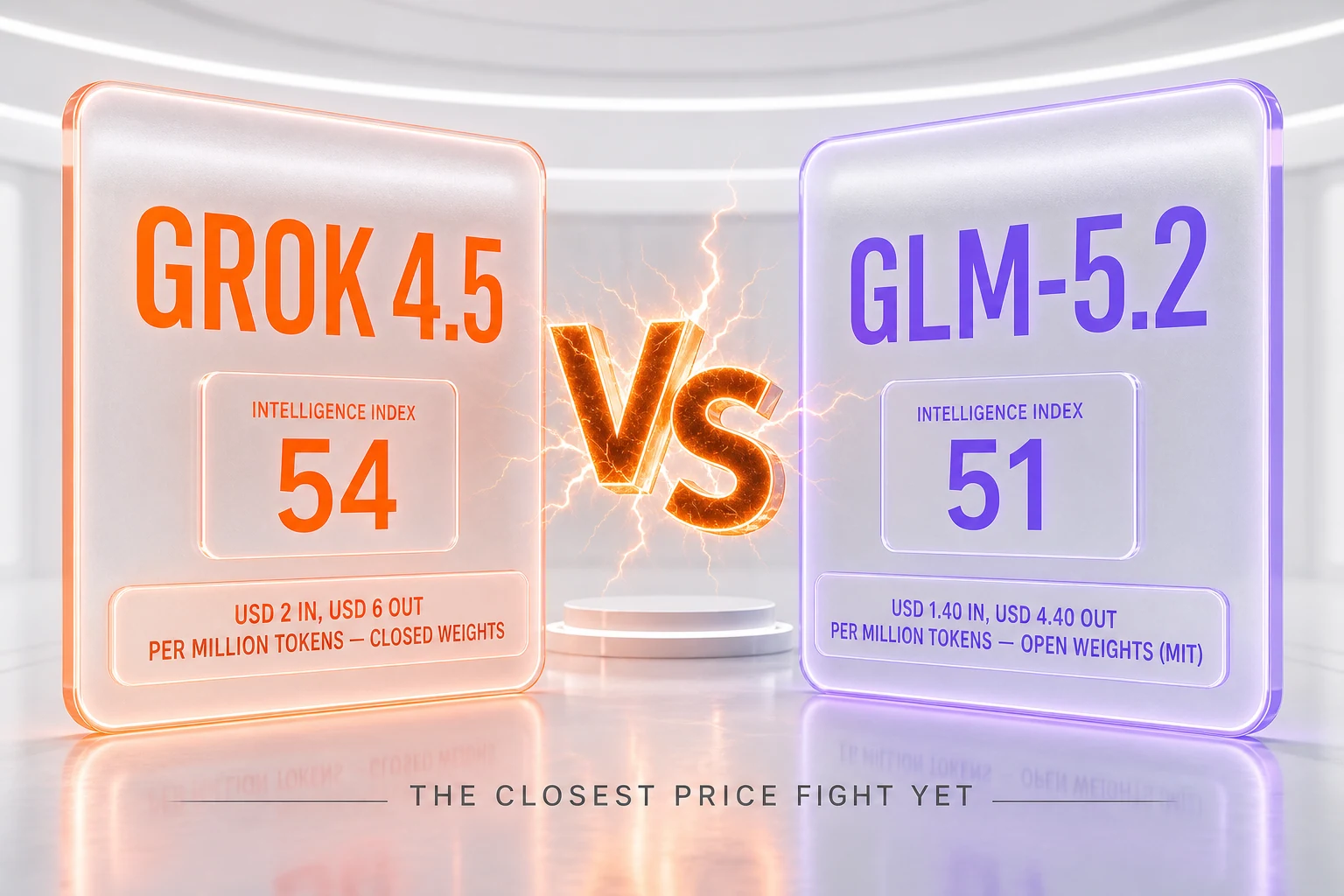
Grok 4.5 vs GLM-5.2 side by side: 54 vs 51 on Artificial Analysis, USD 2 vs USD 1.40 per million input tokens, 500K vs 1M context. Open weights take it.
Feature Comparison
| Feature | Grok 4.5 | GLM-5.2 |
|---|---|---|
| Artificial Analysis Intelligence Index (independent) | 54 | 51 |
| Artificial Analysis Coding Agent Index v1.3 (independent, read August 2, 2026) | 64.44 (Grok Build harness, high effort). Not yet on the independent SWE-bench leaderboard (too new) | 43.18 (Claude Code harness). Zhipu separately self-reports 62.1 on SWE-bench Pro |
| Input price (per million tokens) | USD 2.00 | USD 1.40 |
| Cached input price (per million tokens) | USD 0.30 | USD 0.26 |
| Output price (per million tokens) | USD 6.00 | USD 4.40 |
| Flat-rate plan for heavy interactive coding | None — metered API only | GLM Coding Plan from USD 18 per month |
| Maximum context window | 500,000 tokens | 1,000,000 tokens (output up to 131,072) |
| Model weights and self-hosting | Closed, proprietary; API only | Open weights, MIT license; self-hostable |
| Availability for an EU-based team | Blocked in the EU at launch under the EU AI Act; SpaceXAI signaled EU availability expected around mid-July 2026 | Available anywhere — self-host the MIT weights; hosted Z.ai API is operated from China |
| Documented hallucination rate | 54% hallucination rate, 52% accuracy on AA-Omniscience (independent) | Not measured on AA-Omniscience |
Pricing Comparison
Grok 4.5
GLM-5.2
Detailed Comparison
Grok 4.5 vs GLM-5.2 in 2026: Grok 4.5 is SpaceXAI's (formerly xAI) closed flagship, scoring 54 on the Artificial Analysis Intelligence Index and 64.44 on the Artificial Analysis Coding Agent Index v1.3, with a 500,000-token context and pricing of USD 2 per million input tokens and USD 6 per million output tokens. GLM-5.2 is Zhipu AI's open-weight coding flagship, scoring 51 on the same independent index, with a 1,000,000-token context, MIT-licensed weights you can self-host, and pricing of USD 1.40 per million input tokens and USD 4.40 per million output tokens. Grok 4.5 wins raw independently measured intelligence by 3 points. GLM-5.2 wins on price, context, openness, and availability — and takes the overall verdict on deployability, not on capability.
Quick Verdict
This is the tightest matchup in the open-versus-closed fight right now, and it is tight for a reason that did not exist six months ago: the closed model is cheap. Grok 4.5 is the most aggressively priced closed flagship on the market at USD 2 per million input tokens and USD 6 per million output tokens. Against GLM-5.2 at USD 1.40 and USD 4.40, the gap is roughly 1.4 times on input and 1.36 times on output. In every other open-weight-versus-closed pairing we have written up, the open model undercuts the closed one by 5 to 30 times. Here it undercuts by less than half again.
That collapse in the price gap changes the whole question. You are no longer asking "is the closed model worth 10 times the money?" You are asking something much harder: are 3 points of independently measured intelligence, plus a 21-point lead on the independent coding index, worth giving up open weights, twice the context window, and the ability to run the thing anywhere you want?
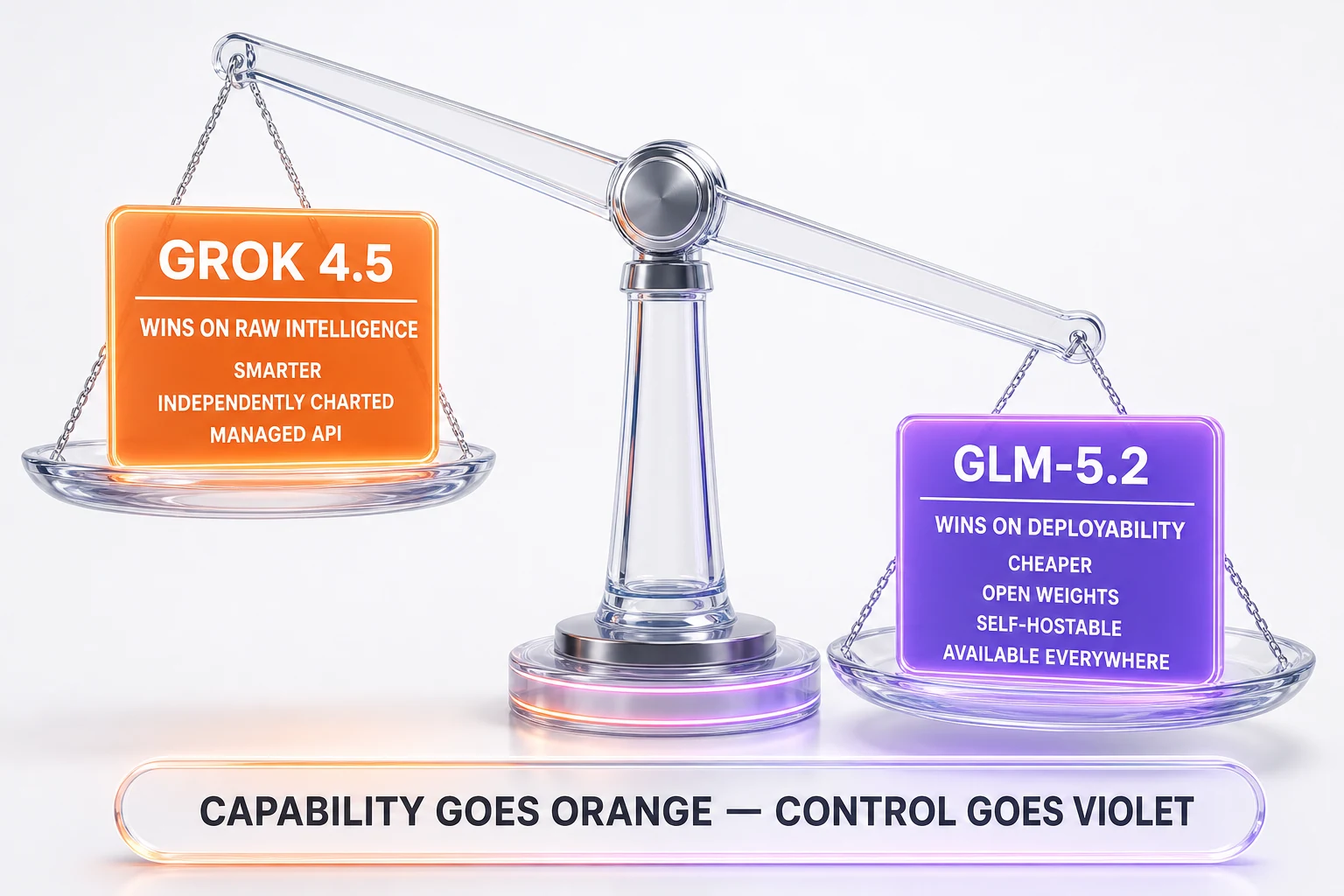
Our answer, narrowly, is no — GLM-5.2 takes the overall verdict. But it wins on what you can deploy and control, not on what the leaderboards say. On the leaderboards, Grok 4.5 is genuinely the better model.
- Grok 4.5 wins raw intelligence. 54 against 51 on the Artificial Analysis Intelligence Index — both independently measured, directly comparable, and a real if modest gap.
- Grok 4.5 scores far higher on the independent coding index. Both models appear on the Artificial Analysis Coding Agent Index v1.3 — Grok 4.5 at 64.44, against GLM-5.2 at 43.18, read August 2, 2026.
- GLM-5.2 wins on price, but by the narrowest margin any open-weight model has managed against a closed flagship.
- GLM-5.2 wins on context — 1,000,000 tokens against 500,000.
- GLM-5.2 wins on control — MIT-licensed open weights, self-hostable, no regional lock-in.
- Availability is the sharpest practical split. Grok 4.5 launched blocked in the European Union — a block lifted on July 17, 2026 — while GLM-5.2 runs wherever you can put a GPU. More on how that is expected to change below.
How We Compared Them
We ran both models side by side through the same set of prompts on their respective APIs — the same refactoring tasks, the same long-document work, the same agentic tool-calling loops — to get a feel for how each one behaves in practice. That hands-on time informs the judgment calls in this piece: how each model handles a long context, how chatty it is, how it recovers when a tool call fails.
What it does not do is produce benchmark numbers. We do not publish our own scores, because a handful of prompts run by one team is not a benchmark. Every number in this comparison comes from a named third party or from the vendor, and we label which is which every single time. That distinction carries a lot of weight in this particular matchup, so here is the rule we hold to:
- Independent means measured by a third-party lab with no stake in the result — Artificial Analysis, LMArena, or vals.ai. These numbers are comparable across models because the same harness ran them.
- Vendor self-reported means the company that built the model published the score using its own harness. These numbers are useful signal, but they are not comparable to independent scores and they are not comparable to each other across vendors.
We never stack the two. You will not find a table row in this article that puts an independent score in one column and a vendor score in the other, because that comparison would be meaningless — and, worse, it would flatter whichever vendor was more generous with its own harness.
Grok 4.5 and GLM-5.2 at a Glance
Grok 4.5 is the current flagship from SpaceXAI, the company formerly known as xAI — the rebrand landed on July 6, 2026, and the model line kept its name, which is why you will still see "xAI Grok" in a lot of coverage. It is a closed, proprietary model: you reach it through the API or the Grok apps, and there are no weights to download. It ships with a 500,000-token context window, text and image input, function calling, and structured outputs. Its defining trait is price. At USD 2 per million input tokens and USD 6 per million output tokens, it undercuts every other frontier closed model by a wide margin, and it does so while sitting fourth on the independent Artificial Analysis Intelligence Index.
GLM-5.2 is Zhipu AI's open-weight coding flagship, released on June 13, 2026 and sold internationally under the Z.ai brand. It is a mixture-of-experts architecture of roughly 753 billion total parameters with about 40 billion active per token, and the weights are published under an MIT license — you can download them, run them on your own hardware, and ship them inside your own product. It carries a 1,000,000-token context window with output up to 131,072 tokens. On the independent Artificial Analysis Intelligence Index it scores 51, which makes it the highest-scoring open-weight model in the world.
One clarification worth making early, because it trips people up: open-weight is not the same as open-source. Zhipu publishes the model weights under MIT, which is genuinely permissive — you can use them commercially, modify them, and redistribute them. It does not publish the training code or the training data. You get the finished model, not the recipe. For almost every practical purpose that distinction does not matter; for auditability and reproducibility, it does. If that trade-off is new to you, we walk through it properly in our guide on choosing between closed and open-weight models.
The Benchmarks: What Is Actually Comparable
This is the section where most comparisons of these two models go wrong, so we are going to be pedantic about it.
The one clean, apples-to-apples comparison is the Artificial Analysis Intelligence Index. Both models are on it, both were measured by the same independent harness, and the numbers are directly comparable:
- Grok 4.5: 54 (independent, Artificial Analysis)
- GLM-5.2: 51 (independent, Artificial Analysis, v4.1)
Grok 4.5 is ahead by 3 points. That is a real gap and we are not going to explain it away — it places Grok fourth overall among all models, closed or open, while GLM-5.2 sits at the top of the open-weight field. Three points on this index is not a rounding error, but it is also not a chasm. It is roughly the distance you would notice on genuinely hard reasoning tasks and would struggle to notice on ordinary ones.
On coding, one comparison is clean and one is not, and the two get mixed up constantly. Here is the actual state of the evidence:
- Grok 4.5 is charted on the Artificial Analysis Coding Agent Index v1.3 at 64.44, measured through the Grok Build harness at high effort and read on August 2, 2026 — independent. It has no SWE-bench Verified score on the independent leaderboard: it is not yet listed there, because the model is too new. We are not going to substitute a number for that absence.
- GLM-5.2 is charted on the same index at 43.18, measured through the Claude Code harness and read the same day — also independent. Zhipu separately reports 62.1 on SWE-bench Pro, which is vendor self-reported.
So the two models do meet on one independent coding measurement, and on it Grok 4.5 is 21.26 points ahead. One caveat travels with that number: the index scores pairs of harness and model, and these two rows were produced by different harnesses — Grok Build for Grok 4.5, Claude Code for GLM-5.2 — so the harness is part of what is being measured. What does not compare is that index result and GLM's 62.1: different tests, run by different parties, under different incentives. Putting an index score next to a SWE-bench Pro percentage and drawing a conclusion would be a category error twice over — wrong benchmark, wrong attribution regime. That is why the vendor figure stays out of the comparison table and out of the infographic.
What you can say honestly is this: both models are independently charted on coding, and Grok 4.5 is well clear of GLM-5.2 there — 64.44 against 43.18. That is a point for Grok, and a wider one than the three-point intelligence gap suggests. GLM-5.2's own 62.1 on SWE-bench Pro is a separate matter: it is the vendor's number on the vendor's harness, and an independently measured result beats a self-reported one as evidence whichever way it reads.
There is one more independent number worth putting on the table, and it does not flatter Grok. On AA-Omniscience, Artificial Analysis measured Grok 4.5 at 52% accuracy with a 54% hallucination rate. That is a high hallucination rate, independently measured, and it is a genuine caveat for anyone pointing this model at factual work without a retrieval layer or a verification step. GLM-5.2 has not been measured on AA-Omniscience, so we cannot tell you it is better — only that Grok's weakness here is documented and GLM's is unknown.
Pricing: The Closest Gap We Have Seen
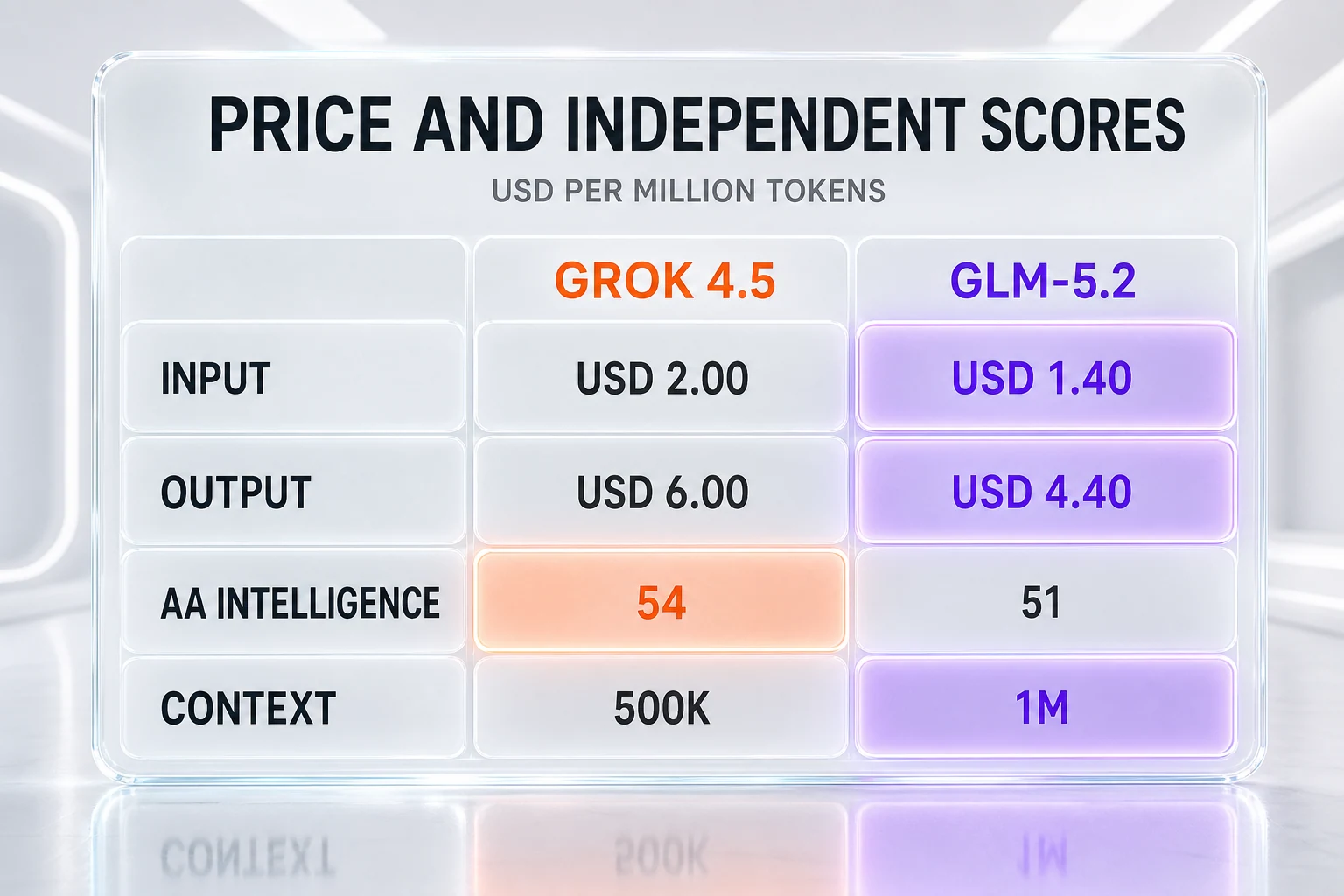
Both models are billed per million tokens. Here is the full picture:
| Pricing (per million tokens) | Grok 4.5 | GLM-5.2 |
|---|---|---|
| Input | USD 2.00 | USD 1.40 |
| Cached input | USD 0.30 | USD 0.26 |
| Output | USD 6.00 | USD 4.40 |
| Flat-rate subscription | Not offered — metered API only | GLM Coding Plan from USD 18 per month |
| Self-hosted cost | Not possible — closed weights | Your own compute; no per-token fee |
GLM-5.2 is cheaper on every metered line, and the cached-input gap is the widest of the three at nearly two times. But look at the magnitude of the win: 1.4 times on input, 1.36 times on output. For context, when we put GLM-5.2 up against GPT-5.5, and when we lined it up against Claude Sonnet 5, the open-weight price argument did a lot of the heavy lifting. Against Grok 4.5 it barely moves the needle. If your monthly inference bill is USD 1,000 on GLM-5.2, the same workload on Grok 4.5 costs somewhere around USD 1,400 — an annoyance, not a business case.
The GLM Coding Plan is the more interesting line in that table. At USD 18 per month for a flat subscription, it changes the shape of the cost curve entirely for a solo developer or a small team doing heavy interactive coding. Grok 4.5 has no equivalent: you pay per token, always. And the self-hosted row is the one that matters at real scale — once you are running enough volume, GLM-5.2's marginal cost is your electricity bill, and Grok's marginal cost never stops being USD 6 per million output tokens.
So the honest read on pricing is: GLM-5.2 wins, and it wins on every line, but this is the first time the closed model has been close enough that price alone will not decide it for anyone. Grok 4.5's pricing is the real story here — it has dragged a closed frontier model into a range where open-weight economics stop being an automatic argument.
Context Window: Two Times the Room
GLM-5.2 ships a 1,000,000-token context window against Grok 4.5's 500,000. Both are large. The question is whether the extra headroom buys you anything.
For most work, it does not. A 500,000-token window already swallows a large codebase, a long document set, or a deep agent trajectory without complaint. If you are summarizing a report or refactoring a service, you will never touch the ceiling on either model.
Where the difference bites is at the extremes: whole-monorepo reasoning, very long agentic runs where the trajectory itself accumulates into hundreds of thousands of tokens, and document workloads where you want to load the entire corpus rather than build a retrieval layer. In those cases the 1,000,000-token window is not a luxury, it is the difference between the task being possible in one pass and needing to be chunked. GLM-5.2 also allows output up to 131,072 tokens, which matters for generation-heavy tasks such as producing a large migration diff in a single response.
This is a clear win for GLM-5.2, but it is a conditional one. Know whether you are actually in the regime where it matters before you let it decide your choice.
Open Weights vs Closed: The Structural Difference
Grok 4.5's weights are closed. You access the model over SpaceXAI's API, in SpaceXAI's regions, under SpaceXAI's terms, at SpaceXAI's prices. If any of those change, you adapt. If the model is deprecated, you migrate. If your data cannot leave your infrastructure, you cannot use it at all.
GLM-5.2's weights are published under an MIT license. You can download them from Zhipu's public repository, run them on your own GPUs, fine-tune them, embed them in a product you ship to customers, and keep serving them for as long as you care to — with no vendor in the loop and no per-token bill. You can also just call Zhipu's hosted API and skip all of that, which is what most people will do.
What open weights actually buy you, in order of how often it matters in practice:
- Data residency. If your data cannot leave your own infrastructure — regulated industries, defense work, health records, or an EU customer with a strict contract — a self-hosted model is not a preference, it is the only option on the table. This is the single most common reason teams choose open weights, and no amount of closed-model quality substitutes for it.
- Price ceiling. A model you host cannot have its price raised on you.
- Continuity. A model you host cannot be deprecated out from under your product.
- Modification. You can fine-tune on your own domain data without shipping that data to anyone.
Against that, closed models buy you the thing nobody wants to admit they want: someone else runs the GPUs. Self-hosting a 753-billion-parameter mixture-of-experts model is not a weekend project. If you do not have the infrastructure and the people to keep it healthy, "you could self-host it" is a theoretical benefit you will never collect, and you should evaluate GLM-5.2 purely on its hosted API — where the price advantage over Grok, as we have seen, is real but modest.
EU Availability: Where This Gets Practical
Grok 4.5 launched blocked in the European Union, a block lifted on July 17, 2026. SpaceXAI held the model back from the EU market on launch, a gap reported as following from the EU AI Act's obligations for general-purpose models judged to carry systemic risk.
This is not a permanent ban, and it is important not to read it as one. It is a staggered rollout. EU availability followed on July 17, 2026, when the xAI release notes recorded that "Grok 4.5 is now available in the API console for EU users." An EU-based team could not call Grok 4.5 for its first nine days; since July 17, 2026 it can. If you are reading this some weeks after publication, check the current status directly with SpaceXAI rather than trusting this paragraph, because this is exactly the kind of fact that goes stale fast. We covered the corporate side of the story when xAI formally became SpaceXAI and the model line kept its name.
GLM-5.2 has no equivalent problem, and the reason is structural rather than diplomatic. Because the weights are open and MIT-licensed, an EU team that cannot or will not send data to a foreign API can simply run the model on its own infrastructure, inside its own jurisdiction. There is no regional gate to wait on, because there is no gatekeeper. That said, the hosted Z.ai API is a different matter: it is operated from China, and if your compliance posture rules out sending data to a Chinese-hosted endpoint, then the hosted route is closed to you and self-hosting is the path. The point is that the path exists at all.
So the honest framing is this: availability was a decisive advantage for GLM-5.2 in the EU for nine days, and is now a non-issue everywhere. What GLM-5.2 keeps is narrower and does not depend on availability: open weights you can run inside your own jurisdiction, which a closed API cannot match. The structural advantage of open weights, on the other hand, does not expire.
Feature-by-Feature Comparison
| Feature | Grok 4.5 | GLM-5.2 | Winner |
|---|---|---|---|
| Artificial Analysis Intelligence Index (independent) | 54 | 51 | Grok 4.5 |
| Artificial Analysis Coding Agent Index v1.3 (independent, read August 2, 2026) | 64.44 (Grok Build harness, high effort). Not yet on the independent SWE-bench leaderboard (too new) | 43.18 (Claude Code harness). Zhipu separately self-reports 62.1 on SWE-bench Pro | Grok 4.5 |
| Input price (per million tokens) | USD 2.00 | USD 1.40 | GLM-5.2 |
| Cached input price (per million tokens) | USD 0.30 | USD 0.26 | GLM-5.2 |
| Output price (per million tokens) | USD 6.00 | USD 4.40 | GLM-5.2 |
| Flat-rate plan for heavy interactive coding | None — metered API only | GLM Coding Plan from USD 18 per month | GLM-5.2 |
| Maximum context window | 500,000 tokens | 1,000,000 tokens (output up to 131,072) | GLM-5.2 |
| Model weights and self-hosting | Closed, proprietary; API only | Open weights, MIT license; self-hostable | GLM-5.2 |
| Availability for an EU-based team | Blocked in the EU at launch under the EU AI Act; SpaceXAI signaled EU availability expected around mid-July 2026 | Available anywhere — self-host the MIT weights; hosted Z.ai API is operated from China | GLM-5.2 |
| Documented hallucination rate | 54% hallucination rate, 52% accuracy on AA-Omniscience (independent) | Not measured on AA-Omniscience | Not comparable |
Pros and Cons
Grok 4.5 — Pros
- Highest independently measured intelligence of the pair: 54 on the Artificial Analysis Intelligence Index against GLM-5.2's 51.
- Well ahead on the independent Artificial Analysis Coding Agent Index v1.3 — 64.44, against GLM-5.2's 43.18.
- Aggressively priced for a closed frontier model at USD 2 per million input tokens and USD 6 per million output tokens.
- Cached input at USD 0.30 per million tokens makes repeated-context workloads cheap.
- Fully managed: no GPUs to run, no infrastructure to keep healthy.
- Function calling, structured outputs, and image input supported out of the box.
Grok 4.5 — Cons
- Blocked in the EU at launch, for nine days, until availability landed on July 17, 2026.
- A 54% hallucination rate on AA-Omniscience (independent) is a serious caveat for factual work without a retrieval or verification layer.
- Closed weights: no self-hosting, no data residency control, no protection against price changes or deprecation.
- Half the context window of GLM-5.2 at 500,000 tokens.
- No flat-rate plan — you pay per token at every volume.
- Still more expensive than GLM-5.2 on every single metered line.
GLM-5.2 — Pros
- Cheapest on every metered line: USD 1.40 input, USD 0.26 cached, USD 4.40 output per million tokens.
- MIT-licensed open weights — self-host, fine-tune, ship it inside your own product.
- Highest-scoring open-weight model in the world at 51 on the independent Artificial Analysis Intelligence Index.
- A 1,000,000-token context window, twice Grok 4.5's, with output up to 131,072 tokens.
- Available anywhere you can put a GPU — no regional gate, no waiting on a rollout.
- The GLM Coding Plan starts at USD 18 per month, which reshapes the economics for heavy interactive coding.
GLM-5.2 — Cons
- Three points behind Grok 4.5 on the independent Artificial Analysis Intelligence Index.
- 21.26 points behind Grok 4.5 on the independent Artificial Analysis Coding Agent Index v1.3 — 43.18 against 64.44 — and its separate 62.1 SWE-bench Pro figure is Zhipu's own, run on Zhipu's harness.
- The hosted API is operated from China, which is disqualifying for some compliance postures.
- Self-hosting a 753-billion-parameter mixture-of-experts model is a serious infrastructure commitment, not a weekend project.
- Open-weight is not open-source: the weights are MIT, but the training code and data are not published.
- Against Grok 4.5 specifically, the price advantage is the thinnest an open-weight model has managed against a closed flagship.
When to Pick Each Model
Pick Grok 4.5 when
- You want the highest independently measured intelligence of the two and you are willing to pay roughly 1.4 times more per token to get it.
- Independent coding evidence matters to you: on the one coding benchmark that measured both models, Grok 4.5 came out 21.26 points ahead, 64.44 against 43.18.
- You have no infrastructure team and no appetite for one — you want a managed API and nothing else.
- You want a closed frontier API with measured capability rather than weights you host yourself.
- Your workload is reasoning-heavy rather than factual-recall-heavy, so the documented hallucination rate is something you can design around with retrieval and verification.
- Your context needs sit comfortably under 500,000 tokens, which for most teams they do.
Pick GLM-5.2 when
- Your data cannot leave your own infrastructure. This is the argument that ends the discussion — self-hosted MIT weights are the only option here, and Grok 4.5 simply cannot compete for the job.
- You are a team that needs weights inside its own jurisdiction rather than a hosted API.
- You want a hard ceiling on cost: at high volume, self-hosting turns your marginal token cost into an infrastructure line item rather than an open-ended bill.
- You genuinely need more than 500,000 tokens of context — whole-repository reasoning, very long agentic trajectories, or corpus-scale document work.
- You are a solo developer or a small team doing heavy interactive coding, where the GLM Coding Plan at USD 18 per month beats metered billing outright.
- You want protection against vendor lock-in, price changes, and deprecation — the things a closed model can do to you regardless of how good it is.
If you are choosing between these two specifically for agentic coding work, it is worth seeing how each stacks up against the rest of the field: GLM-5.2 also faces off against DeepSeek V4, the other heavyweight open-weight contender, and we track the broader landscape in our roundup of the best AI coding tools of 2026.
Final Verdict
GLM-5.2 wins this comparison, narrowly, and not for the reason you would expect.
It does not win on capability. Grok 4.5 is measurably the smarter model — 54 against 51 on the independent Artificial Analysis Intelligence Index — and it is well clear on the independent coding index too, 64.44 against 43.18. If your question is simply "which of these two is the better model," the honest answer is Grok 4.5, and we are not going to dress that up.
GLM-5.2 wins because of everything that surrounds the model. It is cheaper on every line. It has twice the context. Its weights are MIT-licensed and self-hostable, which means it can go places Grok 4.5 structurally cannot — inside a regulated environment, inside an EU data boundary, inside a product you ship. And it works today, everywhere, with no regional gate to wait on.
The thing that makes this matchup genuinely interesting, though, is how close Grok 4.5 came. At USD 2 in and USD 6 out per million tokens, SpaceXAI has priced a closed frontier model into a range where the open-weight cost argument nearly stops working. A 1.4 times price gap is not the 10 times gap that has been carrying open-weight models to easy wins all year. If SpaceXAI keeps pricing like this, the next version of this article may well come out the other way — and open-weight models will have to start winning on merit rather than on the bill.
Two caveats before you decide. First, Grok's 54% hallucination rate on AA-Omniscience is independently measured and it is high; if you are pointing a model at factual work, that number deserves more of your attention than the 3-point intelligence lead. Second, GLM-5.2's SWE-bench Pro claim rests on Zhipu's own harness: treat 62.1 as a vendor number and not as a verified fact. Where an independent lab measured both, on the Coding Agent Index v1.3, GLM-5.2 sits at 43.18 against Grok 4.5's 64.44 — and if independently measured coding ability is what you are actually buying, that gap is a real reason to pick Grok instead.
Frequently Asked Questions
Is Grok 4.5 better than GLM-5.2?
On independently measured intelligence, yes. Grok 4.5 scores 54 on the Artificial Analysis Intelligence Index against GLM-5.2's 51, and it is well ahead on the independent Artificial Analysis Coding Agent Index v1.3 as well, 64.44 against 43.18. But GLM-5.2 is cheaper on every metered line, has twice the context window, ships MIT-licensed open weights you can self-host, and is available everywhere. We give the overall verdict to GLM-5.2 on deployability, not on capability.
Is Grok 4.5 available in the EU?
Not at launch. Yes, since July 17, 2026. SpaceXAI held Grok 4.5 back from the European Union at launch, a gap reported as following from the EU AI Act's obligations for general-purpose models judged to carry systemic risk. It was a staggered rollout rather than a permanent ban: EU availability landed on July 17, 2026. Because this is exactly the kind of fact that changes quickly, check the current status with SpaceXAI directly before you plan around it. GLM-5.2, by contrast, has open MIT-licensed weights and can be self-hosted inside the EU with no regional gate at all — a difference that survives Grok 4.5's opening.
How much cheaper is GLM-5.2 than Grok 4.5?
GLM-5.2 costs USD 1.40 per million input tokens and USD 4.40 per million output tokens. Grok 4.5 costs USD 2 per million input tokens and USD 6 per million output tokens. That works out to roughly 1.4 times on input and 1.36 times on output. GLM-5.2 is cheaper, but this is the narrowest price gap any open-weight flagship has managed against a closed one — in most other matchups the open model undercuts by 5 to 30 times.
What is Grok 4.5's SWE-bench score?
Grok 4.5 does not have one on the independent leaderboard — it is not yet listed there, because the model is too new. Anyone quoting you an independent SWE-bench Verified percentage for Grok 4.5 is quoting a number that does not exist. What Grok 4.5 does have is an Artificial Analysis Coding Agent Index v1.3 result of 64.44 through the Grok Build harness at high effort, which is independently measured. We report that and nothing more.
Can I compare Grok's coding index to GLM's SWE-bench Pro score of 62.1?
No, and it is worth understanding why. They are different benchmarks measuring different things, and they come from different sources: Grok's 64.44 is the Artificial Analysis Coding Agent Index v1.3, measured independently, while GLM's 62.1 on SWE-bench Pro is self-reported by Zhipu using Zhipu's own harness. Putting the two numbers side by side would be wrong twice over — wrong benchmark and wrong attribution. What does compare is the index itself, where both models are charted: Grok 4.5 at 64.44 and GLM-5.2 at 43.18. That is the row our comparison table carries, and the vendor figure is the one we leave out.
Is GLM-5.2 open source?
It is open-weight, which is not quite the same thing. Zhipu publishes the model weights under an MIT license, so you can download them, run them on your own hardware, fine-tune them, and ship them commercially. What Zhipu does not publish is the training code or the training data. You get the finished model, not the recipe. For most practical purposes that is enough; for full auditability and reproducibility, it is not.
Which model has the bigger context window?
GLM-5.2, by a factor of two: 1,000,000 tokens against Grok 4.5's 500,000, with output up to 131,072 tokens. Both are large enough for ordinary work. The gap only matters at the extremes — whole-repository reasoning, very long agentic runs, or loading an entire document corpus in a single pass instead of building a retrieval layer.
Should I worry about Grok 4.5's hallucination rate?
If you are using it for factual work, yes. Artificial Analysis measured Grok 4.5 at 52% accuracy with a 54% hallucination rate on AA-Omniscience — independently measured, and high. That does not make the model unusable, but it does mean you should not point it at factual questions without a retrieval layer or a verification step in front of it. GLM-5.2 has not been measured on AA-Omniscience, so we cannot tell you it does better — only that Grok's weakness here is documented while GLM's is simply unknown.
Can I self-host Grok 4.5?
No. Grok 4.5's weights are closed and proprietary — you reach the model through SpaceXAI's API or the Grok apps, and there is nothing to download. If self-hosting is a requirement for you, whether for data residency, cost control, or continuity, GLM-5.2 is the only one of these two models that can meet it.
Which is better for a team with strict data residency rules?
GLM-5.2, without qualification. Its MIT-licensed weights can be downloaded and run entirely inside your own infrastructure and your own jurisdiction, which means no data ever leaves your boundary. Grok 4.5 is API-only and cannot meet that requirement at any price. Note that this argument applies to self-hosted GLM-5.2, not the hosted Z.ai API, which is operated from China and carries its own compliance considerations.
Does Grok 4.5's price make it the value pick among closed models?
It is the most aggressively priced closed frontier model on the market, at USD 2 per million input tokens and USD 6 per million output tokens — well under half what the other closed flagships charge. That is the genuinely notable thing about it. Elon Musk has described the model as "Opus-class, much faster," but that is a vendor claim rather than a measured result, and we treat it as such. What is measured is the independent Artificial Analysis Intelligence Index score of 54, which places it fourth overall.
Which should I pick if I just want the best agentic coding model of the two?
Grok 4.5, on the evidence available. Both models are charted on the Artificial Analysis Coding Agent Index v1.3 and Grok 4.5 is 21.26 points clear — 64.44 against 43.18 — and it leads on general intelligence as well. GLM-5.2's separate SWE-bench Pro figure of 62.1 is vendor self-reported, which may well prove accurate but has not been independently reproduced. If you need to self-host, that changes the answer immediately, because then GLM-5.2 is the only candidate.
Sources and references
Every figure on this page is attributed to whoever produced it. Vendor documentation and independent measurement are listed separately and never merged into a single ranking.
- Hugging Face — zai-org/GLM-5.2 (published weights and license)
- Artificial Analysis — GLM-5.2 (independent index score and cost per task)
- SpaceXAI — Model documentation (specifications and pricing)
- Artificial Analysis — Grok 4.5 (independent index score and cost per task)
- Artificial Analysis — Model leaderboard (Intelligence Index scores and cost per task across configurations)
Our Verdict
GLM-5.2 wins this comparison, narrowly, and not on capability. Grok 4.5 is measurably the smarter model — 54 against 51 on the independent Artificial Analysis Intelligence Index — and it is well ahead on the independent Artificial Analysis Coding Agent Index v1.3, 64.44 against 43.18. GLM-5.2 wins on everything that surrounds the model: it is cheaper on every metered line (USD 1.40 input and USD 4.40 output per million tokens against USD 2 and USD 6), it has twice the context at 1,000,000 tokens, its MIT-licensed weights are self-hostable, and it works everywhere today while Grok 4.5 launched blocked in the EU pending a rollout expected around mid-July 2026. Pick Grok 4.5 if you want the best independently measured model and can live with a managed, closed API. Pick GLM-5.2 if you need self-hosting, data residency, a hard cost ceiling, or more than 500,000 tokens of context. The story of this matchup is how close Grok came: at a 1.4 times price gap, SpaceXAI has priced a closed flagship into a range where open-weight economics stop being an automatic argument.
Choose Grok 4.5
SpaceXAI's reasoning model — Opus-class speed at $2 and $6 per million tokens, 500K context, available to EU users since July 17, 2026; succeeded by Grok 4.6 on August 12.
Try Grok 4.5 →Choose GLM-5.2
Zhipu AI open-weight coding flagship: 753B MoE (~40B active), 1M context, MIT license, headline SWE-bench Pro 62.1 (vendor self-reported); GLM Coding Plan from around $18 per month or $1.40 in / $4.40 out per million tokens.
Try GLM-5.2 →Frequently Asked Questions
Is Grok 4.5 better than GLM-5.2?
GLM-5.2 wins this comparison, narrowly, and not on capability. Grok 4.5 is measurably the smarter model — 54 against 51 on the independent Artificial Analysis Intelligence Index — and it is well ahead on the independent Artificial Analysis Coding Agent Index v1.3, 64.44 against 43.18. GLM-5.2 wins on everything that surrounds the model: it is cheaper on every metered line (USD 1.40 input and USD 4.40 output per million tokens against USD 2 and USD 6), it has twice the context at 1,000,000 tokens, its MIT-licensed weights are self-hostable, and it works everywhere today while Grok 4.5 launched blocked in the EU pending a rollout expected around mid-July 2026. Pick Grok 4.5 if you want the best independently measured model and can live with a managed, closed API. Pick GLM-5.2 if you need self-hosting, data residency, a hard cost ceiling, or more than 500,000 tokens of context. The story of this matchup is how close Grok came: at a 1.4 times price gap, SpaceXAI has priced a closed flagship into a range where open-weight economics stop being an automatic argument.
Which is cheaper, Grok 4.5 or GLM-5.2?
Grok 4.5 starts at $2 in / $6 out per M tokens. GLM-5.2 starts at $1.4 in / $4.4 out per M tokens. Check the pricing comparison section above for a full breakdown.
What are the main differences between Grok 4.5 and GLM-5.2?
The key differences span across 10 features we compared. For Artificial Analysis Intelligence Index (independent), Grok 4.5 offers 54 while GLM-5.2 offers 51. For Artificial Analysis Coding Agent Index v1.3 (independent, read August 2, 2026), Grok 4.5 offers 64.44 (Grok Build harness, high effort). Not yet on the independent SWE-bench leaderboard (too new) while GLM-5.2 offers 43.18 (Claude Code harness). Zhipu separately self-reports 62.1 on SWE-bench Pro. For Input price (per million tokens), Grok 4.5 offers USD 2.00 while GLM-5.2 offers USD 1.40. See the full feature comparison table above for all details.