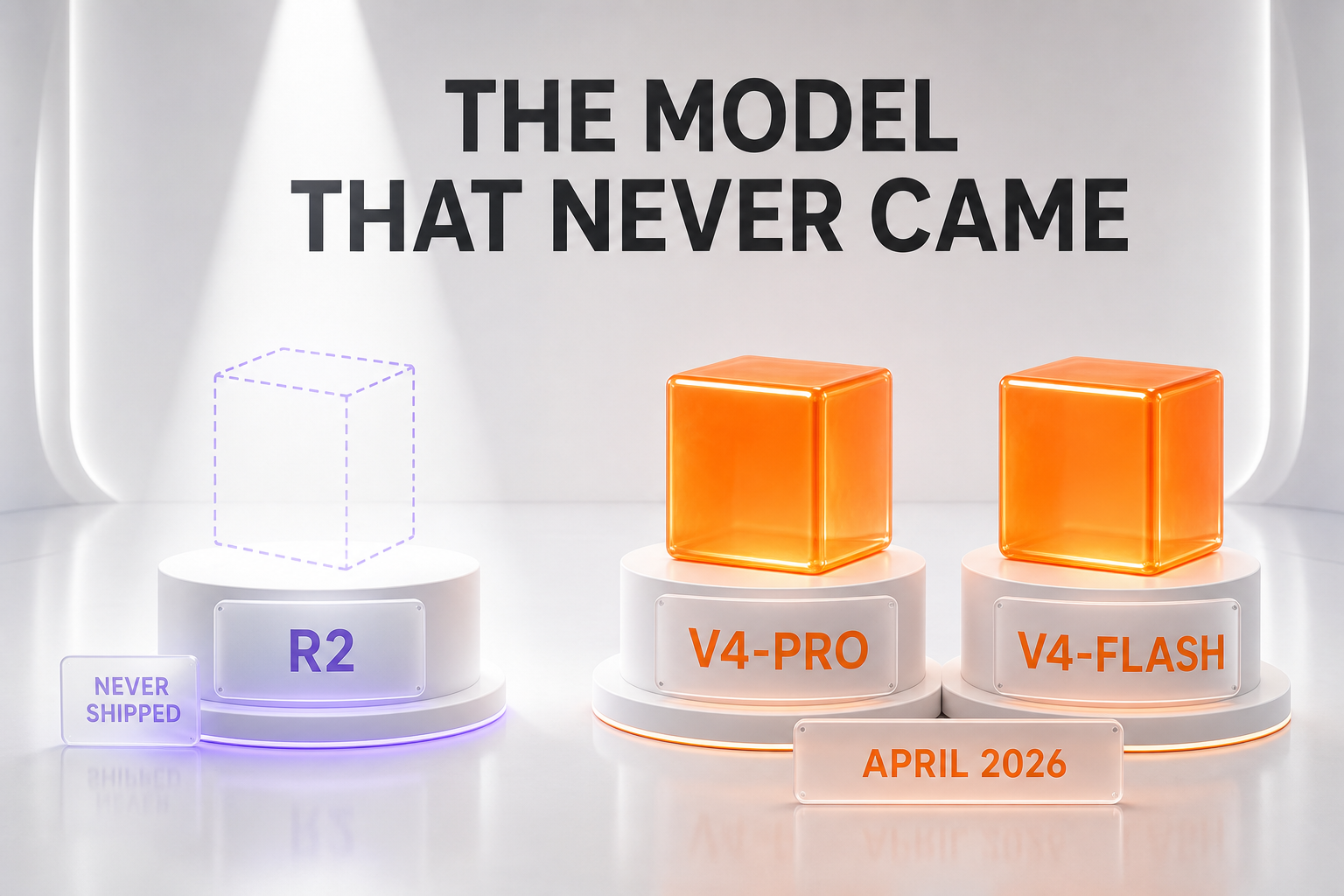
DeepSeek R2 does not exist. As of July 13, 2026, it has never been released, and DeepSeek has never confirmed a release date for it. The hardest proof is DeepSeek's own API documentation: the model list contains exactly four names — deepseek-v4-flash, deepseek-v4-pro, and the two legacy aliases deepseek-chat and deepseek-reasoner, both of which are being deprecated on July 24, 2026. There is no deepseek-r2, and there never has been. Reuters reported that DeepSeek had set no timeline for R2 because founder Liang Wenfeng was not satisfied with its performance. What DeepSeek shipped instead is DeepSeek V4 — V4-Pro and V4-Flash, released on April 24, 2026 — and that is the model you are actually looking for. Every R2 spec sheet you have seen, with its parameter counts, its prices, and its benchmark scores, is built on leaks that DeepSeek never confirmed.
Key Takeaways
- R2 was never released. No launch, no announcement, no confirmed date — ever. It is not a delayed product with a slipping ship date. It is a model the public has never seen.
- The API model list settles it. DeepSeek's official documentation lists
deepseek-v4-flash,deepseek-v4-pro,deepseek-chatanddeepseek-reasoner. No R2. You cannot call a model that was never shipped. - Why it stalled: Reuters reported that Liang Wenfeng, DeepSeek's founder, was not satisfied with R2's performance, and no launch timeline was fixed. Reporting since has added chip supply and training-data constraints as contributing pressures.
- What shipped instead: DeepSeek V4 landed on April 24, 2026 — V4-Pro (1.6-trillion-parameter Mixture-of-Experts, 49 billion active), 1M context, open weights under MIT. Its thinking mode is DeepSeek's 2026 reasoning model. Then came DSpark, an open-source inference framework, in late June 2026.
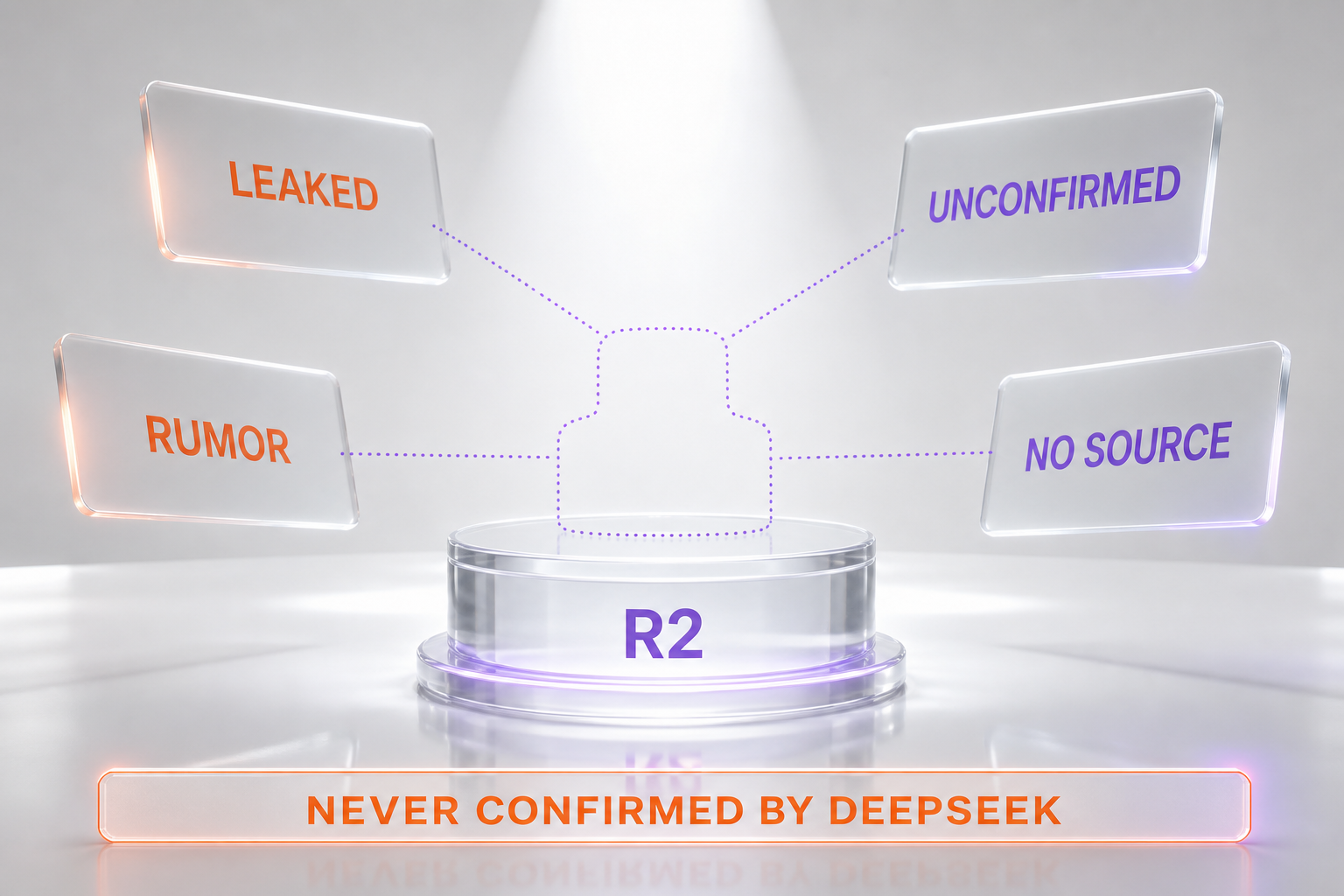
- Every R2 spec in circulation is unverified. The famous numbers — 685 billion parameters, 37 billion active, 128K context, a headline price per million tokens, "88 to 95 percent of Opus" — come from leaks and from aggregators quoting each other. They have never been confirmed by DeepSeek, and different sources cite specs that contradict each other outright.
The Model Everyone Was Waiting For
To understand why R2 became the most-searched model that does not exist, you have to remember what R1 did.
In January 2025, DeepSeek released R1, an open-weight reasoning model that performed close to the frontier at a fraction of the cost of the American labs. It was not a quiet research drop. It knocked hundreds of billions of dollars off US tech valuations in a single trading session, put a Chinese lab on the front page of every financial newspaper on earth, and forced a genuine strategic rethink at companies that had assumed a comfortable moat. R1 is real. R1 shipped. You can still download the weights.
So the sequel wrote itself. If R1 did that, R2 would do more. Through 2025 the expectation hardened into something close to a scheduled event: R2 was coming in May, then in June, then in August, then imminently, then any week now. Publications ran countdowns. Aggregators built spec sheets. Forums traded parameter counts as if they had been announced.
None of it came from DeepSeek. The company never announced R2, never confirmed a launch window, and never published a specification for it. The entire apparatus of anticipation was constructed on the outside, out of leaks, unnamed sources, and — increasingly — other people's articles.
Then DeepSeek did something nobody's countdown had planned for. It skipped the sequel.
Why R2 Never Shipped
The most credible account of what happened comes from Reuters, which reported that DeepSeek had not set a timeline for R2 because Liang Wenfeng, the founder, was not satisfied with the model's performance. Not a launch delay for logistics. Not a regulatory hold. A founder looking at a model that was supposed to follow R1, and declining to put his name on it.
Subsequent reporting layered on the structural pressures that made that call harder to reverse. Export controls had cut DeepSeek off from the highest-end NVIDIA accelerators, compressing training throughput. The volume and quality of the training data available for a much larger reasoning model was described as a real constraint. Reports pointed at code generation and non-English reasoning as specific weak spots the team was still trying to fix.
Whatever the precise mix, the outcome is not ambiguous: R2 never reached a bar its own creator was willing to ship at, and DeepSeek chose silence over a soft launch. That is worth sitting with for a second, because it is the least cynical thing in this entire story. A company under enormous pressure to produce a sequel, with the whole industry watching, decided that shipping something disappointing was worse than shipping nothing. Then it went and solved the problem a different way.
The Hard Proof: DeepSeek's Own Model List
Arguments about rumors can go around forever. The API documentation cannot. If a model exists and you can pay to use it, it has a name in the model list. Here is what DeepSeek's official API documentation lists:
deepseek-v4-flash— current.deepseek-v4-pro— current.deepseek-chat— legacy alias, deprecated on July 24, 2026.deepseek-reasoner— legacy alias, deprecated on July 24, 2026.
That is the complete list. There is no deepseek-r2. There is no R2 endpoint, no R2 preview, no R2 in beta behind a waitlist.
The two legacy names are worth understanding, because they are where a lot of confusion lives. deepseek-chat and deepseek-reasoner now map to the non-thinking and thinking modes of deepseek-v4-flash respectively. So when people say "I'm using DeepSeek's reasoner," they are not using some surviving R-series model. They are using V4-Flash with thinking turned on — and after July 24, 2026, that alias goes away and they will need to call V4 directly.
This is the detail that quietly closes the case. DeepSeek did not shelve reasoning. It folded reasoning into V4 as a mode, which is exactly why a separate R2 stopped needing to exist.
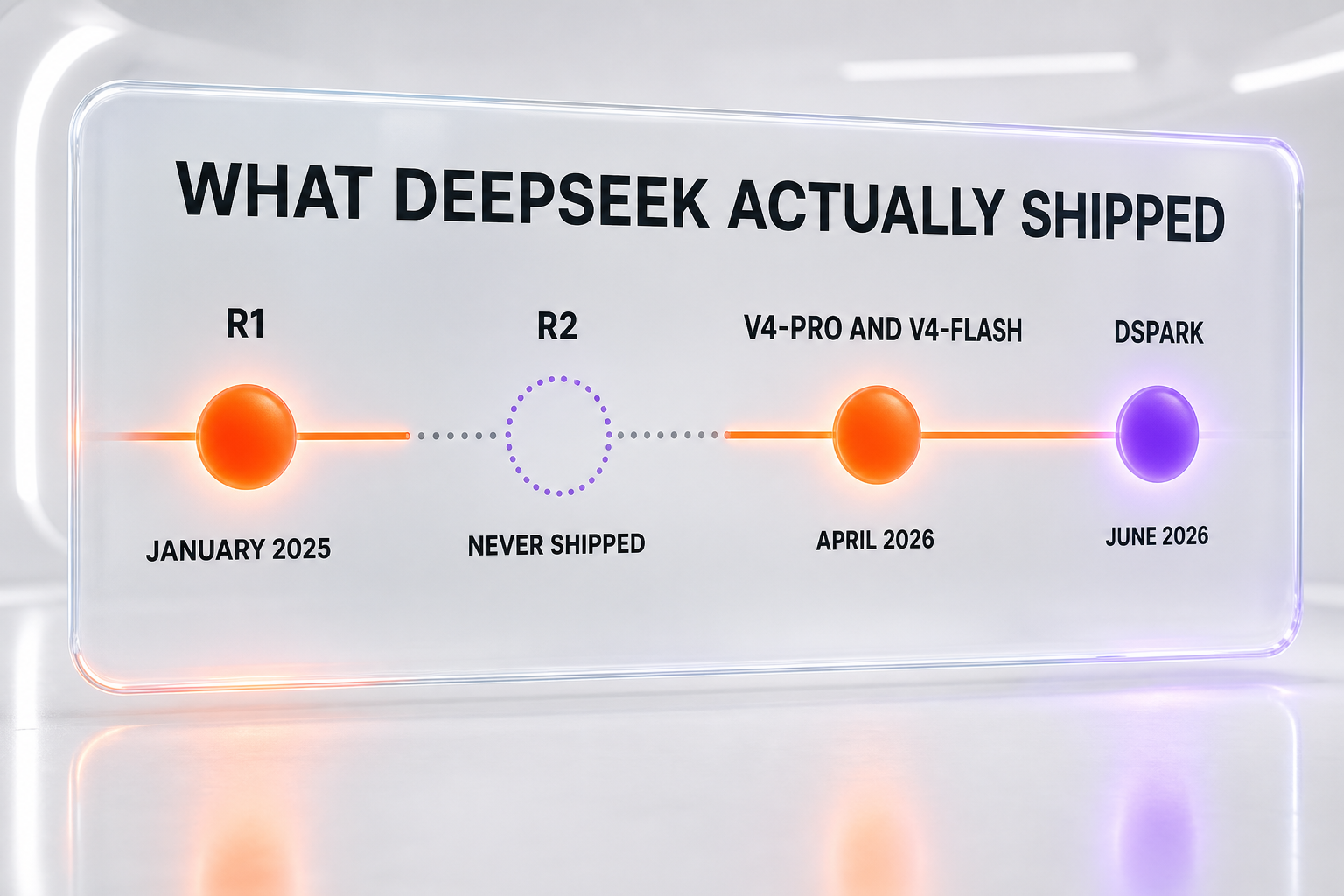
What DeepSeek Shipped Instead
While the internet was waiting for a sequel to a reasoning model, DeepSeek was building a flagship that absorbed reasoning into itself.
DeepSeek V4, April 24, 2026
V4 arrived in two variants. V4-Pro is a Mixture-of-Experts model with 1.6 trillion total parameters and 49 billion active per forward pass, a 1-million-token context window, and open weights released under the MIT license. V4-Flash is the smaller, faster, cheaper sibling. Both are available through the API and both can be downloaded and self-hosted, because MIT means MIT: commercial use, modification, redistribution, no permission required.
The pricing is the part that carries R1's DNA. V4-Pro runs at $0.435 per million input tokens (cache miss) and $0.87 per million output tokens. That rate started life as a 75 percent promotional discount with an expiry date, and DeepSeek then made it the permanent list price. On independent evaluation, V4-Pro scores 44 on the Artificial Analysis Intelligence Index (v4.1) — a third-party measurement, not a vendor claim.
It is also the model that was, notably, trained on Huawei Ascend silicon rather than NVIDIA — the same export-control squeeze that helped stall R2 turned into the constraint that shaped V4. Our full breakdown of the launch is in the V4 launch analysis, and the earlier reporting that predicted a trillion-parameter open-weight flagship is here.
DSpark, late June 2026
The second thing DeepSeek shipped is not a model at all. DSpark is an open-source speculative decoding framework, released under the MIT license, that speeds up how fast V4 models emit tokens — a small draft model proposes candidates, and the full model verifies them in batches instead of generating one token at a time. DeepSeek reports per-user generation speedups in the range of 60 to 85 percent for V4-Flash against its own previous production baseline. Those figures are self-reported by DeepSeek and have not been independently reproduced, so treat them as a vendor claim rather than a measured fact.
Taken together, the two releases describe a company that stopped chasing a headline model and went after the cost of serving tokens instead. That is a less glamorous strategy than "R2 destroys OpenAI." It is also the one that actually shipped.
The Phantom Specs That Circulate Anyway
Search for R2 today and you will find spec sheets. Detailed ones. Parameter counts, active-parameter counts, context windows, prices per million tokens, benchmark percentages, sometimes even review scores out of ten. They look like documentation. They are not.
The numbers that circulate most widely include: 685 billion parameters with 37 billion active, a context window of 128K, an input price around $0.14 per million tokens, performance at 88 to 95 percent of Claude Opus, and a 32B dense variant scoring 92.7 percent on AIME 2025. Not one of these has ever been confirmed by DeepSeek. Every one of them traces back to leaks, to unnamed sources, or to another article that was itself quoting a leak.
Here is the tell that should end the argument. The rumors do not even agree with each other. The 685-billion-parameter figure is the one most commonly reprinted — but other widely-cited write-ups describe R2 as a roughly 1.2-trillion-parameter model with a context window up to 1M. Both cannot be true. Neither has a primary source. When the "specs" of a product contradict each other by a factor of nearly two, you are not looking at leaked documentation. You are looking at guesses that acquired the grammar of facts by being repeated.
This is where we owe our own readers a correction. ThePlanetTools previously published a tool page for DeepSeek R2, built on exactly these circulating specifications, and it carried a review score. That page was wrong — you cannot review a model that does not exist — and this article replaces it. We were part of the problem we are describing, which is precisely why we are describing it.
The mechanism is worth naming, because it will happen again with the next phantom model. A leak appears. An aggregator writes it up with hedged language. A second site copies the first and drops the hedges. A third copies the second and adds a spec table. By the fourth iteration the numbers are in a comparison chart with a price and a score, and the hedges are gone entirely. Nobody lied. Everybody just stopped checking upstream — and the only thing that reliably catches it is going back to the primary source, which in this case is a model list that takes ten seconds to read.
What to Use Today Instead of Waiting for R2
If you arrived here searching for R2, you almost certainly wanted one of three things. Here is where each one actually lives.
- You wanted DeepSeek's reasoning model. That is V4-Pro in thinking mode, or V4-Flash in thinking mode if you are cost-sensitive. This is not a substitute for R2 — it is the successor R2 was going to be, delivered as a mode inside the flagship instead of a separate model. Full review: DeepSeek V4.
- You wanted frontier reasoning at a Chinese-lab price. V4-Pro at $0.435 per million input tokens and $0.87 per million output tokens is the current answer, and it is cheaper than the price the R2 rumors were promising for a model that never shipped.
- You wanted open weights you can run yourself. V4 is MIT-licensed and downloadable. If that is the appeal, start with our guide to self-hosting an open-weight model, and if you are still deciding whether open weights are the right call at all, the open versus closed trade-off is laid out here.
What you should not do is architect around R2. There is no roadmap to build against, no date to plan for, and no specification to design to. Treat R2 as what it is: a model that does not exist.
Will R2 Ever Arrive?
Nobody outside DeepSeek knows, and anyone who tells you a date is guessing. But the structural logic now points away from it.
The reason R2 needed to exist was that reasoning was a separate capability that needed a separate model. In 2026 it is not — it is a mode. V4 has a thinking mode, and DeepSeek has just deprecated the standalone deepseek-reasoner alias in favor of calling V4 directly. A company does not usually retire the reasoning endpoint and simultaneously plan to launch a standalone reasoning model. The most plausible reading is that R2's job was quietly reassigned to V4's thinking mode, and the name was left behind.
It is still possible that DeepSeek ships something called R2 tomorrow, or folds the work into a future V-series release, and if it does we will cover it from primary sources on the day. Two things would change this page immediately: an R2 entry appearing in the official API model list, or an announcement from DeepSeek itself. A leak would not. A spec sheet on an aggregator site would not. Another article quoting another article would not.
Until one of those two things happens, the honest answer to "when is DeepSeek R2 coming out?" is the one almost nobody will give you: it isn't, and it may never have been.
Frequently Asked Questions
Is DeepSeek R2 released?
No. As of July 13, 2026, DeepSeek R2 has never been released, and DeepSeek has never confirmed a release date for it. It does not appear in DeepSeek's official API model list, which contains only deepseek-v4-flash, deepseek-v4-pro, and the two legacy aliases deepseek-chat and deepseek-reasoner. There is no R2 endpoint, no preview, and no waitlist.
What are DeepSeek R2's specs?
R2 has no specifications, because DeepSeek never released it and never published any. The figures you will find online — 685 billion parameters with 37 billion active, a 128K context window, roughly $0.14 per million input tokens, 88 to 95 percent of Claude Opus performance — all come from unconfirmed leaks and from aggregator sites quoting each other. They contradict each other, too: other widely-cited write-ups describe R2 as a roughly 1.2-trillion-parameter model with up to 1M context. None of it is confirmed by DeepSeek.
Why was DeepSeek R2 delayed?
Reuters reported that DeepSeek had not set a launch timeline for R2 because founder Liang Wenfeng was not satisfied with the model's performance. Later reporting added structural pressures: export controls limiting access to top-end NVIDIA accelerators, constraints on the volume and quality of available training data, and specific weaknesses in code generation and non-English reasoning. DeepSeek chose not to ship rather than ship something below its own bar.
Is R2 the same as R1?
No, and the difference matters. R1 is real: DeepSeek released it in January 2025, it is an open-weight reasoning model, and it triggered a global market shock by matching near-frontier performance at a fraction of the cost. R2 was its expected successor, and it was never delivered. If you are downloading or calling R1, you are using a model that exists. R2 is not a newer version of anything you can access.
What should I use instead of DeepSeek R2?
DeepSeek V4, released April 24, 2026. For reasoning tasks, use V4-Pro in thinking mode, or V4-Flash in thinking mode if cost matters more than raw capability. V4-Pro is a 1.6-trillion-parameter Mixture-of-Experts model with 49 billion parameters active per forward pass, a 1-million-token context window, and open weights under the MIT license. It is the reasoning model people are actually looking for when they search for R2.
Does DeepSeek R2 have an API model name?
No. There is no deepseek-r2 model name and there never has been. DeepSeek's official API documentation lists exactly four: deepseek-v4-flash and deepseek-v4-pro, which are current, plus deepseek-chat and deepseek-reasoner, which are legacy aliases being deprecated on July 24, 2026. If a tutorial or code sample tells you to call deepseek-r2, that call will fail, because the model does not exist.
What happened to deepseek-reasoner?
It is being deprecated on July 24, 2026. It was never a standalone R-series model in the first place: deepseek-reasoner and deepseek-chat are legacy aliases that map to the thinking and non-thinking modes of deepseek-v4-flash respectively. After the deprecation date you call V4 directly and select the mode. This is also the clearest signal that reasoning at DeepSeek is now a mode inside the flagship rather than a separate product line.
Where do the leaked R2 specs come from?
From unnamed sources, forum posts, and content aggregators reprinting each other. The pattern is consistent: a leak appears with hedged language, a second site copies it and drops the hedges, a third adds a spec table, and by the fourth iteration the guesses are sitting in a comparison chart with a price and a benchmark score. No primary source exists. DeepSeek has never published an R2 specification, a price, or a benchmark result.
Is DeepSeek V4 a reasoning model?
Yes, in the sense that matters. V4 ships with a thinking mode that performs the extended chain-of-thought reasoning that the R-series was built for, and a non-thinking mode for fast general responses. That is why a separate R2 stopped being necessary: rather than maintaining a distinct reasoning model, DeepSeek folded reasoning into the V4 flagship as a mode you toggle.
How much does DeepSeek V4 cost?
V4-Pro is priced at $0.435 per million input tokens on a cache miss and $0.87 per million output tokens. That rate began as a 75 percent promotional discount with an expiry date, and DeepSeek subsequently made it the permanent list price. V4-Flash is cheaper still. The weights for both are also free to download and self-host under the MIT license, which permits commercial use.
Will DeepSeek ever release R2?
Nobody outside DeepSeek knows, and any date you see quoted is a guess. The structural logic argues against it: DeepSeek has folded reasoning into V4 as a mode and is retiring the standalone deepseek-reasoner alias, which is not what a company does immediately before launching a standalone reasoning model. Two things would confirm a change: an R2 entry appearing in the official API model list, or an announcement from DeepSeek itself. A leak would not.
Why do so many sites review a model that does not exist?
Because "DeepSeek R2 release date" and "DeepSeek R2 specs" are heavily searched, and unconfirmed leaks are easier to publish than verified facts. Once one site prints a spec table, others copy it and the hedging language falls away. We are not innocent here: ThePlanetTools previously published a DeepSeek R2 tool page based on those circulating specs, complete with a review score. It was wrong, and this article replaces it. The check that catches this takes ten seconds — read the vendor's own API model list.
Sources
- Models & Pricing — DeepSeek API Docs — the official model list. Contains deepseek-v4-flash, deepseek-v4-pro, deepseek-chat and deepseek-reasoner, the last two deprecated on July 24, 2026. Contains no R2. This is the primary source for this article.
- DeepSeek R2: Release Date, Rumors & What to Expect — Fello AI. Confirms that as of July 2026 R2 has not launched and DeepSeek has never confirmed a release date, and attributes the hold to Liang Wenfeng's dissatisfaction with performance, citing Reuters.
- DeepSeek Roadmap and Rumors: Official vs Reported — separates confirmed releases from reporting. States plainly that R2 "is not listed as a current public API model," and documents the V4-Pro and V4-Flash specifications and the July 24, 2026 deprecation of the legacy aliases.
- DeepSeek R2 Model Launch Reportedly Delayed Amid Huawei Ascend Chip Hurdles — TrendForce, relaying the Reuters reporting on the absent timeline plus the hardware and training-data constraints.
- DeepSeek open sources DSpark, a new framework to speed up LLM inference by up to 85% — VentureBeat, on the June 2026 release. The speedup figures in that reporting are DeepSeek's own and have not been independently reproduced.