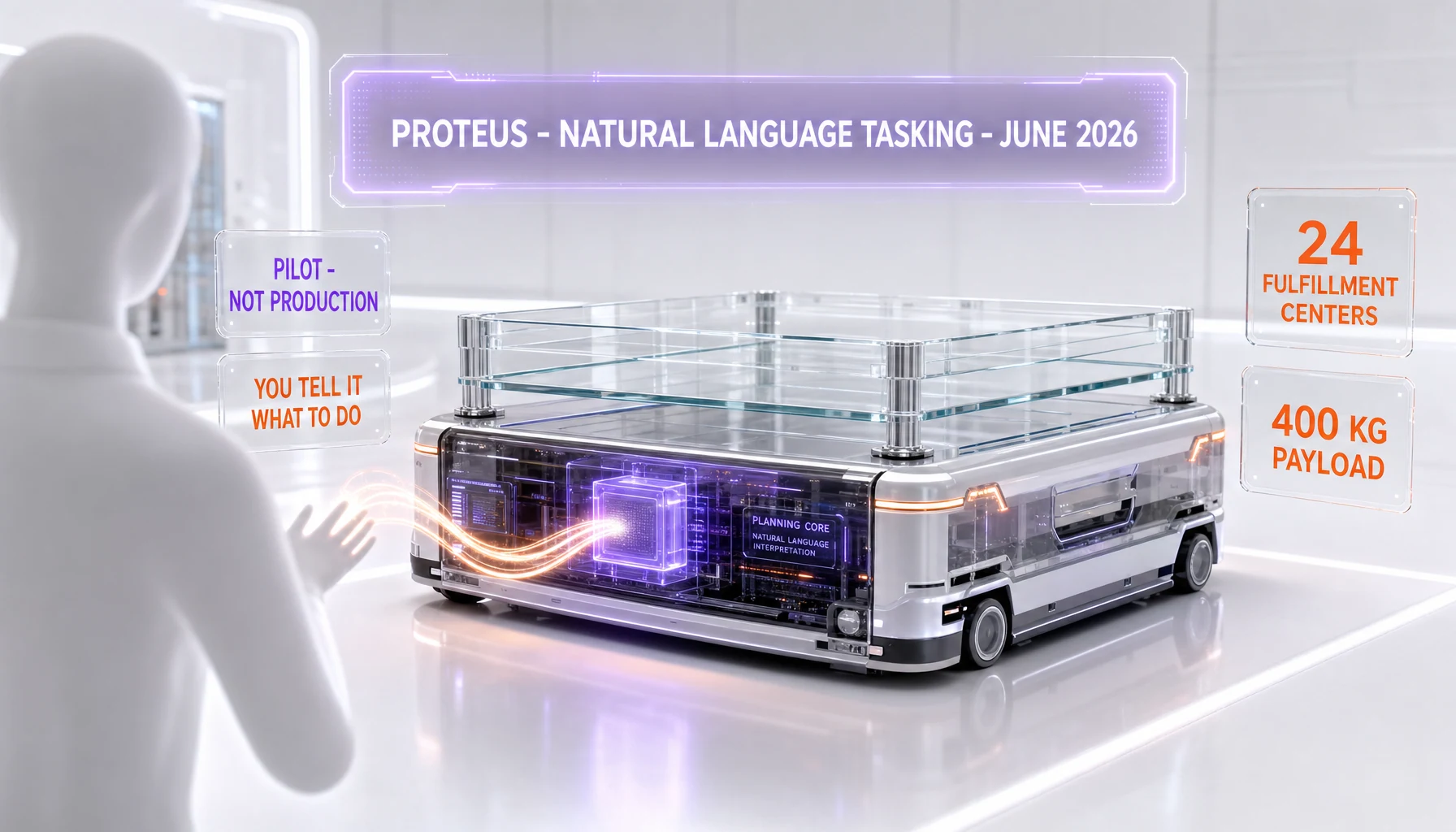
Amazon unveiled a next-generation version of its autonomous warehouse robot, Proteus, that can interpret tasks described in plain natural language instead of requiring dedicated software and manual programming. Announced on June 4, 2026 at Amazon's "Delivering the Future" event in London, the upgrade lets an operator describe what needs to happen — and the robot itself determines the priority, the route, and the timing. The capability is in pilot and lab testing, not full production: the current Proteus fleet already runs across 24 US fulfillment centers, and Amazon ties the work to a planned European expansion exceeding 10 billion euros, with broader deployment targeted for the first half of 2027.
That single sentence — "you tell it what needs to be done, it figures out the rest" — is the entire story, and also the part most likely to be overstated. So let us be precise about what was shown, what was not, and why a warehouse robot understanding natural language matters more than another humanoid demo reel.
What Amazon actually announced
At "Delivering the Future" in London on June 4, 2026, Amazon presented a new generation of Proteus — its first fully autonomous mobile robot — that can be assigned work through natural-language instructions. Rather than loading a job through a dedicated control system and pre-programmed routines, an operator describes the task in ordinary language, and the robot interprets the request and executes it on its own.
Scott Dresser, vice president of Amazon Robotics, framed the shift in plain terms: "You tell it what needs to be done. It figures out the priority, the route, the timing. It becomes your assistant for material movement." Read that quote carefully. The novelty is not that Proteus moves heavy carts — it has done that for years. The novelty is the command surface: a human can now hand the robot an objective instead of a program.
The headline specs are unchanged and verified. Proteus operates across 24 US fulfillment centers and is rated to move loads of roughly 400 kg (about 882 lb). The natural-language capability was demonstrated in connection with a planned European expansion exceeding 10 billion euros (around 11.6 billion US dollars), with wider deployment guided toward the first half of 2027.
Key facts at a glance
- What: A new generation of Amazon's Proteus robot that accepts natural-language task descriptions.
- When and where: Revealed June 4, 2026 at the "Delivering the Future" event in London.
- Who: Scott Dresser, VP of Amazon Robotics, presented the capability.
- Status: Pilot and lab testing — not yet full production. Broader rollout targeted for the first half of 2027.
- Scale today: Current Proteus fleet runs in 24 US fulfillment centers, rated to move about 400 kg per load.
- Money: Tied to a European expansion exceeding 10 billion euros (around 11.6 billion US dollars).
Why we say natural language, not voice
This distinction matters, and most coverage will blur it. The reporting describes natural-language instructions — meaning the robot parses task descriptions written or expressed in ordinary human language — not necessarily spoken voice commands shouted across a noisy warehouse floor. There is a meaningful gap between "type or hand the robot a described task and it plans the work" and "talk to the robot and it obeys." The sources point to the former.
Why be this careful? Because the leap from a graphical control panel to a language interface is already significant on its own. Voice adds a separate stack of problems — far-field microphones, ambient noise rejection, speaker identification, safety confirmation — that warehouses have historically struggled with. Amazon may get there, but conflating "understands language" with "responds to your voice" inflates the claim beyond what was shown. We are describing a language-driven task interface, full stop.
The right mental model is not a robot you talk to. It is a robot you brief — the same way you would brief a new colleague on a task, and trust them to sort out the order of operations.
How a language-driven robot plans a task
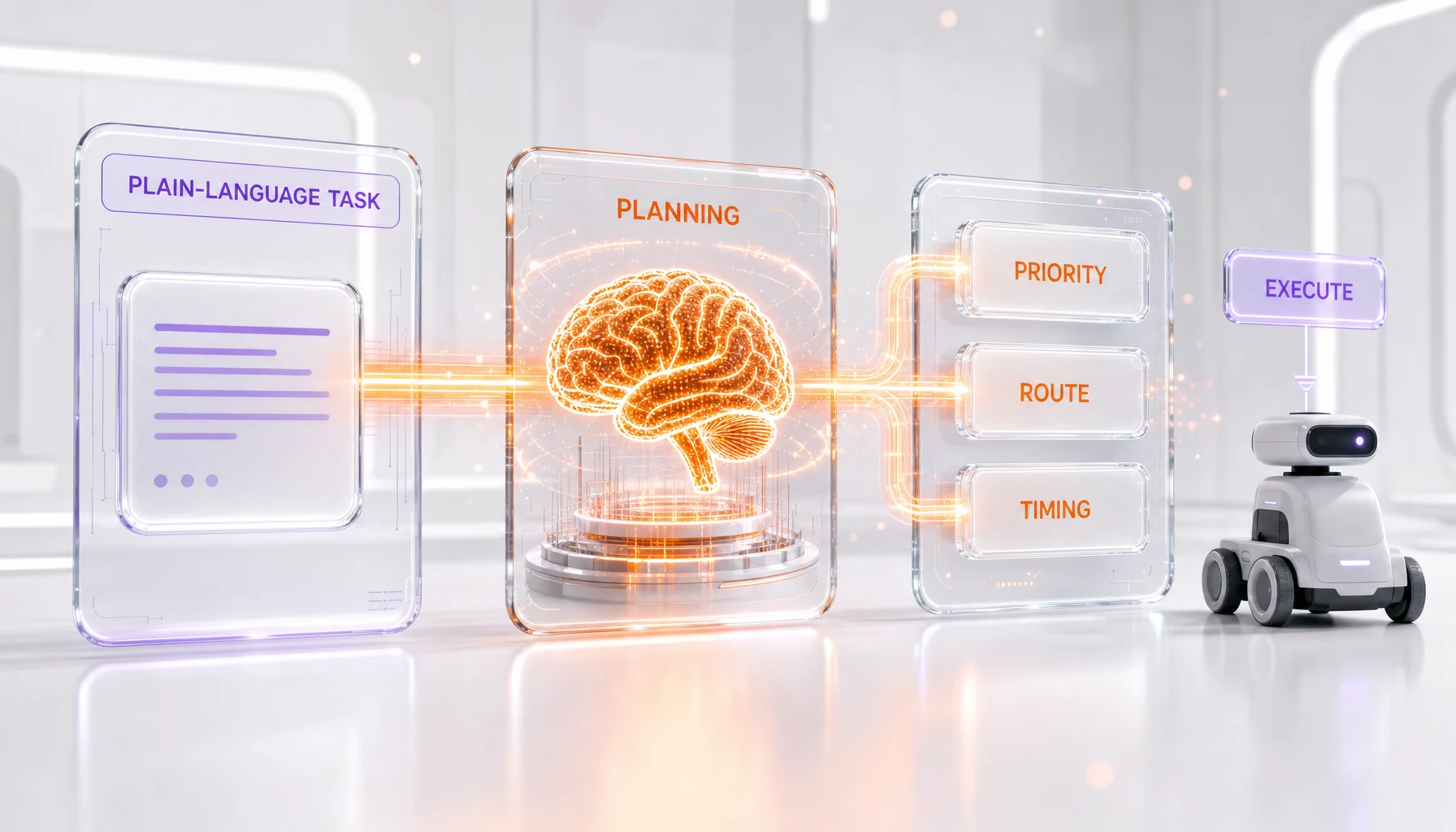
The conceptual pipeline behind Dresser's quote breaks into three decisions the robot now makes for itself. Previously, a dedicated software layer made these decisions and a programmer encoded them. The shift is moving that reasoning into the robot's own planning loop, driven by a language-understanding front end.
Priority: deciding what comes first
Given a described objective, the system has to rank competing demands. If three tasks are pending, which one is urgent, which is blocking other work, and which can wait? Traditional fleet software handled this with rules and queues set by engineers. A language-driven robot interprets the intent of the instruction and weighs it against the current state of the floor.
Route: choosing how to get there
Autonomous navigation across a shared, dynamic warehouse floor — with people, carts, and other robots moving — is the part Proteus already did well. What changes is that the destination and constraints now come from a parsed objective rather than a hard-coded waypoint list. The robot translates "move this to the outbound dock before the next truck" into a concrete path.
Timing: sequencing the work
Timing ties the other two together: when to start, how to interleave with other tasks, and when a job must complete to avoid downstream delay. This is the scheduling intelligence that used to live in a warehouse execution system. Pushing it into the robot's own loop is what makes Dresser's phrase — "your assistant for material movement" — more than marketing.
None of this requires the robot to be a general-purpose reasoner. It requires a narrow but reliable mapping from described intent to a plan a mobile robot can execute. That is a far more tractable problem than open-ended autonomy, which is exactly why a warehouse is the right place to attempt it.
Proteus in context: from dock zones to the open floor
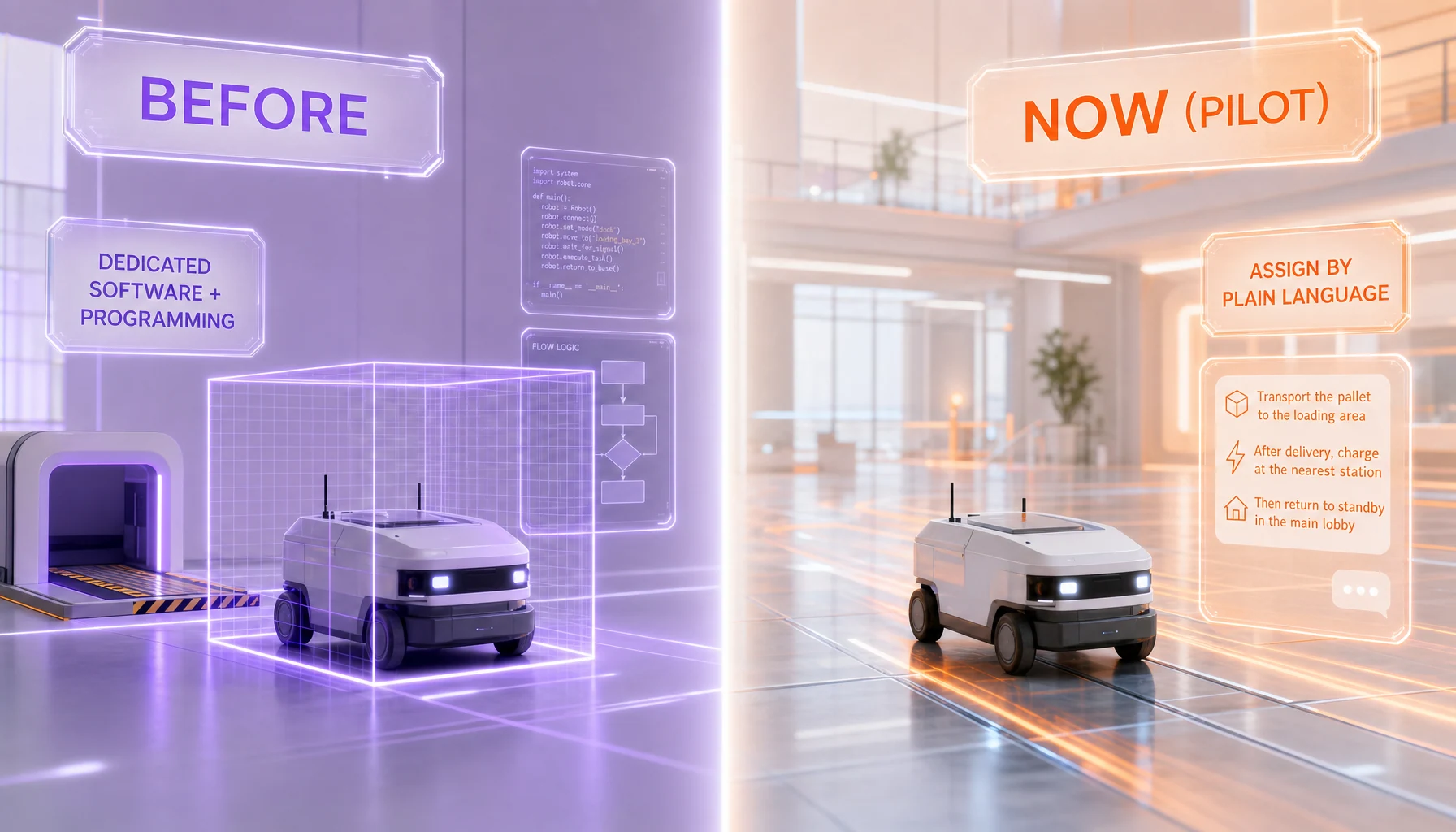
To understand why this is a step change, recall what Proteus was. Amazon introduced Proteus as its first fully autonomous mobile robot, designed to move heavy wheeled carts and operate safely around people without being confined to caged zones. In practice, much of its real-world work concentrated around dock and staging areas, and assigning it work meant dedicated software plus programming. It was autonomous in motion but constrained in assignment.
The new generation attacks the assignment bottleneck. If you can brief the robot in plain language, you no longer need an engineer in the loop to encode each new job. That widens where the robot can usefully operate — from a few well-defined zones toward the broader floor — because the cost of giving it a new task collapses from "schedule a programming change" to "describe what you need."
That is the through-line of the last year in robotics: the hardware has been good enough for a while; the bottleneck is the software that tells it what to do. We saw the same theme when Google DeepMind shipped Gemini Robotics-ER 1.6, an embodied-reasoning model meant to give robots a planning brain, and again when Unitree's H2 Plus became NVIDIA's reference humanoid for the Isaac and GR00T stack. Amazon is applying the same insight to a machine that already earns its keep.
Why assignable robots change warehouse economics
The reason a language interface is a bigger deal than a flashier robot body comes down to deployment economics. Robotics has long suffered from a deployment tax: every new task, every new SKU, every layout change demanded specialist integration work. That tax is what kept robots pinned to repetitive, high-volume stations and out of the messy long tail of warehouse work.
Make a robot assignable in natural language and you change three things at once:
- You remove the programmer from the loop. Floor staff — not robotics engineers — can put a robot to work. That alone changes who can deploy automation and how fast.
- You widen the task surface. A robot that takes described tasks can absorb irregular, lower-volume jobs that were never worth programming individually.
- You compress iteration time. Changing what a robot does becomes a sentence, not a sprint. That is the difference between automation that adapts to operations and operations that bend around automation.
This is the same pattern that made large language models matter for software: the breakthrough was not raw capability but the natural-language interface that let non-experts direct the system. We have written about how that interface logic is reshaping software in our look at the agentic web. Proteus is that same shift arriving in the physical world: the interface, not the actuator, is the unlock.
The fine print: pilot, not production
Important: This capability is in pilot and lab testing. It is not deployed across Amazon's warehouse network today. The current production Proteus fleet runs in 24 US fulfillment centers without the natural-language interface, and broader rollout of the new generation is targeted for the first half of 2027.
It is worth dwelling on this because announcement-day demos and production reality are rarely the same robot. A controlled demonstration of natural-language tasking is genuinely impressive and genuinely incomplete. The hard problems live in the gap between a clean demo and a noisy, 24-hour fulfillment center:
- Ambiguity. Human instructions are underspecified. "Take this to the back" assumes shared context the robot may not have. Robust language tasking needs graceful clarification, not confident wrong moves.
- Safety and verification. A robot that misreads an objective near people is a safety event, not a typo. Production deployment demands confirmation loops and hard safety envelopes that demos can skip.
- Reliability at scale. Working once on a stage is not working ten thousand times a day across dozens of buildings with different layouts. The 2027 timeline is a tell: this needs hardening.
So treat "Proteus understands natural language" as a real research-to-product milestone in pilot — not as a capability you can expect to see running every Amazon warehouse this year. The honest framing is the more impressive one anyway, because it shows a company sequencing a hard problem deliberately rather than overclaiming.
Where this sits against the rest of embodied AI
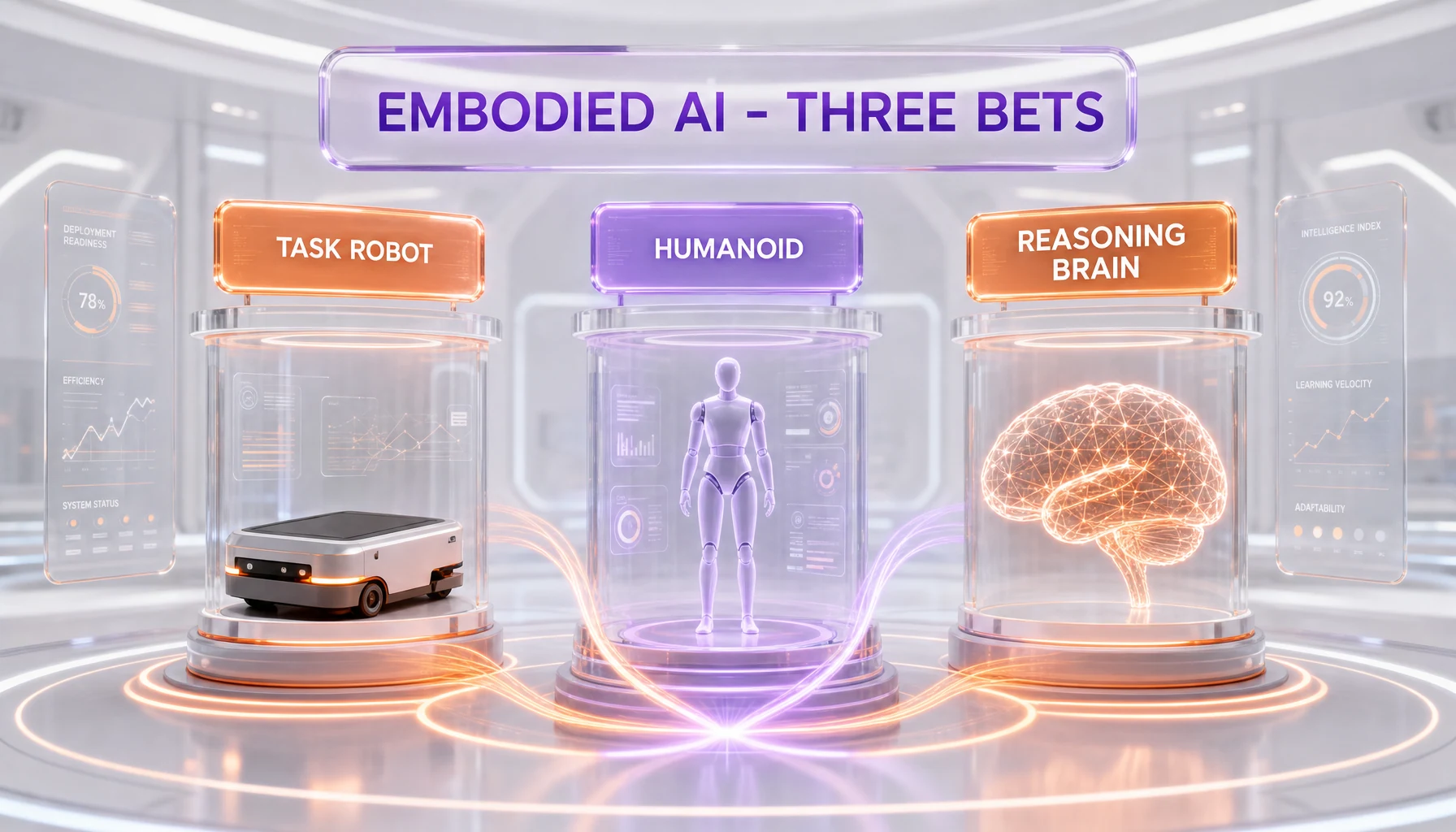
Most embodied-AI headlines this year have been about humanoids and the models that animate them. That makes Amazon's move easy to underrate, because it is neither a humanoid nor a frontier model. It is something arguably more consequential in the near term: a robot already doing real economic work, getting a dramatically better interface.
The contrast is instructive. The humanoid race — from Figure's 24-hour autonomous run to 1X's consumer NEO and China's industrialized humanoid scale-up at Robotera — is a bet on general-purpose bodies that can eventually do anything a human can. That bet is real but distant. Amazon's bet is narrower and nearer: take a proven single-purpose machine and make it trivially re-taskable. The first is a moonshot; the second is a margin lever you can pull this decade.
It also sidesteps the form-factor debate entirely. You do not need a humanoid to move a cart — you need a reliable mover that anyone can direct. By decoupling "smart enough to take instructions" from "shaped like a person," Amazon is making the case that the language interface, not the leg count, is where embodied AI pays off first. The reasoning layer that powers all of this is the same wave we tracked in Wayve Labs' push beyond driving.
The 10 billion euro European bet

The natural-language reveal did not arrive in a vacuum. Amazon framed it alongside a European expansion exceeding 10 billion euros (around 11.6 billion US dollars), with broader robot deployment guided toward the first half of 2027. That pairing is the strategy in plain sight: Amazon is not announcing a lab toy; it is announcing the interface that makes a multi-billion-euro automation buildout worth the spend.
Here is the logic. A 10-billion-euro fleet of robots is only as valuable as your ability to keep it usefully busy. If every task change requires specialist programming, the deployment tax eats your return. If floor staff can re-task robots by describing the work, utilization climbs and the capital pays back faster. The natural-language layer is, in effect, the multiplier on the hardware investment — which is precisely why it was unveiled next to the spending number rather than on its own.
For Europe specifically, where labor markets are tight and regulation around workplace automation is exacting, an interface that lets existing staff direct robots — rather than replacing them with a separate robotics workforce — is also a more politically durable story. Whether that holds up under scrutiny is one of the open questions below.
Our analysis: the interface is the breakthrough, not the body
Our take: this is the most underrated robotics announcement of the season, and the reason is counterintuitive. Nothing about the robot's body changed. Proteus still moves carts; it still tops out around 400 kg; it still rolls around fulfillment centers. The entire advance lives in the layer between a human and the machine — and that is exactly where the value is.
For most of robotics history, the limiting reagent was never the actuator. It was the cost of telling the machine what to do. Programming, integration, and re-tasking were the expensive, slow, expert-gated steps. Collapse those into a sentence and you do not just make one robot better — you change which tasks are worth automating at all. That is a market-expanding move, not a feature bump.
We would temper the enthusiasm in exactly one place: this is a pilot, and the gap between a London demo and 24-hour reliability across a continent is where ambitious robotics announcements usually go to get humbled. The 2027 timeline is honest about that. If Amazon ships natural-language tasking at production reliability, the story will not be "Amazon built a smarter robot." It will be "Amazon made robots assignable by anyone" — and that is the version that reshapes the warehouse, and eventually the factory floor.
What to watch next
- Voice, eventually. Watch for whether Amazon moves from parsed natural-language tasks to true spoken commands. That is a separate, harder milestone — and a clear signal of confidence if it ships.
- Clarification behavior. The real test of a language interface is how it handles ambiguity. Does it ask, or does it guess? Production-grade systems ask.
- The 2027 rollout. Track whether the first-half-2027 target holds, slips, or narrows in scope. Timeline discipline is the truest measure of how solid the pilot really is.
- Spillover to third parties. If Amazon's natural-language tasking works, expect rivals and robotics vendors to chase the same interface. The body race may quietly become an interface race.
Frequently asked questions
What did Amazon announce about Proteus on June 4, 2026?
Amazon unveiled a next-generation version of its Proteus warehouse robot that can interpret tasks described in natural language. Instead of using dedicated software and manual programming, an operator describes what needs to be done, and the robot determines the priority, route, and timing on its own. It was revealed at the "Delivering the Future" event in London.
Can you talk to the Proteus robot with your voice?
The reporting describes natural-language instructions, not explicitly voice commands. That means the robot parses tasks expressed in ordinary human language, but the sources do not confirm spoken, far-field voice control. We deliberately describe it as a natural-language interface rather than a voice assistant to avoid overstating the capability.
Is the natural-language Proteus available in Amazon warehouses now?
No. The natural-language capability is in pilot and lab testing, not full production. The current production Proteus fleet runs in 24 US fulfillment centers without this interface, and broader deployment of the new generation is targeted for the first half of 2027.
What did Scott Dresser say about the new Proteus?
Scott Dresser, vice president of Amazon Robotics, said: "You tell it what needs to be done. It figures out the priority, the route, the timing. It becomes your assistant for material movement." The quote captures the core shift — handing the robot an objective instead of a program.
How much weight can the Proteus robot move?
Proteus is rated to move loads of roughly 400 kg, or about 882 lb. It was designed as Amazon's first fully autonomous mobile robot to move heavy wheeled carts while operating safely around people, without being confined to caged zones.
In how many fulfillment centers does Proteus currently operate?
The current Proteus fleet operates across 24 US fulfillment centers. That is the production footprint of the existing robot — the natural-language generation announced in London is separate and still in pilot.
How does a language-driven robot decide what to do?
Conceptually, it splits the work into three decisions that used to be encoded by a programmer: priority (which task comes first), route (how to navigate there across a shared floor), and timing (when to start and how to sequence the work). A language-understanding front end maps a described objective into a concrete plan the robot can execute.
How is this different from the original Proteus?
The original Proteus was autonomous in motion but constrained in assignment — much of its real-world work concentrated around dock and staging zones, and giving it a new job required dedicated software and programming. The new generation attacks that assignment bottleneck by letting staff brief the robot in plain language, which widens where it can usefully operate.
Why does natural-language control matter for warehouse robots?
It removes the deployment tax. When a robot can be assigned work in plain language, floor staff rather than robotics engineers can put it to work, the range of tasks worth automating widens, and re-tasking becomes a sentence instead of a programming project. The interface, not the robot body, is the economic unlock.
How does this connect to Amazon's European expansion?
Amazon unveiled the capability alongside a European expansion exceeding 10 billion euros, around 11.6 billion US dollars, with broader robot deployment targeted for the first half of 2027. A language interface raises robot utilization, which is what makes a multi-billion-euro automation buildout pay back faster.
How does this compare to humanoid robots like Figure or 1X NEO?
Humanoids are a bet on general-purpose bodies that can eventually do many human tasks — a real but distant goal. Amazon's move is narrower and nearer: take a proven single-purpose mover and make it trivially re-taskable through language. You do not need a humanoid to move a cart; you need a reliable mover anyone can direct.
What are the biggest unanswered questions?
Three stand out: whether Amazon advances from parsed natural-language tasks to true spoken voice control, how the system handles ambiguous instructions (asking versus guessing), and whether the first-half-2027 rollout target holds at production reliability across many buildings. The gap between a demo and 24-hour reliability is where the real test lies.
This is an analysis of publicly reported information. ThePlanetTools.ai has no commercial relationship with Amazon and was not compensated for this article. Figures and quotes are drawn from coverage of Amazon's "Delivering the Future" event (London, June 4, 2026) and The Robot Report. We have framed the capability as natural-language tasking in pilot — not as voice control or a production deployment — to reflect exactly what was demonstrated.