
Databricks is raising a strategic funding round at a $188 billion valuation, the company announced on July 16, 2026. The round is not yet closed: Databricks has signed a term sheet and expects to complete the raise later in the summer, led by existing investor Coatue, with the amount reported by the Wall Street Journal and Reuters at around $3 billion. The money is earmarked for three agent-era products — Unity AI Gateway, Genie and Lakebase — plus future AI acquisitions and deeper research. At $188 billion, Databricks is now worth roughly 40% more than it was in February 2026, and the deal reframes the company less as a data-analytics vendor and more as the governance and data layer that enterprises will run their AI agents on.
Key Takeaways
- Signed, not closed. Databricks has a term sheet for a strategic round at a $188 billion valuation and expects to close it later in summer 2026 — the cash is not in the bank yet.
- Coatue is leading. The round is led by existing investor Coatue and reported at about $3 billion by the Wall Street Journal and Reuters; Databricks has not officially disclosed the size.
- A vertical climb. The valuation is up about 40% from $134 billion in February 2026 and roughly 88% from $100 billion in September 2025, per TechCrunch — one of the steepest repricings in enterprise software.
- The money follows agents. Proceeds target Unity AI Gateway (multi-model governance), Genie (an AI coworker) and Lakebase (serverless Postgres for agents), plus future AI acquisitions.
- "Valuemaxxing." CEO Ali Ghodsi frames the strategy as a move "from tokenmaxxing to valuemaxxing" — a bet that enterprises want the best outcome per dollar, not the smartest model for every task.
What Databricks Actually Announced
Databricks announced on July 16, 2026 that it has signed a term sheet to raise a new strategic round at a $188 billion valuation, led by existing investor Coatue. Crucially, the round has not closed — Databricks says it expects to complete it later in the summer — and the company did not officially state the size. The Wall Street Journal, which first reported the deal, and Reuters put the raise at about $3 billion.
The temporality matters more than usual here. In its own newsroom post, Databricks writes that it "has signed a term sheet for this round, which it expects to close later this summer." That is a deliberate, careful phrasing: a term sheet locks in the headline number and lead investor, but the capital has not changed hands and the roster of participating investors is not final. Reuters, republishing the Wall Street Journal's scoop, put the raise at roughly $3 billion, while noting the deal is not yet done. So the accurate framing, as of late July 2026, is that Databricks is raising — not that it has raised.
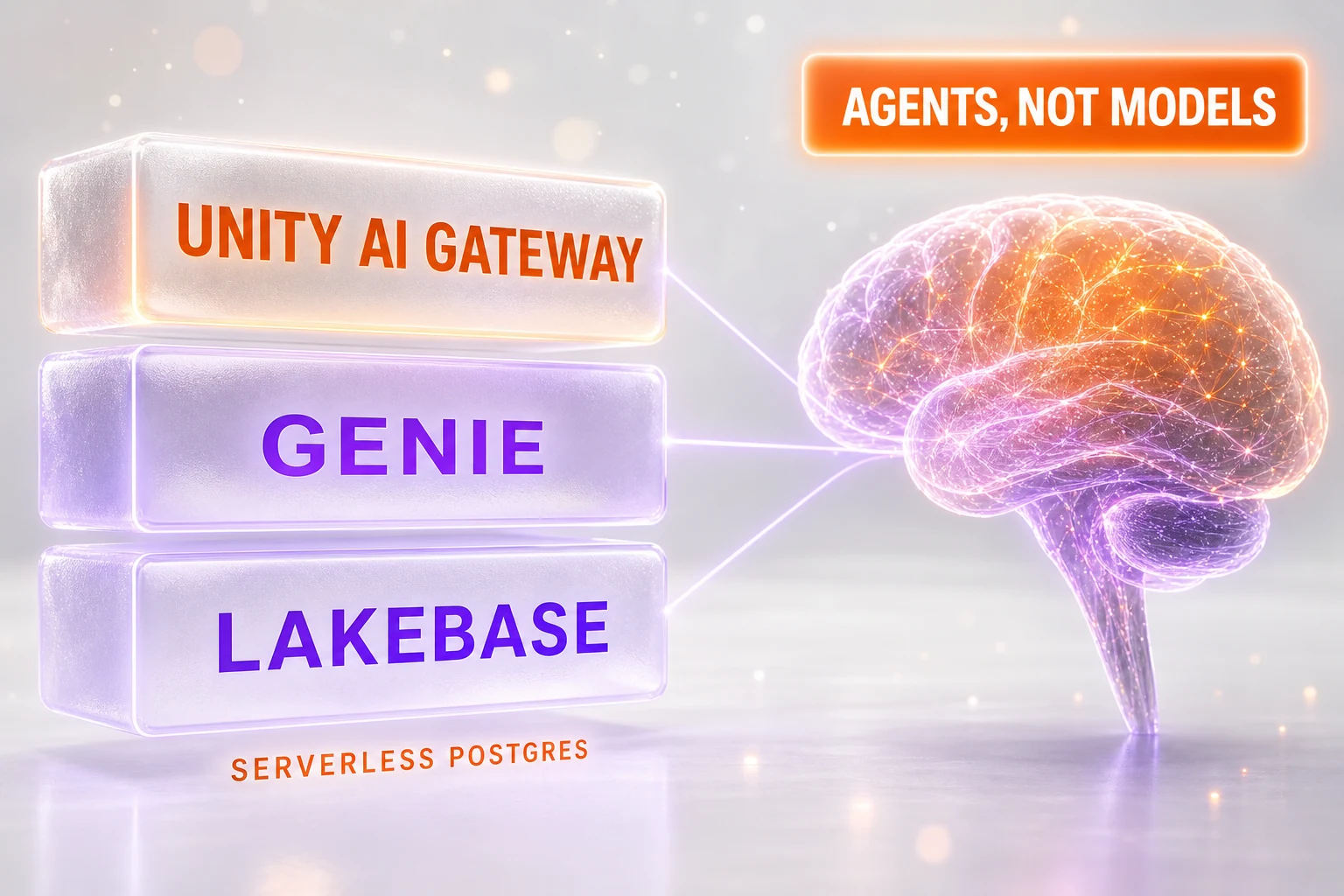
Databricks was explicit about where the money goes. The company said it will "double down" on three products: Unity AI Gateway, its multi-AI governance layer that helps enterprises govern and control the cost of their AI; Genie, an "AI coworker" that turns business data into answers and actions; and Lakebase, its serverless Postgres database built for AI agents. On top of that, it flagged future AI acquisitions and deeper investment in research. None of those three is a frontier language model — a tell about how Databricks sees its own position in the AI stack, which we return to below.
From $62 Billion to $188 Billion: A Valuation Ladder Built in 19 Months
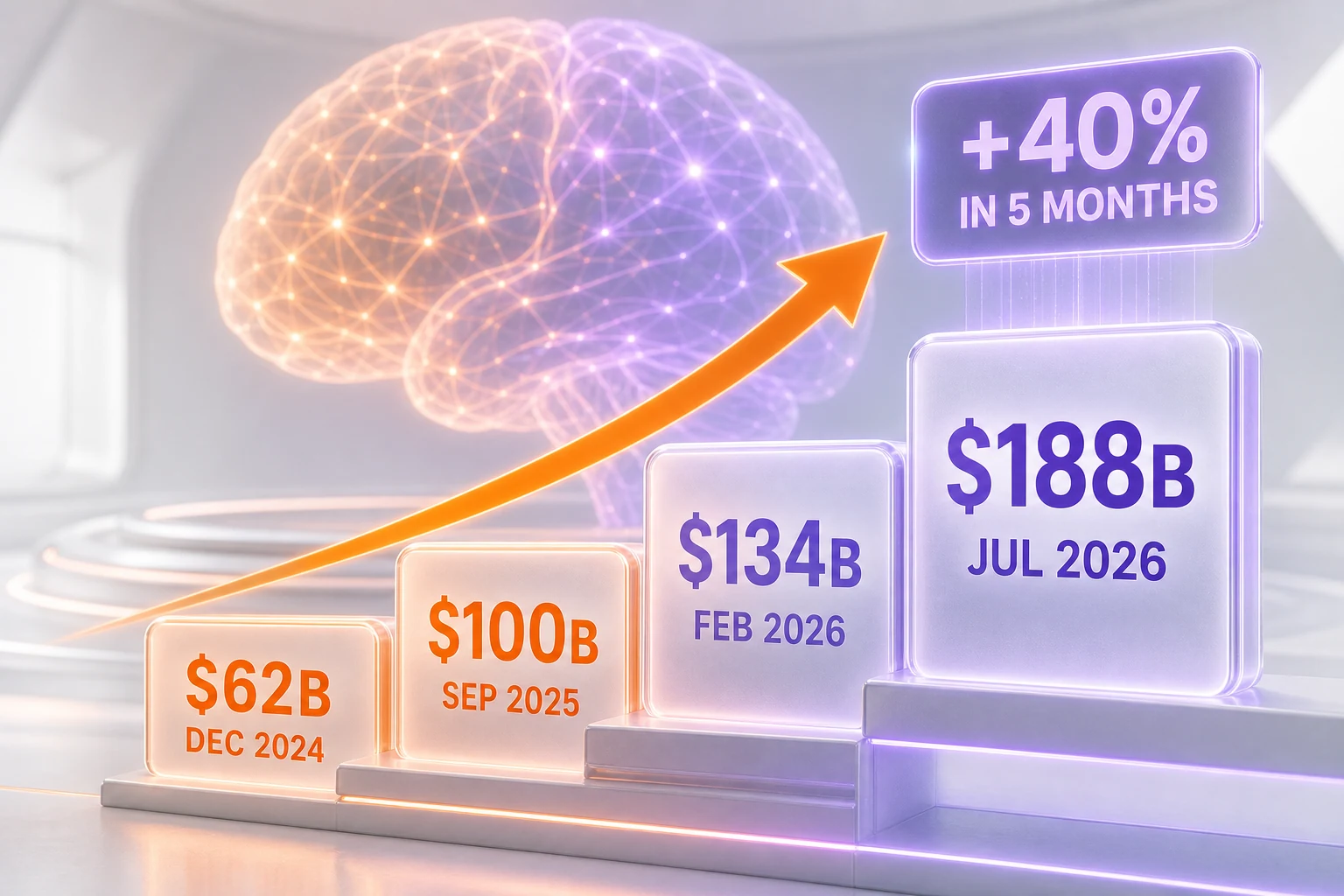
Databricks has repriced itself upward roughly every few months. According to TechCrunch, the company was valued at $62 billion in December 2024, $100 billion in September 2025, $134 billion in a $5 billion Series L in February 2026, and now $188 billion in July 2026. That is a climb of about 40% in five months and roughly 88% in under a year — a pace that mirrors the broader repricing of AI infrastructure.
The arithmetic is worth stating plainly, because both ends of it are sourced. TechCrunch's reporting lists the prior marks: $62 billion (December 2024), $100 billion (September 2025) and $134 billion (February 2026). Moving from $134 billion to $188 billion is a jump of about 40%; moving from $100 billion is a jump of about 88%. Those are extraordinary step-ups for a company already worth more than most public software firms — and they happened without Databricks going public.
That last point is the context. 2026 has been a year of vertical AI valuations, and the biggest numbers have clustered around AI labs and infrastructure. Anthropic raised $65 billion at a $965 billion valuation, and OpenAI filed confidentially toward a listing that has been discussed near $1 trillion. Against those, Databricks' $188 billion is smaller — but it is also a fundamentally different kind of asset. Where the labs are betting on owning the smartest model, Databricks is betting on owning the plumbing that makes any model useful inside an enterprise. Investors are increasingly willing to pay up for both.
"Tokenmaxxing to Valuemaxxing": The Repositioning
The clearest signal in the announcement is not the number but the framing. CEO Ali Ghodsi said enterprises are moving "from tokenmaxxing to valuemaxxing" — spending less on running the smartest model for every task and more on the best outcome per dollar. That reframes Databricks as the control layer above the models rather than a competitor to them.
Here is the quote in full, from the Databricks announcement:
"Enterprises are moving from tokenmaxxing to valuemaxxing. They don't want to burn expensive tokens on the smartest model for every task — they want the best outcome per dollar. That means having the freedom to choose the right AI for the job. This new capital lets us keep pushing our multi-AI strategy forward to meet massive customer demand, so we can keep strengthening Unity AI Gateway, expanding Genie, and advancing Lakebase." — Ali Ghodsi, CEO, Databricks
Strip away the coinage and the strategy is concrete. Databricks is not trying to build a rival to the frontier labs. It is positioning Unity AI Gateway as a neutral broker that routes each request to whichever model is cheapest and good enough, governs how those models touch enterprise data, and reports the cost. That is a bet that model choice is becoming a commodity decision — and that the durable margin sits in the governance and routing layer, not the model itself. It is the same logic driving the broader inference and infrastructure war, where the money is increasingly moving toward whoever controls cost and deployment rather than raw model quality, and it rhymes with why even a lab like OpenAI has moved to build its own inference chip to attack cost directly.
Lakebase and the Database Built for Agents
Lakebase is Databricks' serverless Postgres database built for AI agents, and it is the most strategic of the three products the new capital will fund. Agents need an operational, transactional place to store memory, state and tool-call results with low latency — a different job from the analytical lakehouse. Databricks built Lakebase on Postgres, expanded through its 2025 acquisition of Neon, to own that operational layer.
To see why this matters, it helps to separate two kinds of database work. The classic Databricks lakehouse is analytical: it answers big questions over large historical datasets. But AI agents are operational software — they take actions in loops, remember prior steps, and read and write small pieces of state constantly. That is transactional (OLTP) work, and it wants a fast, always-on operational database, not a warehouse. Lakebase, a serverless Postgres store Databricks built on top of its 2025 Neon acquisition, is Databricks' answer to that gap, complete with features like git-style branching of databases described on its product page.
The strategic prize is owning both halves of an agent's data life in one place: the analytical context the agent reasons over and the operational state it acts on. As the broader agentic web takes shape and enterprises wire agents into real workflows, whoever holds that operational layer sits close to every agent action — a position with the same gravitational pull that made the data warehouse valuable a decade ago.
Why the Infrastructure Layer Keeps Winning the AI Money
The Databricks round fits a pattern: in 2026, some of the biggest AI valuations are accruing not only to the model labs but to the layer that governs, stores and serves data and agents around them. Enterprises are wary of betting everything on a single model, and a neutral control plane that routes across many models is a durable position as models commoditize.
Three forces are pushing value up the stack. First, model quality has converged at the frontier, so switching costs — not raw capability — increasingly decide deals; a governance layer that makes switching easy is valuable precisely because models are interchangeable. Second, data gravity: the customer data already sits inside Databricks, and agents are most useful when they act on that data under governance. Third, buyers want cost control, and the economics of running AI at scale are brutal — as the dissection of OpenAI's 2025 numbers made clear, spend is the story. The same instinct is visible across the market, from the consolidation of agentic tooling to the record private rounds flowing into AI infrastructure. Databricks' pitch is that it can be the neutral, governed control plane for all of it — and its most direct rival for that position is not a model lab but a data platform like Snowflake.
What Could Prove This Wrong
The most important caveat is temporal: the round is not done. A signed term sheet is a commitment to terms, not cash in the bank, and deals of this size can be repriced or restructured before closing. Beyond that, a $188 billion private valuation carries real risk if AI budgets tighten, if hyperscalers bundle comparable governance for free, or if the agentic-database thesis takes longer to pay off than the multiple implies.
The competitive risk is the sharpest. Amazon, Microsoft and Google all offer their own model gateways, vector stores and operational databases, and they can afford to give governance away to keep customers on their clouds. Snowflake is chasing the same "operational plus analytical plus agents" territory. If model routing and agent state become table-stakes features baked into every cloud, the premium Databricks is charging for a neutral control plane could compress. There is also the plain question of whether enterprise agent adoption arrives fast enough to justify an 88%-in-a-year climb — and, unlike OpenAI and Anthropic, Databricks has offered no public-market timeline that would let outside investors reprice it. For now, its value is set by private rounds, not a market.
The Bottom Line
If it closes as signed, Databricks' $188 billion round will stand as one of the clearest bets yet that the money in enterprise AI is moving up the stack — from the models themselves to the governance, data and agent infrastructure around them. Ghodsi's "valuemaxxing" line is a thesis as much as a slogan.
The wager is that the winners of the agent era will be the companies that make many models useful, governable and cheap to run — not necessarily the ones that build the single smartest model. Databricks is putting a $188 billion price on that idea. Whether it holds depends on two things it does not fully control: getting the round closed on the terms it signed, and enterprises actually moving their agents into production fast enough to make the number look cheap in hindsight.
Sources
- Databricks — "Databricks is Raising a Strategic Round of Funding at a $188 Billion Valuation" (company newsroom, July 16, 2026)
- TechCrunch — "Databricks hits $188B valuation, extending its run as AI's favorite second act"
- Reuters (via Yahoo Finance) — "Databricks valued at $188 billion after Coatue-led investment, WSJ reports"
- U.S. News / Reuters — "Databricks Secures Funding Round at $188 Billion Valuation"
- Databricks — Lakebase: Serverless Postgres for Agents and Apps
- Databricks — "Databricks agrees to acquire Neon"
Frequently Asked Questions
How much is Databricks raising and at what valuation?
Databricks announced on July 16, 2026 that it is raising a new strategic round at a $188 billion valuation. The company has signed a term sheet and expects to close the round later in the summer. It did not officially state the amount, but the Wall Street Journal, which first reported the deal, and Reuters put the raise at around $3 billion.
Is the Databricks funding round closed?
No. As of late July 2026 the round is not closed. Databricks has signed a term sheet — an agreement on terms — and says it expects to complete the raise later in the summer. A signed term sheet is a commitment, not cash in hand, so the final amount and any co-investors could still change before closing.
Who is leading the Databricks round?
The round is led by Coatue, described by Databricks as an existing investor. Databricks says the round will also include additional new and existing investors, which it has not fully named.
What will Databricks use the money for?
Databricks says the capital will fund three products built for the agent era — Unity AI Gateway (its multi-model AI governance layer), Genie (an AI coworker that turns business data into answers and actions) and Lakebase (its serverless Postgres database for AI agents) — plus future AI acquisitions and deeper AI research.
What did Ali Ghodsi mean by "tokenmaxxing to valuemaxxing"?
CEO Ali Ghodsi said "Enterprises are moving from tokenmaxxing to valuemaxxing." He means companies no longer want to burn expensive tokens by running the single smartest model on every task; they want the best outcome per dollar, which requires the freedom to route each job to the right model. It frames Databricks as the governance and data layer above the models rather than a model builder.
What is Lakebase?
Lakebase is Databricks’ serverless Postgres database built for AI agents. Unlike the analytical lakehouse, it is an operational, transactional store where agents and apps can read and write state, memory and tool results with low latency. Databricks built it on Postgres and expanded it through its 2025 acquisition of Neon.
What is Unity AI Gateway?
Unity AI Gateway is Databricks’ multi-AI governance solution. It helps enterprises govern their use of AI and control costs by routing and monitoring requests across many models rather than locking into one, which is central to the company’s "valuemaxxing" pitch.
How has Databricks’ valuation changed over time?
According to TechCrunch, Databricks was valued at $62 billion in December 2024, $100 billion in September 2025, $134 billion in a $5 billion Series L in February 2026, and now $188 billion in July 2026. That is a rise of about 40% in five months and roughly 88% in under a year.
How does the $188 billion valuation compare to OpenAI and Anthropic?
Databricks remains smaller than the leading model labs by headline valuation. Anthropic raised at a $965 billion valuation in 2026, and OpenAI has filed confidentially toward a listing discussed near $1 trillion. Databricks sits in a different lane: rather than building frontier models, it sells the governance, data and agent infrastructure enterprises run around those models.
Is Databricks planning an IPO?
Databricks has not announced an IPO. This is a private financing, and the company has continued to raise private capital rather than file to go public, in contrast to OpenAI’s confidential filing and Anthropic’s reported IPO preparations. Treat any listing timeline as speculation until Databricks says otherwise.
Why is Databricks worth $188 billion if it does not build frontier models?
The bet is that as models commoditize, durable value accrues to the layer that governs, stores and serves data and agents around them. A neutral control plane that routes across many models, plus the customer data already inside the lakehouse, is a moat that does not depend on owning the single best model. Investors are pricing that infrastructure position, not a model.
What does the round mean for enterprises building AI agents?
If it closes, a larger Databricks balance sheet accelerates the tooling enterprises use to put agents into production — governance and cost control through Unity AI Gateway, an operational database in Lakebase, and Genie for data-grounded answers. The near-term effect is more mature, more governable agent infrastructure; the longer-term question is how much of that stack hyperscalers will bundle for free.