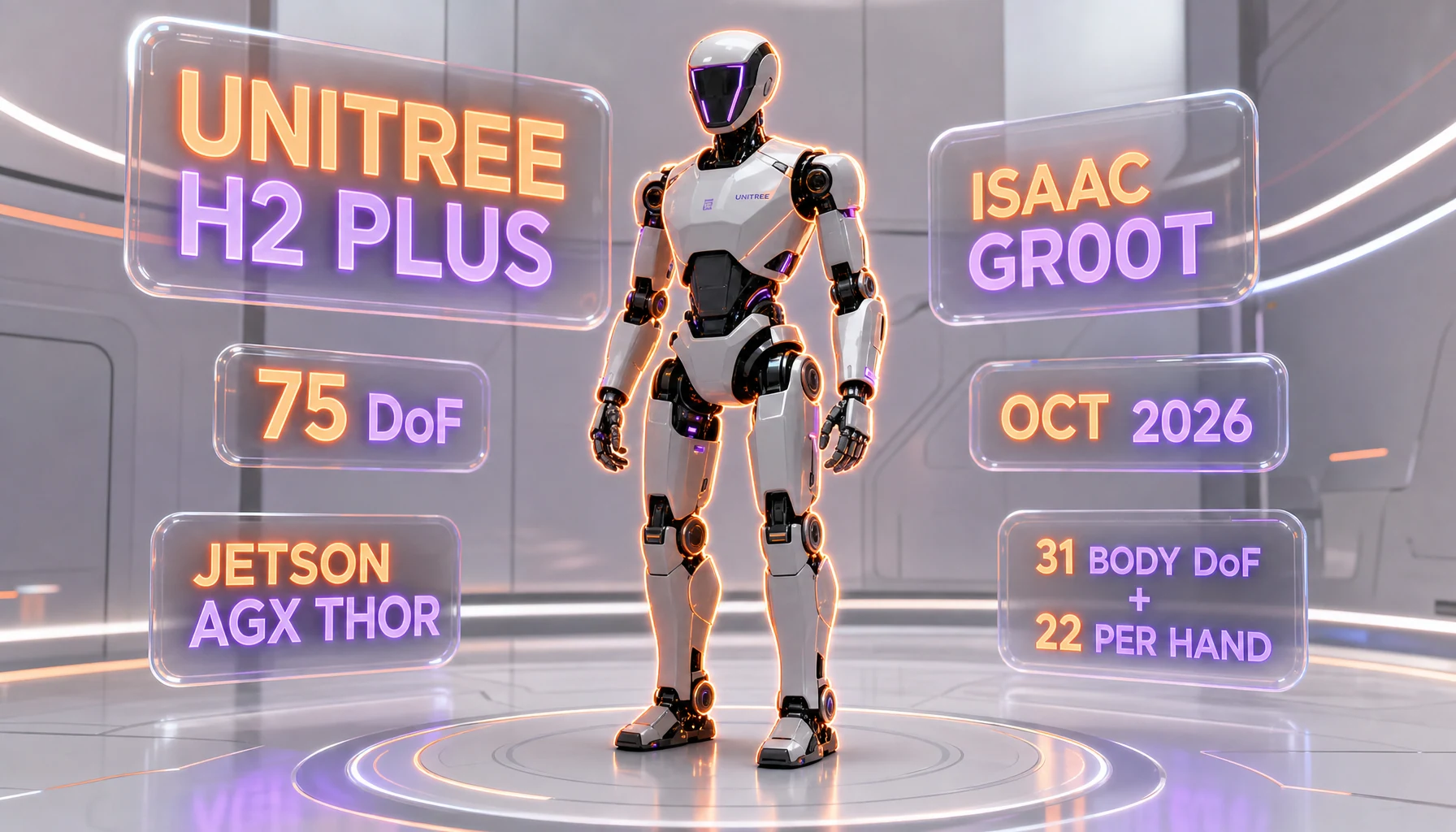
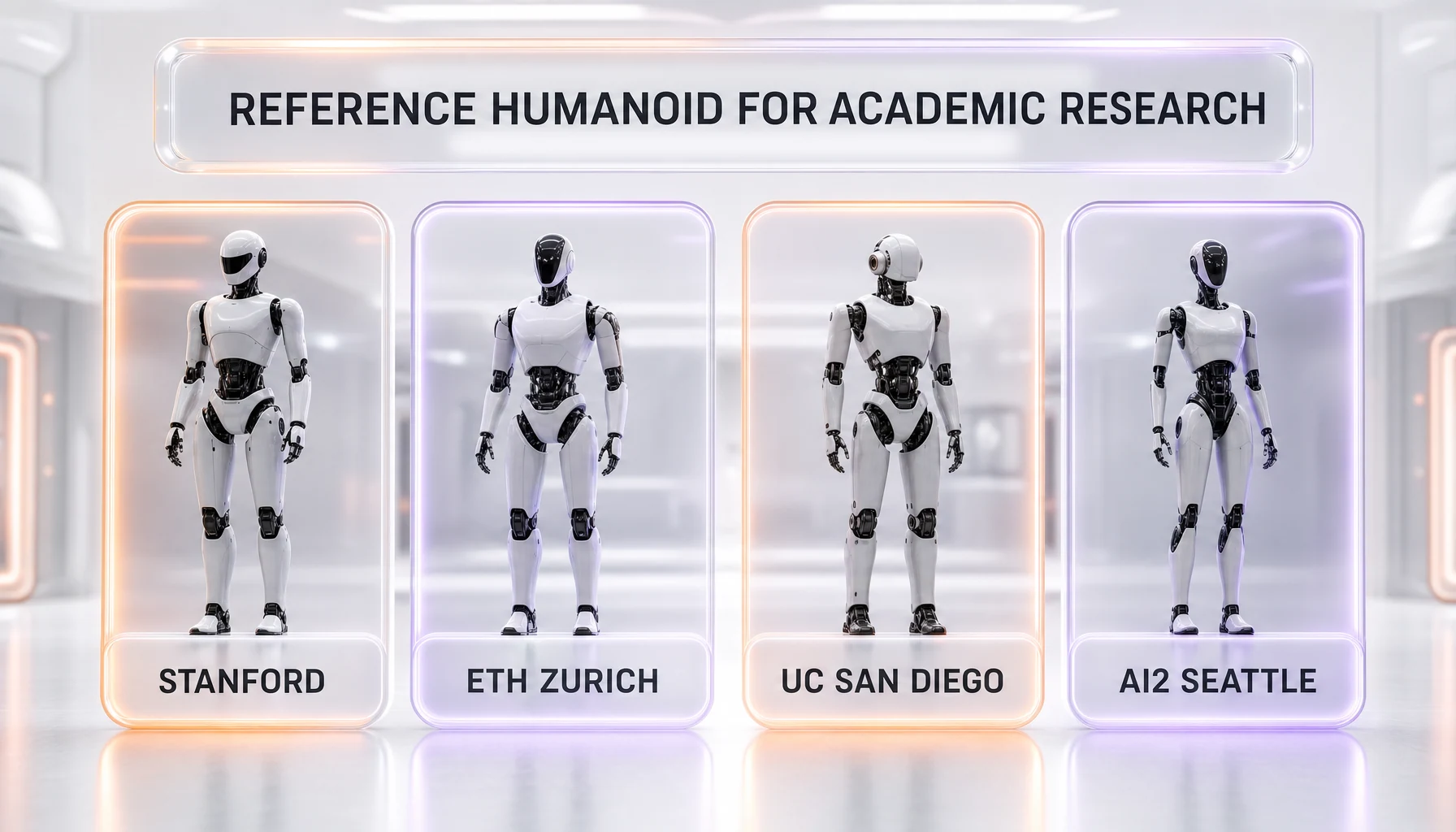
On June 1, 2026, at NVIDIA GTC Taipei, Jensen Huang named the Unitree H2 Plus the NVIDIA Isaac GR00T Reference Humanoid Robot for Academic Research — the first open humanoid reference design built on NVIDIA Jetson AGX Thor and the Isaac GR00T platform. The robot stands roughly 1.80 meters (6 feet) tall, weighs about 68 kilograms (150 pounds), and packs 31 degrees of freedom in the body plus Sharpa Wave five-finger hands at 22 degrees of freedom per hand, for 75 degrees of freedom across the body and hands. Its onboard brain is Jetson AGX Thor, a Blackwell-class module rated at 2,070 FP4 TFLOPS with 128 GB of unified memory. Stanford, ETH Zurich, UC San Diego, and Ai2 are among the first institutions on board, and Unitree, a Chinese company pursuing a STAR Market listing, will ship the platform to labs in October 2026.
The headline is easy to misread as just another humanoid spec sheet. It is not. The interesting move here is structural: NVIDIA did not build its own robot, and it did not crown a Western darling like Figure or 1X. It took a Chinese company’s hardware, wrapped it in its own compute and software, and declared the bundle the official starting point for academic humanoid research worldwide. That is a platform play, not a product launch — and it tells you more about where the physical AI race is heading than any single robot demo this year.
What NVIDIA and Unitree Actually Announced
Let us be precise, because reference designs are easy to overhype. NVIDIA announced the Isaac GR00T Reference Humanoid Robot at GTC Taipei, and Unitree confirmed that its H2 Plus is the body at the center of it. This is not Unitree selling a robot and NVIDIA selling a chip separately. It is a single, NVIDIA-defined configuration: the Unitree H2 Plus chassis, dual Sharpa Wave tactile five-finger hands, Jetson AGX Thor for onboard compute, and the full Isaac GR00T software and model stack, integrated and offered as one open reference for research buyers.
The word that does the heavy lifting is "reference." In hardware, a reference design is a standardized blueprint that others copy rather than reinvent. NVIDIA has done this before in PCs and AI servers, and now it is doing it for humanoids. The pitch to a university lab is simple: stop spending eighteen months assembling a bespoke robot, sensors, and software glue. Buy the reference, and start doing actual robotics research on day one, on the same baseline as Stanford and ETH Zurich.
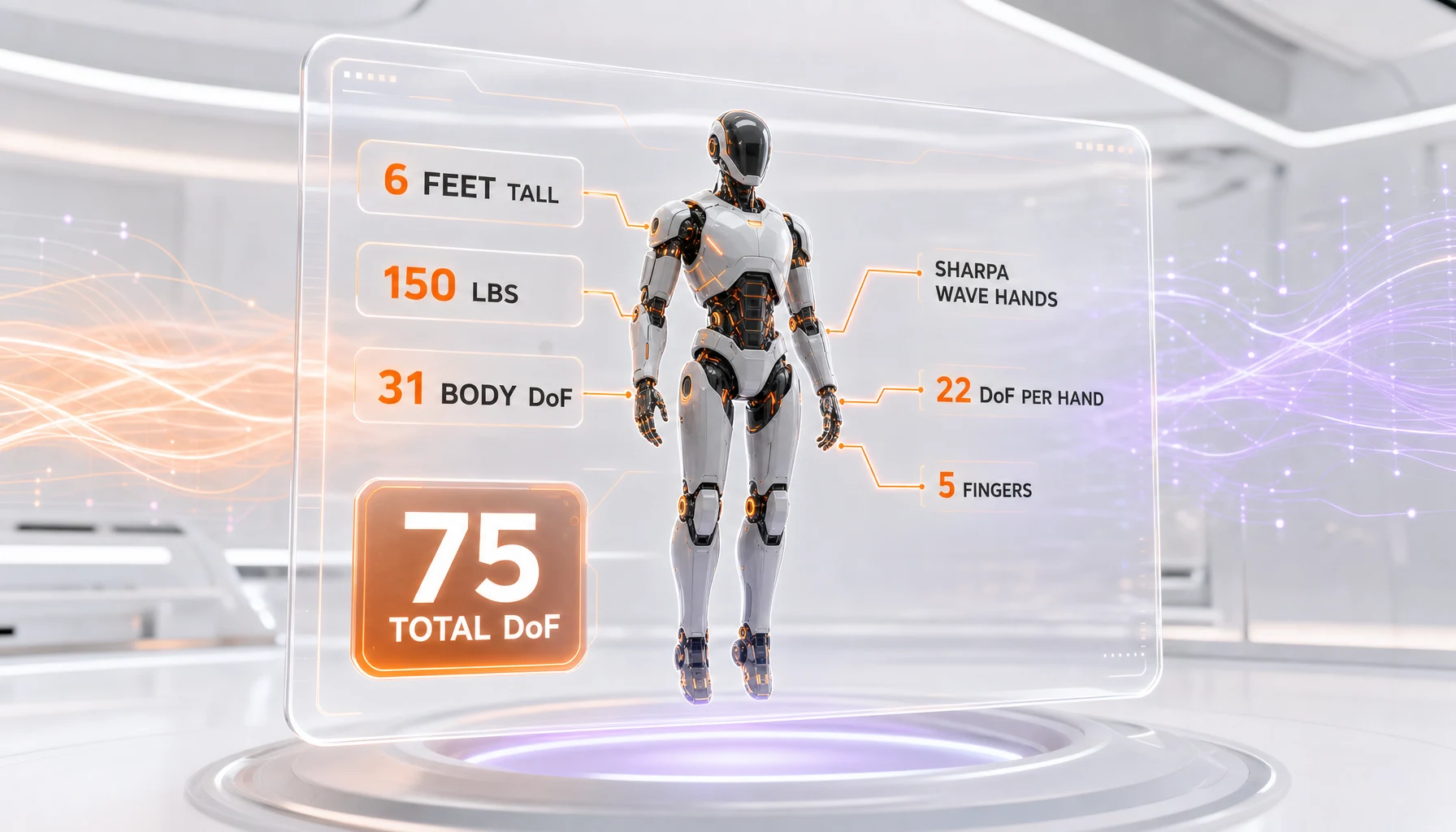
On the numbers, the body is human-scale by design. It is close to 1.80 meters (6 feet) tall and around 68 kilograms (150 pounds), with 31 degrees of freedom across the torso, arms, and legs. That alone makes it a competent locomotion and whole-body platform. The differentiator is the hands. The dual Sharpa Wave units are tactile, five-fingered, and carry 22 degrees of freedom per hand, which is what pushes the total to 75 degrees of freedom across the body and hands. Dexterity, not walking, is the current research bottleneck in humanoids, and the reference design is clearly built to attack it.
The Blackwell Brain: Why Jetson AGX Thor Matters
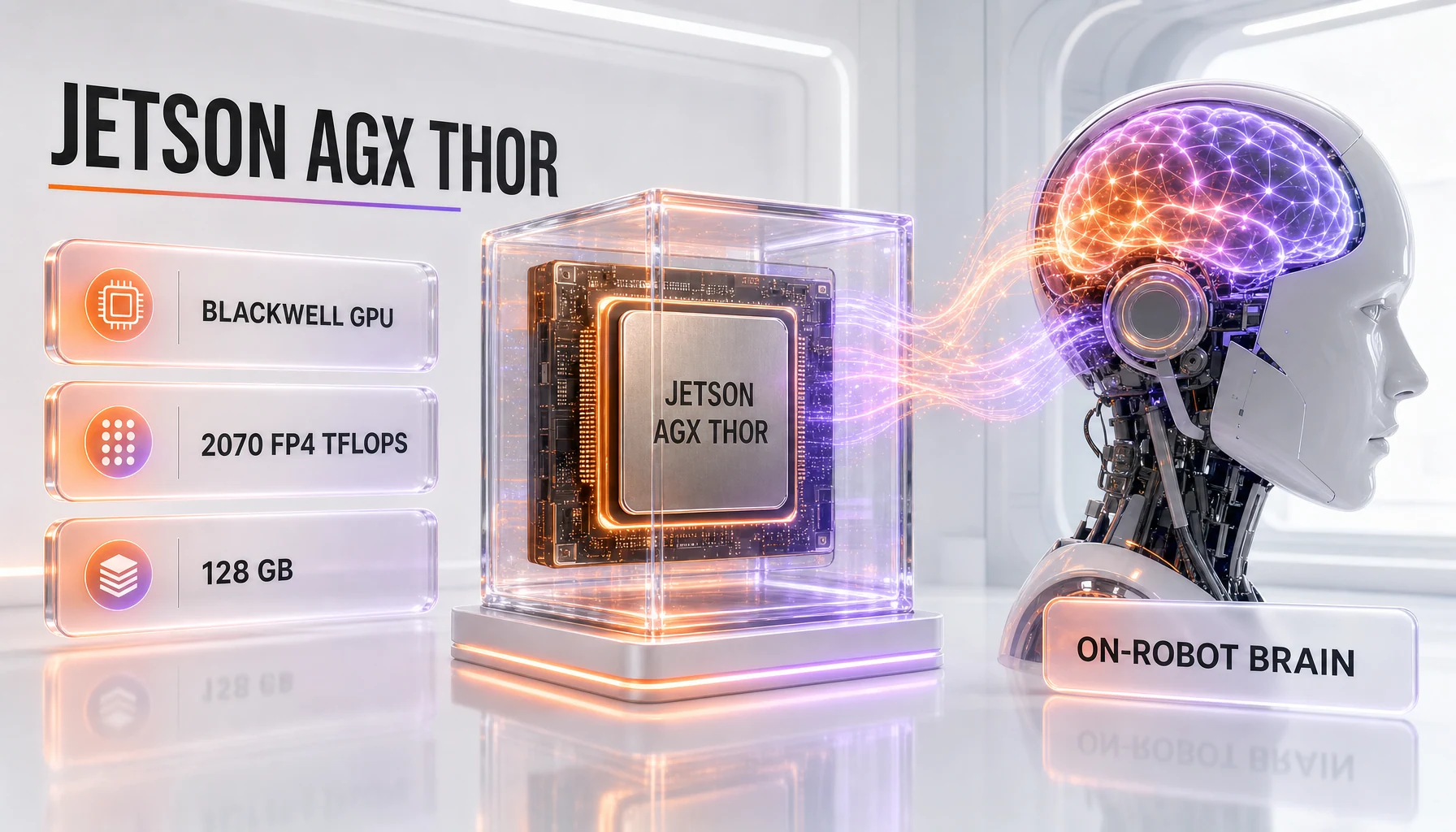
Hardware degrees of freedom are useless without a brain fast enough to coordinate them in real time. That is the role of NVIDIA Jetson AGX Thor, the onboard compute module. It is a Blackwell-generation part rated at 2,070 FP4 TFLOPS with 128 GB of unified memory, sitting inside the robot rather than streaming control from a data center. For a humanoid that has to see, reason, and move 75 joints without a network round trip, on-robot inference at that scale is the enabling piece.
This is also the quiet commercial logic of the whole announcement. Every reference humanoid that ships is a Jetson AGX Thor that ships. NVIDIA has spent 2026 turning its compute dominance into adjacent markets — we covered the trillion dollars in Blackwell and Rubin orders booked at GTC 2026, and the scrutiny over its $40 billion in equity bets across the AI ecosystem. Seeding a robot reference design into every serious academic lab is the same strategy applied to physical AI: get the hardware into the place where the next generation of builders learns, and the lock-in follows.
The software side is just as deliberate. Isaac GR00T is not a single model but a full pipeline: Isaac Teleop for capturing demonstration data, Isaac Sim and Isaac Lab for simulating and training behaviors, Isaac ROS for middleware, the GR00T foundation models themselves, and Jetson Thor for inference at the edge. NVIDIA is not selling a robot; it is selling the entire development loop a robotics researcher needs, with the H2 Plus as the body that loop happens to drive. It is a sharper version of the embodied-reasoning push we saw from Google DeepMind’s Gemini Robotics-ER 1.6 — except NVIDIA owns the silicon underneath everyone.
Why NVIDIA Chose a Chinese Robot
The choice of Unitree is the most loaded part of this story. In a year defined by US-China friction over AI hardware, NVIDIA picking a Chinese company’s humanoid as its global academic reference is not an accident, and it is not charity. It is a judgment that, for price-performance and dexterity, Unitree’s hardware was simply the best fit to standardize on. Unitree has spent years driving down the cost of capable legged and humanoid robots, and that affordability is exactly what an academic reference needs to scale across budget-constrained labs.
It also lands against a striking backdrop. China is not just exporting robot bodies; it is building the governance layer around them. We reported on China’s move to give every humanoid robot a 29-character national ID, and on Robotera shipping humanoids by the thousand after a $200 million-plus raise. The picture that emerges is a country industrializing the humanoid at both the hardware and policy level — while a US chipmaker reaches across the divide to put that hardware in Stanford’s lab.
For Unitree, the timing could hardly be better. The company is pursuing a public listing, with a review under way for China’s STAR Market board. Being anointed NVIDIA’s reference humanoid is a validation stamp money cannot buy heading into an IPO — it ties the company’s hardware to the single most-watched name in AI compute at the exact moment investors are deciding what a humanoid maker is worth. Whatever the strategic complexity for Washington, for Unitree this is a near-perfect pre-IPO narrative.
How the H2 Plus Fits the 2026 Humanoid Race
It is tempting to slot the H2 Plus into the same bracket as Figure, 1X, Tesla, and the rest. That framing misses the point. Most of the headline humanoid companies are vertically integrated: they build the robot, the AI, and the commercial pitch, whether that is warehouse labor or a robot in your kitchen. Figure’s Helix-02 ran a 24-hour-plus autonomous warehouse shift, and 1X put an actual price and date on its NEO consumer humanoid. Those are products chasing revenue.
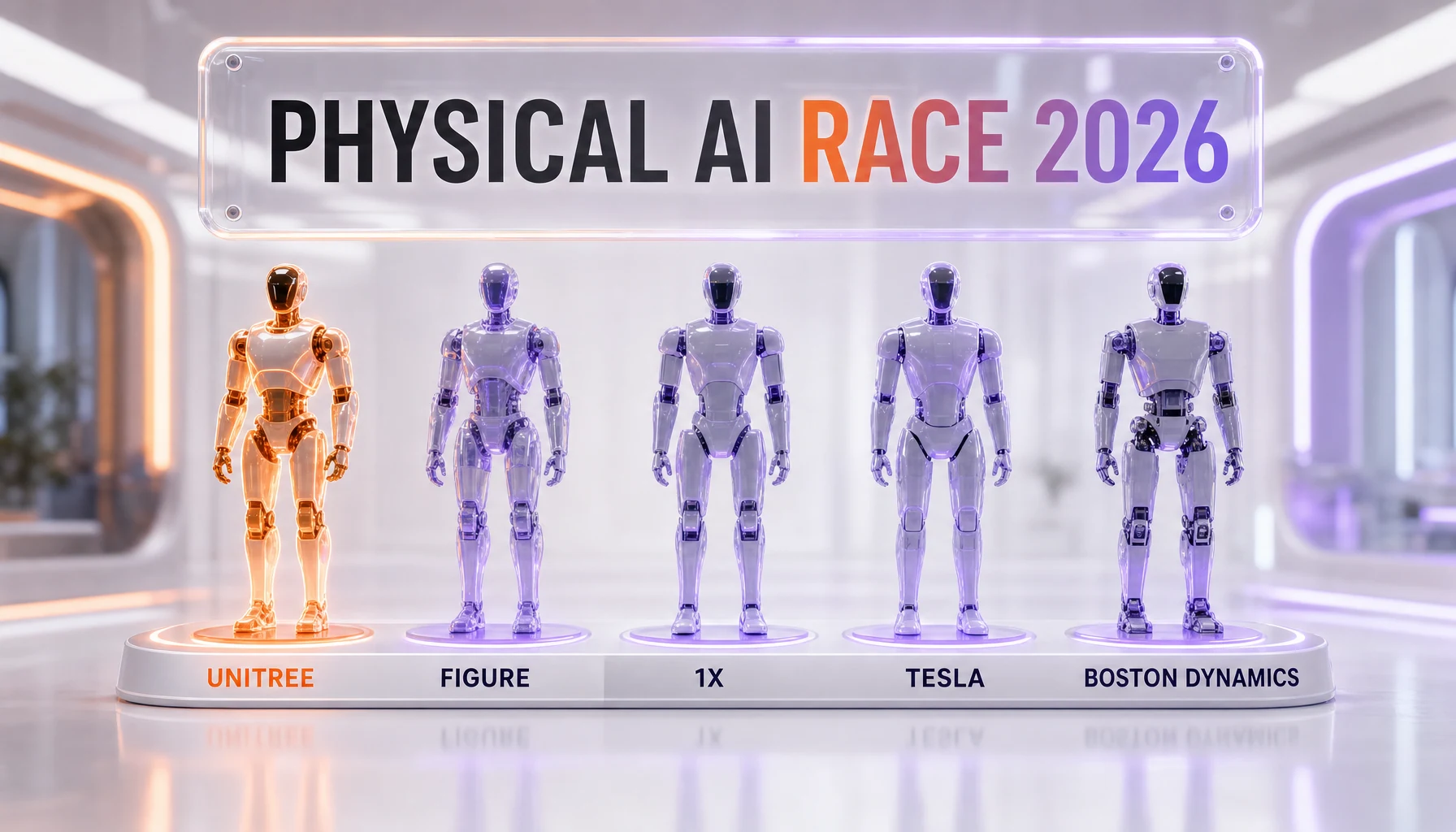
The H2 Plus is a different animal. It is not trying to win a warehouse contract; it is trying to become the default classroom and lab platform for an entire research field. That is a quieter ambition with a longer fuse. The companies fighting for commercial deployments — including the factory partnerships like Humanoid’s binding deal with Schaeffler — are racing for near-term revenue. NVIDIA is playing for the architecture the whole field standardizes on, the same way it captured AI research with CUDA and is now extending its open-weights footprint with Nemotron 3. Whoever owns the research baseline shapes the next decade of talent and tooling.
Our Take
We have watched the humanoid field oscillate between genuine progress and demo theater for three years, and most announcements deserve a skeptical read. This one deserves a strategic read instead. The hardware specs are real and verified, but they are not the story. The story is that NVIDIA just did to humanoid research what it did to AI research: define the default stack, hand it to the most influential labs, and let the lock-in compound. The fact that the body underneath is Chinese, from a company about to go public, only makes the move more revealing about how tangled and pragmatic the physical AI race has become.
The honest caveat is that reference designs live or die on adoption, not press releases. A standardized platform is only powerful if Stanford, ETH Zurich, and the next hundred labs actually build on it instead of rolling their own. October 2026 is when we find out whether the H2 Plus becomes the Raspberry Pi of humanoid research or just another impressive spec sheet. If the embodied-AI research community converges on this stack the way it converged on NVIDIA for training, then the most important humanoid announcement of 2026 was not a robot that did backflips — it was a reference design that quietly decided who owns the on-ramp. For more on the embodied frontier, see our coverage of Wayve Labs going after the whole robot stack.
Frequently Asked Questions
What is the Unitree H2 Plus?
The Unitree H2 Plus is the humanoid robot that NVIDIA named its Isaac GR00T Reference Humanoid Robot for Academic Research, announced June 1, 2026 at NVIDIA GTC Taipei. It stands roughly 1.80 meters (6 feet) tall, weighs about 68 kilograms (150 pounds), and has 31 degrees of freedom in the body plus Sharpa Wave five-finger hands at 22 degrees of freedom per hand, for 75 degrees of freedom across the body and hands. It runs on NVIDIA Jetson AGX Thor compute and the Isaac GR00T open development platform.
What does it mean that the H2 Plus is a "reference humanoid robot"?
A reference design is a standardized, NVIDIA-blessed configuration that other researchers can copy. Instead of every university lab assembling its own one-off robot, hardware, sensors, onboard compute, and software stack, NVIDIA and Unitree defined a single open reference combining the H2 Plus body, Sharpa Wave hands, Jetson AGX Thor, and Isaac GR00T. The goal is to give academic robotics a common baseline so research is reproducible and comparable across institutions.
What chip powers the Unitree H2 Plus?
The H2 Plus runs on NVIDIA Jetson AGX Thor, a Blackwell-generation module. NVIDIA rates Jetson AGX Thor at 2,070 FP4 TFLOPS with 128 GB of unified memory. That is the onboard "brain" that runs the Isaac GR00T models for reasoning, perception, and whole-body control directly on the robot rather than in the cloud.
How many degrees of freedom does the H2 Plus have?
The H2 Plus has 31 degrees of freedom across the body and 22 degrees of freedom per Sharpa Wave hand, for a total of 75 degrees of freedom across the body and hands. The high hand count is what makes the robot suitable for dexterous manipulation research rather than just locomotion demos.
What is NVIDIA Isaac GR00T?
Isaac GR00T is NVIDIA’s open development platform and family of foundation models for humanoid robots. It spans the full workflow: Isaac Teleop for data capture, Isaac Sim and Isaac Lab for simulation and training, Isaac ROS middleware, the GR00T foundation models, and Jetson Thor for on-robot inference. The H2 Plus is the first reference body shipped with this stack pre-integrated.
When will the Unitree H2 Plus reference humanoid be available?
NVIDIA and Unitree said the reference humanoid will be available from Unitree in late 2026, with reporting pointing to October 2026. It is aimed at academic and research buyers rather than consumers, so availability is framed around lab procurement rather than a retail launch.
Which universities and labs are getting the H2 Plus?
The named early institutions are the Stanford Robotics Center, ETH Zurich, UC San Diego’s Advanced Robotics and Controls Laboratory, and Ai2 (the Allen Institute for AI) in Seattle. These are frontier robotics groups, and NVIDIA is using them to seed the reference design across academic research.
How does the H2 Plus compare to Figure and 1X humanoids?
Figure and 1X are vertically integrated companies building their own robots, their own AI stacks, and their own go-to-market for labor and consumers. Figure’s Helix-02 ran a 24-hour-plus autonomous warehouse shift, and 1X put a price and date on its NEO consumer humanoid. The H2 Plus is positioned differently: it is a standardized research platform on the NVIDIA stack, sold to labs, not a finished commercial product competing for warehouse or home contracts.
Is the Unitree H2 Plus a Chinese robot?
Yes. Unitree is a Chinese robotics company, and NVIDIA selecting it as the reference body is notable given the geopolitics of US-China AI hardware. It signals that for academic dexterity research, NVIDIA judged Unitree’s hardware and price-performance the best fit, even as China simultaneously builds its own humanoid governance, including a national robot ID system.
Is Unitree planning an IPO?
Unitree is pursuing a public listing, with a review under way for China’s STAR Market board. Being chosen as NVIDIA’s reference humanoid is a strong validation signal heading into that process, since it ties Unitree’s hardware to the most-watched name in AI compute right before a potential IPO.
Why does the H2 Plus matter for the broader physical AI race?
It standardizes the academic on-ramp to humanoid robotics on NVIDIA’s stack. By making one body, one compute module, and one software platform the default for university labs, NVIDIA shapes which architecture the next generation of robotics researchers learns first, the same lock-in playbook that worked with CUDA in AI. Jensen Huang has called humanoids a multitrillion-dollar opportunity, and owning the research baseline is how NVIDIA intends to sit at the center of it.