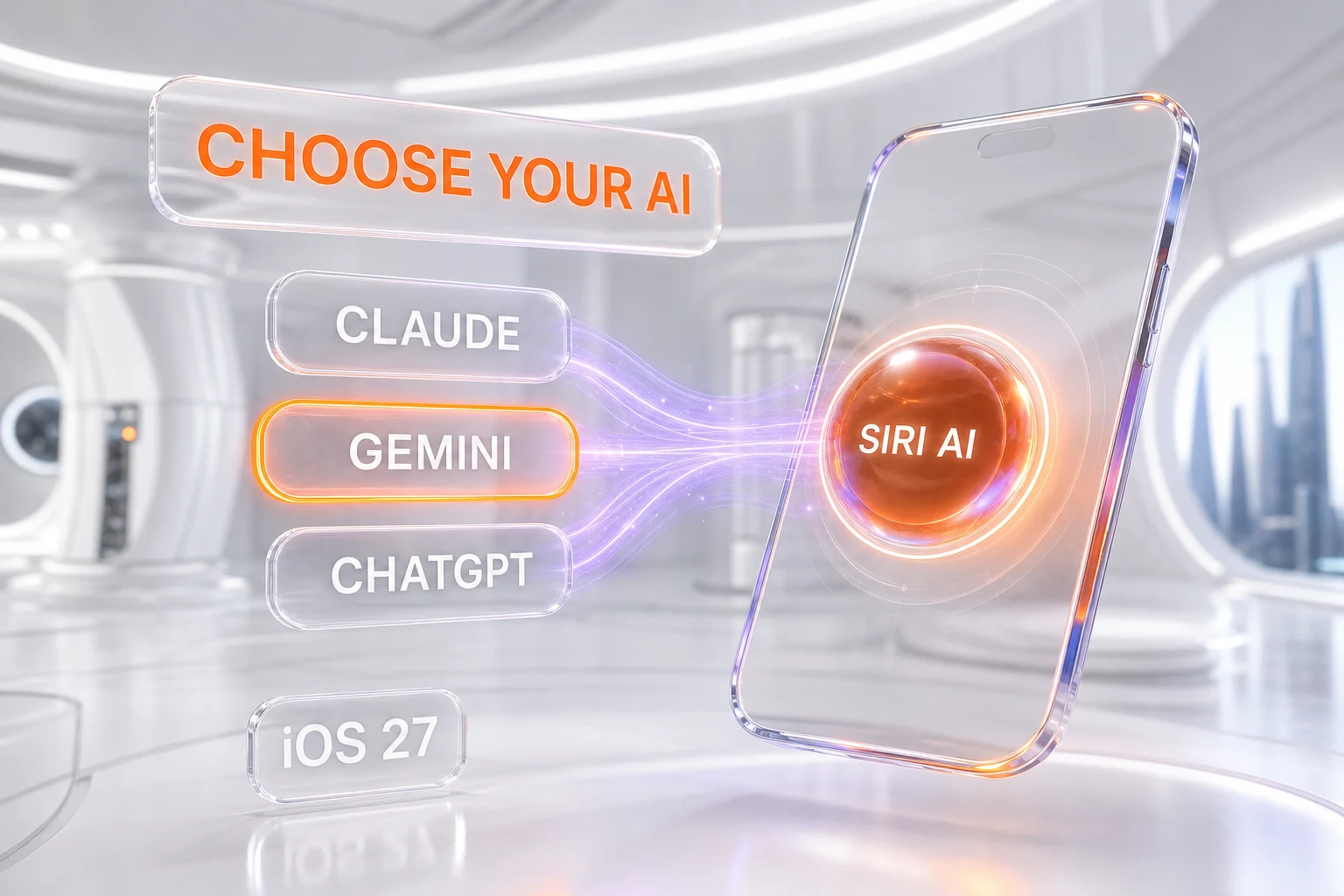
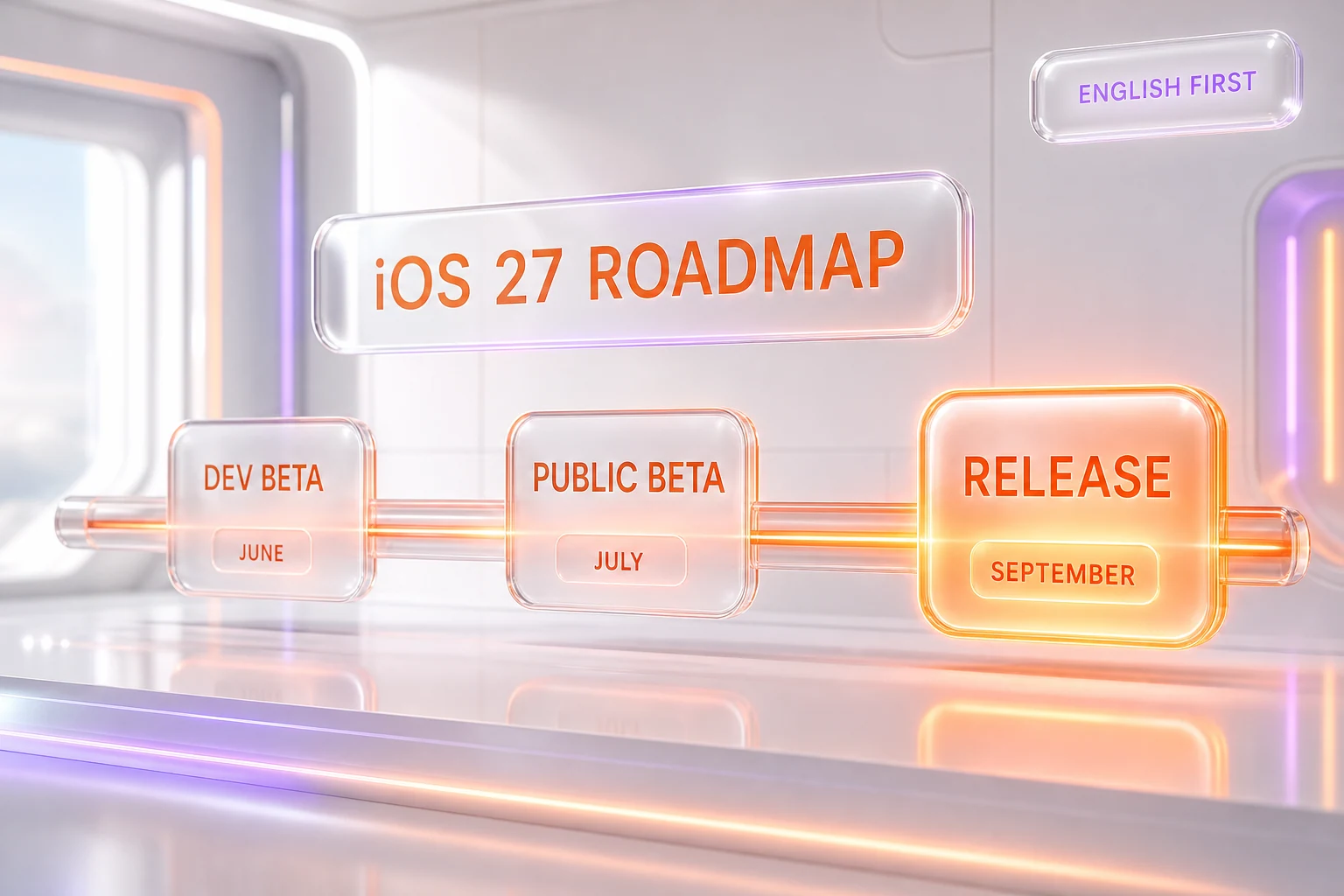
iOS 27 is set to let iPhone users pick Claude, Gemini, or ChatGPT as their assistant — but at WWDC 2026 (June 8-9) Apple only confirmed part of it. Apple unveiled "Siri AI," a full Siri rebuild on Apple Foundation Models, and opened its framework so developers can call Claude and Gemini via one Swift API. The user-facing "pick your assistant" toggle was reported, not shown. Public beta lands mid-July, stable release September 2026 — English first, not in the EU or China at launch.
If you choose your own AI tools, this is the Apple story that actually matters in 2026. For two years, Apple Intelligence funneled hard questions to a single partner, ChatGPT. The picture changing now is bigger than one default. Below is a clean separation of what Apple confirmed at WWDC, what reporters have characterized, what Google itself says, and what remains officially unconfirmed — because the trust in this story lives entirely in that distinction.
What Apple Actually Announced at WWDC 2026
On June 8, 2026, Apple introduced Siri AI, which it describes as "a profoundly more capable and conversational assistant with personal context understanding, broad world knowledge, and onscreen awareness." It is a ground-up rebuild, and the headline structural change is a first for the platform: a standalone Siri app. You can open it directly, revisit past conversations, and sync that history across devices through iCloud.
The other confirmed pillars: on-screen awareness, so Siri can answer questions about whatever is currently displayed; visual intelligence with multimodal image understanding, so you can ask about visual content; and a more natural voice whose pace and expressiveness you can adjust. Apple frames Siri AI as leveraging "the next generation of Apple Intelligence" built on "the next generation of Apple Foundation Models that run on device and on servers using Private Cloud Compute."
Read that sourcing carefully, because it is the crux of the whole story. In its own newsroom releases, Apple credits Apple Foundation Models — and only Apple Foundation Models. We'll come back to why that wording is doing so much work.
The Headline Everyone Wants: Can You Pick Claude or Gemini as Your iPhone Assistant?
The short version: not yet officially, but the groundwork is real and it points that way. Two separate things are being conflated in most coverage, and pulling them apart is the single most useful thing you can do with this announcement.
The first is a developer capability — confirmed, shipping, demonstrable. The second is a consumer-facing model-picker that would let you, the iPhone owner, swap Siri's underlying brain for Claude, Gemini 3.1 Pro, ChatGPT, or Grok. That second piece is strongly reported, was found in beta code, and is widely expected — but Apple did not formally confirm it at WWDC. Treating the two as the same announcement is the most common mistake we've seen in the coverage this week.
Confirmed vs. Still Unconfirmed
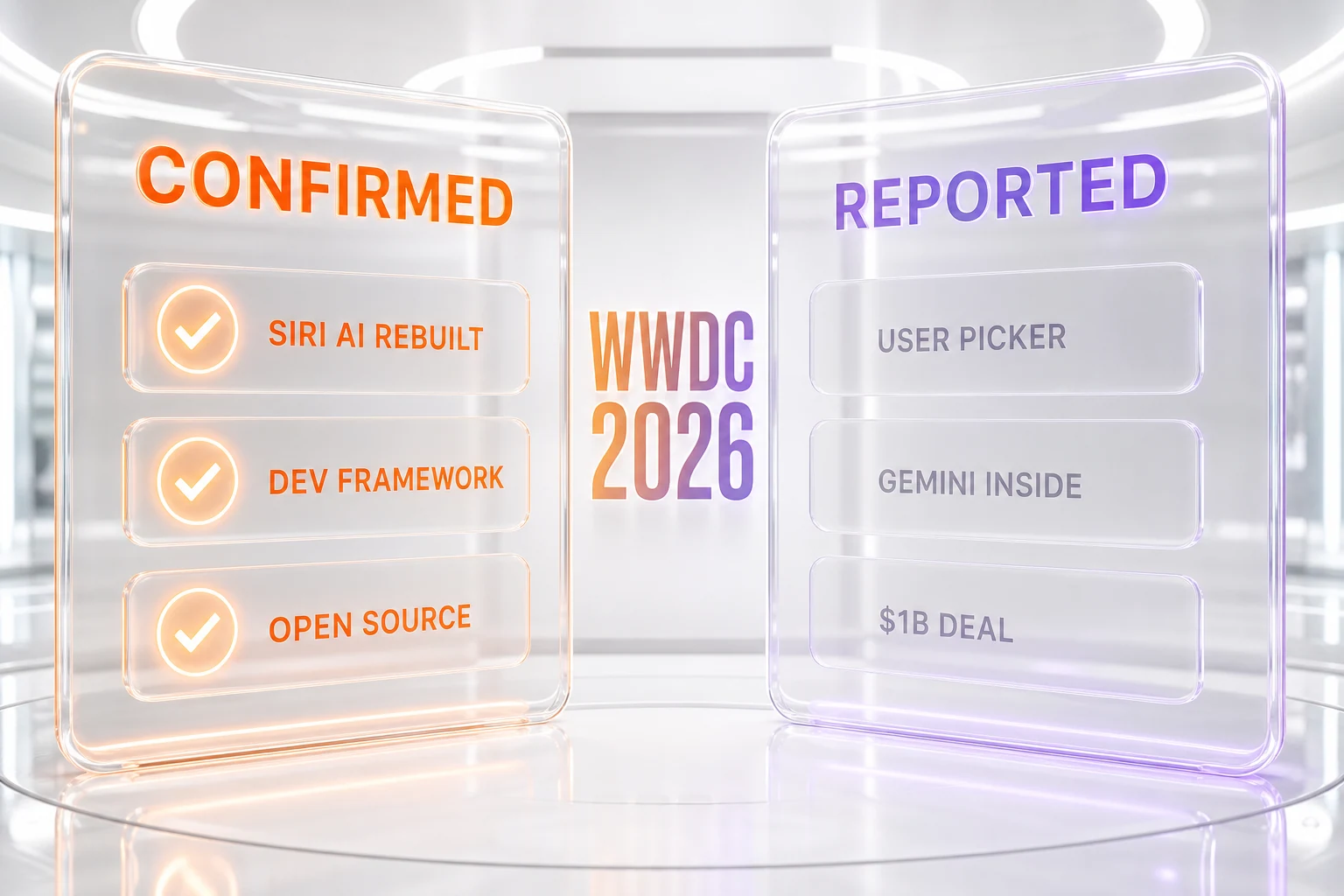
Here is the clean breakdown, based on Apple's own materials versus press reporting.
Confirmed by Apple at WWDC 2026:
- Siri AI exists and is a full rebuild, with a standalone app, on-screen awareness, visual intelligence, and an adjustable voice.
- The Foundation Models framework now lets developers call third-party models like Claude and Gemini through the same Swift API (server-side, cloud-hosted), alongside Apple's on-device and cloud tiers.
- The framework gains image input, a free Private Cloud Compute tier for developers with fewer than two million first-time App Store downloads, and a "Dynamic Profiles" system for multi-agent workflows.
- The Foundation Models framework will go open source later this summer.
- Availability: developer testing began June 8, 2026; consumer beta later this year; English first, with more languages to follow; not in the EU (on iPhone, iPad, Apple Watch) or China at launch.
Reported but NOT confirmed by Apple:
- A consumer "Extensions" system — a Settings panel plus a dedicated App Store section — that would let end users assign Claude, Gemini, ChatGPT, or Grok to power Apple Intelligence features and open-ended chat.
- That Siri itself "runs on" Google Gemini (Apple credits only Apple Foundation Models; the Gemini-under-the-hood framing comes from reporters).
- The roughly one-billion-dollar-per-year figure for the reported Google model license.
Keep this split in mind for everything that follows. The developer story is solid ground. The consumer story is well-sourced speculation.
The Foundation Models Framework Opens to Claude and Gemini
This is the genuinely new, fully confirmed development — and for anyone building apps, it is the bigger deal. At the Platforms State of the Union on June 9, Apple detailed a Foundation Models framework that, per MacRumors, allows developers to "call third-party models like Claude and Gemini through the same Swift API."
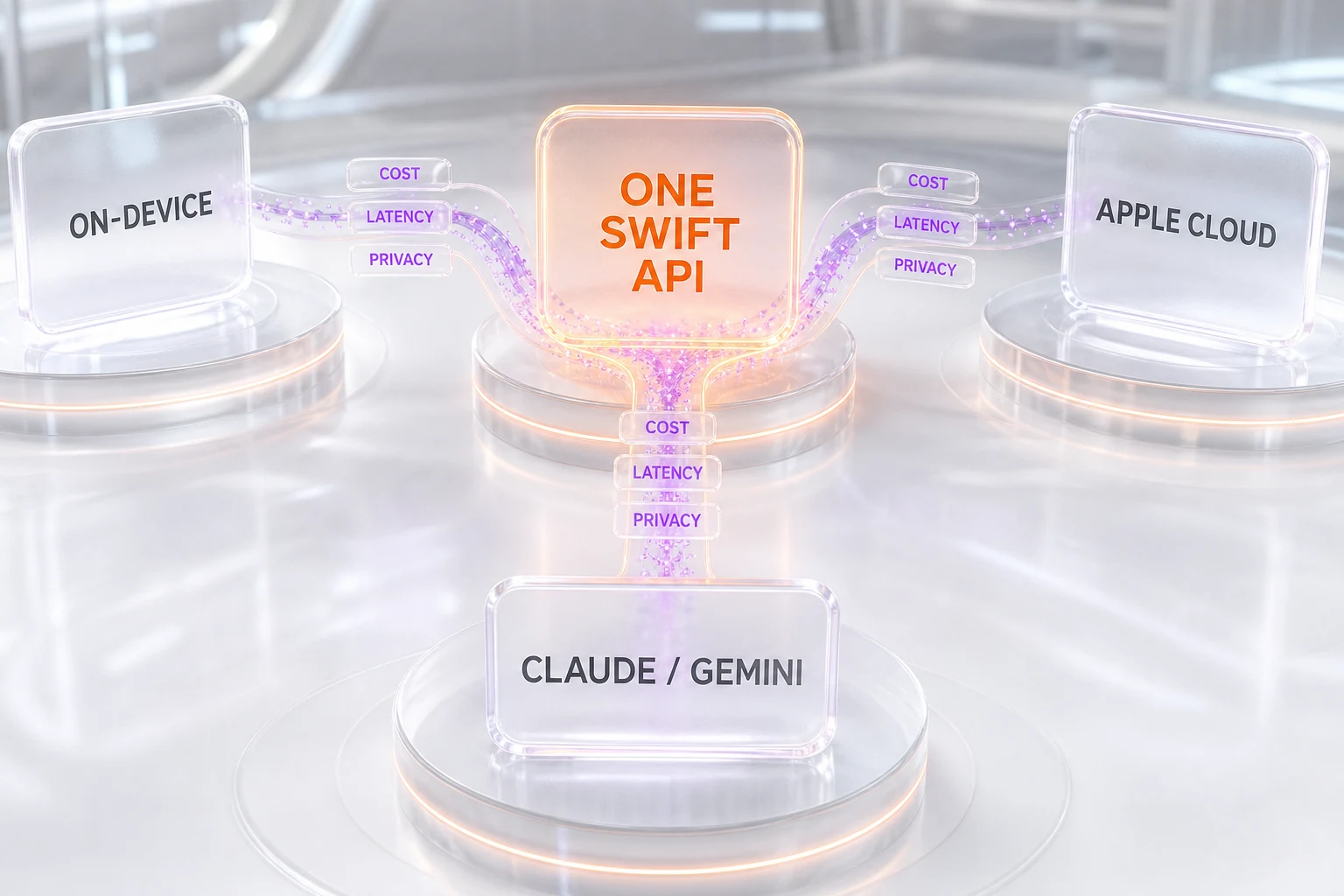
The architecture is the interesting part. A single Swift API can route each request to one of three destinations: a private on-device model, Apple's free cloud tier, or a frontier model like Claude or Gemini hosted server-side. The routing decision can be made per request, weighed by cost, latency, or privacy. Most strikingly, a team can swap one provider for another by updating a Swift Package Manager dependency, with no changes to the session logic itself. Prototype locally, route the hard queries to Claude Opus 4.8 or Gemini, and switch providers later without rewriting your app.
Google confirmed its side independently. In its own developer blog, Google states that "Apple developers can now securely call cloud-hosted Gemini models using the Foundation Models framework," plugging directly in "using the same API." Note the framing precisely: Google describes giving its models and infrastructure to developers. It makes no claim, anywhere, about powering Siri itself. That silence is meaningful.
Apple also confirmed the framework will go open source later this summer. Companion local-model implementations were reported alongside it, but Apple did not name them in its own materials, so we treat those as reported companion implementations rather than confirmed fact.
So Does Siri Run on Gemini? The Model Debate
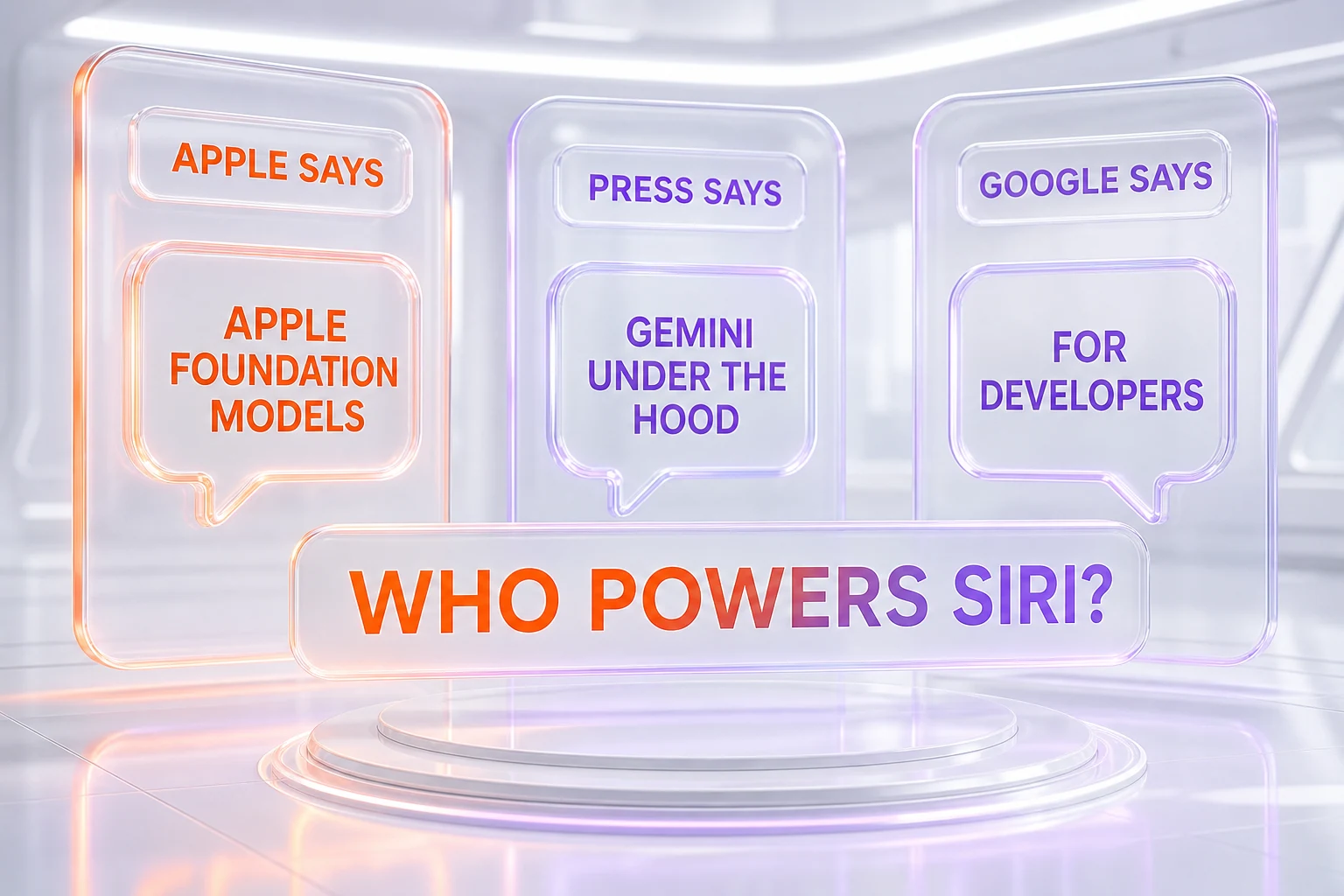
This is where rigor matters most, so we will lay out three accounts and deliberately not resolve them, because the public record does not resolve them.
What reporters say. TechCrunch reported that "Apple said it collaborated with Google and the Gemini family of models to develop the next generation of Apple Foundation Models that power its integrated Apple Intelligence experiences." TechCrunch's own characterization was blunter: "With Google Gemini under the hood." Earlier in 2026, Bloomberg reporting (which we covered in our earlier analysis of the reported $1 billion deal) described a custom Gemini license worth roughly one billion dollars per year, with Google as the infrastructure and model partner.
What Apple says. Apple's two newsroom press releases — one for Siri AI, one for the next generation of Apple Intelligence — make zero mention of Google or Gemini. They credit Apple Foundation Models. Apple frames the technology as its own, developed in collaboration with Google as a supplier of models and infrastructure.
What Google says. Google's blog stays carefully inside the developer lane — Gemini for app builders, via the framework — and asserts nothing about Siri's internals.
So the honest answer is that "Siri runs on Gemini" is reporters' shorthand, not an Apple-confirmed fact. The most defensible reading: Apple positions these as Apple Foundation Models built in collaboration with Google, where Google supplies model and infrastructure capacity. Whether that makes Gemini "Siri's brain" or a back-end ingredient inside an Apple-owned stack is precisely the question Apple's wording leaves open — and, we suspect, intentionally so.
What Changes If You Choose Your Own AI Tools
For developers, the shift is concrete and immediate: real model portability inside the Apple ecosystem. You can prototype on-device for privacy, escalate genuinely hard queries to a frontier model, and change vendors by editing a dependency. That lowers the switching cost that has historically locked apps into a single AI provider, and it puts pricing pressure on every model vendor competing for that routed traffic.
For users, the prize — if Extensions ships — is the end of the single-provider default. Instead of every Apple Intelligence feature deferring to one chatbot, you would assign the brain you trust: one model for Writing Tools, another for open-ended chat, perhaps a search-native option like Perplexity Comet for fact-heavy queries. It would turn Apple Intelligence into a marketplace rather than a storefront.
The strategic read is the most interesting layer. Apple appears to be shifting from "build our own frontier model and win on raw capability" toward "be the privacy-first router and marketplace sitting on top of everyone else's models." That is not a retreat so much as a different bet — closer to the role Intel once played inside the PC: an essential supplier relationship where the partner's component lives inside a product the platform owner controls and brands. Framed that way, the Google collaboration is less a concession than a deliberate position: own the surface, own the privacy layer, rent the frontier intelligence.
The Timeline: Developer Beta to Fall Release
The schedule, as Apple laid it out: developer beta opened June 8, 2026; a public beta arrives in mid-July; and the stable release lands in September 2026, alongside the iPhone 18. Siri AI's consumer rollout trails slightly — Apple says the broader assistant experience reaches users "later this year."
iOS 27 itself is reaching far back into the install base. Apple has positioned it as one of its most broadly compatible releases ever, expanding to most existing iPhones — though sources differ on the exact oldest supported model, with some pointing to the iPhone 11 and others to the iPhone 12, so we will not pin a hard cutoff here.
Two constraints matter for adoption. First, language and region: Siri AI is English-first, with more languages promised soon, and it will not be available initially in the EU (on iPhone, iPad, and Apple Watch) or in China while Apple works through regulatory requirements. Second, hardware. The most powerful on-device model requires at least 12 GB of unified memory — that means iPhone Air, iPhone 17 Pro, and iPhone 17 Pro Max, plus iPad (M4) or later and Mac (M3) or later. A lighter version of Siri AI reaches further down, to iPhone 16 models and later, iPhone 15 Pro and Pro Max, the iPad mini with A17 Pro, and Macs and iPads on M1 or newer.
Why Apple Held the User-Facing Switch Back
If the consumer model-picker is built and sitting in beta code, why was it absent from WWDC entirely? According to The Next Web, the reported "Extensions" system — a Settings panel and a dedicated App Store section, "both built but toggled off on Apple's backend" — "did not appear in any slide, demo, or press release," and "Apple has not publicly confirmed or denied that Extensions will ship with iOS 27 this fall."
The reporting points to three pressures. The first is the EU's Digital Markets Act: third-party model access raises thorny questions about how Apple would offer it in a regulatory environment already forcing it to open other parts of iOS. The second is legal — reporting suggests OpenAI is weighing possible action tied to its existing ChatGPT partnership, which a model-picker would directly reshape. The third is messaging: Apple appears to have wanted Siri AI's own standalone capabilities to land first, establishing credibility for the rebuilt assistant before introducing a screen that invites users to replace its brain. The original feature surfaced via a Mark Gurman and Bloomberg report (the pre-WWDC leak we covered in May) and was found in iOS 27 beta code — which is why "built but not announced" is the most accurate description today.
Our Take and What We're Watching
In our reading, WWDC 2026 confirmed the plumbing and deferred the headline. The developer-side opening to Claude and Gemini is the substantive, verifiable shift — it makes model choice a first-class concept inside the Apple ecosystem and meaningfully lowers lock-in. The consumer model-picker is the story everyone wants, but it remains reported rather than announced, and the honest framing is "set to" and "expected," not "shipping."
We're watching three things between now and the September release. Whether the Extensions panel flips on in a later iOS 27 beta — that is the single clearest signal that the user-facing switch is real for this cycle. Whether Apple ever names a model partner in its own materials, or keeps everything under the Apple Foundation Models banner. And how the EU and OpenAI situations resolve, since both could gate the feature regardless of whether the code is ready. For anyone who picks their own AI tools, the direction of travel is unmistakable — Apple is building toward choice. The open question is purely when, and on whose terms.
Frequently Asked Questions
Can I really pick Claude or Gemini as my iPhone assistant in iOS 27?
Not as a confirmed feature yet. At WWDC 2026, Apple confirmed that developers can call Claude and Gemini through its Foundation Models framework, but it did not formally announce a consumer-facing model-picker. The reported "Extensions" system that would let everyday users swap their assistant exists in beta code but was absent from the keynote, and Apple has neither confirmed nor denied it will ship this fall.
Does the new Siri run on Google Gemini?
It depends on whom you ask, and the public record does not settle it. Apple's own press releases credit only "Apple Foundation Models" and never mention Gemini. TechCrunch reported that Apple "collaborated with Google and the Gemini family of models," characterizing it as "Google Gemini under the hood." Google's own blog talks only about giving Gemini to developers, not powering Siri. The fairest framing: Apple Foundation Models built in collaboration with Google as a model and infrastructure partner.
When does iOS 27 come out?
The developer beta opened June 8, 2026. A public beta arrives in mid-July 2026, and the stable release is expected in September 2026, alongside the iPhone 18. Siri AI's broader consumer rollout follows later in the year.
Which iPhones get the most powerful Siri AI?
The most powerful on-device model requires at least 12 GB of unified memory: iPhone Air, iPhone 17 Pro, and iPhone 17 Pro Max, plus iPad (M4) or later and Mac (M3) or later. A lighter version of Siri AI runs on iPhone 16 models and later, iPhone 15 Pro and Pro Max, the iPad mini (A17 Pro), and Macs and iPads on M1 or newer.
Is Siri AI available in the EU or China?
Not at launch. Apple has said Siri AI will not be available initially in the EU on iPhone, iPad, and Apple Watch, and that it will not be available in China while Apple works through regulatory requirements. It launches in English first, with more languages promised to follow.
What is the Apple Foundation Models framework, and what changed for developers?
It is Apple's Swift API for adding AI to apps. At WWDC 2026, Apple confirmed it now lets developers call cloud-hosted third-party models like Claude and Gemini through the same API, routing each request to an on-device model, Apple's free cloud tier, or a frontier model by cost, latency, or privacy. New additions include image input, a free Private Cloud Compute tier for developers with fewer than two million first-time App Store downloads, and a "Dynamic Profiles" system. Apple says the framework will go open source later this summer.
What is "Extensions" in iOS 27?
Extensions is a reported iOS 27 system — a Settings panel plus a dedicated App Store section — that would let users assign different AI providers (such as Claude, Gemini, ChatGPT, or Grok) to power Apple Intelligence features like Writing Tools, Image Playground, and open-ended chat. It was found in beta code but, per The Next Web, did not appear in any slide, demo, or press release at WWDC.
Why didn't Apple show the third-party AI picker at WWDC?
According to The Next Web, three reported reasons: the EU's Digital Markets Act raises questions about how Apple would offer third-party model access; OpenAI is reportedly weighing legal action tied to the existing ChatGPT partnership; and Apple wanted Siri AI's own standalone capabilities to land first before inviting users to swap its underlying model.
How much is Apple paying Google for Gemini?
Press reports, originating with Bloomberg, have described a custom Gemini license worth roughly one billion dollars per year, with Google as the infrastructure and model partner. This remains a contested press report and has not been confirmed by Apple, which credits only its own Apple Foundation Models.
Will choosing a third-party model replace Siri entirely?
No. Based on the reporting, the model-picker would power specific Apple Intelligence features and open-ended chat rather than replace the assistant wholesale. Siri AI remains the system assistant; a chosen third-party model would supply intelligence behind certain features, not take over the device.