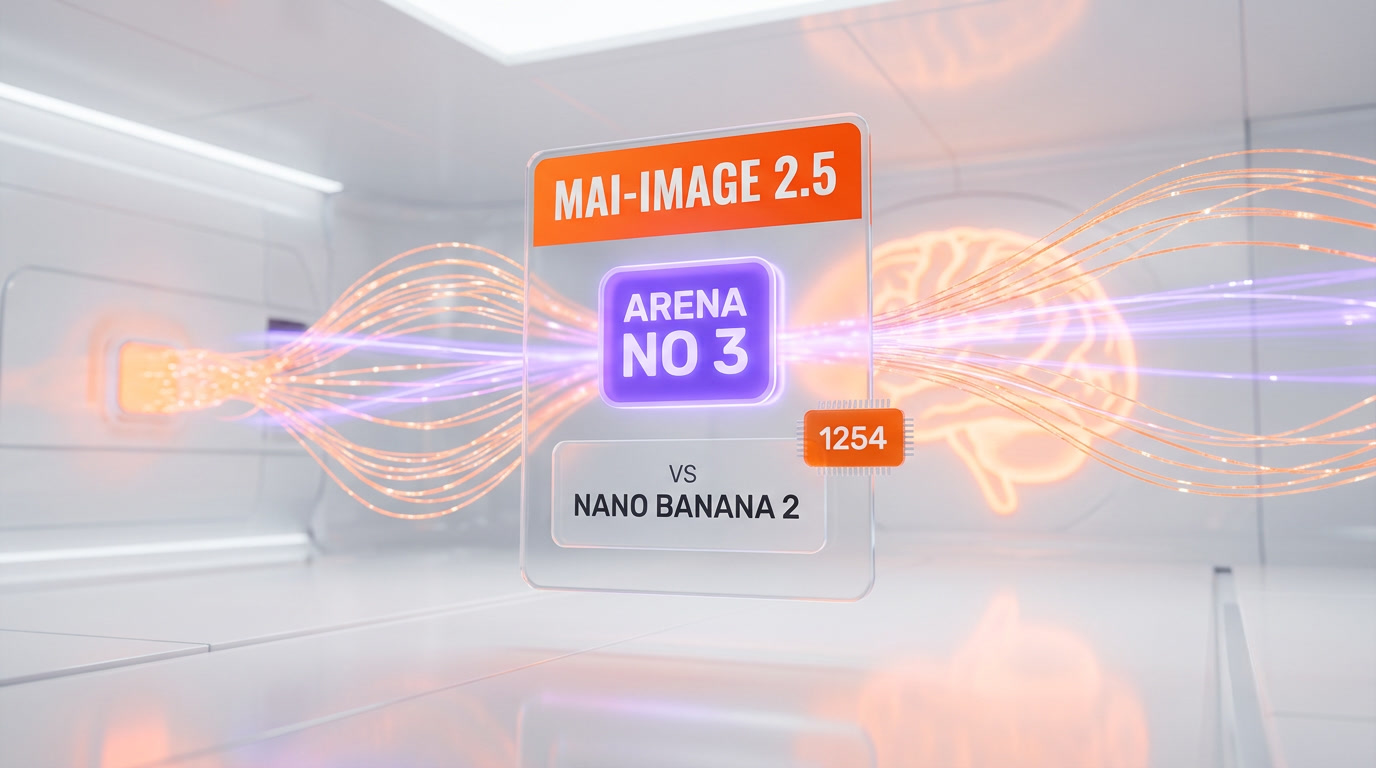
MAI-Image-2.5 is Microsoft's newest in-house text-to-image model, announced by Microsoft AI on May 26, 2026 and described as its best image model to date. According to Microsoft's official blog, it debuts ranked third on the Arena text-to-image leaderboard (formerly LMArena). Secondary reporting from the-decoder places its Arena score at roughly 1254 — level with Google's Nano Banana 2 and behind OpenAI's leading image model — though Arena rankings shift constantly. The bigger story is strategic: MAI-Image-2.5 is the clearest sign yet of Microsoft's push to build its own frontier models and reduce its dependence on OpenAI.
What Happened
On May 26, 2026, Microsoft AI announced MAI-Image-2.5, calling it the company's best in-house image generation model to date. The headline from Microsoft's own blog is precise and verifiable: the model "launches at No. 3 on Arena," the community-voted text-to-image leaderboard previously known as LMArena.
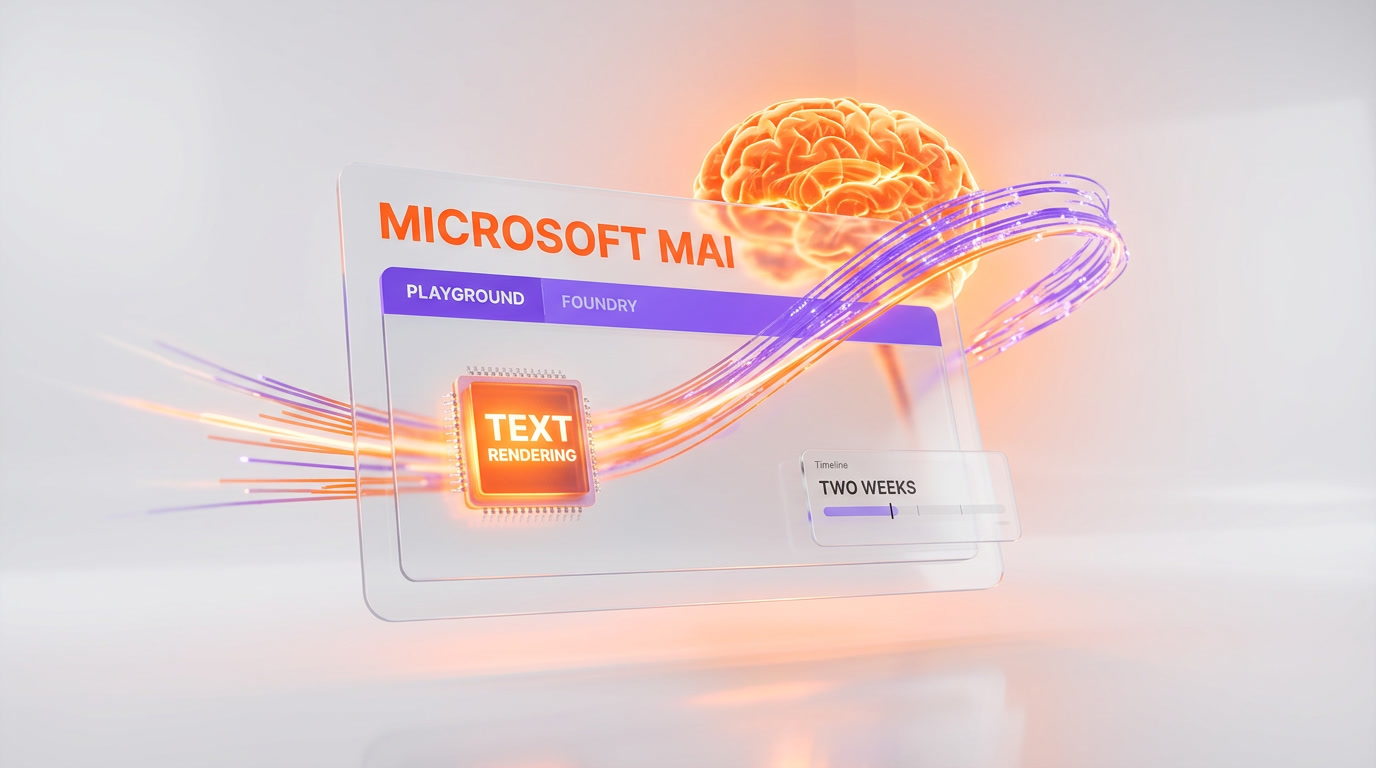
Microsoft frames MAI-Image-2.5 as a direct upgrade over its predecessor, MAI-Image-2, with concrete advances in three areas: text rendering (the perennial weak spot of image models, where letters and words inside an image come out garbled), stylized illustration, and commercial imagery — the kind of clean, on-brand visuals that marketers, designers, and product teams actually ship.
The model is available to try immediately on Arena. Microsoft says it is "coming to the MAI Playground and Foundry within the next two weeks," which puts broad developer and product access on a roughly mid-June 2026 timeline. Foundry is Microsoft's model-and-agent platform (the rebranded successor to Azure AI Foundry), and MAI Playground is Microsoft AI's consumer-facing experimentation surface.
One claim deserves a clear caveat. Microsoft's official post states the No. 3 ranking but does not name Google or OpenAI, and it does not publish a numeric Arena score. The widely repeated framing that MAI-Image-2.5 "pulls even with Google" comes from secondary tier-1 coverage, not from Microsoft. We treat those benchmark numbers as reported figures, attributed and dated below — not as facts we independently verified.
The Numbers — Attributed And Dated
Here is the careful version of the benchmark story, because this is where most coverage gets sloppy.
Confirmed by Microsoft (primary source): MAI-Image-2.5 debuts at No. 3 on the Arena text-to-image leaderboard. That is the only ranking claim Microsoft itself makes.
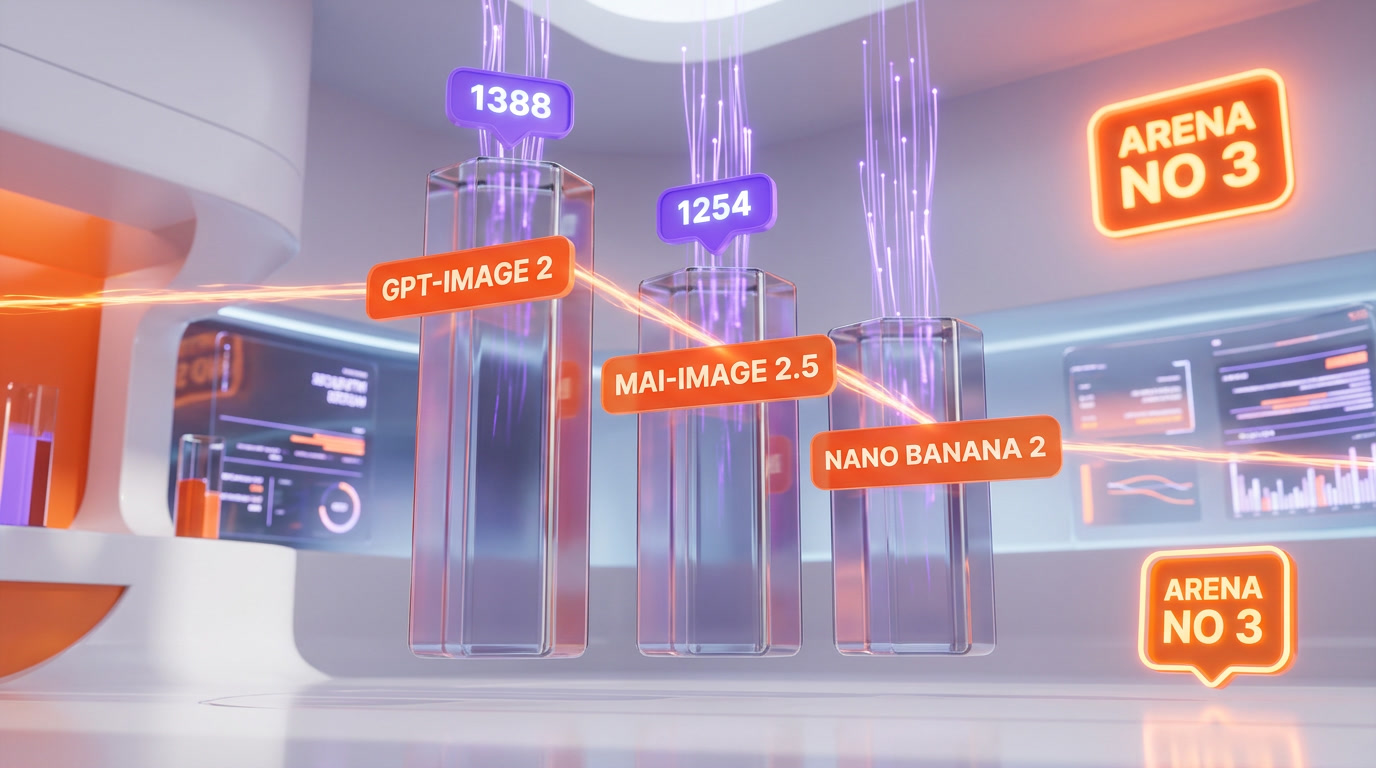
Reported by secondary sources (the-decoder, winbuzzer, late May 2026): MAI-Image-2.5 scores around 1254 on the Arena leaderboard, a gain of roughly +72 over MAI-Image-2. That score is described as level with Google's Nano Banana 2, pushing Google's Nano Banana Pro down to fourth, while OpenAI's gpt-image-2 reportedly leads the board near 1388.
Two things matter about those figures. First, they come from third-party reporting of the Arena leaderboard, not from Microsoft's announcement. Second — and this is the part nobody can footnote away — Arena rankings are live and volatile. They are recomputed continuously from human pairwise votes. A No. 3 debut on May 26, 2026 can be a No. 2 or a No. 5 a week later as votes accumulate and rivals ship updates. Treat any specific number here as a snapshot, not a permanent scoreboard.
| Model | Reported Arena score (late May 2026) | Source tier |
|---|---|---|
| OpenAI gpt-image-2 | ~1388 (leading) | Secondary (winbuzzer) |
| Microsoft MAI-Image-2.5 | ~1254 (No. 3 debut) | Microsoft confirms rank; score per the-decoder |
| Google Nano Banana 2 | ~level with MAI-Image-2.5 | Secondary (the-decoder) |
| Google Nano Banana Pro | 4th (displaced by MAI-Image-2.5) | Secondary (the-decoder) |
The honest headline is "Microsoft draws level with Google," not "Microsoft overtakes Google." MAI-Image-2.5 sits next to Nano Banana 2, not above OpenAI. If you want the deeper context on Google's family of models, we broke them down in our complete guide to Google's Nano Banana image models, and we benchmarked them against Imagen 4 in our Nano Banana vs Imagen 4 comparison.
Why It Matters — The MAI Strategy, Not The Scoreboard
If you only watch the leaderboard, you will miss the actual news. The durable story is not that Microsoft tied a Google model on one volatile benchmark. It is that Microsoft has an image model worth ranking at all — built in-house, under the MAI banner, on a release cadence that is accelerating.
Microsoft spent years as the company that distributed OpenAI's models rather than building frontier models itself. Copilot, Designer, and Bing Image Creator were OpenAI-powered shop windows. MAI-Image-2.5 is part of a deliberate pivot away from that posture. We mapped this shift in detail when Microsoft first signaled its in-house ambitions, in our analysis of Microsoft's MAI in-house models and the OpenAI relationship.
The version history tells the cadence story. MAI-Image-1 arrived in October 2025 as Microsoft's first home-grown image model. MAI-Image-2 followed. MAI-Image-2.5 is the third release in roughly seven months — and the first to land in the top three of a public, community-voted leaderboard. That is a company iterating fast, not dabbling.
For Microsoft, owning the model matters for three concrete reasons: cost (running your own weights is cheaper at Microsoft's scale than paying per-call for someone else's), control (you set the safety policy, the rendering quality bar, and the roadmap), and leverage (every credible in-house model strengthens Microsoft's negotiating position with OpenAI as their commercial agreement evolves).
Text Rendering — Why It Is The Headline Feature
Of the three improvement areas Microsoft cites, text rendering is the one that quietly decides commercial usefulness. For years, AI image models produced beautiful scenes ruined by gibberish text — a poster with melted letters, a product mockup with a misspelled brand name, a UI screenshot full of nonsense words.
Google made text rendering a marquee feature of its Nano Banana family, and OpenAI's gpt-image-2 pushed it further still — we covered that closely when the gpt-image-2 specs and LMArena debut leaked. Microsoft naming text rendering as a top-three advance in MAI-Image-2.5 is a signal that the company knows where the commercial battle is being fought: not on dreamy art, but on whether a model can spell a headline correctly inside a social-media graphic.
The same logic applies to "commercial imagery," Microsoft's second cited improvement. Marketing teams do not need a model that paints surrealist landscapes; they need one that produces clean, on-brand, repeatable visuals with legible copy baked in. That is exactly the slice of the market Microsoft is targeting through Copilot, Designer, and Foundry.
How It Compares — Google, OpenAI, And The Rest
Place MAI-Image-2.5 on the 2026 image-model map and the picture is clear. OpenAI's gpt-image-2 currently sits at the top of the Arena board per secondary reporting, and it powers the consumer experience we wrote about in our coverage of the ChatGPT Images 2 launch and the retirement of DALL-E. Google's Nano Banana 2 holds the tier just below, now sharing that rung with Microsoft.
The challenger field is real, too. Krea's foundation image model entered the conversation as a credible independent option — we put it head-to-head with OpenAI in our Krea 2 vs gpt-image-2 breakdown. The takeaway across all of these: the top of the image-generation market is now a four-way contest among OpenAI, Google, Microsoft, and a fast-moving independent tier, rather than the OpenAI-and-everyone-else picture of 2024.
What MAI-Image-2.5 does not do is dethrone anyone. It draws level with Google in one tier and remains behind OpenAI on the same board. For a model from a company that was barely in the frontier-image conversation a year ago, parity with Google is the achievement — not a number on a leaderboard that will have moved by the time you read this.
Who MAI-Image-2.5 Is Really For
Strip away the leaderboard drama and a clear target user emerges. MAI-Image-2.5 is built for the people already inside Microsoft's ecosystem: marketing teams generating campaign assets in Designer, product teams mocking up interfaces, and developers wiring image generation into apps through Foundry. Microsoft's emphasis on text rendering and commercial imagery is not an accident — those are the exact pain points that have kept enterprises from trusting AI image output in production.
Consider the practical workflow. A social team needs twenty on-brand graphics with a campaign tagline rendered correctly, in the right font weight, without a designer hand-fixing every one. A product manager needs a clean UI mockup with legible button labels for a pitch deck. These are unglamorous, high-volume, text-heavy jobs — and they are precisely where a model that "draws level with Google" on quality but lives natively inside Copilot and Designer can win on convenience rather than raw benchmark supremacy.
That distribution advantage is the part the Arena board cannot measure. OpenAI's gpt-image-2 may sit higher on the leaderboard, but it does not ship by default inside the productivity suite that hundreds of millions of workers already open every morning. For a large slice of commercial image generation, "good enough and already here" beats "marginally better but somewhere else." That is the bet MAI-Image-2.5 represents.
Availability — How And When You Can Use It
Access rolls out in stages. Right now, MAI-Image-2.5 is live on Arena, where anyone can pit it against rival models in blind pairwise comparisons — which is also how it earns its leaderboard position.
Microsoft has committed to bringing the model to the MAI Playground and Foundry within two weeks of the May 26 announcement, putting broad availability around mid-June 2026. Foundry access is the one developers and product teams care about: it is where MAI-Image-2.5 becomes something you can wire into an application, not just a demo you vote on.
- Arena — live now, blind comparison voting, free to try.
- MAI Playground — within two weeks of May 26, 2026 (around mid-June), consumer-facing experimentation.
- Foundry — within two weeks of May 26, 2026, developer and enterprise integration via Microsoft's model platform.
Microsoft has not published per-image pricing or rate limits for MAI-Image-2.5 at announcement. We will update this article when Foundry pricing and API details go live.
Our Take
We have been tracking Microsoft's MAI program since it stopped being a rumor, and MAI-Image-2.5 reads less like a benchmark stunt and more like a milestone in a longer plan. The leaderboard placement is genuinely impressive for a company this new to frontier image modeling — but we would caution anyone against over-indexing on the 1254 number. Arena scores are a live, vote-driven snapshot, the figure comes from secondary reporting rather than Microsoft itself, and it will not be the same number in a month.
The signal worth keeping is the trajectory. Three image models in seven months, each visibly better, the latest landing in the top three of a public board — that is the cadence of a company that intends to own this layer of the stack rather than rent it. Microsoft naming text rendering and commercial imagery as its priorities tells you exactly which customers it is chasing: the marketing, design, and product teams already living inside Copilot, Designer, and Foundry.
The competitive question for the rest of 2026 is not "who tops Arena this week." It is whether Microsoft can convert leaderboard parity into product reality once MAI-Image-2.5 reaches Foundry — and whether OpenAI's lead at the top of the board proves durable or just early. For now, the honest read is the unglamorous one: Microsoft has drawn level with Google, it remains behind OpenAI, and it has done so on its own models. That last part is the news.
What's Next
Three things to watch over the next month. First, the Foundry and MAI Playground rollout around mid-June 2026 — that is when MAI-Image-2.5 stops being a leaderboard entry and becomes a tool people build with. Second, the Arena board itself: whether MAI-Image-2.5 holds, climbs, or slips as votes accumulate and Google or OpenAI ship responses. Third, pricing — Microsoft has said nothing yet about per-image cost in Foundry, and that number will decide how aggressively the model gets adopted against Google's and OpenAI's offerings.
We will refresh this article as Foundry availability, pricing, and updated Arena standings land. The strategic thread — Microsoft building its way out of OpenAI dependence, one MAI model at a time — is the one we will keep pulling.
Frequently Asked Questions
What is MAI-Image-2.5?
MAI-Image-2.5 is Microsoft's newest in-house text-to-image model, announced by Microsoft AI on May 26, 2026 and described as its best image model to date. It debuts ranked third on the Arena text-to-image leaderboard (formerly LMArena), with cited improvements in text rendering, stylized illustration, and commercial imagery over its predecessor MAI-Image-2.
Did MAI-Image-2.5 overtake Google's Nano Banana 2?
No. The accurate framing is that MAI-Image-2.5 draws level with Google's Nano Banana 2, not that it overtakes Google overall. Microsoft's official blog confirms only the No. 3 Arena ranking. Secondary reporting from the-decoder places MAI-Image-2.5 at roughly the same Arena score as Nano Banana 2 and ahead of Nano Banana Pro, while OpenAI's gpt-image-2 still leads the board.
What Arena score did MAI-Image-2.5 get?
Microsoft itself published only the No. 3 ranking, not a numeric score. Secondary sources (the-decoder, winbuzzer) reported an Arena score of around 1254 in late May 2026, a gain of roughly +72 over MAI-Image-2, with OpenAI's gpt-image-2 reported near 1388. These figures come from third-party reporting and Arena rankings change continuously, so treat them as a dated snapshot.
Where does MAI-Image-2.5 rank against OpenAI's gpt-image-2?
Behind it. On the Arena text-to-image leaderboard as reported in late May 2026, OpenAI's gpt-image-2 leads near 1388 while MAI-Image-2.5 debuts at No. 3 around 1254. Microsoft confirms the No. 3 placement; the comparative scores come from secondary coverage and reflect a live, vote-driven board that shifts over time.
When can I use MAI-Image-2.5?
You can try MAI-Image-2.5 on Arena immediately. Microsoft says it is coming to the MAI Playground and Foundry within two weeks of the May 26, 2026 announcement — putting broad consumer and developer access around mid-June 2026. Foundry access is what lets developers integrate the model into applications.
What is the Arena (LMArena) text-to-image leaderboard?
Arena, formerly known as LMArena, is a community-voted leaderboard that ranks AI models by having humans compare two anonymized outputs and pick the better one. For text-to-image, users see two generated images from hidden models and vote, and the rankings are recomputed continuously. Because it is live and vote-driven, positions shift as votes accumulate and new models launch.
What improved in MAI-Image-2.5 over MAI-Image-2?
Microsoft cites three specific advances over MAI-Image-2: text rendering (legible letters and words inside generated images), stylized illustration, and commercial imagery. Text rendering and commercial imagery are the commercially decisive ones, targeting marketing, design, and product teams who need clean, on-brand visuals with correct text.
What are MAI Playground and Foundry?
MAI Playground is Microsoft AI's consumer-facing surface for experimenting with its MAI models. Foundry is Microsoft's model-and-agent platform — the successor to Azure AI Foundry — where developers and enterprises integrate models into applications. Microsoft has committed to bringing MAI-Image-2.5 to both within two weeks of the May 26, 2026 launch.
Why is MAI-Image-2.5 important if it only ties Google?
Because the strategic story outweighs the benchmark. MAI-Image-2.5 is the third in-house Microsoft image model in roughly seven months (after MAI-Image-1 in October 2025 and MAI-Image-2), and the first to reach a public leaderboard's top three. It signals Microsoft's deliberate push to build its own frontier models and reduce dependence on OpenAI, which matters more long-term than any single volatile Arena score.
How does MAI-Image-2.5 fit into Microsoft's strategy against OpenAI?
MAI-Image-2.5 is part of Microsoft's MAI in-house model program, designed to reduce its reliance on OpenAI for the models behind products like Copilot, Designer, and Bing Image Creator. Owning the model gives Microsoft cheaper inference at scale, control over quality and safety, and stronger leverage in its evolving commercial relationship with OpenAI.
Has Microsoft published MAI-Image-2.5 pricing?
Not at announcement. Microsoft has not released per-image pricing, rate limits, or API details for MAI-Image-2.5 as of the May 26, 2026 launch. Pricing is expected to surface when the model reaches Foundry around mid-June 2026, and it will be a key factor in how the model competes with Google's and OpenAI's offerings.
How does MAI-Image-2.5 compare to other 2026 image models like Krea and Imagen 4?
MAI-Image-2.5 sits in the same upper tier as Google's Nano Banana 2 and just behind OpenAI's gpt-image-2 on the reported Arena board. Beyond those leaders, the 2026 field includes Google's Imagen 4 and independent challengers like Krea's foundation image model, making the top of the market a four-way contest among OpenAI, Google, Microsoft, and a fast-moving independent tier.