Claude Fable 5 vs GLM-5.2: Top-Tier Intelligence vs Open-Weight Value (2026)


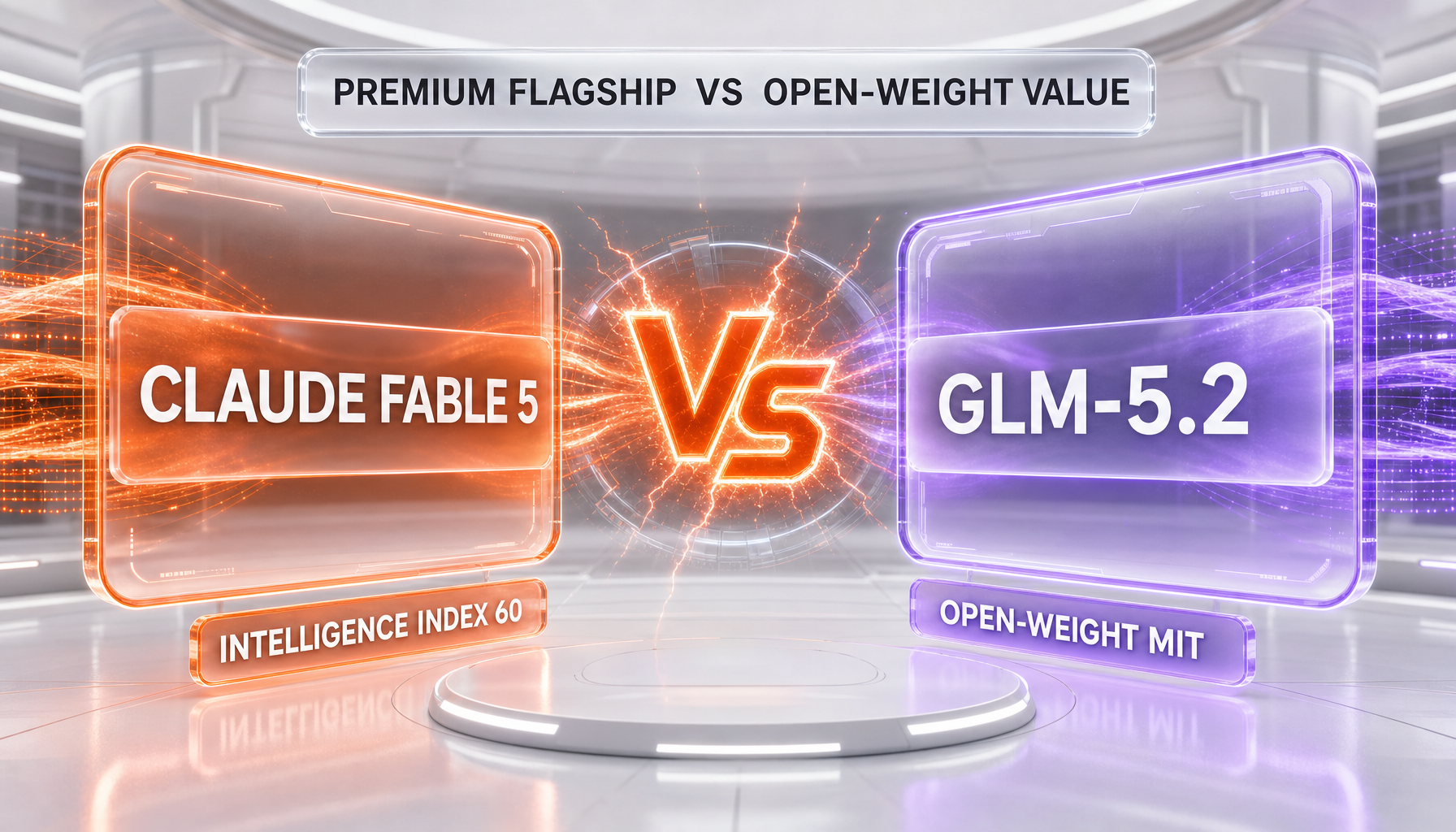
Claude Fable 5 vs GLM-5.2 side by side: Fable owns the independent leaderboards, GLM-5.2 is open-weight MIT at a fraction of the cost. Our split verdict.
Feature Comparison
| Feature | Claude Fable 5 | GLM-5.2 |
|---|---|---|
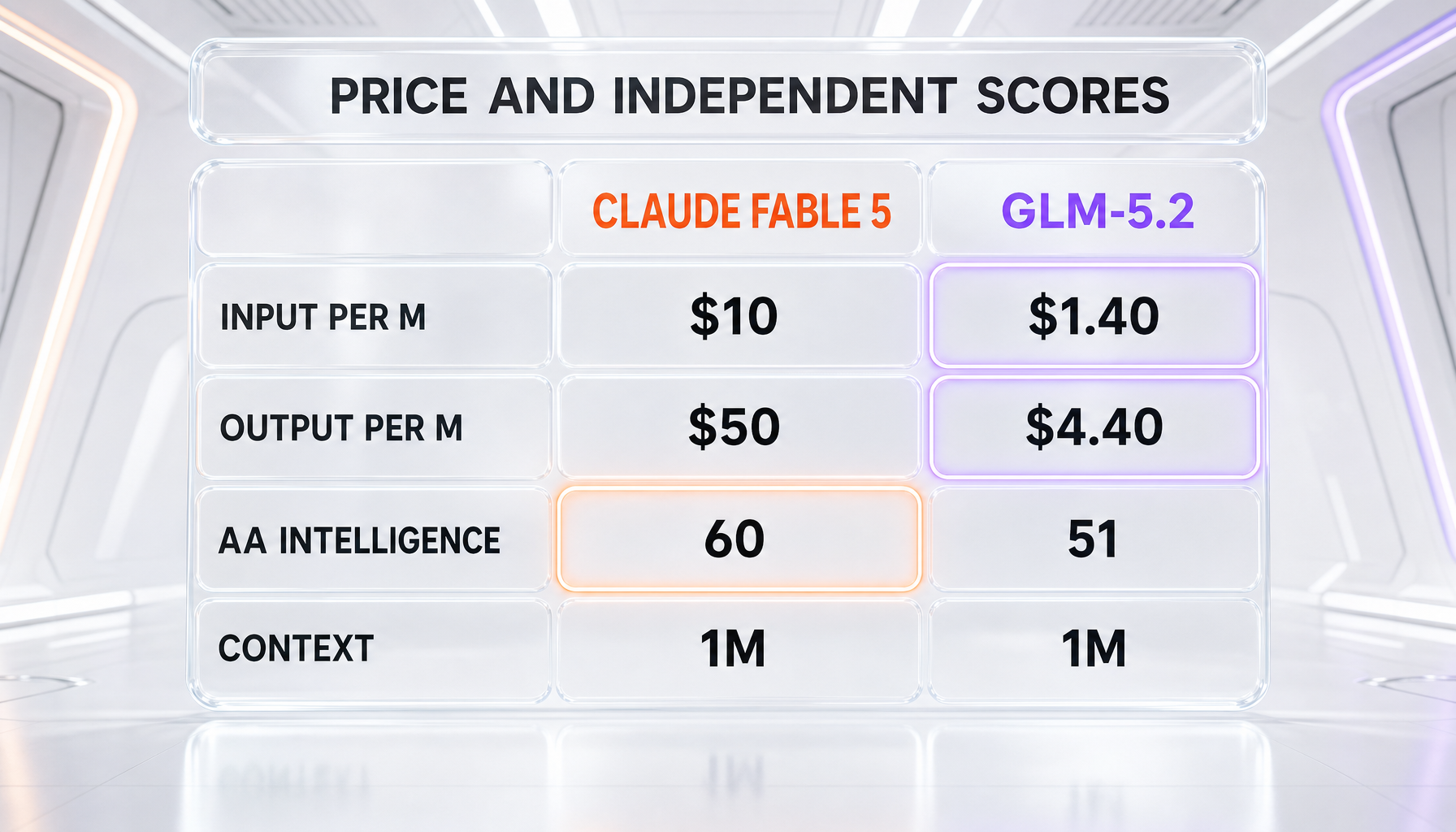
| Artificial Analysis Intelligence Index (independent) | 60 (No. 1 overall) | 51 (No. 1 open-weight, No. 4 overall) |
| LMArena rating (independent, human preference) | 1509 | Not listed |
| SWE-bench Verified (independent, vals.ai) | 95% | Not reported on this suite |
| SWE-bench Pro (vendor self-reported) | Not reported on this suite | 62.1 (Zhipu self-reported) |
| Creative writing and long-form prose | Premium creative flagship | Coding-optimized |
| API input price (per million tokens) | $10.00 | $1.40 ($0.26 cached) |
| API output price (per million tokens) | $50.00 | $4.40 |
| Flat-rate developer plan | Metered API only | GLM Coding Plan from around $18 per month |
| License and self-hosting | Closed, API-only, no fine-tuning | Open-weight MIT, self-host and fine-tune |
| Context window | 1,000,000 tokens | 1,000,000 tokens |
Pricing Comparison
Claude Fable 5
GLM-5.2
Detailed Comparison
Claude Fable 5 is the more capable, independently verified model, while GLM-5.2 is the open-weight value pick that costs a fraction as much. We ran both side by side. Claude Fable 5 tops the independent Artificial Analysis Intelligence Index at 60 (the number one score overall), posts an independent 95 percent on SWE-bench Verified via vals.ai, and holds a 1509 LMArena rating — all for a premium $10 per million input tokens and $50 per million output. GLM-5.2 answers with price and openness: at $1.40 input and $4.40 output per million tokens it is roughly seven times cheaper on input and eleven times cheaper on output, adds a flat GLM Coding Plan from around $18 per month, and ships MIT-licensed weights you can self-host and fine-tune, with a strong Zhipu self-reported SWE-bench Pro of 62.1. This is a deliberate split, not a hedge: pay the closed premium when top-tier capability and third-party verification lead your decision, and reach for GLM-5.2 when cost, open weights, and self-hosting control matter more.
Quick Verdict: who wins on what
These two models are not really in the same weight class, which is exactly why the comparison is interesting. Claude Fable 5 is a premium closed frontier flagship; GLM-5.2 is an open-weight coding model sold at a fraction of the price. Here is the short version before we get into the detail.
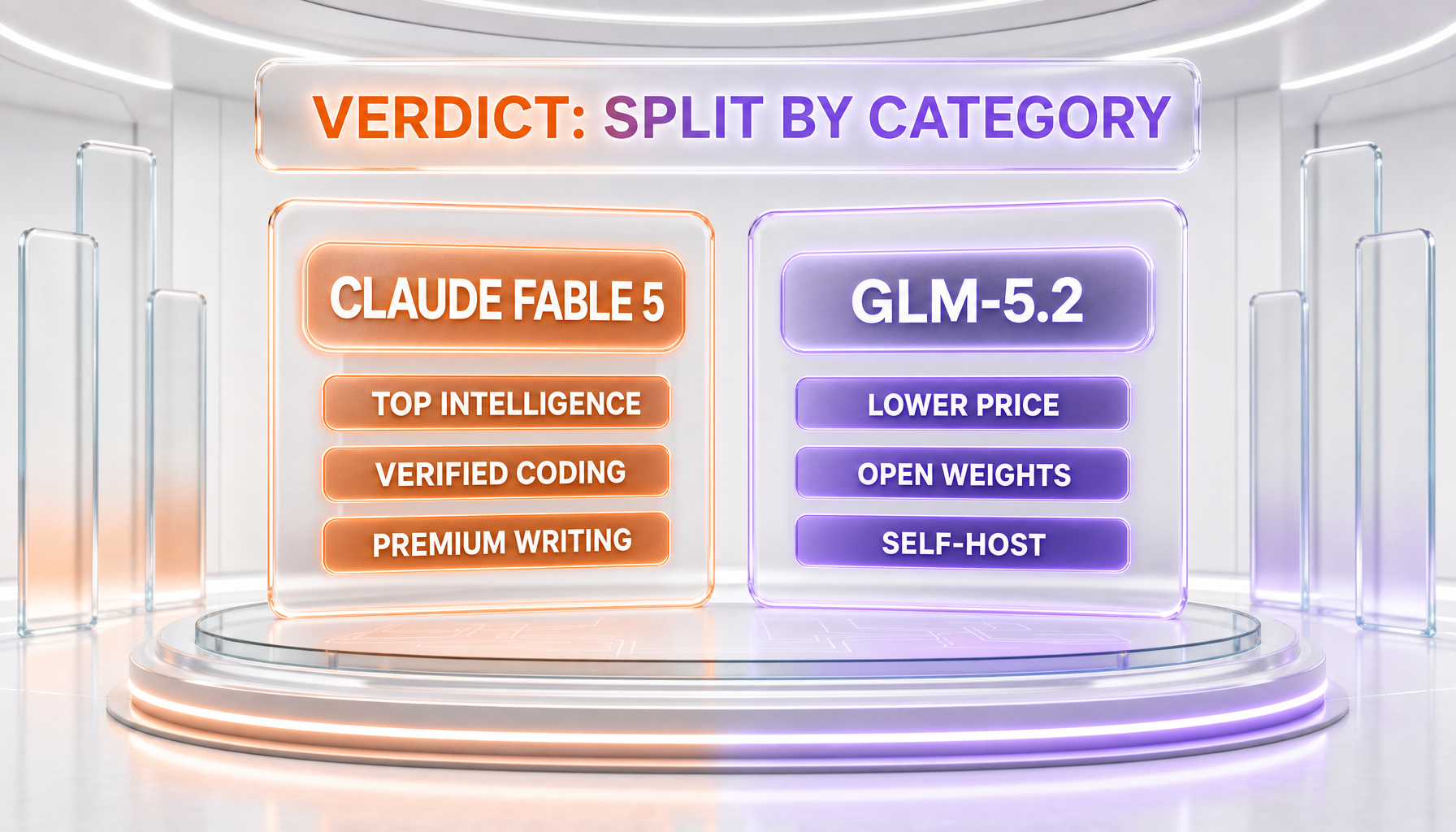
- Best independent intelligence: Claude Fable 5 — it leads the Artificial Analysis Intelligence Index 60 to 51, and its score is the number one result overall on that independent tracker.
- Best independently verified coding: Claude Fable 5 — its 95 percent on SWE-bench Verified is confirmed by the third-party evaluator vals.ai, not by Anthropic.
- Best published coding number for an open model: GLM-5.2 — its 62.1 on SWE-bench Pro is a strong result, though it is Zhipu self-reported and awaits independent confirmation.
- Best price: GLM-5.2, by a wide margin — $1.40 input and $4.40 output per million tokens against Fable's $10 and $50.
- Best for predictable billing: GLM-5.2 — the flat GLM Coding Plan from around $18 per month removes per-token math entirely.
- Best for self-hosting and data residency: GLM-5.2 — MIT-licensed weights you can download, run, and fine-tune on your own hardware.
- Best for creative writing and long-form prose: Claude Fable 5 — it sits in Anthropic's premium creative tier, where GLM-5.2 is coding-optimized.
- Longest context: a tie — both carry a 1 million token context window.
Our overall pick: there isn't one, and that is a deliberate call rather than a cop-out. Claude Fable 5 owns the capability-and-verification cluster; GLM-5.2 owns the cost-and-openness cluster. The right answer depends entirely on which of those two constraints binds your project. If you are optimizing for peak measured capability and third-party proof, Fable wins clean. If you are optimizing for cost per token, open weights, or data control, GLM-5.2 wins just as clean.
Claude Fable 5 in one paragraph
Claude Fable 5 is Anthropic's premium, widely released frontier model — the public flagship of its most capable tier. On the independent leaderboards it is the strongest model we track: an Artificial Analysis Intelligence Index of 60, the number one score overall on that tracker; a 95 percent on SWE-bench Verified as measured independently by vals.ai; and a 1509 rating on LMArena's human-preference leaderboard. It carries a 1 million token context window and Anthropic's well-known strengths in long-form reasoning and creative writing, which is where it stretches furthest ahead of coding-first models. The catch is price: Fable is sold through the API at $10 per million input tokens and $50 per million output tokens, a premium that reflects its position at the top of the intelligence rankings. It is a closed, hosted model — there are no downloadable weights, no self-hosting, and no fine-tuning on your own infrastructure. For a sense of where Fable sits inside Anthropic's own range, see our Claude Fable 5 vs Claude Opus 4.8 comparison.
GLM-5.2 in one paragraph
GLM-5.2 is Zhipu AI's open-weight coding flagship, released on June 13, 2026 under the international Z.ai brand. It is a mixture-of-experts model with roughly 753 billion total parameters and about 40 billion active per token, a 1 million token context window, and output up to 131,072 tokens. Its headline number is a self-reported 62.1 on SWE-bench Pro, and on the independent Artificial Analysis Intelligence Index it scores 51 — which makes it the number one open-weight model in the world and number four overall, a strong showing for a model you can download. It is sold pay-per-token at $1.40 input, $0.26 cached input, and $4.40 output per million tokens, or through a flat-rate GLM Coding Plan that starts around $18 per month. The differentiator is the license: GLM-5.2 ships its weights under MIT on Hugging Face, so you can self-host, fine-tune, and redistribute — though it is open-weight rather than fully open-source, since Zhipu does not release the full training code and data. For the closest open-weight rival, see our GLM-5.2 vs DeepSeek V4 comparison.
Spec and benchmark comparison table
| Dimension | Claude Fable 5 (Anthropic) | GLM-5.2 (Zhipu AI) | Edge |
|---|---|---|---|
| Artificial Analysis Intelligence Index (independent) | 60 (No. 1 overall) | 51 (No. 1 open-weight) | Claude Fable 5 |
| LMArena rating (independent) | 1509 | Not listed | Claude Fable 5 |
| SWE-bench Verified (independent, vals.ai) | 95% | Not reported on this suite | Claude Fable 5 |
| SWE-bench Pro (vendor self-reported) | Not reported on this suite | 62.1 (Zhipu) | GLM-5.2 |
| Creative writing and long-form prose | Premium creative flagship | Coding-optimized | Claude Fable 5 |
| Input price | $10.00 per M tokens | $1.40 per M tokens | GLM-5.2 |
| Output price | $50.00 per M tokens | $4.40 per M tokens | GLM-5.2 |
| Cached input price | Not in our verified figures | $0.26 per M tokens | GLM-5.2 |
| Flat-rate developer plan | Metered API only | GLM Coding Plan from about $18 per month | GLM-5.2 |
| License and weights | Closed, API-only | Open-weight, MIT (self-hostable) | GLM-5.2 |
| Fine-tuning | Not supported (hosted only) | Supported (MIT weights) | GLM-5.2 |
| Context window | 1M tokens | 1M tokens (131,072 output) | Tie |
| Architecture | Closed, not disclosed | Open MoE, 753B total / ~40B active | Transparency: GLM-5.2 |
Independent figures (Artificial Analysis Intelligence Index, LMArena, and SWE-bench Verified via vals.ai) are measured by third parties. GLM-5.2's SWE-bench Pro of 62.1 is Zhipu self-reported. The two coding numbers — Fable's 95 percent SWE-bench Verified and GLM-5.2's 62.1 SWE-bench Pro — come from different benchmarks measured under different regimes and are not directly comparable; we explain why below.
Benchmarks head-to-head: the honest read
The easy mistake with these two models is to line up their biggest coding numbers — Fable's 95 percent against GLM-5.2's 62.1 — and declare a blowout. That comparison is wrong on two separate counts, and understanding why is the single most important thing on this page.
Where they are directly comparable: independent intelligence
Both models appear on the independent Artificial Analysis Intelligence Index, which is the same test scored by the same third party, so this is a genuine apples-to-apples read. Claude Fable 5 scores 60 — the number one result overall on that tracker — while GLM-5.2 scores 51. That 51 is genuinely impressive in context: it is the highest score of any open-weight model in the world and number four overall, behind only a handful of closed frontier systems, and it represents an eleven-point jump over GLM-5.1's 40. But on the one intelligence benchmark both models actually share, Fable is clearly ahead. On LMArena's independent human-preference leaderboard, Fable carries a 1509 rating; GLM-5.2 does not carry a comparable public LMArena number, so its independent standing rests on the Artificial Analysis index rather than head-to-head human voting.
Why the coding numbers cannot be stacked
This is the trap. Claude Fable 5's coding result is 95 percent on SWE-bench Verified, and it is measured independently by vals.ai. GLM-5.2's coding result is 62.1 on SWE-bench Pro, and it is self-reported by Zhipu. Those are two different failures of comparability at once. First, SWE-bench Verified and SWE-bench Pro are different benchmarks — different task sets, different difficulty, different pass criteria — so a number on one does not translate to the other; SWE-bench Pro is a deliberately harder, more contamination-resistant suite where every model scores lower. Second, one number is independently verified and the other is a vendor claim, and self-reported scores across the industry tend to run a few points optimistic. Put those together and you cannot say "95 beats 62.1" as though it were a single race. What you can say is precise and still meaningful: Fable's coding ability has been independently confirmed at an elite level on a public suite, while GLM-5.2's headline coding number is strong but comes from the vendor and has not yet been reproduced by a neutral harness.
What each result actually tells you
So treat the two coding figures as answers to different questions. Fable's 95 percent SWE-bench Verified answers "how good is this model at a widely used coding benchmark, as judged by an independent evaluator?" — and the answer is: exceptional. GLM-5.2's 62.1 SWE-bench Pro answers "what does the vendor report on a harder, newer coding suite?" — and the answer is: a leading result for an open-weight model, pending independent checking. Both are useful; neither cancels the other. For readers weighing GLM against a different closed flagship on the same axes, our GLM-5.2 vs GPT-5.5 comparison runs the same distinction.
The caveat that applies to GLM-5.2
To be explicit: GLM-5.2's independent intelligence score of 51 is real third-party data from Artificial Analysis, and we treat it as such. Its coding headline of 62.1, by contrast, is a Zhipu claim. We are not saying GLM-5.2 is unproven overall — it is the top open-weight model on an independent index — only that its specific coding number is vendor-reported and should be read with the usual grain of salt until an independent SWE-bench Pro run confirms it.
Architecture: closed frontier vs open MoE
The two models sit on opposite sides of the openness divide, and that single fact shapes almost everything else about how you would deploy them.
Claude Fable 5 is a closed model. Anthropic does not disclose its parameter count, its architecture, or its training recipe, and there is no way to run it outside Anthropic's own hosted API. That is the standard trade for a frontier flagship: you get the strongest measured intelligence and a managed, reliable endpoint, but you give up any control over where the model runs or how it is served. For most teams that is a perfectly good trade — the API is fast, well-documented, and backed by Anthropic's safety and reliability engineering — but it does mean Fable is a service you rent, not an asset you own. Your data flows to Anthropic's infrastructure, and your access depends on your account and its rate limits.
GLM-5.2 is an open-weight mixture-of-experts model with roughly 753 billion total parameters and about 40 billion active per token. That sparsity ratio — only around five percent of the network fires on any given token — is how Zhipu keeps inference cost defensible at a frontier-scale parameter count, and it is part of why a flat monthly Coding Plan is economically viable for the vendor. More importantly, the weights are published under an MIT license on Hugging Face, which means you can download the model, run it on your own hardware, quantize it, fine-tune it on your own data, and redistribute it. The important nuance is that open-weight is not the same as fully open-source: Zhipu releases the weights but not the full training code and data recipe, so the community cannot reproduce the model from scratch. Still, for anyone who needs the model to run inside their own environment — for cost, for latency, or for data residency — the difference between a downloadable MIT model and a closed hosted API is the whole ballgame.
The practical upshot is symmetrical. Fable buys you the best measured capability at the cost of any control over deployment; GLM-5.2 buys you full deployment control at the cost of some measured capability. Neither is strictly better — they are different products for different constraints.
Pricing comparison
Pricing is where the split becomes vivid. We took each vendor's published rates rather than working from summaries, and the gap is close to an order of magnitude.
| Tier | Input (per M tokens) | Output (per M tokens) | Notes |
|---|---|---|---|
| Claude Fable 5 (metered API) | $10.00 | $50.00 | Closed, hosted by Anthropic; metered only |
| GLM-5.2 (pay-per-token) | $1.40 | $4.40 | Cached input as low as $0.26 per M tokens |
| GLM-5.2 (GLM Coding Plan) | From about $18 per month, flat | Subscription; quota-based |
Read the metered rates side by side. Against Fable's $10 input and $50 output, GLM-5.2 is roughly seven times cheaper on input and eleven times cheaper on output. For any workload measured in tens or hundreds of millions of tokens a month, that gap dwarfs the capability difference in raw dollar terms. GLM-5.2's cached-input rate of $0.26 per million tokens widens the gap further for retrieval-augmented and tool-use loops that reuse a stable system prompt, where much of the input can hit the cache. Our verified figures for Fable cover its standard $10 input and $50 output only, so we are not citing a Fable cached rate here.
GLM-5.2's second pricing weapon is the flat GLM Coding Plan from around $18 per month. For a heavy individual developer living inside a coding agent all day, a flat plan removes the per-token question entirely and can undercut even GLM's own cheap metered rate. Fable has no equivalent flat developer plan on the API — its API access is metered, full stop.
A worked cost model
Abstract per-token rates are hard to feel, so here is a concrete example. Imagine a small team running 100 million input tokens and 20 million output tokens in a month — a realistic figure for a few engineers or analysts leaning hard on a model across a large body of work.
- Claude Fable 5: 100 million input at $10 per million plus 20 million output at $50 per million is about $1,000 plus $1,000, or roughly $2,000 for the month.
- GLM-5.2 (metered): the same volume at $1.40 input and $4.40 output is about $140 plus $88, or roughly $228 for the month — close to nine times cheaper at this mix.
- GLM-5.2 (Coding Plan): a flat fee from about $18 per month, subject to the plan's quota.
The lesson is not subtle. At this volume GLM-5.2's metered bill is roughly one-ninth of Fable's, and its flat Coding Plan is a rounding error next to either. If your decision is driven by cost per token, this is decisive and it is not close. The counter-argument is equally clear: Fable's $2,000 buys the number one intelligence score and independently verified coding, and for teams where a single better answer is worth far more than the token bill — high-stakes analysis, premium writing, complex reasoning where errors are expensive — that premium can pay for itself many times over. The question is never "which is cheaper" in isolation; it is "is the capability gap worth roughly nine times the price for my specific work?"
How we compared them
We ran both models through the same battery of tasks rather than reading off the leaderboards alone, using each vendor's API with identical prompts and the same context loaded into each window. We focused on three things that matter day to day and that benchmarks only partly capture.
Reasoning and analysis. On multi-step reasoning tasks — tracing a chain of logic, reconciling conflicting sources, structuring a complex argument — Claude Fable 5 was the more consistently precise of the two, which tracks with its number one intelligence ranking. GLM-5.2 was strong and rarely wrong on well-scoped problems, but on the hardest reasoning chains Fable held coherence further before drifting. This is the practical face of the 60-to-51 gap on the independent intelligence index.
Coding and agentic work. Both are genuinely capable coders. GLM-5.2 is purpose-built for this and shows it: it produced clean, runnable patches and slotted naturally into an agentic loop, which is unsurprising given its coding-first design and its ecosystem of drop-in support for coding agents. Fable matched or edged it on the trickiest multi-file changes, consistent with its independently verified SWE-bench Verified result, but the honest read is that for routine coding both are excellent and the deciding factor is more often cost than capability. We could not independently reproduce either vendor's exact benchmark scores, and we are not claiming to — our testing is directional, not a formal evaluation.
Creative and long-form writing. This is where the two separate most clearly. Claude Fable 5 is a premium creative flagship, and on long-form prose — essays, narrative, nuanced tone-matching — it produced noticeably more polished, less formulaic output. GLM-5.2 is competent here but is optimized for code, and it reads like it. If writing quality is central to your use case, this is a real and repeatable difference, not a rounding error.
The takeaway from hands-on use mirrors the numbers: Fable edges raw capability and clearly wins creative writing, GLM-5.2 wins decisively on cost and matches Fable closely enough on routine coding that price becomes the deciding factor for high-volume work.
Winner by category
- Best independent intelligence: Claude Fable 5, at 60 on the Artificial Analysis Intelligence Index against 51.
- Best independently verified coding: Claude Fable 5, with a third-party 95 percent on SWE-bench Verified.
- Best published coding number for an open model: GLM-5.2, with a vendor-reported 62.1 on SWE-bench Pro.
- Best price: GLM-5.2, roughly seven to eleven times cheaper per token.
- Best for predictable flat billing: GLM-5.2, via the GLM Coding Plan from around $18 per month.
- Best for self-hosting and data residency: GLM-5.2, with MIT-licensed downloadable weights.
- Best for fine-tuning on your own data: GLM-5.2, since you control the weights.
- Best for creative writing and long-form prose: Claude Fable 5.
- Longest context: a tie, at 1 million tokens each.
Pros and cons of each model
Claude Fable 5
Pros
- Number one score overall on the independent Artificial Analysis Intelligence Index (60 vs 51).
- Independently verified 95 percent on SWE-bench Verified via vals.ai — elite, third-party-confirmed coding.
- 1509 rating on the independent LMArena human-preference leaderboard.
- Anthropic's premium creative-writing and long-form reasoning pedigree.
- 1 million token context window with a managed, reliable hosted API.
Cons
- Premium price: $10 per million input and $50 per million output — roughly seven to eleven times GLM-5.2.
- Closed and API-only, with no weights to self-host or fine-tune.
- No flat-rate developer plan on the API; billing is metered.
- No published cached-input rate in our verified figures.
- Overkill for teams whose bottleneck is cost rather than capability.
GLM-5.2
Pros
- Roughly seven times cheaper input and eleven times cheaper output than Fable ($1.40 and $4.40 per million tokens).
- Open-weight MIT license — self-host, fine-tune, and redistribute the 753B MoE weights.
- Flat GLM Coding Plan from around $18 per month for fully predictable billing.
- Number one open-weight model on the independent Artificial Analysis Intelligence Index (51, No. 4 overall).
- Strong vendor SWE-bench Pro of 62.1 plus a $0.26 cached-input rate.
Cons
- Trails Fable on the shared independent intelligence index (51 vs 60).
- Its headline coding number (SWE-bench Pro 62.1) is Zhipu self-reported, not independently verified.
- Open-weight, not fully open-source — training code and data are not released.
- Production API is hosted in China, raising data-residency questions for regulated buyers.
- Not positioned for premium creative writing the way Fable is.
When to pick Claude Fable 5 vs GLM-5.2
Pick Claude Fable 5 when: capability is your binding constraint and you want the strongest measured, independently verified model on the board; you do high-stakes reasoning or analysis where a single better answer justifies a higher token bill; premium creative writing or long-form prose is central to your work; you prefer a managed, reliable hosted API and do not need to run the model yourself; or you want the reassurance of third-party verification behind your model choice rather than vendor claims. For teams where quality dominates cost, this is the pick — and if you are weighing Fable against another premium closed flagship, our Claude Fable 5 vs GPT-5.5 comparison is the natural next read.
Pick GLM-5.2 when: cost per token is your binding constraint and you run at volume, where a roughly nine-times-cheaper bill compounds every month; you need to self-host for data residency, latency, or sovereignty, and MIT weights are the only acceptable path; you want to fine-tune on your own data; you prefer a flat, predictable monthly bill through the GLM Coding Plan; or your workload is coding-first, where GLM-5.2 is purpose-built and its published SWE-bench Pro number is a leading open-weight result. If you also want to see GLM measured against a closed mid-tier model, our Claude Sonnet 5 vs GLM-5.2 comparison covers that matchup, and our roundup of the best AI coding tools of 2026 puts both models in wider context.
If you are genuinely torn, the deciding question is simple: is your bottleneck capability and verification or cost and control? The first points to Claude Fable 5, the second to GLM-5.2. There is no universal answer because they optimize for different things.
What would change our verdict
We try to be explicit about the conditions that would move this call, because a verdict you can falsify is more useful than one you cannot.
- An independent SWE-bench Pro run for GLM-5.2 lands. If a neutral harness confirms GLM-5.2's 62.1 — or, just as usefully, comes in materially lower — it would sharpen exactly how close the coding gap really is, since right now that number is a vendor claim while Fable's coding result is independently verified.
- GLM-5.2 climbs the independent intelligence index. A future point release that closes the 51-to-60 gap on Artificial Analysis would weaken Fable's clearest advantage and tilt more cost-sensitive buyers toward the open-weight option.
- Anthropic changes Fable's pricing or adds a flat plan. A meaningful price cut, a cached-input tier, or a flat developer plan for Fable would blunt GLM-5.2's single biggest weapon and make the premium far easier to justify at volume.
- A trusted Western-hosted GLM-5.2 endpoint appears. GLM-5.2's production API is hosted in China. A reputable US or EU hosted endpoint — or wider first-class self-hosting tooling — would remove the biggest blocker for regulated enterprise buyers and broaden its addressable market.
- Creative-writing benchmarks mature. If a credible independent writing-quality benchmark emerges and GLM-5.2 closes the prose gap, Fable's creative-flagship edge would matter less to writing-heavy teams.
Absent those changes, our read stands: Claude Fable 5 for top-tier verified capability and creative writing, GLM-5.2 for cost, open weights, and self-hosting control.
Final verdict
This is a genuine split, and we are not going to invent a single overall winner, because Claude Fable 5 and GLM-5.2 are built for different buyers. Fable is the more capable model and the only one of the two with elite independent verification: it is number one on the Artificial Analysis Intelligence Index at 60, holds an independently measured 95 percent on SWE-bench Verified, carries a 1509 LMArena rating, and brings Anthropic's premium creative-writing pedigree. If capability, third-party proof, or writing quality lead your decision, Fable wins clean — and its premium $10-and-$50 pricing is the price of sitting at the top of the rankings.
GLM-5.2 is not the runner-up so much as the answer to a different question. At $1.40 input and $4.40 output per million tokens it is roughly seven to eleven times cheaper than Fable, adds a flat GLM Coding Plan from around $18 per month, and ships MIT-licensed open weights you can self-host and fine-tune. It is the number one open-weight model on the independent intelligence index and posts a strong, if vendor-reported, SWE-bench Pro of 62.1. For cost-driven, self-hosted, or fine-tuning-heavy work, it wins just as clean.
And to be precise one more time, because it is the crux: the two headline coding numbers — Fable's 95 percent SWE-bench Verified and GLM-5.2's 62.1 SWE-bench Pro — are different benchmarks measured under different regimes, one independent and one vendor-reported, and they cannot be stacked as a single head-to-head. So the verdict stands as a deliberate tie with sharp category ownership: Claude Fable 5 for top-tier independently verified intelligence, coding, and creative writing; GLM-5.2 for price, open weights, self-hosting, and predictable flat billing. Pay the closed premium when capability and verification lead, and self-host the open weights when cost and control do.
Frequently asked questions
Is Claude Fable 5 or GLM-5.2 better?
Neither is universally better — they are built for different buyers, which is why we call it a split. Claude Fable 5 is the more capable and the only one of the two with elite independent verification: it is number one on the Artificial Analysis Intelligence Index at 60, holds an independently measured 95 percent on SWE-bench Verified, and carries a 1509 LMArena rating. GLM-5.2 wins on price and openness: roughly seven to eleven times cheaper per token, MIT-licensed open weights you can self-host, and a flat plan from around $18 per month. Pick on your constraint — capability and verification point to Fable, cost and control point to GLM-5.2.
Is GLM-5.2 cheaper than Claude Fable 5?
Yes, dramatically. GLM-5.2 costs $1.40 per million input tokens and $4.40 output, against Claude Fable 5's $10 input and $50 output — roughly seven times cheaper on input and eleven times cheaper on output. On a workload of 100 million input and 20 million output tokens a month, GLM-5.2's metered bill is about $228 versus roughly $2,000 for Fable, close to nine times cheaper. GLM-5.2 also offers a flat GLM Coding Plan from around $18 per month and a cached-input rate of $0.26 per million tokens.
Can I compare Fable's 95 percent SWE-bench Verified with GLM-5.2's 62.1 SWE-bench Pro?
No, and this is the most important caveat on the page. They are two different benchmarks — SWE-bench Verified and SWE-bench Pro have different task sets, difficulty, and pass criteria, with Pro being the harder suite where every model scores lower. They are also measured under different regimes: Fable's 95 percent is independently verified by vals.ai, while GLM-5.2's 62.1 is Zhipu self-reported. Because of both differences, you cannot say one beats the other head-to-head. Fable's coding is independently confirmed at an elite level; GLM-5.2's is a strong vendor claim awaiting independent checking.
Are GLM-5.2's benchmarks independently verified?
Partly. GLM-5.2's intelligence score of 51 comes from Artificial Analysis, which is an independent third-party tracker, so that number is verified. Its headline coding result — 62.1 on SWE-bench Pro — is Zhipu self-reported and has not yet been reproduced by a neutral harness. So GLM-5.2 has genuine independent standing on intelligence but a vendor-only number on coding. Self-reported scores across the industry tend to run a few points optimistic, so treat the coding figure as directional until an independent run confirms it.
Is GLM-5.2 really open source?
It is open-weight, which is not quite the same thing. Zhipu ships GLM-5.2's weights under an MIT license on Hugging Face, so you can freely download, run, fine-tune, redistribute, and self-host the model — a genuine and valuable freedom. But it does not release the full training code and data recipe, so the community cannot reproduce the model from scratch. That makes it open-weight rather than fully open-source. Claude Fable 5, by contrast, is fully closed, with no weights available at all.
Which is better for coding?
Both are strong coders, and the honest answer depends on what you weight. Claude Fable 5 has the only independently verified coding result — 95 percent on SWE-bench Verified via vals.ai — and edged GLM-5.2 on the trickiest multi-file changes in our testing. GLM-5.2 is purpose-built for coding, posts a leading open-weight vendor result of 62.1 on SWE-bench Pro, and matches Fable closely on routine work at a fraction of the cost. For quality at any price, Fable; for excellent coding at high volume where cost dominates, GLM-5.2.
Which is better for creative writing?
Claude Fable 5, clearly. It sits in Anthropic's premium creative tier and, in our testing, produced noticeably more polished and less formulaic long-form prose — essays, narrative, and nuanced tone-matching. GLM-5.2 is competent at writing but is optimized for code, and it reads that way on longer creative tasks. If writing quality is central to your use case, this is a real and repeatable difference rather than a rounding error, and it is one of Fable's clearest advantages.
What are the context windows of Claude Fable 5 and GLM-5.2?
Both carry a 1 million token context window, so on raw context capacity they tie. GLM-5.2 additionally specifies output of up to 131,072 tokens per response. A 1 million token window is large enough to hold a substantial codebase, a long document set, or an extended conversation in a single context for either model, so for most long-context work neither has a practical advantage over the other on window size alone.
Can I self-host Claude Fable 5 or GLM-5.2?
Only GLM-5.2. Its weights are published under an MIT license on Hugging Face, so you can download the roughly 753-billion-parameter mixture-of-experts model and run it on your own hardware, though full-precision serving of a model that size requires substantial infrastructure. Claude Fable 5 is a closed, hosted model with no downloadable weights, so it can only be accessed through Anthropic's API. If self-hosting or data residency is a hard requirement, GLM-5.2 is the only option of the two.
Is GLM-5.2 being hosted in China a problem?
It can be, depending on your compliance requirements. GLM-5.2's production API is hosted in China, which raises data-residency and regulatory questions for buyers such as US Federal agencies or EU healthcare organizations. The clean workaround is to self-host the MIT-licensed weights inside your own environment, which sidesteps the hosted API entirely. Claude Fable 5 avoids this specific concern by being hosted on Anthropic's infrastructure, but it removes the self-hosting option altogether, so the two trade one form of control for another.
Which should a startup choose, Claude Fable 5 or GLM-5.2?
For a cost-sensitive startup shipping at volume, GLM-5.2 is usually the default because the roughly nine-times-cheaper token bill compounds every month, and self-hosting or fine-tuning options give you room to grow. Choose Claude Fable 5 instead if your product's value hinges on peak reasoning quality, independently verified capability, or premium writing — cases where a single better answer is worth far more than the token savings. Many startups also run a hybrid: GLM-5.2 for high-volume routine work, Fable for the smaller share of high-stakes calls.
What is the overall verdict on Claude Fable 5 vs GLM-5.2?
It is a deliberate split with no single overall winner. Claude Fable 5 wins capability and verification — number one on the Artificial Analysis Intelligence Index at 60, an independent 95 percent on SWE-bench Verified, a 1509 LMArena rating, and premium creative writing. GLM-5.2 wins cost and openness — roughly seven to eleven times cheaper per token, a flat plan from around $18 per month, and MIT open weights you can self-host and fine-tune. Their two coding numbers are different benchmarks under different regimes and cannot be stacked. Pay the closed premium when capability leads; self-host the open weights when cost and control do.
Last compared: July 2026. Pricing and context figures are from vendor documentation; the Artificial Analysis Intelligence Index, LMArena, and SWE-bench Verified (via vals.ai) figures are independent third-party results, while GLM-5.2's SWE-bench Pro of 62.1 is Zhipu self-reported. This comparison contains no affiliate links.
Our Verdict
This is a deliberate split, not a hedge, because Claude Fable 5 and GLM-5.2 are built for different buyers, and we will not crown a single overall winner. Claude Fable 5 is the more capable model and the only one of the two with elite independent verification: it tops the Artificial Analysis Intelligence Index at 60 (the number one score overall), posts an independent 95 percent on SWE-bench Verified via vals.ai, and holds a 1509 LMArena rating, all for a premium $10 per million input tokens and $50 per million output. GLM-5.2 answers with cost and openness: at $1.40 input and $4.40 output per million tokens it is roughly seven times cheaper on input and eleven times cheaper on output, adds a flat GLM Coding Plan from around $18 per month, ships MIT-licensed open weights you can self-host and fine-tune, and posts a strong Zhipu self-reported SWE-bench Pro of 62.1. Those two headline coding numbers measure different benchmarks under different regimes, Fable's 95 percent independently verified and GLM's 62.1 vendor-reported, so they cannot be stacked as a head-to-head. Best for top-tier independently verified intelligence, coding, and creative writing: Claude Fable 5. Best for price, open weights, self-hosting, and predictable flat billing: GLM-5.2. No single overall winner, pay the closed premium when capability and verification lead your decision, and self-host the open weights when cost and control do.
Choose Claude Fable 5
Anthropic's most capable widely released model — the public, safety-classified Mythos-class frontier tier.
Try Claude Fable 5 →Choose GLM-5.2
Zhipu AI open-weight coding flagship: 753B MoE (~40B active), 1M context, MIT license, headline SWE-bench Pro 62.1 (vendor self-reported); GLM Coding Plan from around $18 per month or $1.40 in / $4.40 out per million tokens.
Try GLM-5.2 →Frequently Asked Questions
Is Claude Fable 5 better than GLM-5.2?
This is a deliberate split, not a hedge, because Claude Fable 5 and GLM-5.2 are built for different buyers, and we will not crown a single overall winner. Claude Fable 5 is the more capable model and the only one of the two with elite independent verification: it tops the Artificial Analysis Intelligence Index at 60 (the number one score overall), posts an independent 95 percent on SWE-bench Verified via vals.ai, and holds a 1509 LMArena rating, all for a premium $10 per million input tokens and $50 per million output. GLM-5.2 answers with cost and openness: at $1.40 input and $4.40 output per million tokens it is roughly seven times cheaper on input and eleven times cheaper on output, adds a flat GLM Coding Plan from around $18 per month, ships MIT-licensed open weights you can self-host and fine-tune, and posts a strong Zhipu self-reported SWE-bench Pro of 62.1. Those two headline coding numbers measure different benchmarks under different regimes, Fable's 95 percent independently verified and GLM's 62.1 vendor-reported, so they cannot be stacked as a head-to-head. Best for top-tier independently verified intelligence, coding, and creative writing: Claude Fable 5. Best for price, open weights, self-hosting, and predictable flat billing: GLM-5.2. No single overall winner, pay the closed premium when capability and verification lead your decision, and self-host the open weights when cost and control do.
Which is cheaper, Claude Fable 5 or GLM-5.2?
Claude Fable 5 is priced at $10 in / $50 out per M tokens. GLM-5.2 is priced at $1.4 in / $4.4 out per M tokens. Check the pricing comparison section above for a full breakdown.
What are the main differences between Claude Fable 5 and GLM-5.2?
The key differences span across 10 features we compared. For Artificial Analysis Intelligence Index (independent), Claude Fable 5 offers 60 (No. 1 overall) while GLM-5.2 offers 51 (No. 1 open-weight, No. 4 overall). For LMArena rating (independent, human preference), Claude Fable 5 offers 1509 while GLM-5.2 offers Not listed. For SWE-bench Verified (independent, vals.ai), Claude Fable 5 offers 95% while GLM-5.2 offers Not reported on this suite. See the full feature comparison table above for all details.