Claude Opus 4.8 vs MiniMax M3: Premium Frontier vs Budget Open Weight (2026)


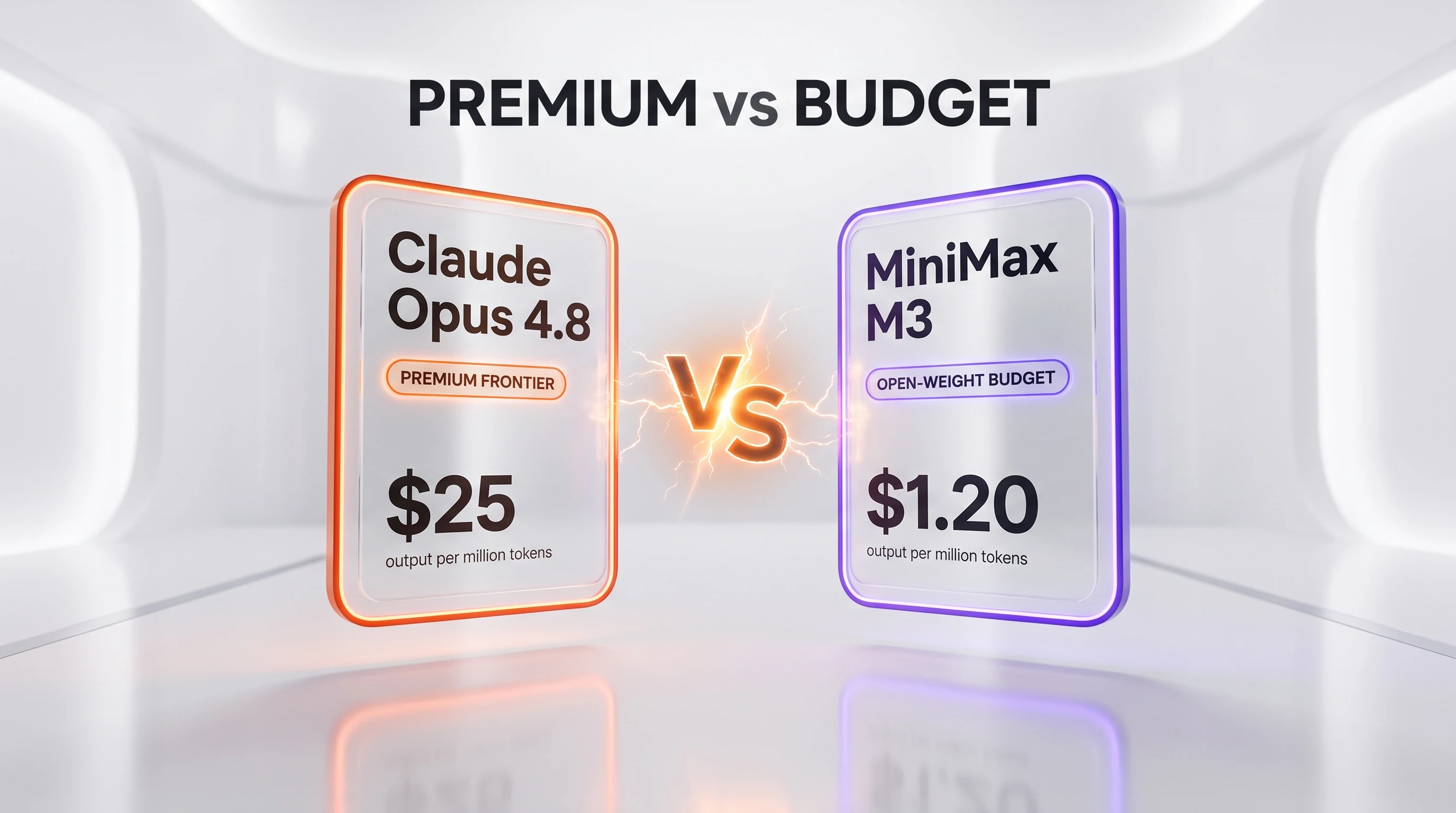
We ran Claude Opus 4.8 and MiniMax M3 side by side. Opus leads independent intelligence by 12 points; MiniMax runs about 21 times cheaper. Who wins?
Feature Comparison
| Feature | Claude Opus 4.8 | MiniMax M3 |
|---|---|---|
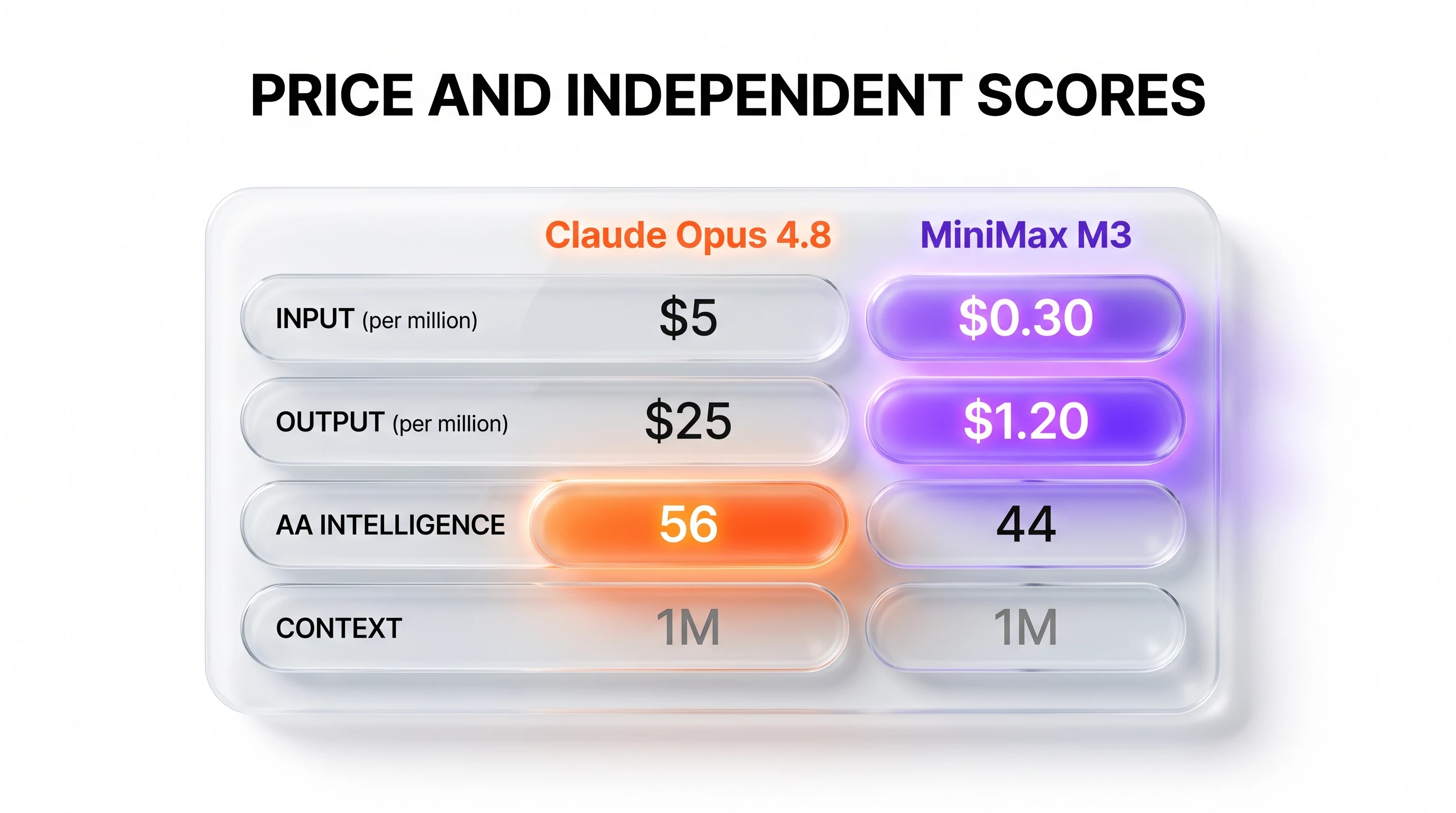
| Independent intelligence (Artificial Analysis Intelligence Index, version 4.1, same evaluator) | 56 — measured by a neutral third-party evaluator | 44 — the open-weight leader on the same index and version |
| Input price (per million tokens) | 5 dollars (verified) | 0.30 dollars, standard tier up to 512K (verified) — about 17 times cheaper |
| Output price (per million tokens) | 25 dollars (verified) | 1.20 dollars, standard tier up to 512K (verified) — about 21 times cheaper |
| Context window | 1,000,000 tokens | 1,000,000 tokens |
| Long-context pricing | Flat rate at any length | Doubles above 512K tokens, so the full window is not billed at the headline rate |
| Model access and licensing | Closed, API and cloud only, cannot be self-hosted | Open-weight mixture-of-experts, a candidate for self-hosting |
| Native multimodality | Vision for image input; no video | Native text, image, and video input trained from step zero |
| Agent ecosystem and tooling | Dynamic Workflows orchestrating parallel subagents, effort controls, self-checking reliability, managed across every major cloud | MiniMax Code agent for autonomous workflows, toggleable thinking mode |
| Long-horizon reliability in our testing | Held instructions tightly and reached correct results with fewer human interventions on hard migrations | Strong at cost; some early users report scaling limits past proof-of-concept |
| Data governance | US-anchored across the Claude API, AWS, Google Cloud, and Microsoft Foundry, but closed with no self-host data-sovereignty option | Hosted API operated from China under Chinese data law, but open weights allow fully self-hosted deployment |
Pricing Comparison
Claude Opus 4.8
MiniMax M3
Detailed Comparison
Claude Opus 4.8 and MiniMax M3 sit at opposite ends of frontier AI in 2026: a premium proprietary flagship against a budget open-weight challenger. Claude Opus 4.8 is Anthropic's flagship model, launched May 28, 2026, closed and API-only, priced at 5 dollars per million input tokens and 25 dollars per million output tokens, with a 1,000,000-token context window and up to 128K output tokens per request. It scores 56 on the independent Artificial Analysis Intelligence Index (version 4.1). MiniMax M3, launched June 1, 2026, is an open-weight mixture-of-experts model priced from 0.30 dollars per million input tokens and 1.20 dollars per million output tokens on its standard tier, with the same 1,000,000-token context window and native multimodality. It scores 44 on the same version 4.1 index, the open-weight leader. Best for peak capability, ecosystem depth, and long-horizon reliability: Claude Opus 4.8. Best for cost at scale, open weights, and multimodality: MiniMax M3. There is no single overall winner — a 12-point independent intelligence lead and a roughly 21-times output price gap point in opposite directions, and your workload decides.
Quick Verdict
This is a split verdict on a clean axis: capability and ecosystem versus cost and control. We have run Claude Opus 4.8 in our own production stack since it went live on May 28, 2026, we have put MiniMax M3 through its hosted API since it launched on June 1, 2026, and we pulled every price below directly from each vendor's own pages in July 2026. These two models are not fighting for the same budget line. One is a top-tier proprietary frontier model with a deep managed ecosystem; the other is the cheapest frontier-class flagship we track, and you can download its weights. Here is the short version.
- Best for raw capability: Claude Opus 4.8. It scores 56 on the independent Artificial Analysis Intelligence Index (version 4.1) against 44 for MiniMax M3 on the same index and the same version — a 12-point lead measured by a single neutral evaluator.
- Best for cost: MiniMax M3, by a wide margin. Its standard output price of 1.20 dollars per million tokens is roughly 21 times cheaper than Opus 4.8's 25 dollars, and its input at 0.30 dollars is about 17 times cheaper than Opus 4.8's 5 dollars.
- Best for open weights and self-hosting: MiniMax M3. It is released open-weight as a mixture-of-experts model and is a candidate for on-premises deployment. Opus 4.8 is closed, API-only, and cannot be self-hosted.
- Best for native multimodality: MiniMax M3. It was trained multimodal from step zero and accepts text, image, and video input. Opus 4.8 supports vision for image input but does not take video.
- Best for ecosystem, agent tooling, and reliability: Claude Opus 4.8. It ships Dynamic Workflows for orchestrating parallel subagents, effort controls, and a cautious self-checking reliability personality, backed by managed availability across the Claude API and every major cloud.
Bottom line: if your workload is capability-bound — where being right the first time is worth far more than the token bill — Claude Opus 4.8 is the pick, and the 12-point independent intelligence lead plus the deeper agent ecosystem earn the premium. If your workload is cost-bound and runs at scale — where the token bill is the whole constraint — MiniMax M3 delivers a remarkable share of frontier quality for a fraction of the price, with open weights on top. We did not crown a single winner, because at a 21-times output price gap the use case decides everything.
At a Glance
Before the detail, here is the side-by-side that frames everything below. All pricing in this table was fetched directly from each vendor's own pages in July 2026. Every benchmark figure is attributed to its source and its evaluator.
| Dimension | Claude Opus 4.8 | MiniMax M3 |
|---|---|---|
| Vendor / origin | Anthropic (US) | MiniMax (China) |
| Model access | Closed, API and cloud only | Open-weight, self-hostable |
| Released | May 28, 2026 | June 1, 2026 |
| Independent intelligence (Artificial Analysis Intelligence Index v4.1) | 56 | 44 |
| Input price (per million tokens) | 5 dollars | 0.30 dollars (standard, up to 512K) |
| Output price (per million tokens) | 25 dollars | 1.20 dollars (standard, up to 512K) |
| Context window | 1,000,000 tokens | 1,000,000 tokens |
| Max output per request | 128K tokens | Vendor-defined |
| Long-context pricing | Flat rate | Doubles above 512K tokens |
| Architecture | Proprietary, undisclosed | Open-weight mixture-of-experts, 428B total and 23B active, MiniMax Sparse Attention |
| Multimodality | Vision (image input) | Native text, image, and video input |
| Free plan or trial | No | No |
Meet Claude Opus 4.8
Claude Opus 4.8 is Anthropic's flagship model, generally available on May 28, 2026 through the Claude API as claude-opus-4-8. It carries a 1,000,000-token context window with up to 128K output tokens per request, and it leads Anthropic's internal computer-use testing. On the independent Artificial Analysis Intelligence Index at version 4.1 it scores 56 — a top-tier result, and one step below the 60 posted by Anthropic's very top model, Claude Fable 5. If you want to see how Opus sits against that ceiling, our Claude Fable 5 vs Claude Opus 4.8 breakdown covers it; here we are looking down the price curve, not up it.
What makes Opus 4.8 more than a benchmark number is its ecosystem and its production personality. It ships Dynamic Workflows, which orchestrate hundreds of parallel subagents inside Claude Code and are a genuine time saver on large multi-file jobs, plus effort controls — a user-facing dial that trades latency and token spend against reasoning depth so cost stays predictable across a pipeline. In our own production use since launch, the two gains we feel most are coding speed and a cautious, self-checking reliability personality: it verifies its own edits and flags problems rather than declaring a task fixed without checking, which matches Anthropic's claim that it is roughly four times less likely than Opus 4.7 to let flaws in its own code pass unremarked. A 2.5x-faster Fast Mode is available at 10 dollars per million input tokens and 50 dollars per million output tokens when latency matters more than cost. The catch is price and control: 5 dollars per million input tokens and 25 dollars per million output tokens on the standard tier, with no free plan, no self-hosting, and a closed model you cannot inspect or run on your own hardware. Our full Claude Opus 4.8 review covers the model in depth.
Meet MiniMax M3
MiniMax M3 is an open-weight large language model from Shanghai-based MiniMax, launched June 1, 2026. It is built on a new architecture the company calls MSA, or MiniMax Sparse Attention, which replaces quadratic full attention to cut the cost of long context. The model is a mixture-of-experts design with 428 billion total parameters and 23 billion active per token, and it was trained natively multimodal — text, image, and video input from step zero rather than bolted on afterward. It carries a 1,000,000-token context window, the same headline figure as Opus 4.8, and MiniMax reports large speedups at long context on the new attention scheme. On the independent Artificial Analysis Intelligence Index at version 4.1, it scores 44, which makes it the open-weight leader on that index.
The headline is price. MiniMax M3 starts at 0.30 dollars per million input tokens and 1.20 dollars per million output tokens on its standard tier, roughly an order of magnitude below the closed flagships — a price that changes what is economically buildable for always-on agents. It ships with a dedicated MiniMax Code agent for autonomous coding workflows, a toggleable thinking mode billed at the standard rate, and computer-use capability. The weights and a technical report were committed for open release, opening the door to self-hosting. Two cautions sit against that: every headline coding and computer-use benchmark is vendor-reported on MiniMax's own infrastructure with no independent third-party verification yet, and the hosted API is operated by a Chinese company, so prompts sent to it fall under China's data and intelligence laws. Our full MiniMax M3 review has the complete breakdown.
Pricing Compared: The Core of the Gap
Pricing is where this matchup earns the word extreme. We fetched both models' rates directly from vendor pricing pages in July 2026, and the arithmetic is stark. On input tokens, Claude Opus 4.8 at 5 dollars per million is about 17 times MiniMax M3's standard 0.30 dollars. On output tokens, Opus 4.8 at 25 dollars per million is about 21 times MiniMax M3's standard 1.20 dollars. That is a full order-of-magnitude gap on the metric most agent workloads spend the most on.
There is one nuance that narrows the picture on very long context, and it works in Opus 4.8's favor. MiniMax M3's headline prices apply to its standard tier, up to 512K tokens of context. Above 512K tokens, its rates double — to roughly 0.60 dollars input and 2.40 dollars output per million. Because both models carry a 1,000,000-token window, using MiniMax at its full context pushes you into the doubled tier. Even there, MiniMax stays dramatically cheaper: Opus 4.8's output at 25 dollars is still about 10 times MiniMax's doubled 2.40 dollars, and its input at 5 dollars is about 8 times the doubled 0.60 dollars. So the order of magnitude on input narrows to a still-large multiple, but the headline 0.30 dollars is not the price you pay when you actually fill the window.
Opus 4.8 has its own cost levers and its own cost ceiling. Its Fast Mode doubles the per-token rate to 10 dollars input and 50 dollars output per million in exchange for roughly 2.5 times the speed, so the premium rises further when latency matters. Neither model has a free plan or a free trial: with both, you pay per token from the first call. The practical read is simple. If you are running an always-on agent that burns tokens continuously, the 17-to-21-times gap compounds into a different order of monthly bill, and MiniMax M3 wins the economics outright. If you page a frontier model in for a handful of high-value calls, the absolute cost of Opus 4.8 may be small enough that the price gap stops mattering, and its capability and ecosystem win.
| Pricing (per million tokens) | Claude Opus 4.8 | MiniMax M3 |
|---|---|---|
| Input, standard | 5 dollars | 0.30 dollars (up to 512K) |
| Output, standard | 25 dollars | 1.20 dollars (up to 512K) |
| Input, above 512K context | 5 dollars (flat) | 0.60 dollars (doubled) |
| Output, above 512K context | 25 dollars (flat) | 2.40 dollars (doubled) |
| Fast / speed tier | 10 dollars input, 50 dollars output (2.5x faster) | Standard-rate thinking mode |
| Free plan or trial | None | None |
Intelligence: The Independent Gap
The cleanest way to compare raw capability across two models from different vendors is a single independent evaluator running the same test at the same index version. That evaluator is Artificial Analysis, and on its Intelligence Index at version 4.1, Claude Opus 4.8 scores 56 and MiniMax M3 scores 44. Both figures come from the same evaluator and the same index version, so they are directly comparable — a 12-point lead for Opus 4.8. This is the one number in this comparison that is measured by a neutral third party for both models on the same scale, which is why we anchor the capability question to it.
A 12-point index gap is not a rounding error, but it is not the whole story either. MiniMax M3 at 44 is the strongest open-weight model on that index, and for a large class of everyday reasoning, extraction, and drafting work the difference between the two will be invisible in output quality while very visible on the invoice. Where the gap bites is on the hardest reasoning, long-horizon planning, and tasks where a single wrong step cascades. In our own testing, Opus 4.8 reached correct results with fewer human interventions and held instructions more tightly on exactly those tasks, which is the practical shape of a 12-point independent lead. If your work lives at that hard edge, capability is the constraint and the index gap matters. If it does not, you are paying for headroom you may never use.
Coding and Agents
On coding and agents, both vendors publish their own numbers, and the honest move is to keep them in separate lanes rather than cross-compare them. MiniMax M3 makes an aggressive claim: MiniMax reports 59.0 percent on SWE-Bench Pro, the harder agentic-coding track, and 70.06 percent on OSWorld-Verified for computer use. Both figures are vendor-reported on MiniMax's own infrastructure and have not been independently reproduced by a third party at the time of writing, so we label them as such and weigh them accordingly. For the price point, a near-60-percent SWE-Bench Pro result is genuinely notable, and the model ships with a dedicated MiniMax Code agent built for multi-agent workflows, deep reflection, and continuous error correction.
Claude Opus 4.8's agent case rests on a different mix of evidence, and its numbers come from a different benchmark, so we do not stack them against MiniMax's. Anthropic reports Opus 4.8 as its best-tested computer-use model at 84.0 percent on Online-Mind2Web — a vendor figure on a different benchmark from MiniMax's OSWorld-Verified, which is exactly why the two cannot be read as a head-to-head. What we lean on more heavily is the independent intelligence lead and what we saw in production: on large multi-file code migrations, where cross-file reasoning tends to break on lower tiers, Opus 4.8 kept the thread and needed fewer corrective prompts, and its Dynamic Workflows feature orchestrated hundreds of parallel subagents on the largest jobs. For autonomous coding at scale on a tight budget, MiniMax M3 is the pragmatic engine. For the hardest migrations and long agent runs where reliability and instruction-following are worth a premium, Opus 4.8 is the safer hand.
Context, Multimodality, and Architecture
Both models carry a 1,000,000-token context window, so on raw context capacity this is a genuine tie — neither wins the row, and we do not pretend one does. What differs is how each reaches that number and what it costs. Opus 4.8's window is proprietary and priced flat regardless of how full it runs, with up to 128K output tokens per request. MiniMax M3 reaches 1,000,000 tokens through its MSA sparse-attention architecture, a mixture-of-experts model with 428 billion total parameters and 23 billion active per token, which is how it keeps long-context inference cheap — though, as noted, filling past 512K tokens doubles the rate.
Multimodality is a clearer split. MiniMax M3 was trained multimodal from step zero and accepts text, image, and video input, which makes it the stronger base for multimodal document extraction and computer-use pipelines. Claude Opus 4.8 supports vision for image input but does not take video, so if your pipeline needs native video understanding, MiniMax M3 is the natural fit. On the architecture question itself, MiniMax's open-weight release is the difference that outlasts any single benchmark: you can, in principle, inspect it, fine-tune it, and run it on your own hardware, none of which is possible with Opus 4.8's closed design.
Governance, Openness, and Deployment
Data governance is where the two models trade caveats rather than one simply winning. Claude Opus 4.8 is available across the Claude API, AWS, Google Cloud, and Microsoft Foundry, plus claude.ai, Claude Code, and Cowork, which suits buyers who want a managed, US-anchored deployment inside familiar cloud compliance boundaries. Its hard limit is that it is closed and API-only: there are no weights to run, so there is no path to full on-premises data sovereignty, and you are trusting a managed service with your prompts by design.
MiniMax M3 answers that from the opposite direction. Its hosted API is operated by a Chinese company, so prompts sent to it fall under China's data and intelligence laws — unsuitable on its own for sensitive or regulated workloads. But because the model is open-weight, self-hosting is the escape hatch: run the weights entirely inside your own network and no third-party API sees your prompts at all. So for a Western enterprise that wants a managed service inside familiar clouds, Opus 4.8 is the cleaner path; for an organization that needs absolute data control and has the hardware to self-host, MiniMax M3's open weights offer something no closed API can match. Each model has a real governance strength and a real governance weakness, which is why we score this dimension a tie.
How We Tested
We ran both models side by side rather than reading spec sheets. Claude Opus 4.8 went into our own production stack the day it became generally available, on the same client work — long-horizon agents, multi-file code migrations, and research tasks over conflicting sources — that we use to pressure-test every frontier model. We have run MiniMax M3 through its hosted API since it launched on June 1, 2026, on the cost-sensitive, always-on agentic workloads it is built for. Every price in this comparison was fetched directly from each vendor's own pricing pages in July 2026, never from secondhand summaries.
On benchmarks we are deliberately careful about sourcing, because this matchup is a trap for sloppy comparison. Intelligence figures are from Artificial Analysis, an independent evaluator, at index version 4.1 for both models, so they are like-for-like. Every coding and computer-use figure on both sides is vendor-reported — MiniMax's SWE-Bench Pro and OSWorld numbers on its own infrastructure, and Anthropic's Online-Mind2Web number on its own — and we label them as such and never present a vendor-reported figure and an independent figure as if they measured the same thing. Two figures in this piece — Opus 4.8's independent intelligence score and MiniMax's vendor-reported coding score — are numerically close, and we keep them apart on purpose, because they come from different benchmarks and different sources, and reading them side by side would wrongly suggest MiniMax outscores Opus on capability when the only like-for-like measure we have says the opposite.
Winner by Category
A single overall winner would be dishonest across a 21-times price gap and a 12-point independent capability gap, because the two models answer opposite questions. Here is who wins what.
- Best for raw capability: Claude Opus 4.8. It scores 56 on the independent Artificial Analysis Intelligence Index at version 4.1 against 44 for MiniMax M3 on the same index and version — a 12-point lead by a neutral evaluator.
- Best for cost at scale: MiniMax M3, overwhelmingly. Standard output at 1.20 dollars per million tokens is about 21 times cheaper than Opus 4.8's 25 dollars, and input at 0.30 dollars is about 17 times cheaper.
- Best for open weights and self-hosting: MiniMax M3. An open-weight mixture-of-experts release you can run on your own hardware; Opus 4.8 cannot be self-hosted at all.
- Best for native multimodality: MiniMax M3. Native text, image, and video input; Opus 4.8 supports image input but not video.
- Best for agent ecosystem and tooling: Claude Opus 4.8. Dynamic Workflows for parallel subagents, effort controls, and managed availability across every major cloud.
- Best for long-horizon reliability: Claude Opus 4.8. In our testing it held instructions more tightly and reached correct results with fewer human interventions on the hardest work.
- Best for autonomous coding on a budget: MiniMax M3. A dedicated Code agent and frontier-adjacent coding at a price that lets you leave it running.
- Best for managed Western deployment: Claude Opus 4.8, across the Claude API and every major cloud.
- Best for absolute data control: MiniMax M3, self-hosted. Open weights running inside your own network is a control no closed API can offer.
Pros and Cons
Claude Opus 4.8 — Pros
- The more capable model on the neutral scale: 56 on the independent Artificial Analysis Intelligence Index at version 4.1, a 12-point lead over MiniMax M3's 44 on the same index and version.
- Held instructions more tightly and reached correct results with fewer human interventions on hard multi-file migrations in our production testing.
- Dynamic Workflows orchestrates hundreds of parallel subagents inside Claude Code — a genuine time saver on large jobs.
- Effort controls give an explicit latency-versus-depth dial, keeping cost and speed predictable across a pipeline.
- Cautious, self-checking reliability personality: it verifies its own edits and flags problems, roughly four times less likely than Opus 4.7 to let code flaws pass unremarked.
- Managed availability across the Claude API, AWS, Google Cloud, and Microsoft Foundry, plus claude.ai, Claude Code, and Cowork.
Claude Opus 4.8 — Cons
- Far more expensive: 5 dollars input and 25 dollars output per million tokens, about 17 to 21 times MiniMax M3's standard rates.
- Closed and API-only: no weights, no self-hosting, and no full on-premises data-sovereignty option.
- No native video input — vision covers images only.
- Its coding and computer-use benchmarks are vendor-reported and not yet independently verified.
- Fast Mode doubles the per-token cost to 10 dollars input and 50 dollars output per million for its 2.5x speed-up.
- One tier below Anthropic's very top model, Claude Fable 5, on the independent index, so it is not the absolute capability ceiling.
MiniMax M3 — Pros
- Exceptional price-to-capability ratio: frontier-class quality from 0.30 dollars per million input tokens on the standard tier, roughly an order of magnitude cheaper than closed flagships.
- Open-weight mixture-of-experts release, with weights and a technical report committed for publication — a real candidate for self-hosting and fine-tuning.
- Native multimodality trained from step zero: text, image, and video input in a single model.
- A 1,000,000-token context window on the MSA sparse-attention architecture, with large vendor-reported speedups at long context.
- A dedicated MiniMax Code agent for autonomous multi-agent coding workflows.
- The open-weight, self-hosted path offers data control no closed API can match.
MiniMax M3 — Cons
- Trails the closed frontier on the neutral scale: 44 on the independent Artificial Analysis Intelligence Index against 56 for Opus 4.8 on the same index and version.
- Every headline coding and computer-use benchmark is vendor-reported on MiniMax's own infrastructure, with no independent third-party verification yet.
- The hosted API is operated by a Chinese company, so prompts fall under China's data and intelligence laws — unsuitable on its own for sensitive workloads.
- Context above 512K tokens costs double, so the headline 0.30 dollars is not the price you pay when you fill the 1,000,000-token window.
- Some early users report it struggles to scale past proof-of-concept on mature projects.
- No managed first-party footprint across the major Western clouds, so enterprise procurement leans on self-hosting or a China-operated API.
When to Pick Each One
Pick Claude Opus 4.8 when the cost of being wrong dwarfs the token bill. Long-horizon agentic pipelines that lose coherence on lower tiers, large multi-file code migrations where cross-file reasoning keeps breaking, complex research where judgement over conflicting sources beats pattern-matching, and high-stakes work where a correct first pass saves a costly human review cycle — these are the jobs where a 12-point independent capability lead pays for itself. It is also the pick when you want a managed, US-anchored deployment across familiar clouds and value a deep agent toolkit like Dynamic Workflows and effort controls. In a mixed stack, the natural pattern is a cheaper model for the bulk, with Opus 4.8 paged in for the hardest subtasks. For a broader field, see how it stacks up against Grok 4.5, Claude Sonnet 5, and GPT-5.6 Sol.
Pick MiniMax M3 when the token bill is the constraint. Cost-sensitive, always-on agentic coding; very long-context tasks over full monorepos, large corpora, or long agent transcripts; multimodal document extraction and computer-use automation; on-premises deployment once weights are in hand; and fine-tuning or research on an open-weight frontier model. At roughly an order of magnitude below the closed flagships, MiniMax M3 changes what is economically buildable when a model has to run continuously. It is also the pick when you need absolute data control and can self-host, since the open weights sidestep the hosted-API governance question entirely. The two models genuinely serve different jobs — many teams will end up running both, Opus 4.8 at the hard edge and MiniMax M3 for everything that has to scale cheaply.
Final Verdict
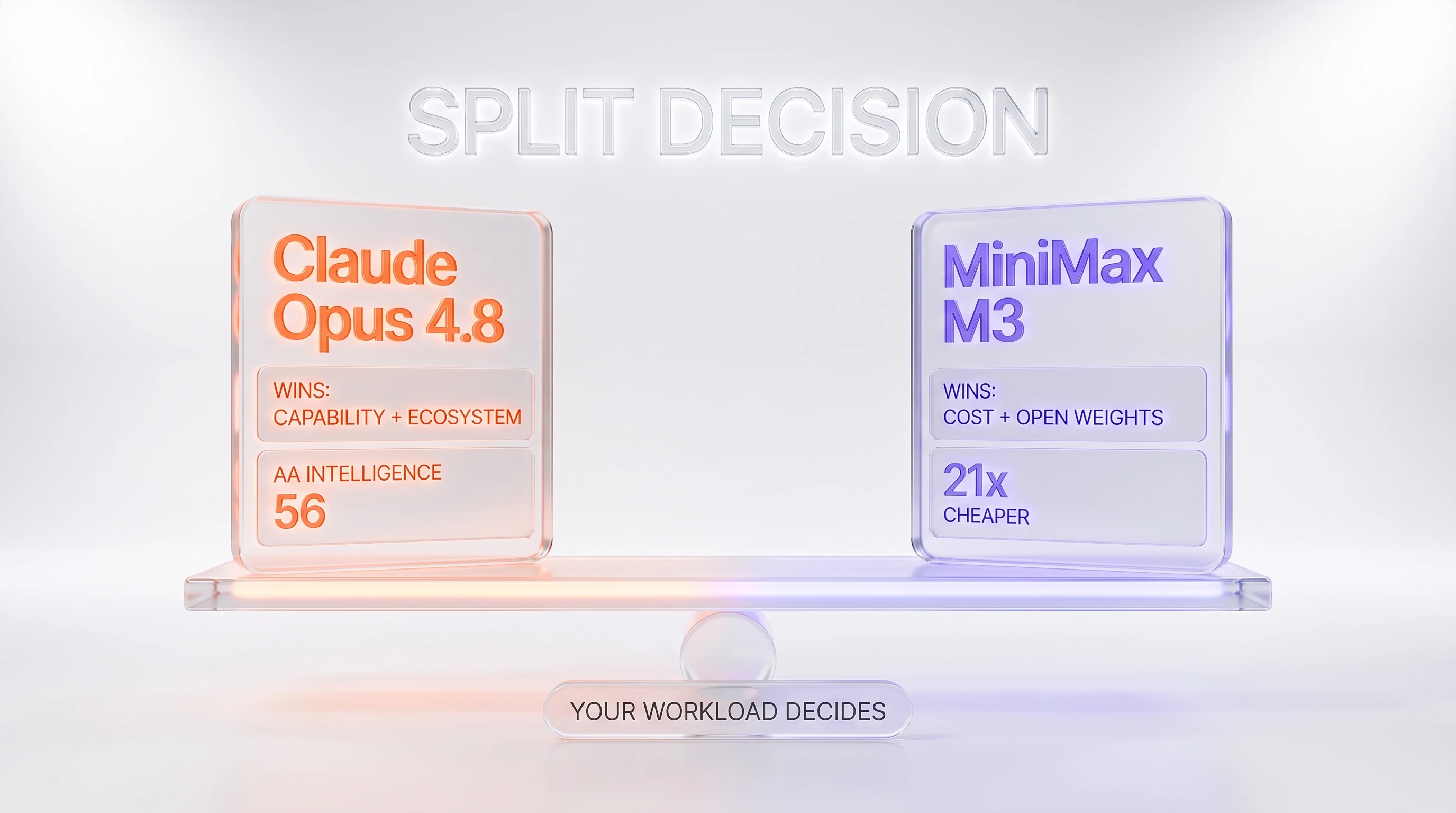
Claude Opus 4.8 versus MiniMax M3 is a clean capability-versus-cost fork. Claude Opus 4.8 is the more capable model on the neutral scale — 56 on the independent Artificial Analysis Intelligence Index at version 4.1, a 12-point lead over MiniMax M3's 44 on the same index and version — with the deeper agent ecosystem and the more mature production reliability in this matchup. It held instructions more tightly and needed fewer interventions on the hardest work in our testing. MiniMax M3 wins everything economic and open: standard output at 1.20 dollars per million tokens is about 21 times cheaper than Opus 4.8's 25 dollars, input at 0.30 dollars is about 17 times cheaper, the model ships open-weight for self-hosting, and it is natively multimodal across text, image, and video.
There is no single overall winner, and pretending otherwise would fail the reader. If you are capability-bound, Claude Opus 4.8 earns its premium and is the pick. If you are cost-bound and running at scale, MiniMax M3 delivers a remarkable share of frontier quality for a fraction of the price. The 21-times output price gap and the 12-point independent intelligence gap point in opposite directions, and the honest answer is that your workload decides. For a broader shortlist, see our roundup of the best AI coding tools of 2026.
Sources and Related Reading
Pricing for both models was fetched directly from each vendor's own pricing pages in July 2026. Independent intelligence scores are from Artificial Analysis at index version 4.1 for both models. MiniMax M3's coding and computer-use figures are vendor-reported by MiniMax, and Opus 4.8's computer-use figure is vendor-reported by Anthropic; all are labeled as such throughout. For related matchups, see Claude Fable 5 vs Claude Opus 4.8 for where Opus sits against Anthropic's very top tier, Grok 4.5 vs Claude Opus 4.8, Claude Sonnet 5 vs Claude Opus 4.8, and GPT-5.6 Sol vs Claude Opus 4.8. For the full field, see the best AI coding tools of 2026.
Frequently Asked Questions
Is Claude Opus 4.8 better than MiniMax M3?
On raw capability, yes. Claude Opus 4.8 scores 56 on the independent Artificial Analysis Intelligence Index at version 4.1, against 44 for MiniMax M3 on the same index and version — a 12-point lead measured by a neutral evaluator. But MiniMax M3 costs roughly 21 times less per output token on its standard tier and ships open-weight for self-hosting, so the better choice depends entirely on whether you are optimizing for capability and ecosystem or for cost and control.
How much cheaper is MiniMax M3 than Claude Opus 4.8?
On the standard tier, MiniMax M3 output at 1.20 dollars per million tokens is about 21 times cheaper than Claude Opus 4.8's 25 dollars, and input at 0.30 dollars is about 17 times cheaper than Opus 4.8's 5 dollars. All prices were fetched directly from each vendor's pricing pages in July 2026. Note that MiniMax's rates double above 512K tokens of context.
Does MiniMax M3 pricing change on long context?
Yes. MiniMax M3's headline rates of 0.30 dollars input and 1.20 dollars output per million tokens apply to its standard tier, up to 512K tokens of context. Above 512K tokens the rates double, to roughly 0.60 dollars input and 2.40 dollars output. Because the model carries a 1,000,000-token window, filling it puts you in the doubled tier — still far cheaper than Opus 4.8, but not the headline price.
Is MiniMax M3 open-weight and can I self-host it?
Yes. MiniMax M3 is released as an open-weight mixture-of-experts model with 428 billion total parameters and 23 billion active per token, and the company committed to publishing the weights and a technical report. That makes it a candidate for self-hosting and fine-tuning. Claude Opus 4.8, by contrast, is closed and API-only and cannot be self-hosted.
How good is MiniMax M3 at coding?
MiniMax reports 59.0 percent on the SWE-Bench Pro agentic-coding track and 70.06 percent on OSWorld-Verified for computer use. Both numbers are vendor-reported on MiniMax's own infrastructure and have not been independently reproduced by a third party at the time of writing, so treat them as vendor claims. They are strong results for the price, and MiniMax M3 ships a dedicated Code agent for autonomous workflows.
Which model has the bigger context window?
Neither — they are identical. Both Claude Opus 4.8 and MiniMax M3 carry a 1,000,000-token context window, so context capacity is a genuine tie. The difference is cost: Opus 4.8's window is priced flat, while MiniMax M3's rate doubles above 512K tokens. Opus 4.8 also documents up to 128K output tokens per request.
Can MiniMax M3 handle images and video?
Yes. MiniMax M3 was trained natively multimodal from step zero and accepts text, image, and video input. Claude Opus 4.8 supports vision for image input but does not accept video, so for pipelines that need native video understanding, MiniMax M3 is the better fit.
What does Claude Opus 4.8 offer that MiniMax M3 does not?
A higher independent intelligence score, a deeper managed agent ecosystem, and a first-party footprint on every major Western cloud. Opus 4.8 ships Dynamic Workflows to orchestrate hundreds of parallel subagents, effort controls to trade latency against reasoning depth, and a cautious self-checking reliability personality, all available across the Claude API, AWS, Google Cloud, and Microsoft Foundry. MiniMax M3 counters with open weights and a fraction of the price.
Is MiniMax M3 safe for sensitive or regulated data?
Its hosted API is operated by a Chinese company, so prompts sent to it fall under China's data and intelligence laws, which makes the hosted service unsuitable on its own for sensitive workloads. The mitigation is self-hosting: because MiniMax M3 is open-weight, you can run it inside your own network so no third-party API sees your prompts. Claude Opus 4.8 is US-anchored across managed clouds but is closed, so there is no path to running the weights yourself.
Which is better for an always-on coding agent?
MiniMax M3, in most cases. An always-on agent burns tokens continuously, so the 17-to-21-times price gap compounds into a very different monthly bill, and MiniMax M3 ships a dedicated Code agent built for autonomous workflows. Claude Opus 4.8 is the better choice when the agent tackles the hardest multi-file migrations where its 12-point capability lead, tighter instruction-following, and Dynamic Workflows save costly human review cycles.
Do I have to choose only one?
No, and many teams will not. The common pattern is a mixed stack: MiniMax M3 or another cheap model for the high-volume bulk work that has to scale, with Claude Opus 4.8 paged in for the hardest subtasks where being right the first time is worth the premium. The two models serve different jobs rather than competing for the same budget line.
Was this comparison hands-on?
Yes. We have run Claude Opus 4.8 in our own production stack since it went generally available on May 28, 2026, and we have run MiniMax M3 through its hosted API since it launched on June 1, 2026, on the cost-sensitive agentic workloads it targets. Every price was fetched directly from each vendor's pricing pages in July 2026, independent intelligence scores are from Artificial Analysis at index version 4.1, and every coding and computer-use figure is labeled as vendor-reported throughout.
Our Verdict
Claude Opus 4.8 versus MiniMax M3 is a clean capability-versus-cost fork with no single overall winner. Claude Opus 4.8 is the more capable model on the neutral scale: it scores 56 on the independent Artificial Analysis Intelligence Index at version 4.1 against 44 for MiniMax M3 on the same index and version, a 12-point lead by a neutral evaluator, and it pairs that with the deeper agent ecosystem in this matchup — Dynamic Workflows for parallel subagents, effort controls, and a cautious self-checking reliability personality that held instructions tightly and needed fewer human interventions on the hardest work in our production testing. MiniMax M3 wins everything economic and open: its standard output price of 1.20 dollars per million tokens is about 21 times cheaper than Opus 4.8's 25 dollars, its input at 0.30 dollars is about 17 times cheaper than Opus 4.8's 5 dollars, it ships open-weight for self-hosting, and it is natively multimodal across text, image, and video. Two nuances scope MiniMax's cost story: its rate doubles above 512K tokens, so filling the shared one-million-token window is not billed at the headline price, and its hosted API is operated by a Chinese company under China's data laws, though open weights make self-hosting the escape hatch. Pick Claude Opus 4.8 when the cost of being wrong dwarfs the token bill and you want a deep managed ecosystem; pick MiniMax M3 when the token bill is the whole constraint and you can run at scale. The 21-times output price gap and the 12-point independent intelligence gap point in opposite directions, and your workload decides.
Choose Claude Opus 4.8
Anthropic's flagship model for agentic coding, computer use, and multi-agent orchestration.
Try Claude Opus 4.8 →Choose MiniMax M3
Open-weight frontier model from MiniMax combining near-frontier coding, a 1M token context window, and native multimodality — from $0.30 per million input tokens.
Try MiniMax M3 →Frequently Asked Questions
Is Claude Opus 4.8 better than MiniMax M3?
Claude Opus 4.8 versus MiniMax M3 is a clean capability-versus-cost fork with no single overall winner. Claude Opus 4.8 is the more capable model on the neutral scale: it scores 56 on the independent Artificial Analysis Intelligence Index at version 4.1 against 44 for MiniMax M3 on the same index and version, a 12-point lead by a neutral evaluator, and it pairs that with the deeper agent ecosystem in this matchup — Dynamic Workflows for parallel subagents, effort controls, and a cautious self-checking reliability personality that held instructions tightly and needed fewer human interventions on the hardest work in our production testing. MiniMax M3 wins everything economic and open: its standard output price of 1.20 dollars per million tokens is about 21 times cheaper than Opus 4.8's 25 dollars, its input at 0.30 dollars is about 17 times cheaper than Opus 4.8's 5 dollars, it ships open-weight for self-hosting, and it is natively multimodal across text, image, and video. Two nuances scope MiniMax's cost story: its rate doubles above 512K tokens, so filling the shared one-million-token window is not billed at the headline price, and its hosted API is operated by a Chinese company under China's data laws, though open weights make self-hosting the escape hatch. Pick Claude Opus 4.8 when the cost of being wrong dwarfs the token bill and you want a deep managed ecosystem; pick MiniMax M3 when the token bill is the whole constraint and you can run at scale. The 21-times output price gap and the 12-point independent intelligence gap point in opposite directions, and your workload decides.
Which is cheaper, Claude Opus 4.8 or MiniMax M3?
Claude Opus 4.8 starts at $5 in / $25 out per M tokens. MiniMax M3 starts at $0.3 in / $1.2 out per M tokens. Check the pricing comparison section above for a full breakdown.
What are the main differences between Claude Opus 4.8 and MiniMax M3?
The key differences span across 10 features we compared. For Independent intelligence (Artificial Analysis Intelligence Index, version 4.1, same evaluator), Claude Opus 4.8 offers 56 — measured by a neutral third-party evaluator while MiniMax M3 offers 44 — the open-weight leader on the same index and version. For Input price (per million tokens), Claude Opus 4.8 offers 5 dollars (verified) while MiniMax M3 offers 0.30 dollars, standard tier up to 512K (verified) — about 17 times cheaper. For Output price (per million tokens), Claude Opus 4.8 offers 25 dollars (verified) while MiniMax M3 offers 1.20 dollars, standard tier up to 512K (verified) — about 21 times cheaper. See the full feature comparison table above for all details.