Claude Opus 5 vs Grok 4.5: 7 Points, 5.8x the Cost per Task (2026)


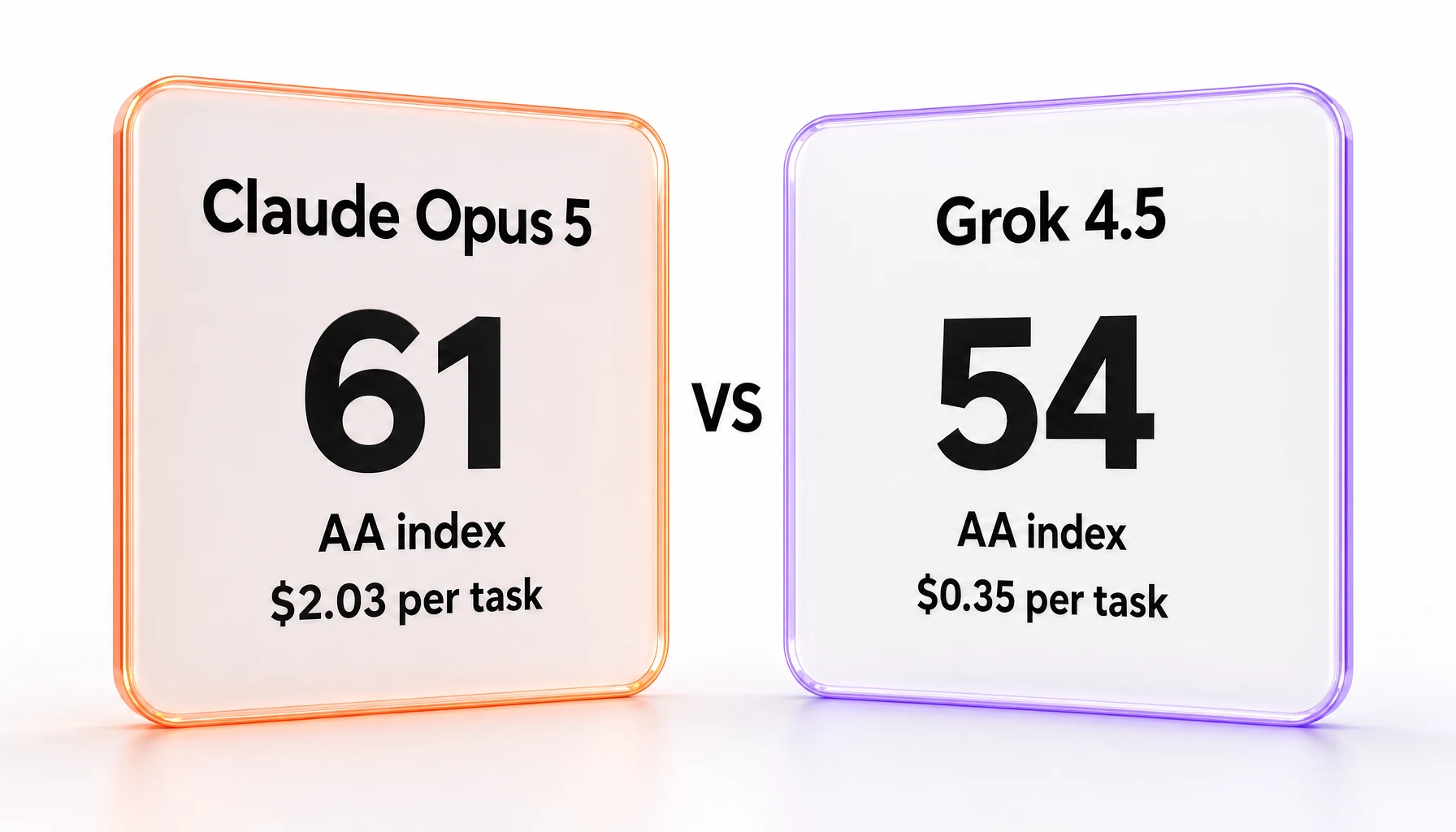
Opus 5 scores 61 on AA v4.1; Grok 4.5 scores 54 at $0.35 per task against $2.03. We researched both: here is what 7 index points really cost.
Feature Comparison
| Feature | Claude Opus 5 | Grok 4.5 |
|---|---|---|
| AA Intelligence Index v4.1, each model at its ceiling | 61 (max effort) | 54 (high effort) |
| AA Intelligence Index v4.1, each model at its default | 59 (high, default) | 54 (high, default) |
| Cost per index task (measured July 28, 2026) | $2.03 at max, $1.06 at default, $0.36 at low | $0.35 |
| Input price per million tokens | $5.00, flat at any length | $2.00 under 200k prompt tokens, $4.00 at or above |
| Output price per million tokens | $25.00, flat at any length | $6.00 under 200k prompt tokens, $12.00 at or above |
| Context window | 1,000,000 tokens | 500,000 tokens |
| Long-context surcharge | None at any length | All tokens in the request rebilled at 2x from 200,000 |
| Max output tokens | 128,000 synchronous, 300,000 via Batch API | Not published |
| Knowledge cutoff | May 2026 | February 1, 2026 |
| Reasoning effort levels | Five: low, medium, high, xhigh, max | Three: low, medium, high |
| Latency to first chunk (measured July 28, 2026) | 67.72s at max, 18.28s at default, 3.18s at low | 8.79s |
| Median output tokens per second (measured July 28, 2026) | 54 | 57 |
| Native X (Twitter) search tool | Not listed in Anthropic tool pricing | x_search: keyword, semantic, user search, thread fetch |
| Batch tier | $2.50 input and $12.50 output | Not published |
Pricing Comparison
Claude Opus 5
Grok 4.5
Detailed Comparison
Claude Opus 5 scores 61 on the Artificial Analysis Intelligence Index v4.1 at max effort and Grok 4.5 scores 54 at high effort, a seven-point gap between each model's own ceiling. The gap narrows to five points when both models run at their documented default, where Opus 5 reads 59. The cost picture runs the other way: on readings taken July 28, 2026, Grok 4.5 completes the index at $0.35 per task while Opus 5 costs $2.03 at max, $1.06 at its default and $0.36 at low effort. Grok 4.5 therefore beats Opus 5's cheapest rung on both score and price, scoring three points higher for one cent less. Opus 5 charges $5 per million input tokens and $25 per million output tokens with a 1,000,000-token context window at standard pricing; Grok 4.5 charges $2 and $6 below 200,000 prompt tokens, doubling to $4 and $12 on every token in the request once the prompt reaches 200,000, with a 500,000-token window. Neither model wins outright.
Quick Verdict: Who Wins What
This comparison does not produce a single winner, and inventing one would misrepresent the data. The two models are separated by a wide cost-efficiency gap in one direction and a capability ceiling in the other, and which of those matters is a property of your workload, not of the models.
- Best raw capability: Claude Opus 5. It reaches 61 on the Artificial Analysis Intelligence Index v4.1 at max effort, the highest score on that leaderboard as of July 28, 2026. Grok 4.5 cannot reach it at any setting, because high is its top effort level.
- Best cost per unit of intelligence: Grok 4.5. At $0.35 per index task it delivers 54 points for roughly one-sixth of what Opus 5 spends to deliver 61.
- Best value floor: Grok 4.5, decisively. Opus 5 at low effort scores 51 for $0.36. Grok 4.5 scores three points higher for a cent less. If your budget lands near that rung, there is no argument for Opus 5.
- Best for long documents: Claude Opus 5. A 1,000,000-token window at flat pricing against Grok's 500,000-token window with a price cliff at 200,000.
- Best for anything touching X: Grok 4.5. SpaceXAI documents an
x_searchtool for keyword, semantic and user search plus thread fetch on X. Anthropic's documented tools do not include an X-specific search. - Best for recency: Claude Opus 5. A May 2026 knowledge cutoff against February 1, 2026.
- Best for interactive latency: Grok 4.5. 8.79 seconds to first chunk against 67.72 seconds for Opus 5 at max effort, though Opus 5 at low effort is faster than both at 3.18 seconds.
We researched both models entirely from primary vendor documentation and from Artificial Analysis, the independent evaluator that runs both on the same index. We did not run our own private evaluations, and nothing below is presented as a hands-on result.
What Does the Full Effort Scale Look Like for Both Models?
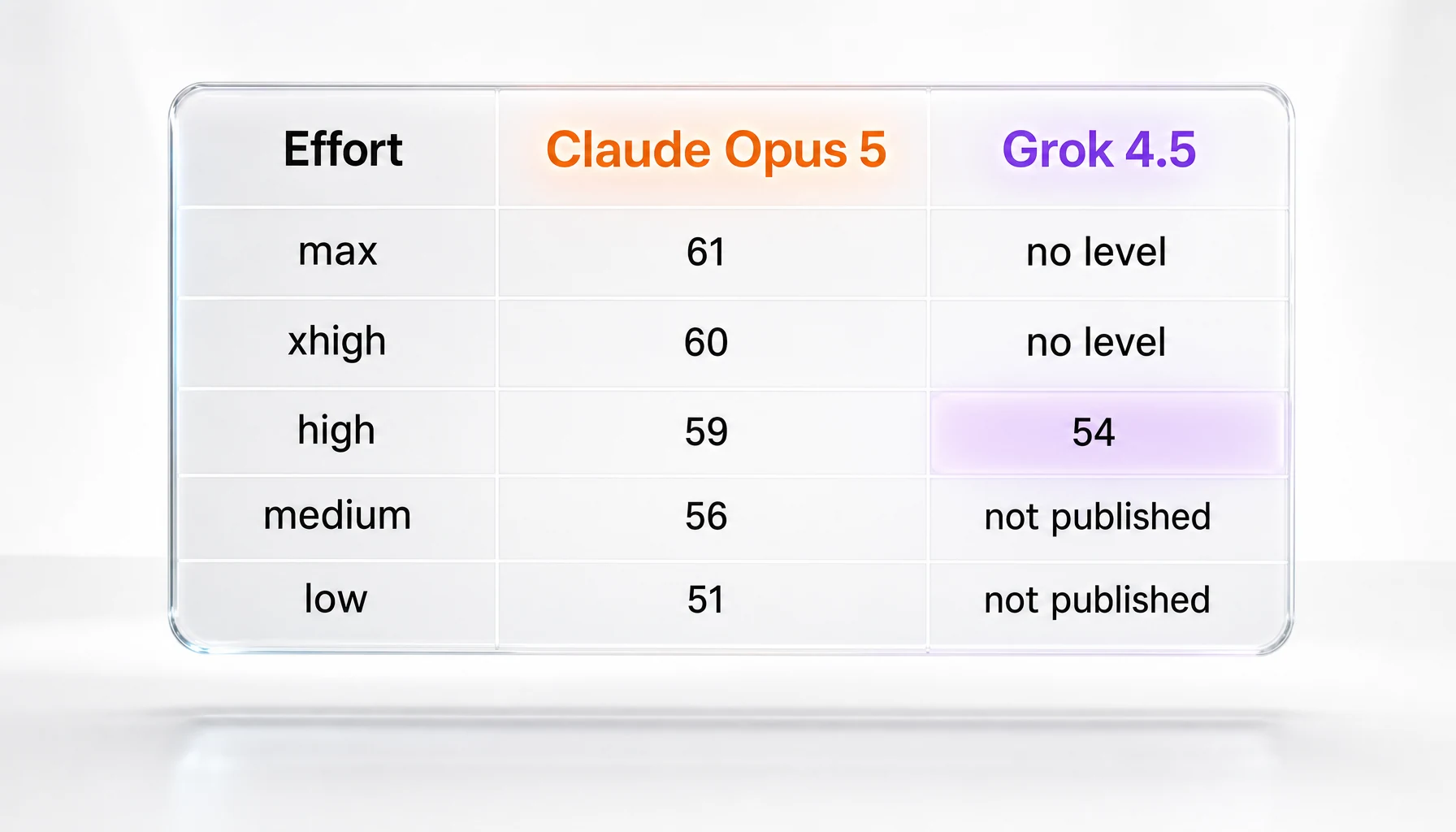
Claude Opus 5 supports five effort levels and Artificial Analysis publishes an index score for every one of them, from 51 at low to 61 at max. Grok 4.5 supports three effort levels according to SpaceXAI's documentation, but Artificial Analysis publishes only the high variant, at 54. Scores for Grok 4.5 at low and medium effort are not published, so no complete scale exists for it.
This is the table most comparisons skip, because the per-effort scores are published on the Artificial Analysis leaderboard rather than on the individual model pages, which show only the top variant. Every row below was read from the leaderboard on July 28, 2026.
Claude Opus 5 — complete published scale
| Effort level | AA Intelligence Index v4.1 | Cost per task, USD (measured July 28, 2026) | Median tokens per second (measured July 28, 2026) | Latency to first chunk, seconds (measured July 28, 2026) |
|---|---|---|---|---|
| max | 61 | $2.03 | 54 | 67.72 |
| xhigh | 60 | $1.56 | 54 | 39.35 |
| high (default) | 59 | $1.06 | 54 | 18.28 |
| medium | 56 | $0.62 | 53 | 5.78 |
| low | 51 | $0.36 | 51 | 3.18 |
Grok 4.5 — published scale
| Effort level | AA Intelligence Index v4.1 | Cost per task, USD (measured July 28, 2026) | Median tokens per second (measured July 28, 2026) | Latency to first chunk, seconds (measured July 28, 2026) |
|---|---|---|---|---|
| high (default and top level) | 54 | $0.35 | 57 | 8.79 |
| medium | Not published | Not published | Not published | Not published |
| low | Not published | Not published | Not published | Not published |
SpaceXAI's reasoning documentation states that grok-4.5 accepts "low", "medium" and "high" for reasoning_effort, and that high is the default. Artificial Analysis has benchmarked only the high variant, and titles its page "Grok 4.5 (high)". We are not going to estimate the missing rows: where a number is not published, the honest entry is that it is not published.
Cost per task, latency and throughput are rolling measurements, not fixed specifications. Artificial Analysis states that its metrics "are 'live' and are based on the past 72 hours of measurements, measurements are taken 8 times a day for single requests and 2 times per day for parallel requests." The index scores themselves are stable within a given index version; the dollar and speed figures in these tables will drift, which is why every one of them carries a measurement date.
Where Do the Seven Points Actually Come From?
The seven-point gap compares each model at its own ceiling: Opus 5 at max effort scores 61, Grok 4.5 at high effort scores 54. Compared at their documented defaults, both of which are labeled high, the gap is five points, because Opus 5 defaults to 59 rather than 61. Quoting seven points as a default-to-default difference overstates the gap by two points.
There are two legitimate ways to compare these models, and they give different answers. Getting this wrong is a common error in model comparisons, so it is worth being precise.
- Ceiling against ceiling: 61 against 54, a seven-point gap. Max is the top of Opus 5's scale and high is the top of Grok 4.5's, so each model is doing everything it can. This is a fair comparison, provided it is labeled as a ceiling comparison.
- Default against default: 59 against 54, a five-point gap. Anthropic documents that "the API default is
high" for Opus 5, and SpaceXAI documents high as Grok 4.5's default. Both figures describe what you get if you send a request without setting an effort parameter. This is the number that describes most real deployments.
What you may not do is compare Opus 5's 61 against Grok 4.5's 54 and describe it as high against high. Opus 5's high is 59. The label "high" means the top of the range on one model and the middle of the range on the other, which is exactly the kind of mismatch that produces wrong conclusions.
For scale, Artificial Analysis estimates "a 95% confidence interval for Artificial Analysis Intelligence Index of less than ±1%." On scores in the fifties and sixties, that is well under a point, so both the five-point and the seven-point gaps are real signal rather than measurement noise.
Which Model Costs More per Task?
Grok 4.5 costs less per task than Claude Opus 5 at every published Opus 5 effort level. Grok 4.5 completes the Artificial Analysis index at $0.35 per task. Opus 5 costs $2.03 at max, $1.56 at xhigh, $1.06 at its default, $0.62 at medium and $0.36 at low, measured July 28, 2026. Running Opus 5 at max costs about 5.8 times what Grok 4.5 costs.
This is where the comparison becomes genuinely interesting, and where an intuitive assumption turns out to be wrong. Grok 4.5 does not cost more per task than Opus 5. It costs less at every rung.
| Comparison (measured July 28, 2026) | Index points | Cost per task, USD | Cost multiple against Grok 4.5 |
|---|---|---|---|
| Grok 4.5 (high) | 54 | $0.35 | Baseline |
| Opus 5 (low) | 51 — three fewer | $0.36 | 1.03x |
| Opus 5 (medium) | 56 — two more | $0.62 | 1.77x |
| Opus 5 (high, default) | 59 — five more | $1.06 | 3.03x |
| Opus 5 (xhigh) | 60 — six more | $1.56 | 4.46x |
| Opus 5 (max) | 61 — seven more | $2.03 | 5.80x |
Two readings deserve emphasis. First, Opus 5 at low effort is dominated: it scores 51 for $0.36 while Grok 4.5 scores 54 for $0.35. Three points lower and a cent more expensive is a loss on both axes, and any workload sitting at that price point has a straightforward answer.
Second, the points get progressively more expensive. Moving from Grok 4.5 to Opus 5 at medium buys two points for an extra $0.27, roughly $0.14 per point. Going all the way to max buys seven points for an extra $1.68, roughly $0.24 per point. The last two points, from 59 to 61, cost an additional $0.97 per task on their own — nearly doubling the bill from the default, a 1.92 times multiple, to gain about three percent of index score.
That is the honest answer to the question this page exists to settle. Dropping seven points from Opus 5's ceiling to Grok 4.5 saves roughly 83 percent of the per-task cost. Dropping five points from the default saves roughly 67 percent.
How Do the Token Prices Compare?
Claude Opus 5 charges $5 per million input tokens and $25 per million output tokens, flat at any context length. Grok 4.5 charges $2 and $6 for prompts under 200,000 tokens, but $4 and $12 once a prompt reaches 200,000 tokens, applied to every token in that request. Opus 5 output is therefore 4.17 times Grok's price on short prompts and 2.08 times on long ones.
We took both price sets directly from the vendors' own documentation rather than from any third-party summary.
| Price line | Claude Opus 5 | Grok 4.5 |
|---|---|---|
| Input, per million tokens | $5.00 | $2.00 under 200k prompt tokens; $4.00 at or above |
| Output, per million tokens | $25.00 | $6.00 under 200k prompt tokens; $12.00 at or above |
| Cache read, per million tokens | $0.50 | $0.30 under 200k prompt tokens; $0.60 at or above |
| Cache write, per million tokens | $6.25 for 5 minutes; $10.00 for 1 hour | Not published as a separate write rate |
| Batch tier | $2.50 input and $12.50 output | Not published for Grok 4.5 |
| Premium speed tier | Fast mode, $10.00 input and $50.00 output, research preview | Not published |
The tiering rule matters more than the headline numbers. SpaceXAI's documentation states that "requests whose prompt reaches 200k tokens are billed at the higher rate for all tokens in the request." That is a cliff, not a marginal rate: a prompt of 199,000 tokens bills entirely at $2 and $6, and a prompt of 201,000 tokens bills entirely at $4 and $12. There is no blended zone, and crossing the threshold by a single token roughly doubles the invoice for that call.
Anthropic takes the opposite approach and says so explicitly: Claude 4.6 and later models "include the full 1M token context window at standard pricing," adding that "a 900k-token request is billed at the same per-token rate as a 9k-token request." Prompt caching and batch discounts apply at standard rates across the full window.
So Grok 4.5's price advantage is real but shrinks with prompt size. On short prompts Opus 5 output costs 4.17 times as much. On prompts over 200,000 tokens that multiple falls to 2.08, and Grok's input advantage narrows from 2.5 times to 1.25 times. For retrieval-heavy or whole-repository work, the two models are far closer on price than the headline rates suggest.
Context Window, Output Limit and Knowledge Cutoff
Claude Opus 5 offers a 1,000,000-token context window, 128,000 output tokens on the synchronous API and up to 300,000 through the Batch API with a beta header, with a May 2026 knowledge cutoff. Grok 4.5 offers a 500,000-token window and a February 1, 2026 cutoff. SpaceXAI does not publish a maximum output token figure for Grok 4.5.
| Specification | Claude Opus 5 | Grok 4.5 | Advantage |
|---|---|---|---|
| Context window | 1,000,000 tokens | 500,000 tokens | Opus 5, by 2x |
| Long-context surcharge | None at any length | All tokens rebilled at 2x from 200,000 | Opus 5 |
| Max output, synchronous | 128,000 tokens | Not published | Opus 5 (only one published) |
| Max output, batch | 300,000 tokens with the output-300k-2026-03-24 beta header | Not published | Opus 5 (only one published) |
| Knowledge cutoff | May 2026 | February 1, 2026 | Opus 5, by about three months |
| Effort levels | Five: low, medium, high, xhigh, max | Three: low, medium, high | Opus 5 |
| Input modalities | Text and image | Text and image | Tie |
| Published rate limits | Tiered by account, not published as a single figure | 150 requests per second; 50,000,000 tokens per minute | Grok 4.5 (published explicitly) |
Anthropic distinguishes between a "reliable knowledge cutoff" of May 2026, meaning the date through which the model's knowledge is most extensive, and a training data cutoff, which for Opus 5 is also May 2026. SpaceXAI publishes a single figure of February 1, 2026 for Grok 4.5. Grok 4.5's x_search tool partly offsets that gap for anything discussed on X, but for general world knowledge held in the weights, Opus 5 is about three months fresher.
The two vendors restrict reasoning differently, and the difference is easy to overstate. SpaceXAI's reasoning guide applies a blanket rule, stating that "reasoning cannot be disabled" for grok-4.5; you can only change its depth through reasoning_effort. Anthropic's restriction on Opus 5 is narrower and attaches to the top two effort levels only: "thinking cannot be disabled at xhigh or max effort: requests that set thinking type to disabled at those levels return a 400 error." Anthropic does not document the same prohibition at Opus 5's lower effort levels, so we are not claiming one.
What Does Grok 4.5 Offer That the Index Does Not Measure?
Grok 4.5 provides a documented x_search tool that performs keyword search, semantic search, user search and thread fetch on X, filterable by handle and date range. It also answers faster, reaching first output in 8.79 seconds against 67.72 seconds for Opus 5 at max effort, and sustains 57 tokens per second against Opus 5's 54.
An index score compresses nine evaluations into one number, and several things that decide real deployments are not among them.
Native search over X
This is Grok 4.5's clearest structural advantage and it is properly documented rather than merely marketed. SpaceXAI's developer documentation describes a tool of type x_search that "enables Grok to perform keyword search, semantic search, user search, and thread fetch on X (formerly Twitter)." It accepts allowed_x_handles and excluded_x_handles filters of up to 20 entries each, from_date and to_date range filters in ISO8601 format, and enable_image_understanding and enable_video_understanding switches for media in posts. SpaceXAI does not publish a per-call price for the tool.
Anthropic's documented server-side tools for Opus 5 are a web search tool at $10 per 1,000 searches and a web fetch tool at no additional cost beyond tokens. Anthropic's tool pricing table does not list an X-specific search tool. If your product depends on structured access to X posts and threads, that capability is documented on one side of this comparison and not the other.
Latency and throughput
Opus 5 at max effort took 67.72 seconds to produce its first chunk and 77.07 seconds for a total response, against 8.79 and 17.52 seconds for Grok 4.5, measured July 28, 2026. For an interactive product that is not a small difference; it is the difference between a pause and an abandoned session. Grok 4.5 also edges throughput at 57 tokens per second against 54.
The nuance is that Opus 5's latency is a function of effort, not of the model. At medium effort Opus 5 reaches first chunk in 5.78 seconds and at low effort in 3.18 seconds, both faster than Grok 4.5. If you want Opus 5's quality ceiling you accept the wait; if you want speed, Opus 5 can be configured for it, at scores of 56 and 51 respectively.
Token efficiency
SpaceXAI reports that Grok 4.5 "is served at fast-model speeds of 80 TPS" and publishes a token-efficiency figure of 15,954 average output tokens per SWE Bench Pro task. Both are vendor-reported figures rather than independent measurements, and the comparison figure SpaceXAI pairs them with is Claude Opus 4.8, not Opus 5. We treat them as claims, not findings.
The throughput claim is worth holding up against the independent reading, because the two do not agree. SpaceXAI states 80 tokens per second; Artificial Analysis measured a median of 57.3 tokens per second for Grok 4.5 on July 28, 2026. Vendor figures are typically measured under favorable conditions while Artificial Analysis measures what customers experience across providers, which is a reasonable explanation for a gap of this size. We report both and rely on the independent number, and we do not average them, because they are not the same measurement.
Why the Vendor Benchmarks Cannot Settle This
Neither vendor has published a head-to-head benchmark against the other model. SpaceXAI announced Grok 4.5 on July 16, 2026, eight days before Claude Opus 5 launched on July 24, so its published charts compare Grok 4.5 with Claude Opus 4.8. Anthropic's Opus 5 announcement compares against Opus 4.8 and Fable 5. The Artificial Analysis index is the only common yardstick.
SpaceXAI's launch post carries five coding benchmarks. On its own figures Grok 4.5 leads Opus 4.8 on SWE Marathon at 29.0 percent against 26.0 percent, on Terminal Bench 2.1 at 83.3 against 78.9, and on DeepSWE 1.0 at 62.0 against 55.75. Opus 4.8 leads on SWE Bench Pro at 69.2 against 64.7, and on DeepSWE 1.1 at 59 against 53.
None of those numbers tell you anything about Claude Opus 5. They were published before Opus 5 existed publicly, and Opus 5 is a different model from Opus 4.8 with a different knowledge cutoff and a different effort scale. Transferring a Grok-versus-Opus-4.8 result onto Grok-versus-Opus-5 would be a straightforward error of substitution, and we are not going to make it. We report these figures only to explain why they cannot be used here.
The same caution applies in reverse. Anthropic describes Opus 5 as coming "close to the frontier intelligence of Claude Fable 5 at half the price" and reports that "on CursorBench 3.2, at max effort, the model performs within 0.5% of Fable 5's peak score, but at half the cost per task." Those are comparisons against Anthropic's own larger model. They say nothing about Grok 4.5.
This leaves the Artificial Analysis Intelligence Index v4.1 as the only place both models are measured by the same party under the same conditions. Version 4.1 combines nine evaluations: GDPval-AA v2, τ³-Banking, Terminal-Bench v2.1, SciCode, AA-LCR, AA-Omniscience, Humanity's Last Exam, GPQA Diamond and CritPt. Independent measurement and vendor self-reporting are different classes of evidence, and we have kept them separate throughout this page rather than stacking them into a single scoreboard.
Pros and Cons of Each Model
Claude Opus 5
Pros
- Highest score on the Artificial Analysis Intelligence Index v4.1 at 61, as of July 28, 2026
- Five effort levels give fine-grained control, with a published index score for every one
- 1,000,000-token context window with no long-context surcharge at any length
- Knowledge cutoff of May 2026, about three months fresher than Grok 4.5
- 128,000 output tokens synchronously and up to 300,000 through the Batch API
- A 50 percent batch discount and a documented $0.50 cache read rate
- At low and medium effort it reaches first output faster than Grok 4.5
Cons
- Costs 5.8 times as much per index task at max effort and 3.03 times at its default
- At low effort it is beaten outright by Grok 4.5, scoring three points lower for a cent more
- 67.72 seconds to first chunk at max effort makes it unsuitable for interactive use at that setting
- Output tokens cost $25 per million, over four times Grok's short-prompt rate
- Reasoning cannot be switched off at xhigh or max, which return a 400 error if you try
- No documented X-specific search tool
Grok 4.5
Pros
- $0.35 per index task, the cheaper model at every published Opus 5 effort level
- Scores 54 against Opus 5's 51 at low effort, while costing marginally less
- Documented
x_searchtool for keyword, semantic and user search plus thread fetch on X - 8.79 seconds to first chunk and 57 tokens per second, ahead of Opus 5 at its higher effort levels
- $2 and $6 per million tokens below 200,000 prompt tokens
- Explicitly published rate limits of 150 requests per second and 50,000,000 tokens per minute
Cons
- Seven points below Opus 5's ceiling and five below its default, with no higher setting available
- Context window of 500,000 tokens, half of Opus 5's
- Every token in a request is rebilled at double rate once the prompt reaches 200,000 tokens
- Knowledge cutoff of February 1, 2026, about three months behind
- Maximum output tokens not published
- Artificial Analysis publishes no score for its low or medium effort levels, so the cost-quality curve below high is unknown
- No published batch tier or separate cache write rate
When to Pick Each Model
Choose Claude Opus 5 when the task is hard enough that seven index points change the outcome, when prompts exceed 500,000 tokens, or when knowledge after February 2026 matters. Choose Grok 4.5 when cost per task dominates, when you need structured search over X posts, or when interactive latency matters more than the last few points of capability.
Pick Claude Opus 5 when
- The task is genuinely at the frontier. If your evaluations show measurable headroom between 54 and 61, the extra $1.68 per task is buying something real.
- Prompts exceed 500,000 tokens. Grok 4.5 cannot accept them at all. This is a hard limit, not a preference.
- Prompts routinely sit just above 200,000 tokens. Grok's cliff doubles the whole request, which erodes much of its price advantage exactly where large-context work lives.
- Recency matters. Three months of additional world knowledge is significant in fast-moving domains.
- You need long single outputs. 128,000 tokens synchronously, or 300,000 in batch, against an unpublished Grok figure.
- You want a tunable cost-quality curve. Five published rungs let you match spend to task difficulty with evidence rather than guesswork.
Pick Grok 4.5 when
- Volume makes cost per task the deciding variable. At scale, 5.8 times is not a rounding difference; it is the difference between a viable and an unviable unit economic.
- You were about to run Opus 5 at low effort. Grok 4.5 scores higher for slightly less. That comparison is not close.
- Your product reads X. Social listening, sentiment work, thread summarization and creator tooling all depend on a capability that only one of these two documents.
- Latency is part of the product. Under nine seconds to first output supports interactive use in a way that a 68-second wait does not.
- Prompts stay comfortably under 200,000 tokens. That is where Grok's $2 and $6 rates apply, and where its price advantage is largest.
The case for running both
These models are priced far enough apart that routing beats choosing for many teams. A workable pattern is Grok 4.5 as the default path and Opus 5 at high or max effort for the minority of requests that fail a quality gate. Because Grok 4.5 at 54 sits between Opus 5's medium at 56 and low at 51, it can genuinely replace the bottom of Anthropic's range rather than merely undercutting it. What it cannot replace is the top.
Frequently Asked Questions
Which is smarter, Claude Opus 5 or Grok 4.5?
Claude Opus 5, by five to seven points on the Artificial Analysis Intelligence Index v4.1 depending on how you compare them. At each model's ceiling, Opus 5 scores 61 at max effort against 54 for Grok 4.5 at high effort, a seven-point gap. At each model's documented default, Opus 5 scores 59 against the same 54, a five-point gap. Artificial Analysis estimates a 95 percent confidence interval of less than plus or minus one percent on the index, so both gaps are larger than measurement noise. Opus 5 was the highest-scoring model on that leaderboard when we checked on July 28, 2026.
Is Grok 4.5 cheaper than Claude Opus 5?
Yes, on both token prices and cost per task. Grok 4.5 charges $2 per million input tokens and $6 per million output tokens for prompts under 200,000 tokens, against $5 and $25 for Claude Opus 5. On cost to complete the Artificial Analysis index, Grok 4.5 came in at $0.35 per task against $2.03 for Opus 5 at max effort and $1.06 at its default, measured July 28, 2026. Grok 4.5 was cheaper than every published Opus 5 effort level, including the lowest.
How much does each model cost per task?
Measured on July 28, 2026, Grok 4.5 at high effort cost $0.35 per Artificial Analysis index task. Claude Opus 5 cost $2.03 at max effort, $1.56 at xhigh, $1.06 at its default high setting, $0.62 at medium and $0.36 at low. Running Opus 5 at max therefore costs about 5.8 times what Grok 4.5 costs, and about 3.03 times at the default. These are rolling measurements based on the previous 72 hours rather than fixed prices, so they move over time.
Is Opus 5 at low effort worth using instead of Grok 4.5?
No, on the published numbers. Claude Opus 5 at low effort scores 51 on the Artificial Analysis Intelligence Index v4.1 at a cost of $0.36 per task. Grok 4.5 scores 54 at $0.35 per task. That is three index points lower and one cent more expensive, which is a loss on both axes. The first Opus 5 setting that scores above Grok 4.5 is medium, at 56 points and $0.62 per task, which costs about 1.77 times as much for a two-point gain.
What is the price difference per token between the two models?
For prompts under 200,000 tokens, Claude Opus 5 input costs 2.5 times Grok 4.5's rate at $5 against $2 per million, and Opus 5 output costs 4.17 times Grok's rate at $25 against $6 per million. For prompts at or above 200,000 tokens, Grok 4.5 doubles to $4 and $12, which narrows the difference to 1.25 times on input and 2.08 times on output. Cache reads are $0.50 per million on Opus 5 against $0.30 for Grok 4.5 below the threshold.
Does Grok 4.5 have a long-context price penalty?
Yes, and it applies retroactively to the whole request. SpaceXAI's documentation states that requests whose prompt reaches 200,000 tokens are billed at the higher rate for all tokens in that request. Input rises from $2 to $4 per million and output from $6 to $12. Because it is a cliff rather than a marginal rate, a 201,000-token prompt bills entirely at the higher rate. Claude Opus 5 has no equivalent penalty: Anthropic states that a 900,000-token request is billed at the same per-token rate as a 9,000-token request.
Which model has the bigger context window?
Claude Opus 5, at 1,000,000 tokens against 500,000 for Grok 4.5. The practical gap is wider than the ratio suggests, because Opus 5 charges standard rates across its entire window while Grok 4.5 doubles all token prices once a prompt reaches 200,000 tokens. For work that regularly loads large codebases or document sets, Opus 5 both accepts more and prices it more predictably.
How many reasoning effort levels does each model support?
Claude Opus 5 supports five: low, medium, high, xhigh and max, with high as the API default. Grok 4.5 supports three according to SpaceXAI's documentation: low, medium and high, also defaulting to high. This means high is the middle of Opus 5's range but the top of Grok 4.5's, so the same label describes different positions on each scale. Artificial Analysis publishes index scores for all five Opus 5 levels but only for Grok 4.5 at high.
Can you turn off reasoning on either model?
The rules differ, and only one of them is a blanket ban. SpaceXAI's reasoning documentation states plainly that reasoning cannot be disabled on grok-4.5; you can only adjust its depth through the reasoning_effort parameter. Anthropic applies a narrower restriction to Claude Opus 5: thinking cannot be disabled at xhigh or max effort, and requests setting thinking type to disabled at those levels return a 400 error. Anthropic does not document that restriction at Opus 5's lower effort levels, so the prohibition is model-wide on Grok 4.5 but limited to the top two settings on Opus 5.
Which model responds faster?
It depends on the effort setting. Measured July 28, 2026, Grok 4.5 reached first output in 8.79 seconds with a total response time of 17.52 seconds, against 67.72 and 77.07 seconds for Claude Opus 5 at max effort. But Opus 5 at medium reached first output in 5.78 seconds and at low in 3.18 seconds, both faster than Grok 4.5. Throughput slightly favors Grok 4.5 at 57 tokens per second against 54 for Opus 5 at its higher levels.
Can Grok 4.5 search X posts in real time?
Yes. SpaceXAI documents a tool of type x_search that enables Grok to perform keyword search, semantic search, user search and thread fetch on X, formerly Twitter. It supports allowed and excluded handle filters of up to 20 entries each, date range filters in ISO8601 format, and optional image and video understanding for media in posts. SpaceXAI does not publish a per-call price for it. Anthropic's documented tools for Claude Opus 5 include web search at $10 per 1,000 searches and web fetch at no extra cost, but its tool pricing table does not list an X-specific search tool.
Which model has the more recent knowledge cutoff?
Claude Opus 5, by about three months. Anthropic lists both a reliable knowledge cutoff and a training data cutoff of May 2026 for Opus 5. SpaceXAI lists February 1, 2026 for Grok 4.5. Grok 4.5 partly compensates through its x_search tool, which retrieves current posts from X at request time, and both models can be given fresh information through their respective web search tools, so the cutoff matters most for knowledge you expect the model to hold without retrieval.
Final Verdict
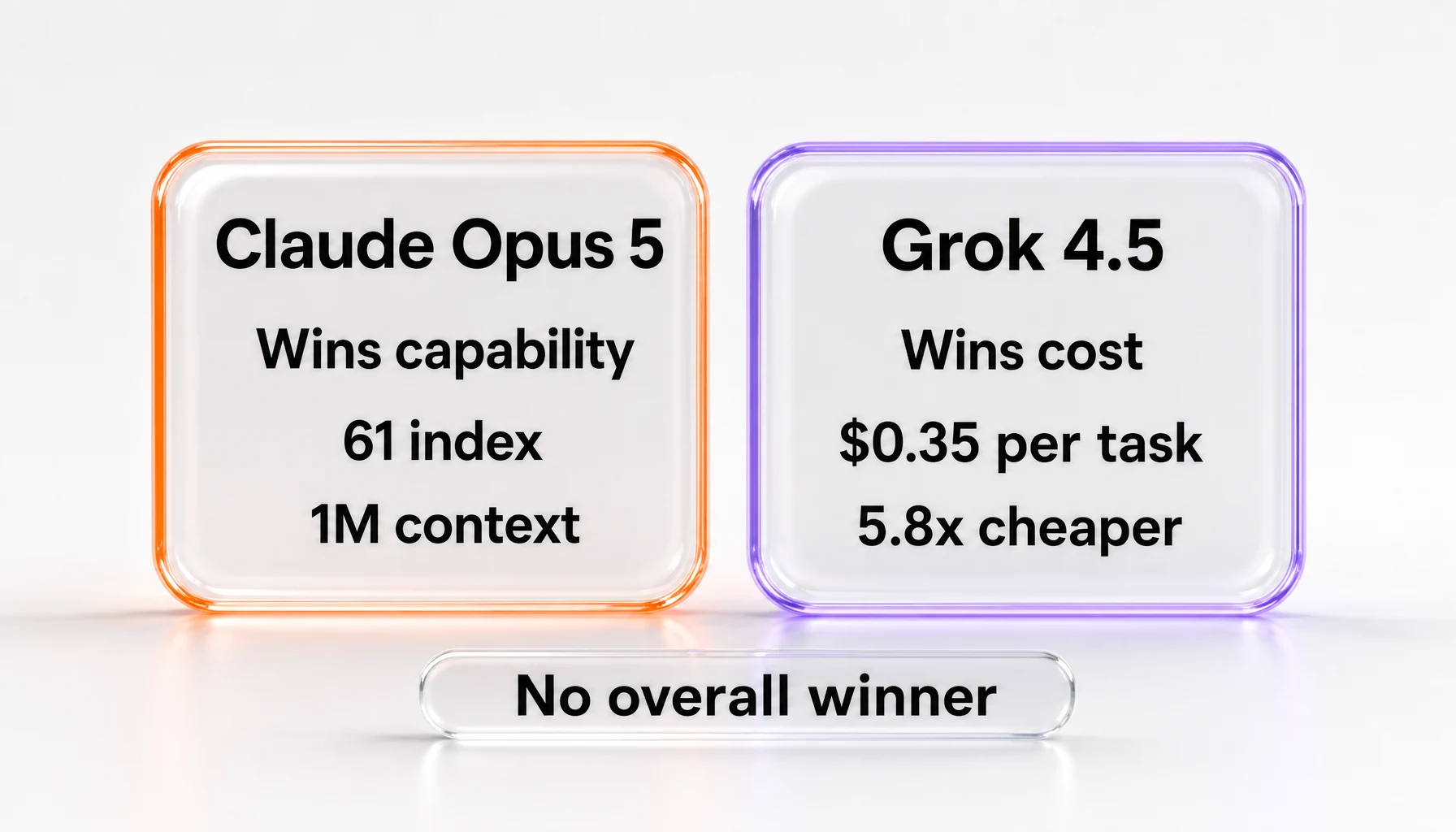
Claude Opus 5 wins on capability, context and recency; Grok 4.5 wins on cost per task, latency and access to X. Neither wins overall. Opus 5's seven-point advantage at its ceiling costs about 5.8 times as much per task, and Grok 4.5 beats Opus 5's cheapest setting outright, scoring 54 against 51 for one cent less.
The question this page set out to answer was what you actually lose by dropping seven index points, and what you gain in return. The answer is unusually clean.
What you lose: seven points against Opus 5's ceiling, or five against its default. Half the context window, and a pricing cliff at 200,000 tokens that doubles the cost of a request retroactively. Roughly three months of knowledge recency. Two effort levels you no longer have access to, and no published figure for maximum output. You also lose visibility, because Artificial Analysis publishes no scores for Grok 4.5 below high effort, so its cost-quality curve is unmapped where Opus 5's is fully documented.
What you gain: about 83 percent of the per-task cost at the extremes, or 67 percent measured default to default. Under nine seconds to first output instead of over a minute at max effort. A documented, filterable search tool over X posts and threads that has no counterpart in Anthropic's documentation. And explicitly published rate limits, which is more than Anthropic offers as a single figure.
The finding we did not expect is that Grok 4.5 is not merely the cheap option. At $0.35 per task against $0.36 it is strictly better than Claude Opus 5's low-effort setting on both score and price. Grok 4.5 does not undercut the bottom of Anthropic's range; it replaces it. Anthropic's answer is that the range extends far above where Grok 4.5 stops, and if your work lives up there, no amount of cost efficiency substitutes for the seven points.
We have set no overall winner for this comparison, because the data does not support one. Teams optimizing cost at volume should default to Grok 4.5. Teams whose output quality is the product should default to Claude Opus 5 at high or max. Teams doing both should route between them, and the routing threshold sits right around Opus 5's medium setting, where the two models are closest on both score and price.
Sources and References
Every figure on this page comes from a primary vendor document or from Artificial Analysis, the independent evaluator that measures both models on the same index. Benchmark readings were taken July 28, 2026. We checked ARC Prize as an additional independent source; neither model appears on its leaderboard, so it is not cited here.
- Artificial Analysis — LLM Leaderboard, source of every per-effort index score, cost per task, throughput and latency figure
- Artificial Analysis — Intelligence Benchmarking Methodology, source for Intelligence Index v4.1 composition and the confidence interval
- Artificial Analysis — Grok 4.5 (high) analysis
- Anthropic — Models overview, source for context window, output limits and knowledge cutoff
- Anthropic — Pricing, source for token rates, caching, batch and long-context pricing
- Anthropic — Effort, source for the five effort levels, the default and the 400 error at xhigh and max
- Anthropic — Introducing Claude Opus 5, July 24, 2026
- SpaceXAI — Introducing Grok 4.5, July 16, 2026, source for vendor-reported benchmarks and token efficiency
- SpaceXAI — grok-4.5 model reference, source for pricing tiers, context window, cutoff and rate limits
- SpaceXAI — Reasoning, source for the three effort levels and the default
- SpaceXAI — X Search tool, source for x_search modes and filters
- SpaceXAI — Web Search tool
Related reading on ThePlanetTools: our full reviews of Claude Opus 5 and Grok 4.5, our report on the Claude Opus 5 launch, and our note on the SpaceXAI rebrand. For adjacent matchups see GPT-5.6 Sol vs Grok 4.5, Grok 4.5 vs Claude Opus 4.8 and Grok 4.5 vs Claude Sonnet 5, or compare against Kimi K3, GPT-5.6 Sol, Claude Sonnet 5 and Claude Opus 4.8.
Our Verdict
No overall winner, and the split is clean rather than mushy. Claude Opus 5 wins raw capability (61 against 54 at each ceiling, 59 against 54 at each default), context (1M against 500k with no long-context surcharge), recency (May 2026 against February 1, 2026) and output ceiling. Grok 4.5 wins cost per task ($0.35 against $2.03 at max, a 5.8x gap), interactive latency (8.79s to first chunk against 67.72s) and native X access via its documented x_search tool. The decisive finding is that Grok 4.5 beats Opus 5 outright at the bottom of Anthropic range: 54 points for $0.35 against 51 points for $0.36. Grok 4.5 replaces Opus 5 low-effort tier rather than merely undercutting it, but it cannot reach the top, because high is its maximum setting. Route between them: default to Grok 4.5 on volume, escalate to Opus 5 at high or max when output quality is the product.
Choose Claude Opus 5
Anthropic's frontier reasoning model — top of the independent index at half the price of Fable 5.
Try Claude Opus 5 →Choose Grok 4.5
SpaceXAI's reasoning model — Opus-class speed at $2 and $6 per million tokens, 500K context, available to EU users since July 17, 2026; succeeded by Grok 4.6 on August 12.
Try Grok 4.5 →Frequently Asked Questions
Is Claude Opus 5 better than Grok 4.5?
No overall winner, and the split is clean rather than mushy. Claude Opus 5 wins raw capability (61 against 54 at each ceiling, 59 against 54 at each default), context (1M against 500k with no long-context surcharge), recency (May 2026 against February 1, 2026) and output ceiling. Grok 4.5 wins cost per task ($0.35 against $2.03 at max, a 5.8x gap), interactive latency (8.79s to first chunk against 67.72s) and native X access via its documented x_search tool. The decisive finding is that Grok 4.5 beats Opus 5 outright at the bottom of Anthropic range: 54 points for $0.35 against 51 points for $0.36. Grok 4.5 replaces Opus 5 low-effort tier rather than merely undercutting it, but it cannot reach the top, because high is its maximum setting. Route between them: default to Grok 4.5 on volume, escalate to Opus 5 at high or max when output quality is the product.
Which is cheaper, Claude Opus 5 or Grok 4.5?
Claude Opus 5 starts at $5 in / $25 out per M tokens. Grok 4.5 starts at $2 in / $6 out per M tokens. Check the pricing comparison section above for a full breakdown.
What are the main differences between Claude Opus 5 and Grok 4.5?
The key differences span across 14 features we compared. For AA Intelligence Index v4.1, each model at its ceiling, Claude Opus 5 offers 61 (max effort) while Grok 4.5 offers 54 (high effort). For AA Intelligence Index v4.1, each model at its default, Claude Opus 5 offers 59 (high, default) while Grok 4.5 offers 54 (high, default). For Cost per index task (measured July 28, 2026), Claude Opus 5 offers $2.03 at max, $1.06 at default, $0.36 at low while Grok 4.5 offers $0.35. See the full feature comparison table above for all details.