Grok 4.5 vs Claude Sonnet 5: Aggressive Price vs Balanced Value (2026)


Grok 4.5 vs Claude Sonnet 5: Grok wins cheaper output and the only charted coding score; Sonnet 5 wins 1M context, speed and EU access. A split.
Feature Comparison
| Feature | Grok 4.5 | Claude Sonnet 5 |
|---|---|---|
| Input price per 1M tokens | $2.00 under 200K, $4.00 above | $2.00 flat at any length |
| Output price per 1M tokens | $6.00 under 200K, $12.00 above | $10.00 flat at any length |
| Cached input per 1M tokens | $0.30 | $0.20 |
| Context window | 500,000 tokens | 1,000,000 tokens |
| AA Intelligence Index | 54 (ranked #4) | 53 |
| AA Coding Agent Index v1.3 (read Aug 2, 2026) | 64.4 — via Grok Build at high effort | N/A (not charted) |
| SWE-bench Verified (independent) | Not yet on independent leaderboard (too new) | N/A (not listed) |
| Independent throughput | Vendor claim only ("much faster") | ~79 tokens per second (measured) |
| EU availability | Available since July 17, 2026 (blocked at launch under the EU AI Act) | Available |
| Ecosystem and distribution | X platform, API (us-east / us-west) | Claude.ai free and Pro, Claude Code, API |
Pricing Comparison
Grok 4.5
Claude Sonnet 5
Detailed Comparison
Grok 4.5 and Claude Sonnet 5 both arrived in the summer of 2026 as mid-priced workhorses, but they trade very different strengths. Grok 4.5, SpaceXAI's new flagship, is cheaper on output at 6 dollars per million tokens against Sonnet 5's 10 dollars, edges it on the Artificial Analysis Intelligence Index (54 to 53), and is the only one of the two with a charted independent coding score. Claude Sonnet 5, Anthropic's balanced value tier, answers with double the context window (1 million tokens against 500,000), an independently measured speed of about 79 tokens per second, and a free path on Claude.ai. Grok 4.5 was blocked in the European Union until July 17, 2026. There is no single overall winner here: pick Grok 4.5 for cheap output and coding value, and Claude Sonnet 5 for context and ecosystem.
Quick Verdict
The one-sentence version: pick Grok 4.5 when cheap output tokens, a measured cost per task, and the only charted independent coding score matter most; pick Claude Sonnet 5 when you need double the context window, an independently measured throughput, a free evaluation path, or EU availability. This one does not have a single overall winner — it is a genuine split, and the honest answer depends on which axis your workload lives on.
The two models sit almost on top of each other on raw intelligence — 54 against 53 on the Artificial Analysis Intelligence Index — so the decision is not really about which is smarter. It is about trade-offs. Grok 4.5 owns the money axis on output and the one independent coding number on the board; Sonnet 5 owns context, distribution, and the only measured speed figure of the pair. Neither sweeps the other, and the row count does not settle it, because a team that runs high-volume generation weighs cheap output far more heavily than a team that needs to feed a million tokens of code into one prompt. So we call the winner by category, not overall.
- Best cheaper output and cost per task: Grok 4.5 (6 dollars per million output tokens against Sonnet 5's 10 dollars, and a measured 2.49 dollars per task on Artificial Analysis)
- Best charted independent coding score: Grok 4.5 (64.4 on the AA Coding Agent Index v1.3, via Grok Build at high effort; Sonnet 5 is not charted there)
- Best raw intelligence, narrowly: Grok 4.5 (54 against 53 on the Intelligence Index — a one-point edge, effectively a coin toss)
- Best context window: Claude Sonnet 5 (1 million tokens against Grok 4.5's 500,000)
- Best measured speed: Claude Sonnet 5 (about 79 tokens per second, independently measured; Grok 4.5's speed is a vendor claim only)
- Best ecosystem: Claude Sonnet 5 (free on Claude.ai, and available in the European Union throughout, where Grok 4.5 arrived on July 17, 2026)
- Overall: a split — no single winner, so we set no overall crown and let your priorities decide
How We Compared Them
Honesty first. Both models are new: Claude Sonnet 5 launched on June 30, 2026, and Grok 4.5 went public on July 9, 2026, so this is early-days analysis, not a months-long production bake-off. We confirmed that both respond on their APIs, and we verified pricing directly from each vendor's own documentation rather than from search snippets — SpaceXAI's model docs for Grok 4.5 and Anthropic's API pricing page for Sonnet 5. Where a capability number exists for only one model, we say so plainly instead of inventing a match for the other side. Two labs, two ways of reporting, and we keep them clearly separated. Read SpaceXAI's model reference at docs.x.ai and Anthropic's pricing at platform.claude.com to check our figures.
One rule shaped every benchmark below: we place two numbers head to head only when both models are measured on the same test at the same scale. That matters a lot here, because the data is lopsided. Grok 4.5 has independent scores from Artificial Analysis — an Intelligence Index of 54, an AA Coding Agent Index v1.3 result of 64.4 through the Grok Build harness, a measured 2.49 dollars per task, and an AA-Omniscience reading — published the day it launched. Claude Sonnet 5 has an independent Intelligence Index of 53 and a measured throughput, but it is not charted on the AA Coding Agent Index, so we cannot line up an independent coding number against Grok's 64.4. On the widely cited SWE-bench Verified leaderboard, neither model is listed at the time of writing: Grok 4.5 is too new to appear on the independent board, and Sonnet 5 is not listed either — so on that specific benchmark it is an honest tie of missing data, and we refuse to fill the gap with a vendor headline. Independent benchmark figures throughout come from Artificial Analysis.
Where we cite a vendor's own claim — SpaceXAI describing Grok 4.5 as "Opus-class, much faster," or Anthropic self-reporting Sonnet 5 at 63.2 percent on SWE-bench Pro and 81.2 percent on OSWorld — we label it as self-reported and never stack it against the other side's independent number. That keeps the comparison defensible rather than tidy. It also means some rows below read "not charted" or "vendor claim only," which is the truthful state of a matchup between two models that are barely two weeks old.
Meet Both Models
Grok 4.5 — SpaceXAI's aggressive-price flagship
Grok 4.5 is SpaceXAI's newest flagship large language model, announced on July 8 and made public on July 9, 2026, replacing Grok 4.3 at the top of the lineup (the older Grok 4.3 and Grok 4.20 stay available). Its pitch is intelligence at an aggressive price: SpaceXAI lists it at 2 dollars per million input tokens, 0.30 dollars cached, and 6 dollars per million output tokens — roughly half the output rate of flagship rivals such as Claude Opus 4.8. It ships a 500,000-token context window, text-and-image input with text output, function calling, structured outputs, and a three-level reasoning-effort control (low, medium, and high, with high as the default). SpaceXAI says it was trained with Cursor on GB300-class GPUs, and Elon Musk described it at launch as "Opus-class, much faster" — a vendor claim we flag rather than treat as measured. One practical caveat applied at launch: Grok 4.5 was blocked in the European Union for its first nine days, a gap closed on July 17, 2026. We cover the platform's July 2026 rebrand from xAI to SpaceXAI in our SpaceXAI rebrand explainer.
Claude Sonnet 5 — Anthropic's balanced value tier
Claude Sonnet 5 is Anthropic's mid-tier model, released June 30, 2026, and positioned as the high-volume default beneath the Claude Opus 4.8 flagship. Its signature is balance: a 1,000,000-token context window (double Grok 4.5's), text-and-image input with text output, a January 2026 training cutoff, and a maximum output of 128,000 tokens (up to 300,000 in a batch beta). Pricing is deliberately low for its class — 2 dollars per million input tokens and 10 dollars output, with cached input at 0.20 dollars. It is closed, reached through the Claude API (model id claude-sonnet-5) and Anthropic's developer tooling, and it is the default model on the free and Pro plans of Claude.ai — which means anyone can try the exact production model in a browser before spending on the API. One pricing footnote matters for the money math below: Sonnet 5 uses Anthropic's newer tokenizer, which produces roughly 30 percent more tokens for the same text, partly eroding its low per-token rate. Anthropic documents both the pricing and the tokenizer change on its pricing page, and the model card on anthropic.com.
Head-to-Head at a Glance

| Dimension | Grok 4.5 | Claude Sonnet 5 | Edge |
|---|---|---|---|
| Input price per 1M tokens | $2.00 under 200K, $4.00 above | $2.00 flat | Tie under 200K; Sonnet 5 above |
| Output price per 1M tokens | $6.00 under 200K, $12.00 above | $10.00 flat | Grok 4.5 under 200K; Sonnet 5 above |
| Cached input per 1M tokens | $0.30 | $0.20 | Sonnet 5 |
| Context window | 500,000 tokens | 1,000,000 tokens | Sonnet 5 |
| AA Intelligence Index | 54 (ranked #4) | 53 | Grok 4.5 (+1) |
| AA Coding Agent Index v1.3 (read Aug 2, 2026) | 64.4 (Grok Build, high) | N/A (not charted) | Grok 4.5 (only charted) |
| SWE-bench Verified (independent) | Not yet on independent leaderboard (too new) | N/A (not listed) | Tie (both missing) |
| Independent throughput | Vendor claim only ("much faster") | ~79 tokens per second (measured) | Sonnet 5 |
| EU availability | Blocked (EU AI Act) | Available | Sonnet 5 |
| Ecosystem and distribution | X platform, API (us-east / us-west) | Claude.ai free and Pro, Claude Code, API | Sonnet 5 |
The table splits, and the split is the whole story. Grok 4.5 takes output price, raw intelligence, and the only charted coding score; Sonnet 5 takes cached price, context, measured speed, and distribution. They tie on input price (both 2 dollars per million) and on the SWE-bench Verified row, where neither is independently listed. Count the rows and Sonnet 5 leads, but do not read that as a verdict — Grok 4.5's wins land on the axes that decide a high-volume generation bill, while Sonnet 5's wins decide a large-context or free-evaluation workflow. Which column matters is entirely about your workload.
Pricing: Where the Money Actually Goes
Price is the axis both labs are fighting on, and it is closer than the headline rates suggest. We verified every figure directly from vendor documentation. Read our plain-English explainer on how these rates work in AI model pricing explained if the input, output, and cached columns are new to you.
| Cost dimension | Grok 4.5 | Claude Sonnet 5 |
|---|---|---|
| Input per 1M tokens | $2.00 under 200K, $4.00 above | $2.00 flat |
| Cached input per 1M tokens | $0.30 | $0.20 |
| Output per 1M tokens | $6.00 under 200K, $12.00 above | $10.00 flat |
| Measured cost per task | $2.49 (Artificial Analysis) | Not charted on the same task set |
| Free access path | None published | Default model on Claude.ai free and Pro |
Look at the raw rates and it is a genuine tie at the top and a Grok win at the bottom. On input, both models charge 2 dollars per million tokens, so there is no gap to speak of. On output, Grok 4.5 is cheaper on prompts under 200,000 tokens — 6 dollars per million against Sonnet 5's 10 dollars, though Grok doubles to 12 above that threshold while Sonnet 5 stays flat — which is the single strongest number in Grok's favor, since output tokens dominate the bill on generation-heavy work. Grok 4.5 also has an independently measured 2.49 dollars per task on Artificial Analysis, a real cost signal Sonnet 5 does not have on the same task set. Sonnet 5 pushes back in exactly one place on price: cached input, where its 0.20-dollar rate undercuts Grok's 0.30 dollars, which matters for workloads that reuse a large system prompt.
Two honesty notes keep this from being a clean Grok rout on cost. First, Sonnet 5 uses Anthropic's newer tokenizer, which Anthropic states produces roughly 30 percent more tokens for the same text — so a headline per-token rate understates Sonnet 5's real cost on your actual content, and you should measure on your own prompts rather than trust the sticker. Second, cross-vendor token pricing is never one-to-one, because SpaceXAI and Anthropic tokenize differently, so the true difference on your workload may not track the per-token ratio exactly. Net: Grok 4.5 wins output price and cost per task, ties on input, and loses cached input — and the tokenizer footnote quietly widens Grok's real-world edge on long text, while Sonnet 5's free Claude.ai path removes the bill entirely for evaluation and light use.
Capability: What the Benchmarks Actually Say
On raw intelligence the two are a statistical tie. Artificial Analysis places Grok 4.5 at 54 on its Intelligence Index — ranked fourth overall, behind Claude Fable 5, GPT-5.5, and Claude Opus 4.8 — and Claude Sonnet 5 at 53. A single point on a composite index is inside the noise; treat it as parity rather than a Grok advantage you can feel. What separates them is not the aggregate score but the shape of the evidence underneath it.
Coding is where the data gap is widest, and it cuts in Grok's favor by default. Grok 4.5 posts 64.4 on the AA Coding Agent Index v1.3, measured through the Grok Build harness at high effort, and that is a genuine, independently charted coding number. Claude Sonnet 5 is not charted on the AA Coding Agent Index at all, so we cannot place an independent coding score beside Grok's 64.4 — the honest read is "Grok has a charted number, Sonnet does not," not "Grok codes better," because the two are not measured on the same board. Anthropic self-reports Sonnet 5 at 63.2 percent on SWE-bench Pro and 81.2 percent on OSWorld-Verified for computer use, and those are real, published figures — but they are self-reported, on different benchmarks, so we do not stack them against Grok's independent 64.4. If a documented, third-party coding score is what you weight most, Grok 4.5 is the only one of the pair that currently has one; if you trust vendor system cards, Sonnet 5's SWE-bench Pro and OSWorld numbers are strong on their own terms.
The SWE-bench Verified board — the coding benchmark buyers most often quote — lists neither model right now. Grok 4.5 is too new to have an independently verified entry, and Claude Sonnet 5 is not listed either, so on that specific test it is an honest tie of absent data. We deliberately do not repeat any vendor's unverified SWE-bench figure to paper over the gap. Reliability is the last capability signal, and here Grok carries a documented caveat: its AA-Omniscience reading is 26, with an accuracy near 52 percent and a hallucination rate around 54 percent — an attributed weakness worth weighing for factual, high-stakes work. Sonnet 5 does not publish a comparable AA-Omniscience figure, so we cannot put a matching number beside it; what we can say is that Grok 4.5's hallucination reading is on the record and high, and Anthropic's models have historically leaned conservative on refusals and factuality. Full independent numbers are on Artificial Analysis, and the SWE-bench board is at vals.ai.
Context, Speed, and Throughput
Context window is Sonnet 5's clearest structural win. It handles 1,000,000 tokens against Grok 4.5's 500,000 — twice the room — which is the difference between feeding one large multi-file repository or a book-length document into a single prompt and having to chunk it. For agentic work that accumulates long tool-call histories, or retrieval-augmented pipelines that stuff many documents into context, that headroom is a real, measurable advantage, not a spec-sheet flex. Grok 4.5's 500,000 tokens is still large by 2026 standards and covers most single-session coding and analysis, but on the biggest inputs Sonnet 5 simply has more room.
Speed is where the evidence is asymmetric, so we are careful. The only independently measured throughput figure of the pair belongs to Sonnet 5, at roughly 79 tokens per second. Grok 4.5's speed advantage is a vendor claim — Musk's "much faster" — not an independent measurement we can cite, because Grok 4.5 is absent from the throughput-charting leaderboards at the time of writing. So we do not declare Grok 4.5 the faster model as a fact; we note that SpaceXAI claims speed, and that the one number we can actually verify is Sonnet 5's. It is entirely possible Grok 4.5 is quick in practice given its smaller context and price positioning, but "possible" is not "measured," and we only score what is on the record. If measured throughput is a hard requirement, Sonnet 5 is the one with a number; if you are willing to take a vendor claim and test it yourself, Grok 4.5 may well deliver. SpaceXAI's own throughput and rate-limit figures — 150 requests per second and 50 million tokens per minute — are documented at docs.x.ai, while independent speed measurements live on Artificial Analysis.
Availability, Access, and Ecosystem
This section decides more real-world adoptions than any benchmark, and it favors Sonnet 5. On jurisdiction: Grok 4.5 was blocked in the European Union at launch, a gap SpaceXAI closed on July 17, 2026. That was a neutral fact rather than a quality judgment, and for nine days it was close to disqualifying on its own for any team building for EU users. It no longer is. Claude Sonnet 5 had no such gap at any point. What remains for European buyers is narrower: Grok 4.5 is served from United States regions, so data residency is a separate question from availability.
On distribution, Sonnet 5 also reaches further. It is the default model on Claude.ai's free and Pro plans, so a non-technical stakeholder can try the exact production model in a browser at no cost before any API spend — a genuinely useful evaluation shortcut. It is reachable through the Claude API with a one-line model-string change for anyone already on Anthropic's SDKs, and through Anthropic's broader developer tooling. Grok 4.5's distribution centers on the X platform and its own API, served from us-east-1 and us-west-2 regions, with function calling and structured outputs but no free consumer tier we could document. Both publish model documentation; both support function calling and structured outputs. The ecosystem gap is not about raw capability — it is about how easily a team, especially outside a pure-API shop, can reach and evaluate the model. For access breadth and a free evaluation path, Sonnet 5 leads; for teams already living on the X platform or committed to SpaceXAI's stack, Grok 4.5 fits natively. Our rebrand explainer covers what did and did not change when xAI became SpaceXAI, and Anthropic documents Sonnet 5's availability on anthropic.com. SpaceXAI's regional and access details are on docs.x.ai.
Winner by Category
Best cheaper output and cost per task: Grok 4.5
At 6 dollars per million output tokens against Sonnet 5's 10 dollars, plus an independently measured 2.49 dollars per task, Grok 4.5 is the cheaper model on the axis that dominates generation-heavy bills. If you run high-volume output — drafting, summarizing, code generation at scale — this is the number that compounds, and it points to Grok.
Best charted independent coding score: Grok 4.5
Grok 4.5's 64.4 on the AA Coding Agent Index v1.3 is the only independent coding number in this matchup; Sonnet 5 is not charted there. Read it as data availability rather than proven superiority — but if you weight third-party coding evidence, Grok is the one that currently has it, and 64.4 places it fourth of the ten entries on that board.
Best context window: Claude Sonnet 5
Sonnet 5's 1,000,000-token window is double Grok 4.5's 500,000, and for large-repository code, long-document analysis, or agentic runs with heavy tool-call histories, that headroom is decisive. When the input is genuinely huge, Sonnet 5 is the safer choice.
Best measured speed: Claude Sonnet 5
The only independently measured throughput of the pair is Sonnet 5's roughly 79 tokens per second. Grok 4.5 claims to be faster, but that claim is not independently verified, so on measured evidence Sonnet 5 wins this one — with the honest caveat that Grok may prove quick once it is benchmarked.
Best ecosystem: Claude Sonnet 5
Sonnet 5 is free to try on Claude.ai and has been available in the European Union throughout, where Grok 4.5 arrived on July 17, 2026. The free evaluation path lowers the cost of testing to zero. On reach and jurisdiction, Sonnet 5 leads clearly.
Overall: a split, no single winner
Because Grok 4.5 owns output price, cost per task, the only charted coding score, and a one-point intelligence edge, while Sonnet 5 owns context, measured speed, and ecosystem, there is no honest overall crown to hand out. This is a split, and forcing a single winner would misrepresent it. Match the model to your axis: cheap output and coding value versus context and distribution.
Pros and Cons of Each
Grok 4.5
What stands out:
- Cheaper output at 6 dollars per million tokens against Sonnet 5's 10 dollars — the strongest cost argument for generation-heavy work
- The only charted independent coding score in the matchup: 64.4 on the AA Coding Agent Index v1.3, via Grok Build at high effort
- Edges the Intelligence Index at 54 against 53, ranking fourth overall on Artificial Analysis
- An independently measured 2.49 dollars per task — a real cost signal Sonnet 5 lacks on the same set
- Predictable pricing with no scheduled price increase, plus function calling and structured outputs
Where it falls short:
- Blocked in the European Union under the EU AI Act's systemic-risk rules — a hard barrier for EU teams
- Half the context window of Sonnet 5 (500,000 against 1,000,000 tokens)
- No independently measured speed figure — the "much faster" line is a vendor claim only
- Documented reliability caveat: an AA-Omniscience hallucination reading around 54 percent
- No free consumer tier we could document, and a narrower distribution centered on the X platform
Claude Sonnet 5
What stands out:
- Double the context window at 1,000,000 tokens — decisive for large-repository code and long-document work
- The only independently measured throughput of the pair, at roughly 79 tokens per second
- Available in the European Union, where Grok 4.5 is blocked
- Free to evaluate as the default model on Claude.ai's free and Pro plans before any API spend
- Cheaper cached input (0.20 dollars against 0.30 dollars) and a January 2026 training cutoff
Where it falls short:
- More expensive output than Grok 4.5 (10 dollars against 6 dollars)
- Not charted on the AA Coding Agent Index, so it has no independent coding score to show
- Newer tokenizer produces roughly 30 percent more tokens for the same text, eroding the low per-token rate
- Trails Grok 4.5 by a point on the Intelligence Index and has no measured cost-per-task figure on the same set
When to Pick Which
Pick Grok 4.5 if...
You run high-volume output. Grok 4.5 is the stronger default when output tokens dominate your bill, because 6 dollars per million is a real, compounding saving over Sonnet 5's 10-to-15-dollar range; when you want the one charted independent coding score and a measured cost per task to plan against; or when a one-point intelligence edge and the absence of any scheduled price increase suit your budgeting. The caveat to clear first: weigh Grok 4.5's documented hallucination reading before trusting it on factual, high-stakes work. If those do not block you, Grok 4.5 is the better-value pick for generation at scale.
Pick Claude Sonnet 5 if...
You need context or distribution. Sonnet 5 is the better choice when your inputs are genuinely large and the 1,000,000-token window earns its keep; when measured throughput matters and you want a number rather than a vendor claim; when a free Claude.ai evaluation path shortens your rollout; or, decisively, when you build for EU users and Grok 4.5 is simply not an option. Reach up to Claude Opus 4.8 only for the hardest, most safety-sensitive slice above Sonnet 5. Weigh the tokenizer footnote when you model cost — the low per-token rate is partly offset by roughly 30 percent more tokens — but for context, speed evidence, and reach, Sonnet 5 leads.
Or route by workload
The two are not mutually exclusive. A common 2026 pattern is to route by axis: send high-volume, output-heavy generation to Grok 4.5 where its cheaper output and coding value pay off, and send large-context or evaluation work to Sonnet 5. If you want to see how Sonnet 5 stacks up against neighboring models, our Claude Sonnet 5 vs GPT-5.5, Claude Sonnet 5 vs Claude Opus 4.8, Claude Sonnet 5 vs Gemini 3.1 Pro, and Claude Sonnet 5 vs DeepSeek V4 comparisons cover the surrounding matchups.
Frequently Asked Questions
Is Grok 4.5 or Claude Sonnet 5 cheaper?
It depends on the token type. On input, they tie — both charge 2 dollars per million tokens. On output, Grok 4.5 is clearly cheaper at 6 dollars per million against Sonnet 5's 10 dollars. Sonnet 5 wins on cached input, at 0.20 dollars against Grok's 0.30 dollars, and on every line once a prompt passes 200,000 tokens, where Grok's rates double and Sonnet 5's do not. For output-heavy work Grok 4.5 is the cheaper choice; note that Sonnet 5's newer tokenizer produces about 30 percent more tokens for the same text, so measure on your own prompts.
Which model is better at coding, Grok 4.5 or Claude Sonnet 5?
On independent evidence, only Grok 4.5 has a charted score: 64.4 on the Artificial Analysis Coding Agent Index v1.3, measured through the Grok Build harness at high effort. Claude Sonnet 5 is not charted on that board, so we cannot place an independent coding number beside Grok's. Anthropic self-reports Sonnet 5 at 63.2 percent on SWE-bench Pro and 81.2 percent on OSWorld-Verified, but those are self-reported and on different benchmarks, so we do not compare them directly against Grok's independent 64.4. If you weight third-party coding data, Grok 4.5 is the only one with it; if you trust vendor system cards, Sonnet 5's numbers stand on their own.
What is Grok 4.5's SWE-bench Verified score?
Grok 4.5 does not have an independently verified SWE-bench Verified score at the time of writing — it is too new to appear on the public vals.ai leaderboard, and we do not repeat any unverified vendor figure. Claude Sonnet 5 is not listed on that board either. So on SWE-bench Verified specifically, both models are missing independent numbers, and it is an honest tie of absent data rather than a win for either side.
Which has the larger context window?
Claude Sonnet 5, by double. Sonnet 5 supports a 1,000,000-token context window, while Grok 4.5 supports 500,000 tokens. For large multi-file codebases, book-length documents, or agentic runs with long tool-call histories, Sonnet 5's extra room is a real advantage. Grok 4.5's 500,000 tokens is still large and covers most single-session work, but on the biggest inputs Sonnet 5 has twice the headroom.
Is Grok 4.5 actually faster than Claude Sonnet 5?
We cannot confirm it. SpaceXAI and Elon Musk describe Grok 4.5 as "much faster," but that is a vendor claim, not an independent measurement, because Grok 4.5 is absent from the throughput-charting leaderboards right now. The only independently measured throughput of the pair belongs to Claude Sonnet 5, at roughly 79 tokens per second. So on measured evidence Sonnet 5 is the one with a speed number; Grok 4.5 may well be fast in practice, but that remains unverified until it is benchmarked.
Can I use Grok 4.5 in the European Union?
Yes, since July 17, 2026. Grok 4.5 was blocked in the European Union at launch, a gap reported as following from the EU AI Act's systemic-risk provisions, and the xAI release notes recorded on July 17, 2026 that "Grok 4.5 is now available in the API console for EU users." Claude Sonnet 5 had no such gap at any point. Note that Grok 4.5 is served from United States regions, so data residency remains a separate question from availability.
Which model is more accurate or reliable?
Grok 4.5 carries a documented reliability caveat: its Artificial Analysis AA-Omniscience reading is 26, with accuracy near 52 percent and a hallucination rate around 54 percent — an attributed weakness worth weighing for factual, high-stakes work. Claude Sonnet 5 does not publish a comparable AA-Omniscience figure, so we cannot place a matching number beside it. What we can say is that Grok 4.5's hallucination reading is on the record and high. For fact-sensitive applications, verify outputs regardless of which model you choose, and weigh Grok's published reading in your decision.
Is Grok 4.5 a flagship, and is Sonnet 5 a mid-tier model?
Yes to both, and the asymmetry matters. Grok 4.5 is SpaceXAI's newest flagship, sitting at the top of its lineup above Grok 4.3 and Grok 4.20. Claude Sonnet 5 is Anthropic's mid-tier model, positioned as a high-volume default below the Claude Opus 4.8 flagship. So Grok 4.5 is being compared against a deliberately mid-tier model — yet the two land within one point on the Intelligence Index, which is part of why Sonnet 5's context, price, and ecosystem hold up despite the tier gap.
Do both models handle images?
Both accept text and image input and produce text output. Neither of these base models generates native audio or video. That means both can read a screenshot, a chart, or a document page and reason over it, which supports coding-from-mockup and document-analysis workflows. On multimodal input the two are close to parity, so the decision usually comes down to price, context, and speed evidence rather than vision.
How much does each model's price change over time?
Grok 4.5 has no announced price change: 2 dollars input, 0.30 dollars cached, and 6 dollars output per million tokens for prompts under 200,000 tokens, with those rates doubling above that threshold. Claude Sonnet 5 has none either: Anthropic announced 2 dollars input and 10 dollars output at launch as introductory pricing through August 31, 2026, then cancelled the scheduled increase to 3 and 15 dollars on August 10, 2026, making those rates standard, with cached input at 0.20 dollars. Neither model has an announced price change to plan around.
Which model should an EU-based startup choose?
Either, since July 17, 2026. Until that date an EU-based startup serving EU users could not ship Grok 4.5 in production, no matter how attractive its output price or coding score. Sonnet 5 is free to evaluate on Claude.ai and offers the larger context window and measured throughput, which remain real advantages for EU teams. With availability settled, the Grok versus Sonnet trade-offs on price and coding are what decide the choice.
Which is the better overall pick in 2026?
Neither, universally — this is a genuine split, which is why we set no single winner. Grok 4.5 wins output price, cost per task, the only charted independent coding score, and a one-point intelligence edge; Claude Sonnet 5 wins context window, measured speed, and ecosystem. For output-heavy work, Grok 4.5 is the value pick; for large-context or evaluation-first workflows, Sonnet 5 is the safer one. Match the model to your workload and jurisdiction rather than to a single headline number.
Final Verdict
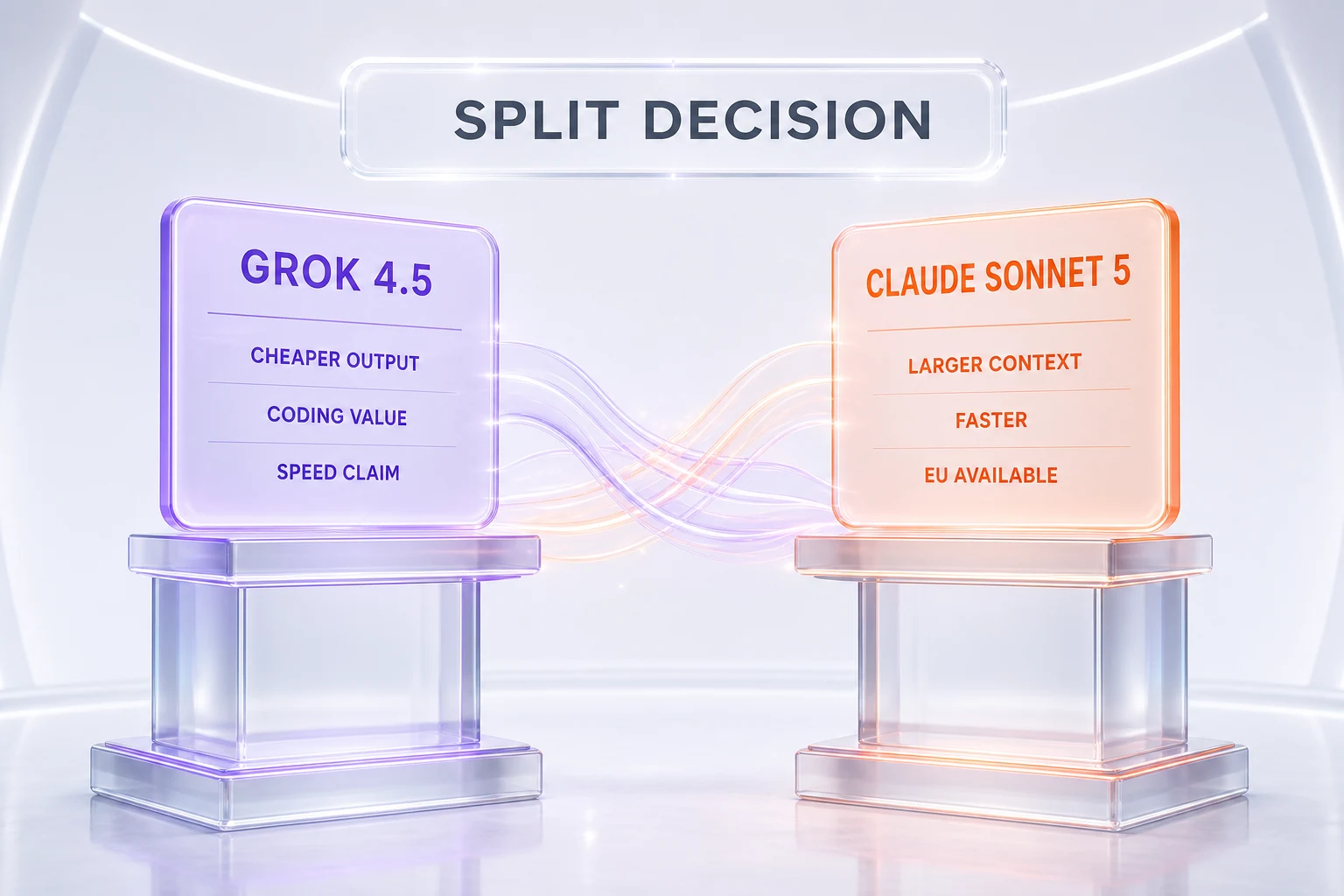
This comparison does not have a winner, and pretending otherwise would misrepresent it. Grok 4.5 and Claude Sonnet 5 are a statistical tie on raw intelligence — 54 against 53 on the Artificial Analysis Intelligence Index — so the decision is entirely about which trade-offs you value. Grok 4.5 is the cheaper model on output at 6 dollars per million tokens, has a measured 2.49 dollars per task on Artificial Analysis's Intelligence Index run, and holds the only charted independent coding score of the pair at 64.44 on the Coding Agent Index v1.3. If your workload is output-heavy, those numbers make Grok 4.5 the value pick.
But Claude Sonnet 5 wins the axes that decide many real deployments. It doubles the context window to 1,000,000 tokens, is the only one of the two with an independently measured throughput at about 79 tokens per second, and is free to evaluate on Claude.ai, where Grok 4.5 is blocked. Weigh the honest caveats on both sides: Grok 4.5 carries a documented hallucination reading around 54 percent and no measured speed number, while Sonnet 5 costs more on output and its newer tokenizer produces roughly 30 percent more tokens for the same text. The two lead on different axes — price and coding value for Grok 4.5, context and reach for Sonnet 5 — so the honest question is which axis your workload lives on. Measure both on your own prompts, and let your actual priorities, not a single headline, make the call.
Last compared: July 2026. Claude Sonnet 5 launched June 30, 2026; Grok 4.5 went public July 9, 2026. Our assessment reflects early hands-on time plus independent benchmarks from Artificial Analysis and each vendor's published specifications; both models are barely two weeks old, so long-run track records are still thin. Independent benchmark figures are from Artificial Analysis; neither model is currently listed on the independent SWE-bench Verified leaderboard, and we do not compare self-reported figures against independent ones. Pricing verified directly from SpaceXAI's and Anthropic's documentation at the time of writing. Grok 4.5 was blocked in the European Union under the EU AI Act until July 17, 2026.
Sources
- SpaceXAI — Grok 4.5 model reference and pricing: docs.x.ai/docs/models/grok-4.5
- Anthropic — Claude API pricing (Sonnet 5 rates, tokenizer note): platform.claude.com and claude.com/pricing
- Artificial Analysis — Intelligence Index, cost per task, AA-Omniscience, and measured throughput: artificialanalysis.ai, and the Coding Agent Index v1.3 (read August 2, 2026): artificialanalysis.ai/agents/coding-agents
- vals.ai — SWE-bench Verified leaderboard (neither model listed at the time of writing): vals.ai
- Anthropic — Claude Sonnet 5 model page and announcements: anthropic.com
Our Verdict
Split decision. Grok 4.5 wins cheaper output (6 dollars per million tokens), a measured 2.49 dollars per task, and the only charted independent coding score (64.4 on the AA Coding Agent Index v1.3, via Grok Build at high effort). Claude Sonnet 5 wins the 1 million-token context window (double Grok 4.5), the only independently measured speed (about 79 tokens per second), and a free Claude.ai path. EU availability no longer separates them: Grok 4.5 has been available to EU users since July 17, 2026. On raw intelligence they tie (54 to 53). Pick Grok 4.5 for output-heavy work; pick Claude Sonnet 5 for context and ecosystem.
Choose Grok 4.5
SpaceXAI's reasoning model — Opus-class speed at $2 and $6 per million tokens, 500K context, available to EU users since July 17, 2026; succeeded by Grok 4.6 on August 12.
Try Grok 4.5 →Choose Claude Sonnet 5
Anthropic's most agentic midsize model — near-Opus 4.8 coding and computer use at $2 per million input tokens.
Try Claude Sonnet 5 →Frequently Asked Questions
Is Grok 4.5 better than Claude Sonnet 5?
Split decision. Grok 4.5 wins cheaper output (6 dollars per million tokens), a measured 2.49 dollars per task, and the only charted independent coding score (64.4 on the AA Coding Agent Index v1.3, via Grok Build at high effort). Claude Sonnet 5 wins the 1 million-token context window (double Grok 4.5), the only independently measured speed (about 79 tokens per second), and a free Claude.ai path. EU availability no longer separates them: Grok 4.5 has been available to EU users since July 17, 2026. On raw intelligence they tie (54 to 53). Pick Grok 4.5 for output-heavy work; pick Claude Sonnet 5 for context and ecosystem.
Which is cheaper, Grok 4.5 or Claude Sonnet 5?
Grok 4.5 starts at $2 in / $6 out per M tokens. Claude Sonnet 5 starts at $2 in / $10 out per M tokens (free plan available). Check the pricing comparison section above for a full breakdown.
What are the main differences between Grok 4.5 and Claude Sonnet 5?
The key differences span across 10 features we compared. For Input price per 1M tokens, Grok 4.5 offers $2.00 under 200K, $4.00 above while Claude Sonnet 5 offers $2.00 flat at any length. For Output price per 1M tokens, Grok 4.5 offers $6.00 under 200K, $12.00 above while Claude Sonnet 5 offers $10.00 flat at any length. For Cached input per 1M tokens, Grok 4.5 offers $0.30 while Claude Sonnet 5 offers $0.20. See the full feature comparison table above for all details.