Claude Opus 5 vs Muse Spark 1.1: Ten Points Apart, Ten Cents Apart (2026)


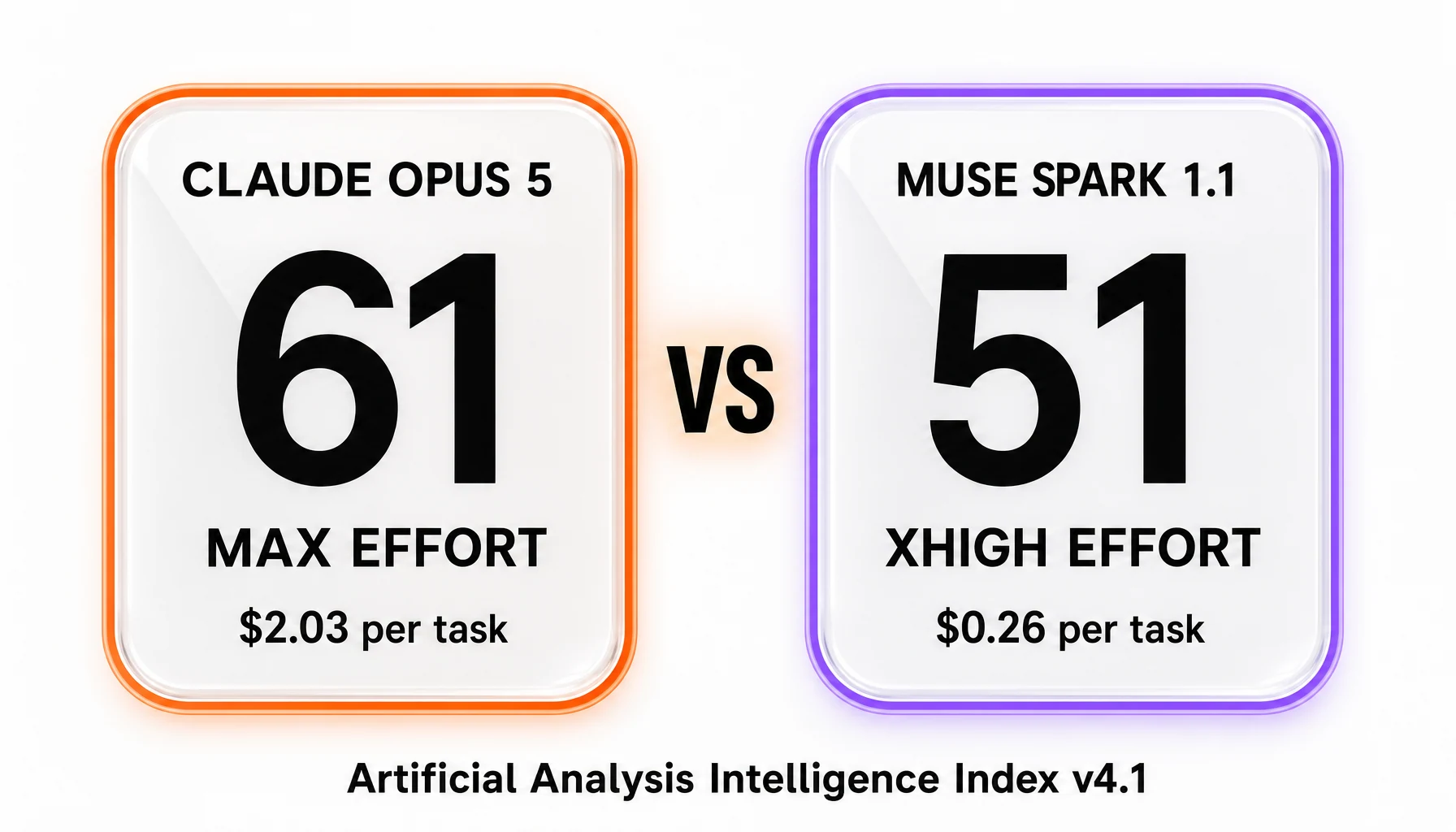
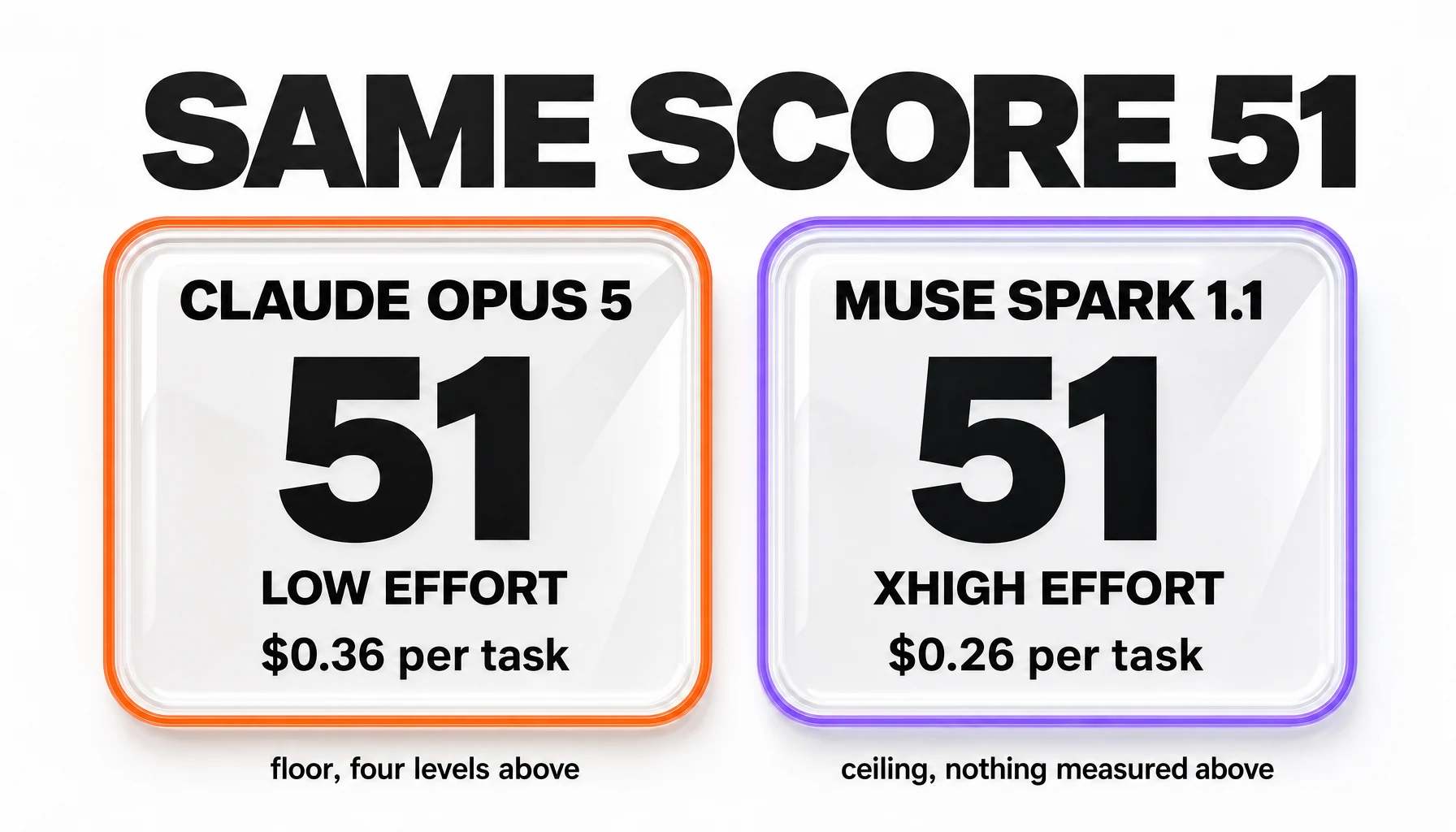
Opus 5 scores 61 at max effort, Muse Spark 1.1 scores 51. But Opus 5 also hits 51 for $0.36 per task, where Meta charges $0.26. Measured July 28, 2026.
Feature Comparison
| Feature | Claude Opus 5 | Muse Spark 1.1 |
|---|---|---|
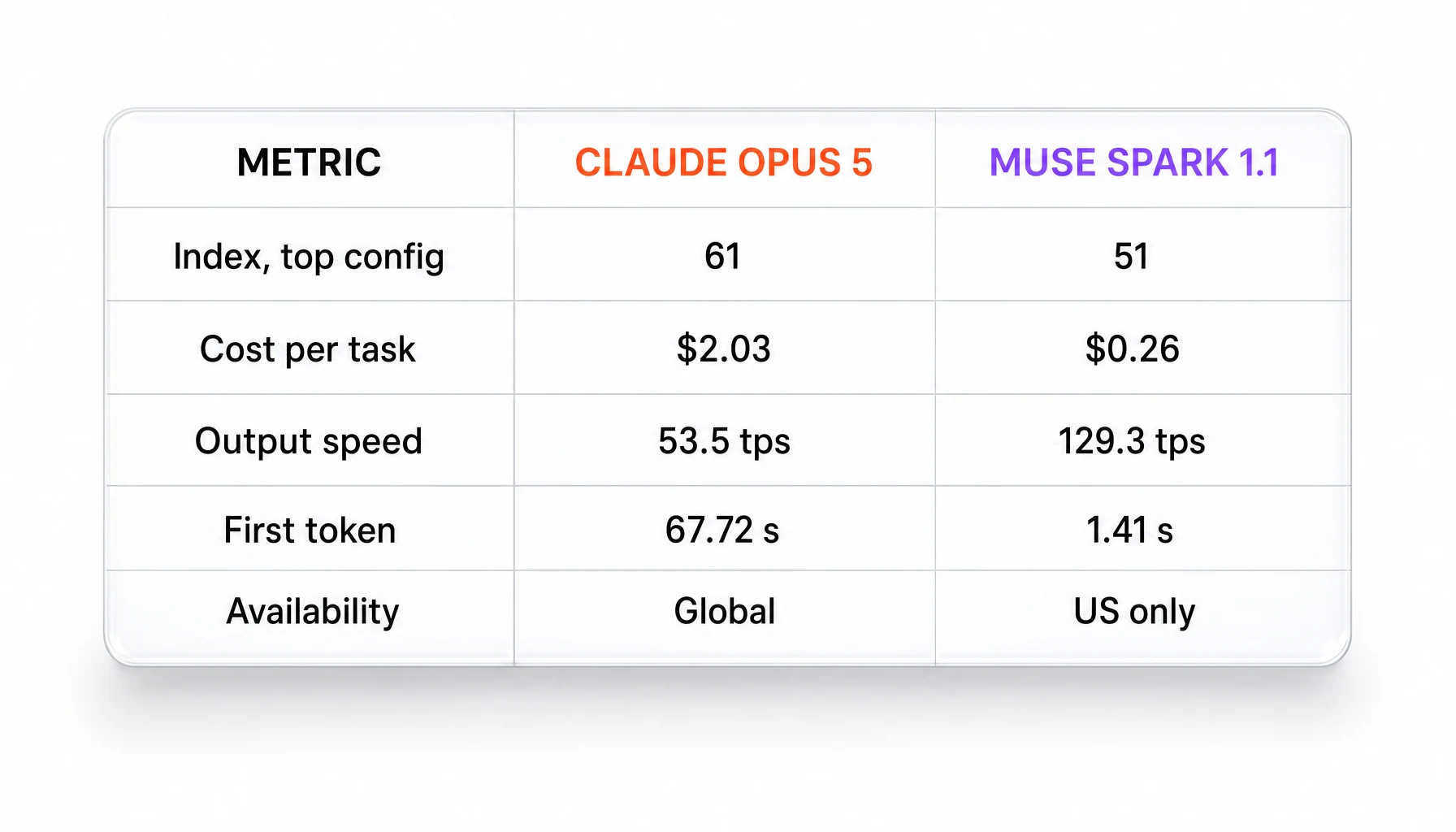
| Artificial Analysis Intelligence Index v4.1, top measured configuration | 61 (max effort) | 51 (xhigh effort) |
| Cost per task at index 51 (measured July 28, 2026) | $0.36 (low effort) | $0.26 (xhigh effort) |
| Measured effort levels published | 5 (low 51 to max 61) | 1 (xhigh only) |
| Input price per million tokens | $5.00 | $1.25 |
| Output price per million tokens | $25.00 | $4.25 |
| Cached input read per million tokens | $0.50 | $0.15 |
| Batch API | 50 percent discount, $2.50 and $12.50 | Not published |
| Output speed, top configuration | 53.5 tokens per second | 129.3 tokens per second |
| Time to first token, top configuration | 67.72 seconds | 1.41 seconds |
| Context window | 1,000,000 tokens | 1,048,576 tokens |
| Maximum output | 128k sync, 300k batch | Not published |
| Knowledge cutoff | May 2026 | Not published |
| Input modalities | Text, image, PDF | Text, image, video, audio, PDF |
| Geographic availability | Global, data-residency options | United States only |
| Availability status | Generally available | Public preview |
| Training on unpaid-tier content | Not addressed in the documentation reviewed | May be used for training with no opt-out; paid-tier content excluded |
| Model weights | Not published | Not published |
| Long-context surcharge | None, full 1M at standard pricing | None published |
Pricing Comparison
Claude Opus 5
Muse Spark 1.1
Detailed Comparison
Claude Opus 5 scores 61 on the Artificial Analysis Intelligence Index v4.1 at max effort, ten points above Muse Spark 1.1 at 51. But the ten points are not the whole story: Opus 5 also scores 51 at its cheapest setting, low effort, for $0.36 per task, while Muse Spark 1.1 reaches the same 51 for $0.26 per task, roughly 28 percent less. Opus 5 costs $5 per million input tokens and $25 per million output tokens; Muse Spark 1.1 costs $1.25 and $4.25. The decisive difference is not price but headroom and access: Opus 5 climbs to 61 while Muse Spark 1.1 has no measured configuration above 51, and Meta's model is a US-only public preview. We researched both from vendor documentation and independent evaluations; all index figures are v4.1 and all cost-per-task figures were read on July 28, 2026.
Which model should you choose?
Pick Claude Opus 5 if your workload needs anything above index 51, if you operate outside the United States, or if you need a published knowledge cutoff, a documented maximum output, and a batch API. Pick Muse Spark 1.1 if you are a US developer running high-volume, latency-sensitive work that never needs to exceed 51, and you can accept public-preview status.
The two models are not competing at the same point on the curve, and that is the single most important fact on this page. Muse Spark 1.1's 51 is posted at xhigh, the top of the reasoning ladder Meta documents. Opus 5's 51 is posted at low, the bottom of its ladder. The same number means opposite things: for Meta it is a ceiling, for Anthropic it is a floor.
That asymmetry sets the terms of the whole comparison. Below 51, neither model has published a measured configuration, so the question does not arise. At 51, Muse Spark 1.1 is cheaper per task and dramatically faster. Above 51, Muse Spark 1.1 has nothing to offer at any price, and Opus 5 has four more rungs to climb.
What does the full effort scale look like for each model?
Artificial Analysis publishes one leaderboard row per reasoning-effort level, not one row per model. Claude Opus 5 appears five times, spanning 51 to 61 and $0.36 to $2.03 per task. Muse Spark 1.1 appears once, at xhigh. Reading only each model's headline entry hides the fact that Opus 5 sells five different price-performance points.
Here is the complete published scale for both models. Cost per task is a rolling measurement, not a fixed property of the model; the figures below were read on July 28, 2026, and Artificial Analysis publishes no on-page "last updated" stamp.
| Model and effort level | Intelligence Index v4.1 | Cost per task USD (measured July 28, 2026) |
|---|---|---|
| Claude Opus 5 (max) | 61 | $2.03 |
| Claude Opus 5 (xhigh) | 60 | $1.56 |
| Claude Opus 5 (high) — API default | 59 | $1.06 |
| Claude Opus 5 (medium) | 56 | $0.62 |
| Claude Opus 5 (low) | 51 | $0.36 |
| Muse Spark 1.1 (xhigh) | 51 | $0.26 |
Three distinctions matter here, and they are easy to collapse into one another.
First, Meta does document a reasoning ladder for Muse Spark 1.1. The reasoning_effort parameter accepts minimal, low, medium, high and xhigh, with xhigh described as maximum reasoning depth. So the lower levels exist. Second, Artificial Analysis has not measured them: only the xhigh configuration carries a published index score and cost per task. Third, one level is explicitly ruled out rather than merely unmeasured — Meta's documentation states that none disables reasoning and is not supported by Muse Spark, returning HTTP 400.
So the honest reading is that Muse Spark 1.1's cheaper rungs exist but are unmeasured, while its non-reasoning rung does not exist at all. We have no independent figure for what Muse Spark 1.1 scores at medium or low, and we are not going to estimate one.
One more caution on defaults. Anthropic documents that effort defaults to high on the Claude API and Claude Code, which puts the out-of-the-box Opus 5 at 59, not 61. Meta publishes no named default for Muse Spark 1.1; its documentation says only that when you omit the parameter, the model reasons at a model-determined level. A like-for-like default versus default comparison therefore cannot be stated precisely, because one of the two defaults is not published.
Is Muse Spark 1.1 strictly dominated by Opus 5?
No. At index 51, Muse Spark 1.1 costs $0.26 per task against $0.36 for Claude Opus 5 at low effort — about 28 percent less for the same measured score. Opus 5's effort dial does not descend far enough to undercut Meta on price at equal intelligence. Muse Spark 1.1 also runs far faster on both measured speed metrics, so it is not dominated on any published axis at that score.
This is worth stating plainly because the opposite conclusion is the intuitive one. A model ten points behind the leader sounds like a model you can dismiss. The measurement does not support that. Opus 5's cheapest measured configuration lands exactly level with Meta's only measured configuration, and costs $0.10 more per task to get there.
What Opus 5 buys for the extra $0.10 is not a better 51. It is the option to go higher later without changing vendors, SDKs, or data-residency posture. That optionality has real value in a system whose requirements are still moving. It has close to zero value in a pipeline whose requirements are fixed and already met at 51.
The reverse framing is equally true and less flattering to Anthropic: if your workload is genuinely satisfied at 51, you are paying a 38 percent per-task premium for headroom you have decided not to use, and accepting much slower responses in the bargain.
What does the index fail to measure?
Speed and latency, and the gap is not close. Artificial Analysis records Muse Spark 1.1 at 129.3 output tokens per second against 53.5 for Claude Opus 5, and time to first token of 1.41 seconds against 67.72 seconds. Both figures compare each model at its top measured configuration — xhigh for Muse Spark, max for Opus 5 — and Artificial Analysis publishes no speed figures for Opus 5 at its lower effort levels.
That caveat is load-bearing. A 67.72-second time to first token is what Opus 5 does when it is thinking as hard as it can. It is not what Opus 5 does at low effort, where it posts the 51 that matches Muse Spark. We simply do not have a published latency figure for Opus 5 at low effort, so the fair statement is top versus top: at their respective maximums, Meta's model starts answering roughly 48 times sooner and sustains about 2.4 times the throughput.
For batch document processing, that difference is an accounting detail. For an interactive agent, a chat surface, or anything with a human waiting, it is the product. A minute of silence before the first token is not a latency figure a consumer product can absorb, whatever the index says.
The index also says nothing about whether you are allowed to use the model, which turns out to be the harder constraint of the two.
Where can each model actually be used?
Claude Opus 5 is generally available through the Claude API, Amazon Bedrock, Claude Platform on AWS, Google Cloud, and Microsoft Foundry. Muse Spark 1.1 is a public preview restricted to the United States: Meta's geographic use policy states that the Services are available only within the United States and that Meta will update the section as eligibility expands to additional jurisdictions.
For a team outside the US, this ends the comparison before any benchmark is consulted. No score at any price is reachable if the API will not serve you.
There is a second access constraint that matters for anyone handling client or proprietary data. Meta's terms distinguish paid from unpaid use: for Paid Services, Meta states it will not use Paid Services content to train Meta models. For unpaid use, Meta may use your content, including inputs and outputs, to train, develop, evaluate and improve its AI models, and the free tier offers no opt-out. Meta dissociates content from the account or API key before training, but may use it for evaluation, security, abuse, quality and policy review without that step.
Anyone prototyping on the free tier with material they do not own should read that clause before pasting anything in. It is not a criticism of Meta's terms, which are clearly published; it is a configuration fact that belongs in the evaluation.
How do the two price structures compare?
Muse Spark 1.1 is cheaper on every published per-token line: $1.25 against $5 per million input tokens, $4.25 against $25 per million output tokens, and $0.15 against $0.50 per million cached input tokens. Claude Opus 5 answers with a 50 percent Batch API discount that Muse Spark 1.1 has no published equivalent for.
| Pricing line | Claude Opus 5 | Muse Spark 1.1 | Advantage |
|---|---|---|---|
| Input, per million tokens | $5.00 | $1.25 | Muse Spark 1.1 |
| Output, per million tokens | $25.00 | $4.25 | Muse Spark 1.1 |
| Cached input read, per million tokens | $0.50 | $0.15 | Muse Spark 1.1 |
| Cache write, 5 minutes, per million tokens | $6.25 | No separate cache write charge published | Muse Spark 1.1 |
| Batch input and output, per million tokens | $2.50 and $12.50 | Not published — no batch API in the documentation | Claude Opus 5 |
| Long-context surcharge | None — full 1M window at standard pricing | None published | Not comparable |
| Web search grounding | $10 per 1,000 searches | $2.50 per 1,000 queries | Muse Spark 1.1 |
| Cost per task at index 51 (measured July 28, 2026) | $0.36 at low effort | $0.26 at xhigh effort | Muse Spark 1.1 |
Two traps are worth defusing on this table. Artificial Analysis also publishes a blended price per million tokens — $3.85 for Opus 5 against $0.78 for Muse Spark 1.1 — which is a weighted average of the token rates, not a cost per task. The $3.85 and the $2.03 are different quantities measuring different things, and swapping one for the other produces nonsense. Separately, Opus 5's model page notes it emitted 100 million output tokens during index evaluation against a 63 million median, described as very verbose; the roughly $3,835 total evaluation cost that follows from this is the bill for running every benchmark, not a per-task figure.
On long context, Anthropic is explicit that Claude 4.6 and later models include the full 1M token context window at standard pricing, noting that a 900k-token request is billed at the same per-token rate as a 9k-token request. Meta publishes no long-context premium for Muse Spark 1.1, but publishes no statement ruling one out either, so we record that as not published rather than as a confirmed absence.
How do the published specifications compare?
Both models carry a roughly one-million-token context window: 1,000,000 for Claude Opus 5 and 1,048,576 for Muse Spark 1.1. From there the specification sheets diverge less on capability than on disclosure — Anthropic publishes a knowledge cutoff and a maximum output; Meta publishes neither for Muse Spark 1.1.
| Specification | Claude Opus 5 | Muse Spark 1.1 |
|---|---|---|
| Vendor | Anthropic | Meta Superintelligence Labs |
| Release date | July 24, 2026 | July 9, 2026 |
| Availability status | Generally available | Public preview, US developers |
| Context window | 1,000,000 tokens | 1,048,576 tokens |
| Maximum output | 128k tokens synchronous, 300k on the Batch API with a beta header | Not published — documented as model-dependent |
| Knowledge cutoff | May 2026 reliable, May 2026 training data | Not published |
| Reasoning effort levels | low, medium, high, xhigh, max — five levels | minimal, low, medium, high, xhigh — five levels; none explicitly unsupported |
| Default effort | high, on the Claude API and Claude Code | Not published — model-determined when omitted |
| Input modalities | Text, image and PDF | Text, image, video, audio and PDF |
| Output modalities | Text | Text |
| Model weights | Not published | Not published |
| Geographic availability | Global, with data-residency options | United States only |
The modality row is the one place where Muse Spark 1.1 offers something Opus 5 does not. Meta documents text, image, video, audio and PDF input against Opus 5's text, image and PDF — Anthropic's Messages API takes PDF documents of up to 600 pages inside a 32 MB request. The gap is video and audio, not documents. Note one inconsistency in Meta's own documentation: a summary table lists the input modalities as text, image, video and PDF, omitting audio, while the detail block on the same page includes audio. We report both readings rather than picking the flattering one.
On weights, both rows say the same thing, and it is deliberate. Anthropic has not published Opus 5 weights and Meta has not published Muse Spark 1.1 weights, but neither has published a statement that weights are withheld. Artificial Analysis labels Muse Spark 1.1 a proprietary model, which is a third-party classification rather than a Meta statement, so we do not present closed weights as a vendor fact. There is no license to read because no license has been published.
That distinction matters more than it looks. Muse Spark 1.1 should not be confused with the earlier Muse Spark, a separate model released April 8, 2026 with a 262k context window that Artificial Analysis lists at index 43 with no published cost per task. Different model, different generation, different numbers. We covered that first release in our report on Meta's superintelligence bet, and Anthropic's July launch in our write-up of the Claude Opus 5 release.
Which model hallucinates less?
We cannot answer this head-to-head, and the honest answer is to say so. Claude Opus 5 appears on the AA-Omniscience evaluation with an Omniscience Index of 31, measured at adaptive reasoning and max effort. We were unable to verify a published AA-Omniscience figure for Muse Spark 1.1: its results table is rendered client-side and the extractable roster shows only a top-performer subset, so its absence from what we could read is not evidence that it was not evaluated.
That is a "we could not verify" rather than a "not measured" or a "does not exist", and the three are different claims. AA-Omniscience is a 12 percent component of the Intelligence Index v4.1, so a model carrying a v4.1 score has presumably been run through it, but we could not confirm how Artificial Analysis handles partial submissions and we are not going to reason from an assumption to a number.
There is a tempting shortcut here that we are declining to take. Anthropic publishes hallucination comparisons between Opus 5 and earlier Claude models. Those figures say nothing whatsoever about Muse Spark 1.1, and chaining them through a third model to reach a verdict about Meta's would be an invented result. If you need a hallucination comparison between these two specifically, the published evidence does not currently support one.
What is actually inside the ten-point gap?
Intelligence Index v4.1 is a weighted average of nine evaluations in four categories: Agents at 34 percent, Coding at 24 percent, Scientific Reasoning at 24 percent, and General at 18 percent. A ten-point spread on this composite is a blend of nine underlying results, not a single capability the way a coding benchmark would be.
The components are GDPval-AA v2 and 𝜏³-Banking for agents; Terminal-Bench v2.1 and SciCode for coding; Humanity's Last Exam, GPQA Diamond and CritPt for scientific reasoning; and AA-Omniscience and AA-LCR for general. Neither model publishes an extractable per-component breakdown on its Artificial Analysis page, and the direct comparison page shows no data for the AA-Omniscience components for either model.
The practical consequence is that we can tell you the gap is ten points on a composite, but not which of the nine evaluations produced it. Anyone whose workload maps cleanly onto one category — a pure coding pipeline, say — should treat the composite as a weak proxy and test on their own task. That advice holds regardless of which model the composite favors.
Who wins each category?
Claude Opus 5 wins on capability ceiling, availability, and disclosure. Muse Spark 1.1 wins on price, speed, latency, and input modalities. Nothing here is a narrow call: each model wins its categories by a wide margin, which is what makes the overall choice depend almost entirely on which categories you are buying for.
| Category | Winner | Evidence |
|---|---|---|
| Peak intelligence | Claude Opus 5 | 61 at max effort against 51; no Muse Spark configuration above 51 is measured |
| Cost per task at index 51 | Muse Spark 1.1 | $0.26 against $0.36 at Opus 5 low effort |
| Per-token pricing | Muse Spark 1.1 | $1.25 and $4.25 against $5 and $25 per million tokens |
| Throughput | Muse Spark 1.1 | 129.3 against 53.5 output tokens per second, top configuration each |
| Time to first token | Muse Spark 1.1 | 1.41 seconds against 67.72 seconds, top configuration each |
| Input modalities | Muse Spark 1.1 | Adds video and audio, which Opus 5 does not accept |
| Geographic availability | Claude Opus 5 | Global with data-residency options against United States only |
| Production readiness | Claude Opus 5 | Generally available against public preview |
| Batch processing | Claude Opus 5 | 50 percent batch discount and 300k batch output against no published batch API |
| Specification disclosure | Claude Opus 5 | Published cutoff, max output and default effort against three unpublished values |
| Free-tier data handling | Not scored | Meta publishes that unpaid-tier content may be used for training with no opt-out; we did not source an equivalent statement for the Claude API, so we do not score this |
| Measured effort granularity | Claude Opus 5 | Five measured price-performance points against one |
What are the strengths and weaknesses of each?
Claude Opus 5 is the more complete product and the more expensive one. Muse Spark 1.1 is the faster and cheaper one with a narrower operating envelope. Neither is a compromise version of the other.
Claude Opus 5
Strengths. Highest measured configuration of the two at 61 on Intelligence Index v4.1. Five measured effort levels spanning 51 to 61, letting one integration serve several price-performance points. Generally available across five platforms with data-residency options. Published May 2026 knowledge cutoff, the most recent among current Claude models. Full 1M context window at standard pricing with no long-context surcharge. 128k synchronous output, 300k on the Batch API. 50 percent batch discount.
Weaknesses. Four times the input price and nearly six times the output price of Muse Spark 1.1. Slower of the two on both measured speed metrics by a wide margin. Text, image and PDF input only — no video and no audio. Its cheapest measured configuration is beaten on price by Meta's only measured configuration. Described on its own evaluation page as very verbose, having emitted 100 million output tokens against a 63 million median, which is a cost consideration on output-heavy work.
Muse Spark 1.1
Strengths. Cheaper of the two at every published per-token line and at equal index score. About 48 times faster to first token and 2.4 times the throughput at top configurations. Broader input modality set, adding video and audio to the text, image and PDF that Opus 5 also accepts. Slightly larger context window at 1,048,576 tokens. Cheaper web search grounding at $2.50 per 1,000 queries. Paid Services content is not used to train Meta models.
Weaknesses. No measured configuration above index 51, so the ceiling is ten points below Opus 5's. Public preview rather than generally available. United States only. No published knowledge cutoff, maximum output, or default effort level. No batch API in the documentation. Unpaid-tier content may be used for training with no opt-out. Only one of its five documented effort levels has been independently measured.
When should you pick each one?
Pick Muse Spark 1.1 for US-based, high-volume, latency-sensitive work with a fixed quality bar at or below index 51 — chat surfaces, real-time assistants, classification and extraction at scale, and multimodal ingestion involving video or audio. Pick Claude Opus 5 when quality is the binding constraint, when you operate outside the US, or when you need production guarantees.
When to pick Muse Spark 1.1
Your users are in the United States and so is your deployment. You are running enough volume that a four-times input-price difference shows up on the invoice. Someone is waiting for the response, which makes a 1.41-second time to first token worth more than ten index points. Your inputs include video or audio, which Opus 5 does not accept. You have validated on your own task that quality at 51 is sufficient, and your requirements are stable enough that you do not expect to need more. You are on a paid tier, so your content is not used for training.
When to pick Claude Opus 5
Your workload has a quality bar above 51, or you do not yet know where the bar is. You operate outside the United States, which settles it immediately. You need a published knowledge cutoff to reason about what the model does and does not know — May 2026 is the most recent among current Claude models. You are running asynchronous bulk work where a 50 percent batch discount outweighs the per-token gap, or you need outputs longer than what Meta documents, which is to say longer than an unpublished number. You need generally available status rather than a public preview for a production commitment. You want the option to raise effort from low to max later without re-integrating.
When the comparison does not apply
If you need model weights, neither model serves you: neither Anthropic nor Meta has published weights for these models, and neither has published a license for them. If you need a documented hallucination comparison between these two specifically, the published evidence does not support one today. And if your requirement is a specific capability rather than a composite score, test both on your own task — a ten-point spread on a nine-evaluation blend does not tell you which of the nine moved.
If the budget matters more than the ceiling, the more useful comparisons are one tier down. We have measured Muse Spark 1.1 against Claude Sonnet 5, against GLM-5.2, and against Gemini 3.5 Flash — all closer matches on price than Opus 5 is. Within Anthropic's own range, Claude Sonnet 5 sits well below Opus 5 on price, and Claude Fable 5 above it on both capability and cost.
Final verdict
Claude Opus 5 wins overall, but not for the reason the headline numbers suggest. It does not win because 61 beats 51. It wins because it also does 51, for $0.10 more per task, while retaining four higher rungs that Muse Spark 1.1 cannot reach at any price — and because it can be used outside the United States, which Muse Spark 1.1 currently cannot.
That verdict comes with a genuine concession. On the axis Meta chose to compete on, Meta wins cleanly. At equal measured intelligence, Muse Spark 1.1 is 28 percent cheaper per task, starts responding roughly 48 times sooner, and sustains more than twice the throughput. Anyone who tells you a model ten points down the index is not worth considering has not looked at the cost-per-task column or the latency column.
The deciding factor is therefore not quality or price but the shape of your constraint. A fixed, validated, US-based workload at 51 should run on Muse Spark 1.1 and would be overpaying on Opus 5. A workload that might need more than 51, or that serves users outside the United States, has exactly one option of the two — and it is not close, because no amount of budget moves Muse Spark 1.1 above its measured ceiling or outside its licensed territory.
One closing caveat on freshness. Index scores are stable within a version, so the 61 and the 51 will hold for v4.1. Cost per task, throughput and latency are rolling measurements that move with provider capacity and pricing; every such figure on this page was read on July 28, 2026, and Muse Spark 1.1 is a public preview whose specifications may change without the courtesy of a version bump.
Frequently asked questions
Is Claude Opus 5 better than Muse Spark 1.1?
On peak measured intelligence, yes: Claude Opus 5 scores 61 on Artificial Analysis Intelligence Index v4.1 at max effort against 51 for Muse Spark 1.1 at xhigh effort. But Opus 5 also scores 51 at low effort for $0.36 per task, while Muse Spark 1.1 reaches 51 for $0.26, so Meta's model is cheaper at equal measured intelligence and is not dominated.
How much does each model cost per million tokens?
Claude Opus 5 costs $5 per million input tokens and $25 per million output tokens, with cached input reads at $0.50 and a 50 percent Batch API discount bringing batch rates to $2.50 and $12.50. Muse Spark 1.1 costs $1.25 per million input tokens and $4.25 per million output tokens, with cached input at $0.15 per million.
What is the difference between cost per task and blended price per million tokens?
Cost per task is what Artificial Analysis actually spent running a model through the Intelligence Index, so it captures verbosity and reasoning length. Blended price per million tokens is a weighted average of the published input and output rates. For Claude Opus 5 these are $2.03 at max effort and $3.85 respectively — different quantities that are not interchangeable.
Which reasoning effort levels does each model support?
Claude Opus 5 supports low, medium, high, xhigh and max, and defaults to high on the Claude API and Claude Code. Muse Spark 1.1 documents minimal, low, medium, high and xhigh through the reasoning_effort parameter. Meta states that none, which disables reasoning, is not supported by Muse Spark and returns HTTP 400.
Why does Muse Spark 1.1 have only one score on the leaderboard?
Artificial Analysis publishes one row per measured configuration, and it has measured Muse Spark 1.1 only at xhigh effort. The lower levels exist in Meta's documentation but carry no published index score or cost per task. This is a gap in measurement, not a gap in the model's capabilities.
Can I use Muse Spark 1.1 outside the United States?
No. Meta's geographic use policy states that the Services are available only within the United States, and that Meta will update the section as eligibility expands to additional jurisdictions. Claude Opus 5 is generally available through the Claude API, Amazon Bedrock, Claude Platform on AWS, Google Cloud and Microsoft Foundry.
Does Meta train on data sent to Muse Spark 1.1?
It depends on the tier. Meta states it will not use Paid Services content to train Meta models. For unpaid use, Meta may use your content, including inputs and outputs, to train, develop, evaluate and improve its models, and the free tier offers no opt-out. Meta dissociates content from the account before training but may review it for security and policy purposes first.
What are the context windows and maximum output lengths?
Claude Opus 5 has a 1,000,000-token context window with 128k maximum output synchronously and 300k on the Batch API using a beta header. Muse Spark 1.1 has a 1,048,576-token context window. Meta does not publish a maximum output figure, documenting it only as model-dependent, with requests above the configured maximum returning HTTP 400.
Which model hallucinates less?
There is no published head-to-head answer. Claude Opus 5 appears on AA-Omniscience with an Omniscience Index of 31 at adaptive reasoning and max effort. We could not verify a published AA-Omniscience figure for Muse Spark 1.1, and its absence from the extractable results is not proof it was not evaluated. Anthropic's own hallucination comparisons are against earlier Claude models and say nothing about Meta's.
Are the weights for either model available to download?
Neither Anthropic nor Meta has published weights for these models, and neither has published a license for them. Artificial Analysis labels Muse Spark 1.1 a proprietary model, but that is a third-party classification rather than a vendor statement. There is no open-weight or open-source release to evaluate for either model.
Is Muse Spark 1.1 the same as Muse Spark?
No. Muse Spark 1.1 was released July 9, 2026 with a 1,048,576-token context window and paid API pricing. The earlier Muse Spark is a separate model released April 8, 2026 with a 262k context window, which Artificial Analysis lists at Intelligence Index 43 with no published cost per task. They are different generations with different numbers.
Which model is faster?
Muse Spark 1.1, by a wide margin. Artificial Analysis records 129.3 output tokens per second against 53.5 for Claude Opus 5, and time to first token of 1.41 seconds against 67.72 seconds. Both figures compare each model at its top measured configuration, and no speed figures are published for Opus 5 at its lower effort levels.
Sources and references
Every figure on this page comes from a vendor's own documentation or from an independent evaluator. Vendor claims and independent measurements are labeled separately throughout, and are never stacked into a single ranking.
- Anthropic — Introducing Claude Opus 5 (vendor: release date, effort setting)
- Anthropic — Models overview (vendor: context window, max output, knowledge cutoff, default effort)
- Anthropic — Pricing (vendor: token rates, caching, batch, long-context pricing)
- Anthropic — Effort (vendor: effort levels)
- Anthropic — Batch processing (vendor: 300k extended output beta)
- Meta — Introducing Muse Spark 1.1 (vendor: release date, public preview, modalities)
- Meta — Muse Spark model page (vendor: public preview for US developers)
- Meta Model API — Pricing and rate limits (vendor: token rates, cached input, web search grounding)
- Meta Model API — Reasoning (vendor: effort levels, unsupported none level)
- Meta Model API — Models (vendor: context window, modalities)
- Meta Model API — Geographic use policy (vendor: United States only)
- Meta Model API — Terms of service (vendor: training on unpaid-tier content, retention)
- Artificial Analysis — Model leaderboard (independent: index scores and cost per task by effort level)
- Artificial Analysis — Claude Opus 5 (independent: speed, latency, blended price)
- Artificial Analysis — Muse Spark 1.1 (independent: speed, latency, blended price)
- Artificial Analysis — Muse Spark (independent: the earlier April 2026 model, for disambiguation)
- Artificial Analysis — Intelligence Index methodology (independent: v4.1 composition and weights)
- Artificial Analysis — AA-Omniscience (independent: Omniscience Index)
- AA-Omniscience: benchmark paper (independent: evaluation design)
Last compared: July 28, 2026. Index scores are Artificial Analysis Intelligence Index v4.1 and are stable within that version. Cost per task, throughput and latency are rolling measurements read on July 28, 2026, not fixed properties of either model.
Our Verdict
Claude Opus 5 wins overall, but not because 61 beats 51. It wins because it also reaches 51 — at low effort, for $0.36 per task against Muse Spark 1.1's $0.26 — while keeping four higher rungs that Meta's model cannot reach at any price, and because it can be used outside the United States, which Muse Spark 1.1 currently cannot. The concession is real: at equal measured intelligence Muse Spark 1.1 is about 28 percent cheaper per task, starts responding roughly 48 times sooner and sustains about 2.4 times the throughput. A fixed, validated, US-based workload at index 51 should run on Muse Spark 1.1 and would be overpaying on Opus 5. A workload that might need more than 51, or that serves users outside the US, has exactly one option of the two.
Choose Claude Opus 5
Anthropic's frontier reasoning model — top of the independent index at half the price of Fable 5.
Try Claude Opus 5 →Choose Muse Spark 1.1
Meta Superintelligence Labs' closed agentic model: Artificial Analysis Intelligence Index 51 and a 1,000,000-token context, at $1.25 input and $4.25 output per million tokens — about a quarter of frontier input rates.
Try Muse Spark 1.1 →Frequently Asked Questions
Is Claude Opus 5 better than Muse Spark 1.1?
Claude Opus 5 wins overall, but not because 61 beats 51. It wins because it also reaches 51 — at low effort, for $0.36 per task against Muse Spark 1.1's $0.26 — while keeping four higher rungs that Meta's model cannot reach at any price, and because it can be used outside the United States, which Muse Spark 1.1 currently cannot. The concession is real: at equal measured intelligence Muse Spark 1.1 is about 28 percent cheaper per task, starts responding roughly 48 times sooner and sustains about 2.4 times the throughput. A fixed, validated, US-based workload at index 51 should run on Muse Spark 1.1 and would be overpaying on Opus 5. A workload that might need more than 51, or that serves users outside the US, has exactly one option of the two.
Which is cheaper, Claude Opus 5 or Muse Spark 1.1?
Claude Opus 5 starts at $5 in / $25 out per M tokens. Muse Spark 1.1 starts at $1.25 in / $4.25 out per M tokens. Check the pricing comparison section above for a full breakdown.
What are the main differences between Claude Opus 5 and Muse Spark 1.1?
The key differences span across 18 features we compared. For Artificial Analysis Intelligence Index v4.1, top measured configuration, Claude Opus 5 offers 61 (max effort) while Muse Spark 1.1 offers 51 (xhigh effort). For Cost per task at index 51 (measured July 28, 2026), Claude Opus 5 offers $0.36 (low effort) while Muse Spark 1.1 offers $0.26 (xhigh effort). For Measured effort levels published, Claude Opus 5 offers 5 (low 51 to max 61) while Muse Spark 1.1 offers 1 (xhigh only). See the full feature comparison table above for all details.