GPT-5.6 Sol vs Claude Fable 5: OpenAI's Flagship vs Anthropic's Frontier Tier (2026)


GPT-5.6 Sol: 60% cheaper on both sides and stronger task economics. Claude Fable 5: the higher independent capability scores. Our split 2026 verdict.
Feature Comparison
| Feature | GPT-5.6 Sol | Claude Fable 5 |
|---|---|---|
| API input price (per million tokens) | $4.00 promotional, up to 272K input (verified) | $10.00 (verified) |
| API output price (per million tokens) | $20.00 promotional, up to 272K input (verified) | $50.00 (verified) |
| Cost per task, AA Intelligence Index (independent, measured August 2, 2026) | $1.86 (Artificial Analysis, max effort) | $3.15 (Artificial Analysis, with fallback) |
| AA Intelligence Index v4.1 (independent, read mid-July 2026; Claude Opus 5 has led since July 24, 2026) | 59 (No.2) | 60 (No.1) |
| LMArena Elo (independent, human preference, read mid-July 2026; Claude Opus 5 now leads) | 1486 (No.8, Xhigh) | 1509 (No.1) |
| SWE-bench Verified (vals.ai, independent) | Not submitted | 95% (No.1) |
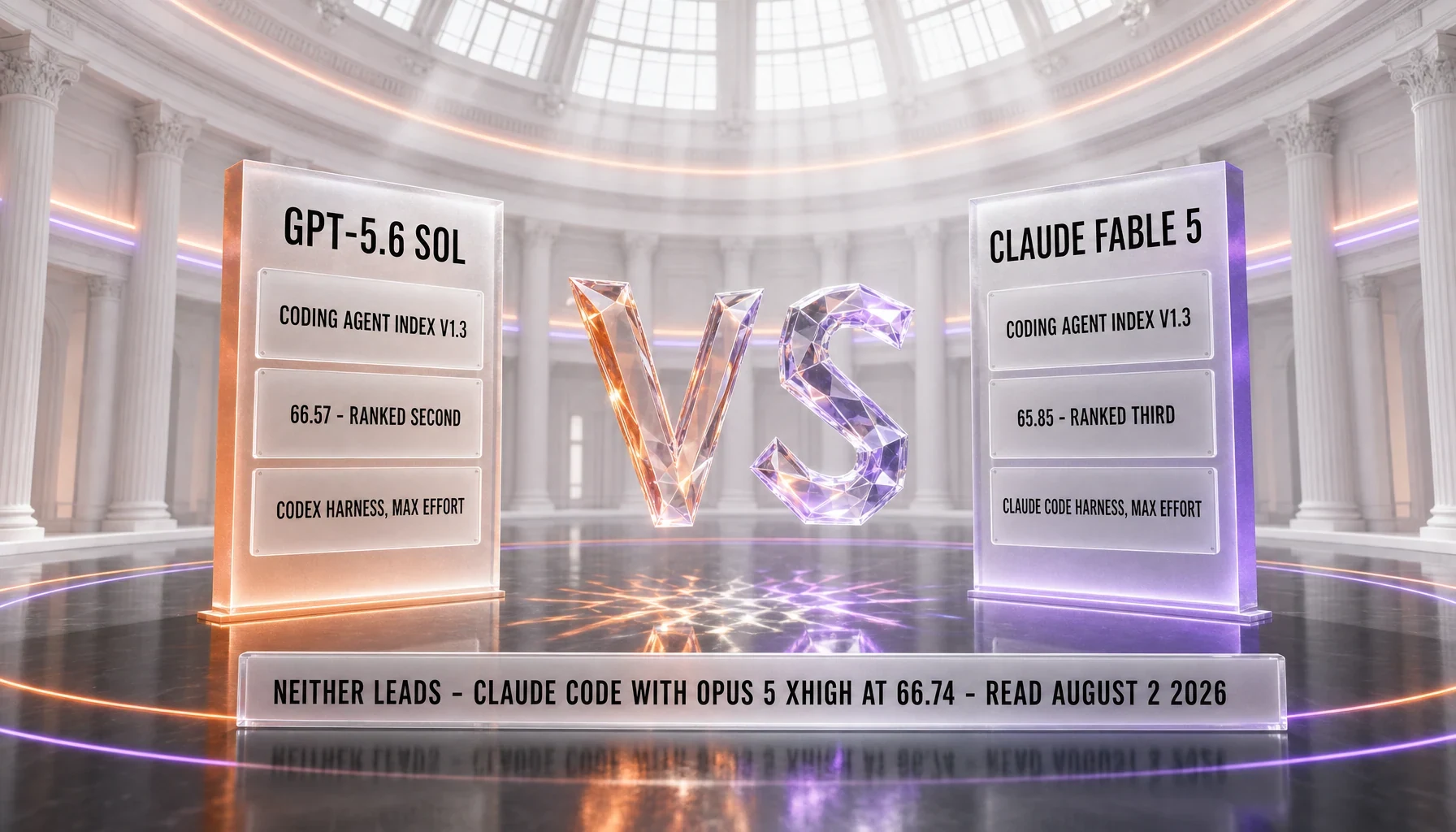
| AA Coding Agent Index v1.3 (independent, read August 2, 2026) | 66.57 — ranked 2nd (Codex harness, max effort) | 65.85 — ranked 3rd (Claude Code harness, max effort) |
| AA-Briefcase agentic tasks (independent) | 42% (1592) | 56% (1764) |
| SWE-bench Pro (self-reported, different suite) | 64.6% (OpenAI reports; disputes benchmark) | ~80.3% (vendor-reported, not independently reproduced) |
| Declared context window | 1,050,000 tokens | 1,000,000 tokens |
| Max output tokens | 128,000 | 128,000 |
| Reasoning control | Low to xhigh, plus new max and ultra multi-agent modes | Adaptive thinking always on — no off switch |
| Multi-agent reasoning mode | Ultra: up to 16 parallel agents (4 by default) | Not offered as a mode |
| Refusal and fallback handling | Standard API refusals | stop_reason refusal as HTTP 200, auto-fallback to Opus 4.8, refusals not billed |
| Data retention | Standard OpenAI API controls; ZDR-compatible Programmatic Tool Calling | Mandatory 30-day retention (Covered Model), no zero-data-retention option |
| Tokenizer efficiency | Standard tokenization | ~30% more tokens for the same text (Anthropic docs) |
| Prompt caching discount | 90% on cached input ($0.40 per million) | 90% on cached input ($1 per million) |
Pricing Comparison
GPT-5.6 Sol
Claude Fable 5
Detailed Comparison
GPT-5.6 Sol and Claude Fable 5 are the two frontier models compared here. GPT-5.6 Sol is OpenAI's flagship capability tier, generally available July 9, 2026, priced at $4 per million input tokens and $20 per million output tokens on requests up to 272,000 input tokens — promotional rates detailed below — with a 1,050,000-token context window. Claude Fable 5 is Anthropic's most capable widely released model, generally available June 9, 2026, priced at $10 per million input tokens and $50 per million output tokens with a 1,000,000-token context window. On the independent leaderboards at this review's mid-July 2026 reading, Artificial Analysis ranked Claude Fable 5 No.1 on its Intelligence Index at 60 to Sol's 59, LMArena put Fable 5 No.1 at 1509 Elo to Sol's 1486, and vals.ai lists Fable 5 at 95 percent on SWE-bench Verified, which Sol has not been submitted to. Claude Opus 5, charted July 24, 2026, has since taken the top of both boards: as of August 4, 2026 the Intelligence Index reads Opus 5 at 60.7, Fable 5 at 59.9, and Sol at 58.9. GPT-5.6 Sol answers on economics and agentic throughput: 40 percent of Fable 5's sticker price on both input and output, about 40 percent less per task on Artificial Analysis's Intelligence Index runs ($1.86 versus $3.15, measured August 2, 2026), and ranked second on the AA Coding Agent Index v1.3 at 66.57 — ahead of Fable 5 at 65.85, behind Claude Code running Opus 5 at 66.74. Best for peak measured intelligence and verified coding: Claude Fable 5. Best for price, cost per task, and agentic throughput: GPT-5.6 Sol.
Quick Verdict
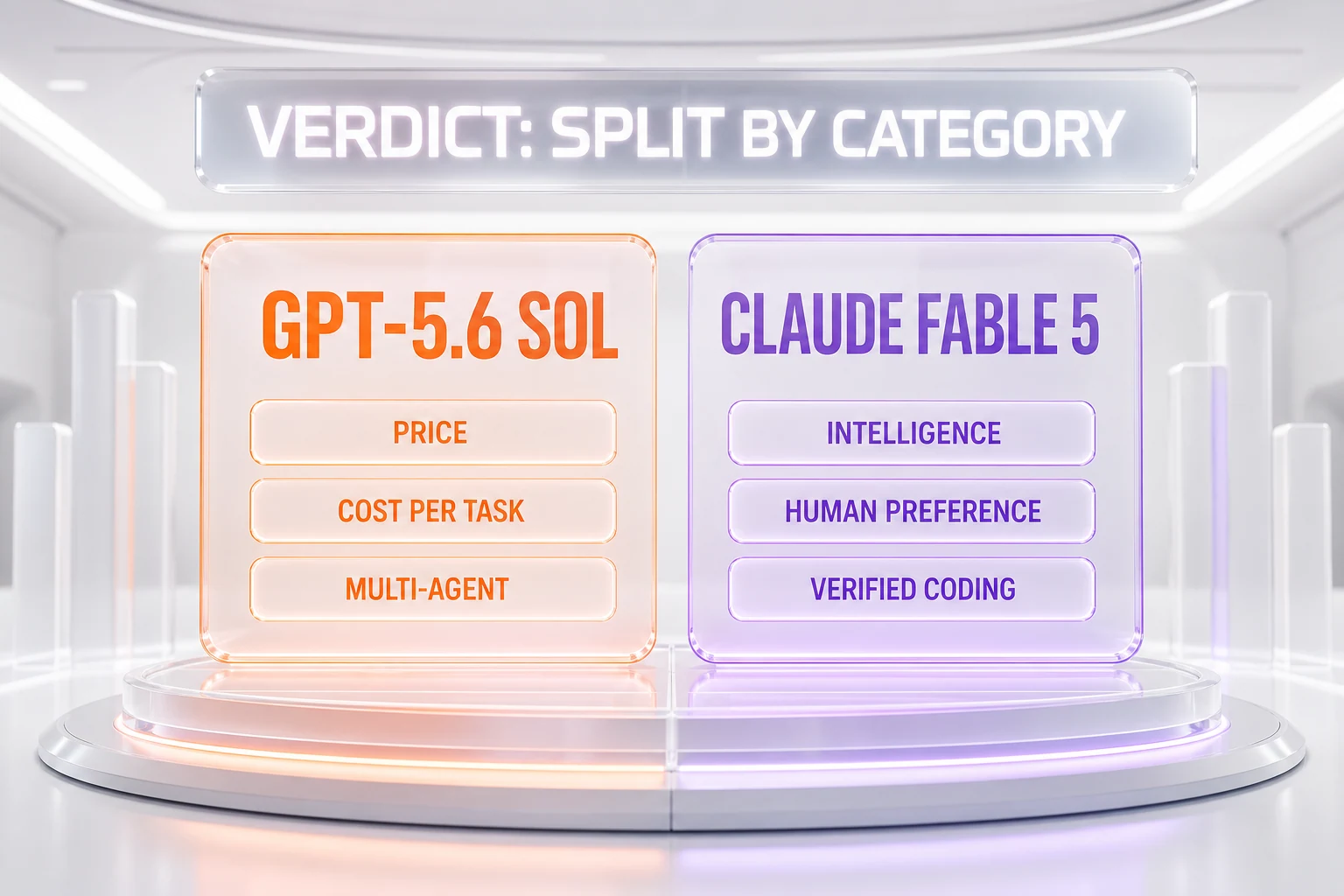
This is a split verdict: Claude Fable 5 leads most of the independent capability leaderboards in this matchup, GPT-5.6 Sol owns the economics — and neither gap is small enough to ignore. Sol went generally available on July 9, 2026, two days before this comparison; Fable 5 has been generally available since June 9 and in our production stack ever since. We have API access to both and have run both side-by-side, so we scope Sol's hands-on claims to roughly 48 hours and lean on attributed third-party benchmarks — Artificial Analysis, LMArena, and vals.ai — wherever our own time is too short. Every figure below carries its source, and self-reported vendor numbers are labeled as such. Here is the short version.
- Best for peak measured intelligence: Claude Fable 5. Artificial Analysis ranked it No.1 on the Intelligence Index at 60 at the mid-July 2026 reading, one point above GPT-5.6 Sol's 59 — a lead over Sol it keeps as of August 4, 2026 (59.9 to 58.9), now behind Claude Opus 5's 60.7.
- Best for human preference: Claude Fable 5. It held the No.1 LMArena Elo at 1509 at the mid-July 2026 reading; GPT-5.6 Sol's Xhigh configuration sat at No.8 with 1486, behind several models in between. Claude Opus 5 has since taken the LMArena lead, but the Fable-over-Sol gap in blind head-to-head voting is real.
- Best for independently verified coding: Claude Fable 5, where measured. On the vals.ai-run SWE-bench Verified suite it posts 95 percent, the top score. GPT-5.6 Sol has not been submitted, so there is no independent Verified number for it — a data gap we flag rather than paper over.
- Best for price: GPT-5.6 Sol, decisively. At $4 per million input and $20 per million output tokens — promotional rates OpenAI cut on August 21, 2026 — it undercuts Fable 5's $10 input and $50 output by 60 percent on both sides. Both rate cards are vendor-verified.
- Best for cost per task: GPT-5.6 Sol. Artificial Analysis measures the cost to run its Intelligence Index at $1.86 per task for Sol at max effort versus $3.15 for Fable 5 in its fallback configuration — about 40 percent less, measured August 2, 2026.
- Best on the agentic coding index: GPT-5.6 Sol. Artificial Analysis ranks it second on the Coding Agent Index v1.3 at 66.57, ahead of Fable 5 at 65.85 and at a lower cost per task ($7.08 against $11.71) — though Claude Code running Opus 5 leads the index at 66.74, so Sol places rather than wins.
- Best for multi-agent workloads: GPT-5.6 Sol. Its new ultra mode spawns up to sixteen reasoning agents in parallel; Fable 5 has no equivalent mode.
- Best for production failure handling: Claude Fable 5. Refusals return as a clean HTTP 200 with an auto-fallback to Claude Opus 4.8 and no charge for the refused attempt — the most production-minded safety design either vendor ships.
The honest caveats up front: Sol has been public for two days, so we treat our hands-on notes as first impressions, not a settled verdict. Fable 5's own headline numbers — an approximately 80.3 percent SWE-bench Pro figure and a GDPval-AA score near 1932 — are vendor-reported and not independently reproduced, and we label them so. Sol's SWE-bench Pro figure of 64.6 percent is self-reported by OpenAI, which also disputes that benchmark's validity. We only declare a winner where both models were measured on the same independent benchmark, and we keep self-reported and third-party numbers strictly apart.
GPT-5.6 Sol vs Claude Fable 5 — Overview
What Is GPT-5.6 Sol?
GPT-5.6 Sol is the flagship capability tier of OpenAI's GPT-5.6 generation, generally available July 9, 2026 after a gated preview on June 26. In OpenAI's new naming scheme the number is the generation and the names — Sol, Terra, and Luna — are durable capability tiers rather than sizes; Sol is the tier aimed at the hardest problems, from complex coding and long-horizon agents to cyber, science, and computer use, per OpenAI's announcement. Its predecessor GPT-5.5 remains active and cheaper for routine work — see our GPT-5.5 review for that tier. Per OpenAI's model documentation, Sol runs a 1,050,000-token context window with up to 128,000 output tokens and a February 16, 2026 knowledge cutoff, handles text and image inputs to text output, and introduces two new reasoning levels above xhigh: max, and ultra, a multi-agent mode that runs up to sixteen reasoning agents in parallel. It also adds Programmatic Tool Calling, where the model writes and executes JavaScript in an isolated, ephemeral runtime to orchestrate its own tools. API pricing is $4 per million input tokens and $20 per million output tokens on requests up to 272,000 input tokens, with cached input at $0.40 per million; above that threshold a long-context rate of $8 and $30 applies to the whole request rather than to the excess. These are promotional rates, detailed in the pricing section below.
What Is Claude Fable 5?
Claude Fable 5 is Anthropic's most capable widely released model, generally available since June 9, 2026, and the first public model of Anthropic's Mythos capability class — the tier that previously lived behind the invitation-only Project Glasswing program. We review it in depth in our Claude Fable 5 review (our score: 9.6 out of 10). It sits above Claude Opus 4.8 in Anthropic's lineup; Fable 5 is the public, safety-classified version, while Mythos 5 stays reserved for vetted professionals. API pricing is $10 per million input tokens and $50 per million output tokens — which we confirmed directly on Anthropic's official pricing documentation — double Claude Opus 4.8 on both sides. Per Anthropic's product page and its API docs, it runs a 1,000,000-token context window with up to 128,000 output tokens, adaptive thinking that is always on and cannot be disabled, and a production-grade refusal design: declined requests return stop_reason refusal as a clean HTTP 200, an optional fallbacks parameter auto-retries on Claude Opus 4.8, and you are not billed for requests refused before output. It is also a Covered Model, carrying a mandatory 30-day retention window with no zero-data-retention option.
How We Compared Them — and What We Did Not Do
Method transparency matters more than usual here, because Sol is two days old at the time of writing and the benchmark discourse around this matchup mixes self-reported and independent numbers freely. Here is exactly what we did and did not do.
- Pricing: both rate cards are vendor-verified. Sol's $4 input and $20 output per million tokens, promotional and applying up to 272,000 input tokens, is confirmed against OpenAI's API pricing page, re-verified on August 28, 2026; Fable 5's $10 input and $50 output per million is confirmed against Anthropic's official pricing docs. No relayed figures.
- Independent benchmarks: we lean on Artificial Analysis (Intelligence Index, Coding Agent Index, cost per task), LMArena (Elo), and vals.ai (SWE-bench Verified). We only declare a benchmark winner where both models were measured on the same suite. Where one model is absent — as Sol is on SWE-bench Verified — we say so and do not substitute a self-reported number.
- Self-reported figures: OpenAI's Terminal-Bench 2.1, DeepSWE, and SWE-bench Pro numbers for Sol, and Anthropic's SWE-bench Pro and GDPval-AA numbers for Fable 5, are labeled as vendor-reported and not treated as head-to-head evidence. OpenAI itself disputes the SWE-bench Pro benchmark's validity, which is another reason we keep it separate. Our SWE-bench Pro versus Verified explainer walks through why these scores are not interchangeable.
- Hands-on: we have run Fable 5 on live client work since its June 9 GA and Sol for roughly 48 hours since its July 9 GA, side-by-side on the same tasks. That is enough for first impressions on Sol, not a controlled benchmark, and we scope every observation accordingly.
- Disclosure: we have no affiliate relationship with OpenAI or Anthropic. There are no sponsored links on this page. Our team uses Claude Fable 5 in production, which is exactly why we have held this comparison to independent, attributed numbers rather than our own preference.
Features and Benchmarks Comparison
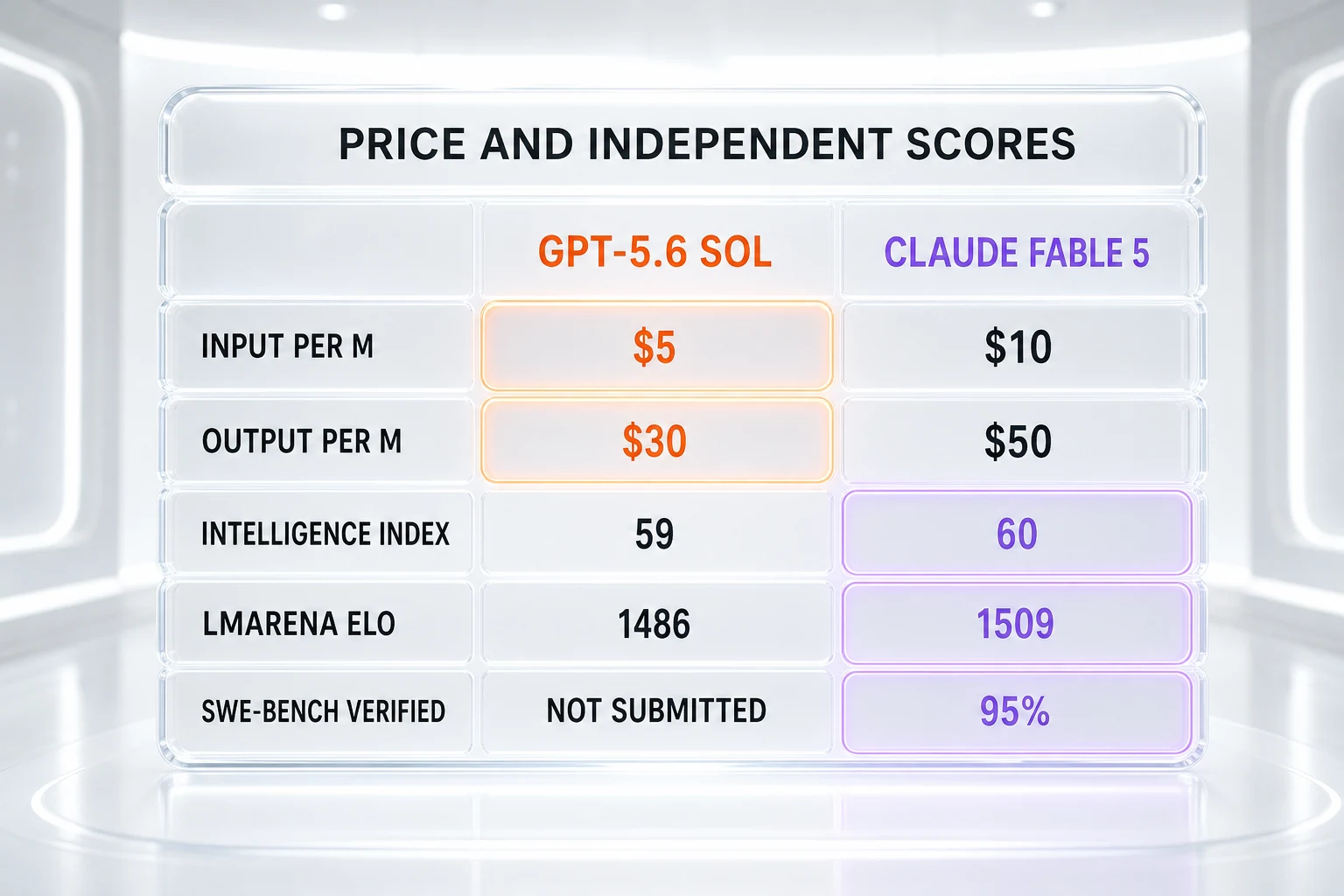
The table below lists every dimension we could verify or attribute. Read the Winner column carefully: it distinguishes vendor-verified pricing, independent benchmarks, and self-reported figures, and it flags where a result is one-sided ("where measured") or genuinely tied. Every benchmark figure carries its source. Sources for the independent scores are Artificial Analysis and LMArena.
| Feature | GPT-5.6 Sol | Claude Fable 5 | Winner |
|---|---|---|---|
| API input price (per million tokens) | $4.00 promotional, up to 272K input (verified) | $10.00 (verified) | GPT-5.6 Sol |
| API output price (per million tokens) | $20.00 promotional, up to 272K input (verified) | $50.00 (verified) | GPT-5.6 Sol |
| Cost per task, AA Intelligence Index (independent, measured August 2, 2026) | $1.86 (Artificial Analysis, max effort) | $3.15 (Artificial Analysis, with fallback) | GPT-5.6 Sol |
| AA Intelligence Index v4.1 (independent, read mid-July 2026; Claude Opus 5 has led since July 24, 2026) | 59 (No.2) | 60 (No.1) | Claude Fable 5 |
| LMArena Elo (independent, human preference, read mid-July 2026; Claude Opus 5 now leads) | 1486 (No.8, Xhigh) | 1509 (No.1) | Claude Fable 5 |
| SWE-bench Verified (vals.ai, independent) | Not submitted | 95% (No.1) | Where measured (Fable 5 only) |
| AA Coding Agent Index v1.3 (independent, read August 2, 2026) | 66.57 — ranked 2nd (Codex harness, max effort) | 65.85 — ranked 3rd (Claude Code harness, max effort) | GPT-5.6 Sol, by 0.72 |
| AA-Briefcase agentic tasks (independent) | 42% (1592) | 56% (1764) | Claude Fable 5 |
| SWE-bench Pro (self-reported, different suite) | 64.6% (OpenAI reports; disputes benchmark) | ~80.3% (vendor-reported, not reproduced) | Not comparable (self-reported) |
| Declared context window | 1,050,000 tokens | 1,000,000 tokens | Tie (within 5 percent) |
| Max output tokens | 128,000 | 128,000 | Tie |
| Reasoning control | Low to xhigh, plus new max and ultra multi-agent modes | Adaptive thinking always on — no off switch | GPT-5.6 Sol (flexibility) |
| Multi-agent reasoning mode | Ultra: up to 16 parallel agents (4 by default) | Not offered as a mode | GPT-5.6 Sol |
| Refusal and fallback handling | Standard API refusals | stop_reason refusal as HTTP 200, auto-fallback to Opus 4.8, refusals not billed | Claude Fable 5 |
| Data retention | Standard OpenAI API controls; ZDR-compatible Programmatic Tool Calling | Mandatory 30-day retention (Covered Model), no zero-data-retention | GPT-5.6 Sol (flexibility) |
| Tokenizer efficiency | Standard tokenization | ~30% more tokens for the same text (Anthropic docs) | GPT-5.6 Sol |
| Prompt caching discount | 90% on cached input ($0.40 per million) | 90% on cached input ($1 per million) | Tie |
Synthesis: the independent capability leaderboards tilt to Fable 5 — at the mid-July 2026 reading it took the Intelligence Index head-to-head by a single point (60 to 59), the LMArena Elo by a clear margin (1509 to 1486), the AA-Briefcase agentic set (56 percent to 42 percent), and SWE-bench Verified uncontested (95 percent, with Sol not submitted). The economics tilt to Sol — 60 percent less on both input and output under its promotional rates, about 40 percent less per task on Artificial Analysis's Intelligence Index runs ($1.86 versus $3.15, measured August 2, 2026), and second place on the AA Coding Agent Index v1.3 at 66.57 against Fable 5's 65.85. The two SWE-bench figures everyone conflates are different suites: Sol's 64.6 percent is self-reported on SWE-bench Pro, Fable 5's 95 percent is independent on SWE-bench Verified, and one does not cancel the other. Context windows are effectively tied. This is not a model that wins everything against a model that wins nothing; it is peak measured capability against peak measured efficiency.
Pricing — GPT-5.6 Sol vs Claude Fable 5 in 2026
Pricing is the cleanest part of this comparison: both rate cards are vendor-verified, and the gap is large. Sol costs 60 percent less than Fable 5 on both input and output under its promotional rates; on the independent per-task measurement, Artificial Analysis puts Sol at $1.86 against $3.15 for Fable 5 — about 40 percent less, measured August 2, 2026. The question is not whether Sol is cheaper — it is — but whether Fable 5's independent capability lead is worth the premium on your specific workload. For the mechanics of input, output, and cached-token billing, our AI model pricing explainer breaks down how these rate cards translate into real bills. Both rate cards below come straight from OpenAI's and Anthropic's own documentation.
GPT-5.6 Sol Pricing
| Tier | Input (per million tokens) | Output (per million tokens) | Notes |
|---|---|---|---|
| Standard API (up to 272K input) | $4.00 | $20.00 | Promotional; verified on OpenAI's API pricing page |
| Standard API (above 272K input) | $8.00 | $30.00 | Long-context band, billed on the whole request |
| Cached input | $0.40 / $0.80 | — | 90 percent discount, by band; cache writes $5.00 / $10.00 |
| Batch and Flex | $2.00 / $4.00 | $10.00 / $15.00 | Half price by band, verified |
Sol's rate card turns on one threshold: 272,000 input tokens. Below it, the same rate applies whether you send one thousand tokens or two hundred thousand. Above it, the long-context rate applies to the full request rather than to the excess, so a single oversized prompt doubles the input cost and adds half again to output. Fable 5 has no equivalent threshold — Anthropic bills its full 1,000,000-token window at the standard rate — so on very large prompts Sol's advantage narrows sharply. There is no free plan at the API level.
These are promotional rates. OpenAI cut Sol's API and credit pricing on August 21, 2026, and the company's two published descriptions of how long the cut lasts do not say the same thing. The GPT-5.6 launch page carries an update reading: "OpenAI dropped the API and credit pricing of GPT-5.6 Sol by over 20% for the next 3 months." The API pricing page states: "GPT-5.6 Sol's promotional pricing is available at least through November 21, 2026." One phrasing closes a window; the other sets a floor and leaves the end open. We are not going to pick between them. Budget for both readings, and do not plan around the rate reverting on a specific date — neither page says it will. Sol's standard rate before the cut was $5 input and $30 output per million tokens, so the gap against Fable 5 was two to one on input and about 1.7 to one on output before August 21.
Claude Fable 5 Pricing
| Tier | Input (per million tokens) | Output (per million tokens) | Notes |
|---|---|---|---|
| Standard API | $10.00 | $50.00 | Verified on Anthropic's official pricing docs |
| Cached input | $1.00 | — | 90 percent discount, verified |
| Batch mode | $5.00 | $25.00 | Half price, verified |
| Full 1M context | Standard rate | Standard rate | No long-context surcharge (Anthropic docs) |
Pricing verdict: Sol wins on price, full stop. On a representative agentic call of 50,000 input tokens and 5,000 output tokens, Sol costs about $0.30 at the promotional rate card ($4 times 0.05 input plus $20 times 0.005 output) versus about $0.75 for Fable 5 ($10 times 0.05 plus $50 times 0.005) — two and a half times more for Fable 5 on that mix. Because the August 21 cut left Sol at exactly 40 percent of Fable 5 on both sides, that 2.5-to-1 multiple now holds whatever your input-output mix, where before the cut it ranged from two to one on input-heavy calls to about 1.7 to one on output-heavy ones. Two effects complicate the picture beyond the rate cards. First, Anthropic's documentation states that Fable 5's newer tokenizer produces roughly 30 percent more tokens for the same text, so an identical prompt bills more on Fable 5 than the rate card alone shows. Second, reasoning effort dominates per-task cost at the top configurations: on Artificial Analysis's independent measurement, running its Intelligence Index costs $3.15 per task on Fable 5 as tested (adaptive reasoning at max effort with Opus 4.8 fallback) against $1.86 on Sol at max effort — about 40 percent less for Sol, measured August 2, 2026. Both models discount cached input by 90 percent, so long-running agents with stable system prompts close some of the gap in production. One caveat on those per-task numbers: Artificial Analysis measured them on August 2, 2026, three weeks before OpenAI cut Sol's rates, so they reflect the old $5 and $30 card rather than the promotional one.
Hands-On Notes — Fable 5 in Production, Sol at 48 Hours
We owe you precision about what this section is and is not. Claude Fable 5 has been in our production stack since its June 9 GA, running live client work in our Next.js and Supabase content pipeline. GPT-5.6 Sol went GA on July 9; we had it running side-by-side within hours, which gives us roughly 48 hours of direct comparison at the time of writing — sharp first impressions, nowhere near a controlled benchmark. Take the Sol observations as scoped and provisional, and weight the attributed benchmarks above them.
Where Sol stood out immediately: throughput and cost. On high-volume agentic runs with heavy tool use, Sol's Programmatic Tool Calling let it batch tool operations in code rather than one call at a time, cutting round trips on the kind of loop-and-filter work that dominates data-wrangling agents. Its lower reasoning levels made cheap bulk calls genuinely cheap — something Fable 5 structurally cannot match because adaptive thinking has no off switch. This lines up with its second-place AA Coding Agent Index v1.3 placement and its roughly 40 percent Intelligence Index cost-per-task advantage, without proving either in 48 hours.
Where Fable 5 held its ground: the hardest single problems. On a deep multi-file refactor and a long-horizon planning task, Fable 5 reached correct results with fewer human interventions in our runs, consistent with its No.1 Intelligence Index and LMArena standing at the time of those runs. Its always-on adaptive thinking shows on exactly this kind of work — it pauses, plans, and self-corrects mid-task. On routine transforms and structured extraction the outcome gap between the two was small to invisible, which is precisely where Sol's price advantage makes it the rational default.
What we saw of the ultra mode: Sol's ultra setting, running multiple reasoning agents in parallel, produced visibly more thorough plans on one hard architecture task than its standard mode — at a noticeably higher token bill for that call. It is a genuine capability lever for the hardest problems, and it is the kind of headroom Fable 5 does not expose as a mode. Whether it changes outcomes at scale is something we will only know with more time.
What we cannot tell you yet: latency under controlled conditions, per-task token economics across a real workload mix, and whether Sol's early production behavior holds up over weeks. We will update this comparison as our side-by-side time with Sol accumulates and as more independent harnesses publish results.
Winner per Category
Best for Peak Measured Intelligence: Claude Fable 5
On the Artificial Analysis Intelligence Index v4.1, Claude Fable 5 scored 60 at this review's mid-July 2026 reading, then the No.1 score, one point above GPT-5.6 Sol's 59. Claude Opus 5, charted July 24, 2026, has since taken the top spot — as of August 4, 2026 the index reads Opus 5 at 60.7, Fable 5 at 59.9, and Sol at 58.9, so Fable 5 keeps its one-point edge over Sol. A single point is inside the margin where task-level results can flip, so this is a narrow lead, and it is corroborated by the AA-Briefcase agentic set, where Fable 5's 56 percent leads Sol's 42 percent. If your workload is the hardest reasoning you have and you want the higher-measuring model of this pair on aggregate intelligence, Fable 5 is the pick on the independent evidence.
Best for Human Preference: Claude Fable 5
On LMArena, where anonymized models compete in blind human voting, Claude Fable 5 held the No.1 Elo at 1509 at this review's mid-July 2026 reading. GPT-5.6 Sol's Xhigh configuration ranked No.8 at 1486, behind several models including Anthropic's own Opus line and Google's Gemini 3 Pro. Blind preference is a different signal from benchmark accuracy — it captures tone, helpfulness, and formatting as much as correctness — and on that signal Fable 5 led this pair at that reading while Sol was strong but mid-pack; Claude Opus 5 has since taken the LMArena lead. For chat-facing and assistant workloads where users judge the output directly, this gap matters.
Best for Independently Verified Coding: Claude Fable 5, Where Measured
On the vals.ai-run SWE-bench Verified suite, Claude Fable 5 posts 95 percent, the top score, ahead of Claude Opus 4.8 at 88.6 percent and every other model on the board. GPT-5.6 Sol has not been submitted, so there is no independent Verified figure for it — we will not pretend a self-reported SWE-bench Pro number fills that gap. OpenAI reports Sol at 88.8 percent on Terminal-Bench 2.1 (91.9 percent in ultra mode), but that is a different, self-reported benchmark. If your mental model of coding ability is calibrated to independently verified GitHub-issue tasks, Fable 5 has the strongest number in this matchup and Sol has none — a gap worth weighing honestly. Our coding-benchmark explainer covers why the two SWE-bench suites are not interchangeable.
Best for Price and Cost per Task: GPT-5.6 Sol
This one is not close. Sol costs $4 per million input tokens against Fable 5's $10, and $20 per million output against $50 — both vendor-verified, Sol's promotionally. Batch and Flex halve Sol again to $2 input and $10 output. And on the one third-party cost-per-task measurement, Artificial Analysis puts Sol at $1.86 per task to run its Intelligence Index versus $3.15 for Fable 5 — about 40 percent less, with Sol at max effort and Fable 5 in its fallback configuration, measured August 2, 2026. Unless your tasks demonstrably need Fable 5's capability lead, Sol delivers more output per dollar.
Ahead of Fable 5 on the AA Coding Agent Index and Multi-Agent Work: GPT-5.6 Sol
The AA Coding Agent Index v1.3 is the one independent capability chart where Sol finishes ahead of Fable 5: it ranks second at 66.57 against Fable 5's 65.85, and at a lower cost per task ($7.08 against $11.71). Sol does not top the index — Claude Code running Opus 5 does, at 66.74. And the entries pair a model with a harness, Sol through Codex and Fable 5 through Claude Code, so part of the 0.72-point gap belongs to the harness rather than the model. Sol also owns multi-agent throughput outright — its new ultra mode runs up to sixteen reasoning agents in parallel (four by default), a mode Fable 5 does not offer, and its Programmatic Tool Calling orchestrates tools in executable code. For long-horizon agentic pipelines measured on the Coding Agent Index rather than SWE-bench Verified, and for workloads that benefit from parallel reasoning, Sol is the pick.
Best for Production Failure Handling: Claude Fable 5
Fable 5's refusal design is the best production safety engineering either vendor ships: declines come back as stop_reason refusal on a clean HTTP 200 rather than an error, the fallbacks parameter auto-retries on Claude Opus 4.8, and refused-before-output requests are not billed. For unattended agents, that is the difference between a logged event and a paged engineer. The trade-off is the Covered Model retention policy that comes with it. Sol handles refusals as standard API responses, but wins the mirror-image category — data retention flexibility — because it offers zero-data-retention-compatible deployment that Fable 5 cannot.
Pros and Cons
GPT-5.6 Sol Pros and Cons
What we like about GPT-5.6 Sol
- Forty percent of Fable 5's sticker price on both sides. $4 input and $20 output per million tokens against Fable 5's $10 and $50 — promotional rates — with Batch and Flex halving it again to $2 and $10.
- About 40 percent less per task. Artificial Analysis measures $1.86 to run its Intelligence Index on Sol at max effort versus $3.15 for Fable 5 in its fallback configuration, measured August 2, 2026.
- Ranked second on the independent AA Coding Agent Index v1.3. A score of 66.57 against Fable 5's 65.85, at lower cost per task — the one capability leaderboard where Sol finishes ahead, though Claude Code with Opus 5 leads it at 66.74.
- Ultra multi-agent mode and Programmatic Tool Calling. Up to sixteen parallel reasoning agents and code-orchestrated tool use, neither of which Fable 5 offers.
- Zero-data-retention-compatible and flexible reasoning. Standard OpenAI data controls plus a five-plus-level effort scale you can turn down or off for cheap bulk calls.
Where GPT-5.6 Sol falls short
- Behind Fable 5 on the independent capability leaderboards. No.2 on the Intelligence Index (59 to 60) and No.8 on LMArena (1486 to 1509) at the mid-July 2026 reading.
- Absent from independent SWE-bench Verified. Not submitted, so it has no independent verified-coding number to weigh against Fable 5's 95 percent.
- Coding headline is self-reported. Its strongest coding figures (Terminal-Bench 2.1, SWE-bench Pro) come from OpenAI, and OpenAI disputes the Pro benchmark it cites.
- Two days old at the time of writing. Our hands-on window is roughly 48 hours, so its production behavior over weeks is unproven.
- No refusal-fallback mechanism. Refusals are standard API responses, with no auto-retry on a sibling model.
Claude Fable 5 Pros and Cons
What we like about Claude Fable 5
- No.1 on the independent Intelligence Index at the mid-July 2026 reading. A score of 60, one point above Sol, and No.1 on LMArena at 1509 for human preference at the same reading — spots Claude Opus 5 has held since July 24, 2026.
- Top independent verified-coding score. 95 percent on the vals.ai-run SWE-bench Verified suite, a benchmark Sol has not been submitted to.
- Best-in-class refusal and fallback engineering. Refusals as clean HTTP 200s, auto-fallback to Claude Opus 4.8, and refused requests not billed.
- 1,000,000-token context that holds up. Coherence stayed strong deep into long runs in our production use, with 128,000 output tokens per request.
- Fewer human interventions on the hardest work. In our runs, deep multi-file and long-horizon tasks completed correctly more often without help.
Where Claude Fable 5 falls short
- Two and a half times Sol's price on both input and output. $10 and $50 per million tokens against Sol's promotional $4 and $20.
- About 70 percent more expensive per task. $3.15 to run the AA Intelligence Index in its fallback configuration versus $1.86 for Sol at max effort, measured August 2, 2026.
- Behind Sol on the agentic coding index and multi-agent work. Sol places above Fable 5 on the AA Coding Agent Index v1.3 (66.57 against 65.85) and offers a parallel-agent ultra mode Fable 5 lacks.
- Adaptive thinking cannot be turned off. No reasoning-free mode for cheap bulk calls, and the raw chain of thought is never returned.
- Mandatory 30-day retention, no zero-data-retention option. The Covered Model policy is a hard blocker for some compliance postures.
When to Pick GPT-5.6 Sol vs Claude Fable 5
Pick GPT-5.6 Sol if...
- Price-performance is the deciding factor — 60 percent less on both input and output, and $1.86 versus $3.15 per task on Artificial Analysis's runs, measured August 2, 2026.
- Your workload is high-volume agentic work measured on the AA Coding Agent Index v1.3, where Sol ranks second at 66.57, just above Fable 5.
- You want a multi-agent reasoning mode (ultra, up to sixteen parallel agents) or code-orchestrated tool use via Programmatic Tool Calling.
- You need reasoning you can turn down or off for cheap bulk calls, which Fable 5's always-on thinking cannot do.
- Zero-data-retention language is in your contracts — Fable 5's Covered Model policy rules it out.
Pick Claude Fable 5 if...
- You want the top of this pair's independent capability curve — the higher Intelligence Index score, the higher LMArena Elo, and the strongest verified-coding score in this matchup.
- Your coding workload looks like independently verified GitHub-issue tasks, where Fable 5 posts 95 percent on SWE-bench Verified and Sol has no independent number.
- You run unattended agents and want refusals handled as clean HTTP 200s with auto-fallback to Claude Opus 4.8 instead of hard failures.
- Human-facing output quality matters, where Fable 5's LMArena showing against Sol (1509 to 1486 at the mid-July 2026 reading) reflects blind preference.
- A mandatory 30-day retention window is acceptable to your compliance team.
Frequently Asked Questions
Is GPT-5.6 Sol better than Claude Fable 5 in 2026?
It depends entirely on what you are optimizing for, and we will not fake a single overall winner. On the independent leaderboards where both appear, Claude Fable 5 leads Sol on measured capability: at this review's mid-July 2026 reading, Artificial Analysis ranked it No.1 on the Intelligence Index at 60 versus 59 for Sol and it held the No.1 LMArena Elo at 1509 against Sol at No.8 (1486) — both No.1 spots have since passed to Claude Opus 5, with Fable 5 at 59.9 to Sol's 58.9 on the index as of August 4, 2026 — and it scores 95 percent on the independently run SWE-bench Verified suite, which Sol has not been submitted to. GPT-5.6 Sol wins on economics and throughput: 40 percent of Fable 5's sticker price on both sides, about 40 percent less per task on Artificial Analysis's own runs ($1.86 versus $3.15, measured August 2, 2026), second place on the AA Coding Agent Index v1.3 at 66.57 against Fable 5's 65.85, and an ultra multi-agent mode Fable 5 lacks. Best for peak intelligence and verified coding: Fable 5. Best for price and agentic throughput: Sol.
How much do GPT-5.6 Sol and Claude Fable 5 cost?
GPT-5.6 Sol costs $4 per million input tokens and $20 per million output tokens on requests up to 272,000 input tokens, with cached input at $0.40 per million and Batch and Flex at half price — we confirmed this on OpenAI's API pricing page on August 28, 2026. Above 272,000 input tokens a long-context rate of $8 and $30 applies to the whole request. Those are promotional rates: OpenAI cut them on August 21, 2026, calling the cut "for the next 3 months" on its launch page and "available at least through November 21, 2026" on its pricing page, and the standard rate beforehand was $5 and $30. Claude Fable 5 costs $10 per million input tokens and $50 per million output tokens, with cached input at $1 per million and Batch mode at $5 input and $25 output — we confirmed this directly on Anthropic's official pricing documentation. At the sticker, Sol is 60 percent cheaper on both input and output. One nuance widens the real gap: Anthropic's documentation notes that Fable 5's newer tokenizer produces roughly 30 percent more tokens for the same text, so an identical prompt bills more tokens on Fable 5 than the rate card alone implies.
Which is better for coding: GPT-5.6 Sol or Claude Fable 5?
It splits by which benchmark you trust. On the independently run SWE-bench Verified suite, Artificial Analysis's partner vals.ai lists Claude Fable 5 at 95 percent, the top score, while GPT-5.6 Sol has not been submitted, so there is no independent Verified number for it at all. On the Artificial Analysis Coding Agent Index v1.3, the order flips: GPT-5.6 Sol ranks second at 66.57, ahead of Fable 5 at 65.85, and at a lower cost per task ($7.08 against $11.71). Neither tops that index — Claude Code running Opus 5 does, at 66.74. OpenAI's own materials report Sol at 88.8 percent on Terminal-Bench 2.1 (91.9 percent in ultra mode), but those are self-reported. If you weight independent, verified coding results, Fable 5 leads; if you weight the agentic-coding-index and cost efficiency, Sol leads.
Why is GPT-5.6 Sol missing from SWE-bench Verified?
Because OpenAI has not submitted GPT-5.6 Sol to it, so as of this comparison there is no independent SWE-bench Verified figure for the model. That is a genuine data gap, and we flag it rather than invent a number. On the independently run SWE-bench Verified leaderboard, Claude Fable 5 sits at 95 percent and Claude Opus 4.8 at 88.6 percent, but Sol simply is not on the board. OpenAI instead reports Sol on SWE-bench Pro (a different, harder suite) at 64.6 percent, and disputes that benchmark's validity, arguing that roughly 30 percent of its tasks are broken. Comparing Sol's self-reported SWE-bench Pro score against Fable 5's independent SWE-bench Verified score is not a like-for-like comparison, so we keep them separate.
Is Claude Fable 5 worth two and a half times the price of GPT-5.6 Sol?
Only where its measured capability lead actually matters to your workload. Fable 5 costs $10 per million input and $50 per million output against Sol's promotional $4 and $20 — two and a half times as much on both sides — and Artificial Analysis measures the cost to run its Intelligence Index at $3.15 per task for Fable 5 versus $1.86 for Sol, about 70 percent more, measured August 2, 2026 and therefore before the August 21 cut. That premium buys the higher Intelligence Index score, the higher LMArena Elo, and a 95 percent SWE-bench Verified result Sol has no independent answer to. If your work is the hardest reasoning and you need the top of this pair's measured capability curve, the premium can pay off; for high-volume agentic and routine work, Sol delivers more output per dollar.
Which has the larger context window: GPT-5.6 Sol or Claude Fable 5?
GPT-5.6 Sol edges it on the declared number, but the difference is negligible. OpenAI's model documentation lists Sol at a 1,050,000-token context window with up to 128,000 output tokens and a February 16, 2026 knowledge cutoff. Anthropic's documentation lists Claude Fable 5 at a 1,000,000-token context window, also with 128,000 output tokens, billed at standard rates across the full window. The 5 percent difference rarely changes an architecture decision. Both handle book-length inputs and large multi-file codebases; the more meaningful differences are in price, reasoning control, and the independent capability scores rather than the raw context size.
What is GPT-5.6 Sol's ultra reasoning mode?
Ultra is a new multi-agent reasoning setting introduced with the GPT-5.6 generation, and it is primarily a Sol feature. Per OpenAI's documentation, the reasoning effort scale now runs from low through xhigh, then adds a new max level and, above that, ultra — which spawns multiple reasoning agents in parallel (four by default, up to sixteen) to attack a single problem. It is aimed at the hardest long-horizon coding, science, and agentic tasks, and OpenAI reports Sol at 91.9 percent on Terminal-Bench 2.1 in ultra mode versus 88.8 percent standard. Claude Fable 5 has no equivalent multi-agent mode; its reasoning is always-on adaptive thinking that you shape with an effort parameter rather than parallel agents. Ultra buys headroom on Sol's hardest tasks, at higher token cost per call.
Which model is cheaper per task: GPT-5.6 Sol or Claude Fable 5?
GPT-5.6 Sol. Artificial Analysis publishes the cost to run its Intelligence Index evaluation, and it lists $1.86 per task for GPT-5.6 Sol at max effort versus $3.15 for Claude Fable 5 in its fallback configuration — about 40 percent less on that specific evaluation, measured August 2, 2026. Artificial Analysis re-measures these figures continuously, so they move with prices and token usage. Sol's lower rate card, optional lower reasoning effort, and standard tokenization all pull its per-task cost down — on the same date, Artificial Analysis lists Sol at high effort at $0.77 per task.
What is Programmatic Tool Calling in GPT-5.6 Sol?
Programmatic Tool Calling is a GPT-5.6 capability where the model writes and executes JavaScript inside an isolated, ephemeral V8 runtime to orchestrate its own tool use, rather than emitting one tool call at a time. Per OpenAI's documentation it is compatible with zero-data-retention deployments, which matters for regulated workloads. In practice it lets Sol batch and chain tool operations in code — looping, filtering, and combining results — which can cut the number of round trips on complex agentic tasks. Claude Fable 5 takes a different route to the same goal, with a memory tool, context editing, compaction, and task budgets, but it does not expose an equivalent code-writing tool-orchestration runtime. If your agents benefit from programmatic orchestration, that is a Sol-specific advantage.
What are the data retention differences between GPT-5.6 Sol and Claude Fable 5?
This is one of Sol's clearer operational advantages. Claude Fable 5 is a Covered Model under Anthropic's Mythos-class safety policy: all traffic carries a mandatory 30-day retention window with human access logged, and there is no zero-data-retention option, which is a hard blocker for some compliance postures. GPT-5.6 Sol runs under OpenAI's standard API data controls, and its Programmatic Tool Calling runtime is documented as compatible with zero-data-retention deployments. If zero-data-retention language is in your contracts, Sol is the one of these two you can currently deploy. The trade-off is that Fable 5's retention is the visible cost of the safety classification that also underpins its refusal-and-fallback design.
Can GPT-5.6 Sol and Claude Fable 5 work together in the same stack?
Yes, and a split stack is arguably the rational setup in mid-2026. A practical routing pattern sends the hardest peak-reasoning work and independently verified coding to Claude Fable 5, which leads Sol on the Intelligence Index, LMArena, and SWE-bench Verified, and sends high-volume agentic runs, cost-sensitive tasks, and multi-agent workloads to GPT-5.6 Sol, which places above Fable 5 on the AA Coding Agent Index v1.3 and costs a fraction as much per task on the Intelligence Index. Abstraction layers such as the Vercel AI SDK, LangChain, or LiteLLM turn cost-aware routing by task type into a configuration exercise rather than a rewrite. Fable 5's own fallback-to-Opus mechanism already normalizes multi-model thinking, so treating Sol and Fable 5 as complementary rather than mutually exclusive is the pragmatic move.
What are the alternatives to GPT-5.6 Sol and Claude Fable 5?
Several sit close by. Claude Opus 4.8, at $5 per million input and $25 per million output tokens, sits between the two — well under Fable 5 on both sides, but above Sol's promotional rates on both — and posts 88.6 percent on the independent SWE-bench Verified suite, a strong middle option we compare against Fable 5 directly. GPT-5.5, OpenAI's prior flagship, remains active and cheaper for routine work. Google's Gemini 3.1 Pro line is the value play for high-volume retrieval, and the GPT-5.6 generation also ships Terra and Luna as cheaper capability tiers below Sol. If you want the tiers immediately below this matchup, our Claude Fable 5 versus Claude Opus 4.8 and Claude Fable 5 versus GPT-5.5 comparisons cover the adjacent trade-offs in detail.
Final Verdict — Peak Capability vs Peak Efficiency, a True Split
After running both side-by-side, verifying pricing on both vendors' own documentation, and holding every capability claim to independent benchmarks, our verdict is a genuine split — not a diplomatic one. Claude Fable 5 is the independent capability leader of this pair: No.1 on the Artificial Analysis Intelligence Index at 60 and No.1 on LMArena at 1509 at this review's mid-July 2026 reading (both top spots have since passed to Claude Opus 5; the index reads Fable 5 at 59.9 to Sol's 58.9 as of August 4, 2026), plus 95 percent on the vals.ai SWE-bench Verified suite that GPT-5.6 Sol has not been submitted to, and the best production refusal-and-fallback design either vendor ships. GPT-5.6 Sol is the efficiency and throughput leader: 40 percent of Fable 5's sticker price on both sides, about 40 percent less per task on Artificial Analysis's Intelligence Index runs ($1.86 versus $3.15, measured August 2, 2026), second on the AA Coding Agent Index v1.3 at 66.57 against Fable 5's 65.85, and a new ultra multi-agent mode Fable 5 does not offer. We disclose plainly that our team runs Fable 5 in production — which is exactly why we anchored every capability comparison to third-party numbers rather than our own habit.
We did not crown a single overall winner because the evidence does not support one honestly: Fable 5's lead is real on the capability leaderboards but comes at two and a half times the sticker price and about 70 percent more per task (measured August 2, 2026, before Sol's price cut), and Sol's efficiency is real but cannot buy the top of the measured intelligence, preference, and verified-coding charts. If your work is the hardest reasoning and you need the top of this pair's independent curve — pick Claude Fable 5 and pay for it. If your work is high-volume agentic or cost-sensitive — pick GPT-5.6 Sol and bank the difference. For most teams the rational endgame is routing: Fable 5 for frontier reasoning and verified coding, Sol for throughput and volume. For the tiers around this matchup, see our Claude Fable 5 review, our Claude Opus 4.8 review — the strong middle option at $5 input and $25 output per million tokens — our Claude Fable 5 vs Claude Opus 4.8 comparison, and our Claude Fable 5 vs GPT-5.5 comparison. Google's value tier is covered in our Gemini 3.1 Pro review.
Sources
Every figure in this comparison is attributed to a primary or independent source. Pricing and specifications come from the vendors' own documentation; capability scores come from independent third parties; self-reported figures are labeled as such throughout.
- OpenAI — GPT-5.6 announcement and positioning
- OpenAI — GPT-5.6 Sol model documentation
- OpenAI — API pricing page (Sol rate card and promotional pricing note)
- Anthropic — Claude Fable 5 pricing documentation
- Anthropic — Claude Fable 5 product page
- Artificial Analysis — Intelligence Index and cost per task
- Artificial Analysis — Coding Agent Index v1.3 leaderboard
- LMArena — human-preference Elo leaderboard
- vals.ai — SWE-bench Verified independent leaderboard
Last compared: July 2026. GPT-5.6 Sol reached general availability on July 9, 2026, and Claude Fable 5 on June 9, 2026; both models are new, and we will revise this comparison as independent benchmark coverage matures.
Our Verdict
A genuine split verdict, capability against value. On the independent leaderboards where both models appear, Claude Fable 5 is the measured capability leader of this pair: at the review's mid-July 2026 reading, Artificial Analysis ranked it No.1 on the Intelligence Index at 60 (one point above Sol's 59) and it held the No.1 LMArena Elo at 1509 against Sol's 1486 at No.8 — both No.1 spots have since passed to Claude Opus 5, with Fable 5 at 59.9 to Sol's 58.9 on the index as of August 4, 2026 — and on the independently run SWE-bench Verified suite it posts 95 percent while GPT-5.6 Sol has not been submitted at all. GPT-5.6 Sol answers on economics and agentic throughput: it costs 40 percent of Fable 5 at the sticker ($4 versus $10 input, $20 versus $50 output per million tokens, both vendor-verified; Sol's are promotional rates cut on August 21, 2026), Artificial Analysis measures its cost to run the Intelligence Index at $1.86 per task versus $3.15 for Fable 5 (measured August 2, 2026), it ranks second on the AA Coding Agent Index v1.3 at 66.57 against Fable 5's 65.85 (Claude Code with Opus 5 leads at 66.74), and it adds an ultra multi-agent reasoning mode Fable 5 does not offer. Best for peak measured intelligence, human preference, and independently verified coding: Claude Fable 5. Best for price, cost per task, agentic-coding-index throughput, and multi-agent workloads: GPT-5.6 Sol. No single overall winner — route frontier reasoning to Fable 5 and high-volume agentic work to Sol.
Choose GPT-5.6 Sol
OpenAI's flagship GPT-5.6 capability tier, with Programmatic Tool Calling and a 1.05M-token context.
Try GPT-5.6 Sol →Choose Claude Fable 5
Anthropic's most capable widely released model — the public, safety-classified Mythos-class frontier tier.
Try Claude Fable 5 →Frequently Asked Questions
Is GPT-5.6 Sol better than Claude Fable 5?
A genuine split verdict, capability against value. On the independent leaderboards where both models appear, Claude Fable 5 is the measured capability leader of this pair: at the review's mid-July 2026 reading, Artificial Analysis ranked it No.1 on the Intelligence Index at 60 (one point above Sol's 59) and it held the No.1 LMArena Elo at 1509 against Sol's 1486 at No.8 — both No.1 spots have since passed to Claude Opus 5, with Fable 5 at 59.9 to Sol's 58.9 on the index as of August 4, 2026 — and on the independently run SWE-bench Verified suite it posts 95 percent while GPT-5.6 Sol has not been submitted at all. GPT-5.6 Sol answers on economics and agentic throughput: it costs 40 percent of Fable 5 at the sticker ($4 versus $10 input, $20 versus $50 output per million tokens, both vendor-verified; Sol's are promotional rates cut on August 21, 2026), Artificial Analysis measures its cost to run the Intelligence Index at $1.86 per task versus $3.15 for Fable 5 (measured August 2, 2026), it ranks second on the AA Coding Agent Index v1.3 at 66.57 against Fable 5's 65.85 (Claude Code with Opus 5 leads at 66.74), and it adds an ultra multi-agent reasoning mode Fable 5 does not offer. Best for peak measured intelligence, human preference, and independently verified coding: Claude Fable 5. Best for price, cost per task, agentic-coding-index throughput, and multi-agent workloads: GPT-5.6 Sol. No single overall winner — route frontier reasoning to Fable 5 and high-volume agentic work to Sol.
Which is cheaper, GPT-5.6 Sol or Claude Fable 5?
GPT-5.6 Sol starts at $4 in / $20 out per M tokens. Claude Fable 5 starts at $10 in / $50 out per M tokens. Check the pricing comparison section above for a full breakdown.
What are the main differences between GPT-5.6 Sol and Claude Fable 5?
The key differences span across 17 features we compared. For API input price (per million tokens), GPT-5.6 Sol offers $4.00 promotional, up to 272K input (verified) while Claude Fable 5 offers $10.00 (verified). For API output price (per million tokens), GPT-5.6 Sol offers $20.00 promotional, up to 272K input (verified) while Claude Fable 5 offers $50.00 (verified). For Cost per task, AA Intelligence Index (independent, measured August 2, 2026), GPT-5.6 Sol offers $1.86 (Artificial Analysis, max effort) while Claude Fable 5 offers $3.15 (Artificial Analysis, with fallback). See the full feature comparison table above for all details.