GPT-5.6 Sol vs Kimi K3: Two Points Apart, 25% Cheaper (2026)

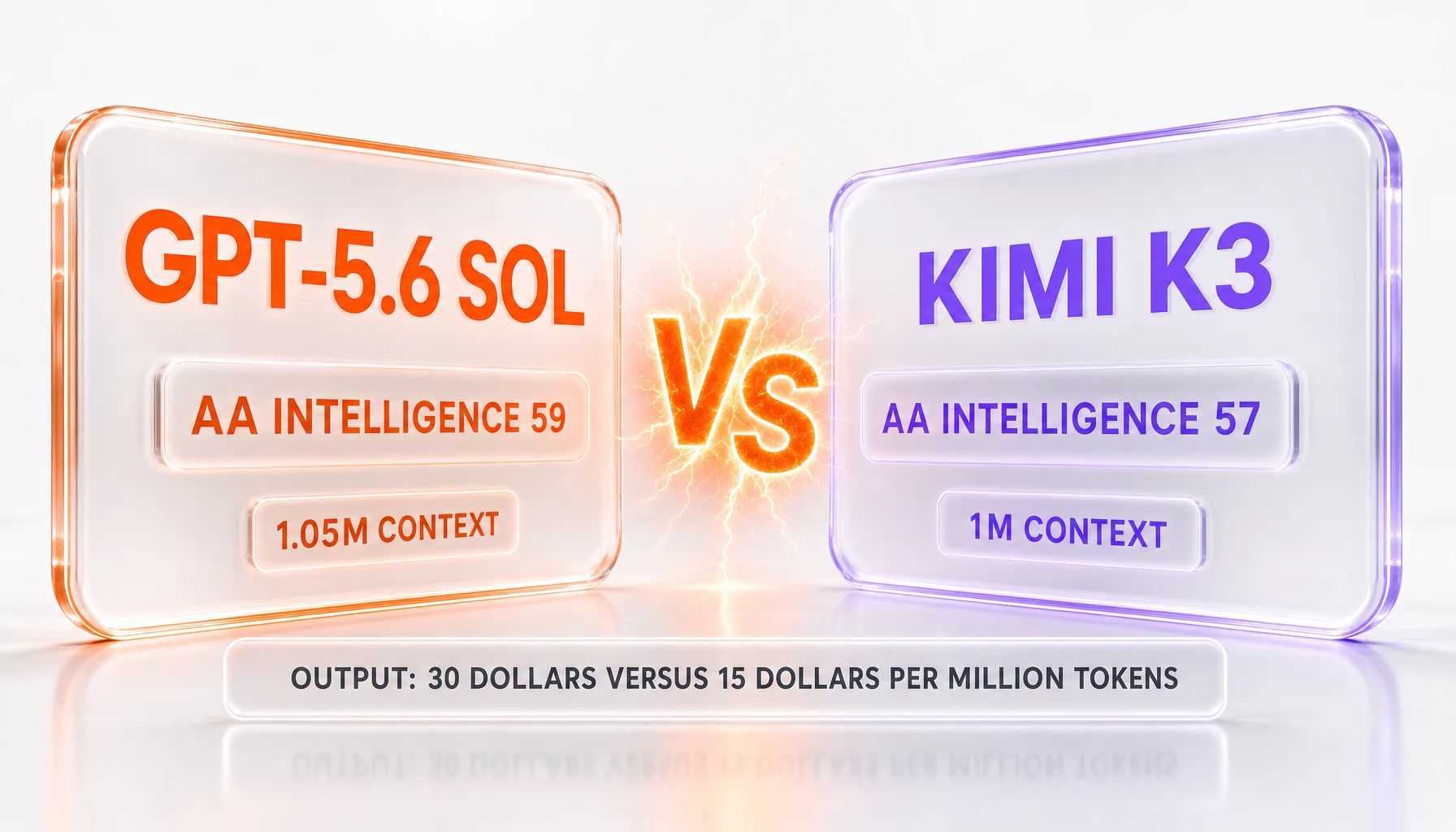
GPT-5.6 Sol vs Kimi K3: Sol leads the AA Intelligence Index 59 to 57, but Kimi K3 undercuts it by 25% on every metered line, with open weights now public.
Feature Comparison
| Feature | GPT-5.6 Sol | Kimi K3 |
|---|---|---|
| API input price (per million tokens) | $4.00 (verified, promotional) | $3.00 (verified) |
| API output price (per million tokens) | $20.00 (verified, promotional) | $15.00 (verified) |
| Cached input (per million tokens) | $0.40 (verified, promotional) | $0.30 (verified) |
| AA Intelligence Index v4.1 (independent) | 59 (No.2) | 57 (No.3) |
| AA Coding Agent Index v1.3 (independent, read August 2, 2026) | 66.57 (Codex harness, max effort) | 61.34 (Kimi Code CLI harness) |
| Context window | 1,050,000 tokens | 1,048,576 tokens |
| Open weights / self-hostable | No (closed API only) | Yes — published July 27, 2026 (Modified MIT), public on Hugging Face |
| Architecture | Closed, undisclosed | ~2.8T-parameter MoE, ~50B active, Kimi Delta Attention |
| Reasoning ceiling / multi-agent | Ultra tier, up to 16 parallel agents | Single always-on reasoning level |
| Native multimodal input | Text and image in | Text and image in (native vision) |
Pricing Comparison
GPT-5.6 Sol
Kimi K3
Detailed Comparison
GPT-5.6 Sol and Kimi K3 are the closest a proprietary flagship and an open challenger have come in 2026, and the gap is now small. On the independent Artificial Analysis Intelligence Index version 4.1, GPT-5.6 Sol scores 59 to Kimi K3's 57 — a two-point lead on the same harness, down from the seventeen-point gulf Sol held over the older Kimi K2.7 Code. Sol keeps three narrow advantages: the two-point intelligence edge, a 1,050,000-token context against Kimi K3's 1,048,576, and a 66.57 on the Coding Agent Index v1.3 against Kimi K3's 61.34. Kimi K3 answers on economics: $3 input and $15 output per million tokens against Sol's $4 and $20 — 25 percent below Sol on both sides, since OpenAI cut Sol's rates on August 21, 2026 — plus open weights, which Moonshot published on July 27, 2026 under a Modified MIT license. Best for peak measured capability, the higher reasoning ceiling, and a proven independent coding record: GPT-5.6 Sol. Best for price and open-weight freedom you can use today: Kimi K3. There is no single overall winner — you pick the axis that binds.
Quick Verdict
This is a genuine split, and a much tighter one than Sol versus any earlier open-weight Kimi: GPT-5.6 Sol still owns measured capability, context, and an independent coding score, but its intelligence lead has shrunk to two points, and Kimi K3 answers with a rate card 25 percent below Sol on every metered line, and open weights on the way. GPT-5.6 Sol reached general availability on July 9, 2026, and we ran it directly through our own OpenAI API key. Kimi K3 launched on July 16, 2026, and we tested it through the Kimi Open Platform API — the model is live and callable today, and its downloadable weights have been public since July 27, 2026. Every figure below carries its source, each vendor's self-reported numbers are labeled as such and kept apart from the independent scores, and we flag the one big headline up front: Kimi K3's open weights shipped on July 27, 2026. Here is the short version.
- Best for peak measured intelligence: GPT-5.6 Sol, narrowly. Artificial Analysis scores it 59 on the Intelligence Index version 4.1 against Kimi K3's 57 — a two-point gap on the same independent harness, the tightest in this series.
- Best on the independent agentic coding index: GPT-5.6 Sol. It scores 66.57 on the Artificial Analysis Coding Agent Index v1.3, through the Codex harness at max reasoning effort, against Kimi K3's 61.34 through the Kimi Code CLI harness — a real 5.23-point gap, of which the harness difference is part.
- Best for context size: GPT-5.6 Sol, but only on paper. Its 1,050,000-token window is 1,424 tokens larger than Kimi K3's 1,048,576 — a margin of 0.14 percent, which is no practical edge at all.
- Best for price: Kimi K3, clearly. At $3 input and $15 output per million tokens it is 25 percent cheaper than Sol on input, cached input and output alike — a narrower gap than at launch, because OpenAI cut Sol to $4 and $20 on August 21, 2026. Both rate cards are vendor-verified.
- Best for open weights and self-hosting, eventually: Kimi K3, with an asterisk. Moonshot published downloadable weights under a Modified MIT license on July 27, 2026, eleven days after launch. Sol is a closed API with no self-host path at all.
- Best for efficient architecture: Kimi K3, on paper. It is a roughly 2.8-trillion-parameter Mixture-of-Experts design with only about 50 billion active parameters per token, paired with Kimi Delta Attention for faster long-context decoding.
- Best for availability and a proven track record: GPT-5.6 Sol. It has been live since July 9 with an independent capability record; Kimi K3 is one day old at the time of writing and its numbers beyond Artificial Analysis are still vendor-reported.
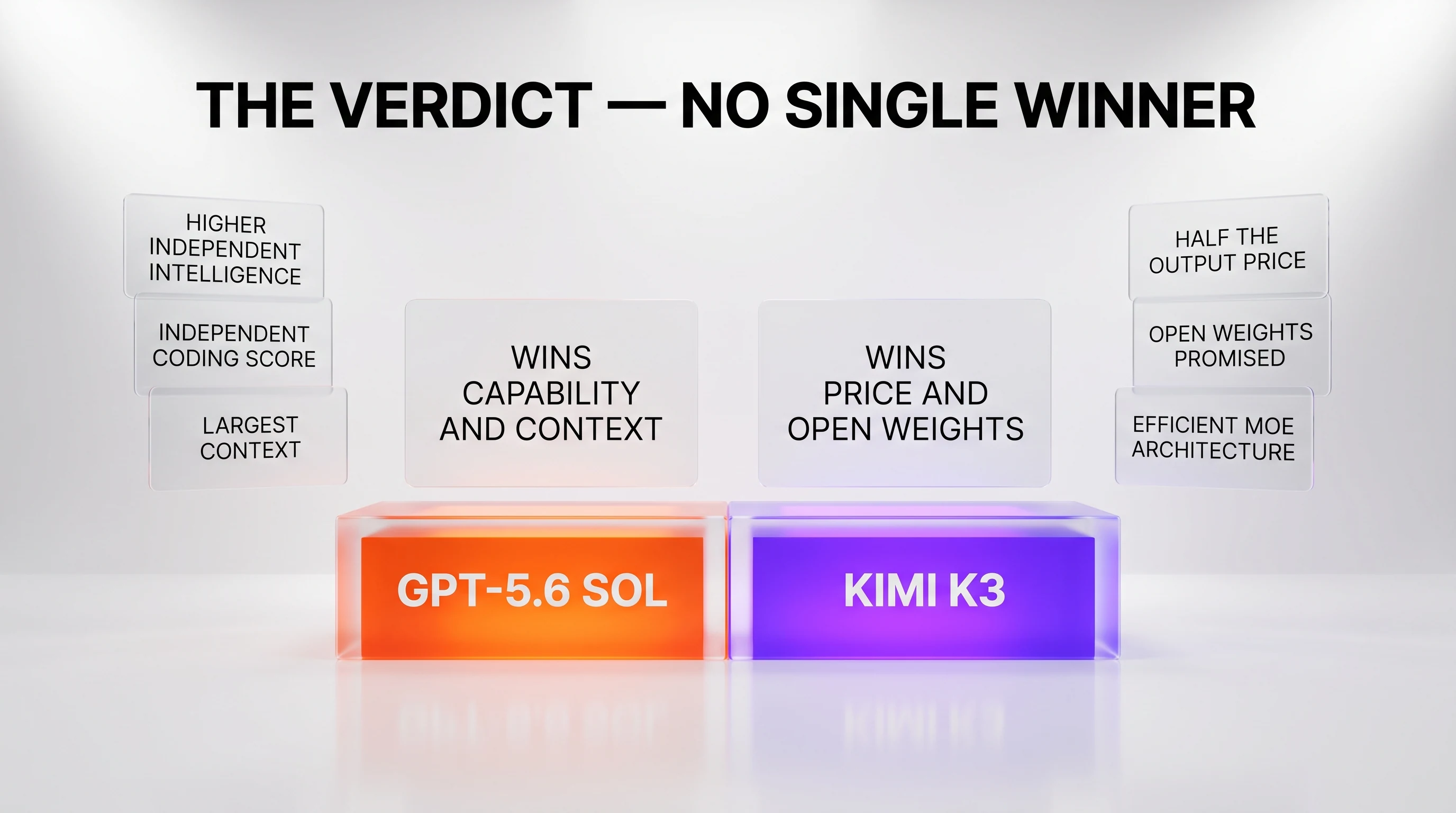
- No single overall winner: Sol wins intelligence, context, and independent coding; Kimi K3 wins price, openness, and architectural efficiency. The right pick is whichever axis is binding for you.
The honest caveats up front: GPT-5.6 Sol is days old and Kimi K3 is one day old at the time of writing, so we treat every hands-on note as a first impression rather than a settled verdict. Neither model carries an independent SWE-bench Verified score — OpenAI has not submitted Sol, and Moonshot skipped the standard public suites for Kimi K3 — so each headline coding figure that is not from Artificial Analysis is self-reported in the vendor's own harness, and we label it that way and never place it next to an independent number. And Kimi K3's central selling point, its open weights, is now real: Moonshot published them on July 27, 2026.
GPT-5.6 Sol vs Kimi K3 — Overview
What Is GPT-5.6 Sol?
GPT-5.6 Sol is the flagship capability tier of OpenAI's GPT-5.6 generation, generally available July 9, 2026 after a gated preview on June 26. In OpenAI's naming scheme the number is the generation and the names — Sol, Terra, and Luna — are durable capability tiers rather than sizes; Sol is the tier aimed at the hardest problems, from complex coding and long-horizon agents to cyber, science, and computer use, per OpenAI's announcement. Per OpenAI's model documentation, Sol runs a 1,050,000-token context window with up to 128,000 output tokens and a February 16, 2026 knowledge cutoff, handles text and image inputs to text output, and introduces two new reasoning levels above xhigh: max, and ultra, a multi-agent mode that runs up to sixteen reasoning agents in parallel. It carries Programmatic Tool Calling, where the model writes and executes JavaScript in an isolated, ephemeral runtime to orchestrate its own tools, plus a deep native tool stack. API pricing is $4 per million input tokens and $20 per million output tokens on requests up to 272,000 input tokens, with cached input at $0.40 per million — promotional rates OpenAI introduced on August 21, 2026, set out in the pricing section below. On the independent leaderboards it is a frontier model: 59 on the Artificial Analysis Intelligence Index and 66.57 on the Coding Agent Index v1.3. It is a closed model — there are no downloadable weights. Our full GPT-5.6 Sol review covers the hands-on detail.
What Is Kimi K3?
Kimi K3 is Moonshot AI's flagship open-weight model, launched July 16, 2026. It is a very large Mixture-of-Experts design — roughly 2.8 trillion total parameters with only about 50 billion active per token, so it stays servable despite its size — running a 1,048,576-token context window and pairing it with Kimi Delta Attention, an attention scheme Moonshot built for faster long-context decoding. It ships native vision, which read images accurately in our API testing, and exposes an OpenAI-compatible API on the Kimi Open Platform, so most SDKs and coding agents work with a base-URL swap. Per Moonshot's platform pricing, the metered API costs $3 per million input tokens on a cache miss, $0.30 per million on a cache hit, and $15 per million output tokens. On the independent Artificial Analysis Intelligence Index version 4.1 it scores 57 — a top-tier result that sits just above Claude Opus 4.8 at 56 and two points below Sol. The headline that makes Kimi K3 notable is openness: Moonshot ships downloadable weights under a Modified MIT license, positioning it against the closed US frontier flagships. Those weights were not published at launch; Moonshot released them eleven days later, on July 27, 2026, so Kimi K3 is now a genuinely downloadable open-weight model. Our full Kimi K3 review has the architecture detail.
How We Compared Them — and What We Did Not Do
Method transparency matters here, because both models are new, one is a single day old, and the open weights that define Kimi K3 had not been released when we tested. Here is exactly what we did and did not do, and where every number comes from.
- Pricing: both rate cards are vendor-verified. We confirmed Sol's $4 input and $20 output per million tokens on OpenAI's API pricing documentation, and Kimi K3's $3 input, $0.30 cached, and $15 output per million tokens on Moonshot's Kimi Open Platform pricing, both re-read on August 28, 2026. No relayed figures.
- Independent benchmarks: we lean on Artificial Analysis for the Intelligence Index version 4.1, because it is the one harness that measures both models on the same basis: Sol at 59, Kimi K3 at 57. Where a model has not been measured — as both are on SWE-bench Verified — we say so and do not substitute a self-reported number.
- Self-reported figures, kept separate: Moonshot published a set of its own benchmark numbers for Kimi K3, measured in its own harnesses and not independently reproduced at launch. We report them in a single clearly labeled paragraph in the hands-on section, well away from any independent score, and we never place a Moonshot-reported figure in the same row or sentence as Sol's independent Artificial Analysis numbers, because they are not measured on the same basis and are not comparable.
- Hands-on: we ran GPT-5.6 Sol through our own OpenAI API key on coding and reasoning tasks within days of its July 9 general availability, and we tested Kimi K3 through the Kimi Open Platform API within a day of its July 16 launch. These are sharp first impressions on two very new models, not controlled benchmarks, and we could not test Kimi K3's self-hosting: the weights had not been released when we ran these tests.
- Disclosure: we have no affiliate relationship with OpenAI or Moonshot AI. There are no sponsored links on this page. This comparison spans a closed US flagship and an open Chinese challenger, and we have no incentive to favor either — only the question of which fits which job.
Features and Benchmarks Comparison
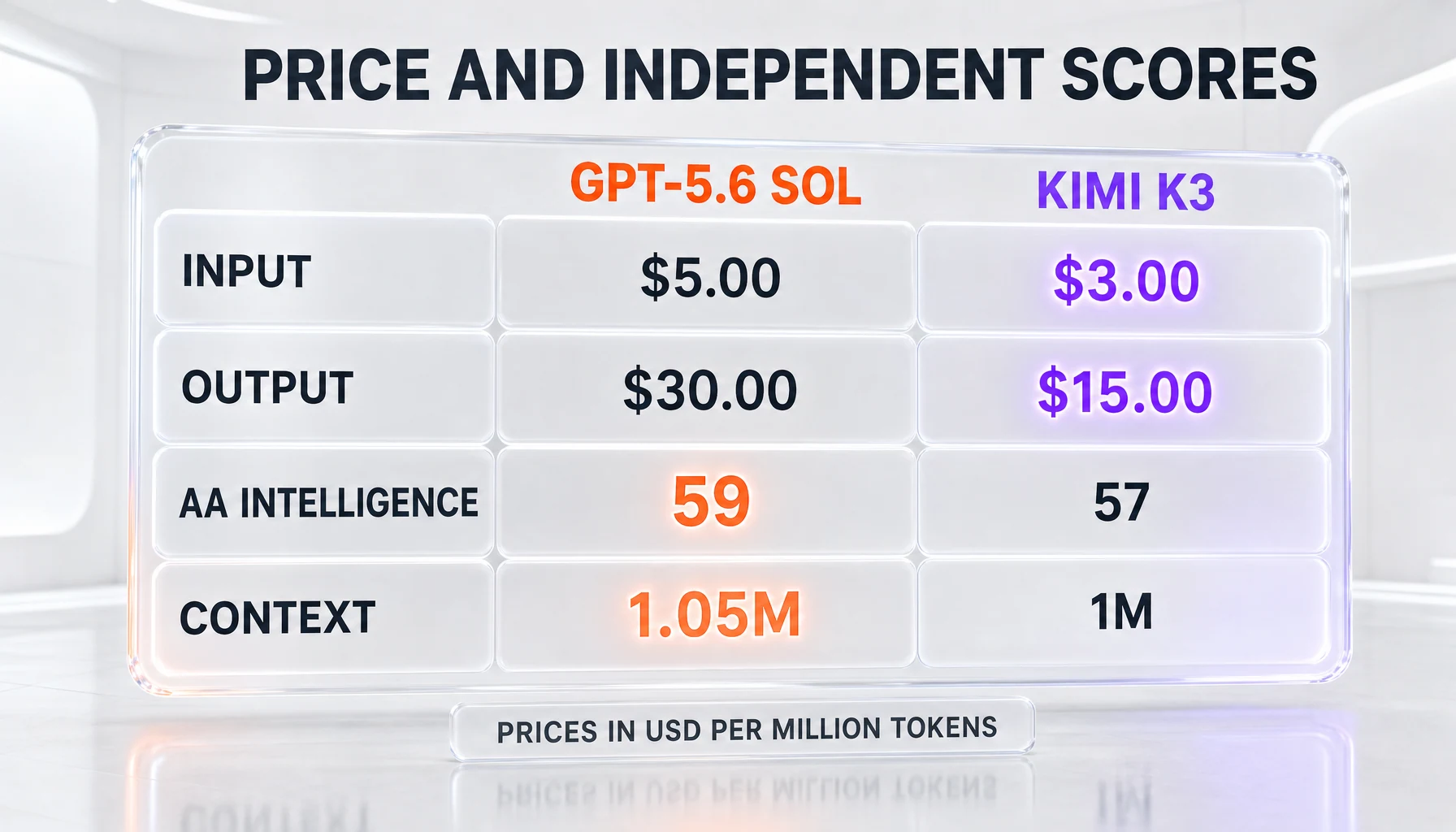
The table below lists every dimension we could verify or attribute independently. Read the Winner column carefully: it distinguishes vendor-verified pricing, independent benchmarks, and genuine ties, and it deliberately keeps Moonshot's self-reported numbers out — those live in their own labeled paragraph further down. Sources for the independent scores are Artificial Analysis, and the specifications come from OpenAI's model documentation and Moonshot's Kimi Open Platform documentation.
| Feature | GPT-5.6 Sol | Kimi K3 | Winner |
|---|---|---|---|
| API input price (per million tokens) | $4.00 (verified, promotional) | $3.00 (verified) | Kimi K3, by 25 percent |
| API output price (per million tokens) | $20.00 (verified, promotional) | $15.00 (verified) | Kimi K3, by 25 percent |
| Cached input (per million tokens) | $0.40 (verified, promotional) | $0.30 (verified) | Kimi K3, by 25 percent |
| AA Intelligence Index v4.1 (independent) | 59 (No.2) | 57 (No.3) | GPT-5.6 Sol |
| AA Coding Agent Index v1.3 (independent, read August 2, 2026) | 66.57 (Codex harness, max effort) | 61.34 (Kimi Code CLI harness) | GPT-5.6 Sol, by 5.23 |
| Context window | 1,050,000 tokens | 1,048,576 tokens | GPT-5.6 Sol, by 1,424 tokens (0.14 percent) |
| Open weights / self-hostable | No (closed API only) | Yes — published July 27, 2026 (Modified MIT), public on Hugging Face | Kimi K3 |
| Architecture | Closed, undisclosed | ~2.8T-parameter MoE, ~50B active, Kimi Delta Attention | Kimi K3 |
| Reasoning ceiling / multi-agent | Ultra tier, up to 16 parallel agents | Single always-on reasoning level, no multi-agent tier | GPT-5.6 Sol |
| Native multimodal input | Text and image in, text out | Text and image in (native vision), text out | Tie |
| SWE-bench Verified (independent public suite) | N/A (not submitted) | N/A (not submitted) | Tie (neither submitted) |
Synthesis: read top to bottom, the table splits cleanly. The three price rows and the openness and architecture rows go to Kimi K3, and the price rows still go there, though less decisively than at launch — 25 percent cheaper on input, cached input and output alike, since OpenAI cut Sol on August 21, 2026 — plus downloadable weights that Sol structurally cannot offer. The intelligence, independent coding, context, and multi-agent rows go to GPT-5.6 Sol, though the margins are the story: the intelligence gap is now just two points on the one independent yardstick the two share, and the context edge is 1,424 tokens on a base of over a million. The independent coding row favors Sol by a real margin — 66.57 on the Coding Agent Index v1.3 against Kimi K3's 61.34, each model running through its own harness. Two rows are honest ties: neither model is on the independent SWE-bench Verified leaderboard, and both accept text and image input. That leaves the decision exactly where the two design philosophies put it: a narrow, proven capability lead against a decisive price cut and open weights you can download.
Pricing — GPT-5.6 Sol vs Kimi K3 in 2026
Pricing is the clearest divide in this comparison, and unlike the intelligence race it is not close. Kimi K3 undercuts GPT-5.6 Sol on every metered line, and once its open weights ship it will let self-hosting teams drop the API bill to compute alone. For the mechanics of input, output, and cached-token billing, our AI model pricing explainer breaks down how these rate cards translate into real invoices. Both tables below come from the vendors' own documentation: Sol from OpenAI's API pricing, Kimi K3 from Moonshot's Kimi Open Platform pricing.
GPT-5.6 Sol Pricing
| Tier | Input (per million tokens) | Output (per million tokens) | Notes |
|---|---|---|---|
| Standard API | $4.00 | $20.00 | Prompts up to 272,000 input tokens; promotional since August 21, 2026 |
| Long context (over 272K input) | $8.00 | $30.00 | 2x input, 1.5x output on the whole request |
| Cached input | $0.40 | — | 90 percent discount, verified |
| Batch mode and Flex | $2.00 | $10.00 | Half price, verified |
| Fast mode (2x) | $8.00 | $40.00 | Renamed from Priority on July 30, 2026, verified |
Kimi K3 Pricing
| Tier | Input (per million tokens) | Output (per million tokens) | Notes |
|---|---|---|---|
| Metered API (cache miss) | $3.00 | $15.00 | Verified on Moonshot's Kimi Open Platform pricing |
| Cached input (cache hit) | $0.30 | — | 90 percent discount, verified |
| Self-hosted (open weights) | Compute only | Compute only | Modified MIT license, weights published July 27, 2026 |
Pricing verdict: Kimi K3 wins price, though by less than at launch. On a representative agentic call of 50,000 input tokens and 5,000 output tokens, Sol costs about $0.30 at the rate card ($4 times 0.05 input plus $20 times 0.005 output), while Kimi K3 costs about $0.225 ($3 times 0.05 plus $15 times 0.005) — 25 percent less for that same call. That 25 percent now holds evenly across the rate card rather than concentrating on output: since OpenAI's August 21, 2026 cut, Kimi K3 sits at three-quarters of Sol on input, cached input and output alike. It widens much further for teams that self-host the open weights and pay only for compute. This is a smaller gap than the five-to-seven-times spread Sol faced against the cheaper Kimi K2.7 Code, because Kimi K3 charges frontier-tier prices for a frontier-tier model — the era of the bargain-basement Chinese open model is over at this capability level. What Sol's remaining premium buys is a proven independent capability record, a higher coding-index result, a marginally larger context, and a managed frontier service you can use with confidence today; whether that is worth a third more per token depends entirely on whether your workload uses the extra capability.
These are promotional rates. OpenAI cut Sol's API and credit pricing on August 21, 2026, and its two published descriptions of how long the cut lasts do not say the same thing. The GPT-5.6 launch page carries an update reading: "OpenAI dropped the API and credit pricing of GPT-5.6 Sol by over 20% for the next 3 months." The API pricing page states: "GPT-5.6 Sol's promotional pricing is available at least through November 21, 2026." One phrasing closes a window; the other sets a floor and leaves the end open. We are not going to pick between them, and neither page says the rate reverts on a particular day. Sol's standard rate before the cut was $5 input and $30 output per million tokens.
Hands-On and Assessment Notes
We owe you precision about what this section is and is not. We ran GPT-5.6 Sol directly through our own OpenAI API key within days of its July 9 general availability, and we tested Kimi K3 through the Kimi Open Platform API within a day of its July 16 launch. Both give us sharp first impressions; neither is a controlled, matched benchmark. Weight the attributed independent numbers and the vendors' documentation above our short hands-on windows on two models this new.
Where Sol stood out in our runs: the hardest single problems. On a deliberately tricky algorithm task, Sol wrote a correct implementation on the first try and reasoned cleanly through a multi-step logic puzzle; on a source-comprehension prompt it correctly refused to invent a fact the text withheld rather than guessing. Turned up to its higher reasoning levels, and especially in the ultra multi-agent mode, it produced visibly more thorough plans on a hard architecture task — at a higher token bill for that call. This lines up with its 59 Intelligence Index and its Coding Agent Index v1.3 score without proving either in a few days.
What we saw from Kimi K3: a genuinely strong open-weight flagship that closes most of the intelligence gap. Its 57 on the Artificial Analysis Intelligence Index is a top-tier result — two points behind Sol and one ahead of Claude Opus 4.8 — and in our API testing its native vision read images accurately and its long-context handling felt responsive, consistent with the Kimi Delta Attention decoding scheme Moonshot built for exactly that. The OpenAI-compatible API meant our existing tooling connected with a base-URL swap. The honest limits: the model runs a single always-on reasoning level that can burn through output tokens on simple prompts, and beyond Artificial Analysis its numbers are still Moonshot's own.
The vendor-reported figures, labeled and kept separate: Moonshot published its own benchmark numbers for Kimi K3 — 88.3 on Terminal-Bench, 91.2 on BrowseComp, and 93.5 on GPQA-Diamond — and it is important to read them for exactly what they are. Every one of those figures was measured in Moonshot's own evaluation harness, was not independently reproduced at the time of writing, and is not measured on the same basis as any Artificial Analysis score, so we treat them as provisional vendor claims and never set them beside Sol's independent numbers as if the two were comparable. They suggest Kimi K3 is a capable agentic and reasoning model, but until an independent harness confirms them they remain self-reported, and both models' independent Coding Agent Index placements are a different kind of evidence entirely.
What the split looked like in practice: these two models compete far more directly than Sol did with any earlier Kimi, because the intelligence gap has nearly closed. Sol is the choice when a proven independent capability record, the higher reasoning ceiling, or a verifiable agentic-coding score decides the outcome; Kimi K3 is the choice when output cost, open weights, or architectural efficiency decides it. We did not crown one winner because the evidence genuinely splits — Sol's lead is real but narrow, and Kimi K3's price and openness are decisive but come with a weights-not-shipped asterisk.
What we cannot tell you yet: a matched, controlled head-to-head on identical tasks, how the open weights, published July 27, 2026, hold up under independent auditing over time, and how either model's early behavior holds up over weeks of production use. We will update this comparison as our side-by-side time accumulates and as more independent harnesses publish results for both.
Winner per Category
Best for Peak Measured Intelligence: GPT-5.6 Sol
On the Artificial Analysis Intelligence Index version 4.1, GPT-5.6 Sol scores 59 against Kimi K3's 57 — a two-point gap on the same independent harness, and the narrowest capability separation Sol has faced against an open challenger in this series. Two points is not nothing on the hardest reasoning tasks, where small differences in a model's ceiling can decide whether a multi-step answer is correct or merely plausible, and Sol pairs that lead with a deeper independent track record. But it is a far cry from the seventeen-point gulf Sol held over the older Kimi K2.7 Code, and for most everyday prompts the two will feel indistinguishable. If your workload leans on the toughest reasoning you have, Sol is the pick on the independent evidence; if it does not, the gap may never bind. Our GPT-5.6 Sol review covers where that headroom shows up.
Best on the Independent Agentic Coding Agent Index: GPT-5.6 Sol
The AA Coding Agent Index v1.3 is the sharpest capability separator here, and unlike the intelligence row it is not close: Sol scores 66.57 through the Codex harness at max reasoning effort, while Kimi K3 scores 61.34 through the Kimi Code CLI harness. The 5.23-point gap includes that harness difference, not just the models. Neither model has an independent SWE-bench Verified result either — OpenAI has not submitted Sol, and Moonshot skipped the public suites for Kimi K3 — so the Coding Agent Index is the best agentic-coding signal available, and both models appear on it. Moonshot's own coding-adjacent numbers exist but are self-reported in its harness and not comparable, as we cover in the hands-on section. Our explainer on agentic coding models covers why an agent index measures something different from a single-shot coding score. Kimi K3 is plainly a capable coder in practice; it simply lacks the independent agentic-coding record Sol has, and for a coding-first shortlist our best AI coding tools guide puts both in context.
Best for Context and Reasoning Depth: GPT-5.6 Sol
Sol keeps the envelope, but on context the margin is now a rounding difference. Per OpenAI's documentation, it runs a 1,050,000-token context — 1,424 tokens larger than Kimi K3's 1,048,576, a difference of 0.14 percent — and its reasoning-effort scale climbs through xhigh and max to ultra, a multi-agent mode that runs up to sixteen reasoning agents in parallel. Kimi K3 has no equivalent multi-agent tier; it exposes a single always-on reasoning level through an OpenAI-compatible API, paired with Kimi Delta Attention to keep long-context decoding fast. For very long documents, whole-repository prompts, or long-horizon autonomous agents that benefit from parallel reasoning, Sol's higher reasoning ceiling is a concrete advantage — but on context the two are the same size to within a rounding error, and the gap is no longer the chasm it was against 256K-class open models.
Best for Price and Cost per Token: Kimi K3
This one runs the other way, and decisively. Kimi K3 costs $3 per million input tokens against Sol's $4, and $15 per million output against $20 — 25 percent cheaper on both, vendor-verified on Moonshot's Kimi Open Platform pricing and OpenAI's. Cached input is $0.30 per million on Kimi K3 against $0.40 on Sol, the same 25 percent. And once Kimi K3's open weights ship, a team running it on its own GPUs can push the marginal cost toward compute alone. This is a narrower gap than the older, cheaper Kimi K2.7 Code offered — Kimi K3 charges frontier prices for a frontier model — but a quarter off every metered line still compounds fast. Unless your tasks demonstrably need Sol's capability lead, Kimi K3 delivers close-to-frontier intelligence for meaningfully less money.
Best for Open Weights and Efficient Architecture: Kimi K3
Openness is a category Sol cannot enter, and Kimi K3's architecture is a genuine differentiator — and the timing caveat is now gone. Moonshot published downloadable weights under a Modified MIT license on July 27, 2026, so you can run the roughly 2.8-trillion-parameter Mixture-of-Experts model — about 50 billion active parameters per token, kept efficient by Kimi Delta Attention — on your own hardware, keep data on-premises, and avoid single-vendor lock-in. GPT-5.6 Sol is a closed model reached only through OpenAI's API, ChatGPT, and Codex, with no weights and no self-host path, per OpenAI's announcement. That openness is now concrete: Moonshot published the Kimi K3 weights on July 27, 2026, so it is a downloadable file rather than a promise. Our guide to closed versus open-weight models walks through when that distinction decides a deployment.
Pros and Cons
GPT-5.6 Sol Pros and Cons
What we like about GPT-5.6 Sol
- Highest measured capability, if narrowly. 59 on the Artificial Analysis Intelligence Index against Kimi K3's 57, plus 66.57 on the Coding Agent Index v1.3 against Kimi K3's 61.34.
- Higher independent agentic-coding score. Its 66.57 on the Coding Agent Index v1.3 leads Kimi K3's 61.34 on the same index, though each model ran through its own harness.
- Million-token context window. 1,050,000 tokens against Kimi K3's 1,048,576 — a margin of 1,424 tokens, so a match rather than a lead — for whole-repository and long-document work.
- Exclusive ultra multi-agent reasoning mode. Up to sixteen parallel reasoning agents for the hardest long-horizon problems — a ceiling Kimi K3 does not offer.
- Proven and available now. Live since July 9 with an independent capability record, and disciplined in our runs — it wrote a correct hard algorithm on the first try and refused to hallucinate a withheld fact.
Where GPT-5.6 Sol falls short
- A third more per token. $4 input and $20 output per million tokens against Kimi K3's $3 and $15 — 33 percent more on both, and those Sol rates are promotional, with OpenAI's two published descriptions of how long they last not agreeing with each other.
- Closed model, no self-hosting. API-only, with no downloadable weights, so it cannot meet on-premises or data-residency requirements.
- Intelligence lead has shrunk to two points. The capability moat over the best open challengers is far thinner than it was a generation ago.
- Absent from independent SWE-bench Verified. Not submitted, so it has no independent verified-coding number — the same gap as Kimi K3.
- Days old at the time of writing. Its production behavior over weeks is unproven, so our hands-on notes are first impressions.
Kimi K3 Pros and Cons
What we like about Kimi K3
- Near-frontier intelligence at a lower price. 57 on the independent Artificial Analysis Intelligence Index, just two points behind Sol and one ahead of Claude Opus 4.8.
- A quarter off every metered line. $3 input and $15 output per million tokens, with cached input at $0.30 — 25 percent below Sol on input, output and cached input alike.
- Open weights published under a Modified MIT license. A self-host path against the closed US flagships, released July 27, 2026 — freedom you can act on today.
- Efficient large MoE with native vision. Roughly 2.8 trillion parameters, about 50 billion active per token, Kimi Delta Attention for fast long-context decoding, and native vision that read images accurately in our testing.
- OpenAI-compatible API and a full million-token context. Drop-in tooling with a base-URL swap, and a context window that finally matches the frontier class.
Where Kimi K3 falls short
- The open-weight license is not plain MIT. The weights shipped July 27, 2026, but Moonshot's terms require a separate agreement for Model-as-a-Service operators above $20 million in revenue over any twelve months, and prominent Kimi K3 attribution above 100 million monthly active users.
- Two points behind Sol on measured intelligence, and a lower independent coding score. 57 to 59 on Artificial Analysis, and 61.34 to 66.57 on the AA Coding Agent Index v1.3.
- Every non-AA benchmark is self-reported. Moonshot skipped the public suites, so its headline agentic and reasoning numbers were not independently reproduced at launch.
- Frontier pricing ends the cheap-open-model advantage. At $3 input and $15 output it is far more expensive than the older Kimi K2.7 Code and no longer a bargain play.
- A single always-on reasoning level. It can burn through output tokens on simple prompts and offers no multi-agent tier like Sol's ultra mode.
When to Pick GPT-5.6 Sol vs Kimi K3
Pick GPT-5.6 Sol if...
- Your workload is the hardest coding, long-horizon agents, science, or computer use, where the two-point intelligence edge and the 5.23-point independent coding-index gap actually change outcomes.
- You need a proven, independently verified capability record today rather than a set of vendor-reported numbers awaiting confirmation.
- You want the ultra multi-agent reasoning mode — up to sixteen parallel agents — that Kimi K3 does not offer.
- You need the higher reasoning ceiling for whole-repository prompts or extended autonomous sessions.
- A managed, closed frontier API fits your compliance posture and you do not need self-hosting.
Pick Kimi K3 if...
- Token cost is the deciding factor — 25 percent below Sol on every metered line, and compute-only once you can self-host.
- Open weights matter to you — Moonshot published them on July 27, 2026: on-premises deployment, data residency, air-gapped environments, or freedom from single-vendor lock-in.
- You want near-frontier intelligence — 57 on the independent index — without paying frontier-flagship prices for it.
- You run high-volume, cost-sensitive work where a quarter off every token compounds on every call.
- An efficient large MoE with native vision and an OpenAI-compatible API fits your stack, and vendor-reported benchmarks awaiting independent confirmation are an acceptable risk while the model matures.
Frequently Asked Questions
Is GPT-5.6 Sol better than Kimi K3 in 2026?
On raw measured capability, yes, but only narrowly, and they are built for different priorities, so there is no single winner. On the independent Artificial Analysis Intelligence Index version 4.1, GPT-5.6 Sol scores 59 against Kimi K3's 57 — a two-point gap on the same harness, the tightest Sol has faced against an open challenger — and Sol scores 66.57 on the Coding Agent Index v1.3 against Kimi K3's 61.34. Sol also runs a 1,050,000-token context against Kimi K3's 1,048,576 — larger by 1,424 tokens, or 0.14 percent. But Kimi K3 costs less — $3 input and $15 output per million tokens against Sol's $4 and $20 on prompts up to 272,000 input tokens, 25 percent below on both — and ships open weights under a Modified MIT license that Sol's closed API cannot match, published on July 27, 2026. For the hardest work and a proven independent record, Sol is the stronger pick; for output cost and open-weight freedom, Kimi K3 is the better fit. It depends on your priority, not on one being universally better.
How much do GPT-5.6 Sol and Kimi K3 cost?
GPT-5.6 Sol costs $4 per million input tokens and $20 per million output tokens on requests up to 272,000 input tokens, with cached input at $0.40 per million; we confirmed those rates on OpenAI's API pricing documentation on August 28, 2026. They are promotional: OpenAI cut them on August 21, 2026 and describes the cut as lasting "for the next 3 months" on its GPT-5.6 launch page and as "available at least through November 21, 2026" on its pricing page. Above 272,000 input tokens Sol bills $8 input and $30 output for the whole request. Kimi K3 costs $3 per million input tokens on a cache miss, $0.30 per million on a cache hit, and $15 per million output tokens, which we verified on Moonshot's Kimi Open Platform pricing. Up to that threshold Kimi K3 is 25 percent cheaper than Sol on input, cached input and output alike; above it the gap widens to 62 percent on input and 50 percent on output. Kimi K3 also ships open weights under a Modified MIT license, published July 27, 2026, so you can run it on your own hardware and pay only for compute. Sol has no self-host option — it is a closed API only. On any given prompt today, Kimi K3 bills meaningfully less than Sol.
What is the difference between GPT-5.6 Sol and Kimi K3?
They are a closed premium flagship and an open-weight challenger that has nearly caught up on intelligence. GPT-5.6 Sol is OpenAI's flagship capability tier of the GPT-5.6 generation, a closed model reached only through OpenAI's API, ChatGPT, and Codex, tuned for the hardest coding, long-horizon agents, and research. Kimi K3 is Moonshot AI's flagship open-weight model — a roughly 2.8-trillion-parameter Mixture-of-Experts design with about 50 billion active parameters per token, a 1,048,576-token context, Kimi Delta Attention, and native vision, with weights published on July 27, 2026 under a Modified MIT license. Sol leads on the independent intelligence and coding indices, and matches Kimi K3 on context size; Kimi K3 leads on price and openness. Sol offers an ultra multi-agent reasoning mode and a deep native tool stack; Kimi K3 offers an OpenAI-compatible API, an efficient MoE architecture, and a self-host path once its weights ship.
Which is cheaper, GPT-5.6 Sol or Kimi K3?
Kimi K3, on every line of the rate card, and by how much depends on prompt size. Up to 272,000 input tokens, Kimi K3 costs $3 per million input tokens against Sol's $4, and $15 per million output tokens against Sol's $20 — 25 percent cheaper on both. Cached input is $0.30 per million on Kimi K3 versus $0.40 on Sol, the same 25 percent. Above that threshold Sol bills the whole request at $8 and $30, which widens the gap to 62 percent cheaper on input and 50 percent on output. Both figures are vendor-verified: Kimi K3's on Moonshot's Kimi Open Platform pricing, Sol's on OpenAI's API pricing documentation. And since Kimi K3's open weights shipped on July 27, 2026, a team running it at scale on its own GPUs can drop the per-token cost further still, paying only for infrastructure. This is a narrower gap than Sol faced against the older, cheaper Kimi K2.7 Code — Kimi K3 charges frontier prices for a frontier model — but a quarter off every metered line still adds up fast.
Is Kimi K3 open source, and can I self-host it yet?
You can self-host it since July 27, 2026, though open-weight is a more accurate label than open source. Moonshot AI did not publish the weights at launch on July 16, 2026, but it released them eleven days later under a Modified MIT license, and they are public and ungated on Hugging Face. You can download the roughly 2.8-trillion-parameter Mixture-of-Experts checkpoint and run it on your own hardware, subject to those terms: they require a separate agreement with Moonshot for Model-as-a-Service operators above $20 million in revenue over any twelve months, and prominent Kimi K3 attribution for products above 100 million monthly active users. GPT-5.6 Sol offers no equivalent at all — it is a closed model available only through OpenAI's API, ChatGPT, and Codex, with no downloadable weights ever. So for a self-host path, Kimi K3 is the only option of the two, and it is available now.
Which is better for coding: GPT-5.6 Sol or Kimi K3?
On the independent evidence available, GPT-5.6 Sol. Sol scores 66.57 on the Artificial Analysis Coding Agent Index v1.3, which pairs each model with its own coding harness; Kimi K3 scores 61.34 through the Kimi Code CLI harness, a 5.23-point gap that includes the harness difference. Neither model has an independent SWE-bench Verified result — OpenAI has not submitted Sol, and Moonshot skipped the public suites for Kimi K3 — so that data gap applies to both. Moonshot has published its own coding-adjacent numbers for Kimi K3, but they were measured in its own harness, were not independently reproduced at launch, and are not comparable to Sol's independent index, so we do not treat them as head-to-head evidence. For the strongest verifiable agentic-coding signal, Sol leads; for cheap, high-volume coding where you value price and a coming self-host path, Kimi K3 is a strong practical pick despite the thinner independent record.
How do GPT-5.6 Sol and Kimi K3 compare on independent benchmarks?
They share one independent yardstick, Artificial Analysis, and on it Sol leads by a narrow margin. On the Intelligence Index version 4.1, GPT-5.6 Sol scores 59 to Kimi K3's 57 — a two-point gap measured on the same evaluation suite, and the closest an open challenger has come to Sol in this series. Sol also scores 66.57 on the Coding Agent Index v1.3, against Kimi K3's 61.34. Beyond Artificial Analysis, neither model appears on the independent SWE-bench Verified leaderboard. Everything else Moonshot publishes for Kimi K3 is self-reported in its own harness and was not independently reproduced at launch, so we report those numbers separately and never place them beside Sol's independent scores as if they were comparable. On the one common independent measure, the race is now genuinely tight.
Does Kimi K3 have a bigger context window than GPT-5.6 Sol?
No, and the two are the same size to within a rounding error. Per OpenAI's model documentation, GPT-5.6 Sol runs a 1,050,000-token context, while Moonshot lists 1,048,576 tokens for Kimi K3 — Sol's is larger by 1,424 tokens, or 0.14 percent. Both are true million-token-class models, a big change from the older open Kimi models that topped out at 256K, so for the vast majority of whole-repository prompts, long documents, and extended agent sessions, either window is ample. Sol's edge is too small to decide anything: a workflow that overruns Kimi K3's window by 1,424 tokens will overrun Sol's on the next call. Kimi K3 also pairs its context with Kimi Delta Attention, an attention scheme Moonshot built to keep long-context decoding fast. On raw context size this is a technical win for Sol; in practice the two windows are the same.
Is Kimi K3 as intelligent as GPT-5.6 Sol?
Very nearly, on the one independent measure they share. On the Artificial Analysis Intelligence Index version 4.1, Kimi K3 scores 57 to GPT-5.6 Sol's 59 — a two-point gap, the narrowest Sol has faced from an open challenger, and Kimi K3's 57 actually sits one point above Claude Opus 4.8's 56. That means Kimi K3 is a top-tier model by any reasonable standard, and for most prompts the difference against Sol will be imperceptible. Where Sol keeps a real edge is the hardest reasoning, where a two-point ceiling difference can still tip a multi-step answer, and the independent Coding Agent Index v1.3, where Sol scores 66.57 and Kimi K3 61.34. So Kimi K3 is not quite as intelligent as Sol on the measured evidence, but it is close enough that the decision usually turns on price, openness, and your specific workload rather than on raw capability.
Should I use GPT-5.6 Sol and Kimi K3 together in the same stack?
For many teams, yes, and a split stack is the rational setup. Both expose an OpenAI-compatible surface — Kimi K3 runs on the OpenAI-compatible Kimi Open Platform, and Sol is the OpenAI API — so an abstraction layer such as the Vercel AI SDK, LangChain, or LiteLLM can route between them by configuration rather than a rewrite. A practical pattern sends the hardest reasoning, the largest-context prompts, and the tasks that need a verifiable agentic-coding score to GPT-5.6 Sol, and sends high-volume, cost-sensitive work to Kimi K3, which costs 25 percent less per token on prompts up to 272,000 input tokens and widens its lead above that threshold. With Kimi K3's open weights public since July 27, 2026, you can even run the bulk of traffic on your own hardware and reserve Sol's paid API for the tasks that measurably need its capability lead. With the intelligence gap down to two points, the two are complements far more than rivals.
Why is Kimi K3 more expensive than earlier Kimi models?
Because Kimi K3 is a frontier-class model, and Moonshot prices it accordingly. Earlier open Kimi models such as Kimi K2.7 Code cost as little as $0.95 per million input tokens and $4 per million output, undercutting Western flagships many times over. Kimi K3 charges $3 input and $15 output per million tokens — several times more than K2.7 — because it now scores 57 on the independent Artificial Analysis Intelligence Index, close to the top of the market, and runs a much larger roughly 2.8-trillion-parameter architecture with a full million-token context. In other words, the price rose because the capability rose: the bargain-basement era of cheap Chinese open models is over at this tier. Kimi K3 is still cheaper than GPT-5.6 Sol — 25 percent less on input, cached input and output on prompts up to 272,000 input tokens, and further below Sol above that threshold — but it is a premium-priced open model, not a budget one, and its value case rests on that near-frontier intelligence plus the published open weights rather than on rock-bottom pricing.
What are the alternatives to GPT-5.6 Sol and Kimi K3?
Several sit close by on both sides of this closed-versus-open divide. Among open-weight rivals to Kimi K3, DeepSeek V4 is another very large Chinese open model with a million-token context, and our GPT-5.6 Sol versus DeepSeek V4 comparison covers that closed-versus-open matchup directly. Among the older, cheaper open Kimi models, Kimi K2.7 Code remains a strong budget pick, and our GPT-5.6 Sol versus Kimi K2.7 Code and GPT-5.6 Sol versus Kimi K2.6 comparisons show how much the gap has narrowed with K3. Among closed flagships near Sol, Claude Opus 4.8 is a coding-first rival with an independently verified SWE-bench Verified score, and Claude Fable 5 is Anthropic's frontier tier. For the mechanics behind these rate cards, our AI model pricing explainer breaks down input, output, and cached-token billing, and our guide to closed versus open-weight models walks through how to choose between the two camps for your own workload.
Final Verdict — A Narrow Capability Lead vs a Decisive Price Cut
After running GPT-5.6 Sol through our own OpenAI API key, testing Kimi K3 through the Kimi Open Platform, verifying both rate cards on the vendors' own documentation, and holding every capability claim to the one independent benchmark the two share, our verdict is a genuine split — and a far tighter one than Sol has faced from any earlier open Kimi. GPT-5.6 Sol is the capability and independent-coding leader: 59 to 57 on the Artificial Analysis Intelligence Index, 66.57 on the Coding Agent Index v1.3 against Kimi K3's 61.34, and a 1,050,000-token context that Kimi K3's 1,048,576 all but matches. Kimi K3 is the price and openness leader: 25 percent cheaper on input, cached input and output alike, an efficient roughly 2.8-trillion-parameter MoE architecture with native vision, and open weights published on July 27, 2026 under a Modified MIT license. Both skip the independent SWE-bench Verified leaderboard, and every Kimi K3 number beyond Artificial Analysis is self-reported in Moonshot's own harness and kept apart from Sol's independent scores.
We did not crown a single overall winner because the evidence does not support one honestly, and the case is closer than ever: Sol's intelligence lead is real but down to two points, its context edge is a negligible 1,424 tokens, and its one clear advantage — the independent Coding Agent Index v1.3 — is a real 5.23-point gap, 66.57 against 61.34, though each model ran through its own harness. Against that, Kimi K3's price cut is concrete and its open-weight release is genuinely differentiating, with the weights public since July 27, 2026. If your work is the hardest reasoning, the higher reasoning ceiling, or needs a proven independent coding score today — pick GPT-5.6 Sol and pay for the ceiling. If your priority is output cost, open weights you can download today, or near-frontier intelligence at a lower price — pick Kimi K3 and bank the difference. Because both expose an OpenAI-compatible surface, the pragmatic endgame for many teams is a split stack: run the volume on Kimi K3, and route only the tasks that measurably need the extra headroom to Sol. For the models and rivals around this matchup, see our GPT-5.6 Sol review, our Kimi K3 review, our best AI coding tools guide, our GPT-5.6 Sol vs DeepSeek V4 comparison, our GPT-5.6 Sol vs Kimi K2.7 Code comparison, and our GPT-5.6 Sol vs Claude Opus 4.8 comparison.
Sources
Every figure in this comparison is attributed to a primary or independent source. Pricing and specifications come from each vendor's own documentation; capability scores come from the independent Artificial Analysis; Moonshot's self-reported figures are labeled as such and kept separate throughout.
- OpenAI — GPT-5.6 announcement, tiers, and positioning
- OpenAI — GPT-5.6 Sol model documentation and specifications
- OpenAI — GPT-5.6 Sol API pricing
- Moonshot AI — Kimi Open Platform pricing and specifications
- Artificial Analysis — Intelligence Index version 4.1 and Coding Agent Index methodology
- Moonshot AI — Kimi model weights on HuggingFace
Last compared: July 2026; pricing re-verified on OpenAI's and Moonshot's own documentation on August 28, 2026. GPT-5.6 Sol reached general availability on July 9, 2026, and Kimi K3 launched on July 16, 2026 and Moonshot published its open weights on July 27, 2026; both are very recent, and we will revise this comparison as independent benchmark coverage matures.
Our Verdict
This is a genuine split, and the tightest Sol has faced from an open challenger: GPT-5.6 Sol keeps a narrow lead on measured capability while Kimi K3 answers with a lower rate card and downloadable weights. On the independent Artificial Analysis Intelligence Index version 4.1, Sol scores 59 to Kimi K3's 57 — a two-point gap on the same harness, down from the seventeen points Sol held over the older Kimi K2.7 Code. Sol also leads the independent agentic-coding index, 66.57 against 61.34 on the Coding Agent Index v1.3; on context the two are level, 1,050,000 tokens against Kimi K3's 1,048,576. Kimi K3 wins the economics: $3 input and $15 output per million tokens, with cached input at $0.30, against Sol's $4, $20 and $0.40 after OpenAI's promotional cut of August 21, 2026 — 25 percent cheaper on all three lines, a narrower margin than the launch-day figures showed — plus a roughly 2.8-trillion-parameter Mixture-of-Experts architecture with about 50 billion active parameters, Kimi Delta Attention, native vision, and open weights under a Modified MIT license. Those weights were not public at launch, but Moonshot released them on July 27, 2026, so Kimi K3 is downloadable today. Moonshot's other headline numbers are self-reported in its own harness and never placed beside Sol's independent scores. We do not crown one winner because the evidence honestly splits: pick GPT-5.6 Sol for the hardest reasoning, the higher reasoning ceiling, and a proven independent coding record; pick Kimi K3 for token cost, architectural efficiency, and open weights you can download today.
Choose GPT-5.6 Sol
OpenAI's flagship GPT-5.6 capability tier, with Programmatic Tool Calling and a 1.05M-token context.
Try GPT-5.6 Sol →Choose Kimi K3
Moonshot AI's ~2.8T-parameter open Mixture-of-Experts flagship — ~50B active, 1M context, native vision. Testable via API today at $3 in / $15 out per million tokens; open weights expected July 27, 2026.
Try Kimi K3 →Frequently Asked Questions
Is GPT-5.6 Sol better than Kimi K3?
This is a genuine split, and the tightest Sol has faced from an open challenger: GPT-5.6 Sol keeps a narrow lead on measured capability while Kimi K3 answers with a lower rate card and downloadable weights. On the independent Artificial Analysis Intelligence Index version 4.1, Sol scores 59 to Kimi K3's 57 — a two-point gap on the same harness, down from the seventeen points Sol held over the older Kimi K2.7 Code. Sol also leads the independent agentic-coding index, 66.57 against 61.34 on the Coding Agent Index v1.3; on context the two are level, 1,050,000 tokens against Kimi K3's 1,048,576. Kimi K3 wins the economics: $3 input and $15 output per million tokens, with cached input at $0.30, against Sol's $4, $20 and $0.40 after OpenAI's promotional cut of August 21, 2026 — 25 percent cheaper on all three lines, a narrower margin than the launch-day figures showed — plus a roughly 2.8-trillion-parameter Mixture-of-Experts architecture with about 50 billion active parameters, Kimi Delta Attention, native vision, and open weights under a Modified MIT license. Those weights were not public at launch, but Moonshot released them on July 27, 2026, so Kimi K3 is downloadable today. Moonshot's other headline numbers are self-reported in its own harness and never placed beside Sol's independent scores. We do not crown one winner because the evidence honestly splits: pick GPT-5.6 Sol for the hardest reasoning, the higher reasoning ceiling, and a proven independent coding record; pick Kimi K3 for token cost, architectural efficiency, and open weights you can download today.
Which is cheaper, GPT-5.6 Sol or Kimi K3?
GPT-5.6 Sol starts at $4 in / $20 out per M tokens. Kimi K3 starts at $3 in / $15 out per M tokens (free plan available). Check the pricing comparison section above for a full breakdown.
What are the main differences between GPT-5.6 Sol and Kimi K3?
The key differences span across 10 features we compared. For API input price (per million tokens), GPT-5.6 Sol offers $4.00 (verified, promotional) while Kimi K3 offers $3.00 (verified). For API output price (per million tokens), GPT-5.6 Sol offers $20.00 (verified, promotional) while Kimi K3 offers $15.00 (verified). For Cached input (per million tokens), GPT-5.6 Sol offers $0.40 (verified, promotional) while Kimi K3 offers $0.30 (verified). See the full feature comparison table above for all details.