GPT-5.6 Terra vs Claude Opus 4.8: Value Tier vs Flagship (2026)


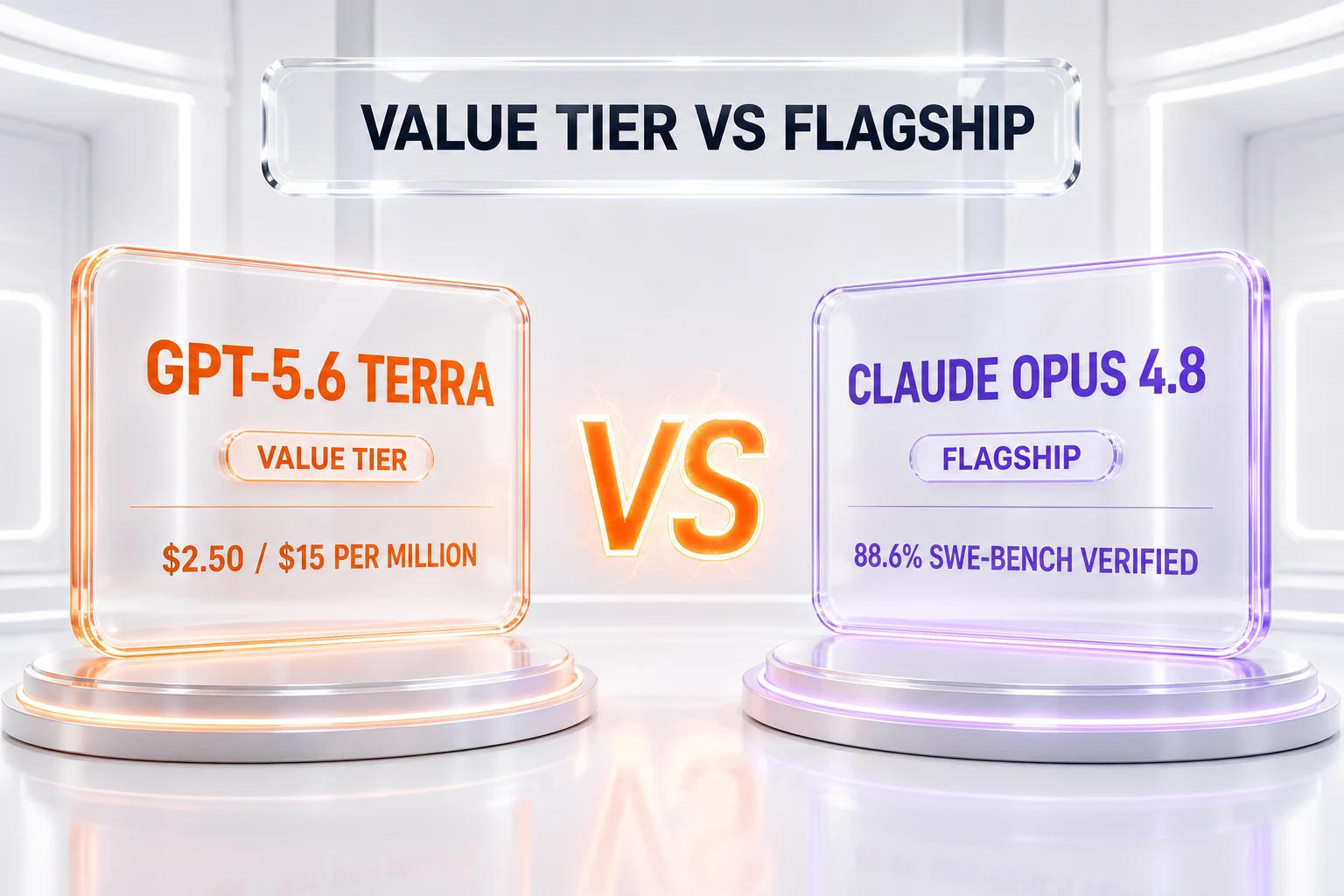
GPT-5.6 Terra is half the price of Claude Opus 4.8 ($2.50 vs $5 input). But Opus scores 88.6% on SWE-bench Verified where Terra has none. Split verdict.
Feature Comparison
| Feature | GPT-5.6 Terra | Claude Opus 4.8 |
|---|---|---|
| Input price (per million tokens) | $2.50 | $5.00 |
| Output price (per million tokens) | $15.00 | $25.00 |
| Cached input price (per million tokens) | $0.25 | $0.50 |
| Cost per task (Artificial Analysis) | ~$0.55 | N/A |
| Context window | 1,050,000 tokens | 1,000,000 tokens |
| Knowledge cutoff | February 16, 2026 | January 2026 |
| Max output tokens | 128,000 | 128,000 |
| SWE-bench Verified (vals.ai, independent) | N/A (not submitted) | 88.6% |
| Artificial Analysis Intelligence Index | 55 | Top tier (about 56 to 61, config-dependent) |
| LMArena Elo (Thinking, independent) | N/A (not charted) | ~1,482 |
| Computer use (agentic, independent) | N/A | ~84% |
Pricing Comparison
GPT-5.6 Terra
Claude Opus 4.8
Detailed Comparison
Editorial independence: ThePlanetTools.ai has no affiliate relationship with OpenAI or Anthropic and earns nothing whether you choose GPT-5.6 Terra or Claude Opus 4.8. This verdict draws on hands-on use of both models through our standard side-by-side prompt set, plus each vendor's published documentation and independent third-party benchmarks. GPT-5.6 Terra reached general availability on July 9, 2026, so our Terra notes are early impressions backed by independent scores rather than months of production data. Last compared: July 2026.
GPT-5.6 Terra vs Claude Opus 4.8 in 2026: GPT-5.6 Terra is OpenAI's balanced value tier at $2.50 per million input tokens and $15 per million output tokens, with an Artificial Analysis Intelligence Index of 55 and a 1,050,000-token context window. Claude Opus 4.8 is Anthropic's premium flagship at $5 per million input tokens and $25 per million output tokens, scoring an independently verified 88.6% on SWE-bench Verified (vals.ai), a benchmark Terra has not been submitted to. The verdict is a split: Terra wins on price, cost per task, and context size, while Opus 4.8 wins on independently verified capability and agentic depth. Pick Terra for high-volume work on a tight budget; pick Opus 4.8 for the hardest tasks where measured capability has to justify the spend.
Quick Verdict
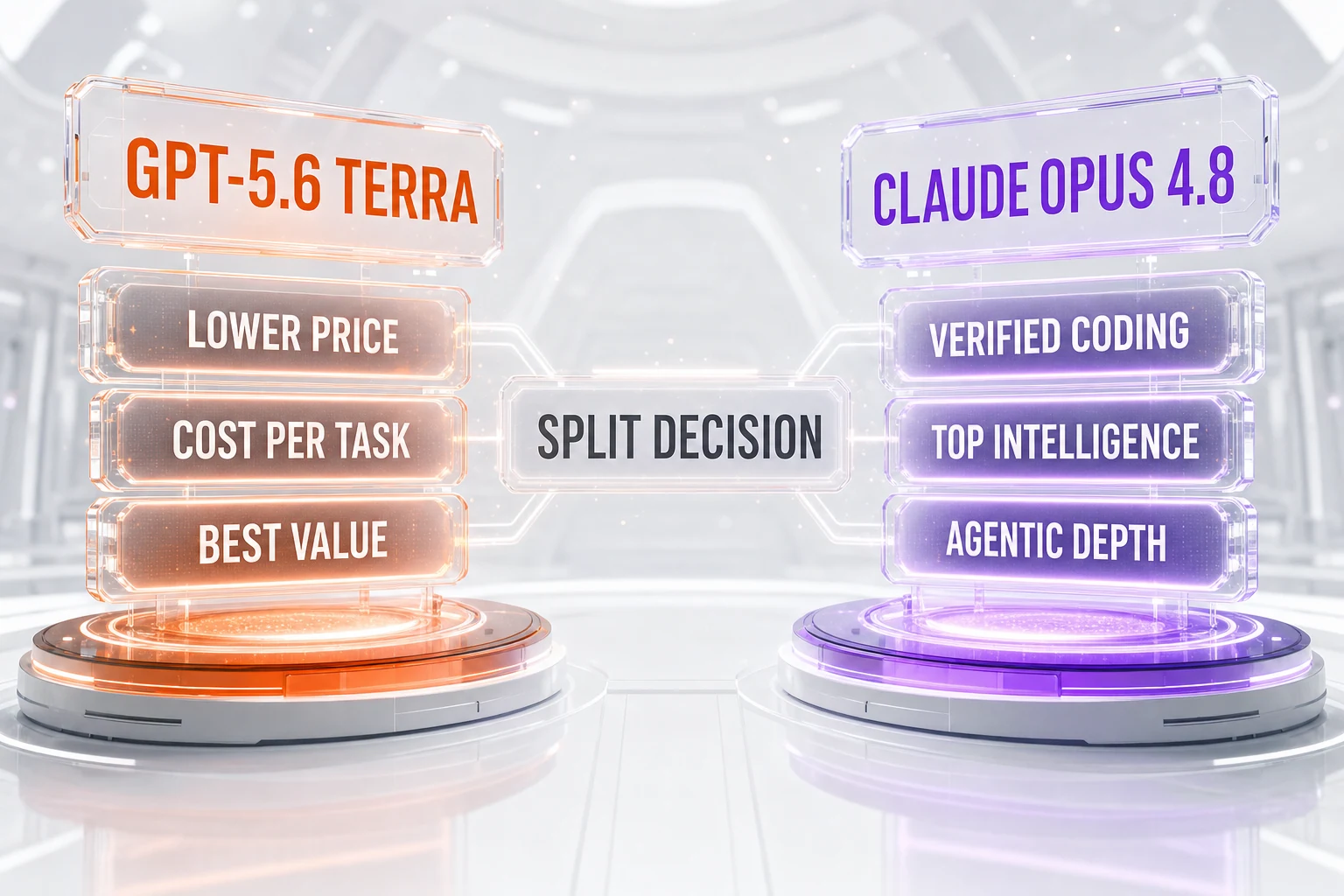
This is not one model beating another outright — it is a value tier meeting a flagship, and each wins the half of the table it was built for. GPT-5.6 Terra undercuts Claude Opus 4.8 on every price axis and carries a slightly larger context window, which makes it the rational default when you are shipping volume and watching the meter. Opus 4.8 holds the capability ceiling: it is the only one of the two with an independently verified SWE-bench score, it sits in the top tier of intelligence rankings, and it leads on agentic computer use. Most teams should route the bulk of their work to Terra and escalate the hardest, highest-stakes tasks to Opus 4.8 — not run everything on the flagship out of habit, and not assume the value tier clears every bar.
- 🏆 GPT-5.6 Terra wins for: price on every axis, cost per task, high-volume production budgets, the larger context window, knowledge freshness, and best raw value
- 🏆 Claude Opus 4.8 wins for: independently verified coding, top-tier intelligence, agentic depth and computer use, and the hardest long-horizon and most demanding tasks
- 💰 Cheaper option: GPT-5.6 Terra — $2.50 versus $5 per million input tokens and $15 versus $25 per million output tokens, exactly half the price on both
- 🧠 More capable option: Claude Opus 4.8 — 88.6% on SWE-bench Verified per vals.ai, where Terra has no submitted score, plus a top-tier Artificial Analysis Intelligence Index
- 📏 Bigger context: GPT-5.6 Terra at 1,050,000 tokens versus Opus 4.8's 1,000,000 — a slight edge, with fresher training data too (February 2026 versus January 2026)
- 🤝 No single winner: this is a value-versus-capability split, so the right answer depends on whether your bottleneck is budget or the difficulty of the task
Both models are available today. Read our full GPT-5.6 Terra review and Claude Opus 4.8 review for the per-model deep dives, or check OpenAI's GPT-5.6 announcement and Anthropic's Claude Opus overview for the primary sources.
How We Compared Them
We ran both models the way teams actually deploy them: the same side-by-side prompt set, the same agentic tasks, and the same code-editing loops. Claude Opus 4.8 has been our production reference flagship since it launched, so the Opus notes here reflect sustained daily use across coding, agentic, and multi-agent work. GPT-5.6 Terra we have had hands-on since its general availability on July 9, 2026 — genuine but early runs, three days of testing rather than months of production telemetry. Where a capability claim rests on a benchmark rather than our own runs, we say so and name the scorer.
We do not re-run SWE-bench Verified or the Artificial Analysis suite ourselves; those come from independent third parties, and we cite them as such. We also refuse to mix numbers from different benchmarks: if one model has a score on a test the other was never submitted to, we leave that cell empty and say why rather than inventing a comparable figure. That discipline matters most on the coding axis, because Opus 4.8 has an independently verified SWE-bench Verified result and Terra does not, and pretending otherwise would be the single easiest way to mislead you. For the primary specs we relied on OpenAI's model documentation and Anthropic's pricing and model pages.
GPT-5.6 Terra and Claude Opus 4.8 at a Glance
GPT-5.6 Terra is OpenAI's balanced, high-volume tier in the GPT-5.6 generation, reached general availability on July 9, 2026. In OpenAI's own framing it is "GPT-5.5-competitive at roughly half the cost," aimed at business workloads like customer support, document processing, and everyday automation rather than the very hardest frontier problems. It offers a 1,050,000-token context window, up to 128,000 output tokens, a February 16, 2026 knowledge cutoff, and reasoning effort that scales from low up to a new maximum setting. It handles text and image inputs and returns text; image generation is a callable tool, not a native output. On independent benchmarks it posts an Artificial Analysis Intelligence Index of 55 and an AA Coding Agent Index of 77. API pricing is $2.50 per million input tokens, $0.25 per million cached input tokens, and $15 per million output tokens, per OpenAI's published pricing. If you want OpenAI's absolute top tier instead of its value tier, that is GPT-5.6 Sol, which sits above Terra in the same family.
Claude Opus 4.8 is Anthropic's flagship, the capability ceiling of the Claude family for agentic coding, computer use, and multi-agent orchestration. It offers a 1,000,000-token context window, up to 128,000 output tokens, and a January 2026 knowledge cutoff. Its headline is an independently verified 88.6% on SWE-bench Verified as measured by vals.ai — the highest of any model in our current library except Anthropic's own premium Fable 5 — and a top-tier placement on the Artificial Analysis intelligence rankings. Standard API pricing is $5 per million input tokens, $0.50 per million cached input tokens, and $25 per million output tokens, with an optional Fast Mode at $10 and $50 for latency-critical work. In production we see tighter instruction-following and more reliable self-checking than mid-tier models — Opus 4.8 is the one we still trust with jobs we cannot afford to get wrong. Anthropic's closer counterpart to Terra in positioning is actually Claude Sonnet 5, its own balanced tier, which we break down against the flagship in Claude Sonnet 5 vs Claude Opus 4.8.
Pricing: Terra Undercuts Opus on Every Axis
Capability is a real gap, and we get to it below. But price is the cleanest, least ambiguous difference between these two, so start here. On the standard API rate, GPT-5.6 Terra costs exactly half of Claude Opus 4.8 on both input and output.
| Model | Input (per million tokens) | Cached input (per million tokens) | Output (per million tokens) | Notes |
|---|---|---|---|---|
| GPT-5.6 Terra | $2.50 | $0.25 | $15 | Batch at $1.25 and $7.50; Priority at $5 and $30 |
| Claude Opus 4.8 | $5 | $0.50 | $25 | Fast Mode option at $10 input, $50 output |
Terra is half of Opus on input ($2.50 against $5), half on cached input ($0.25 against $0.50), and 60% of Opus on output ($15 against $25). Put the other way, Opus 4.8 costs twice Terra's rate on input and about 1.7 times on output. Artificial Analysis pegs Terra at roughly $0.55 per task on its standard workload mix; it has not published a directly comparable per-task figure for Opus 4.8, but Opus's higher token prices make it structurally more expensive per equivalent task. If your workload burns tens of millions of tokens a day, that spread is not a rounding error — it is the difference between a pipeline that pencils out and one that does not.
To make the gap concrete, price a single short coding turn — say 50,000 input tokens and 15,000 output tokens. On Claude Opus 4.8 that costs about $0.25 for the input plus $0.375 for the output, roughly $0.63 in token charges. The same turn on GPT-5.6 Terra costs about $0.125 for the input plus $0.225 for the output, roughly $0.35. That is a 44% saving on identical usage, before you factor in Opus's higher token count for the same text. Multiply that per-turn difference across millions of daily requests and the value case for Terra on routine work becomes hard to argue with.
There is a second pricing nuance that quietly widens the gap, and it is worth understanding rather than skating past. Anthropic's documentation notes that Opus 4.7 and later models, including Opus 4.8, use a newer tokenizer that produces roughly 30% more tokens for the same text than earlier Claude models. Token counting differs between vendors anyway, so you should never assume one company's "million tokens" equals another's for the same document — but the direction here favors Terra: Opus is already twice the sticker price per token, and it may also consume somewhat more tokens to represent the same input. Net effective cost per document can therefore run wider than the headline two-times ratio suggests. For the mechanics of input, output, and cached-token billing, our explainer on AI model pricing walks through how these line items actually add up. Both vendors publish their rates openly: OpenAI's are on its API pricing page and Anthropic's on its pricing documentation.
The Capability Gap: Verified Coding and Top-Tier Intelligence
If Terra owns the price column, Opus 4.8 owns the capability column — and the strongest single piece of evidence is that only one of these models has an independently verified coding score. On SWE-bench Verified, the agentic software-engineering benchmark run by the third-party evaluator vals.ai, Claude Opus 4.8 scores 88.6%. GPT-5.6 Terra has no submitted score on SWE-bench Verified at the time of writing — OpenAI did not enter the GPT-5.6 tiers into that particular independent evaluation, so there is no measured number to compare against. We refuse to invent one.
That gap in the data does not mean Terra is weak at coding; it means we cannot verify it the way we can verify Opus. OpenAI reports Terra at 87.4% on Terminal-Bench 2.1, a separate agentic-coding test — but that is a vendor-reported figure, not an independent one, and it is measured on a different benchmark than SWE-bench Verified, so it cannot be stacked against Opus's 88.6% as if the two numbers meant the same thing. This is exactly the trap our explainer on why SWE-bench scores do not compare across variants was written to help you avoid. The honest summary: Opus 4.8 has a verified coding result near the top of the field; Terra has a strong self-reported result on a different test and no independent one yet.
There is a useful proxy, though, and it is fair to state carefully. OpenAI positions Terra as "GPT-5.5-competitive," and we have already put the Anthropic flagship head-to-head with that model in Claude Opus 4.8 vs GPT-5.5. On SWE-bench Verified, GPT-5.5 scores 82.6% to Opus 4.8's 88.6%. If Terra genuinely lands near GPT-5.5 on capability, as OpenAI claims, then that roughly six-point independent gap is a reasonable stand-in for the Opus-versus-Terra coding gap. Treat that as an inference from OpenAI's own positioning, not a measured Terra result — but it points the same direction as everything else here.
On general intelligence, the independent picture is closer but still tilts to Opus. Artificial Analysis gives GPT-5.6 Terra an Intelligence Index of 55. It places Claude Opus 4.8 in the top tier — the exact figure is configuration-dependent, running from about 56 on Artificial Analysis's model page to roughly 61 on its leaderboard depending on the reasoning setting, which is why we describe it as top-tier rather than pinning a single number. Even the low end of that range sits above Terra's 55. On the human-preference side, Opus 4.8 Thinking carries an LMArena Elo of about 1,482, while Terra is not charted on LMArena's leaderboard, so there is no head-to-head Elo to report. And on agentic computer use — driving browsers and desktops, one of the hardest skills to get reliable — independent evaluations put Opus 4.8 at roughly 84%, a discipline where it remains one of the strongest models available. For a plain-language explainer on what "agentic" actually means for a coding model, see our guide on agentic coding models versus chatbots.
What does this mean in daily use? In our side-by-side runs, both models handled routine coding, drafting, and summarization competently — on everyday tasks the difference is genuinely hard to feel, which is exactly why Terra's price wins for volume work. The separation shows up on the hard edge: multi-step refactors, long agent loops that must not drift, and tasks where a single wrong tool call cascades into a mess. There, Opus 4.8's verified reliability and computer-use lead translated into fewer retries and less babysitting in our testing. Terra's early impressions are strong for its tier, but three days of hands-on is not the sustained production evidence we have accumulated on Opus 4.8, so we treat our Terra capability read as provisional and will revise it as independent data accrues.
Feature-by-Feature Comparison
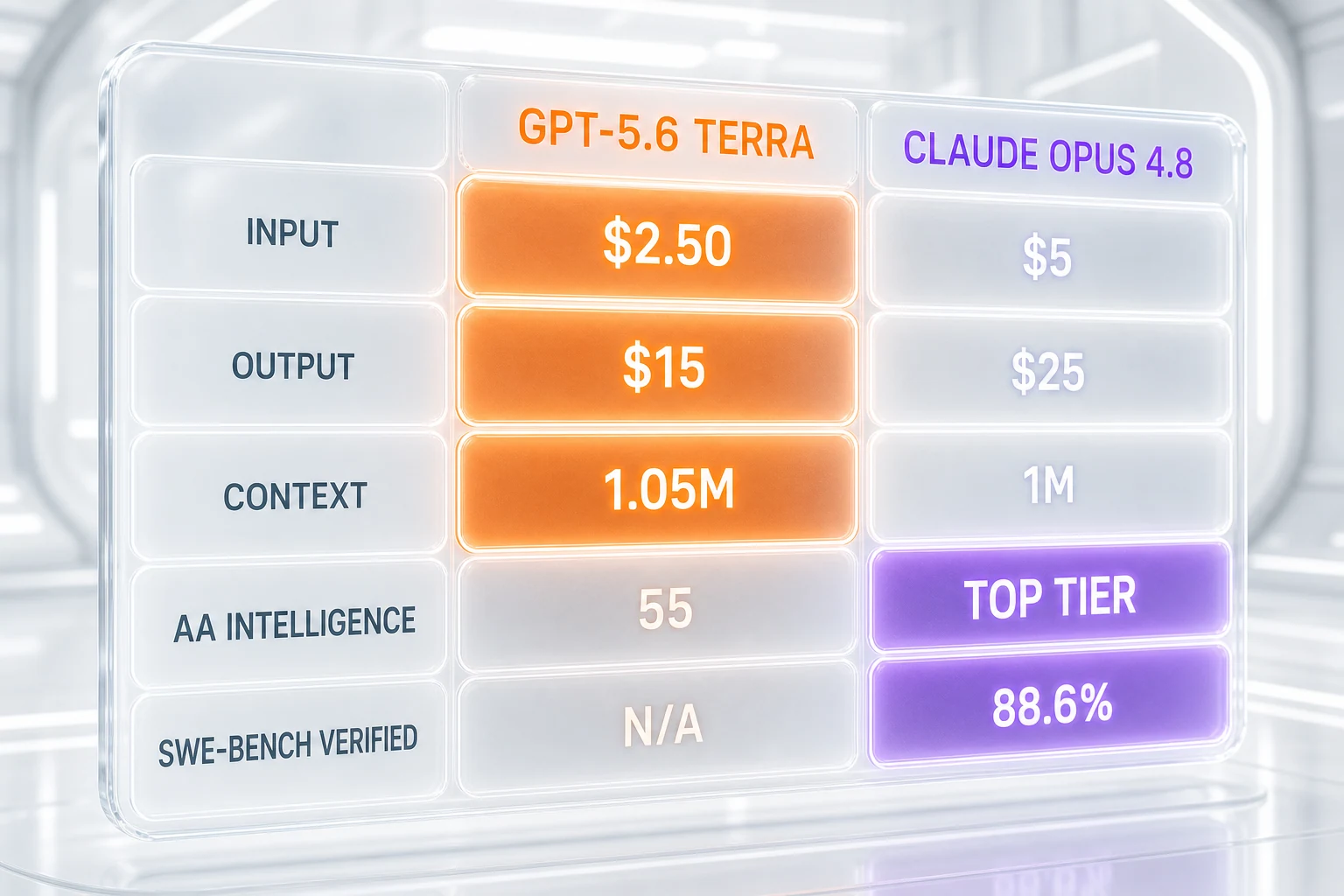
Here is the head-to-head across the dimensions that drive the decision. We only fill a cell with a number when a credible source published a comparable one; where a model was never submitted to a benchmark, the cell reads "N/A" and the edge goes to the model that has a verified result.
| Dimension | GPT-5.6 Terra | Claude Opus 4.8 | Edge |
|---|---|---|---|
| Input price (per million tokens) | $2.50 | $5 | GPT-5.6 Terra |
| Output price (per million tokens) | $15 | $25 | GPT-5.6 Terra |
| Cached input price (per million tokens) | $0.25 | $0.50 | GPT-5.6 Terra |
| Cost per task (Artificial Analysis) | ~$0.55 | N/A (not published) | GPT-5.6 Terra |
| Context window | 1,050,000 tokens | 1,000,000 tokens | GPT-5.6 Terra |
| Knowledge cutoff | February 16, 2026 | January 2026 | GPT-5.6 Terra |
| Max output tokens | 128,000 | 128,000 | Tie |
| SWE-bench Verified (vals.ai, independent) | N/A (not submitted) | 88.6% | Claude Opus 4.8 |
| Artificial Analysis Intelligence Index | 55 | Top tier (about 56 to 61, config-dependent) | Claude Opus 4.8 |
| LMArena Elo (Thinking, independent) | N/A (not charted) | ~1,482 | Claude Opus 4.8 |
| Computer use (agentic, independent) | N/A | ~84% | Claude Opus 4.8 |
Count the edges and the split is almost symmetrical: Terra takes price, cost per task, context, and freshness; Opus 4.8 takes verified coding, intelligence, human-preference ranking, and computer use; max output is a tie. That is the whole comparison in one table — Terra wins the money column, Opus wins the capability column, and neither sweeps.
Pros and Cons
GPT-5.6 Terra — Pros
- Half the price of Opus 4.8 on input and cached input, and 60% on output — $2.50, $0.25, and $15 per million tokens
- Roughly $0.55 per task on Artificial Analysis's workload mix, strong value for high-volume business work
- Larger 1,050,000-token context window and a fresher February 16, 2026 knowledge cutoff
- Solid independent scores: an Artificial Analysis Intelligence Index of 55 and an AA Coding Agent Index of 77
- Positioned by OpenAI as GPT-5.5-competitive at about half the cost, which fits the everyday-automation sweet spot
GPT-5.6 Terra — Cons
- No submitted score on independent SWE-bench Verified, so its top-end coding cannot be verified the way Opus's can
- Intelligence Index of 55 sits below Opus 4.8's top-tier range on the same independent scale
- Not charted on LMArena, so there is no independent human-preference Elo to point to
- Brand new — general availability July 9, 2026 — so the long-run independent track record is still thin
Claude Opus 4.8 — Pros
- Independently verified 88.6% on SWE-bench Verified (vals.ai), among the highest measured coding scores available
- Top-tier Artificial Analysis Intelligence Index and an LMArena Thinking Elo of about 1,482
- Roughly 84% on independent computer-use evaluations, one of the strongest agentic models for browser and desktop work
- Optional Fast Mode for latency-critical work, plus effort controls that trade reasoning depth against cost
- Tighter instruction-following and more reliable self-checking in sustained production use
Claude Opus 4.8 — Cons
- Twice Terra's input price and about 1.7 times its output price — $5 and $25 per million tokens
- A newer tokenizer produces roughly 30% more tokens for the same text, which can widen the effective cost gap further
- Overkill and expensive for high-volume, everyday workloads where a value tier already clears the bar
- Slightly smaller 1,000,000-token context and an older January 2026 knowledge cutoff than Terra
When to Pick Each Model
Pick GPT-5.6 Terra when
- You are running high-volume production traffic where halving the token price decides whether the unit economics work
- Your workload is everyday business automation — customer support, document processing, summarization — rather than the hardest frontier problems
- You need the largest context window of the two, or the freshest training data, for long-document or recent-events work
- You want strong, independently benchmarked general intelligence at a value-tier price and can accept a self-reported rather than verified coding number
- You are already comparing value tiers and want to weigh it against rivals like Grok 4.5 at $2 and $6 per million tokens
Pick Claude Opus 4.8 when
- The task is genuinely hard — long-horizon reasoning, gnarly multi-file refactors, or work where the last few points of verified coding capability change the outcome
- You need a coding result you can actually verify, not just a vendor-reported one, before you trust it in production
- The job leans on agentic computer use, where Opus 4.8's roughly 84% independent score is a genuine advantage
- You want the top-tier intelligence and human-preference ranking, and the budget can absorb twice the token price
- You are standardizing on one flagship and want the model with the deepest independent track record of the pair
The most sophisticated answer, as usual, is "both, by routing." Send the bulk of your traffic to Terra and escalate only the hardest or highest-stakes sub-tasks to Opus 4.8, the same default-and-escalate pattern we recommend inside the Anthropic family in Claude Sonnet 5 vs Claude Opus 4.8. For more cross-vendor context on where the Anthropic flagship lands, see Claude Opus 4.8 vs Gemini 3.1 Pro and Claude Fable 5 vs Claude Opus 4.8. Independent scores throughout this section come from Artificial Analysis and vals.ai.
Final Verdict
Terra for value and volume; Opus 4.8 for verified capability. There is no single winner, and forcing one would misrepresent the models. GPT-5.6 Terra is half the price of Claude Opus 4.8 on input and cached input, 60% of the price on output, carries a larger 1,050,000-token context window, and posts respectable independent intelligence scores — which makes it the correct default for high-volume, budget-bound, everyday work. Claude Opus 4.8 is the only one of the two with an independently verified coding score (88.6% on SWE-bench Verified), sits in the top tier of intelligence rankings, and leads on agentic computer use, which keeps it the right pick for the hardest and highest-stakes tasks where measured capability has to justify the spend.
We are deliberately not naming an overall winner, because the honest read is a division of labor rather than a knockout: Terra is the better buy for most of the work most teams do, and Opus 4.8 is the more capable and more verifiable model for the work that actually stresses a frontier system. If your bottleneck is budget and throughput, default to Terra. If your bottleneck is the difficulty of the task and you need a number you can trust, reach for Opus 4.8 — and if you run both, route to Terra first and escalate to Opus only where the ceiling earns its price. Read the full GPT-5.6 Terra review and Claude Opus 4.8 review for the per-model detail behind this verdict.
Sources
- OpenAI — GPT-5.6 announcement and tier positioning
- OpenAI — GPT-5.6 model documentation (context, output, cutoff)
- OpenAI — API pricing (Terra input, cached, output rates)
- Anthropic — Claude Opus overview
- Anthropic — pricing documentation (Opus 4.8 rates, tokenizer note, Fast Mode)
- vals.ai — SWE-bench Verified leaderboard (Opus 4.8 88.6%)
- Artificial Analysis — Intelligence Index and cost-per-task data
- LMArena — human-preference Elo leaderboard
Frequently Asked Questions
Is GPT-5.6 Terra cheaper than Claude Opus 4.8?
Yes, substantially. GPT-5.6 Terra costs $2.50 per million input tokens and $15 per million output tokens, while Claude Opus 4.8 costs $5 and $25. That is exactly half the price on input and 60% of the price on output. On cached input the gap is the same two-to-one ratio: $0.25 for Terra against $0.50 for Opus. Artificial Analysis also pegs Terra at roughly $0.55 per task on its standard workload mix. On a pipeline burning tens of millions of tokens a day, that price difference is the single biggest lever in this comparison.
Which is more capable, GPT-5.6 Terra or Claude Opus 4.8?
Claude Opus 4.8, on the independent evidence available. It scores 88.6% on SWE-bench Verified as measured by the third-party evaluator vals.ai, sits in the top tier of the Artificial Analysis Intelligence Index (roughly 56 to 61 depending on configuration), and carries an LMArena Thinking Elo of about 1,482. GPT-5.6 Terra scores a solid 55 on the same intelligence index but has no submitted SWE-bench Verified score and is not charted on LMArena, so its top-end capability cannot be verified the same way. Terra is strong for its tier; Opus 4.8 is the more capable and more verifiable model.
Why does GPT-5.6 Terra have no SWE-bench Verified score?
OpenAI did not submit the GPT-5.6 tiers to SWE-bench Verified, the independent agentic-coding benchmark run by vals.ai, at least not by the time of writing. That is a gap in the public data, not evidence that Terra is weak at coding. OpenAI does report Terra at 87.4% on Terminal-Bench 2.1, but that is a vendor-reported figure on a different benchmark, so it cannot be compared directly against Opus 4.8's independently verified 88.6% on SWE-bench Verified. We leave the Terra SWE-bench cell as "N/A" rather than substitute a number from a different test, because mixing benchmarks is one of the easiest ways to mislead.
Does GPT-5.6 Terra have a bigger context window than Opus 4.8?
Slightly. GPT-5.6 Terra offers a 1,050,000-token context window, while Claude Opus 4.8 offers 1,000,000 tokens — a difference of about 5%. Both are genuine million-token-class models, so for most work the practical difference is small; either can hold very large documents or long agent histories. Terra also has a marginally fresher knowledge cutoff, February 16, 2026 against Opus 4.8's January 2026. Both models cap output at 128,000 tokens, so on that dimension they are tied.
Is Claude Opus 4.8 worth twice the price of GPT-5.6 Terra?
It depends entirely on the task. For high-volume, everyday business work — support, document processing, routine automation — Terra clears the bar at half the price, and paying double for Opus 4.8 is hard to justify. For the hardest tasks, where the extra verified capability changes whether the job succeeds, Opus 4.8 earns its premium: it is the only one of the two with an independently verified coding score and it leads on agentic computer use. The rational play for many teams is to route the bulk of traffic to Terra and pay for Opus 4.8 selectively on the sub-tasks that actually need the ceiling.
What does "GPT-5.5-competitive at half the cost" mean for this comparison?
OpenAI positions GPT-5.6 Terra as roughly matching GPT-5.5's capability at about half the price. That framing is useful here because we have already benchmarked Claude Opus 4.8 against GPT-5.5 directly. On SWE-bench Verified, GPT-5.5 scores 82.6% to Opus 4.8's 88.6%. If Terra genuinely lands near GPT-5.5 on capability, that roughly six-point independent gap is a reasonable proxy for the Opus-versus-Terra coding gap. Treat that as an inference from OpenAI's own positioning rather than a measured Terra result, since Terra itself has no independent SWE-bench Verified score.
Which model is better for high-volume production?
GPT-5.6 Terra, in most cases. At high volume the two-to-one price difference dominates, and Terra's independent intelligence and coding-agent scores are more than enough for everyday business workloads. The standard playbook is to send the majority of requests to Terra and escalate only the hardest or most sensitive sub-tasks to Claude Opus 4.8. This is the same default-and-escalate architecture we recommend within the Anthropic family, where Claude Sonnet 5 handles volume and Opus 4.8 takes the exceptions — the pattern generalizes cleanly across vendors as long as your prompts are portable.
Which is better for agentic coding and computer use?
Claude Opus 4.8 on the independent evidence. It posts 88.6% on SWE-bench Verified and roughly 84% on independent computer-use evaluations, making it one of the strongest agentic models available for driving browsers, terminals, and desktops. GPT-5.6 Terra is built for agentic work too — it carries an Artificial Analysis Coding Agent Index of 77 and OpenAI reports 87.4% on Terminal-Bench 2.1 — but those are respectively an aggregate index and a vendor-reported figure, not an independently verified SWE-bench result. For agentic tasks where reliability has to be provable, Opus 4.8 is the safer pick; for high-volume agentic automation on a budget, Terra is compelling.
Do GPT-5.6 Terra and Claude Opus 4.8 have the same context window?
Nearly. GPT-5.6 Terra has a 1,050,000-token context window and Claude Opus 4.8 has 1,000,000 tokens, so Terra leads by about 5%. Both handle text and image inputs and return text; neither produces images natively, though both can call an image-generation tool. Both cap output at 128,000 tokens. The more meaningful specification differences are Terra's fresher February 2026 knowledge cutoff versus Opus's January 2026, and of course the pricing and verified-capability gaps that define this comparison.
What is the Artificial Analysis Intelligence Index for each model?
Artificial Analysis gives GPT-5.6 Terra an Intelligence Index of 55. It places Claude Opus 4.8 in the top tier, but the exact figure is configuration-dependent — roughly 56 on Artificial Analysis's model page and about 61 on its leaderboard, depending on the reasoning setting used. That is why we describe Opus 4.8 as top-tier rather than citing one precise number: the honest reading of the data is a range, not a point. Even the low end of that range sits above Terra's 55, so Opus leads on this independent measure, but by a modest margin at the bottom of its range.
How do these two compare to OpenAI's GPT-5.6 Sol?
GPT-5.6 Terra is OpenAI's balanced value tier; GPT-5.6 Sol is its flagship tier in the same generation, aimed at the hardest problems. So if you are weighing Terra against Claude Opus 4.8 and conclude you need more capability than the value tier offers, the OpenAI-native step up is Sol rather than a bigger Terra. Sol carries a higher Artificial Analysis Intelligence Index of 59 and a top-ranked Coding Agent Index, at a higher price of $5 and $30 per million tokens. Our GPT-5.6 Sol review covers where it lands against the flagship field.
Should I switch my whole pipeline from Opus 4.8 to Terra?
Switch the bulk of it, not all of it. If you have been running everything on Claude Opus 4.8 out of habit, moving the high-volume, non-critical portion to GPT-5.6 Terra typically halves your token cost while giving up verified top-end capability only on those tasks — a trade most teams should take for everyday work. Keep Opus 4.8 on the hardest and highest-stakes paths, where its independently verified coding score and computer-use lead actually matter. Because both models expose standard chat-completion-style APIs, moving a route between them is mostly a model-string and prompt-portability exercise, so you can migrate gradually and measure quality as you go rather than committing all at once.
Our Verdict
Split decision, no overall winner. GPT-5.6 Terra wins on price (half of Opus 4.8 on input and cached input, 60% on output), cost per task (about $0.55 on Artificial Analysis's workload mix), the larger 1,050,000-token context window, and knowledge freshness, which makes it the rational default for high-volume, budget-bound work. Claude Opus 4.8 wins on independently verified capability: 88.6% on SWE-bench Verified (vals.ai) where Terra has no submitted score, a top-tier Artificial Analysis Intelligence Index, an LMArena Thinking Elo near 1,482, and roughly 84% on agentic computer use. Pick Terra for volume and value; pick Opus 4.8 for the hardest tasks where measured capability must justify the spend.
Choose GPT-5.6 Terra
OpenAI's balanced GPT-5.6 tier — GPT-5.5-competitive quality at two times lower cost, with a 1.05M-token context and the full agentic toolbox.
Try GPT-5.6 Terra →Choose Claude Opus 4.8
Anthropic's flagship model for agentic coding, computer use, and multi-agent orchestration.
Try Claude Opus 4.8 →Frequently Asked Questions
Is GPT-5.6 Terra better than Claude Opus 4.8?
Split decision, no overall winner. GPT-5.6 Terra wins on price (half of Opus 4.8 on input and cached input, 60% on output), cost per task (about $0.55 on Artificial Analysis's workload mix), the larger 1,050,000-token context window, and knowledge freshness, which makes it the rational default for high-volume, budget-bound work. Claude Opus 4.8 wins on independently verified capability: 88.6% on SWE-bench Verified (vals.ai) where Terra has no submitted score, a top-tier Artificial Analysis Intelligence Index, an LMArena Thinking Elo near 1,482, and roughly 84% on agentic computer use. Pick Terra for volume and value; pick Opus 4.8 for the hardest tasks where measured capability must justify the spend.
Which is cheaper, GPT-5.6 Terra or Claude Opus 4.8?
GPT-5.6 Terra is priced at $2.5 in / $15 out per M tokens. Claude Opus 4.8 is priced at $5 in / $25 out per M tokens. Check the pricing comparison section above for a full breakdown.
What are the main differences between GPT-5.6 Terra and Claude Opus 4.8?
The key differences span across 11 features we compared. For Input price (per million tokens), GPT-5.6 Terra offers $2.50 while Claude Opus 4.8 offers $5.00. For Output price (per million tokens), GPT-5.6 Terra offers $15.00 while Claude Opus 4.8 offers $25.00. For Cached input price (per million tokens), GPT-5.6 Terra offers $0.25 while Claude Opus 4.8 offers $0.50. See the full feature comparison table above for all details.