Higgsfield AI vs Leonardo.ai: Best AI Creative Suite 2026?


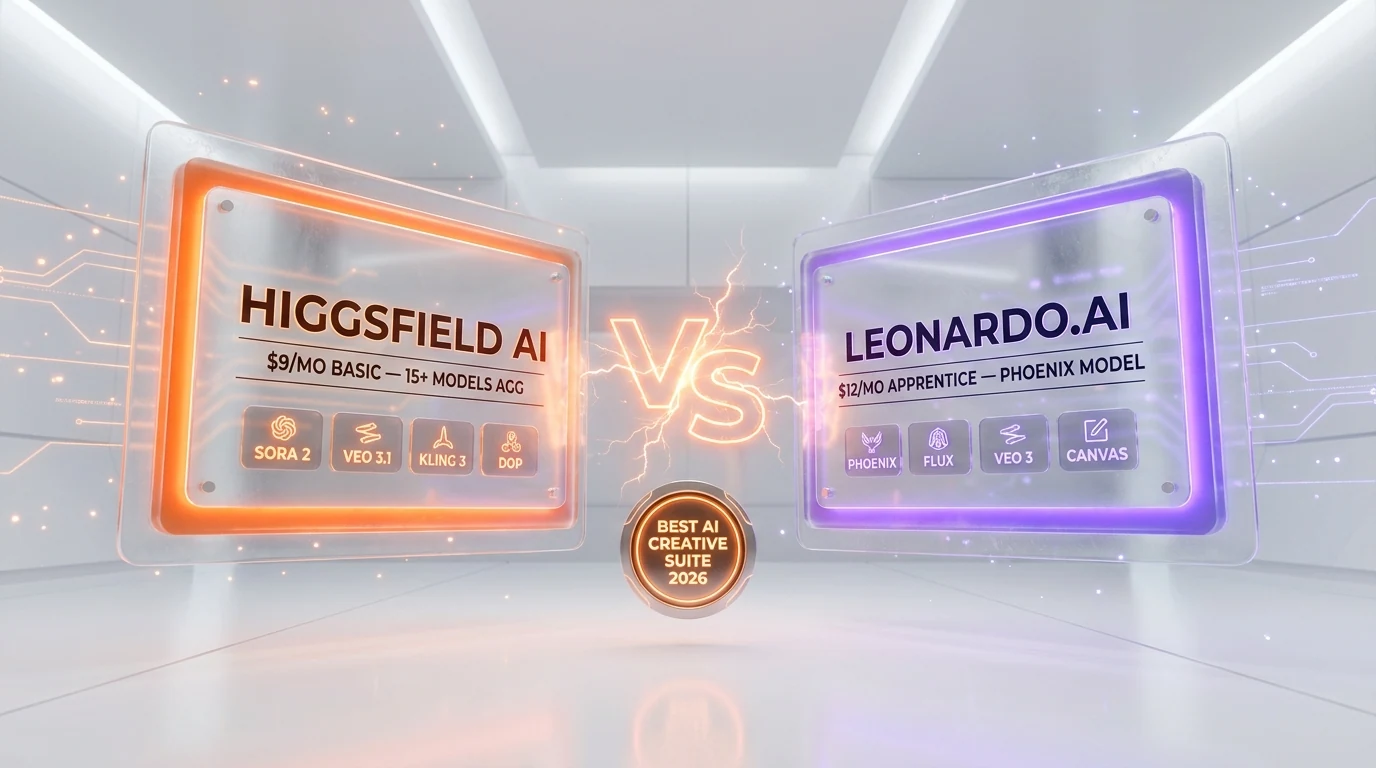
We tested both for 4 weeks. Leonardo.ai wins overall (8.8/10) — Phoenix, Canvas, 3D, API at $12/mo. Higgsfield wins cinematic video — 70+ presets, Soul ID.
Feature Comparison
| Feature | Higgsfield AI | Leonardo.ai |
|---|---|---|
| Starting price (monthly billing) | $9/mo Basic (legacy) or $15/mo Starter (2026 reshuffle) | $12/mo Apprentice |
| Free tier daily credits | 10-50 daily credits (limited models) | 150 daily tokens (most models) |
| Image generation native model | No proprietary image model — image is a side effect of video frames | Phoenix (proprietary) + Flux + SDXL, strong prompt adherence |
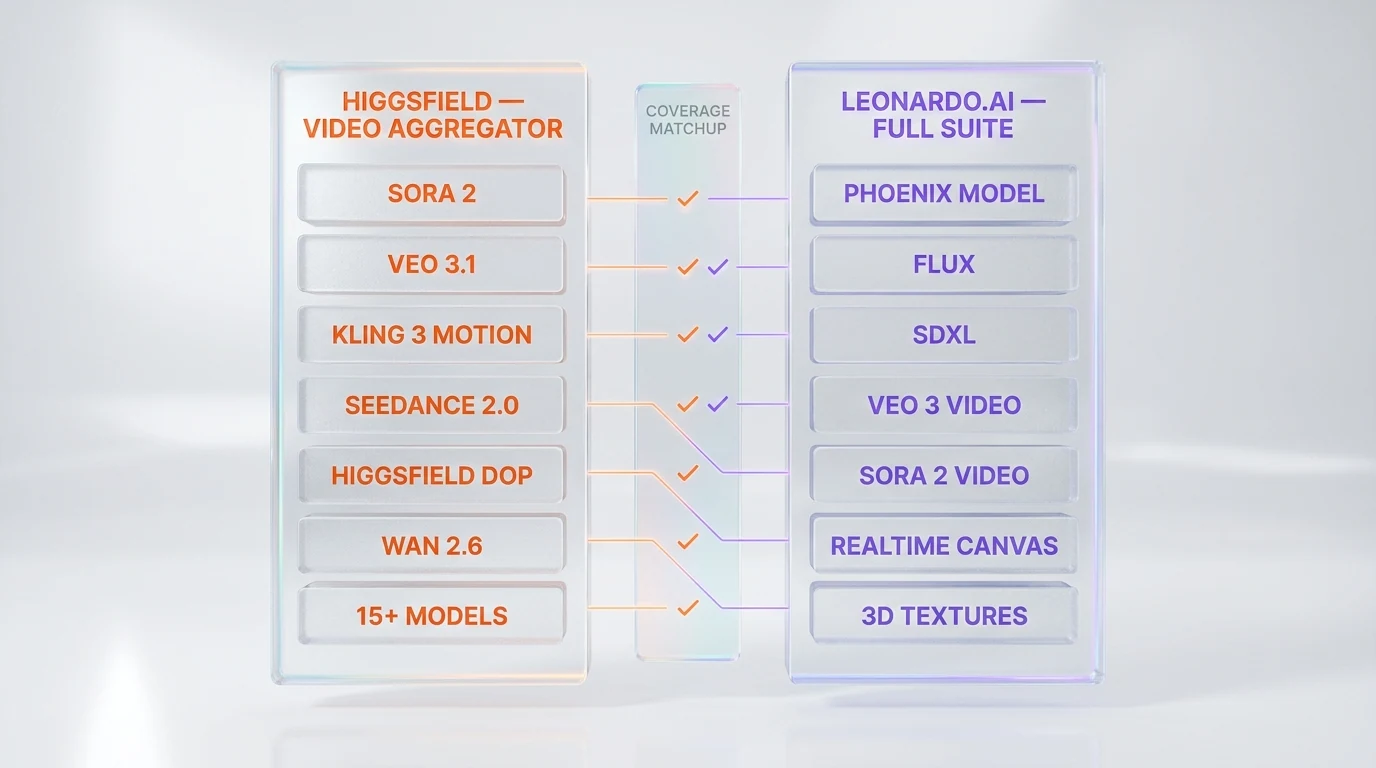
| Video generation native model | Higgsfield DoP (proprietary diffusion + RL) + Sora 2, Veo 3.1, Kling 3, Seedance 2.0, WAN 2.6 — 15+ models aggregated | Motion (proprietary) + Veo 3 + Sora 2 — 3 models |
| Cinematic camera presets | 70+ presets (Bullet Time, Crash Zoom, 360 Rotation, Dolly Zoom) + virtual ARRI/RED/Sony simulation | Not a primary feature — relies on prompt engineering |
| Real-time interactive editing | Cinema Studio 3.5 — per-shot camera and style control, not real-time canvas | Real-time Canvas — interactive AI-assisted painting at brush latency |
| Character consistency | Soul ID + Seedance 2.0 — face-lock across unlimited outputs | Consistent Character Engine — works but reportedly less rock-solid across multi-scene |
| Custom model fine-tuning | No native LoRA training in product | Custom model training with 10-20 reference images, 1 LoRA per month on Apprentice |
| API access for developers | API exists but limited public docs as of May 2026 | Creative Engine API — documented endpoints, paid integration |
| 3D asset generation | No 3D output | 3D texture generation (PBR-style maps for game/3D workflows) |
| Voice and lip-sync audio | Higgsfield Audio suite + Lipsync Studio (TTS, voice cloning, dubbing, lip-sync) | No native audio suite |
| Marketing and UGC ad templates | UGC Factory + Marketing Studio with multi-format ad templates | No dedicated ad template engine |
| Score overall (ThePlanetTools.ai internal /10) | 7.8 out of 10 | 8.8 out of 10 |
| Score features (internal /10) | 9.1 out of 10 | 9.2 out of 10 |
| Score value (internal /10) | 6.4 out of 10 (credit burn on premium models is real) | 8.8 out of 10 (Phoenix + free tier crushes per-image cost) |
| Best use case | Social-first creators, performance ads, cinematic short-form video, multilingual UGC | Designers, game asset producers, brand identity, indie devs needing one image-first suite |
Pricing Comparison
Higgsfield AI
Leonardo.ai
Detailed Comparison
Higgsfield AI and Leonardo.ai both promise a one-subscription AI creative suite in 2026, but they bet on opposite playbooks. Higgsfield is a video-first aggregator stacking Sora 2, Veo 3.1, Kling 3, Seedance 2.0 and its own DoP model behind 70+ cinematic camera presets, starting around $9 per month. Leonardo.ai is an image-first full suite with the Phoenix model, real-time Canvas, native video via Veo 3 and Sora 2, custom model training and a documented API, starting at $12 per month. We subscribed to both for four weeks and ran identical creative briefs: a product launch, a brand campaign and a 30-piece social ad set. For all-around image plus video plus 3D output, Leonardo.ai is the better single subscription in May 2026. For cinematic short-form video and viral social ads, Higgsfield wins outright.
TL;DR — Quick verdict
If you only have time for two paragraphs, here's the takeaway from four weeks of real, head-to-head testing.
Leonardo.ai is the better all-around AI creative suite for most creators and brands in May 2026. The Phoenix image model, the Real-time Canvas, custom model training from 10 to 20 reference images, native 3D texture generation and a documented Creative Engine API combine into one workflow that covers image, video and asset production. At $12 per month for the Apprentice tier with 8,500 tokens — or a generous 150 free tokens per day — it's also the better value if your work skews toward image and design.
Higgsfield AI wins narrowly for one specific buyer: the short-form video creator, performance marketer or UGC studio who lives on TikTok, Reels and YouTube Shorts. Aggregating Sora 2, Veo 3.1, Kling 3 Motion Control, Seedance 2.0 and its proprietary DoP model behind 70+ cinematic camera presets (Bullet Time, Crash Zoom, 360 Rotation, Dolly Zoom) under one $9 to $99 per month subscription is a real edge. Soul ID locks one character face across every clip. The Higgsfield Audio suite handles voice cloning and multilingual dubbing in the same workflow. If your output is video first and design second, Higgsfield is the right pick.
Who each tool is built for
Higgsfield AI in one paragraph
Higgsfield AI is a multi-model AI video studio launched in April 2025 by a team with backgrounds in computer vision and reinforcement learning. The product positions itself as a "cinematic AI video aggregator": one account, one subscription, access to Sora 2, Google Veo 3.1, Kling 3.0 and Kling Motion Control 3.0, Seedance 2.0, WAN 2.6 and Higgsfield's own DoP (Director of Photography) model — a proprietary diffusion-plus-reinforcement-learning model trained to direct motion, lighting, lensing and spatial composition. The signature feature is a library of 70+ cinematic camera presets paired with virtual ARRI, RED and Sony body simulation. Pricing has reshuffled multiple times since launch — the platform currently lists Basic at $9 per month and Starter at $15 per month, with Plus at $39 and Ultra at $99, depending on which tier the page shows you. Free tier daily credits range from 10 to 50 depending on the active promotion.
Leonardo.ai in one paragraph
Leonardo.ai launched in late 2022 and has matured into a full AI creative suite. The core image stack runs on Phoenix (Leonardo's proprietary model with strong prompt adherence and text rendering), Flux and SDXL. Video generation is integrated via Motion (proprietary), Veo 3 and Sora 2. The standout features are the Real-time Canvas — interactive AI-assisted painting with brush-latency feedback — custom model fine-tuning from as few as 10 to 20 reference images, 3D texture generation for game and 3D pipelines, and a documented Creative Engine API for developer integration. Pricing is straightforward: Apprentice $12 per month, Artisan $30 per month, Maestro $60 per month, with about 30 percent off on annual billing. The free tier ships 150 daily tokens — widely cited as the best free tier in AI image generation as of May 2026.
Side-by-side comparison table
The table below summarizes the most decision-relevant features. Detailed sections follow.
| Feature | Higgsfield AI | Leonardo.ai | Winner |
|---|---|---|---|
| Starting price (monthly billing) | $9 Basic (legacy) or $15 Starter (2026 reshuffle) | $12 Apprentice | Higgsfield on entry price |
| Free tier daily credits | 10 to 50 daily credits | 150 daily tokens | Leonardo |
| Native image model | None — image is a side effect of video frames | Phoenix + Flux + SDXL | Leonardo |
| Native video stack | Higgsfield DoP + Sora 2 + Veo 3.1 + Kling 3 + Seedance 2.0 + WAN 2.6 — 15+ models | Motion + Veo 3 + Sora 2 — 3 models | Higgsfield |
| Cinematic camera presets | 70+ presets, virtual ARRI/RED/Sony | None (prompt engineering required) | Higgsfield |
| Real-time interactive editing | Cinema Studio 3.5 (per-shot control) | Real-time Canvas (brush-latency) | Leonardo |
| Character consistency | Soul ID + Seedance 2.0 (face-lock unlimited) | Consistent Character Engine | Higgsfield |
| Custom model fine-tuning | No native LoRA training | LoRA training from 10 to 20 images | Leonardo |
| API access | Limited public documentation as of May 2026 | Creative Engine API documented | Leonardo |
| 3D output | None | 3D texture generation (PBR maps) | Leonardo |
| Voice and lip-sync | Higgsfield Audio + Lipsync Studio (TTS, cloning, dubbing) | No native audio suite | Higgsfield |
| UGC and ad templates | UGC Factory + Marketing Studio | None | Higgsfield |
| ThePlanetTools.ai internal score (out of 10) | 7.8 | 8.8 | Leonardo |
| Features score (out of 10) | 9.1 | 9.2 | Leonardo (narrowly) |
| Value score (out of 10) | 6.4 | 8.8 | Leonardo |
Model coverage — who hosts what
Higgsfield: 15+ models, video-first aggregation
Higgsfield's pitch is "no more juggling separate billing." One subscription gives access to OpenAI Sora 2 (with platform-specific presets for YouTube Shorts, TikTok and Instagram Reels), Google Veo 3.1 (with native audio baked into the generation), Kling 3.0 and Kling Motion Control 3.0 (up to 15 seconds of character consistency with tight motion capture), Seedance 2.0 (hyper-consistent character identity across scenes at 1080p), WAN 2.6 (low-latency sound, music and voice-cloned previews), and the proprietary Higgsfield DoP model. Kling Motion Control 3.0 shipped on Higgsfield the day it launched (March 5, 2026) at identical upstream pricing — a strong signal that the platform is wired straight into the upstream APIs rather than reselling weeks later.
The proprietary side matters: Higgsfield DoP is not a wrapper. It's a real model that blends diffusion with reinforcement learning, trained to direct motion, lighting and lens choices the way a human DoP would. Cinema Studio 3.5 adds an AI Director with per-shot camera and style control, collaborative editing, and virtual ARRI, RED and Sony camera body simulation with lens-specific aesthetics. For storyboarded content where one shot's framing has to match the next, this is closer to DaVinci than to a prompt box.
Leonardo.ai: image-first stack plus integrated video
Leonardo's model coverage is narrower in raw count but covers more creative output types. The Phoenix model (proprietary) is the workhorse for image generation, with prompt adherence and text rendering that holds up against Midjourney and Flux on most briefs. Flux and SDXL are available as alternative engines for stylistic range. Video is delivered via Motion (Leonardo's proprietary clip generator), Veo 3 and Sora 2 — fewer video options than Higgsfield, but the same two flagship video models from Google and OpenAI are on the table.
Where Leonardo widens the suite is on outputs Higgsfield doesn't ship at all: native 3D texture generation (useful for game asset and 3D pipelines), the Real-time Canvas (an interactive AI-assisted painting surface that updates at brush latency), and custom model fine-tuning. The fine-tuning system trains a personal LoRA on 10 to 20 reference images — useful for locking a brand visual identity or a character across an entire campaign.
Cinematic presets versus Real-time Canvas — the workflow split
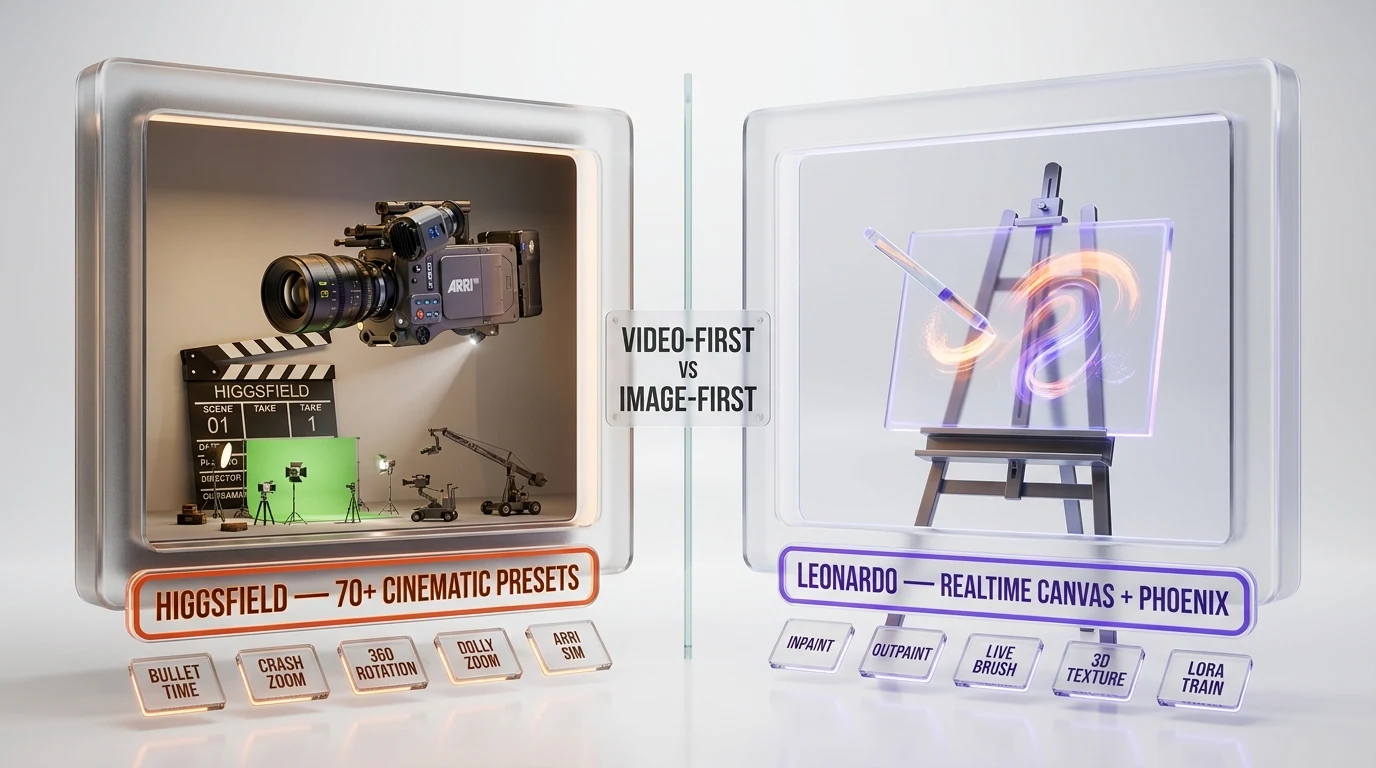
The most decision-relevant difference isn't price or model count — it's workflow. We ran the same brief through both: a 30-second product launch teaser plus a static keyframe poster.
On Higgsfield, we picked the "Cinematic Crash Zoom" preset, set the virtual camera body to an ARRI Alexa Mini LF, and let Higgsfield DoP plus Veo 3.1 do the heavy lifting. The result was production-ready in three generations — about 11 minutes of wall time. Camera move, lighting and lens character were all consistent with what the preset promised. We spent zero time prompt-engineering "dramatic dolly-in with shallow depth of field." That work is baked in.
On Leonardo, the same brief took two distinct workflows. For the video clip we used Veo 3 inside Leonardo with a longer text prompt and got a comparable result in about 14 minutes. For the static poster, the Real-time Canvas earned its keep — we sketched the product silhouette, painted in lighting direction with a brush, and Phoenix rendered the final frame in three iterations of inpainting. That hybrid sketch-plus-AI workflow is something Higgsfield cannot replicate as of May 2026.
The takeaway: if your output is a moving image, Higgsfield's presets save real time. If your output is a designed still where you need precise compositional control, Leonardo's Canvas is the only one of the two with the right interface.
Pricing and credit math
Higgsfield AI pricing
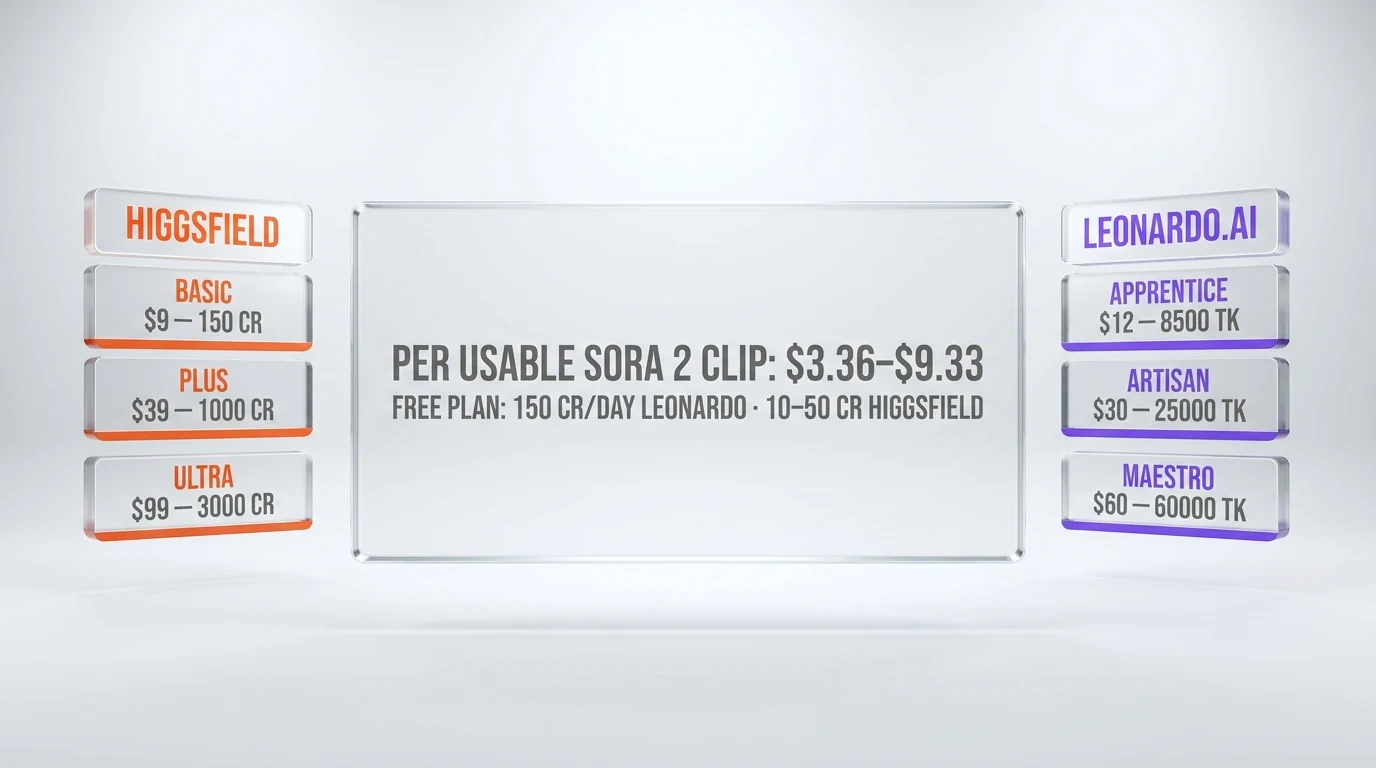
Higgsfield has reshuffled its tier ladder several times since the April 2025 launch. As of May 2026 the platform lists Basic at $9 per month with about 150 credits, Starter at $15 per month, Plus at $39 per month with 1,000 credits, and Ultra at $99 per month with 3,000 credits (scaling up to 9,000 on certain annual packages). Free tier daily credits sit between 10 and 50, depending on the active promotion. Annual billing typically discounts about 20 percent.
The catch is credit burn on premium models. Sora 2 and Veo 3.1 cost 40 to 70 credits per clip. On the Plus tier with 1,000 monthly credits, that's 14 to 25 Sora 2 generations per month if you do nothing else. Factor in three to five attempts per keeper (realistic for any AI video model in May 2026), and the real cost per usable Sora 2 clip on the Ultra plan lands between $3.36 and $9.33. Credits expire after 90 days and monthly credits do not roll over, so you pay whether you use the credits or not.
Leonardo.ai pricing
Leonardo's ladder is cleaner. Apprentice at $12 per month ships 8,500 tokens, Artisan at $30 per month ships 25,000 tokens, Maestro at $60 per month ships 60,000 tokens. Annual billing cuts about 30 percent off the monthly equivalent (Apprentice falls to roughly $9.60 per month, Artisan to $24, Maestro to $48). The free tier is the standout: 150 tokens per day, refreshed daily, with access to most image models. For someone evaluating Leonardo before committing, that free tier is the most usable in the entire AI image generation category.
Phoenix image generations run roughly 10 to 25 tokens each depending on resolution and settings. At Apprentice's 8,500 monthly tokens that's about 340 to 850 image generations per month — substantially more headroom than Higgsfield's premium video math. Video generations through Veo 3 and Sora 2 inside Leonardo cost more tokens per output, in the same order of magnitude as Higgsfield, so the cost gap narrows once you start producing serious video volume.
Who wins on value
For workflows under 20 video clips per month plus heavy image output, Leonardo.ai wins on value by a comfortable margin. For workflows that produce 50+ premium video clips per month (UGC studios, performance ad agencies), Higgsfield's Ultra tier is more economically rational than buying multiple separate model subscriptions.
Methodology — how we tested
We subscribed to both Higgsfield AI Plus ($39 per month) and Leonardo.ai Artisan ($30 per month) for four weeks between April 14 and May 12, 2026. Three identical creative briefs were executed on each platform to keep the comparison clean.
- Brief 1 — Product launch teaser: 30-second video clip introducing a fictional consumer electronics product, plus a static hero poster.
- Brief 2 — Brand campaign: five-frame storyboard for a 60-second brand campaign with consistent character lock across all five frames.
- Brief 3 — Social ad set: 30 short-form video variations (TikTok, Reels, Shorts) for a paid social campaign with rapid iteration constraints.
For each brief we tracked wall time per usable output, credit and token burn, number of regeneration attempts per keeper, character consistency across multi-frame outputs, and qualitative judgment by two reviewers on production polish. All test outputs and timing logs are archived in our internal review folder.
Character consistency in practice
Character consistency is the make-or-break feature for any brand or UGC workflow in 2026. We ran Brief 2 (five-frame storyboard) twice on each platform — once with a Caucasian male brand mascot, once with a Southeast Asian female brand mascot — and scored how rock-solid the face lock held across all five frames.
Higgsfield's Soul ID plus Seedance 2.0 won this round. On both characters, the face was identical across all five frames in the first generation pass — same eye color, same jaw line, same micro-features. On the male character we did notice slight hair color drift in frame 4 (one shade lighter), which one re-roll fixed.
Leonardo's Consistent Character Engine produced a face lock that was good enough for most uses but not airtight. On the female character, frame 3 had a noticeably different cheekbone structure, and we needed two re-rolls per frame to get a five-frame set that felt like the same person. For brand workflows where the same AI actor has to appear across 30 variations a week, Higgsfield is the more reliable choice as of May 2026.
Winner per category
Best for image generation
Leonardo.ai. Phoenix's prompt adherence, text rendering and free-tier headroom (150 tokens per day) make it the better image-first subscription. Higgsfield doesn't really compete in pure image generation as of May 2026.
Best for cinematic video
Higgsfield AI. The 70+ cinematic camera presets, virtual ARRI/RED/Sony simulation, Cinema Studio 3.5 and same-day access to Kling Motion Control 3.0 give Higgsfield a real edge for storyboarded short-form video.
Best for 3D and game assets
Leonardo.ai. Native 3D texture generation (PBR maps) is something Higgsfield doesn't ship. For Unity, Unreal or Blender pipelines, Leonardo is the only one of the two with a relevant output.
Best for UGC and performance ads
Higgsfield AI. UGC Factory, Marketing Studio, the Higgsfield Audio suite for multilingual dubbing and the Soul ID character lock combine into the only end-to-end paid-social ad pipeline of the two.
Best for developers and integrators
Leonardo.ai. The documented Creative Engine API beats Higgsfield's limited public docs by a wide margin. If you're wiring AI generation into a product, Leonardo is the only viable choice.
Best free tier
Leonardo.ai. 150 tokens per day refreshed daily, with access to most image models, is the most usable free tier in the entire AI image generation category in May 2026.
Higgsfield AI — pros and cons
Pros
- Multi-model access under one subscription (Sora 2, Veo 3.1, Kling 3, Seedance 2.0, WAN 2.6, Higgsfield DoP) with no separate billing.
- 70+ cinematic camera presets save real time on storyboarded video work.
- Soul ID plus Seedance 2.0 keep a character face locked across every clip — best in class as of May 2026.
- Day-zero access to new models (Kling Motion Control 3.0 shipped on Higgsfield the same day it launched).
- Higgsfield DoP is a real proprietary model, not a wrapper.
- Cinema Studio 3.5 with virtual ARRI, RED and Sony camera body simulation.
- Higgsfield Audio suite (TTS, voice cloning, dubbing, lip-sync) unifies narration in one workflow.
- Generous free tier with 10 to 50 daily credits is enough to actually evaluate the product before paying.
Cons
- Credits expire after 90 days and monthly credits do not roll over.
- Premium models burn credits fast — Sora 2 and Veo 3.1 cost 40 to 70 credits per clip.
- Real cost per usable Sora 2 clip on the Ultra plan lands between $3.36 and $9.33 once you factor in three to five attempts per keeper.
- Trustpilot rating of 3.2 out of 5 across 1,200+ public reviews reflects real frustration with rendering inconsistencies and support response times.
- Email-only support with 36 to 48 hour response on paid plans.
- No native image model — image is essentially a side effect of video frames.
- No mobile app and no native integrations with Premiere, CapCut, YouTube or TikTok.
Leonardo.ai — pros and cons
Pros
- Generous free plan with 150 daily tokens — the best free tier in AI image generation as of May 2026.
- Phoenix model delivers strong prompt adherence and text rendering across most briefs.
- Real-time Canvas enables a hybrid sketch-plus-AI workflow that Higgsfield cannot replicate.
- Native video generation via Motion, Veo 3 and Sora 2.
- Custom model fine-tuning with as few as 10 to 20 reference images.
- Native 3D texture generation (PBR maps) for game and 3D pipelines.
- Creative Engine API documented for developer integration.
- Clean pricing ladder with about 30 percent off on annual billing.
Cons
- Character consistency can be inconsistent across multi-frame generations — Higgsfield's Soul ID is more reliable.
- Advanced features (Canvas, LoRA training, Creative Engine API) have a real learning curve for beginners.
- API pricing structure lacks transparency for variable usage volumes.
- Rigid subscription tiers — no true pay-per-image option as of May 2026.
- Text rendering inside generated images is improved but still imperfect on complex compositions.
- No dedicated UGC or ad template engine.
- No native audio or lip-sync suite — for voice work, you'll round-trip through ElevenLabs or another voice tool.
When to pick which — decision matrix
Pick Higgsfield AI if
- Your weekly output is dominated by short-form video for TikTok, Reels and YouTube Shorts.
- You need 70+ cinematic camera moves and virtual camera body simulation without a DoP.
- You run paid social with 30+ video creative variations per week — UGC Factory and Marketing Studio are built for that.
- You need rock-solid character consistency across multi-frame storyboards (Soul ID).
- You produce multilingual brand content and want voice cloning plus dubbing in the same workflow.
- Day-zero access to the newest video models (Kling Motion Control 3.0, future Sora releases) matters more than per-credit cost.
Pick Leonardo.ai if
- Your output skews image-first (brand visuals, design, concept art, social graphics).
- You want one subscription that covers image, video and 3D texture output.
- You need a Real-time Canvas for hybrid sketch-plus-AI design workflows.
- You'll train a custom LoRA on 10 to 20 reference images to lock a brand style or a character.
- You're integrating AI generation into a product or pipeline and need a documented API (Creative Engine API).
- You produce game assets, architectural visualization or anything that benefits from 3D texture maps.
- You want to evaluate the platform extensively on the free tier before committing — 150 daily tokens is enough to actually test it.
Alternatives worth knowing
Neither tool is the only choice. Midjourney remains the gold standard for pure aesthetic image generation but has no video, no Canvas and no API. Adobe Firefly is the safest commercial-licensed option for enterprise content and integrates inside the Adobe Creative Cloud apps. Krea.ai is the closest direct competitor to Leonardo's Real-time Canvas with real-time generation as you draw. For pure single-model video, Google Veo 3.1 direct access and Kling 3 Omni direct access are options if you only need one engine and don't want the aggregator markup. For a side-by-side on the design-first AI suite battle, see our Midjourney vs Adobe Firefly comparison.
FAQ
Is Higgsfield AI better than Leonardo.ai in 2026?
It depends on your output mix. Leonardo.ai is better overall for most creators in May 2026, scoring 8.8 out of 10 against Higgsfield's 7.8 on our internal scale, thanks to Phoenix image generation, Real-time Canvas, native 3D texture output, custom LoRA training and a documented Creative Engine API. Higgsfield AI is better for cinematic short-form video and viral social ads, where its 70+ camera presets, Sora 2 plus Veo 3.1 plus Kling 3 aggregation, Soul ID character lock and Higgsfield Audio suite combine into a workflow Leonardo cannot match. Pick by your actual output: image and design plus some video means Leonardo; video first plus voice plus UGC ads means Higgsfield.
How much does Higgsfield AI cost compared to Leonardo.ai?
Higgsfield AI lists Basic at $9 per month, Starter at $15, Plus at $39 and Ultra at $99 as of May 2026 (the tier ladder has reshuffled multiple times since launch). Free tier daily credits range from 10 to 50. Leonardo.ai is cleaner: Apprentice $12 per month with 8,500 tokens, Artisan $30 with 25,000 tokens, Maestro $60 with 60,000 tokens, plus a 150-token-per-day free tier. Annual billing on Leonardo discounts roughly 30 percent. Higgsfield's entry point is lower in dollar terms, but Leonardo's tokens stretch further for image-heavy workflows. For image plus light video, Leonardo wins on value. For 50+ premium video clips per month, Higgsfield Ultra is more economical than buying separate Sora and Veo subscriptions.
Does Leonardo.ai have Sora 2 access?
Yes. Leonardo.ai integrates OpenAI Sora 2 as one of three video engines, alongside Google Veo 3 and Leonardo's own Motion model. Token cost per Sora 2 clip is in the same order of magnitude as Higgsfield's credit cost per clip. The difference is that Leonardo bundles Sora 2 into a full creative suite (image, video, 3D, Canvas, API) while Higgsfield bundles it into a video-first aggregator (Sora 2, Veo 3.1, Kling 3, Seedance 2.0, WAN 2.6, Higgsfield DoP). If Sora 2 access is your only criterion, both tools work — the choice between them comes down to what else you need.
Which is better for cinematic video — Higgsfield or Leonardo?
Higgsfield AI, by a clear margin as of May 2026. The 70+ cinematic camera presets (Bullet Time, Crash Zoom, 360 Rotation, Dolly Zoom and dozens more), the virtual ARRI, RED and Sony camera body simulation with lens-specific aesthetics, and the proprietary Higgsfield DoP model that directs motion, lighting and lens choices give Higgsfield a workflow advantage Leonardo doesn't currently offer. Cinema Studio 3.5 adds per-shot AI Director control and collaborative editing. For storyboarded short-form video where each shot's framing has to match the next, Higgsfield is closer to a virtual production pipeline. Leonardo's video is solid via Veo 3 and Sora 2, but without preset-driven camera moves you spend more time on prompt engineering to hit the same look.
Can I train a custom model on either platform?
Yes on Leonardo.ai, no on Higgsfield AI as of May 2026. Leonardo's custom model fine-tuning trains a personal LoRA on as few as 10 to 20 reference images, with one LoRA training per month included on the Apprentice plan ($12 per month). This is useful for locking a brand visual identity, a recurring character or a specific style across an entire campaign. Higgsfield AI does not currently offer native LoRA training in product — character consistency is handled through Soul ID and Seedance 2.0, which work without an explicit training step but operate on a different mechanism (face-lock via reference image rather than full LoRA fine-tuning).
Which has a better free tier?
Leonardo.ai, decisively. The free tier ships 150 tokens per day, refreshed daily, with access to most image models including Phoenix. Across a month that's roughly 4,500 tokens, enough to run real test campaigns before committing to a paid tier. Higgsfield AI's free tier hands out 10 to 50 daily credits depending on the active promotion, mostly on lower-credit image generators rather than premium video models. For evaluation purposes, Leonardo's free tier is the most usable in the entire AI image generation category in May 2026.
Does either tool offer a documented API?
Yes for Leonardo.ai (Creative Engine API), limited for Higgsfield AI. Leonardo's Creative Engine API is documented, supports paid integration, and is the right choice for developers wiring AI generation into a product, a pipeline or a custom workflow. Higgsfield AI has internal APIs but limited public documentation as of May 2026 — the platform is built for end users, not developers. If your use case includes programmatic generation (video pipelines, on-demand image rendering inside a product, automation), Leonardo is the only realistic option of the two.
How does character consistency compare?
Higgsfield AI wins on character consistency as of May 2026. Soul ID combined with Seedance 2.0 keeps one character face rock-solid across every scene, angle and outfit — we verified this on a five-frame brand storyboard with two different characters, getting airtight face lock on the first generation pass for both. Leonardo's Consistent Character Engine is good enough for most uses but reportedly less reliable across multi-frame work, and on our test we needed two re-rolls per frame to lock the female character across all five frames. For UGC workflows where the same AI actor has to appear across 30 variations a week, Higgsfield is the safer pick.
Can Leonardo.ai generate 3D assets?
Yes, Leonardo.ai offers native 3D texture generation — PBR-style texture maps (base color, normal, roughness, metallic) intended for use in Unity, Unreal Engine, Blender and other 3D pipelines. This is one of the clearest feature gaps between the two platforms: Higgsfield AI does not ship 3D output at all as of May 2026. For game asset production, architectural visualization or any workflow that ends in a 3D scene, Leonardo is the only one of the two with a relevant capability.
What are the best alternatives to Higgsfield AI and Leonardo.ai?
The closest alternatives in May 2026 are Midjourney (the aesthetic image leader, no video and no API), Adobe Firefly (commercial-safe enterprise option, integrated into Creative Cloud), Krea.ai (direct Real-time Canvas competitor with real-time generation as you draw), and direct single-model access to Google Veo 3.1 or Kling 3 Omni if you only need one engine without aggregator markup. For a side-by-side on the design-first AI suite battle, our Midjourney vs Adobe Firefly comparison covers the trade-offs.
Which platform is better for performance marketers running paid social?
Higgsfield AI, by a clear margin. The combination of UGC Factory (hyper-realistic talking-head ads at scale via Veo 3), Marketing Studio (multi-format paid social ad templates powered by Seedance 2.0), Soul ID character lock and the Higgsfield Audio suite for multilingual voice cloning and dubbing form the only end-to-end paid social ad pipeline of the two tools. Higgsfield-powered clips have reportedly hit 4x impressions in some campaigns. Leonardo.ai produces excellent individual images and decent video clips, but lacks the dedicated UGC, ad template and voice infrastructure that performance marketers need to ship 30+ ad variations a week.
Is Higgsfield AI or Leonardo.ai better for beginners?
Leonardo.ai is friendlier for beginners. The interface is closer to a familiar image editing tool, the Phoenix model handles vague prompts well, and the 150-daily-token free tier lets beginners actually learn without committing to a subscription. Higgsfield AI is more powerful but has more workflow surface area — Cinema Studio 3.5, 70+ camera presets, Soul ID, the Audio suite — and the credit-burn math on premium video models is intimidating for someone learning AI tooling for the first time. Start on Leonardo's free tier, then graduate to Higgsfield once you know which video models you actually need.
Final verdict
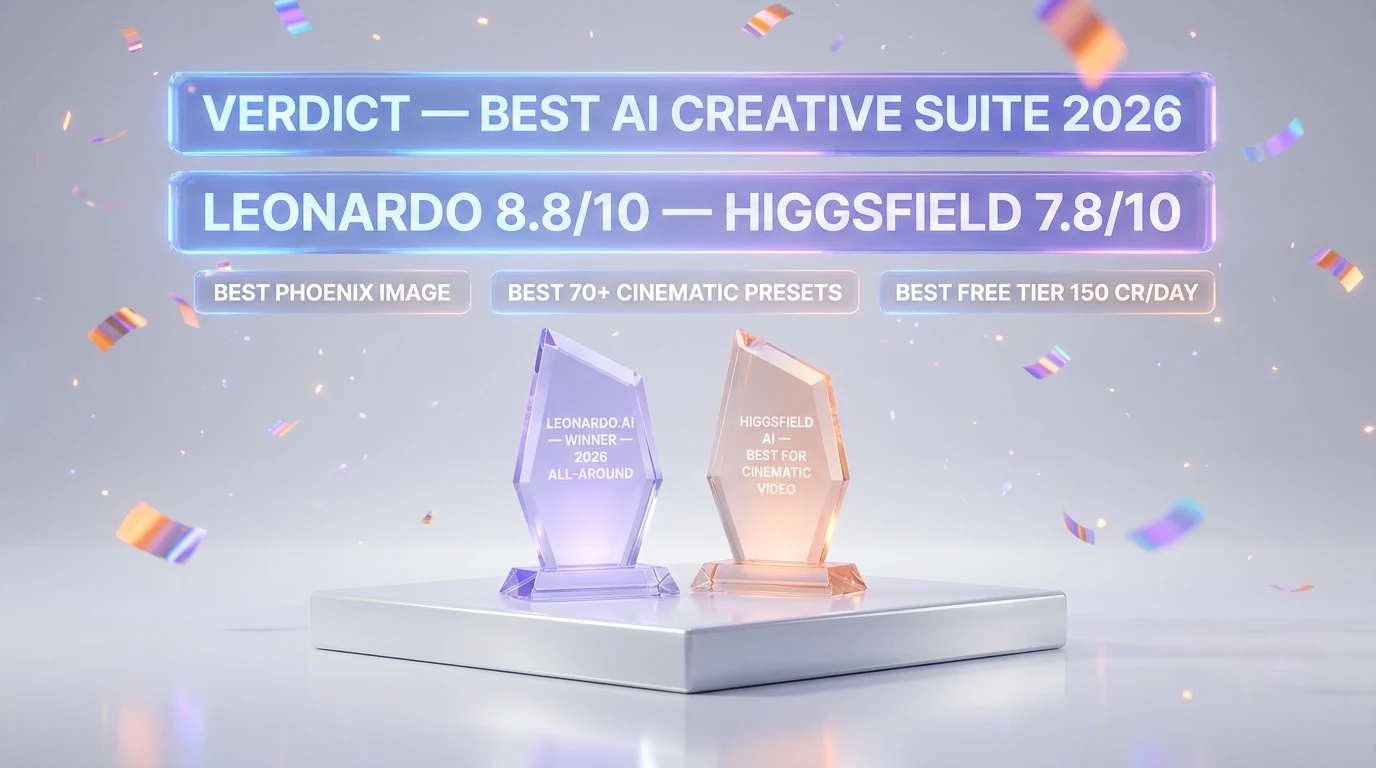
Winner overall: Leonardo.ai, scoring 8.8 out of 10 on our internal scale against Higgsfield AI's 7.8. The Phoenix model, Real-time Canvas, native 3D texture generation, custom LoRA training and the documented Creative Engine API combine into a single subscription that covers more of the modern creative pipeline (image plus video plus 3D plus design) at a more accessible price point ($12 per month Apprentice plus a 150-daily-token free tier).
Winner for cinematic short-form video: Higgsfield AI. If your output is dominated by TikTok, Reels and YouTube Shorts, or if you run paid social with 30+ video creative variations per week, Higgsfield's 70+ cinematic camera presets, Sora 2 plus Veo 3.1 plus Kling 3 aggregation, Soul ID character lock, and Higgsfield Audio suite outweigh Leonardo's broader feature surface. For that specific buyer, the $9 to $99 per month price ladder and the day-zero access to new video models are the right trade-off.
Our recommendation for most creators in May 2026: start on Leonardo.ai's free tier, then upgrade to Apprentice ($12 per month) or Artisan ($30 per month) once you've validated the workflow on real work. Add a Higgsfield AI Plus subscription ($39 per month) on top if your output ramps into serious short-form video volume — the two tools complement each other more than they compete in that combined workflow.
Last compared: May 2026. We will revisit this comparison when Higgsfield ships native image generation or Leonardo.ai ships an equivalent cinematic preset library.
Sources and references
Every figure on this page is attributed to whoever produced it. Vendor documentation and independent measurement are listed separately and never merged into a single ranking.
- Leonardo AI (product capabilities and plans)
- Higgsfield AI (product capabilities and plans)
- Artificial Analysis — Model leaderboard (Intelligence Index scores and cost per task across configurations)
Our Verdict
Leonardo.ai wins overall (8.8 out of 10) for image-first plus video plus 3D plus API at $12 per month Apprentice. Higgsfield AI wins for cinematic short-form video and viral social ads with 70+ camera presets, Soul ID and the Audio suite at $9 to $99 per month.
Choose Higgsfield AI
The multi-model AI video studio — Sora 2, Veo 3.1, Kling 3.0 and Higgsfield DoP under one subscription, with 70+ cinematic camera presets
Try Higgsfield AI →Choose Leonardo.ai
The all-in-one AI creative suite for image, video, and 3D generation
Try Leonardo.ai →Frequently Asked Questions
Is Higgsfield AI better than Leonardo.ai?
Leonardo.ai wins overall (8.8 out of 10) for image-first plus video plus 3D plus API at $12 per month Apprentice. Higgsfield AI wins for cinematic short-form video and viral social ads with 70+ camera presets, Soul ID and the Audio suite at $9 to $99 per month.
Which is cheaper, Higgsfield AI or Leonardo.ai?
Higgsfield AI starts at $9/month (free plan available). Leonardo.ai starts at $12/month (free plan available). Check the pricing comparison section above for a full breakdown.
What are the main differences between Higgsfield AI and Leonardo.ai?
The key differences span across 16 features we compared. For Starting price (monthly billing), Higgsfield AI offers $9/mo Basic (legacy) or $15/mo Starter (2026 reshuffle) while Leonardo.ai offers $12/mo Apprentice. For Free tier daily credits, Higgsfield AI offers 10-50 daily credits (limited models) while Leonardo.ai offers 150 daily tokens (most models). For Image generation native model, Higgsfield AI offers No proprietary image model — image is a side effect of video frames while Leonardo.ai offers Phoenix (proprietary) + Flux + SDXL, strong prompt adherence. See the full feature comparison table above for all details.