GPT-5.2
OpenAI's previous frontier reasoning model — still sold and still supported, with a 400,000-token context and an Artificial Analysis Intelligence Index of 42.2, but beaten on output price, context and capability by GPT-5.6 Terra.

Quick Summary
GPT-5.2 is OpenAI's reasoning model released December 11, 2025 and still generally available on August 3, 2026. It costs $1.75 per million input and $14.00 per million output tokens, with a 400,000-token context window. Artificial Analysis puts its Intelligence Index at 42.2. We researched it. Score 6.8 out of 10.
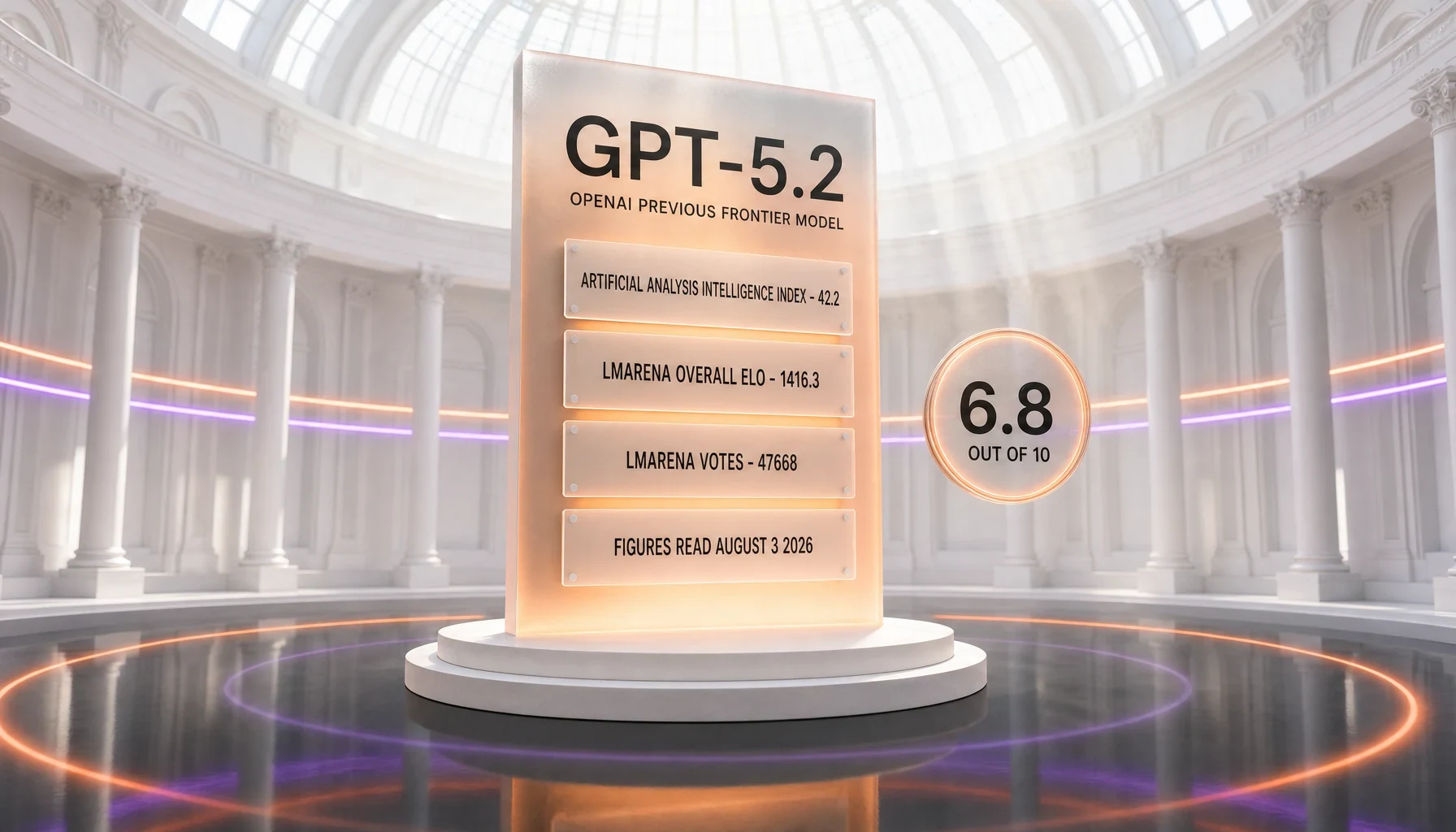
GPT-5.2 is the OpenAI reasoning model released December 11, 2025, and it is still generally available. OpenAI's own model page calls it "our previous frontier model for complex professional work" and recommends GPT-5.6 instead, yet GPT-5.2 remains on the price list at $1.75 per million input tokens and $14.00 per million output tokens, with a 400,000-token context window, a 128,000-token maximum output, and an August 31, 2025 knowledge cutoff. Artificial Analysis puts its Intelligence Index at 42.2, and the LMArena dataset records 47,668 human votes for it. We have not run this model ourselves; this review compiles OpenAI's primary documentation with independent measurements. Score 6.8 out of 10.
Quick Verdict
Score: 6.8 out of 10. GPT-5.2 is a competent, fully documented, still-supported reasoning model whose reason to exist is shrinking month by month. It is not deprecated: as of August 3, 2026 the base model carries no shutdown notice, it is still listed on OpenAI's pricing page, and its model id still resolves through the API. But OpenAI now labels it a previous-generation model and points developers to GPT-5.6, and the newer GPT-5.6 Terra tier beats it on measured intelligence, on context window, and on output price at the same time. The strongest honest case for GPT-5.2 today is inertia: code that already calls it keeps working, and OpenAI's stated deprecation policy gives generally available models at least six months of notice before shutdown.
- ✅ Still generally available on August 3, 2026 — no deprecation notice for the base model or for GPT-5.2 Pro
- ✅ A 400,000-token context window with a 128,000-token maximum output, billed at one flat rate with no long-context surcharge
- ✅ Five reasoning effort settings, from none through xhigh, plus function calling and structured outputs
- ❌ Artificial Analysis puts its Intelligence Index at 42.2, well below the current generation, and publishes no coding and no agentic index for it at all
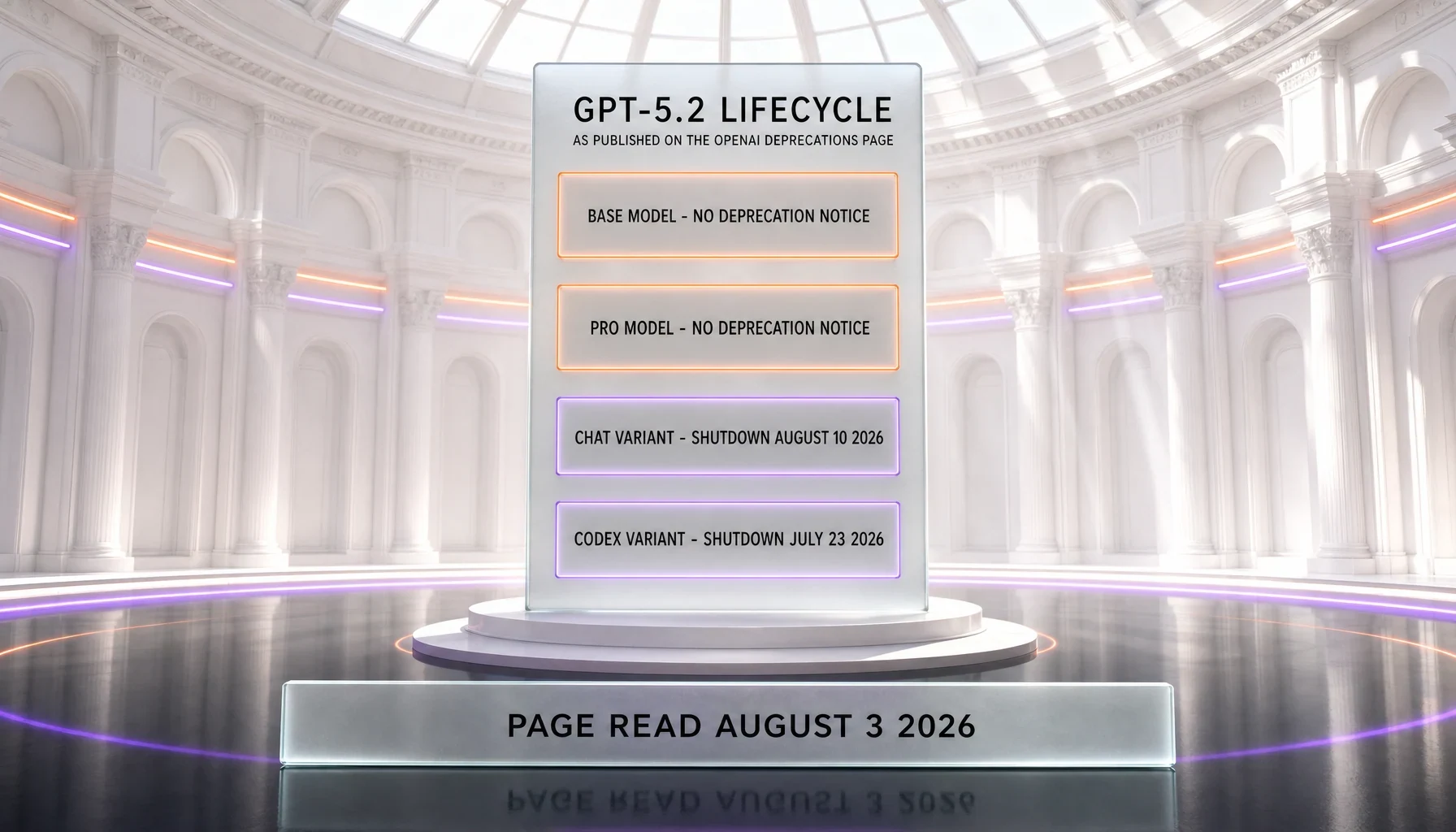
- ❌ Its chat variant shut down on August 10, 2026, and its Codex variant on July 23, 2026 — both ids now return a model_not_found error
Best for: teams with production traffic already pointed at gpt-5.2 who want a documented runway rather than an emergency migration, and anyone who needs a pinned, stable snapshot whose behavior will not shift underneath them.
Not for: new builds. If you are choosing a model today, the same money buys measurably more elsewhere in OpenAI's own catalog.
GPT-5.2 at a Glance
| Attribute | Value |
|---|---|
| Model id | gpt-5.2 (alias), gpt-5.2-2025-12-11 (pinned) |
| Released | December 11, 2025 |
| Status on August 3, 2026 | Generally available; OpenAI labels it "previous frontier model" |
| Standard price | $1.75 per million input tokens, $0.175 per million cached input tokens, $14.00 per million output tokens |
| Context window | 400,000 tokens |
| Maximum output | 128,000 tokens |
| Knowledge cutoff | August 31, 2025 |
| Reasoning effort | none (default), low, medium, high, xhigh |
| Input modalities | Text and image |
| Output modalities | Text |
| Artificial Analysis Intelligence Index | 42.2 |
| LMArena overall Elo | 1416.3 across 47,668 votes |
Prices and specifications read from OpenAI's developer documentation on August 3, 2026. Index figures collected August 2, 2026.
How We Researched This Review
We have not run GPT-5.2 against our own task set, and we are not going to pretend otherwise. This review is research-led, and every number in it comes from one of four places, each named at the point of use.
The first is OpenAI's own developer documentation: the GPT-5.2 model page for specifications and positioning, the API pricing page for rates, and the deprecations page for lifecycle status. The second is OpenAI's live model listing, which we queried directly on August 3, 2026 to confirm which GPT-5.2 model ids still resolve. The third is Artificial Analysis, which publishes independent benchmark indices. The fourth is the official LMArena leaderboard dataset, which records blind head-to-head human preference votes.
We also cross-checked the price. OpenRouter, which reports the rates actually charged across the market, lists GPT-5.2 at $1.75 input and $14.00 output per million tokens. OpenAI's own pricing page lists exactly the same two figures. Two independent sources agreeing to the cent is the strongest confirmation a price can get without an invoice.
Where we compute something ourselves, we say so. Our composite score, which places GPT-5.2 36th among the 207 active models we track, is our own calculation from those inputs and is not a ranking published by any of the sources above. Where a measurement simply does not exist, we say that too, because an absence of evidence is a finding in its own right and not a passing grade.
What Is GPT-5.2?
GPT-5.2 is a reasoning model that OpenAI released on December 11, 2025, one step after GPT-5.1 and one step before the GPT-5.3 line. It was, at the time, the top of the GPT-5 series: a frontier model with adaptive reasoning that allocates more computation to harder prompts and answers quickly on easy ones.
Eight months later, OpenAI's description of it has changed in a way worth quoting exactly. The model page now opens with the line "Previous frontier model for professional work with configurable reasoning effort," and the body text reads: "GPT-5.2 is our previous frontier model for complex professional work. We recommend using the latest GPT-5.6."
That sentence is the whole editorial situation in miniature. It is not a deprecation notice. It carries no date, no shutdown, no forced migration. It is a recommendation, and OpenAI is still perfectly happy to sell you GPT-5.2 tokens. But it is the vendor telling you, in writing, that this is not the model it wants you to build on.
The family around it has grown considerably. OpenAI's catalog on August 3, 2026 spans GPT-5 from August 2025 through GPT-5.1, GPT-5.2, the GPT-5.3 chat and Codex variants, GPT-5.4, GPT-5.5, and the current three-tier GPT-5.6 generation of Sol, Terra, and Luna. GPT-5.2 sits roughly in the middle of that timeline, but as the measurements below show, it sits in the lower half of the capability range: everything OpenAI has released since scores higher.
Is GPT-5.2 Still Available? The Lifecycle, Precisely
This is the question that actually matters for anyone with GPT-5.2 in production, and it has a precise answer that differs by variant. We checked OpenAI's deprecations page and its live model listing on August 3, 2026, then re-checked both — plus a live API call against each id — on August 25, 2026.
The base model: no notice, no date
Neither gpt-5.2 nor gpt-5.2-pro appears on any deprecation table on OpenAI's deprecations page. We scanned every occurrence of the string on that page and the base model is on none of them. Both ids resolve normally through OpenAI's model listing endpoint, and both appear on the current pricing page.
OpenAI's published policy on the same page states that generally available models get at least six months of notice before removal, and that specialized variants such as chat and Codex versions get at least three. Since no notice has been issued for the base model as of August 3, 2026, the earliest conceivable shutdown under that policy is at least six months after whenever a notice does appear.
There is a useful comparison sitting right there on the same page. On June 11, 2026, OpenAI did issue deprecation notices for the original GPT-5 snapshots — gpt-5-2025-08-07, gpt-5-mini-2025-08-07, gpt-5-nano-2025-08-07 and gpt-5-pro-2025-10-06 — all scheduled for removal on December 11, 2026. GPT-5.2, released four months after those snapshots, is not in that batch. The older generation is being retired around it while it stays.
The variants: two shutdown dates, both now past
The specialized variants are a different story, and this is the genuinely actionable part of this review.
gpt-5.2-chat-latest was deprecated in a notice dated May 8, 2026, with a shutdown date of August 10, 2026 and gpt-5.6-sol named as the recommended replacement. That shutdown has since happened. When we re-checked the id on August 25, 2026, a Chat Completions call returned HTTP 404 with the message that the model has been deprecated. Anyone still calling that id is already broken, and gpt-5.6-sol remains the named replacement.
gpt-5.2-codex appears under the April 22, 2026 legacy-snapshot notice with a shutdown date of July 23, 2026, also replaced by gpt-5.6-sol. That date has passed. On August 3, 2026 we found the id still resolving through OpenAI's model listing endpoint, reported the disagreement as we found it, and drew no conclusion. A re-check on August 25, 2026 settles it: the id is still returned by the model listing endpoint, but an actual Chat Completions call returns HTTP 404 with the message that the model has been deprecated. The published shutdown date was the reliable signal. The listing endpoint keeps returning ids that no longer serve traffic, which is why we now treat a live call, not a listing, as the test of availability.
The shape of this is worth naming: the base model survives while its specialized variants are retired around it. If you built on GPT-5.2 through the plain Chat Completions or Responses path, you are fine for now. If you built on its chat or Codex flavor, your clock has already run out.
Key Features
A 400,000-token context window at one flat rate
GPT-5.2 carries a 400,000-token context window and a 128,000-token maximum output. What deserves attention is the billing: on OpenAI's pricing page the GPT-5.4 and GPT-5.5 rows are labeled "less than 272K context length," which signals tiered pricing above that threshold. The GPT-5.2 row carries no such qualifier. Its rate is flat across the whole window.
That is a real, if narrow, advantage over some newer siblings. It is also a smaller window than the current generation offers: the GPT-5.6 tiers all carry roughly 1,050,000 tokens, about two and a half times as much.
Five levels of reasoning effort, up to xhigh
GPT-5.2 exposes a reasoning.effort parameter with five settings: none, which is the default, then low, medium, high, and xhigh. OpenAI's model page rates its reasoning as "Highest" and its speed as "Medium," which is the expected trade for a model of this class.
The practical value of the xhigh setting is that it gives you a lever rather than a fixed cost profile. Cheap prompts can run at none and cost almost nothing in reasoning tokens; the hard ones can be pushed up. Any benchmark figure quoted for this model without its effort setting is incomplete, which is one reason we are careful below about what the published indices do and do not cover.
Function calling and structured outputs, but no fine-tuning
The model page lists streaming, function calling, and structured outputs as supported. It lists fine-tuning and predicted outputs as not supported. That last pair matters for two specific audiences: teams who wanted to specialize the model on their own data have no path here, and teams doing heavy code-rewriting workloads lose the latency optimization that predicted outputs provide.
Text and image in, text out
GPT-5.2 accepts text and image input and returns text. Audio and video are listed as not supported in either direction. It is a text-and-vision reasoning model, not a multimodal generalist, and any workflow needing native speech has to look elsewhere in the catalog.
A pinned snapshot for behavioral stability
Two ids exist: the moving alias gpt-5.2 and the pinned snapshot gpt-5.2-2025-12-11. Pinning is the underrated feature of an older model. A model that is no longer the vendor's flagship is a model that is no longer being tuned, and for regulated or heavily evaluated pipelines, behavioral stability can be worth more than raw capability.
Rate limits, and no free tier
GPT-5.2 is not available on OpenAI's free usage tier. Tier 1 accounts get 500 requests per minute and 500,000 tokens per minute with a 1,500,000-token batch queue; tier 5 accounts get 15,000 requests per minute and 40,000,000 tokens per minute. Those are generous ceilings for a model of this age.
GPT-5.2 Pricing in 2026
API pricing, per million tokens
All figures below were read from OpenAI's developer pricing page on August 3, 2026 and are quoted in US dollars per million tokens.
| Processing tier | Input | Cached input | Output |
|---|---|---|---|
| Standard | $1.75 | $0.175 | $14.00 |
| Batch | $0.875 | $0.0875 | $7.00 |
| Flex | $0.875 | $0.0875 | $7.00 |
| Fast mode | $3.50 | $0.35 | $28.00 |
Three details are worth pulling out. Cached input costs one tenth of fresh input, which is a large discount for any workload with a stable system prompt. Batch and Flex both land at exactly half the standard rate, so a workload that tolerates latency halves its bill. And Fast mode — which OpenAI renamed from Priority processing on July 30, 2026 — costs double.
GPT-5.2 Pro is a separate, considerably more expensive product at $21.00 input and $168.00 output per million tokens on the standard tier.
Where that price sits in OpenAI's own catalog
This is where the value case gets difficult, and it is worth being precise rather than dramatic. Reading OpenAI's pricing page on August 3, 2026, GPT-5.2 at $1.75 input and $14.00 output sits above GPT-5.1 at $1.25 and $10.00, and below GPT-5.4 at $2.50 and $15.00. So far, so orderly.
The problem is GPT-5.6 Terra, which on the same page costs $2.00 input and $12.00 output. Terra is more expensive on input and cheaper on output. For any workload that generates more tokens than it consumes, Terra is the cheaper model. And as the next section shows, it is also the substantially more capable one.
Input price is the only axis on which GPT-5.2 still comes out ahead of the current generation, and it is the axis that matters least for a reasoning model. That is not a criticism of how it was priced in December 2025; it is what happens to a model that stays still while the catalog around it moves.
Benchmarks: What Independent Measurement Says
Artificial Analysis: an Intelligence Index of 42.2, and two blanks
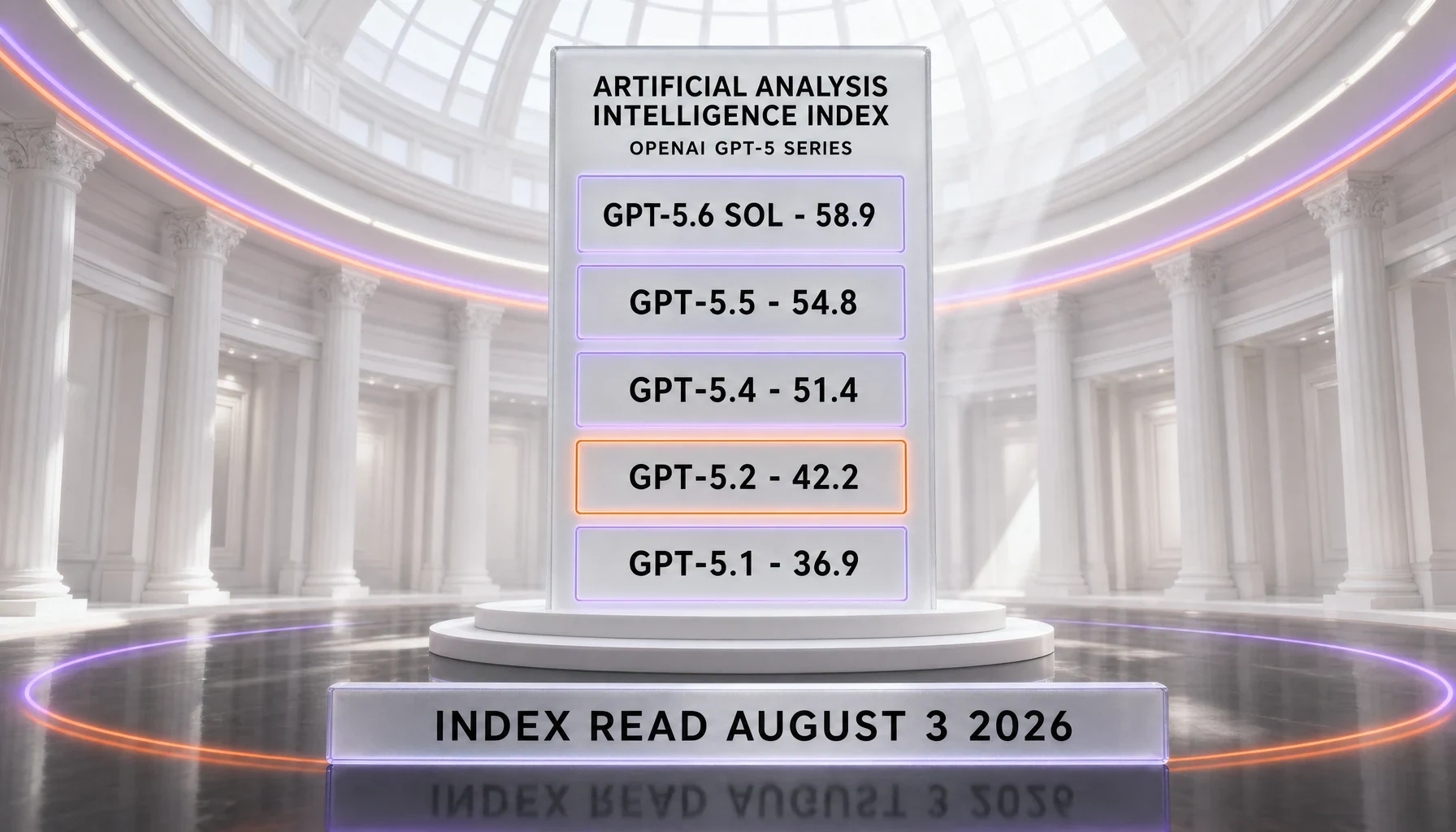
Artificial Analysis puts GPT-5.2's Intelligence Index at 42.2. Placed against its siblings from the same collection, that figure tells a clear story. In descending order: GPT-5.6 Sol scores 58.9, GPT-5.6 Terra scores 55.0, GPT-5.5 scores 54.8, GPT-5.4 scores 51.4, GPT-5.6 Luna scores 51.2, GPT-5.2 scores 42.2, GPT-5.1 scores 36.9, and the original GPT-5 scores 34.7.
GPT-5.2 is therefore a real improvement on everything that came before it in the series, and a clear step below everything that came after. Even Luna, the cheapest tier of the current generation, measures nine points higher.
The more interesting finding is what is missing. Artificial Analysis publishes no coding index and no agentic index for GPT-5.2. Both fields are empty. It also publishes no throughput or latency figures for it. The model does carry a mathematics index of 99, but we exclude mathematics from our own composite by design, because essentially every serious model now scores in the nineties there and the measure no longer separates anything.
The Coding Agent Index: no entry at all
Artificial Analysis also publishes a separate Coding Agent Index, which is a different instrument from the coding index above. It scores pairings of a coding harness with a model and a reasoning effort, not models in isolation. GPT-5.2 has no entry on it.
Put those two facts together and the conclusion is uncomfortable but simple: for agentic coding, the single most contested model use case of 2026, there is no independent published measurement of GPT-5.2 from either instrument. Not a low score — no score. Anyone telling you how GPT-5.2 ranks as a coding agent is telling you something no public benchmark currently supports.
LMArena: heavy voting, middling standing
The official LMArena leaderboard dataset records GPT-5.2 with an overall Elo of 1416.3 across 47,668 votes, under the variant label gpt-5.2-high. LMArena's own overall leaderboard places it 108th.
Those two numbers pull in opposite directions and the tension is the most interesting thing about this model. The vote count is enormous — slightly more than GPT-5.5 collected, at 47,572, and more than GPT-5.1 at 40,700 or GPT-5 at 31,887. Tens of thousands of people put GPT-5.2 in front of a blind comparison and picked a winner. That is genuine, measurable demand.
But volume is not standing. On the same leaderboard, GPT-5.4 sits 18th with an Elo of 1469.9 and GPT-5.5 sits 19th at 1469.4, while GPT-5.1 at 1441.2 places 55th. GPT-5.2's 1416.3 leaves it well down the table. Lots of people use it; when they compare it blind against the field, it loses more often than its newer siblings do.
Where our own composite puts it
Our composite score, which blends the independent benchmark indices with human preference data, places GPT-5.2 36th among the 207 active models we track. That ranking is our calculation, not one published by Artificial Analysis, LMArena or OpenRouter, and it weighs capability rather than value — a model can rank well here and still be a poor purchase, which is precisely the case with GPT-5.2 today.
GPT-5.2 Against the Current Generation
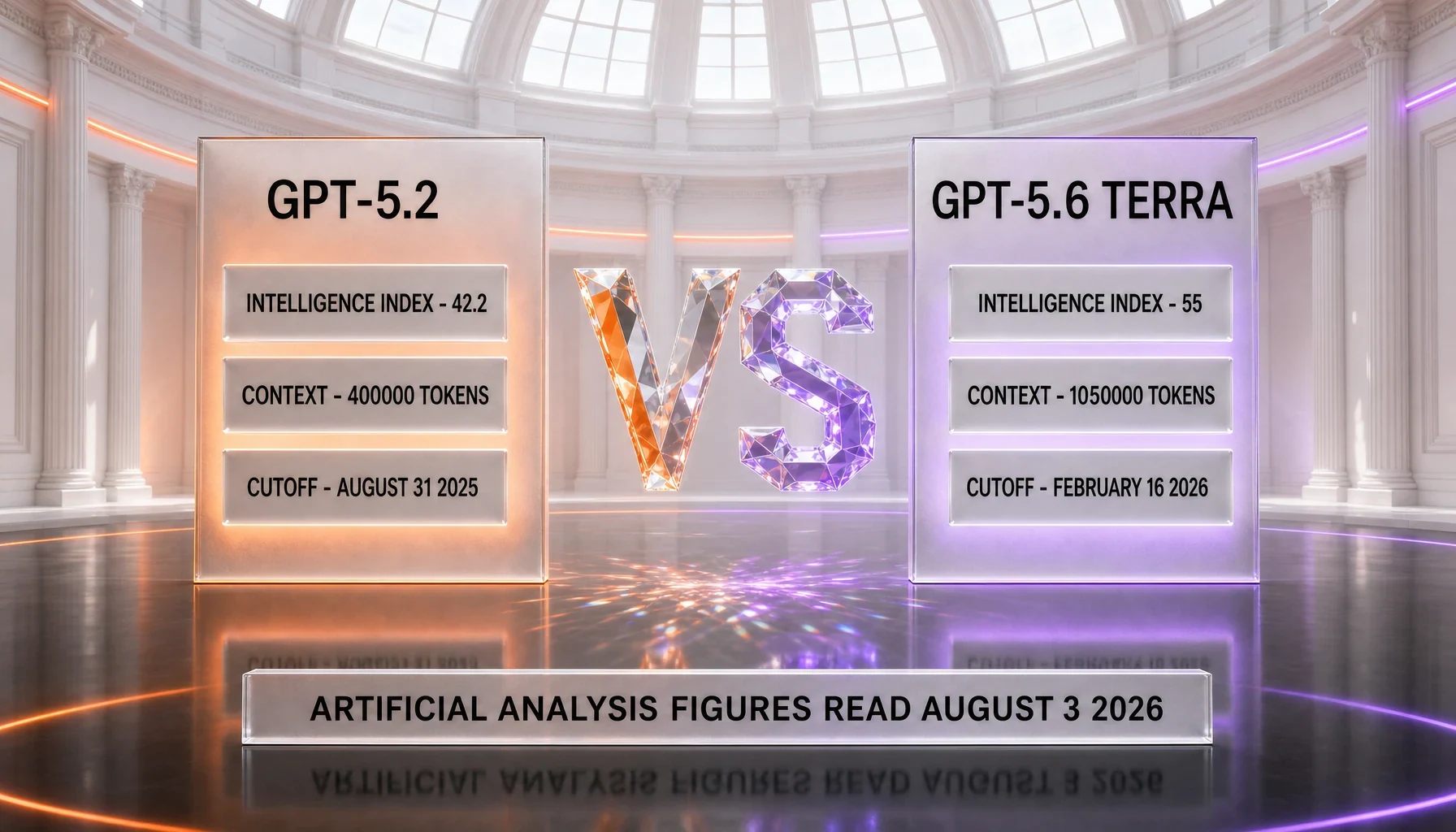
The fairest comparison is not against the GPT-5.6 flagship, which costs far more, but against Terra, the middle tier — because Terra is the model closest to GPT-5.2 in price.
| Specification | GPT-5.2 | GPT-5.6 Terra |
|---|---|---|
| Artificial Analysis Intelligence Index | 42.2 | 55.0 |
| Input price per million tokens | $1.75 | $2.00 |
| Output price per million tokens | $14.00 | $12.00 |
| Context window | 400,000 tokens | 1,050,000 tokens |
| Knowledge cutoff | August 31, 2025 | February 16, 2026 |
| Status | Previous frontier model | Current generation |
Terra wins on measured intelligence by nearly thirteen index points, on context window by a factor of more than two and a half, on knowledge recency by five and a half months, and on output price. GPT-5.2 wins on input price by twenty-five cents per million tokens. If you compare it against Terra's cheaper sibling Luna instead, GPT-5.2 loses on price by a wide margin and still loses on the Intelligence Index.
The one dimension where GPT-5.2 holds an argument is stability. Terra is a current model, actively iterated. GPT-5.2 is finished. For an evaluation-heavy pipeline where a silent behavioral shift is more expensive than a few index points, that is not nothing — but it is a narrow case, and it is the only one.
Strengths and Weaknesses
What holds up
- It is genuinely still supported. No deprecation notice exists for the base model or for GPT-5.2 Pro as of August 3, 2026, and OpenAI's stated policy promises at least six months of warning for generally available models.
- Flat pricing across the full context window. Unlike the GPT-5.4 and GPT-5.5 rows on OpenAI's pricing page, GPT-5.2 carries no long-context surcharge threshold.
- Deep discounts for patient and repetitive workloads. Cached input costs one tenth of standard input, and both Batch and Flex processing run at exactly half the standard rate.
- Five reasoning effort levels including xhigh, which lets a single model serve both trivial and hard prompts without switching providers.
- A pinned snapshot for behavioral stability. A model the vendor has stopped iterating on is a model that will not surprise your evaluation suite.
- Substantial real-world usage. The 47,668 LMArena votes it has accumulated are more than GPT-5.5 or GPT-5.1 collected, which means an unusually large body of practical experience with it exists.
Where it falls short
- The vendor recommends against it in writing. OpenAI's own model page tells developers to use GPT-5.6 instead.
- No independent coding measurement exists. Artificial Analysis publishes neither a coding nor an agentic index for GPT-5.2, and it has no entry on the Coding Agent Index. For the defining workload of 2026, it is unmeasured.
- It is beaten on value inside OpenAI's own catalog. GPT-5.6 Terra costs less per output token, carries a context window more than two and a half times larger, and measures nearly thirteen Intelligence Index points higher.
- Its variants have been retired. The chat variant shut down on August 10, 2026 and the Codex variant on July 23, 2026; both ids returned a model_not_found error when we re-checked on August 25, 2026.
- An August 31, 2025 knowledge cutoff that is now nearly a year stale, against February 16, 2026 for the current generation.
- No fine-tuning, no predicted outputs, no audio, no video, and no availability on OpenAI's free usage tier.
Who Should Still Use GPT-5.2
Existing production traffic on a planned migration
The strongest case. If GPT-5.2 already serves live traffic, the absence of a deprecation notice buys you a documented runway. Migrate deliberately rather than in a panic.
Evaluation-heavy pipelines that punish drift
Where a regression suite has been calibrated against a specific model's behavior, the pinned gpt-5.2-2025-12-11 snapshot on a model no longer being tuned offers a stability that current flagships cannot match.
Batch and offline workloads on legacy contracts
At $0.875 input and $7.00 output per million tokens, Batch processing makes GPT-5.2 defensible for overnight jobs where latency is irrelevant and the integration already exists.
Long-document reasoning under 400,000 tokens
Its flat rate across the entire window, with no long-context threshold, keeps costs predictable on large single documents.
Reproducing published results
Anyone verifying work that was originally run on GPT-5.2 needs the same model, not its successor. That is a real and legitimate reason for a model to stay available.
Where to go instead for new builds
For a new project, GPT-5.6 Terra is the direct replacement at comparable cost and higher measured capability. For high-volume, latency-sensitive work, GPT-5.6 Luna is dramatically cheaper. For frontier reasoning, GPT-5.6 Sol or Claude Opus 5. If price dominates, DeepSeek V4 is worth a look. Our Sol against GPT-5.5 comparison covers the upgrade question inside OpenAI's own line.
Frequently Asked Questions
What is GPT-5.2?
GPT-5.2 is a reasoning model that OpenAI released on December 11, 2025. It carries a 400,000-token context window, a 128,000-token maximum output, and an August 31, 2025 knowledge cutoff, and it accepts text and image input while returning text. OpenAI's model page now describes it as "our previous frontier model for complex professional work" and recommends GPT-5.6 instead. Its model ids are gpt-5.2 and the pinned snapshot gpt-5.2-2025-12-11.
Is GPT-5.2 deprecated?
No. As of August 3, 2026, neither gpt-5.2 nor gpt-5.2-pro appears on any deprecation table on OpenAI's deprecations page, both ids resolve through OpenAI's model listing endpoint, and both are listed on the current pricing page; a re-check on August 25, 2026 found the base model still answering live calls and still on the price list. Two specialized variants are a different matter: gpt-5.2-chat-latest shut down on August 10, 2026 and gpt-5.2-codex on July 23, 2026, and both ids returned a model_not_found error when we re-checked on August 25, 2026.
How much does GPT-5.2 cost?
On the standard processing tier, GPT-5.2 costs $1.75 per million input tokens, $0.175 per million cached input tokens, and $14.00 per million output tokens. Batch and Flex processing both halve those rates to $0.875 input and $7.00 output. Fast mode, which OpenAI renamed from Priority processing on July 30, 2026, doubles them to $3.50 and $28.00. GPT-5.2 Pro is priced separately at $21.00 input and $168.00 output. All figures were read from OpenAI's developer pricing page on August 3, 2026.
What is GPT-5.2's context window?
GPT-5.2 has a 400,000-token context window and a 128,000-token maximum output. Unlike the GPT-5.4 and GPT-5.5 rows on OpenAI's pricing page, which are qualified as applying below 272,000 tokens of context, the GPT-5.2 row carries no such threshold, so its rate is flat across the entire window. The current GPT-5.6 generation carries roughly 1,050,000 tokens by comparison.
What did GPT-5.2 score on independent benchmarks?
Artificial Analysis puts GPT-5.2's Intelligence Index at 42.2 and its mathematics index at 99. It publishes no coding index and no agentic index for the model, and no throughput or latency figures. The official LMArena leaderboard dataset records an overall Elo of 1416.3 across 47,668 votes under the variant label gpt-5.2-high, and LMArena's own overall leaderboard places it 108th. Figures collected August 2, 2026.
Does GPT-5.2 appear on the Coding Agent Index?
No. GPT-5.2 has no entry on the Artificial Analysis Coding Agent Index, which is a separate instrument from the Intelligence Index family and scores pairings of a coding harness with a model and a reasoning effort. Combined with the absence of a coding index and an agentic index for the model, this means there is no independent published measurement of GPT-5.2 as a coding agent from either instrument.
Is GPT-5.2 better than GPT-5.1?
On the published measurements, yes. Artificial Analysis puts GPT-5.2's Intelligence Index at 42.2 against 36.9 for GPT-5.1, and the LMArena dataset records 47,668 votes for GPT-5.2 against 40,700 for GPT-5.1. GPT-5.1 does win on price at $1.25 per million input tokens and $10.00 per million output tokens, against $1.75 and $14.00 for GPT-5.2. On LMArena's own overall leaderboard, however, GPT-5.1 places 55th with an Elo of 1441.2 while GPT-5.2 places 108th at 1416.3.
Should I use GPT-5.2 or GPT-5.6 Terra?
For a new project, GPT-5.6 Terra. Terra measures 55.0 on the Artificial Analysis Intelligence Index against 42.2 for GPT-5.2, carries a 1,050,000-token context window against 400,000, has a February 16, 2026 knowledge cutoff against August 31, 2025, and costs $12.00 per million output tokens against $14.00. GPT-5.2 is cheaper only on input, at $1.75 against $2.00 per million tokens.
What reasoning effort levels does GPT-5.2 support?
GPT-5.2 supports five reasoning effort settings through its reasoning.effort parameter: none, which is the default, then low, medium, high, and xhigh. OpenAI's model page rates its reasoning capability as "Highest" and its speed as "Medium."
Does GPT-5.2 support fine-tuning?
No. OpenAI's model page lists fine-tuning as not supported for GPT-5.2, along with predicted outputs. Streaming, function calling, and structured outputs are all listed as supported.
Is GPT-5.2 multimodal?
Partly. GPT-5.2 accepts text and image input and returns text output. Audio and video are listed as not supported in either direction on OpenAI's model page, so it is a text-and-vision reasoning model rather than a full multimodal system.
Why do so many people still use GPT-5.2?
The LMArena dataset records 47,668 votes for GPT-5.2, slightly more than the 47,572 recorded for GPT-5.5 and well above the 40,700 for GPT-5.1. The most defensible explanation is installed base rather than merit: it was OpenAI's top GPT-5 model for several months, so a large volume of integrations was written against it, and nothing has forced those integrations to move. Its standing is much lower than its usage, since LMArena's own overall leaderboard places it 108th.
Verdict: 6.8 out of 10
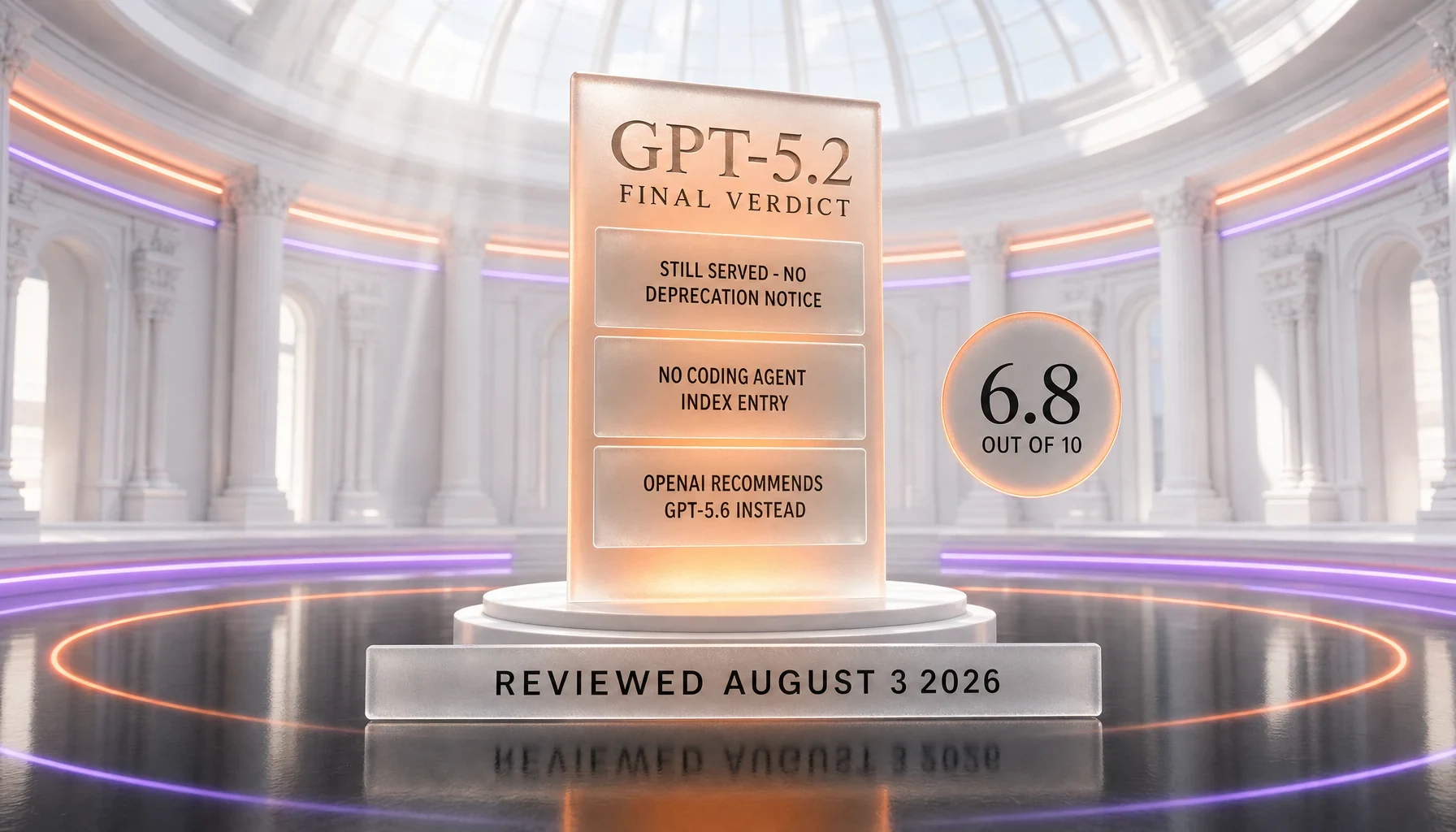
GPT-5.2 earns 6.8 out of 10, and the number is doing a specific job: it separates a model that is broken from a model that is merely superseded. Nothing here is broken. The documentation is complete, the pricing is public and confirmed by an independent market source, the rate limits are generous, the reasoning controls are genuinely useful, and the base model carries no shutdown date.
What it lacks is a reason to be chosen. On the measurements that exist, it is the weakest OpenAI model still marketed for professional work outside the older GPT-5 and GPT-5.1 tiers. On the measurement that matters most in 2026 — agentic coding — nothing exists at all, and we would rather say that plainly than dress an absence up as a result. And on price, the model that replaces it in OpenAI's own catalog costs less per output token while measuring nearly thirteen index points higher.
So the recommendation splits cleanly. If GPT-5.2 is already in your stack, you have time, and you should use it to migrate on your own schedule rather than someone else's — but check your variant ids first, because the chat flavor died on August 10, 2026 and the Codex flavor on July 23, 2026. If you are choosing a model today, there is no argument for starting here.
The broader lesson is one this model illustrates unusually well. A large installed base is not a quality signal. Nearly 48,000 people voted on GPT-5.2 in blind comparisons and it still sits 108th on LMArena's own board. Popularity measured what people already had running. It did not measure what they should build next.
Score breakdown
| Criterion | Score | Why |
|---|---|---|
| Features | 7.0 | Strong reasoning controls, a 400,000-token window, function calling and structured outputs — but no fine-tuning, no predicted outputs, and no audio or video |
| Ease of use | 8.0 | Complete documentation, a stable alias plus a pinned snapshot, and a drop-in path through the standard endpoints |
| Value | 5.2 | Beaten on output price, context window and measured intelligence by GPT-5.6 Terra inside OpenAI's own catalog |
| Support | 7.0 | Fully documented and still on the price list with no deprecation notice, but two of its variants have already been retired and the vendor recommends moving on |
| Overall | 6.8 | A capable, well-supported model with a shrinking reason to exist |
Sources
- OpenAI — GPT-5.2 model page (specifications, positioning, features, rate limits)
- OpenAI — API pricing (standard, Batch, Flex and Fast mode rates)
- OpenAI — Deprecations page (lifecycle status and shutdown dates)
- Artificial Analysis — independent LLM benchmark indices
- LMArena — official leaderboard dataset (Elo, vote counts, overall rank)
- LMArena — public leaderboard
- OpenRouter — GPT-5.2 market pricing and availability
- ThePlanetTools.ai — direct query of OpenAI's model listing endpoint, August 3, 2026, to confirm which GPT-5.2 model ids still resolve. Index figures collected August 2, 2026.
Key Features
Pros & Cons
Pros
- Still generally available on August 3, 2026: neither gpt-5.2 nor gpt-5.2-pro appears on any deprecation table, and both ids resolve through OpenAI’s model listing endpoint.
- Flat per-token pricing across the whole 400,000-token context window, with none of the long-context threshold that the GPT-5.4 and GPT-5.5 rows carry on OpenAI’s pricing page.
- Cached input costs one tenth of standard input, and Batch and Flex processing both run at exactly half the standard rate.
- Five reasoning effort levels from none through xhigh, so one model can serve both trivial and hard prompts.
- A pinned snapshot, gpt-5.2-2025-12-11, on a model the vendor has stopped iterating — behavioral stability that current flagships cannot match.
- Substantial real-world usage: the LMArena dataset records 47,668 votes, more than GPT-5.5 at 47,572 or GPT-5.1 at 40,700.
- Generous rate limits, up to 15,000 requests per minute and 40,000,000 tokens per minute on tier 5.
Cons
- OpenAI recommends against it in writing: its model page calls GPT-5.2 "our previous frontier model" and tells developers to use GPT-5.6 instead.
- No independent coding measurement exists. Artificial Analysis publishes neither a coding index nor an agentic index for GPT-5.2, and it has no entry on the Coding Agent Index.
- Beaten on value inside OpenAI’s own catalog: GPT-5.6 Terra costs $12.00 per million output tokens against $14.00, carries a 1,050,000-token context against 400,000, and measures 55 on the Artificial Analysis Intelligence Index against 42.2.
- Its variants have been retired: gpt-5.2-chat-latest shut down on August 10, 2026 and gpt-5.2-codex on July 23, 2026; both ids returned a model_not_found error when we re-checked on August 25, 2026.
- An August 31, 2025 knowledge cutoff, against February 16, 2026 for the current GPT-5.6 generation.
- No fine-tuning, no predicted outputs, no audio and no video, and no availability on OpenAI’s free usage tier.
Best Use Cases
Platforms & Integrations
Available On
Integrations

We're developers and SaaS builders who use these tools daily in production. Every review comes from hands-on experience building real products — DealPropFirm, ThePlanetIndicator, PropFirmsCodes, and many more. We don't just review tools — we build and ship with them every day.
Written and tested by developers who build with these tools daily.
Frequently Asked Questions
What is GPT-5.2?
OpenAI's previous frontier reasoning model — still sold and still supported, with a 400,000-token context and an Artificial Analysis Intelligence Index of 42.2, but beaten on output price, context and capability by GPT-5.6 Terra.
How much does GPT-5.2 cost?
GPT-5.2 costs $1.75/month.
Is GPT-5.2 free?
No, GPT-5.2 starts at $1.75/month.
What are the best alternatives to GPT-5.2?
Top-rated alternatives to GPT-5.2 can be found in our WebApplication category, where we've reviewed and scored every tool on ThePlanetTools.ai.
Is GPT-5.2 good for beginners?
GPT-5.2 is rated 8/10 for ease of use.
What platforms does GPT-5.2 support?
GPT-5.2 is available on REST API, Chat Completions API, Responses API, Batch API.
Does GPT-5.2 offer a free trial?
No, GPT-5.2 does not offer a free trial.
Is GPT-5.2 worth the price?
GPT-5.2 scores 5.2/10 for value. Value depends on your specific needs.
Who should use GPT-5.2?
GPT-5.2 is ideal for: Existing production traffic on a planned migration, using the absence of a deprecation notice as a documented runway, Evaluation-heavy pipelines where a silent behavioral shift costs more than a few index points, Batch and offline workloads that tolerate latency in exchange for half-price processing, Long-document reasoning under 400,000 tokens, billed at one flat rate with no context surcharge, Reproducing published results that were originally run on GPT-5.2, Text-and-vision reasoning where native audio is not required.
What are the main limitations of GPT-5.2?
Some limitations of GPT-5.2 include: OpenAI recommends against it in writing: its model page calls GPT-5.2 "our previous frontier model" and tells developers to use GPT-5.6 instead.; No independent coding measurement exists. Artificial Analysis publishes neither a coding index nor an agentic index for GPT-5.2, and it has no entry on the Coding Agent Index.; Beaten on value inside OpenAI’s own catalog: GPT-5.6 Terra costs $12.00 per million output tokens against $14.00, carries a 1,050,000-token context against 400,000, and measures 55 on the Artificial Analysis Intelligence Index against 42.2.; Its variants have been retired: gpt-5.2-chat-latest shut down on August 10, 2026 and gpt-5.2-codex on July 23, 2026; both ids returned a model_not_found error when we re-checked on August 25, 2026.; An August 31, 2025 knowledge cutoff, against February 16, 2026 for the current GPT-5.6 generation.; No fine-tuning, no predicted outputs, no audio and no video, and no availability on OpenAI’s free usage tier..
Ready to try GPT-5.2?
Get started today
Try GPT-5.2 Now →