GPT-5.6 Sol vs GPT-5.5: Should You Upgrade? (2026)


GPT-5.6 Sol now costs less than GPT-5.5 — $4.00 input and $20.00 output per million tokens — and leads on capability. GPT-5.5 keeps one verified edge.
Feature Comparison
| Feature | GPT-5.6 Sol | GPT-5.5 |
|---|---|---|
| AA Intelligence Index (v4.1, independent) | 59 | 55 |
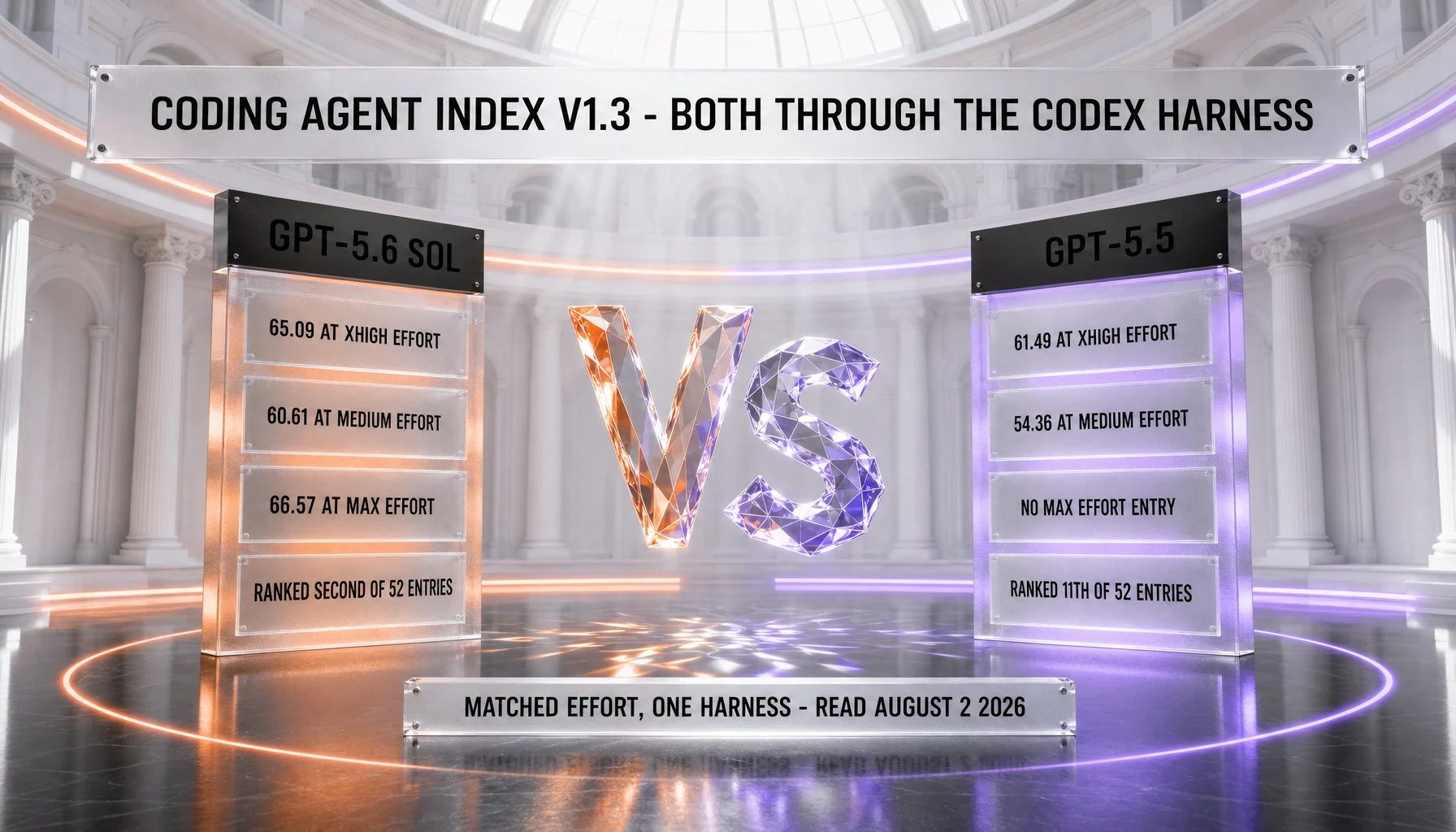
| AA Coding Agent Index v1.3 (independent, read August 2, 2026) | 66.57 — 2nd of 52 (Codex, max); 65.09 (Codex, xhigh); 60.61 (Codex, medium) | 61.49 — 11th of 52 (Codex, xhigh); 54.36 (Codex, medium); 46.09 (Cursor CLI, medium) |
| SWE-bench Verified (vals.ai, independent) | N/A (not submitted) | 82.6% (submitted) |
| LMArena Elo (text arena) | 1486 (Xhigh, No. 8) | 1481 (High) |
| Input price (per million tokens) | $4.00 | $5.00 |
| Output price (per million tokens) | $20.00 | $30.00 |
| Cached input (per million tokens) | $0.40 | $0.50 |
| Context window | 1,050,000 tokens | 1,050,000 tokens |
| Max output | 128,000 tokens | 128,000 tokens |
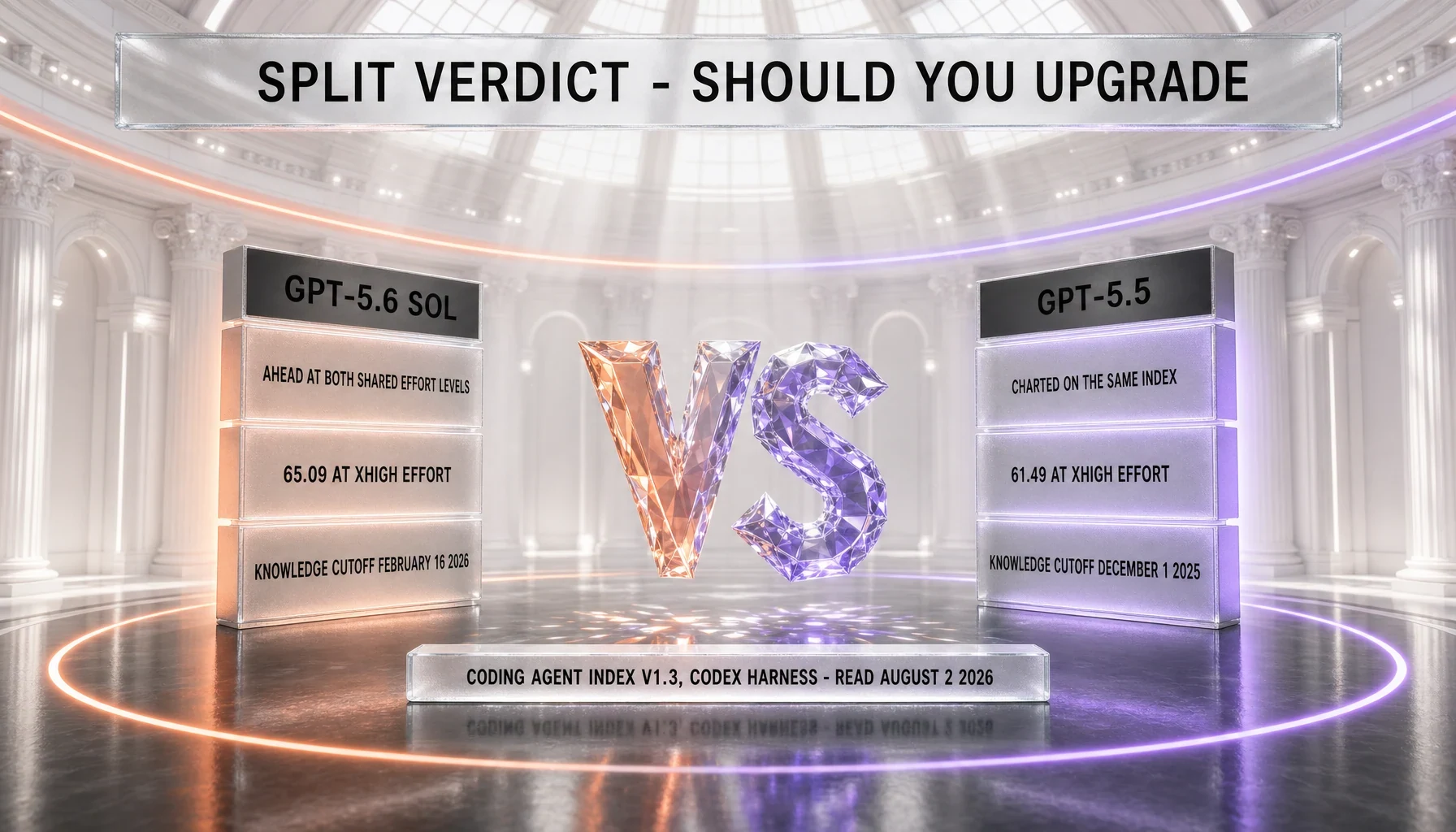
| Knowledge cutoff | Feb 16, 2026 | Dec 1, 2025 |
| Reasoning-effort tiers | low to xhigh, plus max and ultra | none, low, medium, high, xhigh |
| Multi-agent reasoning (ultra) | Yes (up to 16 sub-agents) | No |
| Output tokens per AA task (efficiency) | ~15,000 | ~16,000 |
| Production track record | Since Jul 9, 2026 (new) | Since Apr 23, 2026 (proven) |
| Fine-tuning support | Not supported | Not supported |
Pricing Comparison
GPT-5.6 Sol
GPT-5.5
Detailed Comparison
GPT-5.6 Sol is now the cheaper of the two: $4.00 per million input tokens and $20.00 per million output tokens against GPT-5.5's $5.00 and $30.00, on an identical 1,050,000-token context window and 128,000-token max output. OpenAI cut Sol's rate by over 20 percent on August 21, 2026 and calls the reduction promotional. Sol is the stronger model, leading GPT-5.5 on the Artificial Analysis Intelligence Index (59 versus 55) and leading it on the AA Coding Agent Index v1.3 at both effort settings the two share on the Codex harness — 65.09 to 61.49 at xhigh, 60.61 to 54.36 at medium. Migrate to Sol for new agentic and coding-heavy builds; stay on GPT-5.5 if you value its independently verified SWE-bench Verified score of 82.6 percent and a proven production track record. GPT-5.5 is not deprecated.
Quick Verdict: Should You Upgrade?
OpenAI released GPT-5.6 Sol to general availability on July 9, 2026, roughly two and a half months after GPT-5.5 shipped on April 23. The headline question for anyone already running GPT-5.5 is simple: is Sol a real upgrade, or a version-number bump you can skip? We ran both models through the same prompts on the API to find out, and the answer is more nuanced than the 5.5-to-5.6 jump suggests.
Here is the part that reframes the whole decision: Sol now undercuts GPT-5.5 on every line of the rate card — $4.00 per million input tokens, $20.00 per million output tokens, and $0.40 per million cached input tokens, against GPT-5.5's $5.00, $30.00, and $0.50 — while they share the same 1,050,000-token context window, the same 128,000-token maximum output, and the same text-plus-image input, text-output modality. Migrating cuts your input rate by 20 percent and your output rate by a third. That does not merely remove the usual "is the new model worth the price hike" tension, it inverts it: here the newer model is also the cheaper one.
- Sol wins on raw capability. It leads the Artificial Analysis Intelligence Index (59 versus 55), leads the AA Coding Agent Index v1.3 at both effort settings the two share on the Codex harness — 65.09 to 61.49 at xhigh, 60.61 to 54.36 at medium, with a 66.57 at max effort that GPT-5.5 does not offer — adds two new reasoning tiers, and ships a fresher February 16, 2026 knowledge cutoff versus GPT-5.5's December 1, 2025.
- GPT-5.5 keeps one genuine data edge. It is the only one of the two with a public, independently verified SWE-bench Verified score — 82.6 percent on vals.ai — because Sol has not been submitted to that benchmark yet. On top of that, GPT-5.5 has months of production track record behind it.
- Best overall: GPT-5.6 Sol, because you get the stronger model at the lower price. But this is an addition to OpenAI's lineup, not a forced migration — GPT-5.5 remains active and fully supported.
How We Compared Both Models
We ran GPT-5.6 Sol and GPT-5.5 side by side on the OpenAI API using the same prompts, the same reasoning-effort settings where both models share them, and the same tool configurations. GPT-5.5 has been our reference OpenAI model since April, so we have real production familiarity with its behavior. Sol is far newer: it only reached general availability on July 9, 2026, so treat our Sol observations as early hands-on impressions rather than a matured, months-long verdict. That honesty matters for a model this fresh.
For the numbers that carry weight in this comparison, we lean on independent third parties rather than vendor slides. Pricing and specifications are pulled directly from OpenAI's own model pages on developers.openai.com (last checked July 11, 2026). Intelligence, coding, and cost-per-task figures come from Artificial Analysis. Verified coding scores come from vals.ai's SWE-bench Verified leaderboard, and Elo rankings from LMArena. Wherever a benchmark is a vendor's own self-reported figure, we label it "according to OpenAI" so you can weigh it accordingly. We also cross-checked our own published GPT-5.5 review for consistency. Last compared: July 2026.
What Actually Changed From GPT-5.5 to GPT-5.6 Sol
OpenAI's GPT-5.6 announcement introduces a new naming convention worth understanding before you decide. The number (5.6) marks the generation; the names — Sol, Terra, and Luna — are durable capability tiers rather than model sizes. Sol is the flagship tier aimed at the hardest professional work: complex coding, long-horizon agentic tasks, cyber, science, computer use, and design. It is the direct successor in spirit to GPT-5.5's flagship role, which is exactly why a GPT-5.5 user comparing upgrade paths should look at Sol specifically, not Terra or Luna.
When you line the two flagship models up, most of the spec sheet is identical. The differences concentrate in four places, and only four:
- Reasoning depth. GPT-5.5 exposes five reasoning-effort levels: none, low, medium, high, and xhigh. Sol keeps that ladder and extends it with two new tiers — max and, above it, ultra. Ultra is the genuinely new capability: it runs a multi-agent configuration (four sub-agents by default, scaling up to sixteen) for the model's hardest problems, per OpenAI's documentation. GPT-5.5 has no equivalent.
- Knowledge freshness. Sol's knowledge cutoff is February 16, 2026, versus December 1, 2025 for GPT-5.5 — about two and a half months fresher, which can matter for fast-moving domains.
- Measured capability. On independent benchmarks (detailed below), Sol sits four points above GPT-5.5 on the aggregate Intelligence Index, and it leads on the Coding Agent Index v1.3 at both effort settings the two share on the Codex harness — 65.09 to 61.49 at xhigh and 60.61 to 54.36 at medium, read August 2, 2026.
- Programmatic tool calling. The 5.6 family adds programmatic tool calling, where the model writes and executes JavaScript inside an isolated, ephemeral V8 runtime, per OpenAI. It is designed to be Zero Data Retention compatible.
Everything else — the 1.05M context window, the 128,000-token output ceiling, text-and-image input, the absence of native audio, no fine-tuning support, and the core agentic tool stack — is shared. For a deeper introduction to why a version bump like this is really about agentic capability rather than chat quality, our explainer on agentic coding models versus chatbots lays out the framing. OpenAI's positioning of the release is covered independently by Forbes.
GPT-5.6 Sol vs GPT-5.5: Full Spec Comparison
The table below puts every headline figure side by side. Most rows still read identical — that is much of the story of this matchup — but the three price rows no longer do.
| Attribute | GPT-5.6 Sol | GPT-5.5 |
|---|---|---|
| Vendor | OpenAI | OpenAI |
| Model ID | gpt-5.6-sol | gpt-5.5 |
| General availability | July 9, 2026 | April 23, 2026 |
| Input price (per million tokens) | $4.00 | $5.00 |
| Cached input (per million tokens) | $0.40 | $0.50 |
| Output price (per million tokens) | $20.00 | $30.00 |
| Context window | 1,050,000 tokens | 1,050,000 tokens |
| Max output | 128,000 tokens | 128,000 tokens |
| Knowledge cutoff | Feb 16, 2026 | Dec 1, 2025 |
| Reasoning-effort levels | low to xhigh, plus max and ultra (multi-agent) | none, low, medium, high, xhigh |
| Input modalities | Text, image | Text, image |
| Output modalities | Text | Text |
| Fine-tuning | Not supported | Not supported |
| AA Intelligence Index (v4.1) | 59 | 55 |
| AA Coding Agent Index (v1.3, read Aug 2, 2026) | 66.57 — 2nd of 52 (Codex, max); 65.09 xhigh; 60.61 medium | 61.49 — 11th of 52 (Codex, xhigh); 54.36 (Codex, medium); 46.09 (Cursor CLI, medium) |
| SWE-bench Verified (vals.ai, independent) | N/A (not submitted) | 82.6% |
Sources: OpenAI model documentation and pricing page for prices and specs; Artificial Analysis for the Intelligence and Coding Agent indices; vals.ai for SWE-bench Verified.
Pricing: Sol Undercuts GPT-5.5 on Every Line
This used to be the shortest pricing section we had ever written for a flagship comparison, because the two rate cards matched line for line. Since August 21, 2026 they do not. GPT-5.5 bills $5.00 per million input tokens, $30.00 per million output tokens, and $0.50 per million cached input tokens. Sol bills $4.00, $20.00, and $0.40 — 20 percent less on input, a third less on output, and 20 percent less on cached input. Both offer a Batch API at fifty percent off, which now lands at $2.00 input and $10.00 output per million tokens for Sol against $2.50 and $15.00 for GPT-5.5, and Sol carries a Fast mode tier — the setting OpenAI renamed from Priority on July 30, 2026 — at exactly double its standard rate, $8.00 input and $40.00 output. One asymmetry is worth knowing before you migrate: Sol publishes a long-context tier that lifts its rate to $8.00 input and $30.00 output above 272,000 input tokens, charged across the whole request rather than the overflow alone. Below that threshold, moving a GPT-5.5 workload to Sol lowers the bill by roughly 20 to 33 percent depending on your input-to-output mix — so a $4,000 monthly GPT-5.5 spend does not land flat on Sol, it lands lower.
A second gap runs the same direction: efficiency. Artificial Analysis reports Sol consuming about 15,000 output tokens to complete an Intelligence Index task, versus roughly 16,000 for GPT-5.5, and pegged Sol's cost per task at $1.04 — a figure it computed on Sol's pre-August rate card, so Sol's side of it falls with the cut. Sol reaches an answer with slightly fewer tokens and now bills less for each one, so real per-task cost lands clearly below GPT-5.5's — the opposite of the usual "newer model, higher bill" pattern, twice over. If you want to understand how input, output, and cached-token rates combine into a real monthly figure, our guide to AI model pricing explained walks through the math. Both rate cards are published on OpenAI's API pricing page, and Artificial Analysis publishes the per-task cost methodology on its model pages.
One caveat on that rate: OpenAI presents Sol's reduced pricing as temporary, and its own two statements do not line up. The GPT-5.6 announcement, updated on August 21, 2026, says OpenAI "dropped the API and credit pricing of GPT-5.6 Sol by over 20% for the next 3 months," while the API pricing page states that "GPT-5.6 Sol's promotional pricing is available at least through November 21, 2026." We report both and reconcile neither, because OpenAI has not said what the rate becomes afterward.
Verdict on price: GPT-5.6 Sol wins it outright. Sol is cheaper than GPT-5.5 on input, on output, and on cached input, and it burns slightly fewer tokens per task on top of that. Cost is now an argument for moving rather than a neutral factor — tempered only by the fact that OpenAI labels Sol's reduced rate promotional.
Benchmarks: Independent Numbers vs Self-Reported Claims
Benchmark hygiene is where this comparison earns its keep, because the two models tell very different stories depending on which scoreboard you read. We separate strictly independent, third-party results from OpenAI's own self-reported figures.
Independent, third-party benchmarks
On the Artificial Analysis Intelligence Index (version 4.1), GPT-5.6 Sol scores 59 and GPT-5.5 scores 55 — a four-point gap in Sol's favor on the aggregate measure that folds together reasoning, coding, and knowledge evaluations. On the AA Coding Agent Index v1.3, Sol lands at 66.57 at max reasoning effort and is charted second of the 52 harness-and-model-effort entries, behind Claude Opus 5 at 66.74; GPT-5.5 is charted there too, 11th of the 52 with its 61.49 at xhigh, and because the two share the Codex harness at two effort settings the comparison is like-for-like — 65.09 to 61.49 at xhigh and 60.61 to 54.36 at medium, both in Sol's favor, according to Artificial Analysis. On LMArena's text arena, Sol (Xhigh) holds an Elo around 1486 versus GPT-5.5 (High) at about 1481 — close, but Sol edges ahead.
Then comes the twist that keeps GPT-5.5 relevant. On vals.ai's SWE-bench Verified leaderboard — an independent, run-it-yourself evaluation of real GitHub issue resolution — GPT-5.5 posts 82.6 percent and sits in third place among submitted models. GPT-5.6 Sol is simply absent from that board: it has not been submitted. That is a real data gap, not a low score, and we flag it as "N/A" rather than pretending Sol would land anywhere specific. If independently verified coding performance is a procurement requirement for you, GPT-5.5 currently has a number that Sol does not. The distinction between SWE-bench Verified and the noisier SWE-bench Pro matters here; we break it down in our explainer on SWE-bench Pro versus SWE-bench Verified.
Self-reported by OpenAI (treat with caution)
OpenAI's own launch figures put Sol at 88.8 percent on Terminal-Bench 2.1 (rising to 91.9 percent in Sol Ultra) and 64.6 percent on SWE-bench Pro — a different, harder, and noisier benchmark than SWE-bench Verified, which OpenAI itself has publicly questioned the validity of. For reference, our GPT-5.5 review recorded OpenAI's self-reported SWE-bench Pro figure of 58.6 percent at that model's launch. These are vendor numbers on both sides; they are useful directional signal but not a substitute for third-party verification. We deliberately do not cite GPQA Diamond, AIME, or MMLU figures for Sol, because no reliable independent numbers exist for the 5.6 family yet and several content farms have invented them.
Verdict on benchmarks: Sol wins the independent aggregate ranking and leads the coding-agent board at both effort settings the two share; GPT-5.5 wins the single most credible independent coding benchmark by virtue of having actually been submitted to it. Sol leads both indices, and GPT-5.5 holds the one credential Sol lacks. If you weight verified evidence over headline capability, that trade is closer than the version numbers imply.
Reasoning and Agentic Behavior: The Ultra Tier
The most consequential functional difference between the two models is what happens at the top of the reasoning ladder. GPT-5.5 stops at xhigh — a single, deep reasoning pass. Sol keeps xhigh, adds a max tier above it, and then adds ultra, which OpenAI describes as a multi-agent mode that spins up four sub-agents by default and can scale to sixteen for the hardest problems. In practice, ultra is aimed at long-horizon agentic work — the kind of multi-step task where the model needs to plan, delegate, execute, and verify across many turns rather than answer in one shot.
For a GPT-5.5 user, this is the clearest reason to reach for Sol: if your workload is a long-running agentic loop — an autonomous coding agent, a research orchestrator, a computer-use automation — ultra is a capability GPT-5.5 fundamentally does not have. Sol also inherits the 5.6 family's programmatic tool calling, letting the model write and run JavaScript in an isolated V8 runtime as part of a task, which is a meaningful upgrade for agents that need to compute or transform data mid-task. Both models share the rest of the stack: web search, file search, code interpreter, computer use, hosted shell, and Model Context Protocol clients, all documented on OpenAI's Sol model page and the GPT-5.5 model page.
If your usage is closer to single-turn generation — drafting, summarizing, structured extraction, classification over a large language model API — you will rarely touch max or ultra, and the practical gap between the two models shrinks to the four-point index difference and the fresher cutoff. That is a real consideration: paying attention to your actual reasoning-effort usage tells you how much of Sol's advantage you would even exercise.
Winner by Category
No single model wins everything here, so we split the decision by what you actually optimize for.
- Best for agentic and coding-heavy builds: GPT-5.6 Sol. Its charted AA Coding Agent Index v1.3 score (65.09 against GPT-5.5's 61.49 at matched xhigh effort on the Codex harness, and 66.57 at max), the ultra multi-agent tier, and programmatic tool calling make Sol the stronger choice for autonomous coding agents and long-horizon automation.
- Best for independently verified coding evidence: GPT-5.5. Its 82.6 percent on SWE-bench Verified is a public, third-party number. Sol has none yet.
- Best for raw aggregate intelligence: GPT-5.6 Sol. 59 versus 55 on the AA Intelligence Index, plus a fresher February 2026 knowledge cutoff.
- Best for production stability today: GPT-5.5. Two-plus months of real-world track record versus Sol's few days of general availability.
- Best value: GPT-5.6 Sol. It is 20 percent cheaper on input and a third cheaper on output than GPT-5.5, and slightly more token-efficient per task on top of that.
- Best overall: GPT-5.6 Sol, because it is the stronger model at the lower price — provided you can accept a very new model without a verified coding benchmark yet.
Pros and Cons of Each Model
GPT-5.6 Sol
Where Sol wins:
- Higher aggregate capability at a lower price: 59 on the AA Intelligence Index versus 55, per Artificial Analysis.
- Higher AA Coding Agent Index v1.3 score at every setting the two share — 65.09 to 61.49 at xhigh and 60.61 to 54.36 at medium on the Codex harness, plus a 66.57 at max effort (2nd of 52).
- Two new reasoning tiers, including ultra multi-agent mode (up to sixteen sub-agents) for long-horizon agentic work.
- Fresher knowledge cutoff (February 16, 2026 versus December 1, 2025).
- Programmatic tool calling in an isolated V8 runtime, new to the 5.6 family.
- Slightly better token efficiency per task, which compounds with the lower per-token rate.
Where Sol falls short:
- No public, independently verified SWE-bench Verified score — it has not been submitted.
- Only generally available since July 9, 2026, so limited production track record and little community-tested behavior.
- Same 128,000-token output ceiling and no native audio or fine-tuning, so it inherits GPT-5.5's structural limits.
GPT-5.5
Where GPT-5.5 wins:
- Public, independently verified SWE-bench Verified score of 82.6 percent on vals.ai — a credential Sol lacks.
- Mature, battle-tested model with months of production use since April 2026.
- A standing, non-promotional rate card: GPT-5.5's $5.00 and $30.00 are its ordinary prices, where Sol's lower rate is one OpenAI itself labels promotional.
- Predictable, well-documented behavior for teams with validated pipelines.
Where GPT-5.5 falls short:
- Four points behind Sol on the aggregate AA Intelligence Index (55 versus 59).
- No max or ultra reasoning tier, so no multi-agent mode for the hardest long-horizon tasks.
- Older knowledge cutoff by about two and a half months.
- More expensive than Sol on input, output, and cached input, and slightly less token-efficient per task.
When to Upgrade to Sol, and When to Stay on GPT-5.5
Upgrade to GPT-5.6 Sol if
You are starting a new agentic or coding-heavy build and want the strongest model available; your workloads are long-horizon agents that would benefit from the ultra multi-agent tier; you value the fresher February 2026 knowledge cutoff for a fast-moving domain; or you simply want the best per-dollar capability, since Sol delivers a higher Artificial Analysis index score on a cheaper rate card. Because Sol now costs less per token than GPT-5.5, the budget argument runs toward upgrading — the only real cost is the operational risk of adopting a brand-new model. Teams already comfortable with OpenAI's flagship cadence will find Sol a near drop-in replacement for GPT-5.5 in the Responses and Chat Completions APIs.
Stay on GPT-5.5 if
You run a validated, stable production pipeline where predictable behavior outweighs a four-point capability bump; you have procurement or compliance requirements that demand an independently verified benchmark, where GPT-5.5's SWE-bench Verified score of 82.6 percent is a concrete asset and Sol's absence is a gap; or you simply have no pressing workload that touches the max or ultra reasoning tiers. Crucially, staying is a legitimate choice, not a fallback: GPT-5.5 is not deprecated, it remains fully supported, and OpenAI positions the 5.6 family as an addition to the lineup rather than a forced replacement. Many teams will sensibly pilot Sol on new projects while leaving proven GPT-5.5 workloads untouched until Sol accumulates its own track record and verified benchmarks.
Migrating Safely: What Changes in Your Stack
Because the two models share an API surface, moving from GPT-5.5 to GPT-5.6 Sol is mechanically simple — but "simple" is not "zero effort," and treating it as a blind drop-in swap is how teams get surprised. Here is what actually changes and what to check before you flip production traffic.
The model ID. In most codebases the migration is a one-line change from gpt-5.5 to gpt-5.6-sol, which is also reachable through the gpt-5.6 alias. Both models run in the Responses API and the Chat Completions API, so your request and response shapes stay the same. If you pin snapshots for reproducibility — a practice we recommend for any production pipeline — you will pin a new Sol snapshot rather than inheriting GPT-5.5's, so update your pinning logic accordingly.
Reasoning-effort defaults. This is the setting most likely to trip you up. GPT-5.5 defaults to medium effort, while Sol's ladder extends through max and ultra. If your code hard-codes a reasoning-effort value or relies on the default, verify the behavior explicitly after switching. Ultra in particular spins up multiple sub-agents and changes both latency and token consumption, so do not enable it across every call — reserve it for the hardest tasks where the extra cost is justified.
Prompt behavior and evaluations. A newer base model can shift tone, formatting, and edge-case handling even when raw capability improves. If you keep a golden set of evaluation prompts — and for any serious pipeline you should — run them against Sol before cutting over. Pay attention to structured-output conformance, tool-call formatting, and any prompt tuned specifically to GPT-5.5's quirks. The absence of a public SWE-bench Verified score for Sol makes your own internal evals more important, not less.
Cost monitoring. Sol's per-token rate is lower on every line, but token consumption per task differs, and if you enable higher reasoning tiers your output-token bill will move — ultra especially. Watch your first week of Sol traffic against the GPT-5.5 baseline before assuming the headline saving reaches your invoice, and keep in mind that OpenAI calls Sol's reduced rate promotional. OpenAI's Sol model page and pricing documentation are the authoritative references for both the parameters and the rate card.
Our advice mirrors how we would handle the switch on a real pipeline: run Sol in shadow mode or on a non-critical slice of traffic first, compare outputs against your GPT-5.5 baseline for a week, and only then decide whether the four-point capability gain and the ultra tier justify a full cutover. Because GPT-5.5 is not deprecated, there is no clock forcing the decision — you migrate on your own schedule.
How This Matchup Fits the Wider Field
Sol versus GPT-5.5 is an internal OpenAI upgrade question, but neither model exists in a vacuum. On the independent boards, Sol trades the top of the leaderboard with Anthropic's frontier tier — see our Claude Fable 5 vs GPT-5.5 and Claude Opus 4.8 vs GPT-5.5 comparisons for how GPT-5.5 stacks up against Anthropic today. On price, cheaper challengers like xAI's Grok undercut both OpenAI flagships; our GPT-5.5 vs Grok 4.3 and GPT-5.5 vs DeepSeek V4 pieces cover the cost angle. If you are weighing OpenAI's own tiers, the outgoing GPT-5.4 remains the budget option at $2.50 input and $15.00 output per million tokens, while Claude Opus 4.8 and Claude Fable 5 lead several independent benchmarks. Independent context for the whole field is maintained by Artificial Analysis and LMArena.
Frequently Asked Questions
Should I upgrade from GPT-5.5 to GPT-5.6 Sol?
Upgrade if you want the stronger model at the lower cost. Sol is priced below GPT-5.5 — $4.00 per million input tokens and $20.00 per million output tokens against $5.00 and $30.00 — and Sol leads on the Artificial Analysis Intelligence Index (59 versus 55) and leads it on the AA Coding Agent Index v1.3 at both settings the two share on the Codex harness (65.09 to 61.49 at xhigh, 60.61 to 54.36 at medium). Stay on GPT-5.5 if you run a stable, validated pipeline and value its independently verified SWE-bench Verified score of 82.6 percent and proven track record. GPT-5.5 is not deprecated, so staying is a valid choice.
Is GPT-5.6 Sol more expensive than GPT-5.5?
No — Sol is the cheaper of the two. Sol bills $4.00 per million input tokens, $20.00 per million output tokens, and $0.40 per million cached input tokens, against $5.00, $30.00, and $0.50 for GPT-5.5: 20 percent less on input and a third less on output. Both share a Batch API discount of fifty percent. Because Sol also tends to use slightly fewer output tokens per task (about 15,000 versus 16,000 on an Artificial Analysis Intelligence Index task), the real per-task gap is wider than the rate cards alone suggest. OpenAI describes Sol's reduced rate as promotional and says it runs at least through November 21, 2026.
Is GPT-5.5 deprecated now that GPT-5.6 is out?
No. GPT-5.5 remains active and fully supported. OpenAI positions the GPT-5.6 family (Sol, Terra, and Luna) as an addition to its lineup rather than a forced replacement. GPT-5.5 still appears in OpenAI's model documentation without any deprecation or legacy tag, and it continues to serve production traffic through the Responses and Chat Completions APIs and ChatGPT.
What is the difference between GPT-5.6 Sol and GPT-5.5's context window?
There is no difference. Both models ship a 1,050,000-token context window and a 128,000-token maximum output. Context size is not a reason to migrate — it is identical across the two models, as documented on OpenAI's model pages. Both also accept the same modalities: text and image input, with text output only.
Why does GPT-5.5 have a SWE-bench Verified score but GPT-5.6 Sol does not?
GPT-5.5 has been submitted to and scored on vals.ai's independent SWE-bench Verified leaderboard, where it posts 82.6 percent. GPT-5.6 Sol has not been submitted to that benchmark yet, so no independently verified SWE-bench Verified figure exists for it as of July 2026. We report this as "N/A" rather than estimating a score. If verified coding performance is a hard requirement, GPT-5.5 currently has a credential Sol lacks.
What is the ultra reasoning tier in GPT-5.6 Sol?
Ultra is a new reasoning-effort tier exclusive to the GPT-5.6 family. According to OpenAI, it runs a multi-agent configuration — four sub-agents by default, scaling up to sixteen — for the model's hardest problems, and it is primarily associated with Sol. GPT-5.5 stops at xhigh and has no multi-agent mode. Ultra is aimed at long-horizon agentic tasks that require planning, delegation, and verification across many steps.
Which model is better for agentic coding, GPT-5.6 Sol or GPT-5.5?
GPT-5.6 Sol is stronger for agentic coding on aggregate: on the Artificial Analysis Coding Agent Index v1.3 it leads GPT-5.5 at both effort settings the two share on the Codex harness — 65.09 to 61.49 at xhigh, 60.61 to 54.36 at medium — and reaches 66.57 at max effort, second of 52. Sol also adds the ultra multi-agent tier and programmatic tool calling. However, GPT-5.5 holds the only public SWE-bench Verified score of the two (82.6 percent), so for independently verified single-repository issue resolution specifically, GPT-5.5 has a proven number today.
How much fresher is GPT-5.6 Sol's knowledge cutoff?
Sol's knowledge cutoff is February 16, 2026, versus December 1, 2025 for GPT-5.5 — about two and a half months fresher. For most workloads this is a minor factor, but it can matter for fast-moving domains where recent events, libraries, or documentation are relevant. Both models can still use web search as a tool to reach beyond their training cutoff.
Do GPT-5.6 Sol and GPT-5.5 support fine-tuning?
No, neither model supports fine-tuning. This is one of several specifications the two share. If your stack depends on fine-tuned variants, neither the GPT-5.5 base model nor GPT-5.6 Sol is an option, and you would need to look at smaller, tunable models in OpenAI's lineup instead.
Can I select GPT-5.6 Sol in ChatGPT, or only through the API?
GPT-5.6 Sol is selectable in ChatGPT for Plus, Pro, Business, and Enterprise subscribers, and it is also available through the API and Codex. GPT-5.5 remains available across the same ChatGPT tiers and the API. So for most users, switching between the two is a matter of choosing a different model from the picker or changing a single model ID in an API call.
Is GPT-5.6 Sol worth it if I only do single-turn tasks like drafting or summarizing?
For single-turn work such as drafting, summarizing, structured extraction, or classification, the practical gap between Sol and GPT-5.5 narrows to the four-point Intelligence Index difference and the fresher cutoff, because you rarely touch the max or ultra reasoning tiers. Since Sol is also the cheaper of the two, there is no cost downside to using it, but you also will not exercise most of its advantages. Lighter GPT-5.6 tiers like Terra or Luna may be more cost-effective for high-volume, simple tasks.
What are the risks of moving to GPT-5.6 Sol so soon after launch?
The main risk is maturity. Sol reached general availability on July 9, 2026, so it has limited production track record and little community-tested behavior compared with GPT-5.5's months of real-world use. There is also no independently verified SWE-bench Verified score for Sol yet. A common approach is to pilot Sol on new or non-critical projects while keeping proven GPT-5.5 workloads in place until Sol accumulates its own track record and verified benchmarks.
The Verdict
GPT-5.6 Sol is the better model, and since August 21, 2026 it is also the cheaper one — that is the cleanest way to summarize this matchup. Sol leads GPT-5.5 on the Artificial Analysis Intelligence Index (59 versus 55), leads the AA Coding Agent Index v1.3 at both effort settings the two share on the Codex harness — 65.09 to 61.49 at xhigh, 60.61 to 54.36 at medium — adds the ultra multi-agent reasoning tier and programmatic tool calling, and ships a fresher February 2026 knowledge cutoff, all at $4.00 input and $20.00 output per million tokens against GPT-5.5's $5.00 and $30.00. Migrating lowers the bill instead of raising it, which removes the usual reason to hesitate.
But "better" does not mean "GPT-5.5 is obsolete," and the honest case for staying put is narrower than the version bump implies rather than nonexistent. GPT-5.5 is the only one of the two with a public, independently verified SWE-bench Verified score (82.6 percent on vals.ai, where Sol has not been submitted), and it carries months of production track record that a two-day-old model simply cannot match. If you run a validated, stable pipeline and weight proven, independently benchmarked behavior over a four-point capability increase, staying on GPT-5.5 is entirely defensible.
Our recommendation: reach for GPT-5.6 Sol on new agentic and coding-heavy builds, long-horizon automation, and anything that benefits from deeper reasoning or a fresher cutoff — you get more capability for less money. Keep proven GPT-5.5 workloads where they are until Sol earns its own verified benchmarks and track record. GPT-5.5 is not going anywhere; Sol is an upgrade you can adopt on your own schedule, not a migration anyone is forcing on you.
Sources
- OpenAI — Introducing GPT-5.6 (Sol, Terra, Luna)
- OpenAI API docs — GPT-5.6 Sol model page
- OpenAI API docs — GPT-5.5 model page
- OpenAI API docs — Pricing
- Artificial Analysis — GPT-5.6 benchmarks across Intelligence, Speed and Cost
- Artificial Analysis — GPT-5.5 model analysis
- vals.ai — SWE-bench Verified leaderboard
- LMArena — Leaderboard
- Forbes — OpenAI's GPT-5.6 Lands With Work Agents And A Desktop Pivot
Our Verdict
GPT-5.6 Sol is the better model at the lower price. It leads GPT-5.5 on the Artificial Analysis Intelligence Index (59 versus 55), leads the AA Coding Agent Index v1.3 at both effort settings the two share on the Codex harness — 65.09 to 61.49 at xhigh, 60.61 to 54.36 at medium — adds the ultra multi-agent reasoning tier and programmatic tool calling, and ships a fresher February 2026 knowledge cutoff — all at $4.00 input and $20.00 output per million tokens against GPT-5.5's $5.00 and $30.00, a rate OpenAI cut on August 21, 2026 and labels promotional, with the same 1,050,000-token context window. Upgrade to Sol for new agentic and coding-heavy builds, long-horizon automation, and anything that benefits from deeper reasoning. The case for staying on GPT-5.5 is narrower but real: it is the only one of the two with a public, independently verified SWE-bench Verified score (82.6 percent on vals.ai, where Sol has not been submitted) and it carries months of production track record. GPT-5.5 is not deprecated — Sol is an addition to OpenAI's lineup, not a forced replacement, so migrate on your own schedule.
Choose GPT-5.6 Sol
OpenAI's flagship GPT-5.6 capability tier, with Programmatic Tool Calling and a 1.05M-token context.
Try GPT-5.6 Sol →Choose GPT-5.5
OpenAI's first fully retrained base model since GPT-4.5 — agentic, faster, and double the API price.
Try GPT-5.5 →Frequently Asked Questions
Is GPT-5.6 Sol better than GPT-5.5?
GPT-5.6 Sol is the better model at the lower price. It leads GPT-5.5 on the Artificial Analysis Intelligence Index (59 versus 55), leads the AA Coding Agent Index v1.3 at both effort settings the two share on the Codex harness — 65.09 to 61.49 at xhigh, 60.61 to 54.36 at medium — adds the ultra multi-agent reasoning tier and programmatic tool calling, and ships a fresher February 2026 knowledge cutoff — all at $4.00 input and $20.00 output per million tokens against GPT-5.5's $5.00 and $30.00, a rate OpenAI cut on August 21, 2026 and labels promotional, with the same 1,050,000-token context window. Upgrade to Sol for new agentic and coding-heavy builds, long-horizon automation, and anything that benefits from deeper reasoning. The case for staying on GPT-5.5 is narrower but real: it is the only one of the two with a public, independently verified SWE-bench Verified score (82.6 percent on vals.ai, where Sol has not been submitted) and it carries months of production track record. GPT-5.5 is not deprecated — Sol is an addition to OpenAI's lineup, not a forced replacement, so migrate on your own schedule.
Which is cheaper, GPT-5.6 Sol or GPT-5.5?
GPT-5.6 Sol starts at $4 in / $20 out per M tokens. GPT-5.5 starts at $5 in / $30 out per M tokens. Check the pricing comparison section above for a full breakdown.
What are the main differences between GPT-5.6 Sol and GPT-5.5?
The key differences span across 15 features we compared. For AA Intelligence Index (v4.1, independent), GPT-5.6 Sol offers 59 while GPT-5.5 offers 55. For AA Coding Agent Index v1.3 (independent, read August 2, 2026), GPT-5.6 Sol offers 66.57 — 2nd of 52 (Codex, max); 65.09 (Codex, xhigh); 60.61 (Codex, medium) while GPT-5.5 offers 61.49 — 11th of 52 (Codex, xhigh); 54.36 (Codex, medium); 46.09 (Cursor CLI, medium). For SWE-bench Verified (vals.ai, independent), GPT-5.6 Sol offers N/A (not submitted) while GPT-5.5 offers 82.6% (submitted). See the full feature comparison table above for all details.