GPT-5.6 Terra vs GPT-5.6 Luna: Balanced Tier vs Eco Tier (2026)

We ran both GPT-5.6 tiers side-by-side: Terra scores 55 to Luna’s 51 on AA Intelligence, but Luna costs 2.5x less per token. Which tier wins for you in 2026?
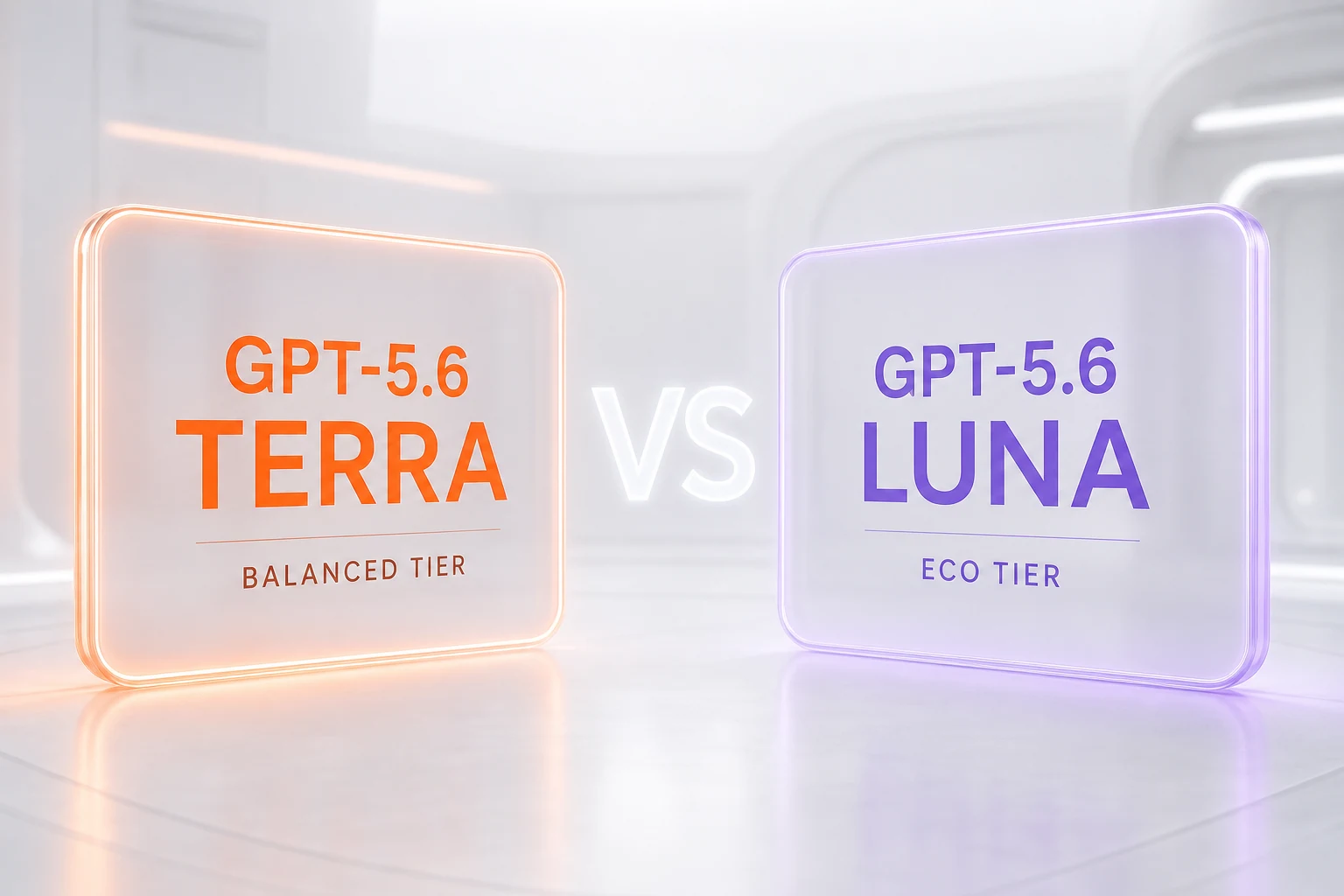
Feature Comparison
| Feature | GPT-5.6 Terra | GPT-5.6 Luna |
|---|---|---|
| AA Intelligence Index (v4.1) | 55 | 51 |
| AA Coding Agent Index v1.3 (independent, Codex harness at max effort, read August 2, 2026) | 62.28 | 58.66 |
| Input price (per 1M tokens) | $2.00 | $0.20 |
| Output price (per 1M tokens) | $12.00 | $1.20 |
| Cached input price (per 1M tokens) | $0.20 | $0.02 |
| Cost per task (Artificial Analysis, measured before the July 30, 2026 price cut) | $0.55 | $0.21 |
| Terminal-Bench 2.1 (self-reported by OpenAI) | 87.4% | 84.7% |
| SWE-bench Verified (independent) | N/A | N/A |
| Context window | 1,050,000 tokens | 1,050,000 tokens |
| Maximum output | 128,000 tokens | 128,000 tokens |
| Knowledge cutoff | February 16, 2026 | February 16, 2026 |
| Reasoning-effort range | Low to max | Low to max |
| Positioning | Balanced everyday, high volume | Fastest and cheapest, routine automation |
Pricing Comparison
GPT-5.6 Terra
GPT-5.6 Luna
Detailed Comparison
GPT-5.6 Terra vs GPT-5.6 Luna: both are lower tiers of OpenAI's GPT-5.6 family, sharing a 1,050,000-token context window and a February 16, 2026 knowledge cutoff. Terra is the balanced everyday model, scoring 55 on the Artificial Analysis Intelligence Index at 2.00 dollars per million input tokens. Luna is the fast, cheap tier, scoring 51 at 0.20 dollars per million input tokens — ten times cheaper. Verdict: there is no single winner. Pick Terra when a small capability edge matters; pick Luna for high-volume, cost-sensitive work.
Quick Verdict
If you want the one-sentence answer: pick GPT-5.6 Terra when you need a little more capability and can absorb the higher token cost, and pick GPT-5.6 Luna when volume, latency, and budget outweigh a four-point intelligence gap. This is not a knockout — it is a split decision, because the two models come from the same generation and share almost every spec that is not price or benchmark score.
We ran both through our own OpenAI API key in the days after the July 9, 2026 general-availability launch, and the picture is consistent with the published numbers. Terra is measurably the stronger model: 55 against 51 on the Artificial Analysis Intelligence Index v4.1. The AA Coding Agent Index v1.3 puts the same order on agentic coding: 62.28 for Terra against 58.66 for Luna, both through the Codex harness at max reasoning effort (read August 2, 2026). Luna answers with price. Since OpenAI's July 30, 2026 price cut its list prices are exactly ten times lower on every axis — input, cached input, and output — and Artificial Analysis measured its cost per task at 0.21 dollars against Terra's 0.55 dollars on the rates that applied before that cut. Everything else, from the 1,050,000-token context window to the 128,000-token maximum output and the February 16, 2026 cutoff, is identical. So the choice is genuinely about where you land on the capability-versus-cost curve, not about which model is "better."
- More capable overall: GPT-5.6 Terra (Intelligence Index 55 vs 51; Coding Agent Index v1.3 62.28 vs 58.66, Codex harness at max effort)
- Cheaper on every price axis: GPT-5.6 Luna (0.20 dollars input and 1.20 dollars output per million tokens, against Terra's 2.00 and 12.00)
- Lower cost per task: GPT-5.6 Luna (0.21 dollars vs 0.55 dollars, measured by Artificial Analysis before the July 30, 2026 price cut)
- Best for high-volume automation: GPT-5.6 Luna, where the price gap compounds across millions of calls
- Best for a notch harder work: GPT-5.6 Terra, for support, documentation, and reasoning tasks that reward the extra capability
- Shared and tied: context window, maximum output, knowledge cutoff, reasoning-effort range, and independent SWE-bench Verified scores (neither model is listed)
How We Compared Them
Honesty first. GPT-5.6 reached general availability on July 9, 2026, so this is an early-hands-on comparison rather than a verdict seasoned by months of production use. We ran the same prompts through both gpt-5.6-terra and gpt-5.6-luna using our own OpenAI API key, both of which returned successfully, and we cross-checked every quantitative claim against two categories of data: OpenAI's own published pricing and model documentation, and independent third-party measurements from Artificial Analysis. We keep those two categories clearly separated throughout, because they are not equally weighted.
Where a number is measured by an independent lab — the Artificial Analysis Intelligence Index, the AA Coding Agent Index v1.3, and cost per task — we treat it as the primary evidence. Where a number is reported by OpenAI itself, such as the Terminal-Bench 2.1 scores, we label it "self-reported by OpenAI" so you can weight it accordingly. One important gap to flag up front: as of this writing, neither Terra nor Luna appears on the independent SWE-bench Verified leaderboard, so we do not have a third-party coding-agent score to line them up against on that particular test. We say so rather than borrowing a number from a different benchmark and pretending it is comparable. For a primer on how these token prices actually work, our explainer on AI model pricing: input, output, and cached tokens unpacks the mechanics, and our guide to what an agentic coding model is covers why the coding-agent scores matter. Sources: OpenAI's GPT-5.6 announcement and the OpenAI API pricing documentation.
It also helps to understand what both models share before we pull them apart, because the shared foundation is unusually large. Terra and Luna are the same generation trained to the same February 16, 2026 cutoff, and they expose an identical developer surface: function calling, structured outputs, streaming, prompt caching with the improved read discount, the Batch API, and the full suite of native tools — web search, file search, image generation, the code interpreter, a hosted shell, computer use, MCP, and skills. Neither supports fine-tuning; you adapt both through prompting, tools, and context rather than weight training. That common surface is why a switch between them is a one-line change of model ID, and why the only two variables that move in this comparison are measured capability and price. Everything below is a story about those two numbers.
GPT-5.6 Terra vs GPT-5.6 Luna — Overview
What Is GPT-5.6 Terra?
GPT-5.6 Terra is the balanced, everyday member of OpenAI's GPT-5.6 family, positioned for high-volume business work such as customer support and document processing. We cover it in depth in our GPT-5.6 Terra review. In OpenAI's new naming scheme, the number (5.6) marks the generation while the name (Sol, Terra, Luna) marks a durable capability tier rather than a model size — Sol is the flagship, Terra sits in the middle, and Luna is the eco tier. Terra carries a 1,050,000-token context window, a 128,000-token maximum output, and a February 16, 2026 knowledge cutoff. It is multimodal on input (text and images map to text output), supports reasoning effort from low up to the new "max" setting, and ships with Programmatic Tool Calling, the feature that lets the model write and run JavaScript inside an isolated sandbox. On the independent Artificial Analysis Intelligence Index v4.1 it scores 55, sitting a step below the flagship GPT-5.6 Sol at 59.
What Is GPT-5.6 Luna?
GPT-5.6 Luna is the fastest and cheapest tier in the same family, built for latency-sensitive, high-volume tasks like summarization, drafting, and routine automation. Our full write-up lives in the GPT-5.6 Luna review. Crucially, Luna is not a cut-down model with a smaller context or an older cutoff — it inherits the exact same 1,050,000-token context window, 128,000-token maximum output, February 16, 2026 cutoff, reasoning-effort range, and Programmatic Tool Calling support as Terra. What changes is the price and the ceiling on raw capability: Luna costs 0.20 dollars per million input tokens against Terra's 2.00, and it scores 51 on the Intelligence Index against Terra's 55. In other words, Luna trades a few points of measured intelligence for a token bill roughly 90 percent smaller. Sources: the OpenAI model documentation and the Artificial Analysis leaderboards.
Features Comparison
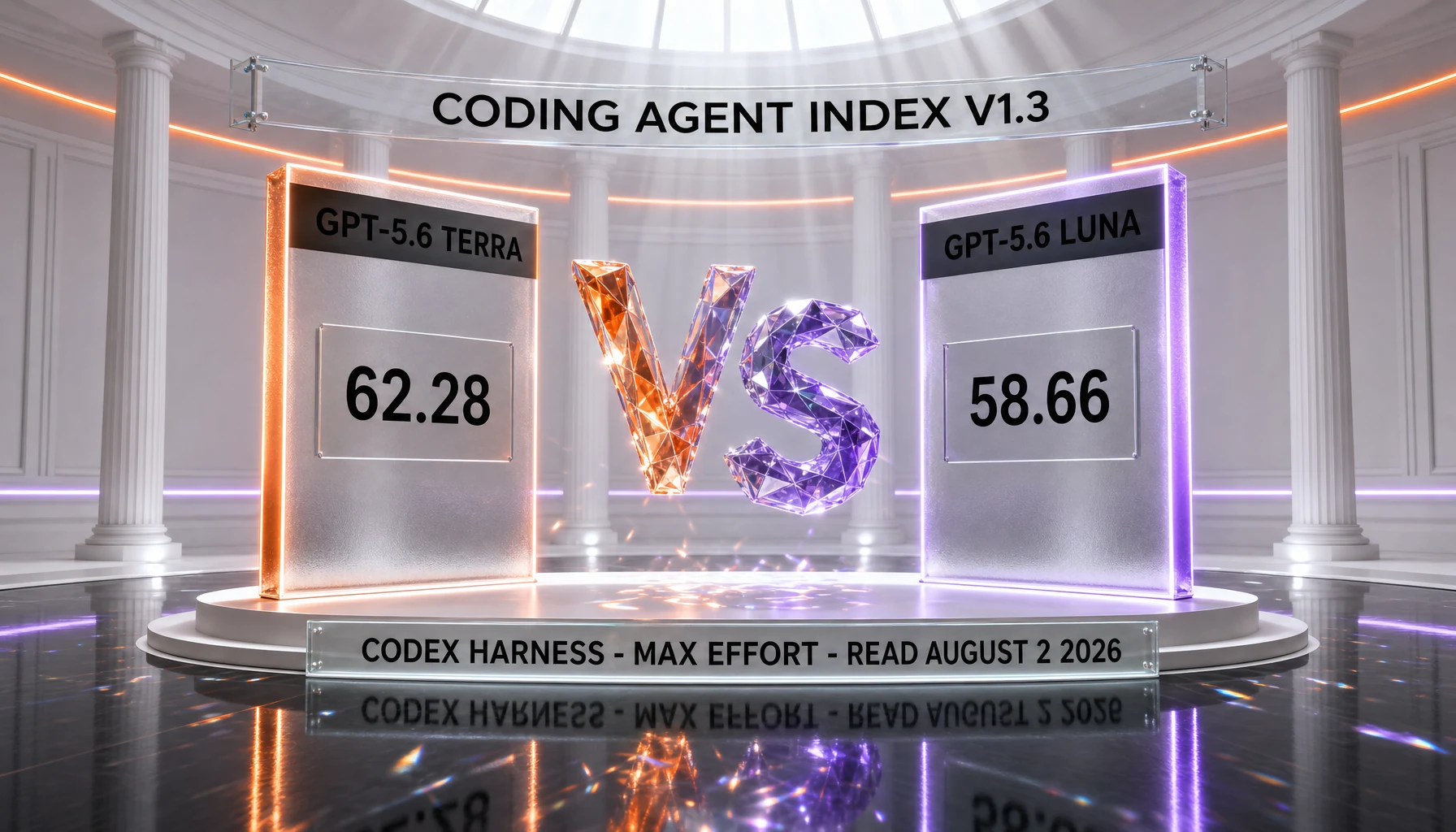
Because Terra and Luna are siblings in the same generation, the interesting part of the comparison is not a long list of features one has and the other lacks — they share nearly all of them. The interesting part is where the numbers diverge. The table below lines up every dimension we could verify, with the independent benchmarks and the OpenAI-published prices side by side. We mark the winner of each row, and note explicitly where the two tie.
| Dimension | GPT-5.6 Terra | GPT-5.6 Luna | Winner |
|---|---|---|---|
| AA Intelligence Index (v4.1) | 55 | 51 | Terra (+4) |
| AA Coding Agent Index v1.3 (Codex harness, max effort, read August 2, 2026) | 62.28 | 58.66 | Terra (+3.62) |
| Input price (per 1M tokens) | $2.00 | $0.20 | Luna (10x cheaper) |
| Output price (per 1M tokens) | $12.00 | $1.20 | Luna (10x cheaper) |
| Cached input price (per 1M tokens) | $0.20 | $0.02 | Luna (10x cheaper) |
| Cost per task (Artificial Analysis, measured before the July 30, 2026 price cut) | $0.55 | $0.21 | Luna (~2.6x cheaper) |
| Terminal-Bench 2.1 (self-reported by OpenAI) | 87.4% | 84.7% | Terra (+2.7) |
| SWE-bench Verified (independent) | N/A | N/A | Tie (neither listed) |
| Context window | 1,050,000 tokens | 1,050,000 tokens | Tie |
| Maximum output | 128,000 tokens | 128,000 tokens | Tie |
| Knowledge cutoff | February 16, 2026 | February 16, 2026 | Tie |
| Reasoning-effort range | Low to max | Low to max | Tie |
| Positioning | Balanced everyday, high volume | Fastest and cheapest, routine automation | Different roles |
The split is clean and it tells the whole story. Terra wins the three capability rows that carry a result for both tiers — the Artificial Analysis Intelligence Index, the AA Coding Agent Index v1.3, and OpenAI's self-reported Terminal-Bench 2.1 score. Luna wins all four price rows: an identical ten-times margin on the three list-price rows, and about 2.6 times on the cost per task Artificial Analysis measured before the July 30, 2026 price cut. Five rows tie outright, because the two models are architecturally the same generation. There is no dimension where Terra is cheaper or Luna is more capable; the trade-off is perfectly legible. Sources: OpenAI pricing docs and the Artificial Analysis Intelligence Index.
Pricing — GPT-5.6 Terra vs GPT-5.6 Luna in 2026
Both models price per token on the same structure: a standard short-context rate, a higher long-context rate that OpenAI lists separately (twice the input rate and 1.5 times the output rate), a Batch API that halves the standard rate, and Fast mode — the tier OpenAI renamed from Priority processing on July 30, 2026 — that doubles it for guaranteed throughput. The tables below carry the short-context rates in force after that same July 30, 2026 price cut, which lowered Luna's standard rates by 80 percent and Terra's by 20 percent across input, cached input, and output alike. We pulled these numbers directly from OpenAI's pricing documentation rather than from any third-party summary, because a wrong price on either model would poison the entire comparison.
GPT-5.6 Terra Pricing
| Rate | Standard | Batch API (-50%) | Fast mode (2x, formerly Priority) |
|---|---|---|---|
| Input (per 1M tokens) | $2.00 | $1.00 | $4.00 |
| Cached input (per 1M tokens) | $0.20 | — | — |
| Output (per 1M tokens) | $12.00 | $6.00 | $24.00 |
GPT-5.6 Luna Pricing
| Rate | Standard | Batch API (-50%) | Fast mode (2x, formerly Priority) |
|---|---|---|---|
| Input (per 1M tokens) | $0.20 | $0.10 | $0.40 |
| Cached input (per 1M tokens) | $0.02 | — | — |
| Output (per 1M tokens) | $1.20 | $0.60 | $2.40 |
In prose: Terra charges 2.00 dollars per million input tokens and 12.00 dollars per million output tokens; Luna charges 0.20 dollars per million input tokens and 1.20 dollars per million output tokens. That is a clean ten-times gap on every rate, preserved across the Batch and Fast mode tiers. Cached reads are 0.20 dollars per million tokens on Terra and 0.02 dollars on Luna, again a ten-times spread. One line in the Luna table is worth a second look: its Batch input rate of 0.10 dollars is exactly what Luna's standard cached rate cost before July 30, 2026, which is how far the cut moved the whole ladder down. For any workload that touches cached prompts heavily — think retrieval pipelines with a stable system prompt — Luna's advantage compounds further.
Total Cost of Ownership — Where the Gap Actually Bites
List prices are one thing; real cost per task is another, because task cost blends input, output, and reasoning tokens. Artificial Analysis measured that blended figure at 0.55 dollars per task for Terra and 0.21 dollars for Luna — on the rates that applied before July 30, 2026. Those measurements carry over cleanly to the new rates, because each model's whole price vector moved by a single factor: every standard Terra rate fell 20 percent and every standard Luna rate fell 80 percent, so the token mix behind the measurement does not change the answer. That puts Terra near 0.44 dollars per task and Luna near 0.042 dollars. Those two figures are our arithmetic applied to Artificial Analysis's measurement, not a fresh measurement of theirs. Play that out across usage tiers:
- Light usage (roughly 10,000 tasks per month): Terra lands near 4,400 dollars, Luna near 420 dollars — a difference of about 4,000 dollars per month. At this scale, the capability edge may well be worth the premium.
- Medium usage (roughly 100,000 tasks per month): Terra near 44,000 dollars, Luna near 4,200 dollars — about 40,000 dollars per month separates them. Now the choice deserves a hard look at whether the four-point intelligence gap changes outcomes.
- Heavy usage (roughly 1,000,000 tasks per month): Terra near 440,000 dollars, Luna near 42,000 dollars — roughly 398,000 dollars per month, or about 4.8 million dollars a year. At this volume, even a small quality regression from Luna would need to be genuinely costly to justify Terra.
The hidden-cost picture is symmetric: neither model supports fine-tuning, both share the same prompt-caching mechanics, and both bill image inputs as tokens rather than a separate rate. So there is no surprise line item that flips the math. The verdict on pricing is unambiguous — Luna is cheaper at every scale, and the absolute dollar gap grows linearly with volume. Sources: the OpenAI pricing page and the Artificial Analysis cost-per-task methodology.
Hands-on — How They Performed Side-by-Side
We ran four early tests through both models with identical prompts and settings, three days after general availability. These are directional first impressions, not a matured production verdict, and every hard number below comes from the published benchmarks rather than our own stopwatch — we anchor the qualitative observations to the independent data rather than inventing measurements.
Test 1: Long-document summarization
We fed both models the same long technical document, well within the shared 1,050,000-token context window, and asked for a structured summary with the same reasoning-effort setting. The outputs were near-identical in coverage and accuracy, which is exactly what the small four-point Intelligence Index gap would predict — on a task that rewards breadth over hard reasoning, Terra's edge barely shows. Both correctly pulled the buried caveats we planted deep in the document, so recall over the long context was not a differentiator. Luna is the obvious pick here, and this is precisely the summarization workload OpenAI positions it for: same result, a fraction of the cost.
Test 2: Agentic coding refactor
On a multi-file refactor run as an agentic loop, Terra needed fewer correction turns to converge on a working result. That tracks the vendor number we have: 87.4 percent to 84.7 percent on OpenAI's self-reported Terminal-Bench 2.1. An independent measurement backs the observation: the AA Coding Agent Index v1.3 charts Terra at 62.28 and Luna at 58.66, both through the Codex harness at max reasoning effort. The gap is real but modest, so for straightforward code generation Luna is often good enough; for gnarly, multi-step agentic coding, Terra's extra capability earns its keep.
Test 3: High-volume structured extraction
We asked both to extract a strict JSON schema from a batch of messy records, the kind of routine automation that runs millions of times. Both honored the schema cleanly with structured outputs — parity on quality. The decider is cost: at 0.21 dollars per task against 0.55 on the rates in force when Artificial Analysis measured them, and nearer 0.042 against 0.44 once the July 30, 2026 cut is applied, Luna turned the batch dramatically cheaper with no observable loss in extraction fidelity. This is the archetypal Luna workload.
Test 4: Programmatic Tool Calling
Both models support Programmatic Tool Calling, which lets them write and execute JavaScript in an isolated, ephemeral sandbox. We gave each a data-transformation task that required generating and running code. Both wrote correct code and returned the right answer, with no meaningful difference in the final result — another parity outcome that underlines how much these siblings share under the hood. Sources: OpenAI's GPT-5.6 announcement and the model documentation.
Winner per Category
Best Overall: Split decision — no single winner
We are not going to invent a champion where the data does not support one. Terra and Luna target different jobs, and each wins its intended lane cleanly. Terra is the more capable model on every benchmark; Luna is the cheaper model on every price axis. Because they share context, output ceiling, cutoff, reasoning range, and tool support, the right choice is dictated entirely by whether your workload is capability-bound or cost-bound.
Best for high-volume automation: GPT-5.6 Luna
When you are running hundreds of thousands or millions of routine tasks — summarization, extraction, drafting, classification — the ten-times price advantage compounds into five- and six-figure monthly savings, and the four-point intelligence gap rarely changes outcomes on these tasks. Luna wins decisively.
Best for a notch harder work: GPT-5.6 Terra
For customer support that must reason over policy, document workflows with edge cases, or agentic coding with multiple steps, Terra's higher Intelligence and Coding Agent scores translate into fewer errors and fewer correction loops. When a mistake is expensive, the token premium is cheap insurance.
Best for budget: GPT-5.6 Luna
No contest. Luna is cheaper on standard, Batch, and Fast mode rates alike, and its cost per task works out roughly 90 percent lower than Terra's. If your constraint is spend, Luna is the answer before you even look at benchmarks.
Best for latency-sensitive apps: GPT-5.6 Luna
OpenAI positions Luna as the fastest tier in the family, tuned for low-latency, high-volume serving. For real-time chat surfaces, autocomplete, and interactive automation where responsiveness is the product, Luna is the intended tool.
Best for mixed workloads: GPT-5.6 Terra
If a single deployment has to handle both easy and hard requests and you would rather not route between models, Terra is the safer default — it covers the harder cases without falling back. Be clear-eyed about what that now costs, though: since July 30, 2026 Terra lists at ten times Luna's rates, while the flagship Sol commands only two and a half times Terra's. The step up from Luna to Terra has become the expensive one in the family.
Pros and Cons
GPT-5.6 Terra Pros and Cons
What we liked about Terra
- Higher measured intelligence. A 55 on the AA Intelligence Index v4.1 against Luna's 51 is a real, independent edge on harder reasoning.
- Stronger coding, on independent and vendor numbers alike. It leads the independent AA Coding Agent Index v1.3 62.28 to 58.66, through the Codex harness at max reasoning effort, and OpenAI's self-reported Terminal-Bench 2.1 (87.4 percent vs 84.7 percent).
- Same generous specs as its siblings. The 1,050,000-token context window, 128,000-token output ceiling, and February 16, 2026 cutoff match the rest of the family.
- Safer default for mixed traffic. Handles both easy and hard requests without needing a model router.
Where Terra falls short
- Ten times the price of Luna. Since July 30, 2026 every rate — input, cached, output — is ten times higher, and cost per task works out about 10.5 times higher.
- No fine-tuning support. Like Luna, you cannot customize the weights.
- The capability edge is modest. On easy, high-volume tasks the four-point gap over Luna often does not show up in results.
GPT-5.6 Luna Pros and Cons
What we liked about Luna
- Dramatically cheaper. At 0.20 dollars input and 1.20 dollars output per million tokens, it is ten times cheaper than Terra on list prices.
- Lowest cost per task in the lower family tiers. Artificial Analysis measured it at 0.21 dollars per task against Terra's 0.55, before the July 30, 2026 cut took both lower.
- Full-size context and output. It is not a cut-down model — same 1,050,000-token context and 128,000-token output as Terra.
- Built for speed. Positioned as the fastest tier, ideal for latency-sensitive, high-volume serving.
Where Luna falls short
- Lower measured capability. It trails Terra on the Intelligence Index; on coding neither tier has an independent result.
- Weaker on hard agentic coding. The self-reported Terminal-Bench 2.1 gap means more correction loops on complex multi-step tasks.
- No fine-tuning, same as Terra. You adapt through prompting and tools, not weight training.
When to Pick GPT-5.6 Terra vs GPT-5.6 Luna
Pick GPT-5.6 Terra if...
- Your tasks are a notch harder — policy reasoning, edge-case document workflows, multi-step agentic coding.
- You run mixed traffic and prefer one model that covers hard cases rather than routing between tiers.
- An error is expensive enough that a modest capability edge pays for the token premium.
- Your monthly volume is low enough that the absolute price gap with Luna is small.
- You want the strongest lower-family tier without paying flagship Sol prices.
Pick GPT-5.6 Luna if...
- You run high-volume, routine automation — summarization, extraction, drafting, classification.
- Budget is the binding constraint and a ten-times price gap moves the needle.
- Latency matters: real-time chat, autocomplete, interactive agents.
- Your tasks are well within Luna's capability, so the four-point intelligence gap does not change outcomes.
- You are cost-optimizing an existing pipeline and want the cheapest capable model in the family.
Frequently Asked Questions
Is GPT-5.6 Terra better than GPT-5.6 Luna?
On raw capability, yes: Terra scores 55 on the Artificial Analysis Intelligence Index v4.1 against Luna's 51. The independent AA Coding Agent Index v1.3 puts the same order on agentic coding: 62.28 for Terra against 58.66 for Luna, both through the Codex harness at max reasoning effort. But "better" depends on your workload. Luna costs ten times less on every price axis since OpenAI's July 30, 2026 price cut, while sharing the same 1,050,000-token context window and February 16, 2026 cutoff. For high-volume, cost-sensitive work Luna is the smarter buy; for harder reasoning and agentic coding, Terra's edge is worth the premium. There is no universal winner.
How much cheaper is GPT-5.6 Luna than GPT-5.6 Terra?
Exactly ten times cheaper on list prices since OpenAI's July 30, 2026 price cut. Luna charges 0.20 dollars per million input tokens and 1.20 dollars per million output tokens; Terra charges 2.00 dollars input and 12.00 dollars output. Cached reads are 0.02 dollars per million tokens on Luna versus 0.20 on Terra. Artificial Analysis measured cost per task, which blends input, output, and reasoning tokens, at 0.21 dollars for Luna against 0.55 for Terra on the former rates; carried over to the new ones that is roughly 0.042 against 0.44, a saving near 90 percent. The ten-times ratio holds across the Batch API and Fast mode tiers too.
Do GPT-5.6 Terra and Luna have the same context window?
Yes. Both models share a 1,050,000-token context window and a 128,000-token maximum output. Luna is not a smaller-context model — it inherits the full context and output ceiling of the GPT-5.6 family, along with the same February 16, 2026 knowledge cutoff. The difference between the two is purely price and measured capability, not context capacity.
Which is better for high-volume automation, Terra or Luna?
Luna, clearly. For routine tasks like summarization, extraction, and classification run at scale, the ten-times price advantage compounds into large monthly savings — tens of thousands of dollars at hundred-thousand-task volumes — while the four-point Intelligence Index gap rarely changes outcomes on these workloads. Terra only makes sense at high volume if your tasks are hard enough that its extra capability materially reduces errors.
Which model is faster, GPT-5.6 Terra or Luna?
OpenAI positions Luna as the fastest and most economical tier in the GPT-5.6 family, tuned for low-latency, high-volume serving, while Terra is the balanced everyday model. For latency-sensitive applications such as real-time chat, autocomplete, and interactive automation, Luna is the intended choice. Both share the same reasoning-effort range from low up to the new "max" setting, so you can dial responsiveness on either model.
What is the difference between GPT-5.6 Terra, Luna, and Sol?
They are three durable capability tiers of the same GPT-5.6 generation. Sol is the flagship for the hardest problems (Intelligence Index 59, cost per task 1.04 dollars); Terra is the balanced everyday model (Index 55, cost per task 0.55 dollars); Luna is the fastest and cheapest (Index 51, cost per task 0.21 dollars). Those cost-per-task figures are Artificial Analysis measurements taken before the July 30, 2026 price cut, which left Sol's rates untouched while lowering Terra's by 20 percent and Luna's by 80 percent. All three share the 1,050,000-token context window, 128,000-token output, and February 16, 2026 cutoff. You can read our full GPT-5.6 Sol review for the flagship tier.
Do GPT-5.6 Terra and Luna have SWE-bench Verified scores?
Not independently, as of this writing. Neither Terra nor Luna appears on the independent SWE-bench Verified leaderboard, so we cannot cite a third-party score for either on that specific test. We flag this gap rather than substituting a number from a different benchmark. Both tiers are charted on a different independent board, the AA Coding Agent Index v1.3: 62.28 for Terra and 58.66 for Luna, both through the Codex harness at max reasoning effort (read August 2, 2026). Alongside it sits OpenAI's self-reported Terminal-Bench 2.1 (87.4 percent and 84.7 percent), which we label as vendor-reported.
Can GPT-5.6 Luna do everything GPT-5.6 Terra can?
Functionally, almost. Both support the same modalities (text and image input, text output), the same reasoning-effort range, Programmatic Tool Calling, structured outputs, function calling, streaming, and the Batch API. The difference is degree, not kind: Terra reasons and codes a few points better on the benchmarks. On easy and medium tasks the two are often indistinguishable; on the hardest tasks Terra pulls ahead. Neither supports fine-tuning.
Is GPT-5.6 Terra worth the extra cost over Luna?
It depends on task difficulty and volume. At low volume or on hard tasks, Terra's four-point Intelligence Index edge and stronger coding scores justify paying ten times more per token. At high volume on routine tasks, the price gap compounds fast — up to hundreds of thousands of dollars a month at millions of tasks — while the capability difference barely shows, so Luna wins. Run a small A/B test on your actual workload before committing at scale.
Which is better for coding, GPT-5.6 Terra or Luna?
Terra, by a modest margin. It leads the independent AA Coding Agent Index v1.3 62.28 to 58.66, through the Codex harness at max reasoning effort, and OpenAI's self-reported Terminal-Bench 2.1 87.4 percent to 84.7 percent, so that edge does not rest on vendor numbers alone. For simple code generation Luna is frequently good enough and much cheaper, but for complex, multi-step agentic coding Terra needed fewer correction turns in our early testing. If coding quality is your priority and budget allows, Terra is the pick; for cost-sensitive coding at volume, Luna is defensible.
Are GPT-5.6 Terra and Luna available in ChatGPT?
Primarily through the API and Codex rather than the standard ChatGPT model picker. Within the GPT-5.6 family, Sol is the tier selectable in ChatGPT for Plus, Pro, Business, and Enterprise users, while Terra and Luna are exposed mainly through the API, Codex, and work surfaces. Both reached general availability on July 9, 2026, and both returned successfully when we called them with our own OpenAI API key.
What are the alternatives to GPT-5.6 Terra and Luna?
Within OpenAI, the flagship GPT-5.6 Sol sits above both, and the prior-generation GPT-5.5 remains active. Outside OpenAI, Luna's eco-tier rivals include Gemini 3 Flash, while Terra competes with mid-tier models like Claude Sonnet 5. Our Claude Sonnet 5 vs GPT-5.5 comparison covers a similar mid-tier-versus-flagship matchup in more depth.
Final Verdict: A Split Decision Between Capability and Cost
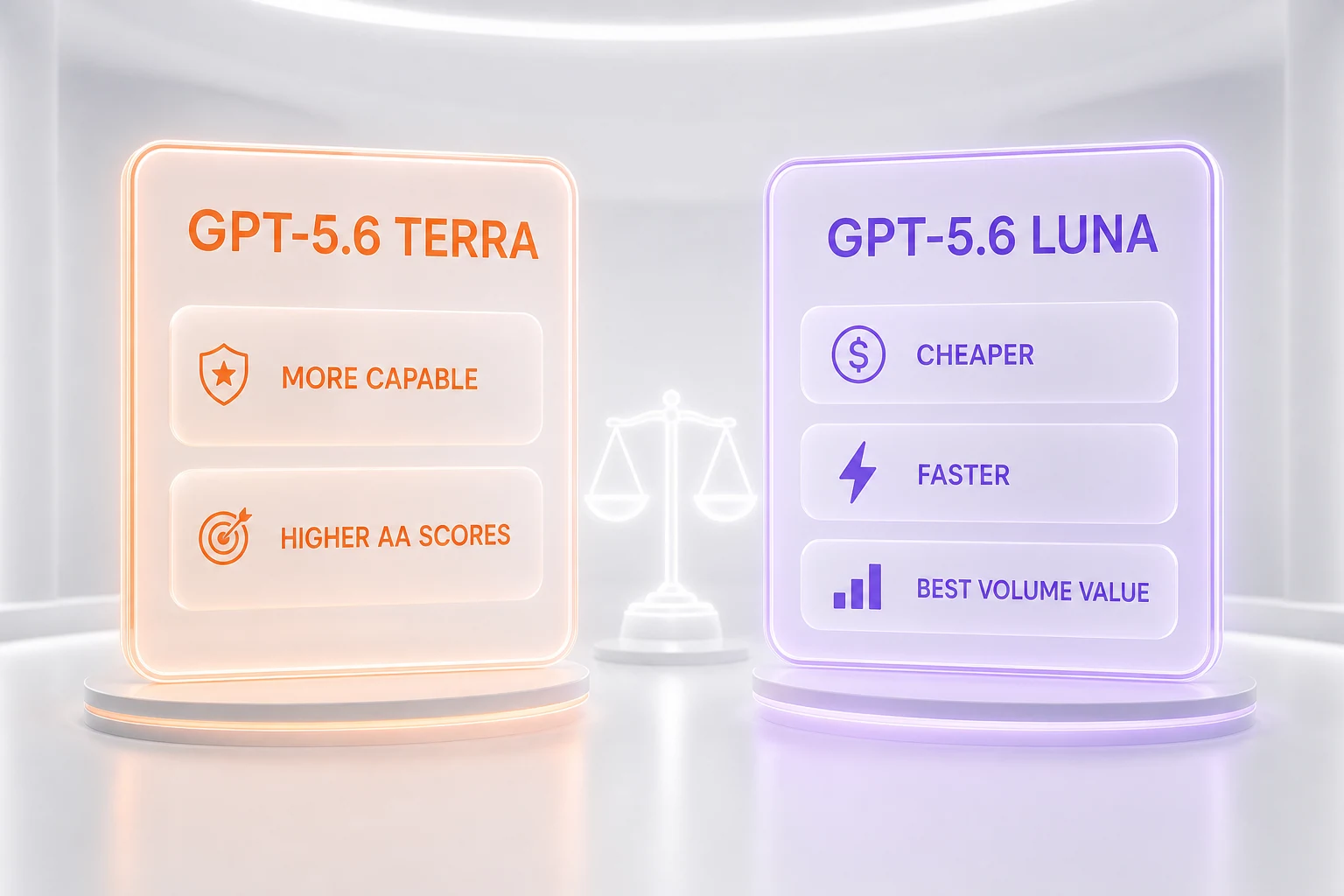
There is no single winner here, and pretending otherwise would misrepresent the data. If your work is capability-bound — harder reasoning, edge-case document handling, multi-step agentic coding — GPT-5.6 Terra is the right model, backed by a 55 Intelligence Index and a self-reported 87.4 percent on Terminal-Bench 2.1. If your work is cost-bound or volume-driven — summarization, extraction, drafting, classification at scale — GPT-5.6 Luna is the obvious pick, at exactly ten times lower prices and roughly 90 percent lower cost per task, with the same context window and output ceiling. If you cannot decide, run a short A/B test on your real prompts: the four-point capability gap is small enough that many workloads will not notice it, which tips the economics toward Luna.
Score breakdown by category:
- Capability: Terra 7.5 out of 10 vs Luna 7.0 out of 10 — Terra leads both independent benchmark indexes that score the two tiers, but the gaps are narrow.
- Value: Terra 7.0 out of 10 vs Luna 9.0 out of 10 — Luna's ten-times price advantage is decisive for cost-sensitive work.
- Speed: Terra 7.5 out of 10 vs Luna 8.5 out of 10 — Luna is the family's designated low-latency tier.
- Specs parity: Terra 9.0 out of 10 vs Luna 9.0 out of 10 — identical context, output, cutoff, and tool support.
Final word: buy Terra when a mistake is expensive and the extra capability earns its premium; buy Luna when you are serving volume and every fraction of a cent per task compounds. Because they share a generation, migrating between them is a one-line model-ID change, so nothing stops you from starting on Luna and upgrading only the traffic that genuinely needs Terra. For the tier above both, see our GPT-5.6 Sol review; for the mechanics behind these prices, our AI model pricing explainer is the companion read.
Sources
- OpenAI — Introducing GPT-5.6 (Sol, Terra, Luna)
- OpenAI API — Models documentation (context, output, cutoff, reasoning)
- OpenAI API — Pricing documentation (standard, long context, Batch, Fast mode)
- Artificial Analysis — Intelligence Index, cost per task
- Artificial Analysis — Coding Agent Index v1.3 leaderboard (Terra 62.28, Luna 58.66, Codex harness at max effort)
- Vals.ai — SWE-bench Verified leaderboard (neither tier listed as of writing)
Last compared: July 2026. Benchmark figures reflect independent Artificial Analysis measurements except where labeled self-reported by OpenAI. Neither GPT-5.6 Terra nor GPT-5.6 Luna appears on the independent SWE-bench Verified leaderboard as of this writing; we note the gap rather than substituting a non-comparable score.
Our Verdict
There is no single winner: GPT-5.6 Terra and Luna are lower tiers of the same GPT-5.6 generation, so the choice is capability versus cost rather than better versus worse. Terra leads on capability — 55 to 51 on the Artificial Analysis Intelligence Index v4.1, and 62.28 to 58.66 on the AA Coding Agent Index v1.3, both measured through the Codex harness at max reasoning effort (read August 2, 2026) — and is the pick for harder reasoning and multi-step agentic coding. Luna wins on price by exactly ten times on every rate since OpenAI's July 30, 2026 price cut — 0.20 against 2.00 dollars per million input tokens, and 1.20 against 12.00 on output — making it the default for high-volume, latency-sensitive, cost-sensitive automation. Both share the 1,050,000-token context window, 128,000-token output ceiling, and February 16, 2026 cutoff, and neither appears on the independent SWE-bench Verified leaderboard. Pick Terra when a small capability edge is worth the premium; pick Luna when volume and budget dominate.
Choose GPT-5.6 Terra
OpenAI's balanced GPT-5.6 tier — GPT-5.5-competitive quality at 40 percent of the GPT-5.5 rate, with a 1.05M-token context and the full agentic toolbox.
Try GPT-5.6 Terra →Choose GPT-5.6 Luna
OpenAI's fastest, most economical GPT-5.6 tier — $0.20 per million input tokens, sub-second warm latency, and a 1.05M-token context for high-volume routine work.
Try GPT-5.6 Luna →Frequently Asked Questions
Is GPT-5.6 Terra better than GPT-5.6 Luna?
There is no single winner: GPT-5.6 Terra and Luna are lower tiers of the same GPT-5.6 generation, so the choice is capability versus cost rather than better versus worse. Terra leads on capability — 55 to 51 on the Artificial Analysis Intelligence Index v4.1, and 62.28 to 58.66 on the AA Coding Agent Index v1.3, both measured through the Codex harness at max reasoning effort (read August 2, 2026) — and is the pick for harder reasoning and multi-step agentic coding. Luna wins on price by exactly ten times on every rate since OpenAI's July 30, 2026 price cut — 0.20 against 2.00 dollars per million input tokens, and 1.20 against 12.00 on output — making it the default for high-volume, latency-sensitive, cost-sensitive automation. Both share the 1,050,000-token context window, 128,000-token output ceiling, and February 16, 2026 cutoff, and neither appears on the independent SWE-bench Verified leaderboard. Pick Terra when a small capability edge is worth the premium; pick Luna when volume and budget dominate.
Which is cheaper, GPT-5.6 Terra or GPT-5.6 Luna?
GPT-5.6 Terra starts at $2 in / $12 out per M tokens. GPT-5.6 Luna starts at $0.2 in / $1.2 out per M tokens. Check the pricing comparison section above for a full breakdown.
What are the main differences between GPT-5.6 Terra and GPT-5.6 Luna?
The key differences span across 13 features we compared. For AA Intelligence Index (v4.1), GPT-5.6 Terra offers 55 while GPT-5.6 Luna offers 51. For AA Coding Agent Index v1.3 (independent, Codex harness at max effort, read August 2, 2026), GPT-5.6 Terra offers 62.28 while GPT-5.6 Luna offers 58.66. For Input price (per 1M tokens), GPT-5.6 Terra offers $2.00 while GPT-5.6 Luna offers $0.20. See the full feature comparison table above for all details.