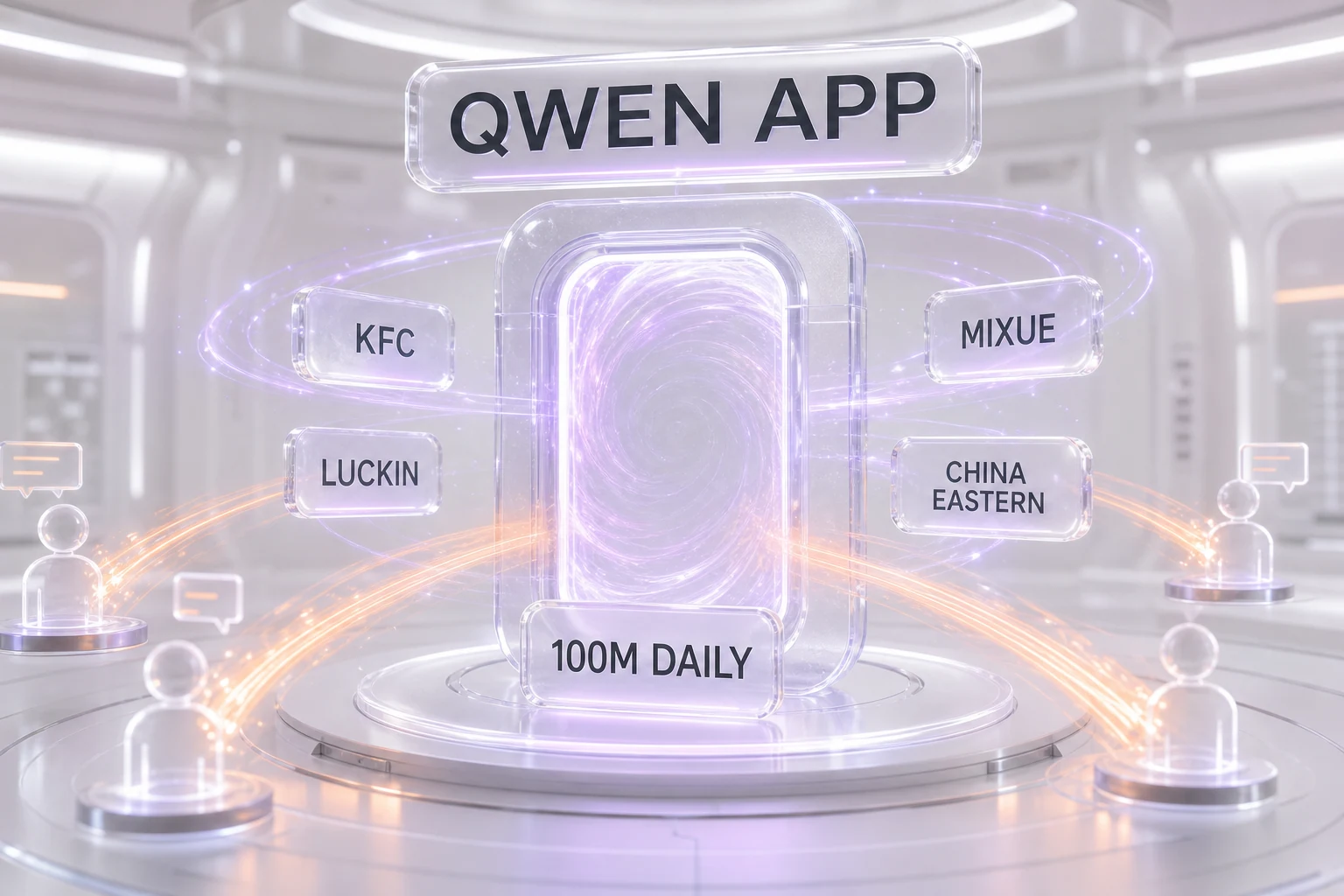
Alibaba opened its consumer Qwen app to third-party agents and services on June 3, 2026, turning the chatbot into what amounts to an app store for AI agents. KFC, Luckin Coffee, Mixue Group and China Eastern Airlines are among the first brands to plug in. Users can now order a two-person KFC meal under RMB 60 (about $8.8) for pickup, or have China Eastern proactively build an itinerary, all from one chat box. The Qwen app already handles over 100 million daily engagements for lifestyle services, and it sits second in China behind ByteDance's Doubao at 345 million monthly active users. It is the clearest Chinese instance yet of the agentic web thesis playing out in a real consumer product.
This is a platform move, not a model release. It is distinct from Alibaba's Qwen models (such as Qwen 3.6) that we have covered before. What changed on June 3 is that the Qwen app stopped being a single assistant and became a gateway other companies can build inside, through what Alibaba calls its Agent and Skill framework. Below we break down what shipped, why it matters, how it compares to the broader agent land grab, and where the gaps are.
What Alibaba Actually Announced
On June 3, 2026, the team behind Alibaba's flagship consumer AI app announced that the Qwen app would open its ecosystem to third-party agents and skills. The news was first reported by Nikkei and picked up by Caixin Global and TechNode on June 4. In plain terms: outside companies can now run their own services inside the Qwen chat interface, so a user can complete a real commercial task without ever leaving the conversation.
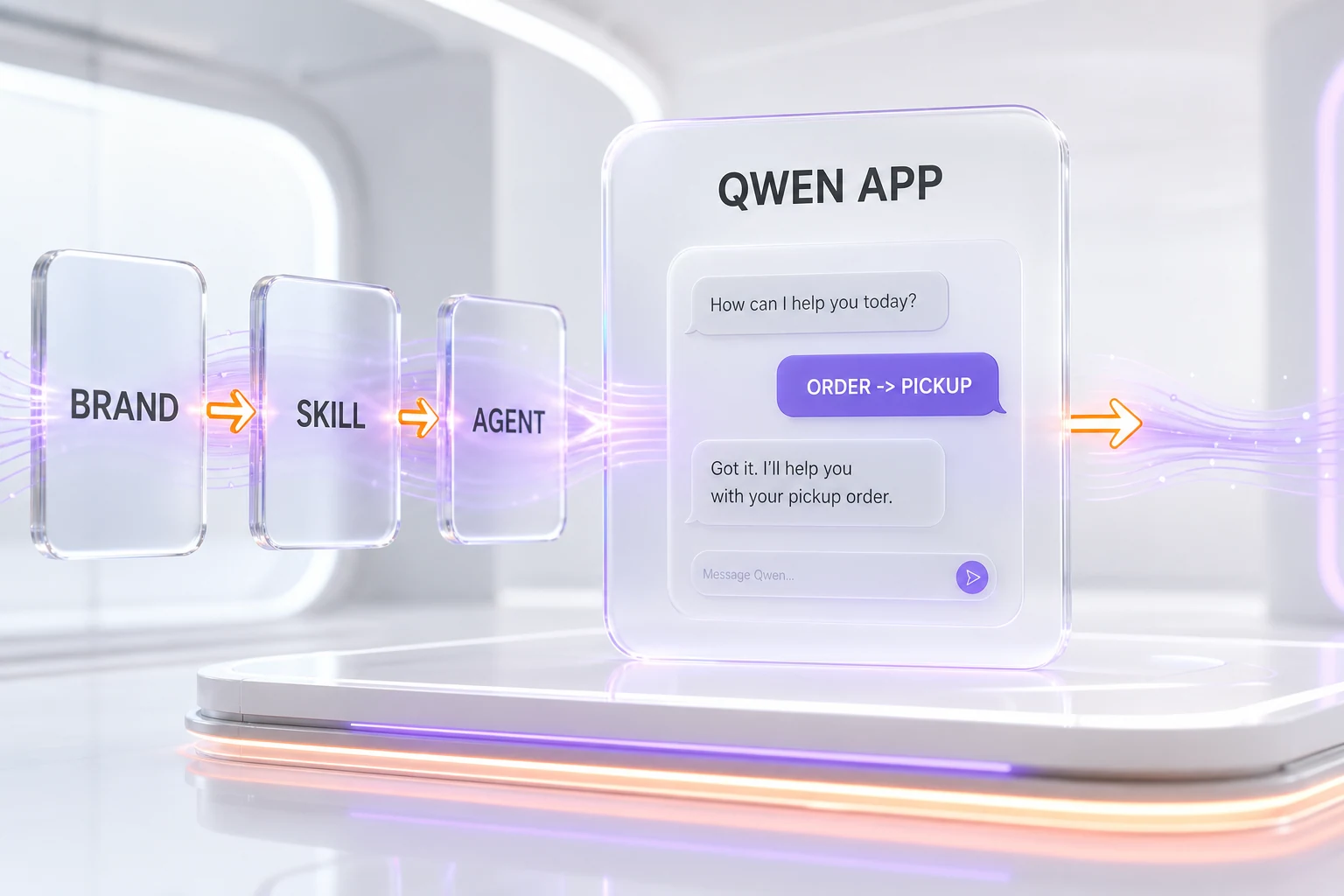
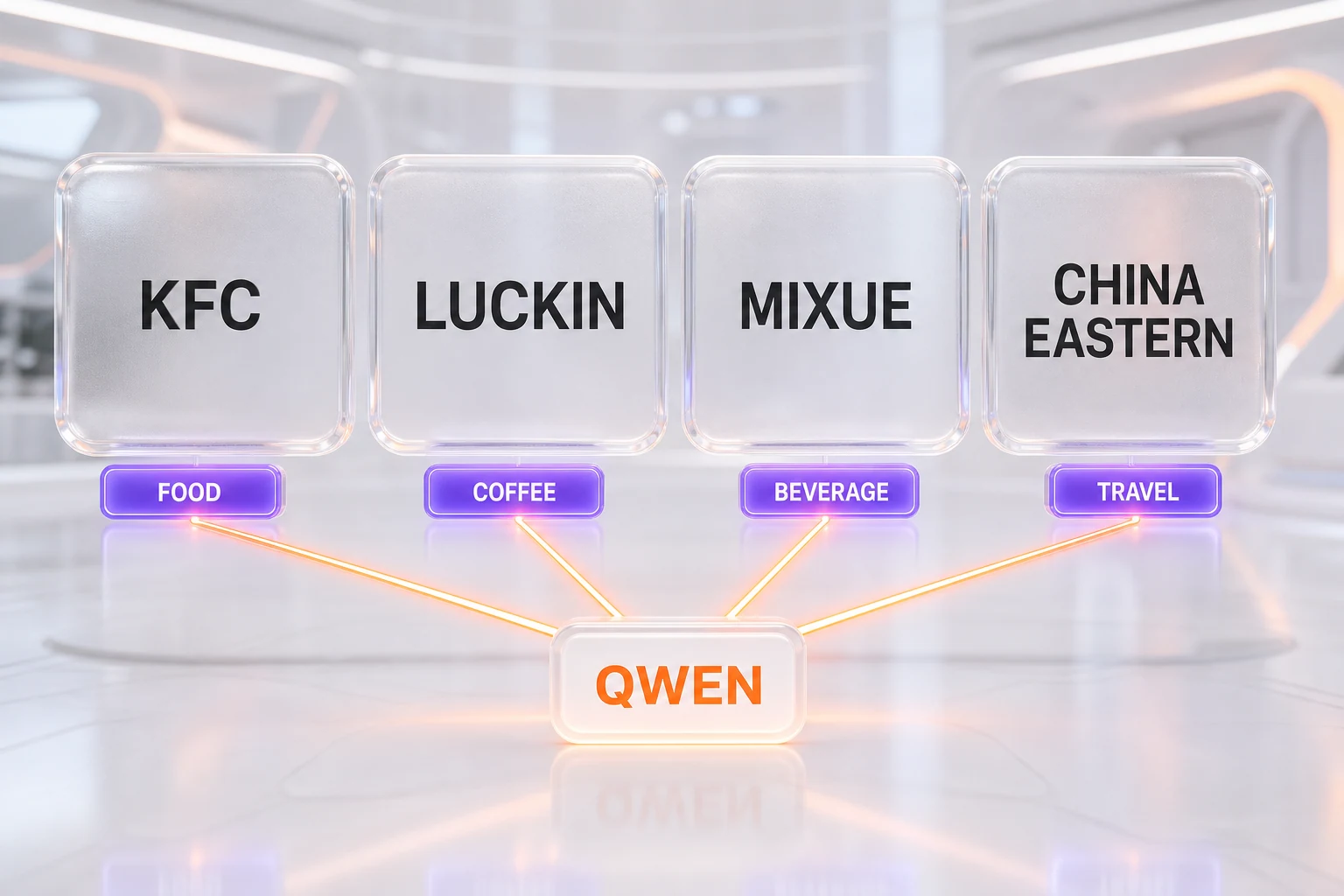
The framework has two layers, and Alibaba is explicit about the distinction. Skills are the live, narrower capabilities that brands can launch today. Agents are the more sophisticated, proactive services coming later that hold deeper context about a user's intent and preferences. Companies including China Eastern Airlines, KFC and Luckin Coffee have launched selected services through Skills first, with richer Agent-based experiences planned next.
Here is what the early partners can do inside Qwen right now:
- KFC: a request can start as a simple order, then move through store selection, coupon application and pickup-time calculation. The example Alibaba showcased was ordering a two-person meal under RMB 60 (about $8.8) from the nearest KFC for pickup.
- China Eastern Airlines: the agent will proactively curate tailored itineraries based on a user's travel plans and preferences.
- Luckin Coffee: contextual awareness lets it give advance notice of peak hours and nudge users to order ahead.
- Mixue Group: the bubble-tea and ice-cream giant is among the first brands testing the new agentic features.
Quoting Fan Zhang, the Qwen app ecosystem lead: "The goal is to share these capabilities—intent understanding, precise matching, and proactive planning—with enterprise partners across all industries." That sentence is the whole strategy in one line. Alibaba is not selling a model to these brands; it is selling distribution and orchestration.
The Six Months That Made It Possible
Opening to outsiders was not a sudden flip of a switch. According to the Qwen team, the app spent the previous six months integrating a range of Alibaba's own ecosystem services first: mapping, ride-hailing, shopping and instant retail. In other words, Alibaba wired up its in-house verticals as the proving ground before exposing the same plumbing to external brands.
That sequencing matters. A KFC pickup order is not just a chat reply. It requires location lookup (mapping), menu and pricing (shopping or instant retail), payment, coupon logic and a pickup-time estimate. By solving those primitives internally over six months, Alibaba built the connective tissue that a third party can now reuse instead of rebuilding. The hard part of an agent platform is rarely the language model; it is the reliable, transactional glue underneath. Alibaba spent half a year on the glue.
Why It Matters: The Agentic Web Reaches the Consumer
For most of 2026, the agentic web has been an infrastructure and protocol story: bots already make up roughly 31% of HTTP traffic, AWS, Cloudflare and Azure have been rebuilding their backends for agent workloads, and Google's WebMCP is trialing in Chrome. We covered that re-architecture in depth in our piece on the agentic web in 2026. What Alibaba did on June 3 is take that abstract thesis and ship it inside an app that tens of millions of ordinary people already open every day.
The strategic prize is the same one super-apps have always chased: own the entry point. If users get used to completing food, coffee, travel and retail tasks by typing into Qwen, the chat box becomes the new home screen. Brands lose their direct funnel and gain a new one inside Alibaba's interface. That is a familiar trade in China, where WeChat's mini-programs taught a generation of businesses to live inside someone else's super-app. The difference now is the interface: not tappable mini-apps, but conversational agents that act on the user's behalf.
It also extends a pattern we have been tracking across markets. OpenAI framed GPT-5.5 around a super-app strategy with an agentic engine. Meta has been monetizing its first business agents. Amdocs put telco agents live on Google's Gemini Enterprise marketplace. Robinhood opened itself to agents over MCP. Alibaba's move is the Chinese consumer-scale version of the same idea: turn your most-used surface into a place where other companies' agents do the work.
How It Compares: The China AI App Race
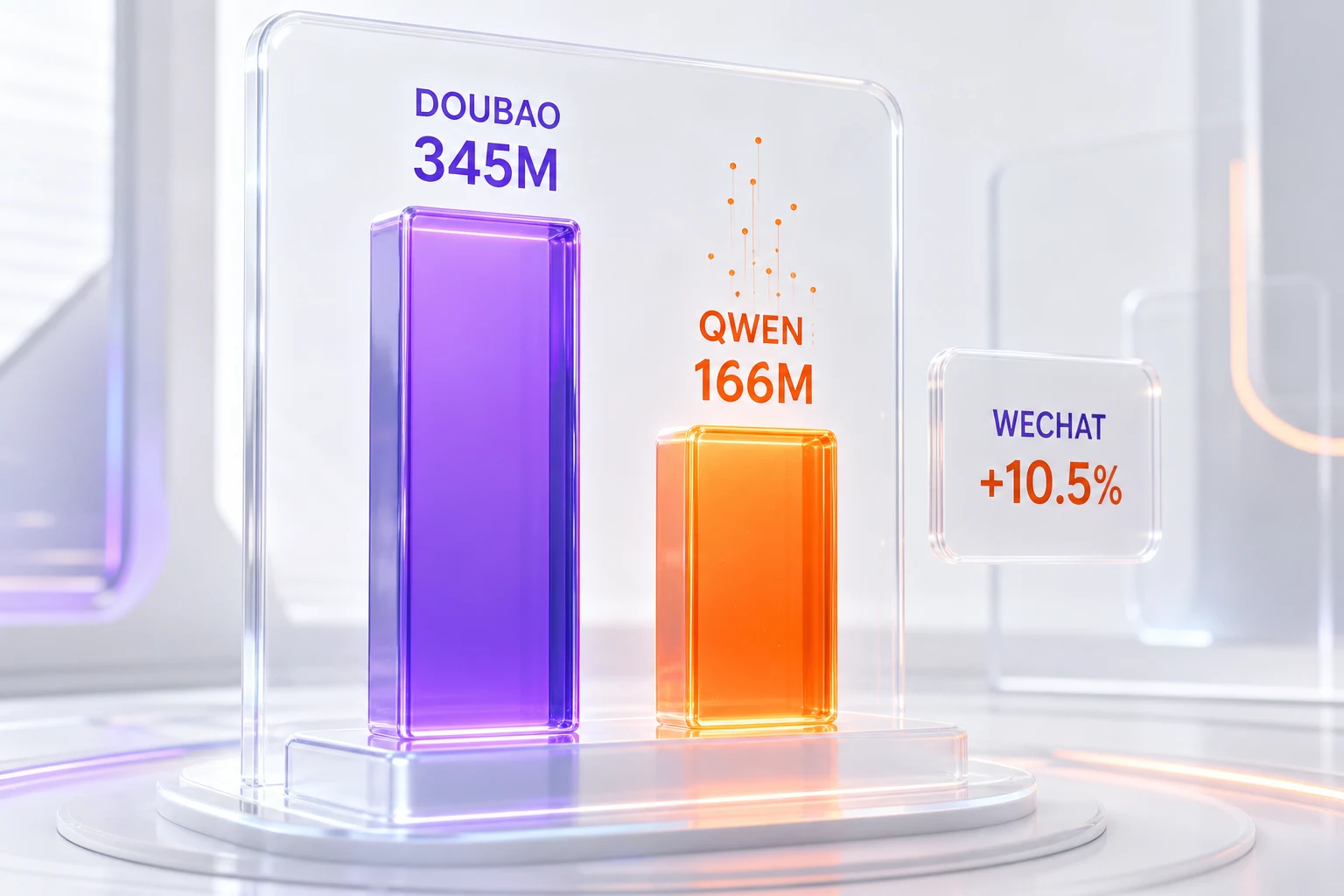
The competitive context explains the urgency. Qwen added 126 million users in the first quarter of 2026 and reached 166 million monthly active users by March 2026, ranking second in China's AI app market. The leader is ByteDance's Doubao at 345 million MAU. Raw model quality alone has not closed that gap, so Alibaba is changing the game from "best chatbot" to "most useful gateway."
Tencent is moving in parallel. It has been testing an AI assistant embedded in WeChat to navigate mini-programs, and the market liked it: Tencent shares gained 10.5%, adding roughly $53 billion in market value. The signal investors are pricing in is clear: whoever owns the agentic front door to Chinese commerce owns an enormous funnel. WeChat already has the merchants and the payment rails; Qwen is racing to build the same brand ecosystem around a conversational, agent-first interface instead of a tap-first one.
So the contest is not Qwen versus Doubao on benchmarks. It is Alibaba versus Tencent on who becomes the default agent platform for everyday transactions, with ByteDance's larger audience as the prize both want to peel away.
The Developer Side: Alibaba Cloud's Skills Portal and MCP
There is a second, more technical track to this story that is easy to conflate but worth keeping separate. Alongside the consumer Qwen app, Alibaba Cloud runs the Agent Skills portal, a discovery and installation platform aimed at developers and their agents rather than at coffee-buying consumers.
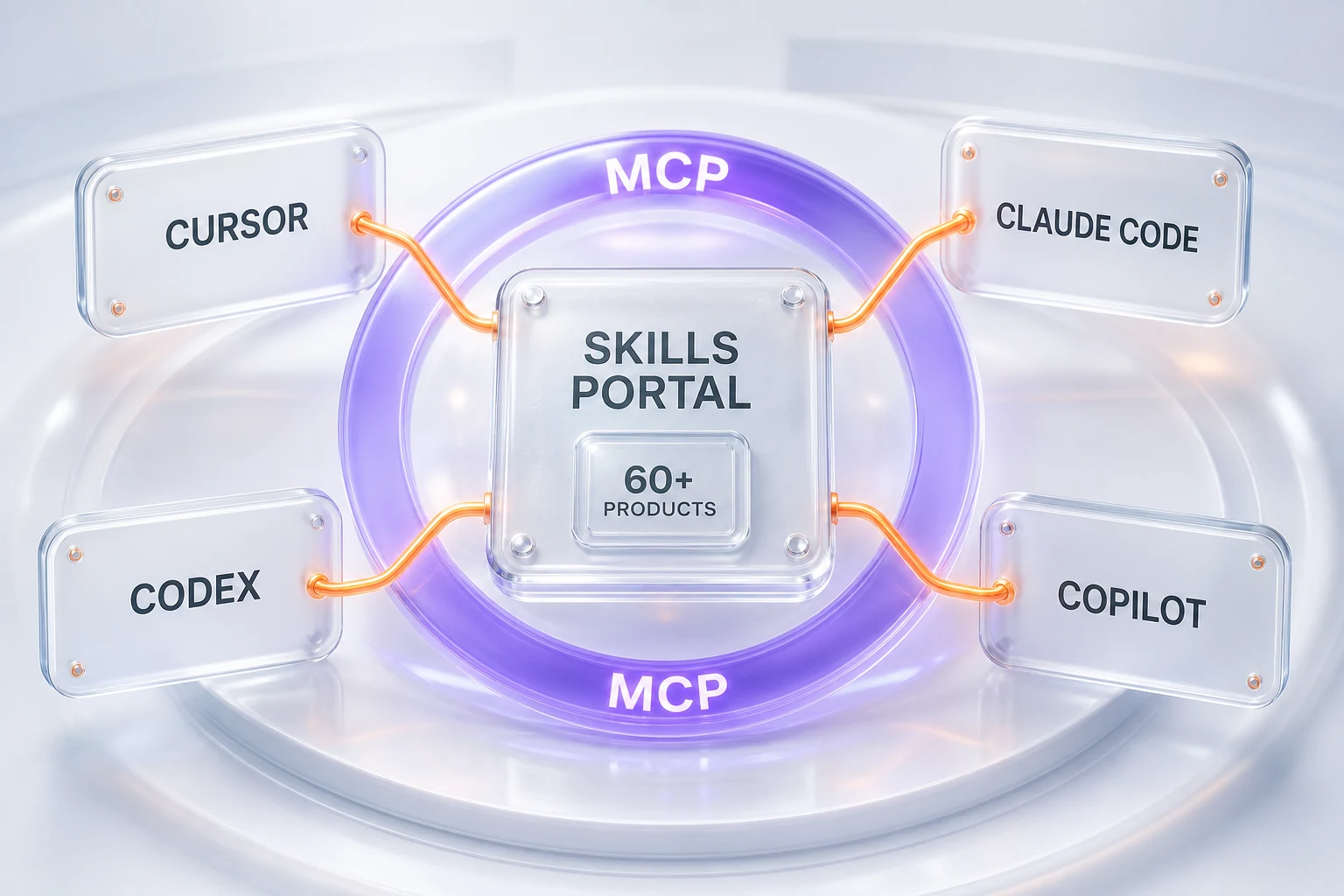
The Skills portal converts capabilities across more than 60 Alibaba Cloud products into a reusable "Agent Skills" format, described as an open standard that packages the instructions, scripts and reference resources an agent needs for a specific task. The stated goal is to kill API-calling complexity and high integration costs, letting an agent operate cloud resources in natural language, orchestrate tasks across products, and stay inside security constraints. The portal itself is free, though any cloud resources an agent actually uses are billed normally.
Crucially, it is built to be agent-agnostic. The Skills portal lists eight compatible clients: Cursor, Claude Code, Qwen Code, Qoder, Codex, Gemini CLI, GitHub Copilot and OpenClaw. And on the model side, Qwen supports the Model Context Protocol through Alibaba Cloud Model Studio, where an agent connects MCP servers via the Responses API. That MCP support is the same standardization logic we see across the industry, from Robinhood's agentic trading to Anthropic's protocol work: speak a common tool-calling language so any agent can plug into any capability.
The honest framing: the consumer Qwen app opening and the Alibaba Cloud Skills portal are two faces of one bet. One courts brands and end users; the other courts developers and their agents. Both push the same outcome, which is that more of the world's services become callable by agents rather than clickable by humans.
What We Make of It
We read this as one of the most consequential agentic launches of the year, precisely because it is so unglamorous. There is no new frontier benchmark here, no record context window. There is a coffee order and a chicken bucket. That is the point. The agentic web stops being a research topic the moment a hundred million people are quietly completing real transactions through agents without thinking about the word "agent" at all.
The strongest part of the strategy is the six-month internal integration. Plenty of companies have announced agent marketplaces; few have first spent half a year hardening the transactional plumbing on their own verticals before inviting outsiders in. That sequencing is why the KFC demo can move from order to coupon to pickup time rather than stalling at "I found a KFC near you."
What would make us more cautious: Alibaba has not disclosed a revenue model. There is no public detail on how brands pay, whether there is a commission, or how ranking and recommendation work when two partners compete for the same intent. Those answers will determine whether this becomes a genuinely open ecosystem or a pay-to-play placement engine. For now, the platform economics are a black box, and we are not going to pretend otherwise.
What's Next
The roadmap Alibaba has signaled is the move from Skills to full Agents: proactive services that remember preferences, handle membership benefits and reminders, and drive repeat purchases without being asked. China Eastern's itinerary curation is the early template for that more autonomous tier.
Watch three things from here. First, how fast the partner list grows beyond the launch names, and whether categories like banking, logistics and healthcare join. Second, whether Alibaba publishes any developer-facing terms or revenue split that turns this from a curated showcase into a true open platform. Third, Tencent's response inside WeChat, because the two giants are now in an open race to define how Chinese consumers transact with agents. The model wars made the headlines in 2025 and early 2026. The platform wars are what 2026's second half will actually be decided on, and Alibaba just fired an early, concrete shot.
Frequently Asked Questions
What did Alibaba announce about the Qwen app on June 3, 2026?
On June 3, 2026, Alibaba announced that its consumer Qwen app would open its ecosystem to third-party agents and services through an Agent and Skill framework. Outside brands can now run their own services inside the Qwen chat interface, letting users complete commercial tasks such as ordering food or booking travel without leaving the conversation. The news was first reported by Nikkei and picked up by Caixin Global and TechNode on June 4.
Is this the same as a Qwen model release?
No. This is a platform announcement, not a model release. It is distinct from Alibaba's Qwen language models, such as Qwen 3.6, that power the assistant. What changed on June 3, 2026 is that the Qwen app became a gateway other companies can build inside, rather than a single self-contained chatbot.
Which brands are the first partners in the Qwen agent ecosystem?
The early partners are KFC, Luckin Coffee, Mixue Group and China Eastern Airlines. KFC supports ordering, store selection, coupon application and pickup-time calculation; China Eastern will proactively curate travel itineraries; Luckin Coffee gives advance notice of peak hours; and Mixue Group is among the first brands testing the new agentic features.
What can users actually do with the Qwen app agents today?
Users can complete real transactions in natural language. Alibaba's showcased example is ordering a two-person KFC meal under RMB 60 (about $8.8) from the nearest store for pickup, with discounts applied automatically. Brands launched these as Skills first, which are narrower live capabilities, ahead of richer proactive Agents that will hold deeper context about user intent and preferences.
How many users does the Qwen app have?
The Qwen app reached 166 million monthly active users by March 2026 after adding 126 million users in the first quarter of 2026, making it the second-largest AI app in China. It also handles over 100 million daily engagements for lifestyle services. The market leader is ByteDance's Doubao at 345 million monthly active users.
Is the Qwen app an app store for AI agents?
Functionally, yes. By letting third-party brands publish Skills and, later, full Agents that users invoke inside the chat, Alibaba turns the Qwen app into a distribution platform for agents, much as an app store distributes apps. Alibaba's own framing is an Agent and Skill framework rather than the literal phrase "app store," but the economic logic of owning the gateway and onboarding outside developers is the same.
How does this compare to WeChat and Tencent?
Tencent is pursuing a parallel strategy, testing an AI assistant inside WeChat to navigate its mini-programs, and the market rewarded it with a 10.5% share gain worth roughly $53 billion in market value. The contrast is interface philosophy: WeChat built a tap-first mini-program economy, while Qwen is building a conversational, agent-first one. Both Alibaba and Tencent are racing to become the default agent gateway for Chinese commerce.
What is the Alibaba Cloud Skills portal, and how is it different from the Qwen app opening?
The Alibaba Cloud Agent Skills portal is a separate, developer-facing platform that converts capabilities across more than 60 Alibaba Cloud products into a reusable "Agent Skills" format, an open standard packaging the instructions and scripts an agent needs for a task. It targets developers and their agents, while the Qwen app opening targets brands and consumers. Both push the same goal of making services callable by agents, but they serve different audiences.
Which AI agents are compatible with the Alibaba Cloud Skills portal?
The Skills portal lists eight compatible clients: Cursor, Claude Code, Qwen Code, Qoder, Codex, Gemini CLI, GitHub Copilot and OpenClaw. The portal itself is free, although any cloud resources an agent actually creates or uses are billed under standard cloud pricing.
Does Qwen support the Model Context Protocol (MCP)?
Yes. Qwen supports the Model Context Protocol through Alibaba Cloud Model Studio, where an agent connects MCP servers via the Responses API. MCP lets large language models use external tools and data with more flexibility than traditional function calling, which is the same standard adopted across the industry by tools like Claude Code, OpenClaw and Robinhood's agentic trading.
How will Alibaba make money from the Qwen agent ecosystem?
Alibaba has not disclosed a revenue model. As of the June 2026 announcement there is no public detail on how brands pay, whether a commission applies, or how recommendation and ranking work when partners compete for the same user intent. Those terms will determine whether the platform becomes a genuinely open ecosystem or a paid-placement engine, and we are not speculating beyond what has been confirmed.
Why does the Qwen app opening matter for the agentic web?
It takes the agentic web from infrastructure theory to consumer reality. For most of 2026 the agentic web has been about backends and protocols like MCP and WebMCP, with bots already making up roughly 31% of HTTP traffic. Alibaba's move puts agent-driven transactions inside an app tens of millions of people use daily, marking the clearest Chinese consumer-scale instance of the agentic web so far.