On June 15, 2026, two changes hit the Claude developer stack at the same time. First, the Claude Agent SDK stops drawing from your Pro, Max, Team, or Enterprise plan quota and switches to a separate monthly credit ($20 Pro / $100 Max 5x / $200 Max 20x). Second, the API retires claude-sonnet-4-20250514 and claude-opus-4-20250514. If your production agents still reference those model IDs on the morning of June 16, every request returns an error. This is the migration playbook.
This is not a code-breaking release on the SDK side. The Claude Code SDK was renamed to Claude Agent SDK in late 2025, and that rename is already shipped. June 15, 2026 is a billing and model-deprecation event, not a fresh package swap. The risk is silent: API calls that worked yesterday with claude-opus-4-20250514 error out, and SDK usage that used to be invisible inside your $20 Pro plan starts metering against a separate credit you may not have noticed in your billing console.
What changes on June 15, 2026
Two events land on the same date. They look independent, but they hit the same developer cohort: people who run Claude programmatically, in CI/CD, or as headless agents.
Event 1 — Agent SDK billing splits from your plan
Before June 15, every Claude Agent SDK call (Python or TypeScript), every claude -p non-interactive CLI invocation, and every Claude Code GitHub Action consumed your plan's standard usage limit. After June 15, those flows move to a dedicated monthly Agent SDK credit that resets independently from your subscription quota.
The credit allocation, per Claude's official billing documentation:
- Pro: $20 per month
- Max 5x: $100 per month
- Max 20x: $200 per month
- Team (Standard seats): $20 per seat per month
- Team (Premium seats): $100 per seat per month
- Enterprise (usage-based): $20 per seat per month
- Enterprise (seat-based Premium): $200 per seat per month
Developer Platform accounts that authenticate with an API key (not a subscription) do not receive this credit. They keep paying API rates directly.

Event 2 — Sonnet 4 and Opus 4 retire from the API
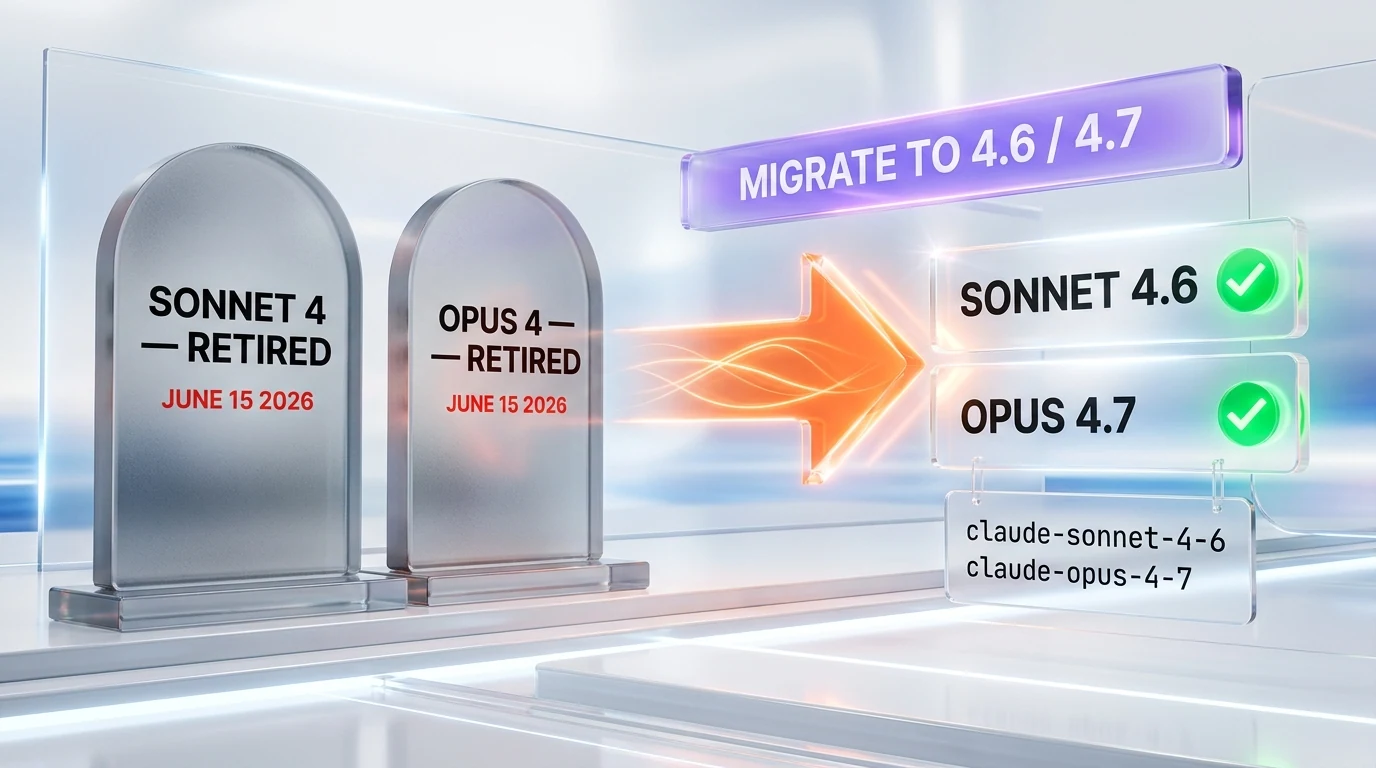
The release notes are unambiguous. From the April 14, 2026 platform changelog: "We announced the deprecation of the Claude Sonnet 4 model (claude-sonnet-4-20250514) and the Claude Opus 4 model (claude-opus-4-20250514), with retirement on the Claude API scheduled for June 15, 2026. We recommend migrating to Claude Sonnet 4.6 and Claude Opus 4.7 respectively."
Retirement on the Claude API means hard errors. The model IDs simply stop resolving. Any agent in production hardcoding those strings will fail.
Why Anthropic split the billing
The strategic read is straightforward. Before this split, developers using the Agent SDK programmatically were burning their plan quota in ways that looked identical to interactive use. A solo dev on Pro who ran a nightly cron with the SDK could exhaust the same usage cap as someone chatting in Claude.ai — and they would not know why their interactive session got rate-limited.
By isolating SDK consumption into a dedicated credit, Anthropic does three things at once. It gives developers predictability — your interactive Claude Code session in the IDE never gets throttled because your nightly agent burned the budget. It gives Anthropic clean cost-attribution between human-driven and programmatic load. And it sets up the pricing scaffolding to upsell additional SDK credits without touching plan pricing.
Strategic positioning versus OpenAI Codex CLI
This billing split also clarifies the competitive shape. Claude Code and OpenAI Codex CLI have been converging on the same headless-agent workflow, but their pricing logic is different. By carving out Agent SDK as a separate line item, Anthropic makes it easier for buyers to compare "what does running 1,000 nightly agentic tasks cost on Claude versus Codex." A muddled plan-quota model made that math impossible.
What counts as Agent SDK usage after June 15
The boundary matters because it determines which credit pool your request hits. Per Anthropic's official categorisation:
The Agent SDK credit covers
- Claude Agent SDK usage in your own projects (Python via
claude-agent-sdk, TypeScript via@anthropic-ai/claude-agent-sdk) - The
claude -pcommand in Claude Code (non-interactive mode) - The Claude Code GitHub Actions integration
- Third-party apps that authenticate with your Claude subscription
Interactive Claude Code stays on plan quota
- Interactive Claude Code in the terminal or IDE
- Web and mobile Claude conversations (claude.ai)
- Claude Cowork sessions
The critical practical line: if you type claude and get a REPL, that is interactive and stays on your plan. If you type claude -p "do X" in a script, that is Agent SDK territory and bills against the new credit. The same Claude Code binary, two different billing tracks depending on invocation mode.

Model deprecation: the fast version
Two specific model IDs go dark on June 15, 2026.
claude-sonnet-4-20250514 — retired
Replacement: claude-sonnet-4-6-20260217 (Claude Sonnet 4.6, generally available since February 17, 2026). The 4.6 release ships with improved agentic search, lower token consumption on multi-step tasks, and the 1M token context window at standard pricing with no beta header. See our Sonnet 4.6 deep dive for the full capability delta.
claude-opus-4-20250514 — retired
Replacement: claude-opus-4-7 (Claude Opus 4.7, generally available since April 16, 2026). Opus 4.7 launched at the same $5 / $25 per MTok pricing as Opus 4.6, and includes API breaking changes versus 4.6 — review the migration guide before bumping. Our Opus 4.7 page tracks the capability improvements and the updated tokenizer.
Haiku context: not affected this round
For completeness — Haiku 3 retired on April 20, 2026, and the current recommended Haiku is Claude Haiku 4.5. Haiku is not part of the June 15 retirement wave, but if your stack still hardcodes claude-3-haiku-20240307, you already have a broken request path.
The renaming context: Claude Code SDK to Claude Agent SDK
If your code still imports from @anthropic-ai/claude-code or claude-code-sdk, that is a separate problem from June 15. The SDK rename is already in effect — Anthropic published the migration guide when the rename shipped. The new packages:
- TypeScript:
@anthropic-ai/claude-agent-sdk(was@anthropic-ai/claude-code) - Python:
claude-agent-sdk(wasclaude-code-sdk)
Python rename gotcha: ClaudeAgentOptions
The Python SDK rename came with one breaking type change: ClaudeCodeOptions is now ClaudeAgentOptions. Cosmetic at a glance, but if you have multiple repos importing the old type, your linter will not catch it until runtime.
System prompt default shifted
Agent SDK v0.1.0 stopped applying Claude Code's system prompt by default. If your old code relied on inherited CLI-style instructions, you need to opt back in explicitly with systemPrompt: { type: "preset", preset: "claude_code" }. Otherwise your agent's behavior subtly changes — quieter responses, no built-in tool preambles.
Migration playbook: step by step
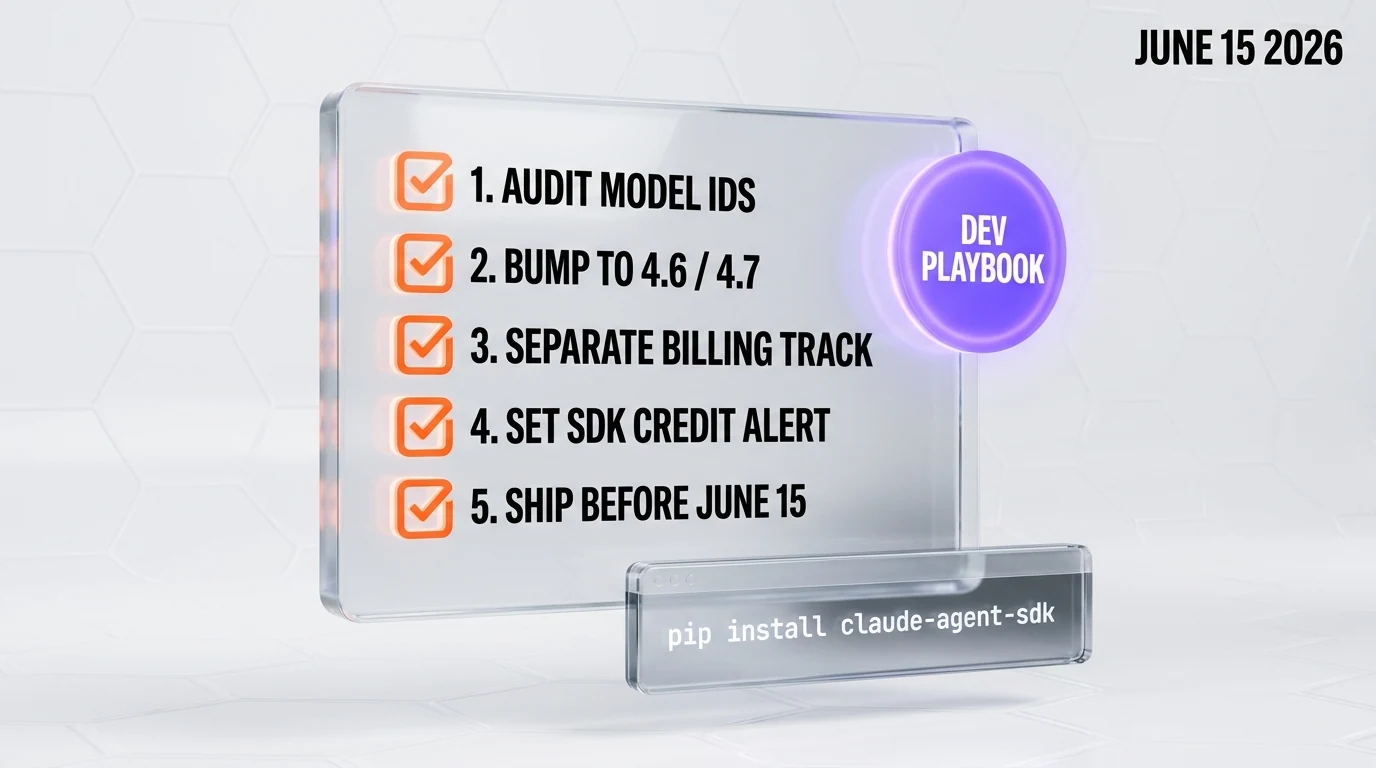
Five concrete actions before June 15. In order.
Step 1 — Audit every hardcoded model ID
Grep your monorepo for claude-sonnet-4-20250514 and claude-opus-4-20250514. Cover production code, fixtures, tests, infrastructure-as-code, CI configs, environment variable defaults, and prompt templates. Tools like ripgrep across all branches matter — a stale staging branch can leak the old ID into a hotfix.
Step 2 — Bump to 4.6 / 4.7
Replace Sonnet 4 with claude-sonnet-4-6-20260217. Replace Opus 4 with claude-opus-4-7. Re-run your evaluation harness — Opus 4.7 in particular ships with API breaking changes (parameter handling, tokenizer updates) that may change output shape for structured-output prompts.
Step 3 — Separate billing tracks
If you run both interactive Claude Code (humans typing) and Agent SDK workloads (cron jobs, GH Actions, custom Python agents), tag them in your internal cost dashboards as separate workloads now. After June 15, the Anthropic console will give you the split — but if you only learn the boundary on June 16, your finance team will not have a baseline.
Step 4 — Set Agent SDK credit alerts
$20 of Pro credit at $5 per MTok output is roughly 4 million Opus 4.7 output tokens per month, but a single long-running agent with extended thinking can chew through that in a day. Add billing alerts at 50 percent and 80 percent of monthly credit. Anthropic publishes this in the console — opt into the email notifications immediately so you find out before the credit caps your nightly run.
Step 5 — Ship the migration before June 15
This is not a "we will roll it out the week of" situation. Anthropic's deprecation track record is hard: April 20 retirement of Haiku 3, October 28, 2025 retirement of Sonnet 3.5 models, January 5, 2026 retirement of Opus 3. Every previous deprecation hit on the announced date, no extensions. Ship and verify by June 13 at the latest.
Who this hits hardest
Three developer profiles need to act fastest.
Solo developers on Pro with nightly agents
If you run a personal automation on a Pro subscription — newsletter summarization, RSS triage, code review on private repos — you were silently using your Pro quota. The $20 Agent SDK credit is the new floor. If your nightly job costs more than that, you either upgrade to Max or watch the agent fail mid-month.
Teams running Claude Code GitHub Actions
The GH Actions integration is explicitly listed as Agent SDK usage. Teams running PR review, automated docs, or CI agents will see those costs move from "invisible inside plan" to a line item in the new credit pool. Audit how many runs per day you trigger.
Third-party app authors
If you ship an app that authenticates with a user's Claude subscription (Bring Your Own Subscription pattern), that usage now hits their Agent SDK credit. End-users may not understand why their plan suddenly shows new billing. Document the behavior in your release notes before June 15.
What does not change
Worth stating explicitly because the rumor mill is loud:
- API endpoints stay the same. No URL rewrites needed.
- Headers stay the same.
anthropic-version, beta headers, all unchanged. - Environment variables stay the same.
ANTHROPIC_API_KEYstill works. - Pricing per MTok is unchanged for 4.6 / 4.7. Opus 4.7 ships at $5 / $25 per MTok, same as 4.6.
- 1M context window stays GA. No regression on Sonnet 4.6 or Opus 4.6 / 4.7.
- Subscription plans themselves are unchanged. Pro stays at $20, Max 5x at $100, Max 20x at $200.
Tooling, observability, and rate-limit headers all stay the same
One more category worth calling out for ops teams. Anthropic explicitly stated the rename of console.anthropic.com to platform.claude.com (effective January 12, 2026) did not change API endpoints, headers, environment variables, or SDKs. The June 15 wave does not reverse that promise. Your existing CI integrations, your observability layer parsing the anthropic-ratelimit-* response headers, and your secret managers storing ANTHROPIC_API_KEY all keep working without code changes. The single observable difference for ops is one new line item in the Anthropic billing console labeled Agent SDK credit, showing burn rate against your monthly allocation.
Your eval harness still works, but you must re-run it
If you maintain a custom evaluation harness pinned to Sonnet 4 or Opus 4 for regression testing, the test cases themselves stay valid. What changes is the underlying model. Re-run the full eval suite against Sonnet 4.6 and Opus 4.7 before June 15 so you have a clean before-and-after delta. Opus 4.7 in particular shipped with a new tokenizer and parameter changes versus Opus 4.6, so even teams that pre-migrated to 4.6 should re-verify behavior on 4.7. Treat the migration as a model upgrade with all the same diligence you would apply to a major library bump.
Comparison to prior Anthropic deprecations
This is the fifth model-deprecation wave in 12 months. The pattern is consistent: roughly 60 days of announced lead time, hard retirement on the date, no extensions.
- July 21, 2025: Claude 2.0, 2.1, Sonnet 3 retired
- October 28, 2025: Sonnet 3.5 (both versions) retired
- January 5, 2026: Opus 3 retired
- February 19, 2026: Sonnet 3.7 and Haiku 3.5 retired
- April 20, 2026: Haiku 3 retired
- June 15, 2026: Sonnet 4 + Opus 4 retired (this wave)
What is unusual about this wave is the simultaneous billing change. Past deprecations were single-axis events — swap the model ID and you were done. June 15 combines a model swap with a billing-model shift on the same date, which means dev teams have to think about two unrelated things at once.
The strategic read
This release reads like Anthropic preparing the developer plan for the next phase of agent-driven usage. Three things stand out from the positioning.
First, the $20 / $100 / $200 ladder mirrors the plan ladder. That is intentional — it signals that future Anthropic upsells will come from "buy more SDK credit" rather than "upgrade your plan." It also keeps interactive Claude Code revenue isolated, which is a strong consumer-facing product line they do not want diluted.
Second, by retiring Sonnet 4 and Opus 4 at the same time as the billing split, Anthropic forces dev teams to consciously re-think their model-cost setup. If you were lazily on Opus 4 because "it works," June 15 is the day you have to decide whether Opus 4.7 is worth the swap or whether Sonnet 4.6 covers your use case at a fraction of the output token cost.
Third, the GH Actions integration being explicitly in scope of the new credit shows where Anthropic expects the next 12 months of growth: Claude Code versus Cursor isn't where the next dollar comes from. It is in headless, CI-resident, infrastructure-grade agentic workloads, and those need their own billing axis to scale.
Bottom line
June 15, 2026 is two changes wearing one date. The model deprecation is the obvious one — swap Sonnet 4 for Sonnet 4.6 and Opus 4 for Opus 4.7 by June 13 and you are done. The billing split is the subtle one — every nightly agent, every claude -p invocation, every GH Action you run starts metering against a separate credit pool that resets monthly. Most production teams will notice the model deprecation first because requests start failing. The smarter teams will have noticed the billing split first because they tagged their workloads in May.
The migration window closes in 32 days from publication. Build accordingly.
Frequently asked questions
When exactly does Claude Agent SDK billing split from my plan?
June 15, 2026. From that date, Claude Agent SDK usage in Python or TypeScript projects, the claude -p non-interactive CLI command, and Claude Code GitHub Actions stop drawing from your Pro, Max, Team, or Enterprise plan quota and move to a separate monthly Agent SDK credit.
How much Agent SDK credit do I get per plan?
$20 per month on Pro, $100 per month on Max 5x, $200 per month on Max 20x, $20 per seat on Team Standard, $100 per seat on Team Premium, $20 per seat on Enterprise usage-based, and $200 per seat on Enterprise seat-based Premium. Developer Platform accounts authenticating with an API key get no credit and keep paying API rates directly.
What counts as Agent SDK usage versus interactive Claude Code?
Agent SDK usage covers programmatic flows: Python claude-agent-sdk, TypeScript @anthropic-ai/claude-agent-sdk, the claude -p CLI command in non-interactive mode, Claude Code GitHub Actions, and third-party apps authenticating with your Claude subscription. Interactive Claude Code in the terminal or IDE, web and mobile Claude conversations on claude.ai, and Claude Cowork sessions stay on your plan's standard quota.
Which Claude models retire on June 15, 2026?
claude-sonnet-4-20250514 and claude-opus-4-20250514 retire from the Claude API. After that date, requests using those model IDs return a hard error. Anthropic recommends migrating to Claude Sonnet 4.6 (claude-sonnet-4-6-20260217) and Claude Opus 4.7 (claude-opus-4-7) respectively.
Is this a breaking change for the Claude Agent SDK itself?
No. The Claude Code SDK was renamed to Claude Agent SDK in late 2025, and that rename is already shipped. June 15, 2026 is a billing and model-deprecation event, not a fresh package swap. If your code already imports from @anthropic-ai/claude-agent-sdk or claude-agent-sdk, you only need to update the model IDs and watch the new billing line.
Will my interactive Claude Code session in VS Code still use my plan quota?
Yes. Interactive Claude Code in the terminal or IDE continues to draw from your subscription's standard usage limits. Only the non-interactive claude -p command, Agent SDK calls, and GitHub Actions integration move to the new credit pool.
What happens to my agent if I do not migrate models before June 15?
Every API call using claude-sonnet-4-20250514 or claude-opus-4-20250514 returns an error after retirement. Production agents hardcoding those IDs will fail. Anthropic does not extend deprecation deadlines — past waves (Sonnet 3.5, Opus 3, Haiku 3) all retired on the announced date.
How do I migrate from Claude Code SDK package to Claude Agent SDK?
For TypeScript projects, uninstall @anthropic-ai/claude-code and install @anthropic-ai/claude-agent-sdk, then update imports. For Python projects, uninstall claude-code-sdk and install claude-agent-sdk, update imports, and rename ClaudeCodeOptions to ClaudeAgentOptions. The full guide lives at code.claude.com.
Does the Agent SDK credit reset or roll over?
The credit resets monthly. Per Anthropic's documentation, the allocation is described as monthly, with no rollover language — assume unused credit at month end does not carry forward. Set billing alerts at 50 percent and 80 percent of monthly credit to avoid mid-month throttling on nightly agents.
How does this compare to using OpenAI Codex CLI for the same workload?
The split makes the comparison cleaner. Before June 15, Claude Agent SDK costs were buried inside plan quota, which made it hard to compare against pay-per-token Codex pricing. After the split, you can directly compare $20 / $100 / $200 of Agent SDK credit against equivalent Codex API spend. See our Claude Code versus OpenAI Codex CLI breakdown for the underlying capability comparison.
Are Pro, Max, Team and Enterprise plan prices changing on June 15?
No. The subscription plans themselves are unchanged. Pro stays at $20 per month, Max 5x at $100, Max 20x at $200. What changes is what those plans cover: from June 15, plan quota covers interactive use only, and SDK programmatic use is metered against a separate credit included with the plan.
Can I buy more Agent SDK credit if I run out mid-month?
Anthropic's current documentation describes the credit as included with each plan tier, but does not yet detail a top-up mechanic at the time of writing. Heavy programmatic users running over the included credit will likely need to either upgrade to a higher plan tier (more included credit) or move to a Developer Platform API key with usage-based billing. Watch the Anthropic billing console for updates as June 15 approaches.