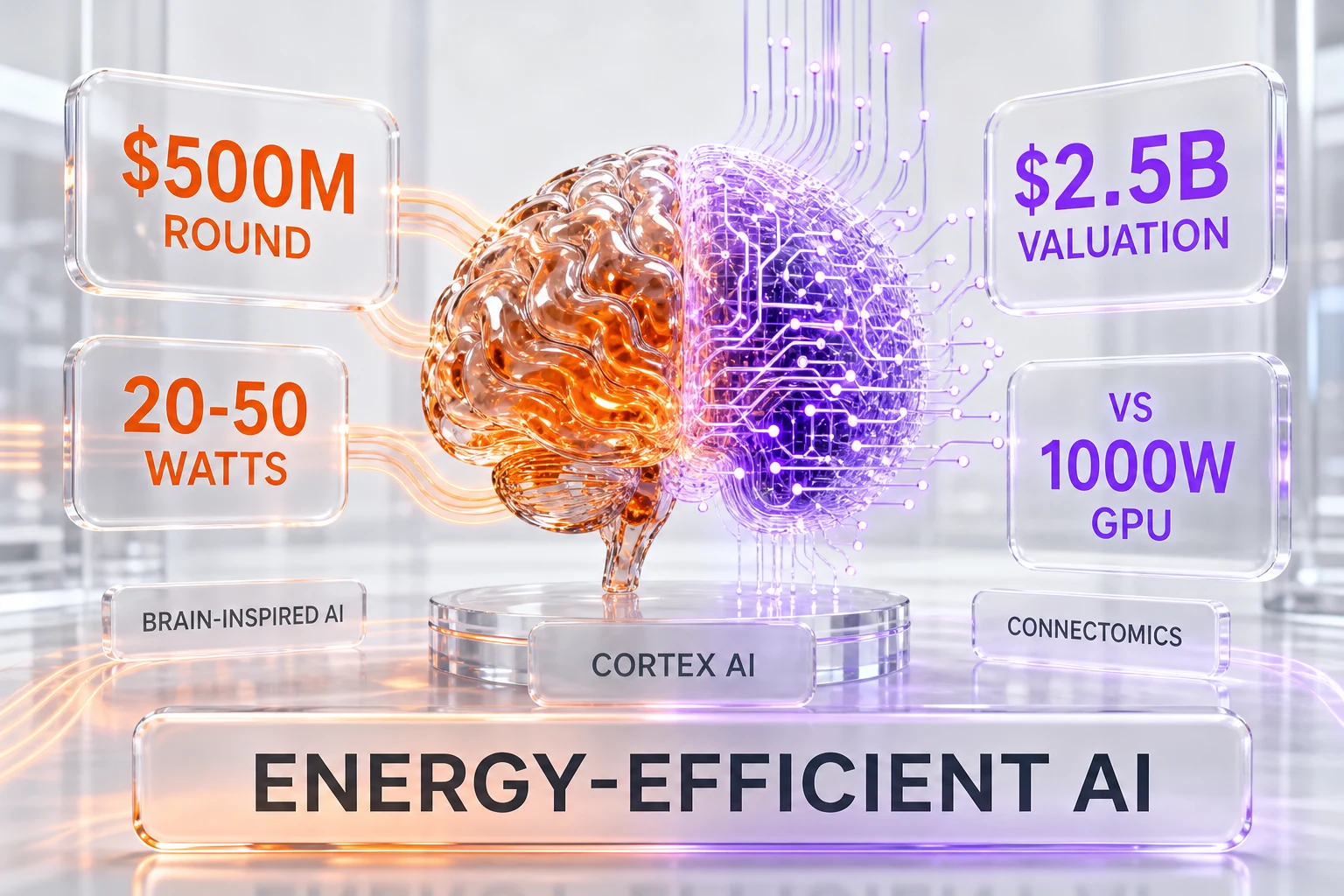
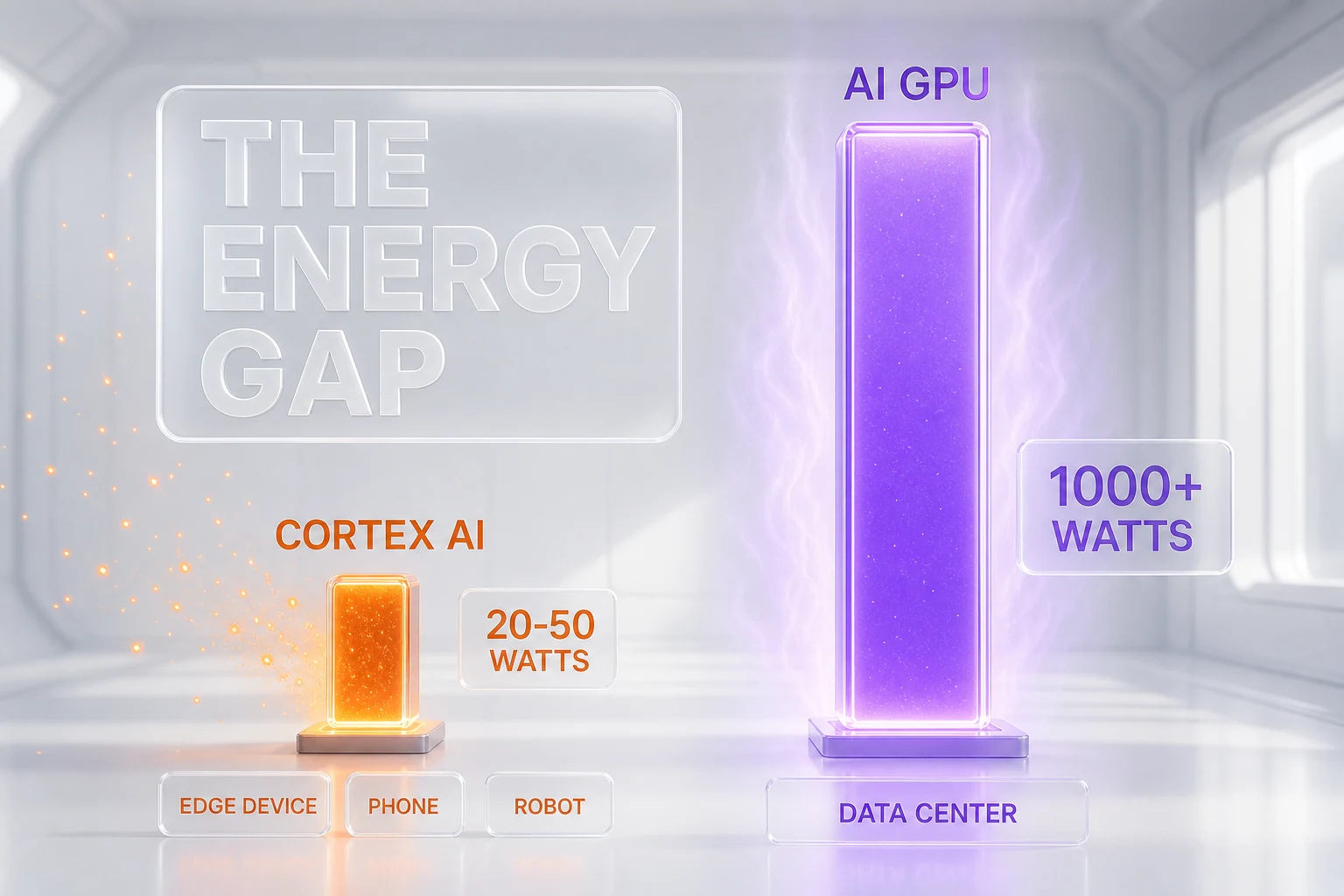
Flourish is a secretive brain-inspired AI startup that, according to Wired, raised a $500 million round at a $2.5 billion valuation in early June 2026, with Jeff Bezos as its single largest individual backer at a reported ~$100 million. Co-founded by Internet Explorer creator and former CTRL-labs founder Thomas Reardon and ex-Amazon executive Rob Williams, Flourish is building a system it calls Cortex AI that uses connectomics to copy the brain's "core algorithm" and run intelligence at 20 to 50 watts — versus the more than 1,000 watts a single AI GPU can draw.
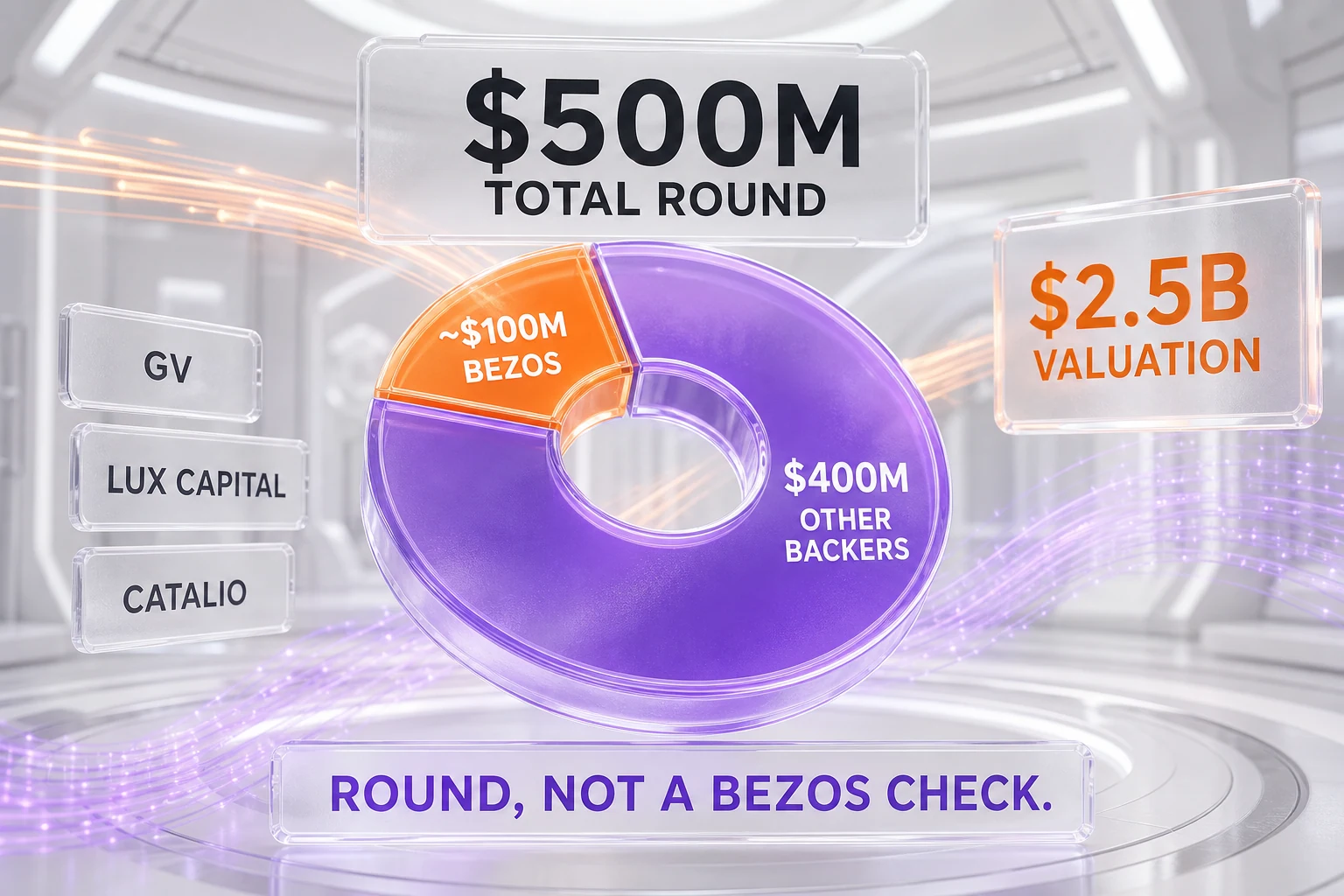
The framing matters, and it is the first thing to get right: the $500 million is the size of the full round, not a Bezos check. Bezos reportedly committed about $100 million — roughly a fifth of the round — which makes him the biggest individual name on the cap table but not the only money in the deal. GV (Alphabet's venture arm), Lux Capital, and Catalio Capital are also reported backers. We are reading this off Wired's reporting, which the startup has not publicly confirmed with a press release or any SEC filing as of June 2026, so every number below should be read as reported, not official.
This one is worth slowing down on, because it sits at the intersection of the two biggest stories in AI right now: the money is getting bigger and stranger, and the power bill is becoming the binding constraint. Flourish is a bet that you cannot brute-force your way out of the energy crisis with more GPUs — that the only path to cheap, ubiquitous intelligence runs through copying the one system we know already does it on a light-bulb's worth of power: the human brain.
What Happened
According to Wired's reporting, picked up by SiliconANGLE and TechFundingNews around June 4 to 5, 2026, Flourish closed a roughly $500 million financing at a $2.5 billion valuation. The headline name is Jeff Bezos, who reportedly anchored the round with a commitment in the neighborhood of $100 million — the largest single individual stake, but explicitly not the entire round. Several outlets reported that Bezos started smaller, around the $50 million mark, and roughly doubled his commitment as other marquee investors came in.
The investor list reportedly includes GV (Alphabet's venture arm), Lux Capital, and Catalio Capital, alongside Bezos. That mix is itself a signal: Lux and Catalio are deep-tech and life-sciences specialists comfortable with long-horizon, science-heavy bets, while GV brings Alphabet-adjacent infrastructure credibility. This is not a generic AI growth round led by a crossover hedge fund chasing the next chatbot.
Here are the load-bearing facts, all reported rather than officially confirmed:
- Round size: approximately $500 million total.
- Valuation: approximately $2.5 billion.
- Bezos stake: reportedly about $100 million — the largest individual check, roughly one-fifth of the round. Not $500 million.
- Other backers: GV (Alphabet), Lux Capital, Catalio Capital.
- Product: Cortex AI, a brain-inspired system built via connectomics.
- Energy target: 20 to 50 watts for the system, versus more than 1,000 watts for a single high-end AI GPU.
- Founders: Thomas Reardon (created Internet Explorer at Microsoft, founded CTRL-labs, later at Meta Reality Labs) and Rob Williams (former Amazon senior executive).
- Source: Wired, reportedly. No company press release or SEC filing confirmed as of June 2026.
Flourish has been deliberately quiet. There is no splashy launch site, no founder podcast tour, no benchmark leaderboard. For a company reportedly worth $2.5 billion, the public footprint is close to zero — which is exactly the kind of profile that tends to surround moonshot science bets where the technical risk is enormous and the timeline is measured in years.
Who Is Behind Flourish
The founder story is the part that makes investors lean in. Thomas Reardon is not a first-time founder chasing a trend. He created Internet Explorer at Microsoft in the mid-1990s — the browser that, for better or worse, defined how a generation first touched the web. He then went back to school for a PhD in neuroscience, an unusual second act for a software executive, and founded CTRL-labs, a neural-interface company that read electrical signals from forearm muscles to control computers. Meta acquired CTRL-labs in 2019, and Reardon went on to lead neuromotor interface work inside Meta Reality Labs.
That arc matters for one reason: Reardon has spent the better part of a decade at the boundary between real neurons and silicon, which is precisely the terrain Flourish is now trying to industrialize. The co-founder, Rob Williams, is reported to be a former Amazon senior executive — the kind of operator who knows how to build large systems and, not incidentally, the kind of profile that helps explain Bezos' comfort with the bet.
It is worth being precise about the Bezos connection here. Bezos backing a company co-founded by a former senior Amazon executive, in a field adjacent to his own deepening AI interests, is a pattern we have seen before. But Flourish is a venture investment in someone else's company, not a Bezos-controlled lab. That distinction becomes critical in the next section.
Flourish Is Not Project Prometheus — Here Is the Difference
Because two Bezos-linked AI stories are now circulating at once, they are easy to conflate. They should not be. Flourish and Project Prometheus are different things, with different structures, different theses, and different relationships to Bezos.
Project Prometheus is the roughly $10 billion AI lab Bezos co-leads, reportedly targeting a $38 billion valuation, focused on physical world models for aerospace, automotive, manufacturing, and pharma. It is a Bezos-founded, Bezos-run operation built around industrial data and post-LLM world models. Flourish, by contrast, is a startup Bezos is investing in — not running — with a much smaller round (about $500 million versus $10 billion) and a fundamentally different scientific bet: not world models, but connectomics, the literal mapping of biological neurons to extract the brain's underlying algorithm.
Here is the cleanest way to keep them straight:
| Dimension | Flourish | Project Prometheus |
|---|---|---|
| Bezos role | Largest individual backer (~$100M) | Co-founder and co-leader |
| Round / capital | ~$500M round | ~$10B reported round |
| Valuation | ~$2.5B | ~$38B (reported) |
| Core thesis | Brain-inspired AI via connectomics | Physical world models |
| Energy angle | Central — 20 to 50 watts target | Not the primary framing |
| Other backers | GV, Lux Capital, Catalio | JPMorgan, BlackRock (reported) |
One is Bezos building an industrial AI empire. The other is Bezos placing a venture-scale bet on a moonshot that, if it works, would make almost everyone else's compute budget look obsolete. Conflating them flattens what is actually interesting about each.
What Cortex AI Is Actually Trying to Do
Flourish's product is reportedly called Cortex AI, and its method is connectomics — the painstaking work of mapping individual neurons and the connections between them at fine resolution. The premise is that today's artificial neural networks only loosely resemble biological ones. They borrow the word "neuron" but discard almost everything about how real neurons actually compute, learn, and stay astonishingly energy-efficient.
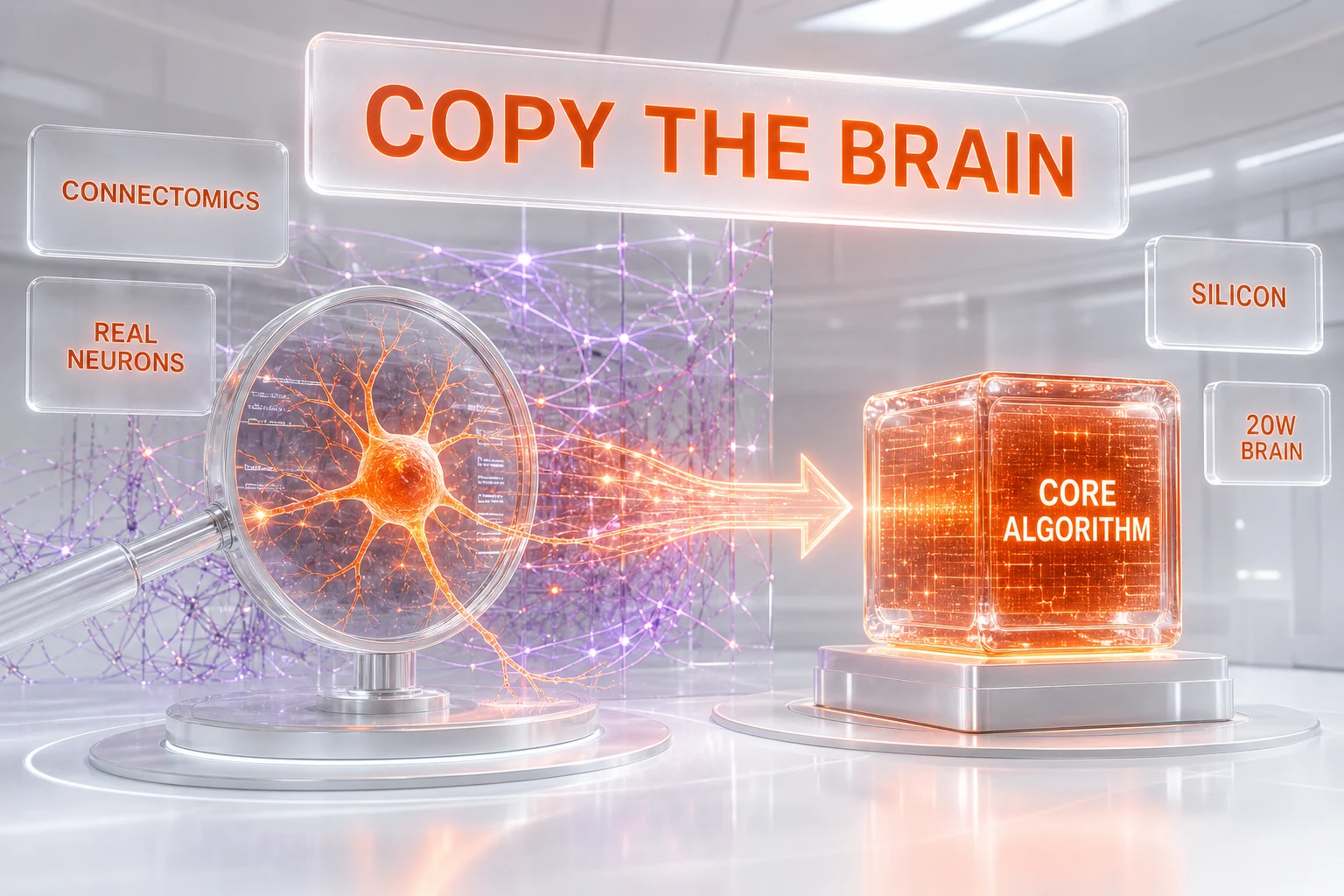
The pitch, as reported, is that somewhere inside the wiring diagram of real brains there is a "core algorithm" — a compact, reusable computational principle that explains why a three-pound organ running on roughly 20 watts can learn from a handful of examples, generalize, and adapt, while a frontier model needs a data center and megawatts to approximate a fraction of that flexibility. Flourish wants to find that principle by studying real neural tissue, then reproduce it in silicon.
If that sounds audacious, it is. Connectomics has historically been one of the slowest, most labor-intensive corners of neuroscience — mapping even a fruit-fly brain took years and enormous resources. Betting that you can extract a deployable "core algorithm" from connectome data, on a venture timeline, is a genuine scientific gamble. That is also exactly why this is funded by deep-tech specialists like Lux and Catalio rather than a generic growth fund: the risk is not "will the market like it," it is "is the underlying science even tractable on this timeline."
Why It Matters: The Energy Angle Is the Whole Story
The reason this round is more than a curiosity is the number 20 to 50 watts. That is the energy target Flourish reportedly attaches to Cortex AI, set against the more than 1,000 watts a single high-end AI GPU can draw. The gap is not incremental — it is a couple of orders of magnitude, and it lands at the exact moment when energy, not algorithms, has become the binding constraint on AI.
The macro context is hard to overstate. We have spent the past year covering the power story from every angle: SoftBank committing up to 75 billion euros to French AI data centers, GridCARE raising to unlock grid capacity for AI, and even Starcloud raising to build orbital data centers because terrestrial power and cooling are running out of headroom. The entire industry is racing to find more watts. Flourish is reportedly betting on the opposite move: needing dramatically fewer of them.
If you take the thesis at face value, a brain-inspired system that delivers useful intelligence at laptop-class power would not just trim cloud bills. It would change where AI can run. Twenty to fifty watts is the power envelope of an edge device, a phone, a wearable, a robot — not a hyperscale rack. The strategic prize is not "cheaper ChatGPT." It is intelligence that runs locally, continuously, and privately, without a data-center umbilical cord. That is a different category of product.
This also reframes the financing arms race we have been tracking, from Anthropic's mega-rounds to NVIDIA's circular equity bets. Most of that capital is, directly or indirectly, a bet on scaling current architectures with more compute and more power. Flourish is a hedge against that entire paradigm — a relatively small check, by 2026 standards, on the possibility that the winning architecture is not bigger, it is biological.
How It Compares to the Brain-Computer and Neuro-AI Field
Flourish is not arriving in a vacuum. The boundary between neuroscience and AI has gotten crowded and well-funded. We recently covered how macaques navigated a virtual environment through an AI-powered intracortical brain-computer interface — a different problem (decoding signals to restore movement) but the same underlying intuition that real neural data is a uniquely valuable training substrate.
The distinction worth drawing is between reading the brain and copying the brain. Brain-computer interfaces, including Reardon's own former work at CTRL-labs and Meta, are mostly about decoding neural or neuromuscular signals to control machines. Flourish's reported ambition is more fundamental and more speculative: not to interface with the brain, but to extract its computational principle and rebuild it in hardware. That is closer to the long-running neuromorphic computing dream than to the BCI field — and neuromorphic hardware has a long history of impressive demos and slow commercial traction.
It is also instructive to set Flourish next to the other science-heavy moonshots commanding big rounds. Isomorphic Labs raised $2.1 billion for AI drug design without a single drug in humans, on a thesis that AI can compress decades of biology. Flourish is the inverse trade: instead of pointing AI at biology, it is pointing biology at AI, mining real neural tissue for the architecture itself. Both are bets that the next leap comes from outside the current LLM scaling curve.
Our Take
We have been following the AI energy crisis closely, and the most honest thing we can say is that Flourish is the most interesting bet of the month precisely because it is the most likely to fail — and the most consequential if it does not. The energy thesis is correct. Power has become the constraint, and every credible projection of where AI demand is going runs straight into grid limits. A company that genuinely cracked intelligence at 20 to 50 watts would not be competing in the current market; it would be deleting most of it.
That said, we want to be careful here, because the gap between a compelling thesis and a shipped product is exactly where moonshots go to die. Connectomics is hard, slow, and has never produced a deployable "core algorithm." Neuromorphic computing has promised brain-like efficiency for over a decade and has not displaced GPUs. The reported $2.5 billion valuation is attached to a company with, as far as anyone can tell, no public product, no benchmarks, and no confirmed technical results. This is a faith-and-founder bet, and the faith is in Reardon's track record and the founders' read of the neuroscience — not in evidence we can inspect.
What would change our minds, in either direction? On the bull side: any credible demonstration that Cortex AI does meaningful work — even narrow, even toy-scale — inside a single-digit or double-digit watt budget would be a genuine signal, because that is the one thing the entire GPU-scaling paradigm cannot easily match. On the bear side: if a year passes with nothing but more funding and more secrecy, that is the classic pattern of a science bet that is further from tractable than the round implied.
The Bezos framing is the part we most want readers to get right, because the headlines are already getting it wrong. Bezos did not put $500 million into Flourish. He reportedly put in around $100 million — meaningful, the largest individual stake, but a venture-scale hedge, not an empire. For a man reportedly co-leading a $10 billion physical-AI lab in Prometheus, a roughly $100 million check on a brain-inspired moonshot is a portfolio move: cover the scaling thesis with Prometheus, hedge it with Flourish. That is not a contradiction. That is how someone with effectively unlimited capital plays a paradigm shift whose winning architecture is still unknown.
What's Next
The immediate thing to watch is confirmation. As of now, this is Wired's reporting, amplified by SiliconANGLE and TechFundingNews, not a company announcement. A formal Flourish statement, a clearer investor list, or any SEC paperwork would move this from "reportedly" to "officially," and would likely add detail on how the round is structured and what milestones the capital is meant to fund.
Beyond confirmation, the real signal will be technical. Watch for any sign of what "core algorithm" means in practice — a paper, a demo, a hire of senior connectomics or neuromorphic-hardware talent, a partnership with a chip foundry. The energy claim is only as good as the silicon that delivers it, and a 20 to 50 watt target implies custom or highly specialized hardware, not a software layer on top of existing GPUs.
We will keep covering both halves of this story — the breathless funding side and the much harder science side — and we will keep drawing the line between Flourish and Prometheus, because they are going to keep getting confused. For now, the one-line version is the right one to hold onto: a roughly $500 million round, anchored but not owned by Bezos at around $100 million, on a secretive startup trying to copy the brain's algorithm and run AI on a light bulb's worth of power. Reported, audacious, and very far from proven.
Frequently Asked Questions
What is Flourish and what is it building?
Flourish is a secretive brain-inspired AI startup co-founded by Internet Explorer creator Thomas Reardon and former Amazon executive Rob Williams. According to Wired, it is building a system called Cortex AI that uses connectomics — the mapping of real neurons and their connections — to reverse-engineer the brain's "core algorithm" and run intelligence at 20 to 50 watts, versus the more than 1,000 watts a single high-end AI GPU can draw.
Did Jeff Bezos invest $500 million in Flourish?
No. The $500 million is the size of the full round, not a Bezos check. According to Wired, Bezos reportedly committed around $100 million — roughly one-fifth of the round — which makes him the single largest individual backer, but not the only investor. GV, Lux Capital, and Catalio Capital are also reported participants. Several outlets noted Bezos started near $50 million before roughly doubling his stake.
What valuation did Flourish raise at?
According to Wired's reporting, Flourish raised approximately $500 million at a roughly $2.5 billion valuation in early June 2026. These figures are reported rather than officially confirmed — there was no company press release or SEC filing confirming the round as of June 2026.
Is Flourish the same as Jeff Bezos' Project Prometheus?
No, they are different. Project Prometheus is the roughly $10 billion AI lab Bezos co-leads, reportedly at a $38 billion valuation, focused on physical world models for aerospace, automotive, manufacturing, and pharma. Flourish is a separate, much smaller startup (about a $500 million round at a $2.5 billion valuation) that Bezos is investing in rather than running, focused on brain-inspired AI via connectomics. One is Bezos-founded and Bezos-run; the other is a venture bet.
What is Cortex AI and how does connectomics fit in?
Cortex AI is Flourish's reported product. Its method is connectomics — mapping individual neurons and their connections at fine resolution to find a compact "core algorithm" that explains why the brain learns and adapts on roughly 20 watts. Rather than scaling artificial neural networks that only loosely resemble biology, Flourish wants to study real neural tissue and reproduce its computational principle in silicon.
Why does the 20 to 50 watt target matter so much?
Energy has become the binding constraint on AI. A single high-end AI GPU can draw more than 1,000 watts, and the industry is racing to find more power — from data centers to grid upgrades to orbital compute. A system delivering useful intelligence at 20 to 50 watts — laptop or edge-device power — would change where AI can run: phones, wearables, robots, and devices, locally and continuously, without a data-center connection. That is a different product category, not just a cheaper cloud bill.
Who is Thomas Reardon?
Thomas Reardon created Internet Explorer at Microsoft in the mid-1990s, then earned a PhD in neuroscience and founded CTRL-labs, a neural-interface startup that read forearm muscle signals to control computers. Meta acquired CTRL-labs in 2019, after which Reardon led neuromotor interface work at Meta Reality Labs. His decade at the boundary of real neurons and silicon is central to Flourish's pitch.
Who else is backing Flourish besides Bezos?
According to reporting, the round includes GV (Alphabet's venture arm), Lux Capital, and Catalio Capital, alongside Jeff Bezos. The mix of deep-tech and life-sciences specialists rather than generic crossover growth investors signals a long-horizon, science-heavy bet rather than a typical AI growth round.
How does Flourish compare to brain-computer interface companies?
There is an important distinction between reading the brain and copying the brain. Brain-computer interfaces — including Reardon's former CTRL-labs and Meta work, and recent intracortical BCI research where macaques navigated a virtual environment — mostly decode neural signals to control machines. Flourish's reported ambition is more fundamental: not to interface with the brain, but to extract its computational principle and rebuild it in hardware, closer to the neuromorphic computing dream.
How reliable are these Flourish details?
They should be read as reported, not confirmed. The numbers and claims trace back to Wired's reporting, amplified by SiliconANGLE and TechFundingNews around June 4 to 5, 2026. As of June 2026 there was no Flourish press release or SEC filing confirming the round, and the company has kept an unusually low public profile. Treat the figures — the $500 million round, $2.5 billion valuation, ~$100 million Bezos stake, and 20 to 50 watt target — at the conditional level.
What are the biggest risks to the Flourish thesis?
Several. Connectomics has historically been slow and labor-intensive, and has never produced a deployable "core algorithm." Neuromorphic computing has promised brain-like efficiency for over a decade without displacing GPUs. The reported $2.5 billion valuation is attached to a company with no public product, no benchmarks, and no confirmed technical results. This is a faith-and-founder bet — the faith is in Reardon's track record and the founders' read of the neuroscience, not in inspectable evidence.
What should we watch for next?
Two things. First, confirmation — a formal Flourish statement, a clearer investor list, or SEC paperwork would move this from "reportedly" to "officially." Second, technical signal — a paper, a demo, senior connectomics or neuromorphic-hardware hires, or a chip-foundry partnership. The 20 to 50 watt claim implies custom or specialized hardware, so the silicon roadmap is where the thesis will be proven or broken.