The Lionsgate-Runway partnership, announced September 18, 2024 as Hollywood's first major studio-AI alliance, has not delivered the custom film model it promised. According to a TheWrap exclusive by Roger Cheng and Jeremy Fuster, the project stalled on a structural problem: Lionsgate's catalog is too small to train a usable generative video model. A person familiar with the situation told TheWrap, "The Lionsgate catalog is too small to create a model. In fact, the Disney catalog is too small to create a model." Lionsgate says the deal is not exclusive and that it is pursuing AI "on several fronts as planned," using Runway's tools alongside other AI companies. Meanwhile other studio-adjacent bets moved forward: OpenAI is backing the roughly $30 million animated feature Critterz, heading to the Cannes market in May 2026, and Amazon's Alexa Fund has invested in Fable Studio's Showrunner platform. The pattern across all three is the same — generative AI is useful around production, but it keeps hitting a wall when asked to replace studio production from a studio's own library.
Disclosure: ThePlanetTools.ai has no affiliate or commercial relationship with Lionsgate, Runway, OpenAI, Amazon, or Fable Studio. We do not earn anything if you click any link in this article. This is an editorial analysis written from public reporting. Where a claim comes from a single outlet, it is attributed to that outlet by name. This piece argues a contrarian read and flags exactly what would prove that read wrong.
What actually happened with the Lionsgate-Runway deal
On September 18, 2024, Lionsgate and Runway announced a partnership that the trade press treated as a turning point. As reported by The Hollywood Reporter, the plan was to build an AI model "customized to Lionsgate's proprietary portfolio of film and television content," designed to help the studio's filmmakers "augment their work." Lionsgate Vice Chair Michael Burns called Runway "a visionary, best-in-class partner" for "capital-efficient content creation." Runway CEO Cristóbal Valenzuela framed it as giving studios "the best and most powerful tools to augment their workflows."

That was the promise. The reported reality, roughly a year later, is different. In a TheWrap exclusive credited to Roger Cheng and Jeremy Fuster, sources described a deal that "encountered unforeseen complications" — limited capability from a single custom model, copyright concerns over Lionsgate's own library, and questions about ancillary rights of actors. The headline problem was data. A person familiar with the situation put it bluntly to TheWrap: "The Lionsgate catalog is too small to create a model. In fact, the Disney catalog is too small to create a model."
The one quote that reframes the entire AI-in-Hollywood story
That second sentence is the part worth sitting with. The claim is not that Lionsgate is uniquely small. The claim, attributed to a source familiar with the project, is that even Disney — the largest film library on Earth — would not have enough proprietary footage to train a frontier-grade video model on its own catalog alone. If accurate, that is not a Lionsgate problem. It is a category problem for the entire "train an AI on our IP" thesis that studios have been selling internally for two years.
In my read, this is the single most important data point in the current AI-and-Hollywood narrative, and it has been almost completely buried under launch announcements. The labs train on billions of clips scraped from the open web. A studio that owns thousands of films still owns a rounding error compared to that. Proprietary IP, the thing studios assumed was their leverage, turns out to be too small to be a moat in the way they imagined.

Lionsgate's official position is "still on, just different"
Lionsgate has not walked away. A studio spokesman told TheWrap it is pursuing AI initiatives "on several fronts as planned" and emphasized the Runway deal "isn't exclusive." The studio said it plans to use both Runway's tools and tools from other AI companies to streamline preproduction and postproduction across multiple film and TV projects, though no specific titles were named. Reporting indicates the practical, surviving use case is the unglamorous one: tweaking backgrounds, generating custom models of specific sets, and other detail work that traditionally costs time and money.
So the deal is not dead. It is demoted. The transformational "make movies with AI from our own library" framing has, per the reporting, quietly become "use AI to speed up the boring parts." That is a meaningful outcome — just not the one that was announced.
The contrarian read: generative AI is hitting the production wall, not the demo wall
Here is the strategic argument I want to make, scoped honestly. The dominant narrative in 2025 and early 2026 was that generative video had basically "arrived" and Hollywood was next. The Lionsgate reporting suggests a more precise framing: the demos arrived, the production pipeline did not. There is a large gap between a model that can generate a stunning eight-second clip and a system that can deliver a coherent, rights-clean, director-controllable feature using a specific studio's own characters and look.
That gap shows up in three places at once, and all three are visible in the Lionsgate story: insufficient training data from a single catalog, unresolved copyright exposure on the studio's own library, and unresolved ancillary rights for the humans on screen. None of those are model-quality problems. You cannot fix them by shipping Runway Gen-5. They are structural to the idea of a studio-trained model.
This is a positioning problem, not a "the tech is bad" problem
To be explicit, because the distinction matters: I am not arguing Runway's model is weak or that the company underdelivered technically. By the reporting, the issue was not the quality of Runway's model — it was that a single studio catalog is not a sufficient dataset for the ambitious projects the deal implied. That is a strategic mismatch between what was sold and what the data could support, not a verdict on engineering. Runway's broader bet, profiled elsewhere, has shifted toward general world models rather than per-studio bespoke models — which, if anything, is consistent with the lesson here.
The pivot pattern: studios are routing around the bespoke-model idea
The interesting move is not that the Lionsgate deal slowed. It is where the energy went instead. Two reference points from May 2026 reporting frame the redirection.
The rights problem that no model upgrade fixes
It is worth isolating the part of the Lionsgate story that gets the least attention because it is the least exciting and the most structural: rights. Per TheWrap's reporting, the complications were not only about training data. They also included copyright concerns over Lionsgate's own library and unresolved questions about the ancillary rights of actors who appear in that library.
Why the rights wall is harder than the data wall
The data wall is, in principle, an engineering and partnership problem — pool more data, license more footage, accept synthetic augmentation. The rights wall is a contracts-and-law problem that sits on decades of existing agreements. A studio cannot retroactively assume it has the right to train a generative model on the likeness and performances of every actor in its back catalog. Those rights were negotiated, in many cases, long before generative video existed. In my read, this is why "use AI on our own library" is structurally harder than it looks: the library is not a clean training corpus, it is a stack of contracts.
How the rights wall shapes where studios pivot
This reframes the Critterz and Showrunner moves. New original IP, like Critterz, can be built with rights structured for AI from day one. Licensing existing IP into a platform, like Showrunner's reported approach, puts the rights question on the table explicitly and negotiates it. Both routes confront the rights problem directly. The bespoke-catalog-model route tried to route around it — and that, per the reporting, is part of what stalled.
OpenAI's Critterz: the $30 million counter-bet
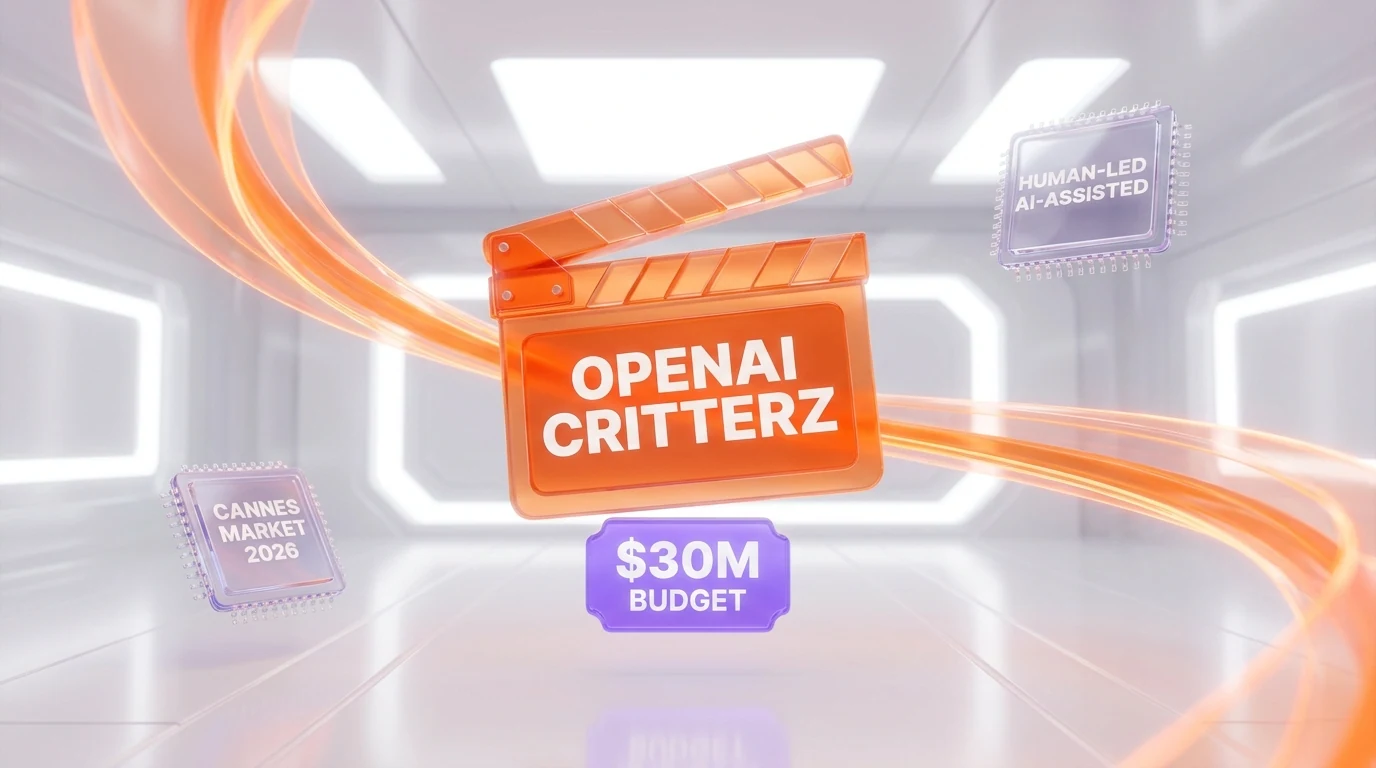
Per Deadline's May 2026 reporting, OpenAI is backing Critterz, an animated feature with a budget in the roughly $30 million range — described as far below a traditional comparable production. Chad Nelson, a creative strategist at OpenAI, is a producer; the feature is a full-length adaptation of a 2023 AI short film Nelson made. The production is run by Nik Kleverov of Native Foreign with Vertigo Films' Allan Niblo and James Richardson, and AGC Studios is handling world sales ahead of the Cannes market, where first footage is set to screen.
Why Critterz is the structurally smarter bet
Critterz does not try to train a model on a studio's locked library. It is, in the project's own framing, "human-led but AI-assisted" — original IP, built ground-up with general-purpose AI tooling inside a normal production company structure, sold through a normal sales agent. That sidesteps every wall Lionsgate hit: there is no proprietary-catalog data requirement, no copyright exposure on an existing library, and the human-talent question is contained because it is new IP with its own deal structure. In my read, Critterz is not "AI replaces the studio." It is "AI lowers the cost basis of a project a studio structure still runs." That is a much more defensible thesis than the bespoke-model one.
The honest caveat on Critterz
The figure to keep scoped: roughly $30 million is the reported budget, and it is reported as significantly cheaper than a traditional equivalent — but a 2026 Cannes market screening of first footage is not a wide theatrical release, a box-office number, or a profit. Critterz proves a production-cost thesis on paper. It has not yet proven a commercial one. I am treating it as a strong directional signal, not a closed case.
Amazon, Fable Studio and Showrunner: the consumer-side bet
The third reference point is Showrunner, built by Fable Studio under CEO Edward Saatchi. Per No Film School's reporting, Amazon's Alexa Fund has invested in Fable to support Showrunner's public launch. Showrunner lets users generate animated episodes from text prompts and uploaded images, and ships with original interactive shows users can extend. Saatchi has described the ambition as a "Netflix of AI."
I want to be careful here, because this is exactly the kind of place a number gets invented. The reporting I reviewed states that Amazon's Alexa Fund invested in Fable but does not disclose a dollar amount, and it does not tie Showrunner to the Critterz project. I am not going to assign a figure to a deal whose figure has not been publicly reported. What is reportable is the direction: Amazon's strategic venture arm put money into a consumer AI-show platform, not into a studio bespoke-model deal.
The Showrunner caveat that matters
Fable previously generated AI South Park episodes that were pulled over copyright claims, and the company is reportedly pursuing licensing agreements with major studios. That history is the entire point of this article in miniature: the technical generation was the easy part; the rights structure around existing IP was the part that broke. Showrunner's path forward runs through licensing, not around it.
The throughline across all three stories
Put the three side by side and a consistent shape appears. Lionsgate-Runway tried to build a model from a studio's existing library and hit a data-and-rights wall. Critterz built new IP with general AI tooling and a normal production structure, and is moving forward. Showrunner generates new consumer-side content and is pursuing licensing for anything based on existing IP. The dividing line is not model quality. It is whether the approach depends on retraining a model on locked, rights-encumbered studio IP. The approaches that avoid that dependency are progressing; the one that required it stalled.

What this means for studio strategy
If the contrarian read holds, the strategic conclusion for studios is uncomfortable: the proprietary-library moat that justified the bespoke-model deals may not exist in the form executives assumed. The defensible plays look like (1) AI as a production-cost lever on new IP, (2) licensing existing IP into AI platforms on the studio's terms rather than training private models, and (3) AI for pre- and postproduction grunt work — which is, notably, exactly where Lionsgate says the surviving value is.
What this means for people choosing video tools
For anyone evaluating generative video tools right now, the takeaway is to separate "can it produce an impressive clip" from "can it carry a controllable, rights-clean production." Most current models are strong on the first and unproven on the second. If you are comparing options, look at controllability and rights posture, not just sample reels. We track the major models individually so you can compare on those terms rather than on marketing.
The broader market read: hype repricing, not collapse
One thing this analysis is careful not to claim: that AI in Hollywood is over, or that the stall means the technology failed. The honest read is narrower and, I think, more useful. What is being repriced is a specific thesis — "studios will train private models on their libraries and replace production" — not the entire category. The evidence from the same reporting cycle points to AI continuing to expand in adjacent roles even as the bespoke-model thesis cools.
What exactly is being repriced
The expensive lesson, to borrow a framing from the trade commentary, is about reading the fine print: data sufficiency and rights structure were underweighted when these deals were announced as transformational. Repricing that thesis does not invalidate AI for previs, background work, postproduction, or new-IP production at a lower cost basis. It invalidates the specific promise that a studio's locked catalog is the moat.
Who this actually helps and hurts
If the contrarian read holds, it is mildly bad for the "license-our-catalog-to-train-a-private-model" pitch and mildly good for general-purpose model vendors and for production companies that build new IP with off-the-shelf tooling. It is roughly neutral for working filmmakers in the near term, because the surviving use case — AI for the slow, expensive detail work — augments rather than replaces. That is a less dramatic conclusion than either the "AI takes over Hollywood" or "AI failed in Hollywood" headlines, which is usually a sign it is closer to right.
Where the leading video models actually stand
The strategic story above is upstream of a practical question: which models are people actually using for production-adjacent work in 2026? Runway's Gen-4.5 model remains a primary reference point for controllable generation, and its broader direction has shifted toward general world models rather than per-studio bespoke training. Google's Veo 3.1 and Kling 3 Omni are the other two names that come up most for production-grade clip generation, and Pika sits in the faster-iteration consumer-creator lane.
How they stack against each other
Because the differences are about control and pipeline fit rather than raw fidelity, head-to-head comparisons are more useful than spec sheets. Our Runway Gen-4.5 vs Veo 3.1 breakdown covers the controllability tradeoff most relevant to production teams, and the Veo 3.1 vs Kling 3 Omni comparison covers the two models most often shortlisted against each other for higher-end work. None of these tools resolves the structural rights-and-data problem at the center of the Lionsgate story — they are upstream of it — but they are where the practical decisions actually get made.
What would prove me wrong
This is a contrarian read, so it should be falsifiable. I would consider the "generative AI hit the studio-production wall" thesis substantially weakened if any of the following happens:
- A major studio ships a real feature or series built primarily from its own bespoke catalog-trained model — not detail work, not background tweaks, but a finished commercial title where the studio-specific model is the production engine. That would directly contradict the "catalog too small" claim.
- The "even Disney's catalog is too small" claim is publicly and credibly rebutted by Disney, Lionsgate, Runway, or a tier-1 outlet with sourcing — for example, a demonstration that a single studio library can train a production-grade model with synthetic augmentation. That single sourced quote is load-bearing for my argument; if it falls, the argument weakens.
- Lionsgate publicly reframes the Runway deal as on-track and transformational with named, shipped projects, rather than the "several fronts as planned" / "not exclusive" language reported by TheWrap.
- Critterz commercially fails in a way that is attributed to its AI-assisted pipeline rather than to normal market factors — which would undercut the "new-IP-with-general-tooling is the smarter path" half of the argument.
If none of those happen over the next year, the contrarian read gets stronger by default. If one does, I will say so.
Frequently asked questions
Did the Lionsgate-Runway AI deal officially collapse?
No. Based on TheWrap's exclusive reporting by Roger Cheng and Jeremy Fuster, the deal has not been abandoned. A Lionsgate spokesman said the studio is pursuing AI "on several fronts as planned" and stressed the Runway deal "isn't exclusive." What stalled is the original ambition — a custom model trained on Lionsgate's catalog to make movies — not the relationship itself, which has reportedly narrowed to preproduction and postproduction support.
Why did the Lionsgate-Runway custom model not work as promised?
The headline reason reported by TheWrap is data. A person familiar with the situation said, "The Lionsgate catalog is too small to create a model. In fact, the Disney catalog is too small to create a model." A single studio's film library, even a large one, is tiny compared to the billions of clips frontier video models train on. Copyright concerns over Lionsgate's own library and unresolved ancillary rights for actors were also cited as complications.
When was the Lionsgate-Runway partnership announced?
September 18, 2024, per The Hollywood Reporter. It was framed as the first partnership between Runway and a major Hollywood studio, with Lionsgate Vice Chair Michael Burns calling Runway a "best-in-class partner" for "capital-efficient content creation."
What is OpenAI's Critterz and how much does it cost?
Critterz is an animated feature OpenAI is backing, with a budget in the roughly $30 million range per Deadline's May 2026 reporting — described as far below a traditional comparable production. Chad Nelson, a creative strategist at OpenAI, is a producer; it adapts a 2023 AI short film he made. AGC Studios is handling world sales ahead of the Cannes market, where first footage is set to screen.
Is Critterz fully AI-generated?
No. The project's own framing is "human-led but AI-assisted." It uses general-purpose AI tooling inside a conventional production company structure with named human producers and a sales agent, rather than a studio catalog-trained model. That structural difference is why it sidesteps the data and rights walls the Lionsgate deal hit.
How much did Amazon invest in Showrunner?
The reporting reviewed states that Amazon's Alexa Fund invested in Fable Studio to support Showrunner's public launch but does not disclose a dollar amount. We are not assigning a figure to a deal whose figure has not been publicly reported. What is reportable is the strategic direction: Amazon's venture arm backed a consumer AI-show platform rather than a studio bespoke-model deal.
What is Showrunner?
Showrunner is a platform from Fable Studio, led by CEO Edward Saatchi, that lets users generate animated episodes from text prompts and uploaded images and extend original interactive shows. Saatchi has described the ambition as a "Netflix of AI." Fable previously generated AI South Park episodes that were pulled over copyright claims and is reportedly pursuing licensing deals with major studios.
Does this mean generative AI cannot be used in Hollywood?
No, and that is not the argument. The reporting suggests AI is being used productively for preproduction and postproduction detail work, and Critterz shows new-IP projects moving forward with general AI tooling. The specific thing that hit a wall is training a model on a single studio's locked, rights-encumbered library to replace production. That is a narrower failure than "AI does not work in film."
Is this analysis affiliated with Lionsgate, Runway, OpenAI, or Amazon?
No. ThePlanetTools.ai has no affiliate or commercial relationship with any company named here and earns nothing from any link in this article. This is an independent editorial analysis built from public, attributed reporting, with a clearly flagged contrarian read and an explicit list of what would prove that read wrong.
Which video AI models are most relevant to this story?
Runway Gen-4.5 is the model at the center of the Lionsgate deal and has since shifted toward general world models. Google Veo 3.1 and Kling 3 Omni are the other production-grade names, and Pika sits in the faster consumer-creator lane. None of them solves the structural data-and-rights problem in the Lionsgate story — they operate upstream of it — but they are where practical tool decisions get made.
What is the single biggest takeaway from the Lionsgate-Runway story?
In my read: the proprietary-library moat that justified studio bespoke-model deals may not exist in the form executives assumed. The reported claim that even Disney's catalog is too small to train a production-grade model, if it holds, reframes the entire "train AI on our IP" strategy. The approaches that avoid that dependency — new IP with general tooling, licensing on the studio's terms — are the ones progressing.
How confident should readers be in this contrarian read?
Treat it as a sourced, falsifiable argument, not a settled fact. The strongest single claim — that even Disney's catalog is too small — comes from one person familiar with the situation via TheWrap, and the article flags exactly that. The "What would prove me wrong" section lists the specific events that would weaken or break the thesis. It is a directional read with stated confidence limits, not a verdict.
Editorial note & disclosure (repeated): No affiliate or commercial relationship exists between ThePlanetTools.ai and Lionsgate, Runway, OpenAI, Amazon, or Fable Studio. We earn nothing from any link here. Every factual claim is attributed to a named outlet — primarily TheWrap (Roger Cheng and Jeremy Fuster), The Hollywood Reporter, and Deadline — and where a claim rests on a single source, that is stated in the text. This is an opinion-driven strategic analysis, not original investigative reporting, and the "What would prove me wrong" section sets the conditions under which the argument should be revised.