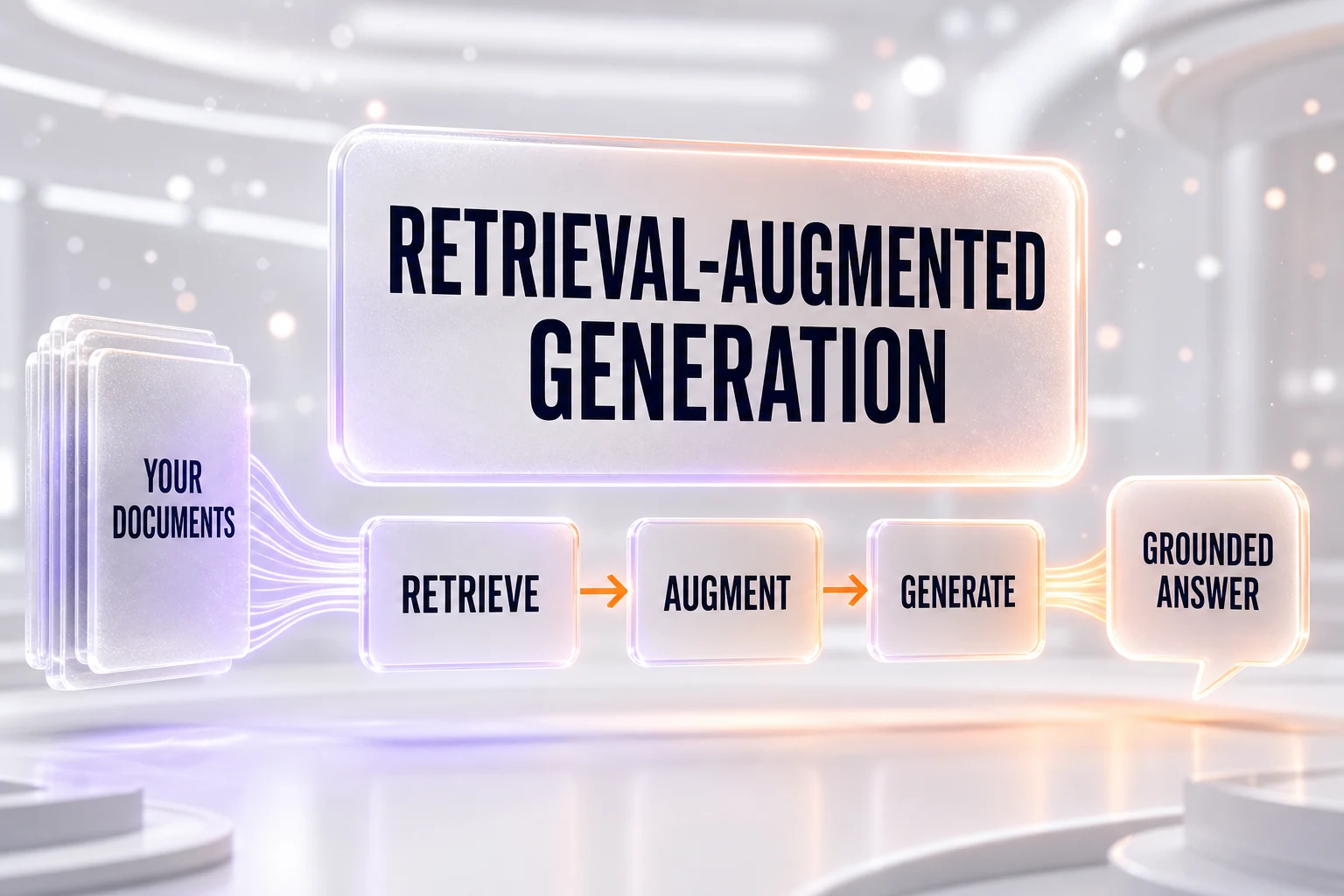
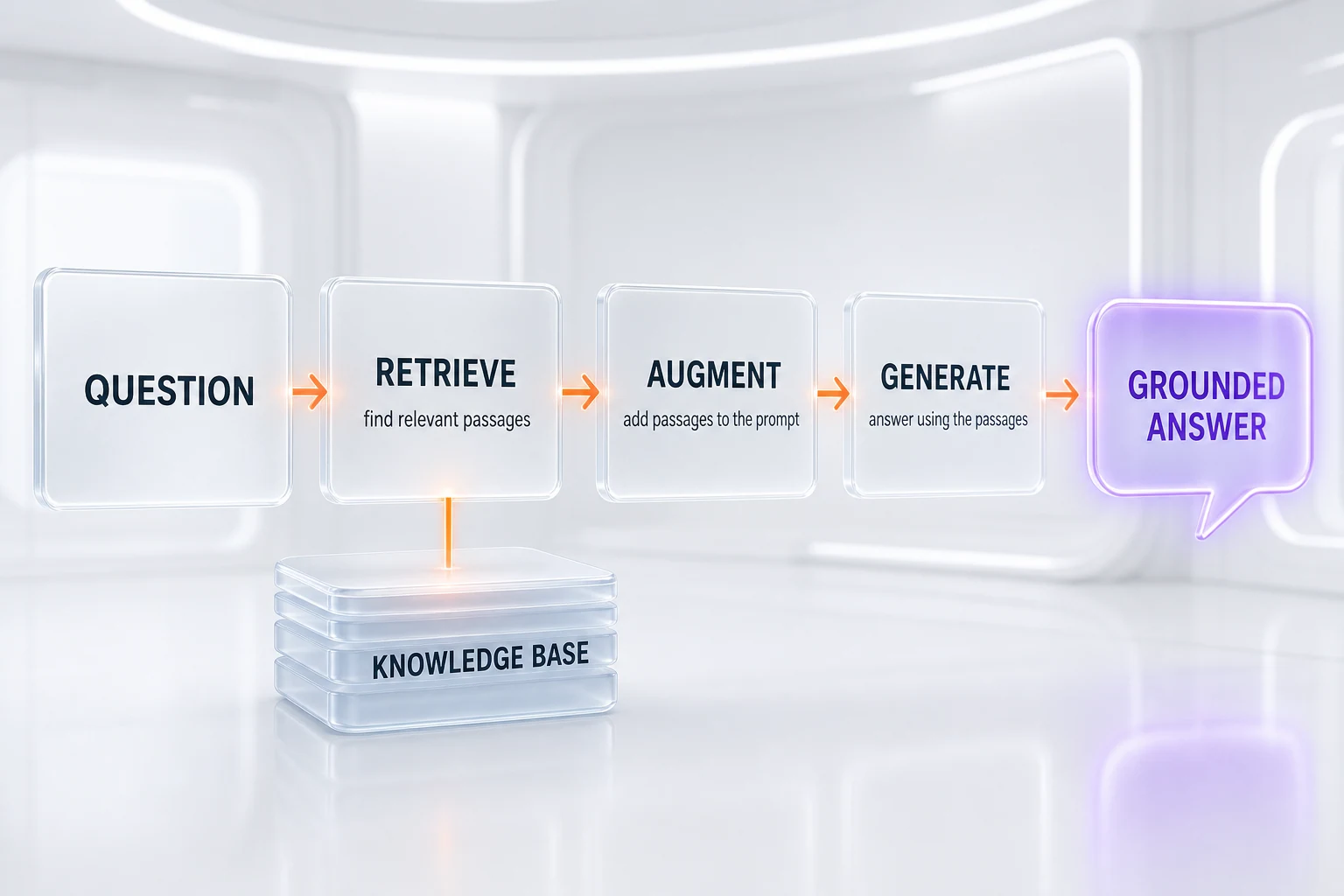
Retrieval-Augmented Generation (RAG) is a technique that lets an AI look things up in your own documents before it answers, instead of relying only on what it memorized during training. When you ask a question, a RAG system first retrieves the most relevant passages from a knowledge base you control, then augments the prompt by pasting those passages in alongside your question, and finally generates an answer that is grounded in that retrieved text. In one sentence: RAG turns a closed-book exam into an open-book one.
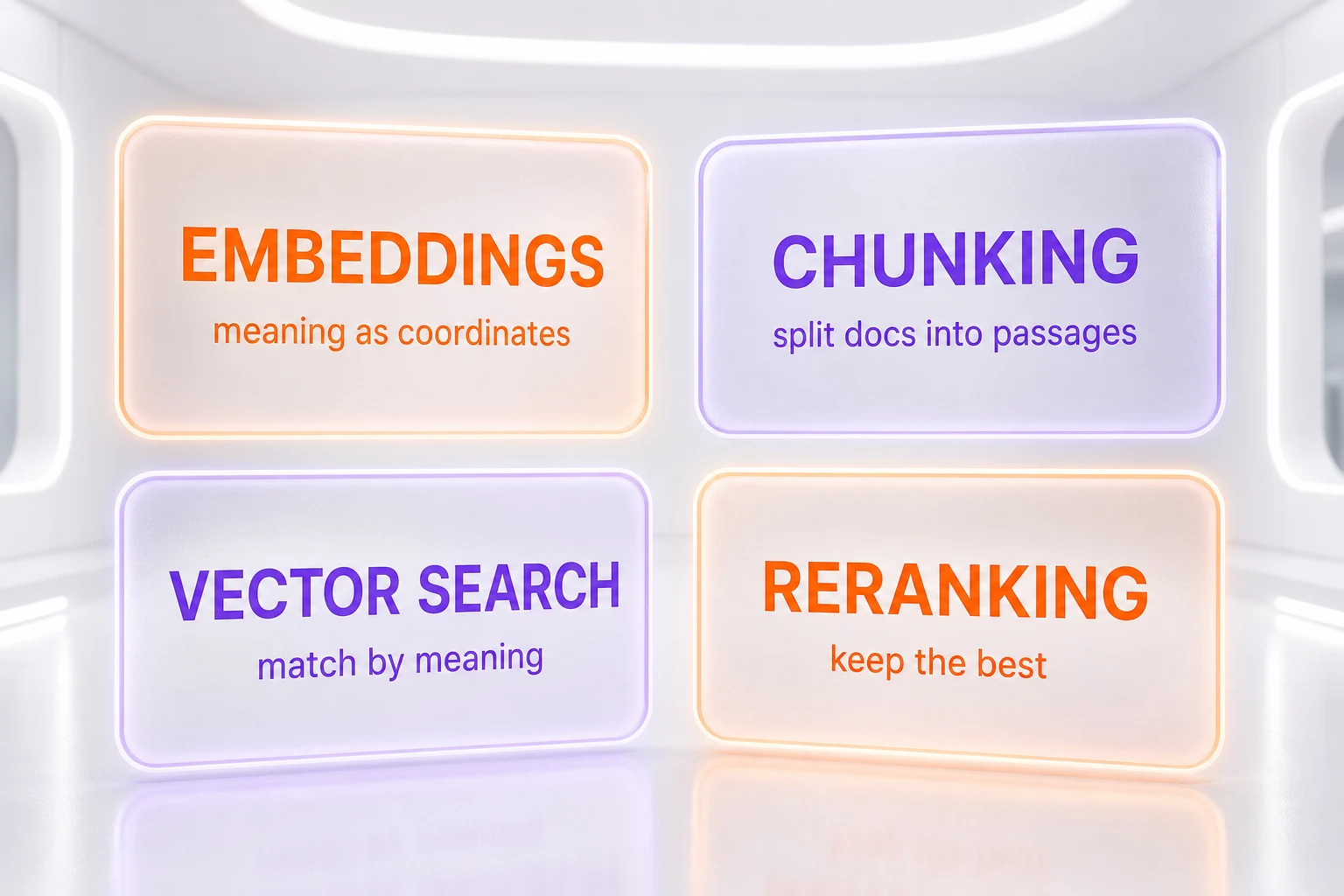
That single change fixes the two problems people run into most with large language models: making things up, and not knowing anything recent. This explainer walks through what RAG is, why it exists, exactly how the three-step pipeline works, and the handful of building blocks — embeddings, chunking, vector search, and reranking — that make it tick. No math, no jargon left undefined. By the end you will understand why nearly every serious business AI system in 2026 is built on RAG, and where it still falls short.
What Is Retrieval-Augmented Generation?
Retrieval-Augmented Generation is a way of connecting a language model to an external source of knowledge so that its answers are based on real, retrievable documents rather than only on its internal memory. The name describes the mechanism precisely: you augment the model's generation with a retrieval step. Nothing about the model itself changes — you do not retrain it or edit its weights. Instead, you change what goes into it at the moment you ask a question.
A plain language model works from memory alone. During training it read a huge amount of text and compressed patterns from it into billions of numbers called weights. When you ask it something, it predicts an answer from those weights. That is powerful, but it has no way to check a fact, no access to your private files, and no knowledge of anything that happened after its training data was collected. RAG bolts a research step onto the front of that process. Before the model writes a word, a retriever searches a knowledge base — your product docs, a support archive, a set of contracts, a wiki — and hands the model the passages most likely to contain the answer. The model then writes its response while literally looking at that text.
The practical upshot is that a RAG system can answer questions about information the model was never trained on: your company's refund policy, last week's release notes, a 400-page compliance manual. The model supplies the language skill and reasoning; the retrieval supplies the facts. This is the same division of labor you see in agentic systems, where retrieval is often just one of many tools an AI can reach for.
Why RAG Exists: The Two Problems It Solves
To understand why RAG became the default architecture for business AI, you have to understand two stubborn weaknesses of language models used on their own.
Problem 1: Hallucinations
A language model is trained to produce fluent, plausible-sounding text. It is not trained to be right. When it does not actually know something, it does not stop and say so — it generates the most likely-looking answer, which can be confidently, completely wrong. This is called a hallucination, and it is the single biggest reason you cannot safely put a raw chatbot in front of customers. The model has no source it is quoting from, so it has nothing to be faithful to.
RAG attacks this directly. By putting real passages in front of the model and instructing it to answer from them, you give the model something concrete to ground its answer in. When the retrieved text says the refund window is 30 days, the model reports 30 days rather than inventing 14. It can also cite which document it used, so a human can verify the claim. Grounding does not eliminate hallucinations entirely — a model can still misread or over-reach — but it reduces them dramatically and, crucially, makes them checkable.
Problem 2: The Knowledge Cutoff
Every model has a knowledge cutoff — a date after which it simply has no information, because its training data stopped there. Ask a 2025-trained model about a policy you changed yesterday and it cannot know. Worse, it may confidently describe the old policy, or hallucinate a new one. Retraining a large model to add fresh knowledge is slow and expensive, and you would have to do it constantly.
RAG sidesteps the cutoff completely. Because the knowledge lives in an external store that you can update at any time, adding new information is as simple as dropping a new document into the index. The model does not need to be retrained; the next question that touches that topic will retrieve the new passage automatically. This is why RAG is the natural fit for anything that changes — pricing, inventory, documentation, news, internal policy.
The Closed-Book Problem in One Line
Put the two problems together and you get the closed-book problem: a model answering from memory alone is a smart student taking an exam with the textbook closed. It will be articulate, and sometimes it will be wrong, and it will never know which. RAG hands that student the textbook.
How RAG Works: The Three-Step Pipeline
Every RAG system, no matter how sophisticated, runs the same three-step loop when it answers a question: retrieve, augment, generate. Understanding these three steps is understanding RAG.
Step 1: Retrieve — Find the Relevant Passages
When your question arrives, the system does not send it straight to the model. First it searches the knowledge base for the passages most likely to answer it. This is the "retrieval" half of the name, and it is where most of the engineering lives. The search is usually done by meaning, not by exact keywords: a question about "getting my money back" can surface a document that only ever says "refund policy," because the retriever understands the two are related. The output of this step is a short list of the top few passages — often three to ten — ranked by relevance.
Step 2: Augment — Put the Passages in the Prompt
Next, the system builds the actual prompt it will send to the model. It takes the retrieved passages and pastes them in alongside your question, typically with an instruction like: "Answer the question using only the context below. If the answer is not in the context, say you do not know." This assembled prompt — your question plus the supporting evidence plus the instruction — is the "augmentation." The model is about to see not just what you asked, but the source material it should answer from. This step is pure text assembly; nothing is being trained or changed.
Step 3: Generate — Answer Using the Passages
Finally, the augmented prompt goes to the language model, which generates the answer. Because the relevant facts are sitting right there in its context window, the model can quote them, paraphrase them, and reason over them instead of dredging up a half-remembered guess. A well-built system also asks the model to cite which passage it used, giving you a trail back to the source. The quality of this final answer depends on two things: how good the retrieval was, and how capable the generating model is. A strong model such as Claude Sonnet 5, GPT-5.5, or Gemini 3.1 Pro will follow the "answer only from the context" instruction faithfully; a weaker one may wander back into its own memory.
That is the whole loop. Retrieve the evidence, augment the prompt with it, generate the grounded answer. Everything else in RAG is about making each of those three steps work better.
The Building Blocks, Explained Simply
The three-step pipeline hides a few pieces of machinery. You do not need to build them yourself to understand RAG, but knowing what each one does makes the difference between treating RAG as magic and treating it as an engineering system you can reason about.
Embeddings: Meaning as Coordinates
An embedding is a way of turning a piece of text into a list of numbers that captures its meaning. Think of it as giving every sentence a set of coordinates in a vast "meaning space." Sentences that mean similar things land close together in that space, even if they share no words. "How do I get a refund?" and "What is your return policy?" end up as neighbors; "How do I get a refund?" and "What is the weather today?" end up far apart. A small AI model called an embedding model produces these coordinates. Embeddings are the trick that lets a computer search by meaning instead of by matching letters — and they are the foundation everything else in RAG stands on.
Chunking: Cutting Documents Into Pieces
Chunking is the unglamorous but critical step of splitting your documents into smaller passages before you index them. You do not embed a whole 50-page manual as one blob — you cut it into bite-sized chunks of a few hundred words each, often with a little overlap so a sentence is not sliced in half at a boundary. Each chunk gets its own embedding. Good chunking keeps related ideas together so that a retrieved passage is self-contained and actually answers the question. Bad chunking — cutting mid-thought, or making chunks too big or too small — is one of the most common reasons a RAG system returns useless context, and we return to it in the limits section below.
Vector Search: Searching by Similarity of Meaning
Once every chunk has an embedding, they all live in a vector database — a store optimized for one job: given the coordinates of your question, find the chunks whose coordinates are closest. This is vector search (also called semantic search or nearest-neighbor search). Your question is embedded into the same meaning space, and the database returns the nearest chunks by distance. Because it operates on meaning, it finds relevant passages that a plain keyword search would miss. Many production systems combine vector search with old-fashioned keyword search — an approach called hybrid search — to get the best of both worlds: meaning and exact matches like part numbers or names. Common building blocks here include pgvector, FAISS, and managed vector services, but the concept is the same regardless of the tool.
Reranking: The Second-Opinion Filter
Vector search is fast but a little rough — it is very good at pulling a handful of plausible candidates and only okay at ordering them perfectly. Reranking adds a second, more careful pass. A reranker model looks at the question and each candidate passage together and scores how well each one actually answers it, then reorders the list so the strongest passages rise to the top. You might retrieve twenty candidates by vector search and then rerank them down to the best four to hand the model. Reranking is one of the highest-leverage upgrades in RAG: it is the difference between "roughly on topic" and "exactly the passage you needed."
The Open-Book Exam Analogy
If you remember one image from this article, make it this one. A plain language model is a bright student sitting a closed-book exam. They have studied enormously and can answer most things from memory — fluently, quickly, and occasionally wrong without realizing it. When they hit a question they never studied, they do not leave it blank; they write a confident, plausible guess.
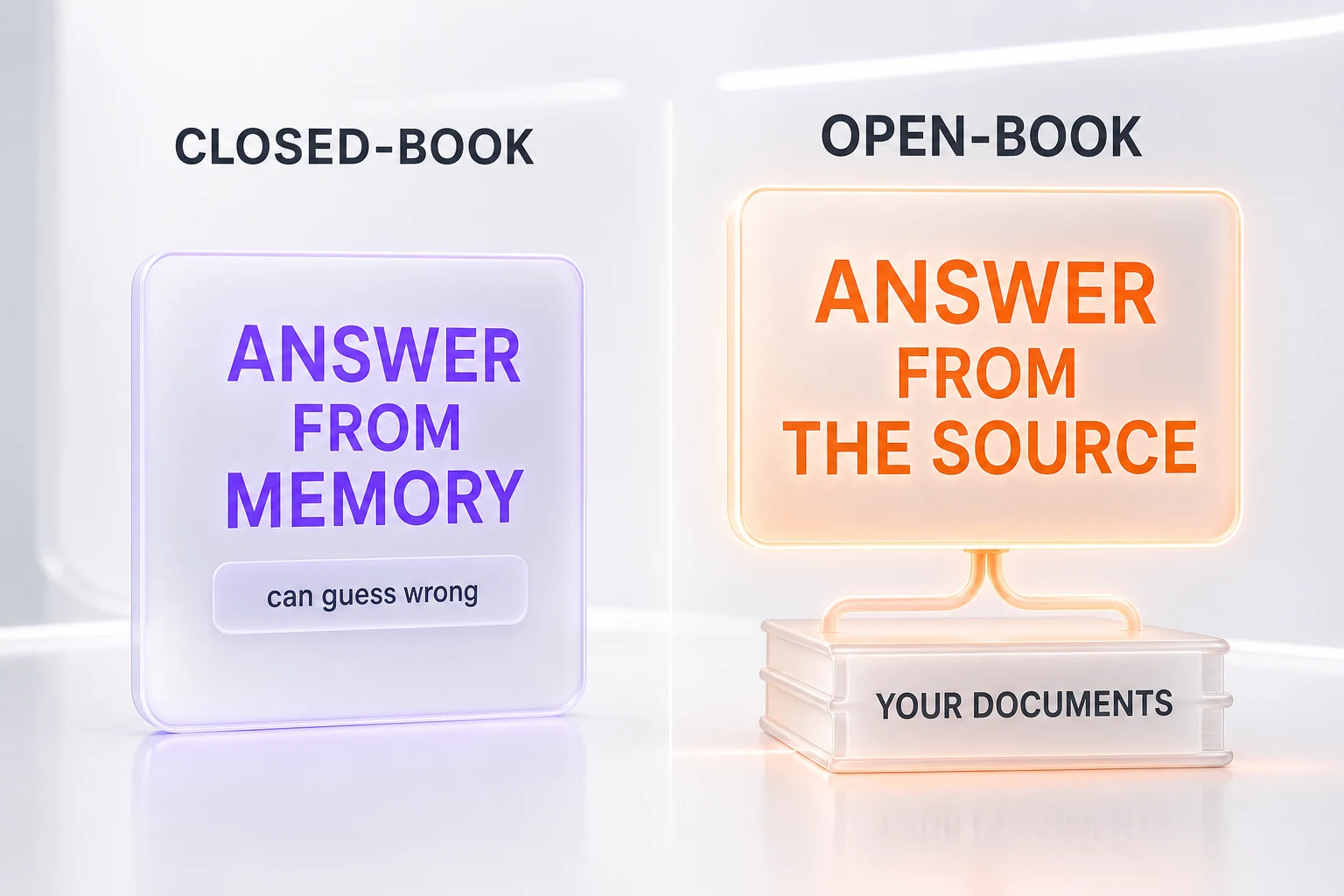
RAG turns that into an open-book exam. Now the same student can look up the relevant page before answering. They still need to be smart — they have to find the right page, read it correctly, and write a good answer — but they are no longer guessing from memory. If the textbook does not cover the question, a good open-book student says "this is not in the material" instead of inventing an answer. That is exactly the behavior RAG is designed to produce: answers grounded in a source, with a graceful "I do not know" when the source is silent. The retriever finds the page; the model reads it and answers.
RAG vs Fine-Tuning: Knowledge vs Behavior
The question that comes up next is almost always: isn't there another way to teach a model new things — fine-tuning? Yes, and confusing the two is one of the most common mistakes people make. They solve different problems and, more often than not, are used together.
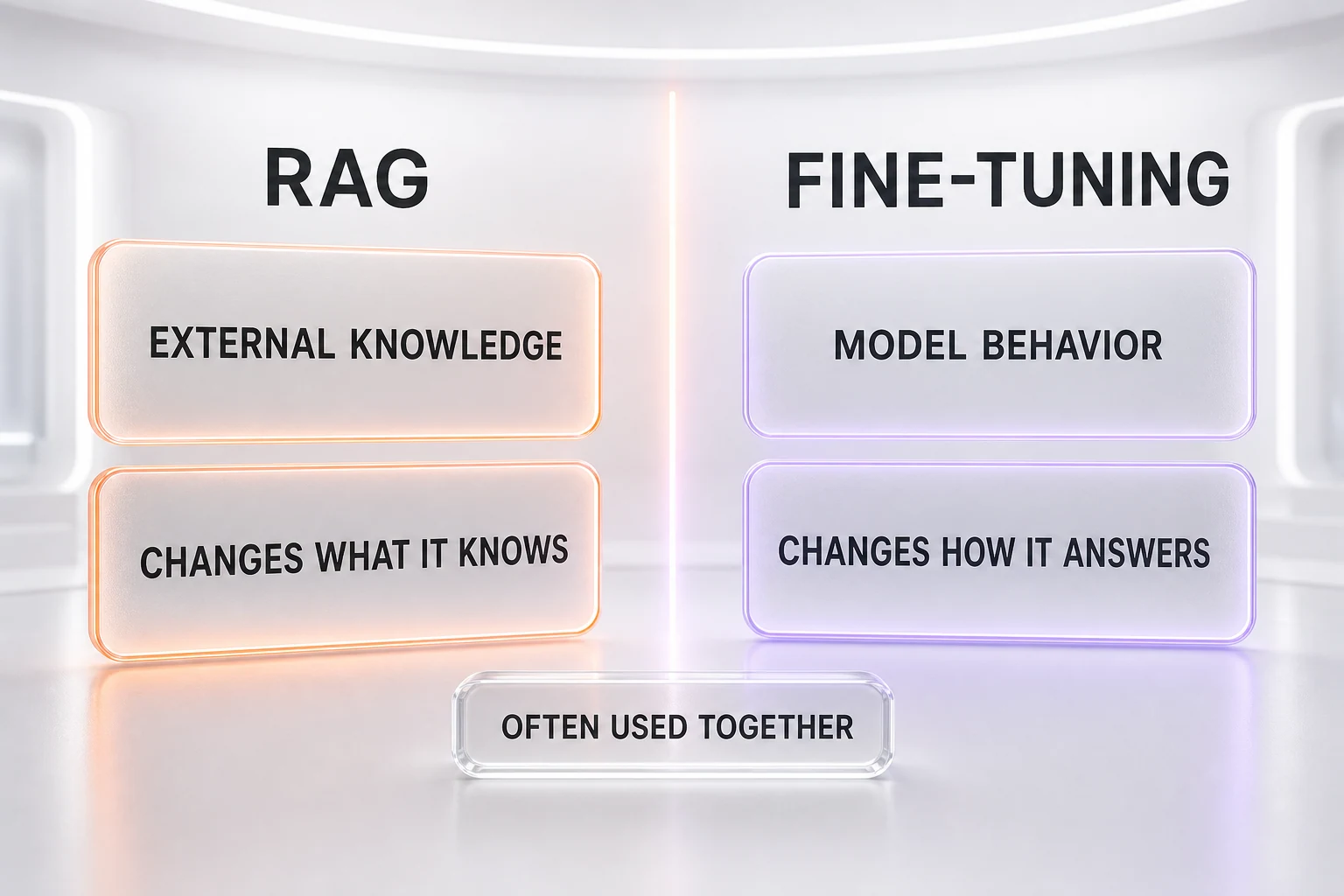
RAG changes what the model knows. It injects external, up-to-date knowledge at the moment of answering, without touching the model's weights. Update a document and the knowledge updates instantly. It is the right tool when the problem is facts: the model needs access to information it was not trained on, especially information that changes.
Fine-tuning changes how the model behaves. It continues training the model on examples so that its weights shift, teaching it a style, a format, a tone, or a specialized skill — always answering in a particular JSON shape, adopting your brand voice, or handling a niche task better. It bakes behavior in, but it does not give the model live access to a knowledge base, and it goes stale the moment your facts change. Fine-tuning is the right tool when the problem is not what the model knows but how it responds.
The clean rule of thumb: reach for RAG when you need current, verifiable knowledge; reach for fine-tuning when you need consistent behavior. Sophisticated systems frequently do both — fine-tune a model to reliably follow instructions and answer in the right format, then wrap it in RAG so it has the facts to answer from. They are complementary, not competitors. Choosing which model to fine-tune or generate with is its own decision, and our guide to closed versus open-weight models covers the tradeoffs in depth.
What RAG Is Good For: Real Business Use Cases
RAG is not an academic curiosity — it is the workhorse behind most of the useful, non-toy AI systems companies actually ship. The pattern fits any situation where the answer lives in documents the model was never trained on.
Customer Support That Quotes Your Actual Docs
The flagship use case. Point a RAG system at your help center, product manuals, and past tickets, and it can answer customer questions with your real policies instead of plausible-sounding fiction. Because it retrieves and can cite the source article, support agents can trust and verify its answers, and customers get information that matches what your documentation actually says. When you change a policy, you change the document, and the assistant is instantly correct.
Internal Knowledge and Onboarding
Every company accumulates a sprawling mess of wikis, runbooks, Slack threads, and slide decks that no single person has fully read. RAG over that corpus becomes an internal expert that new hires can ask "how do we deploy to staging?" or "what is our expense policy?" and get an answer sourced from the real internal docs. It turns scattered institutional knowledge into something queryable. A closely related pattern is retrieval over a codebase: tools like Claude Code effectively retrieve the relevant parts of your repository before reasoning about a change, which is RAG applied to source code.
Legal, Compliance, and Research
In domains where an answer must be traceable to a source — legal contracts, regulatory filings, medical literature, financial reports — RAG's ability to cite the exact passage it used is not a nice-to-have, it is the whole point. A lawyer asking which clause governs termination needs the clause, not a paraphrase the model might have imagined. RAG retrieves the specific text and shows its work, which is why it dominates high-stakes knowledge work where a confident hallucination could be a genuine liability.
The Honest Limits of RAG
RAG is powerful, but it is not magic, and treating it as a guaranteed fix leads to disappointment. Its weaknesses almost all trace back to one truth: a RAG system can only be as good as what it retrieves.
Garbage In, Garbage Out
The model answers from the passages it is given. If your knowledge base is outdated, contradictory, or wrong, the model will faithfully report outdated, contradictory, or wrong answers — often more convincingly than before, because now it is "citing a source." RAG does not clean your documents for you. A messy knowledge base produces a messy assistant, and the grounding can lend false authority to bad information.
Bad Chunking Means Bad Answers
Because retrieval works on chunks, how you cut your documents quietly determines how well the whole system works. Slice a document mid-sentence and the retrieved passage may be missing the context that made it meaningful. Make chunks too large and the truly relevant sentence gets buried in noise that dilutes the match; too small and you lose the surrounding context needed to understand it. A great model on top of bad chunking still returns bad answers, because it never received the passage it needed. Much of the real work in production RAG is tuning this unglamorous step.
Retrieval Can Simply Miss
Sometimes the right passage exists in your knowledge base but the retriever fails to surface it — the question was phrased in an unusual way, the relevant document used very different language, or the answer was spread across several chunks that individually looked weak. When retrieval misses, the model is back to answering from memory or admitting it does not know. This is why reranking, hybrid search, and good chunking matter so much: they are all attempts to make sure the right passage actually gets retrieved.
It Is Not a Memory Upgrade for the Model
A subtle but important point: RAG does not make the model itself smarter or more knowledgeable. The model does not learn or remember anything between questions — every conversation starts fresh, and the knowledge only exists in the passages you retrieve for that specific question. If you need the model to internalize a skill or behavior permanently, that is a job for fine-tuning, not RAG. Keeping this distinction straight is what stops teams from reaching for the wrong tool.
RAG, Agents, and the Models That Power It
RAG rarely lives alone anymore. In 2026 the most capable systems are agentic: instead of running the retrieve-augment-generate loop exactly once, an AI agent decides when to retrieve, what to search for, and whether the passages it got back are good enough — retrieving again with a better query if not. Retrieval becomes one tool in a larger toolbox, alongside running code, calling APIs, and browsing. If that idea is new to you, start with our explainer on what makes a model agentic and the broader rise of AI agents.
The generating model still matters enormously, because it determines how faithfully the system sticks to the retrieved passages and how well it reasons over them. Closed frontier models like Claude Opus 4.8 and GPT-5.5 are strong at instruction-following and grounding. Open-weight models such as DeepSeek V4, Kimi K2.7 Code, and GLM-5.2 are especially attractive for RAG when your documents are sensitive, because you can run the entire pipeline on your own hardware and keep the data in-house — our self-hosting guide walks through exactly how. Either way, the model is the reader; RAG is the library card that gets it the right book.
The Bottom Line
Retrieval-Augmented Generation is the simple, powerful idea that an AI should look things up before it answers. By retrieving relevant passages from a knowledge base you control, augmenting the prompt with them, and generating a grounded answer, RAG solves the two problems that make raw language models risky in production: hallucinations and the knowledge cutoff. Under the hood it leans on embeddings, chunking, vector search, and reranking, but the mental model is an open-book exam — a smart reader with the right page in front of it. It is not a replacement for fine-tuning, which shapes behavior rather than knowledge, and it is only ever as good as the documents you feed it. Get those documents right, chunk them well, retrieve carefully, and RAG is the most reliable way we have in 2026 to make an AI answer from the truth instead of from memory.
Frequently Asked Questions
What is RAG (Retrieval-Augmented Generation) in simple terms?
RAG is a technique that lets an AI look things up in your own documents before it answers, instead of relying only on what it memorized during training. When you ask a question, it retrieves the most relevant passages from a knowledge base, adds them to the prompt, and generates an answer grounded in that text. In short, it turns a closed-book exam into an open-book one.
How does RAG work step by step?
RAG runs a three-step loop: retrieve, augment, generate. First it searches a knowledge base for the passages most relevant to your question. Then it augments the prompt by pasting those passages in alongside your question and an instruction to answer from them. Finally the language model generates an answer using the retrieved passages as its source, ideally citing which one it used.
Why is RAG useful — what problems does it solve?
RAG solves two core weaknesses of language models. It reduces hallucinations by grounding answers in real, retrievable passages the model can quote instead of guessing. And it beats the knowledge cutoff, because the knowledge lives in an external store you can update anytime — add a new document and the system can answer from it immediately, with no retraining.
What is the difference between RAG and fine-tuning?
RAG changes what a model knows by giving it external knowledge at answer time, without touching its weights, so facts update the moment you update a document. Fine-tuning changes how a model behaves by continuing its training on examples, teaching a style, format, or skill. RAG is for current, verifiable knowledge; fine-tuning is for consistent behavior. Sophisticated systems often use both together.
What are embeddings in RAG?
An embedding turns a piece of text into a list of numbers that captures its meaning — like coordinates in a vast meaning space. Sentences that mean similar things land close together even if they share no words, so "how do I get a refund?" sits near "what is your return policy?" Embeddings are what let a RAG system search by meaning rather than by matching exact keywords.
What is chunking and why does it matter?
Chunking is splitting documents into smaller passages of a few hundred words each before indexing them, usually with a little overlap so sentences are not cut in half. Each chunk gets its own embedding. Good chunking keeps related ideas together so a retrieved passage is self-contained; bad chunking is one of the most common reasons a RAG system returns unhelpful context and wrong answers.
What is vector search?
Vector search, also called semantic search, finds passages by similarity of meaning rather than by keywords. Every document chunk is stored as an embedding in a vector database; your question is embedded into the same space, and the database returns the chunks whose coordinates are closest. Many systems combine it with keyword search — hybrid search — to also catch exact matches like names and part numbers.
What does reranking do in a RAG system?
Reranking adds a second, more careful pass after vector search. A reranker model looks at the question and each candidate passage together, scores how well each actually answers it, and reorders them so the strongest passages rise to the top. You might retrieve twenty candidates and rerank down to the best four. It is one of the highest-leverage upgrades for RAG answer quality.
Does RAG stop AI hallucinations completely?
No. RAG reduces hallucinations dramatically by grounding answers in retrieved passages and making them checkable through citations, but it does not eliminate them. A model can still misread a passage or over-reach, and if retrieval misses the right passage the model may fall back on memory. RAG also cannot fix bad source data — if your documents are wrong, it will confidently report wrong answers.
What are the main business use cases for RAG?
The most common are customer support that answers from your real help docs and policies, internal knowledge assistants that let staff query scattered wikis and runbooks, and high-stakes domains like legal, compliance, and research where every answer must be traceable to a cited source. Any situation where the answer lives in documents the model was not trained on is a fit for RAG.
Can I run RAG privately on my own data?
Yes. Because RAG keeps your knowledge in an external store rather than in the model, you can run the whole pipeline in-house. Pairing it with an open-weight model such as DeepSeek V4, Kimi K2.7 Code, or GLM-5.2 lets you keep sensitive documents on your own hardware and avoid sending data to a third-party API, which is a major reason regulated industries favor self-hosted RAG.
What is agentic RAG?
Agentic RAG is when an AI agent, rather than running the retrieve-augment-generate loop exactly once, decides when to retrieve, what to search for, and whether the passages it got back are good enough — retrieving again with a better query if not. Retrieval becomes one tool among many, alongside running code or calling APIs, which makes the system far more capable on complex, multi-step questions.