Claude Fable 5 vs Kimi K3: 3 Points, a Third the Cost (2026)


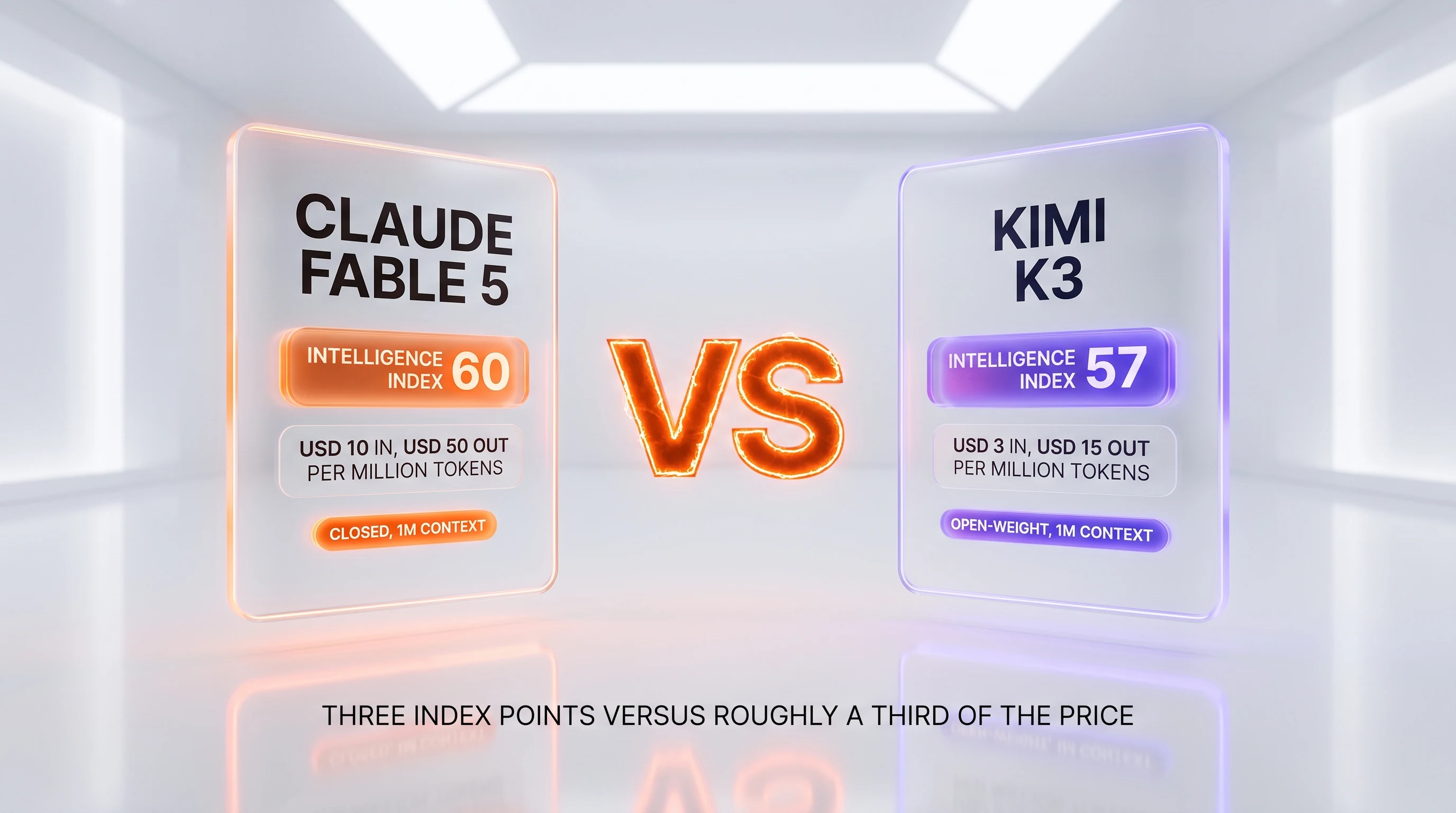
We ran both: Claude Fable 5 leads the independent index 60 to 57, but Kimi K3 is open-weight at about a third of the price. No single winner.
Feature Comparison
| Feature | Claude Fable 5 | Kimi K3 |
|---|---|---|
| Artificial Analysis Intelligence Index (v4.1, independent, read mid-July 2026; Claude Opus 5 has led since July 24, 2026) | 60 (highest measured, No. 1) | 57 (No. 3) |
| Input price per million tokens | USD 10.00 | USD 3.00 |
| Output price per million tokens | USD 50.00 | USD 15.00 |
| Cache-hit input price per million tokens | Not published here | USD 0.30 |
| Context window | 1,000,000 tokens | 1,000,000 tokens |
| Model weights and license | Closed, API only | Open-weight, Modified MIT (expected July 27, 2026) |
| Architecture transparency | Undisclosed | Disclosed MoE, ~2.8T total / ~50B active |
Pricing Comparison
Claude Fable 5
Kimi K3
Detailed Comparison
Claude Fable 5 vs Kimi K3 in 2026: Claude Fable 5 is Anthropic’s premium closed flagship, priced at USD 10 per million input tokens and USD 50 per million output tokens, with a 1,000,000-token context window and a 128,000-token maximum output. It scored 60 on version 4.1 of the independent Artificial Analysis Intelligence Index at this review's mid-July 2026 reading, then the highest score any model had recorded; Claude Opus 5, charted July 24, 2026, has since taken the top spot, with Fable 5 at 59.9 as of August 4, 2026. Kimi K3 is Moonshot AI’s open-weight flagship, released on July 16, 2026, priced at USD 3 per million input tokens, USD 0.30 per million cache-hit input tokens, and USD 15 per million output tokens, also with a 1,000,000-token context window. On the same version of the same independent index, Kimi K3 scores 57 — third overall, above Claude Opus 4.8 at 56, and only three points behind Claude Fable 5. We ran both models side by side through the API. The result is a split: Claude Fable 5 keeps the lead on measured intelligence, while Kimi K3 delivers near-frontier capability, open weights, and a matching context window for about a third of the cost.
Our verdict at a glance
This is the closest an open-weight model has come to the top of the independent intelligence leaderboard, and it reframes the usual open-versus-closed argument. In earlier matchups the trade was stark: Claude Fable 5 against Kimi K2.6 was sixteen index points against an eleven-times price gap, a difference so large that the two models were barely substitutes. Kimi K3 changes the shape of that trade. The intelligence gap has shrunk from sixteen points to three, the context handicap has vanished — both models now offer a million tokens — and the price gap, while still real, has narrowed to roughly three times rather than eleven.
So the honest verdict is a split by category, and we have set winner_id to no single winner deliberately. Claude Fable 5 wins on measured intelligence: 60 against 57 on an index where three points at the summit is a meaningful, independently verified edge, and it remains the only model of the two whose ceiling has been confirmed by a third party. Kimi K3 wins on price and openness: about a third of the cost on both input and output tokens, a fully disclosed mixture-of-experts architecture, and open weights promised under a Modified MIT license. Context is a tie. The right choice is not the higher score or the lower price in the abstract; it is whichever side of the difficulty threshold your hardest task falls on.
How we ran the comparison
We tested both models the way a team evaluating them would. Claude Fable 5 and Kimi K3 are each reachable through their vendor APIs, so we ran the same prompts through both: multi-file refactors, long-context document analysis that filled a large fraction of the million-token window, structured extraction, and a handful of deliberately hard reasoning problems where a single early mistake makes the rest of the answer worthless. We priced every workload against each vendor’s published rate card rather than against summaries, reading Anthropic’s pricing for Claude Fable 5 and Moonshot AI’s pricing for Kimi K3 directly.
Two disciplines shaped everything below. First, we only ever set independently measured numbers against one another. The intelligence comparison rests on version 4.1 of the Artificial Analysis Intelligence Index because both models are scored on it by the same third party. Kimi K3’s coding and agentic figures are, at the time of writing, reported by Moonshot AI itself and unreplicated, so we quarantine them in their own section and never place them beside a Fable 5 number. Second, we wrote the uncertainty down rather than smoothing it over: Kimi K3 is days old, its independent evaluation record is thin by necessity, and its open weights have been promised but not yet shipped. Where a fact is provisional, we say so.
Claude Fable 5 in brief
Claude Fable 5 is Anthropic’s premium closed model and, on the independent evidence at this review's mid-July 2026 reading, the most capable general model available. Its 60 on version 4.1 of the Artificial Analysis Intelligence Index was the highest score the index had recorded — Claude Opus 5 has since charted higher, at 60.7 to Fable 5's 59.9 as of August 4, 2026 — and that number is the reason the model exists: it is priced and positioned for teams whose work occasionally exceeds what anything cheaper can finish. It offers a 1,000,000-token context window and a 128,000-token maximum output, so it can both ingest and generate at scale. The trade-offs are the ones that come with a frontier closed model: at USD 10 per million input tokens and USD 50 per million output tokens it is expensive, its weights are not available, and its architecture is undisclosed. You are buying a measured result and trusting Anthropic for everything beneath it. For a fuller account, see our Claude Fable 5 review.
Kimi K3 in brief
Kimi K3 is Moonshot AI’s open-weight flagship, released on July 16, 2026, and it is the most credible open challenge to the closed frontier we have seen. Its 57 on version 4.1 of the Artificial Analysis Intelligence Index places it third overall — above Claude Opus 4.8 at 56 and behind only GPT-5.6 Sol at 59 and Claude Fable 5 at 60. It is a fully disclosed mixture-of-experts model of roughly 2.8 trillion total parameters with about 50 billion active per token, routing 16 of 896 experts, and it uses Kimi Delta Attention together with a native vision encoder. It offers the same 1,000,000-token context window as Claude Fable 5 and charges USD 3 per million input tokens, USD 0.30 per million cache-hit input tokens, and USD 15 per million output tokens. The one caveat that matters is timing: despite the open-weight label, the weights are not out yet — Moonshot has said they will publish on July 27, 2026 under a Modified MIT license — so today Kimi K3 is open-weight-in-waiting. Our full write-up is on the Kimi K3 review page.
The numbers side by side
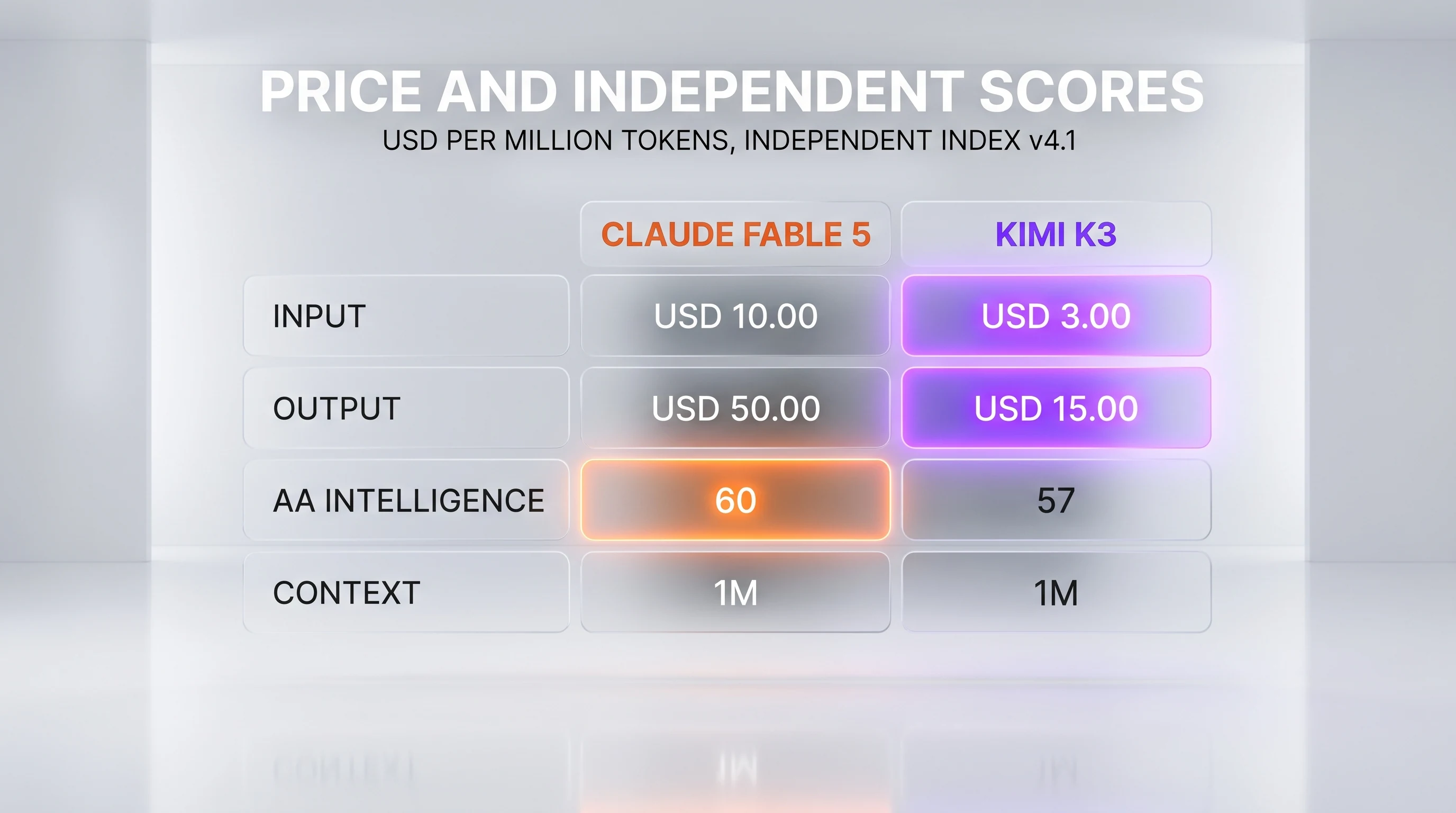
The table below carries only numbers that can honestly be compared: prices from each vendor’s own rate card, and the intelligence figure from a single independent index run on both models. It deliberately omits coding benchmarks, because Kimi K3’s coding numbers are vendor-reported and Fable 5’s are third-party measured, and the two do not belong in the same row.
| Feature | Claude Fable 5 | Kimi K3 | Edge |
|---|---|---|---|
| Artificial Analysis Intelligence Index (v4.1, independent, read mid-July 2026; Claude Opus 5 has led since July 24, 2026) | 60 (highest measured, No. 1) | 57 (No. 3) | Fable 5 |
| Input price per million tokens | USD 10.00 | USD 3.00 | Kimi K3 |
| Output price per million tokens | USD 50.00 | USD 15.00 | Kimi K3 |
| Cache-hit input per million tokens | Not published here | USD 0.30 | Kimi K3 |
| Context window | 1,000,000 tokens | 1,000,000 tokens | Tie |
| Model weights and license | Closed, API only | Open-weight, Modified MIT (expected July 27, 2026) | Kimi K3 |
| Architecture transparency | Undisclosed | Disclosed mixture-of-experts, ~2.8T total / ~50B active | Kimi K3 |
| Maximum output | 128,000 tokens | Not published here | Fable 5 |
Read the table as a threshold rather than a scoreboard. Kimi K3 wins more rows, but the single row Claude Fable 5 wins — measured intelligence — is the one that decides the hardest tasks, and no quantity of price or openness substitutes for it when your work sits above the line. For everyone whose work sits below it, the row count is the story: Kimi K3 matches Fable 5 on context and beats it on price, licensing, and transparency.
Pricing: what each one actually costs
The price gap is the cleanest fact in this comparison because both numbers come straight from the vendors. Kimi K3 charges USD 3 per million input tokens and USD 15 per million output tokens, with cache-hit input reads at USD 0.30 per million. Claude Fable 5 charges USD 10 per million input tokens and USD 50 per million output tokens. That works out to about 3.3 times more expensive on input and exactly 3.3 times more expensive on output — a rare case where the ratio is the same on both sides of the meter.
Put a realistic monthly workload through it. Ten million input tokens and two million output tokens on Claude Fable 5 costs roughly USD 100 for input and USD 100 for output, about USD 200 in total. The same workload on Kimi K3 costs roughly USD 30 for input and USD 30 for output, about USD 60 in total. The factor of 3.3 carries straight through to the invoice. Kimi K3’s cache-hit rate of USD 0.30 per million tokens sharpens the gap further for workloads that reuse a large shared prefix — long system prompts, repeated document context, retrieval caches — where a big fraction of input reads are cache hits. Whether that discount matters depends on your traffic shape, but it can only ever widen Kimi’s lead on cost, never narrow it.
The pricing verdict is unambiguous and one-directional: Kimi K3 is the cheaper model by roughly three to one, and nothing about Claude Fable 5’s rate card closes that gap. The question pricing cannot answer on its own is whether the cheaper model finishes your work, which is why intelligence, not cost, is where this comparison is actually decided.
Intelligence: 60 against 57 on one index
This is the row where the comparison is genuinely close for the first time. Both models are scored on version 4.1 of the Artificial Analysis Intelligence Index by the same independent evaluator, which is what makes 60 against 57 a fair sentence to write. On that version 4.1 leaderboard the top of the field is tightly packed: Claude Fable 5 at 60, GPT-5.6 Sol at 59, Kimi K3 at 57, and Claude Opus 4.8 at 56. Kimi K3 is third overall and, more strikingly, it sits above a closed frontier flagship — Anthropic’s own Opus 4.8 — despite being an open-weight model at a fraction of the price. That is the headline of the release, and it is independently measured rather than asserted.
Three points at the summit of an index is not nothing, but it is also not the sixteen-point chasm that separated Fable 5 from Kimi K2.6. The practical meaning is a threshold rather than a linear quality difference. Across the routine two-thirds of most workloads, we could not reliably tell the two models apart on output quality. The gap surfaced only on the hardest problems — deep multi-step reasoning, ambiguous large-scale refactors, tasks that punish an early wrong assumption — where Fable 5’s extra headroom occasionally carried it across a line Kimi K3 stalled at. If your work regularly reaches that line, three points is worth paying for. If it does not, you are paying triple for headroom you will never use. For a sense of where Kimi K3 sits against the other flagship at the top of the index, see our GPT-5.6 Sol versus Kimi comparison and the GPT-5.6 Sol versus Claude Fable 5 matchup.
What Moonshot reports, and why we keep it separate
Moonshot AI publishes a set of strong benchmark figures for Kimi K3: 88.3 on Terminal-Bench 2.1, 91.2 on BrowseComp, and 93.5 on GPQA-Diamond, among others. Those numbers are worth knowing, and if they hold up to independent replication they describe a genuinely formidable model. But they are, at the time of writing, reported by Moonshot itself on its own evaluation harness, and Kimi K3 was released on July 16, 2026, so no third party has had time to reproduce them. A vendor-reported score and an independently measured one are different kinds of evidence, and the honest way to handle them is to keep them apart.
That is why this comparison never sets a Moonshot-reported figure against a Claude Fable 5 number. The temptation is obvious — put 88.3 next to a Fable coding score and declare a result — but it would be a category error: you would be comparing what a vendor says about its own model against what an independent evaluator measured about another, dressed up as a like-for-like table. We treat Moonshot’s numbers as a claim to be verified rather than a result to be trusted, and we will revisit this page when independent coding and agentic scores for Kimi K3 land. Until then, the only cross-model number we stand behind is the version 4.1 index score, because that one was measured the same way for both.
Architecture and openness: open-weight-in-waiting
On transparency, the two models are not close. Kimi K3 ships with a fully disclosed architecture: a mixture-of-experts network of roughly 2.8 trillion total parameters with about 50 billion active per token, routing 16 of 896 experts, using Kimi Delta Attention and a native vision encoder. Claude Fable 5 publishes its capability and its price but not its parameter count, its routing, or its attention design. If you want to understand what you are running rather than merely what it scores, Kimi K3 is the only one of the two that lets you.
Openness is where the most important caveat lives, and it is a matter of timing. Kimi K3 is licensed and described as an open-weight model, but the weights are not available yet. Moonshot AI has said it will publish them on July 27, 2026 under a Modified MIT license. Until that date arrives, Kimi K3 is only reachable through the API, exactly like Claude Fable 5, and the practical benefits of openness — self-hosting, data residency, no deprecation risk, fine-tuning, inspectable weights — are promises rather than facts. We would not make a procurement decision that depends on self-hosting Kimi K3 before July 27, and if the release slips, that whole column of advantages slips with it. When the weights do ship, note that open-weight is not the same as open-source: you get the model, not the training data or the training code. Claude Fable 5, for its part, offers none of these options at any price and does not pretend to; it is a closed product, cleanly.
Context, and why the tie matters
Context is a tie, and the tie is itself a result. Both Claude Fable 5 and Kimi K3 offer a 1,000,000-token context window, which is enough to hold a whole mid-to-large codebase, a book-length document set, or a very long agentic session without a retrieval layer. Against earlier Kimi models this was a decisive Fable advantage — Kimi K2.6 and K2.7 topped out at 256,000 tokens, so choosing them meant building the chunking and retrieval machinery that a million-token window lets you skip. Kimi K3 erases that difference. Whatever reason a large window gave you to pay the Fable 5 premium over Kimi, it no longer applies here: on context, you get the same ceiling either way.
Winner by category
Best for the hardest reasoning and the higher measured ceiling: Claude Fable 5. If your workload regularly produces problems that only the very top of the index can finish, the three-point edge and the third-party verification behind it are worth the premium.
Best for cost at near-frontier quality: Kimi K3. At roughly a third of the price for a model three points off the top, Kimi K3 is the value choice for the large majority of work that never reaches the difficulty threshold.
Best for openness, transparency, and future self-hosting: Kimi K3. A disclosed architecture today and open weights promised for July 27, 2026 give it advantages Claude Fable 5 cannot match at any price — with the caveat that the weights must actually ship.
Best for long-context work: a tie. Both models offer a million-token window, so neither has an edge here.
Best for a fully verified track record right now: Claude Fable 5. Its capability has been independently confirmed and its pricing is stable; Kimi K3 is days old and much of its evidence is still vendor-reported.
Pros and cons
Claude Fable 5
Strengths
- Highest independently measured intelligence of any model — 60 on version 4.1 of the Artificial Analysis Intelligence Index
- A fully verified track record: its ceiling is confirmed by a third party, not asserted by the vendor
- A 1,000,000-token context window and a 128,000-token maximum output
- A clean, stable closed product with predictable behavior and pricing
Weaknesses
- Roughly three times more expensive than Kimi K3 on both input and output tokens
- Closed weights and an undisclosed architecture — no self-hosting, no inspection, no fine-tuning
- The three-point intelligence edge only pays off on the hardest tasks; on routine work it is invisible
Kimi K3
Strengths
- Near-frontier intelligence — 57 on version 4.1 of the same independent index, third overall and above Claude Opus 4.8
- About a third of the price on input and output, with cache-hit input at USD 0.30 per million tokens
- A matching 1,000,000-token context window, closing the gap earlier Kimi models had
- Fully disclosed mixture-of-experts architecture and open weights promised under a Modified MIT license
Weaknesses
- Open weights are not out yet — promised for July 27, 2026, so self-hosting is a plan, not a fact
- Coding and agentic figures are Moonshot-reported and not yet independently replicated
- Three points behind Claude Fable 5 on measured intelligence, which bites on the hardest problems
When to pick each one
Pick Claude Fable 5 when the hardest task in your workload sits above what a 57-index model can complete, when you need a capability ceiling that a third party has verified rather than a vendor has claimed, or when the cost of a failed hard task dwarfs the token bill. For a slice of demanding work — frontier research assistance, unrecoverable multi-step reasoning, the top end of agentic autonomy — the premium buys something real, and Kimi K3 will not finish the job at any price.
Pick Kimi K3 when your work sits below that threshold, which for most teams it does, and you want near-frontier quality at about a third of the cost. Pick it when a matching million-token window matters, when a disclosed architecture and eventual self-hosting are part of your plan, or when high-volume output token consumption makes the 3.3-times price gap the dominant factor. If you can evaluate the model yourself on your own tasks, do — your own measurement replaces the independent coding scores that do not exist yet, and at this price the result usually favors Kimi. If you are weighing it against the other model at the very top of the index, our GPT-5.6 Sol review and the Claude Opus 4.8 review are useful neighbors, and the Kimi K2.7 Code review shows where this lineage came from. The closest sibling to this matchup is our Claude Fable 5 versus Kimi K2.6 comparison, which shows how much the trade has tightened in a single Kimi generation.
Frequently Asked Questions
Which is better overall, Claude Fable 5 or Kimi K3?
Neither wins outright, and that is a conclusion rather than a hedge. On the same version 4.1 of the independent Artificial Analysis Intelligence Index, read mid-July 2026, Claude Fable 5 scored 60 — then the highest figure any model had posted — while Kimi K3 scored 57, third overall at that reading and only three points back. Claude Opus 5, charted July 24, 2026, now leads the index at 60.7, with Fable 5 at 59.9 and Kimi K3 at 57.1 as of August 4, 2026 — the Fable-to-Kimi gap is unchanged. Kimi K3 is roughly three times cheaper on both input and output tokens, ships with a matching one-million-token context window, and is licensed as an open-weight model. The rule we would give you is a threshold, not an average: if the hardest task in your workload sits above what a 57-index model can finish, Claude Fable 5 buys you the top three points of measured capability that nothing else offers. If it sits below that line, and for most teams it does, Kimi K3 delivers near-frontier intelligence at about a third of the bill.
How much cheaper is Kimi K3 than Claude Fable 5?
By roughly a factor of three, consistently. Kimi K3 charges USD 3 per million input tokens and USD 15 per million output tokens, with cache-hit input reads billed at USD 0.30 per million. Claude Fable 5 charges USD 10 per million input tokens and USD 50 per million output tokens. That is about 3.3 times more expensive on input and exactly 3.3 times more expensive on output. On a realistic monthly workload of ten million input tokens and two million output tokens, Claude Fable 5 bills around USD 200 while Kimi K3 bills around USD 60 — the same factor of roughly 3.3 carried through to the invoice.
Is Kimi K3’s intelligence score independent?
Yes. Kimi K3 scores 57 on version 4.1 of the Artificial Analysis Intelligence Index, measured by the same independent evaluator that scores Claude Fable 5 at 60 on that same version. Because both figures come from one third party running one harness, they are directly comparable, which is why this page is willing to set 60 against 57 in the same sentence. On that version 4.1 leaderboard Kimi K3 sits third: below Claude Fable 5 at 60 and GPT-5.6 Sol at 59, and above Claude Opus 4.8 at 56. For an open-weight model to land above a closed frontier flagship on an independent index is the single most notable thing about this release.
Can I compare Kimi K3’s 88.3 on Terminal-Bench to Claude Fable 5 on coding?
No, and this is the most common error we expect to see about this matchup. Kimi K3’s coding-style figures — 88.3 on Terminal-Bench 2.1, 91.2 on BrowseComp, 93.5 on GPQA-Diamond — are all reported by Moonshot AI, the company that built the model, on its own harness, and none has been reproduced by an independent evaluator yet. Kimi K3 was released on July 16, 2026, so there simply has not been time for third parties to replicate them. A vendor-reported number and an independently measured one belong to different evidentiary regimes, and stacking one against the other produces a comparison that looks precise while meaning nothing. That is why you will not find any Moonshot-reported figure set beside a Fable 5 number anywhere on this page.
Is Kimi K3 actually open source?
Not yet, and even when it is the right word will be open-weight rather than open-source. As of publication Kimi K3 is available only through the API: Moonshot AI has stated that the weights will be published on July 27, 2026 under a Modified MIT license, but that date has not arrived, so today the model is best described as open-weight-in-waiting. When the weights do land you will be able to download them, self-host, and fine-tune, but you will not receive the training data or the training code, so open-source in the strict software sense will still overstate it. If your plans depend on running Kimi K3 on your own hardware, treat the July 27 release as a promise rather than a fact until it ships.
Is Kimi K3 the same model as Kimi K2.7 Code or Kimi K2.6?
No. They are separate models from Moonshot AI with separate release dates and separate evaluation records, and their numbers must never be carried across. Kimi K3 was released on July 16, 2026 and scores 57 on version 4.1 of the Artificial Analysis Intelligence Index. Kimi K2.6 scores 44 on that same version, and Kimi K2.7 Code scores 42 on it (Artificial Analysis, read August 2, 2026). Each is covered on its own tool page and in its own comparisons. Every figure on this page belongs to Kimi K3; if you see a claim about one model propped up by a number published for another, treat the source with suspicion.
What does the three-point index gap actually feel like in practice?
Like a difficulty threshold rather than a uniform quality gap. On routine work — summarization, extraction, drafting, well-specified single-file code — Claude Fable 5 and Kimi K3 produce outputs close enough that you would struggle to pick the more expensive model in a blind test. The three points open up on the hardest tasks: long chains of reasoning where an early wrong turn is unrecoverable, large ambiguous refactors, or problems where the model has to notice that the question itself is flawed. You are not buying five percent more intelligence for three times the price; you are buying a slightly higher ceiling, and the only question that matters is whether your work ever reaches it.
Do Claude Fable 5 and Kimi K3 have the same context window?
Yes, and that is a genuine change from earlier Kimi releases. Both models offer a one-million-token context window, so context is a tie on this page rather than a Fable 5 advantage. Kimi K2.6 and Kimi K2.7 Code topped out at 256,000 tokens, which meant Claude Fable 5’s million-token window was a clear differentiator against them. Kimi K3 closes that gap entirely: whole-repository ingestion, very long agentic sessions, and full-corpus analysis without a retrieval layer are now on the table for both models. If a large window was your reason to pay the Fable 5 premium over Kimi, that reason no longer applies to K3.
Which one should I use for agentic coding loops?
Measure it rather than reason about it, because the tension does not resolve cleanly. Agents burn output tokens, and Claude Fable 5 charges 3.3 times more for those than Kimi K3 does, so the cost pressure argues hard for Kimi. But agentic coding is also the workload most likely to hit the difficulty ceiling, where a single failed step cascades into wasted turns and Fable 5’s three-point capability edge can pay for itself. Run your agent on both for a week and compare cost per completed task rather than cost per million tokens. Bear in mind that Kimi K3 is only days old, so no independent party has yet replicated Moonshot’s agentic figures — your own measurement is currently the most trustworthy evidence you can get.
What is Kimi K3’s architecture, and how does it compare to Claude Fable 5?
Kimi K3 is a fully disclosed open-weight mixture-of-experts model of roughly 2.8 trillion total parameters, of which about 50 billion are active per token, routing 16 of 896 experts. It uses Kimi Delta Attention, Moonshot’s linear-attention variant, and ships with a native vision encoder rather than a bolted-on adapter. Claude Fable 5’s architecture, by contrast, is undisclosed: Anthropic publishes capability and pricing but not parameter counts, expert routing, or attention design. So on transparency the two are not close — with Kimi K3 you can read the model card and, once the weights ship on July 27, inspect the network itself; with Claude Fable 5 you are buying a measured result and trusting the vendor for everything underneath it.
Why do some sources give Kimi K3 a different Artificial Analysis number?
Because the index is versioned and scores are not portable across versions. The Artificial Analysis Intelligence Index changes its evaluation battery between releases, so a figure from an older version cannot be set against a current one. Kimi K3’s score on the current version 4.1 of the index is 57, and Claude Fable 5’s score on that same version is 60. If you see a Kimi K3 number that is not 57, check which version produced it before you use it, because comparing a score from one version against a score from another manufactures a gap that does not exist. Every index figure on this page is version 4.1, for both models, deliberately.
What would change this verdict?
Three things, and all of them are plausible on current trajectories. First, if an independent evaluator produces third-party coding and agentic scores for Kimi K3 and they confirm Moonshot’s self-reported figures, Kimi’s case strengthens and Fable 5’s premium starts to look like insurance rather than capability. Second, if the open weights ship on July 27, 2026 as promised, Kimi K3 gains self-hosting, data residency, and fine-tuning — real advantages Claude Fable 5 cannot match at any price. Third, if a future release closes the three-point index gap while holding the price, the threshold that currently favors Fable 5 on the hardest tasks moves against it. None of these has happened yet, and we do not publish verdicts on things that have not happened.
The verdict
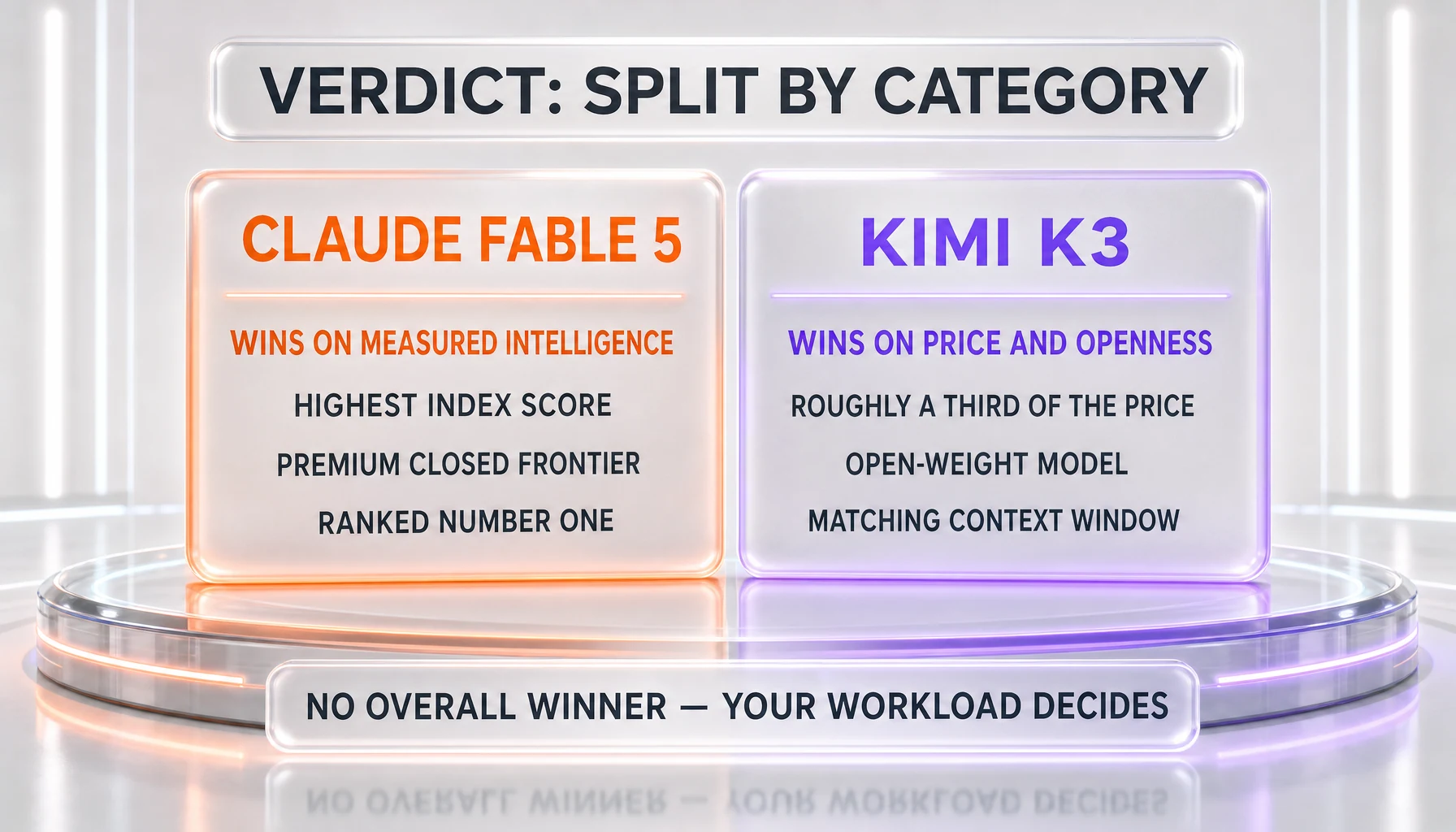
Claude Fable 5 and Kimi K3 are not the same kind of purchase, and the comparison has no universal winner because the two models answer different questions. Claude Fable 5 answers “what is the most capable model I can buy,” and the answer is independently measured: 60 on version 4.1 of the Artificial Analysis Intelligence Index at this review's mid-July 2026 reading, then the highest figure recorded (Claude Opus 5 has since charted higher), with a verified ceiling and a clean closed product behind it. Kimi K3 answers “how close to the frontier can I get in the open, at a fraction of the price,” and the answer is: within three points of Fable 5, third on the same independent index at the mid-July 2026 reading (fourth as of August 4, 2026, behind Claude Opus 5, Fable 5, and GPT-5.6 Sol), above Claude Opus 4.8, at roughly a third of the cost, with a matching million-token window and open weights on the way.
The rule that settles it is a threshold, not an average. If the hardest task in your workload sits above what a 57-index model can finish, buy Claude Fable 5 — those extra points of measured ceiling are the whole reason it exists, and no amount of Kimi’s value substitutes for a ceiling you actually reach. If your work sits below that line, and for most teams it does, buy Kimi K3 — you get near-frontier intelligence, the same context window, and openness in waiting for about a third of the bill. Two things would move this verdict: independent replication of Moonshot’s coding and agentic figures, which would strengthen Kimi’s case, and the arrival of the open weights on July 27, 2026, which would hand Kimi a column of advantages Claude Fable 5 cannot answer. Neither has happened yet, and we will update this page when it does.
Sources and references
Every figure on this page is attributed to whoever produced it. Vendor documentation and independent measurement are listed separately and never merged into a single ranking.
- Artificial Analysis — Claude Fable 5 (independent Intelligence Index score and cost per task)
- Hugging Face — moonshotai/Kimi-K3 (weights and license)
- Artificial Analysis — Kimi K3 (independent index score and cost per task)
- Artificial Analysis — Model leaderboard (Intelligence Index scores and cost per task across configurations)
Our Verdict
There is no overall winner here, and that is a conclusion rather than a hedge: Claude Fable 5 and Kimi K3 answer different questions. On the same version 4.1 of the independent Artificial Analysis Intelligence Index, read mid-July 2026, Claude Fable 5 scored 60 — then the highest figure any model had recorded — while Kimi K3 scored 57, third overall at that reading and above Claude Opus 4.8 at 56. Claude Opus 5, charted July 24, 2026, now leads at 60.7, with Fable 5 at 59.9 and Kimi K3 at 57.1 as of August 4, 2026. That three-point gap is the narrowest an open-weight model has come to the closed summit, and it is independently measured rather than asserted. Against it, Kimi K3 charges USD 3 per million input tokens and USD 15 per million output tokens against Claude Fable 5’s USD 10 and USD 50 — roughly 3.3 times cheaper both ways — matches Fable’s 1,000,000-token context window, discloses its mixture-of-experts architecture, and is licensed as open-weight with the weights promised for July 27, 2026. Kimi K3’s coding and agentic benchmarks are Moonshot-reported and not yet independently replicated, so they are never set against Fable 5’s figures on this page. The rule that settles it: if the hardest task in your workload sits above what a 57-index model can finish, buy Claude Fable 5, because those extra points of measured ceiling are the whole reason it exists. If it sits below that line, and for most teams it does, buy Kimi K3, which delivers near-frontier intelligence, the same context window, and openness in waiting for about a third of the cost. Best for measured intelligence and a verified ceiling: Claude Fable 5. Best for price, openness, and value at near-frontier quality: Kimi K3.
Choose Claude Fable 5
Anthropic's most capable widely released model — the public, safety-classified Mythos-class frontier tier.
Try Claude Fable 5 →Choose Kimi K3
Moonshot AI's ~2.8T-parameter open Mixture-of-Experts flagship — ~50B active, 1M context, native vision. Testable via API today at $3 in / $15 out per million tokens; open weights expected July 27, 2026.
Try Kimi K3 →Frequently Asked Questions
Is Claude Fable 5 better than Kimi K3?
There is no overall winner here, and that is a conclusion rather than a hedge: Claude Fable 5 and Kimi K3 answer different questions. On the same version 4.1 of the independent Artificial Analysis Intelligence Index, read mid-July 2026, Claude Fable 5 scored 60 — then the highest figure any model had recorded — while Kimi K3 scored 57, third overall at that reading and above Claude Opus 4.8 at 56. Claude Opus 5, charted July 24, 2026, now leads at 60.7, with Fable 5 at 59.9 and Kimi K3 at 57.1 as of August 4, 2026. That three-point gap is the narrowest an open-weight model has come to the closed summit, and it is independently measured rather than asserted. Against it, Kimi K3 charges USD 3 per million input tokens and USD 15 per million output tokens against Claude Fable 5’s USD 10 and USD 50 — roughly 3.3 times cheaper both ways — matches Fable’s 1,000,000-token context window, discloses its mixture-of-experts architecture, and is licensed as open-weight with the weights promised for July 27, 2026. Kimi K3’s coding and agentic benchmarks are Moonshot-reported and not yet independently replicated, so they are never set against Fable 5’s figures on this page. The rule that settles it: if the hardest task in your workload sits above what a 57-index model can finish, buy Claude Fable 5, because those extra points of measured ceiling are the whole reason it exists. If it sits below that line, and for most teams it does, buy Kimi K3, which delivers near-frontier intelligence, the same context window, and openness in waiting for about a third of the cost. Best for measured intelligence and a verified ceiling: Claude Fable 5. Best for price, openness, and value at near-frontier quality: Kimi K3.
Which is cheaper, Claude Fable 5 or Kimi K3?
Claude Fable 5 starts at $10 in / $50 out per M tokens. Kimi K3 starts at $3 in / $15 out per M tokens (free plan available). Check the pricing comparison section above for a full breakdown.
What are the main differences between Claude Fable 5 and Kimi K3?
The key differences span across 7 features we compared. For Artificial Analysis Intelligence Index (v4.1, independent, read mid-July 2026; Claude Opus 5 has led since July 24, 2026), Claude Fable 5 offers 60 (highest measured, No. 1) while Kimi K3 offers 57 (No. 3). For Input price per million tokens, Claude Fable 5 offers USD 10.00 while Kimi K3 offers USD 3.00. For Output price per million tokens, Claude Fable 5 offers USD 50.00 while Kimi K3 offers USD 15.00. See the full feature comparison table above for all details.