GPT-5.6 Terra vs Claude Fable 5: Value Tier or Frontier? (2026)


We ran GPT-5.6 Terra and Claude Fable 5 side by side. Terra wins on price at $2.50 vs $10 input; Fable leads on intelligence and 95% verified coding.
Feature Comparison
| Feature | GPT-5.6 Terra | Claude Fable 5 |
|---|---|---|
| Input price per million tokens | $2.50 | $10 |
| Output price per million tokens | $15 | $50 |
| Cached input price per million tokens | $0.25 | $1.00 (90% caching discount) |
| Artificial Analysis Intelligence Index | 55 | 60 (ranked No. 1) |
| SWE-bench Verified (vals.ai, independent) | N/A (not listed) | 95% |
| LMArena ranking (human preference) | N/A (not charted) | No. 1 (Elo 1509) |
| Context window | 1,050,000 tokens | 1,000,000 tokens |
| Max output per request | 128,000 tokens | 128,000 tokens |
| Input modalities | Text and image, text out | Text and image, text out |
| Knowledge cutoff | February 16, 2026 | Not publicly disclosed |
| Reasoning control | Effort levels, low to max, plus ultra multi-agent | Adaptive thinking, always on, cannot disable |
| Free consumer access | No; API, Codex, and Work surfaces only | No free API tier |
| Publisher | OpenAI | Anthropic |
Pricing Comparison
GPT-5.6 Terra
Claude Fable 5
Detailed Comparison
These two models are not aimed at the same buyer, which is exactly why the matchup is useful. GPT-5.6 Terra is OpenAI's balanced, high-volume tier, priced to run business workloads at scale. Claude Fable 5 is Anthropic's most capable widely released model of 2026, and one of its most expensive. We ran both side by side to answer a single question: when is Terra's roughly four-times-cheaper token price the smarter buy, and when does Fable 5's frontier intelligence actually earn its premium?
GPT-5.6 Terra and Claude Fable 5 sit at opposite ends of the price-to-capability curve. Terra costs $2.50 per million input tokens and $15 per million output tokens, roughly a quarter of Fable 5's $10 and $50, and carries a marginally larger 1,050,000-token context window. Claude Fable 5 leads on raw capability: 60 on the Artificial Analysis Intelligence Index versus 55, first on LMArena at an Elo of 1509, and an independent 95 percent on SWE-bench Verified. The verdict is a split. Choose GPT-5.6 Terra for cost and throughput, and Claude Fable 5 for peak intelligence and verified coding.
Last compared: July 2026. Both were tested through their APIs; figures below are attributed to their sources throughout. GPT-5.6 Terra is an OpenAI model; Claude Fable 5 is an Anthropic model.
Quick Verdict
This is a split decision across two different labs, and we did not force a single winner. GPT-5.6 Terra wins on price, on context headroom, and on cost per task, which makes it the default for high-volume, cost-sensitive work. Claude Fable 5 wins on measured intelligence, on independently verified coding, and on blind human preference, which makes it the pick for the hardest and most quality-sensitive work. Because they run on different platforms, choosing between them is more of a commitment than a per-call routing decision, so the question is which set of strengths matches the bulk of your workload. On the public boards, Fable 5 sits first on the Artificial Analysis model index and first on the LMArena leaderboard, while Terra posts a strong 77 on the Artificial Analysis Coding Agent Index.
- GPT-5.6 Terra wins: input, output, and cached-token price (about four times cheaper), a larger 1,050,000-token context window, lower cost per task, and a charted 77 on the Artificial Analysis Coding Agent Index.
- Claude Fable 5 wins: the Artificial Analysis Intelligence Index (60 vs 55), SWE-bench Verified (95 percent vs not listed), LMArena (No. 1 at an Elo of 1509 vs not charted), and creative and long-form writing quality.
- Ties: both cap output at 128,000 tokens per request, both take text and image input and return text, and both are frontier-class general models with million-token-scale context.
GPT-5.6 Terra vs Claude Fable 5 at a Glance
The table below is the whole comparison in one view. Prices are per million tokens. Every benchmark is attributed in the sections that follow, and independent scores are kept separate from vendor self-reported ones.
| Feature | GPT-5.6 Terra | Claude Fable 5 | Winner |
|---|---|---|---|
| Input price per million tokens | $2.50 | $10 | GPT-5.6 Terra |
| Output price per million tokens | $15 | $50 | GPT-5.6 Terra |
| Cached input price per million tokens | $0.25 | $1.00 (90% caching discount) | GPT-5.6 Terra |
| Artificial Analysis Intelligence Index | 55 | 60 (ranked No. 1) | Claude Fable 5 |
| SWE-bench Verified (vals.ai, independent) | N/A (not listed) | 95% | Claude Fable 5 |
| LMArena ranking (human preference) | N/A (not charted) | No. 1 (Elo 1509) | Claude Fable 5 |
| Context window | 1,050,000 tokens | 1,000,000 tokens | GPT-5.6 Terra |
| Max output per request | 128,000 tokens | 128,000 tokens | Tie |
| Input modalities | Text and image, text out | Text and image, text out | Tie |
| Knowledge cutoff | February 16, 2026 | Not publicly disclosed | Tie |
| Reasoning control | Effort levels, low to max, plus ultra multi-agent | Adaptive thinking, always on, cannot disable | Tie |
| Free consumer access | No; API, Codex, and Work surfaces only | No free API tier | Tie |
| Publisher | OpenAI | Anthropic | Tie |
GPT-5.6 Terra in Brief
GPT-5.6 Terra is the balanced middle tier of OpenAI's GPT-5.6 generation, generally available since July 9, 2026 through the API, Codex, and OpenAI's Work surfaces. In OpenAI's new naming, the number is the generation and Sol, Terra, and Luna are durable capability tiers rather than sizes, with Terra positioned as the high-volume workhorse between the Sol flagship and the Luna economy tier. It runs a 1,050,000-token context window, accepts text and image input and returns text, caps output at 128,000 tokens, and lists a knowledge cutoff of February 16, 2026.
Its headline is price against capability. Terra costs $2.50 per million input tokens, $0.25 per million cached input tokens, and $15 per million output tokens, which OpenAI frames as competitive with the previous GPT-5.5 flagship at roughly half the cost. On independent benchmarks it scores 55 on the Artificial Analysis Intelligence Index and a strong 77 on the Artificial Analysis Coding Agent Index, with a measured cost of about $0.55 per task. OpenAI also self-reports 87.4 percent on Terminal-Bench 2.1 for Terra, a figure we label as vendor-reported rather than independently verified.
Practically, Terra is built for the parts of a stack that run constantly: customer support, document processing, extraction, and routine coding, where the token bill dominates and near-flagship quality is enough. It supports the full GPT-5.6 toolchain, including programmatic tool calling that writes and runs JavaScript in an isolated runtime, improved prompt caching, function calling, structured outputs, streaming, and the Batch API at a further 50 percent discount. Fine-tuning is not supported on the GPT-5.6 tiers. Its full specification lives in the OpenAI model documentation.
Claude Fable 5 in Brief
Claude Fable 5 is the publicly available, safety-classified version of Anthropic's Mythos-class frontier model, generally available since June 2026 across the Claude API plus Amazon Bedrock, Google Cloud's Vertex AI, and Microsoft Foundry. It runs a 1,000,000-token context window with up to 128,000 output tokens, and it is the model to beat in 2026: first on the Artificial Analysis Intelligence Index at 60, first on LMArena at an Elo of 1509, and 95 percent on the independently run SWE-bench Verified board tracked by vals.ai.
That capability carries a price. Fable 5 costs $10 per million input tokens and $50 per million output tokens, the most in this comparison, softened by a 90 percent prompt-caching discount that brings cached input to about $1.00 per million. Artificial Analysis pegs a representative Fable 5 run at about $11.80, reflecting both its token price and its always-on reasoning. Its adaptive thinking cannot be disabled, and it can return a clean refusal on some cybersecurity or biology requests, with a documented fallback path to another Claude model such as Claude Opus 4.8.
For builders, Fable 5's toolkit is part of the draw: an effort parameter and task budgets in beta to dial reasoning depth and cap spend, a memory tool, context editing to clear stale tool results, and compaction for long-running sessions. It is also strongest where benchmarks are quietest, in creative and long-form writing, where its craft and coherence over long outputs are a genuine differentiator. Anthropic documents the model on its Fable page and in the Claude model documentation.
Pricing: Where Terra Wins Big
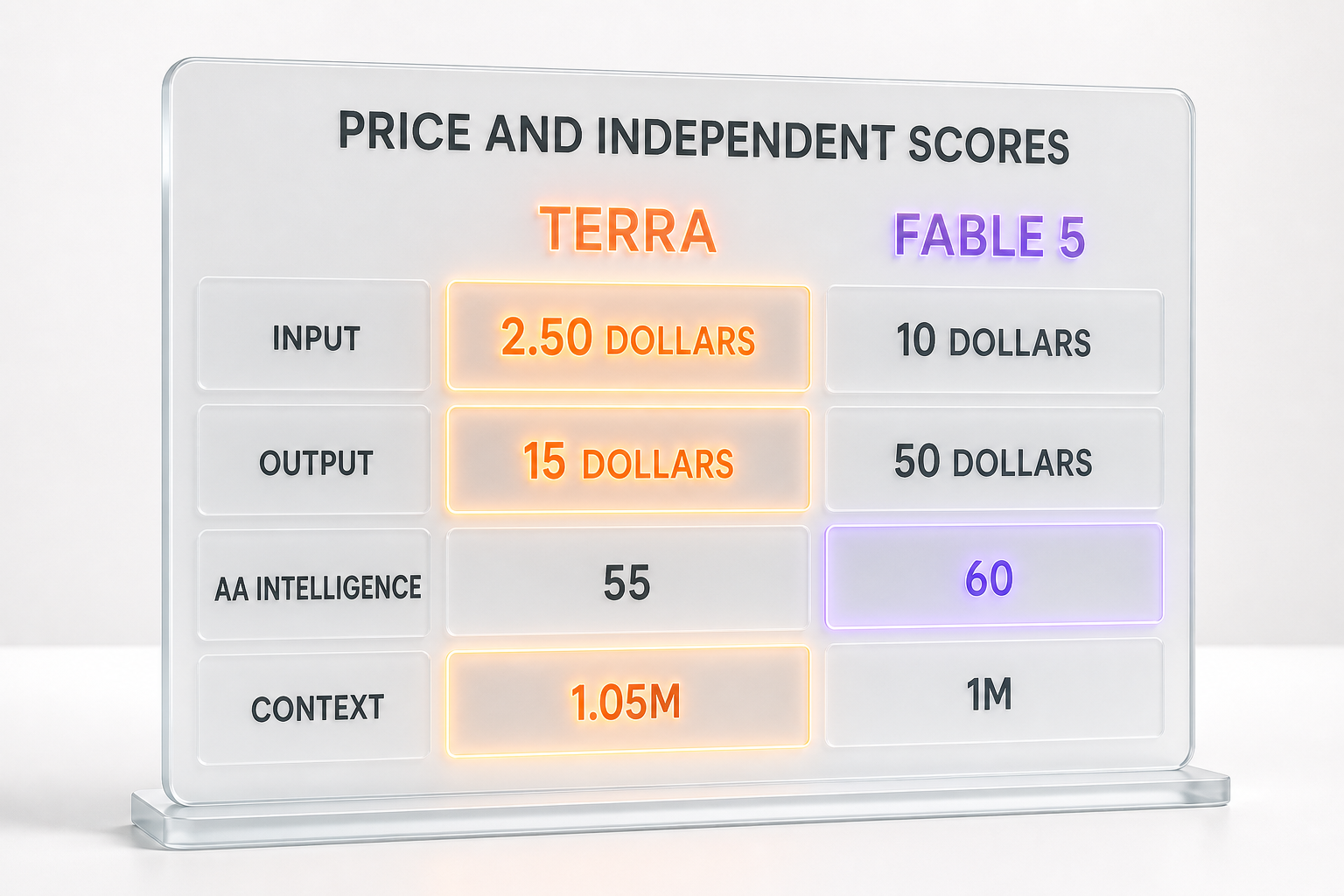
Price is the clearest gap between these two, and it is wide. GPT-5.6 Terra costs $2.50 per million input tokens against Claude Fable 5's $10, and $15 per million output tokens against $50. That is four times cheaper on input and a little over three times cheaper on output, before any caching. Cached input follows the same pattern: about $0.25 per million on Terra against roughly $1.00 per million on Fable 5 after its 90 percent caching discount.
Absolute cost per task tells the same story. Artificial Analysis measures a representative Terra run at about $0.55 and a Fable 5 run at about $11.80, a gap driven by both token price and Fable 5's always-on reasoning, which spends more tokens per answer by design. For a team sending millions of tokens a day, that difference compounds into a real budget line. If token pricing terms like input, output, and cached tokens are unfamiliar, our guide to AI model pricing breaks them down, and the current rate cards live on the OpenAI pricing page and the Anthropic pricing page.
Put concrete numbers on it. Suppose a workload processes ten million input tokens and two million output tokens in a day. On GPT-5.6 Terra that is $25 of input and $30 of output, about $55 in total. The same day on Claude Fable 5 is $100 of input and $100 of output, about $200. That is more than three and a half times more expensive on Fable 5, before any prompt-caching savings, which favor Fable 5's 90 percent cached-input discount but rarely close a gap that wide. Terra also drops another 50 percent through the Batch API for asynchronous jobs, widening the gap further for work that can tolerate a delay.
Capability and Benchmarks: Where Fable 5 Wins
On measured capability, Fable 5 leads on every board that ranks it against the field. On general intelligence it scores 60 on the Artificial Analysis Intelligence Index and ranks first overall, while GPT-5.6 Terra scores 55. Five points on that index is a meaningful gap at the top of the range, and it is the single cleanest measure of raw reasoning quality across the two.
The pattern holds on human preference. Fable 5 tops LMArena at an Elo of 1509, first on blind head-to-head voting, while Terra is not charted there; OpenAI's GPT-5.6 line appears on LMArena through the Sol tier rather than Terra. Even Anthropic's own self-reported launch figures point the same way, with Fable 5 at about 80.3 percent on SWE-bench Pro, a number we label self-reported because it comes from the vendor rather than an independent evaluator. Where a model is simply not on a board, we mark it not listed or not charted rather than estimate, which is why several Terra cells read that way for the Anthropic-specific and preference boards.
It helps to know what these boards measure. The Artificial Analysis Intelligence Index aggregates reasoning, knowledge, and math evaluations into one score, so it proxies general capability rather than any single skill. LMArena ranks models by blind human preference on real prompts, which captures answer quality and style in a way static benchmarks miss. Read those independent boards alongside the vendor slides, and treat the self-reported numbers as directional. For a cross-lab counterpoint on where Fable 5 lands against OpenAI's previous flagship, see our Fable 5 vs GPT-5.5 comparison.
Coding: Two Different Benchmarks, Not a Head-to-Head
Coding is where readers most want a single number, and it is exactly where we have to be careful, because these two models are strong on different boards. Claude Fable 5 posts 95 percent on SWE-bench Verified as tracked independently by vals.ai, the highest verified coding-agent score in this comparison and an independent third-party figure rather than a vendor claim. GPT-5.6 Terra is not listed on that particular board.
Terra's independent coding signal comes from a different evaluation: 77 on the Artificial Analysis Coding Agent Index, which is a strong result and, notably, close behind the Sol flagship at 80. Here is the important caveat: the Coding Agent Index and SWE-bench Verified are two different benchmarks with different task sets and scoring, so a 77 on one and a 95 percent on the other are not comparable head to head. Treat them as two separate signals that each say the same qualitative thing, that both models are capable coding agents, without pretending one number beats the other. For background on what a coding-agent benchmark actually measures, see our explainer on agentic coding models and the SWE-bench project.
The practical read is this. If your evaluation criterion is the independent SWE-bench Verified board specifically, Fable 5 has the number and Terra does not, so Fable 5 is the safer pick for work you will judge against that benchmark. If your criterion is cost-adjusted coding throughput on everyday tasks, Terra's 77 on the Coding Agent Index at a quarter of the price is hard to argue with. Neither of those is a knockout, which is a large part of why the overall verdict lands as a split.
Context, Modalities, and the Ecosystem Gap
Several things are close to equal, and a few genuine differences are not about capability at all. Both models operate at million-token scale: Terra carries a 1,050,000-token context window and Fable 5 carries 1,000,000, so Terra has a slim headroom edge on very long documents and long agent runs, but neither will run out of room on realistic workloads. Both cap output at 128,000 tokens per request, and both accept text and image input and return text, with no native audio or image generation on either; image creation is a callable tool rather than a built-in modality.
The real divide is the ecosystem, and unlike two models from the same lab, these do not share an API. GPT-5.6 Terra lives in OpenAI's world: the OpenAI API, Codex, the Work surfaces, and the GPT-5.6 tool suite including web search, file search, code interpreter, a hosted shell, computer use, and MCP. Claude Fable 5 lives in Anthropic's world: the Messages API, Claude Code, and the cloud placements on Bedrock, Vertex AI, and Foundry, with its own memory, context-editing, and compaction tools. Moving a workload from one to the other is a real migration of prompts, tools, and evaluation harnesses, not a one-line model-string change, so the choice tends to follow whichever platform your team already builds on.
Reasoning Controls and Refusals
The two models expose reasoning very differently, and that difference is operational. GPT-5.6 Terra gives you explicit effort levels, from low through xhigh up to a new max setting, plus an ultra mode that runs multiple agents in parallel, so you can dial how hard the model thinks and cap spend on easy calls. That control is part of why Terra is cheap in practice: you can run most traffic at a low effort level and reserve deeper reasoning for the calls that need it.
Claude Fable 5 takes the opposite approach: adaptive thinking is always on and cannot be switched off, which is deliberate for a frontier model aimed at hard problems but means you pay for reasoning on every call. Fable 5 also ships with safety classifiers that can decline some cybersecurity or biology requests, returning a clean refusal as a successful response rather than an error, paired with a fallbacks parameter so an agent can retry on another Claude model. If you route sensitive work to Fable 5, build that refusal-and-fallback path in from the start; Terra's refusals are lighter but its safety posture is documented on OpenAI's side rather than as a formal Covered Model regime. One compliance detail matters for regulated teams: Fable 5 is a Covered Model with a mandatory 30-day data-retention requirement and is not available under zero data retention.
Where Each Model Runs
Availability follows the two ecosystems. GPT-5.6 Terra is reachable through the OpenAI API under the identifier gpt-5.6-terra, through Codex for coding agents, and through OpenAI's Work surfaces, but it is not one of the models a consumer picks in ChatGPT; in the chat product, the GPT-5.6 generation is exposed through the Sol tier for Plus and Pro users, while Terra and Luna are API and developer-surface models. There is no free Terra tier, though its low token price is close to free for light experimentation.
Claude Fable 5 has no free API tier either, but it is placed where large teams already build: generally available on the Claude API plus Amazon Bedrock, Vertex AI, and Microsoft Foundry, with cloud-specific identifiers such as anthropic.claude-fable-5 on Bedrock. It is the safety-classified, publicly callable version of Anthropic's frontier model, so it is the top of the stack you can reach without a special-access program. For the tier just below it inside Anthropic's lineup, see our Fable 5 vs Opus 4.8 comparison, and the full lineup sits in the Claude model documentation.
How We Compared Them
We compared GPT-5.6 Terra and Claude Fable 5 across three axes: published pricing taken from each vendor's own materials, independent third-party benchmarks, and the practical shape of the work we route to each. For capability we leaned on independent sources rather than vendor slides wherever a model was ranked: vals.ai for SWE-bench Verified, Artificial Analysis for the Intelligence Index, the Coding Agent Index, and cost per task, and LMArena for human preference.
Where only a vendor figure exists, we say so, as with OpenAI's self-reported Terminal-Bench result for Terra and Anthropic's self-reported SWE-bench Pro figure for Fable 5. Where two numbers come from different benchmarks, as with Terra's Coding Agent Index score and Fable 5's SWE-bench Verified score, we refuse to stack them as a head-to-head. And where a model is not on a board, we mark it not listed rather than estimate. The goal is a comparison you can audit line by line rather than a leaderboard we invented.
Winner by Category
Best for cost and volume: GPT-5.6 Terra. About four times cheaper on tokens, a lower cost per task, a slightly larger context window, and a further 50 percent off through the Batch API. For the large, routine majority of most workloads, this is the correct default.
Best for peak capability and verified coding: Claude Fable 5. First on the Intelligence Index at 60, first on LMArena, and the only model here with an independent 95 percent SWE-bench Verified score. When a task is failing because it is genuinely hard, or when writing quality is the product, this is the escalation.
Best overall: it is a split. We set no global winner because the two models optimize for different things and, on different platforms, are not interchangeable per call. A cost-sensitive team running high volume should standardize on Terra; a capability-first team facing hard reasoning, verified coding, or premium writing should standardize on Fable 5. Compare Fable 5 against OpenAI's previous flagship in our Fable 5 vs GPT-5.5 piece, and check the OpenAI and Anthropic pricing pages before you commit.
Pros and Cons
GPT-5.6 Terra
What we liked
- About four times cheaper than Fable 5 on input and more than three times cheaper on output.
- Lowest cost per task here, at roughly $0.55 on Artificial Analysis.
- A slightly larger 1,050,000-token context window.
- A charted 77 on the Artificial Analysis Coding Agent Index, close behind the Sol flagship.
- Explicit effort levels and an ultra multi-agent mode to control spend.
- An extra 50 percent discount through the Batch API for asynchronous jobs.
Where it falls short
- Five points behind on the Artificial Analysis Intelligence Index, at 55 to 60.
- Not listed on the independent SWE-bench Verified board.
- Not charted on LMArena, so no blind human-preference ranking.
- Not selectable in ChatGPT for consumers; it is an API and developer-surface model.
- No fine-tuning support on the GPT-5.6 tiers.
Claude Fable 5
What we liked
- The most capable model here: first on the Artificial Analysis Intelligence Index at 60.
- An independent 95 percent on SWE-bench Verified via vals.ai, the strongest verified coding score in this comparison.
- First on LMArena at an Elo of 1509 on blind human preference.
- Standout creative and long-form writing quality.
- A real agent toolkit: effort parameter, task budgets, memory tool, context editing, and compaction.
Where it falls short
- The most expensive: $10 per million input tokens and $50 output, roughly four times Terra on input.
- Highest cost per task, at about $11.80 on Artificial Analysis.
- Adaptive thinking is always on and cannot be disabled, so you pay for reasoning on every call.
- A Covered Model with a mandatory 30-day data-retention requirement and no zero-data-retention option.
- Can refuse some cybersecurity or biology requests, so agents need a fallback path.
When to Pick Terra vs Fable 5
Pick GPT-5.6 Terra when cost per token is the constraint, when volume is high, when you need the largest context headroom, or when you are already building on OpenAI. It covers the majority of everyday coding, drafting, extraction, support, and analysis at near-flagship quality for a fraction of the price, and its effort levels let you keep most calls cheap. Standardize on Terra and reserve a frontier model for the exceptions.
Pick Claude Fable 5 when the task is genuinely hard and failure is expensive, when you will judge coding against the independent SWE-bench Verified board, or when writing quality is the deliverable rather than a means to an end. Long-horizon agents that lose coherence on lighter models, complex reasoning, and premium long-form content are where its top intelligence ranking and 95 percent verified coding translate into fewer failed runs and better output.
As a concrete split: a support-triage bot that classifies and drafts replies at high volume is a Terra job, where cost and throughput dominate and the task sits well within its range. A one-time migration of a large legacy codebase across a breaking framework change, or a flagship marketing narrative that has to read beautifully, is a Fable 5 job, where a higher success rate or better craft on an expensive, visible task easily repays the token premium. Most roadmaps contain both kinds of work, which is why many teams end up with an account on each.
Final Verdict
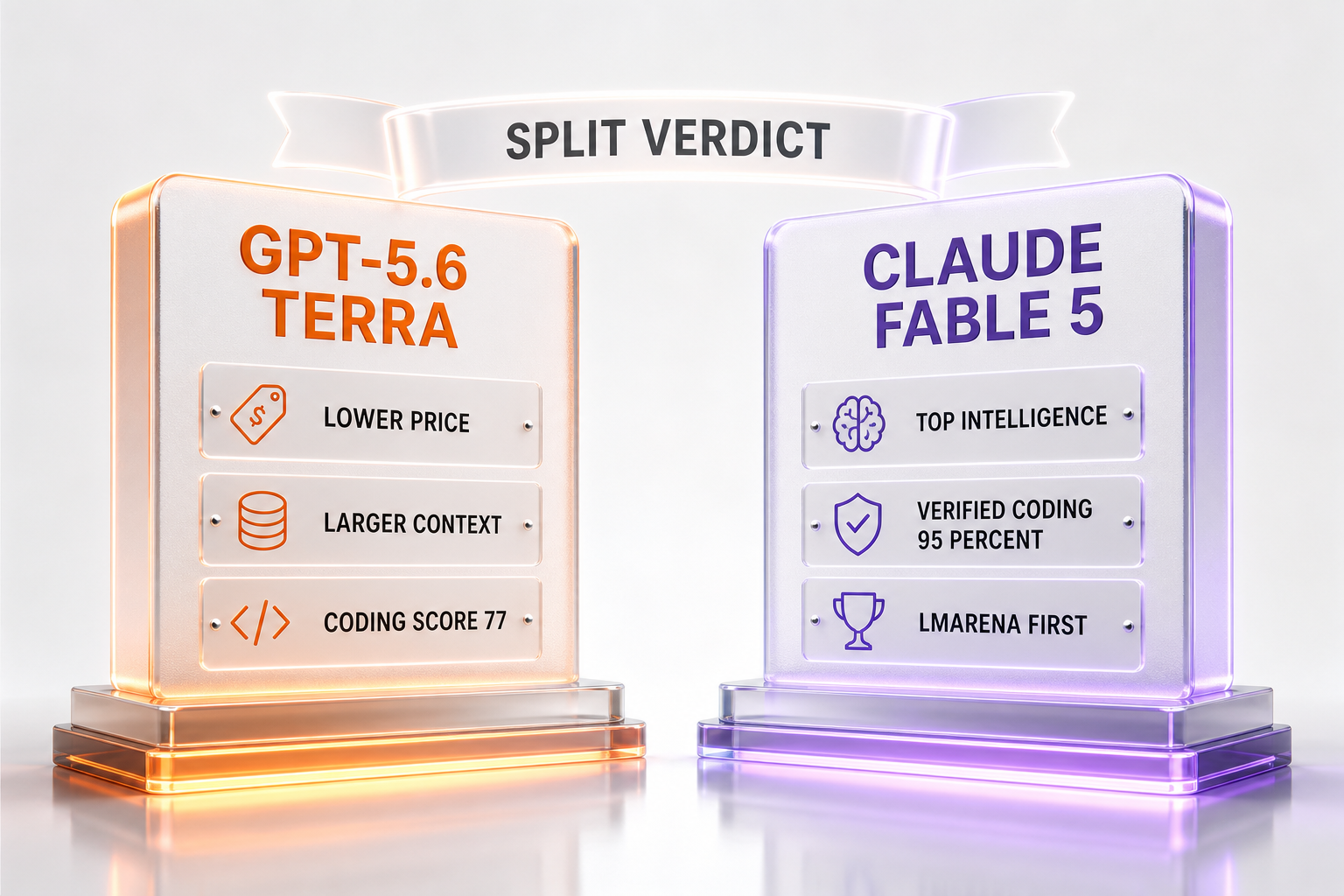
Two labs, opposite ends of the curve. GPT-5.6 Terra is the value tier and wins the practical majority of work on price and throughput: $2.50 per million input tokens, about $0.55 per task, a 1,050,000-token context window, and a charted 77 on the Artificial Analysis Coding Agent Index. Claude Fable 5 is the frontier tier and wins the hardest and most quality-sensitive slice: first on the Artificial Analysis Intelligence Index at 60, first on LMArena at an Elo of 1509, and 95 percent on SWE-bench Verified, at roughly four times the input price.
So we call it a split, and we mean it as advice rather than a dodge. Do not pay the Fable 5 premium for routine, high-volume work that Terra handles at a quarter of the cost, and do not send a genuinely hard reasoning task or a flagship piece of writing to a value tier to save a few dollars. Because these models live on different platforms, most teams will standardize on one and reach for the other only when the workload demands it. Check the live OpenAI and Anthropic pricing before you budget, since both rate cards can move.
Frequently Asked Questions
Is GPT-5.6 Terra or Claude Fable 5 the better model?
It depends on what you optimize for, which is why this is a split verdict. Claude Fable 5 is the more capable model: it leads the Artificial Analysis Intelligence Index at 60 to Terra's 55, tops LMArena with an Elo of 1509, and posts 95 percent on the independently run SWE-bench Verified board, where Terra is not listed. GPT-5.6 Terra wins on economics: it costs $2.50 per million input tokens versus $10 for Fable 5, carries a slightly larger context window, and has a lower cost per task. Pick Fable 5 for the hardest work and premium writing, and Terra for cost-sensitive volume.
How much cheaper is GPT-5.6 Terra than Claude Fable 5?
Terra is about four times cheaper on input and a little over three times cheaper on output: $2.50 per million input tokens versus $10, and $15 per million output tokens versus $50. On cost per task, Artificial Analysis measures Terra at about $0.55 against Fable 5's roughly $11.80. Terra also drops a further 50 percent through the Batch API for asynchronous jobs, so for high-volume, delay-tolerant workloads the real-world gap can be larger still.
Which model is smarter, GPT-5.6 Terra or Claude Fable 5?
By the Artificial Analysis Intelligence Index, Claude Fable 5 is smarter: it scores 60 and ranks first among all models, while GPT-5.6 Terra scores 55. Fable 5 also holds the top spot on LMArena with an Elo of 1509, a measure of blind human preference where Terra is not charted. Terra is a strong balanced-tier model, but Fable 5 is the most capable model Anthropic has widely released in 2026.
What are the coding benchmark scores for GPT-5.6 Terra and Claude Fable 5?
They are strong on two different boards, which are not directly comparable. Claude Fable 5 scores 95 percent on SWE-bench Verified as tracked independently by vals.ai, where Terra is not listed. GPT-5.6 Terra scores 77 on the Artificial Analysis Coding Agent Index, close behind the Sol flagship at 80, on a board where Fable 5 is not individually charted in our data. Because the two benchmarks use different task sets and scoring, a 77 on one and a 95 percent on the other cannot be stacked head to head; treat them as two separate signals that both point to capable coding agents.
Is Claude Fable 5 worth four times the price of GPT-5.6 Terra?
Only for the hardest slice of your workload. Fable 5 costs $10 per million input tokens against Terra's $2.50, so the gap is real. On routine tasks the two often feel similar, so paying four times more buys little. Fable 5 earns its price on genuinely difficult work, on coding you will judge against the independent SWE-bench Verified board, and on premium long-form writing where its top intelligence ranking and craft translate into a better result. For everything else, Terra is the economical default.
Do GPT-5.6 Terra and Claude Fable 5 have the same context window?
Almost. GPT-5.6 Terra runs a 1,050,000-token context window and Claude Fable 5 runs 1,000,000, so Terra has a slim headroom advantage of about 50,000 tokens. Both cap output at 128,000 tokens per request. In practice both operate at million-token scale, and neither will run out of room on realistic documents or agent runs, so the difference is marginal rather than decisive.
Are GPT-5.6 Terra and Claude Fable 5 from the same company?
No. GPT-5.6 Terra is an OpenAI model, part of the GPT-5.6 generation alongside the Sol and Luna tiers, reachable through the OpenAI API and Codex. Claude Fable 5 is an Anthropic model, available through the Claude API, Amazon Bedrock, Vertex AI, and Microsoft Foundry. Because they live on different platforms, switching between them is a real migration of prompts, tools, and evaluation, not a one-line model-string change.
Can I use GPT-5.6 Terra in ChatGPT?
Not directly. In the ChatGPT product, OpenAI exposes the GPT-5.6 generation through the Sol tier for Plus and Pro users, while Terra and Luna are aimed at the API, Codex, and OpenAI's Work surfaces rather than the consumer chat picker. You reach GPT-5.6 Terra through the API under the identifier gpt-5.6-terra. Claude Fable 5 similarly has no free consumer tier and is called through the Claude API and major cloud platforms.
Which model is faster or more cost-efficient for high volume?
GPT-5.6 Terra is the more cost-efficient choice for high volume. It is about four times cheaper on input, has a lower cost per task at roughly $0.55, and offers explicit effort levels so you can run easy calls cheaply, plus a 50 percent Batch API discount. Claude Fable 5 keeps adaptive thinking always on and cannot disable it, so it spends more tokens per answer by design, which raises both cost and latency. For latency-sensitive or high-volume production work, Terra is the better fit.
Does Claude Fable 5 beat GPT-5.6 Terra on independent benchmarks?
On the boards that rank both against the field, yes. Fable 5 leads the Artificial Analysis Intelligence Index at 60 to 55 and tops LMArena at an Elo of 1509, where Terra is not charted. On coding, the comparison splits across two different boards: Fable 5 has 95 percent on the independent SWE-bench Verified board, while Terra posts 77 on the Artificial Analysis Coding Agent Index, a strong score on a different benchmark. Terra's advantages are on price, cost per task, and context size rather than on capability rankings.
What are the knowledge cutoffs and modalities for each model?
GPT-5.6 Terra lists a knowledge cutoff of February 16, 2026, and accepts text and image input while returning text. Claude Fable 5 does not publicly disclose a specific cutoff date and likewise accepts text and image input and returns text. Neither model offers native audio or image generation; on both, image creation is handled by a callable tool rather than a built-in output modality. Both operate at million-token-scale context with a 128,000-token output cap.
Should I switch from GPT-5.6 Terra to Claude Fable 5 for a coding project?
Switch only if the project's success is judged against the independent SWE-bench Verified board or if you are hitting a quality ceiling on the hardest tasks, since that is where Fable 5's 95 percent verified score and top intelligence ranking pay off. For most day-to-day coding, GPT-5.6 Terra's 77 on the Artificial Analysis Coding Agent Index at a quarter of the price is more than competitive, and its effort levels let you scale reasoning up only when needed. Because the two run on different platforms, budget for a real migration of prompts and tools if you move, not a one-line change.
Sources
- OpenAI — API pricing
- OpenAI — model documentation
- OpenAI — GPT-5.6 announcement
- Anthropic — Claude API pricing
- Anthropic — Claude Fable
- Anthropic — Claude models overview
- Artificial Analysis — model index, Intelligence Index, and Coding Agent Index
- vals.ai — SWE-bench Verified leaderboard
- LMArena — leaderboard
- SWE-bench — project site
Our Verdict
Split verdict, no forced winner. GPT-5.6 Terra wins on price (about four times cheaper, $2.50 vs $10 per million input tokens), cost per task (roughly $0.55 vs $11.80), and a slightly larger 1,050,000-token context window. Claude Fable 5 wins on raw capability: 60 on the Artificial Analysis Intelligence Index versus 55, first on LMArena at an Elo of 1509, and an independent 95 percent on SWE-bench Verified where Terra is not listed. They run on different platforms, so most teams should standardize on Terra for high-volume, cost-sensitive work and reach for Fable 5 on the hardest reasoning, verified coding, and premium writing.
Choose GPT-5.6 Terra
OpenAI's balanced GPT-5.6 tier — GPT-5.5-competitive quality at two times lower cost, with a 1.05M-token context and the full agentic toolbox.
Try GPT-5.6 Terra →Choose Claude Fable 5
Anthropic's most capable widely released model — the public, safety-classified Mythos-class frontier tier.
Try Claude Fable 5 →Frequently Asked Questions
Is GPT-5.6 Terra better than Claude Fable 5?
Split verdict, no forced winner. GPT-5.6 Terra wins on price (about four times cheaper, $2.50 vs $10 per million input tokens), cost per task (roughly $0.55 vs $11.80), and a slightly larger 1,050,000-token context window. Claude Fable 5 wins on raw capability: 60 on the Artificial Analysis Intelligence Index versus 55, first on LMArena at an Elo of 1509, and an independent 95 percent on SWE-bench Verified where Terra is not listed. They run on different platforms, so most teams should standardize on Terra for high-volume, cost-sensitive work and reach for Fable 5 on the hardest reasoning, verified coding, and premium writing.
Which is cheaper, GPT-5.6 Terra or Claude Fable 5?
GPT-5.6 Terra is priced at $2.5 in / $15 out per M tokens. Claude Fable 5 is priced at $10 in / $50 out per M tokens. Check the pricing comparison section above for a full breakdown.
What are the main differences between GPT-5.6 Terra and Claude Fable 5?
The key differences span across 13 features we compared. For Input price per million tokens, GPT-5.6 Terra offers $2.50 while Claude Fable 5 offers $10. For Output price per million tokens, GPT-5.6 Terra offers $15 while Claude Fable 5 offers $50. For Cached input price per million tokens, GPT-5.6 Terra offers $0.25 while Claude Fable 5 offers $1.00 (90% caching discount). See the full feature comparison table above for all details.