GPT-5.6 Sol vs Kimi K2.6: Measured Summit vs Open-Weight Price (2026)

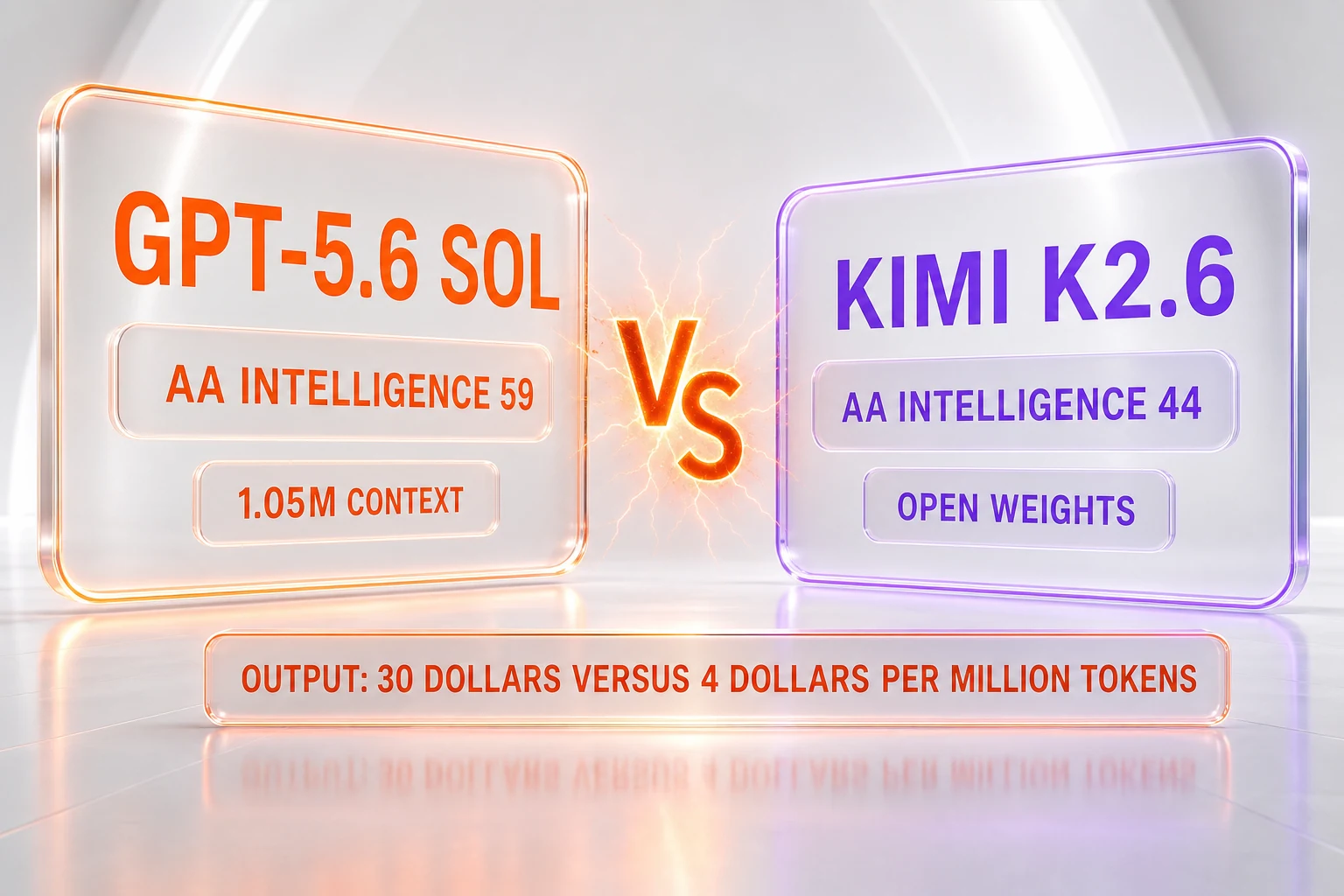
GPT-5.6 Sol vs Kimi K2.6: Sol leads the independent AA Intelligence Index 59 to 44, but Kimi K2.6 costs 5x less on output. Our 2026 verdict.
Feature Comparison
| Feature | GPT-5.6 Sol | Kimi K2.6 |
|---|---|---|
| AA Intelligence Index v4.1 (independent) | 59 | 44 |
| AA Coding Agent Index v1.3 (independent, read August 2, 2026) | 66.57 — 2nd of 52 (Codex harness, max effort) | 32.62 (Claude Code harness) |
| Input price per million tokens | $4.00 ($0.40 cached) | $0.95 ($0.16 cached) |
| Output price per million tokens | $20.00 | $4.00 |
| Context window | 1.05M tokens | 256K tokens |
| Model weights and license | Closed, OpenAI API only | Open-weight, Modified MIT, self-hostable |
| Multi-agent orchestration | Standard tool use in agent loops | Agent swarm: up to 300 sub-agents, 4,000 steps |
Pricing Comparison
GPT-5.6 Sol
Kimi K2.6
Detailed Comparison
GPT-5.6 Sol and Kimi K2.6 are separated by the widest independent intelligence gap in this series and one of the widest price gaps. On the Artificial Analysis Intelligence Index v4.1 — a third-party benchmark, not a vendor claim — OpenAI's Sol scores 59 and Moonshot AI's Kimi K2.6 scores 44, a 15-point difference. On price, the ranking inverts hard: Kimi K2.6 costs $0.95 per million input tokens and $4.00 per million output tokens against Sol's $4.00 and $20.00, making Sol about four times more expensive on input and exactly five times more expensive on output. Sol wins measured capability; Kimi K2.6 wins economics and openness. Which number governs your decision is the whole comparison.
Quick Verdict
The one-sentence version: pick GPT-5.6 Sol when you need the highest independently measured intelligence available and the budget to pay for it; pick Kimi K2.6 when a 15-point index gap costs less than a seven-times output bill, or when open weights are a strategic requirement.
Sol is the narrow overall winner on the axis this comparison is built around — measured capability — and it is not a close call on that axis. A 15-point spread on the Artificial Analysis Intelligence Index v4.1 (59 against 44) is the largest independent gap between any target and challenger we have compared, and Sol adds an independent AA Coding Agent Index v1.3 score of 66.57, second of 52 charted entries. But Kimi K2.6's counter-argument is arithmetic, not rhetoric: at $0.95 input and $4.00 output per million tokens against $4.00 and $20.00, you can run roughly five times as much generation for the same money, on a model whose weights you can download and host yourself under a Modified MIT license.
- Best independently measured intelligence: GPT-5.6 Sol (59 vs 44 on the AA Intelligence Index v4.1)
- Best independently measured coding: GPT-5.6 Sol (AA Coding Agent Index v1.3: 66.57, second of 52, Codex harness at max effort, against Kimi K2.6's 32.62 through the Claude Code harness — different agents, 33.95 points apart)
- Best price: Kimi K2.6 (about four times cheaper on input, exactly five times cheaper on output)
- Best for openness and control: Kimi K2.6 (open weights under Modified MIT, self-hostable, fine-tunable)
- Best for long-context work: GPT-5.6 Sol (1.05M tokens against 256K)
- Best multi-agent orchestration: Kimi K2.6 (agent swarm scaling to 300 sub-agents across 4,000 steps)
- Narrow overall winner: GPT-5.6 Sol — on capability. Flip the priority to cost or openness and Kimi K2.6 becomes the rational default without hesitation.
How We Compared Them
This is a research-led comparison, not a hands-on bake-off. We have not run either model in production at ThePlanetTools, and we say so up front rather than dressing up desk research as a side-by-side trial. What we did instead was impose two rules that most model comparisons quietly skip.
Rule one: independent scores and vendor scores are never mixed. Every number in this piece carries a label. An independent score comes from a third-party evaluator that runs the model itself — here, Artificial Analysis, which publishes the Intelligence Index and the Coding Agent Index. A vendor self-reported score comes from the company that sells the model, running its own harness on its own model. Both can be useful. They are not the same kind of evidence, and a comparison that silently blends them is telling you something it has not actually established.
Rule two: we only put two numbers head to head when they come from the same benchmark, at the same version, under the same evidence regime. That rule is what makes the intelligence comparison in this piece clean and the coding comparison in this piece messy — and we would rather explain the mess than hide it. Both models have an Artificial Analysis Intelligence Index score on version 4.1 of the index, so 59 against 44 is a genuine apples-to-apples measurement. Coding is not so lucky, and we devote a full section below to exactly why.
One version trap deserves a flag, because it is circulating widely. Kimi K2.6's Intelligence Index score is 44 on version 4.1 of the index. A figure of 54 appears in a number of write-ups and social posts; that number comes from an earlier version of the index, which scored models on a different composite. Comparing a v4.1 score for one model against a pre-v4.1 score for the other would inflate Kimi K2.6 by ten points and quietly reverse parts of this analysis. The version-matched number — the only one that can legitimately sit next to Sol's 59 — is 44. Every Kimi K2.6 intelligence figure in this article is that one.
Pricing was taken from each vendor's published API rates rather than from search snippets or aggregator listings, which drift. All prices in this piece are quoted in US dollars per million tokens.
Meet Both Models
GPT-5.6 Sol — the measured summit
GPT-5.6 Sol is OpenAI's top-tier model in the GPT-5.6 family, and as of this writing it sits at or near the top of the independent leaderboards that matter. It scores 59 on the Artificial Analysis Intelligence Index v4.1 and 66.57 on the AA Coding Agent Index v1.3, second of 52 charted entries — both third-party measurements, neither an OpenAI claim. It carries a 1.05-million-token context window, and it is priced accordingly, though less steeply than it was: $4.00 per million input tokens, $0.40 per million cached input tokens, and $20.00 per million output tokens since OpenAI's promotional cut of August 21, 2026.
Sol is the flagship of a three-model family. Below it sit GPT-5.6 Terra (AA Intelligence 55, at half Sol's input rate and 60 percent of its output rate) and GPT-5.6 Luna (AA Intelligence 51, cheaper still). That laddering matters for this comparison, because "GPT-5.6" is not one price point — and if Sol's output rate is what disqualifies it for your workload, the answer may be a different rung of the same ladder rather than a different vendor entirely. The only model with a higher independent Intelligence Index score than Sol in our current set is Claude Fable 5 at 60, one point ahead.
Sol is closed. You reach it through OpenAI's API. There are no weights to download, no self-hosting path, and no fine-tuning of the base model itself.
Kimi K2.6 — the best-measured open-weight challenger
Kimi K2.6 is Moonshot AI's open-weight flagship, released on April 20, 2026. Moonshot AI is a Beijing-based lab. K2.6 is a Mixture-of-Experts model with roughly 1 trillion parameters (1.1 trillion total) of which about 32 billion are active per token, spread across 384 experts (eight routed plus one shared), with a native vision encoder — MoonViT, roughly 400 million parameters — integrated into the same architecture rather than bolted on. Its context window is 256,000 tokens. The weights ship under a Modified MIT license.
Its headline agentic feature is an agent swarm that decomposes a brief into as many as 300 sub-agents coordinating across up to 4,000 steps in a single autonomous run. On price it is aggressive: $0.95 per million input tokens, $0.16 per million cached input tokens, and $4.00 per million output tokens, with consumer plans running from a free tier (Adagio) up to $159 per month (Vivace).
Here is why K2.6 — and not Moonshot's newer model — is the one standing opposite Sol in this piece. Its successor, Kimi K2.7 Code (June 2026), is a dedicated coding model, and on version 4.1 of the Artificial Analysis Intelligence Index it scores 42, read on August 2, 2026 — just under the 44 K2.6 posts on that same version. K2.6 is therefore the stronger of the two Moonshot models on this generalist yardstick, and it is the one this page carries through every section. Scores never transfer between versions, so read the Kimi figures below as K2.6's alone.
Head-to-Head at a Glance
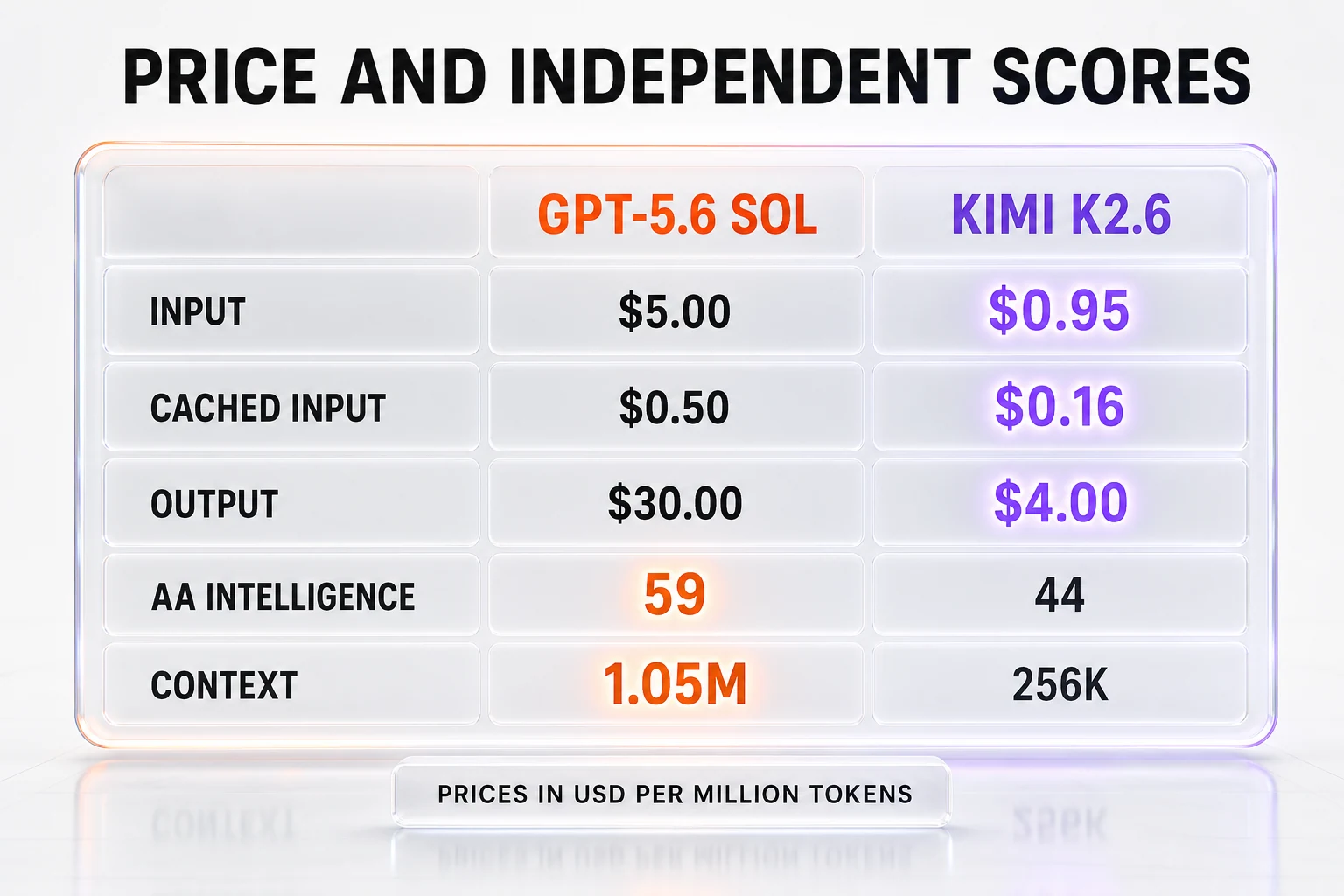
| Dimension | GPT-5.6 Sol | Kimi K2.6 | Edge |
|---|---|---|---|
| AA Intelligence Index v4.1 (independent) | 59 | 44 | Sol (+15) |
| AA Coding Agent Index v1.3 (independent, read August 2, 2026) | 66.57 — 2nd of 52 (Codex harness, max effort) | 32.62 (Claude Code harness) | Sol (+33.95, different harnesses) |
| Input price per million tokens | $4.00 ($0.40 cached) | $0.95 ($0.16 cached) | Kimi K2.6 |
| Output price per million tokens | $20.00 | $4.00 | Kimi K2.6 |
| Context window | 1.05M tokens | 256K tokens | Sol |
| Model weights and license | Closed, OpenAI API only | Open-weight, Modified MIT, self-hostable | Kimi K2.6 |
| Multi-agent orchestration | Standard tool use in agent loops | Agent swarm: up to 300 sub-agents, 4,000 steps | Kimi K2.6 |
The table splits four rows to three in Kimi K2.6's favor, and that count is deliberately misleading — which is exactly why we are pointing it out rather than letting it stand. Counting rows treats a 15-point independent intelligence gap as one unit of evidence and a license choice as another unit of the same size. They are not the same size. Sol's rows are about how good the model is; Kimi K2.6's rows are about what it costs and who controls it. Both matter. Neither is settled by a row count, and any comparison that hands you a tally instead of a judgment is dodging the question.
Intelligence: The Cleanest Signal We Have
The Artificial Analysis Intelligence Index v4.1 is the one measurement in this comparison that is both independent and version-matched, which makes it the closest thing to a referee's scorecard either model has. GPT-5.6 Sol scores 59. Kimi K2.6 scores 44. Fifteen points.
That gap deserves to be sized honestly, because "15 points" is abstract. On the same v4.1 index, Claude Fable 5 scores 60, GPT-5.6 Terra scores 55, and GPT-5.6 Luna scores 51. Sol at 59 is at the summit. Kimi K2.6 at 44 sits well below the entire GPT-5.6 family — below even Luna, the family's cheapest rung, by seven points. So the honest framing is not "Kimi K2.6 is a bit behind the flagship." It is: Kimi K2.6's independently measured intelligence is a tier below every model in the GPT-5.6 lineup, and two tiers below Sol specifically. This is the widest independent capability gap in this comparison series, and pretending otherwise to keep the piece balanced would be dishonest.
What that gap does not tell you is equally important. An index score is a composite across many evaluations; it is a strong signal of general reasoning capability and a weak signal of how a model will behave on your specific workload. A 15-point index gap says Sol will hold up better on hard, multi-step, ambiguous reasoning than K2.6 will. It does not say Sol is 34% better at classifying your support tickets, summarizing your documents, or writing your CRUD endpoints — tasks where both models are likely well past the threshold of "good enough," and where the difference you actually feel is latency and cost, not ceiling. The rule of thumb we would apply: the harder and less structured the task, the more the 15 points matter; the more routine and well-specified the task, the more the price ratio matters.
Coding: A Score Gap Across Two Harnesses, and a Vendor Number That Stays Out of It
This is the section where most comparisons of these two models go wrong, so we are going to be pedantic about it.
Both models are charted on the independent Coding Agent Index, and Kimi K2.6 publishes a coding number of its own on top of that. The two index figures belong side by side, with their harnesses named. Moonshot AI's own figure does not go in that row: it is not the same kind of number and it does not come from the same test, and we will not place it beside an independent one. There are two independent reasons for that refusal, and either one alone would be disqualifying.
GPT-5.6 Sol's coding figure is an AA Coding Agent Index v1.3 score of 66.57, which is independent — Artificial Analysis, a third-party evaluator, ran the model and charted it second of 52 on that index. Kimi K2.6 is charted on the same index at 32.62, through the Claude Code harness — a different agent, which is why we quote both figures with their harness attached.
What Kimi K2.6 has instead is a SWE-bench Pro score of 58.6, which is vendor self-reported: Moonshot AI ran the benchmark on its own model and published the result.
Reason one: they are different benchmarks. The AA Coding Agent Index is a composite index maintained by a third-party evaluator. SWE-bench Pro is a specific benchmark measuring an agent's ability to resolve real software issues. A score on one and a score on the other are two measurements of two different things on two different scales. Subtracting one from the other produces a difference that means precisely nothing, however confident it looks written down.
Reason two — and this is the part that survives even if you found a way to normalize the scales — they are different regimes of evidence. One is a referee's measurement; the other is a competitor's self-report. Vendor self-reported benchmarks are not worthless, but they are systematically optimistic: the company chooses the harness, the scaffold, the prompt, the number of attempts, and — crucially — whether to publish the result at all. Nobody publishes the benchmark they lost. Putting a vendor number and an independent number in the same row implies a symmetry of rigor that does not exist, and it is the single most common way a technically-true comparison becomes practically misleading.
So here is what we can actually say, with the labels attached:
- Sol has a second-ranked independent coding score. Artificial Analysis ran the model and charted it second of 52 on its Coding Agent Index v1.3. That is referee-verified evidence of coding capability, and it is the strongest coding evidence either model has.
- Kimi K2.6 has an independent coding score too, well below Sol's. The same index charts it at 32.62 through the Claude Code harness. Its other coding evidence is the vendor self-reported SWE-bench Pro result described above. Moonshot AI reports that the result beats GPT-5.4 and Claude Opus 4.6 on that same benchmark — but those are Moonshot's numbers for Moonshot's competitors, which is the definition of a figure to read with your eyebrows up.
- The one coding benchmark that covers both ran them through different agents. The Coding Agent Index scores a harness paired with a model, so 66.57 for Codex-plus-Sol and 32.62 for Claude-Code-plus-Kimi are two pairings, not two models in isolation. The honest answer to "which one codes better?" is therefore: Sol has both the better score and the better evidence, with the harness difference stated.
If you need to decide today, the independent coding board is the clearest read available: Sol's Codex pairing at 66.57 against Kimi K2.6's Claude Code pairing at 32.62, a 33.95-point gap in the same direction as the 15-point intelligence gap. Two caveats keep it from being a clean knockout: the harnesses differ, so part of that distance belongs to the agent rather than the model, and Moonshot's own SWE-bench Pro result — a vendor figure on a different benchmark — is the one number you are still being asked to take on faith. If coding quality is the deciding factor and you cannot run your own evaluation, Sol is the better-evidenced choice. If you can run your own evaluation on your own repository, do that instead of trusting either number.
Pricing: Where Kimi K2.6 Pulls Away
Price is the axis where the ranking inverts, and it inverts violently.
| Cost dimension | GPT-5.6 Sol | Kimi K2.6 | Sol's multiple |
|---|---|---|---|
| Input per million tokens | $4.00 | $0.95 | About 4.2 times more |
| Cached input per million tokens | $0.40 | $0.16 | About 2.5 times more |
| Output per million tokens | $20.00 | $4.00 | 5 times more |
| Consumer plans | Sold through OpenAI's paid tiers | Free (Adagio) up to $159 per month (Vivace) | — |
| Self-host cost per token | Not available (closed) | Your own infrastructure only | — |
The output multiple is the one to internalize. Output tokens dominate the bill on almost every generative workload — code generation, long-form writing, agent traces, chain-of-thought reasoning — and Sol charges exactly five times more for them. Put concretely: a workload that costs $400 per month in Kimi K2.6 output tokens costs $2,000 per month in Sol output tokens. That is not a rounding difference you optimize away with better prompts; it is a different line item on a different budget.
Two honesty notes keep this from being a pure rout. First, tokenizers differ across vendors, so the same text does not necessarily produce the same token count on both models, and the real cost ratio on your actual prompts may not track the headline per-token ratio exactly. Measure on your own workload before you commit to a number. Second, a cheaper model that fails costs more than an expensive model that succeeds. If a task requires two Kimi K2.6 attempts plus a human fixing the output, the five-times advantage evaporates and then some. The price gap is real and enormous; it only converts into savings on workloads where both models actually succeed. Establishing that both models succeed on your workload is your job, and it is the single highest-leverage hour of evaluation you can spend here.
Sol's cached input rate of $0.40 per million tokens is worth flagging as its own best economic argument: it narrows the input gap from 4.2 times to about 2.5 times, which matters a lot for agent loops that re-read the same large context across many tool calls. It does nothing for the output bill, which is where the damage is.
Context Window and Architecture
Sol's context window is 1.05 million tokens; Kimi K2.6's is 256,000. That is roughly a four-times advantage for Sol, and it is a real functional difference rather than a spec-sheet flourish. Below about 256K you are choosing between two models that can both hold a large codebase or a long document set in working memory. Above it, only one of them can, and the other requires you to build retrieval and chunking machinery to compensate — engineering work with its own failure modes. If your workflow involves whole-repository reasoning, long legal or financial document sets, or extended agent runs that accumulate context, the 1.05M window is a structural reason to pay Sol's premium that has nothing to do with the index score.
Architecturally, the two models are opposites in what they disclose. Kimi K2.6 is documented in detail: a Mixture-of-Experts design with about 1 trillion parameters (1.1 trillion total), roughly 32 billion active per token, 384 experts arranged as eight routed plus one shared, and a 400-million-parameter MoonViT vision encoder integrated natively so that images are processed in the same forward pass as text. That sparsity ratio — 32 billion active out of 1 trillion — is what lets Moonshot price it at $0.95 input: you pay for the compute you activate, not the parameters you store. Sol's internals are not disclosed, which is standard practice for a closed frontier model and not a criticism, but it does mean that everything you know about how Sol works, you know from its outputs and its price.
Openness, Self-Hosting, and the Agent Swarm
Kimi K2.6's weights are downloadable under a Modified MIT license. This is the second of its two genuine strategic advantages, and for a certain kind of buyer it is worth more than the price gap.
Self-hosting means no per-token vendor exposure, no risk of a hosted model being silently updated underneath a production system you have tuned against, no data leaving your infrastructure, and a real exit option if a provider's pricing or policy shifts. For regulated industries, air-gapped deployments, or anyone whose board has asked what happens if the API price triples, "we hold the weights" is an answer that no closed model can offer at any price. Sol cannot compete on this axis by construction — not because OpenAI built it badly, but because a closed model is a different product category.
The cost of that freedom is operational and it is not small. A 1-trillion-parameter MoE is not something you run on a workstation; serving it in production means a serious GPU cluster and the team to keep it healthy. "Open" is not "free." For most small teams, the realistic version of the openness advantage is not self-hosting at all — it is the optionality of self-hosting, plus a competitive hosted market that keeps Moonshot's own prices honest.
The agent swarm is Kimi K2.6's other differentiator: up to 300 sub-agents coordinating across as many as 4,000 steps in a single autonomous run. Sol does tool use inside agent loops competently — it is, after all, far ahead of Kimi K2.6 on the independent coding index, 66.57 to 32.62 — but Moonshot ships the more explicit, more aggressive orchestration primitive. Whether 300 sub-agents is a genuine capability or a spec-sheet number depends entirely on whether they coordinate usefully at that scale, which we have not verified and which we would want to see measured independently before treating it as a decisive advantage. Read it as a real architectural bet, not as a proven win.
Winner by Category
Best independently measured intelligence: GPT-5.6 Sol
59 against 44 on the AA Intelligence Index v4.1 — a 15-point, independently measured, version-matched gap. This is the cleanest evidence in the comparison and it is not close. Kimi K2.6 scores below every model in the GPT-5.6 family on this index, including the cheapest one.
Best-evidenced coding: GPT-5.6 Sol
Sol holds an independent AA Coding Agent Index v1.3 score of 66.57, second of 52 charted entries, through the Codex harness at max effort. Kimi K2.6 is charted on the same index at 32.62 through the Claude Code harness — independent as well, 33.95 points behind, with the caveat that the two ran different agents. Moonshot AI's separate SWE-bench Pro figure is vendor self-reported, from a different benchmark under a weaker evidence regime, and we refuse to line it up against Sol's. Sol wins the independent score and the quality of the evidence alike.
Best price: Kimi K2.6
$0.95 input and $4.00 output per million tokens against $4.00 and $20.00. About four times cheaper on input and exactly five times cheaper on output — and self-hosting removes the per-token cost entirely. On high-volume generative workloads this is the axis that writes the check.
Best openness and control: Kimi K2.6
Open weights under Modified MIT, self-hostable, fine-tunable, with no per-token vendor exposure and a genuine exit option. Sol cannot compete here by design.
Best long-context work: GPT-5.6 Sol
1.05 million tokens against 256,000 — roughly four times the working memory, and the difference between holding a whole repository in context and engineering a retrieval layer to fake it.
Best multi-agent orchestration: Kimi K2.6
An agent swarm scaling to 300 sub-agents across 4,000 coordinated steps is the more explicit orchestration primitive of the two, though we would want independent verification that it coordinates usefully at the top of that range before calling it decisive.
Narrow overall winner: GPT-5.6 Sol
On the axis this comparison is built around — measured capability — Sol wins, and it wins by the largest independent margin in the series. It has the higher independent intelligence score, the better-evidenced coding, and four times the context. That is the verdict. But it is a verdict scoped to capability, and the scope is doing real work: at five times the output price, Sol has to earn that gap on your specific workload, and on a great many workloads it will not.
Pros and Cons of Each
GPT-5.6 Sol
What stands out:
- Highest independently measured intelligence in this comparison: 59 on the AA Intelligence Index v4.1, 15 points clear of Kimi K2.6
- Charted independent coding score (AA Coding Agent Index v1.3: 66.57, 2nd of 52, Codex harness at max effort) — referee-verified, not self-reported, and 33.95 points clear of Kimi K2.6's Claude Code pairing
- 1.05-million-token context window, roughly four times Kimi K2.6's
- Cached input at $0.40 per million tokens materially softens the input-cost gap on context-heavy agent loops
- Part of a priced ladder — Terra and Luna offer the same family at lower rungs if Sol's rate is prohibitive
Where it falls short:
- $20.00 per million output tokens — exactly five times Kimi K2.6's rate, and output dominates most real bills
- Closed weights: no self-hosting, no fine-tuning of the base model, no exit option, full per-token vendor exposure
- Architecture undisclosed, so capability claims rest entirely on outputs and third-party measurement
- No explicit multi-agent swarm primitive comparable to Kimi K2.6's
- No published SWE-bench Pro figure, so it cannot be compared to Kimi K2.6 on that specific benchmark
Kimi K2.6
What stands out:
- About four times cheaper on input and exactly five times cheaper on output than Sol, with a low $0.16 cached-input rate
- Genuine open weights under a Modified MIT license — self-host, fine-tune, no vendor lock-in
- The best-measured open-weight model available to face Sol: at 44 on the independent AA Intelligence Index v4.1 it sits two points above its own successor, Kimi K2.7 Code, which scores 42 on that same version
- Agent swarm scaling to 300 sub-agents across 4,000 coordinated steps
- Native multimodal architecture with an integrated 400-million-parameter MoonViT vision encoder, plus a fully documented MoE design (1T parameters, 32B active, 384 experts)
- Consumer plans start free (Adagio), so evaluation costs nothing
Where it falls short:
- 15 points behind Sol on the independent AA Intelligence Index v4.1 (44 against 59) — below every model in the GPT-5.6 family, including the cheapest
- Charted at 32.62 on the independent AA Coding Agent Index v1.3 through the Claude Code harness, far behind Sol; its stronger 58.6 on SWE-bench Pro is vendor self-reported by Moonshot AI
- 256K context window against Sol's 1.05M — roughly four times smaller
- Self-hosting a 1-trillion-parameter MoE requires a serious GPU cluster; "open" is not "cheap to run" for a small team
- Moonshot AI is a Beijing-based lab, which is a jurisdictional consideration some Western buyers must weigh regardless of the model's quality
When to Pick Which
Pick GPT-5.6 Sol if...
Your workload lives at the hard end of the difficulty curve and the model's ceiling is what constrains you. Sol is the right call when tasks are genuinely difficult, open-ended, or multi-step; when a 15-point independent intelligence advantage translates into fewer failed runs and less human cleanup; when coding quality is central and you want the model with independent, third-party evidence rather than a self-reported number; when you need more than 256K tokens of context; or when your per-request volume is low enough that a five-times output premium is a rounding error against the salary of the person waiting on the output. In short: pay for Sol when intelligence is the bottleneck. If the price is the only thing stopping you, look at GPT-5.6 Terra (AA Intelligence 55) before you look at a different vendor — it may buy you most of the capability at a fraction of the rate.
Pick Kimi K2.6 if...
The bill is the constraint, or openness is a requirement rather than a preference. Kimi K2.6 is the better choice when you run high-volume generative workloads where a five-times output-price difference compounds into serious money; when your tasks are well-specified enough that both models clear the quality bar and the ceiling never binds; when you need to self-host for data residency, regulatory, or strategic reasons; when the agent swarm's orchestration model fits your architecture; or when you want a hedge against closed-vendor pricing and policy risk. The honest caveat: you are accepting a measurably lower capability ceiling. Do not tell yourself otherwise — 44 against 59 is a real gap, and the right response is to verify on your own workload that the gap never bites, not to pretend it is not there.
Or run both
The most economically rational answer for many teams is not one model but a router. Send the hard, ambiguous, high-stakes requests to Sol, where the 15-point capability advantage earns its price, and send the high-volume, well-specified, repetitive execution to Kimi K2.6, where the five-times cost advantage compounds. This is the dominant 2026 production pattern for a reason: it is the only configuration where you pay the premium exactly where it converts into value. For adjacent matchups, our Claude Sonnet 5 vs Kimi K2.6, Claude Opus 4.8 vs Kimi K2.7 Code, and Kimi K2.7 Code vs DeepSeek V4 comparisons cover the neighboring decisions, and our best AI coding tools of 2026 roundup places both models in the wider field.
Frequently Asked Questions
Is GPT-5.6 Sol or Kimi K2.6 the smarter model?
GPT-5.6 Sol, and the gap is large. On the Artificial Analysis Intelligence Index v4.1 — an independent third-party benchmark, not a vendor claim — Sol scores 59 and Kimi K2.6 scores 44. That 15-point difference is the widest independent capability gap in this comparison series. Kimi K2.6 scores below every model in the GPT-5.6 family on this index, including the cheapest one. Both scores are measured on the same version of the index, which is what makes them directly comparable.
How much cheaper is Kimi K2.6 than GPT-5.6 Sol?
Substantially. Kimi K2.6 charges $0.95 per million input tokens and $4.00 per million output tokens. GPT-5.6 Sol charges $4.00 per million input tokens and $20.00 per million output tokens. That makes Sol about 4.2 times more expensive on input and exactly 5 times more expensive on output. Since output tokens dominate the bill on most generative workloads, the output multiple is the one that matters: a workload costing $400 per month in Kimi K2.6 output tokens would cost $2,000 per month in Sol output tokens.
Why do some sources say Kimi K2.6 scores 54 on the Artificial Analysis index?
Because they are quoting a score from an earlier version of the index. Kimi K2.6's score on the Artificial Analysis Intelligence Index v4.1 — the version on which GPT-5.6 Sol scores 59 — is 44, not 54. The 54 figure comes from a previous version of the index that used a different composite. Comparing a v4.1 score against a pre-v4.1 score would inflate Kimi K2.6 by ten points and produce a misleading conclusion. The version-matched, apples-to-apples number is 44.
Which model is better at coding?
Both models are charted on the same independent board, the AA Coding Agent Index v1.3 measured by Artificial Analysis: GPT-5.6 Sol at 66.57, second of 52 charted entries, through the Codex harness at max effort, and Kimi K2.6 at 32.62 through the Claude Code harness. That index scores a harness paired with a model, so the 33.95-point gap separates two pairings rather than two models in isolation — but it runs in the same direction as the 15-point independent intelligence gap. Moonshot AI's SWE-bench Pro result is a separate, vendor self-reported figure on a different benchmark, and we do not line it up against either number.
Why don't you compare Kimi K2.6's SWE-bench Pro result against Sol's AA Coding Agent Index score?
Two reasons, either of which alone would be disqualifying. First, they are different benchmarks measuring different things on different scales, so the difference between them is not a meaningful quantity — subtracting one from the other produces a number that looks precise and means nothing. Second, they come from different evidence regimes: the AA Coding Agent Index is an independent third-party measurement, while the SWE-bench Pro figure is reported by Moonshot AI about its own model. Vendor self-reported scores are systematically optimistic, because the vendor chooses the harness, the scaffold, and whether to publish the result at all. Presenting the two as a head-to-head row would imply a symmetry of rigor that does not exist.
Can I self-host either model?
You can self-host Kimi K2.6, not GPT-5.6 Sol. Kimi K2.6 ships as open weights under a Modified MIT license, so you can download them, run them on your own infrastructure, and fine-tune them. The practical caveat is scale: it is a Mixture-of-Experts model with roughly 1 trillion parameters and about 32 billion active per token, so serving it in production requires a serious GPU cluster. GPT-5.6 Sol is closed and available only through OpenAI's API, with no downloadable weights and no self-hosting path.
Which model has the larger context window?
GPT-5.6 Sol, by roughly four times: 1.05 million tokens against Kimi K2.6's 256,000. For most single-file or single-document workflows, 256K is more than enough. The difference becomes structural for whole-repository code reasoning, large legal or financial document sets, and long-running agents that accumulate context, where Sol can hold the material in working memory and Kimi K2.6 requires a retrieval and chunking layer to compensate.
What is Kimi K2.6's agent swarm?
It is Moonshot AI's multi-agent orchestration layer. It decomposes a brief into specialized sub-agents — as many as 300 of them — that run and coordinate across up to 4,000 steps in a single autonomous run. GPT-5.6 Sol performs tool use inside agent loops but does not ship an equivalent named swarm primitive. Whether 300 coordinating sub-agents delivers proportional value at the top of that range has not, to our knowledge, been independently measured, so we treat it as a real architectural bet rather than a proven advantage.
Is Kimi K2.6 the same as Kimi K2.7 Code?
No, they are different models. Kimi K2.6 was released on April 20, 2026. Kimi K2.7 Code is a later, separate model, built specifically for coding, and it is charted on the same yardstick: 42 on Artificial Analysis Intelligence Index v4.1, read on August 2, 2026, against 44 for K2.6. This comparison is about Kimi K2.6 specifically, and it is the one we place against GPT-5.6 Sol because it is the higher of the two Moonshot models on that index. Scores never transfer between versions, so read every Kimi figure in the sections above as K2.6's alone.
Is GPT-5.6 Sol worth five times the output price?
It depends entirely on whether intelligence is your bottleneck. If your tasks are hard, open-ended, or multi-step and a capability ceiling is causing failed runs and human cleanup, then a 15-point independent intelligence advantage and a charted independent coding score can easily be worth the premium — a failed cheap run costs more than a successful expensive one. If your tasks are well-specified and both models clear the quality bar, you are paying five times more for headroom you never use. The way to find out is to run a representative evaluation on your own workload, not to reason from either model's benchmark scores.
What are the architectural differences between GPT-5.6 Sol and Kimi K2.6?
Kimi K2.6 is fully documented and GPT-5.6 Sol is not. Kimi K2.6 is a Mixture-of-Experts model with roughly 1 trillion parameters (1.1 trillion total), about 32 billion active per token, 384 experts arranged as eight routed plus one shared, and a natively integrated 400-million-parameter MoonViT vision encoder. That sparsity — a small fraction of parameters activated per token — is a large part of why Moonshot AI can price it at $0.95 per million input tokens. GPT-5.6 Sol's internals are not disclosed, which is standard for a closed frontier model, so what is known about it comes from its outputs, its price, and independent measurement.
Should I use both models together?
For many teams, yes — and it is often the most economically rational configuration. Route hard, ambiguous, high-stakes requests to GPT-5.6 Sol, where the 15-point independent capability advantage earns its price, and route high-volume, well-specified, repetitive execution to Kimi K2.6, where the five-times output-cost advantage compounds into real savings. A router is the only configuration in which you pay the premium exactly where it converts into value, rather than across your whole workload indiscriminately.
Final Verdict
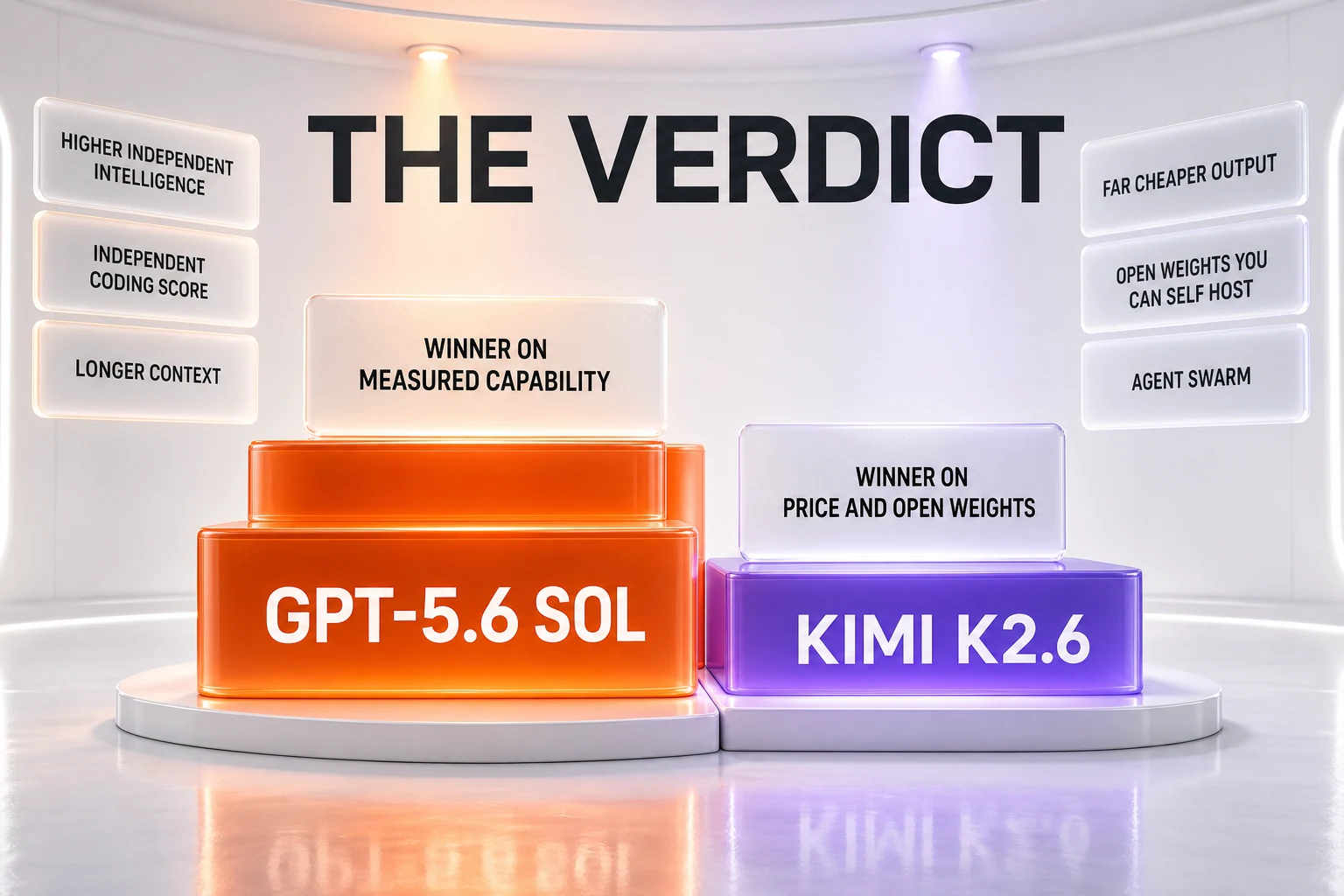
GPT-5.6 Sol is the winner on measured capability, and the margin is the largest in this series. Fifty-nine against forty-four on the Artificial Analysis Intelligence Index v4.1 is not a close reading of a noisy benchmark — it is a 15-point, independently measured, version-matched gap that places Kimi K2.6 below every model in the GPT-5.6 lineup, including the cheapest one. Add a charted independent coding score (AA Coding Agent Index v1.3: 66.57, 2nd of 52) and roughly four times the context window, and the capability verdict writes itself. If the model's ceiling is what constrains your work, Sol is the answer and the rest of this article is a footnote.
But the price gap is not a footnote, and pretending it is would be the easy dishonesty of this piece. Kimi K2.6 costs $0.95 per million input tokens and $4.00 per million output tokens against Sol's $4.00 and $20.00 — about four times cheaper on input and exactly five times cheaper on output, on a model whose weights you can download, host yourself, and fine-tune under a Modified MIT license. For a large share of real production workloads, the tasks are well-specified enough that a 15-point index gap never binds, and in those cases paying five times more for output is buying headroom you will never touch.
So the question is not "which model is better" — Sol is, on every axis that measures capability. The question is whether the capability you are buying is capability you actually need. That is not a question a benchmark can answer for you, and it is not one we can answer for you either. What we can do is tell you that both of the headline numbers here are real and independently measured: the 15-point gap is real, and so is the five-times bill. Run a representative slice of your own workload through both, count the failures, and let the failure rate — not the leaderboard — decide which side of that trade you are on.
Last compared: July 2026. Kimi K2.6 was released April 20, 2026 by Moonshot AI. This is a research-led comparison; we have not run either model in production at ThePlanetTools. Intelligence Index figures (59 and 44, version 4.1) and Coding Agent Index figures (66.57 for Sol through the Codex harness at max effort, 32.62 for Kimi K2.6 through the Claude Code harness, v1.3, read August 2, 2026) are from Artificial Analysis and are independent third-party measurements; both indexes cover both models, though the Coding Agent Index ran them through different harnesses. Separately, and never as a head-to-head against that independent Coding Agent Index score, Kimi K2.6's SWE-bench Pro result of 58.6 is vendor self-reported by Moonshot AI and is labeled as such wherever it appears — the two come from different benchmarks under different standards of evidence, so we do not line them up. Pricing verified from each vendor's published API rates at the time of writing and quoted in US dollars per million tokens.
Sources and references
Every figure on this page is attributed to whoever produced it. Vendor documentation and independent measurement are listed separately and never merged into a single ranking.
- Moonshot AI — Platform documentation (model family, API reference and limits)
- OpenAI — API pricing (per-token, cached and batch rates)
- Artificial Analysis — GPT-5.6 Sol (independent index score and cost per task)
- Artificial Analysis — Model leaderboard (Intelligence Index scores and cost per task across configurations)
Our Verdict
GPT-5.6 Sol is the winner on measured capability, and by the widest independent margin in this series: 59 against 44 on the Artificial Analysis Intelligence Index v4.1, a 15-point gap that places Kimi K2.6 below every model in the GPT-5.6 family, including the cheapest. Sol adds a charted independent AA Coding Agent Index v1.3 score of 66.57, second of 52, and roughly four times the context window (1.05M against 256K). But Kimi K2.6 wins the economics decisively: $0.95 per million input tokens and $4.00 per million output tokens against Sol’s $4.00 and $20.00 — about four times cheaper on input and exactly five times cheaper on output — on a model whose open weights you can self-host and fine-tune under a Modified MIT license. On the independent Coding Agent Index v1.3 both are charted, but through different harnesses — Sol 66.57 through Codex at max effort, Kimi K2.6 32.62 through Claude Code — and we state the harness rather than presenting the 33.95-point gap as if one agent had run both. What stays asymmetric is Moonshot AI's own SWE-bench Pro 58.6, a vendor self-reported figure we never place beside an independent one. The decision reduces to one question: is the capability you are buying capability you actually need? If the model’s ceiling constrains your work, pay for Sol. If your tasks are well-specified enough that a 15-point index gap never binds, the five-times output premium is headroom you will never touch, and Kimi K2.6 is the rational default.
Choose GPT-5.6 Sol
OpenAI's flagship GPT-5.6 capability tier, with Programmatic Tool Calling and a 1.05M-token context.
Try GPT-5.6 Sol →Choose Kimi K2.6
Moonshot AI's open-weight 1T-parameter MoE flagship that scales to 300 sub-agents and 4,000 coordinated steps for long-horizon coding.
Try Kimi K2.6 →Frequently Asked Questions
Is GPT-5.6 Sol better than Kimi K2.6?
GPT-5.6 Sol is the winner on measured capability, and by the widest independent margin in this series: 59 against 44 on the Artificial Analysis Intelligence Index v4.1, a 15-point gap that places Kimi K2.6 below every model in the GPT-5.6 family, including the cheapest. Sol adds a charted independent AA Coding Agent Index v1.3 score of 66.57, second of 52, and roughly four times the context window (1.05M against 256K). But Kimi K2.6 wins the economics decisively: $0.95 per million input tokens and $4.00 per million output tokens against Sol’s $4.00 and $20.00 — about four times cheaper on input and exactly five times cheaper on output — on a model whose open weights you can self-host and fine-tune under a Modified MIT license. On the independent Coding Agent Index v1.3 both are charted, but through different harnesses — Sol 66.57 through Codex at max effort, Kimi K2.6 32.62 through Claude Code — and we state the harness rather than presenting the 33.95-point gap as if one agent had run both. What stays asymmetric is Moonshot AI's own SWE-bench Pro 58.6, a vendor self-reported figure we never place beside an independent one. The decision reduces to one question: is the capability you are buying capability you actually need? If the model’s ceiling constrains your work, pay for Sol. If your tasks are well-specified enough that a 15-point index gap never binds, the five-times output premium is headroom you will never touch, and Kimi K2.6 is the rational default.
Which is cheaper, GPT-5.6 Sol or Kimi K2.6?
GPT-5.6 Sol starts at $4 in / $20 out per M tokens. Kimi K2.6 offers a free plan (free plan available). Check the pricing comparison section above for a full breakdown.
What are the main differences between GPT-5.6 Sol and Kimi K2.6?
The key differences span across 7 features we compared. For AA Intelligence Index v4.1 (independent), GPT-5.6 Sol offers 59 while Kimi K2.6 offers 44. For AA Coding Agent Index v1.3 (independent, read August 2, 2026), GPT-5.6 Sol offers 66.57 — 2nd of 52 (Codex harness, max effort) while Kimi K2.6 offers 32.62 (Claude Code harness). For Input price per million tokens, GPT-5.6 Sol offers $4.00 ($0.40 cached) while Kimi K2.6 offers $0.95 ($0.16 cached). See the full feature comparison table above for all details.