Claude Fable 5 vs Kimi K2.6: 16 Independent Points Against an 11x Price Gap (2026)

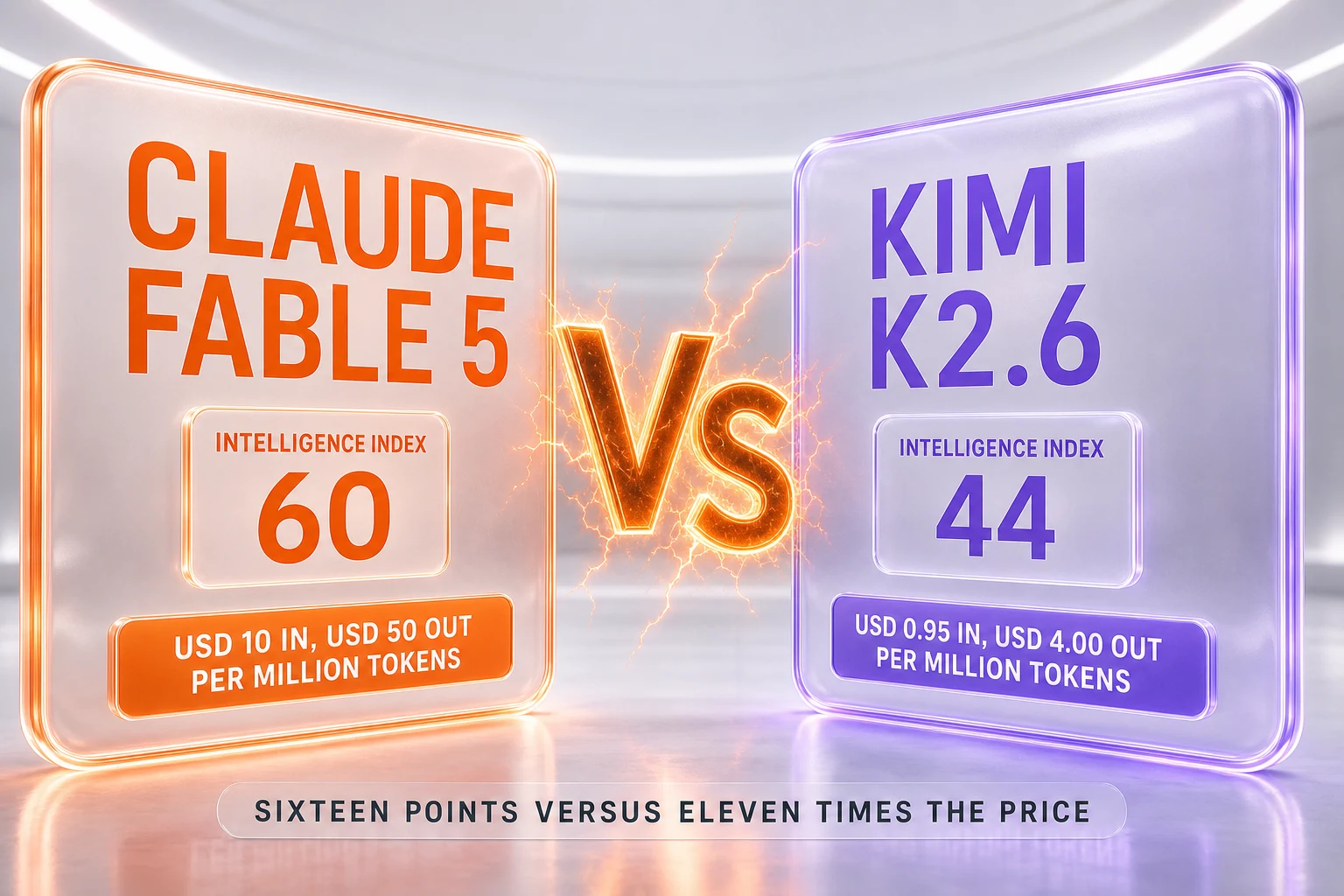
Fable 5 scores 60 on the independent index, Kimi K2.6 scores 44 and costs 11 times less. We ran both side by side. Here is exactly where each one wins.
Feature Comparison
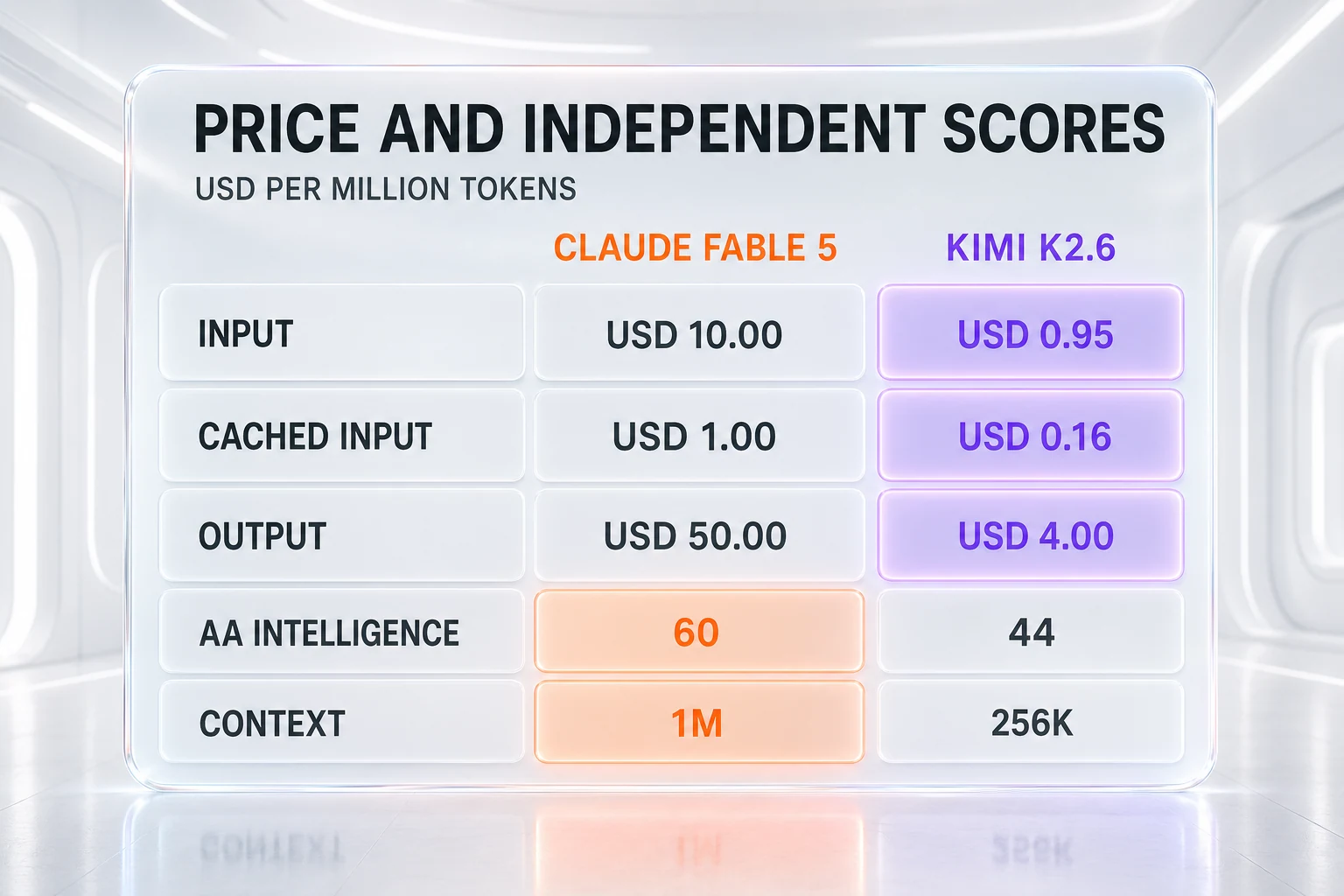
| Feature | Claude Fable 5 | Kimi K2.6 |
|---|---|---|
| Input price per million tokens | USD 10.00 | USD 0.95 |
| Cached input price per million tokens | USD 1.00 | USD 0.16 |
| Output price per million tokens | USD 50.00 | USD 4.00 |
| Cost of a 10M input plus 2M output workload | Around USD 200 | Around USD 17.50 |
| Artificial Analysis Intelligence Index v4.1 (independent) | 60 (highest measured) | 44 |
| Context window | 1,000,000 tokens | 256,000 tokens |
| Independent coding verification | Yes, measured by vals.ai (third party) | No, vendor self-reported figures only |
| Weights and license | Closed, API only | Open weights, Modified MIT |
| Self-hosting | Not available | Yes, on your own hardware |
| Published agent orchestration ceiling | Not published | Up to 300 sub-agents across 4,000 steps |
Pricing Comparison
Claude Fable 5
Kimi K2.6
Detailed Comparison
Claude Fable 5 vs Kimi K2.6 in 2026: Claude Fable 5 is Anthropic's premium flagship, priced at USD 10 per million input tokens, USD 1 per million cached input tokens, and USD 50 per million output tokens, with a 1,000,000-token context window. It scores 60 on the independent Artificial Analysis Intelligence Index version 4.1 — the highest score of any model measured — and 1509 on LMArena. Kimi K2.6 is Moonshot AI's open-weight flagship, released on April 20, 2026, priced at USD 0.95 per million input tokens, USD 0.16 cached, and USD 4 per million output tokens, with a 256,000-token context and downloadable weights under a Modified MIT license. On the same version of the same independent index, Kimi K2.6 scores 44. So the trade is precise and unusually clean: 16 index points against roughly 10.5 times the input price and 12.5 times the output price. There is no overall winner here. Claude Fable 5 wins capability, context, and verified coding evidence. Kimi K2.6 wins price, openness, and operational control — and it wins them by margins that no capability gap of this size can absorb for most workloads.
Quick Verdict
This matchup is rare, and it is rare in a useful way. Both of these models have been scored by the same independent evaluator, on the same version of the same index, under the same harness. That almost never happens when a Western flagship meets a Chinese open-weight model, and it means we can do something here that we normally cannot: compare their intelligence directly, without hedging.
The result is not close, and it is not ambiguous either. Claude Fable 5 scores 60 on the Artificial Analysis Intelligence Index version 4.1. Kimi K2.6 scores 44. Both figures are independent. Sixty is the highest score on that board. Forty-four sits well down the field.
And then you look at the invoice, and the picture inverts. Fable 5 charges USD 10 per million input tokens and USD 50 per million output tokens. Kimi K2.6 charges USD 0.95 and USD 4. Run a realistic month — say 10 million input tokens and 2 million output tokens — and Fable 5 bills you around USD 200 while Kimi K2.6 bills you around USD 17.50. That is roughly 11.4 times the cost for 16 points of measured intelligence.
We are not naming an overall winner in this comparison, and that is a decision rather than a dodge. These two models are not substitutes for one another. One of them is the most capable thing money can buy and is priced accordingly. The other is a competent mid-field model that costs almost nothing and that you can download and run on your own hardware. Declaring a single victor would require us to assume your workload, and your workload is the only variable that settles this.
What we will give you instead is a hard rule, stated up front:
If the hardest task in your workload sits above what a 44-index model can complete, Claude Fable 5 is not expensive — it is the only option, and the price is irrelevant because Kimi K2.6 will not finish the job at any price. If your hardest task sits below that line, Kimi K2.6 is the correct pick and Claude Fable 5 is an eleven-fold tax on capability you are not going to use. Most teams, honestly, sit below the line more often than they think.
- Fable 5 wins measured intelligence. 60 against 44 on the independent index, plus 1509 on LMArena. This is a real, third-party-measured gap, not a marketing claim.
- Fable 5 wins verified coding evidence. It has an independently measured coding score. Kimi K2.6's coding case rests entirely on Moonshot AI's own harness. More on why those two things cannot be put in the same row below.
- Fable 5 wins context. 1,000,000 tokens against 256,000 — close to four times the room.
- Kimi K2.6 wins price, decisively. Roughly 10.5 times cheaper on input, 12.5 times cheaper on output, and around 6 times cheaper on cached input.
- Kimi K2.6 wins control. Open weights under a Modified MIT license, self-hostable, with the full architecture published.
- Kimi K2.6 wins published agent orchestration. Moonshot documents swarms of up to 300 sub-agents across 4,000 coordinated steps. Anthropic publishes no equivalent ceiling for Fable 5.
How We Compared Them, and the Rule We Do Not Break
We ran both models side by side on their APIs — the same refactoring tasks, the same long-document work, the same agentic tool-calling loops — to understand how each one behaves when it is actually working rather than when it is being benchmarked. That hands-on time shapes the judgment calls in this piece: how each model recovers from a failed tool call, how much scaffolding it needs, where it starts to drift.
What that time does not do is produce numbers. We do not publish our own benchmark scores, because a handful of prompts run by one team is not a benchmark and pretending otherwise would be worse than saying nothing. Every figure on this page comes either from a named independent evaluator or from the vendor, and we label which is which, every single time.
Two definitions, because in this comparison they do a lot of work:
- Independent means a third party with no stake in the result ran the test — Artificial Analysis, LMArena, or vals.ai. These numbers are comparable across models, because the same harness ran all of them under the same conditions.
- Vendor self-reported means the company that built the model ran the benchmark on its own harness and published the result. That is useful signal and we will quote it. It is not verification, it is not comparable to an independent number, and it is not reliably comparable to another vendor's self-reported number either, because no two vendor harnesses are alike.
One more thing about the index scores, and it matters more than it sounds. Both Fable 5's 60 and Kimi K2.6's 44 are measured on version 4.1 of the Artificial Analysis Intelligence Index. Index versions are not interchangeable. You will find articles quoting a score of 54 for Kimi K2.6 — that figure comes from an earlier version of the index, and setting it against a version 4.1 score for Fable 5 produces a comparison that means nothing at all. We use 44, because 44 is what K2.6 scores on the same board Fable 5 is standing on.
Claude Fable 5 in Brief
Claude Fable 5 is Anthropic's premium flagship and the most expensive model we track. It costs USD 10 per million input tokens, USD 1 per million cached input tokens, and USD 50 per million output tokens. It carries a 1,000,000-token context window and it is closed: API access only, no weights, no self-hosting, no fine-tuning.
What that money buys is, at the moment, the top of the board. Fable 5 scores 60 on the independent Artificial Analysis Intelligence Index version 4.1, which is the highest score any model has posted on it. It holds a 1509 rating on LMArena, the human-preference leaderboard. And on SWE-bench Verified, it posts 95 percent — a figure measured by vals.ai, an independent third party, not by Anthropic. Very few models in this market carry an independently verified coding number at all, and none of them carries one that high.
The weaknesses are exactly the ones you would predict from that profile. The output price is brutal for anything that generates tokens continuously, which describes most agentic work. The architecture is undisclosed, so you cannot reason about how it behaves at the margins. And because it is API-only, your data leaves your infrastructure and your access depends on a vendor's product decisions.
Kimi K2.6 in Brief
Kimi K2.6 is Moonshot AI's open-weight flagship, released on April 20, 2026 by the Beijing-based lab. It costs USD 0.95 per million input tokens, USD 0.16 cached, and USD 4 per million output tokens through the API. Consumer plans run from USD 0 on the free Adagio tier up to USD 159 per month on Vivace.
Architecturally it is a serious piece of engineering, and unlike Fable 5 you can read the whole design. It is a mixture-of-experts model with roughly 1 trillion parameters in the sparse core and about 1.1 trillion in total, of which around 32 billion are active on any given token. It routes across 384 experts, selecting 8 plus one shared expert per token. It ships a 400-million-parameter MoonViT vision encoder. The context window is 256,000 tokens — 262,144 exactly. And the weights are downloadable under a Modified MIT license, which means you can serve the model on your own hardware and keep every token inside your own network.
Its headline capability claim is agentic. Moonshot documents Kimi K2.6 coordinating swarms of up to 300 sub-agents across as many as 4,000 steps in a single run. That is an unusually explicit ceiling to publish, and no equivalent figure exists for Fable 5.
Then there is the independent number, and it is where the marketing and the measurement part company. On the Artificial Analysis Intelligence Index version 4.1, Kimi K2.6 scores 44. That is a real score from a real evaluator, and it places K2.6 in respectable mid-field company rather than at the frontier. It is not a bad result. It is simply nowhere near 60.
Head to Head: Every Row We Can Honestly Build
One row you will not find in this table is a coding row that sets Fable 5's 95 percent against Kimi K2.6's 58.6. Those are two different benchmarks measured under two different evidentiary regimes, and putting them in the same row would be the single most misleading thing we could do on this page. We explain that in full in the coding section. What we do instead is a row on whether independent coding verification exists at all — which is a question with an honest answer.
| Feature | Claude Fable 5 | Kimi K2.6 | Winner |
|---|---|---|---|
| Input price per million tokens | USD 10.00 | USD 0.95 | Kimi K2.6 |
| Cached input price per million tokens | USD 1.00 | USD 0.16 | Kimi K2.6 |
| Output price per million tokens | USD 50.00 | USD 4.00 | Kimi K2.6 |
| Cost of a 10M input plus 2M output workload | Around USD 200 | Around USD 17.50 | Kimi K2.6 |
| Artificial Analysis Intelligence Index v4.1 (independent) | 60 — highest measured | 44 | Claude Fable 5 |
| Context window | 1,000,000 tokens | 256,000 tokens | Claude Fable 5 |
| Independent coding verification | Yes — measured by vals.ai, a third party | No — vendor figures only | Claude Fable 5 |
| Weights and license | Closed, API only | Open weights, Modified MIT | Kimi K2.6 |
| Self-hosting | Not available | Yes, on your own hardware | Kimi K2.6 |
| Published agent orchestration ceiling | Not published | Up to 300 sub-agents across 4,000 steps | Kimi K2.6 |
Seven rows to Kimi K2.6, three to Claude Fable 5. Resist the urge to read that as a score, because it is not one, and we explain why in the final verdict. Row counts reward whichever model happens to have more separately nameable advantages, and Kimi's advantages fragment into more rows than Fable's do.
Pricing: What an Eleven-Fold Gap Actually Costs
Here are the three numbers that decide most of this comparison, all per million tokens:
- Input: Fable 5 charges USD 10.00. Kimi K2.6 charges USD 0.95. Fable 5 is roughly 10.5 times more expensive.
- Cached input: Fable 5 charges USD 1.00. Kimi K2.6 charges USD 0.16. Fable 5 is roughly 6 times more expensive.
- Output: Fable 5 charges USD 50.00. Kimi K2.6 charges USD 4.00. Fable 5 is 12.5 times more expensive.
Notice which gap is widest. It is output — the tokens the model generates rather than the tokens you feed it. That detail is not a footnote, because output is precisely what agentic workloads consume. A coding agent that reasons across a repository, plans a change, writes the diff, runs the tests, reads the failure, and tries again is an output-token machine. It is the exact workload where Fable 5's premium bites hardest, and it is also, awkwardly, the workload where Fable 5's capability advantage is most likely to be worth something. This tension does not resolve neatly, and anyone who tells you it does is selling you one of the two models.
Cached input narrows the gap, but only in a specific shape of application. Fable 5's cached rate of USD 1.00 per million tokens is a 90 percent discount on its own list price — a steeper proportional discount than Kimi's, whose cached rate of USD 0.16 is about 83 percent off. If your application replays a large, stable prefix on every call — a long system prompt, a fixed corpus, a persistent codebase context — then a large share of your input tokens bill at the cached rate, and Fable 5's effective input cost falls a long way. It still does not fall to Kimi's. But the 10.5-fold input gap can compress to something closer to sixfold, and on a big enough prefix that difference is worth engineering for.
Put a realistic month through both meters. Ten million input tokens and two million output tokens is a modest production workload — a small internal tool, a moderately busy assistant, one engineer's agent habit.
- Claude Fable 5: 10 million input tokens at USD 10 per million is USD 100. Two million output tokens at USD 50 per million is another USD 100. Total: around USD 200.
- Kimi K2.6: 10 million input tokens at USD 0.95 per million is USD 9.50. Two million output tokens at USD 4 per million is USD 8. Total: around USD 17.50.
Roughly 11.4 times the bill, for the same volume of work. Multiply that by a team, by a year, by an agent that runs on a loop, and the difference stops being a line item and becomes a budget.
One honest caveat that cuts against Kimi, and we would rather say it than have you find it: K2.6 is not the cheapest model at its own intelligence level. DeepSeek V4's Pro tier also scores 44 on the same version 4.1 index, and since August 16, 2026 it charges USD 0.66 per million input tokens and USD 1.98 per million output tokens outside peak hours, and double that during them. Off-peak it still undercuts Kimi on both, though by far less than it once did; during peak hours it costs more than Kimi on input and matches it on output. If your reason for choosing K2.6 over Fable 5 is purely price at a given capability, you owe yourself a look at what else sits at 44. Kimi's differentiators against DeepSeek are the vision encoder, the documented agent swarm, and the Modified MIT license, not the raw rate card.
Intelligence: What Sixteen Index Points Buy
The Artificial Analysis Intelligence Index is a composite: a battery of reasoning, knowledge, and problem-solving evaluations run by a third party under a single harness, aggregated into one number. It is not a perfect proxy for usefulness. It is, however, the best like-for-like signal available, and crucially both of our models are on it, on the same version.
Claude Fable 5: 60. Kimi K2.6: 44.
To calibrate that spread, it helps to see the neighborhood. On the same version 4.1 board, GPT-5.6 Sol sits at 59, Claude Opus 4.8 at 56, Grok 4.5 at 54, Claude Sonnet 5 at 53, and GLM-5.2 at 51. Fable 5's 60 is not a comfortable lead over the frontier — it is a one-point lead over GPT-5.6 Sol. But the gap from the frontier down to 44 is a different kind of distance. Kimi K2.6 is not competing with Fable 5 for the top of the board; it is competing in a tier that begins roughly nine points below Fable's nearest rival.
So what do 16 points actually mean when you are working rather than reading a leaderboard? Our hands-on impression, offered as impression rather than measurement, is that the gap shows up as a difficulty threshold rather than as a uniform quality difference. On routine work — summarization, extraction, drafting, straightforward code, single-file edits, well-specified transformations — the two models produce output that is close enough that you would struggle to pick the expensive one out of a lineup. On hard work — multi-step reasoning where an early wrong turn poisons everything downstream, sprawling refactors, genuinely ambiguous specifications, tasks that require the model to notice that the question itself is wrong — the gap opens abruptly and stays open.
That is why we frame the decision as a threshold rather than a slider. You are not buying 36 percent more intelligence for 1,140 percent more money, which would be an obviously terrible trade. You are buying a higher ceiling, and the question is whether your work ever touches the ceiling. If it does, the ceiling is worth whatever it costs, because below it the cheaper model does not produce a worse answer — it produces a failed one, and then you pay for the retry, and then you pay an engineer to work out why. If your work never touches the ceiling, you are paying for altitude you will never reach.
Fable 5's 1509 on LMArena adds a second, independent data point from a different direction: human preference on open-ended prompts rather than scored evaluations. It is a strong rating and it is consistent with the index result. We do not have a like-for-like human-preference figure for Kimi K2.6 in our source set, and rather than assert an absence we cannot verify, we simply leave that comparison unmade.
Coding: The Row We Refuse to Build
This is where most comparisons of these two models go wrong, and it is worth being blunt about the mechanics of the error.
Claude Fable 5 posts 95 percent on SWE-bench Verified, and that figure was produced by vals.ai, an independent third party. Kimi K2.6 posts 58.6 on SWE-bench Pro, and that figure was produced by Moonshot AI, the company that built the model.
These two numbers differ on two axes at once, and either difference alone would be enough to make them incomparable.
First, they are different benchmarks. SWE-bench Verified and SWE-bench Pro are not the same test with a different label. They draw on different task sets with different difficulty distributions, and a model's score on one tells you very little about what it would score on the other. Comparing them is not like comparing two sprinters' 100-meter times; it is like comparing a sprinter's 100-meter time to a different runner's hurdles time and declaring one of them faster.
Second, they were produced under different evidentiary regimes. One was measured by an evaluator with nothing to gain. The other was measured by the vendor, on the vendor's own harness, with the vendor's own scaffolding, and published by the vendor's marketing function. Vendor numbers are not lies — Moonshot's figure is plausible for a model of this architecture, and vendor self-reporting is standard industry practice. But a vendor number has not been checked, and an unchecked number cannot be set against a checked one without quietly laundering the difference.
So we will not put 95 and 58.6 in the same table row. Not in the comparison table above, not in the infographic, not in a sentence engineered to imply the comparison while technically avoiding it. Instead, here is what each number honestly supports on its own terms:
What Fable 5's number supports: that an independent evaluator, running its own harness, found that Fable 5 resolves 95 percent of the SWE-bench Verified task set. That is the strongest independently verified coding result in this market, and it is the single most concrete thing you get for the price premium.
What Kimi K2.6's number supports: that Moonshot's own evaluation of K2.6 on SWE-bench Pro returned 58.6. For internal context, Moonshot reports that this beats GPT-5.4 at 57.7 and Claude Opus 4.6 at 53.4 on the same benchmark — but note that those comparisons are also drawn from Moonshot's own harness, so they tell you how K2.6 ranks inside Moonshot's evaluation, not how it ranks in the world. Read the vendor's claim as a claim: it says Moonshot believes K2.6 is competitive with the previous generation of Western frontier models at coding. That belief may well be right. Nobody outside Moonshot has confirmed it.
The practical consequence for you is straightforward. If you cannot run your own evaluation, Fable 5's coding evidence is the only coding evidence on this page that has been checked by anyone, and that is worth paying for. If you can run your own evaluation — if you have a task set that reflects your actual repository and you can measure both models on it — then you produce your own verification, the asymmetry collapses, and you are back to arguing about price. Which Kimi wins by a factor of eleven.
Context: One Million Against 256,000
Fable 5 carries a 1,000,000-token context window. Kimi K2.6 carries 256,000 — 262,144 exactly. Close to a fourfold difference.
Whether this matters is a question about your data, not about the models. Two hundred and fifty-six thousand tokens is a large window by any historical standard: roughly a mid-sized codebase, a long technical specification with its appendices, several hours of transcript. Most tasks fit inside it comfortably, and if yours do, this row is decorative.
Where it stops being decorative is at the extremes, and the extremes are not exotic anymore. Feeding an entire large repository to a model in one shot, running a long agentic session that accumulates context across hundreds of tool calls, analyzing a full corpus of documents without a retrieval layer in between — these are workloads where a 256,000-token ceiling forces you to build chunking and retrieval machinery, and where a 1,000,000-token ceiling lets you skip it. That machinery is not free. It costs engineering time, it introduces bugs, and it loses information at the seams.
So the honest framing is: for most teams, context is a Fable 5 win that does not change the decision. For a minority whose work lives at the ceiling, it is one of the two or three things that makes Fable 5 non-negotiable — and combined with the intelligence gap, it is the reason that minority exists at all.
Architecture, Openness, and the 300-Agent Swarm
Everything above is about what the models do. This section is about what you can do with them, and it is where the comparison stops being about scores.
Kimi K2.6's weights are downloadable, under a Modified MIT license. The consequences of that sentence are larger than they look on a spec sheet:
- Data residency by construction. If you serve the weights on your own hardware, no token ever leaves your network. That is not a contractual promise from a vendor; it is a property of where the computation happens. For regulated industries, this is frequently the whole ballgame, and no amount of Fable 5's capability substitutes for it.
- No deprecation risk. A model you have downloaded cannot be sunset, repriced, rate-limited, or quietly swapped for a successor that behaves differently. Anyone who has had a production prompt break because a hosted model was updated underneath them knows exactly what this is worth.
- Fine-tuning and inspection. You can adapt the weights to your domain, and you can reason about the architecture because Moonshot published it: a sparse mixture-of-experts core of roughly 1 trillion parameters — about 1.1 trillion in total — with around 32 billion active per token, routed across 384 experts with 8 selected plus one shared, and a 400-million-parameter MoonViT vision encoder attached.
None of this is available with Fable 5, at any price. It is closed, it is hosted, and Anthropic publishes nothing comparable about how it is built.
The counterweight is that open weights are a capability you have to pay for in a different currency. Self-hosting a model with a trillion parameters in its sparse core is not a weekend project. You need serious accelerators, an inference stack, someone to keep it running, and someone to own it when it falls over at 3 a.m. Fable 5's USD 50 per million output tokens looks a lot less unreasonable when you price the alternative honestly — and if you are going to consume Kimi through Moonshot's API anyway, rather than self-hosting it, then the openness argument mostly evaporates and you are simply buying a cheaper hosted model. Which is a perfectly good reason to buy it. It is just not the same reason.
The agent swarm deserves its own note, because it is the one capability claim where Kimi K2.6 has published a specific ceiling and Anthropic has not. Moonshot documents K2.6 coordinating up to 300 sub-agents across as many as 4,000 steps in a single orchestrated run. If you are building fan-out agentic systems, that is a design constraint you can plan against. Fable 5 gives you no equivalent published number — which does not mean it cannot do it, only that you will find out empirically rather than from the documentation. We are recording that as a Kimi win on transparency of the ceiling, not as proof that Kimi orchestrates better.
Winner by Category
| Category | Winner | Why |
|---|---|---|
| Best measured intelligence | Claude Fable 5 | 60 against 44 on the same version of the same independent index. Not a marketing claim — a third-party measurement. |
| Best verified coding evidence | Claude Fable 5 | The only one of the two with a coding score anybody outside the vendor has checked. |
| Best for very long context | Claude Fable 5 | 1,000,000 tokens against 256,000. |
| Best price | Kimi K2.6 | Roughly 10.5 times cheaper on input, 12.5 times cheaper on output. Not close. |
| Best for high-volume agentic loops | Kimi K2.6 | Output tokens are what agents burn, and Fable 5 charges 12.5 times more for them. |
| Best for data residency and control | Kimi K2.6 | Open weights under Modified MIT, self-hostable. Fable 5 cannot offer this at any price. |
| Best documented agent orchestration | Kimi K2.6 | A published ceiling of 300 sub-agents across 4,000 steps. Anthropic publishes no equivalent. |
| Best architectural transparency | Kimi K2.6 | Full mixture-of-experts design published. Anthropic discloses nothing comparable. |
| Best managed experience | Claude Fable 5 | Nothing to serve, nothing to operate, no inference stack to own. |
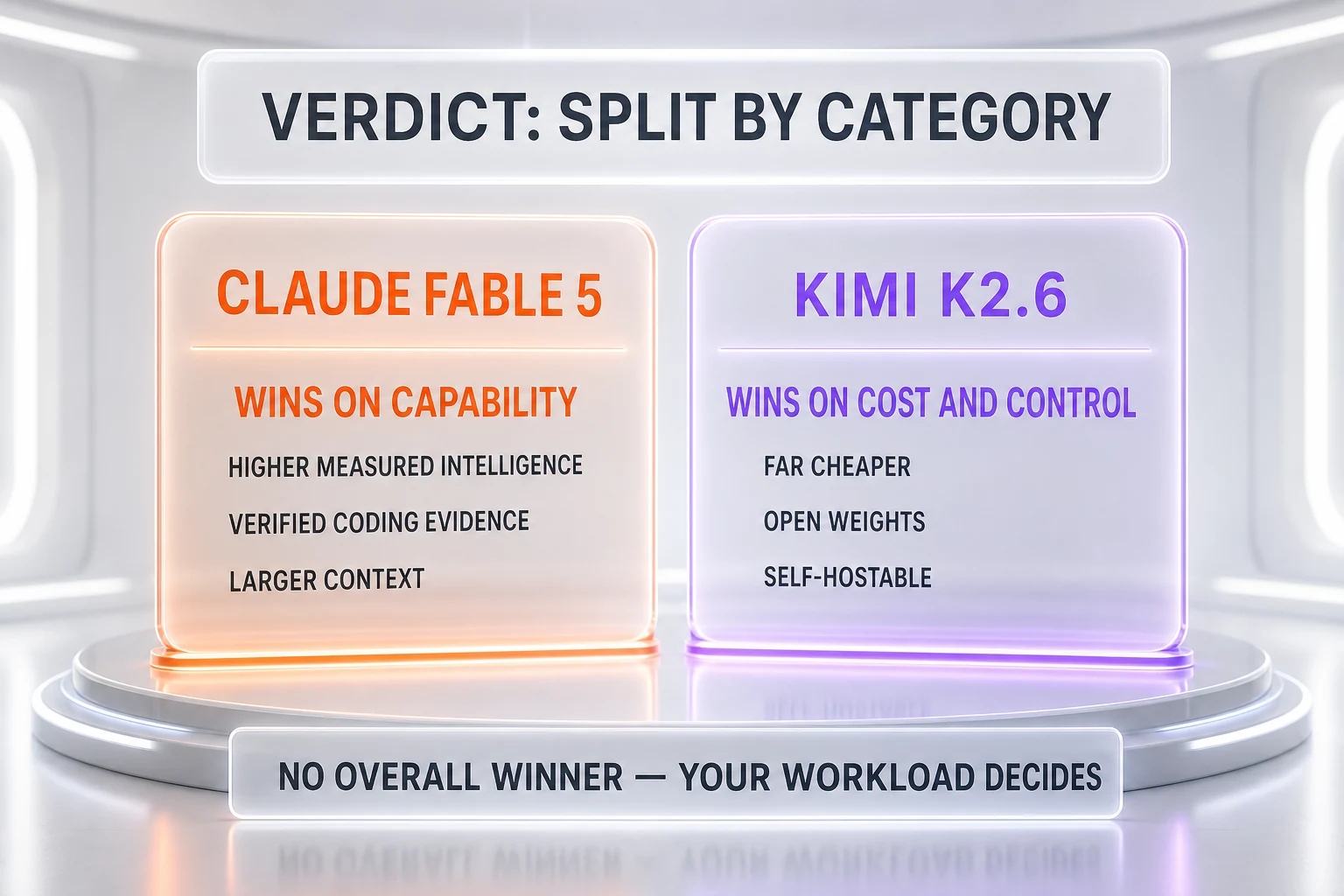
| Best overall | No single winner | They are not substitutes. The threshold rule in the final verdict decides it for your workload. |
Pros and Cons
Claude Fable 5
Pros
- Highest score on the independent Artificial Analysis Intelligence Index version 4.1 at 60 — the top of the board, measured by a third party.
- 1509 on LMArena, an independent human-preference leaderboard.
- An independently verified coding result — 95 percent on SWE-bench Verified, measured by vals.ai rather than by Anthropic.
- 1,000,000-token context window, close to four times Kimi K2.6's.
- Cached input at USD 1 per million tokens is a 90 percent discount on list, which materially softens the cost of applications built on a large stable prefix.
- Fully managed — no weights to serve, no accelerators to buy, no inference stack to keep alive.
Cons
- Very expensive: USD 10 per million input tokens and USD 50 per million output tokens, roughly 10.5 and 12.5 times Kimi K2.6's rates.
- The output premium lands hardest on exactly the workload you would most want to run — continuous agentic loops.
- Closed weights. No self-hosting, no fine-tuning, no protection against repricing or deprecation.
- Undisclosed architecture — you cannot inspect how it works or reason about its behavior at the margins.
- No published ceiling for multi-agent orchestration, so you discover the limits by hitting them.
Kimi K2.6
Pros
- Extremely cheap: USD 0.95 per million input tokens, USD 0.16 cached, USD 4 per million output tokens.
- Open weights under a Modified MIT license — downloadable, self-hostable, fine-tunable.
- Full architectural disclosure: a sparse mixture-of-experts core of roughly 1 trillion parameters, about 1.1 trillion in total, with around 32 billion active per token across 384 experts, plus a 400-million-parameter MoonViT vision encoder.
- A published agent orchestration ceiling of up to 300 sub-agents across 4,000 coordinated steps.
- It does have an independent intelligence score — 44 on the version 4.1 index — which is more than most open-weight challengers can say.
- A free consumer tier, with paid plans running up to USD 159 per month.
Cons
- Sixteen points behind Fable 5 on the independent index, and that gap is measured rather than alleged.
- No independently verified coding score. Its SWE-bench Pro figure of 58.6 is Moonshot's own measurement on Moonshot's own harness.
- 256,000-token context — a quarter of Fable 5's — which forces retrieval machinery on workloads that Fable 5 swallows whole.
- Not even the cheapest model at its own intelligence tier: DeepSeek V4's Pro tier scores the same 44 for less money per token.
- Self-hosting a trillion-parameter mixture-of-experts model is a serious infrastructure commitment, and if you skip it and use the hosted API instead, most of the openness advantage disappears.
When to Pick Claude Fable 5
Pick Fable 5 when your work touches the ceiling — and be honest with yourself about whether it does.
- Your hardest tasks are genuinely hard. Multi-step reasoning where an early error is unrecoverable, sprawling refactors across an unfamiliar codebase, ambiguous specifications that require the model to notice the ambiguity. This is where 16 index points stop being an abstraction.
- You cannot evaluate models yourself. If you have no task set and no evaluation harness, then you are choosing between a coding number a third party verified and a coding number a vendor asserted, and that is not really a choice.
- Your context genuinely exceeds 256,000 tokens. Whole-repository ingestion, very long agentic sessions, full-corpus analysis without a retrieval layer.
- Your token volume is low enough that the premium is noise. If you are spending USD 200 a month rather than USD 200,000, an 11-fold multiplier on a small number is still a small number, and buying the best model on the board is simply the rational move.
- You need it managed. No hardware, no inference stack, no on-call rotation for a model server.
When to Pick Kimi K2.6
Pick Kimi K2.6 when cost or control is the binding constraint — which, for most teams, it quietly is.
- You run high volume. The output gap of 12.5 times compounds with every token an agent generates, and agents generate a lot of tokens. At scale this is the difference between a viable product and an unviable one.
- Your tasks sit below the difficulty threshold. Summarization, extraction, drafting, well-specified code, single-file edits, transformations with clear inputs and outputs. A 44-index model does this work, and Fable 5 does not do it eleven times better.
- Data residency is a hard requirement. Self-hosted open weights mean no token leaves your network. Fable 5 cannot offer this at any price, and no capability score changes that.
- You can measure the models yourself. Your own evaluation on your own task set replaces the missing independent verification entirely — and once it does, the price gap is the only thing left standing.
- You are building fan-out agent systems. The published ceiling of 300 sub-agents across 4,000 steps is a real design input that Fable 5's documentation does not give you.
- You want to fine-tune. Modified MIT weights, your domain, your hardware.
Final Verdict
There is no overall winner in this comparison, and we want to be precise about why that is a conclusion rather than a refusal to reach one.
Start with the row count, because it looks like it settles things and it does not. Kimi K2.6 takes seven rows in our table; Fable 5 takes three. But four of Kimi's seven — input price, cached input price, output price, and the blended workload cost — are one axis counted four times. That axis is cost, and it is an enormous advantage, but it is one advantage. Two more, open weights and self-hosting, are also a single axis: control. So Kimi's case, stated honestly, is it costs roughly a tenth as much and you can own it, plus a published orchestration ceiling that Anthropic simply has not disclosed.
Fable 5's three rows are of a different type. They answer "how good is it, really?" — and unlike the last time we ran this exercise against a Moonshot model, the answer is not "nobody knows." It is 60 against 44, measured by the same evaluator on the same board. Kimi K2.6 has an independent score. It is a mid-field one.
Which means the question this page exists to answer is now a clean one: are 16 points of independently measured intelligence worth roughly eleven times the bill?
And the honest answer is that it depends on one thing only, and it is not your budget. It is the difficulty of the hardest task you actually run.
If that task sits above what a 44-index model can complete, the price comparison is a category error. Kimi K2.6 will not do the job, and a model that does not do the job is not cheap — it is free and useless, and then you pay for the retry, the fallback, and the engineer who has to work out what went wrong. Under those conditions Fable 5 is not a premium purchase. It is the only purchase.
If that task sits below the line — and for most teams, most of the time, it does — then Fable 5 is selling you a ceiling you will never touch, at eleven times the price of a model that reaches everything you actually ask of it. Under those conditions Kimi K2.6 is not the budget option. It is the correct one, and paying for Fable 5 is a rounding error made expensive.
So run the test that settles it: take the hardest thing you genuinely need done, run it through both, and look at the failures rather than the polish. If Kimi K2.6 completes it, buy Kimi K2.6, and do not let a leaderboard talk you out of eleven-fold savings. If it does not, buy Fable 5 and stop optimizing the wrong variable.
Where this verdict is wrong: if Moonshot's next release closes the index gap while holding the price — and the trajectory of Chinese open-weight models over the past year makes that neither impossible nor even unlikely — then the threshold moves, more workloads fall below the line, and the case for Fable 5 narrows to a smaller and smaller top slice of the difficulty distribution. Equally, if an independent evaluator produces a coding number for K2.6 that lands far below Moonshot's self-reported claim, the reverse happens and Fable 5's premium starts to look like insurance rather than indulgence. Both of those are live possibilities. Neither has happened yet, and we do not write verdicts about things that have not happened.
For the rest of the field, we have Fable 5 measured against Claude Opus 4.8, against GPT-5.5, and against DeepSeek V4; and Kimi K2.6 against Claude Sonnet 5. If you want the wider landscape, see our roundup of the best AI coding tools in 2026.
Frequently Asked Questions
Which is better overall, Claude Fable 5 or Kimi K2.6?
Neither, and that is a real answer rather than a hedge. Claude Fable 5 is the more capable model by a margin that has been independently measured: 60 against 44 on version 4.1 of the Artificial Analysis Intelligence Index. Kimi K2.6 is roughly 10.5 times cheaper on input tokens and 12.5 times cheaper on output tokens, ships open weights under a Modified MIT license, and can be self-hosted. Those are not competing answers to the same question; they are answers to different questions. The rule we would give you is this: if the hardest task in your workload sits above what a 44-index model can complete, buy Claude Fable 5 because Kimi K2.6 will not finish the job at any price. If it sits below that line, buy Kimi K2.6, because Claude Fable 5 is then charging you eleven times more for a ceiling you will never reach.
Can I compare Claude Fable 5's 95 percent to Kimi K2.6's 58.6 on coding?
No, and it is one of the most common errors made about this matchup. The two figures differ on two axes at once. First, they are different benchmarks: Claude Fable 5's 95 percent is on SWE-bench Verified, while Kimi K2.6's 58.6 is on SWE-bench Pro, and those are different task sets with different difficulty distributions. Second, they come from different evidentiary regimes: Fable 5's number was measured by vals.ai, an independent third party, while Kimi K2.6's was measured by Moonshot AI, the company that built the model, on its own harness. Either difference alone would make them incomparable. Together they make any side-by-side reading meaningless, which is why you will not find those two figures in the same table row anywhere on this page.
Does Kimi K2.6 have an independent Artificial Analysis score?
Yes. Kimi K2.6 scores 44 on version 4.1 of the Artificial Analysis Intelligence Index, measured independently. That is genuinely notable, because many open-weight challengers have no third-party score at all. Claude Fable 5 scores 60 on the same version of the same index, which is the highest score any model has posted on it. Because both figures come from the same evaluator running the same harness, they are directly comparable — which is exactly why this comparison can talk about intelligence honestly, while it cannot do the same for coding.
Why do some articles say Kimi K2.6 scores 54 on the Artificial Analysis index?
Because they are quoting an earlier version of the index. The Artificial Analysis Intelligence Index is versioned, and scores are not portable across versions — the evaluation battery changes, so the numbers move. Kimi K2.6's score on the current version 4.1 of the index is 44. If you set an older 54 against Claude Fable 5's version 4.1 score of 60, you are comparing results from two different tests and the eight-point gap you appear to see is an artifact of the mismatch. Every index figure on this page is version 4.1, for both models, deliberately.
How much cheaper is Kimi K2.6 than Claude Fable 5?
Substantially. Kimi K2.6 charges USD 0.95 per million input tokens, USD 0.16 per million cached input tokens, and USD 4 per million output tokens. Claude Fable 5 charges USD 10, USD 1, and USD 50 for the same three things. That is roughly 10.5 times more expensive on input, about 6 times more expensive on cached input, and 12.5 times more expensive on output. On a realistic monthly workload of 10 million input tokens and 2 million output tokens, Claude Fable 5 bills around USD 200 while Kimi K2.6 bills around USD 17.50 — a factor of roughly 11.4.
Is Kimi K2.6 the same model as Kimi K2.7 Code?
No. They are separate models from Moonshot AI with separate release dates and separate evaluation records, and their numbers must not be carried across. Kimi K2.6 was released on April 20, 2026 and has an independent Artificial Analysis score of 44 on version 4.1 of the index. Kimi K2.7 Code is a later, distinct release that we cover on its own tool page and in its own comparisons. Every figure on this page belongs to Kimi K2.6. If you see a claim about one model backed by a number that was published for the other, treat the whole article with suspicion.
Is Kimi K2.6 really open source?
It is open-weight, which is close but not identical. Moonshot AI publishes the model weights under a Modified MIT license and you can download them, run them on your own hardware, and fine-tune them. What you do not get is the training data or the training code, so "open source" in the strict software sense overstates it. In practice the distinction rarely changes a buying decision: the things teams usually want from openness — data residency, no deprecation risk, self-hosting, fine-tuning, inspectable architecture — are all available. Claude Fable 5 offers none of them at any price.
What do the sixteen index points actually feel like in practice?
Like a difficulty threshold rather than a uniform quality gap. On routine work — summarization, extraction, drafting, well-specified code, single-file edits — the outputs are close enough that you would struggle to identify the expensive model in a blind test. On hard work — multi-step reasoning where an early wrong turn is unrecoverable, large ambiguous refactors, tasks that require the model to notice the question itself is flawed — the gap opens abruptly. That is why we frame the decision as a threshold: you are not buying 36 percent more intelligence, you are buying a higher ceiling, and the only question that matters is whether your work ever reaches it.
Which one should I use for agentic coding loops?
It cuts both ways, and the tension does not resolve neatly. Agents burn output tokens, and Claude Fable 5 charges 12.5 times more for those than Kimi K2.6 does, so the cost pressure argues hard for Kimi. But agentic coding is also the workload most likely to hit the difficulty ceiling, where a failed step cascades into wasted turns and Fable 5's capability advantage pays for itself. The practical answer is to measure rather than reason: run your agent on both for a week, and compare cost per completed task rather than cost per million tokens. If Kimi K2.6 completes the work, the price gap is decisive. If it stalls or loops, Fable 5's premium is buying you something real.
Is Kimi K2.6 the cheapest model at its capability level?
No, and this cuts against Kimi rather than for it. DeepSeek V4's Pro tier scores the same 44 on version 4.1 of the Artificial Analysis Intelligence Index and since August 16, 2026 charges USD 0.66 per million input tokens and USD 1.98 per million output tokens outside peak hours, less than Kimi K2.6 on both, and double those rates during peak hours, when it is the more expensive of the two on input. If your only reason for picking Kimi K2.6 over Claude Fable 5 is price at a given capability, you should look at what else sits at 44 before committing. Kimi's differentiators against other cheap models are its vision encoder, its documented agent swarm, and its Modified MIT license, not its rate card.
Does the 256,000-token context window hold Kimi K2.6 back?
Only at the extremes, but the extremes are getting less exotic. Two hundred and fifty-six thousand tokens covers a mid-sized codebase, a long specification with appendices, or several hours of transcript, and most tasks fit inside it comfortably. Where it bites is whole-repository ingestion, very long agentic sessions that accumulate context across hundreds of tool calls, and full-corpus analysis without a retrieval layer. Claude Fable 5's 1,000,000-token window lets you skip the chunking and retrieval machinery those workloads otherwise demand — and that machinery costs engineering time, introduces bugs, and loses information at the seams.
What would change this verdict?
Two things, in opposite directions. If Moonshot AI closes the index gap in a future release while holding the price, then the difficulty threshold moves, more workloads fall below it, and the case for Claude Fable 5 shrinks to an ever smaller top slice of hard tasks. Conversely, if an independent evaluator finally produces a third-party coding score for Kimi K2.6 and it lands well below Moonshot's self-reported figure, Fable 5's premium starts to look like insurance rather than indulgence. Both outcomes are plausible on current trajectories. Neither has happened, and we do not publish verdicts on things that have not happened.
Last compared: July 2026. Pricing and independent index scores verified against vendor documentation and Artificial Analysis version 4.1 at the time of writing. We label every figure as either independent or vendor self-reported, and we never stack the two.
Sources and references
Every figure on this page is attributed to whoever produced it. Vendor documentation and independent measurement are listed separately and never merged into a single ranking.
- Artificial Analysis — Claude Fable 5 (independent Intelligence Index score and cost per task)
- Artificial Analysis — Kimi K2.6 (independent index score)
- Artificial Analysis — Model leaderboard (Intelligence Index scores and cost per task across configurations)
Our Verdict
There is no overall winner here, and that is a conclusion rather than a hedge: Claude Fable 5 and Kimi K2.6 are not substitutes for one another. Both models are scored on the same version 4.1 of the independent Artificial Analysis Intelligence Index, which makes the trade unusually clean — Claude Fable 5 posts 60, the highest score any model has recorded, while Kimi K2.6 posts 44. That is a real, third-party-measured gap of 16 points. Against it stands a price gap that runs the other way and runs harder: Claude Fable 5 charges USD 10 per million input tokens, USD 1 cached, and USD 50 per million output tokens, while Kimi K2.6 charges USD 0.95, USD 0.16, and USD 4 — roughly 10.5 times cheaper on input and 12.5 times cheaper on output, with open weights under a Modified MIT license, self-hosting, a published ceiling of 300 sub-agents across 4,000 coordinated steps, and a fully disclosed mixture-of-experts architecture. On coding, the evidence is asymmetric and cannot be stacked: Claude Fable 5's 95 percent on SWE-bench Verified was measured independently by vals.ai, whereas Kimi K2.6's 58.6 on SWE-bench Pro is a different benchmark measured by Moonshot AI itself, so the two figures are never set against each other on this page. The rule that settles it: if the hardest task in your workload sits above what a 44-index model can complete, buy Claude Fable 5 — Kimi K2.6 will not finish the job at any price and the premium is irrelevant. If it sits below that line, and for most teams it does, buy Kimi K2.6 — Claude Fable 5 is then charging roughly eleven times more for a ceiling you will never reach. Best for measured intelligence, verified coding evidence, and 1M-token context: Claude Fable 5. Best for price, open weights, data residency, and high-volume agentic loops: Kimi K2.6.
Choose Claude Fable 5
Anthropic's most capable widely released model — the public, safety-classified Mythos-class frontier tier.
Try Claude Fable 5 →Choose Kimi K2.6
Moonshot AI's open-weight 1T-parameter MoE flagship that scales to 300 sub-agents and 4,000 coordinated steps for long-horizon coding.
Try Kimi K2.6 →Frequently Asked Questions
Is Claude Fable 5 better than Kimi K2.6?
There is no overall winner here, and that is a conclusion rather than a hedge: Claude Fable 5 and Kimi K2.6 are not substitutes for one another. Both models are scored on the same version 4.1 of the independent Artificial Analysis Intelligence Index, which makes the trade unusually clean — Claude Fable 5 posts 60, the highest score any model has recorded, while Kimi K2.6 posts 44. That is a real, third-party-measured gap of 16 points. Against it stands a price gap that runs the other way and runs harder: Claude Fable 5 charges USD 10 per million input tokens, USD 1 cached, and USD 50 per million output tokens, while Kimi K2.6 charges USD 0.95, USD 0.16, and USD 4 — roughly 10.5 times cheaper on input and 12.5 times cheaper on output, with open weights under a Modified MIT license, self-hosting, a published ceiling of 300 sub-agents across 4,000 coordinated steps, and a fully disclosed mixture-of-experts architecture. On coding, the evidence is asymmetric and cannot be stacked: Claude Fable 5's 95 percent on SWE-bench Verified was measured independently by vals.ai, whereas Kimi K2.6's 58.6 on SWE-bench Pro is a different benchmark measured by Moonshot AI itself, so the two figures are never set against each other on this page. The rule that settles it: if the hardest task in your workload sits above what a 44-index model can complete, buy Claude Fable 5 — Kimi K2.6 will not finish the job at any price and the premium is irrelevant. If it sits below that line, and for most teams it does, buy Kimi K2.6 — Claude Fable 5 is then charging roughly eleven times more for a ceiling you will never reach. Best for measured intelligence, verified coding evidence, and 1M-token context: Claude Fable 5. Best for price, open weights, data residency, and high-volume agentic loops: Kimi K2.6.
Which is cheaper, Claude Fable 5 or Kimi K2.6?
Claude Fable 5 starts at $10 in / $50 out per M tokens. Kimi K2.6 offers a free plan (free plan available). Check the pricing comparison section above for a full breakdown.
What are the main differences between Claude Fable 5 and Kimi K2.6?
The key differences span across 10 features we compared. For Input price per million tokens, Claude Fable 5 offers USD 10.00 while Kimi K2.6 offers USD 0.95. For Cached input price per million tokens, Claude Fable 5 offers USD 1.00 while Kimi K2.6 offers USD 0.16. For Output price per million tokens, Claude Fable 5 offers USD 50.00 while Kimi K2.6 offers USD 4.00. See the full feature comparison table above for all details.