Claude Opus 4.8 vs Kimi K3: Higher Score, Lower Price, Pending Weights (2026)


We ran both: Kimi K3 scores 57 on the independent index to Opus 4.8's 56 and costs about 1.67x less, but its open weights ship July 27. A split verdict.
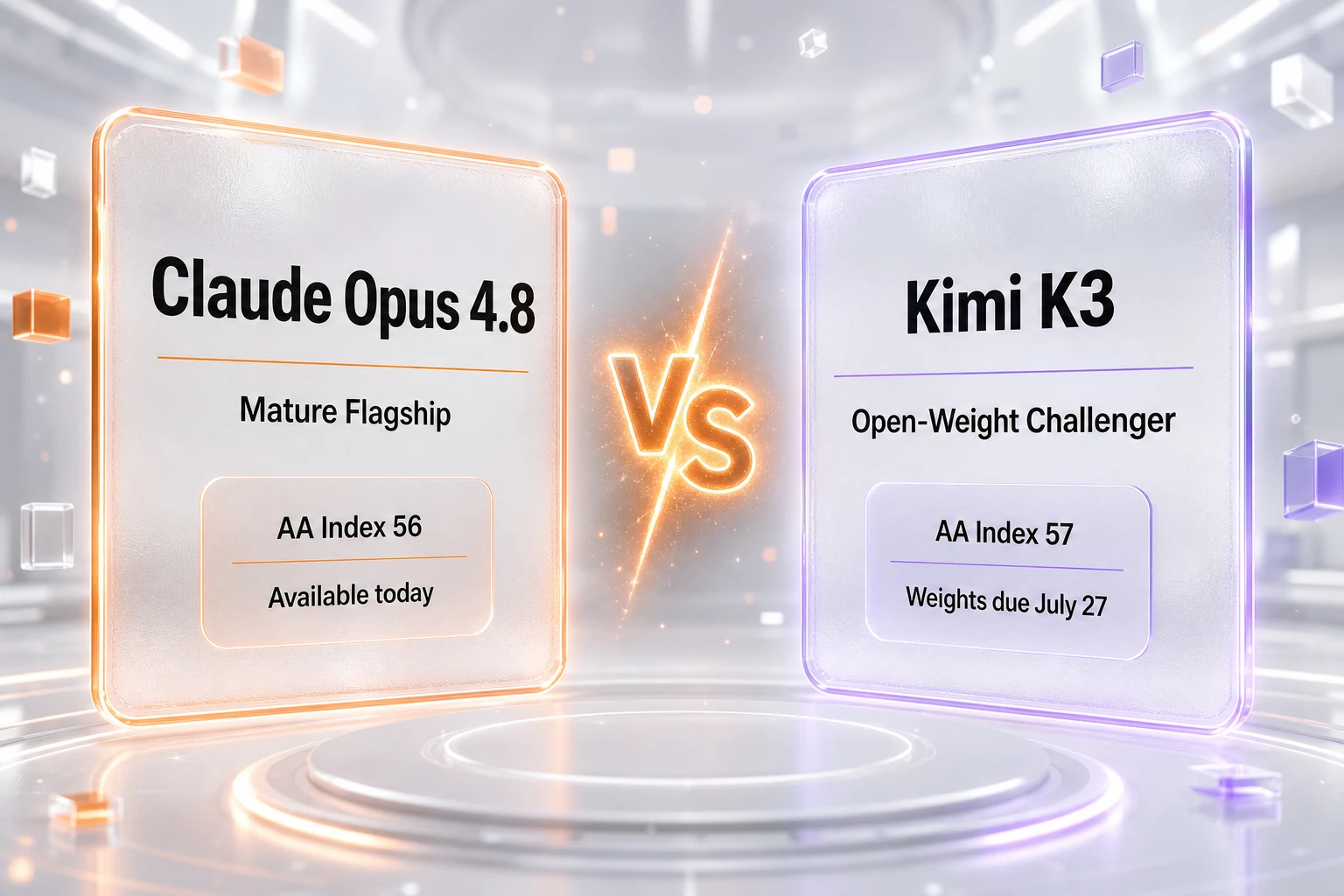
Feature Comparison
| Feature | Claude Opus 4.8 | Kimi K3 |
|---|---|---|
| Artificial Analysis Intelligence Index (v4.1) | 56 | 57 |
| Input price (per M tokens) | $5 | $3 |
| Output price (per M tokens) | $25 | $15 |
| Cache-hit input (per M tokens) | $0.50 | $0.30 |
| Context window | 1M tokens | 1M tokens |
| Open weights / self-hosting | No (closed, API-only) | Open-weight, weights due July 27 |
| Architecture transparency | Proprietary (undisclosed) | MoE ~2.8T total / ~50B active (disclosed) |
| Maturity / track record | Proven since May 28, 2026 | Released July 16, 2026 (days old) |
| Available today, in full | Yes, fully shipped | API live; weights pending |
| Ecosystem & agentic tooling | Claude Code, computer use, Bedrock, Vertex | OpenAI-compatible API; ecosystem forming |
| Reasoning-effort control | Effort controls (latency vs depth) | Single max level (costly) |
| Vision | Native multimodal | Native vision |
Pricing Comparison
Claude Opus 4.8
Kimi K3
Detailed Comparison
Kimi K3 and Claude Opus 4.8 are unusually close on paper, and the surprise runs the wrong way for the incumbent: on the independent Artificial Analysis Intelligence Index version 4.1, the open-weight Kimi K3 scores 57 to Claude Opus 4.8's 56, and it costs less per token — 3 dollars per million input and 15 dollars per million output, against Opus 4.8 at 5 dollars input and 25 dollars output. Both models ship a 1-million-token context window. So why is this not a clean win for the challenger? Because Kimi K3's headline advantage is a promise: its open weights were announced on July 16, 2026 but had not been published at launch, with Moonshot targeting a Modified MIT weight drop on July 27, 2026. Claude Opus 4.8, by contrast, has been in production since late May, is fully available today, and sits inside Anthropic's proven agentic ecosystem. After running both through their APIs, our verdict is a genuine split: Kimi K3 wins the paper metrics — a one-point-higher independent score, lower token pricing, and open weights by design — while Claude Opus 4.8 wins on maturity, reliability, and being completely available right now with no weights left in waiting.
Quick Verdict: Who Wins What
- Higher independent intelligence: Kimi K3 — 57 on the Artificial Analysis Intelligence Index version 4.1 versus 56 for Claude Opus 4.8. Same index version, so the one-point edge is a legitimate, like-for-like result.
- Lower token price: Kimi K3 — 3 dollars per million input and 15 dollars per million output, versus Opus 4.8 at 5 and 25. That is roughly 1.67 times cheaper on both input and output.
- Open weights and self-hosting: Kimi K3 by design — but with an asterisk, because the weights were not published at launch and are only promised for July 27, 2026. Opus 4.8 is closed and API-only, full stop.
- Maturity and reliability: Claude Opus 4.8 — a proven flagship in production since late May, versus a model that is days old at the time of writing.
- Available today, in full: Claude Opus 4.8 — you can deploy every part of it now. Kimi K3's API is live, but its defining open-weight feature is still in waiting.
- Ecosystem and agentic tooling: Claude Opus 4.8 — Claude Code, computer use, prompt caching, the Batch API, and availability on Amazon Bedrock and Google Vertex AI.
- Context window: Tie — both ship a full 1-million-token window.
- Overall: A split you resolve by weighting. If you value the highest verified score, the lower price, and open weights on paper, Kimi K3 edges ahead. If you value a proven, fully available model inside a mature ecosystem, Claude Opus 4.8 is the safer pick today.
Claude Opus 4.8 vs Kimi K3 at a Glance
We ran both models on the same prompts through their respective APIs and lined up the factual specifications side by side before getting into the hands-on notes. Every number below is sourced from primary documentation: Anthropic's pricing docs and the Opus 4.8 materials for Claude, and Moonshot AI's K3 launch figures plus the independent Artificial Analysis Intelligence Index for Kimi. Where a figure is vendor-reported rather than independently measured, we say so explicitly.
| Attribute | Claude Opus 4.8 | Kimi K3 |
|---|---|---|
| Vendor | Anthropic (United States) | Moonshot AI (China) |
| Model type | Closed frontier, API-only | Open-weight Mixture-of-Experts (weights pending) |
| Architecture | Proprietary (not disclosed) | Roughly 2.8 trillion total parameters, about 50 billion active per token, Kimi Delta Attention |
| License | Proprietary, commercial API terms | Modified MIT (weights promised July 27, 2026) |
| Artificial Analysis Intelligence Index (v4.1) | 56 | 57 |
| Context window | 1M tokens at standard pricing | 1M tokens |
| Vision | Native multimodal | Native vision |
| Standard input price | 5 dollars per million tokens | 3 dollars per million tokens |
| Cache-hit input price | 0.50 dollars per million tokens | 0.30 dollars per million tokens |
| Output price | 25 dollars per million tokens | 15 dollars per million tokens |
| Premium speed tier | Fast Mode: 10 in and 50 out per million, 2.5 times faster | Not offered |
| Self-hosting | No | Planned once weights ship (July 27, 2026) |
| Released | May 28, 2026 (proven in production) | July 16, 2026 (days old at writing) |
| Benchmark transparency | Independent index plus standard public suites | Independent index; extra suites are Moonshot-reported |
The headline tension is unusual. In most closed-versus-open matchups the closed model wins capability and the open model wins price. Here the open-weight challenger leads on both the independent intelligence score and the token price, while the closed incumbent's advantages are maturity, reliability, and the simple fact that all of it works today. That is what makes this a genuine judgment call rather than a spec-sheet blowout.
Claude Opus 4.8 Overview
Claude Opus 4.8 is Anthropic's flagship model, released on May 28, 2026 and built for agentic coding, computer use, and multi-agent orchestration. It is closed and API-only — you reach it through Anthropic's API or partner clouds, with no weights to download. On the independent Artificial Analysis Intelligence Index version 4.1 it scores 56, which placed it at or near the top of the field for weeks after launch. It ships a full 1-million-token context window billed at standard rates, metered at 5 dollars per million input tokens and 25 dollars per million output tokens, with cache hits at 0.50 dollars per million and a maximum output of 128,000 tokens. A Fast Mode research preview runs the model 2.5 times faster for a doubled per-token price of 10 dollars input and 50 dollars output. The reason we still reach for Opus 4.8 is not any single benchmark — it is the reliability. In our testing it verifies its own edits, flags uncertainty instead of guessing, and stays on the brief through long agentic loops. By mid-July it has roughly seven weeks of production track record behind it, which is a meaningful signal when you are deploying a model into a workflow that has to keep working.
Kimi K3 Overview
Kimi K3 is Moonshot AI's flagship, announced on July 16, 2026, and it is the largest open-weight model the industry has attempted: a Mixture-of-Experts design with roughly 2.8 trillion total parameters and about 50 billion active per token, using Kimi Delta Attention, a 1-million-token context window, and native vision. On the independent Artificial Analysis Intelligence Index version 4.1 it scores 57, placing it third to fourth in the world — ahead of Claude Opus 4.8 at 56, and behind GPT-5.6 Sol at 59 and Claude Fable 5 at 60. That an open-licensed model reached this rung of an independent leaderboard is the real story. But two facts complicate the open-and-cheaper headline. First, at launch the weights had not been published; Moonshot promises them by July 27, 2026 under a Modified MIT license, so on day one the world's largest open model was, strictly, closed. Second, at 3 dollars per million input and 15 dollars per million output, Kimi K3 is priced like a US frontier model — cheaper than Opus 4.8, but far above the roughly 0.95-dollar input and 4-dollar output rates of its own Kimi K2 predecessors. The ultra-cheap-Chinese-model discount is gone at the top of Moonshot's lineup; K3 competes on capability and openness, not on being the bargain option.
Intelligence: The One Independent Number That Counts
This is the cleanest comparison we can make, so we are foregrounding it. Both models are scored on the same independent Artificial Analysis Intelligence Index, version 4.1, by the same third party using the same methodology. On that index Kimi K3 scores 57 and Claude Opus 4.8 scores 56. Because the index version matches, that one-point gap is a legitimate, like-for-like result — Kimi K3 is, by this independent measure, marginally the more capable general model.
Two honest caveats keep us from over-reading it. A single point on a composite index sits well inside the range where run-to-run variance and prompt sensitivity live, so we treat 56 and 57 as "essentially tied, with a real but small edge to Kimi K3," not as a decisive capability gap. And a general intelligence index is not a task guarantee: your specific workload — a particular coding style, a domain, an agentic loop — can favor either model regardless of the composite. What the number does establish, firmly, is that the days when a closed US flagship automatically out-scored an open Chinese model are over. Kimi K3 is genuinely in the same class as Opus 4.8, and by the one shared independent yardstick it is a hair ahead.
Moonshot-Reported Benchmarks (Not Independently Verified)
Moonshot also published its own benchmark sheet for Kimi K3. We list these separately, and we do not place them next to any independent score, because they are a different kind of evidence: self-reported, on Moonshot's own harnesses, and not independently reproduced at launch. Read them as the vendor's claims, not as measured facts.
- Terminal-Bench: 88.3 (Moonshot-reported)
- BrowseComp: 91.2 (Moonshot-reported)
- GPQA-Diamond: 93.5 (Moonshot-reported)
These figures are strong, but until an independent lab runs the same suites we cannot line them up against Anthropic's numbers or treat them as verified. The only apples-to-apples capability comparison we trust today is the independent index: 57 for Kimi K3, 56 for Claude Opus 4.8. When third-party benchmark results for Kimi K3 appear, we will add them.
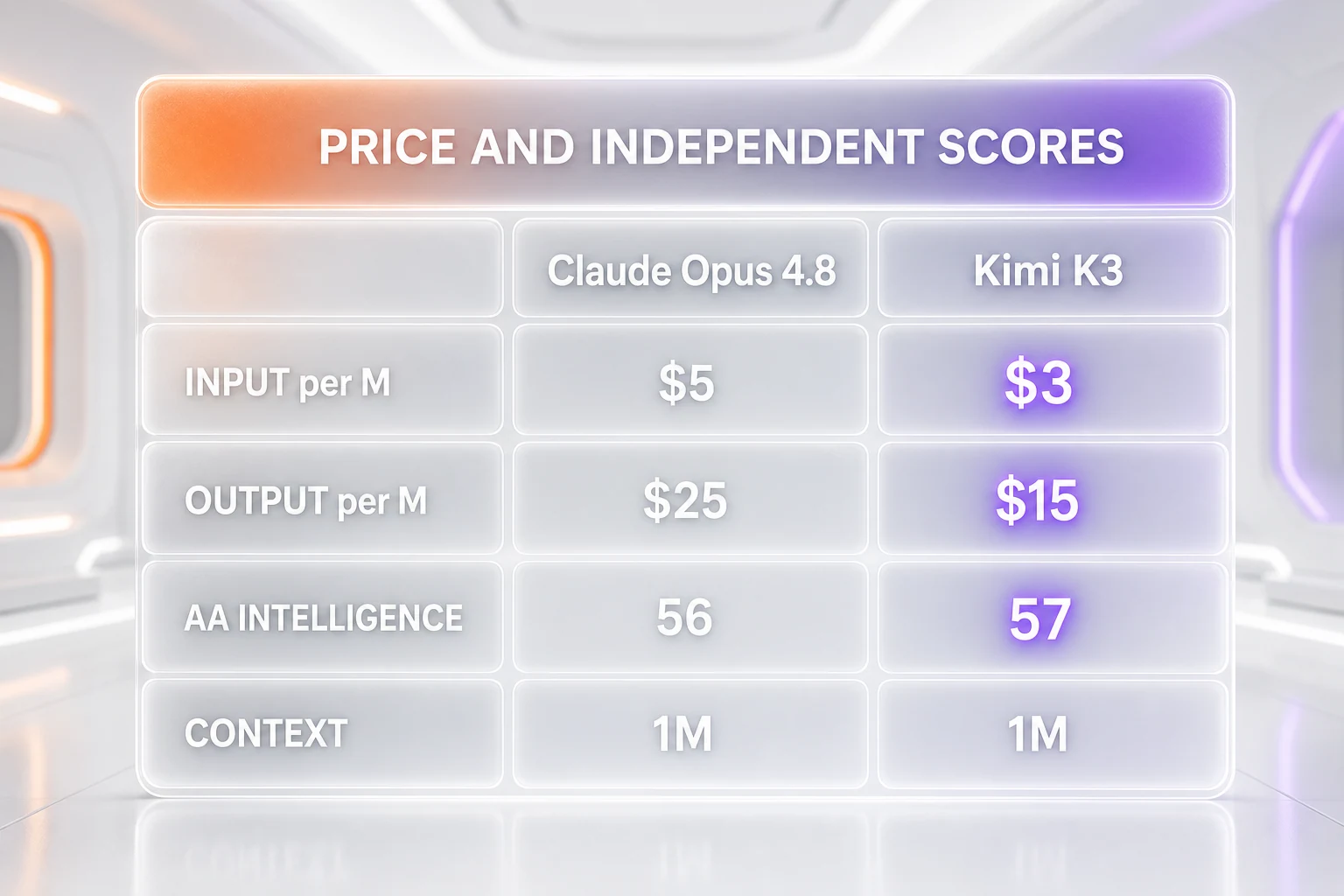
Pricing: Cheaper, But Not Cheap
Both models meter usage per token, billed separately for input and output, so the right way to compare them is rate by rate. We pulled Opus 4.8's figures straight from Anthropic's own pricing documentation and Kimi K3's from Moonshot's launch pricing, rather than stitching numbers together from third-party aggregators.
| Rate | Claude Opus 4.8 | Kimi K3 | Multiple |
|---|---|---|---|
| Input (per million tokens) | 5 dollars | 3 dollars | Opus is about 1.67 times more |
| Cache-hit input (per million tokens) | 0.50 dollars | 0.30 dollars | Opus is about 1.67 times more |
| Output (per million tokens) | 25 dollars | 15 dollars | Opus is about 1.67 times more |
| Premium speed tier | Fast Mode: 10 in and 50 out per million | None | Opus-only option |
Note how consistent the gap is: Kimi K3 is roughly 1.67 times cheaper across input, cached input, and output. Divide Opus 4.8's 25-dollar output rate by Kimi K3's 15-dollar rate and you get about 1.67; the input rates, 5 against 3, give the same ratio. That matters for context, because this is not the six-to-one chasm you see when Opus is set against a budget open model. Kimi K3 is frontier-priced — its 3-dollar input and 15-dollar output rates sit above Claude Sonnet 5's 2-dollar input and 10-dollar output list price — so the story here is "a somewhat cheaper frontier model," not "a bargain alternative." Anthropic also discounts aggressively: prompt caching cuts cache-read input to 0.50 dollars per million, and the Batch API halves both rates for asynchronous work, which can narrow or even close the gap on workloads that fit those patterns. On the flip side, Kimi K3 runs a single maximum reasoning level, which developers have flagged as expensive on token-heavy prompts, so its effective cost per task can climb above what the headline rates suggest.
Real-World Cost Scenarios
Per-million-token rates are abstract, so we modeled three realistic monthly workloads at each vendor's published standard rates. These are illustrative estimates; your real numbers depend on prompt-caching hit rates, batch usage, reasoning-token volume, and how many retries each model needs.
| Workload (monthly) | Claude Opus 4.8 (standard) | Kimi K3 |
|---|---|---|
| Solo developer: 5M input, 3M output | About 100 dollars (25 input plus 75 output) | About 60 dollars (15 input plus 45 output) |
| Small team agent: 30M input, 20M output | About 650 dollars (150 input plus 500 output) | About 390 dollars (90 input plus 300 output) |
| High-volume CI agent: 100M input, 80M output | About 2,500 dollars (500 input plus 2,000 output) | About 1,500 dollars (300 input plus 1,200 output) |
At every scale, Kimi K3 lands at roughly 60 percent of the Opus 4.8 standard bill — a real saving, but a far cry from the order-of-magnitude gaps that budget open models produce. For a solo developer, the 40-dollar monthly difference may be noise next to which model fits your workflow better. For a high-volume CI agent, a 1,000-dollar monthly difference is a budget line worth scrutinizing — and it is exactly where the promised open weights matter, because self-hosting K3 after July 27 could remove the per-token bill entirely for teams with the GPUs to run a 2.8-trillion-parameter Mixture-of-Experts model. Until those weights ship, both models bill you per token through an API, and the gap is a moderate 1.67 times, not a landslide.
Openness and the Weights Still in Waiting
Openness is Kimi K3's structural advantage over Claude Opus 4.8 — and, at the time of writing, its biggest asterisk. Moonshot has committed to publishing the K3 weights under a Modified MIT license, which would let you download the model, run it on your own GPU cluster, fine-tune it, and keep every token of data inside your own infrastructure. For teams with data-residency requirements, air-gapped environments, or a desire to avoid per-token API bills at scale, that is a decisive capability that Claude Opus 4.8 — closed and API-only, with no self-hosting path — can never match.
The catch is that on launch day, and as we write this on July 17, 2026, those weights have not been published. Moonshot targets July 27, 2026 for the drop. Until then, Kimi K3 is available only through Moonshot's API, which means its defining feature is a roadmap item, not a shipped one. We take vendors at their word but score what exists: as of today, neither model can be self-hosted, and Kimi K3's open-weight edge is potential rather than realized. If the weights land on schedule and match the API model, K3 becomes the strongest self-hostable near-frontier model available, and this section of the verdict tilts hard in its favor. If the drop slips or arrives with restrictions, the advantage stays theoretical. That uncertainty is the single most important thing to hold in mind when you read the one-point score and the lower price as reasons to switch.
Hands-On: We Ran Both Side-by-Side
A caveat on method up front, in the spirit of honesty: Claude Opus 4.8 has been in our rotation since late May, so our read on it is deep. Kimi K3 is days old — we have run it through Moonshot's API since launch, not lived with it for weeks — so our K3 notes are early impressions, not a settled evaluation. We ran both on the same set of tasks: a multi-file code refactor, an agentic read-edit-rerun loop, a long-context retrieval task, and a vision task that fed each model a UI screenshot.
General capability. The independent index gap showed up as you would expect from a single point: the two traded blows. Kimi K3 produced sharp, well-reasoned answers that matched its 57 score, and on a couple of harder reasoning prompts it edged Opus. Opus 4.8 was a touch more consistent across repeated runs. Neither pulled clearly ahead in our hands, which is exactly what a 56-versus-57 index would predict.
Agentic reliability. Here Opus 4.8's maturity told. In the read-edit-rerun loop it stayed on the explicit brief, verified its own edits, and recovered from failing tests with minimal supervision. Kimi K3 was capable but occasionally over-explored before converging, and its single maximum reasoning level burned tokens generously on tasks where a lighter setting would have done. For unsupervised agents, Opus 4.8 asked for less babysitting.
Long context. Both ship a 1-million-token window, and both handled a whole mid-size codebase in a single prompt without chunking. This is a genuine tie — a category where earlier open challengers fell short of Opus and K3 does not.
Vision. Both read screenshots competently. Kimi K3's native vision was a pleasant surprise, producing accurate descriptions of UI mockups; Opus 4.8 was marginally tighter on small on-screen text. We would trust either on real design work.
The pattern across our early testing: Kimi K3 matches Opus 4.8 on raw capability and occasionally edges it, exactly as the index suggests, while Opus 4.8 remains the steadier, more predictable agent — the dividend of seven weeks in production versus one.
Ecosystem, Integration, and Availability
A model is only as useful as the tooling and availability around it, and today this favors Claude Opus 4.8. Opus plugs into Anthropic's mature ecosystem: a first-party API, official SDKs, Claude Code for terminal-native development, computer-use and browser-agent tooling, prompt caching and the Batch API for cost control, effort controls that give an explicit latency-versus-depth dial, and availability on Amazon Bedrock and Google Vertex AI for teams that want it inside their existing cloud. All of it is shipped and battle-tested.
Kimi K3 takes the open route, but that route is only partly paved as we write. Its API is OpenAI-compatible, so it drops into any agent framework, IDE plugin, or routing layer that already speaks the OpenAI format — often a one-line base-URL change. Once the weights land on July 27, it also slots into self-hosted inference stacks and GPU-cloud deployments, and third-party providers will likely serve it through their own gateways. Early hands-on notes flagged rough edges typical of a brand-new launch: a single expensive reasoning level and a tokenization quirk where a trivial prompt counted far more input tokens than rival systems, hinting at a sizeable hidden system prompt. None of that is disqualifying, but it is the texture of a model that is one day old against one that has had seven weeks of fixes and community tooling. For teams standardized on the OpenAI API shape, K3 is a low-friction drop-in; for teams that want a fully managed, proven platform with first-party agentic tooling available today, Opus 4.8's ecosystem is more complete.
Winner Per Category
| Category | Winner | Why |
|---|---|---|
| Independent intelligence (AA Index v4.1) | Kimi K3 | 57 versus 56 on the same index version — a small but legitimate edge. |
| Token price | Kimi K3 | About 1.67 times cheaper on input, cached input, and output. |
| Open weights and self-hosting | Kimi K3 | Open-weight by design under Modified MIT; Opus is API-only. Weights due July 27. |
| Architecture transparency | Kimi K3 | Discloses a 2.8-trillion-parameter MoE; Opus keeps its architecture proprietary. |
| Maturity and reliability | Claude Opus 4.8 | Proven in production since late May; steadier in our agentic runs. |
| Available today, in full | Claude Opus 4.8 | Fully shipped now; K3's defining open weights are still pending. |
| Ecosystem and agentic tooling | Claude Opus 4.8 | Claude Code, computer use, prompt caching, Bedrock and Vertex availability. |
| Reasoning-effort control | Claude Opus 4.8 | Effort controls dial cost versus depth; K3 runs a single, costly max level. |
| Context window | Tie | Both ship a full 1-million-token window. |
| Vision | Tie | Both are natively multimodal and read screenshots well. |
Count the rows and Kimi K3 takes the paper metrics while Claude Opus 4.8 takes the reliability-and-availability cluster. That is precisely why the overall verdict does not resolve to a single winner: the two models are strong in different currencies, and which currency you value decides the call.
Pros and Cons
Claude Opus 4.8
Pros
- Mature, proven flagship in production since May 28, 2026 — roughly seven weeks of track record by mid-July.
- Fully available today, with every feature shipped and no weights left in waiting.
- Deep agentic ecosystem: Claude Code, computer use, prompt caching, the Batch API, and availability on Amazon Bedrock and Google Vertex AI.
- Reliable, cautious behavior — verifies its own edits and flags uncertainty instead of guessing.
- Effort controls give an explicit latency-versus-depth dial for predictable cost and speed.
- Full 1-million-token context window at standard pricing, with a 128,000-token maximum output.
Cons
- Scores one point below Kimi K3 on the independent Artificial Analysis Intelligence Index version 4.1 (56 versus 57).
- More expensive — 5 dollars per million input and 25 dollars per million output, about 1.67 times Kimi K3's rates.
- Closed and API-only — no weights to download, no self-hosting, no data sovereignty.
- Fast Mode doubles the per-token cost to 10 input and 50 output per million for its 2.5-times speed-up.
Kimi K3
Pros
- Highest independent score of the two — 57 on the Artificial Analysis Intelligence Index version 4.1, one point above Opus 4.8.
- Cheaper metered API — 3 dollars per million input, 0.30 dollars cached, and 15 dollars per million output, about 1.67 times below Opus 4.8.
- Open-weight by design under a Modified MIT license, promising self-hosting and data control once the weights ship.
- Discloses its architecture — roughly 2.8 trillion total parameters with about 50 billion active per token, the largest open-weight design attempted.
- Full 1-million-token context window and native vision that reads screenshots and mockups well.
- OpenAI-compatible API, so it drops into existing agent frameworks with a one-line base-URL change.
Cons
- Open weights were not published at launch — promised for July 27, 2026, so the defining feature is a roadmap item, not shipped.
- Days old at the time of writing, with none of Opus 4.8's production track record or community tooling.
- Frontier-priced, not cheap — at 3 and 15 dollars per million it costs more than Claude Sonnet 5's 2 and 10 dollars, and far more than its own Kimi K2 predecessors.
- A single maximum reasoning level that developers have flagged as expensive on token-heavy prompts.
- Extra benchmarks beyond the independent index are Moonshot-reported and not yet independently verified.
When to Pick Each Model
When to pick Claude Opus 4.8
- You are deploying into production today and value a proven, stable model over a one-point-higher score.
- You are building autonomous agents that must run unsupervised with minimal babysitting.
- You want a mature ecosystem out of the box — Claude Code, computer use, prompt caching, Bedrock and Vertex.
- You want predictable cost and latency through effort controls and the Batch API.
- You would rather Anthropic run, secure, and update the model than operate it yourself.
When to pick Kimi K3
- You want the highest independently verified intelligence score of the two and a lower token price.
- Open weights and self-hosting are your goal, and you can wait for the July 27, 2026 weight drop.
- Data residency, air-gapped deployment, or avoiding per-token API bills at scale drives your decision.
- You are comfortable running a brand-new model and working around early rough edges.
- You standardize on the OpenAI API shape and want a near-frontier model as a low-friction drop-in.
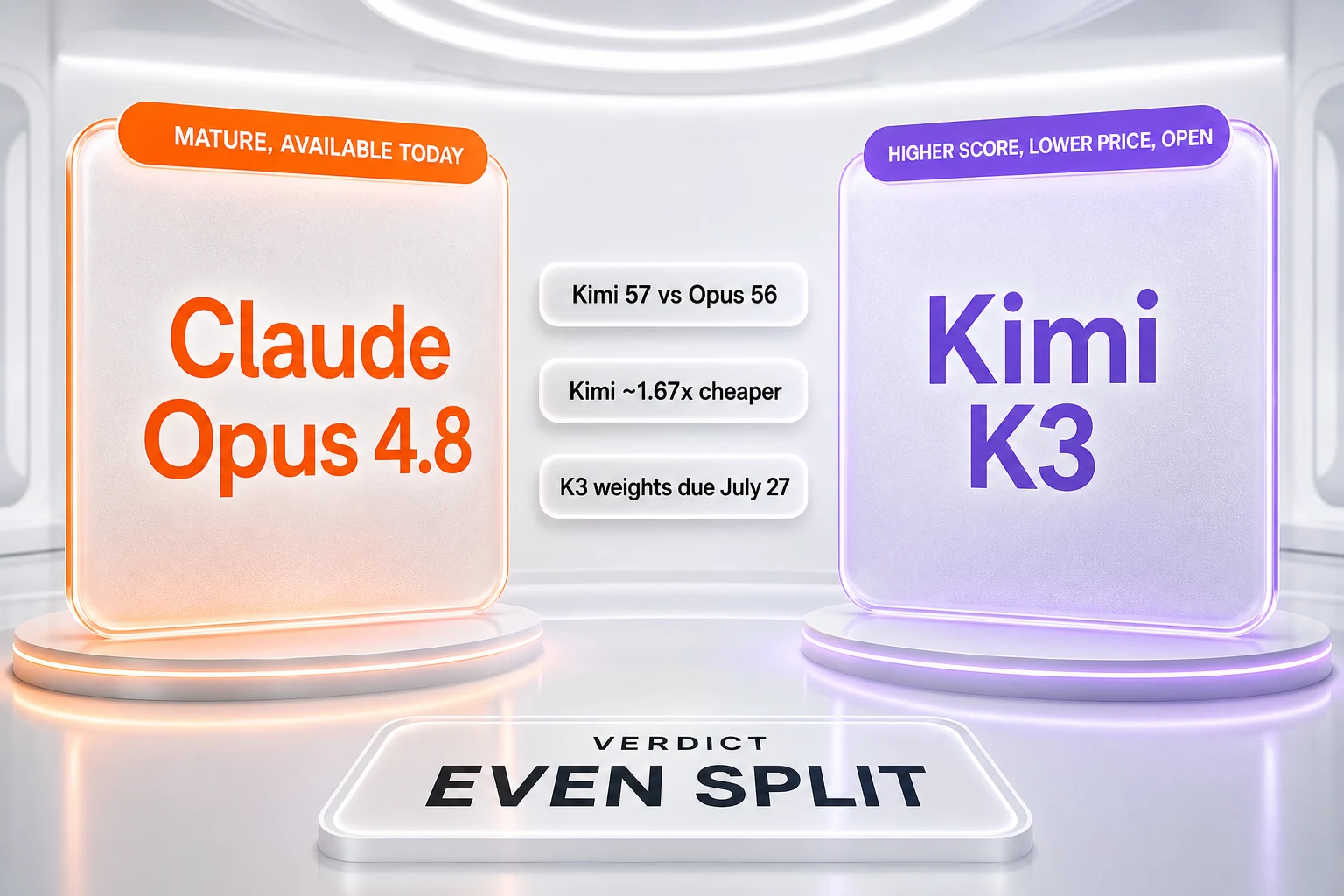
What Would Change Our Verdict
Both models are recent — Opus 4.8 shipped on May 28 and Kimi K3 on July 16, 2026 — and this market moves weekly, so we want to be transparent about what would move the needle.
The K3 weight drop. The single biggest variable is whether Moonshot ships the promised open weights on July 27, 2026, and whether the self-hosted model matches the API version. If it lands on schedule, Kimi K3 becomes the strongest self-hostable near-frontier model available and the value-plus-openness case tilts hard toward it. If the drop slips or arrives with restrictions, K3's central advantage stays theoretical and Opus 4.8's fully-available maturity looks even better by comparison.
Independent verification of Moonshot's benchmarks. Right now the only independent capability number we trust is the Artificial Analysis index. If third-party labs run standard public suites on K3 and confirm Moonshot's strong self-reported figures, the capability case for K3 strengthens further. If independent scores come in below the vendor sheet, the picture cools.
Pricing and reliability over time. This market discounts aggressively, and a brand-new model earns its reliability reputation only with weeks of real use. If Anthropic cuts Opus 4.8 rates, the price gap narrows. If Kimi K3 proves as steady in production as Opus over the coming weeks, the maturity argument fades. We will revisit these figures as both vendors and the model ecosystem evolve.
None of these change the shape of the verdict today: Kimi K3 leads on the paper metrics, Claude Opus 4.8 leads on maturity and availability, and the right pick depends on how heavily you weight a promised feature against a proven one.
Final Verdict
There is no single winner here, and that is the honest read rather than a hedge. By the one yardstick that lets us compare them like for like — the independent Artificial Analysis Intelligence Index version 4.1 — Kimi K3 scores 57 to Claude Opus 4.8's 56, and it costs about 1.67 times less per token. On paper, an open-weight model from a Chinese lab just edged a closed US flagship on both capability and price, which two years ago would have been unthinkable. If you weight the verified score, the lower cost, and open weights by design, Kimi K3 is the forward-looking pick, and the story of this comparison is that the challenger genuinely arrived. But paper is not production. Claude Opus 4.8 has been shipping real work since late May, is fully available today with nothing left in waiting, was the steadier agent in our hands-on runs, and lives inside a mature ecosystem you can deploy against this afternoon. Kimi K3's defining advantage — its open weights — is a promise dated July 27, 2026, and its one-point lead sits inside the noise of a composite index. Our recommendation: if you need a proven model in production now and value reliability and ecosystem over a marginal score, choose Claude Opus 4.8. If you want the highest independent score and the lower price, and you can either work through the API today or wait a week and a half for the weights, choose Kimi K3 — you get a genuinely near-frontier, more transparent model, with the understanding that its biggest feature is still landing.
Frequently Asked Questions
Is Kimi K3 better than Claude Opus 4.8?
By the one independent yardstick that compares them like for like, Kimi K3 is marginally ahead: it scores 57 on the Artificial Analysis Intelligence Index version 4.1 versus 56 for Claude Opus 4.8, and it costs about 1.67 times less per token. But the one-point gap sits inside the noise of a composite index, and Claude Opus 4.8 is the more mature, fully available model with a deeper ecosystem. Kimi K3 wins the paper metrics; Opus 4.8 wins on proven reliability. The better model depends on whether you weight the higher score and lower price or the maturity and immediate availability.
Does Kimi K3 really score higher than Claude Opus 4.8?
Yes, by one point. On the independent Artificial Analysis Intelligence Index version 4.1, Kimi K3 scores 57 and Claude Opus 4.8 scores 56. Because both are measured on the same index version by the same third party, the comparison is legitimate and the edge is real. It is small enough to sit within run-to-run variance, so we read it as "essentially tied, with a slight edge to Kimi K3," not as a decisive capability gap.
How much cheaper is Kimi K3 than Claude Opus 4.8?
Kimi K3 costs 3 dollars per million input tokens and 15 dollars per million output, versus Claude Opus 4.8 at 5 dollars input and 25 dollars output. That makes Opus about 1.67 times more expensive on both input and output — dividing 25 by 15, or 5 by 3, both give roughly 1.67. It is a meaningful saving, but far from the order-of-magnitude gaps that budget open models produce, because Kimi K3 is itself frontier-priced.
Are Kimi K3's open weights available yet?
Not at the time of writing. Kimi K3 was announced on July 16, 2026, but the weights were not published at launch. Moonshot AI has committed to releasing them under a Modified MIT license on July 27, 2026. Until that drop happens, Kimi K3 is available only through Moonshot's API, and its defining open-weight advantage over Claude Opus 4.8 is a promise rather than a shipped feature.
What is the context window of each model?
Both models ship a full 1-million-token context window. Claude Opus 4.8 bills that window at standard pricing, and Kimi K3 offers the same 1-million-token capacity. This is a genuine tie — large enough in either case to hold an entire mid-size codebase in a single prompt without chunking.
Can you compare Kimi K3 and Claude Opus 4.8 benchmarks directly?
Only on the independent Artificial Analysis Intelligence Index, where Kimi K3 scores 57 and Claude Opus 4.8 scores 56 on the same version 4.1. Moonshot also published its own figures for Kimi K3 — Terminal-Bench 88.3, BrowseComp 91.2, and GPQA-Diamond 93.5 — but those are self-reported on Moonshot's own harnesses and not independently reproduced, so we list them separately and do not line them up against Anthropic's numbers.
Is Kimi K3 open source?
It is open-weight by design, not fully open source, and even the weights were not published at launch. Moonshot promises them under a Modified MIT license on July 27, 2026, which would let you download, run, and fine-tune the model. A Modified MIT license is close to standard MIT but typically adds an attribution clause for very large commercial deployments. Claude Opus 4.8, by contrast, is closed and API-only with no weights at all.
Which model is more mature and reliable?
Claude Opus 4.8. It has been in production since May 28, 2026 — roughly seven weeks by mid-July — and was the steadier agent in our hands-on testing, staying on-brief and recovering from failures with less supervision. Kimi K3 is days old at the time of writing, so it has none of that track record yet, and early users flagged rough edges such as a single expensive reasoning level. For deployments that must keep working, Opus 4.8's maturity is a concrete advantage.
Is Kimi K3 a cheap Chinese model?
No — it is cheaper than Claude Opus 4.8 but it is not a budget model. At 3 dollars per million input and 15 dollars per million output, Kimi K3 is priced like a US frontier model and matches Claude Sonnet 5's standard list price. Its own Kimi K2 predecessors charged roughly 0.95 dollars input and 4 dollars output, so K3 represents the end of the ultra-cheap-Chinese-model era at the top of Moonshot's lineup. It competes on capability and openness, not on being the bargain option.
Which model should a startup choose?
It depends on your priority. If you need a proven model to ship a product now, Claude Opus 4.8 gives you maturity, reliability, and a mature ecosystem today. If you are optimizing for the highest independent score and lower token cost, and you either use the API now or can wait for the July 27 weight drop to self-host, Kimi K3 is compelling. For most teams shipping this week, Opus 4.8's immediate availability tips the balance; for teams planning around self-hosting or squeezing token cost, Kimi K3 is worth the wait.
Can both models handle images and screenshots?
Yes. Claude Opus 4.8 is natively multimodal, and Kimi K3 ships native vision. Both handled UI screenshots competently in our testing. Kimi K3's vision was a pleasant surprise, producing accurate descriptions of mockups, while Opus 4.8 was marginally tighter on small on-screen text. We would trust either on real design work.
What would change this verdict?
Three things. First, whether Moonshot ships the promised Kimi K3 weights on July 27, 2026 and whether the self-hosted model matches the API version — an on-schedule drop tilts the verdict toward K3. Second, independent verification of Moonshot's self-reported benchmarks. Third, how each model's pricing and reliability evolve over the coming weeks, since a brand-new model earns its reputation only with real use. We will update this comparison as these resolve.
Related Comparisons
If you are weighing these two against the wider field, these hands-on comparisons and guides go deeper on adjacent matchups:
- Claude Opus 4.8 vs Kimi K2.7 Code — the previous-generation open-weight Kimi against the same Anthropic flagship.
- GPT-5.6 Sol vs Claude Opus 4.8 — two flagships and a split verdict.
- Claude Opus 4.8 vs Gemini 3.1 Pro — coding crown versus best value.
- Kimi K2.7 Code vs GPT-5.5 — open-weight challenger against a closed flagship.
- Claude Opus 4.8 review and Kimi K3 review — our full hands-on write-ups of each model.
- Best AI Coding Tools 2026 — where both models land in our curated shortlist.
Last compared: July 17, 2026. Pricing and specifications verified directly from Anthropic's documentation and Moonshot AI's Kimi K3 launch figures at the time of writing; Claude Opus 4.8's rates and 1-million-token context were confirmed on Anthropic's pricing docs, and the intelligence scores come from the independent Artificial Analysis Intelligence Index version 4.1. We do not have an affiliate relationship with either vendor; this comparison reflects our hands-on testing and each vendor's published figures. Kimi K3's extra benchmarks are Moonshot-reported and not yet independently verified, and its open weights were promised for July 27, 2026 but had not shipped at the time of writing.
Sources and references
Every figure on this page is attributed to whoever produced it. Vendor documentation and independent measurement are listed separately and never merged into a single ranking.
- Artificial Analysis — Claude Opus 4.8 (independent index score and cost per task)
- Hugging Face — moonshotai/Kimi-K3 (weights and license)
- Artificial Analysis — Kimi K3 (independent index score and cost per task)
- Artificial Analysis — Model leaderboard (Intelligence Index scores and cost per task across configurations)
Our Verdict
Split by what you weight. On the one shared independent yardstick, the Artificial Analysis Intelligence Index version 4.1, Kimi K3 scores 57 to Claude Opus 4.8's 56, and it costs about 1.67 times less per token (3 dollars input and 15 dollars output versus 5 and 25). Both ship a 1-million-token context window. So Kimi K3 wins the paper metrics: a marginally higher independent score, lower price, and open weights by design. But its open weights were not published at launch, promised for July 27, 2026 under Modified MIT, and it is days old, while Claude Opus 4.8 has been proven in production since late May, is fully available today, and sits inside a mature agentic ecosystem (Claude Code, computer use, Bedrock, Vertex). Choose Kimi K3 for the higher score, lower cost, and open weights on paper; choose Claude Opus 4.8 for maturity, reliability, and being completely available right now.
Choose Claude Opus 4.8
Anthropic's flagship model for agentic coding, computer use, and multi-agent orchestration.
Try Claude Opus 4.8 →Choose Kimi K3
Moonshot AI's ~2.8T-parameter open Mixture-of-Experts flagship — ~50B active, 1M context, native vision. Testable via API today at $3 in / $15 out per million tokens; open weights expected July 27, 2026.
Try Kimi K3 →Frequently Asked Questions
Is Claude Opus 4.8 better than Kimi K3?
Split by what you weight. On the one shared independent yardstick, the Artificial Analysis Intelligence Index version 4.1, Kimi K3 scores 57 to Claude Opus 4.8's 56, and it costs about 1.67 times less per token (3 dollars input and 15 dollars output versus 5 and 25). Both ship a 1-million-token context window. So Kimi K3 wins the paper metrics: a marginally higher independent score, lower price, and open weights by design. But its open weights were not published at launch, promised for July 27, 2026 under Modified MIT, and it is days old, while Claude Opus 4.8 has been proven in production since late May, is fully available today, and sits inside a mature agentic ecosystem (Claude Code, computer use, Bedrock, Vertex). Choose Kimi K3 for the higher score, lower cost, and open weights on paper; choose Claude Opus 4.8 for maturity, reliability, and being completely available right now.
Which is cheaper, Claude Opus 4.8 or Kimi K3?
Claude Opus 4.8 starts at $5 in / $25 out per M tokens. Kimi K3 starts at $3 in / $15 out per M tokens (free plan available). Check the pricing comparison section above for a full breakdown.
What are the main differences between Claude Opus 4.8 and Kimi K3?
The key differences span across 12 features we compared. For Artificial Analysis Intelligence Index (v4.1), Claude Opus 4.8 offers 56 while Kimi K3 offers 57. For Input price (per M tokens), Claude Opus 4.8 offers $5 while Kimi K3 offers $3. For Output price (per M tokens), Claude Opus 4.8 offers $25 while Kimi K3 offers $15. See the full feature comparison table above for all details.