GPT-5.6 Terra vs GLM-5.2: Closed Intelligence vs Open-Weight Price (2026)
GPT-5.6 Terra vs GLM-5.2: 55 vs 51 on Artificial Analysis, $12 vs $4.40 per million output tokens, closed API vs MIT open weights. When to pick each.
Feature Comparison
| Feature | GPT-5.6 Terra | GLM-5.2 |
|---|---|---|
| Artificial Analysis Intelligence Index (independent) | 55 | 51 — top open-weight model, fourth overall |
| Independent coding score (AA Coding Agent Index v1.3, read August 2, 2026) | 55.79 (Codex harness, high effort); 62.28 at max | 43.18 (Claude Code harness, no effort stated) |
| Vendor-reported coding score | Not submitted to a comparable independent agentic-coding leaderboard | 62.1 on SWE-bench Pro (Zhipu AI self-reported) |
| Input price (per million tokens) | $2.00 | $1.40 |
| Output price (per million tokens) | $12 | $4.40 |
| Cached input (per million tokens) | $0.20 (90 percent discount) | $0.26 |
| Flat-rate plan | None — metered API, Batch API at half price | GLM Coding Plan from around $18 per month |
| Context window | 1,050,000 tokens (128,000 max output) | 1,000,000 tokens (up to 131,072 max output) |
| Model access and license | Closed, proprietary, API only | Open weights under an MIT license |
| Self-hosting and data residency | Not possible — OpenAI endpoints only | Download the weights and run them on your own compute |
| Ecosystem and agentic toolbox | Full OpenAI toolbox: programmatic tool calling, structured outputs, web and file search, code interpreter, computer use, MCP | Drop-in with Claude Code, Cline, Kilo Code, Goose, Roo; smaller first-party surface |
Pricing Comparison
GPT-5.6 Terra
GLM-5.2
Detailed Comparison
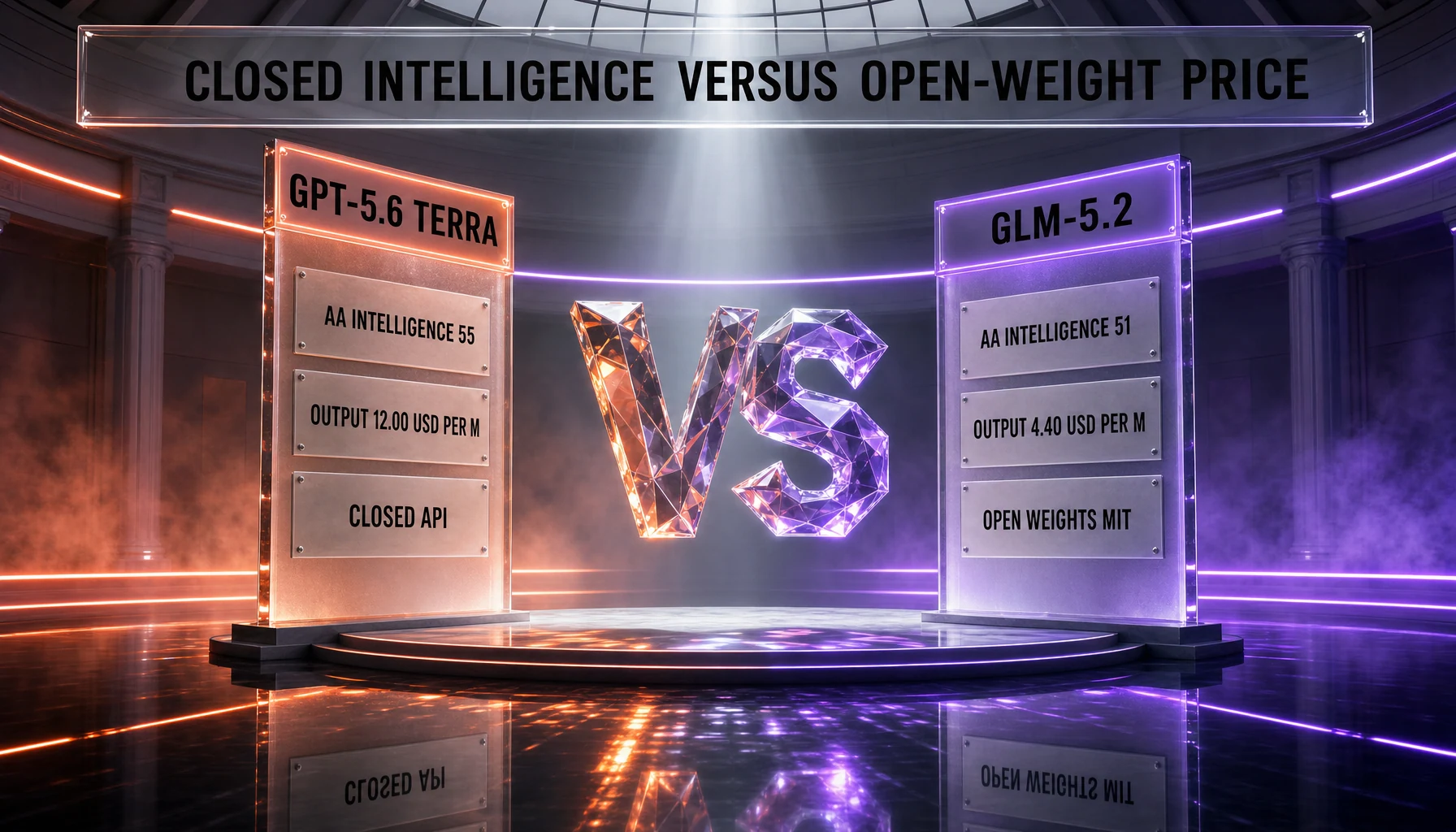
GPT-5.6 Terra and GLM-5.2 are two different answers to the same question. Terra is OpenAI's balanced tier: 55 on the independent Artificial Analysis Intelligence Index and 55.79 on the same lab's Coding Agent Index, a 1,050,000-token context, and a price of $2.00 per million input tokens and $12.00 per million output tokens. GLM-5.2 is Zhipu AI's open-weight coding flagship: 51 on the same independent index, MIT-licensed weights you can download and self-host, a 1,000,000-token context, and $1.40 input and $4.40 output per million tokens. Terra is four points smarter and about 2.7 times more expensive on output. That is the whole trade.
Quick Verdict
This is a split decision, and the fork is sharp: four points of measured intelligence against roughly three times the output bill. On the one independent yardstick that scores both models, GPT-5.6 Terra leads GLM-5.2 by four points — 55 to 51 on the Artificial Analysis Intelligence Index. On price, GLM-5.2 leads by a much wider margin: $1.40 against $2.00 per million input tokens, and $4.40 against $12 per million output tokens. Neither model dominates. Pick the one whose constraint you actually live with.
- 🏆 GPT-5.6 Terra wins for: teams that want the highest independently measured intelligence of the two and the OpenAI platform with its full agentic toolbox
- 🏆 GLM-5.2 wins for: price-sensitive teams, anyone who must self-host or keep data on their own infrastructure, and buyers who want MIT-licensed weights and a flat-rate coding plan instead of a metered bill
- 🧠 Intelligence, independently measured: Terra at 55 versus GLM-5.2 at 51 on the Artificial Analysis Intelligence Index — a real four-point lead for Terra, and a score that makes GLM-5.2 the top open-weight model in the world and fourth overall
- 💰 Cheaper option: GLM-5.2, decisively — $1.40 input and $4.40 output per million tokens against Terra's $2.00 and $12, plus a flat GLM Coding Plan from around $18 per month and the option to run the weights on your own hardware
- 🔓 Openness: GLM-5.2 — MIT weights on HuggingFace, self-hosting, and fine-tuning; GPT-5.6 Terra is closed and reachable only through OpenAI's API and products
- 📏 Context: a near tie — Terra's 1,050,000 tokens against GLM-5.2's 1,000,000, a five percent difference that will not decide anything
Both models are available today. Read our full GPT-5.6 Terra review and our GLM-5.2 review for the per-model deep dives, or keep reading for the head-to-head.
How We Compared Them
We compared these two the way a team actually chooses between them: on price, on the numbers that can be trusted, and on what you are allowed to do with the model once you have it. GPT-5.6 Terra we have run hands-on since it became generally available on July 9, 2026, across business-sized reasoning and coding prompts through the OpenAI API. GLM-5.2 we evaluated through its hosted API and by working with its open weights, which Zhipu AI published under an MIT license on HuggingFace the week after the model's June 13, 2026 launch. Our GLM assessment leans more on published data and shorter hands-on sessions than on months of production history, and we would rather say that plainly than dress it up.
On benchmarks we hold one hard line, and it shapes this entire comparison: we do not mix independent scores with vendor self-reported ones, and we do not stack two different benchmarks in the same row as if they measured the same thing. Exactly one yardstick scores both of these models under the same methodology — the Artificial Analysis Intelligence Index, run by an independent third party. That is where the 55 and the 51 come from, and it is the only place in this article where you will see a direct head-to-head capability number.
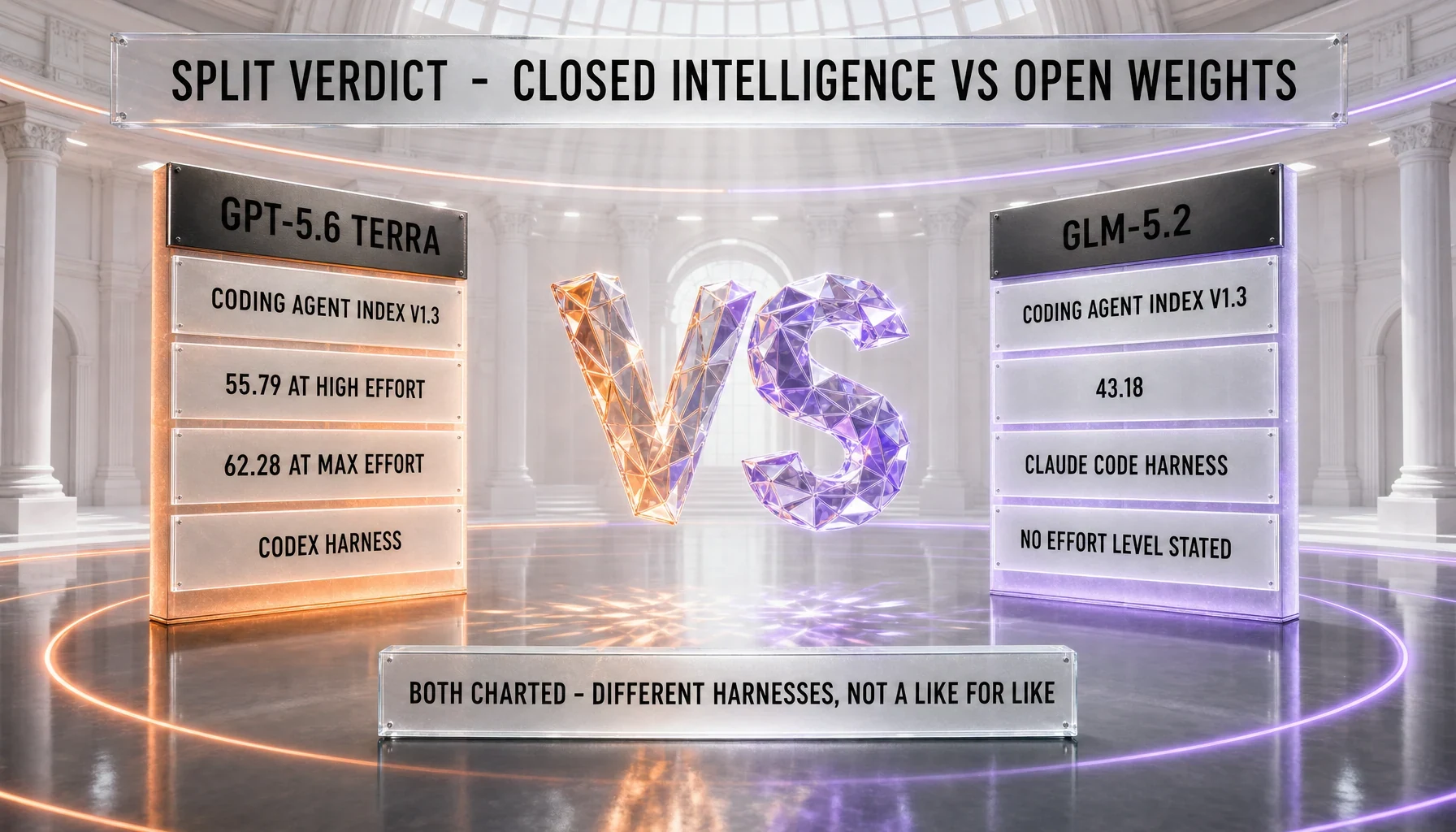
One comparison holds and one does not, so we label both. Artificial Analysis's Coding Agent Index v1.3 charts them both: GLM-5.2 at 43.18 through the Claude Code harness, GPT-5.6 Terra at 55.79 through Codex at high reasoning effort, rising to 62.28 at max. The harnesses differ and the GLM-5.2 entry carries no stated reasoning effort, so this is not a like-for-like pairing — but it is the same index, read the same day, and it is the one independent coding number each model has. What does not hold is the other figure: GLM-5.2's 62.1 on SWE-bench Pro is self-reported by Zhipu AI, not yet reproduced by a neutral harness, and Terra was never submitted to that suite. Setting 43.18 beside 62.1 and calling it a coding verdict would be a fabrication, so we do not do it — not in the tables, not in the graphics, and not in the prose below.
GPT-5.6 Terra and GLM-5.2 at a Glance
GPT-5.6 Terra is the balanced tier of OpenAI's GPT-5.6 family, generally available since July 9, 2026. It is closed and proprietary: you reach it through the OpenAI API, Codex, and ChatGPT for Business and Enterprise, and there are no weights to download. It scores 55 on the Artificial Analysis Intelligence Index and 55.79 on the same lab's Coding Agent Index v1.3, through the Codex harness at high reasoning effort. It carries a 1,050,000-token context window with a 128,000-token maximum output, and it ships the complete agentic toolbox: programmatic tool calling, function calling, structured outputs, web and file search, code interpreter, computer use, and MCP. Pricing is $2.00 per million input tokens and $12 per million output tokens, with cached input discounted 90 percent to $0.20 and a Batch API at half price. Prompts above 272,000 input tokens bill at twice the input rate and one and a half times the output rate across the full request. Terra sits below the flagship GPT-5.6 Sol (59 on the same index) and above the lightweight GPT-5.6 Luna in OpenAI's line-up.
GLM-5.2 is Zhipu AI's open-weight coding flagship, released June 13, 2026 under the international Z.ai brand. It is a sparse mixture-of-experts model — roughly 753 billion total parameters with about 40 billion active per token — with a 1,000,000-token context window and a maximum output of up to 131,072 tokens. Its weights ship under a permissive MIT license, so commercial use, redistribution, fine-tuning, and self-hosting are all allowed. It scores 51 on the Artificial Analysis Intelligence Index, which makes it the highest-scoring open-weight model in the world and fourth overall on that leaderboard — a position no open model held a year ago. Zhipu AI reports 62.1 on SWE-bench Pro, self-reported and not yet independently reproduced. Hosted pricing is $1.40 per million input tokens and $4.40 per million output tokens, with cached input at $0.26, and a flat GLM Coding Plan starts from around $18 per month. It drops into the major coding agents, including Claude Code, Cline, Kilo Code, Goose, and Roo.
Intelligence: 55 vs 51 on the Independent Index
This is the one number that compares the two models directly, measured by the same third party under the same methodology. GPT-5.6 Terra scores 55 on the Artificial Analysis Intelligence Index. GLM-5.2 scores 51. Four points, in Terra's favor, and it is a real lead — about eight percent higher on a scale where the current frontier sits in the high fifties and low sixties.
Four points is not a rounding error, and we are not going to talk it away. On genuinely hard reasoning — the multi-step problems where a model has to hold a chain of constraints together without drifting — a four-point gap on this index is the kind of difference you feel in production, not just on a leaderboard. If the quality of the model's answer is the product you are selling, that gap is the entire argument for paying Terra's price.
What is equally worth saying is where GLM-5.2's 51 sits in the field. It is the top open-weight score on the planet and fourth overall on that index — behind Claude Fable 5 at 60, Claude Opus 4.8 at 56, and GPT-5.5 at 55, and now within four points of GPT-5.6 Terra. GLM-5.1 scored 40. An eleven-point jump in a single release is the most aggressive climb any open-weight model has made this cycle, and it is the reason this comparison is worth having at all. Two years ago the open-weight option was a compromise you accepted for the license. At 51, GLM-5.2 is a model you would consider on capability alone, and then find out it also happens to be open.
One caveat on the index itself, in both directions: an aggregate intelligence score is a blend of many evaluations, and it is a directional instrument rather than a precision one. A four-point gap tells you Terra is measurably ahead. It does not tell you Terra is ahead on your task. If your workload is narrow and repetitive — structured extraction, refactors within a known codebase, high-volume classification — the practical gap on that specific job may be far smaller than four points, and the price gap will not be.
Coding: Two Scores, Two Regimes, No Head-to-Head
Here is where most comparisons of these two models go wrong, so we will be blunt about it. There is no clean coding benchmark on which GPT-5.6 Terra and GLM-5.2 have both been scored. Anyone who tells you otherwise is stacking numbers that do not belong in the same column.
What each model actually has on the record:
- Different harnesses on the Artificial Analysis Coding Agent Index. Both models are charted, but not on comparable terms: Terra at 55.79 through Codex at high reasoning effort, GLM-5.2 at 43.18 through Claude Code with no reasoning effort stated (checked August 2, 2026).
- GLM-5.2 — 62.1 on SWE-bench Pro. This is a real result on a hard agentic software-engineering benchmark, but it is self-reported by Zhipu AI and has not yet been reproduced by a neutral harness. GPT-5.6 Terra was not submitted to a comparable independent agentic-coding leaderboard, so there is no Terra number to place beside it.
These are two different benchmarks measuring different things on different scales, produced under two different attribution regimes — one independent, one vendor — and both of them score GLM-5.2. The 43.18 and the 62.1 cannot be subtracted from one another. They cannot be charted on the same axis. And neither of them has a GPT-5.6 Terra figure to sit opposite it, so there is no head-to-head gap here out of which to manufacture a verdict.
So what can you conclude about coding? Two things, both narrower and both honest. First, on the one independent coding board that carries them both, Terra is ahead: 55.79 on the Coding Agent Index v1.3 through the Codex harness at high reasoning effort, against 43.18 for GLM-5.2 through Claude Code. If you weight externally verified numbers over vendor claims — and you should — that comparison favors Terra, though the harnesses differ and the GLM-5.2 entry states no reasoning effort, so it is a lead rather than a clean like-for-like. Second, on the broader capability signal, the independent intelligence index puts Terra four points up, and coding ability correlates with general reasoning strength even when it is not measured directly. That is a lean, not a proof.
Against that, GLM-5.2 was built as a coding model. Its 62.1 on SWE-bench Pro, vendor-reported as it is, is a step up from GLM-5.1's 58.4, and Zhipu positions it explicitly as an agentic coding flagship rather than a generalist. If your workload is coding and your budget is real, the honest advice is to run both on your own repository for a week rather than to trust either number. The benchmarks cannot settle this one, and pretending they can would be the least useful thing we could do for you.
Pricing: Where GLM-5.2 Pulls Away
Capability is a four-point gap. Price is not close at all, and this is where GLM-5.2 makes the case that keeps it in the conversation.
| Model | Input (per million tokens) | Cached input | Output (per million tokens) | Flat plan |
|---|---|---|---|---|
| GPT-5.6 Terra | $2.00 | $0.20 | $12 | None — metered API, with a Batch API at half price |
| GLM-5.2 — hosted API | $1.40 | $0.26 | $4.40 | GLM Coding Plan from around $18 per month |
| GLM-5.2 — self-hosted | Your own compute (MIT weights) | No per-token vendor fee |
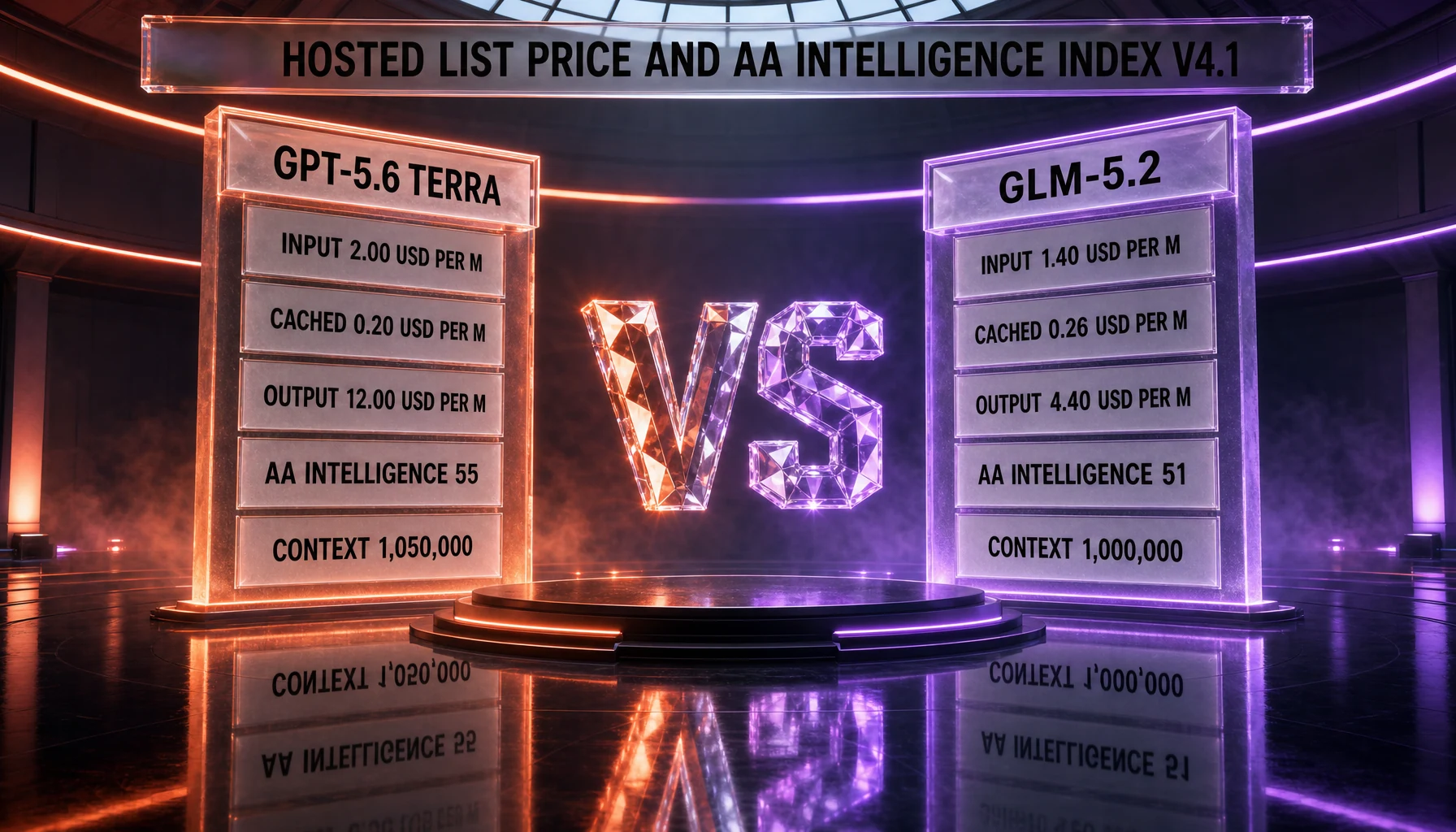
GLM-5.2 is cheaper on both sides of the meter, and the two sides are not cheaper by the same amount. On input, $1.40 against $2.00 is a factor of about 1.4. On output — which is the side that matters for coding agents, because they generate far more than they read — $4.40 against $12 is a factor of about 2.7. That output ratio is the single most consequential number in this comparison, and it is the one that should make you stop and do the arithmetic on your own workload before defaulting to the more capable model.
Two worked examples, so the gap is concrete rather than abstract. Take an output-heavy month of one million input tokens and one million output tokens: Terra costs $2.00 plus $12, or $14.00. GLM-5.2 costs $1.40 plus $4.40, or $5.80. Terra is about 2.4 times the bill. Now take a more input-heavy retrieval workload of ten million input tokens and two million output tokens: Terra costs $20 plus $24, or $44. GLM-5.2 costs $14 plus $8.80, or $22.80. Terra is about 1.9 times the bill. The more your workload generates rather than reads, the wider GLM-5.2's advantage grows.
Cached input is the one row Terra now wins: $0.20 against $0.26 for GLM-5.2, a difference of six cents per million tokens that will rarely show up on an invoice you care about. Terra's cached rate is a 90 percent discount on its input price, which is a genuinely strong cache economics story — if your application replays a large stable prompt prefix on every call, Terra's effective input cost collapses toward GLM-5.2's and the input row stops mattering. It does nothing for the output row, which is where the real money is.
Then there is the GLM Coding Plan, which changes the shape of the decision rather than just the size of the number. From around $18 per month, flat, you get a coding subscription instead of a metered bill — a different financial instrument entirely, and an attractive one for individual developers and small teams who would rather have a predictable line item than a usage graph they have to watch. The honest caveats: pricing above the entry tier is not published, and the plan can consume quota at up to three times its base rate during peak hours, so heavy usage is harder to model in advance than Terra's published per-token rates. Terra's per-token pricing is simpler to forecast. GLM-5.2's is cheaper, in more shapes, with more variables.
And the floor beneath all of it: because GLM-5.2's weights are MIT-licensed, a team with its own GPUs can run the model with no per-token vendor fee at all, paying for compute and operations instead of tokens. For a steady, heavy, always-on workload, that is a structurally different cost curve — one that Terra cannot offer at any price, because there is nothing to download.
Context: 1.05M vs 1M, and a Twist on Output
Both models are in the million-token class, and the gap between them is not one you should plan around. GPT-5.6 Terra publishes a 1,050,000-token context window. GLM-5.2 publishes 1,000,000 tokens. That is a five percent difference. If a prompt fits in one, it fits in the other; if it overflows one, it almost certainly overflows the other. We score this row for Terra because 1.05 million is more than 1 million, and we would rather be accurate than pretend the tie is perfect — but nobody should choose a model over five percent of a context window.
The more interesting number is on the way out. Terra's maximum output is 128,000 tokens. GLM-5.2's is up to 131,072 tokens — marginally higher. It is a small thing, and it cuts against the direction of the context row, which is exactly why we are pointing it out: the model with the slightly smaller context window has the slightly larger maximum output. For very long generated artifacts — a full file rewrite, an exhaustive migration, a long structured report in one pass — GLM-5.2 has a hair more headroom. Neither figure will decide a purchase, but a comparison that only reported the number favoring one side would be selling you something.
What both windows genuinely enable is the same class of work: whole-repository prompts, long autonomous coding sessions, and document sets that used to require chunking and retrieval scaffolding. On that capability, this is a tie in everything but the last decimal.
Open Weights vs Closed API: The Real Dividing Line
Price and intelligence are the numbers people quote. Openness is the axis that actually decides this comparison for most of the teams that have to make it, because it is the one where the two models are not on a spectrum — they are on opposite sides of a wall.
GPT-5.6 Terra is closed and proprietary. You reach it through the OpenAI API, Codex, and ChatGPT for Business and Enterprise. You cannot download it, run it on your own hardware, or inspect it. Notably, it is not selectable in the consumer ChatGPT app either, so there is no free browser tier where a curious developer can try the exact production model before committing. What you get in exchange is a mature platform: the full agentic toolbox — programmatic tool calling, function calling, structured outputs, web and file search, code interpreter, computer use, and MCP — stable SDKs, and the deepest third-party ecosystem in the industry. If your stack already speaks OpenAI, Terra is a model-string change away.
GLM-5.2 is the opposite trade, and the trade is stark. Its weights are published on HuggingFace under an MIT license: free commercial use, redistribution, fine-tuning, and self-hosting. A regulated enterprise can run it inside its own network and answer its data-residency questions with an architecture diagram instead of a vendor promise. A team with a proprietary codebase can fine-tune on it. A high-volume shop can serve it on owned GPUs and decouple inference cost from any price list. And because it drops into Claude Code, Cline, Kilo Code, Goose, and Roo, adopting it does not mean abandoning the tooling your developers already use. This is the same structural advantage that makes DeepSeek V4 compelling at the budget end, and GLM-5.2 brings it to a materially higher capability tier.
The caveats on the open side are real, and we will not paper over them. Open-weight is not open-source: the MIT license covers the weights, but Zhipu AI has not released the training code or the data recipe, so you can run and fine-tune the model without being able to reproduce it. The downloadable weights arrived the week after launch rather than on day one. The production hosted API is operated in China, which raises data-residency questions for regulated Western buyers who use the endpoint rather than self-hosting — self-hosting sidesteps that concern entirely, but it hands you the compute bill and the operational burden in exchange. And GLM-5.2's coding score is a vendor claim, not an independent one, which is a trust consideration in its own right.
Openness buys you control. It also hands you responsibility. Which of those two words matters more to your organization is, in practice, the answer to this comparison. For a longer look at how that same trade plays out against another closed model, see our Claude Sonnet 5 vs GLM-5.2 breakdown.
Feature-by-Feature Comparison
The head-to-head across the dimensions that drive the choice. We only fill a cell when there is a figure or a fact on the record — and where the two models were measured by different benchmarks, we say so instead of forcing a winner.
| Dimension | GPT-5.6 Terra | GLM-5.2 | Edge |
|---|---|---|---|
| Artificial Analysis Intelligence Index (independent) | 55 | 51 — top open-weight model, fourth overall | GPT-5.6 Terra |
| Independent coding score (AA Coding Agent Index v1.3, read August 2, 2026) | 55.79 (Codex harness, high effort); 62.28 at max | 43.18 (Claude Code harness, no effort stated) | GPT-5.6 Terra — different harnesses, not a like-for-like |
| Vendor-reported coding score | Not submitted to a comparable independent agentic-coding leaderboard | 62.1 on SWE-bench Pro (Zhipu AI self-reported) | Different benchmarks — no head-to-head |
| Input price (per million tokens) | $2.00 | $1.40 | GLM-5.2 |
| Output price (per million tokens) | $12 | $4.40 | GLM-5.2 |
| Cached input (per million tokens) | $0.20 (90 percent discount) | $0.26 | Level |
| Flat-rate plan | None — metered API, Batch API at half price | GLM Coding Plan from around $18 per month | GLM-5.2 |
| Context window | 1,050,000 tokens (128,000 max output) | 1,000,000 tokens (up to 131,072 max output) | GPT-5.6 Terra |
| Model access and license | Closed, proprietary, API only | Open weights under an MIT license | GLM-5.2 |
| Self-hosting and data residency | Not possible — OpenAI endpoints only | Download the weights and run them on your own compute | GLM-5.2 |
| Ecosystem and agentic toolbox | Full OpenAI toolbox: programmatic tool calling, structured outputs, web and file search, code interpreter, computer use, MCP | Drop-in with Claude Code, Cline, Kilo Code, Goose, Roo; smaller first-party surface | GPT-5.6 Terra |
Pros and Cons
GPT-5.6 Terra — Pros
- Highest independently measured intelligence of the two: 55 on the Artificial Analysis Intelligence Index, four points clear of GLM-5.2
- The complete agentic toolbox: programmatic tool calling, function calling, structured outputs, web and file search, code interpreter, computer use, and MCP
- 1,050,000-token context window, with the long-context surcharge starting at 272,000 input tokens
- Cached input at $0.20 per million tokens — a 90 percent discount — plus a Batch API at half price for offline workloads
GPT-5.6 Terra — Cons
- Roughly 2.7 times GLM-5.2's output price at $12 per million tokens, and about 1.4 times its input price
- Closed and proprietary — no weights, no self-hosting, no fine-tuning, no data-residency control
- Not selectable in the consumer ChatGPT app, so there is no free browser tier to trial the exact production model
- No fine-tuning support at launch, so teams running tuned production variants cannot migrate them yet
- No independent agentic-coding leaderboard submission, leaving a gap next to models that publish SWE-bench results
GLM-5.2 — Pros
- MIT open weights on HuggingFace: free commercial use, redistribution, fine-tuning, and self-hosting
- Cheapest side of every price row that matters — $1.40 input and $4.40 output per million tokens, a little over a third of Terra's output cost
- Scores 51 on the independent Artificial Analysis Intelligence Index — the top open-weight model in the world and fourth overall, up from GLM-5.1's 40
- Flat GLM Coding Plan from around $18 per month, plus a self-hosted path with no per-token vendor fee at all
- 1,000,000-token context with output up to 131,072 tokens, and drop-in compatibility with Claude Code, Cline, Kilo Code, Goose, and Roo
GLM-5.2 — Cons
- Four points behind Terra on the one independent index that scores both, at 51 against 55
- Its headline coding figure of 62.1 on SWE-bench Pro is vendor self-reported and not yet independently reproduced
- Open weights, not open source — the training code and data recipe are not released
- The production hosted API is operated in China, raising data-residency questions for regulated Western buyers who do not self-host
- Pricing above the entry coding plan is not published, and quota can be consumed at up to three times the base rate during peak hours
When to Pick Each Model
Pick GPT-5.6 Terra when
- The quality of the model's answer is the product — those four points on the independent index are what you are buying, and on hard multi-step reasoning they show
- Your workload leans on the agentic toolbox: programmatic tool calling, computer use, code interpreter, structured outputs, MCP
- Your stack already speaks OpenAI, and a model-string change is the entire migration
- Your prompts replay a large stable prefix, so cached input at $0.20 per million tokens collapses your effective input cost
Pick GLM-5.2 when
- Cost is the binding constraint, particularly on output — $4.40 against $12 per million tokens is a little over a third of the bill, and coding agents are output-heavy
- You must self-host, or keep data on your own infrastructure for sovereignty, compliance, or latency reasons
- You want to fine-tune on a proprietary codebase under a permissive MIT license
- You would rather pay a flat GLM Coding Plan from around $18 per month than watch a metered usage graph
- Avoiding vendor lock-in is a stated priority and owning the weights you run has strategic value
If you cannot decide, let your hardest constraint break the tie. A regulated data boundary or a fixed compute budget points to GLM-5.2, and it gives up four points of measured intelligence to earn that. A requirement for peak independently verified capability and the OpenAI agentic stack points to GPT-5.6 Terra, and the extra cost is what that buys. For wider context on where GLM-5.2 lands against the closed field, see our GLM-5.2 vs GPT-5.5 comparison, and for the budget end of the open-weight market, GLM-5.2 vs DeepSeek V4.
Final Verdict
There is no single winner here, and the reason is not indecision — it is that the two models lead on different axes by margins that do not cancel out. GPT-5.6 Terra is measurably the more intelligent model: 55 against 51 on the independent intelligence index, and it leads that lab's Coding Agent Index v1.3 as well, 55.79 through Codex at high effort against 43.18 for GLM-5.2 through Claude Code — different harnesses, so a lead rather than a like-for-like. GLM-5.2 is dramatically the cheaper model and the only one you can own: $1.40 and $4.40 per million tokens against $2.00 and $12, MIT weights you can download and self-host, and a flat coding plan from around $18 per month. Four points of intelligence, or a little over a third of the output bill and the keys to the model. That is the decision, stated plainly.
We are not naming a winner because naming one would require pretending that one of those advantages is obviously worth more than the other, and it is not — it depends entirely on whether the model is your product or your cost center. If the model's output quality is what your customers pay for, Terra's four points are cheap at any price and you should stop optimizing the invoice. If the model is infrastructure you run at volume, GLM-5.2 at a little over a third of the output cost, with weights you can host inside your own walls, is the more rational buy, and 51 on the independent index means you are no longer sacrificing much capability to get there.
What we will not do is fabricate a coding verdict out of two incompatible benchmarks. GLM-5.2's 43.18 on the Coding Agent Index v1.3 is independent; its own 62.1 on SWE-bench Pro is vendor-reported and measures something else; and GPT-5.6 Terra carries neither. If coding is your workload, the benchmarks cannot settle this — run both on your own repository for a week and let your codebase decide. Read the full GPT-5.6 Terra review and GLM-5.2 review for the per-model detail, and see where both land in our best AI coding tools of 2026 round-up.
Frequently Asked Questions
Is GPT-5.6 Terra better than GLM-5.2?
On measured intelligence, yes: GPT-5.6 Terra scores 55 on the independent Artificial Analysis Intelligence Index against GLM-5.2's 51, a real four-point lead. On price, GLM-5.2 wins decisively — $1.40 input and $4.40 output per million tokens against Terra's $2.00 and $12. And on control, GLM-5.2 wins outright, because its MIT-licensed weights can be downloaded and self-hosted while Terra is closed. Terra is the better model; GLM-5.2 is the better deal. Which one is "better" depends on whether you are buying capability or buying infrastructure.
How much cheaper is GLM-5.2 than GPT-5.6 Terra?
On input, GLM-5.2 costs $1.40 per million tokens against Terra's $2.00 — about 1.4 times cheaper. On output, where the gap really matters, GLM-5.2 costs $4.40 per million tokens against Terra's $12 — about 2.7 times cheaper. For an output-heavy month of one million input and one million output tokens, Terra costs $14.00 and GLM-5.2 costs $5.80. GLM-5.2 also offers a flat GLM Coding Plan from around $18 per month, and because its weights are MIT-licensed you can self-host and pay only for your own compute, with no per-token vendor fee at all.
What is the intelligence gap between GPT-5.6 Terra and GLM-5.2?
Four points on the Artificial Analysis Intelligence Index: 55 for GPT-5.6 Terra, 51 for GLM-5.2. Both figures come from the same independent third party using the same methodology, which makes this the only clean head-to-head capability number the two models share. Four points is roughly eight percent and is not a rounding error — on hard multi-step reasoning it is a difference you notice. Context matters too: GLM-5.2's 51 is the highest score any open-weight model has achieved, placing it fourth overall on that leaderboard, up from GLM-5.1's 40.
Does GLM-5.2 beat GPT-5.6 Terra on coding?
One independent benchmark scores them both, and Terra leads it. On Artificial Analysis's Coding Agent Index v1.3, GPT-5.6 Terra is charted at 55.79 through the Codex harness at high reasoning effort, rising to 62.28 at max, against 43.18 for GLM-5.2 through the Claude Code harness. The harnesses differ and the GLM-5.2 entry states no reasoning effort, so treat it as a lead rather than a matched head-to-head. GLM-5.2's 62.1 on SWE-bench Pro is a separate matter: it is self-reported by Zhipu AI, not yet independently reproduced, and Terra was never submitted to that suite, so the two numbers cannot be stacked. If coding is your workload, run both on your own repository.
Can I self-host GLM-5.2 but not GPT-5.6 Terra?
Yes. GLM-5.2's weights are published on HuggingFace under a permissive MIT license, so you can download them, run the model on your own compute, fine-tune it on a proprietary codebase, and redistribute it, all for commercial use. GPT-5.6 Terra is closed and proprietary — it is reachable only through the OpenAI API, Codex, and ChatGPT for Business and Enterprise, and there are no weights to download at any price. If self-hosting or keeping data inside your own infrastructure is a hard requirement, that alone settles the comparison, because Terra cannot meet it.
Is GLM-5.2 open source?
Not quite — GLM-5.2 is open-weight, not fully open-source. The MIT license covers the model weights, which means you can run, fine-tune, redistribute, and commercialize them freely, but Zhipu AI has not released the training code or the data recipe, so you cannot reproduce the model from scratch. That distinction matters: you get practical control over the model you run, but not full transparency into how it was built. GPT-5.6 Terra is closed on both counts — neither weights nor training details are available.
Which model has the bigger context window?
GPT-5.6 Terra, marginally: 1,050,000 tokens against GLM-5.2's 1,000,000, a five percent difference that will not decide anything. If a prompt fits in one it fits in the other. There is a twist on the way out, though: Terra's maximum output is 128,000 tokens while GLM-5.2's runs up to 131,072, so the model with the slightly smaller context window has the slightly larger maximum output. For very long single-pass generations — a full file rewrite, an exhaustive migration — GLM-5.2 has a hair more headroom.
Which is better for high-volume coding pipelines?
On economics, GLM-5.2, and it is not close. Coding agents are output-heavy, and GLM-5.2's $4.40 per million output tokens is a little over a third of GPT-5.6 Terra's $12. Self-hosting the MIT-licensed weights can remove per-token fees entirely for a steady, always-on workload. The counterweight is capability and predictability: Terra is four points ahead on the independent intelligence index, its per-token rates are published and easy to forecast, and GLM-5.2's coding plan can consume quota at up to three times the base rate during peak hours. For throughput economics GLM-5.2 leads; for peak measured capability Terra does.
Is the GLM Coding Plan cheaper than paying GPT-5.6 Terra per token?
For most individual developers and small teams, yes. The GLM Coding Plan starts from around $18 per month, flat. On Terra's metered API, $18 buys roughly 1.5 million output tokens at $12.00 per million, before you count any input — a budget a busy coding agent can burn through quickly. The caveat is that pricing above the entry GLM tier is not published, and the plan can consume quota at up to three times the base rate during peak hours, so heavy usage is harder to model in advance than Terra's published per-token rates.
Can I use GLM-5.2 inside coding agents like Claude Code?
Yes. GLM-5.2 is a drop-in model for the major agentic coding tools, including Claude Code, Cline, Kilo Code, Goose, and Roo, so you can keep the terminal workflow your team already uses and simply change the model behind it. That low switching cost is a real part of its appeal — adopting an open-weight model does not mean rebuilding your tooling. GPT-5.6 Terra reaches its own agentic surface through the OpenAI API and Codex, with the full toolbox of programmatic tool calling, computer use, code interpreter, and MCP.
Is GPT-5.6 Terra available in the ChatGPT app?
No. GPT-5.6 Terra is not selectable in the consumer ChatGPT app — it is available through the OpenAI API, Codex, and ChatGPT for Business and Enterprise only. That means there is no free browser tier where you can trial the exact production model before committing to API spend, which is a genuine friction point when you are evaluating it against an open-weight alternative you can simply download. GLM-5.2 has no first-party free consumer plan either, though you can run its open weights yourself or trial it through hosted providers.
Should I pick GLM-5.2 to avoid vendor lock-in?
It is one of the strongest reasons to pick it. GLM-5.2's MIT-licensed weights mean the model you run is a model you own: you can host it yourself, fine-tune it, and keep running it regardless of what Zhipu AI does with its pricing, its API, or its roadmap. GPT-5.6 Terra offers no equivalent — if OpenAI changes its rates, deprecates the model, or restricts access, you have no fallback but to migrate. The cost of that independence is four points on the independent intelligence index and a smaller first-party support surface. Whether that is a price worth paying depends on how strategically important owning your inference stack is to you.
Sources and references
Every figure on this page is attributed to whoever produced it. Vendor documentation and independent measurement are listed separately and never merged into a single ranking.
- Hugging Face — zai-org/GLM-5.2 (published weights and license)
- Artificial Analysis — GLM-5.2 (independent index score and cost per task)
- OpenAI — API pricing (per-token, cached and batch rates)
- Artificial Analysis — GPT-5.6 Terra (independent index score)
- Artificial Analysis — Model leaderboard (Intelligence Index scores and cost per task across configurations)
Our Verdict
There is no single winner here, and that is a finding rather than a hedge. GPT-5.6 Terra is measurably the more intelligent model: 55 against GLM-5.2's 51 on the Artificial Analysis Intelligence Index, the one independent yardstick that scores them both, though on that lab's Coding Agent Index v1.3 it is GLM-5.2 that is charted, at 43.18, with Terra absent. GLM-5.2 is dramatically the cheaper model and the only one you can own: $1.40 input and $4.40 output per million tokens against Terra's $2.00 and $12 — a little over a third of the output bill — with MIT-licensed weights you can download, self-host, and fine-tune, and a flat GLM Coding Plan from around $18 per month. The decision reduces to one question: is the model your product, or your cost center? If output quality is what your customers pay for, Terra's four points are cheap and you should stop optimizing the invoice. If the model is infrastructure you run at volume, GLM-5.2 at a little over a third of the output cost, hostable inside your own walls, is the more rational buy — and at 51 on the independent index, the top open-weight score in the world, you are no longer sacrificing much capability to get it. On coding specifically, no verdict is possible: GLM-5.2's 43.18 on the Coding Agent Index v1.3 is independent, its 62.1 on SWE-bench Pro is vendor self-reported, the two measure different things on different scales, and Terra carries neither. Run both on your own repository.
Choose GPT-5.6 Terra
OpenAI's balanced GPT-5.6 tier — GPT-5.5-competitive quality at 40 percent of the GPT-5.5 rate, with a 1.05M-token context and the full agentic toolbox.
Try GPT-5.6 Terra →Choose GLM-5.2
Zhipu AI open-weight coding flagship: 753B MoE (~40B active), 1M context, MIT license, headline SWE-bench Pro 62.1 (vendor self-reported); GLM Coding Plan from around $18 per month or $1.40 in / $4.40 out per million tokens.
Try GLM-5.2 →Frequently Asked Questions
Is GPT-5.6 Terra better than GLM-5.2?
There is no single winner here, and that is a finding rather than a hedge. GPT-5.6 Terra is measurably the more intelligent model: 55 against GLM-5.2's 51 on the Artificial Analysis Intelligence Index, the one independent yardstick that scores them both, though on that lab's Coding Agent Index v1.3 it is GLM-5.2 that is charted, at 43.18, with Terra absent. GLM-5.2 is dramatically the cheaper model and the only one you can own: $1.40 input and $4.40 output per million tokens against Terra's $2.00 and $12 — a little over a third of the output bill — with MIT-licensed weights you can download, self-host, and fine-tune, and a flat GLM Coding Plan from around $18 per month. The decision reduces to one question: is the model your product, or your cost center? If output quality is what your customers pay for, Terra's four points are cheap and you should stop optimizing the invoice. If the model is infrastructure you run at volume, GLM-5.2 at a little over a third of the output cost, hostable inside your own walls, is the more rational buy — and at 51 on the independent index, the top open-weight score in the world, you are no longer sacrificing much capability to get it. On coding specifically, no verdict is possible: GLM-5.2's 43.18 on the Coding Agent Index v1.3 is independent, its 62.1 on SWE-bench Pro is vendor self-reported, the two measure different things on different scales, and Terra carries neither. Run both on your own repository.
Which is cheaper, GPT-5.6 Terra or GLM-5.2?
GPT-5.6 Terra starts at $2 in / $12 out per M tokens. GLM-5.2 starts at $1.4 in / $4.4 out per M tokens. Check the pricing comparison section above for a full breakdown.
What are the main differences between GPT-5.6 Terra and GLM-5.2?
The key differences span across 11 features we compared. For Artificial Analysis Intelligence Index (independent), GPT-5.6 Terra offers 55 while GLM-5.2 offers 51 — top open-weight model, fourth overall. For Independent coding score (AA Coding Agent Index v1.3, read August 2, 2026), GPT-5.6 Terra offers 55.79 (Codex harness, high effort); 62.28 at max while GLM-5.2 offers 43.18 (Claude Code harness, no effort stated). For Vendor-reported coding score, GPT-5.6 Terra offers Not submitted to a comparable independent agentic-coding leaderboard while GLM-5.2 offers 62.1 on SWE-bench Pro (Zhipu AI self-reported). See the full feature comparison table above for all details.