GPT-5.6 Terra vs Grok 4.5: Balanced Value vs Aggressive Price (2026)
Grok 4.5 wins the rate card ($2 input, $6 output), but GPT-5.6 Terra costs $0.55 per task vs $2.49, doubles the context, and runs in the EU. Split verdict.
Feature Comparison
| Feature | GPT-5.6 Terra | Grok 4.5 |
|---|---|---|
| API input price (per million tokens) | $2.00 (verified) | $2.00 (verified) |
| API output price (per million tokens) | $12.00 (verified) | $6.00 (verified) |
| Cached input price (per million tokens) | $0.20 (verified) | $0.30 (verified) |
| Cost per task, AA Intelligence Index (independent) | ~$0.55 (Artificial Analysis) | ~$2.49 (Artificial Analysis) |
| SWE-bench Verified (vals.ai, independent) | N/A (not submitted) | Not yet on an independent leaderboard (too new) |
| AA Intelligence Index (independent) | 55 | 54 (No.4 at publication) |
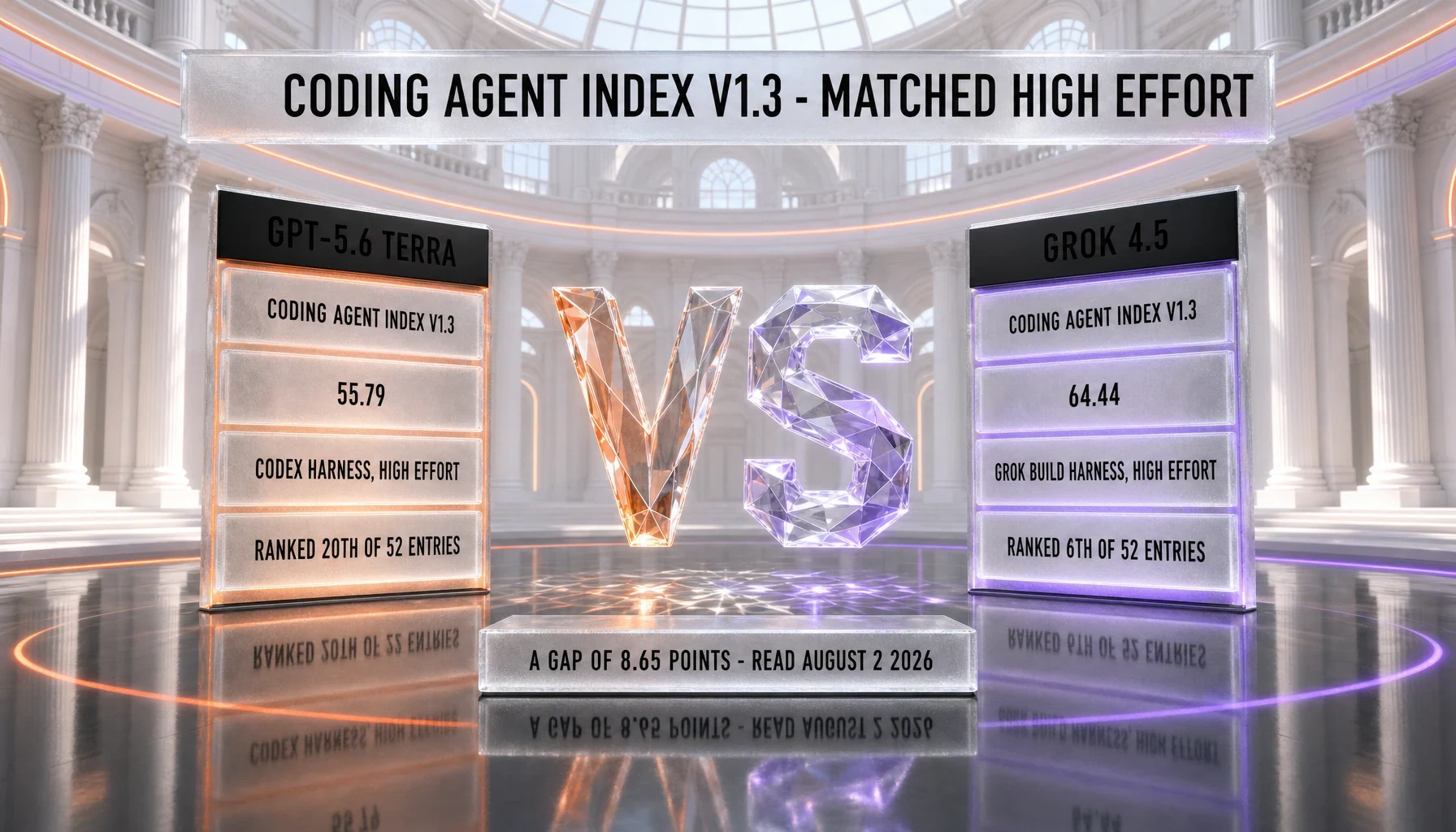
| AA Coding Agent Index v1.3 (independent, read August 2, 2026) | 55.79 — 20th of 52 (Codex harness, high effort); 62.28 at max | 64.44 — 6th of 52 (Grok Build harness, high effort) |
| LMArena Elo (independent, human preference) | Terra tier not charted | Not yet ranked |
| AA-Omniscience hallucination test (independent) | Not published by Artificial Analysis for Terra | 54% hallucination, 52% accuracy |
| Declared context window | 1,050,000 tokens | 500,000 tokens |
| Knowledge cutoff | February 16, 2026 | Not specified in SpaceXAI documentation |
| Reasoning control | Low through max (adds the new max tier) | Low, medium, high (high default) |
| Native agentic tool stack | Web search, file search, code interpreter, hosted shell, computer use, MCP, Programmatic Tool Calling | Function calling and structured outputs |
| Throughput / speed | No independent tokens-per-second figure in our sources | 'Opus-class, much faster' (SpaceXAI claim; no independent figure) |
| EU availability | Available in the EU | Not available in the EU (EU AI Act systemic risk) |
| Maturity and production status | Public July 9, 2026 (brand-new) | Public July 9, 2026 (brand-new) |
| Input and output modalities | Text and image in, text out | Text and image in, text out |
Pricing Comparison
GPT-5.6 Terra
Grok 4.5
Detailed Comparison
GPT-5.6 Terra and Grok 4.5 are the two value-tier frontier models compared here, and both reached public availability on July 9, 2026. GPT-5.6 Terra is the balanced middle tier of OpenAI's GPT-5.6 family, priced at $2.00 per million input tokens and $12.00 per million output tokens with a 1,050,000-token context window. Grok 4.5 is SpaceXAI's price-aggressive flagship, priced at $2 per million input tokens and $6 per million output tokens with a 500,000-token context window. On the raw rate card the two now match on input and Grok 4.5 is half the price on output, yet Artificial Analysis measures Terra's cost per task far lower at about $0.55 against Grok 4.5's $2.49, because Terra burns fewer tokens per task. Terra also edges the Artificial Analysis Intelligence Index 55 to 54, and carries more than double the context. Neither model has an independently verified SWE-bench Verified score. Best for the cheapest raw output-token rate and vendor-stated speed: Grok 4.5. Best for measured cost per task, long context, and marginal capability edges: GPT-5.6 Terra.
Quick Verdict
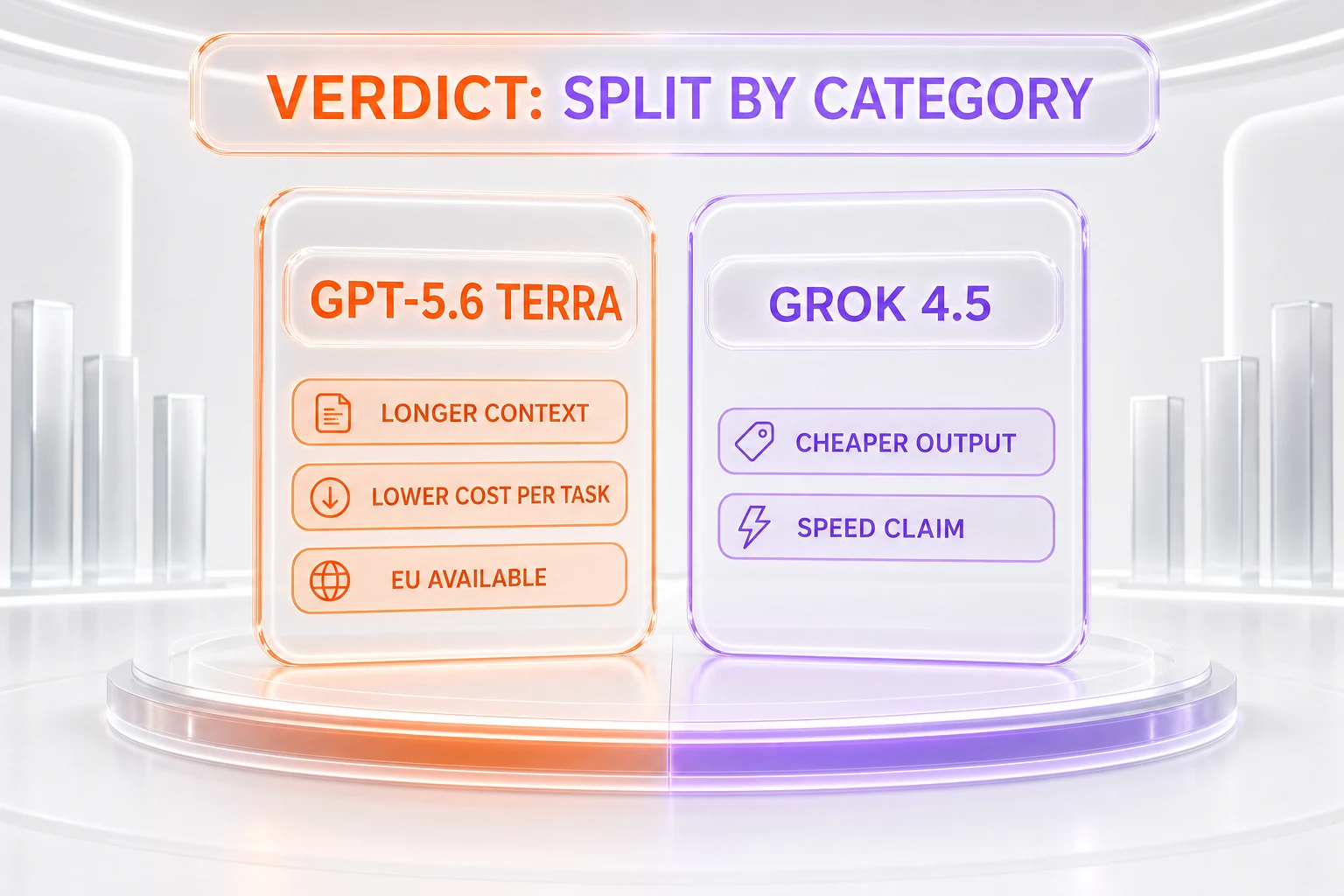
This is a split verdict: Grok 4.5 owns the cheapest raw output-token rate and its vendor-stated speed, while GPT-5.6 Terra owns the measured cost per task, more than double the context, marginal edges on the independent intelligence and coding indices, and a documented knowledge cutoff. Both models reached general availability on the same day — July 9, 2026 — and we ran both side-by-side through our own OpenAI and SpaceXAI API keys, so this is a genuine hands-on comparison rather than a spec-sheet readout, tempered by the fact that both are only days old at the time of writing. Where a benchmark tells the story better than a few days of use, we lean on attributed third-party numbers from Artificial Analysis, LMArena, and vals.ai, and every self-reported vendor figure is labeled as such. Here is the short version.
- Best for raw output-token price: Grok 4.5. At $6 per million output tokens against Terra's $12, it is 50 percent cheaper on the output rate, while its $2 input now matches Terra's $2.00 — both verified on SpaceXAI's documentation.
- Best for measured cost per task: GPT-5.6 Terra, and this is the twist. Artificial Analysis measures Terra at about $0.55 to run its Intelligence Index against Grok 4.5's roughly $2.49 — Terra costs about a fifth as much per task despite the higher output rate, because it generates far fewer tokens to finish the same work.
- Best for cached input: GPT-5.6 Terra. Its cached input is $0.20 per million against Grok 4.5's $0.30 — two-thirds of the read-side cost for agents with stable prompts.
- Best on aggregate intelligence, marginally: GPT-5.6 Terra. Artificial Analysis scores it 55 on the Intelligence Index against Grok 4.5's 54 — a single point, far smaller than the price gaps.
- Best on independent agentic coding: Grok 4.5, and on a measurement rather than on the absence of one. Artificial Analysis charts it at 64.44 on the Coding Agent Index v1.3, through the Grok Build harness at high reasoning effort, against 55.79 for GPT-5.6 Terra through the Codex harness at the same effort — 8.65 points. The harnesses differ, which is part of the result, and Terra's ceiling on that board, 62.28 at max effort, still sits below Grok 4.5's single charted entry.
- Even on verified coding, by absence: tie. Neither model has an independently verified SWE-bench Verified score at vals.ai — OpenAI did not submit Terra, and Grok 4.5 is too new to appear — so we call this a genuine tie rather than crown either.
- Best for long context: GPT-5.6 Terra, by more than double. Its 1,050,000-token window is roughly 2.1 times Grok 4.5's 500,000 tokens.
- Best for raw speed positioning: Grok 4.5, on the vendor's word. SpaceXAI markets it as Opus-class and much faster; our sources carry no independent tokens-per-second figure for either model, so we flag this as a vendor claim, not a benchmarked win.
- EU availability, no longer a differentiator: both. Grok 4.5 was unavailable in the European Union at launch, and SpaceXAI opened API console access to EU users on July 17, 2026.
The honest caveats up front: both models are days old at the time of writing, so we treat our hands-on notes on each as first impressions, not a settled verdict. Neither has an independently verified SWE-bench Verified number, which is an unusual data gap for two frontier models, and we will not paper it over with self-reported figures — OpenAI's self-reported Terminal-Bench 2.1 score for Terra and SpaceXAI's Opus-class framing for Grok 4.5 are both kept strictly separate from independently measured results. Grok 4.5 carries one independent reliability caveat — a 54 percent hallucination rate on Artificial Analysis's AA-Omniscience test — that we present as a standalone data point because our sources hold no equivalent figure for Terra. We only declare a winner where both models were measured on the same independent benchmark.
GPT-5.6 Terra vs Grok 4.5 — Overview
What Is GPT-5.6 Terra?
GPT-5.6 Terra is the balanced middle tier of OpenAI's GPT-5.6 model family, which reached general availability on July 9, 2026 after a gated preview in late June. In the GPT-5.6 lineup, the names are durable capability tiers rather than sizes: Sol is the flagship for the hardest problems, Terra is the balanced, high-volume business tier, and Luna is the fastest and cheapest. OpenAI positions Terra as GPT-5.5-competitive at roughly half the cost, and its rate card now goes further — $2.00 per million input tokens and $12 per million output tokens is 40 percent of GPT-5.5's $5 and $30. Per OpenAI's model documentation, Terra runs a 1,050,000-token context window, a 128,000-token maximum output, and a February 16, 2026 knowledge cutoff, takes text and image inputs to text output, and exposes reasoning effort from low through the new max tier — one step below the multi-agent ultra setting reserved mainly for Sol. It ships OpenAI's full native tool stack — web search, file search, image generation, code interpreter, a hosted shell, computer use, MCP, and skills — plus Programmatic Tool Calling, where the model writes and runs JavaScript in an isolated runtime. You can read our full GPT-5.6 Terra review for the standalone breakdown.
What Is Grok 4.5?
Grok 4.5 is the newest flagship model from SpaceXAI — the company formerly known as xAI, which kept the Grok product name unchanged through its July rebrand, as we covered in our SpaceXAI rebrand explainer. It was announced July 8, 2026 and reached public availability July 9, the same day as the GPT-5.6 family, replacing Grok 4.3 as the flagship while Grok 4.3 and 4.20 remain available. Per SpaceXAI's Grok 4.5 model documentation, it runs a 500,000-token context window, takes text and image inputs to text output, supports function calling and structured outputs, exposes low, medium, and high reasoning with high as the default, and is served from the us-east-1 and us-west-2 regions at rate limits of 150 requests per second. API pricing is $2 per million input tokens, $0.30 per million cached input, and $6 per million output tokens, which we confirmed directly on that documentation. SpaceXAI says Grok 4.5 was trained with Cursor on GB300 GPUs, and Elon Musk has described it as Opus-class and much faster than rivals, a claim we treat as vendor positioning. Grok 4.5 was not offered in the European Union at launch; SpaceXAI opened it to EU users in the API console on July 17, 2026, per its release notes. You can read our full Grok 4.5 review for the standalone breakdown.
How We Compared Them — and What We Did Not Do
Method transparency matters here because both models are days old and the launch discourse mixes self-reported and independent numbers freely. Here is exactly what we did and did not do, so you can weigh every figure below.
- Pricing: both rate cards are vendor-verified. Terra's $2.00 input and $12 output per million tokens is confirmed against OpenAI's pricing documentation; Grok 4.5's $2 input and $6 output per million is confirmed against SpaceXAI's model documentation. No relayed figures. Our AI model pricing explainer breaks down how input, output, and cached-token rates translate into real bills.
- Independent benchmarks: we lean on Artificial Analysis for the Intelligence Index, Coding Agent Index, cost per task, and AA-Omniscience factuality test; on LMArena for human-preference Elo; and on vals.ai for SWE-bench Verified. We only declare a benchmark winner where both models were measured on the same suite. Where one or both are absent, we say so and do not substitute a self-reported number.
- The SWE-bench gap: neither Terra nor Grok 4.5 has an independently verified SWE-bench Verified score. OpenAI did not submit Terra to vals.ai, and Grok 4.5 is too new to appear there. We flag this as a shared blank rather than fill it with OpenAI's self-reported Terminal-Bench figure or SpaceXAI's Opus-class framing.
- Self-reported figures: OpenAI's self-reported Terminal-Bench 2.1 result for Terra and SpaceXAI's Opus-class, much-faster positioning for Grok 4.5 are both labeled as vendor-reported and not treated as head-to-head evidence. Grok 4.5's only independent coding credit is its Artificial Analysis Coding Agent Index v1.3 score of 64.44, measured against GPT-5.6 Terra's 55.79 on that same index at the same high effort setting.
- Hands-on and disclosure: we tested both through our own API keys since their July 9 general availability — roughly a few days of side-by-side — so every observation is scoped as a first impression, and we weight the attributed benchmarks above short hands-on time for both. We have no affiliate relationship with OpenAI or SpaceXAI, and there are no sponsored links on this page. We are based outside the EU, which is why we could test Grok 4.5 directly during the nine days it was unavailable to EU users; that restriction lifted on July 17, 2026.
Features and Benchmarks Comparison
The table below lists every dimension we could verify or attribute. Read the Winner column carefully: it distinguishes vendor-verified pricing, independent benchmarks, and self-reported figures, and it flags where a result is one-sided, genuinely tied, or a standalone caveat. Every benchmark figure carries its source. The independent scores come from Artificial Analysis, LMArena, and vals.ai.
| Feature | GPT-5.6 Terra | Grok 4.5 | Winner |
|---|---|---|---|
| API input price (per million tokens) | $2.00 (verified) | $2.00 (verified) | Tie |
| API output price (per million tokens) | $12.00 (verified) | $6.00 (verified) | Grok 4.5 |
| Cached input price (per million tokens) | $0.20 (verified) | $0.30 (verified) | GPT-5.6 Terra |
| Cost per task, AA Intelligence Index (independent) | ~$0.55 (Artificial Analysis) | ~$2.49 (Artificial Analysis) | GPT-5.6 Terra (about a fifth the cost) |
| SWE-bench Verified (vals.ai, independent) | N/A (not submitted) | Not yet on an independent leaderboard (too new) | Tie (neither has a verified score) |
| AA Intelligence Index (independent) | 55 | 54 (No.4 at publication) | GPT-5.6 Terra (by one point) |
| AA Coding Agent Index v1.3 (independent, read August 2, 2026) | 55.79 — 20th of 52 (Codex harness, high effort); 62.28 at max | 64.44 — 6th of 52 (Grok Build harness, high effort) | Grok 4.5 by 8.65 at matched high effort, in different harnesses |
| LMArena Elo (independent, human preference) | Terra tier not charted | Not yet ranked | Tie (neither ranked) |
| AA-Omniscience hallucination test (independent) | Not published by Artificial Analysis for Terra | 54% hallucination, 52% accuracy | Not comparable (caveat on Grok 4.5) |
| Declared context window | 1,050,000 tokens | 500,000 tokens | GPT-5.6 Terra (2.1x larger) |
| Knowledge cutoff | February 16, 2026 | Not specified in SpaceXAI documentation | GPT-5.6 Terra (documented) |
| Reasoning control | Low through max (adds the new max tier) | Low, medium, high (high default) | GPT-5.6 Terra (finer control) |
| Native agentic tool stack | Web search, file search, code interpreter, hosted shell, computer use, MCP, Programmatic Tool Calling | Function calling and structured outputs | GPT-5.6 Terra |
| Throughput / speed | No independent tokens-per-second figure in our sources | 'Opus-class, much faster' (SpaceXAI claim; no independent figure) | Not comparable (vendor claim) |
| EU availability | Available in the EU | Available in the EU since July 17, 2026 | Tie |
| Maturity and production status | Public July 9, 2026 (brand-new) | Public July 9, 2026 (brand-new) | Tie (both days old) |
| Input and output modalities | Text and image in, text out | Text and image in, text out | Tie |
Synthesis: the rate card tilts to Grok 4.5 on output — $2 input and $6 output per million against Terra's $2.00 and $12, level on input and 50 percent cheaper on output. But the independent cost-per-task figure inverts that story: Artificial Analysis measures Terra at about $0.55 per task against Grok 4.5's $2.49, roughly a fifth the cost, because Terra generates far fewer tokens to finish the same work. The marginal capability signal goes to Terra — a one-point edge on the Intelligence Index (55 to 54) — while the independent agentic-coding measurement goes to Grok 4.5, which the Coding Agent Index v1.3 charts at 64.44 through the Grok Build harness at high reasoning effort against 55.79 for Terra through Codex at the same effort — 6th and 20th respectively among the 52 harness-model-effort pairs, read August 2, 2026. The structural facts go to Terra: more than double the context, a documented cutoff, and a fuller tool stack. Two blanks sit in the middle: neither model has an independently verified SWE-bench Verified score, and neither is ranked on LMArena. This is not a model that wins everything against a model that wins nothing; it is the cheapest raw output rate and a vendor speed claim against measured efficiency, longer reach, and marginal capability edges — and which of those governs your bill and your workload decides the matchup.
Pricing — GPT-5.6 Terra vs Grok 4.5 in 2026
Pricing is the sharpest contrast in this comparison, and it is genuinely split rather than one-sided — the rate card and the measured cost per task point in opposite directions. Both rate cards below come straight from OpenAI's and SpaceXAI's own documentation, and our pricing explainer covers how these translate into real spend.
GPT-5.6 Terra Pricing
| Tier | Input (per million tokens) | Output (per million tokens) | Notes |
|---|---|---|---|
| Standard API | $2.00 | $12.00 | Verified on OpenAI's pricing documentation |
| Cached input | $0.20 | — | 90 percent discount, verified |
| Batch mode | $1.00 | $6.00 | Half price, verified |
| Priority | $4.00 | $24.00 | Double rate for priority processing, verified |
Grok 4.5 Pricing
| Tier | Input (per million tokens) | Output (per million tokens) | Notes |
|---|---|---|---|
| Standard API | $2.00 | $6.00 | Verified on SpaceXAI's model documentation |
| Cached input | $0.30 | — | Verified on SpaceXAI's model documentation |
| Regions | us-east-1, us-west-2 | us-east-1, us-west-2 | Grok 4.5 open to EU users since July 17, 2026; both regions sit in the United States |
Pricing verdict: this is the heart of the split, so read it carefully. On the raw rate card, Grok 4.5 is cheaper on any output-bearing mix — $2 input now matches Terra's $2.00, and $6 output is 50 percent below Terra's $12. On a representative call of 50,000 input and 5,000 output tokens, Grok 4.5 costs about $0.13 ($2 times 0.05 input plus $6 times 0.005 output) against Terra's $0.16 ($2.00 times 0.05 plus $12 times 0.005), and the gap widens as output share grows because Grok 4.5's $6 output is 50 percent of Terra's $12. Yet the one independent per-task measurement reverses the conclusion: Artificial Analysis measures Terra at about $0.55 to run its Intelligence Index against Grok 4.5's roughly $2.49 — Terra costs about a fifth as much per task despite the higher rate card, because it generates far fewer tokens to complete the same reasoning work. Which figure governs your bill depends entirely on your workload: for raw, high-volume generation where both models emit similar token counts, Grok 4.5's cheaper rate dominates; for reasoning-heavy agentic tasks that resemble Artificial Analysis's mix, Terra's efficiency wins by a wide margin. Cached input splits the other way too — Terra's $0.20 is two-thirds of Grok 4.5's $0.30. If cost is your deciding factor, do not read the headline output rate alone: benchmark both on your own traffic, because these two genuinely disagree about which is cheaper.
Hands-On Notes — Both New, Same Launch Day
We owe you precision about what this section is and is not. Both GPT-5.6 Terra and Grok 4.5 went public on July 9, 2026, and we had both running through our own API keys within hours, which gives us a few days of direct use at the time of writing — sharp first impressions, nowhere near a controlled benchmark. Take every observation on either model as scoped and provisional, and weight the attributed benchmarks above our hands-on time.
Where Grok 4.5 stood out immediately: speed and cheap raw output. On high-volume, output-heavy calls — long rewrites, bulk generation, verbose extraction — Grok 4.5 felt fast and the output side of the bill barely moved at $6 per million tokens, which matches SpaceXAI's much-faster positioning even though we have no independent tokens-per-second figure to put a number on it. It returned valid, schema-adherent JSON on every structured-output run in our testing, and its OpenAI-compatible API meant most of our existing SDK code ran with only a base-URL and model-name change. For workloads that are wide and generate a lot of raw text, that combination of low output rate and apparent speed is its strongest hand.
Where GPT-5.6 Terra held the edge: long inputs, token efficiency, and the fuller tool stack. Its 1,050,000-token window swallowed a whole repository plus its history in one context where Grok 4.5's 500,000 tokens forced us to chunk, and on the reasoning-heavy agentic tasks we ran, Terra reached an answer in noticeably fewer tokens — the same behavior that shows up in its $0.55 cost per task against Grok 4.5's $2.49. Its native tool stack, including a hosted shell, computer use, MCP, and Programmatic Tool Calling, gave us more to build on than Grok 4.5's function-calling-and-structured-outputs baseline, and its reasoning control from low through the new max tier offered finer knobs than Grok 4.5's low, medium, and high. None of that is a settled benchmark after a few days, but it is consistent with the attributed numbers.
What we watched carefully: reliability on knowledge-heavy prompts. Artificial Analysis's 54 percent hallucination rate for Grok 4.5 on AA-Omniscience is a published caveat, and while a few days is not enough to confirm or refute it, it is a reason to ground Grok 4.5 with retrieval on factual work rather than trusting raw recall. Our sources carry no equivalent AA-Omniscience figure for Terra, so we present the caveat as one-sided rather than as a head-to-head result, and we would apply the same retrieval discipline to either model on high-stakes facts.
What we cannot tell you yet: either model's latency under controlled conditions, their per-task token economics across a real production workload rather than a benchmark mix, and whether their early behavior holds up over weeks. We will update this comparison as our time on both accumulates and as more independent harnesses — including SWE-bench Verified and LMArena — publish results for them.
Winner per Category
Best for Raw Output Price and Speed Positioning: Grok 4.5
On the raw output rate this one is not close. Grok 4.5 costs $6 per million output tokens against Terra's $12 — 50 percent cheaper — while its $2 input now matches Terra's $2.00, both verified on SpaceXAI's documentation. For high-volume, output-heavy workloads where both models emit similar token counts, that cheaper output rate dominates the bill. Speed is Grok 4.5's other headline: SpaceXAI markets it as Opus-class and much faster, and Elon Musk has repeated that framing, though our sources carry no independent tokens-per-second figure, so we treat it as a credible vendor claim rather than a benchmarked win. Paired with the cheapest output rate in this matchup, that makes Grok 4.5 a strong value play for bulk, latency-sensitive generation — with one hard boundary noted below.
Best for Measured Cost per Task and Cached Input: GPT-5.6 Terra
Here the story flips, and it is the most important nuance in the comparison. Despite its higher output rate, GPT-5.6 Terra costs less to actually run on the one independent per-task measurement we have: Artificial Analysis lists it at about $0.55 to run its Intelligence Index against Grok 4.5's roughly $2.49, because Terra generates far fewer tokens to finish the same reasoning tasks. Its cached input is also two-thirds of the price — $0.20 per million against $0.30 — which compounds for agents with stable system prompts. The rate card and the measured cost genuinely disagree, so the honest reading is workload-dependent: if your usage resembles reasoning-heavy agentic tasks, Terra is cheaper to run; if it is raw bulk output, Grok 4.5's rate card wins. That divergence is exactly why we do not crown a single cost winner.
Best on Aggregate Intelligence, Marginally: GPT-5.6 Terra
Two independent Artificial Analysis indices cover both models, and they split. On the Artificial Analysis Intelligence Index, GPT-5.6 Terra edges ahead by a single point, 55 to 54. On the Coding Agent Index v1.3 the order reverses: Grok 4.5 is charted at 64.44 through the Grok Build harness at high reasoning effort against 55.79 for GPT-5.6 Terra through the Codex harness at the same effort — 6th and 20th respectively among the 52 harness-model-effort pairs, read August 2, 2026. Artificial Analysis placed Grok 4.5 at No.4 in the flagship field at its July 8 publication. The Intelligence Index gap is marginal and we are careful not to oversell it — a one-point edge on an aggregate index is a neighbor, not a generation ahead — while the 8.65-point coding-agent gap at matched high effort is the wider of the two. The remaining capability story is the shared blank: neither model has an independently verified SWE-bench Verified score, and neither is ranked on LMArena, so on the two most-watched independent coding and human-preference leaderboards, this matchup is a tie by absence. The Coding Agent Index scores harness-and-model-effort pairs rather than bare models, which is why the matched-effort reading is the one that counts: Grok Build with Grok 4.5 at high effort against Codex with GPT-5.6 Terra at high effort. Terra reaches 62.28 on that board at max effort, its own ceiling, but that is a different pairing and not a like-for-like answer to Grok 4.5 at high.
Verified Coding and Human Preference: A Tie by Absence
This is the category where honesty means declining to pick. On the independently run SWE-bench Verified suite at vals.ai — where Claude Opus 4.8 sits at 88.6 percent and Claude Fable 5 leads at 95 percent — neither GPT-5.6 Terra nor Grok 4.5 has a score. OpenAI did not submit Terra to that suite, and Grok 4.5 is too new to appear on it. We will not substitute OpenAI's self-reported Terminal-Bench 2.1 result for Terra or SpaceXAI's Opus-class framing for Grok 4.5, because neither is an independently verified SWE-bench Verified number. LMArena tells the same story: the Terra tier is not charted, and Grok 4.5 is not yet ranked. So on the two benchmarks buyers most often ask about — SWE-bench Verified and LMArena — the correct answer is that both models are unproven. The one independent coding board that does cover both is the Coding Agent Index v1.3, where Grok 4.5 is charted at 64.44 and GPT-5.6 Terra at 55.79, both at high effort but in different harnesses.
Best for Long Context and Tooling: GPT-5.6 Terra
GPT-5.6 Terra carries a 1,050,000-token context window against Grok 4.5's 500,000 — more than double, and a genuine architectural difference rather than a rounding gap. For whole-repository code work, large document sets, and agents that accumulate long histories, Terra fits jobs in one context that Grok 4.5 must split. It also brings a fuller native tool stack — web search, file search, code interpreter, a hosted shell, computer use, MCP, and Programmatic Tool Calling — against Grok 4.5's function-calling-and-structured-outputs baseline, plus a documented February 16, 2026 knowledge cutoff where SpaceXAI's documentation specifies none. For long-context pipelines, deep tool use, and teams that value a documented, fuller-featured model, Terra is the pick.
Availability: Both, Since July 17, 2026
This category had no contest until July 17, 2026. Grok 4.5 was not available in the European Union at launch; on that date the xAI release notes published an entry titled "Grok 4.5 available in the EU," stating that "Grok 4.5 is now available in the API console for EU users." GPT-5.6 Terra has been available in the EU throughout. Availability therefore no longer settles the choice before price or benchmarks enter the picture, and the decision returns to the measured differences above. One narrower point survives: Grok 4.5's documentation lists only the us-east-1 and us-west-2 regions, so data residency is a separate question from availability.
Best for the Independent Reliability Signal: GPT-5.6 Terra, Where Measured
Reliability is the category where the data is one-sided in a way that cuts against Grok 4.5. On Artificial Analysis's AA-Omniscience test, which measures how often a model confabulates rather than admitting uncertainty, Grok 4.5 scored 26 with a 52 percent accuracy rate and a 54 percent hallucination rate. Artificial Analysis has not published an equivalent figure for GPT-5.6 Terra in our sources, so this is a standalone caveat on Grok 4.5 rather than a head-to-head result — but for knowledge-intensive work where a confident wrong answer is expensive, it is a signal worth weighing. Ground either model with retrieval and verification on high-stakes facts rather than trusting recall.
Pros and Cons
GPT-5.6 Terra Pros and Cons
What we like about GPT-5.6 Terra
- Far lower measured cost per task. About $0.55 to run the Artificial Analysis Intelligence Index against Grok 4.5's $2.49 — roughly a fifth the cost, because it burns fewer tokens per task.
- More than double the context. A 1,050,000-token window against Grok 4.5's 500,000, enough to hold whole repositories and long histories in one pass.
- Marginal edge on the independent Intelligence Index. A one-point lead, 55 to 54 — and on the Coding Agent Index v1.3 the edge reverses, 55.79 against Grok 4.5's 64.44 at the same high effort.
- Fuller tool stack and finer reasoning control. Web search, file search, code interpreter, a hosted shell, computer use, MCP, and Programmatic Tool Calling, plus reasoning from low through the new max tier.
- A documented cutoff and cheaper cached input. A February 16, 2026 knowledge cutoff, and cached input at $0.20 against Grok 4.5's $0.30.
Where GPT-5.6 Terra falls short
- Double the output rate. $12 per million output tokens against Grok 4.5's $6 — a real gap on high-volume, output-heavy work at the rate card.
- A long-context surcharge. Above 272,000 input tokens Terra bills at twice the input rate and one and a half times the output rate, applied to the full request.
- No independently verified SWE-bench Verified score. OpenAI did not submit Terra, so its verified-coding line is blank, same as Grok 4.5.
- Only a marginal capability lead. A single point on the one independent index that scores both, far smaller than the output-rate gap.
- Days old and unproven over time. Public only since July 9, 2026, so its production behavior over weeks is untested.
Grok 4.5 Pros and Cons
What we like about Grok 4.5
- Cheapest raw output rate in this matchup. $6 per million output tokens against Terra's $12 — 50 percent cheaper — with $2 input level with Terra, verified on SpaceXAI's docs.
- Positioned as much faster. SpaceXAI calls it Opus-class and much faster; speed is its headline selling point for latency-sensitive work, though we treat it as a vendor claim.
- The better independent agentic-coding result of the two. A 64.44 on the Artificial Analysis Coding Agent Index v1.3, through the Grok Build harness at high reasoning effort, against 55.79 for GPT-5.6 Terra through Codex at the same effort — and trained with Cursor on GB300 GPUs.
- OpenAI-compatible API and reliable structured outputs. Most existing SDK code runs with a base-URL and model-name change, and it returned valid JSON on every run in our testing.
- Same-day frontier launch. A brand-new July 9, 2026 flagship that replaced Grok 4.3, competitive on aggregate intelligence at 54 against Terra's 55.
Where Grok 4.5 falls short
- Higher measured cost per task. About $2.49 to run the Artificial Analysis Intelligence Index against Terra's $0.55, because it generates more tokens per task.
- No independently verified SWE-bench Verified score, and absent from LMArena. Too new to appear on either leaderboard.
- Independent hallucination caveat. A 54 percent hallucination rate on Artificial Analysis's AA-Omniscience test, with 52 percent accuracy.
- Half the context window and a thinner tool stack. 500,000 tokens against 1,050,000, and function calling plus structured outputs against Terra's fuller native stack.
When to Pick GPT-5.6 Terra vs Grok 4.5
Pick GPT-5.6 Terra if...
- Your workload is reasoning-heavy and cost-sensitive, where the measured $0.55 per task beats Grok 4.5's $2.49 despite the higher rate card.
- You need long context — a 1,050,000-token window is more than double Grok 4.5's and holds whole repositories in one pass.
- You want the fuller native tool stack — hosted shell, computer use, MCP, and Programmatic Tool Calling — and finer reasoning control up to the new max tier.
- Knowledge-intensive reliability matters and you would rather not deploy against Grok 4.5's published 54 percent hallucination caveat without heavy retrieval.
Pick Grok 4.5 if...
- Your workload is raw, high-volume output where the $6 per million output rate — 50 percent below Terra's $12 — dominates the bill.
- Latency is a top priority and you are willing to trust SpaceXAI's much-faster positioning, or to benchmark speed on your own traffic.
- Your inputs stay well under 500,000 tokens, so the context difference does not affect you and the cheaper rate card carries more weight.
- Agentic coding is your main use and you want the model that leads the independent Coding Agent Index v1.3 at matched high effort — 64.44 against GPT-5.6 Terra's 55.79 — at a lower output rate.
Frequently Asked Questions
Is GPT-5.6 Terra or Grok 4.5 better in 2026?
It depends on your workload, and we will not fake a single overall winner. Grok 4.5 wins the raw rate card on output — $2 per million input tokens and $6 per million output against Terra's $2.00 and $12, level on input and 50 percent cheaper on output — and SpaceXAI markets it as much faster. GPT-5.6 Terra wins the measured cost per task, at about $0.55 to run the Artificial Analysis Intelligence Index against Grok 4.5's $2.49, and it edges the Intelligence Index 55 to 54, carries more than double the context window at 1,050,000 tokens, and is available in the EU where Grok 4.5 was blocked until July 17, 2026. Neither model has an independently verified SWE-bench Verified score. Best for the cheapest output rate and speed: Grok 4.5. Best for measured cost per task and long context: GPT-5.6 Terra.
How much do GPT-5.6 Terra and Grok 4.5 cost?
GPT-5.6 Terra costs $2.00 per million input tokens and $12 per million output tokens, with cached input at $0.20 per million and a Batch mode at half price — we confirmed this on OpenAI's API pricing documentation. Grok 4.5 costs $2 per million input tokens and $6 per million output tokens, with cached input at $0.30 per million — we confirmed this on SpaceXAI's Grok 4.5 model documentation. On the raw rate card the two now match on input, and Grok 4.5 is 50 percent cheaper on output. But Terra's cached input is two-thirds of the price at $0.20 against $0.30, and its measured cost per task is far lower, so the cheaper rate card does not automatically mean the cheaper bill.
Which is cheaper to run, GPT-5.6 Terra or Grok 4.5?
They genuinely disagree, which is why we call the pricing a split. On the rate card, Grok 4.5 is cheaper on any output-bearing mix — $2 input and $6 output per million against Terra's $2.00 and $12, level on input. But on the one independent per-task measurement, Artificial Analysis lists GPT-5.6 Terra at about $0.55 to run its Intelligence Index against Grok 4.5's roughly $2.49, because Terra generates far fewer tokens to finish the same reasoning work. So for raw, high-volume output where both models emit similar token counts, Grok 4.5 is cheaper; for reasoning-heavy agentic tasks that resemble Artificial Analysis's mix, Terra is cheaper by a wide margin. Cost per task always depends on how many tokens a model burns, so benchmark both on your own prompts before committing.
Which is better for coding: GPT-5.6 Terra or Grok 4.5?
One independent coding leaderboard covers both. On the Artificial Analysis Coding Agent Index v1.3, Grok 4.5 is charted at 64.44 through the Grok Build harness at high reasoning effort, against 55.79 for GPT-5.6 Terra through the Codex harness at the same effort — a measured 8.65-point win for Grok 4.5, in different harnesses, with Terra's max-effort ceiling of 62.28 still below it. On the independently run SWE-bench Verified suite at vals.ai, neither model has a score: OpenAI did not submit Terra, and Grok 4.5 is too new to appear. We will not substitute OpenAI's self-reported Terminal-Bench figure or SpaceXAI's Opus-class framing for a verified number. So the independent agentic-coding edge belongs to Grok 4.5 on the Coding Agent Index v1.3, while SWE-bench Verified is a tie by absence for both, and price is the tiebreaker many teams will use — Grok 4.5's cheaper output rate against Terra's lower measured cost per task.
Does GPT-5.6 Terra or Grok 4.5 have a SWE-bench Verified score?
Neither does, as of this comparison. SWE-bench Verified is the independently run coding suite hosted at vals.ai, and both models are absent from it. OpenAI did not submit GPT-5.6 Terra to the suite, and Grok 4.5 reached public availability only on July 9, 2026 and is too new to appear on the leaderboard. That is a data gap we flag rather than fill with self-reported numbers. For reference, on that same suite Claude Opus 4.8 posts 88.6 percent and Claude Fable 5 leads at 95 percent, but both Terra and Grok 4.5 are simply blank. A different independent coding signal does cover both: on the Artificial Analysis Coding Agent Index v1.3, Grok 4.5 is charted at 64.44 and GPT-5.6 Terra at 55.79, both at high effort in their own vendors' harnesses.
Which has the larger context window: GPT-5.6 Terra or Grok 4.5?
GPT-5.6 Terra, by more than double. OpenAI documents Terra at a 1,050,000-token context window with a 128,000-token maximum output and a February 16, 2026 knowledge cutoff, while SpaceXAI's documentation lists Grok 4.5 at 500,000 tokens. That is not a rounding difference — Terra holds roughly 2.1 times as much context, which matters for whole-repository code work, long document sets, and agents that accumulate large histories. Both models take text and image inputs and return text. If your workloads routinely exceed half a million tokens, Terra is the only one of the two that fits them in a single context; if they stay well under 500,000 tokens, the difference will not affect you and Grok 4.5's cheaper output rate carries more weight.
Is Grok 4.5 available in the EU?
No. At the time of writing, SpaceXAI does not make Grok 4.5 available in the European Union, citing the EU AI Act's systemic-risk obligations, and its API documentation lists only the us-east-1 and us-west-2 regions. GPT-5.6 Terra, by contrast, is available in the EU. For any team that must serve or process data inside the European Union, that makes Grok 4.5 a non-option regardless of its price, and Terra becomes the default of these two by elimination. We are based outside the EU, so we were able to test Grok 4.5 directly, but we flag the restriction prominently because it is a hard gate for a large share of readers, and it can settle the entire decision before price or benchmarks enter the picture.
Which is more reliable, GPT-5.6 Terra or Grok 4.5?
There is one independent reliability caveat, and it is on Grok 4.5. On Artificial Analysis's AA-Omniscience test, which probes how often a model confabulates rather than admitting it does not know, Grok 4.5 scored 26 with a 52 percent accuracy rate and a 54 percent hallucination rate. Artificial Analysis has not published an equivalent AA-Omniscience figure for GPT-5.6 Terra in our sources, so we present Grok 4.5's number as a standalone caveat rather than a head-to-head result. It is a signal to weigh for knowledge-intensive work where a confident wrong answer is costly. As with any single benchmark, treat it as one data point: for high-stakes factual work, ground either model with retrieval and verification rather than trusting raw recall.
Which model is faster: GPT-5.6 Terra or Grok 4.5?
We cannot declare a numeric speed winner, because our sources give no independent tokens-per-second figure for either model in this matchup. SpaceXAI positions Grok 4.5 as Opus-class and much faster than its rivals, and Elon Musk has repeated that framing, but that is a vendor claim rather than an independently benchmarked figure. Speed is genuinely one of Grok 4.5's headline selling points, and paired with its cheaper output rate it may well be the faster and cheaper choice for high-volume bulk generation, but we will not crown it on a vendor statement alone. If latency is your deciding factor, benchmark both models on your own traffic before committing, because published rate cards and marketing claims do not measure real-world tail latency on your prompts.
Which has the higher Artificial Analysis Intelligence Index: GPT-5.6 Terra or Grok 4.5?
GPT-5.6 Terra, but only just. Artificial Analysis scores Terra at 55 on its Intelligence Index against Grok 4.5's 54, and it placed Grok 4.5 at No.4 in the flagship field at its July 8 publication. A single point on an aggregate index is a marginal gap, not a decisive one, and it is far smaller than the differences on price and context between the two models. On this measure alone, the two are effectively neighbors. The more meaningful separations in this matchup are Terra's lower measured cost per task, its more than double context window, and its EU availability, rather than the one-point Intelligence Index margin, which we are careful not to oversell.
Are GPT-5.6 Terra and Grok 4.5 new models?
Yes, both are brand-new, and they launched on the same day. GPT-5.6 Terra is the balanced middle tier of OpenAI's GPT-5.6 family, which reached general availability on July 9, 2026 after a gated preview in late June; GPT-5.5 remains active and was not deprecated. Grok 4.5 was announced by SpaceXAI on July 8 and reached public availability on July 9, replacing Grok 4.3 as the flagship. Because both are only days old at the time of writing, we scope our hands-on notes on each as first impressions and lean on attributed third-party benchmarks for the capability claims. We will revise this comparison as independent benchmark coverage of both models matures over the coming weeks.
What are the alternatives to GPT-5.6 Terra and Grok 4.5?
Several sit close by. Within OpenAI's own family, GPT-5.6 Sol is the flagship tier above Terra for the hardest problems, and GPT-5.5 remains the established prior flagship at $5 input and $30 output per million tokens. On capability, Claude Opus 4.8 posts 88.6 percent on the independent SWE-bench Verified suite, and Claude Opus 5 leads the Artificial Analysis Intelligence Index at 60.7 as of August 4, 2026, with Claude Fable 5 at 59.9. On the value end, Grok's own predecessor Grok 4.3 and Gemini 3.1 Pro are worth weighing. If you want the adjacent matchup in detail, our GPT-5.5 versus Grok 4.3 comparison covers the previous round of this same OpenAI-versus-Grok rivalry, and our full Terra and Grok 4.5 reviews go deeper on each model on its own.
Final Verdict — Cheapest Output Rate vs Measured Efficiency, a True Split
After running both GPT-5.6 Terra and Grok 4.5 through our own API keys since their shared July 9 launch, verifying pricing on both vendors' own documentation, and holding every capability claim to independent benchmarks, our verdict is a genuine split — not a diplomatic one. Grok 4.5 is the raw rate-card and speed play: at $2 input and $6 output per million tokens it is level on input and 50 percent below Terra on output, and SpaceXAI positions it as Opus-class and much faster; for high-volume, output-heavy work that combination is genuinely compelling. GPT-5.6 Terra is the measured-efficiency, longer-reach model: its cost per task is about $0.55 against Grok 4.5's $2.49, it edges the one independent index that scores both by a point, it carries more than double the context window, it ships a fuller native tool stack with a documented cutoff, and it is available in the EU. We disclose plainly that we have no affiliate relationship with either vendor and tested both through our own API keys.
We did not crown a single overall winner because the evidence does not support one honestly. The pricing itself is split: the rate card favors Grok 4.5 while the independent cost-per-task figure favors Terra, and which governs your bill depends on how token-efficient your workload is. Neither model has an independently verified SWE-bench Verified score, so the most-watched coding benchmark is a tie by absence for both, and the capability edges Terra does hold are a single point each. If your work is raw, high-volume output outside the EU — pick Grok 4.5 and bank the cheaper output rate and its speed positioning. If your work is reasoning-heavy, long-context, EU-bound, or sensitive to measured cost per task — pick GPT-5.6 Terra. For many teams the rational endgame is routing: Grok 4.5 for cheap, fast bulk generation where a one-point capability gap does not change the outcome, and GPT-5.6 Terra for reasoning-heavy, long-context, and EU traffic where its efficiency and reach pull ahead. For the tools and neighbors around this matchup, see our GPT-5.6 Terra review, our Grok 4.5 review, our GPT-5.6 Sol review, our GPT-5.5 review, our Grok 4.3 review, and our GPT-5.5 vs Grok 4.3 comparison.
Sources
Every figure in this comparison is attributed to a primary or independent source. Pricing and specifications come from the vendors' own documentation; capability scores come from independent third parties; self-reported vendor positioning is labeled as such throughout.
- OpenAI — GPT-5.6 API pricing
- OpenAI — GPT-5.6 model documentation and specifications
- OpenAI — GPT-5.6 announcement and capability tiers
- SpaceXAI — Grok 4.5 model documentation and pricing
- SpaceXAI — Grok product home
- Artificial Analysis — Intelligence Index, cost per task, and AA-Omniscience
- Artificial Analysis — Coding Agent Index v1.3 leaderboard (Grok 4.5 64.44 Grok Build high, Terra 55.79 Codex high)
- LMArena — human-preference Elo leaderboard
- vals.ai — SWE-bench Verified independent leaderboard
Last compared: July 2026. Both GPT-5.6 Terra and Grok 4.5 reached public availability on July 9, 2026 and are new; we will revise this comparison as independent benchmark coverage of both models matures.
Our Verdict
A genuine split verdict between two value-tier frontier models that launched on the same day, July 9, 2026, and we will not fake a single overall winner. Grok 4.5 is the raw rate-card and speed play: at $2 per million input tokens and $6 per million output it matches Terra on input and comes in 50 percent below its $12 output, and SpaceXAI markets it as Opus-class and much faster, a vendor claim we do not treat as a benchmarked win. GPT-5.6 Terra is the measured-efficiency, longer-reach model: Artificial Analysis measures its cost per task at about $0.55 against Grok 4.5's $2.49 because it burns far fewer tokens per task, it edges the Intelligence Index 55 to 54 — though on the Coding Agent Index v1.3 Grok 4.5 leads it 64.44 to 55.79 at the same high effort setting, in different harnesses — carries more than double the context at 1,050,000 tokens, ships a fuller native tool stack with a documented February 16, 2026 cutoff, and is available in the EU where Grok 4.5 is blocked under the AI Act's systemic-risk provisions. Neither model has an independently verified SWE-bench Verified score — OpenAI did not submit Terra and Grok 4.5 is too new to appear — so verified coding is a tie by absence, and Grok 4.5 carries a standalone AA-Omniscience reliability caveat with a 54 percent hallucination rate. The pricing itself is split: the rate card favors Grok 4.5 while the independent cost-per-task figure favors Terra, and which governs your bill depends on how token-efficient your workload is. Best for the cheapest raw output rate and speed on non-EU work: Grok 4.5. Best for measured cost per task, long context, marginal capability edges, and EU deployment: GPT-5.6 Terra. No single overall winner — route raw high-volume output outside the EU to Grok 4.5, and reasoning-heavy, long-context, and EU-bound work to GPT-5.6 Terra.
Choose GPT-5.6 Terra
OpenAI's balanced GPT-5.6 tier — GPT-5.5-competitive quality at 40 percent of the GPT-5.5 rate, with a 1.05M-token context and the full agentic toolbox.
Try GPT-5.6 Terra →Choose Grok 4.5
SpaceXAI's reasoning model — Opus-class speed at $2 and $6 per million tokens, 500K context, available to EU users since July 17, 2026; succeeded by Grok 4.6 on August 12.
Try Grok 4.5 →Frequently Asked Questions
Is GPT-5.6 Terra better than Grok 4.5?
A genuine split verdict between two value-tier frontier models that launched on the same day, July 9, 2026, and we will not fake a single overall winner. Grok 4.5 is the raw rate-card and speed play: at $2 per million input tokens and $6 per million output it matches Terra on input and comes in 50 percent below its $12 output, and SpaceXAI markets it as Opus-class and much faster, a vendor claim we do not treat as a benchmarked win. GPT-5.6 Terra is the measured-efficiency, longer-reach model: Artificial Analysis measures its cost per task at about $0.55 against Grok 4.5's $2.49 because it burns far fewer tokens per task, it edges the Intelligence Index 55 to 54 — though on the Coding Agent Index v1.3 Grok 4.5 leads it 64.44 to 55.79 at the same high effort setting, in different harnesses — carries more than double the context at 1,050,000 tokens, ships a fuller native tool stack with a documented February 16, 2026 cutoff, and is available in the EU where Grok 4.5 is blocked under the AI Act's systemic-risk provisions. Neither model has an independently verified SWE-bench Verified score — OpenAI did not submit Terra and Grok 4.5 is too new to appear — so verified coding is a tie by absence, and Grok 4.5 carries a standalone AA-Omniscience reliability caveat with a 54 percent hallucination rate. The pricing itself is split: the rate card favors Grok 4.5 while the independent cost-per-task figure favors Terra, and which governs your bill depends on how token-efficient your workload is. Best for the cheapest raw output rate and speed on non-EU work: Grok 4.5. Best for measured cost per task, long context, marginal capability edges, and EU deployment: GPT-5.6 Terra. No single overall winner — route raw high-volume output outside the EU to Grok 4.5, and reasoning-heavy, long-context, and EU-bound work to GPT-5.6 Terra.
Which is cheaper, GPT-5.6 Terra or Grok 4.5?
GPT-5.6 Terra starts at $2 in / $12 out per M tokens. Grok 4.5 starts at $2 in / $6 out per M tokens. Check the pricing comparison section above for a full breakdown.
What are the main differences between GPT-5.6 Terra and Grok 4.5?
The key differences span across 17 features we compared. For API input price (per million tokens), GPT-5.6 Terra offers $2.00 (verified) while Grok 4.5 offers $2.00 (verified). For API output price (per million tokens), GPT-5.6 Terra offers $12.00 (verified) while Grok 4.5 offers $6.00 (verified). For Cached input price (per million tokens), GPT-5.6 Terra offers $0.20 (verified) while Grok 4.5 offers $0.30 (verified). See the full feature comparison table above for all details.