Grok 4.5 vs Claude Fable 5: Cheapest Frontier vs Most Capable (2026)


Grok 4.5 is 5-8x cheaper at $2 and $6 per million tokens; Claude Fable 5 leads the Intelligence Index at 60 and SWE-bench Verified at 95%. Our split verdict.
Feature Comparison
| Feature | Grok 4.5 | Claude Fable 5 |
|---|---|---|
| API input price (per million tokens) | $2.00 (verified) | $10.00 (verified) |
| API output price (per million tokens) | $6.00 (verified) | $50.00 (verified) |
| Cost per task, AA Intelligence Index (independent) | ~$2.49 (Artificial Analysis) | ~$11.80 (Artificial Analysis) |
| AA Intelligence Index (independent) | 54 (No.4) | 60 (No.1) |
| SWE-bench Verified, vals.ai (independent) | Not yet on independent leaderboard (too new) | 95% |
| LMArena Elo (independent, human preference) | Not listed as of July 2026 | No.1 (1509) |
| Declared context window | 500,000 tokens | 1,000,000 tokens |
| EU availability | Blocked (EU AI Act systemic-risk) | Available |
| Response speed | Vendor claim: much faster (Musk, unverified) | Slower (per Anthropic docs) |
Pricing Comparison
Grok 4.5
Claude Fable 5
Detailed Comparison
Grok 4.5 and Claude Fable 5 are the two frontier models compared here, and they sit at opposite ends of the price-versus-capability trade-off. Grok 4.5 is SpaceXAI's flagship, priced at $2 per million input tokens and $6 per million output tokens with a 500,000-token context window. Claude Fable 5 is Anthropic's most capable widely released model, priced at $10 per million input tokens and $50 per million output tokens with a 1,000,000-token context window. On independent leaderboards, Claude Fable 5 leads: it tops the Artificial Analysis Intelligence Index at 60, ranks No.1 on LMArena at 1509 Elo, and posts 95 percent on the vals.ai SWE-bench Verified suite, while Grok 4.5 scores 54 on the Intelligence Index and is not yet on the LMArena or SWE-bench Verified leaderboards. Grok 4.5 wins decisively on price — roughly five times cheaper on input and about eight times cheaper on output — and on measured cost per task. This is a split, and we do not crown a single overall winner.
Quick Verdict
This is a split by category, and we will not fake a single overall winner: Claude Fable 5 is the more capable and more independently verified model, while Grok 4.5 is far cheaper and faster and finishes tasks for a fraction of the cost. Grok 4.5 reached public availability on July 9, 2026; Claude Fable 5 has been generally available since June 9, 2026. We ran both side-by-side through our own SpaceXAI and Anthropic API keys, so our hands-on notes on Grok 4.5 are sharp first impressions rather than a matured verdict, and we anchor every capability claim to attributed third-party numbers from Artificial Analysis, LMArena, and vals.ai wherever our own time is too short. Every figure below carries its source, and vendor self-reported claims are labeled as such. Here is the short version.
- Best raw capability: Claude Fable 5. It leads the Artificial Analysis Intelligence Index at 60 against Grok 4.5's 54, and it is the most capable widely released model of 2026 on that composite.
- Best independently verified coding: Claude Fable 5. It posts 95 percent on the vals.ai SWE-bench Verified suite, the highest of any model that leaderboard tracks; Grok 4.5 is not yet on that independent leaderboard, so it has no verified SWE-bench number at all.
- Best human-preference ranking: Claude Fable 5. It sits No.1 on LMArena at 1509 Elo, while Grok 4.5 is not listed on LMArena as of this comparison.
- Best input price: Grok 4.5, at $2 per million input tokens against Fable 5's $10 — roughly five times cheaper.
- Best output price: Grok 4.5, at $6 per million output tokens against Fable 5's $50 — about eight times cheaper.
- Best measured cost per task: Grok 4.5. Artificial Analysis measures it at about $2.49 per task against roughly $11.80 for Claude Fable 5, close to a five-fold gap.
- Best availability: Claude Fable 5. It is available in the European Union, while Grok 4.5 is blocked in the EU under the AI Act's systemic-risk provisions.
- Best factual reliability signal: a caution on Grok 4.5. Artificial Analysis's AA-Omniscience test scores it at 26 with a 54 percent hallucination rate; Fable 5 is not scored on that specific run in our sources but leads the broader capability benchmarks.
No single overall winner. Route capability-critical, verification-critical, and EU-based work to Claude Fable 5; route cost-sensitive, high-volume, and latency-sensitive work outside the EU to Grok 4.5. Elon Musk's "Opus-class, much faster" framing is partly supported on coding value and speed but not on general intelligence or measured reliability, and we show every number behind that call below.
Grok 4.5 vs Claude Fable 5 at a Glance
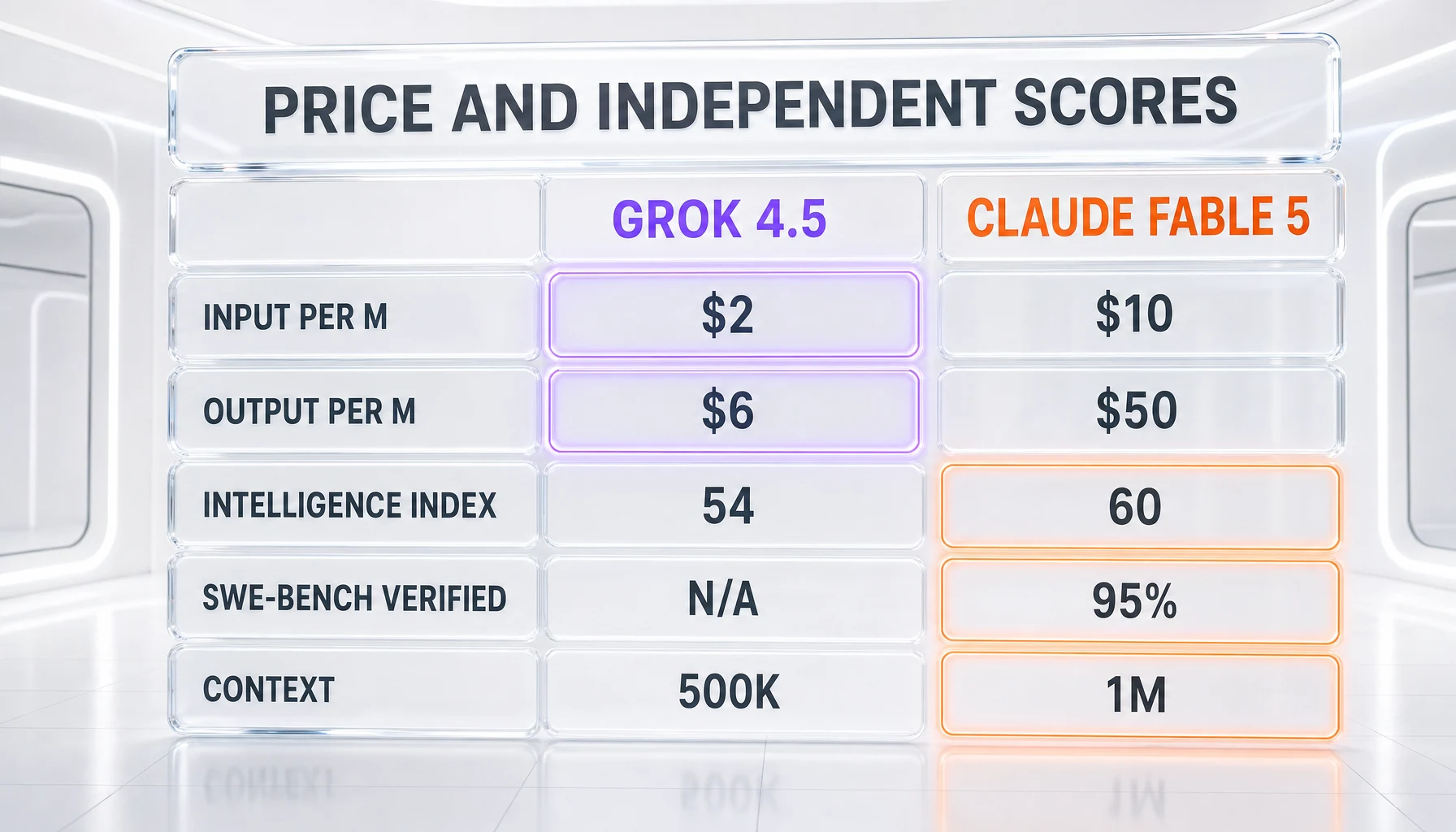
The two models diverge sharply on almost every axis. Grok 4.5 is roughly five times cheaper on input, about eight times cheaper on output, and measured at nearly a fifth of the cost per task. Claude Fable 5 answers with the highest independent capability scores of 2026: the top Intelligence Index, the No.1 LMArena ranking, and the leading verified SWE-bench result. One model wins the wallet, the other wins the benchmark, and that is exactly why a single crown would be dishonest.
| Attribute | Grok 4.5 | Claude Fable 5 |
|---|---|---|
| Vendor | SpaceXAI (xAI) | Anthropic |
| API model ID | grok-4.5 | claude-fable-5 |
| Input price (per million tokens) | $2.00 | $10.00 |
| Output price (per million tokens) | $6.00 | $50.00 |
| Cached input (per million tokens) | $0.50 | Prompt caching offered |
| Cost per task (Artificial Analysis) | ~$2.49 | ~$11.80 |
| AA Intelligence Index (independent) | 54 (No.4) | 60 (No.1) |
| SWE-bench Verified, vals.ai (independent) | Not yet on independent leaderboard (too new) | 95% |
| LMArena Elo (independent) | Not listed as of July 2026 | No.1 (1509) |
| AA Coding Agent Index (independent) | 76 | Leads via SWE-bench Verified (95%) |
| Context window | 500,000 tokens | 1,000,000 tokens |
| Max output | Not stated on model page | 128,000 tokens |
| EU availability | Blocked (EU AI Act systemic-risk) | Available |
| Modalities | Text and image in, text out | Text and image in, text out |
Sources for this table are the SpaceXAI Grok 4.5 model documentation and Anthropic's models overview for specifications, and Artificial Analysis, LMArena, and vals.ai for the independent scores. We confirmed both price cards directly on the vendors' own pricing pages, covered in the pricing section below.
What Each Model Is
Grok 4.5
Grok 4.5 is SpaceXAI's flagship reasoning model, released to the public on July 9, 2026, one day after its announcement, and it replaces Grok 4.3 as the company's top model while Grok 4.3 and Grok 4.20 remain available. Per the SpaceXAI model documentation, Grok 4.5 carries a 500,000-token context window, text-plus-image input with text output, function calling, structured outputs, and a reasoning-effort control with low, medium, and high levels (high by default). It is priced aggressively at $2 per million input tokens, $0.50 per million cached input tokens, and $6 per million output tokens — what SpaceXAI frames as roughly half the price of rival flagships. One material caveat: Grok 4.5 is blocked in the European Union, which the company attributes to the EU AI Act's systemic-risk classification for the most capable general-purpose models, and its documented regions are US-based only. Elon Musk has described it as "Opus-class, much faster," a characterization we treat as a vendor claim rather than an independently verified result. For the full standalone breakdown, see our Grok 4.5 review, and for the corporate context, our report on the xAI-to-SpaceXAI rebrand.
Claude Fable 5
Claude Fable 5 is Anthropic's most capable widely released model — the public, safety-classified frontier tier — generally available since June 9, 2026. Per Anthropic's models overview, Fable 5 carries a 1,000,000-token context window (roughly 555,000 words), a 128,000-token maximum output, a January 2026 knowledge cutoff, adaptive thinking that is always on, and text-plus-image input with text output. Anthropic's own documentation labels its comparative latency as "Slower," reflecting the depth-over-speed positioning of a top capability tier. It is the most expensive model in this matchup at $10 per million input tokens and $50 per million output tokens, and it is the model to beat on independent capability: it leads the Artificial Analysis Intelligence Index at 60, ranks No.1 on LMArena, and tops the vals.ai SWE-bench Verified suite at 95 percent. For the full hands-on breakdown, see our Claude Fable 5 review.
Pricing: Grok 4.5 Undercuts Fable 5 by Five to Eight Times
The price gap here is the widest single difference in this comparison. Grok 4.5 costs $2 per million input tokens, $0.50 per million cached input tokens, and $6 per million output tokens; we confirmed this directly on the SpaceXAI model documentation. Claude Fable 5 costs $10 per million input tokens and $50 per million output tokens; we confirmed this directly on Anthropic's pricing documentation. That puts Grok 4.5 at one-fifth of Fable 5's input rate and roughly one-eighth of its output rate — a gap so large it changes which workloads are even economical to run.
The spread compounds on output-heavy work. For an agent that reads a large context and writes a short answer, both models bill mostly on input, and Grok 4.5's five-fold input advantage already dominates. For an agent that reads little and writes a lot — long generations, verbose reasoning traces, large code diffs — Fable 5's $50 per million output rate stacks up fast against Grok 4.5's $6, and the effective cost difference can approach an order of magnitude. Grok 4.5 also offers cached input at $0.50 per million tokens for repeated context, and Anthropic offers prompt caching and Batch API discounts on Fable 5 that narrow the gap for specific patterns, but neither closes a five-to-eight-times spread on the standard rate card.
Measured cost per task tells the same story rather than reversing it. Artificial Analysis publishes the cost to run its Intelligence Index evaluation, and it lists Grok 4.5 at about $2.49 per task against roughly $11.80 for Claude Fable 5 — close to a five-fold difference that lines up with the rate-card gap. This is the opposite of the "cheaper sticker, pricier in practice" pattern seen in some matchups: here Grok 4.5 is cheaper on the rate card and cheaper per measured task. The question the price gap forces is not whether Grok 4.5 saves money — it plainly does — but whether Fable 5's higher capability is worth paying five to eight times more for on your specific work. For a primer on why input, output, and cached tokens are billed differently, see our guide to AI model pricing explained.
Benchmarks: Capability to Fable 5, Value to Grok 4.5
This is the heart of the comparison, and it splits cleanly along a capability-versus-cost line. Claude Fable 5 holds the independent capability crown across intelligence, human preference, and verified coding, while Grok 4.5 delivers a respectable independent coding score at a fraction of the price. We separate independent third-party results from vendor self-reported claims throughout, because the two are not the same class of evidence.
Broad intelligence: Fable 5 leads the Intelligence Index
On the Artificial Analysis Intelligence Index — a composite spanning reasoning, knowledge, math, and coding — Claude Fable 5 scores 60, the highest of any model on that index and the reason it is widely described as the most capable model of 2026. Grok 4.5 scores 54, placing it fourth behind Fable 5, GPT-5.5, and Claude Opus 4.8. Six points on this composite is a meaningful gap rather than noise: it separates the top tier from the strong-but-not-frontier tier. If your workload rewards the deepest reasoning and broadest knowledge, the independent number points at Fable 5.
Human preference: Fable 5 is No.1 on LMArena, Grok 4.5 is unlisted
On LMArena's human-preference Elo leaderboard, Claude Fable 5 ranks No.1 at 1509 Elo, ahead of every model the arena charts. Grok 4.5 is not listed on LMArena as of this comparison, so there is no third-party human-preference number for it yet. As with several new releases, independent leaderboard coverage lags the launch by weeks, and we flag the gap rather than fill it with a vendor figure. On the evidence available, Fable 5 owns the human-preference signal outright.
Coding: Grok 4.5 scores well on one index, Fable 5 leads the verified suite
Coding splits across two different independent benchmarks. On the Artificial Analysis Coding Agent Index — a composite that measures agentic, tool-using coding — Grok 4.5 scores 76, roughly matching GPT-5.5 and a genuinely solid result, especially at Grok 4.5's price. On the independently run vals.ai SWE-bench Verified suite, which resolves real GitHub issues against a hidden test suite, Claude Fable 5 posts 95 percent — the highest of any model vals.ai tracks. Grok 4.5 is not yet on the SWE-bench Verified leaderboard; it was released only days before this comparison and has no independently verified SWE-bench number at all, so we present its Coding Agent Index result rather than substitute a self-reported figure. The honest read: Fable 5 leads independently verified software engineering by a clear margin, while Grok 4.5's Coding Agent Index score shows it is a capable agentic coder for far less money. For readers new to the distinction between a chat model and an agentic one, our explainer on agentic coding models versus chatbots covers the ground.
Factual reliability: a documented caution on Grok 4.5
Reliability is where Grok 4.5 carries a specific, attributed caveat. On Artificial Analysis's AA-Omniscience factuality test, Grok 4.5 scores 26, with 52 percent accuracy and a 54 percent hallucination rate — meaning that on that particular evaluation it fabricates a majority of the time it is uncertain. That is a reliability signal worth weighing for high-stakes factual, legal, medical, or financial work. Claude Fable 5 is not scored on that specific AA-Omniscience run in our sources, so we will not invent a comparable number for it; what we can say is that Fable 5 leads the broader AA Intelligence Index at 60 and the verified SWE-bench suite at 95 percent, and that high capability does not automatically guarantee low hallucination. The takeaway is directional rather than a head-to-head: Grok 4.5 has a documented factuality weakness, and Fable 5's frontier capability standing is the stronger reliability proxy of the two, but readers who need audited factual accuracy should test both on their own gold-standard prompts.
The "Opus-class, much faster" claim, labeled
Elon Musk has characterized Grok 4.5 as "Opus-class, much faster." We treat that as a vendor claim, not an independently verified fact, and the evidence supports it only in part. On coding value, Grok 4.5's Coding Agent Index of 76 and its low cost per task make it a credible budget alternative to an Opus-tier model for agentic coding. On speed, the direction is at least consistent with the record: Anthropic's own documentation labels Claude Fable 5's comparative latency as "Slower," so a faster challenger is plausible, though we have not measured a controlled head-to-head throughput figure. Where the claim does not hold is general intelligence and reliability: Grok 4.5's Intelligence Index of 54 sits below Claude Opus 4.8 as well as Fable 5, and its AA-Omniscience factuality score is a documented weakness. So "Opus-class, much faster" is fair as a coding-value-and-speed pitch and overstated as a blanket capability claim — which is precisely the split this comparison keeps returning to. For the model Musk is measuring against, see our Claude Opus 4.8 review.
Context, Availability, and Specifications
On raw specifications the two models differ in ways that will matter to some workloads and not others. Claude Fable 5 carries a 1,000,000-token context window, roughly 555,000 words, against Grok 4.5's 500,000 tokens — a two-to-one difference that becomes decisive on whole-repository analysis, very long documents, or large multi-file agent runs, and irrelevant for the many workloads that sit comfortably under half a million tokens. Fable 5 caps output at 128,000 tokens; Grok 4.5's model page does not state a maximum output, so we do not assert one. Both accept text and image input and return text, and neither generates images natively.
The sharper practical difference is availability. Grok 4.5 is blocked in the European Union, which SpaceXAI attributes to the EU AI Act's systemic-risk provisions for the most capable general-purpose models, and its documented deployment regions are US-based. For any team operating inside the EU, that single fact can settle the choice regardless of price, because a model you cannot legally serve to your users is not a candidate. Claude Fable 5 is generally available across the Claude API and the major cloud platforms, including in the EU. Grok 4.5's reasoning control exposes low, medium, and high effort levels; Fable 5 uses always-on adaptive thinking. Both are current flagships from their vendors, but they are built for different buyers — Grok 4.5 for cost-and-throughput-driven US deployments, Fable 5 for capability-and-availability-driven global ones.
How We Compared Them
We ran both models side-by-side through our own SpaceXAI and Anthropic API keys. Grok 4.5 reached public availability on July 9, 2026, so our hands-on time with it is measured in days, not weeks, and we scope our own notes to first impressions accordingly; Claude Fable 5 we have used since its June 9 release and reviewed in depth. Because Grok 4.5 is new, we deliberately avoid leaning on our own short experience for capability claims and instead anchor every performance statement to attributed third-party benchmarks — Artificial Analysis, LMArena, and vals.ai — and to each vendor's own documentation for prices and specifications. Where a number is self-reported by a vendor, we say so, and where a leaderboard has no entry for a model, we flag the gap rather than paper over it.
We disclose plainly that we have no affiliate relationship with either SpaceXAI or Anthropic, and we paid standard API rates to test both. Neither model is "ours," and this comparison is not sponsored by either vendor. Our first-impression read is that both behave like the models their scores imply: Grok 4.5 is quick and noticeably cheap to run, a genuinely appealing option for high-volume tasks, while Claude Fable 5 is the steadier, more thorough performer on hard multi-step reasoning and long agent runs, consistent with its independent SWE-bench Verified and Intelligence Index standing. Those are impressions, not measurements, and we treat them as such. The verdict below rests on the attributed numbers and the confirmed price cards, not on our vibes.
Strengths and Weaknesses
Grok 4.5
Where Grok 4.5 leads
- Dramatically cheaper input. $2 per million input tokens against Claude Fable 5's $10 — roughly one-fifth the price, confirmed on the SpaceXAI model documentation.
- Dramatically cheaper output. $6 per million output tokens against Fable 5's $50 — about one-eighth the price, the widest gap in this matchup.
- Lower measured cost per task. About $2.49 on Artificial Analysis's Intelligence Index run against roughly $11.80 for Fable 5, a near-five-fold efficiency advantage.
- Solid independent coding score for the price. An Artificial Analysis Coding Agent Index of 76, roughly matching GPT-5.5, at a fraction of frontier cost.
- Speed positioning. Marketed as "much faster" than an Opus-tier model, and consistent with Anthropic's own "Slower" latency label on Fable 5, though we have not measured a controlled head-to-head.
Where Grok 4.5 falls short
- Lower broad intelligence. An Artificial Analysis Intelligence Index of 54 (No.4) against Fable 5's leading 60.
- No independently verified coding number. Not yet on the vals.ai SWE-bench Verified leaderboard, so its verified software-engineering performance is unmeasured by a third party.
- Documented factuality weakness. An AA-Omniscience score of 26, with a 54 percent hallucination rate, a real caution for high-stakes factual work.
- Blocked in the European Union. Unavailable to EU-based deployments under the AI Act's systemic-risk provisions.
- Smaller context and thin independent coverage. A 500,000-token window against Fable 5's 1,000,000, and days-old public availability means independent benchmarks are still filling in.
Claude Fable 5
Where Claude Fable 5 leads
- Highest independent intelligence. No.1 on the Artificial Analysis Intelligence Index at 60, the top score of 2026.
- Independently verified coding lead. 95 percent on the vals.ai SWE-bench Verified suite, the highest that leaderboard tracks, where Grok 4.5 has no number.
- No.1 human preference. Top of the LMArena Elo leaderboard at 1509, where Grok 4.5 is unlisted.
- Larger context window. 1,000,000 tokens against Grok 4.5's 500,000, decisive for whole-repository and long-document work.
- Available in the EU. Generally available across the Claude API and major clouds, including the European Union.
Where Claude Fable 5 falls short
- Far more expensive. $10 per million input and $50 per million output — five to eight times Grok 4.5's rate card.
- Higher measured cost per task. About $11.80 on Artificial Analysis's run against Grok 4.5's $2.49.
- Slower by its own documentation. Anthropic labels Fable 5's comparative latency "Slower," a trade-off for its depth.
- Overkill for routine work. Its frontier capability is wasted on high-volume, low-complexity tasks where a cheaper model suffices.
- Premium tier economics. The most expensive model in this matchup, which can strain budgets at scale.
When to Pick Grok 4.5 vs Claude Fable 5
Pick Grok 4.5 if...
- Cost is your binding constraint — its $2 input and $6 output rates are five to eight times cheaper than Fable 5, and it wins on measured cost per task too.
- You run high-volume or latency-sensitive workloads where price and speed matter more than the last few points of capability.
- Your coding is agentic and tool-using, where its Coding Agent Index of 76 is a strong result for the money.
- You operate outside the European Union, since Grok 4.5 is currently blocked there.
- You can tolerate a documented factuality caveat and thin independent coverage in exchange for a large cost saving.
Pick Claude Fable 5 if...
- You need the most capable widely released model of 2026, leading the independent Intelligence Index at 60.
- You require independently verified coding performance — its 95 percent on the submitted SWE-bench Verified suite is the kind of third-party number Grok 4.5 currently lacks.
- Your workloads demand the larger 1,000,000-token context for whole-repository or long-document work.
- You operate inside the European Union or need guaranteed availability across major cloud platforms.
- Capability and verifiability justify paying a five-to-eight-times premium over Grok 4.5 on your specific work.
Frequently Asked Questions
Is Grok 4.5 better than Claude Fable 5 in 2026?
It depends on whether you optimize for cost or capability, and we will not fake a single overall winner. Claude Fable 5 is the more capable model: it leads the Artificial Analysis Intelligence Index at 60 against Grok 4.5's 54, ranks No.1 on LMArena at 1509 Elo where Grok 4.5 is unlisted, and posts 95 percent on the vals.ai SWE-bench Verified suite where Grok 4.5 has no verified number yet. Grok 4.5 wins decisively on price, at $2 per million input and $6 per million output against Fable 5's $10 and $50, and on measured cost per task at about $2.49 against roughly $11.80. Best for capability and verification: Claude Fable 5. Best for cost and volume: Grok 4.5.
How much do Grok 4.5 and Claude Fable 5 cost?
Grok 4.5 costs $2 per million input tokens, $0.50 per million cached input tokens, and $6 per million output tokens, which we confirmed on the SpaceXAI model documentation. Claude Fable 5 costs $10 per million input tokens and $50 per million output tokens, which we confirmed on Anthropic's pricing documentation. That makes Grok 4.5 roughly five times cheaper on input and about eight times cheaper on output. The gap is widest on output-heavy work, where Fable 5's $50 rate stacks up against Grok 4.5's $6, and it holds up on measured cost per task, where Artificial Analysis lists Grok 4.5 at about $2.49 against roughly $11.80 for Fable 5.
Which is cheaper, Grok 4.5 or Claude Fable 5?
Grok 4.5 is cheaper on every measure. On the rate card it is $2 per million input tokens against Fable 5's $10 and $6 per million output tokens against Fable 5's $50 — roughly five times cheaper on input and about eight times cheaper on output. On measured cost per task, Artificial Analysis lists Grok 4.5 at about $2.49 against roughly $11.80 for Claude Fable 5, close to a five-fold difference. Unlike some matchups where a cheaper rate card is undone by token inefficiency, Grok 4.5 is cheaper both per token and per measured task. The question is not whether it saves money but whether Fable 5's higher capability justifies the premium for your work.
Which is better for coding: Grok 4.5 or Claude Fable 5?
Claude Fable 5 leads independently verified coding, and Grok 4.5 is strong for its price. On the vals.ai SWE-bench Verified suite, which resolves real GitHub issues, Fable 5 posts 95 percent, the highest that leaderboard tracks; Grok 4.5 is not yet on that independent leaderboard, so it has no verified SWE-bench number as of this comparison. On the Artificial Analysis Coding Agent Index, which measures agentic tool-using coding, Grok 4.5 scores 76, roughly matching GPT-5.5 and a solid result at a fraction of the cost. So Fable 5 wins on independently verified software engineering, while Grok 4.5 is a capable agentic coder for far less money. Which matters depends on whether you weight verified benchmarks or cost efficiency.
Does Grok 4.5 have a SWE-bench Verified score?
No. As of this comparison in July 2026, Grok 4.5 is not on the independently run vals.ai SWE-bench Verified leaderboard, so it has no third-party verified SWE-bench figure. It was released only days earlier, on July 9, 2026, and independent leaderboard coverage typically lags a launch by weeks. We flag that gap rather than substitute a self-reported number or a figure we cannot source. For an independent coding signal that does cover Grok 4.5, we use the Artificial Analysis Coding Agent Index, where it scores 76. By contrast, Claude Fable 5 leads the SWE-bench Verified suite at 95 percent, a submitted, third-party result.
Is Grok 4.5 really "Opus-class," as Elon Musk claims?
Partly, and only on specific axes. We treat "Opus-class, much faster" as a vendor claim, not an independently verified fact. It holds up on coding value and speed: Grok 4.5's Coding Agent Index of 76 and its low cost per task make it a credible budget alternative for agentic coding, and Anthropic's own documentation labels its Fable tier "Slower," so a faster challenger is plausible. It does not hold up on general intelligence, where Grok 4.5's Artificial Analysis Intelligence Index of 54 sits below Claude Opus 4.8 and Claude Fable 5, or on reliability, where its AA-Omniscience factuality score is a documented weakness. So the claim is fair as a coding-value-and-speed pitch and overstated as a blanket capability statement.
Which has the larger context window: Grok 4.5 or Claude Fable 5?
Claude Fable 5, by a factor of two. Anthropic's models overview lists Fable 5 at a 1,000,000-token context window, roughly 555,000 words, while the SpaceXAI model documentation lists Grok 4.5 at 500,000 tokens. That two-to-one difference is decisive for whole-repository analysis, very long documents, or large multi-file agent runs, where the extra headroom lets Fable 5 hold more of the problem in a single pass. For the many workloads that sit comfortably under half a million tokens, the difference will not affect your choice, and you should decide on price, benchmarks, or availability instead. Fable 5 also caps output at 128,000 tokens; Grok 4.5's model page does not state a maximum output.
Why is Grok 4.5 blocked in the European Union?
SpaceXAI attributes the block to the EU AI Act's systemic-risk provisions, which impose additional obligations on the most capable general-purpose AI models, and Grok 4.5's documented deployment regions are US-based only. For any organization operating inside the EU, that availability gap can settle the choice regardless of price, because a model you cannot legally serve to your users is not a viable option there. Claude Fable 5, by contrast, is generally available across the Claude API and major cloud platforms, including in the European Union. If EU availability is a hard requirement for your deployment, Claude Fable 5 is the only one of these two you can use, and the price comparison becomes moot.
How reliable is Grok 4.5 on factual accuracy?
Artificial Analysis's AA-Omniscience factuality test scores Grok 4.5 at 26, with 52 percent accuracy and a 54 percent hallucination rate, meaning it fabricates a majority of the time it is uncertain on that evaluation. That is a real caution for high-stakes factual, legal, medical, or financial work, and it is one reason we do not present Grok 4.5 as a drop-in frontier replacement despite its price. Claude Fable 5 is not scored on that specific AA-Omniscience run in our sources, so we will not invent a comparable number; what we can say is that it leads the broader Intelligence Index at 60 and the verified SWE-bench suite at 95 percent. Regardless of model, teams that need audited factual accuracy should test both on their own gold-standard prompts.
Did you test both Grok 4.5 and Claude Fable 5?
Yes, we ran both side-by-side through our own SpaceXAI and Anthropic API keys, and we have no affiliate relationship with either vendor. Because Grok 4.5 only reached public availability on July 9, 2026, our hands-on time with it is measured in days, so we scope our own notes on it to first impressions and anchor every capability claim to attributed third-party benchmarks from Artificial Analysis, LMArena, and vals.ai. Claude Fable 5 we have used since its June 9 release and reviewed in depth. Where a performance number is self-reported by a vendor, we label it as such, and where a leaderboard has no entry for a model, we flag the gap rather than fill it. The verdict rests on attributed numbers and confirmed price cards.
Is Grok 4.5 or Claude Fable 5 better for high-volume production workloads?
Grok 4.5, in most cost-driven cases, provided you are outside the EU and can tolerate its reliability caveat. Its $2 input and $6 output rates and its roughly $2.49 measured cost per task make it far cheaper to run at scale than Claude Fable 5's $10, $50, and roughly $11.80, and a five-to-eight-times cost difference dominates the economics of high-volume pipelines. The exceptions are workloads that demand the highest capability, independently verified coding, the larger context window, EU availability, or audited factual accuracy — for those, Fable 5's premium is justified. For most teams the rational move is to route: Grok 4.5 for the high-volume bulk and Fable 5 for the hardest or most sensitive tasks.
What are the alternatives to Grok 4.5 and Claude Fable 5?
Several sit close by. Claude Opus 4.8 is Anthropic's flagship one tier below Fable 5, at half the rate card and the Opus-class model Musk measures Grok against. GPT-5.5 is OpenAI's flagship and a direct capability neighbor to Grok 4.5 on coding. Grok 4.3, Grok 4.5's predecessor, remains available and cheaper still for routine work. For the adjacent matchups in detail, see our Claude Fable 5 vs Grok 4.3 comparison, our Claude Fable 5 vs GPT-5.5 comparison, our Claude Fable 5 vs Claude Opus 4.8 comparison, and our GPT-5.5 review and Grok 4.3 review.
Final Verdict — Capability or Value, Not Both
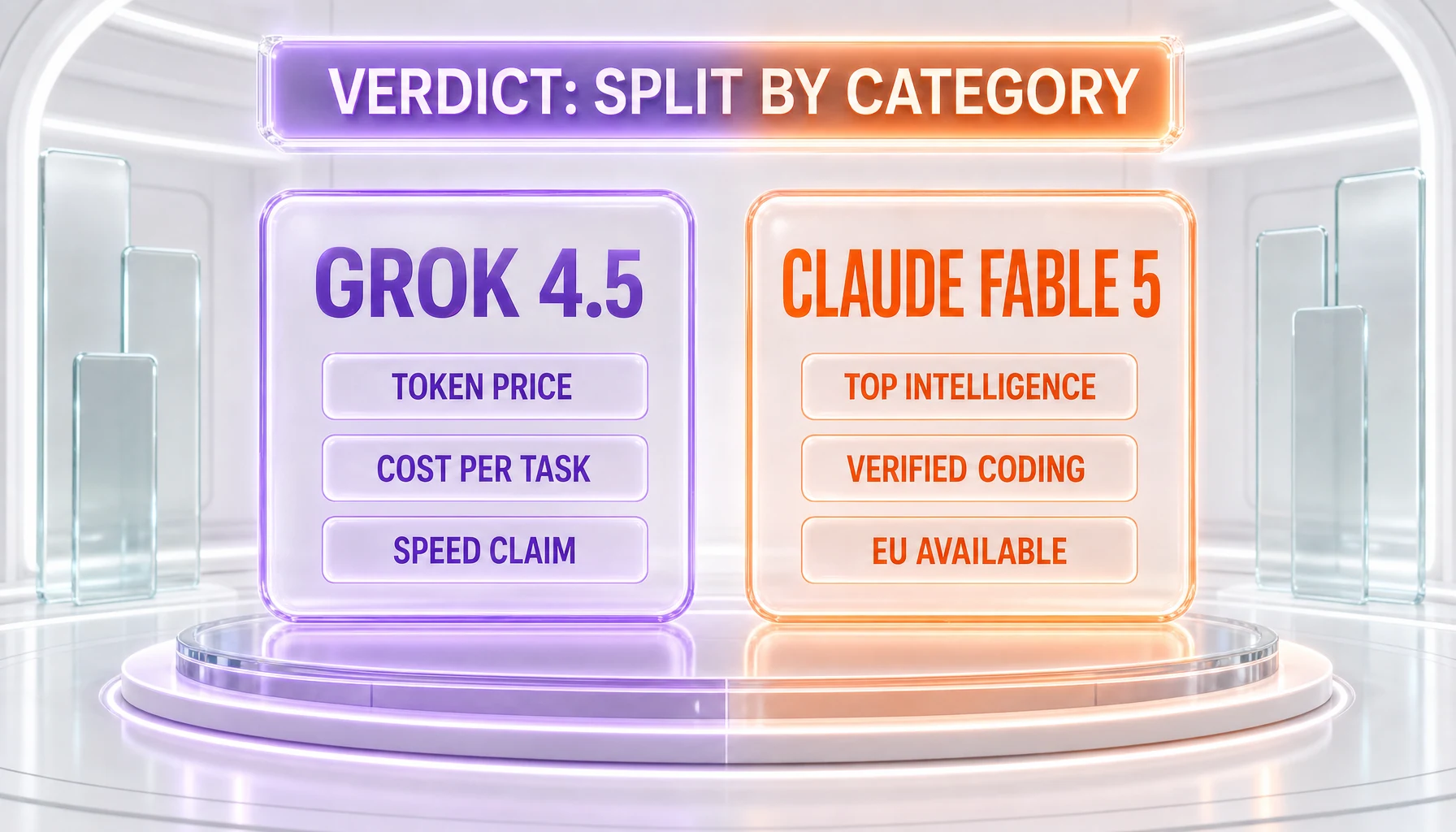
After running both side-by-side, confirming pricing on each vendor's own documentation, and holding every capability claim to independent benchmarks, our verdict is a genuine split along a single axis: capability versus value. Claude Fable 5 is the capability and verification leader: it tops the Artificial Analysis Intelligence Index at 60, ranks No.1 on LMArena at 1509 Elo, posts a leading 95 percent on the independently verified vals.ai SWE-bench Verified suite, carries the larger 1,000,000-token context, and is available in the European Union. Grok 4.5 is the value and throughput leader: it costs $2 per million input and $6 per million output against Fable 5's $10 and $50 — five to eight times cheaper — finishes tasks for about $2.49 against roughly $11.80, posts a respectable Coding Agent Index of 76, and is marketed as much faster. We disclose plainly that we have no affiliate relationship with either vendor and tested both through our own API keys.
We did not crown a single overall winner because the evidence does not support one honestly. Fable 5's capability lead is real across intelligence, human preference, and verified coding; so is Grok 4.5's five-to-eight-times cost advantage and its solid agentic-coding score. Elon Musk's "Opus-class, much faster" framing is partly earned — on coding value and speed — and overstated on general intelligence, where Grok 4.5 sits at 54 behind both Opus 4.8 and Fable 5, and on reliability, where its 54 percent AA-Omniscience hallucination rate is a documented caution. If your work rewards the highest capability, independently verified coding, the larger context, or EU availability, pick Claude Fable 5. If your work rewards cost, throughput, or speed and runs outside the EU, pick Grok 4.5. For many teams the rational endgame is routing: Grok 4.5 for the high-volume bulk, Claude Fable 5 for the hardest, most sensitive, or EU-bound work. For the neighbors around this matchup, see our Grok 4.5 review, our Claude Fable 5 review, our Claude Opus 4.8 review, our Claude Fable 5 vs Grok 4.3 comparison, and our Claude Fable 5 vs GPT-5.5 comparison.
Sources
Every figure in this comparison is attributed to a primary or independent source. Pricing and specifications come from the vendors' own documentation; capability scores come from independent third parties; vendor claims are labeled as such throughout.
- SpaceXAI — Grok 4.5 model documentation, pricing, and specifications
- SpaceXAI — company and Grok product site
- Anthropic — Claude models overview, Fable 5 pricing and specifications
- Anthropic — Claude Fable product page
- Artificial Analysis — Intelligence Index, Coding Agent Index, cost per task, and AA-Omniscience
- LMArena — human-preference Elo leaderboard
- vals.ai — SWE-bench Verified independent leaderboard
- European Commission — EU AI Act regulatory framework
Last compared: July 2026. Grok 4.5 reached public availability on July 9, 2026, and Claude Fable 5 has been generally available since June 9, 2026. Both are current flagships, and we will revise this comparison as independent benchmark coverage of Grok 4.5 matures.
Our Verdict
A split verdict between the cheapest frontier challenger and the most capable model of 2026, and we will not fake a single overall winner. Claude Fable 5 is the capability and verification leader: it tops the Artificial Analysis Intelligence Index at 60, ranks No.1 on LMArena at 1509 Elo, posts a leading 95 percent on the independently verified vals.ai SWE-bench Verified suite, carries the larger 1,000,000-token context, and is available in the European Union. Grok 4.5 is the value and throughput leader: it costs $2 per million input tokens and $6 per million output tokens against Fable 5's $10 and $50 — roughly five times cheaper on input and about eight times cheaper on output — is measured at about $2.49 per task against roughly $11.80 for Fable 5, posts a solid Artificial Analysis Coding Agent Index of 76, and is marketed as much faster, consistent with Anthropic's own Slower latency label on Fable 5. Grok 4.5 carries real caveats: it is not yet on the independent SWE-bench Verified or LMArena leaderboards, its AA-Omniscience factuality score of 26 comes with a 54 percent hallucination rate, and it is blocked in the European Union under the AI Act's systemic-risk provisions. Elon Musk's 'Opus-class, much faster' framing is partly supported on coding value and speed but overstated on general intelligence and reliability. Best for capability, independently verified coding, the larger context, and EU availability: Claude Fable 5. Best for cost, throughput, and speed outside the EU: Grok 4.5. No single overall winner — route capability-critical and EU-based work to Claude Fable 5, and cost-sensitive high-volume work outside the EU to Grok 4.5.
Choose Grok 4.5
SpaceXAI's flagship reasoning model — Opus-class speed at $2 and $6 per million tokens, 500K context, blocked in the EU.
Try Grok 4.5 →Choose Claude Fable 5
Anthropic's most capable widely released model — the public, safety-classified Mythos-class frontier tier.
Try Claude Fable 5 →Frequently Asked Questions
Is Grok 4.5 better than Claude Fable 5?
A split verdict between the cheapest frontier challenger and the most capable model of 2026, and we will not fake a single overall winner. Claude Fable 5 is the capability and verification leader: it tops the Artificial Analysis Intelligence Index at 60, ranks No.1 on LMArena at 1509 Elo, posts a leading 95 percent on the independently verified vals.ai SWE-bench Verified suite, carries the larger 1,000,000-token context, and is available in the European Union. Grok 4.5 is the value and throughput leader: it costs $2 per million input tokens and $6 per million output tokens against Fable 5's $10 and $50 — roughly five times cheaper on input and about eight times cheaper on output — is measured at about $2.49 per task against roughly $11.80 for Fable 5, posts a solid Artificial Analysis Coding Agent Index of 76, and is marketed as much faster, consistent with Anthropic's own Slower latency label on Fable 5. Grok 4.5 carries real caveats: it is not yet on the independent SWE-bench Verified or LMArena leaderboards, its AA-Omniscience factuality score of 26 comes with a 54 percent hallucination rate, and it is blocked in the European Union under the AI Act's systemic-risk provisions. Elon Musk's 'Opus-class, much faster' framing is partly supported on coding value and speed but overstated on general intelligence and reliability. Best for capability, independently verified coding, the larger context, and EU availability: Claude Fable 5. Best for cost, throughput, and speed outside the EU: Grok 4.5. No single overall winner — route capability-critical and EU-based work to Claude Fable 5, and cost-sensitive high-volume work outside the EU to Grok 4.5.
Which is cheaper, Grok 4.5 or Claude Fable 5?
Grok 4.5 is priced at $2 in / $6 out per M tokens. Claude Fable 5 is priced at $10 in / $50 out per M tokens. Check the pricing comparison section above for a full breakdown.
What are the main differences between Grok 4.5 and Claude Fable 5?
The key differences span across 9 features we compared. For API input price (per million tokens), Grok 4.5 offers $2.00 (verified) while Claude Fable 5 offers $10.00 (verified). For API output price (per million tokens), Grok 4.5 offers $6.00 (verified) while Claude Fable 5 offers $50.00 (verified). For Cost per task, AA Intelligence Index (independent), Grok 4.5 offers ~$2.49 (Artificial Analysis) while Claude Fable 5 offers ~$11.80 (Artificial Analysis). See the full feature comparison table above for all details.