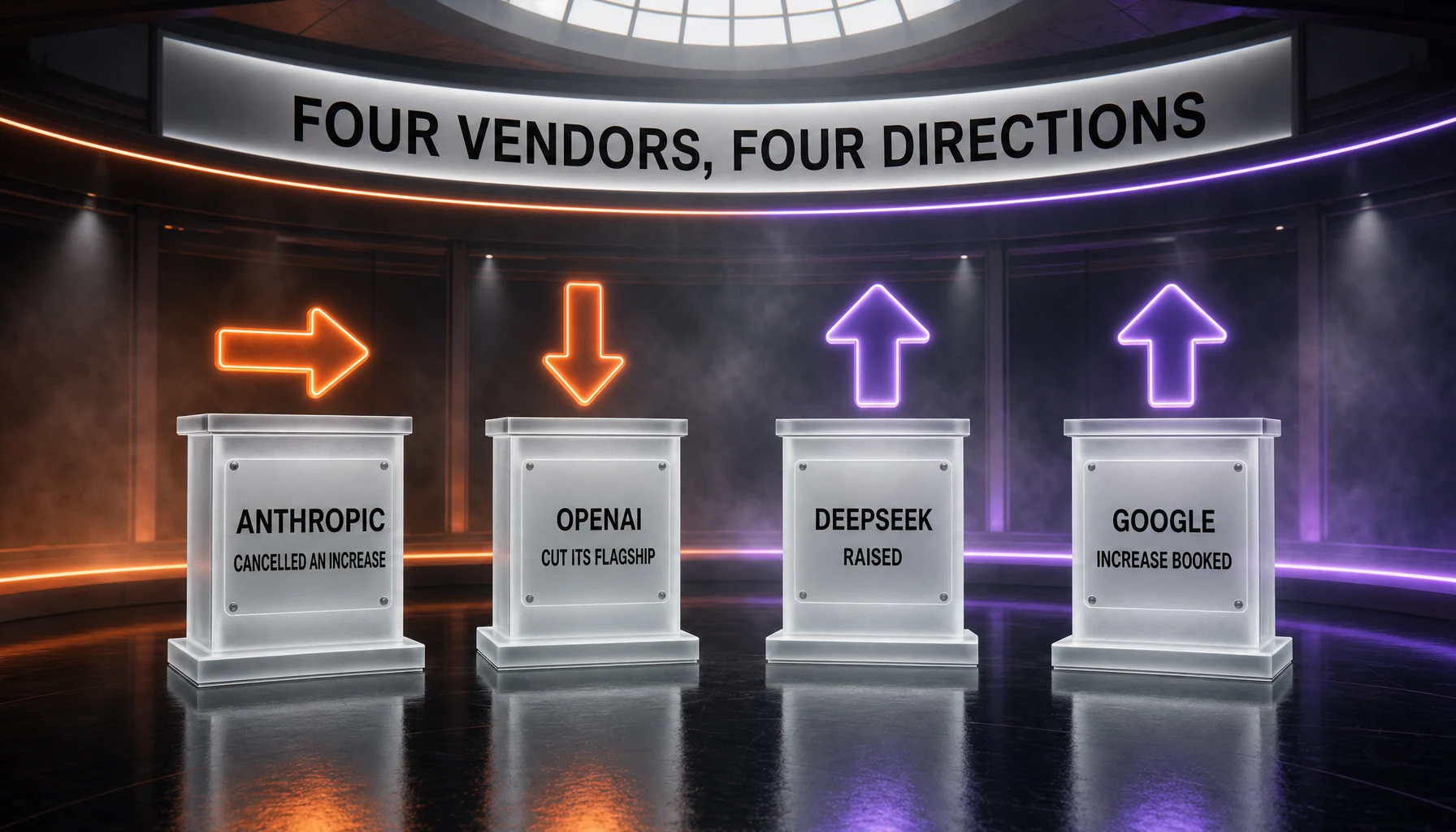
Between August 10 and August 21, 2026, four model vendors changed their published API prices, and no two moved in the same direction. Anthropic deleted an increase it had already scheduled, making Claude Sonnet 5 permanent at $2 per million input tokens and $10 per million output tokens. OpenAI cut GPT-5.6 Sol from $5 and $30 to $4 and $20 — and wrote an expiry date next to it. DeepSeek replaced flat rates with a peak and off-peak grid whose cheaper tier already sits above the flat rate it replaced. Google shipped Gemini 3.7 Flash at $0.75 and $3.75 with a doubling already booked for January 1, 2027. Twelve days, four vendors, four directions. Two of the four price sheets now carry a date at which the number changes.
Key takeaways
- Anthropic cancelled a price increase it had already published. The August 10, 2026 API release note states that the scheduled move to $3 and $15 per million tokens on September 1 "will not occur." We could not find a second instance of a frontier vendor withdrawing an announced increase this year.
- OpenAI's flagship cut is dated — and OpenAI dates it two incompatible ways. GPT-5.6 Sol is $4 and $20 per million tokens. Three OpenAI pages say the promotional pricing is available "at least through November 21, 2026"; the launch page says the cut runs "for the next 3 months." A floor and a fixed window are not the same commitment, and nothing in the primary sources settles which one holds.
- DeepSeek moved the other way on August 16. Its cheaper off-peak tier runs between 1.52 and 6.07 times the flat rate it replaced, depending on the billing line. No end date is attached.
- Google published the increase and the current price in the same cell. Gemini 3.7 Flash reads "$0.75 through December 31, 2026. $1.50 starting January 1, 2027." The doubling is already in the table.
- The rate is no longer the whole price. Three of these four sheets carry, or carried, an expiry date. Reading only the number and not the date next to it now produces a wrong budget on two of the four vendors.
Four price moves in twelve days
Every figure in the table below is a vendor list price per million tokens, read on August 22, 2026 from the vendor's own documentation. The final column is the part most price coverage drops: what, if anything, the sheet says about how long the number lasts.
| Vendor and model | Direction | Date | Price now (per 1M tokens) | What the sheet says about duration |
|---|---|---|---|---|
| Anthropic — Claude Sonnet 5 | Increase cancelled | August 10, 2026 | $2 input, $10 output | Nothing. The August 31, 2026 expiry was removed. |
| DeepSeek — V4-Pro and V4-Flash | Increase | Announced August 13, effective August 16, 2026 at 16:00 UTC | Peak and off-peak grid. V4-Flash off-peak: $0.22 input, $0.66 output | Nothing |
| Google — Gemini 3.7 Flash | Increase, pre-booked | August 13, 2026 | $0.75 input, $3.75 output | Through December 31, 2026, then $1.50 and $7.50. A date and the new price. |
| OpenAI — GPT-5.6 Sol | Cut | August 21, 2026 | $4 input, $20 output (short context) | Two wordings: "at least through November 21, 2026" on three pages, "for the next 3 months" on the launch page. |
Anthropic deleted an increase it had already announced
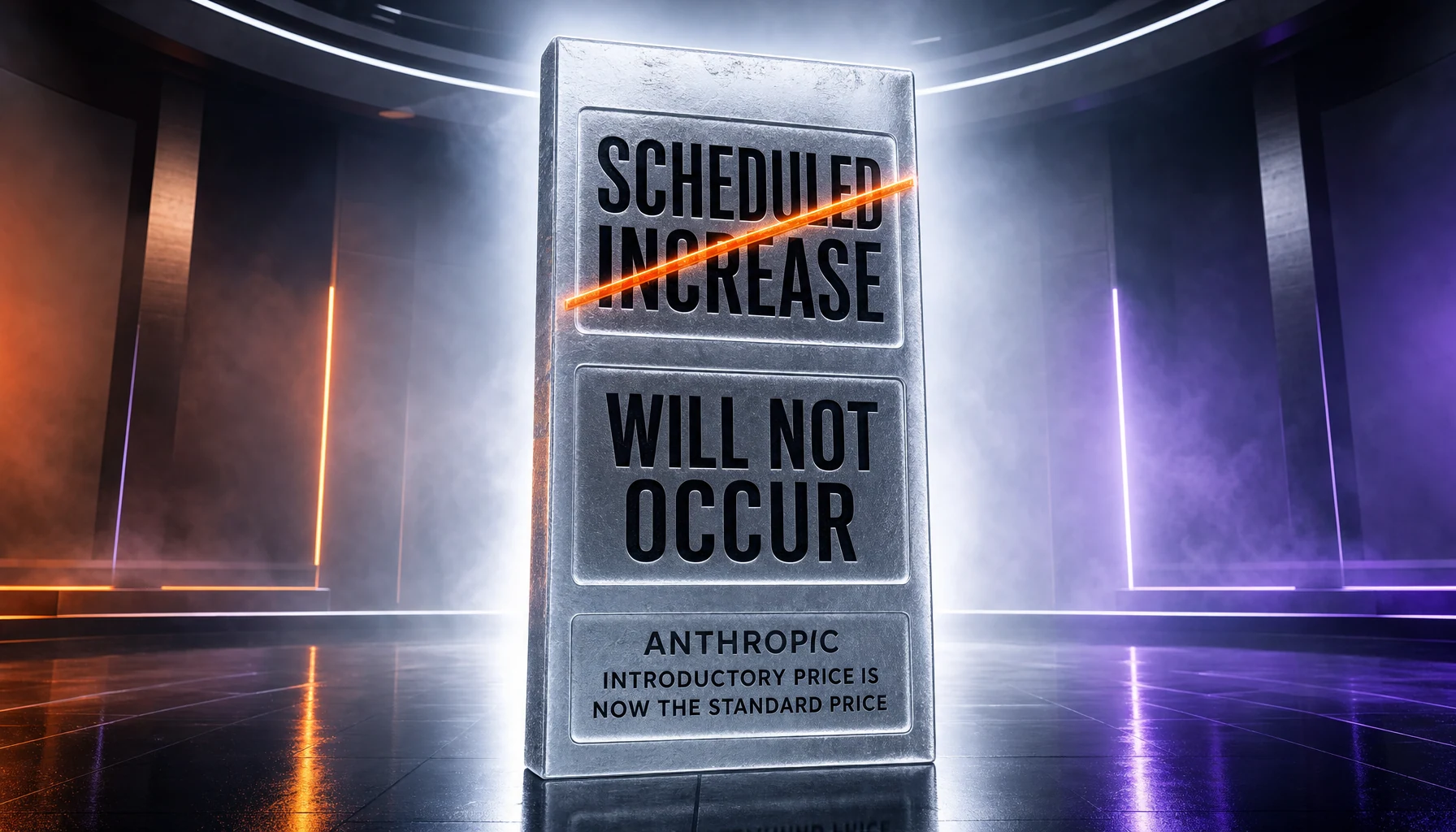
Claude Sonnet 5 launched on the Claude API at $2 per million input tokens and $10 per million output tokens, described at the time as introductory pricing that would run through August 31, 2026 and then rise to $3 and $15. On August 10, 2026, the Claude Platform release notes retired that schedule in one sentence.
The introductory pricing for Claude Sonnet 5 ($2 / $10 per MTok) is now the standard price: the previously scheduled increase to $3 / $15 per MTok on September 1, 2026 will not occur.
The same statement appears as a dedicated note on the Claude pricing documentation, in slightly longer form: the $2 and $10 rates, "announced at launch as introductory pricing through August 31, 2026, is now the standard price." We are citing the documentation deliberately. The consumer-facing pricing page renders its API table client-side and carries no equivalent callout that we could read; the two documentation pages are where the commitment is written down.
Cancelling a scheduled increase is not the same as cutting a price. Nothing on an invoice changes on September 1 as a result of this announcement — that is precisely the point. What changed is that a number teams had already been told to budget for was withdrawn before it took effect. We track vendor pricing pages daily for our breakdown of how input, output and cached tokens are billed, and this is the only reversal of an announced increase we have recorded in 2026.
It also leaves an inversion inside Anthropic's own lineup that is easy to miss: Claude Sonnet 5 is now permanently cheaper than the model it replaced. Sonnet 4.6 remains listed at $3 and $15. Sonnet 5 sits a third below it on input and a third below on output, with a 1M token context window, and it is the newer model. Our launch coverage from July 1, 2026 was written while the August 31 expiry was still on the page; that expiry no longer exists.
Anthropic list prices on August 22, 2026
| Model | Input (per 1M tokens) | Output (per 1M tokens) | Cache hit and refresh |
|---|---|---|---|
| Claude Fable 5 | $10 | $50 | $1 |
| Claude Opus 5 | $5 | $25 | $0.50 |
| Claude Sonnet 5 | $2 | $10 | $0.20 |
| Claude Sonnet 4.6 | $3 | $15 | $0.30 |
| Claude Haiku 4.5 | $1 | $5 | $0.10 |
Two modifiers sit on top of that table and are worth naming, because both change a bill without changing a list price. Pinning inference to the United States with the inference_geo parameter applies a 1.1x multiplier across every token category on Claude 4.6 and later models. And fast mode, still a research preview, prices Claude Opus 5 and Opus 4.8 at $10 and $50 — exactly double the standard rate — for what Anthropic documents as up to 2.5 times higher output tokens per second. Claude Fable 5 and Claude Haiku 4.5 are unaffected by either change.
OpenAI cut its flagship — and put a date on the cut
On August 21, 2026, OpenAI added a dated line to the top of the GPT-5.6 launch page: "OpenAI dropped the API and credit pricing of GPT-5.6 Sol by over 20% for the next 3 months." The same page's body still carries the launch prices from July 9, 2026 — Sol at $5 input and $30 output per million tokens — which makes the before and after readable side by side on a single vendor URL.
The OpenAI API changelog entry for the same day is more precise than the launch-page line, and it is where the horizon is written down.
GPT-5.6 Sol now costs $4 per million input tokens and $20 per million output tokens, representing 20% lower input pricing and 33% lower output pricing. GPT-5.6 Sol's promotional pricing is available at least through November 21, 2026.
The same sentence about the November 21, 2026 floor appears as a note under the flagship table on the OpenAI API pricing page, which is where the full grid lives.
That sentence is the reason this article is shaped the way it is. GPT-5.6 Sol at $4 and $20 is a promotion with a date attached, not a repriced product. Any cost model that assumes $4 input in December 2026 is assuming something OpenAI has not written down anywhere.
OpenAI describes the same cut two different ways
The launch page says the cut runs "for the next 3 months." The API changelog, the API pricing documentation and the openai.com API pricing page all say the promotional pricing is available "at least through November 21, 2026." Three months from August 21, 2026 is November 21, 2026, so both wordings point at the same day. They do not make the same statement about it.
"For the next 3 months" describes a window. It has an end. "At least through" describes a floor: it says the earliest the price could change, and is silent on the latest. One phrasing tells a buyer when the discount stops; the other tells a buyer when it is guaranteed until. We are not going to arbitrate between them, because the primary sources do not. OpenAI has published both, on the same price change, in the same week, on four pages it controls. The duration of the promotion is not determinable from what OpenAI has written.
What is determinable is the floor, and it is worth stating plainly because it is the only part all four pages support: through November 21, 2026, GPT-5.6 Sol is $4 and $20 per million tokens at short context. What happens on November 22 is a question the vendor's own documentation answers twice, differently.
GPT-5.6 list prices on August 22, 2026
| Model | Input, short context | Output, short context | Input, long context | Output, long context |
|---|---|---|---|---|
| gpt-5.6-sol | $4.00 | $20.00 | $8.00 | $30.00 |
| gpt-5.6-terra | $2.00 | $12.00 | $4.00 | $18.00 |
| gpt-5.6-luna | $0.20 | $1.20 | $0.40 | $1.80 |
All figures per million tokens on the standard service tier. Long context applies to prompts exceeding 272K tokens.
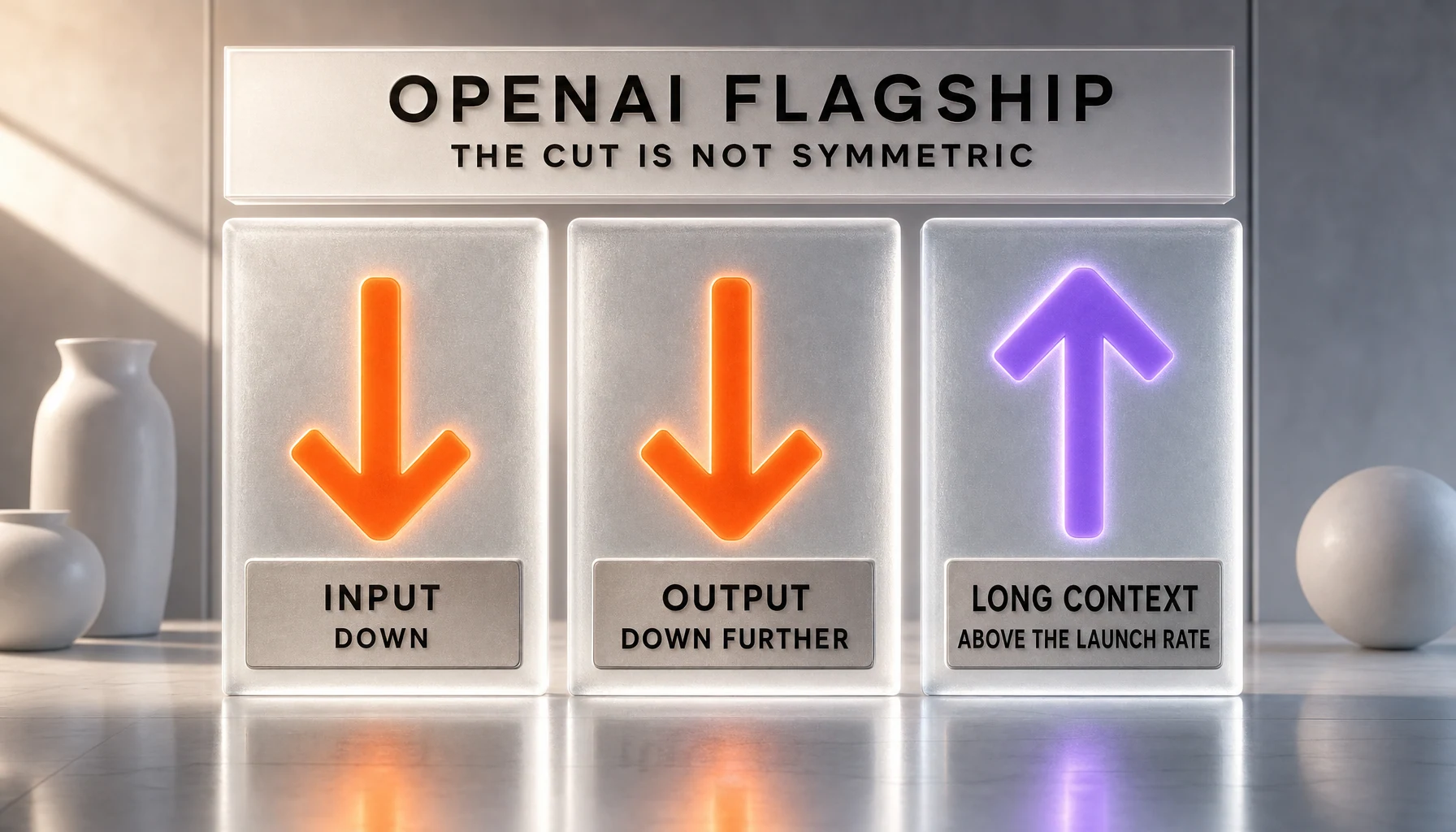
Two details in that table deserve more attention than the headline. First, the cut is not symmetric, and OpenAI says so in the changelog even though the launch page does not: input fell 20 percent, from $5 to $4, while output fell 33 percent, from $30 to $20. The "over 20%" on the launch page is the conservative half of OpenAI's own pair of figures. On a workload that consumes and emits tokens in equal measure, the combined rate moves from $35 to $24 per million tokens each way, a reduction of 31 percent — our arithmetic on OpenAI's published prices, not a vendor figure.
Second, the long-context column is where large agent runs actually land, and the headline framing says nothing about it. OpenAI's changelog puts the boundary at prompts exceeding 272K tokens. Above it, Sol's input is $8 per million tokens, double the short-context rate and above the $5 the model launched at. A team that moved to GPT-5.6 Sol for million-token repository context is not paying $4 for those tokens.
Why this is not the price cut we covered in July
We published an analysis of OpenAI's July 30, 2026 price cut three weeks ago, and the two events are genuinely different. On July 30, OpenAI cut the two smaller models and left the flagship alone: GPT-5.6 Luna dropped 80 percent to $0.20 and $1.20, GPT-5.6 Terra dropped 20 percent to $2.00 and $12.00, and Sol stayed at $5 and $30. The August 21 move is the first time the flagship itself has been cut, and the first OpenAI price change of the GPT-5.6 generation to arrive with a stated end date. Terra and Luna's July rates carry no such note on the pricing page today.
DeepSeek went the other way, and its cheapest hour costs more than its old price
On August 13, 2026, DeepSeek announced in its API change log that it would replace flat per-model rates with peak and off-peak billing, effective at 16:00 UTC on August 16. The framing is a scheduling incentive: off-peak rates are exactly half of peak rates, peak hours are 01:00 to 04:00 and 06:00 to 10:00 UTC, and moving work outside those windows halves the bill. What the framing does not say is what the baseline was.
Comparing the live DeepSeek pricing page against an archived copy from August 14, 2026 gives two dated readings of the same document. Every off-peak rate in the new grid is above the flat rate it replaced — between 1.52 and 6.07 times higher depending on the billing line, with the steepest multiplier on deepseek-v4-pro cache-hit input. Peak runs between roughly 3 and 12 times the old flat rate. The cheapest hour of the new grid costs more than every hour of the old one, and no end date is attached. We are publishing a dedicated breakdown of the DeepSeek grid separately; the point here is only the direction, which is the opposite of both Anthropic's and OpenAI's. DeepSeek V4 Flash now lists at $0.22 input and $0.66 output per million tokens off-peak, against $0.14 and $0.28 flat through August 15.
Google has already booked its increase for January 1
Gemini 3.7 Flash reached general availability on August 13, 2026 — the same day DeepSeek announced its increase. Its row on the Gemini API pricing page does something none of the other three do: it prints the current price and the future price in the same cell. Input reads "$0.75 through December 31, 2026. $1.50 starting January 1, 2027." Output reads "$3.75 through December 31, 2026. $7.50 starting January 1, 2027."
That is a firm doubling on both sides, dated, and published on day one rather than announced later. Gemini 3.6 Flash carries the identical two-stage schedule. The reference point sits one row down: Gemini 3.5 Flash lists at a flat $1.50 input and $9.00 output with no promotional period at all. So Gemini 3.7 Flash is currently half the input price of the model it succeeds, and on January 1, 2027 it lands at exactly that model's input price and below its output price. Both readings are true; which one a team budgets against depends entirely on whether it read the second sentence in the cell.
Google's own Gemini API changelog entry for August 13, 2026 describes the model as generally available at an introductory price through December 31, 2026. The word "introductory" is the same one Anthropic used for Sonnet 5. Only one of the two has been withdrawn.
What these four sheets have in common
The pattern across these twelve days is not the direction of the moves — they contradict each other — but the instrument. Three of the four vendors have used a dated price in this generation: OpenAI with a promotion that runs at least through November 21, 2026, Google with an introductory rate through December 31, 2026, and Anthropic with an introductory rate through August 31, 2026 that it then made permanent. Only DeepSeek changed a price with no date on either side of it.
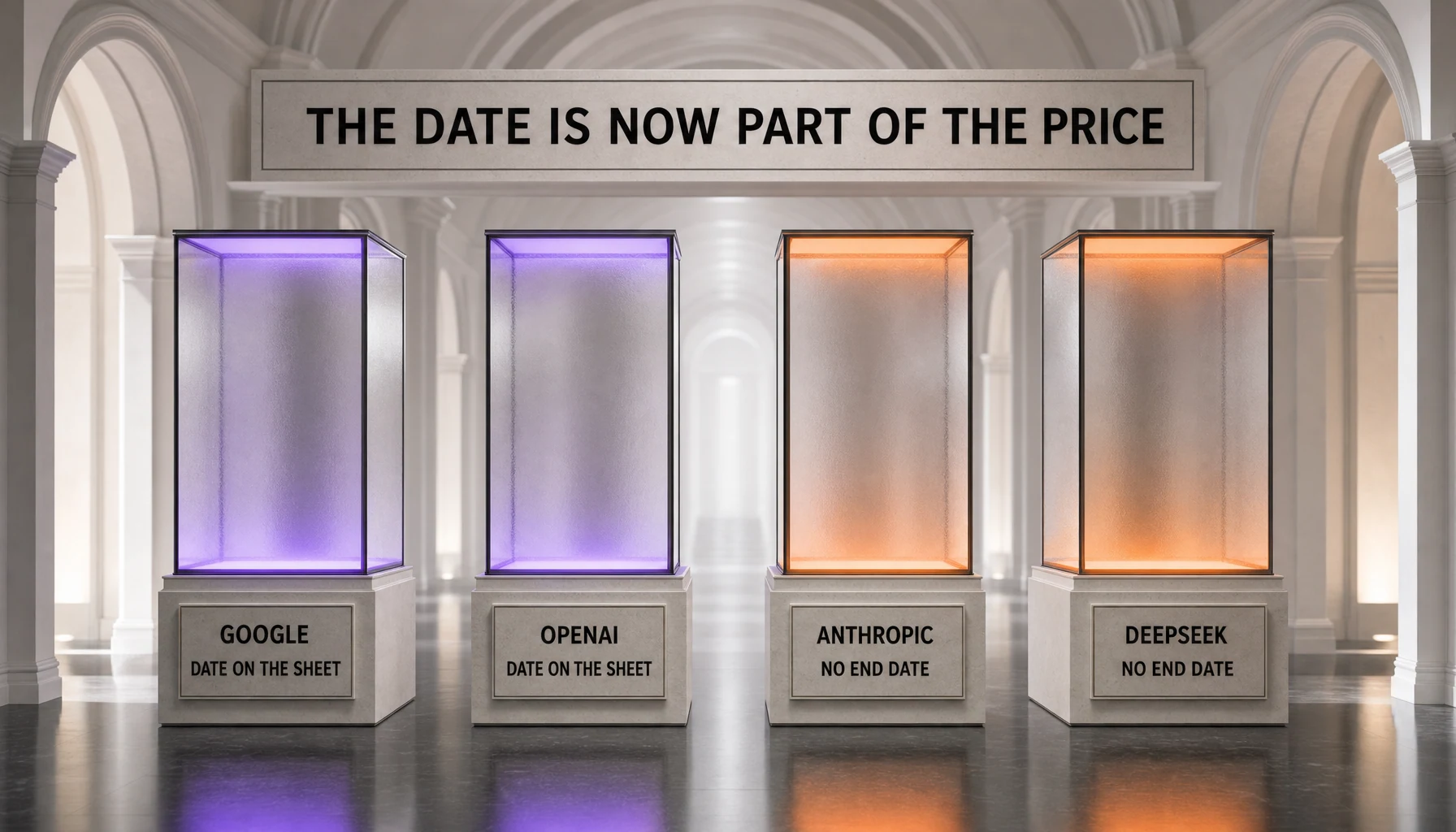
For anyone building a cost model, that has one concrete consequence. A price sheet entry now has two fields that matter, and only one of them is a number. On Google, both are legible: the budget breaks on January 1, 2027, and the sheet says what it breaks to. On OpenAI, the date is legible and the meaning is not — November 22, 2026 is either the day the discount ends or the day the guarantee lapses, depending on which OpenAI page is open. On Anthropic, a team that read the sheet in July and did not re-read it is now over-budgeting for September by 50 percent on Sonnet 5.
None of this tells us where prices go next, and we are not going to pretend otherwise. Four vendors moved in four directions inside twelve days, which is close to the maximum possible disagreement — and one of the four does not agree with itself on how long its own move lasts. What can be stated from the documents is narrower and more useful: one of these four prices has a published change date and a published new number, one has a published date its vendor describes in two incompatible ways, one increase has already landed, and one increase was cancelled.
What would change this reading
This article is a reading of four vendor documents on a single day, and specific events would revise it. If OpenAI aligns its four pages on a single wording, the ambiguity we describe resolves itself and one of them turns out to have been a drafting artifact rather than a commitment. If OpenAI extends the GPT-5.6 Sol promotion past November 21, 2026, the "at least" is what will have made that possible, and the launch page's three-month framing was the misleading one. If Google removes the January 1, 2027 line from the Gemini 3.7 Flash cell the way Anthropic removed the September 1 line from Sonnet 5, the count of pre-booked increases drops to zero. If DeepSeek attaches a promotional window to its new grid, its move stops being the outlier. And if any of these four vendors publishes a change after August 22, 2026, the table above is a snapshot, not a state.
We also want to be explicit about one limit. Every figure here is a list price per token. None of it is a cost per task, which depends on how many tokens a model spends to finish a job and cannot be derived by dividing list prices. A cheaper rate on a more verbose model can produce a larger bill, and that comparison requires an instrument and a measurement date that this article does not carry.
The bottom line
Between August 10 and August 21, 2026, Anthropic cancelled a published increase, DeepSeek delivered one, Google scheduled one for January 1, 2027, and OpenAI cut its flagship under a promotion its own pages describe both as a three-month window and as a floor running at least through November 21, 2026. The one durable change is Anthropic's, because it removed a date rather than adding one: Claude Sonnet 5 at $2 and $10 per million tokens is now the standard price with no expiry attached, and it sits below the Sonnet 4.6 it succeeds. Everything else on this page has a clock on it. Google's alarm time is printed on its own page, along with what the price becomes. OpenAI's is printed four times, in two different meanings.
AI API pricing in August 2026 — FAQ
Did Anthropic really cancel the Claude Sonnet 5 price increase?
Yes. The Claude Platform API release notes entry dated August 10, 2026 states that the introductory pricing for Claude Sonnet 5 of $2 and $10 per million tokens is now the standard price, and that the previously scheduled increase to $3 and $15 per million tokens on September 1, 2026 will not occur. The same statement appears as a note on the Claude pricing documentation page.
How much does Claude Sonnet 5 cost now?
Claude Sonnet 5 lists at $2 per million input tokens and $10 per million output tokens, with cache hits and refreshes at $0.20 per million tokens. As of August 10, 2026 that is the standard price with no expiry date attached. Pinning inference to the United States with the inference_geo parameter applies a 1.1x multiplier on top of every token category.
Is Claude Sonnet 5 cheaper than Claude Sonnet 4.6?
Yes, permanently. Claude Sonnet 5 is $2 input and $10 output per million tokens. Claude Sonnet 4.6 remains listed at $3 and $15. Sonnet 5 is therefore a third cheaper on both input and output than the model it succeeds, and the September 1, 2026 increase that would have equalized them was cancelled on August 10, 2026.
How much does GPT-5.6 Sol cost after the August 2026 price cut?
GPT-5.6 Sol lists at $4 per million input tokens and $20 per million output tokens on the standard tier at short context. At long context the same model is $8 input and $30 output per million tokens. It launched on July 9, 2026 at $5 and $30, so the short-context input fell 20 percent and the short-context output fell 33 percent.
Is the GPT-5.6 Sol price cut permanent?
No, and OpenAI describes how long it lasts in two incompatible ways. The API changelog, the API pricing documentation and the openai.com API pricing page all state that GPT-5.6 Sol's promotional pricing is available at least through November 21, 2026. The GPT-5.6 launch page instead describes the August 21, 2026 change as a drop for the next 3 months. A floor and a fixed window are not the same commitment, and the primary sources do not settle which one applies.
How is this different from the OpenAI price cut in July 2026?
The July 30, 2026 cut applied to the two smaller models and left the flagship untouched: GPT-5.6 Luna fell 80 percent to $0.20 and $1.20 per million tokens, GPT-5.6 Terra fell 20 percent to $2.00 and $12.00, and Sol stayed at $5 and $30. The August 21, 2026 cut is the first one to touch Sol, and the first in this generation to arrive with a stated end date.
Did DeepSeek raise its API prices in August 2026?
Yes. DeepSeek announced on August 13, 2026 that it would replace flat per-model rates with peak and off-peak billing, effective at 16:00 UTC on August 16, 2026. Comparing the live pricing page against an archived copy from August 14, every off-peak rate is between 1.52 and 6.07 times the flat rate it replaced, and peak rates run roughly 3 to 12 times the old flat rate.
What are DeepSeek's peak hours?
DeepSeek defines peak hours as 01:00 to 04:00 and 06:00 to 10:00 UTC, with all other hours billed off-peak. Off-peak rates are exactly half of peak rates. That is 7 peak hours out of 24, but the off-peak tier is itself above the flat rate DeepSeek charged through August 15, 2026, so no hour of the day costs what it did before the change.
How much does Gemini 3.7 Flash cost?
Gemini 3.7 Flash lists at $0.75 per million input tokens and $3.75 per million output tokens, including thinking tokens, on the paid tier. Google's pricing page states that those rates apply through December 31, 2026, and that the price becomes $1.50 input and $7.50 output starting January 1, 2027. Gemini 3.6 Flash carries the identical schedule.
Is Gemini 3.7 Flash cheaper than Gemini 3.5 Flash?
Today, yes. Gemini 3.7 Flash is $0.75 input and $3.75 output per million tokens, against a flat $1.50 and $9.00 for Gemini 3.5 Flash, which carries no promotional period. From January 1, 2027 the scheduled rates of $1.50 and $7.50 put Gemini 3.7 Flash at exactly the older model's input price and below its output price.
Which AI model prices have a date written on the vendor page?
Two of the four vendors covered here, and they attach it differently. Google states that Gemini 3.7 Flash costs $0.75 and $3.75 through December 31, 2026 and $1.50 and $7.50 from January 1, 2027 — a date and the new price. OpenAI states on three pages that GPT-5.6 Sol's promotional pricing runs at least through November 21, 2026, and on its launch page that the cut runs for the next 3 months, which is a different claim. Anthropic removed its Claude Sonnet 5 expiry on August 10, 2026, and DeepSeek's new grid carries no date.
Does a lower price per token mean a lower bill?
Not necessarily. Every figure in this article is a list price per million tokens. Total cost depends on how many tokens a model spends to complete a task, which varies by model and workload and cannot be derived by dividing list prices. A cheaper rate on a more verbose model can produce a larger invoice than a more expensive rate on a terser one.
Sources
- Claude Platform release notes (entry of August 10, 2026 cancelling the September 1 increase; entry of July 1, 2026 for the Claude Sonnet 5 launch and its introductory pricing; read August 22, 2026)
- Claude Platform pricing documentation (list prices for Fable 5, Opus 5, Sonnet 5, Sonnet 4.6 and Haiku 4.5; the Claude Sonnet 5 introductory pricing note; the 1.1x data residency multiplier; fast mode rates)
- Claude Platform fast mode documentation (up to 2.5 times higher output tokens per second on Claude Opus 5 and Opus 4.8, at $10 and $50 per million tokens)
- OpenAI — Introducing GPT-5.6 (dated update of August 21, 2026 on the Sol price drop; dated update of July 30, 2026 on Luna and Terra; the July 9, 2026 launch prices of $5 and $30 for Sol)
- OpenAI API pricing (current standard, short-context and long-context rates for gpt-5.6-sol, gpt-5.6-terra and gpt-5.6-luna; the note that Sol's promotional pricing runs at least through November 21, 2026)
- OpenAI API changelog (entry of August 21, 2026 giving the new Sol rates as 20 percent lower input and 33 percent lower output, and the "at least through November 21, 2026" wording; entry of August 4, 2026 placing the long-context boundary at prompts exceeding 272K tokens)
- OpenAI API pricing (openai.com) (third page carrying the "at least through November 21, 2026" wording, against the launch page's "for the next 3 months")
- DeepSeek API change log (entry of August 13, 2026 announcing peak and off-peak billing effective 16:00 UTC on August 16, 2026)
- DeepSeek API models and pricing (the live peak and off-peak grid and the peak-hour definition)
- DeepSeek API models and pricing, archived August 14, 2026 (the flat rates in force through August 15, 2026, used as the baseline for the multipliers)
- Gemini API pricing (Gemini 3.7 Flash and 3.6 Flash at $0.75 and $3.75 through December 31, 2026 then $1.50 and $7.50; Gemini 3.5 Flash at a flat $1.50 and $9.00)
- Gemini API changelog (entry of August 13, 2026 for the Gemini 3.7 Flash general availability release and its introductory price through December 31, 2026)
Every price in this article is a vendor list price per million tokens, read from the vendor's own documentation on August 22, 2026, or from a dated archive of it. Percentages, multipliers and combined rates are our arithmetic on those published prices and are labeled as such where they appear. Prices change without notice; the dates given in the table are the dates each vendor has published, not a forecast.