DeepSeek V4 Flash
DeepSeek's small MoE model — 284B parameters with 13B activated, 1M context, MIT-licensed weights — that outscores its own flagship on the Artificial Analysis Intelligence Index v4.1.

Quick Summary
DeepSeek V4 Flash is a text-only MoE model, 284B parameters with 13B activated, 1M context, MIT-licensed. It scores 49.9 on the Artificial Analysis Intelligence Index v4.1, above V4 Pro at 44.3. $0.22 input and $0.66 output per million tokens off-peak. Score 8.8 out of 10.
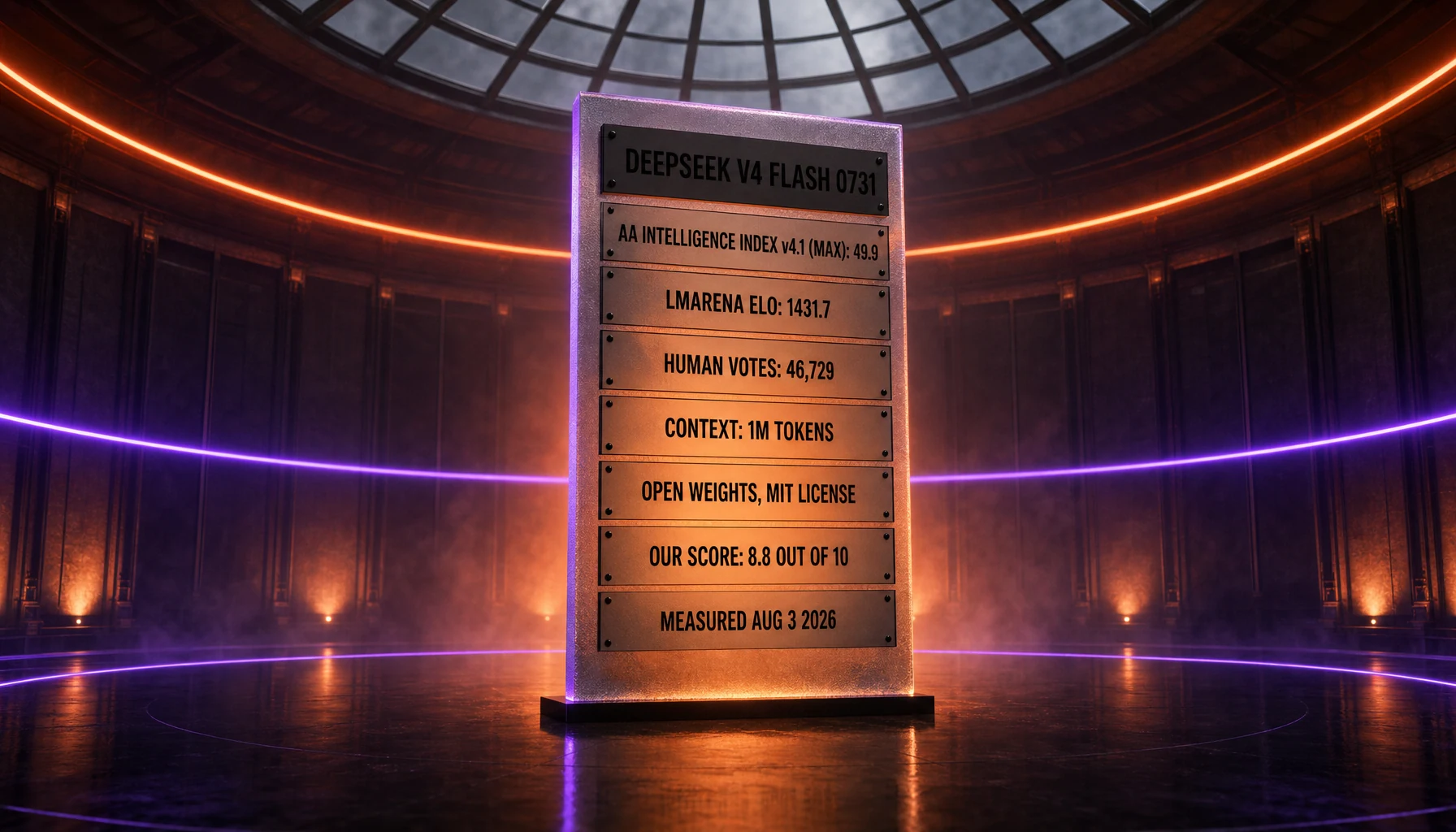
DeepSeek V4 Flash is a text-only mixture-of-experts model with 284B total parameters, 13B activated per token, and a 1M-token context window. DeepSeek prices it at $0.22 input and $0.66 output per million tokens off-peak, and $0.44 and $1.32 during peak hours. It scores 49.9 on the Artificial Analysis Intelligence Index v4.1, above DeepSeek V4 Pro at 44.3. Weights ship under the MIT license. Our score: 8.8 out of 10.
TL;DR — Our Verdict
Score: 8.8 out of 10. DeepSeek V4 Flash is the cheap tier of the DeepSeek V4 family that beats the expensive tier on the one independent composite index measuring both. It is the obvious default for high-volume text work where cost per token dominates, and the wrong pick if you need images, audio, video, or a documented latency guarantee — none of those exist here.
- Scores 49.9 on the Artificial Analysis Intelligence Index v4.1 against 44.3 for DeepSeek V4 Pro, while DeepSeek charges roughly a third as much for it.
- Prompt cache hits are billed at about one thirty-first of the cache-miss input rate, which reshapes the economics of any repeated-prefix workload.
- Weights are public under the MIT license, so self-hosting and commercial fine-tuning carry no vendor permission problem.
- No independent speed measurement exists for a model named "Flash" — Artificial Analysis publishes neither throughput nor latency for it as of August 3, 2026.
- No entry on Artificial Analysis's Coding Agent Index v1.3, so there is no independent agentic coding result in a real harness.
Our Methodology for This Review
We have not deployed DeepSeek V4 Flash, and nothing here is a hands-on account. We researched it. Every figure below was pulled on August 3, 2026 from a named primary source, and we say which one each time.
Prices come from DeepSeek's own published rate card — not a reseller, not a search summary. Specifications come from the same documentation set and from the Hugging Face repository, benchmarks from Artificial Analysis and LMArena, market context from the OpenRouter listing. All seven are itemized under Sources.
Two disclosures matter. We compute a composite score of our own, and where we cite it we label it as ours — it is not an Artificial Analysis ranking. And where a measurement does not exist, we say so rather than substituting a proxy; that applies most sharply to speed, which we treat as a finding rather than a gap to paper over.
We also checked what is not there. We read all 52 entries on the Artificial Analysis Coding Agent Index v1.3 to confirm DeepSeek V4 Flash has none, rather than inferring absence from a failed search — the difference between a verified absence and a guess.
What Is DeepSeek V4 Flash?
DeepSeek V4 Flash is the smaller of the two models in DeepSeek's V4 generation: a sparse mixture-of-experts network carrying 284B total parameters with 13B activated per token, so roughly one parameter in twenty-two does work on any given forward pass. Its sibling DeepSeek V4 Pro carries 1.6T total parameters with 49B activated — about five and a half times the total capacity and just under four times the active capacity.
One point of confusion is worth settling immediately, because it has produced a lot of bad reporting. DeepSeek V4 Flash and DeepSeek-V4-Flash-0731 are the same model, not two competing releases. DeepSeek's documentation states it plainly: "The deepseek-v4-flash model has been updated to DeepSeek-V4-Flash-0731. The calling method remains unchanged — simply use deepseek-v4-flash to access the latest version." deepseek-v4-flash is the stable API name you call; DeepSeek-V4-Flash-0731 is the revision it currently serves. The 0731 suffix lines up with the July 31, 2026 creation date of that revision's OpenRouter listing.
What Flash is not, is a multimodal assistant. It accepts text and returns text — no native image, audio, or video input. If your workload has a vision component, this model does not participate in it, and no amount of favorable pricing changes that.
The weights are open. DeepSeek publishes them at deepseek-ai/DeepSeek-V4-Flash-0731 under the MIT license, about as permissive as open model licensing gets. As of our August 3, 2026 check, the repository showed 156,173 downloads and 1,867 likes. The architecture is registered as DeepseekV4ForCausalLM, quantization is fp8 with an fp4 expert dtype, six experts activate per token, and the accompanying paper is arXiv 2606.19348. Our review of DeepSeek V4 covers the family, and our launch coverage covers how Flash and Pro were positioned against each other on day one.
Key Features
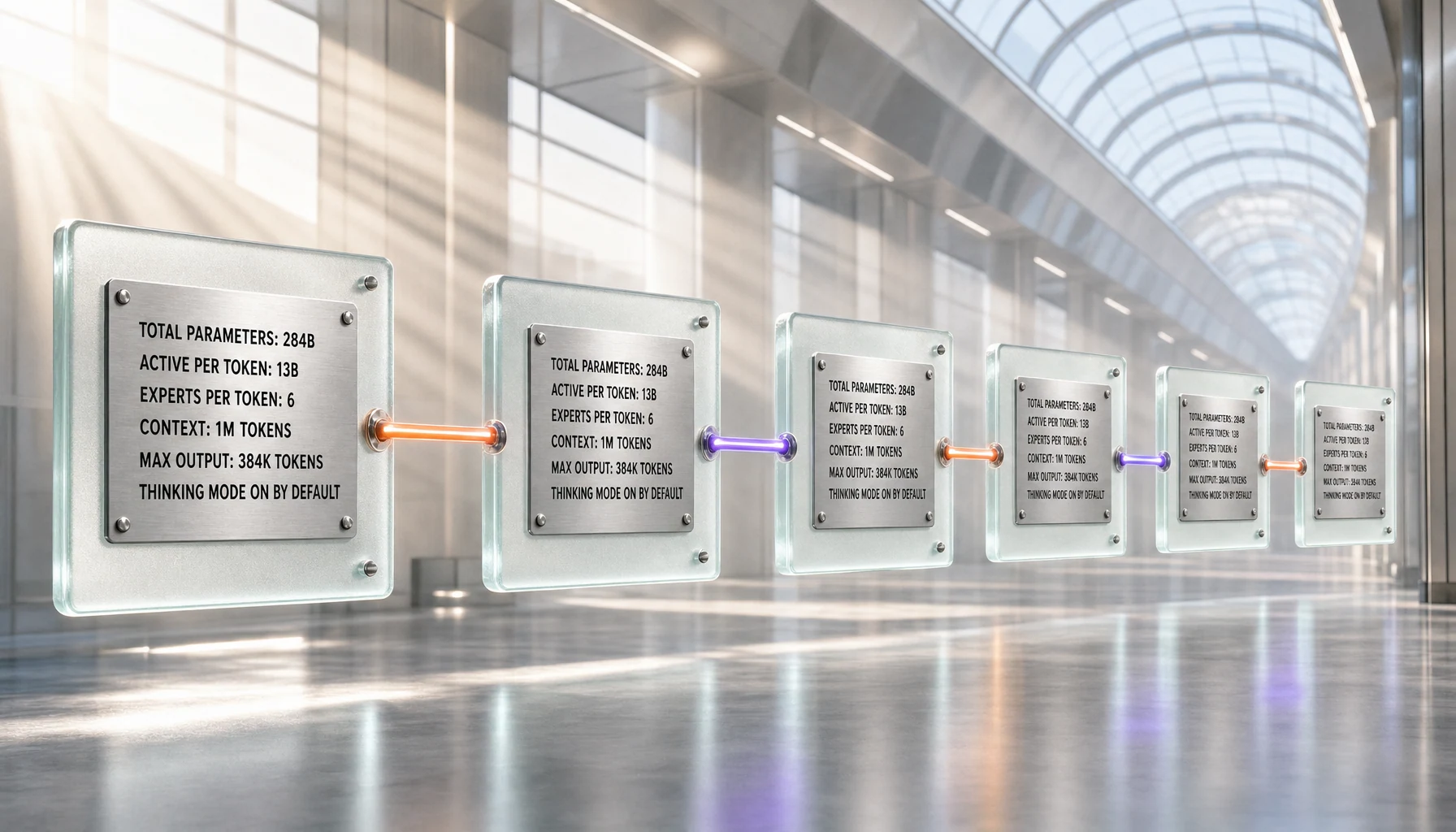
A 1M-token context with a 384K-token output ceiling
DeepSeek states a 1M-token context window and a maximum output of 384K tokens. The output figure is the unusual one — most models pair a very large context with a generation limit in the tens of thousands. That envelope puts long-form generation and large structured extractions inside a single call rather than across a chunking loop you have to build and maintain.
The marketplace does not mirror it, though. OpenRouter's deepseek/deepseek-v4-flash listing carries a 393,216-token ceiling — 384K expressed exactly — while its deepseek/deepseek-v4-flash-0731 listing caps output at 65,536 tokens. Same model, two listings, two very different limits, and the one that applies is attached to the route you actually call.
Thinking and non-thinking modes, with thinking on by default
Flash runs in two modes. Thinking is the default; non-thinking is available where an intermediate reasoning pass is wasted effort. A separate reasoning_effort parameter controls that budget. This matters more than it sounds: the Artificial Analysis entry is labeled at max effort, so the published index score reflects the expensive end of the dial, not the default you get out of the box.
Two API surfaces: OpenAI-compatible and Anthropic-compatible
DeepSeek exposes an OpenAI-compatible base URL at https://api.deepseek.com and an Anthropic-compatible one at https://api.deepseek.com/anthropic. For teams already on either SDK, adoption is a base-URL swap and a model-name change rather than an integration project — the most practical feature on this list for anyone evaluating a migration.
Structured output, tool calls, prefix completion, and FIM
JSON Output and Tool Calls are both supported. Chat Prefix Completion is in beta. FIM Completion — fill-in-the-middle, the primitive behind editor-style code infill — is also in beta and works in non-thinking mode only.
The Responses API is the notable one. As of our August 3, 2026 check DeepSeek supports it on Flash only, and states V4 Pro support arrives in early August 2026 — a window open as we publish. That makes Flash, briefly, the more capable of the two on API surface as well as index score.
A 2500-request concurrency ceiling
DeepSeek publishes a concurrency limit of 2500 for deepseek-v4-flash against 500 for deepseek-v4-pro — five times the parallel request volume. For batch pipelines that ceiling is frequently what decides throughput in practice, independent of how fast any single request completes.
MIT-licensed open weights
The MIT license removes the question that dominates procurement conversations around closed models: you can host it yourself, fine-tune it, ship it inside a product, and keep the result private. With fp8 quantization and an fp4 expert dtype, the deployment footprint is set by 13B active parameters rather than 284B total — what makes self-hosting a real option rather than a theoretical one.
DeepSeek V4 Flash Pricing in 2026
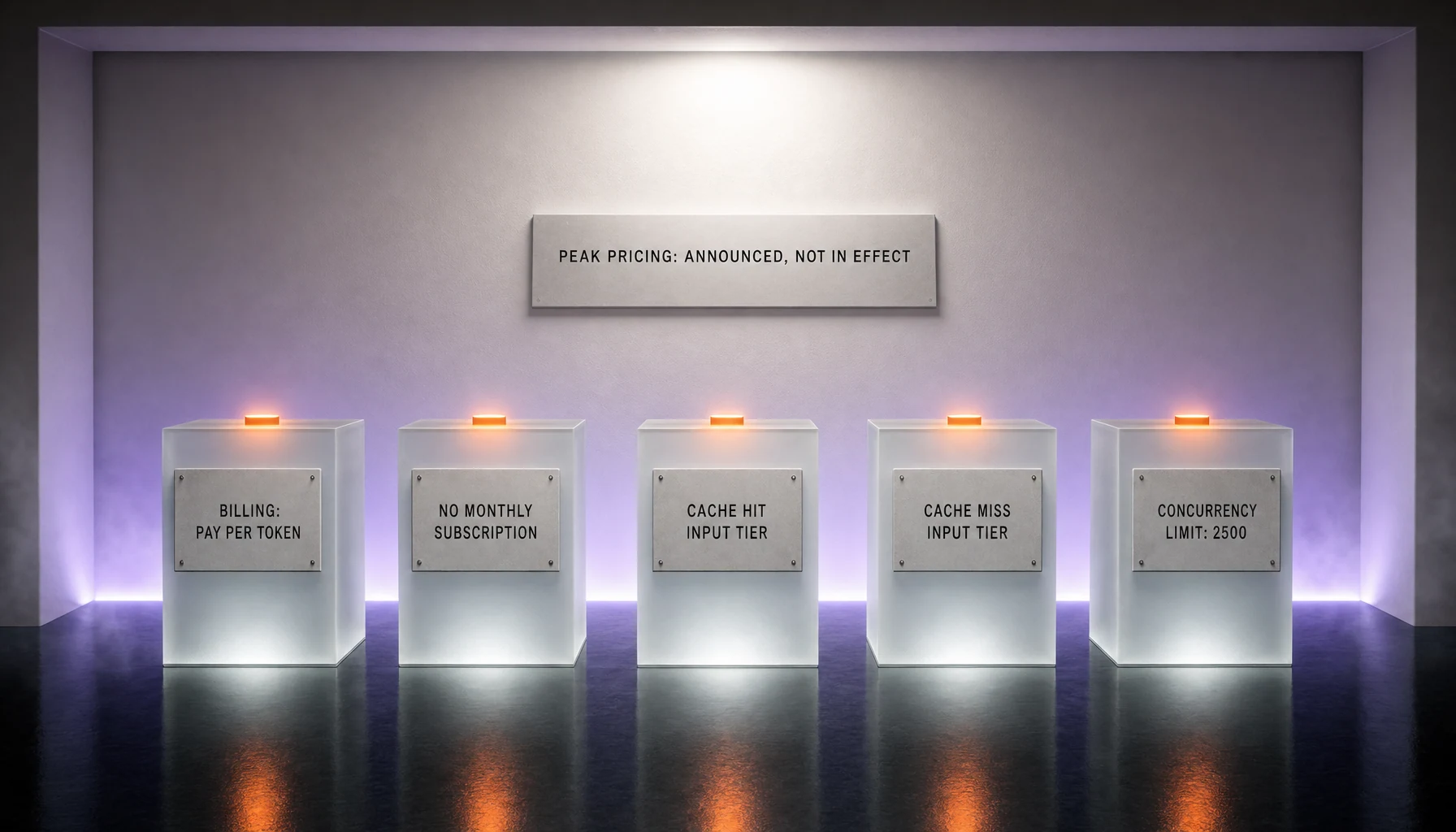
DeepSeek meters V4 Flash purely per token, with no subscription tier and no seat license. These are the rates published on DeepSeek's own pricing page, checked August 3, 2026, shown against V4 Pro for scale.
| Billing item | deepseek-v4-flash | deepseek-v4-pro |
|---|---|---|
| Input, cache hit (per million tokens) | $0.007 off-peak, $0.014 peak | $0.022 off-peak, $0.044 peak |
| Input, cache miss (per million tokens) | $0.22 off-peak, $0.44 peak | $0.66 off-peak, $1.32 peak |
| Output (per million tokens) | $0.66 off-peak, $1.32 peak | $1.98 off-peak, $3.96 peak |
| Concurrency limit | 2500 | 500 |
Two ratios fall out cleanly. V4 Pro costs exactly 3 times what Flash costs on both the cache-miss input rate and the output rate, so DeepSeek prices the gap uniformly rather than weighting one side; before August 16, 2026 that ratio was 3.1. And a cache hit on Flash is billed at about one thirty-first of a cache miss; on V4 Pro the discount is now one thirtieth, where it used to be one one-hundred-twentieth. Prompt caching is not a rounding-error optimization here, it is the dominant variable in the bill for any workload reusing a system prompt, a document, or a retrieved context across many calls.
Why OpenRouter shows a different number
If you price this model through a marketplace you will see a figure that does not match the vendor's page. OpenRouter lists the 0731 revision at $0.09 and $0.18 per million tokens with a 65,536-token output ceiling (checked August 3, 2026), below DeepSeek's own published rate — a marketplace listing, not a change to DeepSeek's price sheet. Cache reads on that listing are quoted at $0.018 per million tokens.
The older deepseek/deepseek-v4-flash listing on the same marketplace, created April 24, 2026, quotes $0.14 and $0.28 with the 393,216-token output ceiling, which was identical to the vendor until DeepSeek raised its rates on August 16, 2026. The deepseek/deepseek-v4-flash-latest alias currently resolves to the same terms as the 0731 listing. OpenRouter reports a single serving provider.
Be exact about what that means, because it has been widely misreported: DeepSeek's published rate is $0.22 input and $0.66 output per million tokens outside peak hours, and $0.44 and $1.32 during them, following the increase of August 16, 2026. A marketplace quoting a lower number is making a routing and margin decision of its own. Treating it as a vendor price cut produces a cost model that breaks the moment you call DeepSeek's endpoint directly.
An announced peak-hours policy, with no effective date
DeepSeek's pricing page carries a forward-looking notice that belongs in any budget you build. It states the API service will "soon adopt a peak/off-peak pricing policy," that during peak hours "prices will be 2x the regular prices, applicable to all billing items," and that "the effective date will be subject to the official announcement." The peak window is given as 9:00 to 12:00 and 14:00 to 18:00 Beijing Time, UTC+8, daily.
As of August 3, 2026 this is announced and not in force, with no effective date published. The rates above are current, with no promotion attached and no scheduled increase you can plan against — only a stated intent to double all billing items in a defined daily window at some future point. If your workload runs on Asia-Pacific business hours, price that risk in.
Best for: teams whose bill is dominated by token volume rather than per-request quality ceilings, and who can exploit prompt caching.
What the Independent Measurements Say
This section decides the score, so we are precise about which instrument produced which number. Several look similar and measure different things.
Artificial Analysis Intelligence Index v4.1
On the Artificial Analysis Intelligence Index v4.1, checked August 3, 2026, the entry is labeled exactly "DeepSeek V4 Flash 0731 (max)" and scores 49.9. The entry for "DeepSeek V4 Pro (max)" scores 44.3. Both labels carry the reasoning effort setting and both are measured at max, so this is like-for-like on the effort dial.
That result is the central fact about this model: DeepSeek's small, cheap, openly licensed model outscores DeepSeek's own flagship by 5.6 points on the composite index that evaluates both, at roughly a third of the flagship's token price. Vendors do not usually ship that inversion, and when they do it tends to be temporary.
Here is where 49.9 sits among nearby models on the same index and collection date:
| Model (as labeled by Artificial Analysis) | Intelligence Index v4.1 |
|---|---|
| GPT-5.6 Luna (max) | 51.2 |
| GLM-5.2 (max) | 51.1 |
| Muse Spark 1.1 (xhigh) | 50.6 |
| Gemini 3.6 Flash | 50.1 |
| DeepSeek V4 Flash 0731 (max) | 49.9 |
| Qwen3.7 Max | 46.0 |
| MiniMax-M3 | 44.4 |
| DeepSeek V4 Pro (max) | 44.3 |
Component benchmark results
Artificial Analysis also publishes individual benchmark results for V4 Flash, checked the same day:
| Benchmark | Result |
|---|---|
| GPQA | 90.8 percent |
| Terminal-Bench v2.1 | 78.7 percent |
| SciCode | 49.9 percent |
| Humanity's Last Exam | 36.8 percent |
| Tau-bench Banking | 31.1 percent |
One warning, because the collision is easy to propagate: SciCode returns 49.9 percent, the same figure as the composite Intelligence Index score. Coincidence, not a relationship — one is a percentage on a single scientific coding benchmark, the other a 0-to-100 composite across many.
Separately, Artificial Analysis publishes an artificial_analysis_coding_index value of 69.1 for this model. That index belongs to the Intelligence Index family and is a property of the model itself. It is not the Coding Agent Index, a different board entirely, and the two are routinely confused.
The Coding Agent Index v1.3: a verified absence
The Artificial Analysis Coding Agent Index v1.3 scores pairings of a harness, a model, and an effort level — not models on their own — composing DeepSWE, Terminal-Bench v2, and SWE-Atlas-QnA. We read all 52 entries on August 3, 2026.
DeepSeek V4 Flash has no entry on it. The only DeepSeek pairing charted is "Claude Code - DeepSeek V4 Pro (high)". There is no independent measurement of how V4 Flash performs as an agent inside a real coding harness — the setting most people actually deploy a coding model into.
Note that this board runs Terminal-Bench v2, while the 78.7 percent above is Terminal-Bench v2.1 measured on the model directly. Different version, different evaluation setting, and neither substitutes for the other.
LMArena human preference
On the LMArena leaderboard dataset, checked August 3, 2026, DeepSeek V4 Flash holds an Elo of 1431.7 across 46,729 votes, placing it 72nd overall.
That rank sits lower than the benchmark index would lead you to expect, and we will not smooth the disagreement away. The instruments measure different things: the Intelligence Index scores capability on curated tasks at a specified reasoning effort, while LMArena aggregates blind human preference on whatever people bring. The honest reading is that V4 Flash is measurably capable and not especially beloved — and which matters more depends on whether a human or a parser reads the output.
Speed: no independent measurement exists
The model is called Flash. As of August 3, 2026, Artificial Analysis publishes neither a throughput figure nor a latency figure for it.
We state that as a finding rather than filling it with a plausible estimate. We have no tokens-per-second number, no time-to-first-token number, and no basis for either. If speed is a hard requirement, measure it yourself on your own routes and prompt shapes, and do not treat the name as a specification. This is also why our speed sub-score here is a neutral default rather than a measured value.
Our composite index
We maintain a composite score across the model market. In our August 3, 2026 collection, covering 207 active models, DeepSeek V4 Flash scores 77.2 out of 100, which places it 18th of the 207 models we track. The sub-scores are intelligence 73.6, value 98.9, capabilities 73.2, speed 50, and ecosystem 80.
Three caveats, because a composite is only as useful as its disclosure. This is our ranking, not an Artificial Analysis ranking — nobody else produces this number. It sorts on the capability axis rather than price-performance, so the 98.9 value sub-score shows up in the composite but is not what put the model at 18th. And the speed figure of 50 is the neutral default we assign when no measurement exists, not a claim that this model is average in speed.
What Stands Out
- It beats the flagship it is supposed to sit below. 49.9 against 44.3 on the Artificial Analysis Intelligence Index v4.1, both at max effort, while costing about a third as much per token.
- The cache economics are unusually aggressive. Cache hits bill at $0.007 per million tokens off-peak against $0.22 for a miss — a roughly thirty-onefold reduction that rewrites the cost model for RAG, long system prompts, and any pipeline with a stable prefix.
- MIT-licensed open weights. Published at
deepseek-ai/DeepSeek-V4-Flash-0731, with commercial use, fine-tuning, and private redistribution all permitted — no vendor-dependency argument against building on it. - A 1M-token context with a vendor-stated 384K-token output ceiling. The generation limit is the rarer half of that pair, and it removes a chunking layer from long-form pipelines.
- Migration is a configuration change. OpenAI-compatible and Anthropic-compatible base URLs both exist, so existing code moves across without an SDK rewrite.
- Five times the concurrency of V4 Pro. A 2500-request ceiling against 500 makes it the better of the two for batch work on structural grounds, before any quality comparison.
- Ahead of its own flagship on API surface. Responses API support landed on Flash first, alongside JSON output, tool calls, chat prefix completion, and FIM completion.
Where It Falls Short
- No published speed measurement. For a model whose name is a speed claim, the absence of any independent throughput or latency figure as of August 3, 2026 forces you to benchmark before you commit.
- No agentic coding result in a real harness. Across all 52 entries on the Coding Agent Index v1.3, DeepSeek V4 Flash appears zero times. Choosing it to drive a coding agent means choosing without that evidence.
- Text only. No native image, audio, or video input — a hard exclusion for multimodal pipelines, not something prompting works around.
- Human preference does not match the benchmarks. Rank 72 on LMArena, with an Elo of 1431.7 across 46,729 votes, sits well below what the index score suggests — worth weighing if humans read the output directly.
- An unpriced future. DeepSeek has announced a peak-hours policy doubling every billing item in a defined daily window, with no effective date published as of August 3, 2026.
Real-World Use Cases
High-volume classification and extraction
A $0.22 per million token off-peak input rate and a 2500-request concurrency ceiling suit pipelines running the same narrow instruction across millions of records — tagging, routing, entity extraction, sentiment scoring. Non-thinking mode is the right configuration here; the reasoning pass adds cost without adding much on tasks with a bounded answer space.
Cache-heavy retrieval workloads
Any architecture sending the same large prefix repeatedly — a fixed system prompt, a retrieved document set, a schema definition — collects the roughly thirty-onefold cache discount on the repeated portion. This is arguably the strongest economic argument for the model, and it only appears once you look past the headline rate to the cache-hit line.
Long-document synthesis and long-form generation
The 1M-token context handles the input side of large-document work and the vendor-stated 384K-token ceiling handles generation. Contract summaries, book-length translations, and exhaustive structured extractions run as a single call rather than an orchestration problem — provided you call a route carrying the full ceiling rather than the 65,536-token marketplace variant.
Self-hosted and air-gapped deployment
The MIT license and published weights make on-premises deployment a decision rather than a negotiation, and with 13B active parameters out of 284B total the serving footprint is set by the active path. For regulated environments where data cannot leave the building, this is the whole argument.
Editor-side code completion and research work
FIM Completion is in beta and works in non-thinking mode, the correct mode for infill anyway. Paired with the coding index value of 69.1 Artificial Analysis publishes for the model, there is a reasonable case for inline completion — noting that the agentic side of coding remains unmeasured. Open weights, a stated architecture, and an arXiv paper (2606.19348) also make this a model researchers can study rather than only query.
Alternatives to DeepSeek V4 Flash
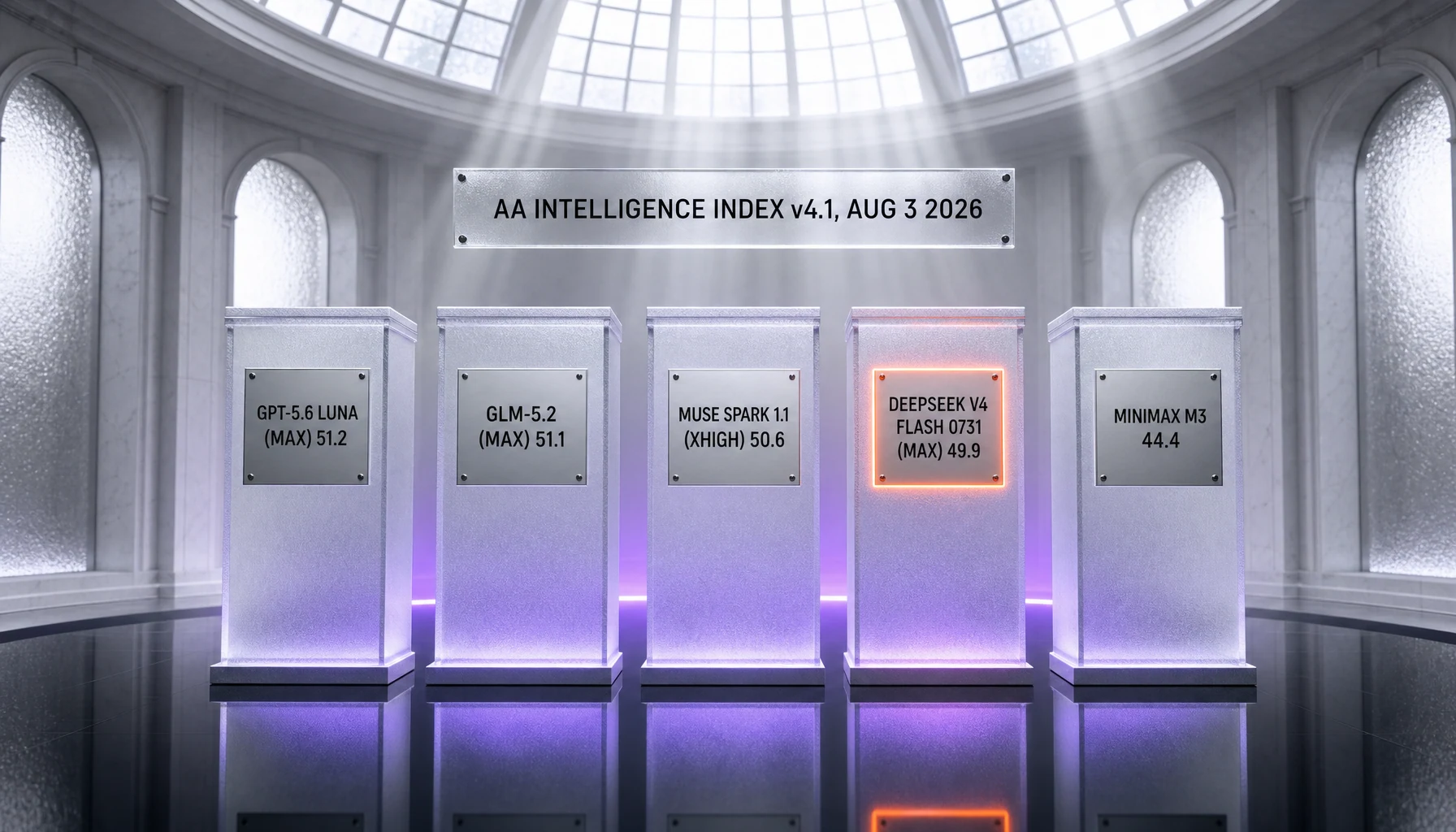
The models sitting closest to V4 Flash on the Artificial Analysis Intelligence Index v4.1 make the most useful shortlist, and we are comparing on that index only. We did not re-verify competitor pricing on August 3, 2026, so we do not quote competitor rates here — our individual reviews carry them, and they are the place to check before you commit budget.
| Model | Intelligence Index v4.1 | Why you would pick it instead |
|---|---|---|
| DeepSeek V4 Flash 0731 (max) | 49.9 | MIT-licensed weights, 1M context, and DeepSeek's lowest published rate in the V4 family |
| GPT-5.6 Luna (max) | 51.2 | Highest index score in this neighborhood, backed by OpenAI's platform |
| GLM-5.2 (max) | 51.1 | Also open-weight, and scores above Flash on the same index |
| Muse Spark 1.1 (xhigh) | 50.6 | Scores above Flash on the same index, though measured at a different effort setting; weights are closed |
| MiniMax M3 | 44.4 | Native multimodality, which V4 Flash does not have at all |
Read that table carefully. V4 Flash is not the most capable model in its neighborhood — GPT-5.6 Luna, GLM-5.2, and Muse Spark 1.1 all score above it. What it has is the combination: within 1.3 points of the top of this group, a published vendor rate of $0.22 and $0.66 per million tokens off-peak, and an MIT license. If capability alone decides your choice, one of the models above it is the better answer. If capability per dollar decides it, GLM-5.2 is the one genuine rival on both axes, being also open-weight.
The most direct comparison is internal. Against DeepSeek V4 Pro, Flash wins on index score, price, concurrency, and — as of August 3, 2026 — Responses API support. Pro's advantages are its parameter count and being the pairing charted on the Coding Agent Index. We covered this inversion in our article on the 0731 revision overtaking V4 Pro.
Our head-to-heads cover DeepSeek V4, not V4 Flash specifically, so read them for family-level context rather than Flash's numbers: GLM-5.2 versus DeepSeek V4, Kimi K2.7 Code versus DeepSeek V4, GPT-5.6 Luna versus DeepSeek V4, and Claude Fable 5 versus DeepSeek V4. Shopping the small-and-cheap tier more broadly, Claude Haiku 4.5 and Kimi K3 are worth reading alongside this one.
Frequently Asked Questions
What is DeepSeek V4 Flash?
DeepSeek V4 Flash is a text-only mixture-of-experts language model carrying 284B total parameters with 13B activated per token, across six experts routed per token. It supports a 1M-token context window and a vendor-stated maximum output of 384K tokens, runs in thinking mode by default with non-thinking available, and exposes a separate reasoning_effort parameter. Weights are published on Hugging Face under the MIT license. It is the smaller sibling of DeepSeek V4 Pro, which carries 1.6T total parameters with 49B activated.
Is DeepSeek V4 Flash the same model as DeepSeek-V4-Flash-0731?
Yes — one model, not two. DeepSeek's documentation states that "the deepseek-v4-flash model has been updated to DeepSeek-V4-Flash-0731" and that "the calling method remains unchanged — simply use deepseek-v4-flash to access the latest version." deepseek-v4-flash is the stable API name; DeepSeek-V4-Flash-0731 is the revision it currently serves. Any comparison presenting them as competing models describes something that does not exist. DeepSeek V4, V4 Pro, and V4 Flash, by contrast, are genuinely distinct models.
How much does DeepSeek V4 Flash cost?
DeepSeek's published rate, checked August 28, 2026, depends on the hour. Outside peak hours it is $0.22 per million input tokens on a cache miss and $0.66 per million output tokens; during peak hours it is $0.44 and $1.32. Peak hours are 01:00 to 04:00 and 06:00 to 10:00 UTC, Monday through Friday. Input hitting the prompt cache bills at $0.007 per million tokens off-peak, about one thirty-first of the cache-miss rate. There is no subscription tier and no seat pricing. For scale, DeepSeek V4 Pro costs $0.66 input and $1.98 output per million tokens off-peak — exactly 3 times the Flash rate on both sides.
Why does OpenRouter list a lower price than DeepSeek?
OpenRouter lists the 0731 revision at $0.09 and $0.18 per million tokens with a 65,536-token output ceiling, checked August 3, 2026, below DeepSeek's own published rate — a marketplace listing, not a change to DeepSeek's price sheet. A separate, older OpenRouter listing for deepseek/deepseek-v4-flash quoted $0.14 and $0.28 with a 393,216-token output ceiling, which matched the vendor's flat rate until August 16, 2026. DeepSeek raised its published rates on that date rather than reducing them, so a marketplace figure below the current vendor rate is a marketplace decision, not a vendor price cut. If you call DeepSeek's endpoint directly, the vendor rate is what you pay.
Is DeepSeek V4 Flash better than DeepSeek V4 Pro?
On the Artificial Analysis Intelligence Index v4.1, yes. The entry "DeepSeek V4 Flash 0731 (max)" scores 49.9 while "DeepSeek V4 Pro (max)" scores 44.3 — a 5.6-point gap at the same reasoning effort. Flash also has five times the concurrency ceiling and, as of August 3, 2026, Responses API support Pro lacks. Pro's advantages are its far larger parameter count and being the DeepSeek model charted on the Coding Agent Index v1.3, where Flash has no entry.
How fast is DeepSeek V4 Flash?
Nobody has published an independent answer. As of August 3, 2026, Artificial Analysis publishes neither a throughput figure nor a latency figure for DeepSeek V4 Flash. We have no tokens-per-second measurement to report and will not estimate one. Despite the model's name, there is currently no third-party evidence about its speed, so if latency or throughput matters to your deployment, benchmark it yourself against your own prompt shapes and serving route before committing.
Is DeepSeek V4 Flash open source?
The weights are open and published under the MIT license at deepseek-ai/DeepSeek-V4-Flash-0731 on Hugging Face. MIT permits commercial use, modification, fine-tuning, and redistribution with minimal obligations, so self-hosting and shipping derivative models are both allowed. As of our August 3, 2026 check the repository showed 156,173 downloads and 1,867 likes. The architecture is registered as DeepseekV4ForCausalLM, quantization is fp8 with an fp4 expert dtype, and the accompanying paper is arXiv 2606.19348.
What context window does DeepSeek V4 Flash support?
DeepSeek states a 1M-token context window with a maximum output of 384K tokens. The output ceiling depends on how you reach the model. OpenRouter's deepseek/deepseek-v4-flash listing carries a 393,216-token ceiling — 384K expressed exactly — while its deepseek/deepseek-v4-flash-0731 listing caps output at 65,536 tokens. Same model, different routes, materially different generation limits. Check the ceiling attached to the endpoint you actually call.
Does DeepSeek V4 Flash support tool calling and structured output?
Yes to both. DeepSeek documents JSON Output and Tool Calls as supported on V4 Flash. Chat Prefix Completion is available in beta, and FIM Completion — fill-in-the-middle, used for editor-style code infill — is also in beta and works in non-thinking mode only. The Responses API is supported on Flash as of August 3, 2026, ahead of V4 Pro, for which DeepSeek states support arrives in early August 2026. Both an OpenAI-compatible base URL and an Anthropic-compatible base URL are available.
Can DeepSeek V4 Flash process images or audio?
No. DeepSeek V4 Flash is text-only, accepting no native image, audio, or video input. This is a hard architectural limit rather than a feature gap prompting can work around, and it rules the model out for document-with-diagram parsing, screenshot understanding, transcription, and any other multimodal workload. If you need those capabilities alongside low token cost, you need a different model — MiniMax M3, for one, offers native multimodality.
Is DeepSeek V4 Flash good for coding agents?
The evidence is incomplete, and the distinction matters. Artificial Analysis publishes an artificial_analysis_coding_index value of 69.1 and a Terminal-Bench v2.1 result of 78.7 percent — both measuring the model directly. Separately, its Coding Agent Index v1.3 scores harness-and-model pairings across DeepSWE, Terminal-Bench v2, and SWE-Atlas-QnA, and across all 52 entries DeepSeek V4 Flash appears zero times. So there are model-level coding numbers, but no independent measurement of the model driving an actual agent harness.
Will DeepSeek V4 Flash get more expensive during peak hours?
Possibly, but not yet. DeepSeek's pricing page states the API service will "soon adopt a peak/off-peak pricing policy" under which "prices will be 2x the regular prices, applicable to all billing items," with peak hours of 9:00 to 12:00 and 14:00 to 18:00 Beijing Time, UTC+8, daily. It adds that "the effective date will be subject to the official announcement." As of August 3, 2026 no effective date has been published and the policy is not in force, so billing uses the standard rates all day.
Verdict: 8.8 out of 10
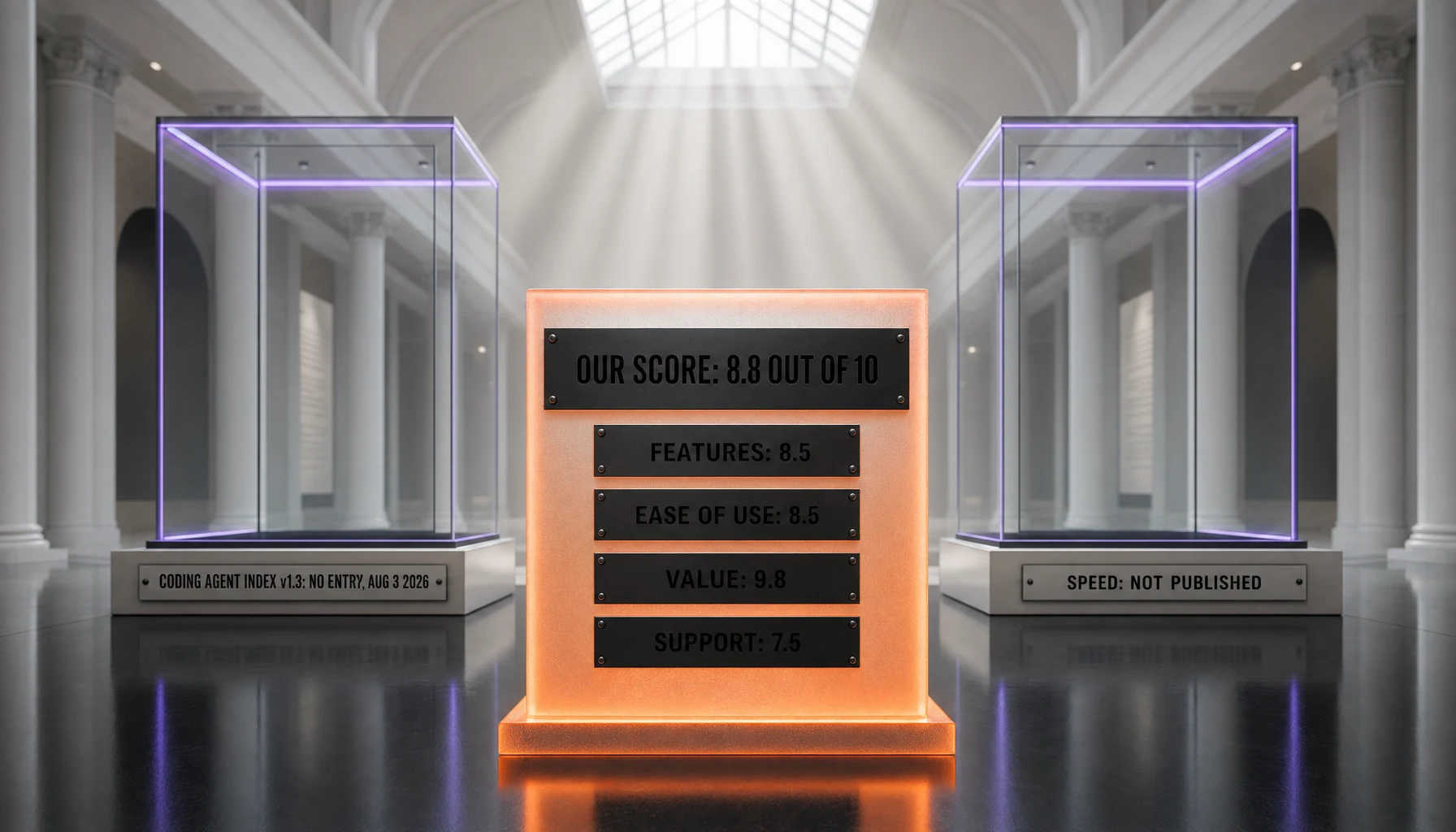
DeepSeek V4 Flash earns 8.8 out of 10 on three things: it outscores its own flagship on the independent index that measures both, DeepSeek prices it at roughly a third of that flagship, and its weights are MIT-licensed. That combination changes the default answer for a whole class of high-volume text work.
What keeps it from scoring higher is what nobody has measured. A model named Flash with no published throughput or latency figure is asking you to take the name on faith. A model absent from all 52 pairings on the Coding Agent Index v1.3 has no independent agentic coding evidence, whatever its model-level coding index says. And rank 72 on LMArena against a top-tier benchmark index is a disagreement between instruments we can describe but not resolve.
Score breakdown:
- Features: 8.5 out of 10 — 1M context, a 384K-token output ceiling, dual API compatibility, tool calls, JSON output, prefix completion, and FIM cover almost everything a text workload needs. The text-only ceiling holds it back.
- Ease of Use: 8.5 out of 10 — compatible base URLs make adoption a configuration change. The split between vendor and marketplace output ceilings is a genuine trap for new users.
- Value: 9.8 out of 10 — $0.22 and $0.66 per million tokens off-peak for a 49.9 index score, with cache hits at about one thirty-first of the input rate and MIT weights on top. The strongest part of the model by a wide margin.
- Support: 7.5 out of 10 — clear documentation and a public rate card, but a single serving provider on OpenRouter, an announced-but-undated peak-pricing policy, and no published performance data all add uncertainty to a production commitment.
Final word. Buy DeepSeek V4 Flash if your bill is dominated by token volume, your workload is text-in and text-out, and you can exploit prompt caching — in that scenario it is close to the strongest option at any price, and the MIT license means you are never locked in. Skip it if you need multimodal input, a contractual latency figure, or harness evidence before staffing an autonomous coding agent. Either way, budget against DeepSeek's published rates rather than a marketplace quote.
Sources
- DeepSeek API pricing — token rates, cache-hit and cache-miss lines, concurrency limits, and the announced peak-hours notice. Checked August 3, 2026.
- DeepSeek API documentation — the statement that
deepseek-v4-flashnow serves DeepSeek-V4-Flash-0731, plus base URLs, modes, and feature support. Checked August 3, 2026. - DeepSeek-V4-Flash-0731 on Hugging Face — MIT license, weights, architecture, quantization, download and like counts, arXiv reference. Checked August 3, 2026.
- Artificial Analysis — DeepSeek V4 Flash — Intelligence Index v4.1 score, component benchmarks, and coding index value. Checked August 3, 2026.
- Artificial Analysis Coding Agent Index — the v1.3 board of 52 harness-and-model pairings on which DeepSeek V4 Flash has no entry. Checked August 3, 2026.
- LMArena leaderboard — Elo rating, vote count, and overall rank. Checked August 3, 2026.
- OpenRouter — deepseek/deepseek-v4-flash-0731 — marketplace quote, output ceiling, cache read rate, and provider count. Checked August 3, 2026.
Key Features
Pros & Cons
Pros
- Outscores DeepSeek V4 Pro on the Artificial Analysis Intelligence Index v4.1 — 49.9 against 44.3, both measured at max reasoning effort — while costing about a third as much per token.
- Prompt cache hits bill at $0.007 per million tokens against $0.22 for a cache miss off-peak, a roughly thirty-onefold reduction that rewrites the cost model for retrieval pipelines and long system prompts.
- Open weights under the MIT license at deepseek-ai/DeepSeek-V4-Flash-0731, permitting commercial use, fine-tuning, and private redistribution with no vendor dependency.
- A 1M-token context window paired with a vendor-stated 384K-token maximum output, which removes a chunking layer from long-form generation pipelines.
- Both an OpenAI-compatible base URL and an Anthropic-compatible base URL, so migrating an existing codebase is a configuration change rather than an SDK rewrite.
- A 2500-request concurrency ceiling against 500 for DeepSeek V4 Pro — five times the parallel request volume, which often decides batch throughput in practice.
- Responses API support ahead of V4 Pro, alongside JSON Output, Tool Calls, Chat Prefix Completion (Beta), and FIM Completion (Beta, non-thinking mode only).
Cons
- No independent speed measurement exists: Artificial Analysis publishes neither throughput nor latency for this model as of August 3, 2026, despite the name promising speed.
- No entry on the Artificial Analysis Coding Agent Index v1.3 — verified across all 52 harness-and-model pairings — so there is no independent agentic coding result in a real harness.
- Text-only, with no native image, audio, or video input, which rules the model out of multimodal workloads entirely rather than merely limiting them.
- Rank 72 overall on LMArena, with an Elo of 1431.7 across 46,729 votes, sits well below what its benchmark index score would suggest — the two instruments disagree.
- DeepSeek has announced a peak-hours policy that would double all billing items during a defined daily window, with no effective date published as of August 3, 2026.
Best Use Cases
Platforms & Integrations
Available On
Integrations

We're developers and SaaS builders who use these tools daily in production. Every review comes from hands-on experience building real products — DealPropFirm, ThePlanetIndicator, PropFirmsCodes, and many more. We don't just review tools — we build and ship with them every day.
Written and tested by developers who build with these tools daily.
Frequently Asked Questions
What is DeepSeek V4 Flash?
DeepSeek's small MoE model — 284B parameters with 13B activated, 1M context, MIT-licensed weights — that outscores its own flagship on the Artificial Analysis Intelligence Index v4.1.
How much does DeepSeek V4 Flash cost?
DeepSeek V4 Flash costs $0.22/month.
Is DeepSeek V4 Flash free?
No, DeepSeek V4 Flash starts at $0.22/month.
What are the best alternatives to DeepSeek V4 Flash?
Top-rated alternatives to DeepSeek V4 Flash include Claude Code (9.9/10), Cursor (9.5/10), Veo 3.1 (9.4/10), Claude Opus 4.7 (9.4/10) — all reviewed with detailed scoring on ThePlanetTools.ai.
Is DeepSeek V4 Flash good for beginners?
DeepSeek V4 Flash is rated 8.5/10 for ease of use.
What platforms does DeepSeek V4 Flash support?
DeepSeek V4 Flash is available on REST API (api.deepseek.com), OpenAI-compatible SDKs via https://api.deepseek.com, Anthropic-compatible SDKs via https://api.deepseek.com/anthropic, Hugging Face (deepseek-ai/DeepSeek-V4-Flash-0731 weights), Self-hosted from open weights (MIT license), OpenRouter.
Does DeepSeek V4 Flash offer a free trial?
No, DeepSeek V4 Flash does not offer a free trial.
Is DeepSeek V4 Flash worth the price?
DeepSeek V4 Flash scores 9.8/10 for value. We consider it excellent value.
Who should use DeepSeek V4 Flash?
DeepSeek V4 Flash is ideal for: High-volume classification, tagging, routing, and entity extraction across millions of records in non-thinking mode, Cache-heavy retrieval workloads that resend a fixed system prompt, document set, or schema on every call, Long-document synthesis and long-form generation inside a single call, using the 1M-token context and 384K-token output ceiling, Self-hosted and air-gapped deployment from the MIT-licensed open weights, for regulated environments, Cost reduction on an existing OpenAI or Anthropic integration by routing high-volume traffic through the compatible base URLs, Editor-side code completion via FIM, and academic research on published weights and architecture.
What are the main limitations of DeepSeek V4 Flash?
Some limitations of DeepSeek V4 Flash include: No independent speed measurement exists: Artificial Analysis publishes neither throughput nor latency for this model as of August 3, 2026, despite the name promising speed.; No entry on the Artificial Analysis Coding Agent Index v1.3 — verified across all 52 harness-and-model pairings — so there is no independent agentic coding result in a real harness.; Text-only, with no native image, audio, or video input, which rules the model out of multimodal workloads entirely rather than merely limiting them.; Rank 72 overall on LMArena, with an Elo of 1431.7 across 46,729 votes, sits well below what its benchmark index score would suggest — the two instruments disagree.; DeepSeek has announced a peak-hours policy that would double all billing items during a defined daily window, with no effective date published as of August 3, 2026..
Best Alternatives to DeepSeek V4 Flash
Ready to try DeepSeek V4 Flash?
Get started today
Try DeepSeek V4 Flash Now →