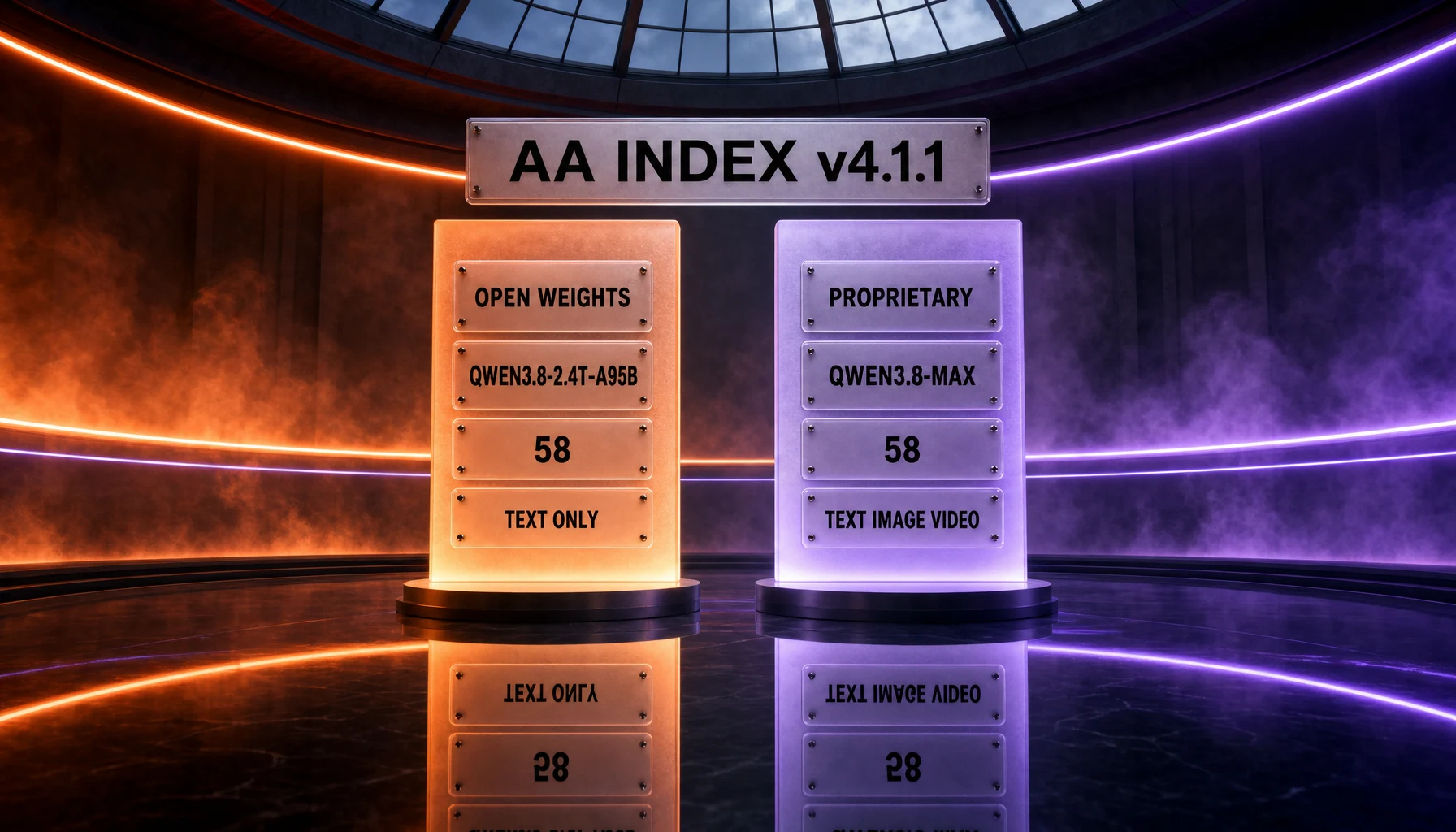
Qwen3.8-2.4T-A95B is the open-weights model Alibaba published on Hugging Face on August 8, 2026, and its model card states plainly: "For the first time, Qwen3.8 brings a Qwen-Max-class model to open release." It is a sparse Mixture-of-Experts design with 2.4 trillion total parameters, 95 billion active per token, 92 layers, and 512 experts of which 10 routed plus 1 shared fire on each pass. On the Artificial Analysis Intelligence Index version 4.1.1, checked on August 22, 2026, it scores 58 — the same displayed figure as Alibaba's own proprietary Qwen3.8-Max service, which lists at $2.00 per million input tokens and $6.00 per million output tokens on QwenCloud. The difference between the two is not measured intelligence. It is features, and a license that names Alibaba's own products.
Key Takeaways
- The weights are out, and this is the event. In July we covered the paid Qwen3.8-Max preview, which shipped with no model card, no active-parameter count, no license, and no independent score. All four of those gaps closed on August 8 when the repository went live.
- 58 and 58, from the same evaluator on the same day. Artificial Analysis Intelligence Index version 4.1.1, checked August 22, 2026: Qwen3.8 Max scores 58.1 and Qwen3.8 2.4T A95B scores 57.7. Both display as 58. The open model is 0.4 points behind on the underlying value, not level with it — an important distinction the rounded number hides.
- The gap is functional, not cognitive. The model card says the proprietary Qwen3.8-Max adds "vision input & non-thinking support, 1M context length by default, official built-in tools, etc." Artificial Analysis lists the open model as text-input only with a 984,000-token context, and the service as text, image, and video with 1 million.
- The license is not Apache, and it names Qoder and QwenWork. The Qwen3.8-Max License requires a separate commercial license from anyone running a "Model as a Service" or "AI Work Assistant" business above $50,000,000 in aggregate revenue over any consecutive twelve months — and it defines "AI Work Assistant" by pointing at Alibaba's own two products.
- Two licenses in one family, split by size. Qwen3.8-27B shipped three days earlier under Apache-2.0 with native vision and has been downloaded 2,090,699 times. The 2.4-trillion-parameter sibling carries the house license and has 17,386 downloads. Same release cycle, two legal regimes.
What Alibaba Actually Published
On August 8, 2026, Alibaba created the Hugging Face repository Qwen/Qwen3.8-2.4T-A95B and, roughly one minute earlier, its FP8 sibling Qwen/Qwen3.8-2.4T-A95B-FP8. Both carry the same non-Apache license file. This is the first time the company has released a model it describes as Qwen-Max-class in downloadable form — its top tier had until now stayed behind the API.
The architecture is disclosed in full, which is itself the news. The model runs 2.4 trillion total parameters with 95 billion activated per token across 92 layers. It uses 512 experts, of which 10 routed experts plus 1 shared expert activate on any given forward pass. The hidden dimension is 8192 and the vocabulary is 248,320 tokens after padding. Attention is a hybrid: Gated DeltaNet layers with 128 linear attention heads for values and 16 for query-key, interleaved with gated attention running 64 query heads against 4 key-value heads at 256 dimensions.
Read that against what we could report a month ago. In July, the single most important number about this model — the active-parameter count — was the one Alibaba would not publish, which made any statement about its serving cost guesswork. The answer turned out to be 95 billion active out of 2.4 trillion, a sparsity ratio of roughly 1 in 25. For comparison, Kimi K3 activates about 50 billion of its 2.8 trillion. Qwen's flagship fires nearly twice as much compute per token as Moonshot's.
Adoption, measured on August 22, 2026, is modest in unit terms and unsurprising for a model of this size: 17,386 downloads and 1,141 likes on the bf16 repository, and 21,400 downloads and 229 likes on the FP8 variant. A 2.4-trillion-parameter checkpoint is not something most teams pull casually. The FP8 build leading the bf16 build on downloads is the tell — the people fetching this are the ones who have thought about how they will serve it.
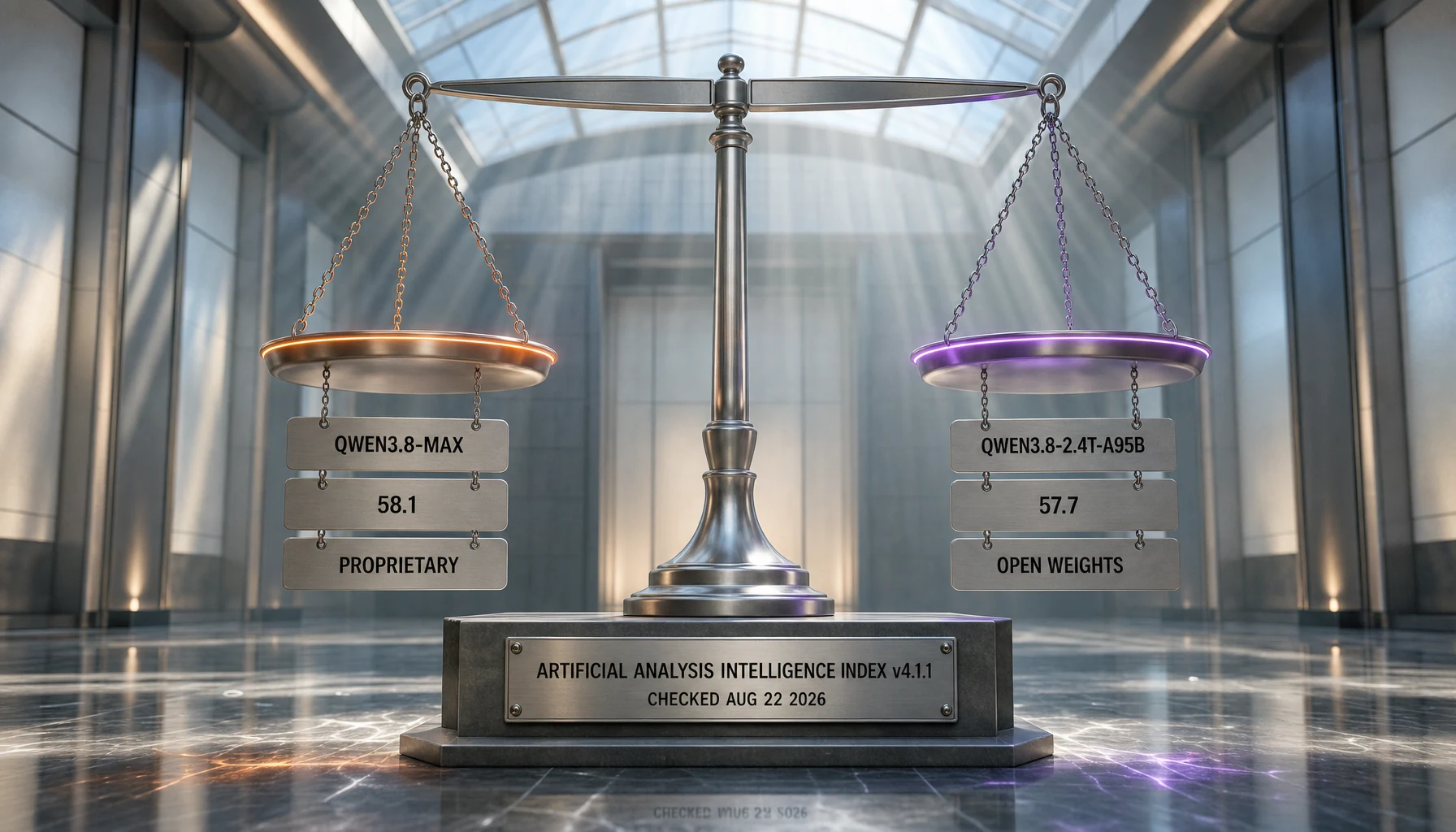
The Number That Carries the Story: 58 and 58
On the Artificial Analysis Intelligence Index version 4.1.1, checked on August 22, 2026, Qwen3.8 Max scores 58.1 and Qwen3.8 2.4T A95B scores 57.7. Artificial Analysis displays both as 58. Cost per index task comes out at $1.13 for the proprietary service and $1.09 for the open model, and median output speed is 45 tokens per second for both. Two products, one from behind an API and one you can download, measured by the same independent evaluator, landing on the same rounded figure.
Be precise about what "the same" means here. The underlying values differ by 0.4 points, and the open model is the one below. That is well inside the range where an index revision or a rerun could reorder them, and it is not evidence that the downloadable weights match the hosted service exactly. What it does support is the claim Alibaba makes in the model card — that this is a Qwen-Max-class model — and that claim now has an outside number attached to it rather than only the company's own testing.
For context on the same index version and the same check date, Artificial Analysis places Claude Opus 5 at maximum reasoning effort on 63.1, Claude Fable 5 with fallback on 62.1, GPT-5.6 Sol at max on 60.9, Grok 4.6 at high effort on 60.9, Kimi K3 at max on 59.7, and GLM-5.3 at max on 59.5. Alibaba's pair sits in the tier just below the leaders, roughly five points off the top. That is a meaningful distance on an index built from nine evaluations, and it is a much smaller distance than "second only to Fable 5" — the line Alibaba used in July, from its own testing, which we flagged at the time as a claim rather than a measurement.
One caveat belongs on every one of these figures. Artificial Analysis marks version 4.1.1 as an update in which τ-Banking moved to v1.0.1 and the graders for Humanity's Last Exam, AA-LCR, and AA-Omniscience were upgraded to GPT-5.6 Luna at medium effort. Scores from a previous index version are not directly comparable to these. We will come back to that.
What the Downloadable Model Does Not Do
The proprietary Qwen3.8-Max service is not a smarter model. It is a more capable product. Alibaba says so directly in the model card, listing what the official Qwen3.8-Max version adds on top of the open release: "vision input & non-thinking support, 1M context length by default, official built-in tools, etc."
The independent measurements line up with that description. Artificial Analysis records the open Qwen3.8 2.4T A95B as accepting text input only, with a 984,000-token context window as served. It records Qwen3.8 Max as accepting text, image, and video, with a 1-million-token window. QwenCloud's own specification page for the service, checked August 22, 2026, gives 1 million total context, a 991,000-token maximum input, a 131,000-token maximum output, and up to 262,000 tokens of reasoning, alongside function calling, structured outputs, context caching, batches, and built-in tools for code interpretation, web search, web extraction, and image search.
| Attribute | Qwen3.8-2.4T-A95B (open weights) | Qwen3.8-Max (QwenCloud service) |
|---|---|---|
| Intelligence Index v4.1.1, checked Aug 22, 2026 | 57.7 (displays as 58) | 58.1 (displays as 58) |
| Input modalities | Text | Text, image, video |
| Context window | 984K as measured by Artificial Analysis | 1M (991K max input, 131K max output) |
| Non-thinking mode | Not in the open release | Yes |
| Built-in tools | Not in the open release | Code interpreter, web search, web extraction, image search |
| List price, input | Your own infrastructure | $2.00 per million tokens |
| List price, output | Your own infrastructure | $6.00 per million tokens |
| License | Qwen3.8-Max License | QwenCloud terms |
QwenCloud's published list prices for the service, checked August 22, 2026, are $2.00 per million input tokens and $6.00 per million output tokens, with implicit input caching at $0.25 per million, explicit cache creation at $2.50 per million, and explicit cache reads at $0.17 per million. Those are list rates from the vendor's own page, not marketplace quotes.
So the trade is legible. Download the weights and you get the reasoning core with no vision, no non-thinking path, no hosted tools, and the serving bill for a 95-billion-active-parameter model on your own hardware. Call the API and you get the product, at a published price, with the parts that make it convenient. What you no longer get by paying is a materially smarter model — and that is the shift worth noticing.
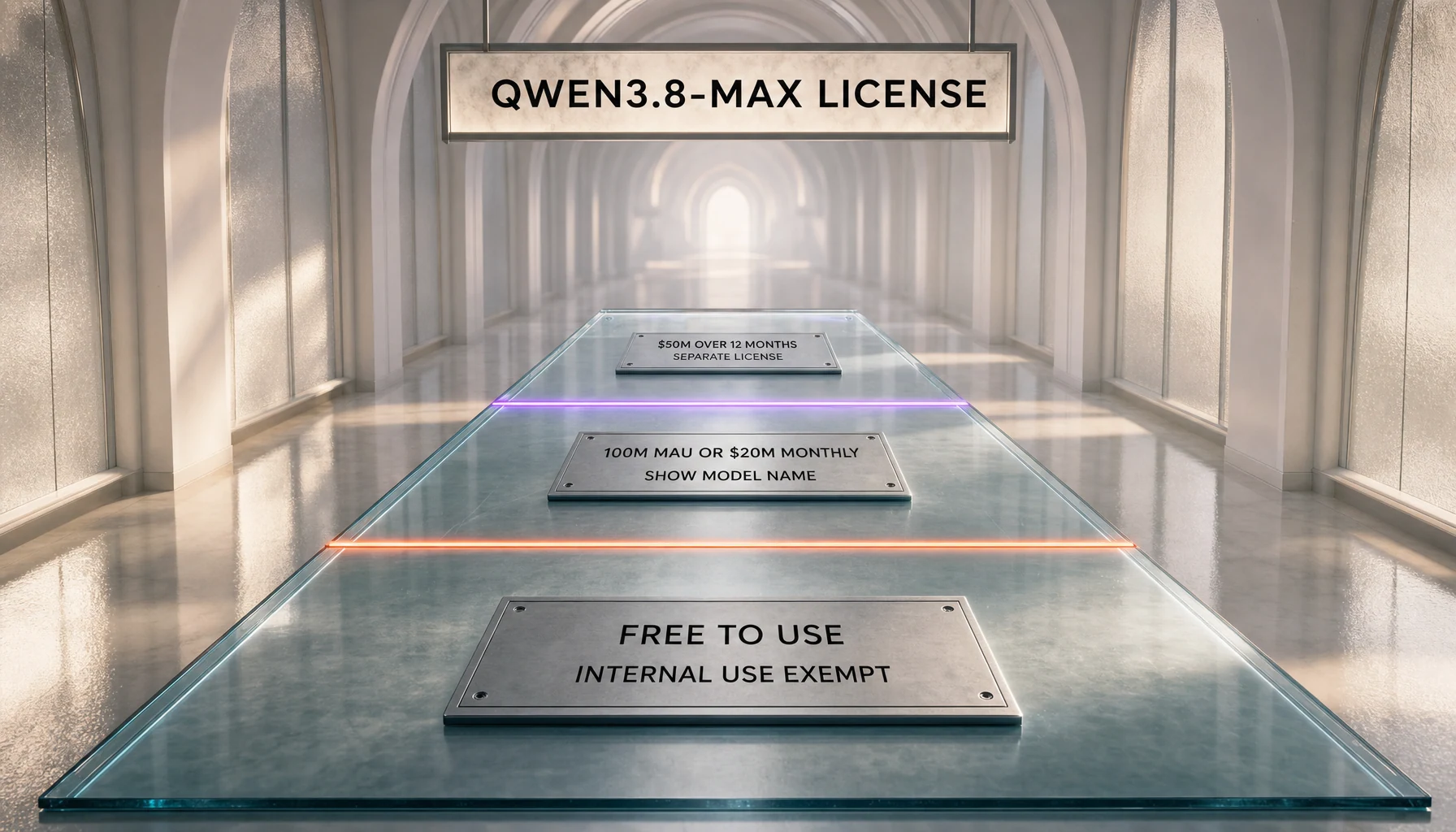
The License Is Not Apache — and It Names Alibaba's Own Products
The file at the root of the repository is the Qwen3.8-Max License. It is broadly permissive and, notably, contains no territorial restriction — there is no clause excluding any country or region. What it does contain is two commercial triggers, both keyed to how big you are rather than what you build.
The first is a naming obligation. If the software is used for commercial products or services with more than 100,000,000 monthly active users, or more than $20,000,000 in monthly revenue, the license requires that the "respective model name must be prominently displayed on the user interface." At that scale, you may ship it, but you must say you are shipping it.
The second is a licensing obligation, and it is the one with teeth. If the licensee or any of its affiliates "conducts a Model as a Service or AI Work Assistant business, and the aggregate revenue ... exceeds US$50,000,000 ... during any consecutive twelve (12) months, the licensee shall obtain a separate license." There is an explicit carve-out for internal use: the requirement does not apply to internal use "provided that such Use does not make the Software, its outputs, or its underlying model capabilities available to any third party." Run it inside your company and the threshold does not reach you. Expose it to a customer and it does.
Here is the detail that makes this release worth reading closely. The license defines "AI Work Assistant" as "an independent AI-powered product primarily designed for AI-assisted coding or office productivity (e.g., Qoder and QwenWork)." The examples are Alibaba's own products. The definition then narrows deliberately, excluding "(a) a single-purpose AI tool ...; (b) an AI assistant primarily designed for a domain other than coding or office productivity ... or (c) an AI assistant that is a feature of a product whose primary purpose is not AI-assisted coding or office productivity."
Read the shape of that carve-out rather than the intent behind it. A narrow tool is exempt. An assistant for medicine, law, or design is exempt. An AI feature bolted onto a product that does something else is exempt. What is not exempt is a standalone coding or office-productivity assistant at scale — which is a precise description of the category Qoder and QwenWork compete in. Alibaba has released weights that a large direct competitor cannot build a commercial product on without coming back to negotiate. We are reporting the clause, not a motive; the text is public and says what it says.
For teams evaluating this, the practical test is short. Are you above $50,000,000 in aggregate revenue over twelve consecutive months from a Model as a Service or standalone coding-or-office assistant business? If no, the license reads as permissive. If yes, you need a separate agreement before commercial use. And if you are above 100,000,000 monthly active users or $20,000,000 in monthly revenue in any commercial use, the model name goes in your interface. Anyone weighing this against the alternatives should read our guide on choosing between closed and open-weight models, because "open weights" has stopped being a single category.
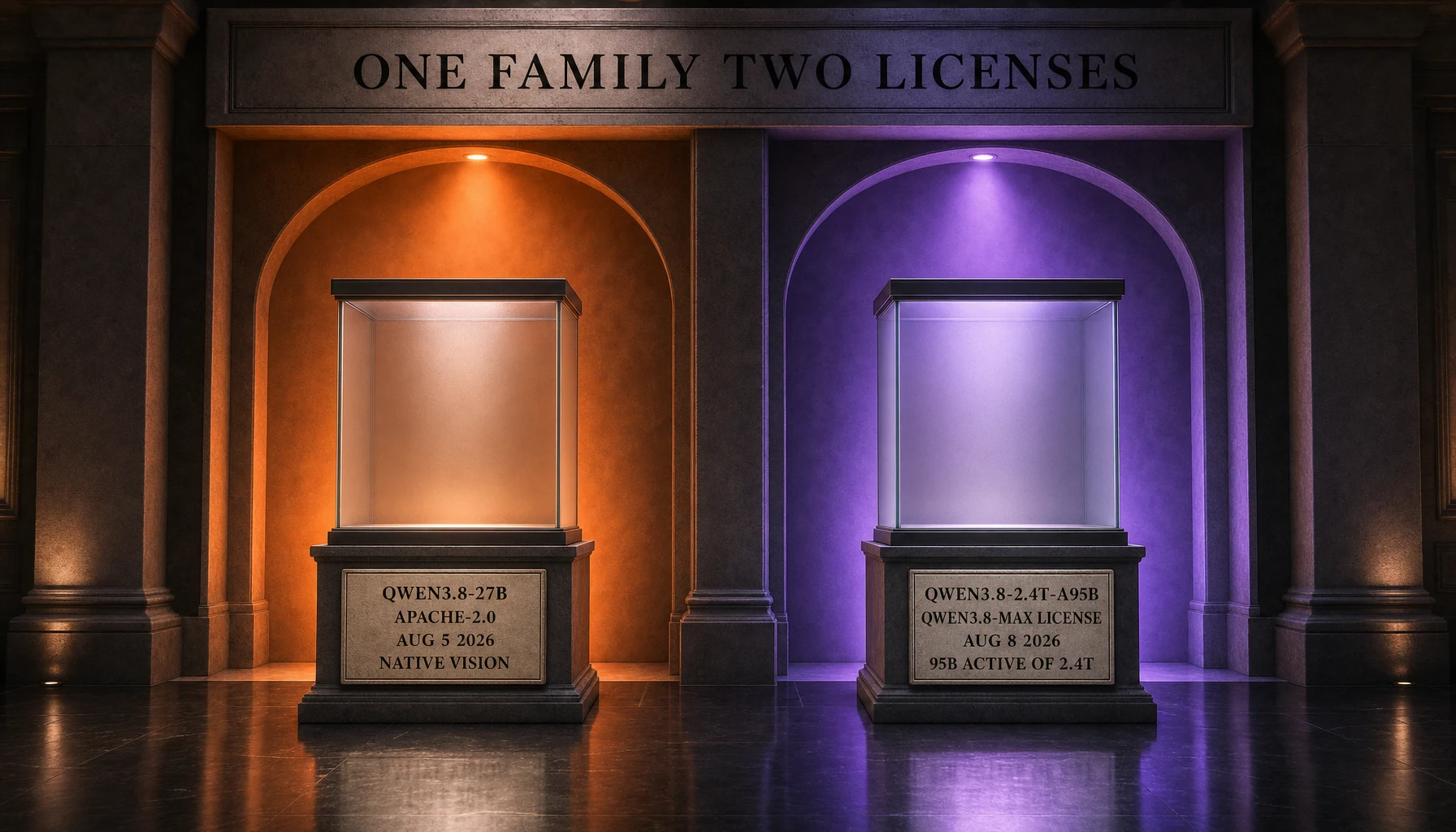
Two Licenses in One Family, Split by Size
Three days before the 2.4-trillion-parameter release, on August 5, 2026, Alibaba published Qwen/Qwen3.8-27B under Apache-2.0. It is a dense model, natively vision-language, tagged image-text-to-text on Hugging Face. Its FP8 variant followed on August 13, also Apache-2.0. On August 22, 2026 the 27B has 2,090,699 downloads and 12,021 likes; the FP8 build has 2,306,777 downloads and 661 likes. On QwenCloud the hosted 27B lists at $0.50 per million input tokens and $3.00 per million output tokens, with a 1-million-token context and text, image, and video input.
| Qwen3.8-27B | Qwen3.8-2.4T-A95B | |
|---|---|---|
| Repository created | August 5, 2026 | August 8, 2026 |
| License | Apache-2.0 | Qwen3.8-Max License |
| Architecture | Dense | Sparse MoE, 95B active of 2.4T |
| Vision | Native vision-language | Text only in the open release |
| Downloads, checked Aug 22, 2026 | 2,090,699 | 17,386 |
| Hosted list price | $0.50 in, $3.00 out per million tokens | $2.00 in, $6.00 out per million tokens (Max service) |
Two things stand out. The first is that the legal regime tracks model size, not model capability: the small model is unencumbered, the large one is gated. The second is stranger — the Apache-2.0 model has native vision and the restrictively licensed flagship does not, at least in its open form. If your workload is multimodal and you want clean license terms, the 27B is the one that gives you both, and the download counts suggest the market has already worked that out. It has moved roughly 120 times as many copies as its enormous sibling.
This is not unique to Alibaba. Google shipped Gemma 4 under Apache-2.0 across its whole size range, while Moonshot's Kimi K3 arrived promising a modified MIT license. The pattern across labs in 2026 is that the small models get clean licenses and the frontier-scale ones get bespoke ones with revenue triggers.
What We Said in July, and What Landed
Our July coverage of the Qwen3.8-Max preview closed by naming three things that would tell us whether the model was a frontier product or a frontier press release. All three have now landed, which is rare enough to be worth stating plainly.
We asked for an independent score to replace Alibaba's self-graded "second only to Fable 5" ranking. Artificial Analysis has now measured both the service and the open model at a displayed 58, roughly five points behind Claude Opus 5 at max effort on version 4.1.1 — a real result, and a more modest one than the vendor's line implied. We asked for the disclosures that turn a headline into a product: an active-parameter count, a model card, and a standard price list. All three exist now — 95 billion active, a full architecture card, and published QwenCloud list rates. And we asked for the open-weight release itself, with a real date and a real license. August 8, 2026, under the Qwen3.8-Max License.
The one thing we did not anticipate is the shape of the license. In July the open question was whether the weights would arrive at all. They did, and the interesting constraint turned out not to be geography or research-only usage but a revenue threshold aimed at one specific competitive category.
Reading an Index That Moves
A score is only meaningful with the version of the instrument that produced it and the date it was read. Artificial Analysis Intelligence Index version 4.1.1 aggregates nine evaluations: GDPval-AA v2, τ-Banking, Terminal-Bench v2.1, SciCode, Humanity's Last Exam, GPQA Diamond, CritPt, AA-Omniscience, and AA-LCR. Every figure in this article was read from Artificial Analysis on August 22, 2026 on that version.
That matters because the index has moved recently, and not only because models improved. Artificial Analysis describes version 4.1.1 as an update in which τ-Banking went to v1.0.1 and the graders for Humanity's Last Exam, AA-LCR, and AA-Omniscience were upgraded to GPT-5.6 Luna at medium effort. Claude Opus 5 reads 63.1 today against the 61 we recorded in July. Part of that movement belongs to the ruler, not the thing being measured.
The practical consequence for anyone comparing models: do not mix scores across index versions, and do not read a 0.4-point gap as a ranking. Qwen3.8 Max at 58.1 and Qwen3.8 2.4T A95B at 57.7 are, for decision-making purposes, the same measurement. The claim this article makes is not that the open model beats the paid one. It is that on an independent instrument, on one day, they are indistinguishable.
What This Changes for Teams
Until now, the reliable trade with Chinese frontier labs was that the open release sat a tier below the flagship. You downloaded the second-best model and paid for the best one. Qwen3.8-2.4T-A95B breaks that pattern: the downloadable weights and the paid endpoint post the same displayed index score, and the paid tier justifies itself on vision, a non-thinking mode, hosted tools, and the full context window rather than on raw capability.
For most teams the arithmetic still favors the API. Serving 95 billion active parameters out of a 2.4-trillion-parameter checkpoint is a serious infrastructure commitment, and at $2.00 and $6.00 per million tokens the hosted service is not priced as a luxury. The download counts say the same thing — 17,386 pulls is a number that describes labs and infrastructure teams, not the general developer population.
Where the release genuinely changes the calculation is for organizations that cannot send data to an API at all, and for researchers who now have a Max-class checkpoint to inspect. For them the constraint is no longer capability. It is the license, and the license is readable in ten minutes. Check your revenue against $50,000,000 over twelve consecutive months, check whether you are exposing the model to third parties, and you will know within one reading whether this model is free for you or a negotiation.
Frequently Asked Questions
What is Qwen3.8-2.4T-A95B?
Qwen3.8-2.4T-A95B is the open-weights model Alibaba published on Hugging Face on August 8, 2026. It is a sparse Mixture-of-Experts model with 2.4 trillion total parameters and 95 billion activated per token, running 92 layers, 512 experts of which 10 routed plus 1 shared fire per pass, a hidden dimension of 8192, and a 248,320-token vocabulary. Its model card states that "For the first time, Qwen3.8 brings a Qwen-Max-class model to open release," making it the first Alibaba model at the Max tier to ship as downloadable weights.
Is the open Qwen3.8 as good as the paid Qwen3.8-Max?
On the Artificial Analysis Intelligence Index version 4.1.1, checked on August 22, 2026, both display a score of 58. The underlying values are 58.1 for the proprietary Qwen3.8 Max and 57.7 for the open Qwen3.8 2.4T A95B, so the open model is 0.4 points behind rather than exactly level. Cost per index task is $1.13 and $1.09 respectively, and both run at a median 45 tokens per second. For practical purposes the two are indistinguishable on measured intelligence.
What does the paid Qwen3.8-Max service have that the open weights do not?
The model card lists what the official Qwen3.8-Max version adds: "vision input & non-thinking support, 1M context length by default, official built-in tools, etc." Artificial Analysis records the open model as text-input only with a 984,000-token context as served, and the service as accepting text, image, and video with a 1-million-token window. QwenCloud additionally documents function calling, structured outputs, context caching, batches, and built-in tools for code interpretation, web search, web extraction, and image search. The difference between the two products is functional, not cognitive.
What license does Qwen3.8-2.4T-A95B use?
It ships under the Qwen3.8-Max License, not Apache-2.0. The license is broadly permissive and contains no territorial restriction, but it adds two commercial triggers. Commercial products above 100,000,000 monthly active users or $20,000,000 in monthly revenue must display the model name prominently in the user interface. Separately, a Model as a Service or AI Work Assistant business whose aggregate revenue exceeds $50,000,000 over any consecutive twelve months must obtain a separate license before commercial use.
Why does the license mention Qoder and QwenWork?
The license uses Alibaba's own products as the definition of the category it restricts. It defines an "AI Work Assistant" as "an independent AI-powered product primarily designed for AI-assisted coding or office productivity (e.g., Qoder and QwenWork)," then excludes single-purpose AI tools, assistants built for domains other than coding or office productivity, and AI features inside products whose primary purpose is something else. The effect is that the $50,000,000 separate-license requirement lands on standalone coding and office assistants at scale — the category Alibaba's own two products compete in.
Can I use Qwen3.8-2.4T-A95B commercially for free?
In most cases yes. The license is permissive by default and carries no territorial restriction. You need a separate license only if you or an affiliate runs a Model as a Service or AI Work Assistant business with aggregate revenue above $50,000,000 over any consecutive twelve months. Internal use is explicitly exempt from that requirement, provided the use "does not make the Software, its outputs, or its underlying model capabilities available to any third party." Above 100,000,000 monthly active users or $20,000,000 in monthly revenue, you must also display the model name in your interface.
How much does Qwen3.8-Max cost on QwenCloud?
QwenCloud's published list prices, checked on August 22, 2026, are $2.00 per million input tokens and $6.00 per million output tokens. Implicit input caching is $0.25 per million tokens, explicit cache creation is $2.50 per million, and explicit cache reads are $0.17 per million. The service offers a 1-million-token context with a 991,000-token maximum input, a 131,000-token maximum output, and up to 262,000 reasoning tokens. These are vendor list rates rather than marketplace prices.
How does Qwen3.8 compare to Claude Opus 5 and GPT-5.6 Sol?
On Artificial Analysis Intelligence Index version 4.1.1, checked August 22, 2026, Claude Opus 5 at maximum reasoning effort scores 63.1, Claude Fable 5 with fallback scores 62.1, GPT-5.6 Sol at max scores 60.9, and Grok 4.6 at high effort scores 60.9. Both Qwen3.8 models display 58. That places Alibaba's pair roughly five points behind the leaders on this index version, in the tier just below, and ahead of nothing at the very top. Comparisons are only valid within the same index version.
How does it compare to Kimi K3 and GLM-5.3?
On the same index version and check date, Kimi K3 at max scores 59.7 and GLM-5.3 at max scores 59.5, both slightly ahead of the Qwen3.8 pair at a displayed 58. On architecture, Kimi K3 activates roughly 50 billion of its 2.8 trillion parameters per token, while Qwen3.8-2.4T-A95B activates 95 billion of 2.4 trillion — so Alibaba's model fires nearly twice the compute per token. The three sit within a few points of each other, close enough that an index revision could reorder them.
Why is Qwen3.8-27B under Apache-2.0 but the 2.4T model is not?
Alibaba split the licensing by model size. Qwen3.8-27B, created on Hugging Face on August 5, 2026, is a dense natively vision-language model under Apache-2.0, and its FP8 variant from August 13 is also Apache-2.0. The 2.4-trillion-parameter flagship, created August 8, carries the Qwen3.8-Max License with its revenue triggers. The company has not framed this as a reproach or explained the split. The observable fact is that the small model is unencumbered and the frontier-scale one is gated.
How many times has Qwen3.8-2.4T-A95B been downloaded?
As of August 22, 2026, the bf16 repository shows 17,386 downloads and 1,141 likes, and the FP8 variant shows 21,400 downloads and 229 likes. Those numbers are small relative to the family: Qwen3.8-27B has 2,090,699 downloads and its FP8 build has 2,306,777. That gap is what a 2.4-trillion-parameter checkpoint looks like in practice — the audience is labs and infrastructure teams, not the general developer population.
What is Artificial Analysis Intelligence Index version 4.1.1?
It is the version of the independent Artificial Analysis Intelligence Index in effect when we checked these scores on August 22, 2026. It aggregates nine evaluations: GDPval-AA v2, τ-Banking, Terminal-Bench v2.1, SciCode, Humanity's Last Exam, GPQA Diamond, CritPt, AA-Omniscience, and AA-LCR. Artificial Analysis describes 4.1.1 as an update in which τ-Banking moved to v1.0.1 and the graders for Humanity's Last Exam, AA-LCR, and AA-Omniscience were upgraded to GPT-5.6 Luna at medium effort. Scores from earlier index versions are not directly comparable.
Sources
- Qwen/Qwen3.8-2.4T-A95B model card — architecture, open-release statement, and the list of what the proprietary Qwen3.8-Max adds.
- Qwen3.8-Max License — the display threshold, the $50,000,000 separate-license requirement, the "AI Work Assistant" definition, and the internal-use exemption.
- Qwen/Qwen3.8-27B and Qwen3.8-2.4T-A95B-FP8 — creation dates, licenses, and download counts.
- QwenCloud — Qwen3.8-Max and QwenCloud — Qwen3.8-27B — vendor list prices and context limits.
- Artificial Analysis — Qwen3.8 2.4T A95B and Artificial Analysis — Qwen3.8 Max — Intelligence Index version 4.1.1 scores, cost per task, and output speed, checked August 22, 2026.