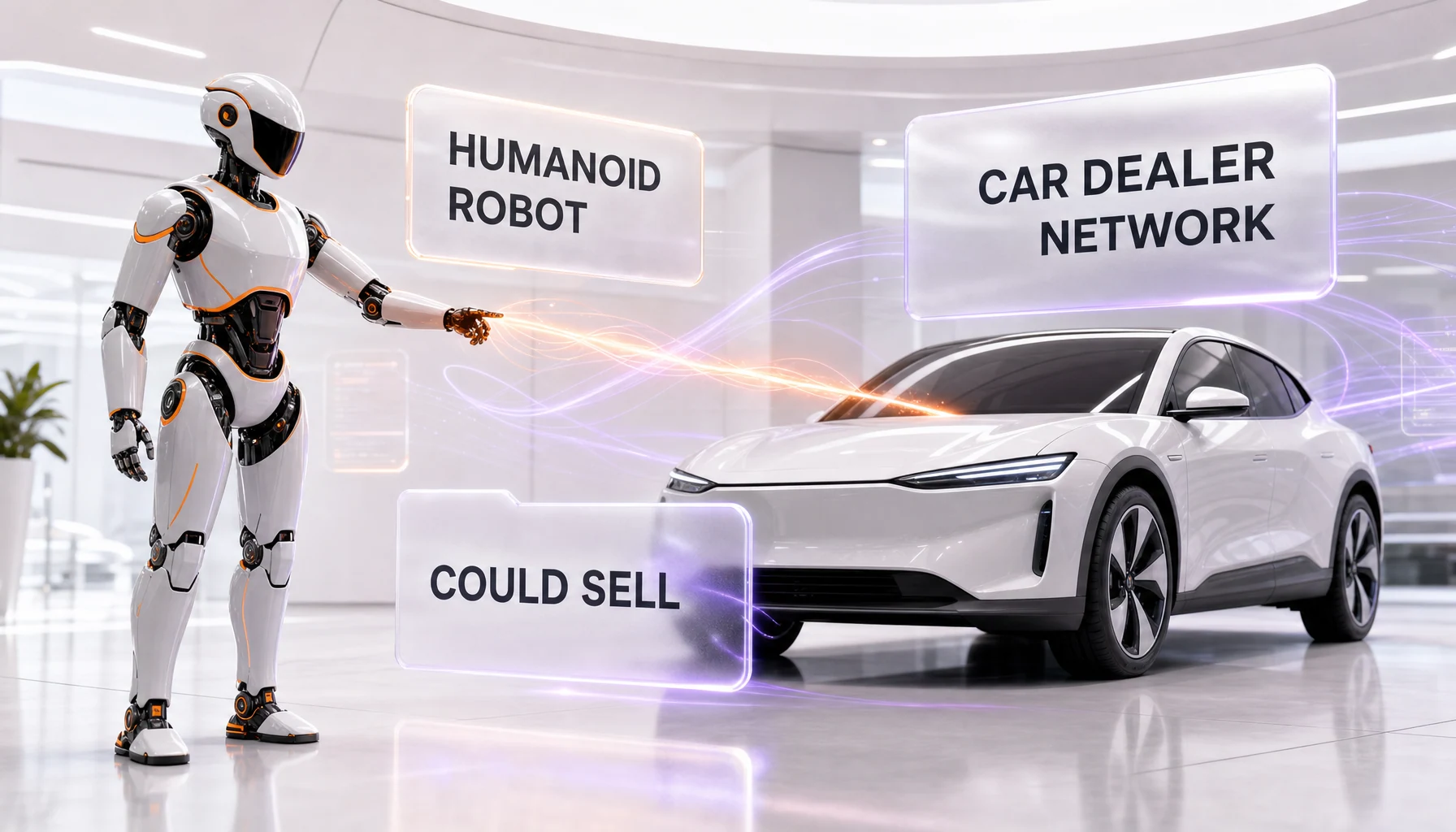
BYD, the Chinese carmaker, has confirmed it is developing humanoid robots and said that, if those robots ever become household products, the company could sell them through its existing car dealership network. The framing is conditional, not a committed launch. The statements came from BYD Executive Vice President Li Ke (Stella Li), reported by First Financial and picked up by CnEVPost and CarNewsChina on June 3 and 4, 2026. BYD gave no commercialization timeline, no pricing, no specifications, and no production targets.
What BYD Actually Said
On June 3 and 4, 2026, Chinese auto outlets reported that BYD had confirmed an internal humanoid robot program. The source was an interview with BYD Executive Vice President Li Ke (Stella Li), originally carried by First Financial and summarized by CnEVPost and CarNewsChina. The headline idea is simple and unusually concrete for an early-stage robotics story: BYD could one day sell humanoid robots in the same showrooms where it sells cars.
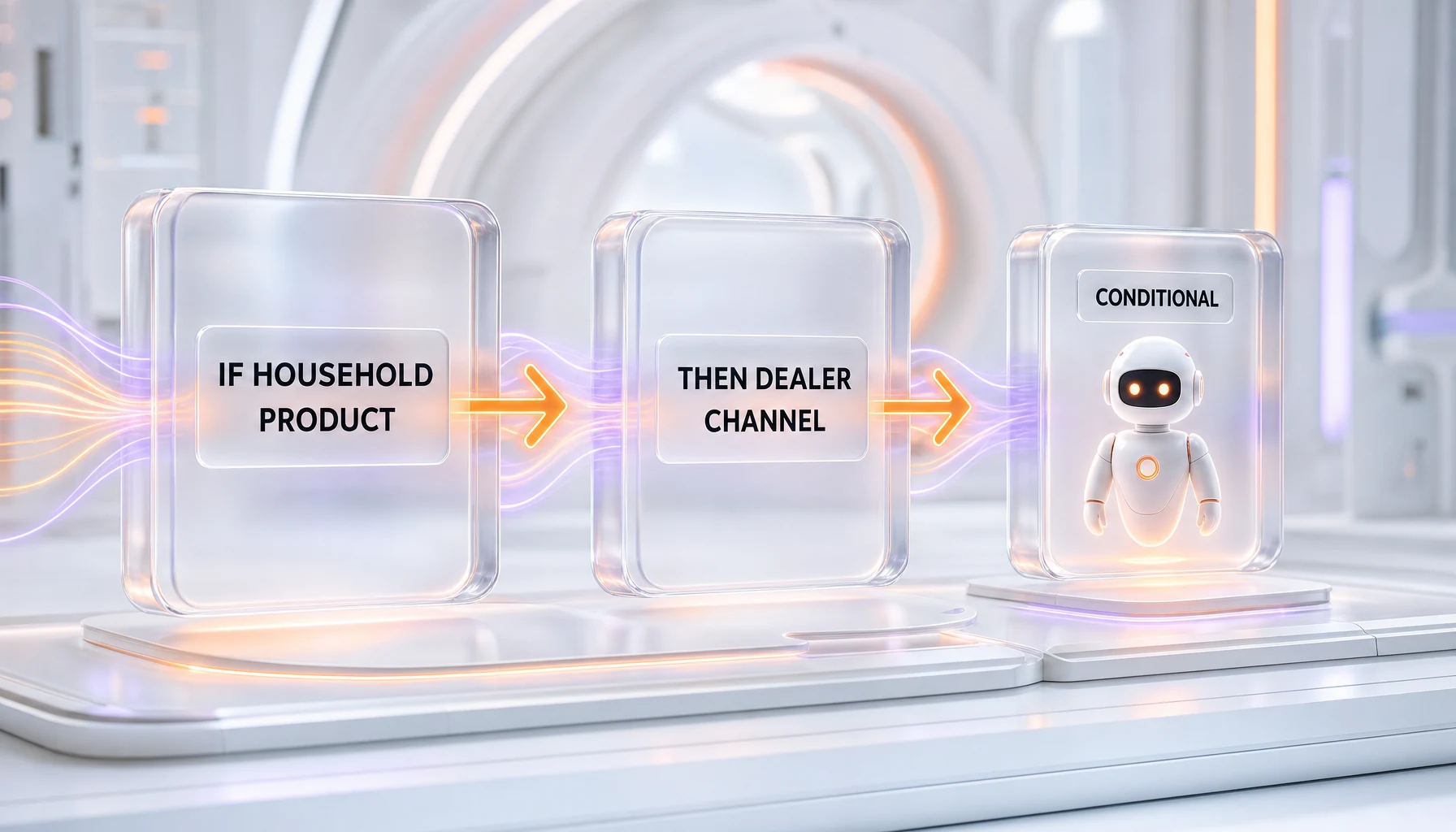
The critical word is "could." Li Ke framed the dealer channel as a possibility tied to a condition, not a roadmap with a date. The reported position was that if humanoid robots eventually become household products, BYD could distribute them through its existing dealer network. That is a meaningful difference from a press release announcing a product on sale. There is no robot you can buy, reserve, or price today, and BYD did not say there would be one by any specific quarter or year.
Three things were confirmed in the reporting. First, BYD is working on humanoid robots internally. Second, the company sees its huge dealer footprint as a candidate distribution channel for a hypothetical consumer robot. Third, BYD is thinking about an open platform rather than a closed, in-house-only product line — meaning it could build its own robots while also cooperating with external robotics companies.
Just as important is what was not said. The executive did not provide a commercialization timeline, technical specifications, investment figures, or production targets. Any number you may have seen attached to this story — prototype counts, unit volumes, factory output — did not come from this confirmation. We are deliberately not repeating figures that the primary reporting does not contain.
Why the Dealer Network Angle Matters
Most humanoid robot companies face the same wall after they solve the hard engineering: how do you actually sell, deliver, install, finance, service, and support a physical machine that walks into someone's home or workplace? Software ships over the internet. A robot does not. It needs a retail surface, a logistics chain, trained technicians, spare parts, warranty handling, and a trusted brand a buyer is willing to let into their building.
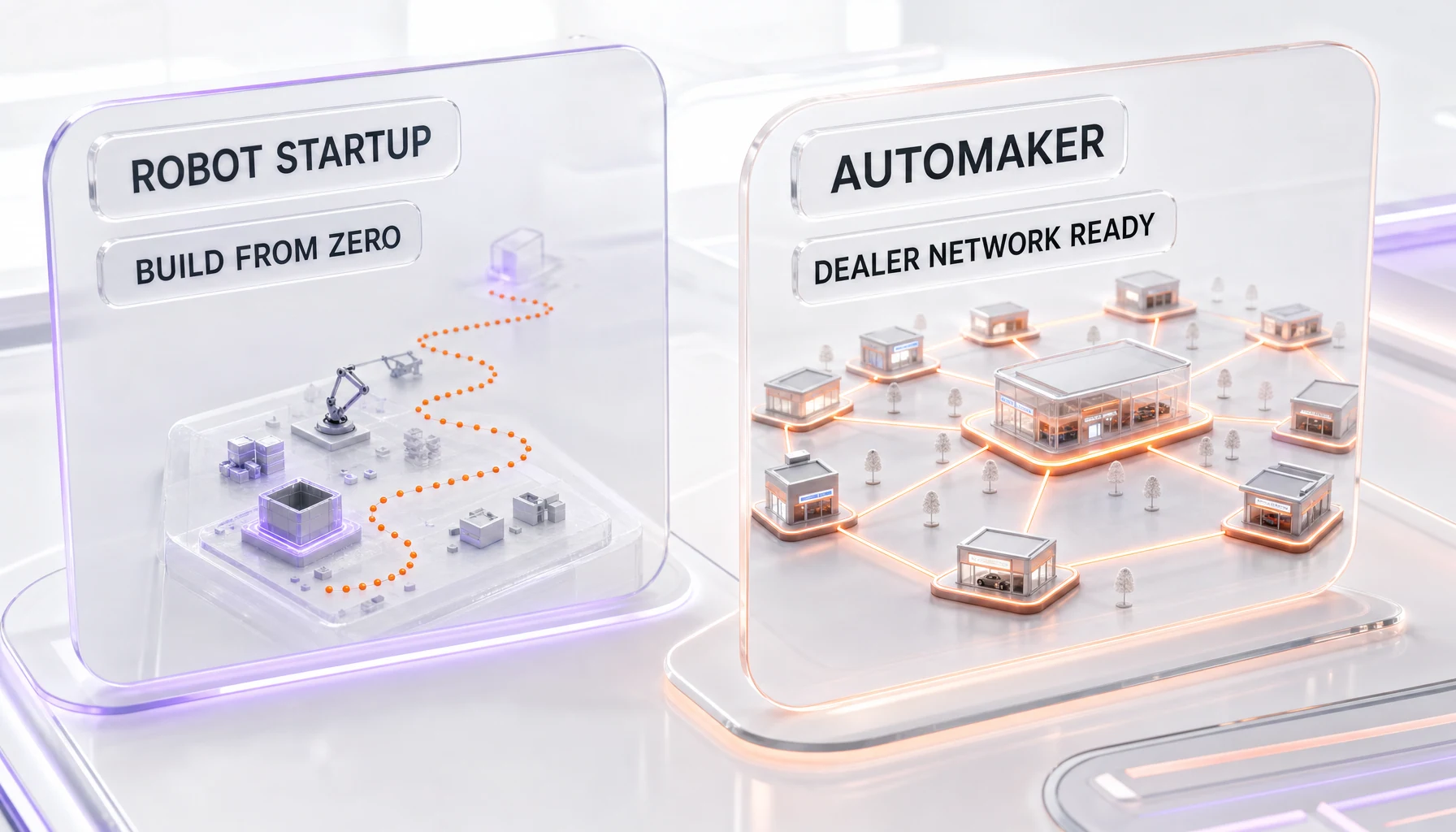
This is exactly the part a car company already owns. A dealer network is a pre-built distribution and service machine: physical stores in nearly every city, sales staff who handle high-ticket purchases, financing desks, service bays, and parts logistics. If a humanoid robot ever becomes a five-figure consumer durable — closer to a car than a laptop — then the car retail model maps onto it almost perfectly. That is the strategic insight behind BYD's comment, and it is why a conditional remark from an auto executive got picked up across the robotics press.
Contrast that with the current crop of humanoid startups. Figure, 1X, Robotera, and Unitree are vertically integrated robotics companies. They build the hardware, the AI stack, and have to invent their go-to-market from scratch — pilot deals, enterprise contracts, waitlists, and direct sales. 1X put a price and a date on its NEO consumer humanoid, which is itself a milestone, but the company still has to figure out delivery, installation, and support at scale. A carmaker with thousands of dealers does not have that problem; it has the opposite one of finding a product worth putting on the floor.
So the dealer-network idea is less a robotics announcement and more a distribution thesis. BYD is signaling that, in the convergence of cars and robots, the company believes its retail and service infrastructure is a structural advantage that pure-play robot startups cannot easily match.
The Auto-to-Robot Technology Bridge
BYD's deeper argument is that cars and humanoid robots are built from overlapping technology. Li Ke's reasoning, as reported, was that automotive AI and robotics share common technological foundations: both depend on perception, decision-making, motion control, software integration, and hardware engineering. The reporting also quoted a blunter version — that automotive software is complex, and porting it into robots is comparatively easy for an automaker.
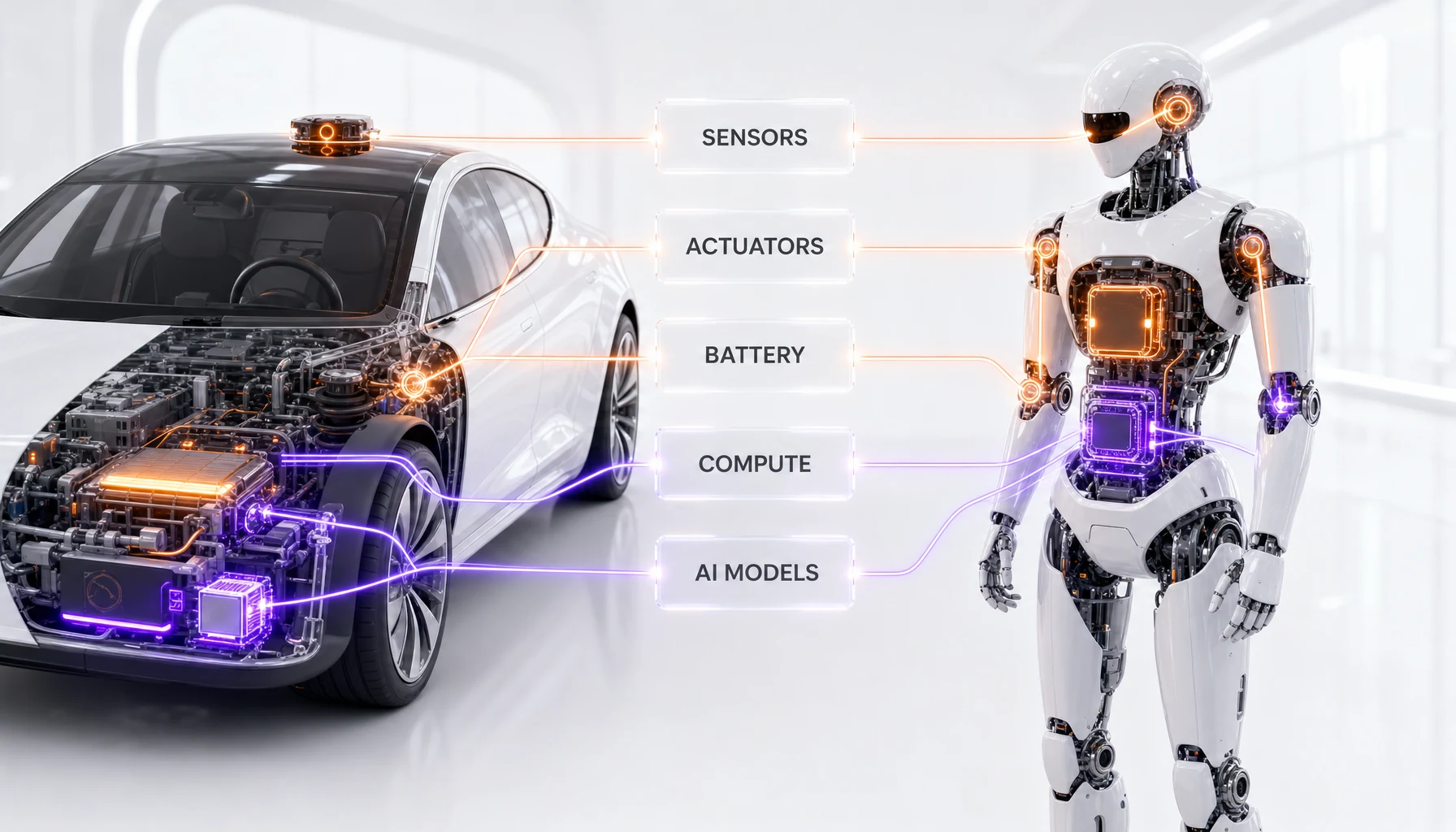
There is real substance to this. A modern intelligent electric vehicle is, in effect, a robot on wheels. It carries cameras, lidar and radar, electric actuators, battery systems, high-voltage power electronics, onboard compute, and AI models for perception and planning. A humanoid robot needs the same ingredient list: sensors to see the world, actuators to move, batteries for power, a compute platform for the brain, and trained models to decide what to do. The bill of materials and the engineering disciplines rhyme strongly.
This is the same logic driving the broader physical AI wave in 2026. Google DeepMind shipped Gemini Robotics-ER 1.6 to give robots embodied reasoning, and NVIDIA standardized the Unitree H2 Plus as its Isaac GR00T reference humanoid, putting a Jetson Thor brain and a common software stack underneath academic robotics. The same compute, sensing, and AI primitives that power autonomy in cars are now powering autonomy in legged machines. An automaker that has spent years building those systems for vehicles has a credible, if unproven, claim that it can repurpose them.
The caveat is that "shares foundations" is not the same as "is easy." Bipedal balance, dexterous manipulation, and safe operation around people in unstructured spaces are hard problems that car autonomy does not fully prepare you for. Driving is a constrained task on roads; a household robot has to handle an open-ended physical world. Shared components lower the barrier; they do not erase it.
The Open Platform Signal
BYD's second strategic note is that it may build an open robot platform rather than a closed, internally developed product line. As reported, the company could both produce its own in-house robots and accommodate products developed in cooperation with external robotics companies. In other words, BYD is not necessarily positioning itself as a single robot brand; it is hinting at being a platform and a channel for many robots.
This matters because it changes the competitive question. A closed humanoid maker competes head-to-head with Figure, 1X, and Tesla's Optimus on a single product. A platform-and-channel player instead asks: whose robots can ride on my hardware, my software, and my dealer floor? If BYD builds an open platform and pairs it with a retail and service network, it could become an aggregator of the robotics market rather than just another competitor in it. That is a far more defensible position, and it echoes how the most valuable technology companies tend to win — by owning the layer everyone else has to plug into.
It is worth keeping expectations calibrated. "Could build an open platform" is a hint about strategy, not a shipped SDK or a partner program with named companies. But it tells you how BYD is thinking, and that thinking is consistent with a distribution-first, ecosystem-oriented playbook rather than a single-product one.
China's Humanoid Push Is the Backdrop
BYD is not making this move in a vacuum. China has spent 2026 industrializing humanoid robotics faster than anywhere else, and the policy and capital environment is unusually aggressive. Robotera raised more than $200 million and began shipping humanoids by the thousand, signaling that Chinese players are moving from demos to volume manufacturing. At the same time, China rolled out a national 29-character digital ID system for humanoid robots, with thousands of units already coded — a level of governance infrastructure with no US equivalent.
Into that environment, a BYD entry reads as a heavyweight joining a crowded, fast-moving field. BYD is one of the largest automakers in the world by volume, with deep manufacturing capability, battery expertise through its own cell business, and a vast domestic dealer footprint. If any company can credibly argue that it can both manufacture humanoids at scale and distribute them through a consumer-grade retail network, an automaker of BYD's size is a plausible candidate.
The competitive context outside China is intense too. Figure's Helix-02 ran a 24-hour autonomous warehouse shift, pushing the frontier on real-world endurance, and Humanoid signed a binding deal to put thousands of robots in factories by 2032. Even self-driving leaders are widening their scope — Wayve launched a research unit aimed at the whole robot stack, not just driving. BYD's comment slots into this larger story of the car industry and the robot industry colliding.
A Reality Check on the Hype
It is easy to over-read a single executive interview. So here is the honest accounting of what this is and is not. It is a confirmation that a major automaker is developing humanoid robots, plus a strategic comment about a possible future distribution channel. It is not a product launch, a price, a date, or a guarantee that BYD will ever sell a robot to a consumer at all.
The conditional structure deserves emphasis because it is doing a lot of work. The dealer-channel plan depends on a prior event that has not happened: humanoid robots becoming genuine household products. As of mid-2026, no company has shipped a humanoid robot that is broadly useful, affordable, and reliable enough for typical homes without human teleoperation in the loop. Until that threshold is crossed by someone, the question of which store sells the robot is downstream of a much harder question — whether a home-ready robot exists at all.
There is also a credibility-versus-execution gap to watch. Carmakers have repeatedly announced ambitious adjacent bets that arrive late or scaled down. The shared-technology argument is sound in principle, but humanoid robotics has humbled well-funded teams before. BYD's manufacturing and retail strengths are real assets; they do not by themselves solve bipedal autonomy or safe human-robot interaction.
The most defensible takeaway is narrow and durable: the convergence of automotive and robotics is no longer theoretical, and the companies with manufacturing scale plus consumer distribution are starting to think out loud about how a robot would actually reach a buyer. That is a genuinely important shift in how the industry frames the problem, even if BYD's specific robot remains, for now, a development project without a date.
What to Watch Next
A few concrete signals will tell you whether this is a strategic hint or a real program taking shape. The first is a named product or a public demo with specifications — that would move BYD from "developing robots" to "has a robot." The second is any partner announcement under the open-platform idea: if BYD names external robotics companies it is cooperating with, the platform thesis becomes tangible. The third is dealer-level activity — pilot programs, showroom space, or service training for robots — which would be the earliest physical evidence that the distribution channel is being prepared.
None of those exist yet. What exists is a confirmed development effort and a clearly articulated distribution thesis from one of the world's biggest carmakers. In a year when the car industry and the robot industry keep colliding, that thesis is worth tracking precisely because BYD has the manufacturing and retail muscle to make it more than talk — if and when a consumer-ready humanoid robot actually arrives.
Frequently Asked Questions
Is BYD selling humanoid robots now?
No. As of June 2026, BYD is not selling humanoid robots and has not announced a product, price, or release date. BYD Executive Vice President Li Ke (Stella Li) confirmed the company is developing humanoid robots internally and said that, if such robots ever become household products, BYD could sell them through its dealer network. That is a conditional possibility, not a product on sale.
Did BYD say it will definitely sell robots through its car dealerships?
No. The statement was conditional. The reported position was that if humanoid robots eventually become household products, BYD could distribute them through its existing dealer network. There is no commitment, no timeline, and no confirmation that BYD will ever sell a consumer robot. The dealer-channel idea is a strategic possibility tied to a future that has not happened yet.
Who at BYD made these statements?
The statements were attributed to BYD Executive Vice President Li Ke, also known by the English name Stella Li. They were reported by Chinese outlet First Financial and summarized in English by CnEVPost and CarNewsChina on June 3 and 4, 2026.
Why would a carmaker sell humanoid robots through dealers?
A dealer network is a ready-made distribution and service infrastructure: physical stores, sales staff for high-ticket purchases, financing, service bays, parts logistics, and warranty handling. If a humanoid robot becomes an expensive consumer durable closer to a car than a laptop, that retail and service model maps onto it well. It is the part of the business that pure-play robot startups still have to build from scratch.
How are cars and humanoid robots technologically similar?
According to BYD, automotive AI and robotics share common foundations: perception, decision-making, motion control, software integration, and hardware engineering. A modern intelligent electric vehicle uses cameras, sensors, electric actuators, batteries, onboard compute, and AI models — the same ingredient list a humanoid robot needs. BYD argues that automotive software is complex enough that porting it into robots is comparatively easy for an automaker.
Will BYD build its own robots or work with other companies?
Possibly both. BYD indicated it may build an open robot platform that can produce its own in-house robots while also accommodating products developed in cooperation with external robotics companies. This points to a platform-and-channel strategy rather than a single closed product line, though no partner companies were named.
How many humanoid robots is BYD producing?
BYD did not disclose any production numbers. The primary reporting explicitly states that the executive did not provide a commercialization timeline, technical specifications, investment figures, or production targets. Any specific prototype counts or unit volumes circulating elsewhere did not come from this confirmation, so they should be treated with caution.
When will BYD's humanoid robots be available?
No date has been given. BYD provided no commercialization timeline. The dealer-sales scenario is explicitly conditional on humanoid robots first becoming viable household products, which has not happened across the industry as of mid-2026. Until a home-ready robot exists, the availability question remains open-ended.
How does BYD compare to Figure, 1X, and Unitree?
Figure, 1X, Robotera, and Unitree are vertically integrated robotics companies that build their own hardware, AI stacks, and go-to-market. Figure's Helix-02 ran a 24-hour autonomous shift, 1X put a price and date on its NEO consumer humanoid, and NVIDIA made the Unitree H2 Plus its reference research humanoid. BYD's potential edge is different: it is an automaker with massive manufacturing scale and a nationwide dealer network, so its argued advantage is distribution and production rather than a finished robot.
Why is this happening in China specifically?
China has been industrializing humanoid robotics aggressively in 2026. Robotera raised more than $200 million and began shipping humanoids in volume, and China rolled out a national 29-character digital ID system for robots with thousands of units already coded. That policy and capital environment, combined with BYD's scale as one of the world's largest automakers, makes a carmaker entering humanoids a natural extension of the broader push.
Is the BYD humanoid robot story overhyped?
It should be read carefully. The confirmed facts are narrow: BYD is developing humanoid robots and sees its dealer network as a possible future channel. There is no product, price, date, or production target. The bigger and more durable signal is that automotive and robotics are converging, and companies with manufacturing scale plus consumer distribution are starting to plan how a robot would actually reach a buyer. The specific BYD robot, for now, is a development project without a date.