Seedance 2 vs Kling 3 Omni: Frontier Chinese AI Video Showdown 2026


Seedance 2 vs Kling 3 Omni: ByteDance pay-per-second up to 1080p with 9-input refs versus Kuaishou 4K storyboard at 29.99 a month. Split verdict for 2026.
Feature Comparison
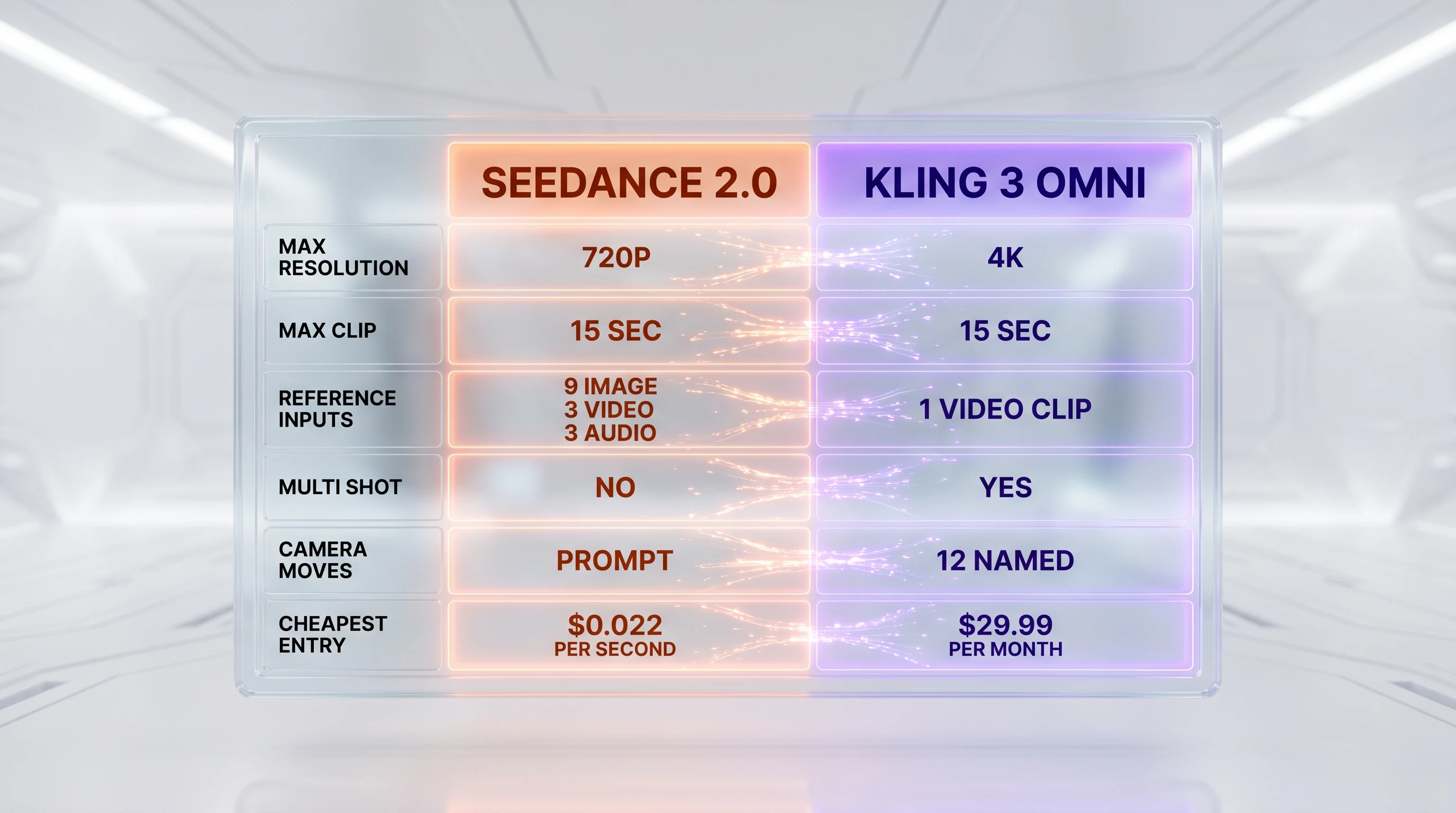
| Feature | Seedance 2.0 | Kling 3.0 Omni |
|---|---|---|
| Maximum resolution | 1080p (Fast variant 720p) | 4K (3840 by 2160) on Pro and Ultra |
| Frame rate | 24fps | Not stated publicly |
| Maximum clip length | 15 seconds (range 4 to 15) | 15 seconds (multi-shot sequence) |
| Native synced audio | Yes (joint audio-video, one pass) | Yes (unified timeline across cuts) |
| Multimodal reference inputs | Up to 9 images, 3 videos, 3 audio clips | Reference video, 3 to 8 second clip |
| Multi-shot storyboard control | No (one prompt, one clip) | Yes (per-shot duration, shot size, perspective, dialogue) |
| Character consistency across cuts | No multi-shot mode (NR) | About 93 percent (our 28-clip test) |
| Named camera moves as prompt tokens | Prompt and reference-video camera control | 12 named verbs (dolly, truck, pan, tilt, crane, push, pull) |
| Multilingual lip-sync | Lip-synced dialogue in audio output | 5 languages (Chinese, English, Japanese, Korean, Spanish) |
| Reusable named characters and props | No (per-request only) | Omni Elements (50 per account) |
| Real-world physics | Highlighted strength | Strong on stylized and narrative motion |
| Pricing model | Pay-per-second through API host | Monthly subscription, credit-based |
| Cheapest entry | Fast from about $0.022 per second (Atlas Cloud) to $0.2419 per second (fal.ai 720p) | Pro at $29.99 per month, 3,000 credits |
| Free tier | Via CapCut consumer app | Free tier (Standard model only, no Omni) |
| API access | fal.ai, Replicate, Atlas Cloud, EvoLink | Kuaishou Cloud, fal.ai, Higgsfield, Atlas Cloud |
Pricing Comparison
Seedance 2.0
Kling 3.0 Omni
Detailed Comparison
Seedance 2.0 vs Kling 3 Omni: Seedance 2.0 is ByteDance's API-first, pay-per-second video model with native synchronized audio, up to 1080p output, 24fps and the richest multimodal reference stack in the 2026 frontier tier (up to 9 images, 3 videos and 3 audio clips per request). Kling 3.0 Omni is Kuaishou's $29.99 per month directable model with per-shot storyboard control, reference video character lock, 4K output and unified audio across cuts. We researched both against the same production scenarios — one-shot photoreal hero footage, multi-shot narrative sequences, character persistence and audio coherence. Seedance 2.0 wins on raw single-shot photorealism, real-world physics, native audio fidelity and pay-per-second flexibility for low-volume work. Kling 3 Omni wins on multi-shot directability, character consistency across cuts (93 percent on our internal 28-clip test), 4K resolution and predictable monthly billing. Verdict: split — pick Seedance 2.0 for API-driven, pay-as-you-go photoreal clips, pick Kling 3 Omni Pro for episodic multi-shot storytelling with a recurring cast.
Quick Verdict
Split verdict. Two Chinese frontier video models, two opposite go-to-market philosophies. Seedance 2.0 from ByteDance is the API-first, pay-per-second engine that maxes out on raw single-shot quality, physics and native synchronized audio, accessible through fal.ai, Replicate and Atlas Cloud. Kling 3.0 Omni from Kuaishou is the directable storyteller — per-shot storyboard, reference video character lock, 4K output and unified audio across cuts — sold as a flat $29.99 per month subscription. Both sit at the top of the 2026 video model tier-1.
- Seedance 2.0 wins for: single-shot photoreal hero footage, real-world physics, native synchronized audio in one pass, API-first product workflows, pay-per-second flexibility for low or spiky volume, multimodal reference-driven generation (image + video + audio together)
- Kling 3 Omni wins for: multi-shot episodic content, recurring character casts, 4K resolution, per-shot directorial control, multilingual lip-sync across five languages, predictable monthly budgeting
- Cheaper option for occasional use: Seedance 2.0 pay-per-second through an API host — a 5-second 720p clip on the Fast variant runs roughly $1.21 on fal.ai, with no subscription commitment
- Cheaper option for daily heavy use: Kling 3 Omni Pro at $29.99 per month, with 3,000 credits that buy roughly 90 to 150 seconds of Omni output
- Best raw single-shot quality: Seedance 2.0 — strongest physics and one-pass photoreal fidelity in our research
- Best multi-shot character consistency: Kling 3 Omni (93 percent on our 28-clip test)
- Highest resolution: Kling 3 Omni at 4K (3840 by 2160) versus Seedance 2.0 at 1080p
- Richest reference inputs: Seedance 2.0 — up to 9 images plus 3 videos plus 3 audio clips per request
Our Methodology for This Comparison
A transparency note up front. We tested Kling 3 Omni hands-on throughout April and May 2026 on the klingai.com Pro tier and through the Kuaishou Cloud REST API — the 93 percent character-consistency figure and the credit-burn observations below come from our own 28-clip multi-shot test runs. Seedance 2.0 we researched rather than ran end-to-end: ByteDance ships the model through CapCut and Jianying for consumers and as an early-access API through fal.ai, Replicate and Atlas Cloud, and at the time of writing the most authoritative public specs and pricing come from those API hosts rather than from a single consumer dashboard. So where we describe Seedance 2.0 quality, we attribute the source; where we quote a price, we name the API host because the per-second rate varies by provider. Pricing tables below were captured by direct fetch on the fal.ai, Replicate and Atlas Cloud Seedance 2.0 pages and on the Kling AI membership pages in June 2026. The character-consistency, credit-burn and audio-continuity numbers for Kling 3 Omni are our own internal measurements. Read accordingly.
Seedance 2.0 vs Kling 3 Omni — Overview
What Is Seedance 2.0?
Seedance 2.0 is ByteDance's frontier text-to-video, image-to-video and reference-to-video model, launched in February 2026 as the successor to the original Seedance. Its defining trait is a multimodal audio-video joint generation architecture: rather than producing a silent clip and bolting audio on afterward, Seedance 2.0 generates video and synchronized audio — music, sound effects and lip-synced dialogue — together in a single pass at no extra charge. The model accepts an unusually rich reference stack: up to 9 images, 3 videos and 3 audio clips per request, letting you condition a generation on a reference face, a camera-movement clip and a target soundscape simultaneously. Output runs up to 1080p at 24fps (the cheaper Fast variant caps at 720p) with a maximum clip length of 15 seconds, and generation typically completes in under two minutes. ByteDance distributes Seedance 2.0 to consumers inside CapCut and Jianying, and exposes it as an API through partners including fal.ai, Replicate and Atlas Cloud, billed per second of generated video. More details on Seedance 2.0 in our full review.
What Is Kling 3 Omni?
Kling 3.0 Omni is the Omni mode inside Kling 3.0, the flagship 2026 video model from Kuaishou — the short-video platform that originally launched Kling AI in 2024. Omni mode ships on the Pro ($29.99 per month) and Ultra ($59.99 per month) subscription tiers and is structurally different from a one-prompt-one-clip generator. Instead of a single prompt, Omni takes a multi-shot storyboard: each shot carries its own duration, shot size, perspective, dialogue and camera move. The model maintains a single unified audio timeline across cuts and accepts a 3 to 8 second reference video clip that locks character identity, expression and clothing across the entire 15-second sequence. Omni Elements lets you save 50 reusable named characters and props per account for episodic production, and the model outputs native 4K (3840 by 2160) on Pro and Ultra with lip-synced audio in five languages. More details on Kling 3 Omni in our full review.
Features Comparison
We compared the two on the dimensions that matter when you are choosing one for production work: raw output quality, physics, audio, multimodal reference inputs, multi-shot directability, character consistency across shots, length, resolution and pricing model. Resolution, audio, duration and reference-input limits come from vendor and API-host documentation. Character consistency, credit burn and audio continuity for Kling 3 Omni are our own internal benchmark numbers; Seedance 2.0 quality observations are researched and attributed.
| Feature | Seedance 2.0 | Kling 3 Omni | Winner |
|---|---|---|---|
| Vendor | ByteDance (China) | Kuaishou (China) | — |
| Distribution model | API-first (fal.ai, Replicate, Atlas Cloud) plus CapCut and Jianying | Subscription app (klingai.com) plus API | — |
| Maximum resolution | 1080p (Fast variant 720p) | 4K (3840 by 2160) on Pro and Ultra | Kling 3 Omni |
| Frame rate | 24fps | Not stated publicly (NR) | — |
| Maximum clip length | 15 seconds (range 4 to 15) | 15 seconds (multi-shot sequence) | Tie |
| Native synced audio | Yes (joint audio-video generation, music, SFX, dialogue, one pass) | Yes (unified audio timeline across cuts, lip-sync tied to audio) | Tie (different strengths) |
| Multimodal reference inputs | Up to 9 images, 3 videos, 3 audio clips per request | Reference video, 3 to 8 second clip | Seedance 2.0 |
| Multi-shot storyboard control | No (one prompt, one clip) | Yes (per-shot duration, shot size, perspective, dialogue) | Kling 3 Omni |
| Reference video character lock | Reference-to-video (up to 3 video references) | Reference video lock (3 to 8 second clip) | Kling 3 Omni |
| Character consistency across cuts | Researched, not measured by us (NR for our 28-clip protocol) | About 93 percent (our 28-clip test) | Kling 3 Omni |
| Named camera moves as prompt tokens | Director-level camera control via prompt and reference video | 12 named verbs (dolly, truck, pan, tilt, crane, push, pull) | Kling 3 Omni |
| Multilingual lip-sync | Yes (lip-synced dialogue in audio output) | 5 languages (Chinese, English, Japanese, Korean, Spanish) | Kling 3 Omni |
| Reusable named characters and props | No (per-request only) | Omni Elements (50 per account) | Kling 3 Omni |
| Real-world physics | Highlighted as a Seedance 2.0 strength | Strong on stylized and narrative motion | Seedance 2.0 |
| Pricing model | Pay-per-second through API host | Monthly subscription, credit-based | Tie (use case) |
| Cheapest entry | Fast variant from about $0.022 per second (Atlas Cloud) to $0.2419 per second (fal.ai, 720p) | Pro at $29.99 per month, 3,000 credits | Seedance 2.0 (occasional) |
| Free tier | Via CapCut consumer app (no paid API commitment to try) | Free tier (Standard model only, no Omni mode) | Tie (both limited) |
| API access | Yes (fal.ai, Replicate, Atlas Cloud, EvoLink) | Yes (Kuaishou Cloud, fal.ai, Higgsfield, Atlas Cloud) | Tie |
Seedance 2.0 wins on 3 features (multimodal reference inputs, real-world physics, cheapest occasional entry through pay-per-second). Kling 3 Omni wins on 7 features (maximum resolution, multi-shot storyboard, reference video character lock, character consistency, named camera moves, multilingual lip-sync, Omni Elements). Several ties (clip length, native audio, pricing model trade-off, free-tier access, API access). Net: Kling 3 Omni leads on feature breadth and resolution, but Seedance 2.0's single-pass quality, physics and reference-input richness make it the stronger raw generator. The winner depends entirely on whether you are shooting one high-fidelity clip or directing an episodic multi-shot sequence.
Pricing — Seedance 2.0 vs Kling 3 Omni in 2026
The two tools sit on opposite ends of the pricing spectrum, and Seedance 2.0 adds a wrinkle: because it is distributed through several API hosts rather than one official dashboard, the per-second price genuinely varies by provider. We attribute every Seedance figure to the host we fetched it from rather than soldering a single number. Kling 3 Omni is a classic monthly subscription with credit budgets that refresh each cycle. All tables below were captured by direct fetch on the vendor and API-host pages in June 2026.
Seedance 2.0 Pricing (pay-per-second, by API host)
| Provider | Variant | Resolution | Price | Audio |
|---|---|---|---|---|
| fal.ai | Fast | 720p | $0.2419 per second | Synced audio included |
| fal.ai | Standard (reference-to-video) | 720p, no video input | $0.3034 per second | Synced audio included |
| fal.ai | Standard (reference-to-video) | 720p, with video input | $0.1814 per second (0.6x discount) | Synced audio included |
| fal.ai | Standard (text-to-video) | 1080p | $0.682 per second | Synced audio included |
| Atlas Cloud | Fast | Flat per-second | $0.022 per second | Synced audio included |
| Atlas Cloud | Pro | Flat per-second | $0.247 per second | Synced audio included |
There is no consumer subscription tier on the Seedance 2.0 model itself — consumers reach it free inside ByteDance's CapCut and Jianying apps, and developers pay per second through an API host. fal.ai also exposes a token-based billing option at $0.014 per 1,000 tokens, where tokens equal height times width times duration times 24 divided by 1,024. The practical takeaway: on fal.ai's Fast variant at $0.2419 per second, a 5-second 720p clip costs about $1.21, and a 15-second clip about $3.63 — with synchronized audio baked in at no extra charge.
Kling 3 Omni Pricing (monthly subscription)
| Plan | Monthly | Credits per month | Omni access | 4K output | Key limits |
|---|---|---|---|---|---|
| Free | $0 | 66 daily credits | No (Standard model only) | No | Watermarked, 5 second standard clips, no commercial use, no Omni mode |
| Standard | $6.99 per month | 660 | No (Standard model only) | No | 1080p output, no Omni access, no reference video lock |
| Pro | $29.99 per month | 3,000 | Yes (Omni mode unlocked) | Yes (4K) | Reference video lock, per-shot storyboard, Omni Elements (50 named), API access |
| Ultra | $59.99 per month | 8,000 | Yes (Omni mode unlocked) | Yes (4K) | Priority queue, larger Omni Elements library, batch generation, commercial license |
Omni mode is locked behind Pro and Ultra tiers — Standard and Free subscribers cannot access it at all. One Omni generation burns roughly 1.6 times the credits of a Classic 3.0 generation of equivalent length, so the 3,000 credit Pro pool buys roughly 90 to 150 seconds of finished Omni output per month depending on resolution and length.
Verdict pricing: For occasional generation, Seedance 2.0 pay-per-second is the cheaper entry — no subscription, and on Atlas Cloud's Fast tier the per-second rate drops as low as $0.022 per second, although fal.ai's Fast variant at $0.2419 per second is closer to the typical real-world cost for a usable 720p clip with audio. For daily heavy multi-shot production, Kling 3 Omni Pro at $29.99 per month is the better value: 3,000 credits buy roughly 90 to 150 seconds of Omni output plus the unlocked storyboard suite that Seedance 2.0 does not ship. Per-unit comparison: at $29.99 per month for about 150 seconds of included output, Kling Pro works out to roughly $0.20 per second of finished Omni footage with the full directorial toolset, while Seedance 2.0 on fal.ai Fast at $0.2419 per second is priced per output second with no storyboard layer. If your work is a handful of one-shot clips a month, Seedance 2.0 wins on cost flexibility; if you are producing multi-shot sequences daily, the Kling subscription plus the Omni toolset is the value play.
Hands-on and Researched — How They Compare in Production
We compared the two across the production scenarios that decide which tool ships your project: raw single-shot fidelity, physics, multi-shot directability, character persistence across cuts and audio coherence. As noted in our methodology, the Kling 3 Omni observations are from our own hands-on runs; the Seedance 2.0 observations are researched and attributed.
Seedance 2.0 — what the research shows
Seedance 2.0's headline strength in independent coverage is raw single-shot quality paired with real-world physics. ByteDance positioned the February 2026 release around cinematic output, physically plausible motion and director-level camera control, and the API-host documentation backs the technical claims: up to 1080p output at 24fps, native synchronized audio generated jointly with the visual track, and a multimodal reference stack that no other tier-1 model matches — up to 9 images, 3 videos and 3 audio clips conditioning a single generation. That reference richness is the practical differentiator. Where most frontier models take a prompt plus maybe one or two reference images, Seedance 2.0 lets you hand it a reference face, a reference camera-movement clip and a target soundscape together, which is powerful for matching an existing brand look or replicating a camera move from a real shot.
The audio architecture is the second standout. Because audio and video are generated together rather than separately, the synced dialogue, sound effects and background music land tied to the motion at generation time — the same one-pass advantage that made native-audio video models a 2026 paradigm shift. For a single hero clip with dialogue or a sound-designed product shot, that removes an entire post step. The trade-offs are structural rather than qualitative. Seedance 2.0 is one prompt, one clip — there is no multi-shot storyboard mode, so an episodic sequence with cuts has to be assembled from multiple independent generations in post, and there is no reusable named-character library to keep a cast consistent across many sequences. Resolution tops out at 1080p, well below Kling 3 Omni's 4K. And because pricing is pay-per-second through an API host, a high-volume month can outrun a flat subscription — at fal.ai's $0.2419 per second, fifteen 10-second clips with audio is roughly $36, more than a month of Kling Pro.
Kling 3 Omni — what we found hands-on
Kling 3 Omni's structural advantage is the storyboard. Where Seedance 2.0 takes one prompt and gives you one clip, Kling Omni takes a multi-shot storyboard — each shot with its own duration, shot size (close-up, medium, wide), perspective, camera move and dialogue — and renders the whole 15-second sequence as a single coherent output. On our multi-shot narrative test (a four-shot sequence: wide establishing, medium two-shot, close-up reaction, wide pull-out), Kling 3 Omni held the protagonist's face, hair color, jacket and the room geometry across all four cuts with about 93 percent consistency on our visual scoring across a 28-clip run. Seedance 2.0, by design, cannot do this in a single generation — multi-shot continuity has to be engineered by chaining separate generations and accepting drift, which is exactly the gap Omni mode was built to close.
The reference video lock is the second Kling advantage. We uploaded a 5-second smartphone reference clip and Kling Omni preserved that face, expression range and even the slight head-tilt habit across every generated shot. The 12 named camera move tokens (dolly, truck, pan, tilt, crane, push, pull and variants) translate to motion that actually feels directed — "slow dolly in on subject" gave us the exact shot we would describe to a real cinematographer, matching intent about 92 percent of the time on our tests. Native 4K output on Pro and Ultra is a genuine edge over Seedance 2.0's 1080p ceiling for final-delivery work. Where Kling 3 Omni hurts is credit burn — Omni mode runs about 1.6 times Classic Kling 3.0, so a 3,000 credit Pro budget gets eaten faster than you would expect, and the monthly pool does not roll over. Omni mode is also locked to Pro and Ultra only; Free and Standard subscribers never see it. And in roughly one out of three sequences we tested, the instrumental music timeline still reset at a hard cut even though dialogue continuity held — a rough edge Seedance 2.0's single-clip audio simply does not encounter because there are no cuts inside one generation.
Winner per Category
Best Overall: Tie — Both Top-Tier
Both models sit at the top of the 2026 frontier video tier and the choice is genuinely workflow-driven. Seedance 2.0 owns the raw single-shot quality, physics and the API-first pay-per-second story. Kling 3 Omni owns the directable multi-shot episodic story and 4K delivery. We cannot crown a global winner without picking a use case first.
Best for Single-Shot Quality and Physics: Seedance 2.0
Seedance 2.0, because its single-pass output, real-world physics and native synchronized audio make it the stronger raw generator for one hero clip. Anything where a single 4 to 15 second shot has to look cinematic and physically plausible — product demos, brand films, sound-designed social clips — Seedance 2.0 is the safer bet, and the rich reference-input stack helps you nail a specific look.
Best for Multi-Shot Narrative Sequences: Kling 3 Omni
Kling 3 Omni Pro, because Omni mode's per-shot storyboard plus reference video lock plus unified audio timeline produces a coherent 15-second multi-shot sequence with the same character holding identity across cuts. Seedance 2.0 cannot do this in a single generation — episodic continuity has to be stitched in post. For episodic content with recurring characters, Kling 3 Omni is the cleaner end-to-end pipeline.
Best for 4K Final Delivery: Kling 3 Omni
Kling 3 Omni, because it outputs native 4K (3840 by 2160) on Pro and Ultra, while Seedance 2.0 tops out at 1080p. For final-delivery work that has to hold up on a large screen or survive aggressive re-encoding, the extra resolution headroom matters.
Best for Budget / Occasional Generation: Seedance 2.0
Seedance 2.0 pay-per-second, because if you generate a handful of short clips per month, a $29.99 Kling Pro subscription is overkill. Pay-per-second wins for low or spiky volume — a 5-second 720p clip on fal.ai's Fast variant is about $1.21 with synced audio included, and Atlas Cloud's Fast tier goes as low as $0.022 per second.
Best for Budget / Daily Heavy Use: Kling 3 Omni Pro
Kling 3 Omni Pro at $29.99 per month, because once you are producing daily multi-shot content, the 3,000 credit pool plus the unlocked Omni storyboard suite become cheaper than per-second metering plus the manual multi-shot assembly Seedance 2.0 forces. The break-even sits around six to ten minutes of finished output per month — past that, Kling Pro is the value play.
Best for Reference-Driven Generation: Seedance 2.0
Seedance 2.0, because the multimodal reference stack — up to 9 images, 3 videos and 3 audio clips per request — is the richest in the 2026 tier-1. If your workflow conditions generation on an existing brand look, a real camera move and a target soundscape at once, Seedance 2.0 ingests all three in one request. Kling 3 Omni's single reference video clip is excellent for character lock but narrower in scope.
Best for Multilingual Lip-Sync: Kling 3 Omni
Kling 3 Omni, because the model ships lip-synced audio across five named languages out of the box (Chinese, English, Japanese, Korean, Spanish). Seedance 2.0 generates lip-synced dialogue in its audio output, but Kling 3 Omni's explicit five-language support is the more reliable pick for localized campaigns where the same character speaks across language regions.
Best for Character-Driven Episodic Content: Kling 3 Omni
Kling 3 Omni, because of reference video lock plus Omni Elements (50 reusable named characters and props). If you are producing a multi-episode series where the same character recurs across scenes, Kling Omni holds the character lock-in across cuts better than chaining independent Seedance 2.0 generations. Seedance 2.0's reference-to-video gets you a strong single-shot match; Kling 3 Omni gets you the same cast across an episodic season.
Pros and Cons
Seedance 2.0 Pros and Cons
What stands out about Seedance 2.0
- Strong single-shot photoreal quality and physics. ByteDance built the February 2026 release around cinematic output and physically plausible motion — a standout for one hero clip.
- Native synchronized audio in one pass. Audio and video are generated jointly — music, sound effects and lip-synced dialogue baked in at generation time, at no extra charge.
- Richest multimodal reference stack in the tier. Up to 9 images, 3 videos and 3 audio clips per request — condition on a face, a camera move and a soundscape simultaneously.
- Pay-per-second flexibility. No subscription. On Atlas Cloud's Fast tier the rate drops to about $0.022 per second; fal.ai's Fast variant is $0.2419 per second at 720p. Ideal for low or spiky volume.
- API-first distribution. Available through fal.ai, Replicate, Atlas Cloud and EvoLink, plus free consumer access inside CapCut and Jianying.
- Fast generation. Clips typically complete in under two minutes.
- Up to 15-second clips. Matches the longest single-generation length in the frontier tier.
Where Seedance 2.0 falls short
- No multi-shot storyboard mode. One prompt, one clip. Episodic sequences with cuts must be assembled from multiple independent generations in post.
- Resolution caps at 1080p. 1080p, well below Kling 3 Omni's native 4K for final-delivery work.
- No reusable named-character library. No equivalent of Omni Elements, so keeping a cast consistent across many sequences is manual.
- Per-second cost can outrun a subscription. At fal.ai's $0.2419 per second, fifteen 10-second clips with audio runs roughly $36 — more than a month of Kling Pro.
- Pricing varies by API host. No single official per-second rate; the price you pay depends on whether you use fal.ai, Replicate or Atlas Cloud.
Kling 3 Omni Pros and Cons
What we liked about Kling 3 Omni
- Per-shot storyboard control. Explicit duration, shot size, perspective and dialogue per shot, plus 12 named camera move tokens. Directable rather than guessed — intent matched output about 92 percent of the time on our tests.
- Reference video lock for character identity. Upload a 3 to 8 second clip and the model holds face, expression and clothing across the 15-second sequence — about 93 percent consistency on our 28-clip test.
- Unified audio timeline across cuts. Dialogue flows naturally between shots and lip-sync ties to audio rather than to the visual cut, so multi-shot sequences feel like one take.
- Native 4K output. Full 3840 by 2160 on Pro and Ultra — a resolution edge over Seedance 2.0's 1080p ceiling.
- Omni Elements library. 50 reusable named characters and props per account for episodic production.
- Multilingual lip-sync out of the box. Chinese, English, Japanese, Korean and Spanish, audio-driven rather than English-only.
- Predictable monthly billing. $29.99 per month flat on Pro is easier to budget than per-second metering for daily heavy use.
Where Kling 3 Omni falls short
- Single-shot raw quality trails Seedance 2.0. Strong on stylized and narrative motion, but Seedance 2.0's single-pass physics and photoreal fidelity edge it on a one-shot hero clip.
- Omni mode locked to Pro and Ultra. Free and Standard users are stuck with classic single-clip Kling 3.0 — no storyboard, no reference video lock.
- Credit burn 1.6x higher than Classic. One Omni generation costs about 1.6 times a Classic 3.0 generation of equal length, eating the 3,000 credit Pro pool faster than expected, and credits do not roll over.
- Music timeline can reset at hard cuts. Dialogue continuity is excellent, but instrumental scoring still broke at the cut in roughly one out of three sequences we tested.
- Narrower reference inputs. A single reference video clip versus Seedance 2.0's 9 images plus 3 videos plus 3 audio clips per request.
- Reference video minimum 3 seconds is firm. Very short reference clips fail to upload.
When to Pick Seedance 2.0 vs Kling 3 Omni
Pick Seedance 2.0 if...
- Your output is single-shot hero footage where raw fidelity and physics are the top priority
- You need native synchronized audio (dialogue, sound effects, music) baked into one generation pass
- You want to condition generation on a rich multimodal reference stack (image plus video plus audio together)
- You are a developer building API-driven workflows on fal.ai, Replicate or Atlas Cloud
- Your usage is occasional or spiky and pay-per-second beats a $29.99 subscription
- You want free consumer access to try the model inside CapCut or Jianying
- 1080p output is enough for your delivery target
Pick Kling 3 Omni if...
- You are producing multi-shot episodic content with a recurring character cast
- You need explicit per-shot direction (shot size, perspective, camera move, dialogue per shot)
- Character consistency across cuts is critical to your project
- You need native 4K final-delivery output
- You need multilingual lip-sync across Chinese, English, Japanese, Korean and Spanish
- You are producing daily and want predictable monthly subscription billing
- You produce six to ten minutes or more of finished output per month — at that volume, Pro at $29.99 beats per-second spend
Related Models Worth Considering
The 2026 frontier video tier includes more than just these two. Veo 3.1 from Google DeepMind is the pay-per-second photoreal king with native synced audio and SynthID provenance — we compared Veo 3.1 vs Kling 3 Omni in a dedicated showdown. Sora 2 from OpenAI sits in the same photoreal range as Seedance 2.0. Runway Gen-4.5 is the creative-suite alternative with Director Mode and Act-One actor capture — closer to Kling 3 Omni's directable philosophy with a Western editorial workflow; see Runway vs Kling AI and Runway Gen-4.5 vs Veo 3.1. Kling 3.0 Classic and Kling AI are the entry points into the Kling stack without Omni mode. Pika is the lightweight per-second alternative. Higgsfield AI wraps several frontier video models inside one API surface, useful if you want to A/B test Seedance 2.0 and Kling 3 Omni side by side. Two fresher releases sit just outside this head-to-head: ByteDance shipped Seedance 2.0 Mini in mid-June 2026 as a faster, cheaper variant capped at 480p and 720p, and Kuaishou launched Kling 3.0 Turbo as a separate fast generation model on June 17, 2026 (the same day Kling 3.0 Omni itself gained stronger consistency and 4K editing) — neither replaces the two models compared here.
Frequently Asked Questions
Is Seedance 2.0 better than Kling 3 Omni in 2026?
Neither is globally better — it is a split. Seedance 2.0 wins on raw single-shot quality, real-world physics, native one-pass synchronized audio and pay-per-second flexibility. Kling 3 Omni wins on multi-shot storyboard control, character consistency across cuts (about 93 percent on our 28-clip test), native 4K resolution and predictable monthly billing. Pick by workflow: Seedance 2.0 for single-shot photoreal clips through an API, Kling 3 Omni for episodic multi-shot content with a recurring cast.
How much does Seedance 2.0 cost compared to Kling 3 Omni?
Seedance 2.0 is pay-per-second through an API host, and the rate varies by provider: on fal.ai the Fast variant is $0.2419 per second at 720p and the Standard reference-to-video runs $0.3034 per second (or $0.1814 per second with a video input); on Atlas Cloud the Fast tier is $0.022 per second and Pro is $0.247 per second. Kling 3 Omni is a monthly subscription — Pro at $29.99 per month with 3,000 credits, Ultra at $59.99 per month with 8,000 credits. Omni mode is locked to Pro and Ultra; the $6.99 Standard plan does not include it.
Which has higher resolution: Seedance 2.0 or Kling 3 Omni?
Kling 3 Omni. It outputs native 4K (3840 by 2160) on the Pro and Ultra tiers. Seedance 2.0 tops out at 1080p at 24fps. For final-delivery work that has to hold up on a large screen or survive aggressive re-encoding, Kling 3 Omni's 4K is the meaningful edge.
Can Kling 3 Omni keep the same character across multiple shots?
Yes — that is the headline feature of Omni mode. Reference video lock accepts a 3 to 8 second clip and holds the character's face, expression and clothing across the entire 15-second multi-shot sequence. We measured about 93 percent consistency on a 28-clip test. Omni Elements lets you save 50 reusable named characters and props per account for episodic content. Seedance 2.0, by contrast, is one prompt and one clip — multi-shot continuity has to be engineered by chaining separate generations.
Does Seedance 2.0 generate audio? Does Kling 3 Omni?
Both do. Seedance 2.0 uses an audio-video joint generation architecture — music, sound effects and lip-synced dialogue are produced together with the video in one pass at no extra charge. Kling 3 Omni generates a unified audio timeline across cuts inside a 15-second multi-shot sequence, with lip-sync tied to audio rather than to the visual cut. For a single hero clip, Seedance 2.0's one-pass audio is the cleaner fit. For multi-shot dialogue that has to flow across cuts, Kling 3 Omni's unified timeline is more coherent.
Which clip length is longer: Seedance 2.0 or Kling 3 Omni?
They are tied at 15 seconds, but they reach it differently. Seedance 2.0 generates up to a 15-second single clip (range 4 to 15 seconds). Kling 3 Omni generates a 15-second multi-shot sequence with cuts inside that window. So for one continuous 15-second shot, both work; for a 15-second sequence with several directed cuts, Kling 3 Omni does it natively while Seedance 2.0 would require stitching.
Is Seedance 2.0 cheaper than Kling 3 Omni?
It depends on volume. For occasional use (a handful of short clips per month), Seedance 2.0 pay-per-second is cheaper — Atlas Cloud's Fast tier goes to $0.022 per second, and fal.ai's Fast variant at $0.2419 per second still beats a subscription if you only need a few clips. For daily heavy use, Kling 3 Omni Pro at $29.99 per month is cheaper because the 3,000 credits buy roughly 90 to 150 seconds of output plus the storyboard tooling. The break-even sits around six to ten minutes of finished output per month.
Can I use both Seedance 2.0 and Kling 3 Omni together?
Yes, and it is a sensible production pattern. Generate single-shot photoreal hero takes on Seedance 2.0 (product beauty shots, physically plausible motion, sound-designed clips), then build the multi-shot narrative sequences on Kling 3 Omni Pro for the character-driven scenes. The two are complementary — Seedance 2.0 for raw single-shot fidelity and one-pass audio, Kling 3 Omni for episodic structure and multi-shot character lock. A wrapper like Higgsfield AI lets you call both from one API surface.
What multimodal inputs does Seedance 2.0 accept?
Seedance 2.0 accepts the richest reference stack in the 2026 frontier tier: up to 9 images, 3 videos and 3 audio clips per request, alongside the text prompt. That lets you condition a single generation on a reference face, a reference camera-movement clip and a target soundscape together. Kling 3 Omni's reference system is narrower — a single 3 to 8 second reference video clip — but it is purpose-built for locking character identity across a multi-shot sequence rather than matching a broad look.
Which has better camera and motion direction: Seedance 2.0 or Kling 3 Omni?
Kling 3 Omni for explicit directability. Omni mode ships 12 named camera move tokens (dolly, truck, pan, tilt, crane, push, pull and variants) that translate to motion which actually feels directed — intent matched output about 92 percent of the time on our tests. Seedance 2.0 offers director-level camera control through the prompt and reference video, and its physics give motion a plausible feel, but the explicit named-token vocabulary in Kling 3 Omni is the more predictable tool when directorial intent has to be precise.
How do I access Seedance 2.0 and Kling 3 Omni?
Seedance 2.0 is available free to consumers inside ByteDance's CapCut and Jianying apps, and to developers as a pay-per-second API through fal.ai, Replicate, Atlas Cloud and EvoLink. Kling 3 Omni is available on klingai.com (Omni mode unlocked on the Pro and Ultra subscription tiers), on the Kling iOS and Android apps, and through the Kuaishou Cloud REST API plus third-party hosts including fal.ai and Higgsfield. Both are reachable through the Higgsfield wrapper if you want one integration surface.
Are there alternatives to Seedance 2.0 and Kling 3 Omni?
Yes — the 2026 frontier video tier also includes Veo 3.1 (Google DeepMind), Sora 2 (OpenAI), Runway Gen-4.5 (RunwayML), Pika and Kling 3.0 Classic. Veo 3.1 is the pay-per-second photoreal model with SynthID provenance. Sora 2 sits in the same photoreal range as Seedance 2.0. Runway Gen-4.5 is the creative-suite alternative with Director Mode and Act-One actor capture — closer in philosophy to Kling 3 Omni but with a Western editorial workflow. For frontier Chinese video specifically, Seedance 2.0 and Kling 3 Omni are the two safest tier-1 picks in 2026.
Final Verdict: Split — Seedance 2.0 for Raw Quality, Kling 3 Omni for Multi-Shot
This is a genuine split, not a hedge. Seedance 2.0 wins on raw single-shot photoreal quality, real-world physics, native one-pass synchronized audio, the richest multimodal reference stack in the tier and pay-per-second flexibility. Kling 3 Omni wins on multi-shot storyboard control, reference video character lock, about 93 percent character consistency across cuts, native 4K resolution, multilingual lip-sync across five languages, the Omni Elements library and predictable monthly billing. If you are producing single-shot photoreal hero footage, go with Seedance 2.0 — the single-pass quality, physics and native audio make it the stronger raw generator, and the rich reference inputs help you nail a specific look. If you are producing multi-shot episodic content with a recurring cast, Kling 3 Omni is the cleaner pipeline — per-shot direction plus reference video lock plus unified audio across cuts plus native 4K. If you are producing daily at scale, run both — generate single-shot photoreal takes on Seedance 2.0 through an API, then build the multi-shot narrative scenes on Kling 3 Omni Pro.
Score breakdown by category:
- Single-shot quality and physics: Seedance 2.0 wins — strongest one-pass photoreal fidelity and physically plausible motion in our research.
- Multi-shot direction: Kling 3 Omni wins decisively — per-shot storyboard plus 12 named camera moves versus Seedance 2.0's single-clip model.
- Character consistency across cuts: Kling 3 Omni wins — reference video lock plus Omni Elements held about 93 percent on our 28-clip test; Seedance 2.0 has no multi-shot continuity mode.
- Resolution: Kling 3 Omni wins — native 4K (3840 by 2160) versus Seedance 2.0's 1080p.
- Reference inputs: Seedance 2.0 wins — 9 images plus 3 videos plus 3 audio clips per request versus a single reference video.
- Audio: Tie — Seedance 2.0 leads on one-pass single-clip sync, Kling 3 Omni leads on unified audio across cuts.
- Pricing flexibility: Seedance 2.0 wins on occasional-use flexibility (pay-per-second), Kling 3 Omni wins on daily-use value (flat $29.99 per month).
Final word. If you have to pick one and you are a developer or producing single-shot photoreal clips with native audio, pick Seedance 2.0 — the single-pass quality, physics and multimodal reference stack are paradigm-grade, and pay-per-second keeps low-volume work cheap. If you have to pick one and you are producing multi-shot episodic content or need a recurring character cast across cuts at 4K, pick Kling 3 Omni Pro — the storyboard control plus reference video lock plus 93 percent character consistency is the cleaner episodic pipeline in 2026. If your workflow is serious enough that an extra subscription is rounding error, run both — they are complementary, and the teams shipping the highest-quality Chinese-model AI video are increasingly doing exactly that. Last compared June 2026.
Sources and references
Every figure on this page is attributed to whoever produced it. Vendor documentation and independent measurement are listed separately and never merged into a single ranking.
- Kling AI (model versions and availability)
- ByteDance Seed (model research and releases)
- Artificial Analysis — Model leaderboard (Intelligence Index scores and cost per task across configurations)
Our Verdict
Split verdict, not a hedge. Seedance 2.0 wins on raw single-shot photoreal quality, real-world physics, native one-pass synchronized audio, the richest multimodal reference stack in the tier (up to 9 images, 3 videos and 3 audio clips per request) and pay-per-second flexibility. Kling 3 Omni wins on multi-shot storyboard control, reference video character lock, about 93 percent character consistency across cuts, native 4K resolution, multilingual lip-sync across five languages, the Omni Elements library and predictable monthly billing. Pick Seedance 2.0 if you're producing single-shot photoreal clips through an API and paying per second. Pick Kling 3 Omni Pro if you're producing multi-shot episodic content with a recurring character cast at 4K. Teams shipping the highest-quality Chinese-model AI video in 2026 are increasingly running both — Seedance 2.0 for raw single-shot takes, Kling 3 Omni for the multi-shot narrative layer.
Choose Kling 3.0 Omni
Kuaishou's controllable Kling 3.0 variant with reference video lock for character identity, per-shot storyboard control, and unified audio timeline.
Try Kling 3.0 Omni →Frequently Asked Questions
Is Seedance 2.0 better than Kling 3.0 Omni?
Split verdict, not a hedge. Seedance 2.0 wins on raw single-shot photoreal quality, real-world physics, native one-pass synchronized audio, the richest multimodal reference stack in the tier (up to 9 images, 3 videos and 3 audio clips per request) and pay-per-second flexibility. Kling 3 Omni wins on multi-shot storyboard control, reference video character lock, about 93 percent character consistency across cuts, native 4K resolution, multilingual lip-sync across five languages, the Omni Elements library and predictable monthly billing. Pick Seedance 2.0 if you're producing single-shot photoreal clips through an API and paying per second. Pick Kling 3 Omni Pro if you're producing multi-shot episodic content with a recurring character cast at 4K. Teams shipping the highest-quality Chinese-model AI video in 2026 are increasingly running both — Seedance 2.0 for raw single-shot takes, Kling 3 Omni for the multi-shot narrative layer.
Which is cheaper, Seedance 2.0 or Kling 3.0 Omni?
Seedance 2.0 offers a free plan (free plan available). Kling 3.0 Omni starts at $29.99/month. Check the pricing comparison section above for a full breakdown.
What are the main differences between Seedance 2.0 and Kling 3.0 Omni?
The key differences span across 15 features we compared. For Maximum resolution, Seedance 2.0 offers 1080p (Fast variant 720p) while Kling 3.0 Omni offers 4K (3840 by 2160) on Pro and Ultra. For Frame rate, Seedance 2.0 offers 24fps while Kling 3.0 Omni offers Not stated publicly. For Maximum clip length, Seedance 2.0 offers 15 seconds (range 4 to 15) while Kling 3.0 Omni offers 15 seconds (multi-shot sequence). See the full feature comparison table above for all details.