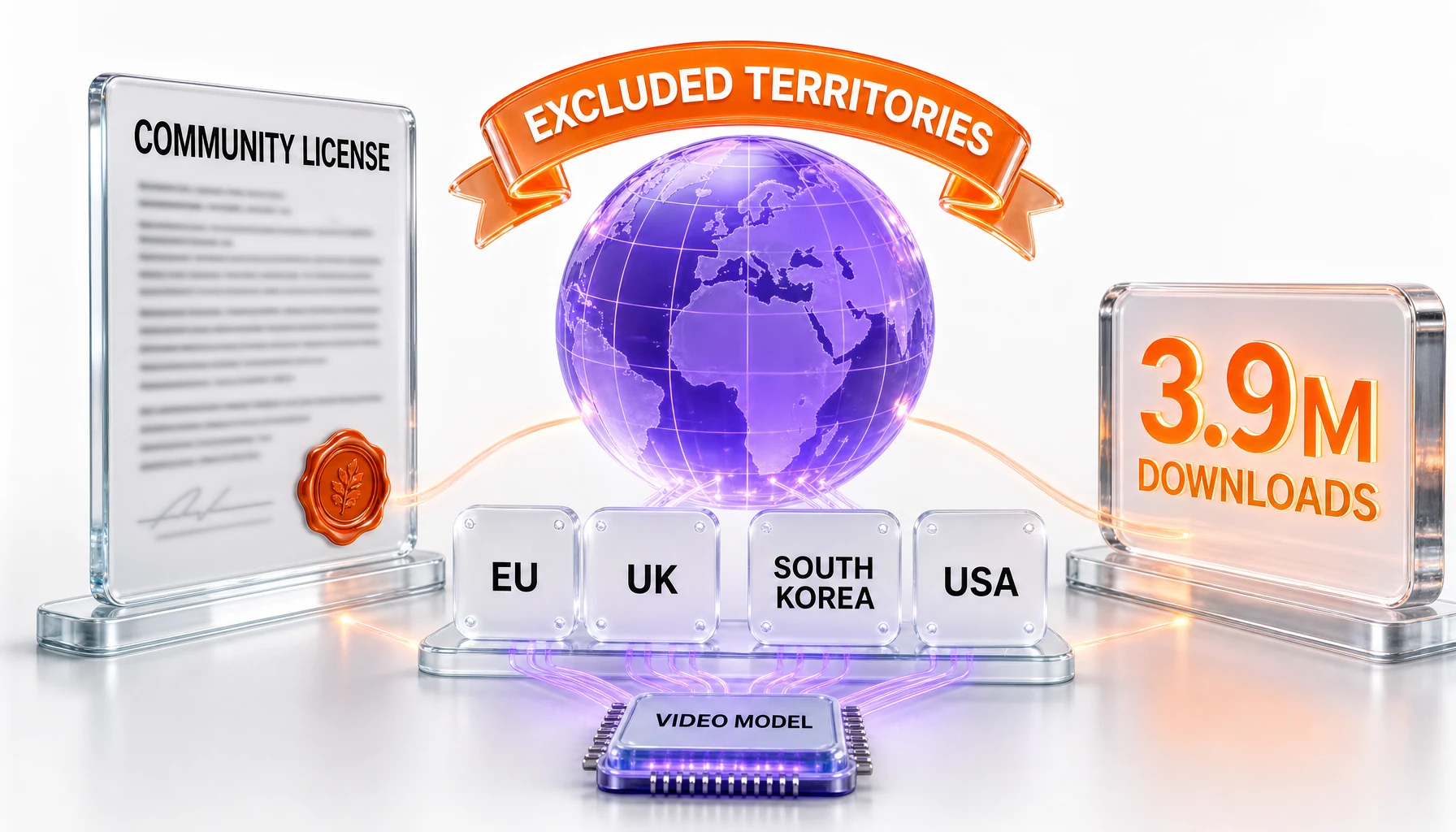
MiniMax H3 is an open-weight video generation model — not a language model — published on Hugging Face, where it has been downloaded 3,899,160 times as of August 22, 2026. Its license, dated August 2, 2026 and issued by Nanonoble Pte. Ltd., defines the European Union, the United Kingdom, the Republic of Korea and the United States of America as "Excluded Territories," and grants rights only within the territory that remains. A Q&A document committed to the same repository on August 6, 2026 states that the MiniMax-H3 API is "Globally available with built-in safeguards and responsible-use controls." Both files sit in the same repository. On the question of what a developer in Paris, London, Seoul or San Francisco may actually do with this model, they do not read the same way.
Key takeaways
- MiniMax H3 is a video generation model, not an LLM. It produces video with synchronized stereo audio, 4 to 15 seconds long, at up to 2K resolution and 24 FPS.
- The license defines "Excluded Territories" as the EU, the UK, South Korea and the US, and Section V.4 bars using, reproducing, modifying, distributing or displaying the works or their Outputs outside the permitted territory.
- The license defines "Output" to include results obtained "through Hosted Services," and defines "Hosted Services" to include APIs. The official Q&A in the same repository says the API is globally available.
- The Q&A's own heading says the license is "limited to the EU, UK, South Korea, and US" — the reverse of what the license text does, which is exclude those four.
- Five days later the same publisher released MiniMax Music 3 under an MIT-style license with no territorial clause at all. The restriction tracks the medium, not the company.
What MiniMax H3 actually is
MiniMax H3 is a general-purpose, omni-modal generative system that takes text, images, video and audio as input and produces video with native stereo audio. It is not a chat model, not a coding model, and not a competitor to the MiniMax M-series language models. Confusing the two matters here, because the licensing question turns entirely on the fact that this is a video model.
The published specifications are precise. Output runs 4 to 15 seconds at 24 FPS, with audio at 32 kHz stereo. The shorter side of the frame defaults to 768 pixels, and 2K output is reached through a separate module called H3-Regenerate-2K, which feeds the 768p result back through the system together with the original context. Dialogue is stably supported in 11 languages: Arabic, Chinese, English, French, German, Italian, Japanese, Korean, Portuguese, Russian and Spanish.
The system ships as three parts, and only some of them are open. H3-Base generates the audio and video at 768p. H3-Regenerate-2K upscales through regeneration. The third, H3-Context-IR, interprets free-form multimodal instructions and converts them into a structured representation the base model can consume — and it is explicitly not in the release. The model card states that because H3-Context-IR "relies on a multi-stage workflow and multiple hosted models and services, it is not included in this open-source release," and that MiniMax provides an API to reproduce it. The documented full 2K workflow accordingly combines a locally deployed model with calls to MiniMax API endpoints using a platform token.
That architectural detail is worth holding onto. Even the open-weight path, as documented by the publisher, routes through a hosted service for its highest-quality output. The line between "running the weights" and "using the API" is thinner here than the open-weight label suggests. For the broader question of what that label is worth in 2026, we covered the trade-offs in our guide to choosing between closed and open-weight models.
Adoption has been immediate. The Hugging Face repository records 3,899,160 downloads and more than 4,300 likes as of August 22, 2026. Because the repository was initialized on August 3, 2026, its all-time total and its trailing 30-day count are currently the same number.
What the license actually says
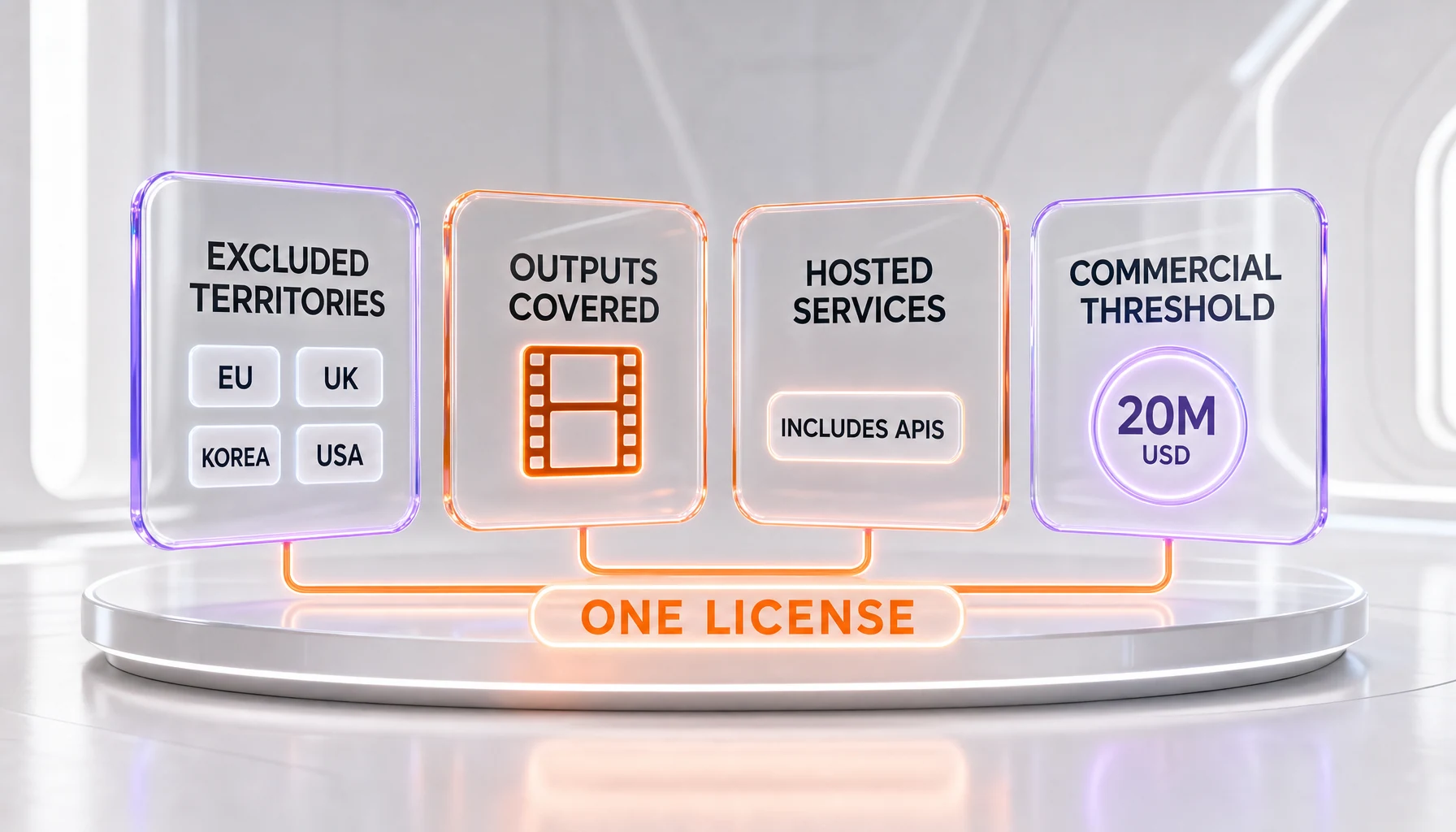
The operative sentence is short. Definition 5 reads: "'Excluded Territories' means the European Union, the United Kingdom, the Republic of Korea and the United States of America." Definition 3 then sets the "Applicable Territory" as "worldwide, excluding the Excluded Territories," and the grant of rights in Section II is made "solely within the Applicable Territory."
The document is titled the MiniMax H3 Community License Agreement, carries the date August 2, 2026, and names the licensor in Definition 15 as Nanonoble Pte. Ltd., a Singapore entity. It is governed by the laws of the Hong Kong Special Administrative Region.
Four provisions matter for anyone assessing exposure:
- Section V.4 covers outputs, not just weights. The text: "You may not use, reproduce, modify, distribute, or display the MiniMax H3 Works or any of their Outputs or results outside the Applicable Territory. Any such use outside the Applicable Territory is not authorized by this Agreement."
- "Output" is defined broadly. Definition 12: "'Output' means any result of operating or otherwise using MiniMax H3 or any Model Derivatives (including through Hosted Services)."
- "Hosted Services" expressly includes APIs. Definition 8: "'Hosted Services' means hosted services provided via application programming interfaces (APIs), web access, or any other electronic or remote means."
- The agreement binds by use, including through hosted services. The preamble: "By clicking to accept, or by using, reproducing, modifying, distributing, running, or displaying any portion or element of the MiniMax H3 Works (including through any Hosted Services) in any manner, you acknowledge and accept the terms of this Agreement."
Beyond territory, the agreement carries terms that will be familiar to anyone who has read a recent Chinese open-weight release. Section IV.1 requires separate prior written authorization from MiniMax for commercial products and services generating more than 20 million US dollars in yearly revenue, requested by email with a specified subject line. Section IV.2 requires prominently displaying "MiniMax H3" in the user interface of any commercial product built on it. Section V.3 forbids using the works or their outputs to improve any other AI model. Section V.5 requires anyone offering a downstream generation service to implement, maintain, test and periodically review safeguards, and to run a reporting mechanism for suspected violations.
The acceptable use policy in Exhibit A lists 20 prohibitions. The first is simply "Use outside the Applicable Territory," which places the territorial limit inside the conduct rules as well as the grant. Others are conventional for the category: no exploitation of minors, no election disinformation, no impersonation without consent, no military use, and — item 12 — no dissemination of machine-generated content in public environments "without clearly and prominently disclosing that such information and/or content is machine-generated." That last one runs parallel to the labeling regimes platforms are now building out on their own, as when YouTube moved to auto-label photorealistic AI video.
One footnote at the end of the license is easy to miss: the encoder inside H3 uses Qwen3-VL-32B, which is licensed under Apache 2.0. A permissively licensed component sits inside a territorially restricted system.
What the official Q&A says
The file docs/QA-about-License.md lives in the same repository as the license and was committed on August 6, 2026, four days after the license date. It gives the publisher's reasoning, and it makes a specific promise about the API.
On why the open-weight scope is limited, the document points to regulation rather than to any particular market. It argues that "video generation models are facing a more complex and rapidly evolving regulatory environment compared with text or code models," and names three pressures. The EU AI Act "has started enforcement, while practical requirements for models capable of generating video and likeness-related content are still evolving" — the enforcement milestone we covered when the Commission gained the power to fine general-purpose AI providers on August 2, 2026, the same date the license carries. It cites "similar regulatory uncertainties" in the UK and South Korea. And on the US it is unusually direct: "In the US, AI regulation remains a rapidly changing landscape, and MiniMax is also involved in ongoing copyright-related legal proceedings specifically concerning generative video AI."
The document frames the release as a choice between waiting for regulatory clarity and shipping with a stated scope, says MiniMax chose the second, and adds: "The current limitation means 'not yet', not 'not ever.'"
Then comes the passage that sits awkwardly against the license. Asked why the API can be used globally when open weights are restricted, the Q&A answers that the difference is the distribution model — MiniMax operates the serving infrastructure for API access and can enforce safeguards there, whereas with open weights "users can independently deploy, modify, and distribute the model, which makes it much harder to ensure the same level of compliance." It concludes with two bullets:
- "API: Globally available with built-in safeguards and responsible-use controls."
- "Open weights: Temporarily limited in certain regions until the regulatory and compliance framework becomes clearer."
The commitments section repeats it: MiniMax undertakes to "Keep MiniMax-H3 API available globally, so users can continue accessing the model," and to "Clearly communicate any future license changes instead of making silent updates." Organizations in the restricted regions are told they can apply for a formal license through an application form, which returns a live page.
Contradiction one: the API promise against Section V.4
Read together, the two documents point in different directions on a question that has a practical answer: can a company in Berlin or Boston call the MiniMax H3 API and use the video that comes back?
The Q&A says the API is globally available. The license says Outputs may not be used outside the Applicable Territory, defines Output to include results obtained through Hosted Services, defines Hosted Services to include APIs, and states in its preamble that using the works "including through any Hosted Services" constitutes acceptance of the agreement. Follow those four provisions in sequence and API output used in an Excluded Territory looks like it falls inside the restriction.
A reconciling reading is available, and it is not far-fetched. One could argue the Community License governs the open-weight distribution — the thing being licensed on Hugging Face — while API access is a separate commercial relationship governed by MiniMax's platform terms of service, which the license does not purport to displace. Under that reading the two documents describe two different products and never actually meet, and the Q&A's "difference is the distribution model" framing supports it.
The difficulty is that the license's own preamble reaches for hosted services explicitly, and Definition 12 goes out of its way to pull API results into the definition of Output. Those are drafting choices that cut against treating the two channels as unconnected.
We are not in a position to say which reading governs, and this article is not legal advice. What we can say is that the question is not answered by reading either document alone, and that the answer determines whether a European or American studio putting H3 output in a client deliverable is inside or outside the terms. Anyone with real exposure should put both documents in front of a lawyer rather than in front of a summary — including this one.

Contradiction two: the Q&A's own heading
The second discrepancy is inside a single document, and it is a matter of plain text. The heading of the Q&A's first section reads: "Why is MiniMax-H3's open-weight license currently limited to the EU, UK, South Korea, and US?"
That describes the opposite of what the license does. The license does not limit the open-weight grant to those four territories — it excludes them and grants rights everywhere else. The body text immediately below the heading is consistent with the license, describing "the current territory scope" and explaining why those regions are treated differently. Only the heading inverts the meaning.
The model card resolves the same point correctly elsewhere. Its License section links the application form with the parenthetical "only for USA/EU/UK/South Korea" — that is, the form is for people in the excluded regions who need permission, which is exactly what the license contemplates. Two of the three documents in the repository describe the scope the same way. The Q&A heading is the outlier.
We are reporting the discrepancy, not assigning a cause. A reader can draw their own conclusion about whether a heading that reverses the meaning of the document it introduces is a drafting slip or something else. What is not in dispute is that the heading and the license say different things, and that a developer who reads only the heading will reach the wrong conclusion about their own country.
A third document, and what it adds
The model card contains a Safety Guardrails note describing automated moderation of user-submitted text, images and video, and of enhanced prompts. It ends with a sentence that bears on the whole question: "These guardrails do not affect the Licensee's obligations under the MiniMax H3 Community License, especially those relating to lawful use and use restrictions."
This is notable because safeguards are the load-bearing argument in the Q&A for treating the API differently. The Q&A's case is that MiniMax can enforce compliance on its own infrastructure, and therefore global API access is appropriate. The model card, describing those same guardrails, states that they do not affect the licensee's obligations under the license — and the use restrictions are where the territorial limit lives.
Again, we report the texts. The model card sentence may be aimed at users who might treat moderation as a substitute for their own compliance work, which is a normal thing for a publisher to say. It nonetheless points in the opposite direction from the Q&A's reasoning.
Five days later: Music 3, and no territory clause
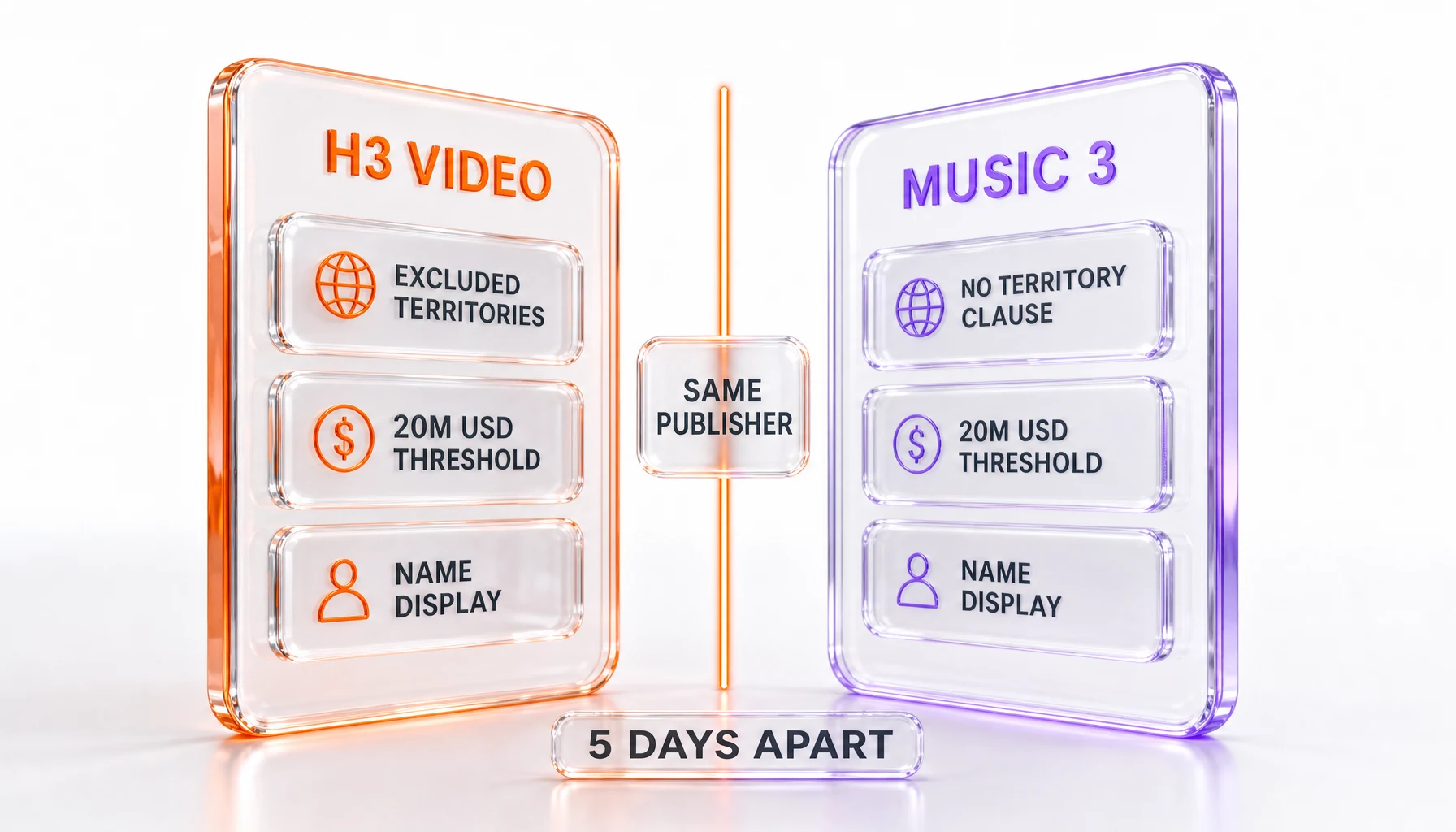
The most useful piece of context comes from the same publisher. On August 7, 2026 — five days after the H3 license date — MiniMax released MiniMax Music 3, a music generation model, under a license with no territorial restriction whatsoever.
We read that license line by line. It opens with the standard MIT formulation: "Permission is hereby granted, free of charge, to any person obtaining a copy of this Software... to deal in the Software, including without limitation the rights to use, copy, modify, merge, publish, distribute, sublicense, and/or provide copies of the Software." There is no Applicable Territory, no Excluded Territories, and no mention of the EU, the UK, Korea or the US anywhere in the document.
What makes the comparison sharp is how much of the rest is identical. Music 3 keeps the same 20 million US dollar yearly revenue threshold requiring prior written authorization. It keeps the requirement to display the model name prominently in a commercial interface. It keeps the downstream safeguards obligation almost word for word. Its acceptable use policy runs through the same prohibitions in the same order, minus one: the H3 policy opens with "Use outside the Applicable Territory," and the Music 3 policy simply does not have that item.
So the two licenses are not a strict regime and a lenient one. They are the same commercial regime with one clause added in the video case. The variable is not the publisher's appetite for control — it is the medium.
That reading is what the Q&A itself argues, and the specificity of its wording supports it: MiniMax describes proceedings "specifically concerning generative video AI." Music generation is not free of copyright litigation either — the sector's exposure was on display when Suno raised 400 million dollars mid-lawsuit — but the license MiniMax attached to its music model draws no territorial line, while the one attached to its video model does. Music 3 itself is a substantial release: complete songs up to five minutes, 32 kHz 16-bit stereo output, an 8B global model paired with a 0.6B local model. It had 16,644 downloads as of August 22, 2026, a small fraction of H3's.
Not the first geographic line in the sand
Regional carve-outs have become a recurring feature of frontier releases rather than an anomaly. We covered the pattern when SpaceXAI shipped Grok 4.5 at half price with Europe locked out, and the underlying dynamic is the same: a lab facing divergent regulatory regimes ships to the markets it is confident about and defers the rest.
What is different about H3 is the direction of the restriction and the object it attaches to. Grok 4.5 was a hosted product withheld from a market. H3 is an open-weight release where the weights are downloadable by anyone, from anywhere, without a gate — and the restriction operates through a license rather than through infrastructure. Nothing prevented 3.9 million downloads. The license is the only control surface, and control surfaces made of text depend entirely on whether people read them.
That is precisely the compliance gap the Q&A describes when it says the concern is "the ability to control compliance after open weights leave our infrastructure." It is also a gap with a demonstrated history: we looked at how thin post-release control can be when a tool called Heretic stripped guardrails off open-weight models in minutes. MiniMax is not wrong about the mechanics. The question the two documents leave open is what that means for users who never intended to be outside the terms in the first place.
For context on the publisher's broader lineup, MiniMax's language-model work runs on a separate track — we reviewed MiniMax M3 and its 1M-context open-weight coding claims in June. Its consumer video product, Hailuo, is a separate hosted offering. And the competitive field H3 enters is crowded with hosted models carrying no such clause, including Veo 3.1, Sora 2 and Kling 3.0 Omni — the last from a company whose funding round we covered as China's video generation war escalated.
What this means if you were planning to use it
The practical position depends on where you are, and the honest summary is that the four largest Western creative markets are the ones with a question mark over them.
If you are outside the Excluded Territories, the license grants the usual open-weight rights, subject to the revenue threshold, the attribution requirement and the acceptable use policy. If you are inside them, the license text does not grant you rights to the weights, and the application form is the route the publisher offers. The Q&A states that applications are reviewed against the deployment scenario and the compliance controls in place.
Three points deserve attention regardless of location. Section V.3's bar on using outputs to improve other AI models rules out using H3 as a synthetic data source for a competing system. Section V.2 requires binding your own downstream users to terms at least as protective, which is a real engineering and contractual obligation if you are wrapping H3 in a product. And Section VIII.2 provides that on termination you must delete copies and notify downstream recipients — a clause that only works if you have tracked who they are.
Where a license restricts outputs rather than only weights, the exposure follows the deliverable rather than the deployment. Video generated on a compliant server and delivered to a client in an Excluded Territory is exactly the scenario Section V.4's language reaches toward, and exactly the scenario the Q&A's global-API promise appears to permit. That is the contradiction in its most concrete form, and it is the version worth taking to counsel.
What we could not verify
We could not verify MiniMax's list pricing for H3 API access from a primary source. The pricing page on minimax.io returns a live page but renders its figures in JavaScript, so no prices appear in the HTML we retrieved, and the platform documentation path for pricing returns a 404. We are not reproducing figures from marketplaces or resellers, because those are not the publisher's list prices and can differ materially. If cost is decisive for you, get it from the platform directly.
We also make no claim about how MiniMax interprets or enforces its own license, or about how a court in any of the four Excluded Territories would read it. We quote the documents; we do not speak for their author.
Frequently asked questions
Is MiniMax H3 a language model?
No. MiniMax H3 is a video generation model — specifically an omni-modal system that accepts text, images, video and audio, and outputs video with synchronized stereo audio. It is unrelated to MiniMax's M-series language models. Output runs 4 to 15 seconds at 24 FPS with 32 kHz stereo audio, reaching 2K resolution through a separate regeneration module.
Which territories does the MiniMax H3 license exclude?
Definition 5 of the license states: "'Excluded Territories' means the European Union, the United Kingdom, the Republic of Korea and the United States of America." Definition 3 sets the "Applicable Territory" as worldwide excluding those, and the grant of rights in Section II applies solely within the Applicable Territory.
Does the restriction cover video generated with the model, or only the weights?
Section V.4 covers both: "You may not use, reproduce, modify, distribute, or display the MiniMax H3 Works or any of their Outputs or results outside the Applicable Territory." Definition 12 defines "Output" as any result of operating or using the model, "including through Hosted Services," and Definition 8 defines Hosted Services to include APIs.
Can I use the MiniMax H3 API from the EU or the US?
The two official documents do not read the same way on this. The Q&A in the repository states "API: Globally available with built-in safeguards and responsible-use controls." The license restricts Outputs obtained through Hosted Services, which it defines to include APIs, outside the Applicable Territory. We are not in a position to say which governs, and this is not legal advice — anyone with real exposure should take both documents to a lawyer.
Why does the Q&A heading say the license is "limited to" the EU, UK, South Korea and the US?
That heading states the reverse of the license, which excludes those four territories rather than limiting the grant to them. The body text below the heading is consistent with the license, and the model card describes the application form as "only for USA/EU/UK/South Korea" — the excluded regions that need permission. The heading is the outlier among the three documents.
Who is the licensor, and what law governs the agreement?
Definition 15 identifies the licensor as Nanonoble Pte. Ltd., a Singapore entity. Section IX provides that the agreement is governed by the laws of the Hong Kong Special Administrative Region of the People's Republic of China, with exclusive jurisdiction in Hong Kong courts, and excludes the UN Convention on Contracts for the International Sale of Goods.
What reason does MiniMax give for the territorial scope?
The Q&A cites regulatory pressure specific to video models: the EU AI Act has started enforcement while requirements for video and likeness-generating models are still evolving, similar uncertainty exists in the UK and South Korea, and in the US the document states that "MiniMax is also involved in ongoing copyright-related legal proceedings specifically concerning generative video AI." It describes the limitation as "'not yet', not 'not ever.'"
Can organizations in the excluded regions get permission to use it?
Yes. The Q&A states that organizations in restricted regions can apply for a formal license, and that MiniMax may authorize usage after reviewing the deployment scenario and confirming appropriate compliance controls. The application form is hosted at platform.minimax.io/h3-license, and the model card labels it as being for USA, EU, UK and South Korea. The license also invites contact in Section II.
Is there a revenue threshold in the license?
Yes. Section IV.1 requires separate prior written authorization from MiniMax if your commercial products and services generate more than 20 million US dollars in yearly revenue, requested by email with a specified subject line. Section IV.2 separately requires displaying "MiniMax H3" prominently in the user interface of any commercial product built on it.
How does the MiniMax Music 3 license compare?
MiniMax Music 3, released on August 7, 2026, carries an MIT-style license with no territorial restriction at all. It keeps the same 20 million US dollar revenue threshold, the same interface attribution requirement and nearly identical downstream safeguards, and its acceptable use policy matches H3's minus the item barring use outside the Applicable Territory. The territorial clause is attached to the video model, not to the publisher.
How many times has MiniMax H3 been downloaded?
The Hugging Face repository records 3,899,160 downloads and more than 4,300 likes as of August 22, 2026. Because the repository was initialized on August 3, 2026, its all-time total and its trailing 30-day figure are currently identical. Nothing gates the download itself — the license is the only control on how the weights are used.
Are the open weights enough to reproduce MiniMax's own output quality?
Not on their own, according to the model card. H3-Context-IR, which interprets multimodal instructions before generation, "is not included in this open-source release" because it relies on hosted models and services. MiniMax provides an API to reproduce its behavior, and the documented full 2K workflow combines a locally deployed model with calls to MiniMax API endpoints using a platform token.
Sources
- MiniMax (Nanonoble Pte. Ltd.) — MiniMax H3 Community License Agreement
- MiniMax — Q&A About License (MiniMax-H3 repository)
- MiniMax — MiniMax-H3 model card and specifications
- MiniMax — MiniMax-Music3 Community License
- MiniMax — MiniMax Music 3 model card
- MiniMax — MiniMax H3 license application form
- Alibaba Qwen — Qwen3-VL license (Apache 2.0), the encoder used by H3