GPT-5.6 Terra vs Claude Sonnet 5: The Balanced-Tier Showdown (2026)


OpenAI's GPT-5.6 Terra vs Anthropic's Claude Sonnet 5: Terra leads AA Intelligence 55 to 53; Sonnet 5 undercuts it on price today. Our split 2026 verdict.
Feature Comparison
| Feature | GPT-5.6 Terra | Claude Sonnet 5 |
|---|---|---|
| API input price (per million tokens) | $2.00 (verified) | $2.00 (verified) |
| API output price (per million tokens) | $12.00 (verified) | $10.00 (verified) |
| Cached input price (per million tokens) | $0.20 (verified) | $0.20 (verified) |
| Batch output price (per million tokens) | $6.00 (verified) | $5.00 (verified) |
| Cost per task, AA Intelligence Index (independent) | ~$0.55 (Artificial Analysis) | Not published as a per-task figure in our sources |
| AA Intelligence Index (independent) | 55 | 53 |
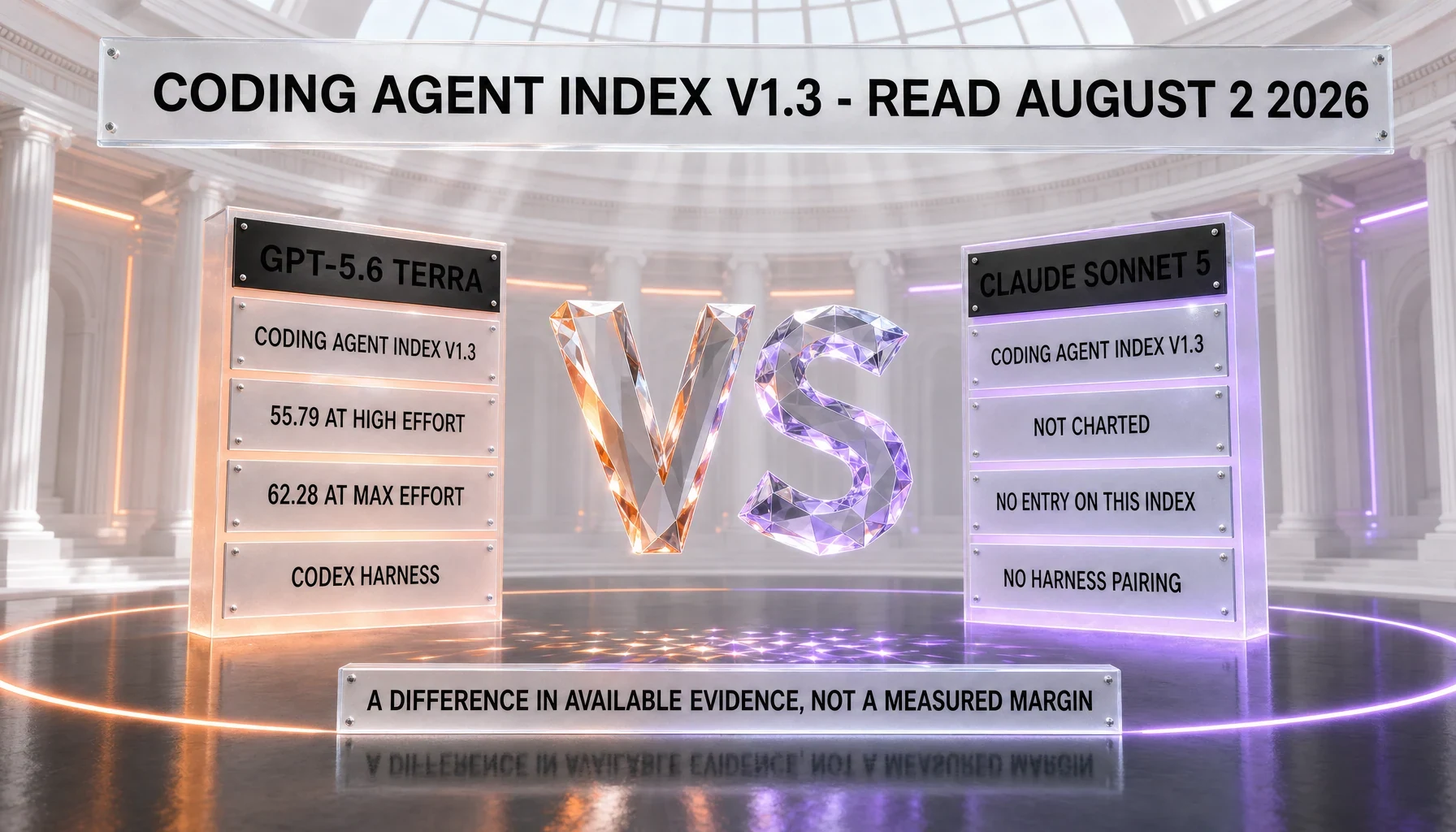
| AA Coding Agent Index v1.3 (independent, read August 2, 2026) | 55.79 (Codex harness, high effort); 62.28 at max | Not charted |
| Output speed (independent tokens per second) | Not published for Terra in our sources | 79.0 (Artificial Analysis) |
| SWE-bench Verified (vals.ai, independent) | Not submitted | Not listed |
| Declared context window | 1,050,000 tokens | 1,000,000 tokens |
| Max output tokens | 128,000 tokens | 128,000 tokens (up to 300,000 via Batch beta) |
| Knowledge cutoff | February 16, 2026 | January 2026 |
| Tokenizer efficiency (per vendor docs) | OpenAI tokenizer | Newer tokenizer, ~30% more tokens for the same text (Anthropic) |
| Reasoning control | Low to xhigh, plus new max level | Adaptive thinking, effort dial (defaults to high) |
| Code execution and tool use | Programmatic Tool Calling: model-written JS in an isolated V8 runtime (ZDR-compatible) | Code execution tool (container-based) plus function calling and structured outputs |
| Consumer availability | API, Codex, and ChatGPT for Work | Default model on free and Pro Claude.ai, plus API and Claude Code |
| Vendor coding-benchmark headline | Terminal-Bench 2.1 87.4% (self-reported) | SWE-bench Pro 63.2%, OSWorld-Verified 81.2% (self-reported) |
| Input and output modalities | Text and image in, text out | Text and image in, text out |
Pricing Comparison
GPT-5.6 Terra
Claude Sonnet 5
Detailed Comparison
GPT-5.6 Terra and Claude Sonnet 5 are the two balanced mid-tier models compared here, both aimed at high-volume production work at a good capability-to-cost ratio. GPT-5.6 Terra is OpenAI's balanced tier, generally available July 9, 2026, priced at $2.00 per million input tokens and $12.00 per million output with a 1,050,000-token context window. Claude Sonnet 5 is Anthropic's midsize model, generally available June 30, 2026, priced at $2 per million input tokens and $10 per million output, with a 1,000,000-token context window. On the independent Artificial Analysis Intelligence Index, Terra scores 55 to Sonnet 5's 53, and Terra carries the only per-task cost figure, at about $0.55; on the Artificial Analysis Coding Agent Index v1.3 only Terra is charted, at 55.79 through the Codex harness at high reasoning effort. Sonnet 5 is cheaper on output and is the default model on Claude.ai. Best for the independent Intelligence Index, per-task cost, and long context: GPT-5.6 Terra. Best for the lowest price and consumer reach: Claude Sonnet 5.
Quick Verdict
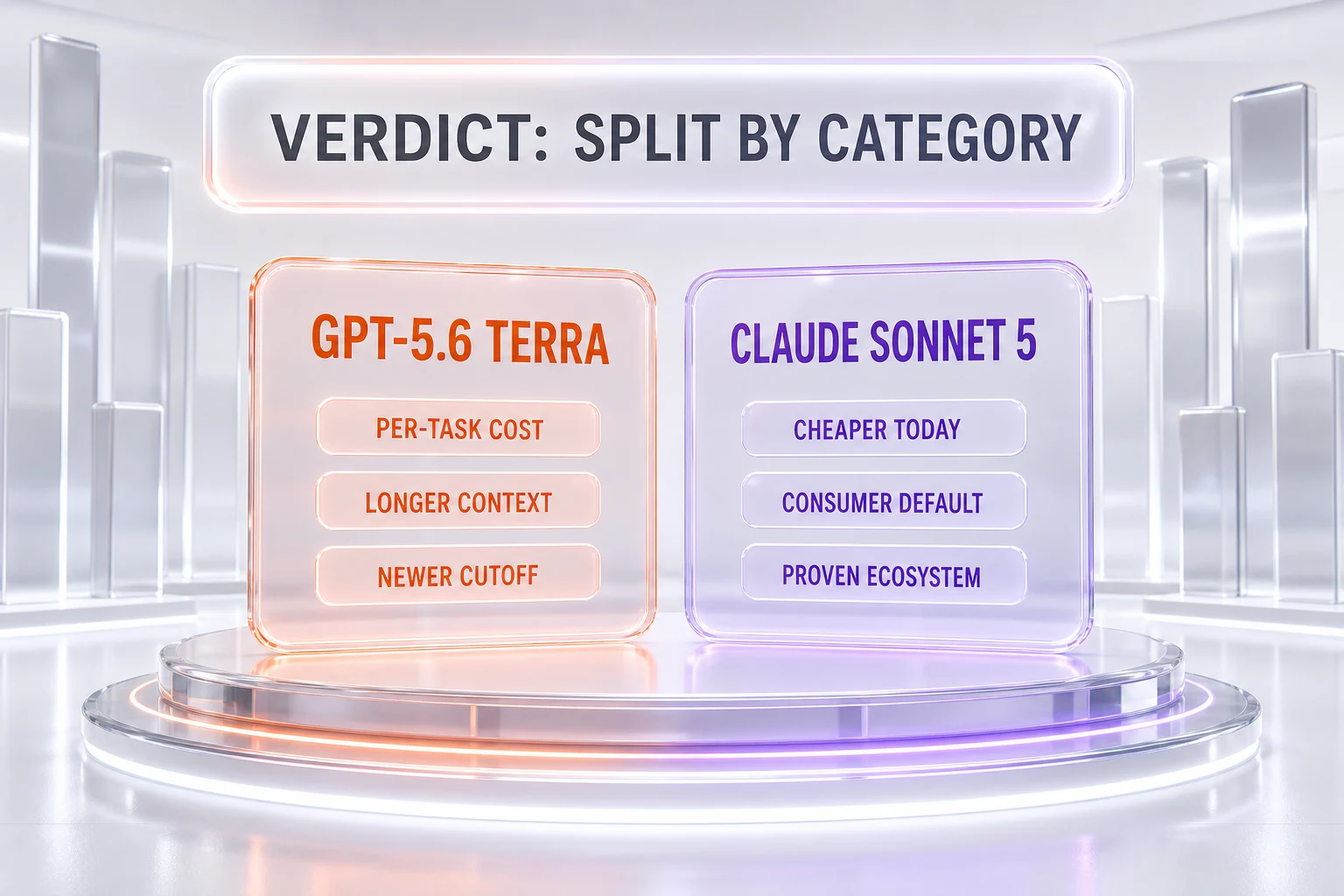
This is a split verdict: GPT-5.6 Terra edges the independent capability and coding indices and owns the per-task economics, while Claude Sonnet 5 undercuts it on price today and reaches far more users as the default model on Claude.ai — and the pricing story flips on a date. Both are balanced, mid-tier models built for the same job: high-volume production workloads where the trade-off between capability and cost is the whole point. Both are reachable through our own OpenAI and Anthropic API keys, so we have run them side-by-side on the same tasks — Sonnet 5 since its June 30 general availability and Terra since July 9, which makes our Terra notes first impressions rather than a settled verdict. We lean on attributed third-party numbers from Artificial Analysis wherever our own time is too short, and every figure below carries its source. Here is the short version.
- Best on the independent intelligence aggregate: GPT-5.6 Terra, narrowly. Artificial Analysis scores it 55 on the Intelligence Index against Claude Sonnet 5's 53 — a two-point gap that sits inside benchmark noise.
- Only one of the two is on the independent coding index: GPT-5.6 Terra is charted on the Artificial Analysis Coding Agent Index v1.3 at 55.79, through the Codex harness at high reasoning effort, and at 62.28 at max; Claude Sonnet 5 has no entry there (checked August 2, 2026). That is an asymmetry in what has been measured, not a demonstration that Terra codes better.
- Best for cost per task: GPT-5.6 Terra. Artificial Analysis measures it at about $0.55 to run its Intelligence Index and publishes no equivalent per-task figure for Sonnet 5 in our sources.
- Best for price: Claude Sonnet 5, on output. Its $10 per million output undercuts Terra's $12, while its $2 input is level with Terra's $2.00.
- Best for long context: GPT-5.6 Terra, marginally. Its 1,050,000-token window is five percent larger than Sonnet 5's 1,000,000 tokens.
- Best for consumer reach: Claude Sonnet 5. It is the default model on the free and Pro plans of Claude.ai; Terra is limited to the API, Codex, and ChatGPT for Work.
- Best for a measured output-speed figure: Claude Sonnet 5, where measured. Artificial Analysis lists it at 79 output tokens per second and publishes no Terra figure in our sources.
- Best for the newest knowledge: GPT-5.6 Terra. Its February 16, 2026 cutoff is about a month ahead of Sonnet 5's January 2026.
The honest caveats up front: Terra is days old at the time of writing, so we treat our hands-on notes on it as first impressions. Neither model has been submitted to the independently run SWE-bench Verified suite, so there is no third-party verified-coding number for either, and we will not paper over that gap with self-reported figures. One fact flattens the price advantage that looks decisive at first: Anthropic states Sonnet 5's newer tokenizer counts roughly 30 percent more tokens for the same text, which narrows the effective-cost gap. We only declare a winner where both models were measured on the same independent benchmark, and we keep self-reported and third-party numbers strictly apart.
GPT-5.6 Terra vs Claude Sonnet 5 — Overview
What Is GPT-5.6 Terra?
GPT-5.6 Terra is the balanced capability tier of OpenAI's GPT-5.6 generation, generally available July 9, 2026. In OpenAI's naming scheme the number is the generation and the names — Sol, Terra, and Luna — are durable capability tiers rather than model sizes; Terra is the middle tier, aimed at high-volume business work such as customer support and document processing, and OpenAI positions it as GPT-5.5-competitive at two times lower cost, per OpenAI's announcement. Its predecessor GPT-5.5 remains active, and our GPT-5.6 rollout explainer covers how the generation reached the public. Per OpenAI's model documentation, Terra runs a 1,050,000-token context window with up to 128,000 output tokens and a February 16, 2026 knowledge cutoff, handles text and image inputs to text output, and exposes a reasoning-effort scale from low through xhigh up to the new max level. It adds Programmatic Tool Calling, where the model writes and executes JavaScript in an isolated, ephemeral runtime to orchestrate its own tools. API pricing is $2.00 per million input tokens and $12 per million output tokens, with cached input at $0.20 per million, and it is available through the API, Codex, and ChatGPT for Work.
What Is Claude Sonnet 5?
Claude Sonnet 5 is Anthropic's midsize model, generally available June 30, 2026, and positioned as the best combination of speed and intelligence in the Claude family — the workhorse tier below the Claude Opus 4.8 flagship. Anthropic markets it as its most agentic midsize model, reporting near-Opus results at a fraction of the price, and our Sonnet 5 launch analysis covers why it matters that Anthropic made it the default model. Per Anthropic's model documentation, Sonnet 5 runs a 1,000,000-token context window with up to 128,000 output tokens — 300,000 through a Batch API beta header — a January 2026 knowledge cutoff, adaptive thinking with an effort dial that defaults to high, and text and image inputs to text output. API pricing is $2 per million input tokens and $10 per million output, which we confirmed on Anthropic's pricing documentation. Anthropic also notes Sonnet 5 uses a newer tokenizer that produces roughly 30 percent more tokens for the same text. Critically, it is the default model on the free and Pro plans of Claude.ai and is available in Claude Code at model id claude-sonnet-5.
How We Compared Them — and What We Did Not Do
Method transparency matters here, because Terra is days old at the time of writing and the pricing comparison hinges on a date and a tokenizer detail that a casual read of the rate cards misses. Here is exactly what we did and did not do.
- Pricing: both rate cards are vendor-verified. Terra's $2.00 input and $12 output per million tokens is confirmed against OpenAI's pricing documentation; Sonnet 5's $2 and $10 is confirmed against Anthropic's pricing documentation. No relayed figures. Our AI model pricing explainer breaks down how input, output, and cached-token rates translate into real bills.
- Independent benchmarks: we lean on Artificial Analysis for the Intelligence Index, cost per task, and output speed. We only declare a benchmark winner where both models were measured on the same suite. Where a model is absent — Claude Sonnet 5 from the Coding Agent Index, and both models from SWE-bench Verified — we say so and do not substitute a self-reported number.
- Self-reported figures: OpenAI's Terminal-Bench 2.1 number for Terra and Anthropic's SWE-bench Pro and OSWorld-Verified numbers for Sonnet 5 are labeled as vendor-reported, measured on different suites, and not treated as head-to-head evidence. Our agentic coding model explainer covers why coding-agent scores and chatbot scores measure different things.
- Hands-on: we have run both models through our own OpenAI and Anthropic API keys — Sonnet 5 since June 30 and Terra since July 9. That gives us more time with Sonnet 5 and only first impressions of Terra, and we scope every observation accordingly.
- Disclosure: we have no affiliate relationship with OpenAI or Anthropic. There are no sponsored links on this page. We flag the tokenizer difference prominently because it changes the cost conclusion, not because it favors one vendor.
Features and Benchmarks Comparison
The table below lists every dimension we could verify or attribute. Read the Winner column carefully: it distinguishes vendor-verified pricing, independent benchmarks, and self-reported figures, and it flags where a result is one-sided ("where measured"), genuinely tied, or date-dependent. Every benchmark figure carries its source. Sources for the independent scores are Artificial Analysis and vals.ai.
| Feature | GPT-5.6 Terra | Claude Sonnet 5 | Winner |
|---|---|---|---|
| API input price (per million tokens) | $2.00 (verified) | $2.00 (verified) | Tie |
| API output price (per million tokens) | $12.00 (verified) | $10.00 (verified) | Claude Sonnet 5 |
| Cached input price (per million tokens) | $0.20 (verified) | $0.20 (verified) | Tie |
| Batch output price (per million tokens) | $6.00 (verified) | $5.00 (verified) | Claude Sonnet 5 |
| Cost per task, AA Intelligence Index (independent) | ~$0.55 (Artificial Analysis) | Not published as a per-task figure in our sources | GPT-5.6 Terra |
| AA Intelligence Index (independent) | 55 | 53 | GPT-5.6 Terra |
| AA Coding Agent Index v1.3 (independent, read August 2, 2026) | 55.79 (Codex harness, high effort); 62.28 at max | Not charted | GPT-5.6 Terra — on availability of evidence, not a measured margin |
| Output speed (independent tokens per second) | Not published for Terra in our sources | 79.0 (Artificial Analysis) | Where measured (Sonnet 5 only) |
| SWE-bench Verified (vals.ai, independent) | Not submitted | Not listed | Neither submitted |
| Declared context window | 1,050,000 tokens | 1,000,000 tokens | GPT-5.6 Terra (5% larger) |
| Max output tokens | 128,000 tokens | 128,000 tokens (up to 300,000 via Batch beta) | Claude Sonnet 5 (higher ceiling) |
| Knowledge cutoff | February 16, 2026 | January 2026 | GPT-5.6 Terra |
| Tokenizer efficiency (per vendor docs) | OpenAI tokenizer | Newer tokenizer, ~30% more tokens for the same text | GPT-5.6 Terra (effective cost) |
| Reasoning control | Low to xhigh, plus new max level | Adaptive thinking, effort dial (defaults to high) | Tie |
| Code execution and tool use | Programmatic Tool Calling: model-written JS in an isolated V8 runtime (ZDR-compatible) | Code execution tool (container-based) plus function calling and structured outputs | Tie |
| Consumer availability | API, Codex, and ChatGPT for Work | Default model on free and Pro Claude.ai, plus API and Claude Code | Claude Sonnet 5 |
| Vendor coding-benchmark headline | Terminal-Bench 2.1 87.4% (self-reported) | SWE-bench Pro 63.2%, OSWorld-Verified 81.2% (self-reported) | Not comparable (self-reported) |
| Input and output modalities | Text and image in, text out | Text and image in, text out | Tie |
Synthesis: the independent capability signals tilt slightly to Terra — it takes the Intelligence Index by two points (55 to 53), it is the only one of the two with a published per-task cost (about $0.55), it carries a marginally larger context window and a newer cutoff, and its more efficient tokenizer lowers effective cost. But three of those are one-sided data gaps rather than head-to-head losses for Sonnet 5, and the two-point Intelligence gap is inside noise. The price signal tilts to Sonnet 5 — its rate undercuts Terra on output and matches it on input — and it owns consumer reach as the default model on Claude.ai plus the only published output-speed figure. Neither model appears on SWE-bench Verified, so verified coding is a shared blank. This is not a model that wins everything against a model that wins nothing; it is a slight independent-benchmark edge and per-task economics against a real price-and-reach advantage that partly expires in September.
Pricing — GPT-5.6 Terra vs Claude Sonnet 5 in 2026
Pricing is the sharpest contrast in this comparison, and it is where the naive read and the measured read diverge most. On today's rate card, Claude Sonnet 5 is cheaper on output and level on input. But a date and a tokenizer detail complicate that headline, and the one independent per-task measurement points the other way. Both rate cards below come straight from OpenAI's and Anthropic's own documentation, and our pricing explainer covers how these translate into real spend.
GPT-5.6 Terra Pricing
| Tier | Input (per million tokens) | Output (per million tokens) | Notes |
|---|---|---|---|
| Standard API | $2.00 | $12.00 | Verified on OpenAI's pricing documentation |
| Cached input | $0.20 | — | 90 percent discount, verified |
| Batch mode | $1.00 | $6.00 | Half price, verified |
| Priority (2x) | $4.00 | $24.00 | Higher-availability tier, verified |
Context pricing is tiered: prompts above 272,000 input tokens bill at twice the input rate and one and a half times the output rate, applied to the full request rather than to the excess, so a 900,000-token request bills at $4.00 and $18.00 per million tokens. Below that threshold the rates are stable, and there is no introductory promotion to expire.
Claude Sonnet 5 Pricing
| Tier | Input (per million tokens) | Output (per million tokens) | Notes |
|---|---|---|---|
| Standard | $2.00 | $10.00 | Verified on Anthropic's pricing documentation |
| Cached input (read) | $0.20 | — | Verified |
| Batch mode | $1.00 | $5.00 | Half price, verified |
Pricing verdict: Claude Sonnet 5 wins the rate card, and Anthropic's cancellation of the September 1, 2026 increase on August 10, 2026 makes that permanent. Sonnet 5's $2 input is level with Terra's $2.00 and its $10 output undercuts Terra's $12 by about 17 percent. On a representative call of 50,000 input tokens and 5,000 output tokens, Sonnet 5 costs about $0.15 ($2 times 0.05 input plus $10 times 0.005 output) versus about $0.16 for Terra ($2.00 times 0.05 plus $12 times 0.005) — roughly 6 percent cheaper. Two things pull the effective comparison back toward Terra. First, Artificial Analysis measures Terra at about $0.55 per task to run its Intelligence Index and publishes no equivalent per-task figure for Sonnet 5 in our sources, because per-task cost depends on how many tokens each model burns to finish. Second, Anthropic states Sonnet 5's newer tokenizer counts roughly 30 percent more tokens for the same text, so an identical document is billed more tokens on Sonnet 5; as an illustration, that inflation can push the effective input cost above Terra's on a same-text basis. The lesson is not that one rate card is wrong — both are real — but that the sticker price decides your bill only if your token counts match. Test on your own prompts before assuming the cheaper card is the cheaper model.
Hands-On Notes — What Side-by-Side Testing Showed
We owe you precision about what this section is and is not. We have run both models through our own OpenAI and Anthropic API keys on the same tasks, but the windows are uneven: Claude Sonnet 5 has been generally available since June 30, 2026, and GPT-5.6 Terra only since July 9, so our Terra observations are first impressions rather than a settled read. Take everything below as scoped, and weight the attributed benchmarks above it.
Where Terra stood out: steady, token-efficient throughput on structured business tasks. On multi-document summarization and support-style question answering — the workloads OpenAI built Terra for — it reached usable answers with fewer tokens than we expected, consistent with its lower measured per-task cost and its more compact tokenizer. Its 1,050,000-token window swallowed large document sets in one pass, and Programmatic Tool Calling let it batch tool operations in executable code rather than one call at a time, which cut round trips on loop-and-filter agent work.
Where Sonnet 5 stood out: agentic tool loops and clean writing. On multi-step tasks that use browsers and terminals, Sonnet 5's tool-error recovery felt mature, matching Anthropic's positioning of it as its most agentic midsize model, and its prose came out tighter with less editing on our drafting tasks. Being the default model on Claude.ai also meant we could sanity-check behavior in the chat interface for free before spending API tokens, which is a practical advantage Terra does not offer at the consumer tier.
What we watched carefully: the price-versus-tokens question. Because Sonnet 5's tokenizer counts more tokens for the same text, our early runs showed its output discount buying less than the rate card implied on identical inputs. We did not run a controlled token-accounting benchmark across a full workload mix, so we present this as an observation that aligns with Anthropic's own documentation rather than a measured result. It is exactly the kind of thing that only shows up when you compare on your real prompts.
What we cannot tell you yet: Terra's behavior over weeks, controlled latency for both under identical conditions, and per-task economics across a representative production mix. We will update this comparison as our side-by-side time accumulates and as more independent harnesses publish results for both models.
Winner per Category
Best on the Independent Intelligence Index: GPT-5.6 Terra, Narrowly
On the Artificial Analysis Intelligence Index, GPT-5.6 Terra scores 55 against Claude Sonnet 5's 53 — a two-point gap on the aggregate independent measure. We call it for Terra because it is the higher number on the same suite, but we flag plainly that a two-point difference sits inside the noise band Artificial Analysis itself cautions against over-reading. For context, the top of that chart is around 59 to 60, so both of these mid-tier models land a handful of points below the frontier, which is exactly what their balanced positioning promises. If your workload is the hardest reasoning you have and you want the model that measures higher on aggregate intelligence, Terra is the pick of these two on the independent evidence — but do not expect a night-and-day difference.
Independent Coding Agent Index: Only GPT-5.6 Terra Is Charted
GPT-5.6 Terra is charted on the Artificial Analysis Coding Agent Index v1.3 at 55.79, through the Codex harness at high reasoning effort, and at 62.28 at max effort; Claude Sonnet 5 has no entry there at all (checked August 2, 2026). So that index gives Terra an independent agentic-coding number Sonnet 5 does not have — an asymmetry of evidence rather than a measured margin between the two. Neither model has been submitted to the independently run SWE-bench Verified suite, so there is no third-party verified-coding number for either; for reference, Claude Opus 4.8 posts 88.6 percent on that suite, the flagship Sonnet 5 is measured against as near-Opus. Each vendor publishes its own coding headline on a different suite — OpenAI reports Terra at 87.4 percent on Terminal-Bench 2.1, Anthropic reports Sonnet 5 at 63.2 percent on SWE-bench Pro and 81.2 percent on OSWorld-Verified — and because the suites differ, those numbers are not comparable. On independent evidence only Terra carries a coding-index result; on verified coding, both are blank, and our agentic coding explainer covers why the suite matters as much as the score.
Best for Price: Claude Sonnet 5
Claude Sonnet 5 holds the cheaper output rate. It costs $2 per million input tokens, level with Terra's $2.00, and $10 per million output against $12 — about 17 percent cheaper on output, both verified on Anthropic's documentation. For high-volume, output-heavy workloads, that is a real saving, and Anthropic made it permanent on August 10, 2026 by cancelling the increase it had scheduled for September 1. The remaining caveat is the tokenizer: Anthropic's newer tokenizer counts roughly 30 percent more tokens for the same text, which erodes the effective discount. Where your work is price-sensitive, Sonnet 5 wins on output; on token-heavy inputs, measure before you assume.
Best for Long Context and Newest Knowledge: GPT-5.6 Terra
Terra carries a 1,050,000-token context window against Sonnet 5's 1,000,000 — five percent larger, a marginal edge rather than an architectural gulf, and one partly offset by Sonnet 5's heavier tokenizer counting more tokens per document. Both cap standard output at 128,000 tokens, though Sonnet 5 can reach 300,000 through a Batch beta header, so the output ceiling actually favors Sonnet 5 for very long generations. Where Terra pulls clearly ahead is knowledge freshness: its February 16, 2026 cutoff is about a month newer than Sonnet 5's January 2026, which matters for questions about recent events, libraries, and APIs. For workloads that lean on the freshest training knowledge and slightly larger raw context, Terra is the pick; for the largest single outputs, Sonnet 5's batch ceiling is the edge.
Best for Consumer Reach and Ecosystem: Claude Sonnet 5
Reach is the category where Sonnet 5 wins on structure, not benchmarks. It is the default model on the free and Pro plans of Claude.ai, which puts it in front of a vast consumer audience at no cost and lets developers sanity-check behavior in the chat interface before spending API tokens. GPT-5.6 Terra, by contrast, is a tier you reach through the API, Codex, and ChatGPT for Work — it is not the model a free ChatGPT user talks to. Sonnet 5 also plugs into the mature Claude Code and Claude API ecosystem, and Artificial Analysis publishes a measured output speed for it (79 tokens per second) where it lists none for Terra in our sources. For teams that value a proven consumer default, free chat access, and a published speed figure, Sonnet 5 is the pick of these two.
Pros and Cons
GPT-5.6 Terra Pros and Cons
What we like about GPT-5.6 Terra
- Higher on the independent intelligence aggregate. Intelligence Index 55 to 53 on Artificial Analysis, plus the only Coding Agent Index v1.3 entry of the two, at 55.79.
- The only published per-task cost. About $0.55 to run the Artificial Analysis Intelligence Index, where Sonnet 5 has no comparable figure in our sources.
- More token-efficient by design. Its tokenizer counts fewer tokens for the same text than Sonnet 5's, lowering effective cost on identical inputs.
- Marginally larger context and newer knowledge. A 1,050,000-token window and a February 16, 2026 cutoff, about a month ahead of Sonnet 5.
- Programmatic Tool Calling. Code-orchestrated tool use in an isolated runtime.
Where GPT-5.6 Terra falls short
- More expensive than Sonnet 5 on output. $12 per million output against Sonnet 5's $10, with input level at $2.
- No consumer-tier presence. It is API-, Codex-, and Work-only, not the model a free ChatGPT user reaches.
- Absent from independent SWE-bench Verified. Not submitted, so it has no third-party verified-coding number.
- No published output-speed figure in our sources. Artificial Analysis lists a tokens-per-second number for Sonnet 5 but not for Terra.
- Days old at the time of writing. Our hands-on window on Terra is short, so its production behavior over weeks is unproven.
Claude Sonnet 5 Pros and Cons
What we like about Claude Sonnet 5
- Cheaper on output. $10 output per million undercuts Terra's $12, with input level at $2, verified on Anthropic's docs.
- The consumer default on Claude.ai. Free and Pro users get it by default, and developers can test it in chat before spending API tokens.
- A published independent output speed. 79 tokens per second on Artificial Analysis, where Terra has no figure in our sources.
- Higher output ceiling. Up to 300,000 output tokens through a Batch beta header, against Terra's 128,000.
- Mature agentic tooling. Strong tool-error recovery and a proven Claude Code and API ecosystem, positioned as Anthropic's most agentic midsize model.
Where Claude Sonnet 5 falls short
- Behind Terra on the independent indices that cover it. Intelligence Index 53 to 55, and no entry at all on the Coding Agent Index v1.3, where Terra is charted at 55.79.
- No published per-task cost. Artificial Analysis lists a total run cost but no per-task figure for Sonnet 5 in our sources, where Terra has about $0.55.
- Heavier tokenizer. Anthropic notes roughly 30 percent more tokens for the same text, which erodes the per-token discount.
- Absent from independent SWE-bench Verified. Not listed, so it too has no third-party verified-coding number.
When to Pick GPT-5.6 Terra vs Claude Sonnet 5
Pick GPT-5.6 Terra if...
- You want the higher independent capability of these two — a 55 Intelligence Index against 53, per Artificial Analysis.
- Per-task economics matter more than the sticker rate, where Terra measures about $0.55 on the AA Intelligence Index run and Sonnet 5 has no comparable figure.
- Your workloads will run past August 2026 or lean on token-heavy inputs, where Terra's stable price and more compact tokenizer win on effective cost.
- You need the newest training knowledge — a February 16, 2026 cutoff, about a month ahead of Sonnet 5.
- You already build on the OpenAI API, Codex, or ChatGPT for Work and want code-orchestrated tool use via Programmatic Tool Calling.
Pick Claude Sonnet 5 if...
- Price is the deciding factor — its $10 output per million undercuts Terra's $12, with input level at $2.
- Consumer reach matters — it is the default model on the free and Pro plans of Claude.ai, where a free ChatGPT user cannot reach Terra.
- You want a proven, mature agentic ecosystem in Claude Code and the Claude API, with strong tool-error recovery.
- You need very long single outputs, where Sonnet 5's 300,000-token Batch ceiling beats Terra's 128,000.
- A published independent output-speed figure matters to you (79 tokens per second on Artificial Analysis), or you want to test in chat before paying for API tokens.
Frequently Asked Questions
Is GPT-5.6 Terra better than Claude Sonnet 5 in 2026?
It depends on what you are optimizing for, and we will not fake a single overall winner. On the one independent aggregate both appear on, GPT-5.6 Terra edges ahead: Artificial Analysis scores it 55 on the Intelligence Index against Claude Sonnet 5's 53, a two-point gap that sits inside benchmark noise. Terra also carries the only published per-task cost, about $0.55, and the only entry of the two on the independent Coding Agent Index v1.3, at 55.79. Claude Sonnet 5 answers on price and reach: its $10 per million output undercuts Terra's $12 while its $2 input is level with Terra's $2.00, and it is the default model on the free and Pro plans of Claude.ai. Best for the independent indices, per-task cost, and long context: Terra. Best for the lowest price and consumer reach: Sonnet 5.
How much do GPT-5.6 Terra and Claude Sonnet 5 cost?
GPT-5.6 Terra costs $2.00 per million input tokens and $12 per million output tokens, with cached input at $0.20 per million and Batch mode at half price — we confirmed this on OpenAI's API pricing documentation. Claude Sonnet 5 runs $2 per million input tokens and $10 per million output, with cache reads at $0.20 — we confirmed this on Anthropic's pricing documentation. So Sonnet 5 is cheaper on output and level on input. Both prices are for the API; Sonnet 5 is also free to use as the default model on Claude.ai.
Is Claude Sonnet 5 really cheaper than GPT-5.6 Terra?
On output, yes. Anthropic's pricing of $2 input and $10 output per million tokens is level with Terra's $2.00 on input and undercuts its $12 output. Anthropic announced that rate at launch as introductory pricing through August 31, 2026, then cancelled the scheduled increase to $3 and $15 on August 10, 2026, so it is now the standard price. Two further facts complicate the raw-rate read. First, Anthropic notes its newer tokenizer counts roughly 30 percent more tokens for the same text, so an identical document costs more tokens on Sonnet 5 and the effective-cost gap narrows. Second, Artificial Analysis measures Terra at about $0.55 per task to run its Intelligence Index but publishes no equivalent per-task figure for Sonnet 5 in our sources. Measure on your own prompts before assuming the cheaper rate card is the cheaper model.
Which is better for coding: GPT-5.6 Terra or Claude Sonnet 5?
On independent evidence, Terra has the only comparable number, but the data is thin for both. Artificial Analysis charts GPT-5.6 Terra on its Coding Agent Index v1.3, at 55.79, but has no entry for Claude Sonnet 5, so there is no head-to-head independent coding score. Neither model has been submitted to the independently run SWE-bench Verified suite, so there is no third-party verified-coding figure for either — a genuine data gap we flag rather than fill. Each vendor publishes its own coding headline: OpenAI reports Terra at 87.4 percent on Terminal-Bench 2.1, and Anthropic reports Sonnet 5 at 63.2 percent on SWE-bench Pro and 81.2 percent on OSWorld-Verified, both self-reported and measured on different suites, so they are not comparable. If coding is your priority, benchmark both on your own repositories rather than trusting cross-suite vendor numbers.
Why are GPT-5.6 Terra and Claude Sonnet 5 missing from SWE-bench Verified?
Because neither vendor has submitted these specific models to the independently run SWE-bench Verified suite, so as of this comparison there is no third-party Verified figure for either. On that leaderboard, Claude Fable 5 sits at 95 percent and Claude Opus 4.8 at 88.6 percent, but GPT-5.6 Terra is absent and Claude Sonnet 5 is not listed. We flag the gap rather than substitute a self-reported number. There is no independent coding signal that covers both models: Artificial Analysis charts Terra on its Coding Agent Index v1.3, at 55.79, but not Sonnet 5. Both vendors instead publish their own coding numbers on different suites — Terra on Terminal-Bench 2.1, Sonnet 5 on SWE-bench Pro and OSWorld-Verified — which we label as self-reported and do not treat as head-to-head.
Which has the larger context window: GPT-5.6 Terra or Claude Sonnet 5?
GPT-5.6 Terra, marginally. OpenAI's model documentation lists Terra at a 1,050,000-token context window with a February 16, 2026 knowledge cutoff, while Anthropic's documentation lists Claude Sonnet 5 at 1,000,000 tokens with a January 2026 cutoff. That is a five-percent difference in raw tokens rather than the two-to-one gaps seen in some matchups, so for most workloads it will not be the deciding factor. There is a subtlety worth knowing: Anthropic notes Sonnet 5's newer tokenizer produces roughly 30 percent more tokens for the same text, so a given document consumes more of Sonnet 5's window than of Terra's. Both models take text and image inputs and return text, and both cap output at 128,000 tokens, though Sonnet 5 can reach 300,000 output tokens through a Batch API beta header.
What is GPT-5.6 Terra, and how does it fit OpenAI's lineup?
GPT-5.6 Terra is the balanced capability tier of OpenAI's GPT-5.6 generation, generally available July 9, 2026. In OpenAI's naming scheme the number is the generation and the names — Sol, Terra, and Luna — are durable capability tiers rather than model sizes. Terra sits in the middle: OpenAI positions it as a balanced everyday model for high-volume business work such as customer support and document processing, and describes it as GPT-5.5-competitive at two times lower cost. Above it, Sol targets the hardest problems; below it, Luna is the fastest and cheapest. Terra runs a 1,050,000-token context window with up to 128,000 output tokens, a February 16, 2026 knowledge cutoff, text and image inputs, and a reasoning-effort scale from low through xhigh up to the new max level. It is available through the API, Codex, and ChatGPT for Work, priced at $2.00 per million input tokens and $12 per million output.
What is Claude Sonnet 5, and how does it fit Anthropic's lineup?
Claude Sonnet 5 is Anthropic's midsize model, generally available June 30, 2026, and positioned as the best combination of speed and intelligence in the Claude family. It sits below Claude Opus 4.8, the flagship for complex agentic coding, and above Claude Haiku 4.5, the fastest tier. Anthropic markets Sonnet 5 as its most agentic midsize model and reports near-Opus results at a fraction of the price, including a self-reported 63.2 percent on SWE-bench Pro and 81.2 percent on OSWorld-Verified. It runs a 1,000,000-token context window with up to 128,000 output tokens (300,000 via a Batch beta), a January 2026 knowledge cutoff, adaptive thinking with an effort dial that defaults to high, and text and image inputs. Critically, it is the default model on the free and Pro plans of Claude.ai, and is available in Claude Code and via the API at model id claude-sonnet-5.
Does the tokenizer difference matter when comparing prices?
Yes, more than most rate-card comparisons admit. Anthropic's own documentation states that Claude Sonnet 5's newer tokenizer produces approximately 30 percent more tokens for the same text than earlier models, with the exact figure depending on content. Because API billing is per token, that means an identical prompt and response are counted as more tokens on Sonnet 5, so its lower per-token rate buys less than the sticker gap suggests. As an illustration only: Sonnet 5's $2 input is level with Terra's $2.00 on paper, but if the same text is roughly 30 percent more tokens, the effective per-document input cost lands above Terra's. Anthropic frames the tokenizer as contributing to improved performance, so it is a trade-off rather than a pure penalty. The practical takeaway is to compare cost on your own real workloads, not on the rate card alone.
Which model is faster: GPT-5.6 Terra or Claude Sonnet 5?
We cannot declare a numeric speed winner, because our sources publish an independent throughput figure for only one of the two. Artificial Analysis measures Claude Sonnet 5 at 79 output tokens per second; it does not publish an equivalent figure for GPT-5.6 Terra in our sources, only for the flagship Sol tier at about 74.5 tokens per second. OpenAI positions Terra as GPT-5.5-competitive and efficient, and Anthropic positions Sonnet 5 as fast, but positioning is not a benchmark. So on independent evidence, Sonnet 5 has a measured output speed and Terra does not in our sources — which is a data point in Sonnet 5's favor, not a proven head-to-head win. If latency is your deciding factor, benchmark both on your own traffic before committing, because tokens per second on a leaderboard rarely matches your production mix.
Which model should a business choose for high-volume production work?
That is exactly the segment both models target, and the honest answer is to split by priority. Pick GPT-5.6 Terra if you want the higher independent Intelligence Index (55 to 53), the lowest measured per-task cost (about $0.55 on the Artificial Analysis Intelligence Index), the marginally larger context, or the newer knowledge cutoff. Pick Claude Sonnet 5 if the lowest price matters most — its $10 output undercuts Terra's $12 — or if you want consumer reach as the default model on Claude.ai, or a published output-speed figure. For most teams the rational move is to prototype the same production prompts on both, measure real cost and quality on your data, and route by workload rather than picking one for everything.
What are the alternatives to GPT-5.6 Terra and Claude Sonnet 5?
Several sit nearby in the balanced and flagship tiers. GPT-5.5, OpenAI's prior flagship, remains active and is the model Terra is benchmarked against as competitive at half the cost. Claude Opus 4.8, at $5 per million input and $25 per million output tokens, posts 88.6 percent on the independent SWE-bench Verified suite and is the model Sonnet 5 is measured against as near-Opus. Gemini 3 Flash is Google's fast, low-cost tier for high-volume work. If you want the adjacent matchups in detail, our Claude Sonnet 5 versus GPT-5.5 comparison covers the previous OpenAI-versus-Anthropic mid-tier round, and our Claude Sonnet 5 versus Claude Opus 4.8 comparison covers the workhorse-versus-flagship trade-off inside Anthropic's own lineup.
Final Verdict — A True Split Between Two Balanced Tiers
After running both side-by-side, verifying pricing on both vendors' own documentation, and holding every capability claim to independent benchmarks, our verdict is a genuine split — not a diplomatic one. GPT-5.6 Terra is the independent-benchmark and per-task-cost leader of the pair: it scores 55 to Claude Sonnet 5's 53 on the Artificial Analysis Intelligence Index, carries the only published per-task cost (about $0.55), a marginally larger 1,050,000-token context, a newer February 16, 2026 cutoff, and a more compact tokenizer that lowers effective cost. Claude Sonnet 5 is the price-and-reach leader: its $10 output per million tokens undercuts Terra and its $2 input is level with Terra, it is the default model on the free and Pro plans of Claude.ai, it carries the only published output-speed figure at 79 tokens per second, and it offers a higher 300,000-token output ceiling. We disclose plainly that we have no affiliate relationship with either vendor and tested both through our own API keys.
We did not crown a single overall winner because the evidence does not support one honestly: Terra's benchmark edge is real but partly rests on one-sided data gaps and a two-point Intelligence margin inside the noise, while Sonnet 5's price lead is real but confined to output and narrowed by its heavier tokenizer. If your work is capability-benchmark-sensitive, long-context, or cost-measured per task — pick GPT-5.6 Terra. If your work is price-sensitive, consumer-facing, or output-heavy — pick Claude Sonnet 5. For many teams the rational move is to prototype the same production prompts on both, measure real cost and quality on your own data, and route by workload rather than picking one for everything. For the tiers and neighbors around this matchup, see our GPT-5.5 review, our Claude Sonnet 5 review, our Claude Opus 4.8 review, our Claude Sonnet 5 vs GPT-5.5 comparison, and our Claude Sonnet 5 vs Claude Opus 4.8 comparison.
Sources
Every figure in this comparison is attributed to a primary or independent source. Pricing and specifications come from the vendors' own documentation; capability scores come from independent third parties; self-reported figures are labeled as such throughout.
- OpenAI — GPT-5.6 announcement and tier positioning
- OpenAI — GPT-5.6 Terra model documentation and specifications
- OpenAI — GPT-5.6 API pricing
- Anthropic — Claude Sonnet 5 model documentation and specifications
- Anthropic — Claude Sonnet 5 API pricing
- Artificial Analysis — Intelligence Index, cost per task, and output speed
- Artificial Analysis — Coding Agent Index v1.3 leaderboard (neither model charted)
- vals.ai — SWE-bench Verified independent leaderboard
Last compared: July 2026. GPT-5.6 Terra reached general availability on July 9, 2026, and Claude Sonnet 5 on June 30, 2026. Claude Sonnet 5's $2 and $10, announced at launch as introductory pricing through August 31, 2026, became the standard price on August 10, 2026 when Anthropic cancelled the scheduled increase. Both models are recent, and we will revise this comparison as independent benchmark coverage matures.
Our Verdict
A split verdict between two balanced mid-tier models built for the same job — high-volume production work at a good capability-to-cost ratio — and we will not fake a single overall winner. On the one independent aggregate both appear on, GPT-5.6 Terra edges ahead: Artificial Analysis scores it 55 on the Intelligence Index against Claude Sonnet 5's 53, a two-point gap that sits inside benchmark noise. Neither model is charted on the independent Coding Agent Index v1.3. Terra carries the only published per-task cost figure (about $0.55 to run the Intelligence Index), a marginally larger 1,050,000-token context against Sonnet 5's 1,000,000, and a newer February 16, 2026 knowledge cutoff versus January 2026. Sonnet 5 answers on price and reach: its rate of $2 per million input tokens and $10 per million output matches Terra's $2.00 input and undercuts its $12 output, it is the default model on the free and Pro plans of Claude.ai where Terra is API-, Codex-, and Work-tier only, and Artificial Analysis measures it at 79 output tokens per second where it publishes no Terra figure. One honest caveat levels the price story: Anthropic notes Sonnet 5's newer tokenizer counts roughly 30 percent more tokens for the same text, which narrows the effective-cost gap. Neither model has been submitted to independent SWE-bench Verified. Best for the independent intelligence and coding indices, per-task economics, longest context, and newest knowledge: GPT-5.6 Terra. Best for the lowest price and the widest consumer reach: Claude Sonnet 5. No single overall winner — route capability-benchmark-sensitive and long-context work to Terra, and price-sensitive or consumer-facing work to Sonnet 5, and test both on your own prompts before committing.
Choose GPT-5.6 Terra
OpenAI's balanced GPT-5.6 tier — GPT-5.5-competitive quality at 40 percent of the GPT-5.5 rate, with a 1.05M-token context and the full agentic toolbox.
Try GPT-5.6 Terra →Choose Claude Sonnet 5
Anthropic's most agentic midsize model — near-Opus 4.8 coding and computer use at $2 per million input tokens.
Try Claude Sonnet 5 →Frequently Asked Questions
Is GPT-5.6 Terra better than Claude Sonnet 5?
A split verdict between two balanced mid-tier models built for the same job — high-volume production work at a good capability-to-cost ratio — and we will not fake a single overall winner. On the one independent aggregate both appear on, GPT-5.6 Terra edges ahead: Artificial Analysis scores it 55 on the Intelligence Index against Claude Sonnet 5's 53, a two-point gap that sits inside benchmark noise. Neither model is charted on the independent Coding Agent Index v1.3. Terra carries the only published per-task cost figure (about $0.55 to run the Intelligence Index), a marginally larger 1,050,000-token context against Sonnet 5's 1,000,000, and a newer February 16, 2026 knowledge cutoff versus January 2026. Sonnet 5 answers on price and reach: its rate of $2 per million input tokens and $10 per million output matches Terra's $2.00 input and undercuts its $12 output, it is the default model on the free and Pro plans of Claude.ai where Terra is API-, Codex-, and Work-tier only, and Artificial Analysis measures it at 79 output tokens per second where it publishes no Terra figure. One honest caveat levels the price story: Anthropic notes Sonnet 5's newer tokenizer counts roughly 30 percent more tokens for the same text, which narrows the effective-cost gap. Neither model has been submitted to independent SWE-bench Verified. Best for the independent intelligence and coding indices, per-task economics, longest context, and newest knowledge: GPT-5.6 Terra. Best for the lowest price and the widest consumer reach: Claude Sonnet 5. No single overall winner — route capability-benchmark-sensitive and long-context work to Terra, and price-sensitive or consumer-facing work to Sonnet 5, and test both on your own prompts before committing.
Which is cheaper, GPT-5.6 Terra or Claude Sonnet 5?
GPT-5.6 Terra starts at $2 in / $12 out per M tokens. Claude Sonnet 5 starts at $2 in / $10 out per M tokens (free plan available). Check the pricing comparison section above for a full breakdown.
What are the main differences between GPT-5.6 Terra and Claude Sonnet 5?
The key differences span across 18 features we compared. For API input price (per million tokens), GPT-5.6 Terra offers $2.00 (verified) while Claude Sonnet 5 offers $2.00 (verified). For API output price (per million tokens), GPT-5.6 Terra offers $12.00 (verified) while Claude Sonnet 5 offers $10.00 (verified). For Cached input price (per million tokens), GPT-5.6 Terra offers $0.20 (verified) while Claude Sonnet 5 offers $0.20 (verified). See the full feature comparison table above for all details.